- Analytics
- News and Tools
- Market News
Analytics, News, and Forecasts for CFD Markets: currency news — 01-03-2023.
- EUR/JPY is marching towards 145.50 gradually as chances of more rates from the ECB look solid.
- Along with Germany, the price index in Spain and France has also surprised market participants with an upside release.
- Tokyo’s inflation is seen lower despite expansionary monetary policy from the BoJ.
The EUR/JPY pair is approaching the critical resistance of 145.50 gradually in the early Tokyo session. The cross rebounded firmly from below 144.00 after a perpendicular fall amid a surprise rise in the German Harmonized Index of Consumer Prices (HICP) (Feb) data. The annual preliminary HICP jumped to 9.3% against the consensus of 9.0% and the 9.2% figure released earlier. On a monthly basis, the German HICP has jumped by 1% vs. the expectations of 0.7%.
A surprise rise in German inflation has bolstered the expectations of further rise in interest rates by the European Central Bank (ECB). Along with Germany, the price index in Spain and France has also surprised market participants with an upside release.
It looks like the upbeat labor market is demanding higher wages from firms and then pumping extra funds into the economy. The street is already anticipating that Eurozone might avoid a deep recession, which could be backed by upbeat domestic demand.
Post-release of German inflation, ECB policymaker Joachim Nagel reiterated on Wednesday that further significant rate hikes beyond March may be needed, as reported by Reuters. He further added, "Energy price drop has no essential bearing on ECB's medium-term inflation projections." ECB policymaker expects the "German economy to contract in Q1; gradual pick up from Q2 seen but no major improvement seen."
For further action, Eurozone inflation data will be keenly watched, which is scheduled for Thursday. The preliminary Eurozone HICP (Feb) is seen declining to 8.2% from the former release of 8.6%. Apart from that, the Unemployment Rate (Jan) is expected to decline to 6.5% versus 6.6% released earlier.
The Japanese Yen is likely to dance to the tunes of the Tokyo inflation data, which will release on Friday. Tokyo’s headline Consumer Price Index (CPI) (Feb) is expected to decline to 4.1% from the prior release of 4.4%. The Japanese economy is struggling to accelerate domestic demand despite immense initiatives from Bank of Japan (BoJ) policymakers and the administration.
On Wednesday, Bank of Japan (BoJ) board member Junko Nakagawa also cited the current monetary policy as appropriate as an expansionary policy is highly essential for supporting the economy and fueling wages.
- USD/CHF picks up bids to reverse the previous day’s pullback moves.
- Swiss PMI, Real Retail Sales also came in softer after downbeat Q4 GDP.
- US ISM PMI details, hawkish Fed talks keep inflation fears on the table and propel the US Treasury bond yields.
- Second-tier data, risk catalysts are the key to clear directions.
USD/CHF licks its wounds around 0.9400, following a downbeat start of the March month, as the Swiss currency pair picks up bids during early Thursday. In doing so, the quote justifies downbeat statistics at home, versus firmer details of the US data, as well as the strong Treasury bond yields and hawkish Fed talks, which could recall the US Dollar bulls.
That said, Swiss Real Retail Sales shrank 2.2% YoY in January versus 2.2% expected growth a revised down previous reading of -3.0%. On the same line was the Swiss SVME Purchasing Managers’ Index for February as it marched 48.9 market forecasts versus 49.3 prior. It should be noted that the Swiss Gross Domestic Product (GDP) arrived at 0% in the fourth quarter (Q4) of 2022 vs. an expected growth of 0.3% and 0.2% recorded in the third quarter.
On the other hand, US ISM Manufacturing PMI details renew inflation fears as the headline gauge rose to 47.7 from 47.4 prior, versus the 48.0 expected but the Prices Paid and New Orders marked the highest figures in five and four months respectively.
Not only the data but hawkish Federal Reserve (Fed) talks also challenge the previous day’s US Dollar weakness, as well as the USD/CHF pullback. Minneapolis Federal Reserve (Fed) President Neel Kashkari said, "Wage growth is now too high to be consistent with 2% inflation." The policymaker also added and noted that it is concerning that the Federal Reserve's rate hikes so far have not brought down service inflation.
It’s worth noting, however, that the previously softer US data dump and China-inspired risk-on mood, as well as month-start consolidation, seemed to have teased the USD/CHF bears.
Amid these plays, the US 10-year Treasury bond yields rose to the highest levels since early November 2022 by poking the 4.0% mark whereas the two-year counterpart rallied to the June 2007 levels by piercing the 4.90% mark. The jump in the US Treasury bond yields suggests the market’s fears of inflation and recession, which in turn probed bulls on Wall Street and weigh on S&P 500 Futures of late, suggesting a likely rebound on the US Dollar.
Looking ahead, a light calendar pushes the USD/CHF traders to keep track of the risk catalysts for fresh impulse.
Technical analysis
A 13-day-old bullish channel, currently between 0.9345 and 0.9480, keeps USD/CHF buyers hopeful.
- GBP/USD finds interest around 1.2000 as the USD Index is demonstrating signs of volatility contraction.
- Upbeat forward demand and higher prices paid by producers indicate a rebound in US inflation.
- BoE Bailey reiterated that the UK labor market is extremely tight.
The GBP/USD pair has sensed buying interest after a marginal correction to near 1.2000 in the early Asian session. The Cable is still inside the woods amid a mixed market mood. The US Dollar Index (DXY) is looking to sustain its auction above the 104.00 support after a recovery move from below 103.70 as the United States ISM Manufacturing PMI gamut conveyed a rebound in the inflationary pressures.
S&P500 futures witnessed pressure as investors are still struggling to ignore fears of more rates from the Federal Reserve (Fed). Hawkish commentaries delivered by Fed policymakers fueled US Treasury yields. The return offered on 10-year US government bonds jumped to 4%.
Minneapolis Fed President Neel Kashkari reiterated on Wednesday that inflation in the US is still very high and that their job is to bring it down, as reported by Reuters. He further added that he is open-minded on a 25 basis points (bps) hike versus a 50 bps increase.
Considering the whole US ISM Manufacturing PMI (Feb) gamut, it would be appropriate to consider a rebound in the US Consumer Price Index (CPI) as forward demand and prices paid by producers have skyrocketed.
The ISM Manufacturing New Orders Index accelerated to 47.0 from the expectations of 43.7 and the former release of 42.5. And the Manufacturing Price Paid climbed to 51.3 vs. the consensus of 45.0 and the former release of 44.5. Higher prices paid by manufacturers will be added to the goods offered by them and will amp up the inflationary pressures.
Ambiguous commentary from Bank of England (BoE) Governor Andrew Bailey has pushed the Pound Sterling inside the woods. An absence of clear guidance on interest rates kept investors on the sidelines. BoE Bailey said that some further increase in bank rates may turn out to be appropriate but added that nothing is decided, as reported by Reuters. However, he reiterated that the United Kingdom's labor market is extremely tight.
- NZD/USD seesaws in a choppy range after confirming a bullish chart formation and refreshing two-week high.
- Convergence of 21-day EMA, 200-day EMA challenges Kiwi pair buyers.
- Looming bull cross on MACD defends upside bias.
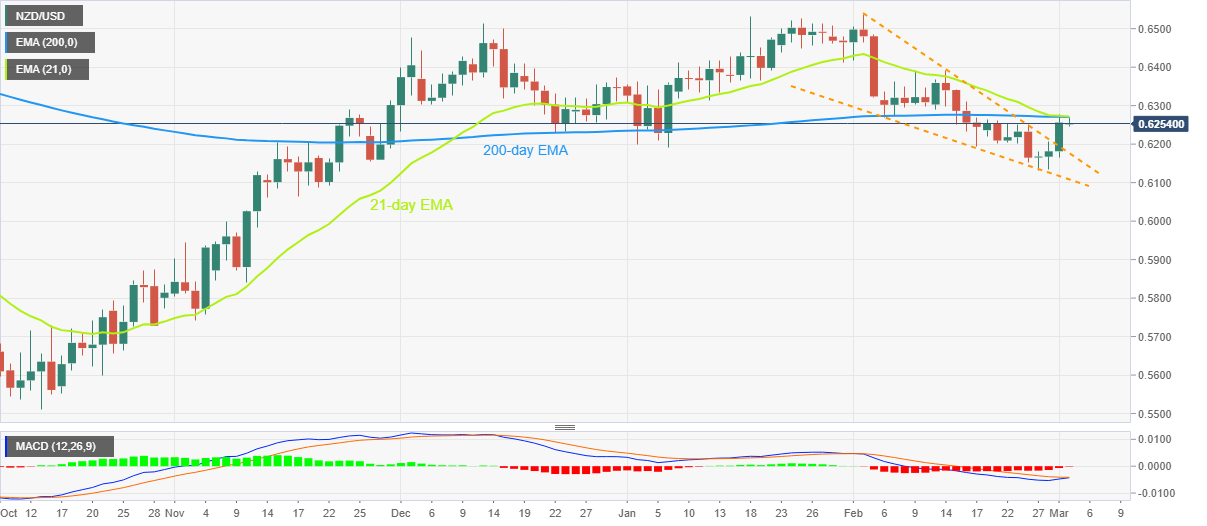
NZD/USD bulls struggle to justify the falling wedge breakout as the key moving averages challenge upside near the mid-0.6200s during early Thursday. However, the impending bull cross on the MACD indicator keeps the Kiwi pair buyers hopeful, especially after the confirmation of the bullish chart pattern the previous day.
The upside break of a one-month-old falling wedge bullish formation failed to cross the convergence of the 200-day Exponential Moving Average (EMA) and the 21-day EMA, around 0.6270 by the press time.
Should the quote crosses the immediate hurdle, as expected due to the MACD conditions and falling wedge confirmation, the NZD/USD can quickly poke the mid-February swing high surrounding 0.6390.
In a case where the Kiwi buyers keep the reins past 0.6390, as well as cross the 0.6400 threshold, the highs marked in the last December and the previous month, respectively near 0.6515 and 0.6540, could act as buffers during the theoretical run-up targeting 0.6600.
Meanwhile, pullback moves remain less important until the quote stays beyond the aforementioned wedge’s top line, close to 0.6175 at the latest.
It’s worth noting that January’s low of 0.6190 acts as the immediate support for the NZD/USD bears to watch during the fresh fall.
That said, lows marked during November 14 and 17 around 0.6060 appear the key for the pair sellers to track as a break of which won’t hesitate to challenge the 0.6000 psychological magnet.
NZD/USD: Daily chart
Trend: Further upside expected
- AUD/USD struggles to defend the previous day’s rebound from a two-month low, grinds higher of late.
- Downbeat Aussie data contrasts with China-inspired optimism to challenge bulls.
- Softer US Dollar allowed Aussie buyers to begin March on a positive note.
- Strong US Treasury bond yields, mixed US data appears a challenge for the bulls.
AUD/USD remains sidelined around 0.6755 as traders await more signals to back the latest rebound from a two-month low during early Thursday morning in Asia. In doing so, the Aussie pair struggles to justify the softer US Dollar and China-linked market optimism amid strong US Treasury bond yields and mostly upbeat US data.
That said, the Aussie pair managed to reverse the Aussie GDP and inflation-induced pessimism after strong China activity data for February. The risk barometer pair also benefited from China Finance Minister Liu He’s comments as he showed readiness to bolster the nation’s fiscal spending. The policymaker also mentioned that the foundation of China's economic recovery is still not stable and challenges the AUD/USD bulls afterward.
Elsewhere, US ISM Manufacturing PMI details renew inflation fears as the headline gauge rose to 47.7 from 47.4 prior, versus the 48.0 expected but the Prices Paid and New Orders marked the highest figures in five and four months respectively.
Ahead of the data, Minneapolis Federal Reserve (Fed) President Neel Kashkari said, "Wage growth is now too high to be consistent with 2% inflation." The policymaker also added and noted that it is concerning that the Federal Reserve's rate hikes so far have not brought down service inflation.
It should be observed the US 10-year Treasury bond yields rose to the highest levels since early November 2022 by poking the 4.0% mark whereas the two-year counterpart rallied to the June 2007 levels by piercing the 4.90% mark. The jump in the US Treasury bond yields suggests the market’s fears of inflation and recession, which in turn challenge the risk-barometer AUD/USD pair. That said, Wall Street closed mixed while the S&P 500 Futures struggled for clear directions of late.
Looking forward, Australia’s Building Permits for January may offer immediate direction ahead of the US Weekly Initial Jobless Claims. However, major attention will be on Friday’s US ISM Services PMI amid fears of strong services inflation.
Technical analysis
Unless crossing a convergence of the one-month-old descending resistance line and the 200-DMA, around 0.6795, as well as staying beyond the 0.6800 round figure, the AUD/USD bulls are off the table.
- After printing an inverted hammer on Tuesday, GBP/JPY capped its fall.
- The GBP/JPY would face strong support at the confluence of the 100/200/20-day EMAs.
- GBP/JPY Price Analysis: In the near term, it’s neutral to upward biased.
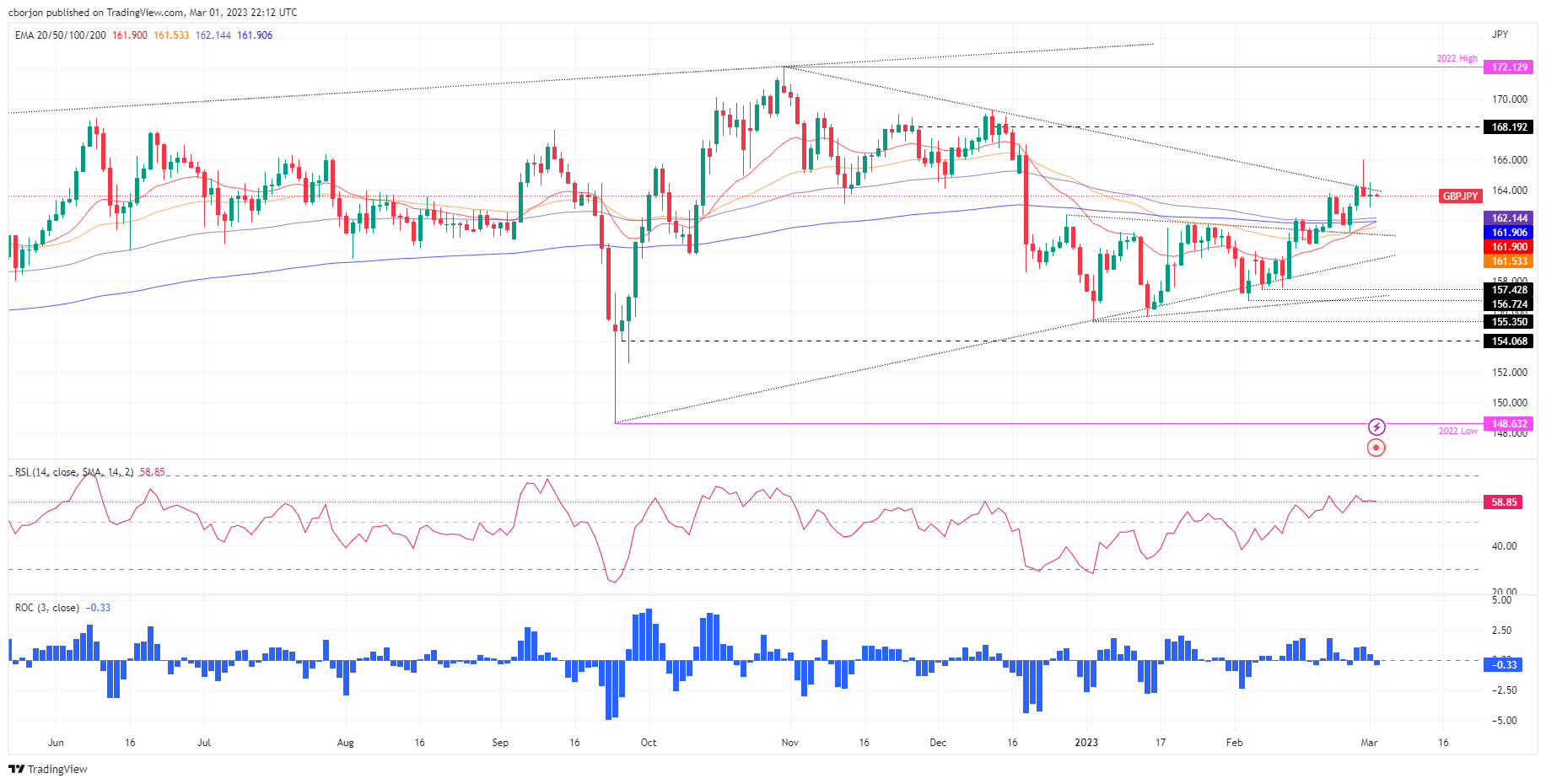
The GBP/JPY finished Wednesday’s session printing a doji, meaning that neither buying/selling pressure dominated the session. Nevertheless, Tuesday’s session formed an inverted hammer, usually a bearish biased candlestick, so the GBP/JPY could extend its losses. At the time of writing, the GBP/JPY exchanges hand at 163.62
GBP/JPY Price Action
On Wednesday, the GBP/JPY traded within a 100 pip range throughout the day, though closed nearby the open. For the third time, the GBP/JPY achieved a daily close below a four-month-old downslope trendline, meaning sellers are leaning into that trendline.
The Relative Strength Index (RSI), albeit in bullish territory, is almost flat, while the Rate of Change (RoC) suggests that buying pressure is waning. Therefore, further downside is expected.
Therefore, if the GBP/JPY currency pair breaks below the daily low of 163.58 from February 28th, it would increase the likelihood of a further drop toward the weekly low of 162.59. If the currency pair falls below that level, it could reach the area where the 100 and 20-day Exponential Moving Averages (EMAs) intersect at approximately 161.89/74.
Alternatively, if the GBP/JPY currency pair rises, the first resistance level would be 164.00. If it surpasses that level, GBP buyers may push the pair towards the next level of resistance at 165.00, followed by a challenge of the year-to-date high at 166.00.
GBP/JPY Daily chart
GBP/JPY Technical levels
- EUR/USD is aiming to reclaim the 1.0700 resistance as the risk-off mood has faded.
- The Fed needs not to be in a hurry to calm down the policy-tightening spell.
- A rebound in German inflation has bolstered the case of 50 bps rate hike continuation.
The EUR/USD pair has turned sideways after failing to recapture the round-level resistance of 1.0700 in the late New York session. The major currency pair is expected to recapture the aforementioned resistance as the risk-off mood has faded after hopes of recovery in China post the release of the Caixin Manufacturing PMI overshadowed the risk of a global recession.
S&P500 settled Wednesday’s session with some losses after Federal Reserve (Fed) policymakers sounded hawkish while delivering guidance on interest rates. The US Dollar Index (DXY) has retreated to near 104.00 after failing to extend recovery above 104.20, portraying mix market mood. Meanwhile, the demand for US government bonds remained extremely weak, which led to a jump in the 10-year US Treasury yields to 4%.
Atlanta Fed President Raphael Bostic expected the central bank to push the terminal rate to the 5.00%-5.25% range as the United States Consumer Price Index (CPI) is extremely sticky. Apart from that, the Fed policymaker expects the central bank to keep the elevated terminal rate stable well into 2024.
Meanwhile, the release of the US ISM Manufacturing PMI gamut claimed that the inflationary pressures have rebounded and the Fed should not be in a hurry to calm down the policy tightening spell. The Manufacturing PMI remained contracted consecutively for the fourth time amid higher rates by the Fed. The economic data landed at 47.7, lower than the consensus of 48.0.
However, the forward demand looks extremely solid as New Orders Index jumped to 47.0 from the expectations of 43.7 and the former release of 42.5.
On the Eurozone front, stronger-than-anticipated German Harmonized Index of Consumer Prices (HICP) cleared that the road towards achieving price stability for the European Central Bank (ECB) is full of troubles. The German HICP climbed to 9.3% from the estimates of 9.0% and the former release of 9.2%. ECB President Christine Lagarde has already announced that the central bank is looking to hike interest rates further by 50 bps in its March monetary policy.
- Gold price probes three-day winning streak with a retreat from one-week high.
- Softer US Dollar, China-inspired optimism favor XAU/USD buyers amid a lack of major United States data/events.
- US ISM Manufacturing PMI details, upbeat Treasury bond yields challenges Gold buyers.
Gold price (XAU/USD) retreat to $1,836, following a three-day rebound from a two-month low, as the metal buyers struggle to gain a major positive catalyst to back the latest run-up, especially amid upbeat United States data and Treasury bond yields. It’s worth noting, however, that the softer US Dollar and China-linked market optimism puts a floor under the XAU/USD price amid a lack of major data/events.
Gold price eases on United States data, yields
Gold price pares recent gains while easing from the short-term key technical hurdle surrounding $1,845 after the United States ISM Manufacturing PMI details renew inflation fears. That said, the headlines gauge rose to 47.7 from 47.4 prior, versus the 48.0 expected. However, the details were quite interesting as Prices Paid and New Orders marked the highest figures in five and four months respectively.
On the other hand, the US 10-year Treasury bond yields rose to the highest levels since early November 2022 by poking the 4.0% mark whereas the two-year counterpart rallied to the June 2007 levels by piercing the 4.90% mark. The just in the US Treasury bond yields suggest the market’s fears of inflation and recession, which in turn underpin the hopes of the US Dollar rebound and the pullback of the XAU/USD.
Amid the upbeat data and strong yields, the Minneapolis Federal Reserve (Fed) President Neel Kashkari reiterated on Wednesday that inflation in the US is still very high and that their job is to bring it down, as reported by Reuters. "Wage growth is now too high to be consistent with 2% inflation," Kashkari added and noted that it is concerning that the Federal Reserve's rate hikes so far have not brought down services inflation.
US Dollar, China challenges XAU/USD bears
Although the Gold buyers seem to fade the momentum due to the latest swing in the US data and the hawkish Federal Reserve talks, not to forget upbeat yields, the XAU/USD sellers are off the table as the US Dollar remains weak and China flashes signs of a rebound.
That said, the US Dollar Index (DXY) began March on a back foot after posting the biggest monthly gain since September 2022, with a daily loss of nearly half a percent while poking the 104.40 level at the latest.
Elsewhere, strong prints of China’s Caixin and NBS Manufacturing PMIs for February join the Non-Manufacturing PMI for the said month to mark an upbeat economic rebound in the world’s biggest industrial player. Following the data, China Finance Minister Liu He showed readiness to bolster the nation’s fiscal spending while also mentioning that the foundation of China's economic recovery is still not stable.
Moving on, the Gold price may witness further consolidation of the recent gains amid a light economic calendar in the United States. However, scheduled readings of the Eurozone inflation data and risk catalysts surrounding China and Russia may keep entertaining the XAU/USD traders.
Gold price technical analysis
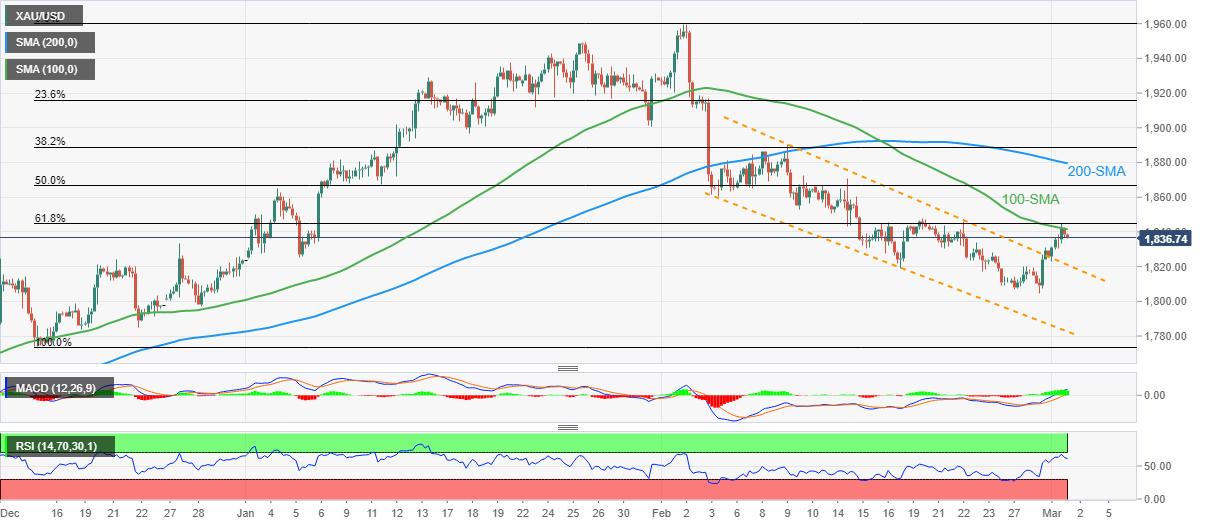
Gold price struggles to justify the previous day’s descending channel breakout as it retreats from the 61.8% Fibonacci retracement level of its up-move from December 2022 to February 2023, as well as the 100-bar Simple Moving Average (SMA).
The pullback move also gained support from the Relative Strength Index (RSI) line, placed at 14, as it hit the overbought territory.
Hence, a pullback towards the previous resistance line of a one-month-old bearish channel’s top line, close to $1,821 appears imminent.
However, bullish signals from the Moving Average Convergence and Divergence (MACD) indicator and multiple supports around $1,800 and $1,780 challenge the XAU/USD past $1,821.
Meanwhile, a convergence of the 100-SMA and the 61.8% Fibonacci retracement, also known as the “Golden Fibonacci ratio”, around $1,842-45, restrict the immediate run-up of the Gold price.
Following that, the 200-SMA hurdle of $1,880 appears the last defense of the Gold bears.
Hence, Gold price is likely to decline further but the downside room seems limited.
Gold price: Four-hour chart
Trend: Pullback expected
- USD/CAD retreats from daily and weekly highs as the Asian session is about to begin.
- Despite dipping, oscillators remain bullish, meaning that further USD/CAD upside is expected.
- USD/CAD Price Analysis: Bullish reclaiming of 1.3600 could trigger a rally towards 1.3800.
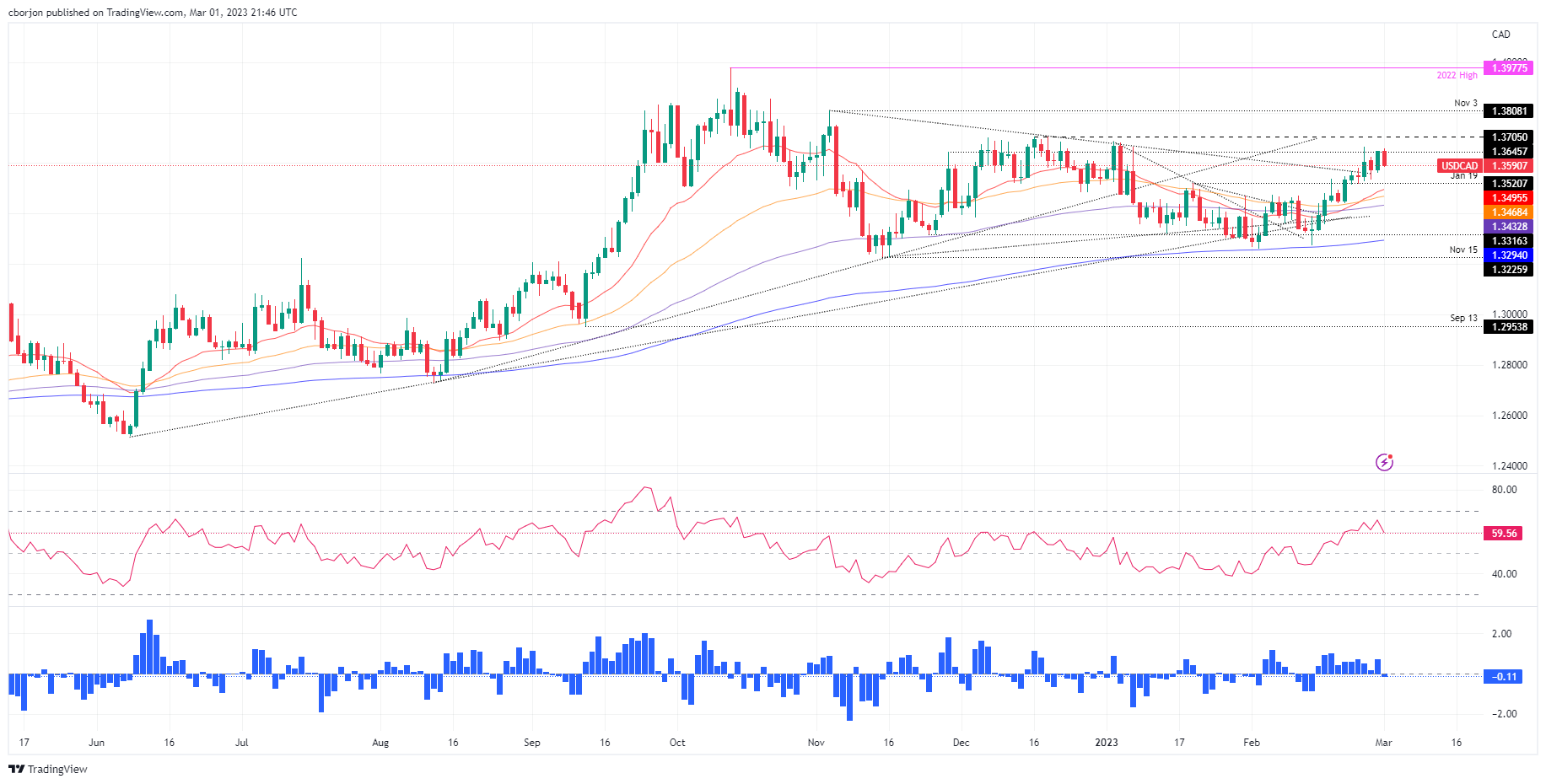
The USD/CAD tumbled from weekly highs around 1.3658, dropping nearly 0.40%, as Wall Street closed with losses, while the greenback remained offered throughout the session. US economic data was mixed, though a subcomponent of the ISM Manufacturing PMI report for February sparked inflation fears in the United States (US). At the time of writing, the USD/CAD exchanges hands at 1.3594.
USD/CAD Price action
The USD/CAD is upward biased despite dipping below 1.3600, in a fall sponsored by overall US Dollar weakness. Technically speaking, the USD/CAD pair’s failure to print a lower low than Tuesday’s 1.3560 kept the uptrend intact, even though the Relative Strength Index (RSI) shifted downwards.
For a bearish continuation, USD/CAD sellers must achieve a daily close below 1.3560. Once that is achieved, the USD/CAD next support would be the January 19 daily high turned support at 1.3520, ahead of testing the 1.3500 psychological level.
On the other hand, and in the most likely scenario, the USD/CAD first resistance would be the 1.3600 psychological level. A breach of the latter will expose the year-to-date (YTD) high at 1.3665, followed by the 1.3700 figure, and then the November 3 daily high at 1.3808.
USD/CAD Daily chat
USD/CAD Technical levels
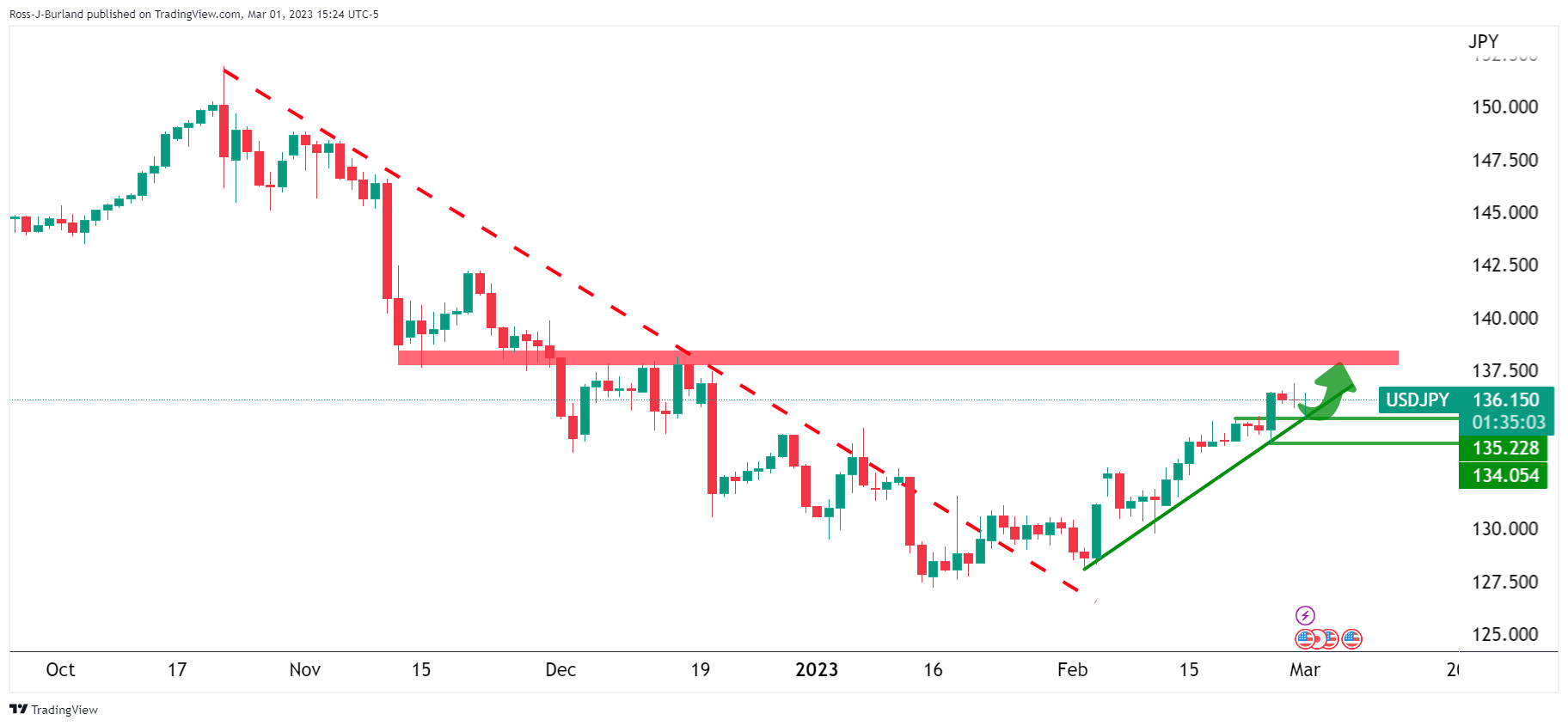
- USD/JPY shorts are in the market but need to break 135.20.
- USD/JPY bears eye a break of 135.20 to open the risk of a move to 134.00.
USD/JPY could be setting itself up for a fade on rallies to break trendline support. The following illustrates a bearish bias given the week's template so far.
USD/JPY technical analysis
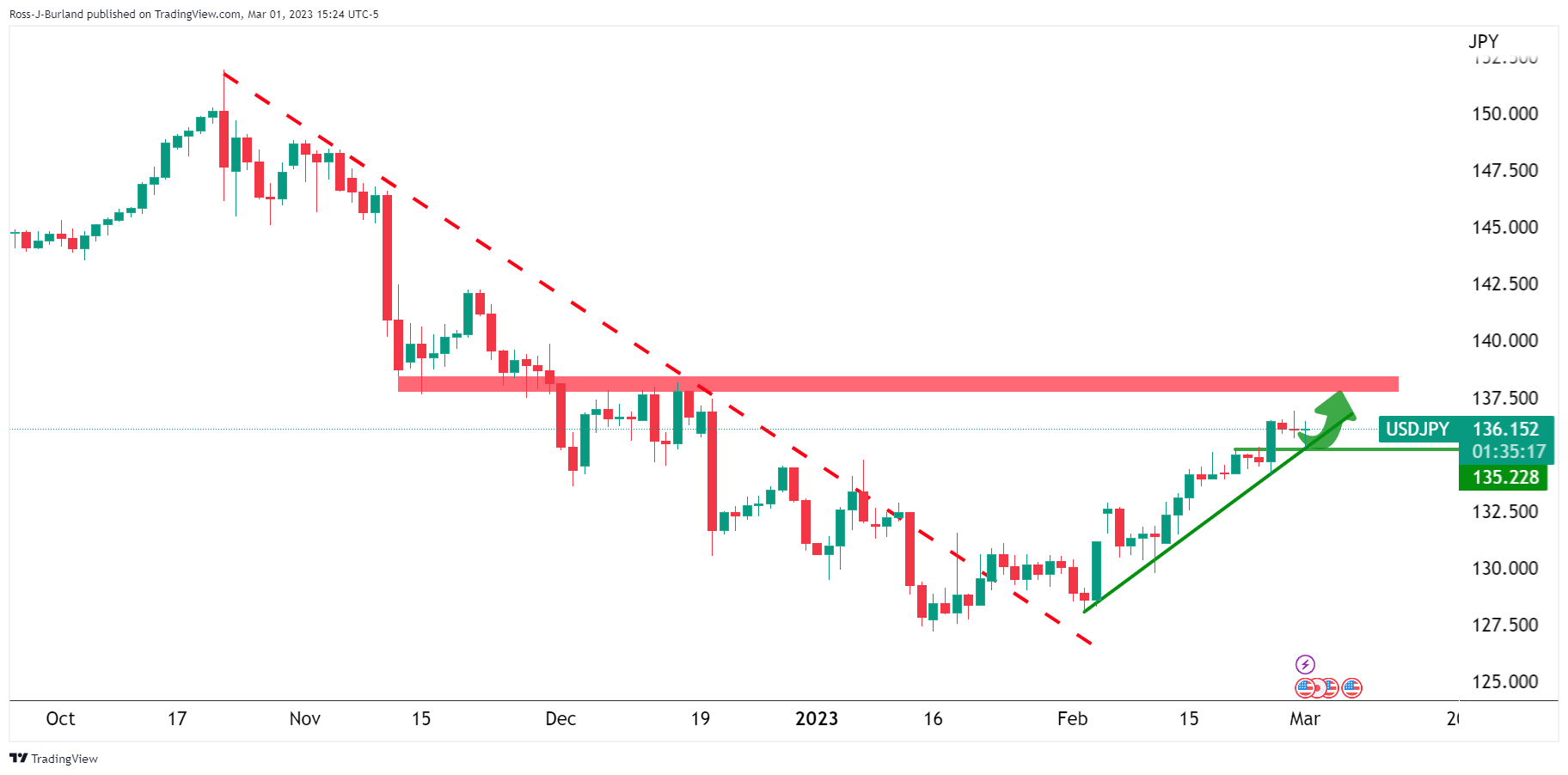
On the face of it, things would appear bullish given the trendline and holding above the 135.20s horizontal support that guards 134.05 below it.
However, when zooming down to the week's template so far, we can see a failed break out on Tuesday that was followed up by shorts on Wednesday and breaking structure around 135.70/90:
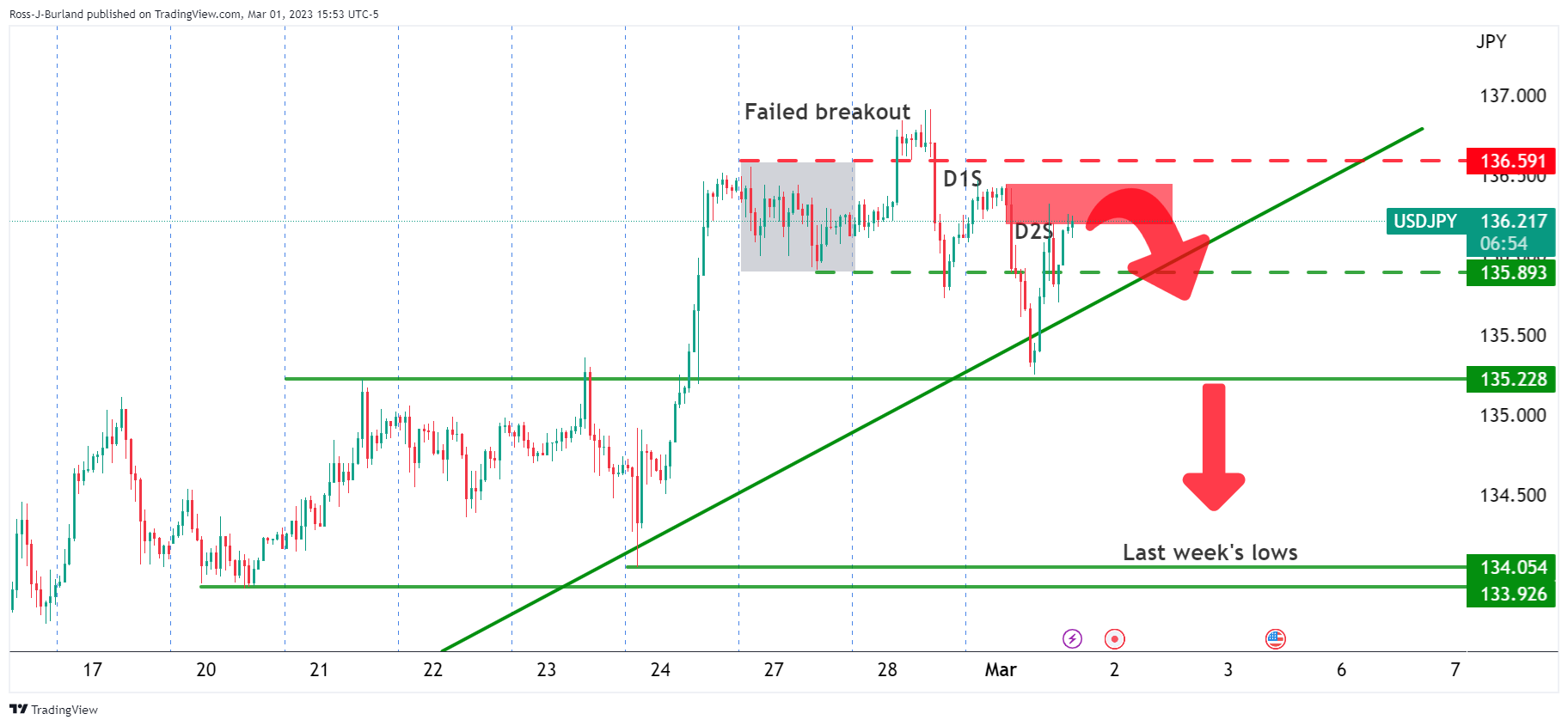
We have Day 1 shorts (D1S) and Day 2 Shorts in the market which is building the case for a significant move lower. The thesis is that bears are lurking up high and will be looking to sell at a premium, fading any rallies in the high-volume sessions such as in London and US. A break of 135.20 opens the risk of a move to 134.00 for the near future for a test of last week's lows.
- NZD/USD was the strongest peer in the FX space and rallied more than 1%.
- US manufacturing activity stabilized, but input prices rose, sparking inflation concerns.
- NZD/USD Price Analysis: Will test solid resistance around 0.6280-0.6300, with daily Mas hoovering around the area.
Despite sentiment shifting sour, the NZD/USD rallies and stays firm above the 0.6250 area, bolstered by a softer greenback, albeit UST bond yields are rising sharply. US equities are pointing toward registering losses, which could weigh on risk-sensitive currencies at the beginning of the Asian session. At the time of writing, the NZD/USD is gaining 1.16% or 71 pips.
NZD/USD continued its uptrend on a soft US Dollar
Wall Street is set for a lower close. The Institute for Supply Management (ISM) reported that the February US Manufacturing Purchasing Managers’ Index (PMI) was 47.7, lower than the estimated value of 48. Although it seems to have stabilized compared to the previous month’s reading of 47.4., the prices subcomponent increased significantly, causing concerns about inflation among investors.
That augmented speculations that the Federal Reserve would continue tightening monetary conditions as traders pushed back rate cuts, as the CME FedWatch Tool reported.
The NZD/USD trimmed some of its earlier gains on the ISM release and dipped toward 0.6222, before resuming the uptrend, despite hawkish comments by Federal Reserve officials.
Neil Kashkari of the Minnesota Fed commented that he’s open to raising rates by 25 or 50 bps at the upcoming meeting, while he foresees rates peaking around 5.4%. Of late, Atlanta’s Fed President Raphael Bostic commented that rates need to go as high as 5% - 5.25% and stood there “well into 2024.”
On the New Zealand (NZ) docket, the lack of data kept investors leaning on US Dollar dynamics and expectations that the Reserve Bank of New Zealand (RBNZ) is expected to raise rates in April, with odds for a 50 bps standing at 51%, per money market futures.
NZD/USD Technical analysis
The NZD/USD is neutral to upward biased, even though it sits below the daily Exponential Moving Averages (EMAs). However, at the time of typing, it faces solid resistance with the 50 and 200-day EMAs, at 0.6293 and 0.6282, respectively. If the NZD/USD cracks the 200-day EMA, that will exacerbate a rally above the 0.6300 mark. Otherwise, failure to do it would pave the way for further downside.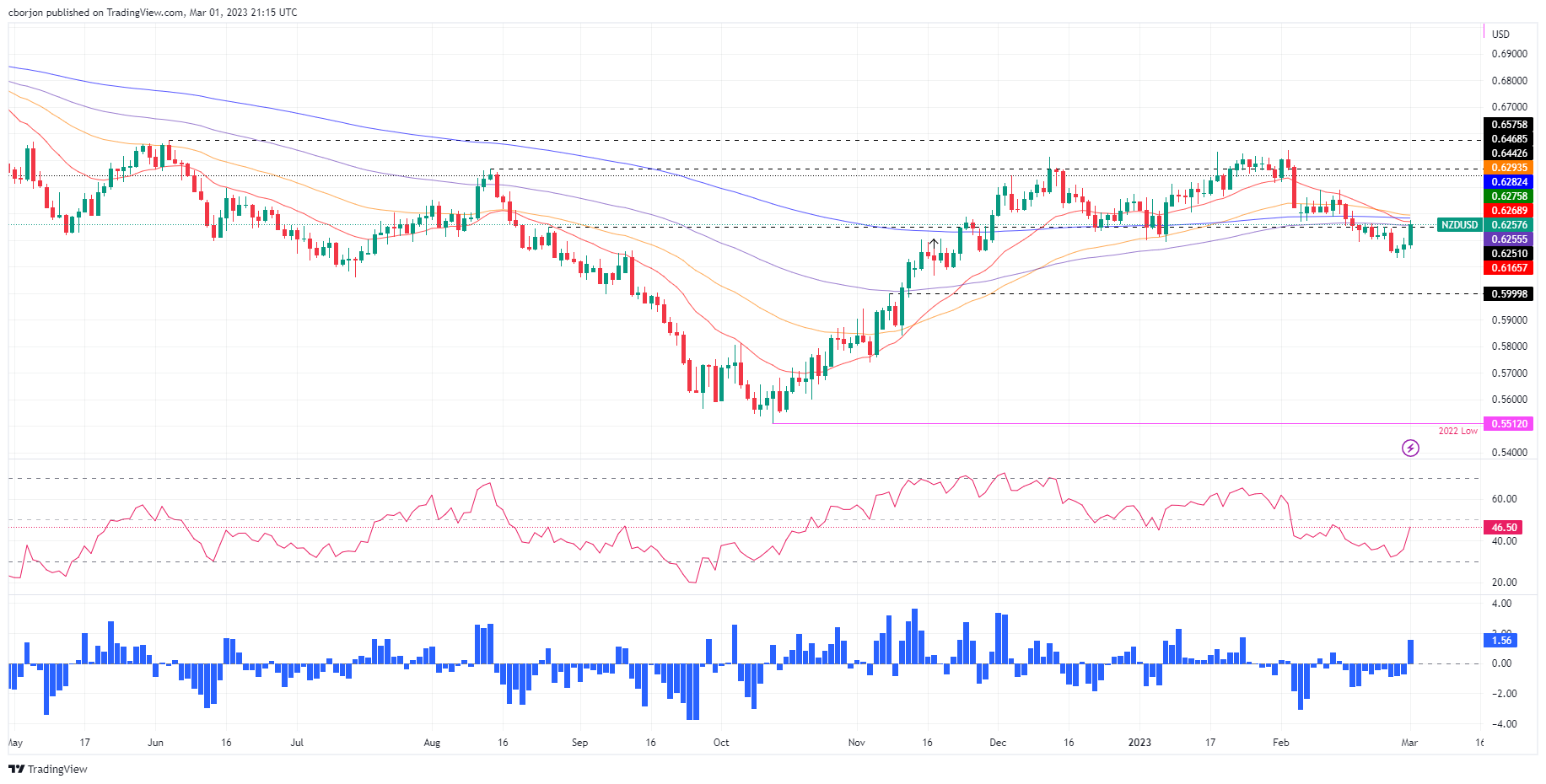
Trend: Neutral upwards.
What to watch?
What you need to take care of on Thursday, March 2:
The US Dollar dropped across the board on Wednesday, even as US yields jumped. Most European stock markets posted losses, and in Wall Street, indexes were mixed. The market hit bottom after the release of the US ISM Manufacturing PMI but then recovered.
The February Index rose to 47.7, showing the sector remains in contraction territory. The surprise came from the Price Paid Index, which jumped 6.8 points to 51.3 and triggered a sell-off in Treasuries and a short-lived recovery of the US Dollar. Currencies reflected somewhat more optimism than equities. Chinese PMIs rose above 50, leading to hopes for the economic outlook.
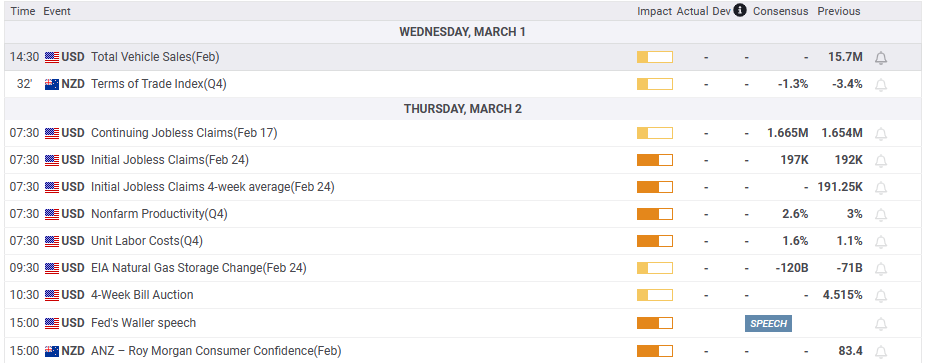
Market participants will continue to look closely at the bond market after a day in which US and European bond yields jumped after inflation figures. The economic calendar shows for Thursday Eurozone CPI, European Central Bank minutes and US Initial Jobless Claims.
The Euro was among the top performers across the FX board, boosted by higher-than-expected German inflation numbers and hawkish ECB expectations. EUR/USD hit weekly highs near 1.0700 and then pulled back. The Pound lagged with GBP/USD testing levels under 1.2000. USD/JPY ended flat on Wednesday despite higher government bond yields.
AUD/USD rebounded from monthly lows, being able to defend the 0.6700 support. The Kiwi was the best performer on Wednesday, with NZD/USD hitting the highest level in two weeks at 0.6275. USD/CAD dropped modestly and is hovering around 1.3600.
Gold rose for the second day in a row despite higher yields, finding resistance at $1,845/oz. Bitcoin was unable to regain $24,000 and pulled back.
Like this article? Help us with some feedback by answering this survey:
- US Dollar is under pressure in risk-on markets.
- Euro rallies to a one-week high and China is bouncing back.
The US Dollar is broadly weaker to kick off March after posting a 3% gain for February while risk appetite roared back to life on the evidence of a stronger-than-expected recovery in the Chinese economy.
At the time of writing, DXY, an index that measures the greenback vs. a basket of currencies, is losing 0.36% after falling from a high of 105.09 and reaching a low of 104.09 on the day so far, backing down from its first monthly gain after a four-month losing streak.
A bunch of strong U.S. economic data in recent weeks has raised market expectations that the Federal Reserve has further to go in hiking rates. Futures pricing continues to edge higher, with a peak rate climbing on Wednesday to 5.45% in the fed funds by September. However, China's Non-manufacturing activity grew at a faster pace in February, while the Caixin/S&P Global manufacturing PMI reading for last month likewise surpassed. The offshore yuan jumped 1.3% to 6.8683 per dollar, set for its largest one-day gain since late November.
The US Dollar has also struggled to hold up vs. the Pound and Euro. For instance, the pound surged 1% at the start of the week after Britain struck a post-Brexit Northern Ireland trade deal with the European Union. However, the euro, which is the majority of the basket in the DXY, is firmer due to the latest German inflation data exceeding expectations, supporting the case for the European Central Bank to raise interest rates further. The data comes ahead of key eurozone inflation data on Thursday while the Single Currency rises to a one-week high of 1.0691.
- GBP/USD bears are in town and eye a move towards last week's lows.
- Failed breakout to the upside for the week leaves a bearish bias on the charts.
GBP/USD shorts a