- Analytics
- News and Tools
- Market News
CFD Markets News and Forecasts — 12-03-2025
- EUR/USD eased slightly on Wednesday, slipping back below 1.0900.
- EU data remains functionally non-impactful as US data weighs.
- US CPI inflation eased more than expected in February, building hopes for PPI figures.
EUR/USD bidders eased off the gas pedal on Wednesday, allowing Fiber to retreat around one-third of one percent and pushed bids back below the 1.0900 major price handle. Despite a significant recovery in EUR/USD over the last couple of weeks, buyers are settling back down after readjusting Fiber by over 5% in less than two weeks.
European economic data is barely registering on the needle this week as trade war concerns and US inflation data rule the roost. On Wednesday, the US implemented a worldwide 25% tariff on all steel and aluminum imports, marking a significant escalation in President Donald Trump’s aim to simultaneously initiate a trade war with all of the nation's allies.
In February, US Consumer Price Index (CPI) inflation fell more sharply than expected, with headline CPI at 0.2% month-over-month and 2.8% year-over-year, slightly quicker than predictions. While this remains above the Federal Reserve’s (Fed) 2% target, it has raised hopes for rate adjustments. The CME’s FedWatch Tool now indicates better than even odds for a Fed rate cut in June, up from July.
Nearly four years have passed since US headline inflation hit “transitory” levels. Aside from a brief slowdown in Q3 2024, key inflation metrics have remained steady since June 2023, when the post-Covid inflation rate eased to 3% annually.
Despite cooler CPI readings in February, there are signs of potential challenges for policymakers: gasoline and fuel oil prices fell by 3.1% and 5.1%, but natural gas prices surged by 6%. Additionally, shelter price inflation rose by 4.2% year-over-year, while a small 0.3% decrease in vehicle prices masked a 2.6% rise in food price inflation compared to last year.
EUR/USD price forecast
EUR/USD looks set to end its recent bull run, closing lower and slipping back below 1.0900 just as quickly as it jumped the major handle in the first place. However, Fiber has climbed nearly 7.6% bottom-to-top from the last major swing low near 1.0175, with bulls easily snapping the 200-day Exponential Moving Average (EMA) in the process.
EUR/USD is now running aground of technical resistance from the 1.0900 handle, a technical region that flummoxed Euro bulls the last time around back in October and November of last year.
EUR/USD daily chart
Euro FAQs
The Euro is the currency for the 19 European Union countries that belong to the Eurozone. It is the second most heavily traded currency in the world behind the US Dollar. In 2022, it accounted for 31% of all foreign exchange transactions, with an average daily turnover of over $2.2 trillion a day. EUR/USD is the most heavily traded currency pair in the world, accounting for an estimated 30% off all transactions, followed by EUR/JPY (4%), EUR/GBP (3%) and EUR/AUD (2%).
The European Central Bank (ECB) in Frankfurt, Germany, is the reserve bank for the Eurozone. The ECB sets interest rates and manages monetary policy. The ECB’s primary mandate is to maintain price stability, which means either controlling inflation or stimulating growth. Its primary tool is the raising or lowering of interest rates. Relatively high interest rates – or the expectation of higher rates – will usually benefit the Euro and vice versa. The ECB Governing Council makes monetary policy decisions at meetings held eight times a year. Decisions are made by heads of the Eurozone national banks and six permanent members, including the President of the ECB, Christine Lagarde.
Eurozone inflation data, measured by the Harmonized Index of Consumer Prices (HICP), is an important econometric for the Euro. If inflation rises more than expected, especially if above the ECB’s 2% target, it obliges the ECB to raise interest rates to bring it back under control. Relatively high interest rates compared to its counterparts will usually benefit the Euro, as it makes the region more attractive as a place for global investors to park their money.
Data releases gauge the health of the economy and can impact on the Euro. Indicators such as GDP, Manufacturing and Services PMIs, employment, and consumer sentiment surveys can all influence the direction of the single currency. A strong economy is good for the Euro. Not only does it attract more foreign investment but it may encourage the ECB to put up interest rates, which will directly strengthen the Euro. Otherwise, if economic data is weak, the Euro is likely to fall. Economic data for the four largest economies in the euro area (Germany, France, Italy and Spain) are especially significant, as they account for 75% of the Eurozone’s economy.
Another significant data release for the Euro is the Trade Balance. This indicator measures the difference between what a country earns from its exports and what it spends on imports over a given period. If a country produces highly sought after exports then its currency will gain in value purely from the extra demand created from foreign buyers seeking to purchase these goods. Therefore, a positive net Trade Balance strengthens a currency and vice versa for a negative balance.
- GBP/USD middled on Wednesday, stuck just south of 1.3000.
- UK data remains underwhelming this week as US data takes center stage.
- US CPI inflation eased in February, helping to cool inflation fears.
GBP/USD cycled near recent highs on Wednesday, building a base near the key 1.3000 handle as markets take a moment after US Consumer Price Index (CPI) inflation chilled even more than expected in February. Markets now await Thursday’s US Producer Price Index (PPI), with key consumer sentiment and consumer inflation expectations due on Friday.
The US imposed a global 25% tariff on all steel and aluminum imported into the US on Wednesday, kicking off the next critical stage of US President Donald Trump’s desire to get into a trade war with all of the US’s allies at once. A recent spat between the US and Canada came to a fizzling close this week after Donald Trump threatened to double metals tariffs on Canada just days before the US’s steel tariffs were slated to come online. After some back-and-forth posturing, both countries settled with the US imposing its “normal” 25% across-the-board tariffs on steel and aluminum, and Canada set to impose its own tariffs on a targeted amount of goods later this week.
In February, US Consumer Price Index (CPI) inflation decreased more sharply than expected, with headline CPI falling to 0.2% month-over-month and 2.8% year-over-year, dipping slightly quicker than market predictions. Although this reading is still above the Federal Reserve’s (Fed) 2% target, it has instilled some optimism that the Fed can adjust policy rates moving forward. Based on the CME’s FedWatch Tool, rate markets now suggest more than even chances of a Fed rate cut occurring in June, up from the previous expectation of July.
Nearly four years have passed since US headline inflation reached “transitory” levels, and aside from a brief slowdown in Q3 2024, key inflation metrics have largely remained consistent since June 2023, when the post-Covid inflation rate first eased to 3% on an annual basis.
Observers of commodities will note that despite the cooler CPI readings in February, there are underlying indicators that may pose challenges for policymakers soon: while gasoline and fuel oil prices generally dropped during this period—falling 3.1% and 5.1% respectively—natural gas prices surged by 6% overall. Additionally, inflation estimates for shelter prices rose by another 4.2% year-over-year, while a small decrease of 0.3% in new vehicle prices masked a rise in food price inflation, which increased by 2.6% compared to the same time last year.
GBP/USD price forecast
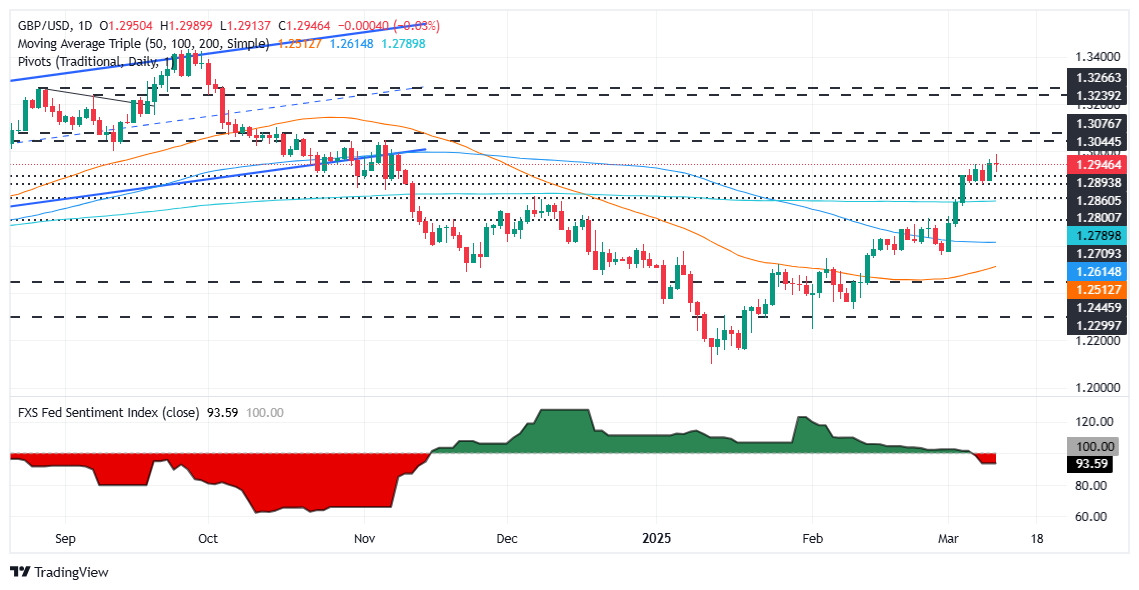
The GBP/USD pair is experiencing its second consecutive week of gains, approaching new 18-week highs close to 1.2950. The significant 1.3000 resistance level may limit any additional upward movement, as this key level was previously a notable consolidation point in October and November of 2024.
Currently, demand is strong among buyers, but technical indicators have remained in overbought territory since January, suggesting a potential reversal could happen soon.
GBP/USD daily chart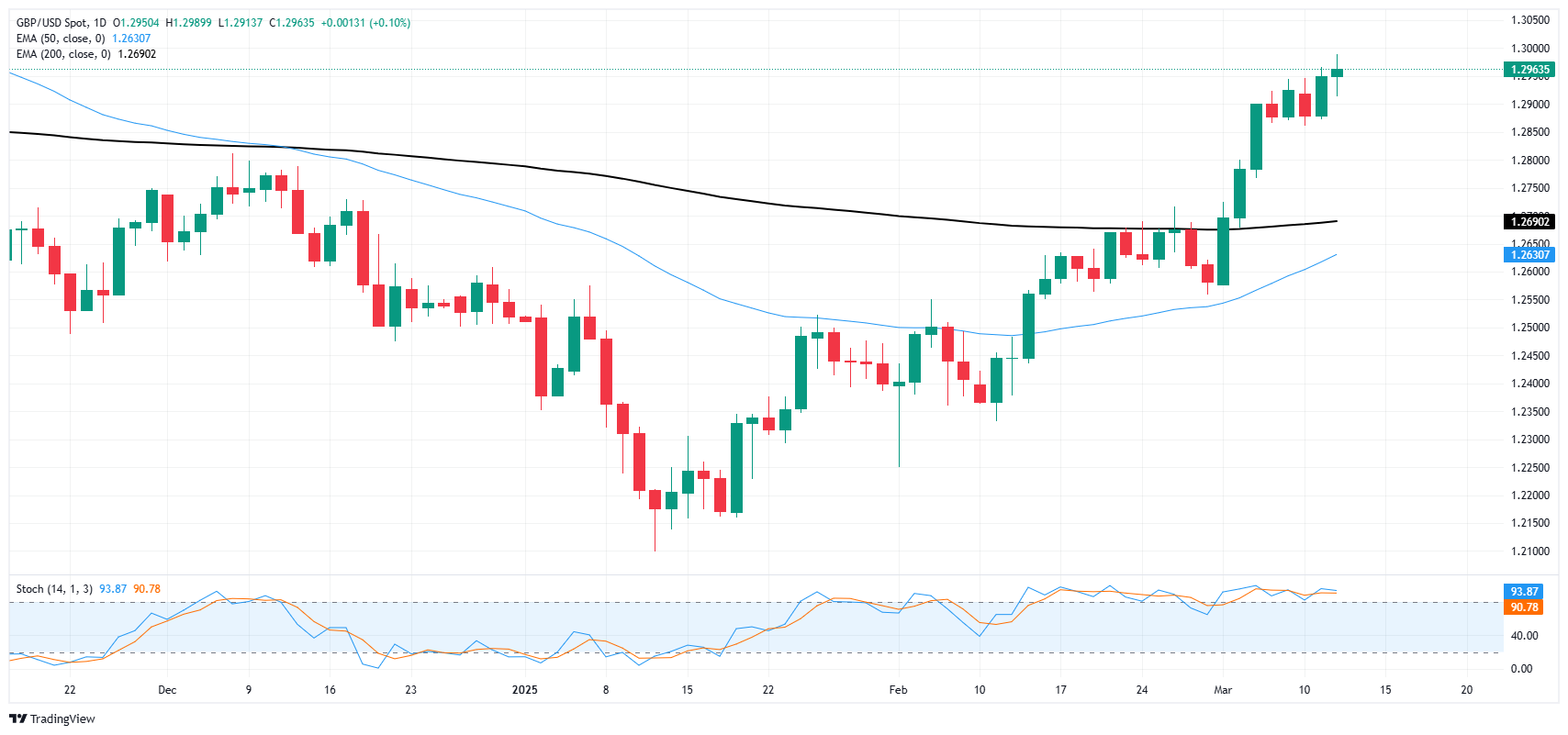
Pound Sterling FAQs
The Pound Sterling (GBP) is the oldest currency in the world (886 AD) and the official currency of the United Kingdom. It is the fourth most traded unit for foreign exchange (FX) in the world, accounting for 12% of all transactions, averaging $630 billion a day, according to 2022 data. Its key trading pairs are GBP/USD, also known as ‘Cable’, which accounts for 11% of FX, GBP/JPY, or the ‘Dragon’ as it is known by traders (3%), and EUR/GBP (2%). The Pound Sterling is issued by the Bank of England (BoE).
The single most important factor influencing the value of the Pound Sterling is monetary policy decided by the Bank of England. The BoE bases its decisions on whether it has achieved its primary goal of “price stability” – a steady inflation rate of around 2%. Its primary tool for achieving this is the adjustment of interest rates. When inflation is too high, the BoE will try to rein it in by raising interest rates, making it more expensive for people and businesses to access credit. This is generally positive for GBP, as higher interest rates make the UK a more attractive place for global investors to park their money. When inflation falls too low it is a sign economic growth is slowing. In this scenario, the BoE will consider lowering interest rates to cheapen credit so businesses will borrow more to invest in growth-generating projects.
Data releases gauge the health of the economy and can impact the value of the Pound Sterling. Indicators such as GDP, Manufacturing and Services PMIs, and employment can all influence the direction of the GBP. A strong economy is good for Sterling. Not only does it attract more foreign investment but it may encourage the BoE to put up interest rates, which will directly strengthen GBP. Otherwise, if economic data is weak, the Pound Sterling is likely to fall.
Another significant data release for the Pound Sterling is the Trade Balance. This indicator measures the difference between what a country earns from its exports and what it spends on imports over a given period. If a country produces highly sought-after exports, its currency will benefit purely from the extra demand created from foreign buyers seeking to purchase these goods. Therefore, a positive net Trade Balance strengthens a currency and vice versa for a negative balance.
Bank of Japan officials see several reasons against intervening in the bond market even after benchmark yields hit the highest level since 2008, Bloomberg reported, citing people familiar with the matter.
Officials are determined not to step into the market unless extreme moves take place, for fear of introducing trading thresholds that might damage market functioning.
Investors need to get used to a world without the BoJ’s yield curve control after the program ended last year.
Market reaction
At the press time, the USD/JPY pair is down 0.06% on the day to trade at 148.15.
Japanese Yen FAQs
The Japanese Yen (JPY) is one of the world’s most traded currencies. Its value is broadly determined by the performance of the Japanese economy, but more specifically by the Bank of Japan’s policy, the differential between Japanese and US bond yields, or risk sentiment among traders, among other factors.
One of the Bank of Japan’s mandates is currency control, so its moves are key for the Yen. The BoJ has directly intervened in currency markets sometimes, generally to lower the value of the Yen, although it refrains from doing it often due to political concerns of its main trading partners. The BoJ ultra-loose monetary policy between 2013 and 2024 caused the Yen to depreciate against its main currency peers due to an increasing policy divergence between the Bank of Japan and other main central banks. More recently, the gradually unwinding of this ultra-loose policy has given some support to the Yen.
Over the last decade, the BoJ’s stance of sticking to ultra-loose monetary policy has led to a widening policy divergence with other central banks, particularly with the US Federal Reserve. This supported a widening of the differential between the 10-year US and Japanese bonds, which favored the US Dollar against the Japanese Yen. The BoJ decision in 2024 to gradually abandon the ultra-loose policy, coupled with interest-rate cuts in other major central banks, is narrowing this differential.
The Japanese Yen is often seen as a safe-haven investment. This means that in times of market stress, investors are more likely to put their money in the Japanese currency due to its supposed reliability and stability. Turbulent times are likely to strengthen the Yen’s value against other currencies seen as more risky to invest in.
- USD/CHF stabilizes at 0.8810 for second straight day, hugs critical 200-day SMA after rebound from yearly lows.
- Technical downtrend persists; recent lower highs and lower lows suggest bears maintain control but momentum slows.
- Break below 0.8800 could trigger deeper declines toward cycle lows; upside break opens door to 0.8850, then potentially 0.9000.
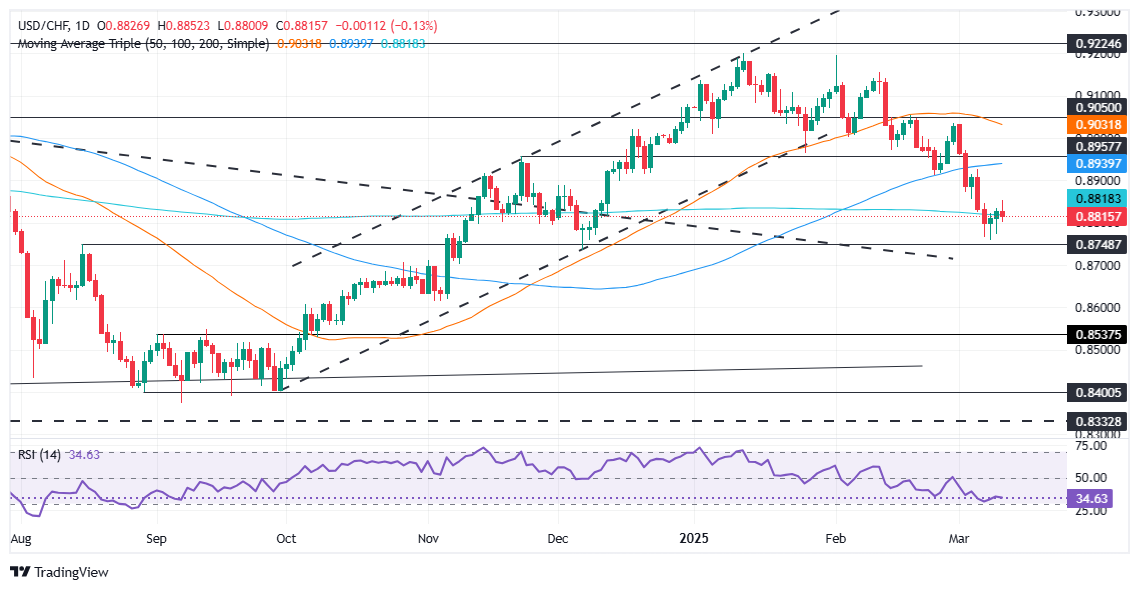
The USD/CJF holds firm around the 0.8810 mark for the second consecutive day and clings to the 200-day Simple Moving Average (SMA) at 0.8813 after bouncing off yearly lows of 0.8757. At the time of writing, the pair trades at 0.8814, virtually unchanged, as Thursday’s Asian session begins.
USD/CHF Price Forecast: Technical outlook
USD/CHF is in an ongoing downtrend after dropping below key dynamic support levels like the 100 and 200-day SMAs. In addition, the pair carved successive series of lower highs and lower lows, indicating that sellers might be in charge. Nevertheless, the fall halted shy of clearing the latest cycle low of 0.8726, the December 6 low.
The Relative Strength Index (RSI) began to rise on Monday but shifted flat during the session. Therefore, USD/CHF might remain sideways, awaiting a fresh catalyst.
If USD/CHF clears the 200-day SMA, this paves the way to challenge 0.8800, ahead of the latest cycle low. Otherwise, if buyers reclaim the 200-day SMA, look for a test of the 0.8850 area before rallying to the 0.9000 mark.
USD/CHF Price Chart – Daily
Swiss Franc FAQs
The Swiss Franc (CHF) is Switzerland’s official currency. It is among the top ten most traded currencies globally, reaching volumes that well exceed the size of the Swiss economy. Its value is determined by the broad market sentiment, the country’s economic health or action taken by the Swiss National Bank (SNB), among other factors. Between 2011 and 2015, the Swiss Franc was pegged to the Euro (EUR). The peg was abruptly removed, resulting in a more than 20% increase in the Franc’s value, causing a turmoil in markets. Even though the peg isn’t in force anymore, CHF fortunes tend to be highly correlated with the Euro ones due to the high dependency of the Swiss economy on the neighboring Eurozone.
The Swiss Franc (CHF) is considered a safe-haven asset, or a currency that investors tend to buy in times of market stress. This is due to the perceived status of Switzerland in the world: a stable economy, a strong export sector, big central bank reserves or a longstanding political stance towards neutrality in global conflicts make the country’s currency a good choice for investors fleeing from risks. Turbulent times are likely to strengthen CHF value against other currencies that are seen as more risky to invest in.
The Swiss National Bank (SNB) meets four times a year – once every quarter, less than other major central banks – to decide on monetary policy. The bank aims for an annual inflation rate of less than 2%. When inflation is above target or forecasted to be above target in the foreseeable future, the bank will attempt to tame price growth by raising its policy rate. Higher interest rates are generally positive for the Swiss Franc (CHF) as they lead to higher yields, making the country a more attractive place for investors. On the contrary, lower interest rates tend to weaken CHF.
Macroeconomic data releases in Switzerland are key to assessing the state of the economy and can impact the Swiss Franc’s (CHF) valuation. The Swiss economy is broadly stable, but any sudden change in economic growth, inflation, current account or the central bank’s currency reserves have the potential to trigger moves in CHF. Generally, high economic growth, low unemployment and high confidence are good for CHF. Conversely, if economic data points to weakening momentum, CHF is likely to depreciate.
As a small and open economy, Switzerland is heavily dependent on the health of the neighboring Eurozone economies. The broader European Union is Switzerland’s main economic partner and a key political ally, so macroeconomic and monetary policy stability in the Eurozone is essential for Switzerland and, thus, for the Swiss Franc (CHF). With such dependency, some models suggest that the correlation between the fortunes of the Euro (EUR) and the CHF is more than 90%, or close to perfect.
- USD/CAD edges lower to 1.4365 in Wednesday’s late American session.
- US CPI rose at the slowest pace in four months in February.
- BoC cut its key interest rate by 25 bps on Wednesday, citing trade uncerainty with the US for the decision.
The USD/CAD pair weakens to near 1.4365 during the late American session on Wednesday. The upside for the Greenback might be limited amid intense tariff uncertainty from US President Donald Trump and fears of a US recession.
US inflation rose at the slowest pace in four months in February. Data released by Labor Statistics on Wednesday showed that the US Consumer Price Index (CPI) increased 0.2% MoM in February after a sharp 0.5% advance in January. This figure came in softer than the expectation of 0.3%. The core CPI, excluding volatile food and energy categories, rose 0.2% MoM during the same period.
This inflation report fueled speculation that the US Federal Reserve (Fe) may cut rates sooner than previously thought. This, in turn, might drag the US Dollar (USD) lower against the Canadian Dollar (CAD) in the near term.
As widely expected, the Bank of Canada (BoC) on Wednesday decided to cut its key interest rate by 25 basis points (bps), bringing it down to 2.75%. This was the BoC’s seventh consecutive interest rate cut. A move that comes just hours after US President Donald Trump issued new steel and aluminum tariffs against Canada.
BoC governor Tiff Macklem said during the press conference, “In recent months, the pervasive uncertainty created by continuously changing U.S. tariff threats has shaken business and consumer confidence.” Tu Nguyen, economist at RSM Canada, said the uncertainty was hurting Canadian growth and another round of tariffs in April could limit the BoC’s options even more. This might exert some selling pressure on the Loonie and help limit the pair’s losses.
Canadian Dollar FAQs
The key factors driving the Canadian Dollar (CAD) are the level of interest rates set by the Bank of Canada (BoC), the price of Oil, Canada’s largest export, the health of its economy, inflation and the Trade Balance, which is the difference between the value of Canada’s exports versus its imports. Other factors include market sentiment – whether investors are taking on more risky assets (risk-on) or seeking safe-havens (risk-off) – with risk-on being CAD-positive. As its largest trading partner, the health of the US economy is also a key factor influencing the Canadian Dollar.
The Bank of Canada (BoC) has a significant influence on the Canadian Dollar by setting the level of interest rates that banks can lend to one another. This influences the level of interest rates for everyone. The main goal of the BoC is to maintain inflation at 1-3% by adjusting interest rates up or down. Relatively higher interest rates tend to be positive for the CAD. The Bank of Canada can also use quantitative easing and tightening to influence credit conditions, with the former CAD-negative and the latter CAD-positive.
The price of Oil is a key factor impacting the value of the Canadian Dollar. Petroleum is Canada’s biggest export, so Oil price tends to have an immediate impact on the CAD value. Generally, if Oil price rises CAD also goes up, as aggregate demand for the currency increases. The opposite is the case if the price of Oil falls. Higher Oil prices also tend to result in a greater likelihood of a positive Trade Balance, which is also supportive of the CAD.
While inflation had always traditionally been thought of as a negative factor for a currency since it lowers the value of money, the opposite has actually been the case in modern times with the relaxation of cross-border capital controls. Higher inflation tends to lead central banks to put up interest rates which attracts more capital inflows from global investors seeking a lucrative place to keep their money. This increases demand for the local currency, which in Canada’s case is the Canadian Dollar.
Macroeconomic data releases gauge the health of the economy and can have an impact on the Canadian Dollar. Indicators such as GDP, Manufacturing and Services PMIs, employment, and consumer sentiment surveys can all influence the direction of the CAD. A strong economy is good for the Canadian Dollar. Not only does it attract more foreign investment but it may encourage the Bank of Canada to put up interest rates, leading to a stronger currency. If economic data is weak, however, the CAD is likely to fall.
- AUD/JPY was seen trading around the 93.75 area ahead of the Asian session, posting a second consecutive day of gains.
- Indicators show signs of recovery, but the overall outlook remains uncertain as momentum is still in negative territory.
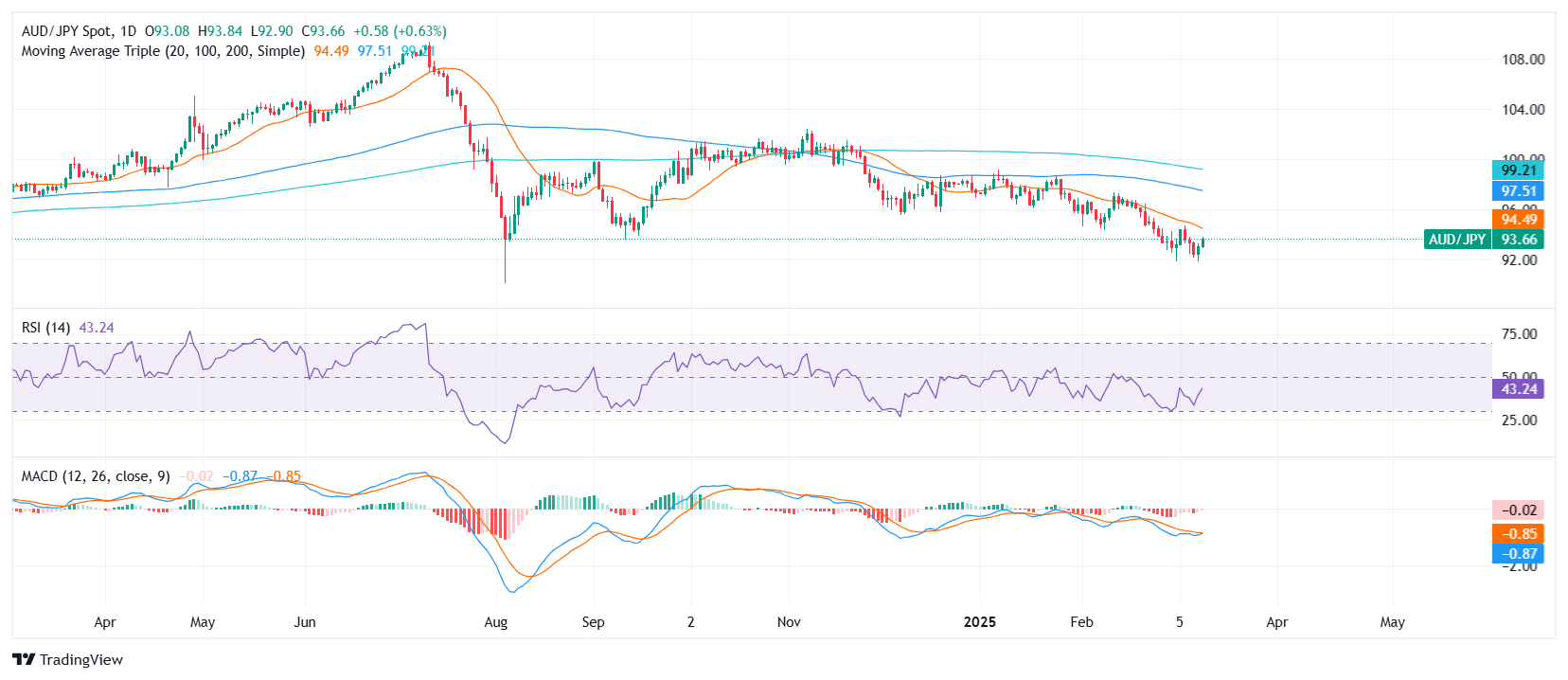
The AUD/JPY pair extended its recovery on Wednesday ahead of the Asian session, rising for the second straight day and trading near the 93.75 zone. Buyers are showing renewed interest after the recent downside, but the overall bias remains uncertain as indicators, while improving, continue to signal weakness.
Technically, the Relative Strength Index (RSI) is climbing sharply but remains in negative territory, indicating that bullish momentum is yet to fully establish. Similarly, the Moving Average Convergence Divergence (MACD) histogram is printing decreasing red bars, which suggests that selling pressure is fading, but further confirmation is needed for a sustained rebound.
Looking ahead, immediate resistance is seen near the 94.00 level, where a breakout could reinforce the short-term bullish outlook. On the downside, key support is found around 93.20, with a break below potentially triggering renewed selling pressure. If the pair manages to hold above this area, consolidation around current levels might be expected.
AUD/JPY daily chart
- XAG/USD surges to two-week highs amid softer inflation data and persistent tariff worries
- US CPI misses forecasts, fueling speculation of Fed easing and boosting Silver’s allure despite rising yields.
- Technical indicators remain bullish; RSI signals further upside as Silver buyers aim at February’s peak of $33.39.
Silver price rallied to three-week highs as it cleared the $33.00 handle on Wednesday, posting gains of over 0.90%, unfazed by a jump in US Treasury bond yields and a strong US Dollar. At the time of writing, XAG/USD trades at $33.21 after bouncing off daily lows of $32.70.
A softer-than-expected US inflation report revealed that the Consumer Price Index (CPI) dipped in headline and core measures. Although this spurred speculation that the Federal Reserve (Fed) might lower borrowing costs, it's just one month of good data, which, according to Fed Chair Jerome Powell, is not enough to stir the boat.
Meanwhile, traders continue to digest US President Donald Trump's tariff rhetoric. Trump threatens further tariffs as the EU and Canada retaliate.
XAG/USD Price Forecast: Technical outlook
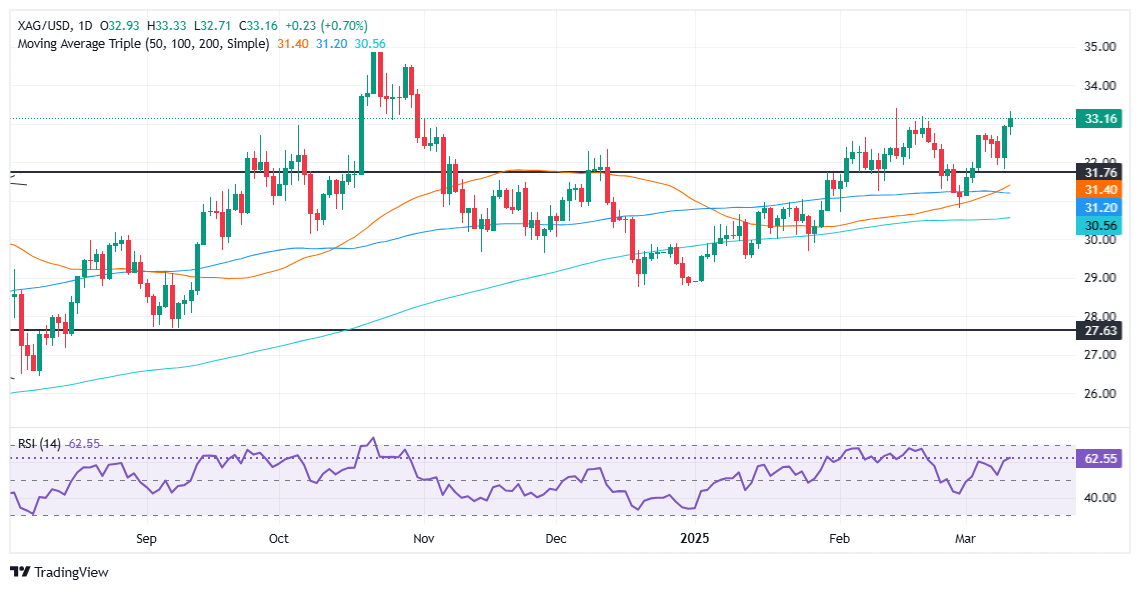
Silver's price remains upward-biased after bottoming near $32.00 for the last four trading days. Since then, XAG/USD has been up more than 2% in the week, and with momentum being a tailwind for the grey metal, further gains are seen.
The Relative Strength Index (RSI) is bullish, signaling buyers are in charge.
The first resistance would be the February 14 daily high at $33.39. A breach of that level will expose the $34.00 figure. Should sellers step in, they must clear $33.00. Once surpassed, prices could fall to March 11 swing low of $31.81.
XAG/USD Price Chart – Daily
Silver FAQs
Silver is a precious metal highly traded among investors. It has been historically used as a store of value and a medium of exchange. Although less popular than Gold, traders may turn to Silver to diversify their investment portfolio, for its intrinsic value or as a potential hedge during high-inflation periods. Investors can buy physical Silver, in coins or in bars, or trade it through vehicles such as Exchange Traded Funds, which track its price on international markets.
Silver prices can move due to a wide range of factors. Geopolitical instability or fears of a deep recession can make Silver price escalate due to its safe-haven status, although to a lesser extent than Gold's. As a yieldless asset, Silver tends to rise with lower interest rates. Its moves also depend on how the US Dollar (USD) behaves as the asset is priced in dollars (XAG/USD). A strong Dollar tends to keep the price of Silver at bay, whereas a weaker Dollar is likely to propel prices up. Other factors such as investment demand, mining supply – Silver is much more abundant than Gold – and recycling rates can also affect prices.
Silver is widely used in industry, particularly in sectors such as electronics or solar energy, as it has one of the highest electric conductivity of all metals – more than Copper and Gold. A surge in demand can increase prices, while a decline tends to lower them. Dynamics in the US, Chinese and Indian economies can also contribute to price swings: for the US and particularly China, their big industrial sectors use Silver in various processes; in India, consumers’ demand for the precious metal for jewellery also plays a key role in setting prices.
Silver prices tend to follow Gold's moves. When Gold prices rise, Silver typically follows suit, as their status as safe-haven assets is similar. The Gold/Silver ratio, which shows the number of ounces of Silver needed to equal the value of one ounce of Gold, may help to determine the relative valuation between both metals. Some investors may consider a high ratio as an indicator that Silver is undervalued, or Gold is overvalued. On the contrary, a low ratio might suggest that Gold is undervalued relative to Silver.
- Gold climbs above $2,930 as safe-haven demand overcomes rising US yields
- Softer US CPI supports bets on Fed rate cuts, fueling Gold’s rally despite USD rebound.
- Trade war fears persist; US Treasury yields rise on concerns of renewed inflation pressure from tariffs.
- Central banks continue aggressive Gold purchases, underpinning bullish sentiment.
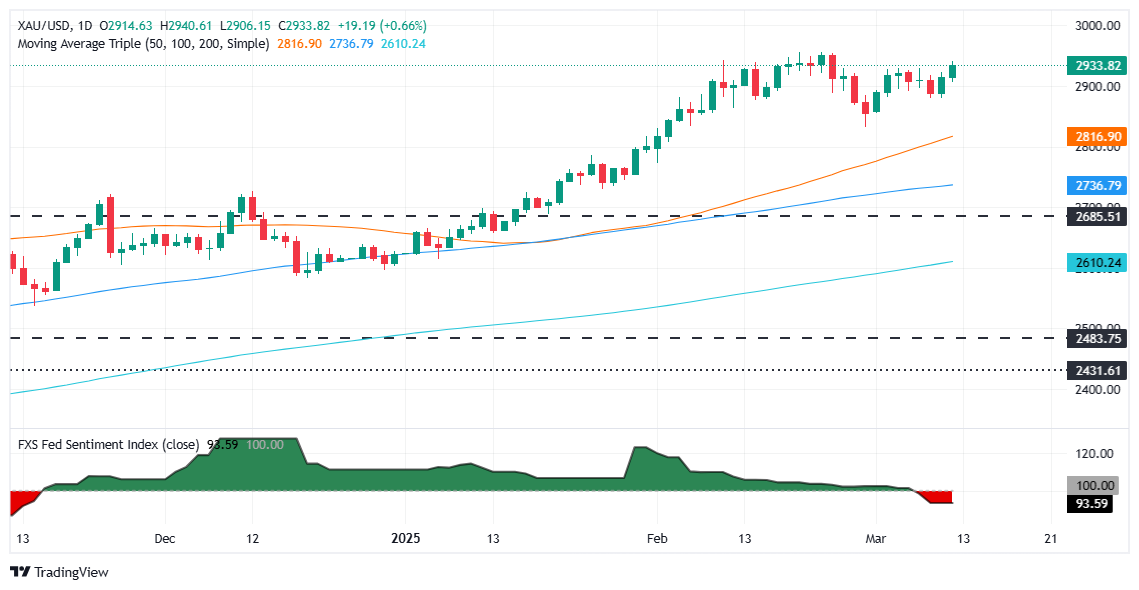
Gold price rises late in the North American session, unfazed by high US Treasury bond yields and a stronger US Dollar on Wednesday. At the time of writing, XAU/USD trades with gains of 0.63% and changes hands at $2,933 after a US inflation report that was softer than projected.
The US Bureau of Labor Statistics (BLS) revealed that consumer inflation in the United States (US) edged lower in February. Nevertheless, investors remain skeptical of the improvement as aggressive tariffs on US imports could trigger a second round of inflation.
February’s data increased the odds that the Federal Reserve (Fed) might cut interest rates thrice in 2025. Nevertheless, Fed officials, led by Chair Jerome Powell, had expressed that they do not look at just one month of data.
In the meantime, US Treasury yields climbed amid fears that the global trade war could push prices higher. Consequently, the US Dollar Index (DXY), which tracks the Greenback’s value against six currencies, gains 0.14% to 103.55.
On Wednesday, 25% US tariffs on steel and aluminum took effect at midnight as US President Donald Trump is battling to reduce the trade deficit by applying duties on imports.
The non-yielding metal is poised to extend its rally, even though there is progress on a truce between Ukraine and Russia.
The World Gold Council (WGC) revealed that central banks continued to purchase Gold. The People’s Bank of China (PBoC) and the National Bank of Poland (NBP) added 10 and 29 tonnes in the first two months of 2025, respectively.
Given the backdrop, Gold is set to test the $2,950 mark. Traders will eye the release of the US Producer Price Index (PPI) for February, Initial Jobless Claims and the University of Michigan (UoM) Consumer Sentiment.
Daily digest market movers: Gold price shrugs of high US yields
- The US 10-year Treasury bond yield recovers and rises three basis points to 4.314%.
- US real yields, as measured by the US 10-year Treasury Inflation-Protected Securities (TIPS) yield that correlates inversely to Gold prices, climb one basis points to 1.981%, capping non-yielding metal gains.
- The US Consumer Price Index (CPI) for February increased 2.8% YoY, slightly below the expected 2.9% and down from 3.0% in January, indicating continued moderation in inflation.
- Core CPI, which strips out volatile food and energy prices, dipped from 3.3% in January to 3.1% YoY, reinforcing signs of continued disinflation in the U.S. economy.
- The Atlanta Fed GDPNow model predicts the first quarter of 2025 at -2.4%, which would be the first negative print since the COVID-19 pandemic.
- Money market traders had priced in 71 basis points of easing in 2025, down from 77 bps a day ago, via data from Prime Market Terminal.
XAU/USD technical outlook: Gold prolongs its rally past $2,930
Gold price has cleared the top of the $2,880 - $2,930 trading range and hit a two-week peak of $2,940 with buyers eyeing $2,950 as the next key resistance level before clearing the record high at $2,954. Once surpassed, Gold would be poised to challenge $3,000.
Conversely, if XAU/USD drops below $2,900, the next support would be $2,850, ahead of the February 28 low of $2,832. Up next would be $2,800.
Gold FAQs
Gold has played a key role in human’s history as it has been widely used as a store of value and medium of exchange. Currently, apart from its shine and usage for jewelry, the precious metal is widely seen as a safe-haven asset, meaning that it is considered a good investment during turbulent times. Gold is also widely seen as a hedge against inflation and against depreciating currencies as it doesn’t rely on any specific issuer or government.
Central banks are the biggest Gold holders. In their aim to support their currencies in turbulent times, central banks tend to diversify their reserves and buy Gold to improve the perceived strength of the economy and the currency. High Gold reserves can be a source of trust for a country’s solvency. Central banks added 1,136 tonnes of Gold worth around $70 billion to their reserves in 2022, according to data from the World Gold Council. This is the highest yearly purchase since records began. Central banks from emerging economies such as China, India and Turkey are quickly increasing their Gold reserves.
Gold has an inverse correlation with the US Dollar and US Treasuries, which are both major reserve and safe-haven assets. When the Dollar depreciates, Gold tends to rise, enabling investors and central banks to diversify their assets in turbulent times. Gold is also inversely correlated with risk assets. A rally in the stock market tends to weaken Gold price, while sell-offs in riskier markets tend to favor the precious metal.
The price can move due to a wide range of factors. Geopolitical instability or fears of a deep recession can quickly make Gold price escalate due to its safe-haven status. As a yield-less asset, Gold tends to rise with lower interest rates, while higher cost of money usually weighs down on the yellow metal. Still, most moves depend on how the US Dollar (USD) behaves as the asset is priced in dollars (XAU/USD). A strong Dollar tends to keep the price of Gold controlled, whereas a weaker Dollar is likely to push Gold prices up.
- AUD/USD continues its upward trajectory, surpassing the 0.6300 hurdle as bullish momentum builds.
- US inflation data came in lower than expected, increasing speculation about an earlier-than-anticipated Fed rate cut.
- Trade tensions persist as the US moves forward with fresh tariffs, raising concerns about global economic growth.
- Technical indicators show improving bullish momentum, with AUD/USD eyeing the 0.6360 resistance zone.
The AUD/USD pair added to Tuesday’s uptick and trespassed the 0.6300 hurdle despite a decent rebound in the Greenback. The pair extended gains on Wednesday, supported by softening United States (US) inflation data, which bolstered expectations that the Federal Reserve (Fed) may adjust interest rates sooner than previously anticipated. While the US Dollar (USD) attempted a recovery, risk sentiment remained favorable for the Australian Dollar (AUD), opening the door for a potential test of the monthly highs near 0.6360.
Daily digest market movers: Australian Dollar extends gains as US CPI weakens
- The US Consumer Price Index (CPI) inflation slowed faster than anticipated in February, with headline CPI inflation declining to 0.2% month-over-month and 2.8% year-over-year.
- The cooling inflation data, while still above the Federal Reserve’s 2% target, reinforced expectations of potential policy adjustments. Fed rate markets now price in better-than-even odds of a rate cut by June, shifting from the previous consensus of July.
- US trade policy remains in focus as President Donald Trump reiterated his intent to impose tariffs on imported cars. During a meeting with Irish Prime Minister Micheál Martin, Trump emphasized that the European Union has been “tough” on US trade, suggesting potential further protectionist measures. The comments fueled market uncertainty regarding upcoming trade negotiations.
- The Australian Dollar remained resilient despite ongoing US-China trade tensions. Concerns persist that escalating tariffs could significantly impact Australian business activity, given Australia’s heavy reliance on exports to China. So far, the US has imposed 20% tariffs on Chinese imports, and the risk of additional measures remains.
AUD/USD Technical Analysis: Upside momentum strengthens toward 0.6360
AUD/USD rose on Wednesday, moving toward the 0.6315 region during the American session, extending its rebound from earlier in the week. Despite an attempted recovery in the US Dollar, the pair maintained bullish traction, with technical indicators showing improving conditions.
The Moving Average Convergence Divergence (MACD) indicator continues to print decreasing red histogram bars, indicating fading bearish pressure. Meanwhile, the Relative Strength Index (RSI) has risen to 54, entering positive territory and suggesting increasing buying momentum.
The pair has regained its footing and is approaching key resistance levels. The next upside target stands near 0.6360, where a break could accelerate bullish momentum. On the downside, initial support is seen around 0.6280, with stronger demand expected near 0.6250 if selling pressure re-emerges.
Australian Dollar FAQs
One of the most significant factors for the Australian Dollar (AUD) is the level of interest rates set by the Reserve Bank of Australia (RBA). Because Australia is a resource-rich country another key driver is the price of its biggest export, Iron Ore. The health of the Chinese economy, its largest trading partner, is a factor, as well as inflation in Australia, its growth rate and Trade Balance. Market sentiment – whether investors are taking on more risky assets (risk-on) or seeking safe-havens (risk-off) – is also a factor, with risk-on positive for AUD.
The Reserve Bank of Australia (RBA) influences the Australian Dollar (AUD) by setting the level of interest rates that Australian banks can lend to each other. This influences the level of interest rates in the economy as a whole. The main goal of the RBA is to maintain a stable inflation rate of 2-3% by adjusting interest rates up or down. Relatively high interest rates compared to other major central banks support the AUD, and the opposite for relatively low. The RBA can also use quantitative easing and tightening to influence credit conditions, with the former AUD-negative and the latter AUD-positive.
China is Australia’s largest trading partner so the health of the Chinese economy is a major influence on the value of the Australian Dollar (AUD). When the Chinese economy is doing well it purchases more raw materials, goods and services from Australia, lifting demand for the AUD, and pushing up its value. The opposite is the case when the Chinese economy is not growing as fast as expected. Positive or negative surprises in Chinese growth data, therefore, often have a direct impact on the Australian Dollar and its pairs.
Iron Ore is Australia’s largest export, accounting for $118 billion a year according to data from 2021, with China as its primary destination. The price of Iron Ore, therefore, can be a driver of the Australian Dollar. Generally, if the price of Iron Ore rises, AUD also goes up, as aggregate demand for the currency increases. The opposite is the case if the price of Iron Ore falls. Higher Iron Ore prices also tend to result in a greater likelihood of a positive Trade Balance for Australia, which is also positive of the AUD.
The Trade Balance, which is the difference between what a country earns from its exports versus what it pays for its imports, is another factor that can influence the value of the Australian Dollar. If Australia produces highly sought after exports, then its currency will gain in value purely from the surplus demand created from foreign buyers seeking to purchase its exports versus what it spends to purchase imports. Therefore, a positive net Trade Balance strengthens the AUD, with the opposite effect if the Trade Balance is negative.
Finally, the Greenback managed to regain some composure and clocked acceptable gains following multi-month lows. The broader scenario, however, remained clouded by intense tariff uncertainty as well as fears of a US recession.
Here is what you need to know on Thursday, March 13:
The US Dollar Index (DXY) set aside part of the multi-day deep sell-off, retesting the 103.80 zone amid rising yields. Producer Prices will be in the spotlight seconded by the usual Initial Jobless Claims.
EUR/USD met some resistance and receded to the sub-1.0900 region in response to the mild bounce in the US Dollar. Industrial Production in the euro area will be published along with speeches by the ECB’s De Guindos, Nagel and Villeroy.
GBP/USD pushed harder and came just pips away from the key 1.3000 threshold, just to give away some impulse afterwards. The RICS House Price Balance will be the sole release across the Channel.
USD/JPY added to Tuesday’s uptick, climbing to multi-day highs and briefly surpassing the 149.00 barrier. The weekly Foreign Bond Investment figures are due.
Despite tariff concerns and the uptick in the US Dollar, AUD/USD rose further north of the 0.6300 hurdle, hitting two-day peaks at the same time. The final Building Permits and Private House Approvals are expected, followed by the speech by the RBA’s Jones.
Prices of WTI rose to three-day highs near the $68.00 mark per barrel despite the ounce in the US Dollar and persistent trade war concerns.
Gold prices advanced to two-week tops around $2,940 per troy ounce following tariff jitters and the lower-than-expected US CPI print. Silver prices rose past the $33.00 mark per ounce, coming just short of the yearly peak.
- The Canadian Dollar slipped 0.5% higher on Wednesday.
- The Bank of Canada delivered a broadly-expected 25 bps rate cut.
- Trade war concerns continue to boil away on the back burner.
The Canadian Dollar (CAD) recovered some ground on Wednesday, bolstered by a general easing in Greenback market flows. The Loonie gained roughly one-half of one percent against the US Dollar, pushing USD/CAD back down below the 1.4400 handle.
The Bank of Canada (BoC) delivered another quarter-point rate cut despite the overarching threat of a trade war with the US spiraling out of control, as the Canadian central bank races to prop up the off-kilter Canadian economy ahead of a prolonged spat over tariffs with US President Donald Trump. US Consumer Price Index (CPI) inflation figures cooled faster than expected in February, helping to ease overall market tensions somewhat, but investors remain tepid after the US imposed a global 25% tariff on all steel and aluminum imported into the US.
Daily digest market movers: Markets recover balance, but trade war fears continue to simmer
- The Canadian Dollar clawed back around one-half of one percent on Wednesday, dragging USD/CAD back down to the 1.4350 range, a familiar congestion level for Loonie traders.
- US CPI inflation eased slightly in February, helping to batten down a resurgence in inflation concerns sparked by an unexpected uptick in price pressures in January.
- The BoC trimmed its main reference rate by 25 bps, to 2.75%. Further rate cuts will become increasingly more difficult to deliver as the US’s trade war with all of its closest trading partners continues to ramp up.
- US President Donald Trump reminded markets that he still intends to do another batch of tariffs in April. Another ‘defensive’ tariff is also expected in the near future on copper.
- Incoming Canadian Prime Minister Mark Carney, who is slated to replace incumbent PM Justin Trudeau, noted that he’s ready to talk with the US administration, but on his terms.
Canadian Dollar price forecast
The Canadian Dollar’s mid-week rebound puts the USD/CAD chart back into dread territory as the lack of a prevailing trend leaves the Loonie pairing exposed to continued whipsaw conditions. A demand zone 1.4440 and 1.4480 has priced in a firm technical ceiling, while technical support from the sub-1.4300 region has put a firm floor just beneath price action.
USD/CAD daily chart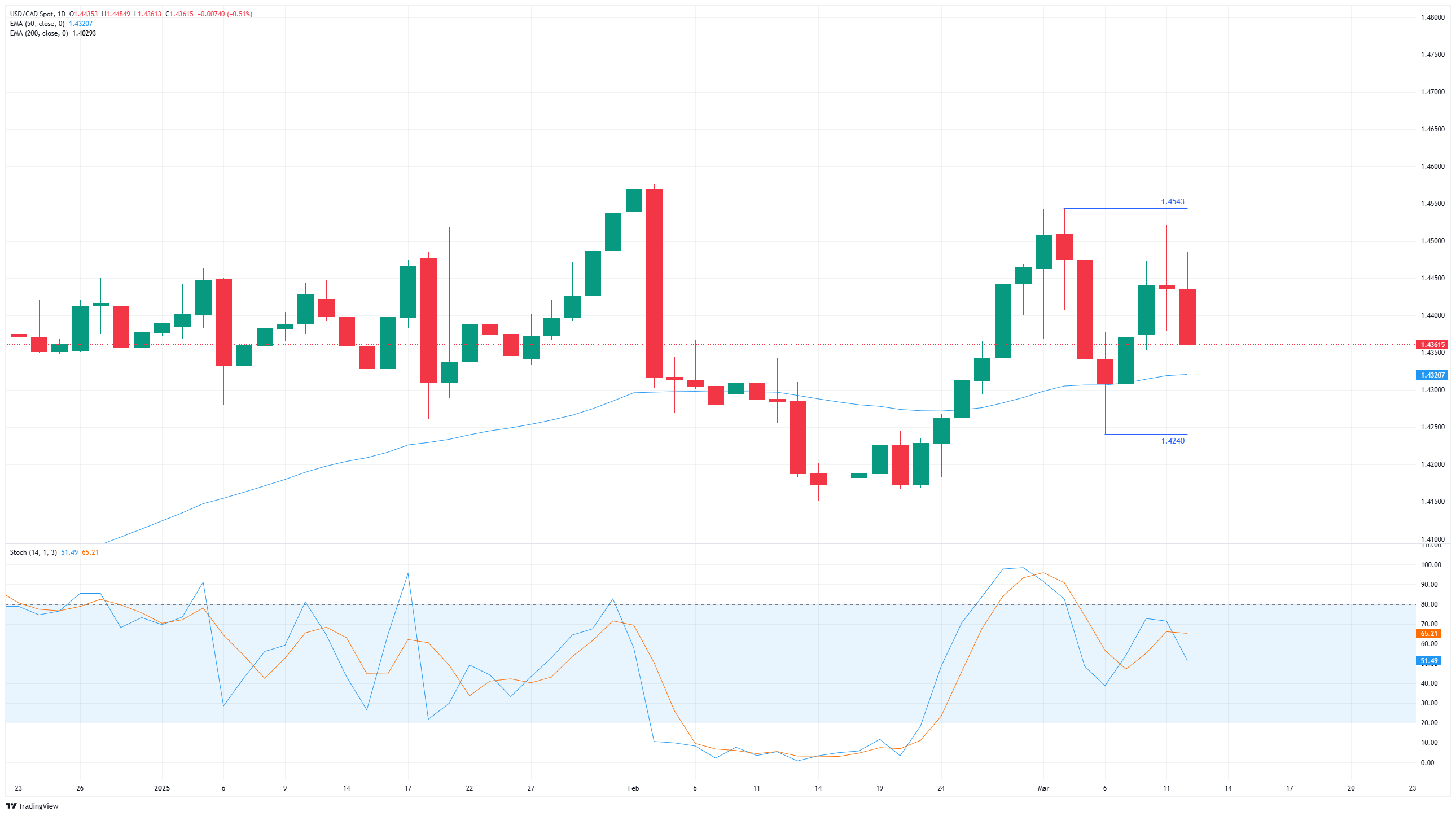
Canadian Dollar FAQs
The key factors driving the Canadian Dollar (CAD) are the level of interest rates set by the Bank of Canada (BoC), the price of Oil, Canada’s largest export, the health of its economy, inflation and the Trade Balance, which is the difference between the value of Canada’s exports versus its imports. Other factors include market sentiment – whether investors are taking on more risky assets (risk-on) or seeking safe-havens (risk-off) – with risk-on being CAD-positive. As its largest trading partner, the health of the US economy is also a key factor influencing the Canadian Dollar.
The Bank of Canada (BoC) has a significant influence on the Canadian Dollar by setting the level of interest rates that banks can lend to one another. This influences the level of interest rates for everyone. The main goal of the BoC is to maintain inflation at 1-3% by adjusting interest rates up or down. Relatively higher interest rates tend to be positive for the CAD. The Bank of Canada can also use quantitative easing and tightening to influence credit conditions, with the former CAD-negative and the latter CAD-positive.
The price of Oil is a key factor impacting the value of the Canadian Dollar. Petroleum is Canada’s biggest export, so Oil price tends to have an immediate impact on the CAD value. Generally, if Oil price rises CAD also goes up, as aggregate demand for the currency increases. The opposite is the case if the price of Oil falls. Higher Oil prices also tend to result in a greater likelihood of a positive Trade Balance, which is also supportive of the CAD.
While inflation had always traditionally been thought of as a negative factor for a currency since it lowers the value of money, the opposite has actually been the case in modern times with the relaxation of cross-border capital controls. Higher inflation tends to lead central banks to put up interest rates which attracts more capital inflows from global investors seeking a lucrative place to keep their money. This increases demand for the local currency, which in Canada’s case is the Canadian Dollar.
Macroeconomic data releases gauge the health of the economy and can have an impact on the Canadian Dollar. Indicators such as GDP, Manufacturing and Services PMIs, employment, and consumer sentiment surveys can all influence the direction of the CAD. A strong economy is good for the Canadian Dollar. Not only does it attract more foreign investment but it may encourage the Bank of Canada to put up interest rates, leading to a stronger currency. If economic data is weak, however, the CAD is likely to fall.
- DXY remains muted as inflation slows faster than expected.
- China and the EU vow retaliation over US tariffs.
- Ukraine-Russia ceasefire deal under discussion.
- US Dollar Index stabilizes in the mid-103.00 area.
The US Dollar steadies on Wednesday, with DXY hovering around 103.50 as traders digest the latest Consumer Price Index (CPI) data. The February inflation report showed both headline and core figures cooling faster than anticipated, reinforcing expectations of softer price pressures ahead of recently imposed United States (US) tariffs. US President Donald Trump was also on the wires, and markets are assessing his words.
Daily digest market movers: Inflation cools, trade tensions rise
- The latest CPI report showed inflation decelerating in February, with both monthly and yearly figures coming in below expectations.
- Monthly headline inflation registered at 0.2%, down from 0.5% in January, while core inflation eased to 0.2%, softer than the expected 0.3%.
- On a yearly basis, headline inflation slipped to 2.8% from 3.0%, while core inflation fell to 3.1% from 3.3%.
- On the global trade front, China reaffirmed plans to retaliate against recent US tariffs, adding to trade concerns.
- EU Commission President Ursula von der Leyen confirmed that the bloc is preparing to impose countermeasures on April 13.
- Diplomatic efforts to end the Ukraine-Russia conflict gained traction, with a potential ceasefire deal brokered by the US now awaiting Russia’s response.
- During a press event with Ireland’s Prime Minister, US President Donald Trump reiterated his grievances over European trade policies, highlighting his intention to impose tariffs on imported cars.
DXY technical outlook: Key support levels in focus
The US Dollar Index (DXY) remains under pressure, holding just above multi-month lows near 103.50. The Relative Strength Index (RSI) and Moving Average Convergence Divergence (MACD) suggest oversold conditions, prompting traders to pause aggressive selling. Despite the recent slump, a break below 103.30 could open the door for further losses, while a rebound above 104.00 may trigger short-term recovery attempts.
Inflation FAQs
Inflation measures the rise in the price of a representative basket of goods and services. Headline inflation is usually expressed as a percentage change on a month-on-month (MoM) and year-on-year (YoY) basis. Core inflation excludes more volatile elements such as food and fuel which can fluctuate because of geopolitical and seasonal factors. Core inflation is the figure economists focus on and is the level targeted by central banks, which are mandated to keep inflation at a manageable level, usually around 2%.
The Consumer Price Index (CPI) measures the change in prices of a basket of goods and services over a period of time. It is usually expressed as a percentage change on a month-on-month (MoM) and year-on-year (YoY) basis. Core CPI is the figure targeted by central banks as it excludes volatile food and fuel inputs. When Core CPI rises above 2% it usually results in higher interest rates and vice versa when it falls below 2%. Since higher interest rates are positive for a currency, higher inflation usually results in a stronger currency. The opposite is true when inflation falls.
Although it may seem counter-intuitive, high inflation in a country pushes up the value of its currency and vice versa for lower inflation. This is because the central bank will normally raise interest rates to combat the higher inflation, which attract more global capital inflows from investors looking for a lucrative place to park their money.
Formerly, Gold was the asset investors turned to in times of high inflation because it preserved its value, and whilst investors will often still buy Gold for its safe-haven properties in times of extreme market turmoil, this is not the case most of the time. This is because when inflation is high, central banks will put up interest rates to combat it. Higher interest rates are negative for Gold because they increase the opportunity-cost of holding Gold vis-a-vis an interest-bearing asset or placing the money in a cash deposit account. On the flipside, lower inflation tends to be positive for Gold as it brings interest rates down, making the bright metal a more viable investment alternative.
- Mexican Peso drives USD/MXN towards the 20.00 figure.
- Tariff uncertainties persist but yield advantage keeps Peso attractive
- US CPI data softer than expected, raising bets on Fed rate cuts and boosting MXN appeal.
- Mexico’s Finance Minister acknowledges economic slowdown amid trade tensions; Industrial data eyed.
The Mexican Peso (MXN) rallies against the US Dollar (USD) on Wednesday as the latest inflation report in the United States (US) could force the Federal Reserve (Fed) to lower borrowing costs, hence widening the interest rate differential between Mexico and the US. At the time of writing, the USD/MXN pair trades at 20.19, down 0.35%.
Mexico’s economic docket remains absent, with traders eyeing the release of Industrial Production figures. Nevertheless, data has taken a backseat as US trade policies drive the financial markets.
Today, the US began applying 25% tariffs to aluminum and steel imports worldwide, without exemptions, including Mexico. Mexican President Claudia Sheinbaum said that she would wait for a resolution in the upcoming weeks, adding “We will wait until April 2 and from then we will see whether our definition of reciprocal tariffs will be applied too.”
Mexican Finance Minister Edgar Amador Zamora said the national economy is expanding but shows signs of slowing down linked to trade tensions with the US.
The US Bureau of Labor Statistics (BLS) revealed that consumer inflation in the US came beneath estimates in headline and underlying figures. Although this is a relief for the Federal Reserve (Fed), concerns that tariffs could be inflation-prone would likely keep the Fed in holding mode as they assess their impact on monetary policy.
Besides this, Fed officials will watch the release of the Producer Price Index (PPI) on Thursday, as some of its data is used to calculate the Core Personal Consumption Expenditures (PCE) Price Index.
Daily digest market movers: Mexican Peso rises boosted by weak US Dollar
- Data in Mexico shows the economy is slowing down, with private economists estimating growth at 0.81%, according to a Banco de Mexico (Banxico) February poll. This and a dismal Consumer Confidence report on Monday suggest that Banxico could lower interest rates at the upcoming March 27 meeting.
- According to Reuters, Mexico's president said on Wednesday that the country's government will not tap its open credit line with the International Monetary Fund (IMF), adding that current economic challenges do not yet require financing from the lender.
- The US Consumer Price Index (CPI) rose 0.2% MoM in February, below the expected 0.3%. On a year-over-year (YoY) basis, inflation eased from 3.0% to 2.8%.
- Core CPI, which excludes volatile food and energy prices, increased 0.2% MoM, slowing from January’s 0.4% and falling short of forecasts. Over the past twelve months, Core CPI declined from 3.3% to 3.1%, signaling further disinflationary progress.
- Money market futures traders had been priced in 74 basis points of easing by the Federal Reserve (Fed) toward the end of the year.
- A Reuters poll showed that 70 out of 74 economists say the risk of recession has risen in the US, Canada and Mexico.
- In the boiler room, trade disputes between the US and Mexico remain front and center. If the countries reach an agreement, it could pave the way for a recovery of the Mexican currency. Otherwise, further USD/MXN upside is seen as US tariffs could trigger a recession in Mexico.
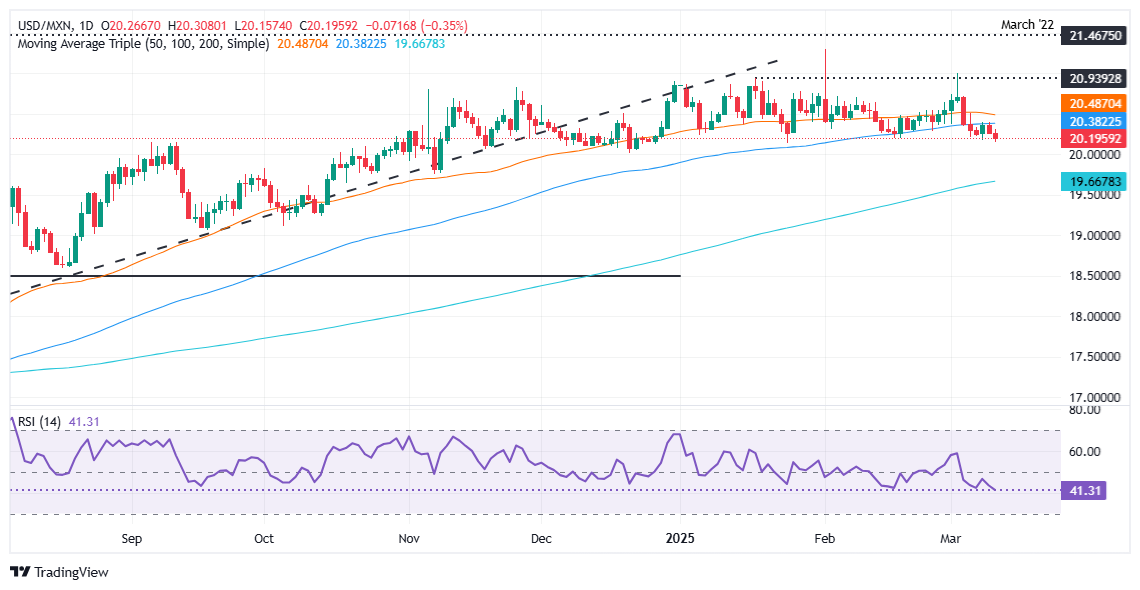
USD/MXN technical outlook: Mexican Peso surges as USD/MXN tumbles below 20.20
USD/MXN finally broke below the 20.20 figure, which opens the door to test the 20.00 figure, as sellers push the spot price below the 100-day Simple Moving Average (SMA) at 20.22. If the pair drops below 20.00, sellers could challenge the 200-day SMA at 19.62.
Conversely, if USD/MXN climbs past the 100-day SMA, buyers could be tempted to challenge the 50-day SMA at 20.47. Once surpassed, the 20.50 mark is up next.
Mexican Peso FAQs
The Mexican Peso (MXN) is the most traded currency among its Latin American peers. Its value is broadly determined by the performance of the Mexican economy, the country’s central bank’s policy, the amount of foreign investment in the country and even the levels of remittances sent by Mexicans who live abroad, particularly in the United States. Geopolitical trends can also move MXN: for example, the process of nearshoring – or the decision by some firms to relocate manufacturing capacity and supply chains closer to their home countries – is also seen as a catalyst for the Mexican currency as the country is considered a key manufacturing hub in the American continent. Another catalyst for MXN is Oil prices as Mexico is a key exporter of the commodity.
The main objective of Mexico’s central bank, also known as Banxico, is to maintain inflation at low and stable levels (at or close to its target of 3%, the midpoint in a tolerance band of between 2% and 4%). To this end, the bank sets an appropriate level of interest rates. When inflation is too high, Banxico will attempt to tame it by raising interest rates, making it more expensive for households and businesses to borrow money, thus cooling demand and the overall economy. Higher interest rates are generally positive for the Mexican Peso (MXN) as they lead to higher yields, making the country a more attractive place for investors. On the contrary, lower interest rates tend to weaken MXN.
Macroeconomic data releases are key to assess the state of the economy and can have an impact on the Mexican Peso (MXN) valuation. A strong Mexican economy, based on high economic growth, low unemployment and high confidence is good for MXN. Not only does it attract more foreign investment but it may encourage the Bank of Mexico (Banxico) to increase interest rates, particularly if this strength comes together with elevated inflation. However, if economic data is weak, MXN is likely to depreciate.
As an emerging-market currency, the Mexican Peso (MXN) tends to strive during risk-on periods, or when investors perceive that broader market risks are low and thus are eager to engage with investments that carry a higher risk. Conversely, MXN tends to weaken at times of market turbulence or economic uncertainty as investors tend to sell higher-risk assets and flee to the more-stable safe havens.
During a public meeting with Ireland's Prime Minister, or Taoiseach, Micheál Martin, United States (US) President Donald Trump took the opportunity to deliver another hodge-podge of comments addressing his usual variety of topics that White House watchers have become increasingly familiar with.
Without sharing any specific details, President Trump declared that the EU has been "tough" on the US in terms of trade, noting that Europeans tend to not buy very many US-produced food products or vehicles. Given the enormous costs of shipping both durable and non-durable goods between two high-income economic zones, as well as prolonged shipping times, the lack of movement of time-sensitive goods such as food and price-sensitive goods such as automobiles is hardly surprising. Donald Trump also reiterated his intent to put tariffs on cars imported into the US, a move which is unlikely to result in a change in manufacturing and instead simply raise the cost of transportation for US citizens.
President Donald also reiterated his stance that Canada is "one of the worst" on dairy tariffs. Donald Trump again failed to note that Canada's high tariffs on dairy are a cap-trade restriction allotted under Trump's own USMCA trade deal that he championed during his first deal, and only kick in after a certain amount of US dairy products are imported into Canada.
To date, the US has never successfully hit the import quotas to active Canada's dairy tariffs, as most US dairy products fail to meet Canadian health and safety standards. Canada also financially protects its own dairy market in order to prevent US-based economic dumping within its borders, a practice that the US itself has a history of vehemently opposing within its own economy.
Key highlights
The latest inflation numbers are 'very good news.'
The EU has been very tough.
We are going to do reciprocal tariffs.
I am very happy that oil is down.
We have people going to Russia now, I hope we can get a ceasefire.
It is up to Russia now.
We have gotten some positive messages on ceasefire.
Weapons today are so powerful, we're working so hard to get this thing finished.
The EU was set up in order to take advantage of the US.
Planning to lower taxes if Democrats behave.
I have the right to adjust tariffs.
April 2nd will be a very big day.
There will be very little flexibility.
Flexibility on tariffs, but there will be very little flexibility once we start.
I will respond to EU counter-tariffs.
Tax policy would stop Ireland from taking business.
Tax policy is to stop other nations from taking business.
There is still a massive deficit, we are going to even that out.
I can pressure Russia, but I hope it won't be necessary.
I can do financial deals that are bad for Russia.
No one is expelling anyone from Gaza.
There is a lot of downside for Russia too.
The EU has gone after our companies like Apple.
I'm not happy with the EU, we'll win that financial battle.
The EU doesn't take US farm products or cars.
Absolutely will put tariffs on cars.
Canada is one of the worst on dairy tariffs.
I have great respect for China’s President Xi.
NATO can be a force for the good.
- The Dow Jones rose early on Wednesday after US CPI inflation cooled faster than expected.
- Market sentiment quickly resumed its sour stance as trade war fears continue to simmer.
- Global tariffs on steel and aluminum imports are set to punish US consumers.
The Dow Jones is down around 150 points on Wednesday, bearing the brunt of broad-market trade war fears as the United States (US) imposes a global 25% tariff on all steel and aluminum imports into the US market. US consumers are set to bear the brunt of the cost burden, and US officials have signaled that further import tariffs will be coming on other key commodities such as copper.
US Consumer Price Index (CPI) inflation cooled even faster than expected in February, with headline CPI inflation falling to 0.2% MoM and 2.8% YoY, declining slightly faster than markets had forecast. The coolish print, while still riding well above the Federal Reserve’s (Fed) 2% target, helped to bolster some confidence that the Fed will remain able to adjust policy rates in the future. According to the CME’s FedWatch Tool, rate markets are pricing in better-than-even odds of the Fed’s next rate cut happening in June, compared to the previous bet of July.
It has been nearly four years since headline US inflation hit “transitory” levels, and outside of a brief lull in Q3 2024, top-of-the-line inflation metrics have remained relatively unchanged from where they sat in June of 2023, when the post-Covid inflation rate initially cooled to 3% on an annualized basis.
Commodity watchers will note that within February’s cooler CPI print, the underlying basket is still flashing some possible warning signs that policymakers may need to deal with in the near future: Gasoline and fuel oil prices generally fell during the reference period, declining 3.1% and 5.1% YoY, respectively, but natural gas prices soared 6% in the aggregate. Inflation estimates for shelter prices also climbed another 4.2% YoY, while a slight 0.3% decline in new vehicle prices masked another acceleration in food price inflation, which rose 2.6% from this time a year ago.
Market bears refused to let the overall cooler CPI print dampen their selling spirits on Wednesday. The Dow Jones shrugged off an initial topside spike early in the day to resume selling off key stocks in the face of the US administration’s new global 25% import tax on all steel and aluminum into the US. Trade war concerns continue to simmer away near the foreground, with US Commerce Secretary Howard Lutnick warning markets that additional protections on copper will likely be in the works.
Dow Jones news
Roughly two-thirds of the Dow Jones Industrial Average tested into the red on Wednesday, with some of the day’s losses getting offset by an upside recovery in battered tech-rally darling Nvidia (NVDA). Nvidia was up 5.6% on the day, clawing its way back to $115 per share ahead of the company’s week-long GTC AI conference.
On the low side, Verizon Communications (VZ) fell 3.3%, slipping below $42 per share. McDonald’s (MCD) also fell 2.7%, dragging the fast food giant down below $300 per share for the first time since early February.
Dow Jones price forecast
Wednesday’s back-and-forth chart action sees the Dow Jones testing new 26-week lows at the 41,000 major price handle, but bidders remain unwilling to give up the fight entirely, marking in a possible technical turnaround point at the key technical figure. The DJIA remains down around 3.5% for the current week, and intraday bids are off of last November’s record highs by over 8% as the Dow Jones inches toward correction territory.
Dow Jones daily chart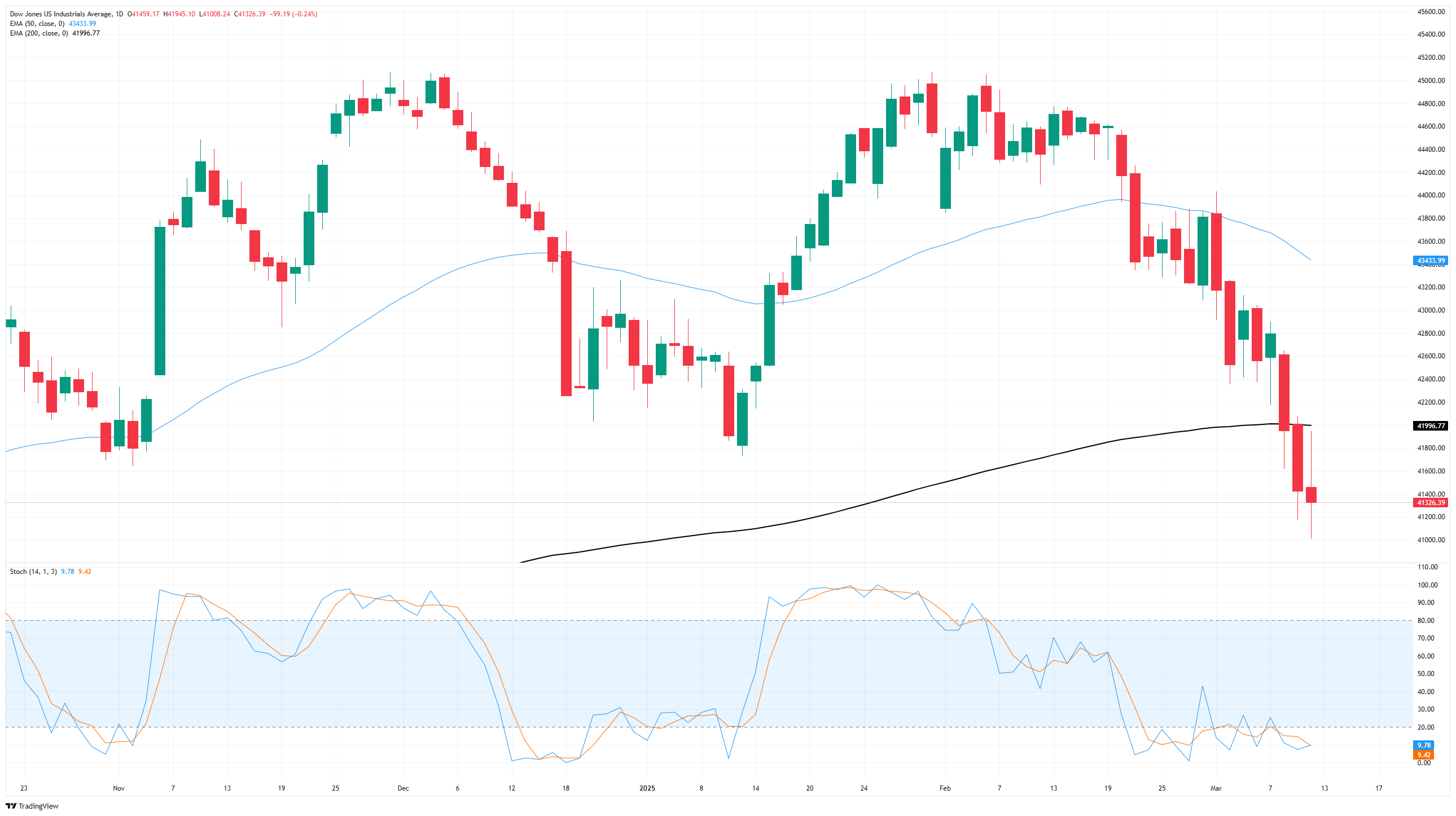
Dow Jones FAQs
The Dow Jones Industrial Average, one of the oldest stock market indices in the world, is compiled of the 30 most traded stocks in the US. The index is price-weighted rather than weighted by capitalization. It is calculated by summing the prices of the constituent stocks and dividing them by a factor, currently 0.152. The index was founded by Charles Dow, who also founded the Wall Street Journal. In later years it has been criticized for not being broadly representative enough because it only tracks 30 conglomerates, unlike broader indices such as the S&P 500.
Many different factors drive the Dow Jones Industrial Average (DJIA). The aggregate performance of the component companies revealed in quarterly company earnings reports is the main one. US and global macroeconomic data also contributes as it impacts on investor sentiment. The level of interest rates, set by the Federal Reserve (Fed), also influences the DJIA as it affects the cost of credit, on which many corporations are heavily reliant. Therefore, inflation can be a major driver as well as other metrics which impact the Fed decisions.
Dow Theory is a method for identifying the primary trend of the stock market developed by Charles Dow. A key step is to compare the direction of the Dow Jones Industrial Average (DJIA) and the Dow Jones Transportation Average (DJTA) and only follow trends where both are moving in the same direction. Volume is a confirmatory criteria. The theory uses elements of peak and trough analysis. Dow’s theory posits three trend phases: accumulation, when smart money starts buying or selling; public participation, when the wider public joins in; and distribution, when the smart money exits.
There are a number of ways to trade the DJIA. One is to use ETFs which allow investors to trade the DJIA as a single security, rather than having to buy shares in all 30 constituent companies. A leading example is the SPDR Dow Jones Industrial Average ETF (DIA). DJIA futures contracts enable traders to speculate on the future value of the index and Options provide the right, but not the obligation, to buy or sell the index at a predetermined price in the future. Mutual funds enable investors to buy a share of a diversified portfolio of DJIA stocks thus providing exposure to the overall index.
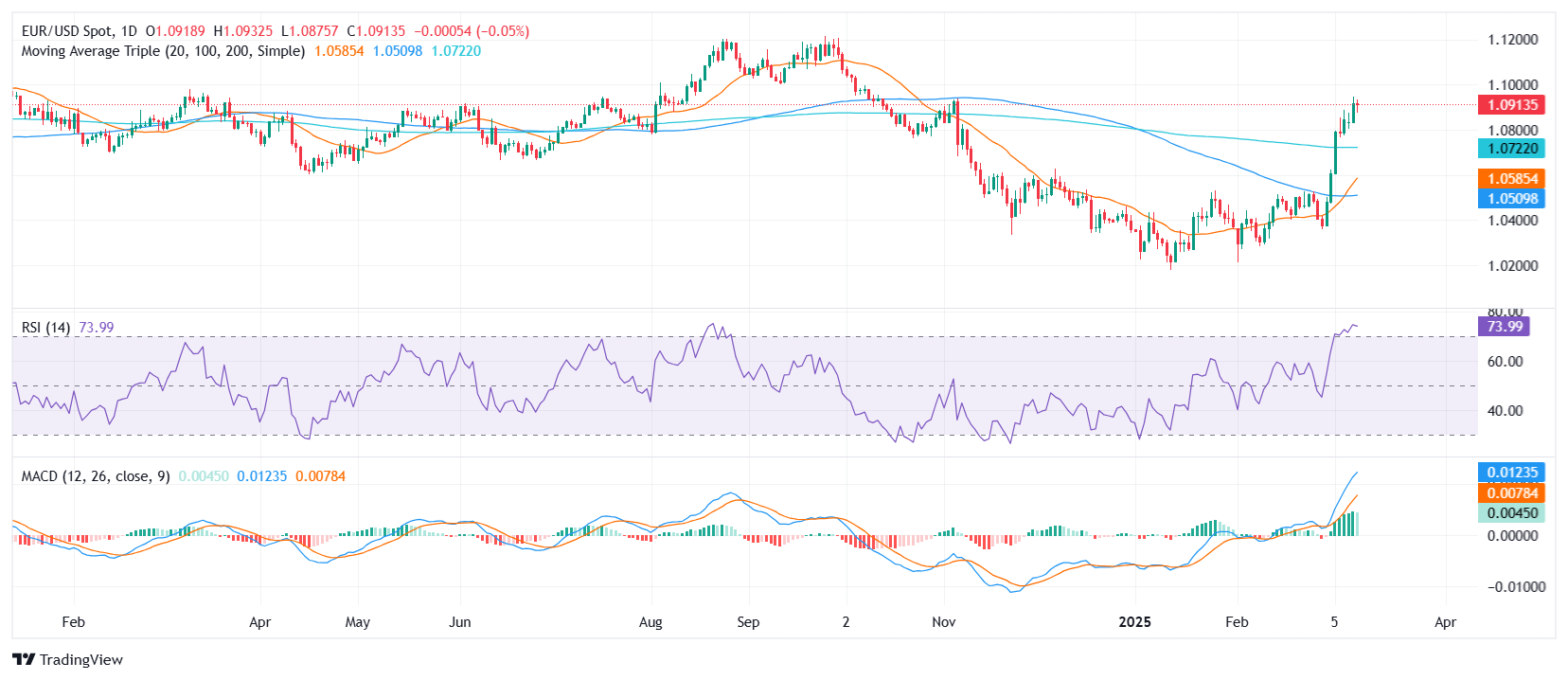
- EUR/USD was seen trading around the 1.0900 area after the European session, moving sideways with neutral momentum.
- Despite recent strong gains, the pair struggles to extend higher as overbought conditions weigh on momentum.
The EUR/USD pair traded with a neutral tone on Wednesday after the European session, hovering around the 1.0900 mark as market participants took a step back following its strong rally. The pair appears to be consolidating as bulls hesitate near recent highs, lacking strong momentum to push further.
From a technical perspective, the Relative Strength Index (RSI) remains in overbought territory but has started to flatten, signaling a pause in buying pressure. Meanwhile, the Moving Average Convergence Divergence (MACD) continues to print green bars, suggesting that the overall bullish trend remains intact. However, the lack of immediate follow-through from buyers indicates that further gains may not be imminent.
Looking at key levels, immediate resistance is found at 1.0930, while a decisive break above this level could open the door toward 1.0980. On the downside, initial support lies near 1.0850, with stronger buying interest likely around the 200-day Simple Moving Average (SMA) at 1.0720.
EUR/USD daily chart
- US inflation eases to 3.1% YoY (core), boosting Fed rate-cut expectations.
- 25% tariffs remain a risk factor; further UK rate cuts could cap Sterling's gains.
- Traders look toward US PPI on Thursday and UK GDP release for direction.
The Pound Sterling depreciated against the US Dollar on Wednesday as US inflation data revealed the disinflation process continued. At the time of writing, the GBP/USD trades at 1.2925, down 0.13%.
Sterling dips to 1.2925 amid cautious market reaction to US CPI report
In February, the US Consumer Price Index (CPI) was below the estimated 0.3% and rose by 0.2% MoM. On a yearly basis, CPI dipped from 3% to 2.8%. Excluding volatile items, the so-called Core CPI expanded by 0.2% MoM, down from 0.4% in January, beneath forecast, and in the twelve months to February, slid from 3.3% to 3.1%.
The GBP/USD spiked on the data release but retreated to 1.2920 as traders digested the news.
Although the data was positive, fears of an inflation reacceleration loom due to tariffs imposed on goods imported to the US. Today, 25% tariffs on aluminum and steel are in effect, with no exceptions.
Money market futures traders had been priced in 74 basis points of easing by the Federal Reserve (Fed) toward the end of the year. Hence, further GBP/USD upside is seen unless the Bank of England (BoE) cuts rates more aggressively than the Fed or next month’s CPI data comes hotter than today’s, which would put downward pressure on the pair.
The US economic docket will feature the Producer Price Index (PPI) for the same period as today’s CPI and Initial Jobless Claims data. Traders brace for Gross Domestic Product (GDP) figures in the UK on Friday.
GBP/USD Price Forecast: Technical outlook
GBP/USD is set to continue its uptrend despite today’s dip on US inflation data. The Relative Strength Index (RSI) shows that buyers are taking a respite, as the RSI is overbought. If the pair clears 1.2950, the next resistance would be 1.3000. Once surpassed, the next stop would be November’s 6 high at 1.3047. However, if GBP/USD turns downward and clears 1.2900, a test of the 200-day Simple Moving Average (SMA) at 1.2790 is on the cards.
British Pound PRICE Today
The table below shows the percentage change of British Pound (GBP) against listed major currencies today. British Pound was the strongest against the Japanese Yen.
| USD | EUR | GBP | JPY | CAD | AUD | NZD | CHF | |
|---|---|---|---|---|---|---|---|---|
| USD | 0.05% | 0.03% | 0.37% | -0.23% | 0.04% | -0.00% | 0.00% | |
| EUR | -0.05% | -0.03% | 0.32% | -0.24% | -0.02% | -0.06% | -0.04% | |
| GBP | -0.03% | 0.03% | 0.35% | -0.25% | 0.00% | -0.03% | -0.02% | |
| JPY | -0.37% | -0.32% | -0.35% | -0.59% | -0.32% | -0.37% | -0.34% | |
| CAD | 0.23% | 0.24% | 0.25% | 0.59% | 0.27% | 0.22% | 0.25% | |
| AUD | -0.04% | 0.02% | -0.01% | 0.32% | -0.27% | -0.04% | 0.00% | |
| NZD | 0.00% | 0.06% | 0.03% | 0.37% | -0.22% | 0.04% | 0.02% | |
| CHF | -0.01% | 0.04% | 0.02% | 0.34% | -0.25% | -0.01% | -0.02% |
The heat map shows percentage changes of major currencies against each other. The base currency is picked from the left column, while the quote currency is picked from the top row. For example, if you pick the British Pound from the left column and move along the horizontal line to the US Dollar, the percentage change displayed in the box will represent GBP (base)/USD (quote).
Mark Carney, the candidate who has been tapped to replace incumbent Prime Minister Justin Trudeau, has signalled that he and the Canadian administration responsible for cross-border discussions are ready and prepared to begin holding meetings with their US counterparts, and US President Donald Trump specifically to discuss trade matters. However, incoming PM Carney has fired a shot across Trump's bow, warning that Canada may not be coming to the talks table with the somber, begging approach that President Trump may be hoping for. Future-PM Carney noted that Trump is expected to respect Canada's sovereignty as the nation remains unavailable and uninterested in being 'acquired' by the US.
Key highlights
We are ready to sit down with the US government and with Trump to discuss tariffs and trade.
I am ready to meet with Trump, looking for a common approach.
I'm ready to sit down with Trump at the appropriate time, when there's respect for Canadian sovereignty.
- USD/CAD looks for an interim support near 1.4400 after the release of the US inflation data for February and the BoC’s monetary policy decision.
- Cooling US inflation is expected to prompt Fed dovish bets.
- The BoC cut interest rates by 25 bps to 2.75%, as expected, and guided a dismal economic outlook.
The USD/CAD pair looks for temporary support near the key level of 1.4400 during North American trading hours on Wednesday after the release of the United States (US) Consumer Price Index (CPI) data for February and the Bank of Canada’s (BoC) interest rate decision.
The US CPI report showed that year-on-year headline and core inflation decelerated at a faster-than-expected pace to 2.8% and 3.1%, respectively. On a monthly basis, both headline and core CPI rose at a moderate pace of 0.2%, compared to estimates of 0.3%. The US Dollar Index (DXY), which tracks the Greenback’s value against six major currencies, moved higher to near 103.75 after the US inflation data release from the four-month low of 103.20 refreshed on Tuesday.
The recovery move in the Greenback appears to be short-lived as cooling inflationary pressures is the unfavorable scenario for the US Dollar (USD), knowing that soft inflation data boosts Federal Reserve (Fed) dovish bets.
Meanwhile, the Canadian Dollar (CAD) gained after the BoC reduced its key borrowing rates by 25 basis points (bps) to 2.75%, as expected. Traders were increasingly confident about the BoC easing its monetary policy further amid growing worries over the Canadian economic outlook due to the tariff war with the US.
Canadian Dollar PRICE Today
The table below shows the percentage change of Canadian Dollar (CAD) against listed major currencies today. Canadian Dollar was the strongest against the Japanese Yen.
| USD | EUR | GBP | JPY | CAD | AUD | NZD | CHF | |
|---|---|---|---|---|---|---|---|---|
| USD | 0.22% | 0.17% | 0.45% | -0.13% | 0.24% | 0.25% | 0.09% | |
| EUR | -0.22% | -0.06% | 0.19% | -0.35% | 0.00% | 0.03% | -0.13% | |
| GBP | -0.17% | 0.06% | 0.27% | -0.29% | 0.07% | 0.09% | -0.07% | |
| JPY | -0.45% | -0.19% | -0.27% | -0.57% | -0.21% | -0.20% | -0.34% | |
| CAD | 0.13% | 0.35% | 0.29% | 0.57% | 0.37% | 0.38% | 0.23% | |
| AUD | -0.24% | -0.00% | -0.07% | 0.21% | -0.37% | 0.02% | -0.13% | |
| NZD | -0.25% | -0.03% | -0.09% | 0.20% | -0.38% | -0.02% | -0.15% | |
| CHF | -0.09% | 0.13% | 0.07% | 0.34% | -0.23% | 0.13% | 0.15% |
The heat map shows percentage changes of major currencies against each other. The base currency is picked from the left column, while the quote currency is picked from the top row. For example, if you pick the Canadian Dollar from the left column and move along the horizontal line to the US Dollar, the percentage change displayed in the box will represent CAD (base)/USD (quote).
On Tuesday, Canada’s Ontario Premier Doug Ford agreed to roll back the 25% surcharge levied on electricity exported to the US after President Donald Trump threatened to impose additional 25% tariffs on imports of aluminum and steel from Canada. Earlier this month, Trump imposed 25% tariffs on Canada for allowing drugs into the US through borders.
After the policy decision, Boc Governor Tiff Macklem warned that heightened “trade tensions” could disrupt “job market recovery”. Macklem warned that US tariffs will likely “increase inflationary pressures in Canada and curb growth”. He guided a moderate growth in the January-March period as trade conflict weighs on “sentiment and activity”.
- USD/JPY soars to near 149.00 as the US Dollar gains after soft US inflation data for February.
- Cooling US inflation is expected to boost Fed dovish bets.
- The Japanese Yen underperforms despite Japan’s firms agreed for further wage hikes.
The USD/JPY pair surges to near 149.20 during North American trading hours on Wednesday. The asset strengthens as the US Dollar (USD) gains slightly despite the release of the softer-than-expected United States (US) Consumer Price Index (CPI) report for February. The US Dollar Index (DXY), which tracks the Greenback’s value against six major currencies, advances to near 103.75 from an over four-month low of 103.20 posted on Tuesday.
US Dollar PRICE Today
The table below shows the percentage change of US Dollar (USD) against listed major currencies today. US Dollar was the strongest against the Japanese Yen.
| USD | EUR | GBP | JPY | CAD | AUD | NZD | CHF | |
|---|---|---|---|---|---|---|---|---|
| USD | 0.33% | 0.12% | 0.68% | -0.18% | 0.14% | 0.18% | 0.15% | |
| EUR | -0.33% | -0.20% | 0.37% | -0.51% | -0.20% | -0.15% | -0.19% | |
| GBP | -0.12% | 0.20% | 0.58% | -0.29% | 0.02% | 0.06% | 0.03% | |
| JPY | -0.68% | -0.37% | -0.58% | -0.85% | -0.53% | -0.50% | -0.52% | |
| CAD | 0.18% | 0.51% | 0.29% | 0.85% | 0.32% | 0.36% | 0.33% | |
| AUD | -0.14% | 0.20% | -0.02% | 0.53% | -0.32% | 0.04% | 0.02% | |
| NZD | -0.18% | 0.15% | -0.06% | 0.50% | -0.36% | -0.04% | -0.03% | |
| CHF | -0.15% | 0.19% | -0.03% | 0.52% | -0.33% | -0.02% | 0.03% |
The heat map shows percentage changes of major currencies against each other. The base currency is picked from the left column, while the quote currency is picked from the top row. For example, if you pick the US Dollar from the left column and move along the horizontal line to the Japanese Yen, the percentage change displayed in the box will represent USD (base)/JPY (quote).
The US CPI report showed that the headline inflation rose by 2.8%, slower than estimates of 2.9% and the 3% increase seen in January. The core CPI – which excludes volatile food and energy prices – cooled down to 3.1% from the prior reading of 3.3%. Economists projected a slowdown in the underlying inflation data but at a moderate pace to 3.2%. On month, both headline and core CPI grew by 0.2%, slower than expectations of 0.3%.
Cooling inflationary pressures are expected to force traders to raise bets supporting the Federal Reserve (Fed) to reduce interest rates in the May meeting. On Friday, Fed Chair Jerome Powell said that the restrictive monetary policy stance won’t long last “if labor market unexpectedly weakens or inflation falls more than expected”.
The outlook of the US Dollar remains weak in past few weeks as investors see US President Doanald Trump’s tariff agenda leading to an economic slowdown, assuming that higher import duties would lead to a sharp decline in the purchasing power of households.
Meanwhile, the Japanese Yen (JPY) is underperforming its peers even though big Japanese firms have agreed to substantial wage hikes for the third year in a row, Reuters report. Such a scenario would boost inflation expectations and bets supporting the Bank of Japan (BoJ) to raise interest rates again this year.
US Dollar FAQs
The US Dollar (USD) is the official currency of the United States of America, and the ‘de facto’ currency of a significant number of other countries where it is found in circulation alongside local notes. It is the most heavily traded currency in the world, accounting for over 88% of all global foreign exchange turnover, or an average of $6.6 trillion in transactions per day, according to data from 2022. Following the second world war, the USD took over from the British Pound as the world’s reserve currency. For most of its history, the US Dollar was backed by Gold, until the Bretton Woods Agreement in 1971 when the Gold Standard went away.
The most important single factor impacting on the value of the US Dollar is monetary policy, which is shaped by the Federal Reserve (Fed). The Fed has two mandates: to achieve price stability (control inflation) and foster full employment. Its primary tool to achieve these two goals is by adjusting interest rates. When prices are rising too quickly and inflation is above the Fed’s 2% target, the Fed will raise rates, which helps the USD value. When inflation falls below 2% or the Unemployment Rate is too high, the Fed may lower interest rates, which weighs on the Greenback.
In extreme situations, the Federal Reserve can also print more Dollars and enact quantitative easing (QE). QE is the process by which the Fed substantially increases the flow of credit in a stuck financial system. It is a non-standard policy measure used when credit has dried up because banks will not lend to each other (out of the fear of counterparty default). It is a last resort when simply lowering interest rates is unlikely to achieve the necessary result. It was the Fed’s weapon of choice to combat the credit crunch that occurred during the Great Financial Crisis in 2008. It involves the Fed printing more Dollars and using them to buy US government bonds predominantly from financial institutions. QE usually leads to a weaker US Dollar.
Quantitative tightening (QT) is the reverse process whereby the Federal Reserve stops buying bonds from financial institutions and does not reinvest the principal from the bonds it holds maturing in new purchases. It is usually positive for the US Dollar.
Pound Sterling (GBP) is down slightly on the session, but price moves largely reflect the broader tone on the USD, Scotiabank's Chief FX Strategist Shaun Osborne notes.
UK forgoes US steel tariff response
"The UK has decided against snap retaliation against US steel tariffs and will instead push for broader talks on trade to avoid additional measures."
"Cable continues to consolidate around Fib retracement resistance in the low 1.29 zone. Short-term trend momentum remains bullish, suggesting limited scope for GBP losses now; look for support at 1.2875/80. Resistance (bull break out trigger) is 1.2975."
The Euro (EUR) peaked around 1.0950 yesterday vs US Dollar (USD), helped in part by news of progress in Ukraine peace talks, Scotiabank's Chief FX Strategist Shaun Osborne notes.
EU announces retaliatory tariffs
"Spot drifted off the intraday high into the close and is trading little changed on the session. The EU’s retaliatory tariffs target EUR26bn worth of US imports, largely from Republican states in a replay of the EU’s 2018 tactics. The tariffs apply from April 1. The EUR retains a firm undertone overall and continues to trade a little below my FV estimate (1.0983) at present."
"The EUR is consolidating. A minor peak may have formed at 1.0947 yesterday but the underlying trend higher in the EUR remains strong and scope for EUR losses may be limited, given the recent pattern of trade where strong advances have been followed by brief consolidations before gains resume. Look for support on EUR dips to the mid/upper 1.08s. Intraday support is 1.0840/45."
The Canadian Dollar (CAD) is moderately higher (with the MXN) as 25% steel/aluminum tariffs were enforced as of midnight. Yesterday’s swings in spot reflected the ebb and flow of tariff headlines and there is unlikely to be any escape from that issue for some time. Thankfully, an off ramp was found amid yesterday’s flurry of threats and counter-threats but ultimately, US manufacturers are still facing a significant jump in input costs from tariffs, Scotiabank's Chief FX Strategist Shaun Osborne notes.
CAD steady ahead of BoC policy decision as steel tariffs land
"Canada is one of the primary sources of aluminum for the US. Bellicose trade talk will ensure that the Bank of Canada has to keep the door open to lower rates down the road. Assuming a 25bps cut at today’s policy decision, taking the Target rate to 2.75%, markets are pricing in roughly 50bps of additional easing, putting the policy rate in the 2.25% area by late this year. A cut and a cautiously dovish bias today are largely priced in to markets at this point."
"USD/CAD is likely to continue range trading between 1.4350/1.4550 for now. Price signals suggest some resiliency in the CAD despite all the recent volatility in the market. USD/CAD closed little changed on the day yesterday and the “doji” candle signal that formed on the daily chart suggests the USD’s push into the low 1.45 area has stalled (close to where early March USD gains peaked)."
"A look at the intraday chart supports the idea of a short-term USD peak at least, with the USD carving out a bearish outside range around yesterday’s peak on the 6-hour chart. There should be firm resistance now at 1.4525/50 but there may also be a bias towards a modest pickup in the CAD towards support at 1.4400/05. A push below here targets 1.4350/75."
The US Dollar (USD) is trading a little higher overall on the session, but gains are limited and price action suggests the DXY is consolidating recent losses, rather than reversing, at this point, Scotiabank's Chief FX Strategist Shaun Osborne notes.
USD consolidates recent losses but focus on growth/yields remains
"Stock market sentiment has improved a little, despite US steel and aluminum tariffs coming into force and the EU announcing retaliatory measures on some US goods. Global bonds are steady (Treasurys) to slightly softer (European debt) while crude oil is a little firmer on the session."
"More generally, steadier stocks—now the S&P 500 has reached 'correction' territory—may help the USD stabilize for the moment. The USD moves inversely with equities more typically as heightened equity volatility usually drives 'haven' demand for it."
"Equity market losses, reflecting a ratcheting up of tariff threats, is very much a 'made in the USA' issue so the USD may trade more in line with equity sentiment for now. A further drop in the US main averages after the S&P’s cumulative 10% drop from the February high, will add to USD headwinds as investors reconsider the 'US exceptionalism' narrative."
- The US Dollar trades broadly flat and stabilizes after a downbeat day on Tuesday.
- Traders brace for the February US CPI release on Wednesday.
- The US Dollar Index holds in the mid-103.00 area after bouncing off a pivotal level.
The US Dollar Index (DXY), which tracks the performance of the US Dollar (USD) against six major currencies, trades broadly flat and stabilizes on Wednesday while traders await the United States (US) Consumer Price Index (CPI) release for February. The consensus view is that the monthly and yearly gauges on the core and headline inflation data should ease a little from previous readings. That consensus view will be an interesting match with the analysts’ and economists’ forecasts, who have been eagerly releasing comments over the past few weeks that US President Donald Trump’s tariffs are inflationary.
On the geopolitical front, China again vowed to retaliate on US tariffs. Meanwhile, Europe is set to issue countermeasures on April 13, European Union (EU) leader Ursula Von Der Leyen said this Wednesday. Overnight headlines emerged on the Ukraine-Russia war, where a ceasefire truce is on the table after Ukraine agreed to a brokered deal by the US. The ball is now in the court of Russia to support or refuse it.
Daily digest market movers: Last CPI as an anomaly
- At 12:30 GMT, the US Consumer Price Index (CPI) report for February will be released:
- The monthly headline inflation is expected to ease to 0.3% from 0.5% in January. Core inflation is set to ease to 0.3% from 0.4% previously.
- The yearly headline reading is expected to decelerate to 2.9% from 3.0% in January. The core gauge is set to soften to 3.2% from 3.3% the previous month.
- A much softer reading in inflation data should boost rate-cut bets for the Federal Reserve (Fed) and result in another drop in the US Dollar.
- Around 17:00 GMT, the US Treasury will auction a 10-year Note.
- At 17:35 GMT, St. Louis Fed President Alberto Musalem will speak at the NABE Economic Policy Conference in Washington, D.C.
- Equities are enjoying a big sigh of relief with a ceasefire deal on the table for Ukraine. In Europe, all indices are up over 1%.
- The CME Fedwatch Tool projects a 97.0% chance for no interest rate changes in the upcoming Fed meeting on March 19. The chances of a rate cut at the May 7 meeting stand at 37.6% and 81.7% at June’s meeting.
- The US 10-year yield trades around 4.27%, off its near five-month low of 4.10% printed on March 4.
US Dollar Index Technical Analysis: Not a one-day event
The US Dollar Index (DXY) still faces potential selling pressure as recession fears remain. Traders are concerned about tariffs’ impact and uncertainty on the US economy. A softer inflation reading could help take away the recession fear, though it would still result in a weaker US Dollar with an increasing Federal Reserve’s rate cut bets and a declining rate differential with other countries as main drivers.
Upside risk is the fear of a rejection at 104.00 that could result in more downturn. If bulls can avoid that, look for a large sprint higher towards the 105.00 round level, with the 200-day Simple Moving Average (SMA) at 105.03. Once broken through that zone, a string of pivotal levels, such as 105.53 and 105.89, will present as caps.
On the downside, the 103.00 round level could be considered a bearish target in case US yields roll off again, with even 101.90 not unthinkable if markets further capitulate on their long-term US Dollar holdings.
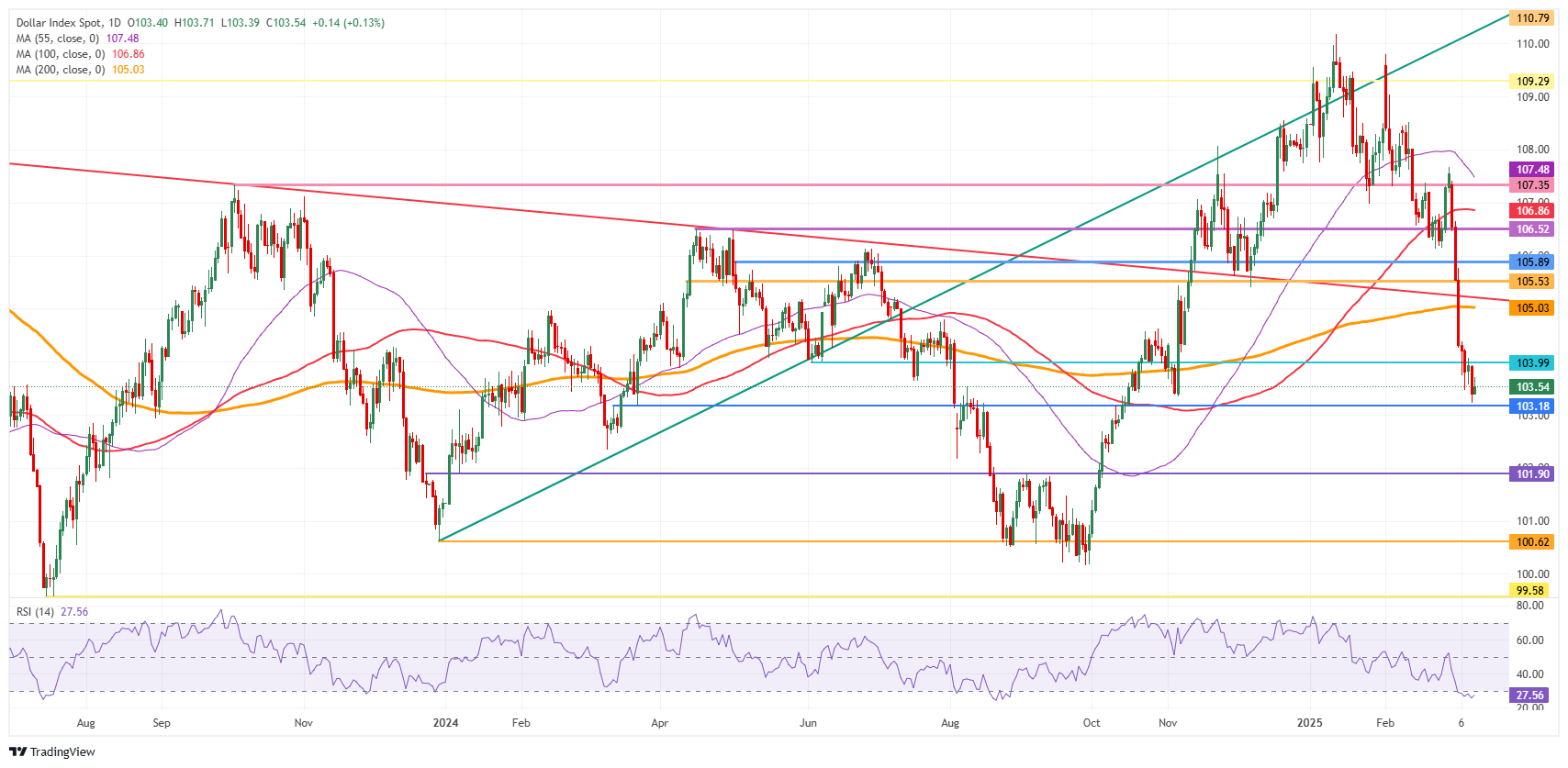
US Dollar Index: Daily Chart
US Dollar FAQs
The US Dollar (USD) is the official currency of the United States of America, and the ‘de facto’ currency of a significant number of other countries where it is found in circulation alongside local notes. It is the most heavily traded currency in the world, accounting for over 88% of all global foreign exchange turnover, or an average of $6.6 trillion in transactions per day, according to data from 2022. Following the second world war, the USD took over from the British Pound as the world’s reserve currency. For most of its history, the US Dollar was backed by Gold, until the Bretton Woods Agreement in 1971 when the Gold Standard went away.
The most important single factor impacting on the value of the US Dollar is monetary policy, which is shaped by the Federal Reserve (Fed). The Fed has two mandates: to achieve price stability (control inflation) and foster full employment. Its primary tool to achieve these two goals is by adjusting interest rates. When prices are rising too quickly and inflation is above the Fed’s 2% target, the Fed will raise rates, which helps the USD value. When inflation falls below 2% or the Unemployment Rate is too high, the Fed may lower interest rates, which weighs on the Greenback.
In extreme situations, the Federal Reserve can also print more Dollars and enact quantitative easing (QE). QE is the process by which the Fed substantially increases the flow of credit in a stuck financial system. It is a non-standard policy measure used when credit has dried up because banks will not lend to each other (out of the fear of counterparty default). It is a last resort when simply lowering interest rates is unlikely to achieve the necessary result. It was the Fed’s weapon of choice to combat the credit crunch that occurred during the Great Financial Crisis in 2008. It involves the Fed printing more Dollars and using them to buy US government bonds predominantly from financial institutions. QE usually leads to a weaker US Dollar.
Quantitative tightening (QT) is the reverse process whereby the Federal Reserve stops buying bonds from financial institutions and does not reinvest the principal from the bonds it holds maturing in new purchases. It is usually positive for the US Dollar.
- AUD/USD consolidates below 0.6300 as investors await the US CPI data for February.
- The US Dollar has remained under pressure amid deepening US economic risks.
- The US-China trade war has diminished the appeal of the Australian Dollar.
The AUD/USD pair trades in a tight range below the key level of 0.6300 in Wednesday’s European session. The Aussie pair consolidates as investors await the United States (US) Consumer Price Index (CPI) data for February, which will be published at 12:30 GMT.
Investors await the US inflation data to get fresh cues about whether the Fed will cut interest rates in the May meeting. In the policy meeting next week, the Fed is almost certain to keep interest rates steady in the range of 4.25%-4.50%. According to the CME FedWatch tool, there is a 42% chance that the central bank will cut interest rates in May, increased significantly from 10.4% seen a month ago.
The US CPI report is expected to show that year-on-year headline inflation rose at a slower pace of 2.9%, compared to a 3% increase seen in January. In the same period, the core CPI – which excludes volatile food and energy prices – is expected to have decelerated to 3.2% from the prior release of 3.3%.
Ahead of the US inflation data, the US Dollar Index (DXY) is marginally higher from its four-month low of 103.35. The US Dollar (USD) has remained on the backfoot as investors worry about the US economic outlook under the leadership of President Donald Trump. On Tuesday, the comments from US Commerce Secretary Howard Lutnick indicated that Trump's policies are worth fears that they could lead to a recession.
Meanwhile, the upside in the Australian Dollar (AUD) remains capped amid fears that the US-China trade war could result in a sharp decline in Australia’s business activity, knowing that Australia relies heavily on exports to China. Till now, the US has imposed 20% tariffs on imports from China.
US Dollar FAQs
The US Dollar (USD) is the official currency of the United States of America, and the ‘de facto’ currency of a significant number of other countries where it is found in circulation alongside local notes. It is the most heavily traded currency in the world, accounting for over 88% of all global foreign exchange turnover, or an average of $6.6 trillion in transactions per day, according to data from 2022. Following the second world war, the USD took over from the British Pound as the world’s reserve currency. For most of its history, the US Dollar was backed by Gold, until the Bretton Woods Agreement in 1971 when the Gold Standard went away.
The most important single factor impacting on the value of the US Dollar is monetary policy, which is shaped by the Federal Reserve (Fed). The Fed has two mandates: to achieve price stability (control inflation) and foster full employment. Its primary tool to achieve these two goals is by adjusting interest rates. When prices are rising too quickly and inflation is above the Fed’s 2% target, the Fed will raise rates, which helps the USD value. When inflation falls below 2% or the Unemployment Rate is too high, the Fed may lower interest rates, which weighs on the Greenback.
In extreme situations, the Federal Reserve can also print more Dollars and enact quantitative easing (QE). QE is the process by which the Fed substantially increases the flow of credit in a stuck financial system. It is a non-standard policy measure used when credit has dried up because banks will not lend to each other (out of the fear of counterparty default). It is a last resort when simply lowering interest rates is unlikely to achieve the necessary result. It was the Fed’s weapon of choice to combat the credit crunch that occurred during the Great Financial Crisis in 2008. It involves the Fed printing more Dollars and using them to buy US government bonds predominantly from financial institutions. QE usually leads to a weaker US Dollar.
Quantitative tightening (QT) is the reverse process whereby the Federal Reserve stops buying bonds from financial institutions and does not reinvest the principal from the bonds it holds maturing in new purchases. It is usually positive for the US Dollar.
Today, focus in CAD FX space turns to the BoC meeting at 14:45 CET - where markets and consensus favour a 25bp rate cut, Danske Bank's FX analysts Kristoffer Kjær Lomholt and Filip Andersson report.
Any easing on tariffs to act as a CAD positive
"We also anticipate a 25bp rate cut, bringing the policy rate to 2.75%, as we expect the BoC to ensure that the Canadian economy is well-padded against the impact of US tariffs. Note that it is an interim meeting without a new MPR, but focus will remain on tariffs, which continues to weigh heavily on USD/CAD."
"This was evident in yesterday's session, with the cross surpassing the 1.45-mark following Trump's remarks about doubling tariffs on all imported steel and aluminium products from Canada after Ontario announced that it would maintain its electricity levy until US tariffs were removed."
"However, the pair concluded the session lower around 1.44 amid news that Trump is 'probably' going to reduce the recently increased tariffs on Canada after Ontario suspended its surcharge on electricity exports to the US. We forecast USD/CAD to tick down to 1.41 in the near term, given stretched short CAD positioning and further USD-weakness. Any easing on tariffs would act as a CAD positive, while more hawkish tones from the BoC would also support our short-term view."
EUR/USD has edged slightly higher over the last 24 hours, with the EUR and European currencies broadly outperforming in the G10 space amid rising optimism that Germany's debt package will be approved, Danske Bank's FX analysts Kristoffer Kjær Lomholt and Filip Andersson report.
EUR and European currencies outperform in the G10 space
"Yesterday's US JOLTS job openings came in slightly above consensus at 7,740k (cons.: 7,600k) but saw negative revisions, leaving the data largely in line with expectations."
"Trump's announcement of an additional 25% tariff on all steel and aluminium imports from Canada, effective today, had remarkably little market impact - reinforcing the view that tariff announcements hold diminishing significance for markets."
"Today, the focus shifts to US CPI. We expect headline inflation at +0.2% m/m SA and core at +0.3% m/m SA - slightly below consensus for the headline print. However, this is not a high-conviction call, as the impact of tariffs remains difficult to quantify."
The tactical short USD/JPY spot trade from FX Top Trades 2025, initiated on 13 January, has reached its soft target of 147.00, Danske Bank's FX analysts Kristoffer Kjær Lomholt and Filip Andersson report.
Little room for further downside in long-end US yields
"While we initially intended to keep the trade open and adjusted the soft target to 145.00, we have decided to close the position booking a 5.7% profit, including a negative carry of -0.57%."
"While we still favour short USD/JPY on a strategic basis, the pair has remained steady in the 147-148 range despite declining US yields and risk-off sentiment - typically JPY-positive factors - suggesting that further tactical downside may be limited for now."
"Additionally, in our view, there is little room for further downside in long-end US yields, and as such, we believe closing this trade is the prudent move."
USD/CAD broke out from its multiyear range and experienced an extended uptrend, Société Générale's FX analysts note.
A move towards 1.4240 and 1.4150 can’t be ruled out
"The move has faced strong resistance near 1.4800 last month. A phase of consolidation is under way after this test. The pair has so far carved out a lower high near 1.4550, the 61.8% retracement of the first leg of pullback."
"However, signals of a large decline are not yet visible. Low achieved earlier this week at 1.4350 is first support. If this is breached, a deeper down move can’t be ruled out towards 1.4240 and February low of 1.4150."
President Donald Trump threatened to increase steel and aluminium tariffs on Canada to 50% in retaliation to Ontario’s move to raise taxes on electricity exports to the US, a sign of trade war escalation. However, Trump backed down fairly quickly after Ontario dropped its electricity surcharge, ING's commodity experts Ewa Manthey and Warren Patterson note.
More price rises are likely in the near term
"Broader tariffs of 25% come into effect today for aluminium and steel imports. Aluminium is likely to be most impacted with the US importing significant volumes of its aluminium from abroad. Canada is the main source of aluminium for US industry, accounting for 58% of imports, US government figures show."
"Canada supplies about 23% of steel imports into the US. Tariffs have seen the US Midwest aluminium premium surge; it’s up more than 75% since the beginning of the year. More price rises are likely in the near term."
As long as any recovery in US Dollar (USD) remains below 7.2500 vs Chinese Yuan (CNH), there is room for another leg lower towards 7.2200 before stabilization can be expected. In the longer run, while there has been no significant increase in momentum, USD could potentially drop to 7.2000, UOB Group's FX analysts Quek Ser Leang and Peter Chia note.
USD can potentially drop to 7.2000
24-HOUR VIEW: "Two days ago, USD rose to a high of 7.2697 before closing at 7.2637. Yesterday, we highlighted that 'despite the advance, there has been no significant increase in momentum, and instead of continuing to rise, USD is more likely to trade in a 7.2400/7.2700 range.' Instead of trading in a range, USD fell, reaching a low of 7.2250 in late NY trade. The sharp drop appears to be overdone, and while USD could recover today, as long as 7.2500 is not breached, there is potential for further downside toward 7.2200 before stabilization can be expected. The major support at 7.2000 is unlikely to come into view today."
1-3 WEEKS VIEW: "In our most recent narrative from last Thursday (06 Mar, spot at 7.2440), we indicated that 'the downward pressure remains intact, and should USD break below and hold below 7.2260, the next level to watch is 7.2000.' Yesterday (Tuesday), USD fell slightly below 7.2260 (low of 7.2250). While there has been no significant increase in downward momentum, USD could potentially drop to 7.2000. We will hold the same view, provided that the ‘strong resistance’ at 7.2650 (level previously at 7.2800) is not breached."
China has turned into a FDI net exporter since 2022, with inward flows collapsing to USD 4.5bn in 2024. China ODI has shifted from DM to EM, and become more focused on metals and transport in recent years. Amid near-term capital outflow pressure, demand for diversification to support CNY and assets medium-term, Standard Chartered's economists report.
A dramatic unfolding of Trump 2.0
"Trump 2.0 has unfolded in an unprecedented fashion; only a month after taking office, he has announced multiple tariff actions on a broad swathe of countries. The US stance on China remains tough, with another 20% tariff already imposed. Besides trade, the US also seeks to curb China’s maritime, logistics and shipbuilding sectors. Furthermore, Trump has signed the America First Investment Policy memorandum, hardening restrictions on bilateral investment with China. We believe more such actions are likely."
"Near-term, additional US tariffs could drag down China’s growth, while the impact of its other restrictions are likely to be limited. China dominates global shipping; hence, finding an alternative to China and building ships may take time. The Committee on Foreign Investment in the United States (CFIUS) mandate had already been strengthened during the previous trade war, and China’s FDI in the US has dropped notably since then. However, rising policy uncertainty could continue to disrupt global supply chains and capital markets, increasing market fragmentation. This could pose downward pressure on the CNY near-term. Medium-term, however, RMB internationalization could be accelerated, supporting both the currency and demand for CNY-dominated assets."
"In this report, we look at China’s FDI trends. China has turned into a net FDI exporter since 2022, reflecting a reduction in foreign investors’ investment and the repatriation of profits from China. China has increasingly invested in EM while its outward direct investment (ODI) in DM has declined notably (not only in the US). By sector, its ODI in metals and transport has ramped up while dropping in energy and technology. The US’ FDI position (i.e., cumulative FDI) in China is triple that of China’s ODI position in the US. While we do not expect China to target US FDI assets broadly as part of its retaliation against US tariffs, protectionist policies in the US could prompt capital withdrawal from China, adding downward pressure on the CNY."
US Dollar (USD) could continue to rebound vs Japanese Yen (JPY), but it does not seem to have enough momentum to break above 148.80. In the longer run, downward momentum has largely faded; USD is expected to trade in a range between 146.50 and 149.50, UOB Group's FX analysts Quek Ser Leang and Peter Chia note.
Downward momentum has largely faded
24-HOUR VIEW: "Although we indicated yesterday that USD 'could continue to decline', we pointed out, 'it remains to be seen if it has enough momentum to reach 146.05.' We added, 'To sustain the momentum, USD must remain below 147.60.' USD subsequently fell less than expected (low of 146.52) and then staged a surprisingly robust rebound (high of 148.11). Today, USD could continue to rebound, but currently, it does not seem to have enough momentum to break above 148.80. Support is at 147.50, followed by 147.00."
1-3 WEEKS VIEW: "After holding a negative USD view since late last week, we indicated yesterday (11 Mar, spot at 146.80) that it 'is expected to continue to decline, and the next technical target is at 146.05'. We did not anticipate the strong rebound that reached 148.11. While our ‘strong resistance’ level at 148.25 has not been breached yet, downward momentum has largely faded. From here, we expect USD to trade in a range between 146.50 and 149.50."
European natural gas prices rose yesterday with TTF Natural Gas Futures (TTF) settling almost 3.6% higher on the day, ING's commodity experts Ewa Manthey and Warren Patterson note.
Increased attacks may provide further support to the market
"Colder weather is forecast in Northwest Europe over the coming days, which should support demand. In addition, increased attacks between Russia and Ukraine may provide further support to the market."
"The market is eagerly watching how ceasefire talks evolve. EU gas storage is a little under 36% full, down from 61% at the same stage last year and below the 5-year average of 47% full."
- Silver price rises to near $33.00 as the US Dollar underperforms amid escalating fears of a US economic slowdown.
- Investors await the US inflation data for February.
- Hopes of a truce between Russia and Ukraine could weigh on the Silver price.
Silver price (XAG/USD) climbs to near $33.00 in European trading hours on Wednesday, the highest level seen in more than two weeks. The white metal strengthens as deepening fears of a United States (US) economic slowdown have kept the US Dollar (USD) on the backfoot. The US Dollar Index (DXY), which gauges the Greenback’s value against six major currencies, is slightly higher but remains close to an over four-month low of 103.35.
Investors expect the US economy is exposed to a recession as the tariff policies of President Donald Trump could weigh on consumer demand in the near term, assuming that tariffs will be inflationary. Fears of a US recession escalated after comments from US Commerce Secretary Howard Lutnick in a CBS interview on Tuesday indicated that policies by the President are worthwhile despite fears that they could lead to a recession. The appeal of precious metals, such as Silver, increases when economic uncertainty heightens.
Growing US economic risks have fuelled expectations that the Federal Reserve (Fed) could cut interest rates sooner rather than later. According to the CME FedWatch tool, there is a 42% chance that the central bank will cut interest rates in May, significantly increased from 10.4% seen a month ago. For fresh guidance on the Fed’s monetary policy outlook, investors await the US Consumer Price Index (CPI) data for February, which will be published at 12:30 GMT.
Economists expect the year-on-year headline inflation data to have risen at a slower pace of 2.9%, compared to the 3% increase seen in January. In the same period, the core CPI – which excludes volatile food and energy prices – is estimated to have decelerated to 3.2% from the prior release of 3.3%.
On the geopolitical front, growing optimism over an end of war in Ukraine has failed to weigh on the Silver price. On Tuesday, Ukraine agreed to an immediate 30-day ceasefire in a meeting with US officials in Saudi Arabia. Meanwhile, Russia wants to speak with US President Trump before commenting on the acceptability of a temporary ceasefire.
Silver technical analysis
Silver price trades in an Ascending Triangle chart pattern on a daily timeframe, which indicates indecisiveness among market participants. The horizontal resistance of the above-mentioned chart pattern is placed from the February 14 high of $33.40, while the upward-sloping border is placed from the December 31 low of $28.78.
The 20-day Exponential Moving Average (EMA) near $32.20, continues to support the Silver price.
The 14-day Relative Strength Index (RSI) climbs above 60.00. A bullish momentum would trigger if the RSI sustains above that level.
Looking down, the psychological level of $30.00 will act as key support for the Silver price. While, the October 22 high of $34.87 will be the major barrier.
Silver daily chart
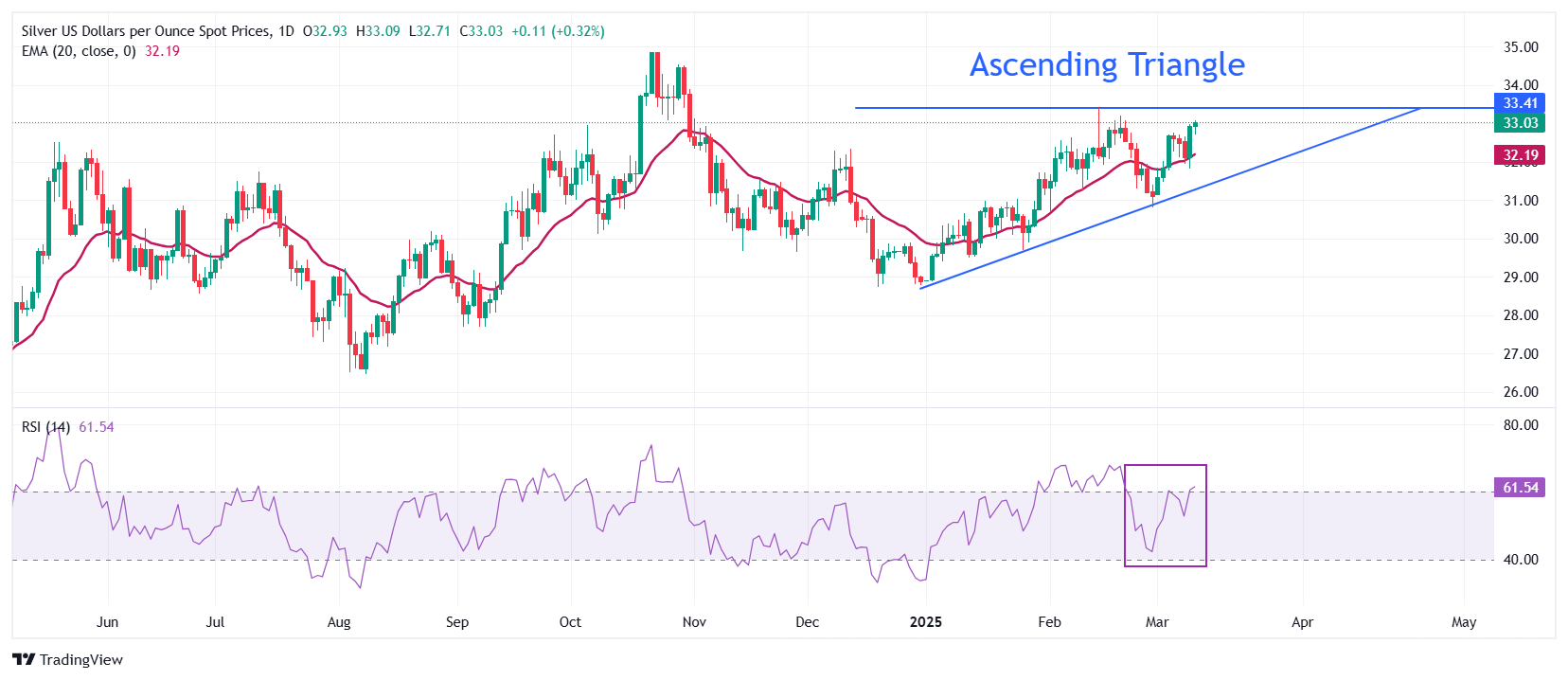
Silver FAQs
Silver is a precious metal highly traded among investors. It has been historically used as a store of value and a medium of exchange. Although less popular than Gold, traders may turn to Silver to diversify their investment portfolio, for its intrinsic value or as a potential hedge during high-inflation periods. Investors can buy physical Silver, in coins or in bars, or trade it through vehicles such as Exchange Traded Funds, which track its price on international markets.
Silver prices can move due to a wide range of factors. Geopolitical instability or fears of a deep recession can make Silver price escalate due to its safe-haven status, although to a lesser extent than Gold's. As a yieldless asset, Silver tends to rise with lower interest rates. Its moves also depend on how the US Dollar (USD) behaves as the asset is priced in dollars (XAG/USD). A strong Dollar tends to keep the price of Silver at bay, whereas a weaker Dollar is likely to propel prices up. Other factors such as investment demand, mining supply – Silver is much more abundant than Gold – and recycling rates can also affect prices.
Silver is widely used in industry, particularly in sectors such as electronics or solar energy, as it has one of the highest electric conductivity of all metals – more than Copper and Gold. A surge in demand can increase prices, while a decline tends to lower them. Dynamics in the US, Chinese and Indian economies can also contribute to price swings: for the US and particularly China, their big industrial sectors use Silver in various processes; in India, consumers’ demand for the precious metal for jewellery also plays a key role in setting prices.
Silver prices tend to follow Gold's moves. When Gold prices rise, Silver typically follows suit, as their status as safe-haven assets is similar. The Gold/Silver ratio, which shows the number of ounces of Silver needed to equal the value of one ounce of Gold, may help to determine the relative valuation between both metals. Some investors may consider a high ratio as an indicator that Silver is undervalued, or Gold is overvalued. On the contrary, a low ratio might suggest that Gold is undervalued relative to Silver.
The Kremlin said in a statement on Wednesday, “we need to hear from US National Security Advisor Mike Waltz and Secretary of State Marco Rubio before we will comment on the acceptability of a ceasefire for Russia.”
Additional takeaways
A call between Trump and Putin can be organised "very fast" if needed
Carefully studying statements issued after US-Ukraine talks.
Expect the US camp to brief Moscow on details of talks in the coming days.
Market reaction
Following these headlines, the US Dollar Index (DXY) seems to have paused its recovery. At press time, it is up 0.11% on the day to near 103.50.
Momentum indicators are turning neutral; New Zealand Dollar (NZD) is expected to trade in a 0.5675/0.5730 range vs US Dollar (USD). In the longer run, there has been no further increase in upward momentum; a break of 0.5660 would mean that the recovery is not reaching 0.5775, UOB Group's FX analysts Quek Ser Leang and Peter Chia note.
Momentum indicators are turning neutral
24-HOUR VIEW: "While we expected NZD to 'edge lower' yesterday, we pointed out, 'it is unlikely to break the strong support level at 0.5660.' We highlighted that 'resistance levels are at 0.5715 and 0.5730.' However, NZD dipped less than expected, as it rebounded from 0.5679 to 0.5725. Momentum indicators are turning neutral, and we expect NZD to trade in a 0.5675/0.5735 range today."
1-3 WEEKS VIEW: "We continue to hold the same view as yesterday (11 Mar, spot at 0.5695). As highlighted, the recent price action did not result 'in any increase in momentum,' and a break of 0.5660 (‘strong support’ level) would mean that the recovery is not reaching 0.5775.”
Despite the ongoing uncertainty in global markets, oil prices managed to settle higher yesterday, supported by the weaker USD. Even so, ICE Brent continues to trade below US$70/bbl and prices will likely remain sensitive to external developments. The oil market seems to be largely ignoring Ukraine agreeing to a US-brokered ceasefire. There is still uncertainty over where Russia stands on the proposed agreement, ING's commodity experts Ewa Manthey and Warren Patterson note.
Uncertainty over where Russia stands on the proposed agreement
"Numbers overnight from the American Petroleum Institute (API) were fairly bearish. US crude oil inventories increased by 4.2m barrels over the last week, well above the roughly 2m barrel build the market expected. Draws in Cushing crude oil inventories and gasoline stocks offset some of the bearishness, falling 1.2m barrels and 4.6m barrels, respectively. Meanwhile, distillate stocks grew by 400k barrels."
"U.S. Energy Information Administration’s (EIA) latest Short-Term Energy Outlook showed that surplus expectations for the market over 2025 and 2026 were reduced thanks to sanctions. The EIA now expects the global market to be in a 100k b/d surplus in 2025, compared to a previous forecast for a surplus of 500k b/d. In 2026, the EIA cut its surplus forecast from 1m b/d to 500k b/d. US crude oil production estimates were increased marginally for both 2025 and 2026, despite the more recent weakness seen in West Texas Intermediate (WTI) crude."
- Gold adds to weekly gains after China vows to counter US tariffs.
- A US-brokered ceasefire deal in Ukraine is on the table for Russia to consider.
- Traders are mulling the upcoming US inflation data on Wednesday.
Gold’s price (XAU/USD) holds onto weekly gains and trades above $2,915 at the time of writing on Wednesday ahead of the United States (US) Consumer Price Index (CPI) release for February. Market consensus is for a deceleration in all inflation measures, both monthly and yearly gauges. However, many analysts and economists have commented that the current US tariff approach will be inflationary for the US, which could trickle through in the numbers.
Meanwhile, traders are still cautious about tariffs after the Chinese Minister of Foreign Affairs Wang Yi commented that if the US wants to suppress China with its steel and aluminum tariffs. Europe, meanwhile, committed to putting countermeasures in place by April 13. On the geopolitical side, a ceasefire deal in Ukraine brokered by the US has been put forward to Russia for consideration.
Daily digest market movers: Concerns on Wall Street
- Chinese consumption stocks rise as the nation’s annual political gathering wraps up with support for domestic demand. Hong Kong jewelers lead the gains, bolstered by haven demand for Gold proxies, Bloomberg reports.
- Wall Street is growing angsty as investors become increasingly unnerved by whipsawing tariff policy, sticky inflation, and the unknown pace of the Federal Reserve’s (Fed) interest-rate easing. Market forecasters at banks, including JPMorgan Chase & Co. and RBC Capital Markets, have tempered bullish calls for 2025 as Trump’s tariffs stoke fears of slowing economic growth, Bloomberg reports.
- The CME Fedwatch Tool sees a 97.0% chance for no interest rate changes in the upcoming Fed meeting on March 19. The chances of a rate cut at the May 7 meeting currently stand at 39.5%.
Technical Analysis: Catalyst warning
Relentless – that is wording that comes to mind when thinking about both the headlines on tariffs and the move in Gold this week. The Monday dip was bought eagerly, while Bullion now makes its way to test the monthly cap around $2,930. Once that level breaks, a move toward a new all-time high is back in the cards.
Gold is back above the $2,900 round level and, from an intraday technical perspective, it is back above the daily Pivot Point at $2,906. Gold is on its way to the R1 resistance near $2,931, converging with last week’s highs. Once through there, the intraday R2 resistance at $2,947 comes into focus on the upside ahead of the all-time high of $2,956.
On the downside, the Wednesday Pivot Point stands at $2,906. In case that level breaks, look at the S1 support around $2,890. The S2 support at $2,864, coinciding with the February 12 low, should avoid any further downturn.
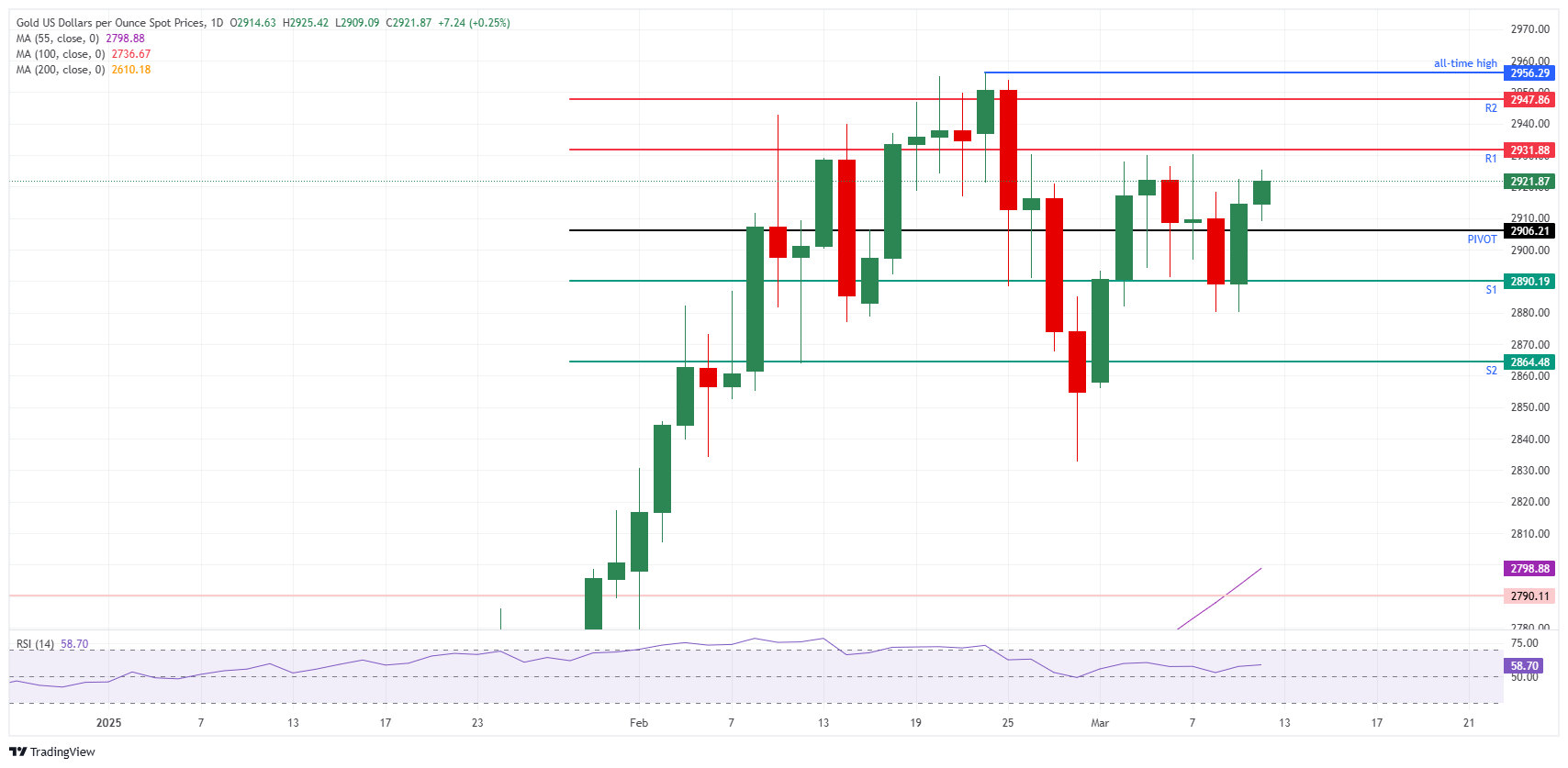
XAU/USD: Daily Chart
Gold FAQs
Gold has played a key role in human’s history as it has been widely used as a store of value and medium of exchange. Currently, apart from its shine and usage for jewelry, the precious metal is widely seen as a safe-haven asset, meaning that it is considered a good investment during turbulent times. Gold is also widely seen as a hedge against inflation and against depreciating currencies as it doesn’t rely on any specific issuer or government.
Central banks are the biggest Gold holders. In their aim to support their currencies in turbulent times, central banks tend to diversify their reserves and buy Gold to improve the perceived strength of the economy and the currency. High Gold reserves can be a source of trust for a country’s solvency. Central banks added 1,136 tonnes of Gold worth around $70 billion to their reserves in 2022, according to data from the World Gold Council. This is the highest yearly purchase since records began. Central banks from emerging economies such as China, India and Turkey are quickly increasing their Gold reserves.
Gold has an inverse correlation with the US Dollar and US Treasuries, which are both major reserve and safe-haven assets. When the Dollar depreciates, Gold tends to rise, enabling investors and central banks to diversify their assets in turbulent times. Gold is also inversely correlated with risk assets. A rally in the stock market tends to weaken Gold price, while sell-offs in riskier markets tend to favor the precious metal.
The price can move due to a wide range of factors. Geopolitical instability or fears of a deep recession can quickly make Gold price escalate due to its safe-haven status. As a yield-less asset, Gold tends to rise with lower interest rates, while higher cost of money usually weighs down on the yellow metal. Still, most moves depend on how the US Dollar (USD) behaves as the asset is priced in dollars (XAU/USD). A strong Dollar tends to keep the price of Gold controlled, whereas a weaker Dollar is likely to push Gold prices up.
Australian Dollar (AUD) is expected to trade in a 0.6255/0.6320 range vs US Dollar (USD). In the longer run, current price movements are likely part of a range trading phase between 0.6215 and 0.6355, UOB Group's FX analysts Quek Ser Leang and Peter Chia note.
Current price movements are likely part of a range trading phase
24-HOUR VIEW: "When AUD was at 0.6280 yesterday, we noted that it 'is under mild downward pressure.' We indicated that it 'could test 0.6250, but the major support at 0.6215 is not expected to come to come into view.' We highlighted that 'Resistance is at 0.6295; a breach of 0.6320 would indicate that the current mild downward pressure has eased.' However, AUD did not quite test 0.6250, as it traded between 0.6259 and 0.6312. The price movements are likely part of a range trading phase. Today, we expect AUD to trade in a 0.6255/0.6320 range."
1-3 WEEKS VIEW: "Our update from yesterday (11 Mar, spot at 0.6280) still stands. As highlighted, The current price movements are likely part of a range trading phase between 0.6215 and 0.6355.”
We expect a 25bp rate cut of the Bank of Canada overnight rate to 2.75% today. This would be a consensus move and markets are fully pricing it in. All the focus will be on the wording for future moves and, crucially, on hints of the BoC’s reaction function to US tariffs, ING's FX analyst Francesco Pesole notes.
USD/CAD to move above 1.45 on the back of US protectionism
"The BoC already outlined a baseline scenario where US tariffs triggered an initially larger growth impact compared to the inflationary shock. That suggests a dovish BoC reaction and markets are pricing in 75bp of cuts in total (including today) for 2025."
"While Trump’s 50% metals tariff threat only lasted half a day, recent developments point in the direction of further escalation in the US-Canada trade spat and raises the probability that the BoC will err on the dovish side in its communication to prevent excessive negative repricing in growth expectations."
"We have been bullish on USD/CAD, and still favour a structural move above 1.45 on the back of US protectionism. The upcoming electoral campaign in Canada will focus on the tariff response, and indications of growing anti-US sentiment means both the Conservatives (which are leading in polls) and the Liberals (now led by Mark Carney) will retain a rather hawkish stance on trade."
- EUR/USD shows resilience near 1.0900 as US recession risks keep the US Dollar on the backfoot.
- US Commerce Secretary Lutnick sees President Trump’s policies as worthwhile despite they may lead to a recession.
- The Euro capitalizes on hopes of Ukraine’s ceasefire for 30 days and German debt restructuring plans.
EUR/USD ticks lower but stays near a five-month high, trading at 1.0920 in European trading hours on Wednesday. The major currency pair remains firm as the US Dollar (USD) is broadly on the backfoot due to increased concerns over the United States (US) economic outlook under the leadership of President Donald Trump.
The US Dollar Index (DXY), which tracks the Greenback’s value against six major currencies, rises slightly after gauging temporary support near an over four-month low of 103.35.
The US Dollar underperforms as US President Trump’s tariff agenda has fuelled risks of an economic recession in the near term. Market participants expect Trump’s “America First” policies to boost inflationary pressures, eventually diminishing the purchasing power of households already battling high inflation.
Meanwhile, fears of a US recession escalated after comments from US Commerce Secretary Howard Lutnick in a CBS interview on Tuesday indicated that policies by the President are worthwhile despite they had prompted fears of a recession. Lutnick said, “These policies are the most important thing America has ever had, and they are worth it” after being asked whether it would be worth executing Trump’s policies even if they led to a recession.
On the domestic front, investors await the US Consumer Price Index (CPI) data for February, which will be published at 12:30 GMT. Investors will pay close attention to the US inflation data as it will influence market speculation over the Federal Reserve’s (Fed) monetary policy outlook. Year-over-year headline inflation data is estimated to have decelerated to 2.9% from the 3% increase seen in January. In the same period, the core CPI – which excludes volatile food and energy prices – is expected to have risen by 3.2% compared to the prior release of 3.3%.
Daily digest market movers: EUR/USD gains as Ukraine agrees to an immediate 30-day ceasefire
- EUR/USD has been advancing for over a week as the Euro (EUR) is outperforming on optimism over the German defense spending deal. Hopes for a clearance to German debt restructuring to boost defense spending accelerated after Franziska Brantner-led-German Green Party agreed to negotiate with likely next Chancellor Friedrich Merz and Social Democratic Party’s (SDP) co-leader Lars Klingbeil in a scheduled meeting on Thursday.
- Market participants expect that widening the German “debt brake” could be a game-changer for the Eurozone economy, assuming that the monetary stimulus will stimulate economic growth. Such a scenario would also force the European Central Bank (ECB) officials to reassess their monetary policy path. The ECB had been guiding that the interest rate path is clearly on the downside.
- Additionally, the acceleration in optimism over peace in Ukraine has increased the Euro’s appeal. On Tuesday, Ukraine agreed to an immediate 30-day ceasefire in a meeting with US officials in Saudi Arabia. US Secretary of State Marco Rubio said he would now take the offer to the Russians, Reuters report.
- Meanwhile, tariff policies by US President Trump continue to be a nightmare for the Euro. Trump’s tariff policies keep him in a dominant position while negotiating deals with his trading partners. On Tuesday, Canada’s Ontario Premier, Doug Ford, rolled back the 25% surcharge levied on electricity exported to the US after Trump threatened to increase levies on steel and aluminum imports from Canada to 50%.
Technical Analysis: EUR/USD wobbles inside Tuesday’s trading range
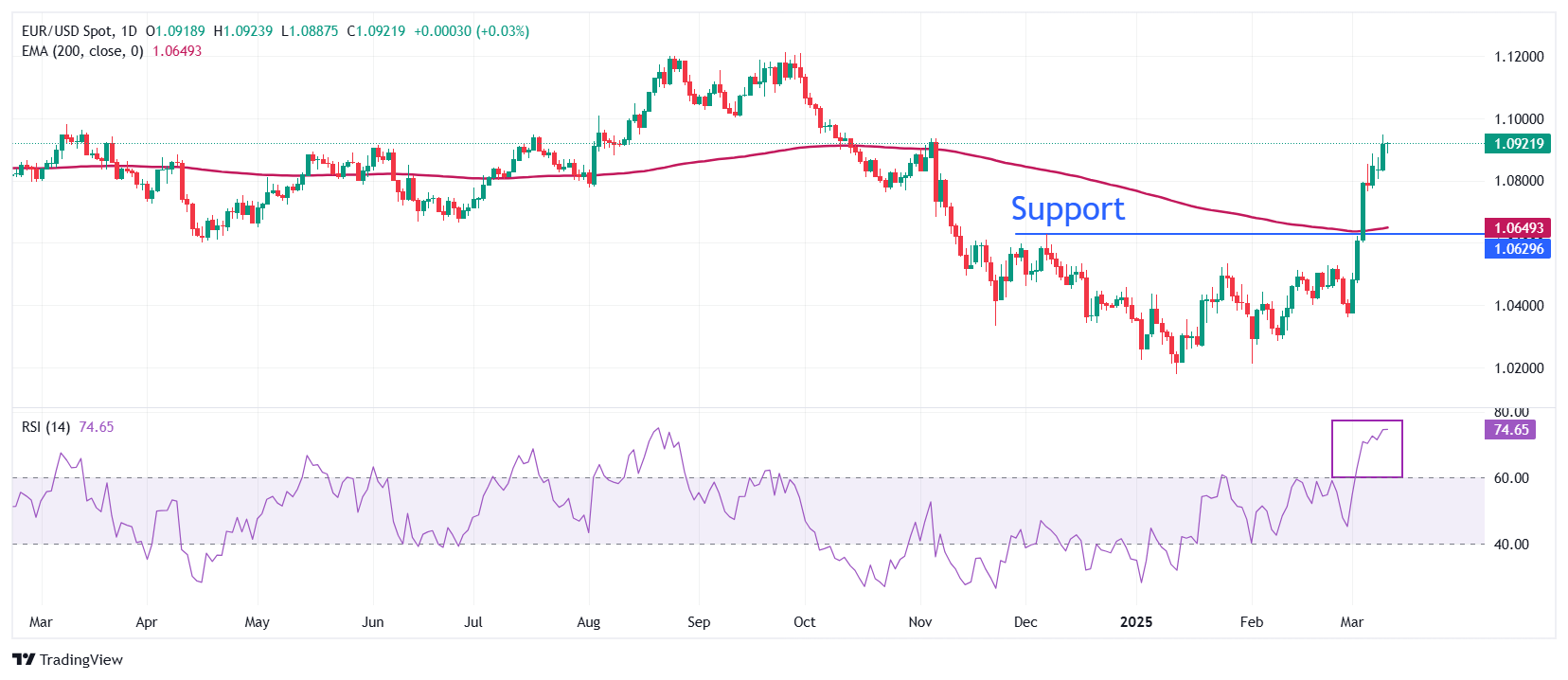
EUR/USD stays firm near 1.0900 and trades inside Tuesday’s trading range on Wednesday. The major currency pair strengthened after a decisive breakout above the December 6 high of 1.0630 last week. The long-term outlook of the major currency pair is bullish as it holds above the 200-day Exponential Moving Average (EMA), which trades around 1.0650.
The 14-day Relative Strength Index (RSI) jumps to near 75.00, indicating a strong bullish momentum.
Looking down, the December 6 high of 1.0630 will act as the major support zone for the pair. Conversely, the psychological level of 1.1000 will be the key barrier for the Euro bulls.
Euro FAQs
The Euro is the currency for the 19 European Union countries that belong to the Eurozone. It is the second most heavily traded currency in the world behind the US Dollar. In 2022, it accounted for 31% of all foreign exchange transactions, with an average daily turnover of over $2.2 trillion a day. EUR/USD is the most heavily traded currency pair in the world, accounting for an estimated 30% off all transactions, followed by EUR/JPY (4%), EUR/GBP (3%) and EUR/AUD (2%).
The European Central Bank (ECB) in Frankfurt, Germany, is the reserve bank for the Eurozone. The ECB sets interest rates and manages monetary policy. The ECB’s primary mandate is to maintain price stability, which means either controlling inflation or stimulating growth. Its primary tool is the raising or lowering of interest rates. Relatively high interest rates – or the expectation of higher rates – will usually benefit the Euro and vice versa. The ECB Governing Council makes monetary policy decisions at meetings held eight times a year. Decisions are made by heads of the Eurozone national banks and six permanent members, including the President of the ECB, Christine Lagarde.
Eurozone inflation data, measured by the Harmonized Index of Consumer Prices (HICP), is an important econometric for the Euro. If inflation rises more than expected, especially if above the ECB’s 2% target, it obliges the ECB to raise interest rates to bring it back under control. Relatively high interest rates compared to its counterparts will usually benefit the Euro, as it makes the region more attractive as a place for global investors to park their money.
Data releases gauge the health of the economy and can impact on the Euro. Indicators such as GDP, Manufacturing and Services PMIs, employment, and consumer sentiment surveys can all influence the direction of the single currency. A strong economy is good for the Euro. Not only does it attract more foreign investment but it may encourage the ECB to put up interest rates, which will directly strengthen the Euro. Otherwise, if economic data is weak, the Euro is likely to fall. Economic data for the four largest economies in the euro area (Germany, France, Italy and Spain) are especially significant, as they account for 75% of the Eurozone’s economy.
Another significant data release for the Euro is the Trade Balance. This indicator measures the difference between what a country earns from its exports and what it spends on imports over a given period. If a country produces highly sought after exports then its currency will gain in value purely from the extra demand created from foreign buyers seeking to purchase these goods. Therefore, a positive net Trade Balance strengthens a currency and vice versa for a negative balance.
While overbought, Pound Sterling (GBP) may have just enough momentum to test 1.2975 vs US Dollar (USD) before the risk of a pullback increases. In the longer run, uptrend in GBP appears to be ready to consolidate or pause; a break below 1.2855 will indicate that upward momentum has eased, UOB Group's FX analysts Quek Ser Leang and Peter Chia note.
Uptrend in GBP appears to be ready to consolidate or pause
24-HOUR VIEW: "Yesterday, we held the view that GBP 'is likely to trade in a range between 1.2845 and 1.2930.' Our view was incorrect, as GBP soared, reaching a high of 1.2966. While conditions are overbought, GBP may have just enough momentum to test the key resistance at 1.2975 before the risk of a pullback increases. The next resistance at 1.3000 is unlikely to come under threat. Support levels are at 1.2920 and 1.2900."
1-3 WEEKS VIEW: "We revised our outlook for GBP to positive early last week. After tracking the rise for more than a week, we highlighted yesterday (11 Mar, spot at 1.2875) that “upward momentum is slowing, and a breach of 1.2830 (‘strong support’ level) would mean that 1.2975 is out of reach this time around.” Although GBP subsequently rose to 1.2966, there has been no further increase in momentum. Overall, the uptrend appears to be ready to consolidate or pause, and a break below 1.2855 (‘strong support’ level was at 1.2830 yesterday) would indicate that the current upward momentum has eased. Looking ahead, should GBP break above 1.2975, there is another major resistance at 1.3000."
European Central Bank (ECB) Governing Council member Gediminas Šimkus said on Wednesday that “we will see if we cut rates or pause in April.”
Further comments
It is irrational to commit to future rate decisions.
The direction of travel has not changed.
FX option expiries for Mar 12 NY cut at 10:00 Eastern Time via DTCC can be found below.
EUR/USD: EUR amounts
- 1.0700 779m
- 1.0875 896m
- 1.0950 974m
GBP/USD: GBP amounts
- 1.2650 750m
USD/JPY: USD amounts
- 148.00 577m
- 150.00 2.3b
USD/CHF: USD amounts
- 0..8900 545m
AUD/USD: AUD amounts
- 0.6295 601m
- 0.6385 616m
USD/CAD: USD amounts
- 1.4320 791m
- 1.4380 734m
NZD/USD: NZD amounts
- 0.5575 792m
EUR/GBP: EUR amounts
- 0.8405 564m
Silver prices (XAG/USD) rose on Wednesday, according to FXStreet data. Silver trades at $33.01 per troy ounce, up 0.26% from the $32.93 it cost on Tuesday.
Silver prices have increased by 14.25% since the beginning of the year.
| Unit measure | Silver Price Today in USD |
|---|---|
| Troy Ounce | 33.01 |
| 1 Gram | 1.06 |
The Gold/Silver ratio, which shows the number of ounces of Silver needed to equal the value of one ounce of Gold, stood at 88.44 on Wednesday, broadly unchanged from 88.52 on Tuesday.
Silver FAQs
Silver is a precious metal highly traded among investors. It has been historically used as a store of value and a medium of exchange. Although less popular than Gold, traders may turn to Silver to diversify their investment portfolio, for its intrinsic value or as a potential hedge during high-inflation periods. Investors can buy physical Silver, in coins or in bars, or trade it through vehicles such as Exchange Traded Funds, which track its price on international markets.
Silver prices can move due to a wide range of factors. Geopolitical instability or fears of a deep recession can make Silver price escalate due to its safe-haven status, although to a lesser extent than Gold's. As a yieldless asset, Silver tends to rise with lower interest rates. Its moves also depend on how the US Dollar (USD) behaves as the asset is priced in dollars (XAG/USD). A strong Dollar tends to keep the price of Silver at bay, whereas a weaker Dollar is likely to propel prices up. Other factors such as investment demand, mining supply – Silver is much more abundant than Gold – and recycling rates can also affect prices.
Silver is widely used in industry, particularly in sectors such as electronics or solar energy, as it has one of the highest electric conductivity of all metals – more than Copper and Gold. A surge in demand can increase prices, while a decline tends to lower them. Dynamics in the US, Chinese and Indian economies can also contribute to price swings: for the US and particularly China, their big industrial sectors use Silver in various processes; in India, consumers’ demand for the precious metal for jewellery also plays a key role in setting prices.
Silver prices tend to follow Gold's moves. When Gold prices rise, Silver typically follows suit, as their status as safe-haven assets is similar. The Gold/Silver ratio, which shows the number of ounces of Silver needed to equal the value of one ounce of Gold, may help to determine the relative valuation between both metals. Some investors may consider a high ratio as an indicator that Silver is undervalued, or Gold is overvalued. On the contrary, a low ratio might suggest that Gold is undervalued relative to Silver.
(An automation tool was used in creating this post.)
- USD/CAD may encounter initial resistance at the monthly high of 1.4543.
- The 14-day Relative Strength Index (RSI) is positioned above 50, supporting a bullish outlook.
- Immediate support is positioned at the nine-day EMA, around the 1.4401 level.
USD/CAD retraces its recent losses, trading around 1.4440 during the European hours on Wednesday. Technical analysis on the daily chart suggests the pair remains within an ascending channel pattern, suggesting a bullish bias.
The 14-day Relative Strength Index (RSI) remains above 50, reinforcing a bullish sentiment. A continued decline could further validate the downside bias. Additionally, the USD/CAD pair remains above the nine-day Exponential Moving Average (EMA), signaling a strengthening short-term price momentum.
The USD/CAD pair could find initial resistance at the monthly high of 1.4543, which was recorded on March 4., followed by the upper boundary of the ascending channel at 1.4650. A break above this level could reinforce the bullish bias and support the pair to explore the region around 1.4793—the highest level since March 2003, recorded on February 3.
On the downside, the immediate support is located at the nine-day EMA of 1.4401 level. A break below this level could weaken the short-term price momentum and put downward pressure on the USD/CAD pair to test the 50-day EMA at 1.4322, closely aligned with the ascending channel’s lower boundary.
Further decline would weaken the bullish bias and lead the USD/CAD pair to navigate the area around the three-month low of 1.4151, last seen on February 14.
USD/CAD: Daily Chart
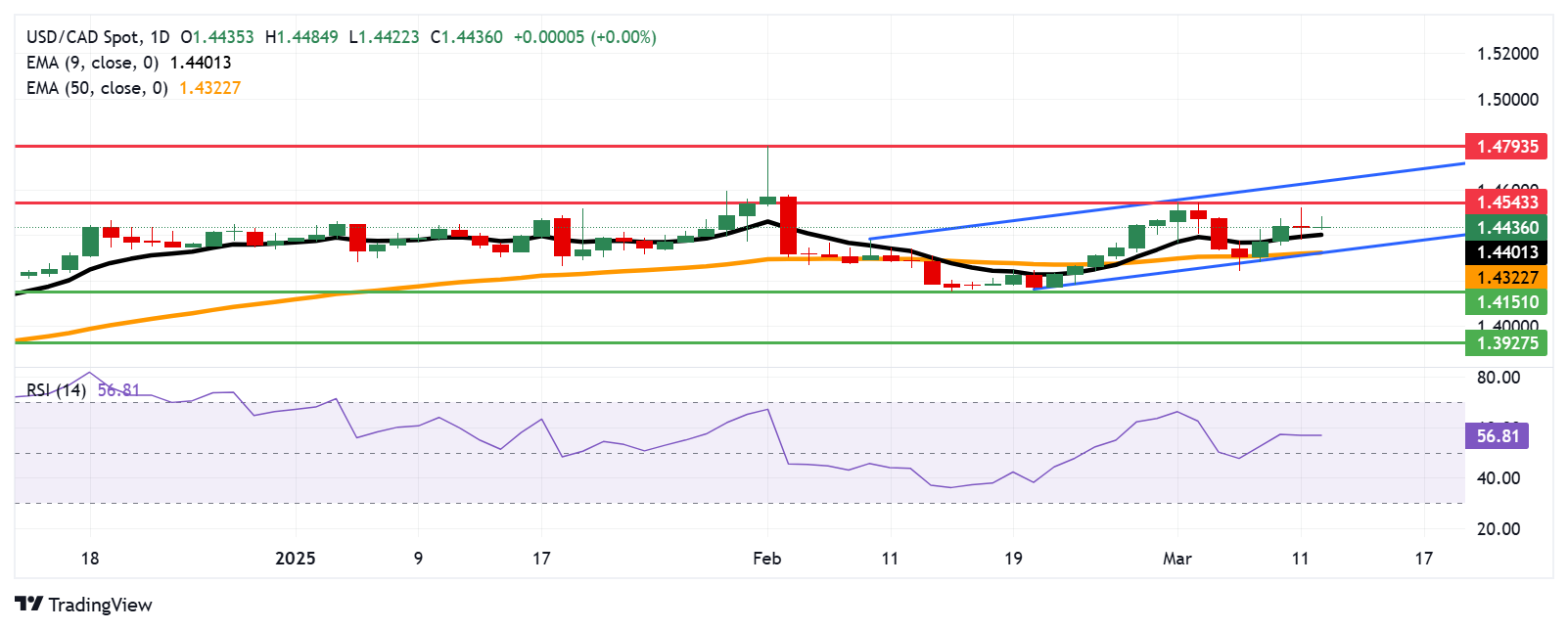
Canadian Dollar PRICE Today
The table below shows the percentage change of Canadian Dollar (CAD) against listed major currencies today. Canadian Dollar was the strongest against the Japanese Yen.
| USD | EUR | GBP | JPY | CAD | AUD | NZD | CHF | |
|---|---|---|---|---|---|---|---|---|
| USD | -0.04% | 0.06% | 0.43% | 0.03% | -0.01% | -0.04% | -0.10% | |
| EUR | 0.04% | 0.09% | 0.45% | 0.07% | 0.00% | -0.01% | -0.06% | |
| GBP | -0.06% | -0.09% | 0.36% | -0.02% | -0.07% | -0.10% | -0.15% | |
| JPY | -0.43% | -0.45% | -0.36% | -0.40% | -0.44% | -0.48% | -0.51% | |
| CAD | -0.03% | -0.07% | 0.02% | 0.40% | -0.04% | -0.08% | -0.11% | |
| AUD | 0.00% | -0.01% | 0.07% | 0.44% | 0.04% | -0.02% | -0.09% | |
| NZD | 0.04% | 0.00% | 0.10% | 0.48% | 0.08% | 0.02% | -0.04% | |
| CHF | 0.10% | 0.06% | 0.15% | 0.51% | 0.11% | 0.09% | 0.04% |
The heat map shows percentage changes of major currencies against each other. The base currency is picked from the left column, while the quote currency is picked from the top row. For example, if you pick the Canadian Dollar from the left column and move along the horizontal line to the US Dollar, the percentage change displayed in the box will represent CAD (base)/USD (quote).
- NZD/USD drifts lower on Wednesday amid a modest USD bounce from a multi-month low.
- China’s economic woes and escalating US-China trade tensions further undermine the Kiwi.
- Fed rate cut bets and a positive risk tone cap the USD and support the pair ahead of US CPI.
The NZD/USD pair struggles to capitalize on the overnight bounce from a multi-day low, around the 0.5680-0.5675 region and attracts fresh sellers on Wednesday amid a modest US Dollar (USD) uptick. Spot prices remain depressed through the first half of the European session and currently trade near the 0.5700 mark, down 0.15% for the day as traders keenly await the release of the US consumer inflation figures.
Investors will look to the crucial US Consumer Price Index (CPI) report for cues about the Federal Reserve's (Fed) rate-cut path. This, in turn, should influence the near-term USD price dynamics and provide some meaningful impetus to the NZD/USD pair. Heading into the key data risk, traders opt to lighten their USD bearish bets following the recent slump to the lowest level since October 16. Apart from this, the worsening US-China relations and persistent deflationary pressures in the world’s second-largest economy, which tends to undermine antipodean currencies, weigh on the NZD/USD pair.
In fact, China’s National Bureau of Statistics (NBS) reported on Sunday that consumer prices plunged to their lowest level in more than a year and factory-gate prices contracted for 29 consecutive months. Meanwhile, US President Donald Trump decided to double the levy on Chinese imports to 20% on March 4 and also designated China as a currency manipulator for the first time in decades. In response, China announced retaliatory tariffs of up to 15% on US products, raising the risk of a further escalation of the trade war between the world's two largest economies and exerting some pressure on the Kiwi.
Any meaningful USD appreciation, however, seems elusive in the wake of rising bets that a tariff-driven slowdown in the US economic activity might force the Federal Reserve (Fed) to cut interest rates several times this year. Apart from this, a generally positive tone around the equity markets contributes to capping the safe-haven buck and offers some support to the risk-sensitive New Zealand Dollar (NZD). This, in turn, warrants caution before placing aggressive bearish bets around the NZD/USD pair and confirming that the recent move-up witnessed over the past week or so has run out of steam.
US-China Trade War FAQs
Generally speaking, a trade war is an economic conflict between two or more countries due to extreme protectionism on one end. It implies the creation of trade barriers, such as tariffs, which result in counter-barriers, escalating import costs, and hence the cost of living.
An economic conflict between the United States (US) and China began early in 2018, when President Donald Trump set trade barriers on China, claiming unfair commercial practices and intellectual property theft from the Asian giant. China took retaliatory action, imposing tariffs on multiple US goods, such as automobiles and soybeans. Tensions escalated until the two countries signed the US-China Phase One trade deal in January 2020. The agreement required structural reforms and other changes to China’s economic and trade regime and pretended to restore stability and trust between the two nations. However, the Coronavirus pandemic took the focus out of the conflict. Yet, it is worth mentioning that President Joe Biden, who took office after Trump, kept tariffs in place and even added some additional levies.
The return of Donald Trump to the White House as the 47th US President has sparked a fresh wave of tensions between the two countries. During the 2024 election campaign, Trump pledged to impose 60% tariffs on China once he returned to office, which he did on January 20, 2025. With Trump back, the US-China trade war is meant to resume where it was left, with tit-for-tat policies affecting the global economic landscape amid disruptions in global supply chains, resulting in a reduction in spending, particularly investment, and directly feeding into the Consumer Price Index inflation.
- Bank of Canada (BoC) is seen reducing its policy rate by 25 bps.
- The Canadian Dollar remains on the defensive against the US Dollar.
- Headline inflation in Canada remains below the bank’s 2% target.
- Attention will also be on Governor Macklem’s press conference.
All eyes are on the Bank of Canada (BoC) this Wednesday, with market consensus expecting another rate cut—the seventh in a row. This time, the talk is about a 25-basis-point reduction, similar to the move in January.
Meanwhile, the Canadian Dollar (CAD) has been losing some steam lately, falling from last week’s highs and nearing the 1.4500 level against the US Dollar (USD).
Adding another twist, Canada's inflation figures are now in focus. In February, the annual inflation rate, as measured by the headline Consumer Price Index (CPI), edged up to 1.9% from 1.8%. At the same time, the BoC’s core CPI increased for the second straight month, reaching 2.1% compared to the same period in 2024, which exceeds the bank's target.
Navigating trade turbulence: The Bank of Canada's strategy
Further easing seems likely, though the Bank of Canada is expected to remain cautious. The central bank is balancing several factors—a recent uptick in inflation, a strong labour market and GDP levels that align with its forecasts—with the uncertainties brought on by the Donald Trump administration’s unpredictable United States (US) trade policies.
At its January meeting, Governor Tiff Macklem noted that the threat of tariffs is hard to ignore when you look outside. He explained that ensuring the economy is on solid ground before new tariffs take effect is crucial. From a risk management standpoint, this concern helped drive the decision to cut the policy rate by 25 basis points.
Regarding inflation, Macklem emphasized that while some increase was anticipated, the key was to prevent an initial rise in prices from spreading widely to other goods, services, and wages. He stressed that the aim was for inflation to eventually return to 2% rather than evolving into a persistent, harmful trend for Canadians.
Minutes released on February 12 further revealed that the Bank of Canada's governing council was worried a prolonged trade conflict with the US could permanently shrink domestic GDP. The minutes also noted that on January 29, the BoC reduced its key policy rate to 3%—its sixth consecutive cut—in light of the potential economic risks if President Donald Trump followed through on his threat to impose tariffs on all Canadian imports.
Previewing the BoC’s interest rate decision, Taylor Schleich, Warren Lovely and Ethan Currie at the National Bank of Canada noted: “The Bank of Canada is all but assured to lower its overnight target by 25 basis points on Wednesday, the presumptive move marking the seventh straight rate cut and bringing the policy rate to the mid-point of the estimated neutral range. Unlike prior decisions though, easing will be less about absorbing already-accumulated economic slack and more about supporting an economy mired in trade conflict. Indeed, in normal times recent data would likely be consistent with holding steady on the policy rate, as GDP and jobs growth pick up and underlying inflation firms. But the Bank was already leaning dovish, Macklem stressing that trade uncertainty alone was ‘doing damage’ so it’s not clear that these data will matter much for this decision.”
When will the BoC release its monetary policy decision, and how could it affect USD/CAD?
The Bank of Canada is set to announce its policy decision on Wednesday at 13:45 GMT, with Governor Tiff Macklem scheduled to hold a press conference at 14:30 GMT.
While major surprises are not expected, investors predict the tone of the bank’s message will remain fixated on US tariffs and their impact on the Canadian economy, a view that can extend to developments around the Canadian Dollar (CAD).
Senior Analyst Pablo Piovano from FXStreet noted that if the recovery picks up pace, USD/CAD should face initial resistance at its March peak of 1.4542 set on March 4. A breakout of the latter could pave the way for a potential test of the 2025 high at 1.4792 recorded on February 3.
Additionally, Piovano indicated that occasional bearish moves might test the March low of 1.4237 hit on March 6, seconded by the provisional 100-day SMA at 1.424 and then the 2025 bottom of 1.4150 reached on February 14.
Economic Indicator
BoC Interest Rate Decision
The Bank of Canada (BoC) announces its interest rate decision at the end of its eight scheduled meetings per year. If the BoC believes inflation will be above target (hawkish), it will raise interest rates in order to bring it down. This is bullish for the CAD since higher interest rates attract greater inflows of foreign capital. Likewise, if the BoC sees inflation falling below target (dovish) it will lower interest rates in order to give the Canadian economy a boost in the hope inflation will rise back up. This is bearish for CAD since it detracts from foreign capital flowing into the country.
Read more.Next release: Wed Mar 12, 2025 13:45
Frequency: Irregular
Consensus: 2.75%
Previous: 3%
Source: Bank of Canada
Interest rates FAQs
Interest rates are charged by financial institutions on loans to borrowers and are paid as interest to savers and depositors. They are influenced by base lending rates, which are set by central banks in response to changes in the economy. Central banks normally have a mandate to ensure price stability, which in most cases means targeting a core inflation rate of around 2%. If inflation falls below target the central bank may cut base lending rates, with a view to stimulating lending and boosting the economy. If inflation rises substantially above 2% it normally results in the central bank raising base lending rates in an attempt to lower inflation.
Higher interest rates generally help strengthen a country’s currency as they make it a more attractive place for global investors to park their money.
Higher interest rates overall weigh on the price of Gold because they increase the opportunity cost of holding Gold instead of investing in an interest-bearing asset or placing cash in the bank. If interest rates are high that usually pushes up the price of the US Dollar (USD), and since Gold is priced in Dollars, this has the effect of lowering the price of Gold.
The Fed funds rate is the overnight rate at which US banks lend to each other. It is the oft-quoted headline rate set by the Federal Reserve at its FOMC meetings. It is set as a range, for example 4.75%-5.00%, though the upper limit (in that case 5.00%) is the quoted figure. Market expectations for future Fed funds rate are tracked by the CME FedWatch tool, which shapes how many financial markets behave in anticipation of future Federal Reserve monetary policy decisions.
European Central Bank (ECB) President Christine Lagarde said on Wednesday that they cannot ensure that inflation will always be at 2% but added that they must set the monetary policy so it converges to 2%, per Reuters.
Key takeaways
"In case of large shocks, risk grows that inflation becomes more persistent."
"Trade fragmentation is likely to lead to larger, more disruptive relative price changes."
"Must pay particular attention to anchoring inflation expectations."
"Trade, defence, climate issues can amplify or counteract the existing inflation forces."
"Cannot provide forward guidance but must be clear about reaction function."
Market reaction
These comments failed to trigger a reaction in the Euro. At the time of press, EUR/USD was trading little changed on the day at 1.0915.
ECB FAQs
The European Central Bank (ECB) in Frankfurt, Germany, is the reserve bank for the Eurozone. The ECB sets interest rates and manages monetary policy for the region. The ECB primary mandate is to maintain price stability, which means keeping inflation at around 2%. Its primary tool for achieving this is by raising or lowering interest rates. Relatively high interest rates will usually result in a stronger Euro and vice versa. The ECB Governing Council makes monetary policy decisions at meetings held eight times a year. Decisions are made by heads of the Eurozone national banks and six permanent members, including the President of the ECB, Christine Lagarde.
In extreme situations, the European Central Bank can enact a policy tool called Quantitative Easing. QE is the process by which the ECB prints Euros and uses them to buy assets – usually government or corporate bonds – from banks and other financial institutions. QE usually results in a weaker Euro. QE is a last resort when simply lowering interest rates is unlikely to achieve the objective of price stability. The ECB used it during the Great Financial Crisis in 2009-11, in 2015 when inflation remained stubbornly low, as well as during the covid pandemic.
Quantitative tightening (QT) is the reverse of QE. It is undertaken after QE when an economic recovery is underway and inflation starts rising. Whilst in QE the European Central Bank (ECB) purchases government and corporate bonds from financial institutions to provide them with liquidity, in QT the ECB stops buying more bonds, and stops reinvesting the principal maturing on the bonds it already holds. It is usually positive (or bullish) for the Euro.
Global risk sentiment continued to sour yesterday as President Trump announced he’d double tariffs on Canadian steel and aluminum to 50%, and later pulled the threat as Ontario suspended a 25% surcharge on electricity exports. Markets have been looking for some reprieve from the tariff story, but there are very few signs that stock instability can press Trump to scale back protectionism noise just yet. US global tariffs on steel and aluminum took effect today without exemptions, ING's FX analyst Francesco Pesole notes.
The tide can turn pretty rapidly for the USD
"The US Dollar (USD) ended the day lower again yesterday but started to rebound overnight. Our view is that with US tariffs being rolled out, the greenback has room to recover. The reasoning is that if data fails to endorse market pessimism on the US in the coming weeks, the tide can turn pretty rapidly for the dollar. The whole premise of the current bearish narrative is that US tariffs are harming a slowing US economy, but recessionary calls in the recent past have often been misplaced when it comes to the US."
"Incidentally, the inflation story is yet to improve convincingly enough for the Fed to cut rates again. Today’s February CPI release can trigger an uptick in the dollar should our call for 0.3% core CPI MoM print prove correct. That is also the consensus view, but the dollar is embedding quite a lot of negatives and should be asymmetrically more sensitive to hawkish news. We have a bullish bias on USD today."
"We have also seen important political developments inside and outside the US. On the latter, Ukraine agreed to a 30-day ceasefire deal brokered by the US. That now needs to be approved by Russia. Domestically, the US House passed legislation to avert a government shutdown on Saturday. A few votes from moderate Democrats are needed to secure Senate approval, and markets are not ready to price the shutdown risk out just yet."
Further sustained rise in Euro (EUR) vs US Dollar (USD) seems unlikely; it is more likely to consolidate in a 1.0870/1.0950 range. In the longer run, technical target at 1.0945 exceeded; deeply overbought conditions suggest while further gains are possible, the potential for additional upside may be limited, UOB Group's FX analysts Quek Ser Leang and Peter Chia note. 0
Potential for additional upside may be limited
24-HOUR VIEW: "We did not anticipate the strong surge in EUR that sent it to a high of 1.0947 (we were expecting sideways trading). The advance is deeply overbought, and negative momentum divergence is tentatively forming. To put it another way, further sustained rise in EUR seems unlikely. Today, EUR is more likely to consolidate its gains and trade in a 1.0870/1.0950 range."
1-3 WEEKS VIEW: "We have expected a strong EUR since early last week. Yesterday (11 Mar, spot at 1.0835), we highlighted that 'upward momentum is showing signs of slowing, and EUR must push higher soon, or the chance of it reaching 1.0945 will decrease quickly.' EUR then soared, slightly exceeding the technical target of 1.0945 (high has been 1.0947). While the uptrend remains intact for now, it is worth noting that conditions are very deeply overbought. This suggests that while further gains are possible, the potential for additional upside may be limited. Additionally, the 1.1100 level, as a key psychological resistance, may not be easy to break. On the downside, a breach of 1.0805 (‘strong support’ level was at 1.0720 yesterday) would indicate the start of a consolidation or pullback."
- WTI price may face challenges as demand concerns grow over a potential US economic slowdown.
- The dollar-denominated commodity found support from a weaker US Dollar.
- API report indicated that US crude oil stockpiles increased by 4.247 million barrels last week, following a 1.455-million-barrel previous decline.
West Texas Intermediate (WTI) Oil price gains ground for the second successive day, trading $66.40 during the European hours on Wednesday. However, Oil prices faced downward pressure amid rising demand concerns over a potential US economic slowdown and the impact of tariffs on global growth, which limited further gains.
However, a weaker US Dollar (USD) might have limited the downside for the Oil prices, driven by growing fears of an economic downturn in the United States (US). President Donald Trump referred to the economy as being in a "transition period," and investors interpreted these remarks as an early warning of potential instability.
Adding to market uncertainty, US stock prices continued to decline on Tuesday, extending the largest selloff in months as investors reacted to higher import tariffs and weakening consumer sentiment. With ongoing ambiguity surrounding tariff developments and persistent worries over US economic growth, Oil market sentiment remains cautious.
Meanwhile, a Houthi spokesperson announced late Tuesday that the group would target any Israeli vessel violating its ban on Israeli ships navigating through the Red and Arabian Seas, the Bab al-Mandab Strait, and the Gulf of Aden, effective immediately.
In the US, the latest American Petroleum Institute (API) report showed crude Oil stockpiles rose by 4.247 million barrels for the week ending February 28, following a 1.455-million-barrel decline the previous week. Analysts had expected an increase of 2.1 million barrels.
Additionally, the US joined other agencies in revising Oil market projections. The International Energy Agency (IEA) cut its 2025 surplus forecast and halved its estimated glut for next year due to anticipated declines in Iranian and Venezuelan crude output. The Energy Information Administration (EIA) also projected a decline in global Oil inventories in Q2 2025.
WTI Oil FAQs
WTI Oil is a type of Crude Oil sold on international markets. The WTI stands for West Texas Intermediate, one of three major types including Brent and Dubai Crude. WTI is also referred to as “light” and “sweet” because of its relatively low gravity and sulfur content respectively. It is considered a high quality Oil that is easily refined. It is sourced in the United States and distributed via the Cushing hub, which is considered “The Pipeline Crossroads of the World”. It is a benchmark for the Oil market and WTI price is frequently quoted in the media.
Like all assets, supply and demand are the key drivers of WTI Oil price. As such, global growth can be a driver of increased demand and vice versa for weak global growth. Political instability, wars, and sanctions can disrupt supply and impact prices. The decisions of OPEC, a group of major Oil-producing countries, is another key driver of price. The value of the US Dollar influences the price of WTI Crude Oil, since Oil is predominantly traded in US Dollars, thus a weaker US Dollar can make Oil more affordable and vice versa.
The weekly Oil inventory reports published by the American Petroleum Institute (API) and the Energy Information Agency (EIA) impact the price of WTI Oil. Changes in inventories reflect fluctuating supply and demand. If the data shows a drop in inventories it can indicate increased demand, pushing up Oil price. Higher inventories can reflect increased supply, pushing down prices. API’s report is published every Tuesday and EIA’s the day after. Their results are usually similar, falling within 1% of each other 75% of the time. The EIA data is considered more reliable, since it is a government agency.
OPEC (Organization of the Petroleum Exporting Countries) is a group of 12 Oil-producing nations who collectively decide production quotas for member countries at twice-yearly meetings. Their decisions often impact WTI Oil prices. When OPEC decides to lower quotas, it can tighten supply, pushing up Oil prices. When OPEC increases production, it has the opposite effect. OPEC+ refers to an expanded group that includes ten extra non-OPEC members, the most notable of which is Russia.
West Texas Intermediate (WTI) Oil price advances on Wednesday, early in the European session. WTI trades at $66.37 per barrel, up from Tuesday’s close at $66.33. Brent Oil Exchange Rate (Brent crude) is also up, advancing from the $69.64 price posted on Tuesday, and trading at $69.68.
WTI Oil FAQs
WTI Oil is a type of Crude Oil sold on international markets. The WTI stands for West Texas Intermediate, one of three major types including Brent and Dubai Crude. WTI is also referred to as “light” and “sweet” because of its relatively low gravity and sulfur content respectively. It is considered a high quality Oil that is easily refined. It is sourced in the United States and distributed via the Cushing hub, which is considered “The Pipeline Crossroads of the World”. It is a benchmark for the Oil market and WTI price is frequently quoted in the media.
Like all assets, supply and demand are the key drivers of WTI Oil price. As such, global growth can be a driver of increased demand and vice versa for weak global growth. Political instability, wars, and sanctions can disrupt supply and impact prices. The decisions of OPEC, a group of major Oil-producing countries, is another key driver of price. The value of the US Dollar influences the price of WTI Crude Oil, since Oil is predominantly traded in US Dollars, thus a weaker US Dollar can make Oil more affordable and vice versa.
The weekly Oil inventory reports published by the American Petroleum Institute (API) and the Energy Information Agency (EIA) impact the price of WTI Oil. Changes in inventories reflect fluctuating supply and demand. If the data shows a drop in inventories it can indicate increased demand, pushing up Oil price. Higher inventories can reflect increased supply, pushing down prices. API’s report is published every Tuesday and EIA’s the day after. Their results are usually similar, falling within 1% of each other 75% of the time. The EIA data is considered more reliable, since it is a government agency.
OPEC (Organization of the Petroleum Exporting Countries) is a group of 12 Oil-producing nations who collectively decide production quotas for member countries at twice-yearly meetings. Their decisions often impact WTI Oil prices. When OPEC decides to lower quotas, it can tighten supply, pushing up Oil prices. When OPEC increases production, it has the opposite effect. OPEC+ refers to an expanded group that includes ten extra non-OPEC members, the most notable of which is Russia.
Disclaimer: West Texas Intermediate (WTI) and Brent oil prices mentioned above are based on FXStreet data feed for Contracts for Differences (CFDs).
(An automation tool was used in creating this post.)
EUR/USD received some extra support yesterday from the news that Ukraine agreed to a 30-day truce with Russia, but has retreated from the 1.095 highs to just under 1.090 as the dollar started to recover and the EU announced €26bn worth of retaliatory tariffs against the US. Markets had already largely priced in a Ukraine-Russia peace deal, and while another small leg higher in EUR/USD may be due if and when Russia agrees to the terms of the truce, the pair can face greater upside resistance on the back of stretched technicals, ING's FX analyst Francesco Pesole notes.
A drop to 1.080 is more likely than a rally to 1.10
"Despite the correction overnight, EUR/USD remains around 1.5% overvalued, according to our short-term fair value model. Also, the latest CFTC data show positioning has moved back to neutral territory. Speculative net-shorts accounted for only 1.5% of open interest as of 4 March, down from 11% at the end of February."
"With US core CPI potentially capping dovish sentiment on the Fed today, the two-year EUR:USD swap rate gap may struggle to tighten beyond the -140bp level (now -144bp), and may instead face some rewidening that would make EUR/USD even more expensive at current levels. There is also a risk that either ECB President Christine Lagarde or any of the many other ECB speakers today will sound slightly more dovish after the EU’s retaliatory tariff announcement."
"At this stage, we think a drop to 1.080 is more likely than a rally to 1.10 in EUR/USD."
- The Pound Sterling clings to gains near 1.2950 against the US Dollar ahead of the US CPI data for February on Wednesday.
- US President Trump’s tariff policies continue to cap investors' risk appetite.
- The BoE is expected to keep interest rates unchanged in the monetary policy meeting next week.
The Pound Sterling (GBP) stays firm near the four-month high of 1.2965 against the US Dollar (USD) in Wednesday’s European session. The GBP/USD pair clings to gains while the US Dollar gauges temporary support ahead of the United States (US) Consumer Price Index (CPI) data for February, which will be published at 12:30 GMT.
The US inflation data will significantly influence market speculation for the Federal Reserve’s (Fed) monetary policy outlook. On Friday, Fed Chair Jerome Powell said the central bank could maintain “policy restraint for longer if inflation progress stalls”.
Economists expect year-over-year headline inflation to have decelerated to 2.9% from 3% in January. In the same period, the core CPI – which excludes volatile food and energy prices – is estimated to have risen by 3.2% from the prior release of 3.3%. Both headline and core CPI are expected to have grown at a slower pace of 0.3% on a monthly basis.
Signs of easing inflationary pressures would boost expectations that the Fed could cut interest rates in the May policy meeting. According to the CME FedWatch tool, there is a 42% chance that the central bank will cut interest rates in May, an increase from 10.4% seen a month ago. On the contrary, sticky figures would diminish them.
Daily digest market movers: Pound Sterling stabilizes ahead of UK monthly GDP
- The Pound Sterling trades quietly against its major peers on Wednesday as investors look for fresh cues about next week’s Bank of England’s (BoE) monetary policy meeting. Traders are confident that the BoE will keep interest rates steady at 4.5% as a slew of officials have guided a ‘gradual and cautionary’ monetary easing approach.
- Last week, four BoE policymakers, including Governor Andrew Bailey, guided a gradual path for “unwinding monetary policy restrictiveness” as the inflation persistence is less likely to fade “on its own accord”. Contrary to them, BoE member Catherine Mann supports a swift policy-easing approach due to “substantial volatility” coming from financial markets, especially from “cross-border spillovers”.
- This week, investors will focus on the United Kingdom's (UK) monthly Gross Domestic Product (GDP), and Industrial and Manufacturing Production data for January, which will be released on Friday. The UK economy is expected to have grown at a moderate pace of 0.1%, compared to the 0.4% economic expansion seen in December. Monthly factory data is estimated to have declined in the first month of 2025.
- On the geopolitical front, US President Donald Trump’s tariff agenda continues to keep investors on their toes across the globe. Trump threatened to double tariffs on imports of steel and aluminum from Canada but scrapped his decision after Canada’s Ontario Premier, Doug Ford, agreed to roll back a 25% surcharge levied on electricity exported to the US.
- Comments from US Commerce Secretary Howard Lutnick in an interview with CBS on Tuesday indicated that Trump’s tariff is more a negotiation tactic to have the upper hand while closing deals with his trading partners. “Let the dealmaker make his deals,” Lutnick said.
Technical Analysis: Pound Sterling sees more upside above 1.2965
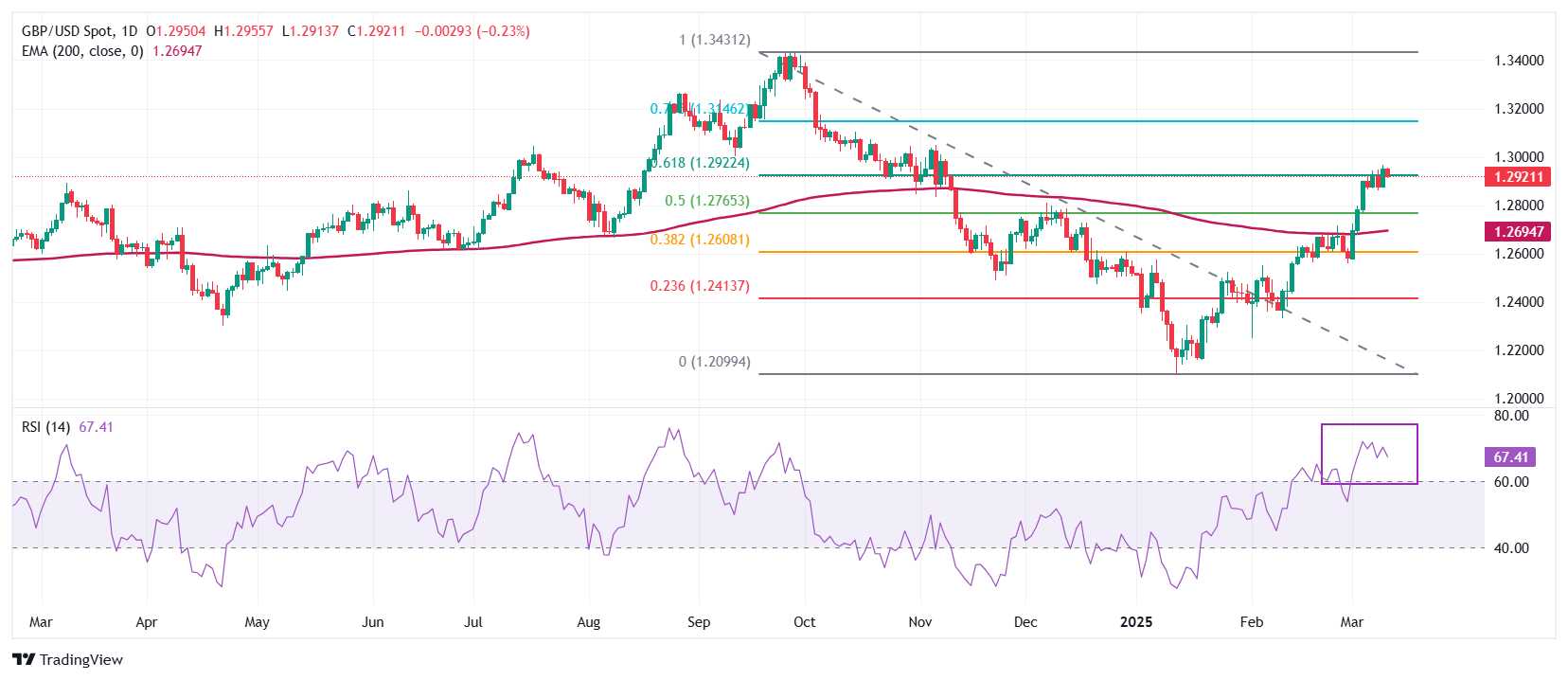
The Pound Sterling aims to extend its upside above the four-month high of 1.2965 against the US Dollar posted on Tuesday. The long-term outlook of the GBP/USD pair has turned bullish as it holds above the 200-day Exponential Moving Average (EMA), which is around 1.2695.
The 14-day Relative Strength Index (RSI) holds above 60.00, suggesting a strong bullish momentum.
Looking down, the 50% Fibo retracement at 1.2767 and the 38.2% Fibo retracement at 1.2608 will act as key support zones for the pair. On the upside, the psychological 1.3000 level will act as a key resistance zone.
Pound Sterling FAQs
The Pound Sterling (GBP) is the oldest currency in the world (886 AD) and the official currency of the United Kingdom. It is the fourth most traded unit for foreign exchange (FX) in the world, accounting for 12% of all transactions, averaging $630 billion a day, according to 2022 data. Its key trading pairs are GBP/USD, also known as ‘Cable’, which accounts for 11% of FX, GBP/JPY, or the ‘Dragon’ as it is known by traders (3%), and EUR/GBP (2%). The Pound Sterling is issued by the Bank of England (BoE).
The single most important factor influencing the value of the Pound Sterling is monetary policy decided by the Bank of England. The BoE bases its decisions on whether it has achieved its primary goal of “price stability” – a steady inflation rate of around 2%. Its primary tool for achieving this is the adjustment of interest rates. When inflation is too high, the BoE will try to rein it in by raising interest rates, making it more expensive for people and businesses to access credit. This is generally positive for GBP, as higher interest rates make the UK a more attractive place for global investors to park their money. When inflation falls too low it is a sign economic growth is slowing. In this scenario, the BoE will consider lowering interest rates to cheapen credit so businesses will borrow more to invest in growth-generating projects.
Data releases gauge the health of the economy and can impact the value of the Pound Sterling. Indicators such as GDP, Manufacturing and Services PMIs, and employment can all influence the direction of the GBP. A strong economy is good for Sterling. Not only does it attract more foreign investment but it may encourage the BoE to put up interest rates, which will directly strengthen GBP. Otherwise, if economic data is weak, the Pound Sterling is likely to fall.
Another significant data release for the Pound Sterling is the Trade Balance. This indicator measures the difference between what a country earns from its exports and what it spends on imports over a given period. If a country produces highly sought-after exports, its currency will benefit purely from the extra demand created from foreign buyers seeking to purchase these goods. Therefore, a positive net Trade Balance strengthens a currency and vice versa for a negative balance.
- EUR/GBP dips amid rising confidence that the BoE will maintain higher interest rates for an extended period.
- BoE policymakers signaled that the process of easing monetary policy restrictiveness would be gradual.
- The Franziska Brantner-led German Green Party may support the approval of a defense spending deal.
EUR/GBP halts its seven-day winning streak, trading around 0.8430 during the European hours on Wednesday. The currency cross weakens as the Pound Sterling (GBP) strengthens, driven by growing trader confidence that the Bank of England (BoE) will keep interest rates higher for longer.
Market expectations for a prolonged restrictive monetary policy stance by the BoE are supported by strong wage growth in the United Kingdom (UK), which continues to fuel inflation in the services sector. Last week, four BoE policymakers, including Governor Andrew Bailey, told the Parliamentary Treasury Committee that unwinding monetary policy restrictiveness would be gradual, as inflation persistence is unlikely to subside on its own.
However, the EUR/GBP cross appreciated as the Euro (EUR) outperforms its peers, buoyed by optimism that the Franziska Brantner-led German Green Party will support the approval of a defense spending deal set for discussion on Thursday. Earlier, German leaders agreed to ease the borrowing cap, known as the “debt brake,” and establish a €500 billion infrastructure fund to bolster defense spending and stimulate economic growth.
Germany’s fiscal plans have also led traders to reconsider expectations for the European Central Bank (ECB) to implement two additional rate cuts by the summer. ECB policymaker and Bank of Finland Governor Olli Rehn noted that forecasts and core inflation indicators suggest inflation is on track to align with the 2% target.
Interest rates FAQs
Interest rates are charged by financial institutions on loans to borrowers and are paid as interest to savers and depositors. They are influenced by base lending rates, which are set by central banks in response to changes in the economy. Central banks normally have a mandate to ensure price stability, which in most cases means targeting a core inflation rate of around 2%. If inflation falls below target the central bank may cut base lending rates, with a view to stimulating lending and boosting the economy. If inflation rises substantially above 2% it normally results in the central bank raising base lending rates in an attempt to lower inflation.
Higher interest rates generally help strengthen a country’s currency as they make it a more attractive place for global investors to park their money.
Higher interest rates overall weigh on the price of Gold because they increase the opportunity cost of holding Gold instead of investing in an interest-bearing asset or placing cash in the bank. If interest rates are high that usually pushes up the price of the US Dollar (USD), and since Gold is priced in Dollars, this has the effect of lowering the price of Gold.
The Fed funds rate is the overnight rate at which US banks lend to each other. It is the oft-quoted headline rate set by the Federal Reserve at its FOMC meetings. It is set as a range, for example 4.75%-5.00%, though the upper limit (in that case 5.00%) is the quoted figure. Market expectations for future Fed funds rate are tracked by the CME FedWatch tool, which shapes how many financial markets behave in anticipation of future Federal Reserve monetary policy decisions.
Japan’s Chief Cabinet Secretary Yoshimasa Hayashi noted on Wednesday that “I would like to have close communication with the US over auto tariffs.”
Additional quotes
It's regrettable that the US went ahead with steel and aluminum tariff despite our request for exemption.
The measure could have a major impact on Japan-US economic relations and the multilateral trade system.
Separately, China's Foreign Ministry warned on US President Donald Trump’s steel and aluminium tariffs, saying that “if the US insists on suppressing China, China must resolutely counter it.”
Market reaction
USD/JPY keeps pushing higher, tracking a broad US Dollar rebound, currently trading 0.55% higher on the day at 148.55.
Here is what you need to know on Wednesday, March 12:
Following a volatile American session that was dominated by tariff headlines on Tuesday, financial markets quiet down early Wednesday. The US economic calendar will feature Consumer Price Index (CPI) data for February. Later in the day, the Bank of Canada (BoC) will announce monetary policy decisions.
US President Donald Trump announced on Tuesday that he will impose an additional 25% tariff, in addition to the previously announced 25%, on steel and aluminum imports from Canada. In response, Ontario Premier Doug Ford announced that they will place a 25% surcharge on the electricity that they supply to more than 1 million homes in the US. Trump backed off following this development and the White House said that only the previously planned 25% tariffs on steel and aluminum products from Canada and all other countries will go into effect with no exceptions or exemptions.
US Dollar PRICE This week
The table below shows the percentage change of US Dollar (USD) against listed major currencies this week. US Dollar was the weakest against the Euro.
| USD | EUR | GBP | JPY | CAD | AUD | NZD | CHF | |
|---|---|---|---|---|---|---|---|---|
| USD | -0.51% | 0.03% | 0.31% | 0.72% | 0.44% | 0.35% | 0.32% | |
| EUR | 0.51% | 0.50% | 0.81% | 1.25% | 1.05% | 0.84% | 0.72% | |
| GBP | -0.03% | -0.50% | 0.27% | 0.71% | 0.54% | 0.27% | 0.28% | |
| JPY | -0.31% | -0.81% | -0.27% | 0.42% | 0.20% | -0.04% | 0.09% | |
| CAD | -0.72% | -1.25% | -0.71% | -0.42% | -0.33% | -0.38% | -0.43% | |
| AUD | -0.44% | -1.05% | -0.54% | -0.20% | 0.33% | -0.20% | -0.27% | |
| NZD | -0.35% | -0.84% | -0.27% | 0.04% | 0.38% | 0.20% | 0.06% | |
| CHF | -0.32% | -0.72% | -0.28% | -0.09% | 0.43% | 0.27% | -0.06% |
The heat map shows percentage changes of major currencies against each other. The base currency is picked from the left column, while the quote currency is picked from the top row. For example, if you pick the US Dollar from the left column and move along the horizontal line to the Japanese Yen, the percentage change displayed in the box will represent USD (base)/JPY (quote).
Early Wednesday, European Commission President Ursula von der Leyen said that the European Union (EU) has launched 'swift and proportionate countermeasures' on US imports in response to steel tariffs. Similarly, UK Trade Minister Jonathan Reynolds said that it is disappointing that the US has decided to go ahead with global tariffs on steel and aluminum, adding that they will keep all options on the table and won't hesitate to respond in the national interest. Meanwhile, Australia’s Prime Minister Anthony Albanese noted that they will not impose reciprocal tariffs on the US, explaining that retaliatory measures would only increase costs for Australian consumers and fuel inflation.
The US Dollar (USD) came under selling pressure in the early American session on Tuesday and the USD Index dropped to its weakest level since mid-October near 103.20. Early Wednesday, the USD Index stages a rebound and trades in positive territory above 103.50. US stock index futures also cling to modest gains in the European morning after Wall Street's main indexes registered losses on Tuesday.
After fluctuating wildly in the second half of the day, USD/CAD closed virtually unchanged on Tuesday. The pair edges higher on Wednesday and trades above 1.4450. The BoC is widely expected to lower the policy rate by 25 basis points to 2.75% after the March meeting.
EUR/USD gathered bullish momentum and climbed to its highest level in five months near 1.0950 on Tuesday. The pair corrects lower on Wednesday and trades below 1.0900 in the European morning.
GBP/USD gained more than 0.5% on Tuesday and rose above 1.2950. Pressured by the USD recovery early Wednesday, the pair retreats toward 1.2900.
USD/JPY holds its ground and rises toward 148.50 after posting modest gains on Tuesday. Bank of Japan Governor Kazuo Ueda said on Wednesday that it is natural for long-term rates to shift in line with the market view on the outlook for short-term policy rates.
Following Monday's decline, Gold rebounded on Tuesday and gained nearly 1% on the day. XAU/USD struggles to preserve its bullish momentum but manages to hold above $2,900 on Wednesday.
Tariffs FAQs
Tariffs are customs duties levied on certain merchandise imports or a category of products. Tariffs are designed to help local producers and manufacturers be more competitive in the market by providing a price advantage over similar goods that can be imported. Tariffs are widely used as tools of protectionism, along with trade barriers and import quotas.
Although tariffs and taxes both generate government revenue to fund public goods and services, they have several distinctions. Tariffs are prepaid at the port of entry, while taxes are paid at the time of purchase. Taxes are imposed on individual taxpayers and businesses, while tariffs are paid by importers.
There are two schools of thought among economists regarding the usage of tariffs. While some argue that tariffs are necessary to protect domestic industries and address trade imbalances, others see them as a harmful tool that could potentially drive prices higher over the long term and lead to a damaging trade war by encouraging tit-for-tat tariffs.
During the run-up to the presidential election in November 2024, Donald Trump made it clear that he intends to use tariffs to support the US economy and American producers. In 2024, Mexico, China and Canada accounted for 42% of total US imports. In this period, Mexico stood out as the top exporter with $466.6 billion, according to the US Census Bureau. Hence, Trump wants to focus on these three nations when imposing tariffs. He also plans to use the revenue generated through tariffs to lower personal income taxes.
- The US Dollar Index rebounds to near 103.55 in Wednesday’s early European session, adding 0.13% on the day.
- The negative outlook of the index remains in play, but further consolidation cannot be ruled out amid the oversold RSI condition.
- The crucial support level to watch is the 103.10-103.00 region; the immediate resistance level is seen at 104.40.
The US Dollar Index (DXY), an index of the value of the US Dollar (USD) measured against a basket of six world currencies, recovers to near 103.55 after bouncing off four-month lows around 103.20. However, the upside for the index might be limited amid concerns mounted over a US slowdown and the impact of tariffs on global economic growth.
According to the daily chart, the bearish sentiment of the DXY remains intact as the index holds below the key 100-day Exponential Moving Average (EMA). The downward momentum is supported by the 14-day Relative Strength Index (RSI), which stands below the midline. Nonetheless, the oversold RSI condition indicates that further consolidation cannot be ruled out before positioning for any near-term DXY depreciation.
The key support level for the USD index emerges near the 103.10-103.00 zone, representing the lower limit of the Bollinger Band and the psychological level. Further south, the next contention level is seen at 102.27, the low of August 14, 2024. The additional downside filter to watch is 100.53, the low of August 28, 2024.
On the bright side, the first upside barrier for the DXY is located at 104.40, the high of March 6. Any follow-through buying above this level could pave the way to 106.35, the 100-day EMA. A decisive break above the mentioned level could see a rally to 107.38, the high of February 19.
US Dollar Index (DXY) daily chart
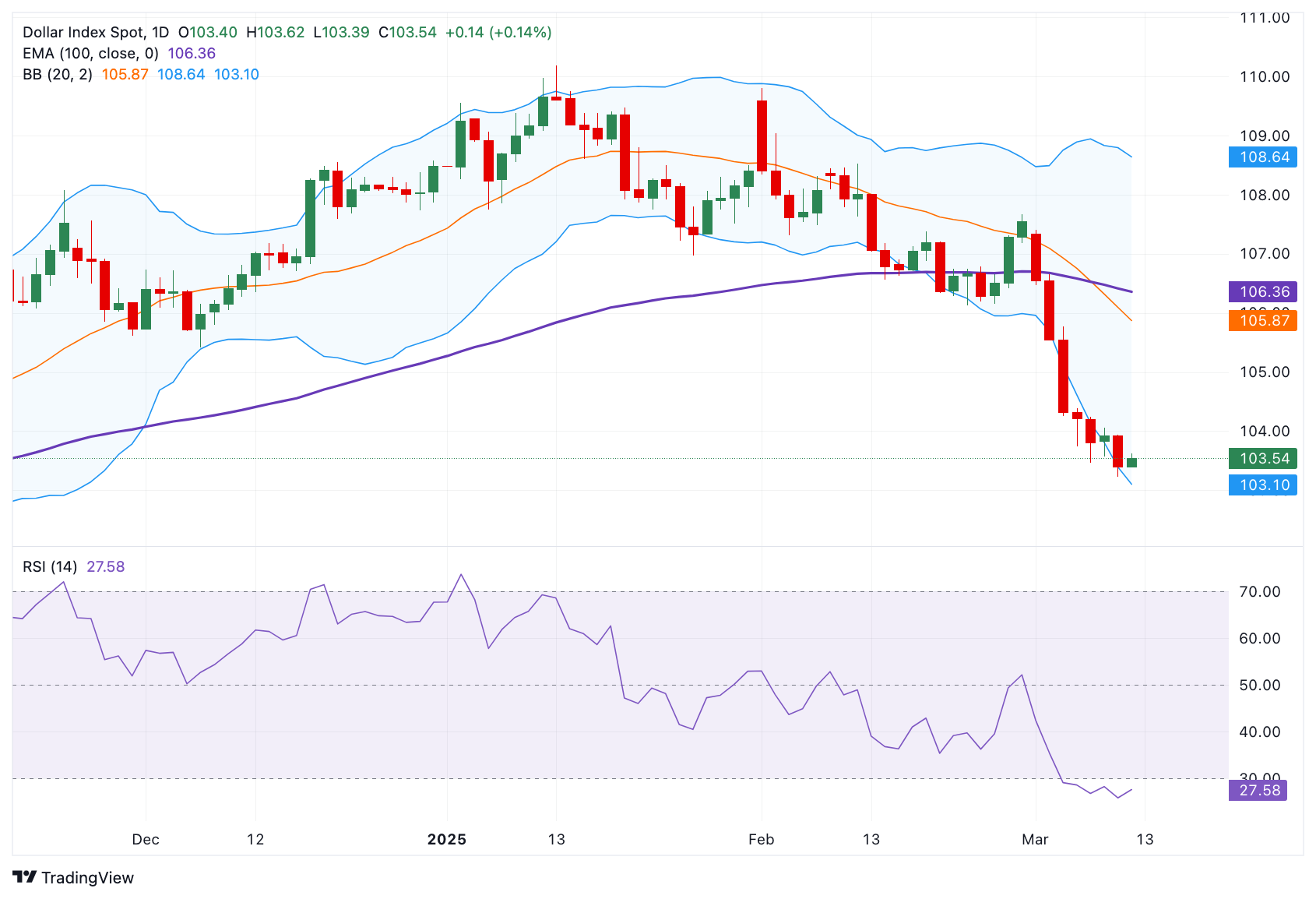
US Dollar FAQs
The US Dollar (USD) is the official currency of the United States of America, and the ‘de facto’ currency of a significant number of other countries where it is found in circulation alongside local notes. It is the most heavily traded currency in the world, accounting for over 88% of all global foreign exchange turnover, or an average of $6.6 trillion in transactions per day, according to data from 2022. Following the second world war, the USD took over from the British Pound as the world’s reserve currency. For most of its history, the US Dollar was backed by Gold, until the Bretton Woods Agreement in 1971 when the Gold Standard went away.
The most important single factor impacting on the value of the US Dollar is monetary policy, which is shaped by the Federal Reserve (Fed). The Fed has two mandates: to achieve price stability (control inflation) and foster full employment. Its primary tool to achieve these two goals is by adjusting interest rates. When prices are rising too quickly and inflation is above the Fed’s 2% target, the Fed will raise rates, which helps the USD value. When inflation falls below 2% or the Unemployment Rate is too high, the Fed may lower interest rates, which weighs on the Greenback.
In extreme situations, the Federal Reserve can also print more Dollars and enact quantitative easing (QE). QE is the process by which the Fed substantially increases the flow of credit in a stuck financial system. It is a non-standard policy measure used when credit has dried up because banks will not lend to each other (out of the fear of counterparty default). It is a last resort when simply lowering interest rates is unlikely to achieve the necessary result. It was the Fed’s weapon of choice to combat the credit crunch that occurred during the Great Financial Crisis in 2008. It involves the Fed printing more Dollars and using them to buy US government bonds predominantly from financial institutions. QE usually leads to a weaker US Dollar.
Quantitative tightening (QT) is the reverse process whereby the Federal Reserve stops buying bonds from financial institutions and does not reinvest the principal from the bonds it holds maturing in new purchases. It is usually positive for the US Dollar.
The Bank of Japan (BoJ) Governor Kazuo Ueda said on Wednesday that he is “very worried about uncertainty over overseas economy, prices.”
Additional quotes
Underlying inflation still remains below 2%.
BoJ ready to conduct bond-buying operation nimbly in exceptional cases when long-term rates make irregular moves.
Market reaction
USD/JPY is holding gains above 148.00 following Ueda’s cautious remarks, adding 0.23% on a daily basis.
UK Trade Minister Jonathan Reynolds said on Wednesday that they are “negotiating a wider economic agreement to eliminate additional tariffs.”
Further comments
It's disappointing that the US has imposed global tariffs on steel and aluminum.
Focused on a more pragmatic approach and rapidly negotiating on the matter.
Will keep all options on the table and won't hesitate to respond in the national interest.
Market reaction
At the time of writing, GBP/USD holds lower ground near 1.2925, down 0.19% so far.
British Pound PRICE Today
The table below shows the percentage change of British Pound (GBP) against listed major currencies today. British Pound was the weakest against the US Dollar.
| USD | EUR | GBP | JPY | CAD | AUD | NZD | CHF | |
|---|---|---|---|---|---|---|---|---|
| USD | 0.13% | 0.16% | 0.15% | 0.08% | 0.10% | 0.16% | 0.05% | |
| EUR | -0.13% | 0.03% | 0.00% | -0.05% | -0.03% | 0.04% | -0.07% | |
| GBP | -0.16% | -0.03% | -0.02% | -0.08% | -0.06% | 0.00% | -0.11% | |
| JPY | -0.15% | 0.00% | 0.02% | -0.08% | -0.05% | -0.00% | -0.09% | |
| CAD | -0.08% | 0.05% | 0.08% | 0.08% | 0.03% | 0.08% | -0.02% | |
| AUD | -0.10% | 0.03% | 0.06% | 0.05% | -0.03% | 0.06% | -0.04% | |
| NZD | -0.16% | -0.04% | -0.00% | 0.00% | -0.08% | -0.06% | -0.11% | |
| CHF | -0.05% | 0.07% | 0.11% | 0.09% | 0.02% | 0.04% | 0.11% |
The heat map shows percentage changes of major currencies against each other. The base currency is picked from the left column, while the quote currency is picked from the top row. For example, if you pick the British Pound from the left column and move along the horizontal line to the US Dollar, the percentage change displayed in the box will represent GBP (base)/USD (quote).
European Commission President Ursula von der Leyen said on Wednesday that the European Union (EU) has launched 'swift and proportionate countermeasures' on US imports in the EU in response to steel tariffs.
Additional comments
EU responds with countermeasures worth EUR26 billion.
It will reimpose suspended 2018 and 2020 rebalancing measure and will introduce new measures.
Measures will be imposed in two steps from April 1 to 13.
Market reaction
The Euro (EUR) has come under moderate selling pressure on these headlines, with EUR/USD losing 0.15% on the day to trade near 1.0900 as of writing.
Tariffs FAQs
Tariffs are customs duties levied on certain merchandise imports or a category of products. Tariffs are designed to help local producers and manufacturers be more competitive in the market by providing a price advantage over similar goods that can be imported. Tariffs are widely used as tools of protectionism, along with trade barriers and import quotas.
Although tariffs and taxes both generate government revenue to fund public goods and services, they have several distinctions. Tariffs are prepaid at the port of entry, while taxes are paid at the time of purchase. Taxes are imposed on individual taxpayers and businesses, while tariffs are paid by importers.
There are two schools of thought among economists regarding the usage of tariffs. While some argue that tariffs are necessary to protect domestic industries and address trade imbalances, others see them as a harmful tool that could potentially drive prices higher over the long term and lead to a damaging trade war by encouraging tit-for-tat tariffs.
During the run-up to the presidential election in November 2024, Donald Trump made it clear that he intends to use tariffs to support the US economy and American producers. In 2024, Mexico, China and Canada accounted for 42% of total US imports. In this period, Mexico stood out as the top exporter with $466.6 billion, according to the US Census Bureau. Hence, Trump wants to focus on these three nations when imposing tariffs. He also plans to use the revenue generated through tariffs to lower personal income taxes.
- USD/CHF gains ground to around 0.8840 in Wednesday’s early European session.
- The renewed US Dollar demand provides some support to the pair ahead of US CPI report.
- Global economic uncertainty and geopolitical tensions might boost the safe-haven flows, benefiting the CHF.
The USD/CHF pair trades in positive territory for the third consecutive day near 0.8840 during the early European session on Wednesday. The uptick of the pair is bolstered by the renewed US Dollar (USD) demand. Traders will keep an eye on the US February Consumer Price Index (CPI) inflation data, which is due later on Wednesday.
Meanwhile, the US Dollar Index (DXY), a measure of the USD's value relative to its most significant trading partners' currencies, rebounds to around 103.60 after bouncing off the multi-month lows near 103.20. Nonetheless, the Greenback faces some headwinds amid concerns mounted over a US slowdown and the impact of tariffs on global economic growth.
Market players will take more cues from the US CPI release on Wednesday. The headline CPI is expected to show an increase of 0.3% MoM in February. On an annual basis, headline inflation is forecast to show an increase of 2.9%, while core CPI is estimated to show a rise of 3.2% during the same reported period.
Houthi spokesman said late Tuesday that they will attack any Israeli ship that violates the group's ban on Israeli ships passing through the Red and Arabian Seas, the Bab al-Mandab Strait, and the Gulf of Aden, effective immediately. Heightened safe-haven demand amid growing concerns over global economic conditions and geopolitical tensions in the Middle East could boost the Swiss Franc (CHF) and create a headwind for USD/CHF.
Swiss Franc FAQs
The Swiss Franc (CHF) is Switzerland’s official currency. It is among the top ten most traded currencies globally, reaching volumes that well exceed the size of the Swiss economy. Its value is determined by the broad market sentiment, the country’s economic health or action taken by the Swiss National Bank (SNB), among other factors. Between 2011 and 2015, the Swiss Franc was pegged to the Euro (EUR). The peg was abruptly removed, resulting in a more than 20% increase in the Franc’s value, causing a turmoil in markets. Even though the peg isn’t in force anymore, CHF fortunes tend to be highly correlated with the Euro ones due to the high dependency of the Swiss economy on the neighboring Eurozone.
The Swiss Franc (CHF) is considered a safe-haven asset, or a currency that investors tend to buy in times of market stress. This is due to the perceived status of Switzerland in the world: a stable economy, a strong export sector, big central bank reserves or a longstanding political stance towards neutrality in global conflicts make the country’s currency a good choice for investors fleeing from risks. Turbulent times are likely to strengthen CHF value against other currencies that are seen as more risky to invest in.
The Swiss National Bank (SNB) meets four times a year – once every quarter, less than other major central banks – to decide on monetary policy. The bank aims for an annual inflation rate of less than 2%. When inflation is above target or forecasted to be above target in the foreseeable future, the bank will attempt to tame price growth by raising its policy rate. Higher interest rates are generally positive for the Swiss Franc (CHF) as they lead to higher yields, making the country a more attractive place for investors. On the contrary, lower interest rates tend to weaken CHF.
Macroeconomic data releases in Switzerland are key to assessing the state of the economy and can impact the Swiss Franc’s (CHF) valuation. The Swiss economy is broadly stable, but any sudden change in economic growth, inflation, current account or the central bank’s currency reserves have the potential to trigger moves in CHF. Generally, high economic growth, low unemployment and high confidence are good for CHF. Conversely, if economic data points to weakening momentum, CHF is likely to depreciate.
As a small and open economy, Switzerland is heavily dependent on the health of the neighboring Eurozone economies. The broader European Union is Switzerland’s main economic partner and a key political ally, so macroeconomic and monetary policy stability in the Eurozone is essential for Switzerland and, thus, for the Swiss Franc (CHF). With such dependency, some models suggest that the correlation between the fortunes of the Euro (EUR) and the CHF is more than 90%, or close to perfect.
- USD/MXN consolidates in a range above the monthly low touched earlier this week.
- The technical setup favors bearish traders and supports prospects for further losses.
- A sustained strength beyond the 100-day SMA is needed to negate the negative bias.
The USD/MXN pair struggles for a firm intraday direction on Wednesday and oscillates in a narrow trading band, around the 20.2790-20.2795 region through the Asian session. Spot prices, meanwhile, remain close to the lowest level since January 24 touched on Monday, and seem vulnerable to slide further amid the underlying bearish sentiment surrounding the US Dollar (USD).
Investors now seem convinced that a tariff-driven slowdown in the US economic activity and signs of a cooling US labor market might force the Federal Reserve (Fed) to cut interest rates several times this year. This, in turn, has been a key factor behind the recent USD downfall to its lowest level since mid-October set on Tuesday. The USD bears, however, seem reluctant to place fresh bets ahead of the release of the US consumer inflation figures, which, in turn, is seen acting as a tailwind for the USD/MXN pair.
From a technical perspective, last week's breakdown and acceptance below the 100-day Simple Moving Average (SMA) for the first time since May 2024 favors the USD/MXN bears. Moreover, oscillators on the daily chart have just started gaining negative traction and suggest that the path of least resistance for spot prices remains to the downside. Hence, any intraday move-up might be seen as a selling opportunity and remain capped near the 20.3825-20.3830 region, or the 100-day SMA support breakpoint.
However, some follow-through buying beyond the weekly top, around the 20.4040 area, might prompt some short-covering move and lift the USD/MXN pair to the 20.5040 area en route to the next relevant hurdle near the 20.6060-20.6070 region. The momentum could extend further towards the 20.7035-20.7040 resistance before spot prices eventually aim to challenge the monthly swing high, around the 21.0000 round-figure mark.
On the flip side, weakness below the 20.2540-20.2535 area could find some support near the 20.1810 region, or the monthly low touched on Monday. This is followed by the year-to-date through, around the 20.1345 zone, below which the USD/MXN pair could accelerate the fall towards the 20.0715 intermediate support en route to the December 2024 swing low, around the 20.0215 region.
USD/MXN daily chart
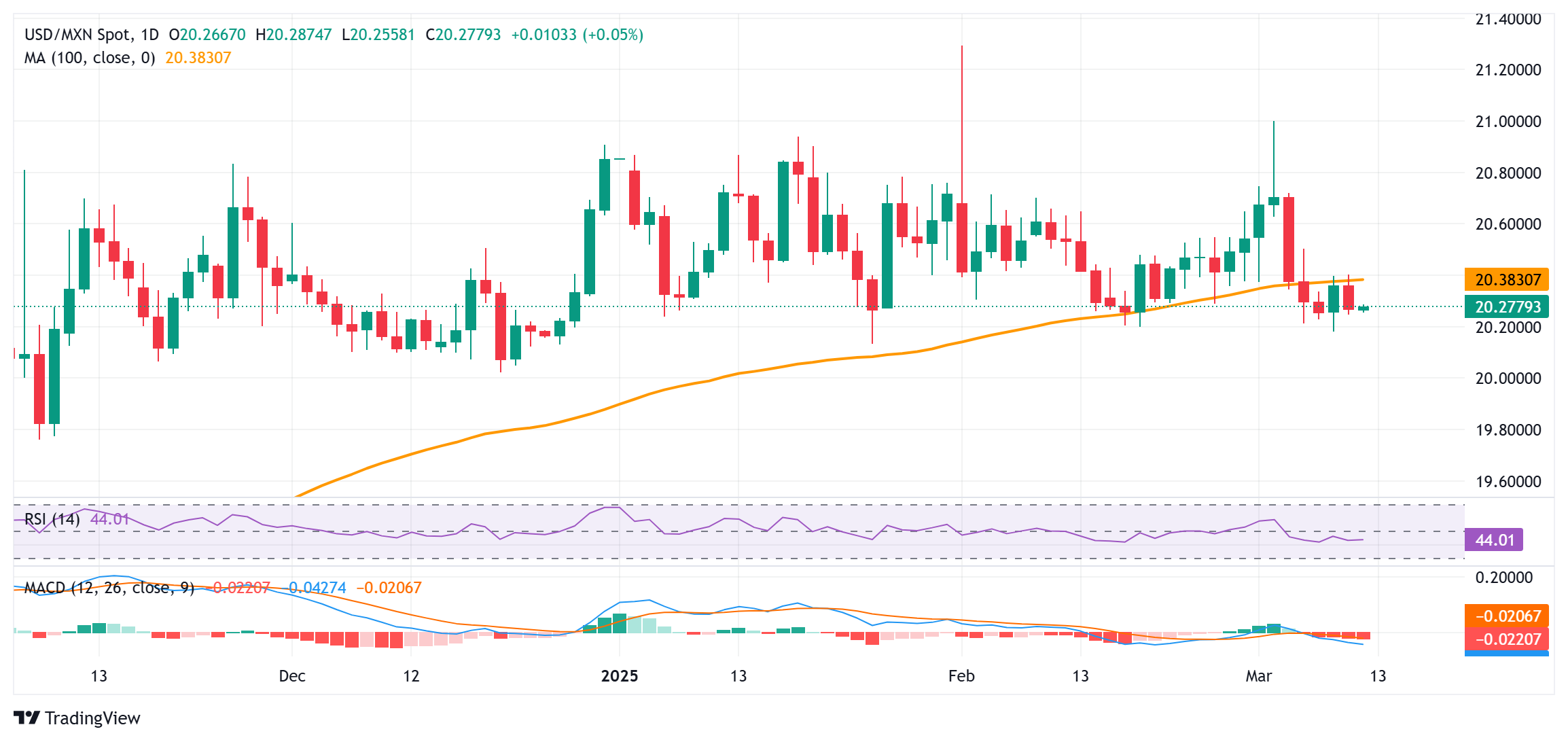
Mexican Peso FAQs
The Mexican Peso (MXN) is the most traded currency among its Latin American peers. Its value is broadly determined by the performance of the Mexican economy, the country’s central bank’s policy, the amount of foreign investment in the country and even the levels of remittances sent by Mexicans who live abroad, particularly in the United States. Geopolitical trends can also move MXN: for example, the process of nearshoring – or the decision by some firms to relocate manufacturing capacity and supply chains closer to their home countries – is also seen as a catalyst for the Mexican currency as the country is considered a key manufacturing hub in the American continent. Another catalyst for MXN is Oil prices as Mexico is a key exporter of the commodity.
The main objective of Mexico’s central bank, also known as Banxico, is to maintain inflation at low and stable levels (at or close to its target of 3%, the midpoint in a tolerance band of between 2% and 4%). To this end, the bank sets an appropriate level of interest rates. When inflation is too high, Banxico will attempt to tame it by raising interest rates, making it more expensive for households and businesses to borrow money, thus cooling demand and the overall economy. Higher interest rates are generally positive for the Mexican Peso (MXN) as they lead to higher yields, making the country a more attractive place for investors. On the contrary, lower interest rates tend to weaken MXN.
Macroeconomic data releases are key to assess the state of the economy and can have an impact on the Mexican Peso (MXN) valuation. A strong Mexican economy, based on high economic growth, low unemployment and high confidence is good for MXN. Not only does it attract more foreign investment but it may encourage the Bank of Mexico (Banxico) to increase interest rates, particularly if this strength comes together with elevated inflation. However, if economic data is weak, MXN is likely to depreciate.
As an emerging-market currency, the Mexican Peso (MXN) tends to strive during risk-on periods, or when investors perceive that broader market risks are low and thus are eager to engage with investments that carry a higher risk. Conversely, MXN tends to weaken at times of market turbulence or economic uncertainty as investors tend to sell higher-risk assets and flee to the more-stable safe havens.
- EUR/JPY strengthens as the JPY weakens amid shifting safe-haven flows and an improvement in global risk sentiment.
- Japan’s top companies are poised to implement substantial wage hikes for the third straight year to help workers cope with inflation.
- The Euro gains as the Franziska Brantner-led German Green Party may back the approval of a defense spending deal.
EUR/JPY continues its upward momentum for the second consecutive day, trading around 161.60 during Wednesday’s Asian session. The pair strengthens as the Japanese Yen (JPY) weakens amid concerns that US President Donald Trump may introduce new tariffs on Japan.
Additionally, the JPY faces pressure due to shifting safe-haven flows and a modest improvement in global risk sentiment. Market confidence gets a boost after President Trump reversed his decision to double tariffs on Canadian steel and aluminum to 50%, a move he announced late Tuesday. However, the White House confirmed to Reuters that a 25% tariff on all imported steel and aluminum will still take effect on Wednesday, impacting key US trade partners, including Canada and Mexico.
Despite this, the JPY’s downside may be cushioned as Japanese government bond (JGB) yields recently surged to a multi-year high of 1.5712 amid speculation over further rate hikes by the Bank of Japan (BoJ). BoJ Governor Ueda stated that it is natural for long-term interest rates to adjust based on market expectations for future short-term rates, emphasizing the need for clear communication regarding policy decisions. The BoJ, which raised interest rates to 0.5% in late January, is set to hold its next policy meeting next week.
Japan’s largest companies are set to offer significant wage hikes for the third consecutive year, aiming to help workers manage inflation and address labor shortages, according to Reuters. Rengo, the country’s largest labor union umbrella group representing 7 million members, is advocating for a 6.09% wage increase—exceeding last year’s 5.85% and marking the highest level in 32 years. Some companies, such as Denso, have already agreed to record-breaking wage hikes.
The EUR/JPY cross appreciates as the Euro (EUR) outperforms its peers, buoyed by optimism that the Franziska Brantner-led German Green Party will support the approval of a defense spending deal set for discussion on Thursday. Earlier, German leaders agreed to ease the borrowing cap, known as the “debt brake,” and establish a €500 billion infrastructure fund to bolster defense spending and stimulate economic growth.
Germany’s fiscal plans have also led traders to reconsider expectations for the European Central Bank (ECB) to implement two additional rate cuts by the summer. ECB policymaker and Bank of Finland Governor Olli Rehn noted that forecasts and core inflation indicators suggest inflation is on track to align with the 2% target.
- Gold price struggles to build on the overnight move up, though the downside seems limited.
- A modest USD bounce from a multi-month low and a positive risk tone cap the precious metal.
- Trade war fears and Fed rate cut bets support the XAU/USD pair ahead of the US CPI report.
Gold price (XAU/USD) trades near the weekly high during the Asian session on Wednesday and looks to build on the previous day's goodish rebound from the $2,880 region, or a one-week low. Investors remain worried about the potential economic fallout from US President Donald Trump's trade tariffs, which, in turn, is seen as a key factor that continues to underpin the safe-haven bullion. Moreover, expectations that the Federal Reserve (Fed) will cut interest rates several times this year amid concerns about a tariff-driven slowdown in the US economic activity lend additional support to the non-yielding yellow metal.
Meanwhile, the US Dollar (USD) edges higher and recovers a part of the overnight losses to its lowest level since mid-October amid some repositioning trade ahead of the crucial US consumer inflation figures. Adding to this, the optimism over the passage of the six-month US funding bills, Ukraine's acceptance of the US proposal for a ceasefire with Russia, and a positive risk tone might cap gains for the Gold price. Nevertheless, the fundamental backdrop seems tilted in favor of bullish traders and supports prospects for a further appreciating move, suggesting that any corrective pullback might be seen as a buying opportunity.
Daily Digest Market Movers: Gold price traders opt to wait for the US inflation figures before placing fresh bets
- US President Donald Trump upped the ante in a trade war and said on Tuesday that he would double planned tariff increases on steel and aluminum coming from Canada to 50%, providing a strong boost to the safe-haven Gold price. Trump, however, reversed course in response to Ontario Premier Doug Ford's announcement to suspend a 25% surcharge on electricity sold to the US.
- The lower house of Congress narrowly passed a Republican spending bill that would avoid a government shutdown on March 14 and keep the US government open until September, further boosting investors' confidence. The bill now heads to the Senate and will need the support of at least seven Democrats to overcome the 60-vote filibuster threshold before sending it to Trump for his signature.
- Ukraine expressed readiness to accept the US proposal for an immediate, interim 30-day ceasefire with Russia after bilateral talks in Jeddah, Saudi Arabia. The US would now take the offer to Russia, which has not yet responded to the proposal. The development, however, remains supportive of a turnaround in the global risk sentiment and might act as a headwind for the precious metal.
- Over the weekend, Trump declined to rule out the possibility of a recession in the US and flagged some economic turbulence on the back of his policy agenda. This, along with signs of a cooling US labor market, continues to fuel speculations that the Federal Reserve would soon resume its rate-cutting cycle. In fact, traders are pricing in three rate cuts of 25 basis points each by the end of this year.
- This might keep a lid on any meaningful US Dollar recovery from its lowest level since mid-October touched on Tuesday and favors the XAU/USD bulls. Traders, however, might opt to wait on the sidelines and look forward to the crucial US Consumer Price Index (CPI) report, which might influence the Fed's rate-cut path and provide some meaningful impetus to the non-yielding yellow metal.
Gold price needs to break and stay above $2,928-2,930 for a sustained upward move
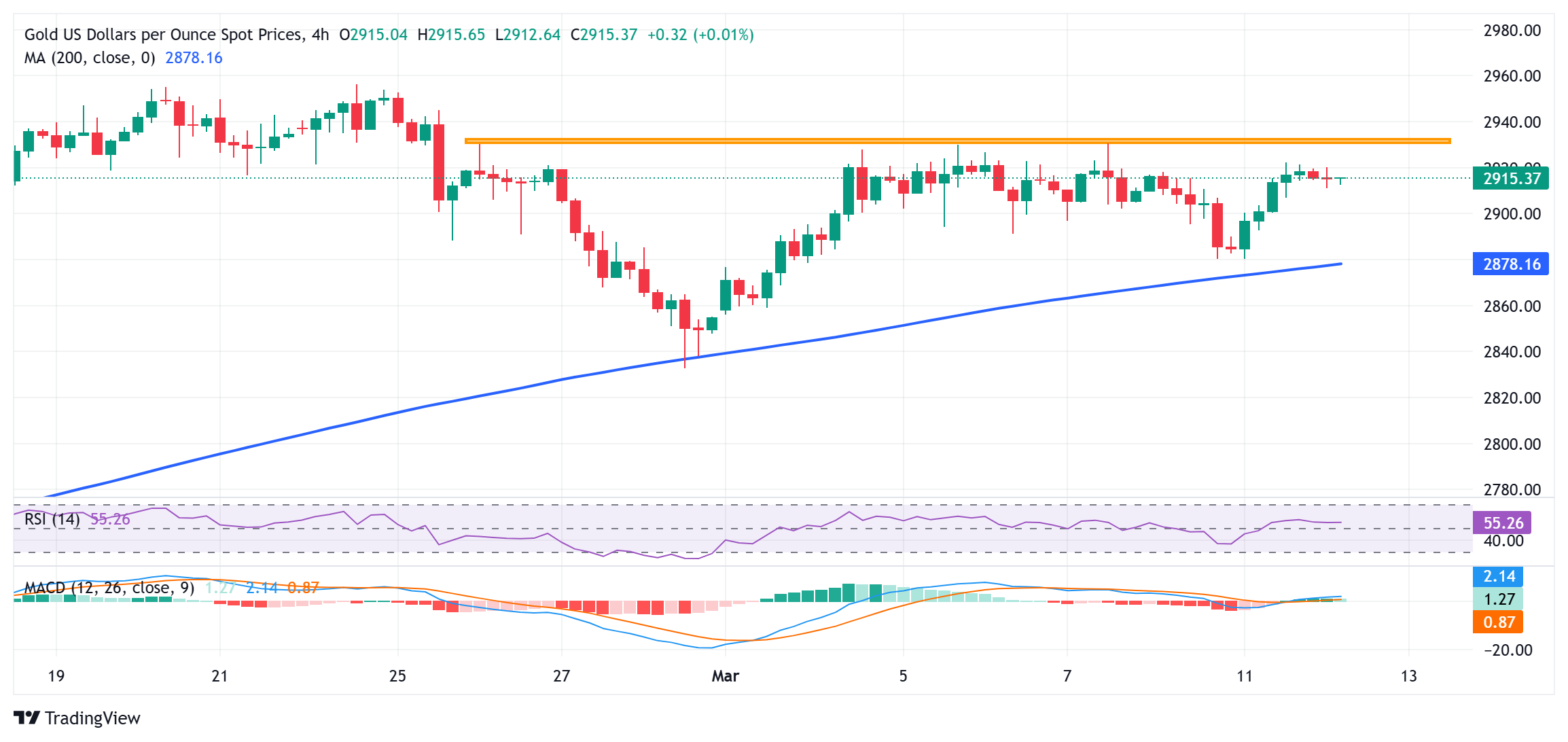
From a technical perspective, bulls might need to wait for a move beyond the $2,928-2,930 hurdle before positioning for further gains. The subsequent move up has the potential to lift the Gold price back towards the all-time peak, around the $2,956 area touched on February 24. Some follow-through buying will be seen as a fresh trigger for bulls and pave the way for the resumption of the recent well-established uptrend amid still positive oscillators on the daily chart.
On the flip side, weakness below the $2,900 mark might now find some support near the $2,880 region, or the weekly low. This is followed by the $2,860 region, below which the Gold price could accelerate the slide towards the late February swing low, around the $2,833-2,832 region, before eventually dropping to the $2,800 mark.
Gold FAQs
Gold has played a key role in human’s history as it has been widely used as a store of value and medium of exchange. Currently, apart from its shine and usage for jewelry, the precious metal is widely seen as a safe-haven asset, meaning that it is considered a good investment during turbulent times. Gold is also widely seen as a hedge against inflation and against depreciating currencies as it doesn’t rely on any specific issuer or government.
Central banks are the biggest Gold holders. In their aim to support their currencies in turbulent times, central banks tend to diversify their reserves and buy Gold to improve the perceived strength of the economy and the currency. High Gold reserves can be a source of trust for a country’s solvency. Central banks added 1,136 tonnes of Gold worth around $70 billion to their reserves in 2022, according to data from the World Gold Council. This is the highest yearly purchase since records began. Central banks from emerging economies such as China, India and Turkey are quickly increasing their Gold reserves.
Gold has an inverse correlation with the US Dollar and US Treasuries, which are both major reserve and safe-haven assets. When the Dollar depreciates, Gold tends to rise, enabling investors and central banks to diversify their assets in turbulent times. Gold is also inversely correlated with risk assets. A rally in the stock market tends to weaken Gold price, while sell-offs in riskier markets tend to favor the precious metal.
The price can move due to a wide range of factors. Geopolitical instability or fears of a deep recession can quickly make Gold price escalate due to its safe-haven status. As a yield-less asset, Gold tends to rise with lower interest rates, while higher cost of money usually weighs down on the yellow metal. Still, most moves depend on how the US Dollar (USD) behaves as the asset is priced in dollars (XAU/USD). A strong Dollar tends to keep the price of Gold controlled, whereas a weaker Dollar is likely to push Gold prices up.
Gold prices remained broadly unchanged in India on Wednesday, according to data compiled by FXStreet.
The price for Gold stood at 8,171.77 Indian Rupees (INR) per gram, broadly stable compared with the INR 8,170.87 it cost on Tuesday.
The price for Gold was broadly steady at INR 95,313.88 per tola from INR 95,303.41 per tola a day earlier.
| Unit measure | Gold Price in INR |
|---|---|
| 1 Gram | 8,171.77 |
| 10 Grams | 81,717.66 |
| Tola | 95,313.88 |
| Troy Ounce | 254,170.50 |
Daily digest market movers: Gold price unfazed by high US yields
-
The US 10-year Treasury bond yield recovers and edges up six basis points to 4.282% as traders eye the Fed’s interest rate cuts.
-
US real yields, as measured by the US 10-year Treasury Inflation-Protected Securities (TIPS) yield that correlates inversely to Gold prices, climb five-and-a-half basis points to 1.963%, a headwind for the non-yielding metal.
-
The Atlanta Fed GDP Now model predicts the first quarter of 2025 at -2.4%, which would be the first negative print since the COVID-19 pandemic.
-
The US JOLTS report showed that job openings rose to 7.740 million in January, up from 7.508 million, surpassing expectations of 7.63 million, signaling continued strength in the labor market.
-
The People’s Bank of China (PBoC) continues to purchase Gold, according to the World Gold Council (WGC). The PBoC increased its holdings by 10 tonnes in the first two months of 2025. However, the largest buyer was the National Bank of Poland (NBP), which increased its reserve by 29 tonnes, its largest purchase since June 2019, when it bought 95 tonnes.
-
Money market traders had priced in 77.5 basis points of easing in 2025, up from 74 bps last Friday, via data from Prime Market Terminal.
FXStreet calculates Gold prices in India by adapting international prices (USD/INR) to the local currency and measurement units. Prices are updated daily based on the market rates taken at the time of publication. Prices are just for reference and local rates could diverge slightly.
Gold FAQs
Gold has played a key role in human’s history as it has been widely used as a store of value and medium of exchange. Currently, apart from its shine and usage for jewelry, the precious metal is widely seen as a safe-haven asset, meaning that it is considered a good investment during turbulent times. Gold is also widely seen as a hedge against inflation and against depreciating currencies as it doesn’t rely on any specific issuer or government.
Central banks are the biggest Gold holders. In their aim to support their currencies in turbulent times, central banks tend to diversify their reserves and buy Gold to improve the perceived strength of the economy and the currency. High Gold reserves can be a source of trust for a country’s solvency. Central banks added 1,136 tonnes of Gold worth around $70 billion to their reserves in 2022, according to data from the World Gold Council. This is the highest yearly purchase since records began. Central banks from emerging economies such as China, India and Turkey are quickly increasing their Gold reserves.
Gold has an inverse correlation with the US Dollar and US Treasuries, which are both major reserve and safe-haven assets. When the Dollar depreciates, Gold tends to rise, enabling investors and central banks to diversify their assets in turbulent times. Gold is also inversely correlated with risk assets. A rally in the stock market tends to weaken Gold price, while sell-offs in riskier markets tend to favor the precious metal.
The price can move due to a wide range of factors. Geopolitical instability or fears of a deep recession can quickly make Gold price escalate due to its safe-haven status. As a yield-less asset, Gold tends to rise with lower interest rates, while higher cost of money usually weighs down on the yellow metal. Still, most moves depend on how the US Dollar (USD) behaves as the asset is priced in dollars (XAU/USD). A strong Dollar tends to keep the price of Gold controlled, whereas a weaker Dollar is likely to push Gold prices up.
(An automation tool was used in creating this post.)
- EUR/USD weakens to around 1.0900 in Wednesday’s Asian trading hours.
- Renewed USD demand weighs on the major pair.
- Traders will take more cues from the US February CPI inflation report, which is due later on Wednesday.
The EUR/USD pair attracts some sellers to near 1.0900, snapping the three-day winning streak during the Asian trading hours on Wednesday. The renewed US Dollar (USD) demand undermines the major pair. Later on Wednesday, the US February Consumer Price Index (CPI) inflation data will be in the spotlight.
The Greenback gains traction as US President Donald Trump's steel and aluminum tariffs take effect on Wednesday. The White House confirmed that fresh 25% tariffs on all imported steel and aluminum will still go into effect on Wednesday, including against allies and top US suppliers Canada and Mexico.
Furthermore, the rising bets that the European Central Bank (ECB) will cut interest rates two times more by the summer could drag the shared currency lower against the USD. Traders had fully priced in two more rate reductions amid firm confidence that the Eurozone inflation will sustainably return to the 2% target this year.
On the other hand, probable US economic slowdown and trade policy uncertainty might weigh on the Greenback. Investors are worried about US weaker economic data as well as big cuts to the government workforce and government spending. Goldman Sachs analysts last week raised its recession chance from 15% to 20%, citing it saw policy changes as the key risk to the economy.
Euro FAQs
The Euro is the currency for the 19 European Union countries that belong to the Eurozone. It is the second most heavily traded currency in the world behind the US Dollar. In 2022, it accounted for 31% of all foreign exchange transactions, with an average daily turnover of over $2.2 trillion a day. EUR/USD is the most heavily traded currency pair in the world, accounting for an estimated 30% off all transactions, followed by EUR/JPY (4%), EUR/GBP (3%) and EUR/AUD (2%).
The European Central Bank (ECB) in Frankfurt, Germany, is the reserve bank for the Eurozone. The ECB sets interest rates and manages monetary policy. The ECB’s primary mandate is to maintain price stability, which means either controlling inflation or stimulating growth. Its primary tool is the raising or lowering of interest rates. Relatively high interest rates – or the expectation of higher rates – will usually benefit the Euro and vice versa. The ECB Governing Council makes monetary policy decisions at meetings held eight times a year. Decisions are made by heads of the Eurozone national banks and six permanent members, including the President of the ECB, Christine Lagarde.
Eurozone inflation data, measured by the Harmonized Index of Consumer Prices (HICP), is an important econometric for the Euro. If inflation rises more than expected, especially if above the ECB’s 2% target, it obliges the ECB to raise interest rates to bring it back under control. Relatively high interest rates compared to its counterparts will usually benefit the Euro, as it makes the region more attractive as a place for global investors to park their money.
Data releases gauge the health of the economy and can impact on the Euro. Indicators such as GDP, Manufacturing and Services PMIs, employment, and consumer sentiment surveys can all influence the direction of the single currency. A strong economy is good for the Euro. Not only does it attract more foreign investment but it may encourage the ECB to put up interest rates, which will directly strengthen the Euro. Otherwise, if economic data is weak, the Euro is likely to fall. Economic data for the four largest economies in the euro area (Germany, France, Italy and Spain) are especially significant, as they account for 75% of the Eurozone’s economy.
Another significant data release for the Euro is the Trade Balance. This indicator measures the difference between what a country earns from its exports and what it spends on imports over a given period. If a country produces highly sought after exports then its currency will gain in value purely from the extra demand created from foreign buyers seeking to purchase these goods. Therefore, a positive net Trade Balance strengthens a currency and vice versa for a negative balance.
- USD/CAD gains ground as traders adopt caution ahead of the US CPI data.
- The Bank of Canada is widely anticipated to deliver a 25 basis point rate cut on Wednesday.
- The US Dollar faced challenges amid mounting concerns over a potential US economic slowdown.
USD/CAD maintains its gains after a previous session of losses, trading around 1.4440 during Asian hours on Wednesday. The pair's upside is supported by a stronger US Dollar (USD), driven by market caution ahead of the US Consumer Price Index (CPI) release and the Bank of Canada (BoC) interest rate decision later in the North American session.
According to LSEG data, financial markets estimate an 80% probability of a quarter-point rate cut by the Bank of Canada (BoC) in March, which would lower the policy rate from 3.0% to 2.75%. Investors also anticipate at least two additional cuts by the end of 2025.
The USD/CAD pair faced resistance as the Canadian Dollar (CAD) found support from easing trade war concerns. Ontario’s decision to suspend a planned 25% surcharge on electricity exports to the US, along with President Trump’s reconsideration of doubling tariffs on Canadian steel and aluminum, helped reduce cost pressures on Canadian exporters.
Meanwhile, Canada’s Energy Minister, Jonathan Wilkinson, warned on Tuesday that the country could implement non-tariff measures, including potential restrictions on Oil exports to the US, if trade tensions escalate further.
The US Dollar faced challenges amid growing concerns about a potential economic slowdown in the US. President Trump described the economy as being in a "transition period," a statement investors viewed as an early indication of possible turbulence ahead.
Canadian Dollar PRICE Today
The table below shows the percentage change of Canadian Dollar (CAD) against listed major currencies today. Canadian Dollar was the weakest against the US Dollar.
| USD | EUR | GBP | JPY | CAD | AUD | NZD | CHF | |
|---|---|---|---|---|---|---|---|---|
| USD | 0.20% | 0.21% | 0.19% | 0.09% | 0.21% | 0.26% | 0.11% | |
| EUR | -0.20% | 0.00% | -0.03% | -0.10% | 0.00% | 0.06% | -0.09% | |
| GBP | -0.21% | -0.00% | -0.02% | -0.11% | 0.00% | 0.05% | -0.09% | |
| JPY | -0.19% | 0.03% | 0.02% | -0.09% | 0.03% | 0.06% | -0.06% | |
| CAD | -0.09% | 0.10% | 0.11% | 0.09% | 0.12% | 0.16% | 0.04% | |
| AUD | -0.21% | -0.01% | -0.01% | -0.03% | -0.12% | 0.05% | -0.09% | |
| NZD | -0.26% | -0.06% | -0.05% | -0.06% | -0.16% | -0.05% | -0.14% | |
| CHF | -0.11% | 0.09% | 0.09% | 0.06% | -0.04% | 0.09% | 0.14% |
The heat map shows percentage changes of major currencies against each other. The base currency is picked from the left column, while the quote currency is picked from the top row. For example, if you pick the Canadian Dollar from the left column and move along the horizontal line to the US Dollar, the percentage change displayed in the box will represent CAD (base)/USD (quote).
- Silver price may test the primary barrier at the four-month high of $33.40 level.
- The 14-day RSI remains above the 50 mark, reinforcing a bullish bias.
- The initial support appears at the nine-day EMA of $32.41.
Silver price (XAG/USD) loses ground after registering gains in the previous session, trading around $32.80 during the Asian hours on Wednesday. Technical analysis on the daily chart indicates a weakening bullish bias, with the grey metal remaining below an ascending channel pattern.
However, the Silver price remains above the nine-day and 50-day Exponential Moving Averages (EMAs), signaling that short-term momentum is stronger and further upward movement. Additionally, the 14-day Relative Strength Index (RSI) is positioned above the 50 mark, reinforcing the bullish bias.
On the upside, the primary barrier appears at the four-month high of $33.40, recorded on February 14, which is aligned with the lower boundary of the ascending channel. A successful return to the ascending channel would strengthen the bullish outlook and drive the metal price toward the channel's upper boundary at $35.10.
To the downside, the XAG/USD pair may find initial support at the nine-day EMA of $32.41, followed by the 50-day EMA at $31.65 level. A break below this level could weaken short- and medium-term price momentum, pushing Silver's price toward the two-month low of $30.70, recorded on February 3.
XAG/USD: Daily Chart
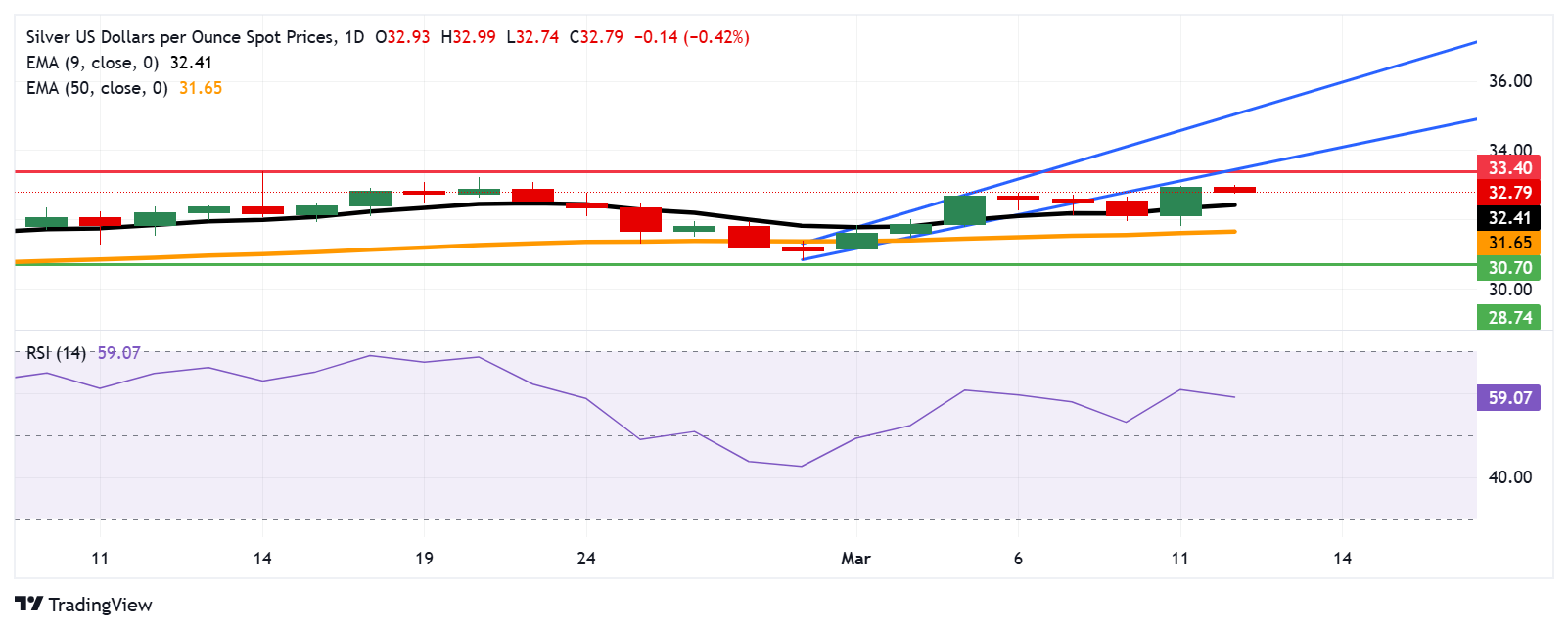
Silver FAQs
Silver is a precious metal highly traded among investors. It has been historically used as a store of value and a medium of exchange. Although less popular than Gold, traders may turn to Silver to diversify their investment portfolio, for its intrinsic value or as a potential hedge during high-inflation periods. Investors can buy physical Silver, in coins or in bars, or trade it through vehicles such as Exchange Traded Funds, which track its price on international markets.
Silver prices can move due to a wide range of factors. Geopolitical instability or fears of a deep recession can make Silver price escalate due to its safe-haven status, although to a lesser extent than Gold's. As a yieldless asset, Silver tends to rise with lower interest rates. Its moves also depend on how the US Dollar (USD) behaves as the asset is priced in dollars (XAG/USD). A strong Dollar tends to keep the price of Silver at bay, whereas a weaker Dollar is likely to propel prices up. Other factors such as investment demand, mining supply – Silver is much more abundant than Gold – and recycling rates can also affect prices.
Silver is widely used in industry, particularly in sectors such as electronics or solar energy, as it has one of the highest electric conductivity of all metals – more than Copper and Gold. A surge in demand can increase prices, while a decline tends to lower them. Dynamics in the US, Chinese and Indian economies can also contribute to price swings: for the US and particularly China, their big industrial sectors use Silver in various processes; in India, consumers’ demand for the precious metal for jewellery also plays a key role in setting prices.
Silver prices tend to follow Gold's moves. When Gold prices rise, Silver typically follows suit, as their status as safe-haven assets is similar. The Gold/Silver ratio, which shows the number of ounces of Silver needed to equal the value of one ounce of Gold, may help to determine the relative valuation between both metals. Some investors may consider a high ratio as an indicator that Silver is undervalued, or Gold is overvalued. On the contrary, a low ratio might suggest that Gold is undervalued relative to Silver.
- GBP/USD retreats from a multi-month top amid some repositioning ahead of the US CPI.
- Bets that the Fed will cut rates further amid recession fears should cap any USD recovery.
- Expectations for a slow BoE rate-cutting cycle could underpin the GBP and support the pair.
The GBP/USD pair edges lower during the Asian session on Wednesday and erodes a part of the previous day's strong move up to over a four-month peak, around the 1.2965 area. Spot prices currently trade around the 1.2935 region, though the downtick lacks bearish conviction as traders keenly await the release of the US consumer inflation figures before placing fresh directional bets.
The US Consumer Price Index (CPI) report will play a key role in influencing market expectations about the Federal Reserve's (Fed) rate-cut path, which, in turn, will drive the US Dollar (USD) demand and provide a fresh impetus to the GBP/USD pair. In the meantime, some repositioning trade ahead of the crucial data assists the buck to recover a part of the previous day's slide to its lowest level since mid-October and acts as a headwind for the currency pair.
Any meaningful USD appreciation, however, seems elusive in the wake of growing acceptance that the Federal Reserve (Fed) will cut interest rates several times this year amid worries about a tariff-driven slowdown in the US economic activity. Apart from this, expectations that the Bank of England (BoE) will cut rates more slowly than other central banks, including the Fed, might underpin the British Pound (GBP) and lend support to the GBP/USD pair.
Even from a technical perspective, last week's sustained breakout above the very important 200-day Simple Moving Average (SMA) was seen as a key trigger for bulls and suggests that the path of least resistance for the currency pair is to the upside. Hence, any further corrective slide might still be seen as a buying opportunity and is more likely to remain limited.
Pound Sterling FAQs
The Pound Sterling (GBP) is the oldest currency in the world (886 AD) and the official currency of the United Kingdom. It is the fourth most traded unit for foreign exchange (FX) in the world, accounting for 12% of all transactions, averaging $630 billion a day, according to 2022 data. Its key trading pairs are GBP/USD, also known as ‘Cable’, which accounts for 11% of FX, GBP/JPY, or the ‘Dragon’ as it is known by traders (3%), and EUR/GBP (2%). The Pound Sterling is issued by the Bank of England (BoE).
The single most important factor influencing the value of the Pound Sterling is monetary policy decided by the Bank of England. The BoE bases its decisions on whether it has achieved its primary goal of “price stability” – a steady inflation rate of around 2%. Its primary tool for achieving this is the adjustment of interest rates. When inflation is too high, the BoE will try to rein it in by raising interest rates, making it more expensive for people and businesses to access credit. This is generally positive for GBP, as higher interest rates make the UK a more attractive place for global investors to park their money. When inflation falls too low it is a sign economic growth is slowing. In this scenario, the BoE will consider lowering interest rates to cheapen credit so businesses will borrow more to invest in growth-generating projects.
Data releases gauge the health of the economy and can impact the value of the Pound Sterling. Indicators such as GDP, Manufacturing and Services PMIs, and employment can all influence the direction of the GBP. A strong economy is good for Sterling. Not only does it attract more foreign investment but it may encourage the BoE to put up interest rates, which will directly strengthen GBP. Otherwise, if economic data is weak, the Pound Sterling is likely to fall.
Another significant data release for the Pound Sterling is the Trade Balance. This indicator measures the difference between what a country earns from its exports and what it spends on imports over a given period. If a country produces highly sought-after exports, its currency will benefit purely from the extra demand created from foreign buyers seeking to purchase these goods. Therefore, a positive net Trade Balance strengthens a currency and vice versa for a negative balance.
- The US Consumer Price Index is forecast to rise 2.9% YoY in February.
- The core CPI inflation is seen a tad lower at 3.2% last month.
- The inflation data could impact the US Dollar’s value and the Fed’s cautious policy stance.
The United States (US) Bureau of Labor Statistics (BLS) is set to publish the high-impact Consumer Price Index (CPI) inflation report for February on Wednesday at 12:30 GMT.
The CPI figures could notably impact the US Dollar (USD) and the Federal Reserve’s (Fed) cautious monetary policy stance.
What to expect in the next CPI data report?
As measured by CPI, inflation in the US is set to rise at an annual pace of 2.9% in February, down slightly from 3.0% reported in January. Core CPI inflation, which excludes the volatile food and energy categories, is expected to ease to 3.2% in the same period from a year earlier, compared to a 3.3% growth in January.
On a monthly basis, a 0.3% increase is projected for the headline CPI and the core CPI inflation figures.
Previewing the report, analysts at TD Securities noted: “We expect core CPI inflation to cool down in February following the January jump to 0.45%, as price resets came in firmer than expected in the services segment. We look for slowing in both the goods and services segments, with owners' equivalent rent (OER) inflation dropping to a 3-month low.”
“On a year-over-year (YoY) basis, headline and core CPI inflation are likely to drop by a tenth each to 2.9% and 3.2%, respectively,” TDS analysts said.
How could the US Consumer Price Index report affect EUR/USD?
Against mounting US economic slowdown concerns and President Donald Trump-led global tariff war, markets are now pricing in 85 basis points (bps) of easing from the Fed this year, compared to 75 bps on Monday, per the LSEG Fed interest rate probabilities.
The recent slew of US data releases has been quite discouraging, especially with the February Nonfarm Payrolls (NFP) report on Friday showing that the US economy added 151,000 jobs in February, compared with an expected rise of 160,000 and a previous downward revision of 125,000. The Unemployment Rate climbed to 4.1% versus expectations of 4%. The Labor Force Participation Rate ticked a tad lower to 62.4% in the same period from January’s 62.6%.
On the other hand, Fed Chair Jerome Powell stated on Friday that the US central bank would take a cautious approach to monetary policy easing, adding that the economy currently "continues to be in a good place".
Therefore, stakes are high heading into the US CPI showdown as the inflation report could shed fresh light on the direction of the Fed’s interest rates and the USD.
A bigger-than-expected cooldown in the annual headline and core inflation prints could shake off concerns over risks to the disinflation path, compelling Fed to resume rate cuts while exacerbating the Greenback’s pain.
Conversely, the US dollar would find renewed demand if the US CPI data surprises the upside. This scenario would justify the Fed’s prudence on inflation and policy outlooks, reviving hawkish Fed expectations.
Dhwani Mehta, Asian Session Lead Analyst at FXStreet, offers a brief technical outlook for EUR/USD and explains: “EUR/USD’s near-term technical picture points to a likely buyer exhaustion as the Relative Strength Index (RSI) indicator on the daily chart sits within the overbought territory above 70. However, any pullback could be quickly bought into as a 21-day Simple Moving Average (SMA) and 100-day SMA Bull Cross remains in play.”
“EUR/USD needs acceptance above the November 6 2024 high of 1.0937 to extend the uptrend toward the 1.1000 psychological level. The next relevant bullish targe is seen at the 1.1050 mark. Conversely, the immediate support is at the 200-day SMA at 1.0721, below which the March 5 low of 1.0602 will be tested. The 21-day SMA at 1.0546 will be buyers' last defence.”
Economic Indicator
Consumer Price Index (YoY)
Inflationary or deflationary tendencies are measured by periodically summing the prices of a basket of representative goods and services and presenting the data as The Consumer Price Index (CPI). CPI data is compiled on a monthly basis and released by the US Department of Labor Statistics. The YoY reading compares the prices of goods in the reference month to the same month a year earlier.The CPI is a key indicator to measure inflation and changes in purchasing trends. Generally speaking, a high reading is seen as bullish for the US Dollar (USD), while a low reading is seen as bearish.
Read more.Next release: Wed Mar 12, 2025 12:30
Frequency: Monthly
Consensus: 2.9%
Previous: 3%
Source: US Bureau of Labor Statistics
The US Federal Reserve has a dual mandate of maintaining price stability and maximum employment. According to such mandate, inflation should be at around 2% YoY and has become the weakest pillar of the central bank’s directive ever since the world suffered a pandemic, which extends to these days. Price pressures keep rising amid supply-chain issues and bottlenecks, with the Consumer Price Index (CPI) hanging at multi-decade highs. The Fed has already taken measures to tame inflation and is expected to maintain an aggressive stance in the foreseeable future.
Inflation FAQs
Inflation measures the rise in the price of a representative basket of goods and services. Headline inflation is usually expressed as a percentage change on a month-on-month (MoM) and year-on-year (YoY) basis. Core inflation excludes more volatile elements such as food and fuel which can fluctuate because of geopolitical and seasonal factors. Core inflation is the figure economists focus on and is the level targeted by central banks, which are mandated to keep inflation at a manageable level, usually around 2%.
The Consumer Price Index (CPI) measures the change in prices of a basket of goods and services over a period of time. It is usually expressed as a percentage change on a month-on-month (MoM) and year-on-year (YoY) basis. Core CPI is the figure targeted by central banks as it excludes volatile food and fuel inputs. When Core CPI rises above 2% it usually results in higher interest rates and vice versa when it falls below 2%. Since higher interest rates are positive for a currency, higher inflation usually results in a stronger currency. The opposite is true when inflation falls.
Although it may seem counter-intuitive, high inflation in a country pushes up the value of its currency and vice versa for lower inflation. This is because the central bank will normally raise interest rates to combat the higher inflation, which attract more global capital inflows from investors looking for a lucrative place to park their money.
Formerly, Gold was the asset investors turned to in times of high inflation because it preserved its value, and whilst investors will often still buy Gold for its safe-haven properties in times of extreme market turmoil, this is not the case most of the time. This is because when inflation is high, central banks will put up interest rates to combat it. Higher interest rates are negative for Gold because they increase the opportunity-cost of holding Gold vis-a-vis an interest-bearing asset or placing the money in a cash deposit account. On the flipside, lower inflation tends to be positive for Gold as it brings interest rates down, making the bright metal a more viable investment alternative.
- The Japanese Yen drifts lower against the USD for the second consecutive day on Wednesday.
- Concerns about Trump’s trade tariffs and a positive risk tone undermine the safe-haven JPY.
- The divergent BoJ-Fed policy expectations should limit any meaningful downside for the JPY.
The Japanese Yen (JPY) continues losing ground against its American counterpart for the second straight day on Wednesday and moves away from the highest level since October touched the previous day. Concerns that US President Donald Trump could impose fresh tariffs on Japan and a slight improvement in the global risk sentiment turn out to be key factors undermining the safe-haven JPY. Any meaningful JPY depreciation, however, still seems elusive in the wake of hawkish Bank of Japan (BoJ) expectations.
Data released earlier today showed that Japan's annual wholesale inflation – Producer Price Index (PPI) – rose 4.0% in February, underscoring broadening inflationary pressure. Adding to this, hopes that bumper wage hikes seen last year will continue this year remain supportive of the growing market acceptance that the BoJ will hike interest rates further. This, along with the recent sharp narrowing of rate differentials between Japan and other countries should act as a tailwind for the lower-yielding JPY and help limit losses.
Apart from this, persistent worries about the potential economic fallout from Trump's trade policies and a global trade war should offer support to the JPY. The US Dollar (USD), on the other hand, languishes near a multi-month low amid bets that a tariff-driven slowdown in the US would force the Federal Reserve (Fed) to lower borrowing costs multiple times this year. This should further contribute to capping the upside for the USD/JPY pair as traders keenly await the release of the US consumer inflation figures.
Japanese Yen is pressured by rising trade tensions; downside seems cushioned amid BoJ rate hike bets
- US President Donald Trump on Tuesday threatened a 50% tariff on steel and aluminum from Canada, though he reversed course after Ontario paused surcharges on electricity to US customers. Earlier, Japan’s Trade Minister Yoji Muto said that he has failed to win assurances from US officials that Japan will be exempt from steel tariffs, which take effect on Wednesday.
- The lower house of Congress narrowly passed a Republican spending bill that would avoid a government shutdown on March 14 and keep the US government open until September. The bill now heads to the Senate and will need the support of at least seven Democrats to overcome the 60-vote filibuster threshold before being sent to Trump for his signature.
- Data published by the Bank of Japan this Wednesday showed that the Producer Price Index (PPI) slowed to a 4.0% year-on-year rate in February from 4.2% in the previous month. Given that consumer inflation in Japan has exceeded the central bank's target for nearly three years, the latest PPI supports prospects for further monetary policy tightening by the BoJ.
- The yield on the benchmark 10-year Japanese government bond remains close to its highest level since October 2008 touched on Monday. In contrast, the 10-year US Treasury bond yield remains close to a multi-month low touched earlier this March amid concerns about a tariff-driven US economic slowdown and bets for more rate cuts by the Federal Reserve.
- In fact, market participants are now pricing in about three rate cuts of 25 basis points each by the Fed by the end of this year. The bets were lifted by Friday's weaker US Nonfarm Payrolls report, which pointed to signs of a cooling US labor market. This keeps the US Dollar depressed near its lowest level since mid-October and caps the upside for the USD/JPY pair.
- Traders also seem reluctant and opt to wait for the release of the US consumer inflation figures before positioning for the next leg of a directional move. The crucial Consumer Price Index (CPI) report will play a key role in influencing expectations about the Fed's rate-cut path, which, in turn, will drive USD demand and provide a fresh impetus to the currency pair.
USD/JPY might attract fresh sellers and remain capped below the 148.60-148.70 support breakpoint
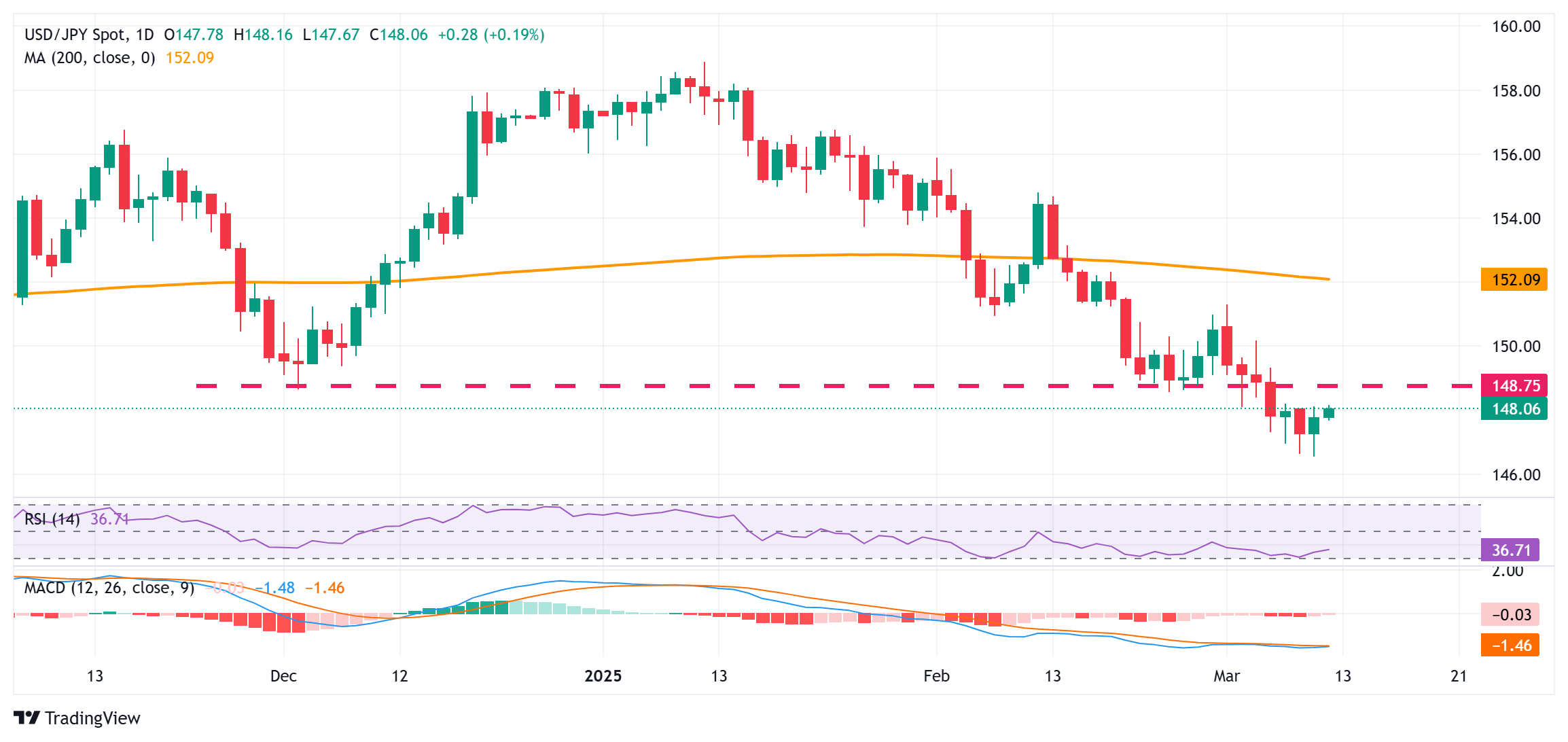
From a technical perspective, oscillators on the daily chart are holding deep in negative territory and are still away from being in the oversold zone. This, in turn, suggests that the path of least resistance for the USD/JPY pair is to the downside and any further move up is likely to remain capped near the 148.60-148.70 horizontal support breakpoint. However, some follow-through buying, leading to a subsequent strength beyond the 149.00 mark, might trigger a short-covering rally towards the 149.70-149.75 intermediate resistance en route to the 150.00 psychological mark.
On the flip side, the 147.25 area now seems to act as immediate support ahead of the 147.00 round figure and the 146.55-146.50 zone, or a multi-month trough touched on Tuesday. A break below the latter might turn the USD/JPY pair vulnerable to accelerate the fall toward the 146.00 round figure. The downward trajectory could eventually drag spot prices to the 145.00 psychological mark with some intermediate support near the 145.40-145.35 zone.
Economic Indicator
Producer Price Index (YoY)
The Producer Price Index released by the Bank of Japan is a measure of prices for goods purchased by domestic corporates in Japan. The PPI is correlated with the CPI (Consumer Price Index) and is a way to measure changes in manufacturing cost and inflation in Japan. A high reading is seen as anticipatory of a rate hike and is positive (or bullish) for the JPY, while a low reading is seen as negative (or Bearish).
Read more.Last release: Tue Mar 11, 2025 23:50
Frequency: Monthly
Actual: 4%
Consensus: 4%
Previous: 4.2%
Source: Statistics Bureau of Japan
| Raw materials | Closed | Change, % |
|---|---|---|
| Silver | 32.934 | 2.59 |
| Gold | 2915.28 | 0.9 |
| Palladium | 943.51 | 0.28 |
- The Indian Rupee strengthens in Wednesday’s Asian session.
- The likely RBI intervention and softer US Dollar underpin the INR.
- The Indian and US CPI inflation reports will take center stage later on Wednesday.
The Indian Rupee (INR) rebounds on Wednesday. The potential foreign exchange intervention from the Reserve Bank of India (RBI) and strong Asian currencies, especially the offshore Chinese Yuan provide some support to the Indian currency.
Nonetheless, the unabated outflows of foreign funds into Indian equities could exert some selling pressure on the local currency. Foreign investors have withdrawn almost $15 billion from Indian shares so far this year, putting outflows on track to surpass the record $17 billion registered in 2022.
Additionally, a recovery in crude oil prices could undermine the Indian Rupee. It’s worth noting that India is the world's third-largest oil consumer and higher crude oil prices tend to have a negative impact on the INR value. Looking ahead, traders will closely monitor the Indian and US Consumer Price Index (CPI) inflation reports for February, which are due later on Wednesday.
Indian Rupee gains ground amid a weaker US Dollar
- RBI was the net seller of over $36 billion between June and December to support the Indian Rupee, according to government data on Tuesday.
- Trump reversed his decision to double tariffs on Canadian steel and aluminum to 50%, which he announced late Tuesday.
- The US JOLTS report showed that job openings rose to 7.740 million in January, up from 7.508 million, surpassing expectations of 7.63 million.
- Financial markets have priced in 75 basis points (bps) of rate cuts from the Fed this year, LSEG data show, with a rate cut fully priced in for June.
USD/INR maintains a constructive outlook despite consolidation in the near term
The Indian Rupee trades on a stronger note on the day. The bullish trend of the USD/INR pair remains in play as the price is above the key 100-day Exponential Moving Average (EMA) on the daily chart. The upward momentum is reinforced by the 14-day Relative Strength Index (RSI), which is located above the midline near 56.15.
The immediate resistance level is seen at 87.53, the high of February 28. Sustained buying above this level could pave the way to an all-time high near 88.00, en route to 88.50.
On the flip side, the low of March 6 at 86.86 acts as the first downside target for the pair. Any follow-through selling could open the door for a deeper drop toward 86.48, the low of February 21, followed by 86.14, the low of January 27.
Indian Rupee FAQs
The Indian Rupee (INR) is one of the most sensitive currencies to external factors. The price of Crude Oil (the country is highly dependent on imported Oil), the value of the US Dollar – most trade is conducted in USD – and the level of foreign investment, are all influential. Direct intervention by the Reserve Bank of India (RBI) in FX markets to keep the exchange rate stable, as well as the level of interest rates set by the RBI, are further major influencing factors on the Rupee.
The Reserve Bank of India (RBI) actively intervenes in forex markets to maintain a stable exchange rate, to help facilitate trade. In addition, the RBI tries to maintain the inflation rate at its 4% target by adjusting interest rates. Higher interest rates usually strengthen the Rupee. This is due to the role of the ‘carry trade’ in which investors borrow in countries with lower interest rates so as to place their money in countries’ offering relatively higher interest rates and profit from the difference.
Macroeconomic factors that influence the value of the Rupee include inflation, interest rates, the economic growth rate (GDP), the balance of trade, and inflows from foreign investment. A higher growth rate can lead to more overseas investment, pushing up demand for the Rupee. A less negative balance of trade will eventually lead to a stronger Rupee. Higher interest rates, especially real rates (interest rates less inflation) are also positive for the Rupee. A risk-on environment can lead to greater inflows of Foreign Direct and Indirect Investment (FDI and FII), which also benefit the Rupee.
Higher inflation, particularly, if it is comparatively higher than India’s peers, is generally negative for the currency as it reflects devaluation through oversupply. Inflation also increases the cost of exports, leading to more Rupees being sold to purchase foreign imports, which is Rupee-negative. At the same time, higher inflation usually leads to the Reserve Bank of India (RBI) raising interest rates and this can be positive for the Rupee, due to increased demand from international investors. The opposite effect is true of lower inflation.
- NZD/USD struggles amid broad risk aversion, driven by policy shifts from US President Donald Trump.
- The New Zealand Dollar faces headwinds as deflationary pressures in China deepen, weighing on market sentiment.
- Headline US CPI inflation is expected to ease in February after picking up momentum in January.
NZD/USD edges lower after registering gains in the previous session, trading around 0.5710 during the Asian hours on Wednesday. The pair faces headwinds amid broad risk aversion, driven by policy shifts by US President Donald Trump, particularly tariffs that increased the likelihood of a prolonged trade war.
On data front, Electronic card transactions in New Zealand rose by 0.3% to NZD 6,528 million on a seasonally adjusted basis in February 2025. Consumables saw a 0.6% increase, while apparel gained 1%. Fuel remained unchanged, showing no significant movement.
Additionally, the New Zealand Dollar (NZD) faces headwinds as deflationary pressures in China intensify. February saw the steepest decline in consumer prices in 13 months, alongside the 29th consecutive monthly drop in factory-gate prices. Given China’s role as New Zealand’s largest trading partner, these developments have dampened market sentiment.
However, the downside of the NZD/USD pair may be limited as the US Dollar (USD) faces headwinds amid concerns over a potential economic slowdown in the United States (US). US President Donald Trump described the economy as being in a "transition period," which investors interpreted as an early sign of possible turbulence ahead.
With the Federal Reserve in its blackout period ahead of the March 19 meeting, central bank commentary will be minimal this week. Traders are shifting their focus to February’s US Consumer Price Index (CPI) release on Wednesday for further insights into inflation trends.
New Zealand Dollar PRICE Today
The table below shows the percentage change of New Zealand Dollar (NZD) against listed major currencies today. New Zealand Dollar was the weakest against the US Dollar.
| USD | EUR | GBP | JPY | CAD | AUD | NZD | CHF | |
|---|---|---|---|---|---|---|---|---|
| USD | 0.10% | 0.09% | 0.10% | 0.02% | 0.10% | 0.11% | 0.04% | |
| EUR | -0.10% | -0.01% | -0.03% | -0.08% | -0.01% | 0.02% | -0.05% | |
| GBP | -0.09% | 0.01% | 0.02% | -0.07% | 0.00% | 0.02% | -0.05% | |
| JPY | -0.10% | 0.03% | -0.02% | -0.09% | -0.01% | 0.00% | -0.05% | |
| CAD | -0.02% | 0.08% | 0.07% | 0.09% | 0.08% | 0.10% | 0.03% | |
| AUD | -0.10% | 0.00% | -0.00% | 0.00% | -0.08% | 0.02% | -0.04% | |
| NZD | -0.11% | -0.02% | -0.02% | -0.00% | -0.10% | -0.02% | -0.06% | |
| CHF | -0.04% | 0.05% | 0.05% | 0.05% | -0.03% | 0.04% | 0.06% |
The heat map shows percentage changes of major currencies against each other. The base currency is picked from the left column, while the quote currency is picked from the top row. For example, if you pick the New Zealand Dollar from the left column and move along the horizontal line to the US Dollar, the percentage change displayed in the box will represent NZD (base)/USD (quote).
Australia’s Prime Minister (PM) Anthony Albanese said on Wednesday that “retaliatory measures would only increase costs for Australian consumers and fuel inflation.”
PM Albanese confirmed that “Australia will not impose reciprocal tariffs on the United States (US).”
His comments come after US President Donald Trump proceeded with 25% tariffs on all imported steel and aluminium.
Market reaction
The AUD/USD pair fails to find any impetus from these headlines, losing 0.13% on the day to trade near 0.6290 as of writing.
Australian Dollar PRICE Today
The table below shows the percentage change of Australian Dollar (AUD) against listed major currencies today. Australian Dollar was the weakest against the US Dollar.
| USD | EUR | GBP | JPY | CAD | AUD | NZD | CHF | |
|---|---|---|---|---|---|---|---|---|
| USD | 0.09% | 0.10% | 0.15% | 0.02% | 0.11% | 0.13% | 0.05% | |
| EUR | -0.09% | 0.00% | 0.03% | -0.07% | 0.02% | 0.05% | -0.04% | |
| GBP | -0.10% | -0.01% | 0.04% | -0.07% | 0.01% | 0.04% | -0.05% | |
| JPY | -0.15% | -0.03% | -0.04% | -0.12% | -0.02% | -0.01% | -0.07% | |
| CAD | -0.02% | 0.07% | 0.07% | 0.12% | 0.09% | 0.11% | 0.04% | |
| AUD | -0.11% | -0.02% | -0.01% | 0.02% | -0.09% | 0.03% | -0.05% | |
| NZD | -0.13% | -0.05% | -0.04% | 0.00% | -0.11% | -0.03% | -0.08% | |
| CHF | -0.05% | 0.04% | 0.05% | 0.07% | -0.04% | 0.05% | 0.08% |
The heat map shows percentage changes of major currencies against each other. The base currency is picked from the left column, while the quote currency is picked from the top row. For example, if you pick the Australian Dollar from the left column and move along the horizontal line to the US Dollar, the percentage change displayed in the box will represent AUD (base)/USD (quote).
On Wednesday, the People’s Bank of China (PBOC) set the USD/CNY central rate for the trading session ahead at 7.1696 as compared to the previous day's fix of 7.1741 and 7.2324 Reuters estimates.
PBOC FAQs
The primary monetary policy objectives of the People's Bank of China (PBoC) are to safeguard price stability, including exchange rate stability, and promote economic growth. China’s central bank also aims to implement financial reforms, such as opening and developing the financial market.
The PBoC is owned by the state of the People's Republic of China (PRC), so it is not considered an autonomous institution. The Chinese Communist Party (CCP) Committee Secretary, nominated by the Chairman of the State Council, has a key influence on the PBoC’s management and direction, not the governor. However, Mr. Pan Gongsheng currently holds both of these posts.
Unlike the Western economies, the PBoC uses a broader set of monetary policy instruments to achieve its objectives. The primary tools include a seven-day Reverse Repo Rate (RRR), Medium-term Lending Facility (MLF), foreign exchange interventions and Reserve Requirement Ratio (RRR). However, The Loan Prime Rate (LPR) is China’s benchmark interest rate. Changes to the LPR directly influence the rates that need to be paid in the market for loans and mortgages and the interest paid on savings. By changing the LPR, China’s central bank can also influence the exchange rates of the Chinese Renminbi.
Yes, China has 19 private banks – a small fraction of the financial system. The largest private banks are digital lenders WeBank and MYbank, which are backed by tech giants Tencent and Ant Group, per The Straits Times. In 2014, China allowed domestic lenders fully capitalized by private funds to operate in the state-dominated financial sector.
- The Australian Dollar struggles amid broad risk aversion and ongoing economic concerns in China.
- Australia’s strong economic data last week lowered expectations of further rate cuts by the Reserve Bank of Australia.
- The US Dollar struggled amid growing concerns over a potential US economic slowdown.
The Australian Dollar (AUD) weakens against the US Dollar (USD) on Wednesday, weighed down by broad risk aversion. Concerns intensified due to policy shifts by US President Donald Trump, particularly tariffs that increased the likelihood of a prolonged trade war.
The AUD also faces pressure from ongoing economic uncertainties and persistent deflationary risks in China, Australia’s largest trading partner, as traders await key policy announcements from Beijing.
Market participants remain focused on the Reserve Bank of Australia’s (RBA) policy outlook, especially after last week’s strong economic data reduced expectations of further rate cuts. Economic growth surpassed forecasts, marking its first acceleration in over a year.
The latest RBA Meeting Minutes signaled a cautious stance on monetary policy, emphasizing that February’s rate cut does not indicate a commitment to continued easing.
Investors are now turning their attention to February’s US Consumer Price Index (CPI) release on Wednesday for further insights into inflation trends.
With the Federal Reserve in its blackout period ahead of the March 19 meeting, central bank commentary will be scarce this week.
Australian Dollar struggles as escalating global trade tensions weigh on market sentiment
- The US Dollar Index (DXY), which tracks the US Dollar against six major currencies, inches higher and is hovering around 103.50 at the time of writing. However, the Greenback faced challenges due to the likelihood of a US economic slowdown.
- President Trump reversed his decision to double tariffs on Canadian steel and aluminum to 50%, a move he announced late Tuesday. However, the White House confirmed to Reuters that new 25% tariffs on all imported steel and aluminum will still take effect on Wednesday, impacting allies and key US suppliers, including Canada and Mexico.
- Trump characterized the economy as being in a "transition period," hinting at a potential slowdown. Investors took his remarks as an early signal of possible economic turbulence in the near future.
- Last week, Fed Chair Jerome Powell reassured markets that the central bank sees no immediate need to adjust monetary policy despite rising uncertainties. San Francisco Fed President Mary Daly echoed this sentiment, noting that increasing business uncertainty could dampen demand but does not justify an interest rate change.
- RBA Deputy Governor Andrew Hauser highlighted that global trade uncertainty is at a 50-year high. Hauser warned that uncertainty stemming from US President Donald Trump's tariffs could prompt businesses and households to delay planning and investment, potentially weighing on economic growth.
- Bloomberg reported on Tuesday, citing sources familiar with the matter, that trade and other negotiations between the US and China remain at a deadlock. Chinese officials state that the US has not provided clear steps regarding fentanyl measures needed for tariff relief. Meanwhile, a source familiar with White House discussions indicated that no plans are currently underway for an in-person meeting between the two leaders.
- China announced on Saturday that it will impose a 100% tariff on Canadian rapeseed oil, oil cakes, and peas, along with a 25% levy on aquatic products and pork from Canada. The move comes as retaliation against tariffs introduced by Canada in October, escalating trade tensions. This marks a new front in a broader trade conflict driven by US President Donald Trump's tariff policies. The tariffs are set to take effect on March 20.
Technical Analysis: Australian Dollar tests nine-day barrier near 0.6300
The AUD/USD pair is trading near 0.6290 on Wednesday, with technical analysis of the daily chart showing the pair remaining below the nine-day Exponential Moving Average (EMA), signaling weakening short-term momentum. Additionally, the 14-day Relative Strength Index (RSI) is positioned slightly below 50, reinforcing a bearish bias.
On the downside, the AUD/USD pair could navigate the region around the five-week low of 0.6187, recorded on March 5.
The AUD/USD pair tests immediate resistance at a nine-day EMA of 0.6294, followed by the 50-day EMA at 0.6306. A break above this level could strengthen short-term momentum, potentially pushing the pair toward the three-month high of 0.6408, last reached on February 21.
AUD/USD: Daily Chart
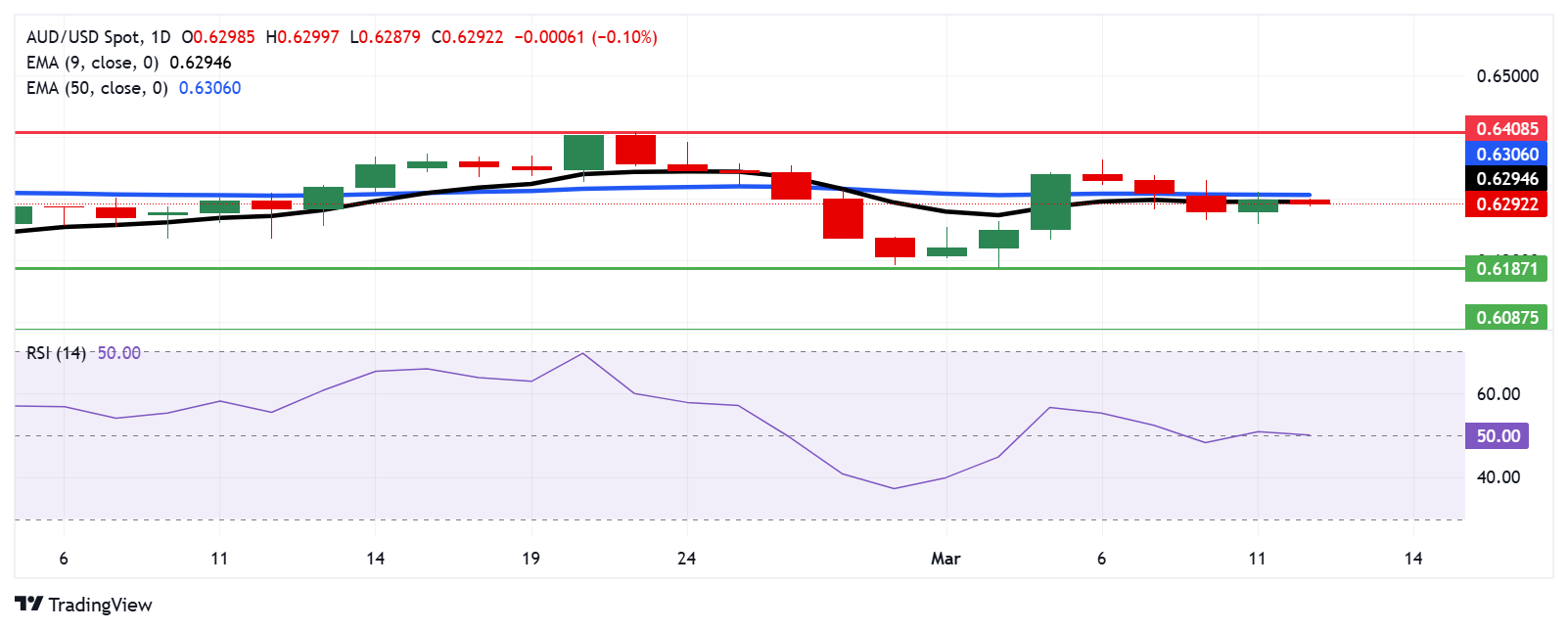
Australian Dollar PRICE Today
The table below shows the percentage change of Australian Dollar (AUD) against listed major currencies today. Australian Dollar was the weakest against the Canadian Dollar.
| USD | EUR | GBP | JPY | CAD | AUD | NZD | CHF | |
|---|---|---|---|---|---|---|---|---|
| USD | 0.11% | 0.12% | 0.09% | -0.00% | 0.10% | 0.09% | 0.09% | |
| EUR | -0.11% | -0.00% | -0.06% | -0.12% | -0.03% | -0.04% | -0.03% | |
| GBP | -0.12% | 0.00% | -0.04% | -0.11% | -0.02% | -0.02% | -0.03% | |
| JPY | -0.09% | 0.06% | 0.04% | -0.08% | 0.02% | 0.00% | 0.00% | |
| CAD | 0.00% | 0.12% | 0.11% | 0.08% | 0.10% | 0.09% | 0.09% | |
| AUD | -0.10% | 0.03% | 0.02% | -0.02% | -0.10% | 0.00% | 0.00% | |
| NZD | -0.09% | 0.04% | 0.02% | -0.01% | -0.09% | -0.00% | -0.00% | |
| CHF | -0.09% | 0.03% | 0.03% | -0.01% | -0.09% | -0.00% | 0.00% |
The heat map shows percentage changes of major currencies against each other. The base currency is picked from the left column, while the quote currency is picked from the top row. For example, if you pick the Australian Dollar from the left column and move along the horizontal line to the US Dollar, the percentage change displayed in the box will represent AUD (base)/USD (quote).
Australian Dollar FAQs
One of the most significant factors for the Australian Dollar (AUD) is the level of interest rates set by the Reserve Bank of Australia (RBA). Because Australia is a resource-rich country another key driver is the price of its biggest export, Iron Ore. The health of the Chinese economy, its largest trading partner, is a factor, as well as inflation in Australia, its growth rate and Trade Balance. Market sentiment – whether investors are taking on more risky assets (risk-on) or seeking safe-havens (risk-off) – is also a factor, with risk-on positive for AUD.
The Reserve Bank of Australia (RBA) influences the Australian Dollar (AUD) by setting the level of interest rates that Australian banks can lend to each other. This influences the level of interest rates in the economy as a whole. The main goal of the RBA is to maintain a stable inflation rate of 2-3% by adjusting interest rates up or down. Relatively high interest rates compared to other major central banks support the AUD, and the opposite for relatively low. The RBA can also use quantitative easing and tightening to influence credit conditions, with the former AUD-negative and the latter AUD-positive.
China is Australia’s largest trading partner so the health of the Chinese economy is a major influence on the value of the Australian Dollar (AUD). When the Chinese economy is doing well it purchases more raw materials, goods and services from Australia, lifting demand for the AUD, and pushing up its value. The opposite is the case when the Chinese economy is not growing as fast as expected. Positive or negative surprises in Chinese growth data, therefore, often have a direct impact on the Australian Dollar and its pairs.
Iron Ore is Australia’s largest export, accounting for $118 billion a year according to data from 2021, with China as its primary destination. The price of Iron Ore, therefore, can be a driver of the Australian Dollar. Generally, if the price of Iron Ore rises, AUD also goes up, as aggregate demand for the currency increases. The opposite is the case if the price of Iron Ore falls. Higher Iron Ore prices also tend to result in a greater likelihood of a positive Trade Balance for Australia, which is also positive of the AUD.
The Trade Balance, which is the difference between what a country earns from its exports versus what it pays for its imports, is another factor that can influence the value of the Australian Dollar. If Australia produces highly sought after exports, then its currency will gain in value purely from the surplus demand created from foreign buyers seeking to purchase its exports versus what it spends to purchase imports. Therefore, a positive net Trade Balance strengthens the AUD, with the opposite effect if the Trade Balance is negative.
Japan’s largest companies are expected to offer substantial wage hikes for a third consecutive year, helping workers cope with inflation and retain staff amid labour shortages, per Reuters.
Last year’s shunto or "spring labor offensive" wage talks resulted in a 5.1% average pay hike, the highest in 33 years, following 3.58% in 2023. This year’s increases are expected to be similar.
Labor union group Rengo, Japan’s largest labor union umbrella group with 7 million members, is pushing for a 6.09% wage increase, surpassing last year’s 5.85%, a level not seen in 32 years. Some firms, like Denso, have already agreed to record hikes.
Investors will keep an eye on small and midsized businesses, which employ 70% of Japan’s workforce, to see if they can match large firms’ wage increases.
Market reaction
At the press time, the USD/JPY pair is up 0.17% on the day to trade at 148.02.
Japanese Yen FAQs
The Japanese Yen (JPY) is one of the world’s most traded currencies. Its value is broadly determined by the performance of the Japanese economy, but more specifically by the Bank of Japan’s policy, the differential between Japanese and US bond yields, or risk sentiment among traders, among other factors.
One of the Bank of Japan’s mandates is currency control, so its moves are key for the Yen. The BoJ has directly intervened in currency markets sometimes, generally to lower the value of the Yen, although it refrains from doing it often due to political concerns of its main trading partners. The BoJ ultra-loose monetary policy between 2013 and 2024 caused the Yen to depreciate against its main currency peers due to an increasing policy divergence between the Bank of Japan and other main central banks. More recently, the gradually unwinding of this ultra-loose policy has given some support to the Yen.
Over the last decade, the BoJ’s stance of sticking to ultra-loose monetary policy has led to a widening policy divergence with other central banks, particularly with the US Federal Reserve. This supported a widening of the differential between the 10-year US and Japanese bonds, which favored the US Dollar against the Japanese Yen. The BoJ decision in 2024 to gradually abandon the ultra-loose policy, coupled with interest-rate cuts in other major central banks, is narrowing this differential.
The Japanese Yen is often seen as a safe-haven investment. This means that in times of market stress, investors are more likely to put their money in the Japanese currency due to its supposed reliability and stability. Turbulent times are likely to strengthen the Yen’s value against other currencies seen as more risky to invest in.
- WTI price rebounds to around $66.25 in Wednesday’s early Asian session.
- Softer USD and rising Middle East geopolitical tensions boost the WTI price.
- Crude oil stockpiles in the US rose by 4.247 million barrels last week, according to the API.
West Texas Intermediate (WTI), the US crude oil benchmark, is trading around $66.25 during the early Asian session on Wednesday. The WTI price recovers some lost ground on the weakening in the US Dollar (USD) and escalating geopolitical tensions in the Middle East.
A decline in the Greenback lifts the USD-denominated commodity price as it makes oil less expensive for overseas buyers. The US Dollar Index (DXY), a measure of the USD's value relative to its most significant trading partners' currencies, declines to new multi-month lows near 103.20.
A Houthi spokesman said late Tuesday that they will attack any Israeli ship that violates the group's ban on Israeli ships passing through the Red and Arabian Seas, the Bab al-Mandab Strait, and the Gulf of Aden, effective immediately.
Meanwhile, Trump is trying to choke off Iranian oil exports as part of his attempts to push Tehran to curtail its nuclear program. Iran's Supreme Leader, Ayatollah Ali Khamenei, said on Saturday that his country will not be bullied into negotiations. The rising geopolitical tensions in the Middle East could provide some support to the WTI price in the near term.
Crude Oil inventories climbed last week. The American Petroleum Institute (API) weekly report showed crude oil stockpiles in the United States for the week ending February 28 rose by 4.247 million barrels, compared to a fall of 1.455 million barrels in the previous week. The market consensus estimated that stocks would increase by 2.1 million barrels.
US President Donald Trump’s tariff policy uncertainty and the concern over the impact of tariffs on global economic growth might undermine the WTI price. Trump reversed his decision to double tariffs on Canadian steel and aluminum to 50%, which he announced late Tuesday. The White House confirmed that fresh 25% tariffs on all imported steel and aluminum will still go into effect on Wednesday, including against allies and major US suppliers Canada and Mexico.
WTI Oil FAQs
WTI Oil is a type of Crude Oil sold on international markets. The WTI stands for West Texas Intermediate, one of three major types including Brent and Dubai Crude. WTI is also referred to as “light” and “sweet” because of its relatively low gravity and sulfur content respectively. It is considered a high quality Oil that is easily refined. It is sourced in the United States and distributed via the Cushing hub, which is considered “The Pipeline Crossroads of the World”. It is a benchmark for the Oil market and WTI price is frequently quoted in the media.
Like all assets, supply and demand are the key drivers of WTI Oil price. As such, global growth can be a driver of increased demand and vice versa for weak global growth. Political instability, wars, and sanctions can disrupt supply and impact prices. The decisions of OPEC, a group of major Oil-producing countries, is another key driver of price. The value of the US Dollar influences the price of WTI Crude Oil, since Oil is predominantly traded in US Dollars, thus a weaker US Dollar can make Oil more affordable and vice versa.
The weekly Oil inventory reports published by the American Petroleum Institute (API) and the Energy Information Agency (EIA) impact the price of WTI Oil. Changes in inventories reflect fluctuating supply and demand. If the data shows a drop in inventories it can indicate increased demand, pushing up Oil price. Higher inventories can reflect increased supply, pushing down prices. API’s report is published every Tuesday and EIA’s the day after. Their results are usually similar, falling within 1% of each other 75% of the time. The EIA data is considered more reliable, since it is a government agency.
OPEC (Organization of the Petroleum Exporting Countries) is a group of 12 Oil-producing nations who collectively decide production quotas for member countries at twice-yearly meetings. Their decisions often impact WTI Oil prices. When OPEC decides to lower quotas, it can tighten supply, pushing up Oil prices. When OPEC increases production, it has the opposite effect. OPEC+ refers to an expanded group that includes ten extra non-OPEC members, the most notable of which is Russia.
- WTI price rebounds to around $66.25 in Wednesday’s early Asian session.
- Softer USD and rising Middle East geopolitical tensions boost the WTI price.
- Crude oil stockpiles in the US rose by 4.247 million barrels last week, according to the API.
West Texas Intermediate (WTI), the US crude oil benchmark, is trading around $66.25 during the early Asian session on Wednesday. The WTI price recovers some lost ground on the weakening in the US Dollar (USD) and escalating geopolitical tensions in the Middle East.
A decline in the Greenback lifts the USD-denominated commodity price as it makes oil less expensive for overseas buyers. The US Dollar Index (DXY), a measure of the USD's value relative to its most significant trading partners' currencies, declines to new multi-month lows near 103.20.
A Houthi spokesman said late Tuesday that they will attack any Israeli ship that violates the group's ban on Israeli ships passing through the Red and Arabian Seas, the Bab al-Mandab Strait, and the Gulf of Aden, effective immediately.
Meanwhile, Trump is trying to choke off Iranian oil exports as part of his attempts to push Tehran to curtail its nuclear program. Iran's Supreme Leader, Ayatollah Ali Khamenei, said on Saturday that his country will not be bullied into negotiations. The rising geopolitical tensions in the Middle East could provide some support to the WTI price in the near term.
Crude Oil inventories climbed last week. The American Petroleum Institute (API) weekly report showed crude oil stockpiles in the United States for the week ending February 28 rose by 4.247 million barrels, compared to a fall of 1.455 million barrels in the previous week. The market consensus estimated that stocks would increase by 2.1 million barrels.
US President Donald Trump’s tariff policy uncertainty and the concern over the impact of tariffs on global economic growth might undermine the WTI price. Trump reversed his decision to double tariffs on Canadian steel and aluminum to 50%, which he announced late Tuesday. The White House confirmed that fresh 25% tariffs on all imported steel and aluminum will still go into effect on Wednesday, including against allies and major US suppliers Canada and Mexico.
WTI Oil FAQs
WTI Oil is a type of Crude Oil sold on international markets. The WTI stands for West Texas Intermediate, one of three major types including Brent and Dubai Crude. WTI is also referred to as “light” and “sweet” because of its relatively low gravity and sulfur content respectively. It is considered a high quality Oil that is easily refined. It is sourced in the United States and distributed via the Cushing hub, which is considered “The Pipeline Crossroads of the World”. It is a benchmark for the Oil market and WTI price is frequently quoted in the media.
Like all assets, supply and demand are the key drivers of WTI Oil price. As such, global growth can be a driver of increased demand and vice versa for weak global growth. Political instability, wars, and sanctions can disrupt supply and impact prices. The decisions of OPEC, a group of major Oil-producing countries, is another key driver of price. The value of the US Dollar influences the price of WTI Crude Oil, since Oil is predominantly traded in US Dollars, thus a weaker US Dollar can make Oil more affordable and vice versa.
The weekly Oil inventory reports published by the American Petroleum Institute (API) and the Energy Information Agency (EIA) impact the price of WTI Oil. Changes in inventories reflect fluctuating supply and demand. If the data shows a drop in inventories it can indicate increased demand, pushing up Oil price. Higher inventories can reflect increased supply, pushing down prices. API’s report is published every Tuesday and EIA’s the day after. Their results are usually similar, falling within 1% of each other 75% of the time. The EIA data is considered more reliable, since it is a government agency.
OPEC (Organization of the Petroleum Exporting Countries) is a group of 12 Oil-producing nations who collectively decide production quotas for member countries at twice-yearly meetings. Their decisions often impact WTI Oil prices. When OPEC decides to lower quotas, it can tighten supply, pushing up Oil prices. When OPEC increases production, it has the opposite effect. OPEC+ refers to an expanded group that includes ten extra non-OPEC members, the most notable of which is Russia.
| Index | Change, points | Closed | Change, % |
|---|---|---|---|
| NIKKEI 225 | -235.16 | 36793.11 | -0.64 |
| Hang Seng | -1.35 | 23782.14 | -0.01 |
| KOSPI | -32.79 | 2537.6 | -1.28 |
| ASX 200 | -72.2 | 7890.1 | -0.91 |
| DAX | -292.18 | 22328.77 | -1.29 |
| CAC 40 | -105.69 | 7941.91 | -1.31 |
| Dow Jones | -478.23 | 41433.48 | -1.14 |
| S&P 500 | -42.49 | 5572.07 | -0.76 |
| NASDAQ Composite | -32.22 | 17436.1 | -0.18 |
Bank of Japan Governor Kazuo Ueda said early Wednesday that it is natural for long-term rates to shift in line with the market view on the outlook for short-term policy rates.
Key quotes
Market determines long-term rates.
No big difference in our view and that of markets when asked about recent long-term rate increases.
Long-term rate shifts reflect market views on economic, price trends and global rate adjustments.
It is true that long-term rates have been rising as a trend since last year.
Long-term rates have been rising as a trend since last year.
Increase in extended rates is likely to elevate funding costs for government finances.
Market reaction
At the press time, the USD/JPY pair is up 0.20% on the day to trade at 148.09.
Bank of Japan FAQs
The Bank of Japan (BoJ) is the Japanese central bank, which sets monetary policy in the country. Its mandate is to issue banknotes and carry out currency and monetary control to ensure price stability, which means an inflation target of around 2%.
The Bank of Japan embarked in an ultra-loose monetary policy in 2013 in order to stimulate the economy and fuel inflation amid a low-inflationary environment. The bank’s policy is based on Quantitative and Qualitative Easing (QQE), or printing notes to buy assets such as government or corporate bonds to provide liquidity. In 2016, the bank doubled down on its strategy and further loosened policy by first introducing negative interest rates and then directly controlling the yield of its 10-year government bonds. In March 2024, the BoJ lifted interest rates, effectively retreating from the ultra-loose monetary policy stance.
The Bank’s massive stimulus caused the Yen to depreciate against its main currency peers. This process exacerbated in 2022 and 2023 due to an increasing policy divergence between the Bank of Japan and other main central banks, which opted to increase interest rates sharply to fight decades-high levels of inflation. The BoJ’s policy led to a widening differential with other currencies, dragging down the value of the Yen. This trend partly reversed in 2024, when the BoJ decided to abandon its ultra-loose policy stance.
A weaker Yen and the spike in global energy prices led to an increase in Japanese inflation, which exceeded the BoJ’s 2% target. The prospect of rising salaries in the country – a key element fuelling inflation – also contributed to the move.
| Pare | Closed | Change, % |
|---|---|---|
| AUDUSD | 0.62925 | 0.25 |
| EURJPY | 161.195 | 1.1 |
| EURUSD | 1.09107 | 0.69 |
| GBPJPY | 191.237 | 0.95 |
| GBPUSD | 1.2945 | 0.54 |
| NZDUSD | 0.57119 | 0.24 |
| USDCAD | 1.44341 | -0.03 |
| USDCHF | 0.88279 | 0.22 |
| USDJPY | 147.72 | 0.4 |







© 2000-2026. All rights reserved.
This site is managed by Teletrade D.J. LLC 2351 LLC 2022 (Euro House, Richmond Hill Road, Kingstown, VC0100, St. Vincent and the Grenadines).
The information on this website is for informational purposes only and does not constitute any investment advice.
The company does not serve or provide services to customers who are residents of the US, Canada, Iran, The Democratic People's Republic of Korea, Yemen and FATF blacklisted countries.
Making transactions on financial markets with marginal financial instruments opens up wide possibilities and allows investors who are willing to take risks to earn high profits, carrying a potentially high risk of losses at the same time. Therefore you should responsibly approach the issue of choosing the appropriate investment strategy, taking the available resources into account, before starting trading.
Use of the information: full or partial use of materials from this website must always be referenced to TeleTrade as the source of information. Use of the materials on the Internet must be accompanied by a hyperlink to teletrade.org. Automatic import of materials and information from this website is prohibited.
Please contact our PR department if you have any questions or need assistance at pr@teletrade.global.


 Bank
Bank transfers


