- Analiza
- Novosti i instrumenti
- Vesti sa tržišta
Forex-novosti i prognoze od 01-05-2024
Japan's top currency diplomat, Masato Kanda, who will instruct the BoJ to intervene, when he judges it necessary, declined to confirm if Japanese authorities had stepped into the foreign exchange (FX) market early Thursday following a sharp strengthening of the Yen. Kanda added that they will disclose intervention data at the end of this month.
Market reaction
At the time of writing, USD/JPY was trading at 155.67, adding 0.68% on the day.
Japanese Yen FAQs
The Japanese Yen (JPY) is one of the world’s most traded currencies. Its value is broadly determined by the performance of the Japanese economy, but more specifically by the Bank of Japan’s policy, the differential between Japanese and US bond yields, or risk sentiment among traders, among other factors.
One of the Bank of Japan’s mandates is currency control, so its moves are key for the Yen. The BoJ has directly intervened in currency markets sometimes, generally to lower the value of the Yen, although it refrains from doing it often due to political concerns of its main trading partners. The current BoJ ultra-loose monetary policy, based on massive stimulus to the economy, has caused the Yen to depreciate against its main currency peers. This process has exacerbated more recently due to an increasing policy divergence between the Bank of Japan and other main central banks, which have opted to increase interest rates sharply to fight decades-high levels of inflation.
The BoJ’s stance of sticking to ultra-loose monetary policy has led to a widening policy divergence with other central banks, particularly with the US Federal Reserve. This supports a widening of the differential between the 10-year US and Japanese bonds, which favors the US Dollar against the Japanese Yen.
The Japanese Yen is often seen as a safe-haven investment. This means that in times of market stress, investors are more likely to put their money in the Japanese currency due to its supposed reliability and stability. Turbulent times are likely to strengthen the Yen’s value against other currencies seen as more risky to invest in.
- GBP/USD trades on a stronger note around 1.2535 amid the weaker USD on Thursday.
- The Fed maintained rates unchanged in a 5.25%–5.50% range, as widely expected.
- Financial markets expect the Bank of England (BoE) to cut borrowing costs in the June or August meetings.
The GBP/USD pair gains traction near 1.2535 on Thursday during the early Asian session. The uptick of the major pair is supported by the sharp decline of the US Dollar (USD) after the US Federal Reserve (Fed) left its interest rate unchanged.
As widely anticipated, the US central bank kept its benchmark rate in a target range of 5.25%–5.50% at its May meeting on Wednesday, its highest level in more than two decades. The US Fed did not expect it would be appropriate to cut the interest rate until the central bank gain greater confidence that inflation was moving sustainably to its 2% target.
Furthermore, Fed Chair Jerome Powell said during the press conference, “I think it’s unlikely that the next policy rate move will be a hike.” These comments spark a modest dovish reaction in the markets, which weighs on the Greenback and creates a tailwind for the GBP/USD pair. Amidst the persistence of elevated inflation and the robust economy, financial markets see only one rate cut in November, according to the CME FedWatch. The central bank has also announced that it will now reduce its bond portfolio more slowly. The Fed will reduce their monthly holdings in US Treasury securities from $60 billion to $25 billion, starting in June
On the other hand, investors expect the Bank of England (BoE) to cut borrowing costs in the June or August meetings, as BoE Governor Andrew Bailey said he is confident that headline inflation will return to 2% in April. However, BoE Chief Economist Huw Pill warned last week that there were greater risks from cutting the interest rate too quickly, rather than too late. His remarks provide some support for the Pound Sterling (GBP).
- EUR/USD churned after Fed rate hold.
- Investors pivoting to focus on Friday’s US NFP.
- Quiet Thursday ahead with mid-tier data.
EUR/USD cycled familiar territory on Wednesday after the US Federal Reserve (Fed) held rates as many investors had expected. However, market participants were hoping for further signs of impending rate cuts from the US central bank. At current cut, rate markets are anticipating a first and only rate cut for the year in November.
Powell speech: Unlikely that next policy rate move would be a hike
Thursday sees final HCOB Manufacturing Purchasing Manager Index (PMI) figures from Europe, with markets expecting the prints to land exactly where preliminary figures had come in. Manufacturing currently comprises less than 24% of the overall European economy.
Friday’s US NFP will drive much of the market momentum to close out the trading week, with markets expecting a print of 243K in April versus the previous month’s 303K. Revisions to data will be closely watched as layoffs continue to plague larger sections of the US economy. Investors are also hoping that Average Hourly Earnings MoM in April hold flat at 0.3% as wages continue to be the popular target for broad-market inflation fears.
EUR/USD technical outlook
EUR/USD has churned in near-term consolidation for six consecutive trading days as the pair grapples with the 1.0700 handle. The 200-hour Exponential Moving Average (EMA) provides a key midrange level, with rough upper and lower bounds at 1.0740 and 1.0650.
A near-term floor has been priced in near the 1.0600 handle on daily candles, but the pair has struggled on the bearish side of the 200-day EMA near 1.0790.
EUR/USD hourly chart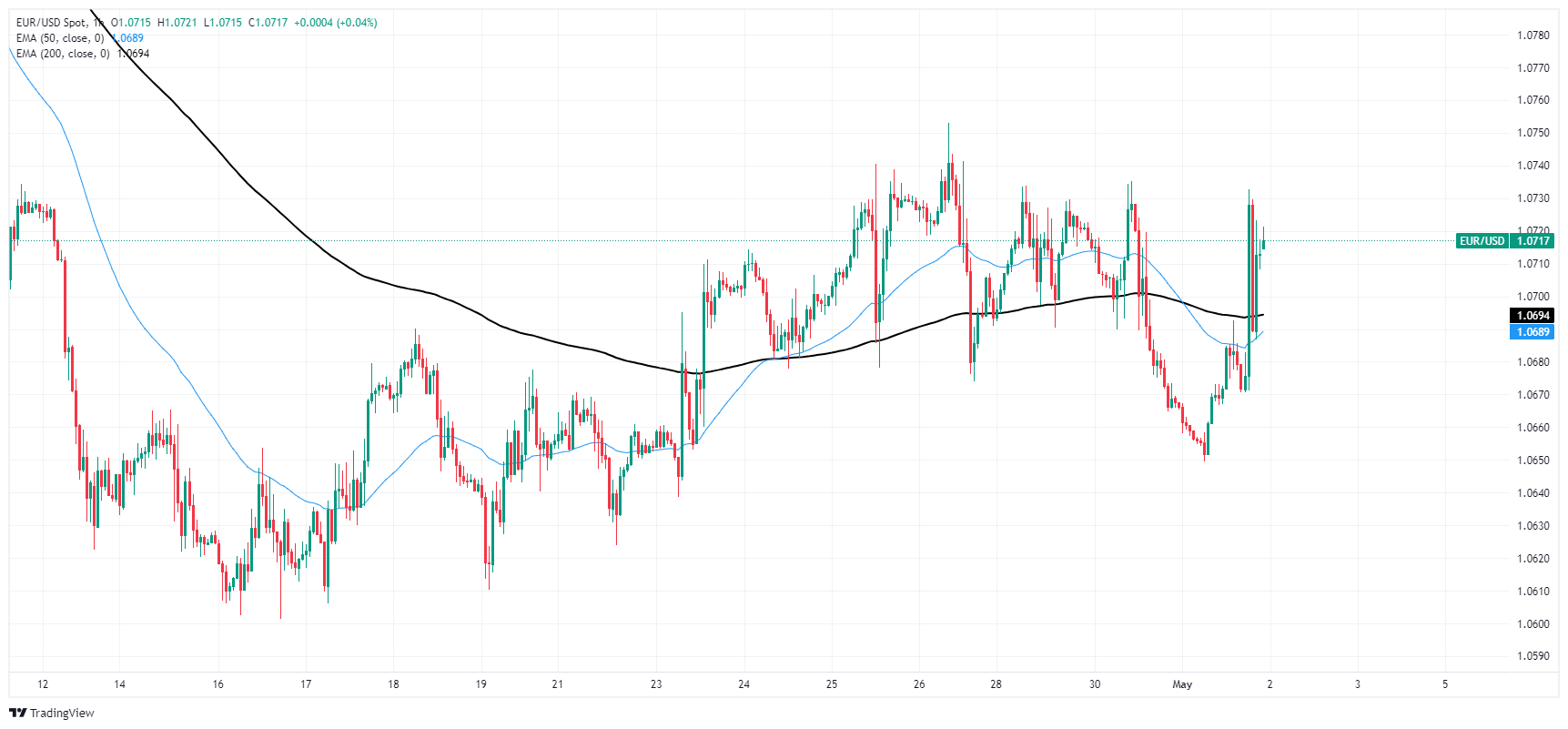
EUR/USD daily chart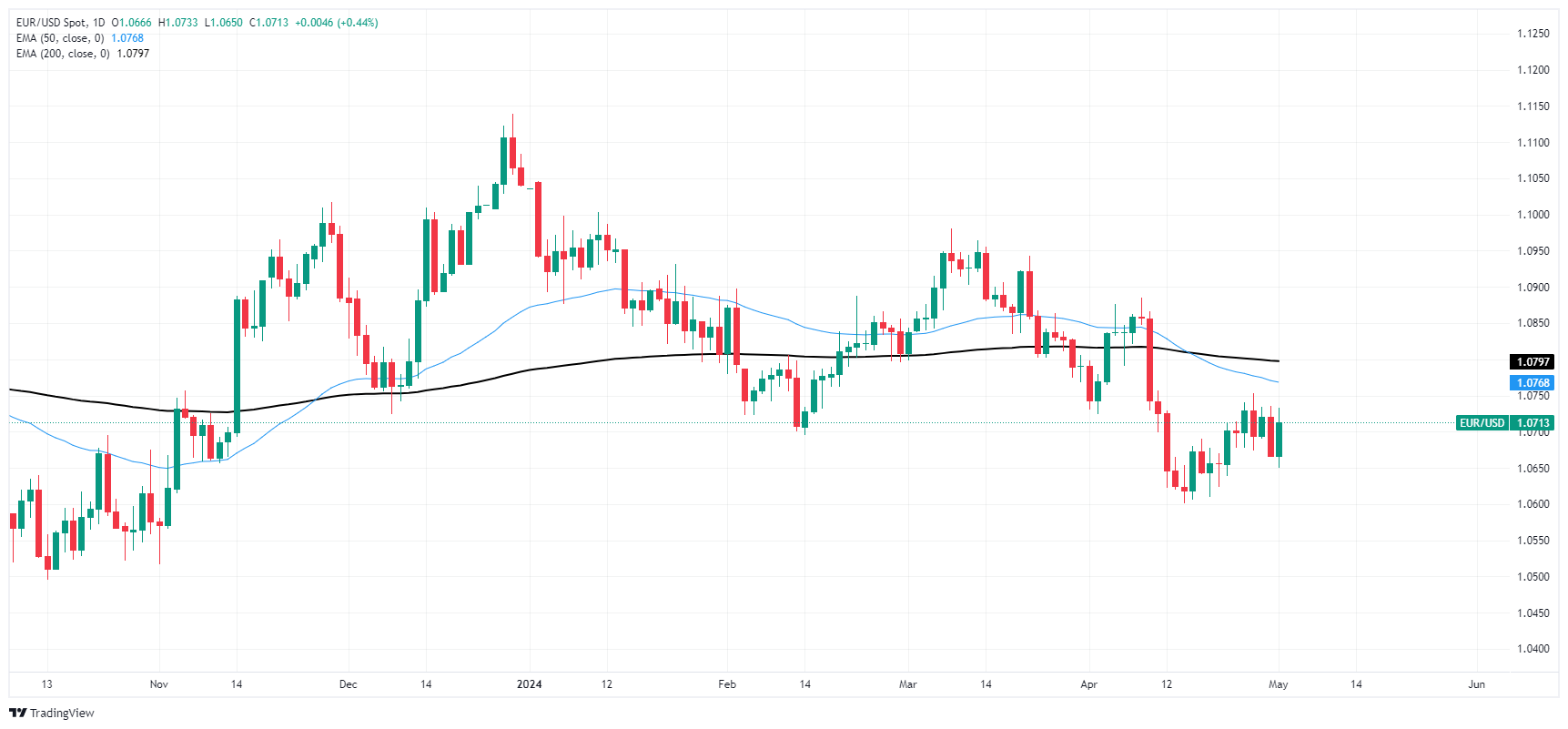
Bank of Canada (BoC) Governor Tiff Macklem hit newswires late Wednesday, reiterating that the BoC isn't beholden to following the Federal Reserve's (Fed) playbook as the two central banks grapple with slightly different economic situations.
Key highlights
- BoC is getting close to being able to cut rates.
- GDP growth is expected to be 1.5% in 2024, 2.0% in 2025 and 2026.
- Data since January has increased our confidence that inflation will continue to come back down.
- BoC expected core inflation to continue to ease gradually.
- Growth in the Canadian economy appears to be picking up.
- Monetary policy appears to be working.
- BoC does not have to do whatever the Fed does.
- Silver stable at $26.64 after Fed holds rates steady, per Chair Powell's data-driven stance.
- Technicals: Silver rebounds from $26.27 low, eyes $27.00 resistance.
- Silver hints at bullish trend; breakout above $27.14 could reinforce this.
- Bearish shift requires silver below $26.13, targeting lower supports.
Silver's price stayed firm at around $26.64 after the Fed decided to hold rates unchanged and Powell’s press conference. Fed Chair Jerome Powell said they would remain data-dependent, decide meeting by meeting, and won’t cut rates until they’re confident that inflation is trending towards its 2% goal.
XAG/USD Price Analysis: Technical outlook
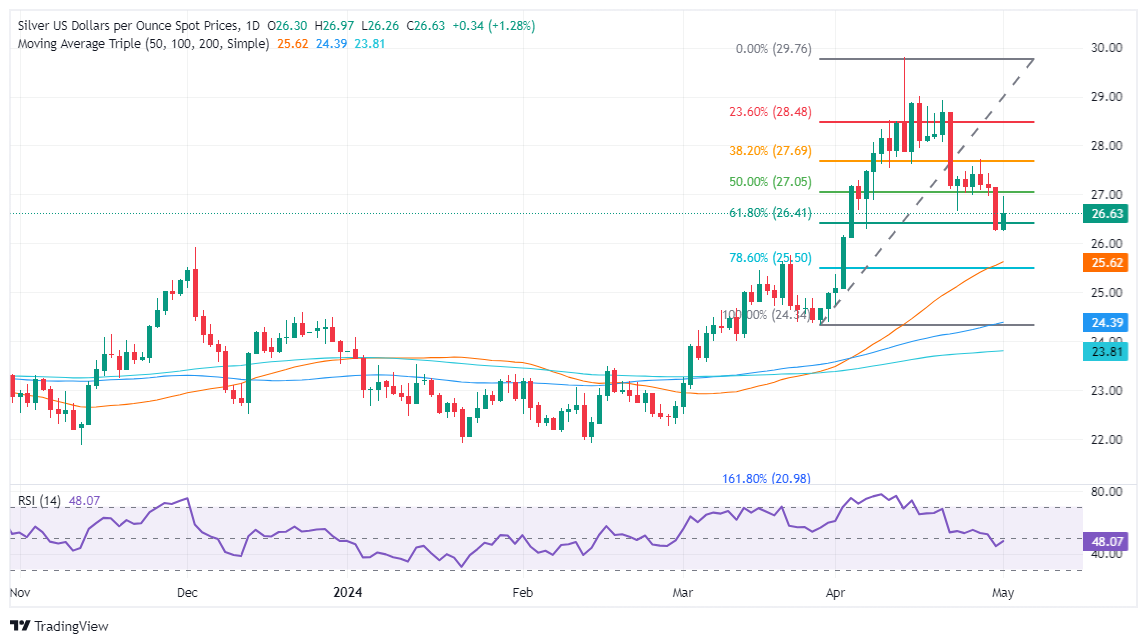
The grey metal dipped below the 61.8% Fibonacci retracement at $26.41, hitting a two-week low of $26.27 before resuming its uptrend. Although Silver reached a daily high of $26.96, buyers lacked the strength to break above the $27.00 figure, which paved the way to retreat to current price levels.
The XAG/USD is upward biased despite going through a pullback that sent prices from around $29.79 to $26.27. For sellers to shift the bias to bearish, they would need to push the spot price below the May 5 high at $26.13, which would pave the way toward $26.00 and below.
On the flip side, and the most likely scenario, if XAG/USD achieves a daily close at around the current level, a ‘bullish harami’ and a two-candle chart pattern will form. This usually would be bullish for the asset, but buyers must crack the April 30 high at $27.14, before resuming its uptrend.
XAG/USD Price Action – Daily Chart
- The Fed acknowledged no significant progress towards the 2% inflation goal, maintaining a hawkish stance.
- Despite challenges, Powell notes restrictive policies have moderated inflation and that risks to dual goals are more balanced.
- Markets are giving up the hopes of three rate cuts in 2024.
The NZD/USD found some momentum after the widely-anticipated Federal Reserve (Fed) decision which announced yet another hold, leaving rates at the 5.25-5.50% range. Powell’s cautious tone and data dependency were taken as dovish by markets which made investors dump the USD.
In addition, Powell stated that the bank still needs additional evidence to gain confidence to start cutting rates, noting that inflation’s progress stagnated in the last months. He confirmed that in case data continues to come strong, it would be appropriate to hold the restrictive police for some more time. When the data started to align with the bank’s forecast, he pointed out that he would consider cutting rates.
Regarding expectations, markets are giving up hopes of a cut in June and July and are pushing the start of the easing to September or even November.
NZD/USD technical analysis
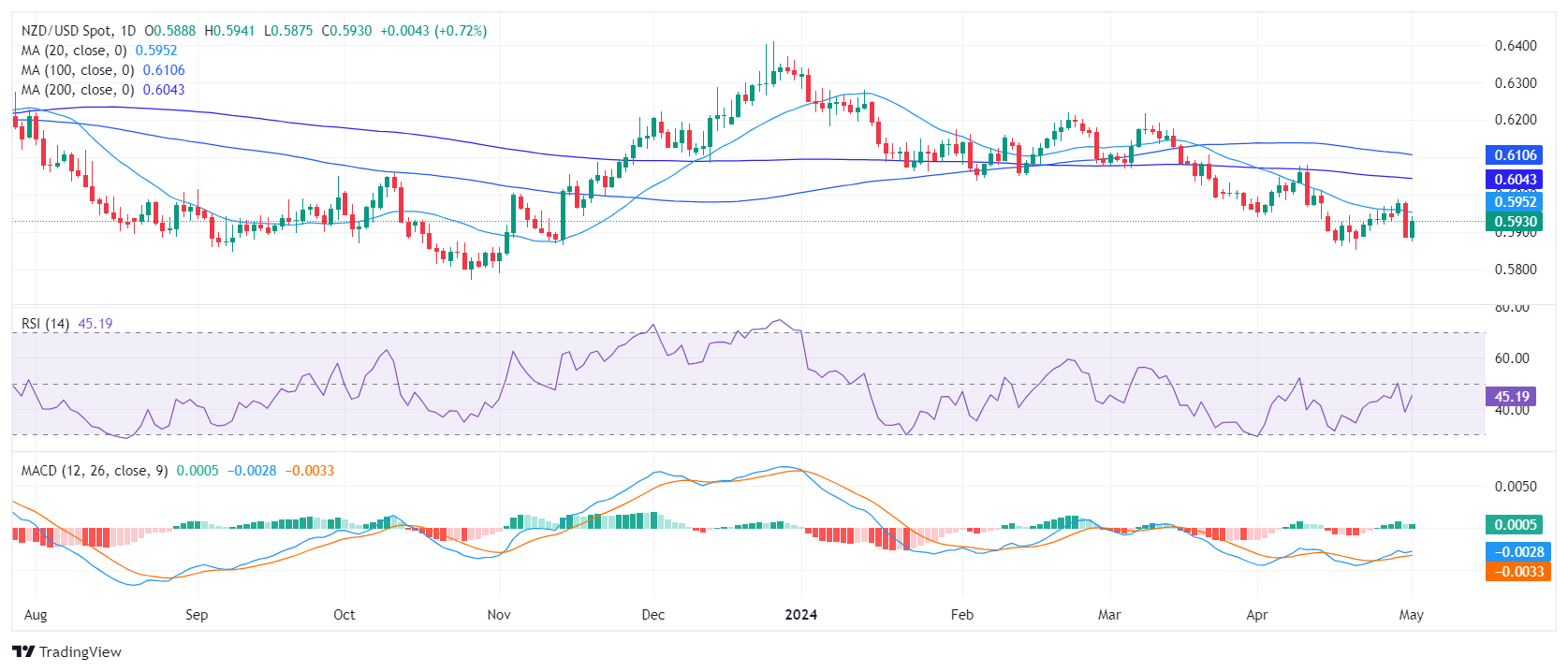
On the daily chart, the Relative Strength Index (RSI) stands in negative territory. The recent readings note an uptick to 44 which shows some light for the bulls but that they remain beneath the positive line. In addition, the Moving Average Convergence Divergence (MACD) histogram marks flat green bars, indicating a slight positive momentum.
NZD/USD daily chart
Shifting to the hourly chart display, the RSI shows diverse readings with an overbought condition at 70 followed by a drop to 55. Concurrently, the hourly MACD charts flat green bars, similar to the daily forecast, hinting at prospective positive impulse in the short-term.
NZD/USD hourly chart
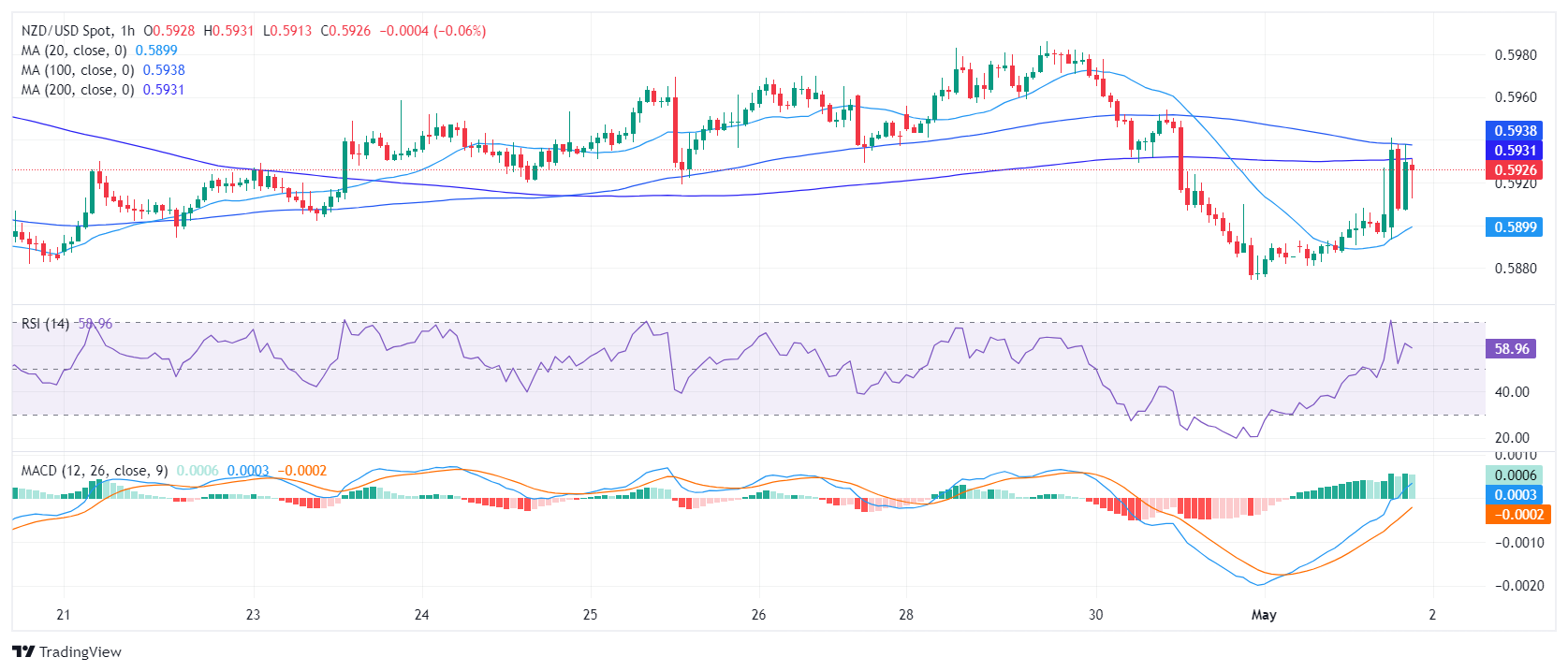
In assessing the wider picture, the NZD/USD is under significant downward pressure as it is currently positioned below the 20, 100, and 200-day Simple Moving Averages (SMAs).
Overall, the NZD/USD exhibits a mixed picture. Despite an hourly overbought signal tempering prospective bearish conditions, the key SMAs, coupled with the daily RSI readings, lean towards the bearish side, deprecating the NZD/USD pair. Current conditions suggest that sellers may continue to dominate, particularly as the pair trails below the important SMAs but buyers might make another stride at the 20-day SMA at 0.5950 which could brighten the outlook.
- WTI slips back below $80 per barrel.
- Crude Oil markets unsettled by latest Fed rate call.
- Supplies continue to overwhelm Crude Oil demand.
West Texas Intermediate (WTI) US Crude Oil fell below $80.00 per barrel on Wednesday as US Crude Oil supply continues to overwhelm demand, and the US Federal Reserve (Fed) remains hobbled on the path forward toward rate cuts.
With most global markets focused on the Fed’s latest rate call, the Energy Information Administration (EIA) printed its latest week-on-week barrel counts for US Crude Oil supply. According to the EIA, US barrel counts grew by 7.265 million for the week ended April 26, well below the forecast -2.3 million decline, and entirely engulfing the -6.368 million decline reported the week before.
The EIA’s upside barrel buildup adds to the same scenario unfolding in American Petroleum Institute (API) numbers published earlier this week. This week’s EIA print represents the highest WoW Crude Oil buildup since the week ended February 9. EIA US Crude Oil Stocks are up 9.473 million barrels in the month of April, and US Crude Oil production tracked by the EIA has oversupplied nearly 30 million barrels since the beginning of the year.
The Fed’s latest rate call held interest rates steady as markets broadly expected, but bumpy progress on dragging inflation lower has hobbled the Fed’s ability to reduce interest rates, and markets will be pivoting to focus on Friday’s US Nonfarm Payrolls (NFP) labor report for a hard look at developments in the domestic US economy.
WTI technical outlook
Wednesday’s decline drag WTI back below $80.00 per barrel and dropping out of a firm demand zone between $82.00 and $80.00. WTI is not trading into the 200-day Exponential Moving Average (EMA) near $79.17, and US Crude Oil is now trading down nearly 10% from the last swing high of $81.25 in early April.
WTI hourly chart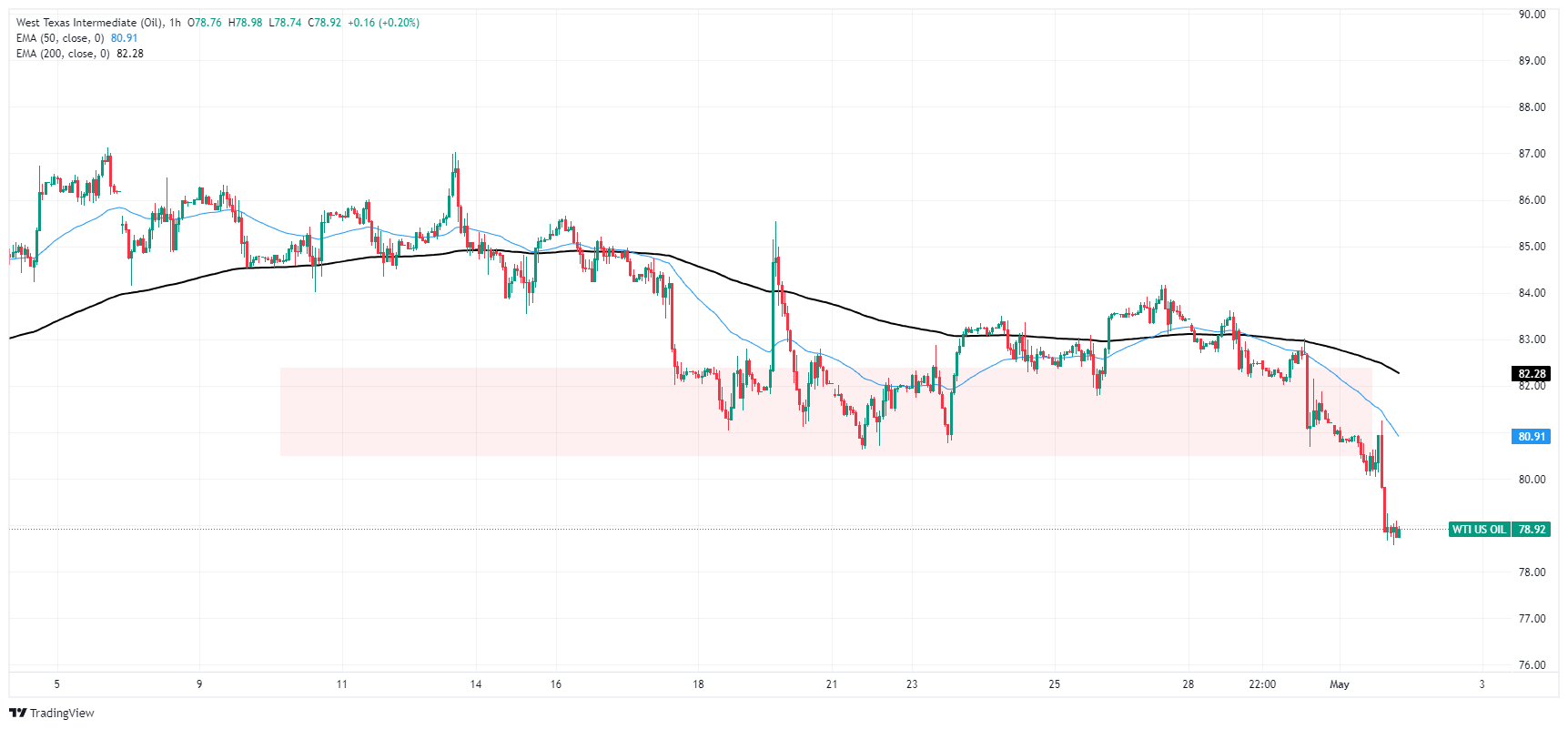
WTI daily chart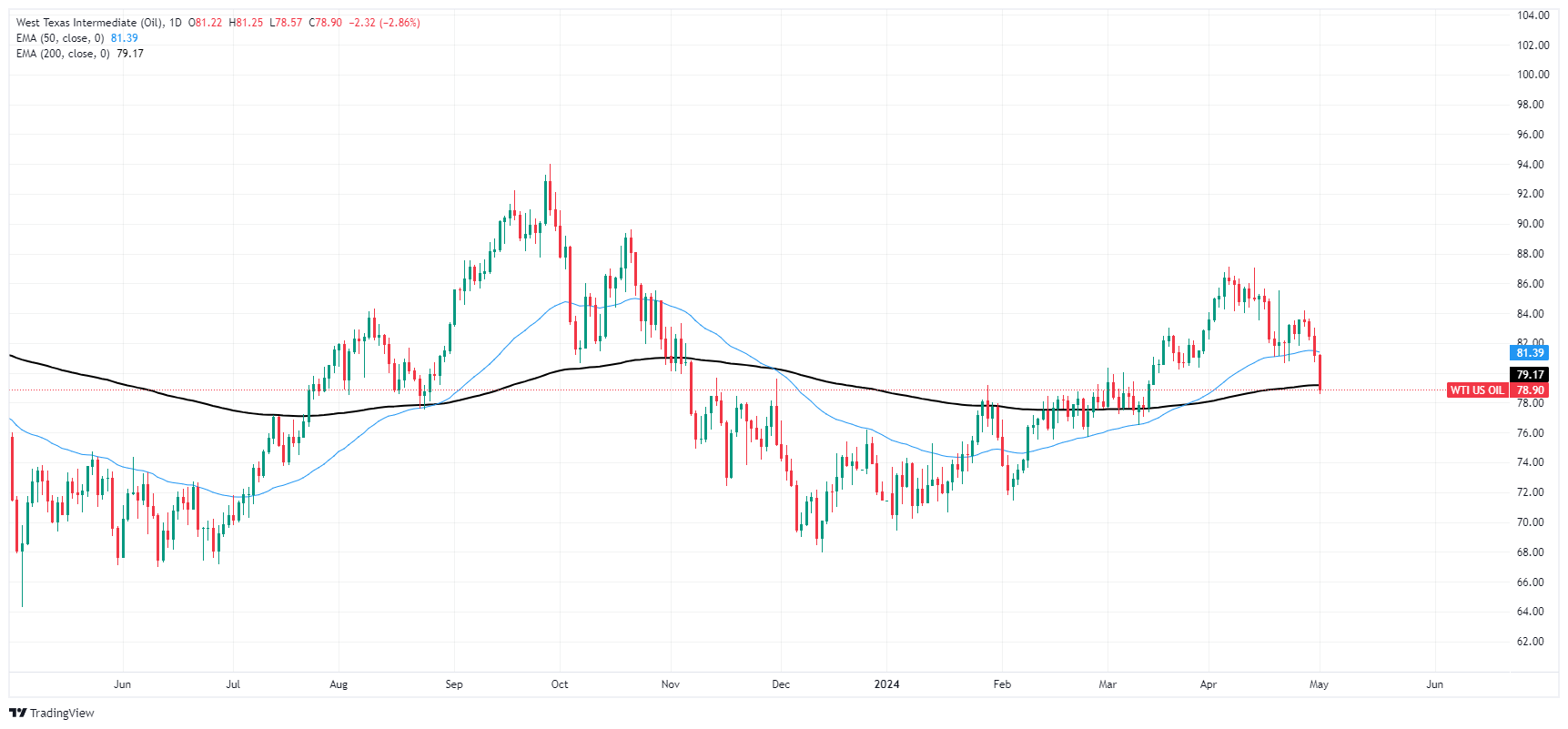
- Jerome Powell pointed out that the progress on inflation stagnated but that it was on track to the 2% target.
- He also pointed out that monetary policy needs more time to do its job and that a rate hike is highly unlikely.
- Markets are pushing rate cuts to year-end.
The US Dollar Index (DXY) tumbled to 105.45 on Wednesday following the Federal Reserve (Fed) decision to hold rates at 5.25-5.50% and Chair Powell’s cautious comments.
The US economy, despite facing inflationary pressures and a tightening labor market, maintains robust domestic demand as per Powell's observations. While registering progress, inflation remains high, leading to the Fed's cautious stance on its future trajectory. As for now investors are giving up their hopes on three rate cuts this year and are instead delaying the start of the easing cycle to Q4.
Daily digest market movers: DXY drops as markets digest Powell’s comments
- The Federal Reserve (Fed) emphasized that progress on inflation stagnated and that they need more confidence to start cutting.
- During the press conference, Jerome Powell acknowledged significant progress toward the Fed's dual goals, but that inflation is still above target, with further progress uncertain.
- He also presented different case scenarios where he basically stated that if data continues coming strong, they will hold their monetary policy for longer. If data gives the bank more confidence, they will start cutting.
- However, the basically took of the table the posibility of a rate cut.
- Currently, the likelihood of a rate cut by the Fed in June and July is low while those odd for the September meeting dipped below 55%.
DXY technical analysis: DXY is poised for a downward move, despite slight bullish indicators
On the daily chart, the Relative Strength Index (RSI) is on a negative slope even as it remains in positive territory, implying that despite the buying momentum, there is increasing bearish pressure. The Moving Average Convergence Divergence (MACD) showcases flat red bars indicating the possibility of a bearish crossover soon. This signals that the selling force could pick up steam in the coming trading sessions.
Additionally, the DXY's position above its Simple Moving Averages (SMAs) suggests a slightly bullish tone in the short term. Although showing a negative short-term outlook, the fact that it remains above the 20, 100, and 200-day SMAs insinuates the undercurrent of the bull forces that could balance out the bear camp.
US Dollar FAQs
The US Dollar (USD) is the official currency of the United States of America, and the ‘de facto’ currency of a significant number of other countries where it is found in circulation alongside local notes. It is the most heavily traded currency in the world, accounting for over 88% of all global foreign exchange turnover, or an average of $6.6 trillion in transactions per day, according to data from 2022. Following the second world war, the USD took over from the British Pound as the world’s reserve currency. For most of its history, the US Dollar was backed by Gold, until the Bretton Woods Agreement in 1971 when the Gold Standard went away.
The most important single factor impacting on the value of the US Dollar is monetary policy, which is shaped by the Federal Reserve (Fed). The Fed has two mandates: to achieve price stability (control inflation) and foster full employment. Its primary tool to achieve these two goals is by adjusting interest rates. When prices are rising too quickly and inflation is above the Fed’s 2% target, the Fed will raise rates, which helps the USD value. When inflation falls below 2% or the Unemployment Rate is too high, the Fed may lower interest rates, which weighs on the Greenback.
In extreme situations, the Federal Reserve can also print more Dollars and enact quantitative easing (QE). QE is the process by which the Fed substantially increases the flow of credit in a stuck financial system. It is a non-standard policy measure used when credit has dried up because banks will not lend to each other (out of the fear of counterparty default). It is a last resort when simply lowering interest rates is unlikely to achieve the necessary result. It was the Fed’s weapon of choice to combat the credit crunch that occurred during the Great Financial Crisis in 2008. It involves the Fed printing more Dollars and using them to buy US government bonds predominantly from financial institutions. QE usually leads to a weaker US Dollar.
Quantitative tightening (QT) is the reverse process whereby the Federal Reserve stops buying bonds from financial institutions and does not reinvest the principal from the bonds it holds maturing in new purchases. It is usually positive for the US Dollar.
The Greenback gave away Tuesday’s advance amidst declining US yields across the curve, all after the Fed left its interest rates unchanged, as expected, and Chief Powell ruled out an interest rate hike as the Fed’s next move.
Here is what you need to know on Thursday, May 2:
The USD Index (DXY) tumbled below the 106.00 support in the wake of the FOMC gathering along with the retracement in US yields. On May 2, weekly Initial Jobless Claims are due seconded by Balance of Trade results and Factory Orders.
EUR/USD reversed Tuesday’s pullback and returned beyond 1.0700 the figure in response to the marked sell-off in the Greenback following the FOMC event. The final HCOB Manufacturing PMI in both Germany and the euro area will be in the spotlight in the domestic docket on May 2.
GBP/USD regained the 1.2500 hurdle and above following the strong decline in the US Dollar after the fed matched consensus, leaving its rates unchanged. There will be no data releases on the UK docket on May 2.
USD/JPY partially trimmed Tuesday’s firm performance on the back of the renewed and strong selling bias in the Greenback and diminishing US yields across the curve. The BoJ will publish its Minutes on May 2 followed by weekly Foreign Bond Investment figures and the Consumer Confidence gauge.
AUD/USD managed to stage a sharp comeback, retaking the 0.6500 barrier and beyond following the weak tone in the Greenback. In Australia, the Balance of Trade and preliminary Building Permits are expected on May 2.
Prices of WTI remained on the back foot and dropped to multi-week lows below the $79.00 mark per barrel.
Gold prices edged higher and surpassed the $2,300 mark per troy ounce following renewed weakness in the Dollar and lower yields. By the same token, Silver regained some upside traction and trimmed part of the recent intense drop.
Federal Reserve Chairman Jerome Powell explains the decision to leave the policy rate, federal funds rate, unchanged at the range of 5.25-5.5% and responds to questions in the post-meeting press conference.
Key quotes
"We are at peace that we will do what we think is right when we think it is right."
"We will not take into account political events in our decisions."
"Pending elections are not part of our thinking."
"We've seen pretty consistent progress on slowing wage growth, but it's bumpy."
"If wages are running higher than productivity would warrant, that would boost inflation."
"We've seen progress on wages but it's inconsistent, ways to go on that."
"Restrictive monetary policy is doing what it is supposed to do."
"Reversal of supply and demand distortions and restrictive policy are bringing down inflation; have made lots of progress but a ways to go."
"Market rents are barely going up at all now."
"Market rents take years to get all the way into rents for rollover tenants."
"So it takes some time, I am confident that this will show up in measured inflation is market rents remain low."
"But we think it will take significantly longer than we thought."
About Jerome Powell (via Federalreserve.gov)
"Jerome H. Powell first took office as Chair of the Board of Governors of the Federal Reserve System on February 5, 2018, for a four-year term. He was reappointed to the office and sworn in for a second four-year term on May 23, 2022. Mr. Powell also serves as Chairman of the Federal Open Market Committee, the System's principal monetary policymaking body. Mr. Powell has served as a member of the Board of Governors since taking office on May 25, 2012, to fill an unexpired term. He was reappointed to the Board and sworn in on June 16, 2014, for a term ending January 31, 2028."
Fed FAQs
Monetary policy in the US is shaped by the Federal Reserve (Fed). The Fed has two mandates: to achieve price stability and foster full employment. Its primary tool to achieve these goals is by adjusting interest rates. When prices are rising too quickly and inflation is above the Fed’s 2% target, it raises interest rates, increasing borrowing costs throughout the economy. This results in a stronger US Dollar (USD) as it makes the US a more attractive place for international investors to park their money. When inflation falls below 2% or the Unemployment Rate is too high, the Fed may lower interest rates to encourage borrowing, which weighs on the Greenback.
The Federal Reserve (Fed) holds eight policy meetings a year, where the Federal Open Market Committee (FOMC) assesses economic conditions and makes monetary policy decisions. The FOMC is attended by twelve Fed officials – the seven members of the Board of Governors, the president of the Federal Reserve Bank of New York, and four of the remaining eleven regional Reserve Bank presidents, who serve one-year terms on a rotating basis.
In extreme situations, the Federal Reserve may resort to a policy named Quantitative Easing (QE). QE is the process by which the Fed substantially increases the flow of credit in a stuck financial system. It is a non-standard policy measure used during crises or when inflation is extremely low. It was the Fed’s weapon of choice during the Great Financial Crisis in 2008. It involves the Fed printing more Dollars and using them to buy high grade bonds from financial institutions. QE usually weakens the US Dollar.
Quantitative tightening (QT) is the reverse process of QE, whereby the Federal Reserve stops buying bonds from financial institutions and does not reinvest the principal from the bonds it holds maturing, to purchase new bonds. It is usually positive for the value of the US Dollar.
Federal Reserve Chairman Jerome Powell explains the decision to leave the policy rate, federal funds rate, unchanged at the range of 5.25-5.5% and responds to questions in the post-meeting press conference.
Key quotes
"I don't know if productivity will run persistently above trend."
"Could have significant increase in potential economic output."
"We believe our policy stance is in a good place given current situation."
"We are not satisfied with 3% inflation, we will return inflation to 2% over time."
"Our stance we think is appropriate to do that."
"Policy focus has been on what to do about holding current level of restriction; that was meeting discussion."
"Restrictive monetary policy needs more time to do its job."
"How long that will take, how patient we need to be, will depend on data."
About Jerome Powell (via Federalreserve.gov)
"Jerome H. Powell first took office as Chair of the Board of Governors of the Federal Reserve System on February 5, 2018, for a four-year term. He was reappointed to the office and sworn in for a second four-year term on May 23, 2022. Mr. Powell also serves as Chairman of the Federal Open Market Committee, the System's principal monetary policymaking body. Mr. Powell has served as a member of the Board of Governors since taking office on May 25, 2012, to fill an unexpired term. He was reappointed to the Board and sworn in on June 16, 2014, for a term ending January 31, 2028."
Central banks FAQs
Central Banks have a key mandate which is making sure that there is price stability in a country or region. Economies are constantly facing inflation or deflation when prices for certain goods and services are fluctuating. Constant rising prices for the same goods means inflation, constant lowered prices for the same goods means deflation. It is the task of the central bank to keep the demand in line by tweaking its policy rate. For the biggest central banks like the US Federal Reserve (Fed), the European Central Bank (ECB) or the Bank of England (BoE), the mandate is to keep inflation close to 2%.
A central bank has one important tool at its disposal to get inflation higher or lower, and that is by tweaking its benchmark policy rate, commonly known as interest rate. On pre-communicated moments, the central bank will issue a statement with its policy rate and provide additional reasoning on why it is either remaining or changing (cutting or hiking) it. Local banks will adjust their savings and lending rates accordingly, which in turn will make it either harder or easier for people to earn on their savings or for companies to take out loans and make investments in their businesses. When the central bank hikes interest rates substantially, this is called monetary tightening. When it is cutting its benchmark rate, it is called monetary easing.
A central bank is often politically independent. Members of the central bank policy board are passing through a series of panels and hearings before being appointed to a policy board seat. Each member in that board often has a certain conviction on how the central bank should control inflation and the subsequent monetary policy. Members that want a very loose monetary policy, with low rates and cheap lending, to boost the economy substantially while being content to see inflation slightly above 2%, are called ‘doves’. Members that rather want to see higher rates to reward savings and want to keep a lit on inflation at all time are called ‘hawks’ and will not rest until inflation is at or just below 2%.
Normally, there is a chairman or president who leads each meeting, needs to create a consensus between the hawks or doves and has his or her final say when it would come down to a vote split to avoid a 50-50 tie on whether the current policy should be adjusted. The chairman will deliver speeches which often can be followed live, where the current monetary stance and outlook is being communicated. A central bank will try to push forward its monetary policy without triggering violent swings in rates, equities, or its currency. All members of the central bank will channel their stance toward the markets in advance of a policy meeting event. A few days before a policy meeting takes place until the new policy has been communicated, members are forbidden to talk publicly. This is called the blackout period.
Federal Reserve Chairman Jerome Powell explains the decision to leave the policy rate, federal funds rate, unchanged at the range of 5.25-5.5% and responds to questions in the post-meeting press conference.
Key quotes
"Since December, goods and housing inflation has been higher than expected."
"My expectation is over the course of this year, inflation will move back down but my confidence in that is lower than it was before."
"Looks like substantial lags in when lower market rents will turn up in the data."
"Active tool of monetary policy is interest rates."
"Plan to slow balance sheet runoff is aimed at making it smooth, avoiding market turmoil."
"Balance sheet slowdown now is to ensure a smooth process and not market turmoil like last time."
"Economy has been very hard for forecasters to predict."
"There are paths to not cutting, and paths to cutting -- it will depend on the data."
"As inflation has come down to below 3%, the Fed's employment goal comes back into focus."
"I don't know if inflation will fall enough, or won't fall enough, to merit rate cuts."
About Jerome Powell (via Federalreserve.gov)
"Jerome H. Powell first took office as Chair of the Board of Governors of the Federal Reserve System on February 5, 2018, for a four-year term. He was reappointed to the office and sworn in for a second four-year term on May 23, 2022. Mr. Powell also serves as Chairman of the Federal Open Market Committee, the System's principal monetary policymaking body. Mr. Powell has served as a member of the Board of Governors since taking office on May 25, 2012, to fill an unexpired term. He was reappointed to the Board and sworn in on June 16, 2014, for a term ending January 31, 2028."
Interest rates FAQs
Interest rates are charged by financial institutions on loans to borrowers and are paid as interest to savers and depositors. They are influenced by base lending rates, which are set by central banks in response to changes in the economy. Central banks normally have a mandate to ensure price stability, which in most cases means targeting a core inflation rate of around 2%. If inflation falls below target the central bank may cut base lending rates, with a view to stimulating lending and boosting the economy. If inflation rises substantially above 2% it normally results in the central bank raising base lending rates in an attempt to lower inflation.
Higher interest rates generally help strengthen a country’s currency as they make it a more attractive place for global investors to park their money.
Higher interest rates overall weigh on the price of Gold because they increase the opportunity cost of holding Gold instead of investing in an interest-bearing asset or placing cash in the bank. If interest rates are high that usually pushes up the price of the US Dollar (USD), and since Gold is priced in Dollars, this has the effect of lowering the price of Gold.
The Fed funds rate is the overnight rate at which US banks lend to each other. It is the oft-quoted headline rate set by the Federal Reserve at its FOMC meetings. It is set as a range, for example 4.75%-5.00%, though the upper limit (in that case 5.00%) is the quoted figure. Market expectations for future Fed funds rate are tracked by the CME FedWatch tool, which shapes how many financial markets behave in anticipation of future Federal Reserve monetary policy decisions.
Federal Reserve Chairman Jerome Powell explains the decision to leave the policy rate, federal funds rate, unchanged at the range of 5.25-5.5% and responds to questions in the post-meeting press conference.
Key quotes
"Our decisions depend on incoming data."
"We think policy is well positioned to address different paths the economy might take."
"If inflation proves more persistent and labor market remains strong, then it could be appropriate to hold off on rate cuts."
"But there are other paths which would point to rate cuts."
"That would be if we gain greater confidence and unexpected weakening in labor market."
"Data will have to answer question of if this is peak rate."
"To reduce rates, we want to be confident inflation is moving down."
"Incoming inflation data will be at the very heart of that decision."
"Not obvious connection between easing in financial conditions and inflation."
"Wouldn't rule out that we could still have strong growth or labor market and inflation continue to fall."
"We will probably have to see wage growth ease to more sustainable levels to reach inflation goal."
"I don't know how long it will take before we can cut rates."
"We do need to take a signal from three worse-than-expected inflation readings."
"Will take us longer to get ourselves sufficiently confident to change policy rate."
About Jerome Powell (via Federalreserve.gov)
"Jerome H. Powell first took office as Chair of the Board of Governors of the Federal Reserve System on February 5, 2018, for a four-year term. He was reappointed to the office and sworn in for a second four-year term on May 23, 2022. Mr. Powell also serves as Chairman of the Federal Open Market Committee, the System's principal monetary policymaking body. Mr. Powell has served as a member of the Board of Governors since taking office on May 25, 2012, to fill an unexpired term. He was reappointed to the Board and sworn in on June 16, 2014, for a term ending January 31, 2028."
Fed FAQs
Monetary policy in the US is shaped by the Federal Reserve (Fed). The Fed has two mandates: to achieve price stability and foster full employment. Its primary tool to achieve these goals is by adjusting interest rates. When prices are rising too quickly and inflation is above the Fed’s 2% target, it raises interest rates, increasing borrowing costs throughout the economy. This results in a stronger US Dollar (USD) as it makes the US a more attractive place for international investors to park their money. When inflation falls below 2% or the Unemployment Rate is too high, the Fed may lower interest rates to encourage borrowing, which weighs on the Greenback.
The Federal Reserve (Fed) holds eight policy meetings a year, where the Federal Open Market Committee (FOMC) assesses economic conditions and makes monetary policy decisions. The FOMC is attended by twelve Fed officials – the seven members of the Board of Governors, the president of the Federal Reserve Bank of New York, and four of the remaining eleven regional Reserve Bank presidents, who serve one-year terms on a rotating basis.
In extreme situations, the Federal Reserve may resort to a policy named Quantitative Easing (QE). QE is the process by which the Fed substantially increases the flow of credit in a stuck financial system. It is a non-standard policy measure used during crises or when inflation is extremely low. It was the Fed’s weapon of choice during the Great Financial Crisis in 2008. It involves the Fed printing more Dollars and using them to buy high grade bonds from financial institutions. QE usually weakens the US Dollar.
Quantitative tightening (QT) is the reverse process of QE, whereby the Federal Reserve stops buying bonds from financial institutions and does not reinvest the principal from the bonds it holds maturing, to purchase new bonds. It is usually positive for the value of the US Dollar.
Federal Reserve Chairman Jerome Powell explains the decision to leave the policy rate, federal funds rate, unchanged at the range of 5.25-5.5% and responds to questions in the post-meeting press conference.
Key quotes
"I do think policy is restrictive and is weighing on demand."
"You can see that with the labor market."
"Saw evidence of that today in the JOLTS report."
"Quits and hiring rates have normalized."
"We believe over time policy is sufficiently restrictive to bring inflation back down to 2%."
"The data will show if that's so."
"Unlikely that next policy rate move would be a hike."
"Policy focus is on how long to keep policy restrictive."
"To hike, we'd need to see evidence policy is not sufficiently restrictive -- that's not what we see."
About Jerome Powell (via Federalreserve.gov)
"Jerome H. Powell first took office as Chair of the Board of Governors of the Federal Reserve System on February 5, 2018, for a four-year term. He was reappointed to the office and sworn in for a second four-year term on May 23, 2022. Mr. Powell also serves as Chairman of the Federal Open Market Committee, the System's principal monetary policymaking body. Mr. Powell has served as a member of the Board of Governors since taking office on May 25, 2012, to fill an unexpired term. He was reappointed to the Board and sworn in on June 16, 2014, for a term ending January 31, 2028."
Interest rates FAQs
Interest rates are charged by financial institutions on loans to borrowers and are paid as interest to savers and depositors. They are influenced by base lending rates, which are set by central banks in response to changes in the economy. Central banks normally have a mandate to ensure price stability, which in most cases means targeting a core inflation rate of around 2%. If inflation falls below target the central bank may cut base lending rates, with a view to stimulating lending and boosting the economy. If inflation rises substantially above 2% it normally results in the central bank raising base lending rates in an attempt to lower inflation.
Higher interest rates generally help strengthen a country’s currency as they make it a more attractive place for global investors to park their money.
Higher interest rates overall weigh on the price of Gold because they increase the opportunity cost of holding Gold instead of investing in an interest-bearing asset or placing cash in the bank. If interest rates are high that usually pushes up the price of the US Dollar (USD), and since Gold is priced in Dollars, this has the effect of lowering the price of Gold.
The Fed funds rate is the overnight rate at which US banks lend to each other. It is the oft-quoted headline rate set by the Federal Reserve at its FOMC meetings. It is set as a range, for example 4.75%-5.00%, though the upper limit (in that case 5.00%) is the quoted figure. Market expectations for future Fed funds rate are tracked by the CME FedWatch tool, which shapes how many financial markets behave in anticipation of future Federal Reserve monetary policy decisions.