Новини ринків

УВАГА: Матеріал у cтрічці новин та аналітики оновлюєтьcя автоматично, перезавантаження cторінки може уповільнити процеc появи нового матеріалу. Для оперативного отримання матеріалів рекомендуємо тримати cтрічку новин поcтійно відкритою.
Cортувати за валютними парами
25.05.2022
23:54
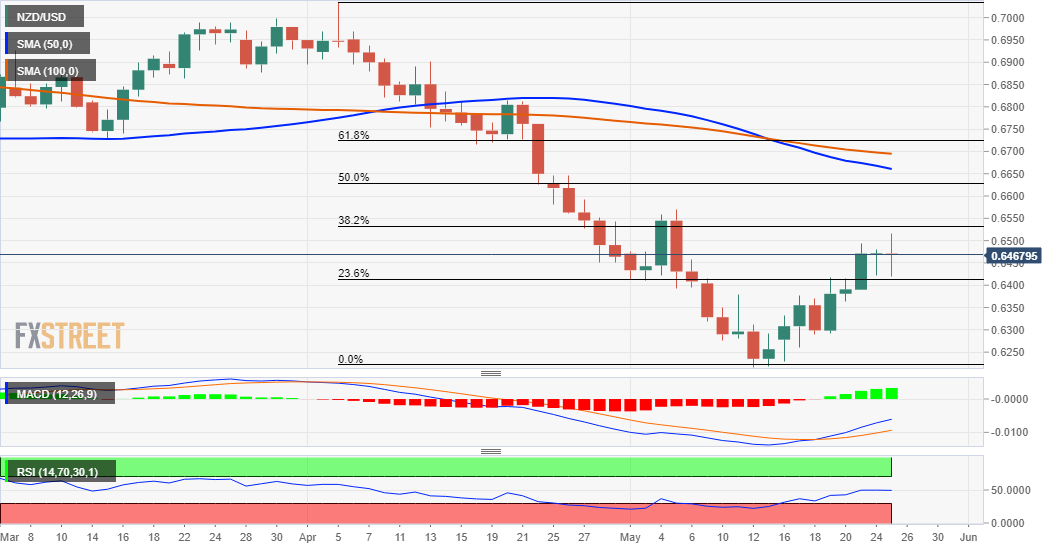
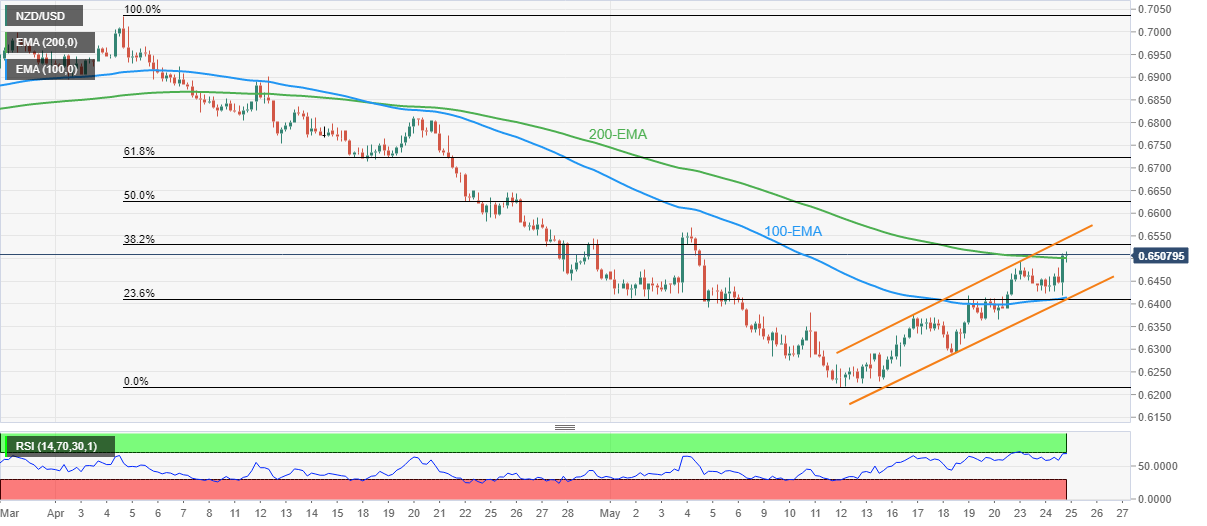
NZD/USD marches towards 0.6500 despite renewed NZ recession fears, US PCE eyed NZDUSD
  • NZD/USD is advancing towards 0.6500 as DXY weakness ahead of US PCE.
  • The antipodean is performing stronger despite renewed fears of recession.
  • A consecutive 50 bps interest rate hike has been announced by the RBNZ.

The NZD/USD pair has displayed a bullish open drive move in the early Tokyo session, following a bullish Wednesday. The asset is rising swiftly after hitting a low of 0.6418. The kiwi bulls got strengthened after the Reserve Bank of New Zealand (RBNZ) elevated its Official Cash Rate (OCR) by 50 basis points (bps).  

To combat the soaring inflation, the RBNZ announced a consecutive interest rate hike by 50 bps on Wednesday. The RBNZ is not taking the bullet and passing on the impact of mounting inflationary pressures. Officially, the OCR has reached 2% and the central bank sees more policy tightening in order to curb the price pressures. In the first quarter of CY2022, the annual Consumer Price Index (CPI) was recorded at 6.9%, significantly higher than the targeted boundary of 2%.

While deploying its quantitative measures to safeguard the economy from galloping price pressure, the RBNZ has pressed the recession button. RBNZ Governor Adrian Orr in his speech dictated that a period of recession cannot be ruled out however he is not predicting one. The economy will observe the growth headwinds as elevating interest rates will tighten the liquidity leakage into the economy.

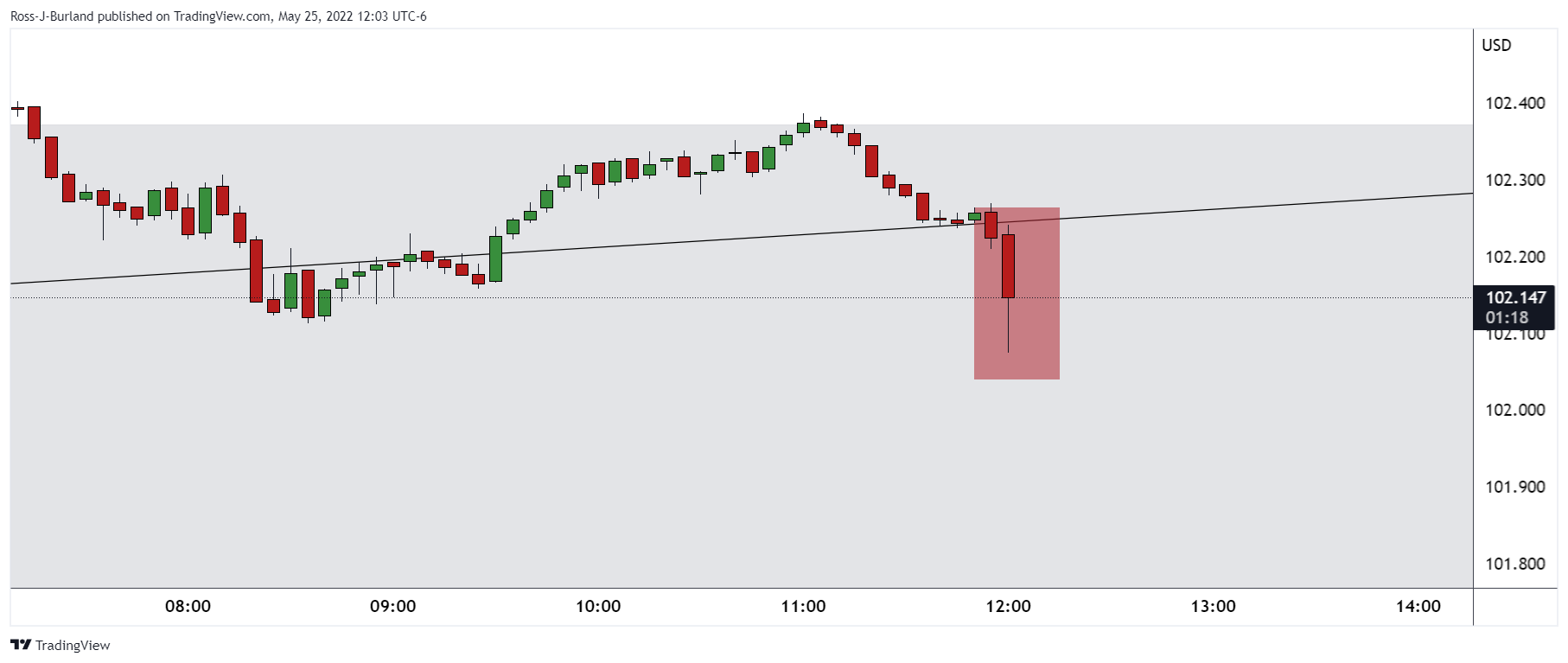
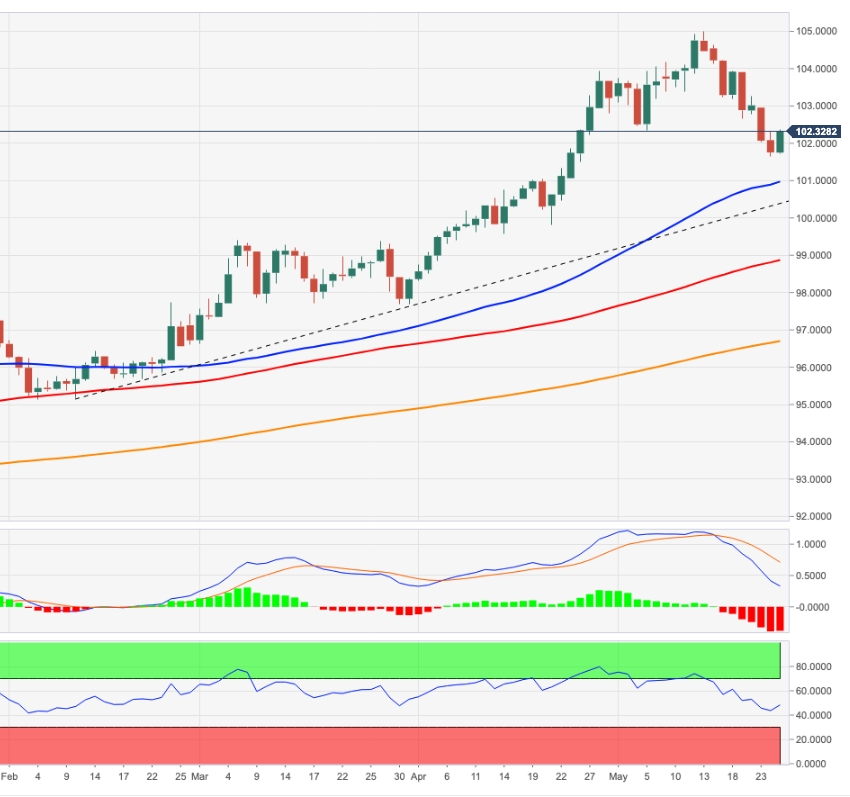
Meanwhile, the US dollar index (DXY) is dragging lower and may hit the round-level support of 102.00. The market participants are cautious ahead of the release of the Core Personal Consumption Expenditure (PCE). A stabled figure of 7% is expected from the core PCE numbers.


23:52
Japan Corporate Service Price Index (YoY) above expectations (0.9%) in April: Actual (1.7%)
23:51
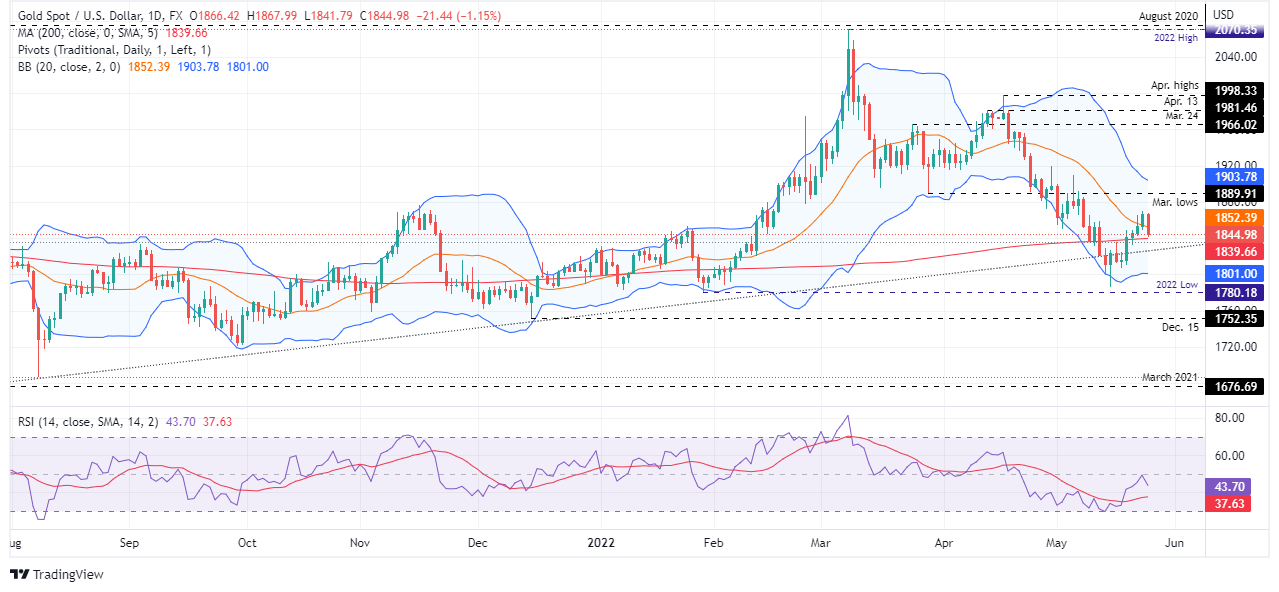
Gold Price Forecast: XAU/USD defends bounce off weekly support near $1,850 ahead of US GDP
  • Gold floats above an eight-day-old support line amid sluggish markets.
  • US dollar struggles to defend the rebound from monthly low post-FOMC Minutes.
  • Headlines from Ukraine and China may entertain traders amid light calendar in Asia, off in Europe.

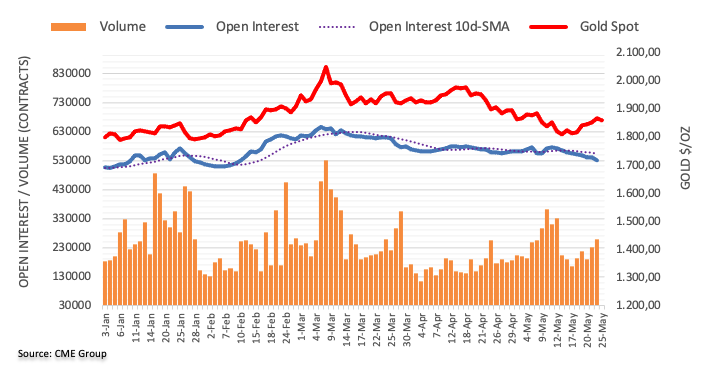
Gold (XAU/USD) treads water around $1,855, defending the previous day’s corrective pullback from a one-week-old support line during Thursday’s Asian session as sluggish markets and a lack of major data/events seem to restrict the metal’s immediate moves. Also challenging the commodity prices is the mixed play of the US dollar moves and challenges to sentiment, especially from China and Ukraine.

The US Dollar Index (DXY) fades the bounce off a one-month low, struggling to stay beyond 102.00, after the latest Federal Open Market Committee (FOMC) Minutes endorsed the 50 basis points (bps) of rate hikes for only the next couple of meetings, raising doubts on the rate-lift trajectory past-September on statements like, “It would be appropriate to consider sales of mortgage-backed securities.”

It’s worth noting that another set of US data, namely the Durable Goods Orders for April, joined downbeat housing figures to weigh on the US dollar, amid growth fears. As per the latest US Durable Goods Orders, the growth slowed down to 0.4% MoM versus market forecasts and revised down prior readings of 0.6%. Also, the Core Durable Goods Orders rose 0.3% MoM versus 0.6% expected and 1.1% prior (revised).

However, the latest headlines from China and Ukraine seem to challenge the market sentiment and keep the greenback on the bull’s radar. That said, “Ukrainian President Volodymyr Zelensky on Wednesday savaged suggestions that Kyiv gives up territory and make concessions to end the war with Russia, saying the idea smacked of attempts to appease Nazi Germany in 1938,” per Reuters. On the other hand, China criticizes the US Draft Security Council resolution on North Korea and adds to the recently alive Sino-American tensions.

Amid these plays, the S&P 500 Futures remain directionless near 3,975 even after Wall Street managed to post notable gains. Further, the US Treasury yields also stay sluggish around 2.74% by the press time.

Moving on, a light calendar emphasizes risk catalysts for fresh impulse ahead of second readings of the US Q1 2022 GDP, Weekly US Jobless Claims and the Pending Home Sales for April, as well as the Fedspeak.

Also read: Gold Price Forecast: Technicals hint at more slides ahead

Technical analysis

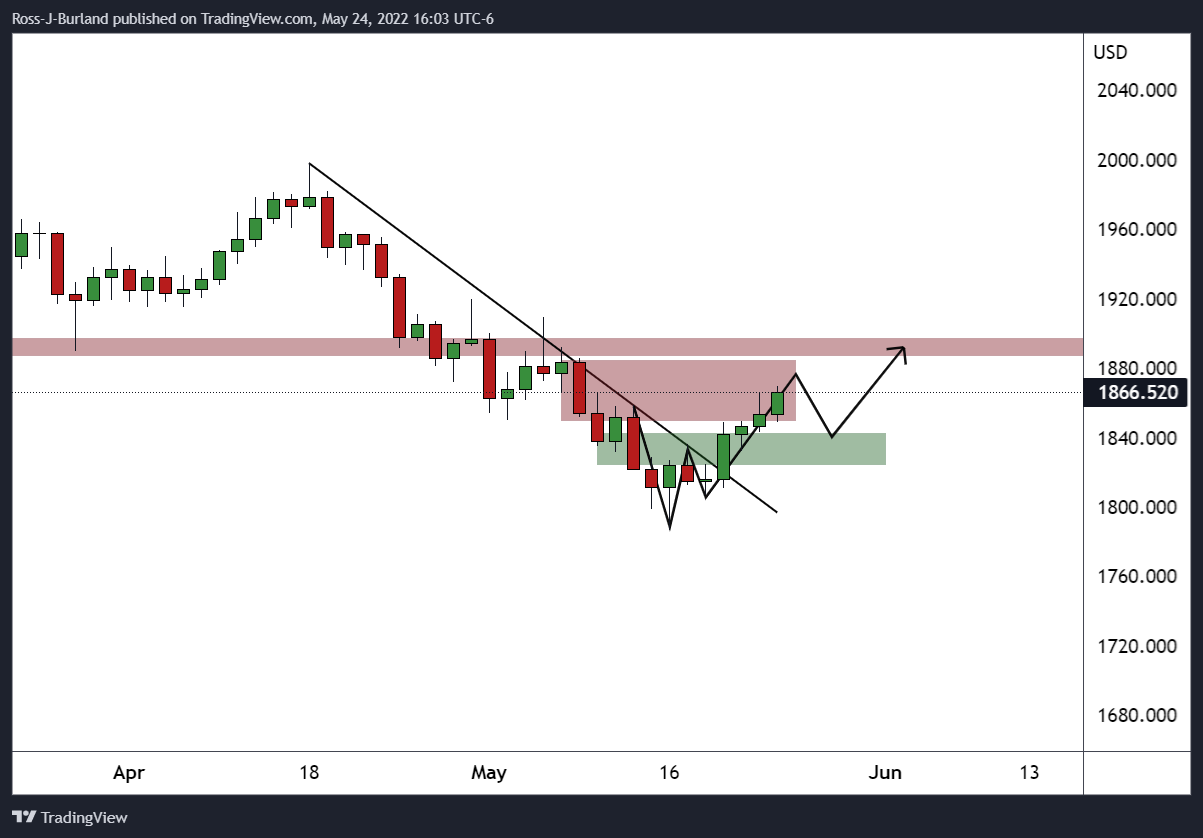
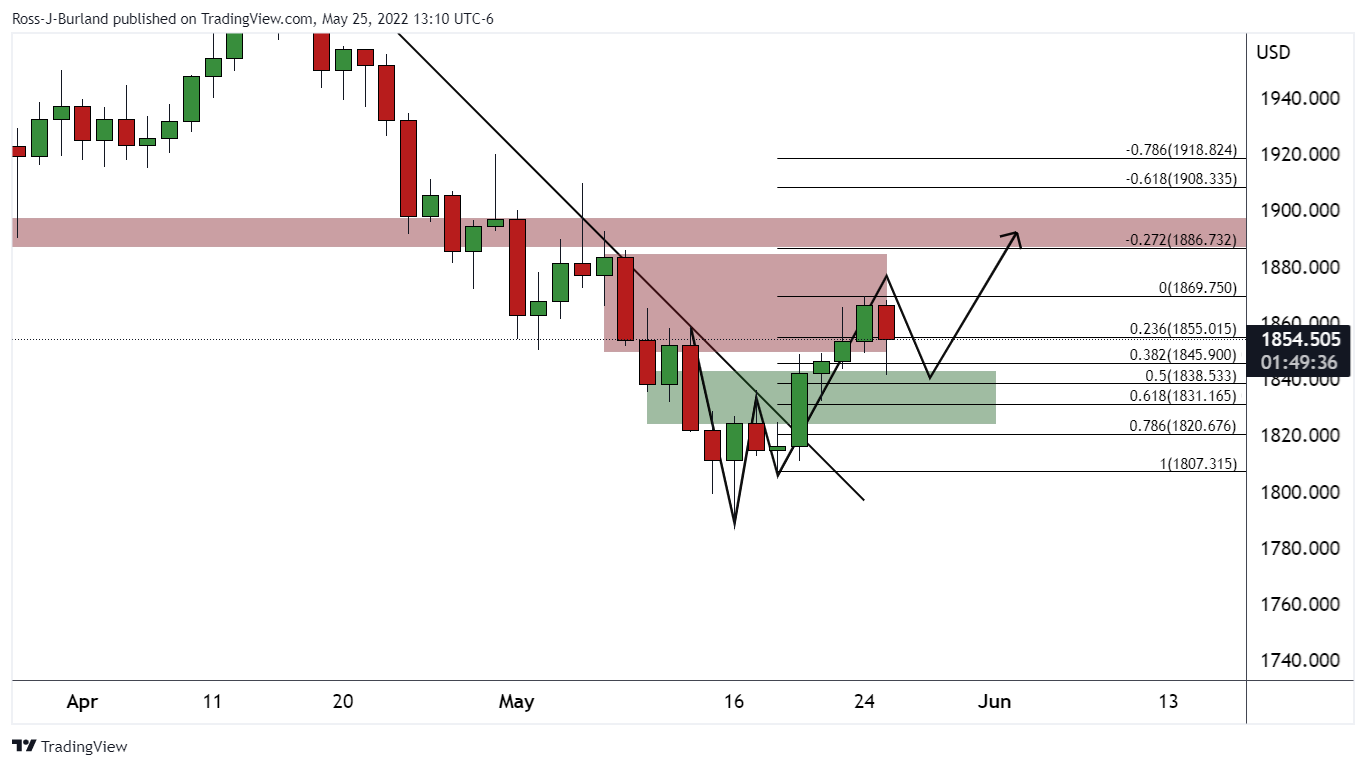
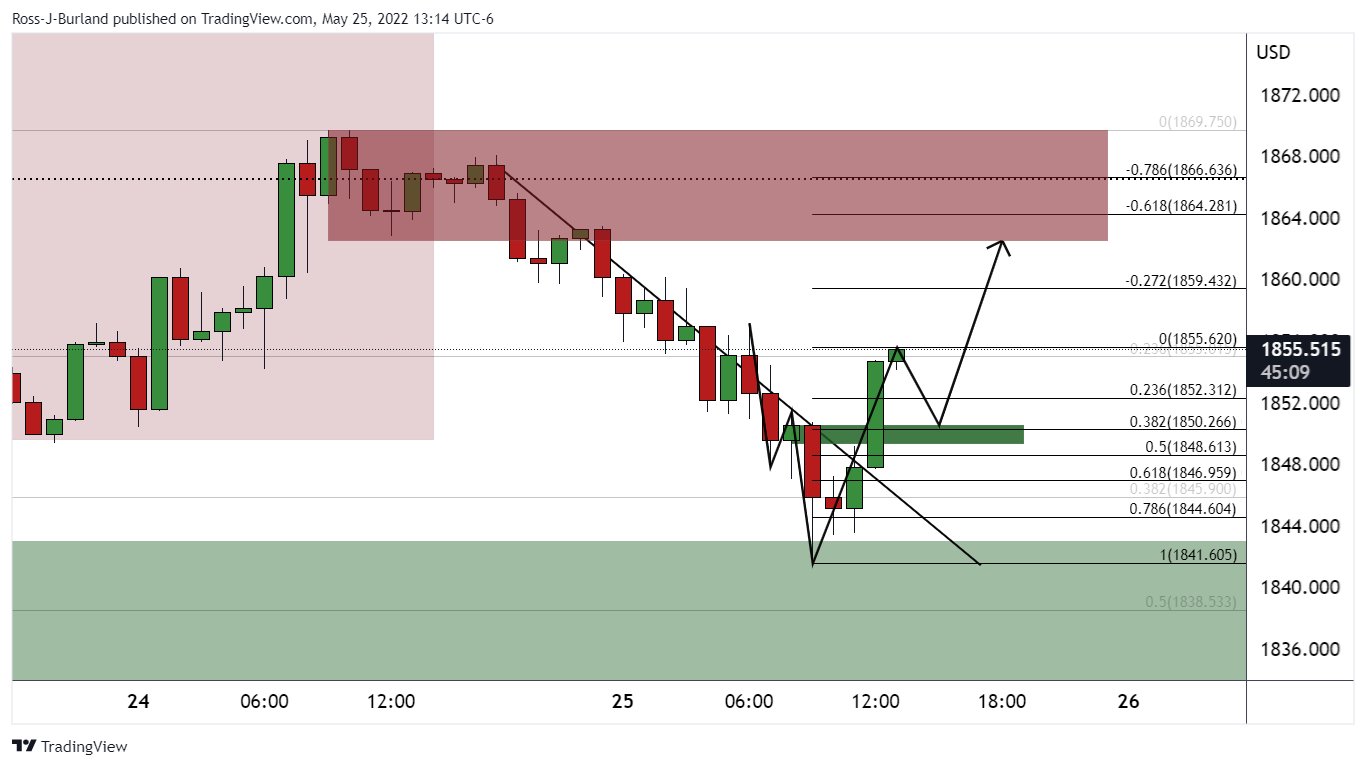
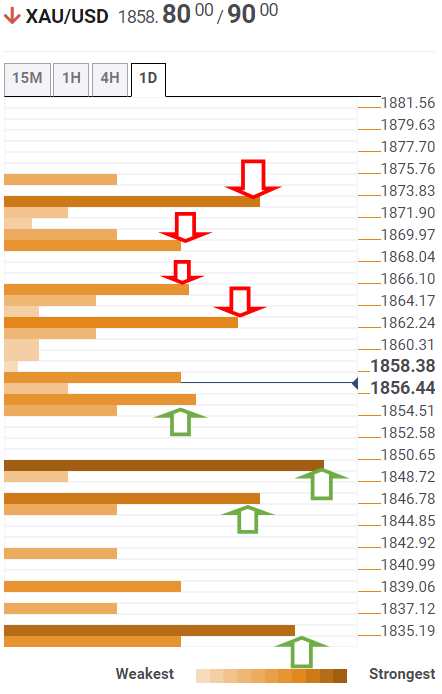
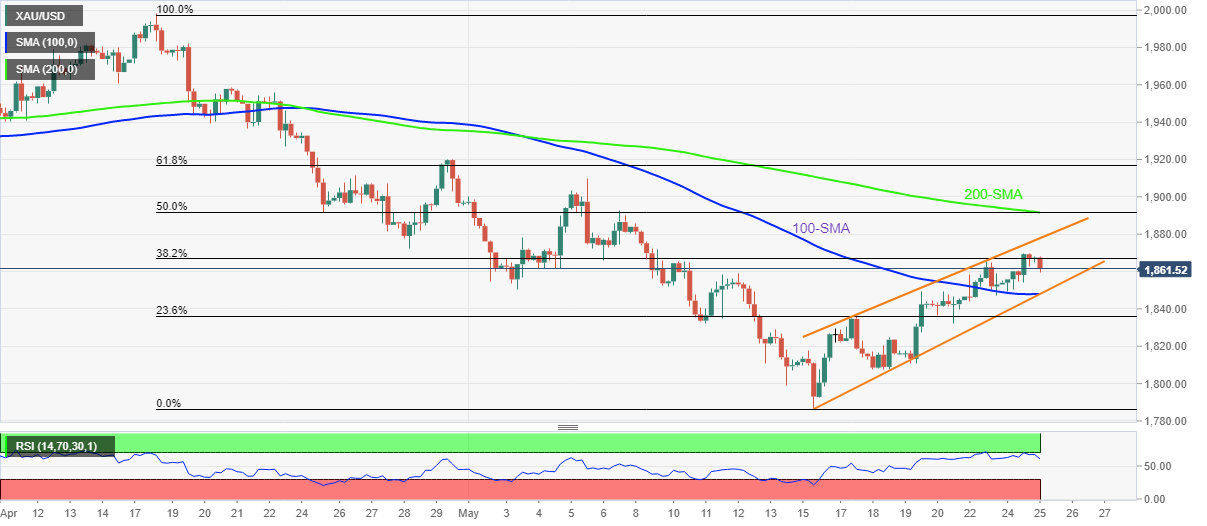
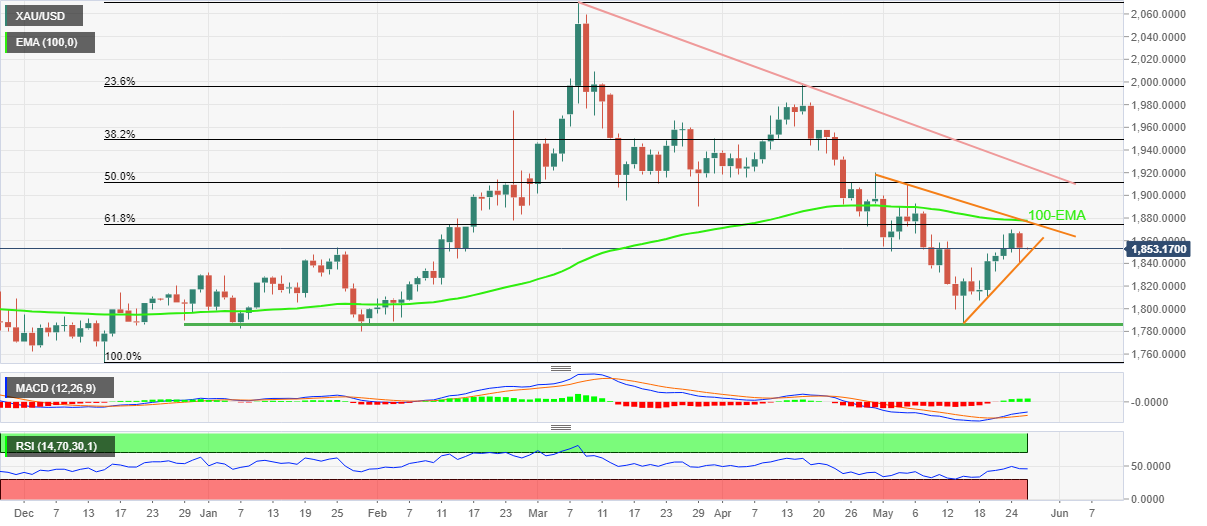
Despite snapping a four-day uptrend on Wednesday, an upward sloping trend line from May 16 restricts the immediate downside of gold, around $1,848. Also challenging the gold sellers are the bullish MACD signals and steady RSI (14).

It should, however, be noted that a clear downside break of $1,848 support could make the metal vulnerable to visiting the yearly horizontal area surrounding $1,787, with the $1,800 threshold likely acting as an intermediate halt.

Alternatively, the 61.8% Fibonacci retracement of December 2021 to March 2022 upside, near $1,875, restricts immediate recovery moves of gold price.

Following that, a one-month-old descending trend line and the 100-day EMA will challenge the bulls at around $1,878.

Should the quote trade successfully past $1,878, the odds favoring a run-up towards the $1,900 round figure and then to the monthly high near $1,910 can’t be ruled out.

Gold: Daily chart
Trend: Further recovery expected
 

23:50
Japan Foreign Investment in Japan Stocks rose from previous ¥-342.9B to ¥4.1B in May 20
23:50
Japan Foreign Bond Investment up to ¥627B in May 20 from previous ¥370.8B
23:23
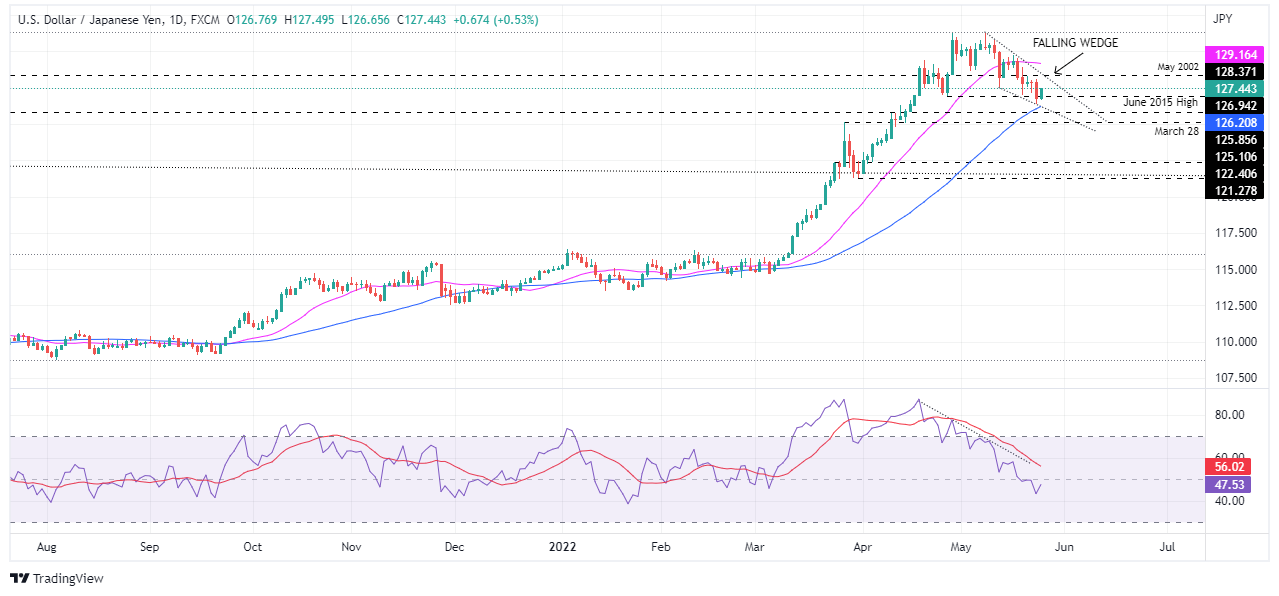
USD/JPY to find bids around 127.00 ahead of US GDP and PCE USDJPY
  • USD/JPY is declining modestly towards 127.00 as investors await US PCE and GDP.
  • The annual US GDP is seen stable at -1.4% while the PCE is seen firmer at 7%.
  • The yen bulls have delivered a decent performance this week on upbeat PMI numbers.

The USD/JPY pair has witnessed a minor correction after failing to cross 127.50 as investors are keeping an eye on the US Gross Domestic Product (GDP) numbers, which are due on Thursday. The annual GDP is seen stabled at -1.4%.

The asset has remained vulnerable in the past few trading sessions amid weakness in the US dollar index (DXY). The DXY has delivered a subdued performance from the last week after printing a 19-year high of 105.00 on May 13. Investors have dumped the greenback heavily at elevated levels amid a rebound in the risk-on impulse, which diminished the safe-haven appeal.

Consecutive 50 basis points (bps) interest rate elevation by the Federal Reserve (Fed) in June monetary policy is the talk of the town and it looks like investors have already priced in the extreme hawkish stance by the Fed.

Apart from the US GDP numbers, investors will also focus on the quarterly Core Personal Consumption Expenditure (PCE), which is also seen stabled at 7%. A higher-than-expected Core PCE figure could force the Fed to sound more hawkish than the current usual.

On the Japanese front, the yen bulls have performed better this week on upbeat Jibun Bank Purchase Managers Index (PMI) numbers. The Manufacturing PMI landed at 53.2, against the forecasts of 52 while the Services PMI was recorded at 51.7, higher in comparison with the estimates of 50.6.


23:18
USD/CAD Price Analysis: Bears flirt with weekly support above 1.2800 USDCAD
  • USD/CAD grinds lower around an upward sloping trend line from Monday.
  • Steady RSI, multiple hurdles to the south challenge bears.
  • Fortnight-old horizontal area restricts immediate recovery moves ahead of monthly resistance zone.

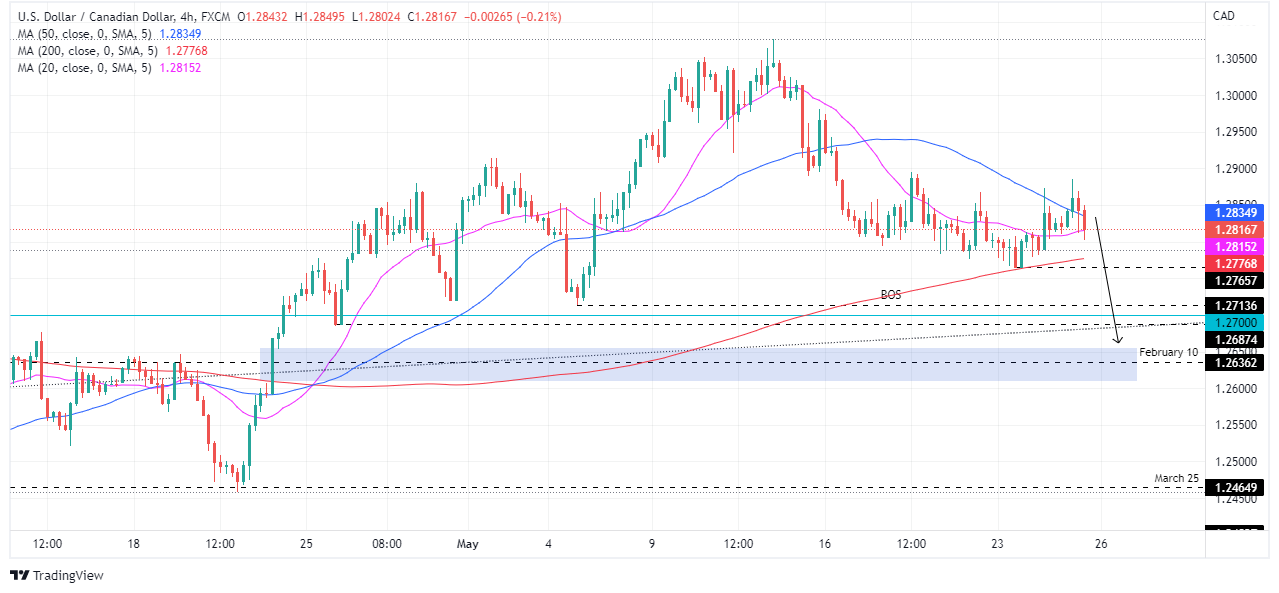
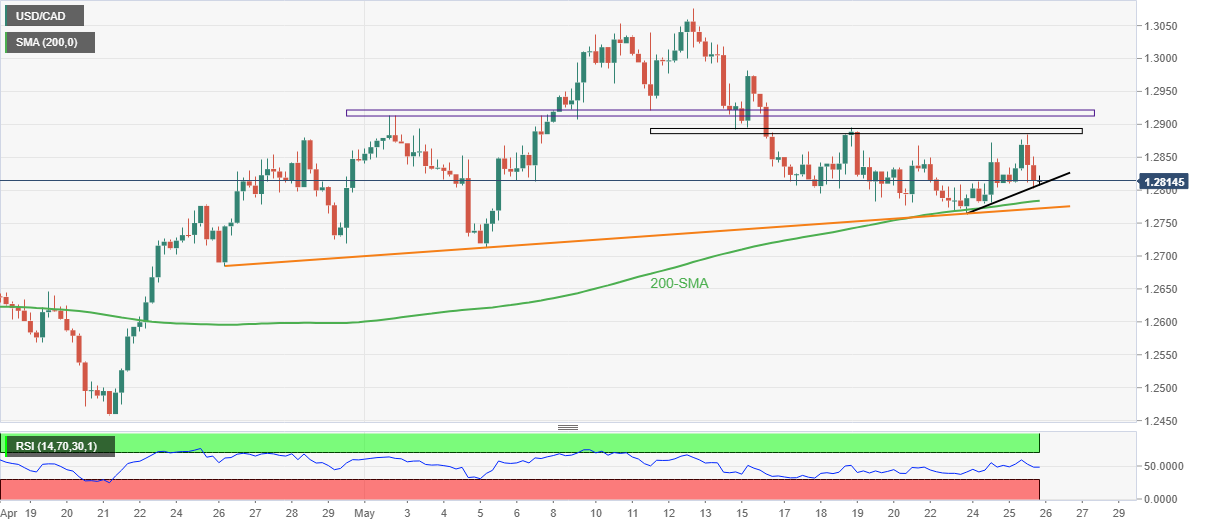
USD/CAD holds lower ground near 1.2815, after taking a U-turn from the fresh weekly high, as sellers jostle with a short-term support line during Thursday’s inactive Asian session.

In addition to the weekly ascending trend line, a steady RSI also tests the USD/CAD sellers.

Even if the quote breaks the 1.2810 immediate support, the 200-SMA and a one-month-old rising support line, respectively around 1.2785 and 1.2770, will challenge the pair’s further downside.

Hence, multiple supports and steady RSI keeps USD/CAD bears doubtful until the quote stays beyond 1.2770, a break of which will not hesitate to challenge the monthly low of 1.2713.

On the contrary, a two-week-old horizontal area surrounding 1.2885-95 challenges the short-term rebound ahead of the 1.2915-20 region comprising multiple levels marked since May 02.

Should the USD/CAD bulls manage to cross the 1.2920 hurdle, the 1.3000 psychological magnet may test the upside momentum targeting the monthly peak of 1.3076.

USD/CAD: Four-hour chart

Trend: Recovery expected


23:12
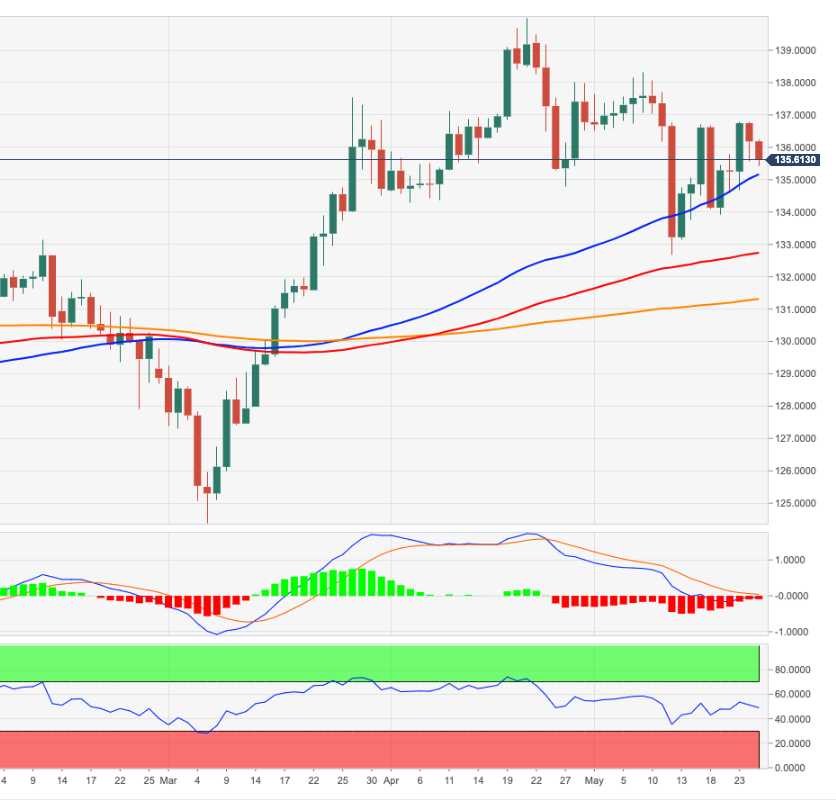
EUR/JPY Price Analysis: Seesaws around the 50-DMA as volatility shrank, the rising-wedge stills in play EURJPY
  • The EUR/JPY rally continues, albeit retracing from weekly highs, gaining 0.82% in the week,
  • A risk-on market mood weighed on the common currency and lifted the JPY.
  • EUR/JPY Price Forecast: Rising wedge in the daily chart might lead the pair to tumble towards 132.00 unless EUR/JPY bulls reclaim 137.00.

The shared currency slides for the second consecutive day against the Japanese yen, despite recent ECB policymaker’s “hawkish” commentary and a risk-on market mood that usually weighs on the yen. At the time of writing, the EUR/JPY is trading at 136.04, posting minimal gains of 0.13% as the Asian session starts.

On Thursday, sentiment is positive as global equities rally. Asian equity futures depict a higher open in Asian markets once the US FOMC May meeting minutes reiterated what Fed policymakers said after May 5. Investors’ shrugged off China’s coronavirus crisis, which spurred factory halts in April, mainly in Shanghai.

On Wednesday, the EUR/JPY pair opened near the daily high and plunged, despite a risk-on market mood, aiming towards the 200-hour simple moving average (SMA) at 135.32, breaking on its way south, support levels like the 50-hour SMA at 136.07, and the 100-hour SMA at 135.60. However, the cross-currency is back above Thursday’s central daily pivot point, up by some 0.11%.

EUR/JPY Price Forecast: Technical outlook

The EUR/JPY daily chart depicts the pair as upward biased. However, the cross advances steadily and will face a solid supply area around the 137.00 mark, which EUR/JPY bulls have been unable to conquer.

It’s worth noting that a rising wedge formed, which, once broken, might open the door for further losses. That said, the EUR/JPY’s first support would be the 50-day moving average (DMA) at 135.83. A breach of the latter would open the door for a re-test of the rising wedge bottom trendline, around 135.00-135.20. Once cleared, the following demand zone would be the rising wedge target at 132.00, followed by the 200-DMA at 131.32.

Key Technical Levels


23:08
News from Ukraine, China’s UN Mission refresh geopolitical fears

Fresh geopolitical concerns were raised from Ukraine and China, challenging the market’s cautious optimism triggered after the latest Federal Open Market Committee (FOMC) Minutes.

“Ukrainian President Volodymyr Zelensky on Wednesday savaged suggestions that Kyiv gives up territory and make concessions to end the war with Russia, saying the idea smacked of attempts to appease Nazi Germany in 1938,” said Reuters.

The news also adds, “The angry comments by Zelenskiy and a senior aide come as Ukrainian troops are facing a renewed offensive in two eastern regions that Russian-speaking separatists seized part of in 2014.”

On the other hand, China’s UN Mission conveyed that the US Draft Security Council resolution on North Korea will not solve any problem.

“The US knows the best method to de-escalate tensions with North Korea, but opposes it,” adds China’s UN Mission.

Market reaction

The news stops S&P 500 Futures to track Wall Street gains, down 0.15% intraday around 3,975 by the press time of Thursday’s initial Asian session.

Also read: Post FOMC: Market shift from catch-down camp to short covering mode

23:01
Ireland Consumer Confidence declined to 55.2 in May from previous 57.7
22:53
AUD/USD buyers attack 0.7100 amid sluggish Asian session, second-tier Aussie data eyed AUDUSD
  • AUD/USD grinds higher after bouncing off 21-DMA, eyes to snap two-day downtrend.
  • RBA’s Ellis hints at more rate rises, FOMC Minutes raised doubts on rate lifts post-September.
  • Firmer equities, rebound in gold prices add strength to the recovery moves.
  • Australia Q1 Private Capital Expenditure (Capex) will decorate calendar ahead of US Preliminary GDP.

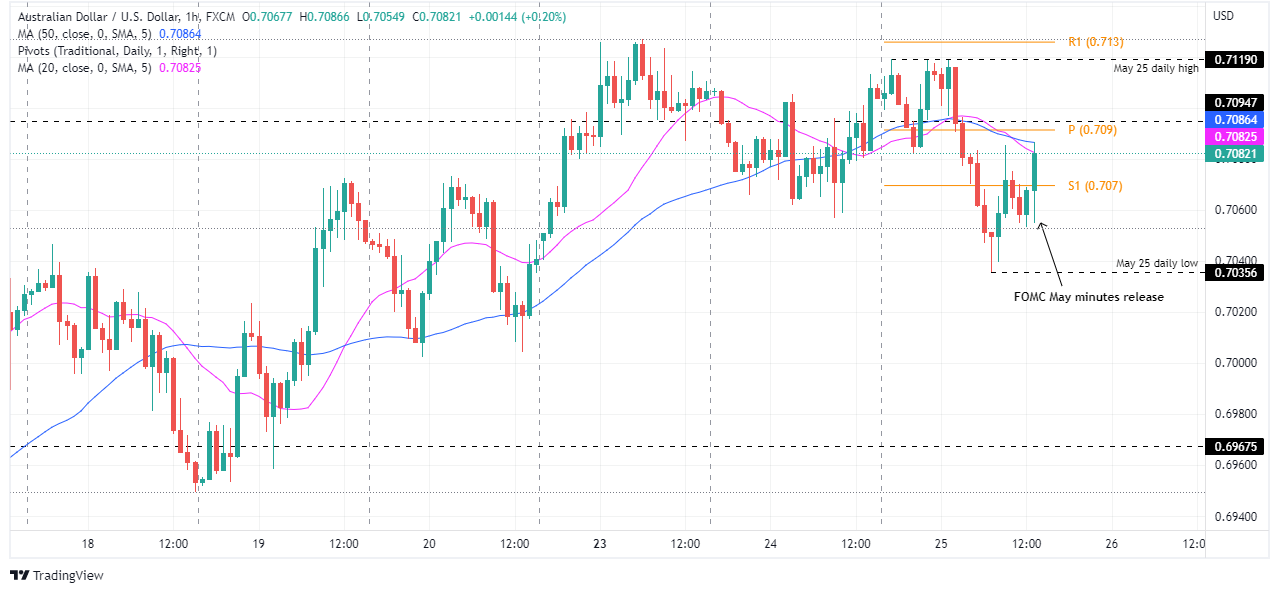
AUD/USD picks up bids to refresh intraday high around 0.7100, extending the previous day’s rebound from 0.7035, amid broad US dollar weakness. In doing so, the Aussie pair approaches the three-week top marked on Monday after witnessing a mildly downbeat performance in the last two days. It should be observed, though, that a light calendar and limited macro restrict the quote’s immediate moves during Thursday’s Asian session.

AUD/USD remained pressured during early Wednesday as a risk-aversion wave, mainly led by the headlines concerning the US-China tussles and geopolitical fears emanating from North Korea, as well as China’s covid conditions, underpinned the US dollar’s safe-haven demand. Hawkish comments from RBA Assistant Governor (Economic) Luci Ellis, however, couldn’t attract bids.

However, downbeat US data and FOMC Minutes raising possibilities of no frequent rate hikes seemed to have favored the AUD/USD buyers of late. As per the Minutes of the May 03-04 Fed meeting, policymakers endorsed the 50 basis points (bps) of rate hikes for the next couple of meetings. However, statements like, “it would be appropriate to consider sales of mortgage-backed securities,” seemed to have raised doubts about the rate increases past September, which in turn weighed on the US dollar after release.

Additionally drowning the greenback was the US Durable Goods Orders for April. As per the latest US Durable Goods Orders, the growth slowed down to 0.4% MoM versus market forecasts and revised down prior readings of 0.6%. Also, the Core Durable Goods Orders rose 0.3% MoM versus 0.6% expected and 1.1% prior (revised).

It should be noted that the hawkish ECBSpeak also contributed to the AUD/USD run-up, via firmer EUR and softer USD.

Against this backdrop, Wall Street closed on the positive side but the US 10-yer Treasury yields struggled to defend the bounce off the monthly low.

Moving on, Australia’s first quarter (Q1) 2022 Private Capital Expenditure, expected 1.5% versus 1.1% prior, will act as an immediate catalyst for AUD/USD traders. However, major attention will be given to the qualitative factors amid a lack of major data/events.

Technical analysis

A two-week-old ascending trend line restricts immediate AUD/USD downside around 0.7070 before the 21-DMA level surrounding 0.7040. Meanwhile, the recent swing high surrounding 0.7125-30 challenges the bulls.

It’s worth noting that the firmer MACD and steady RSI join the Aussie pair’s rebound from short-term key supports to keep buyers hopeful.


22:38
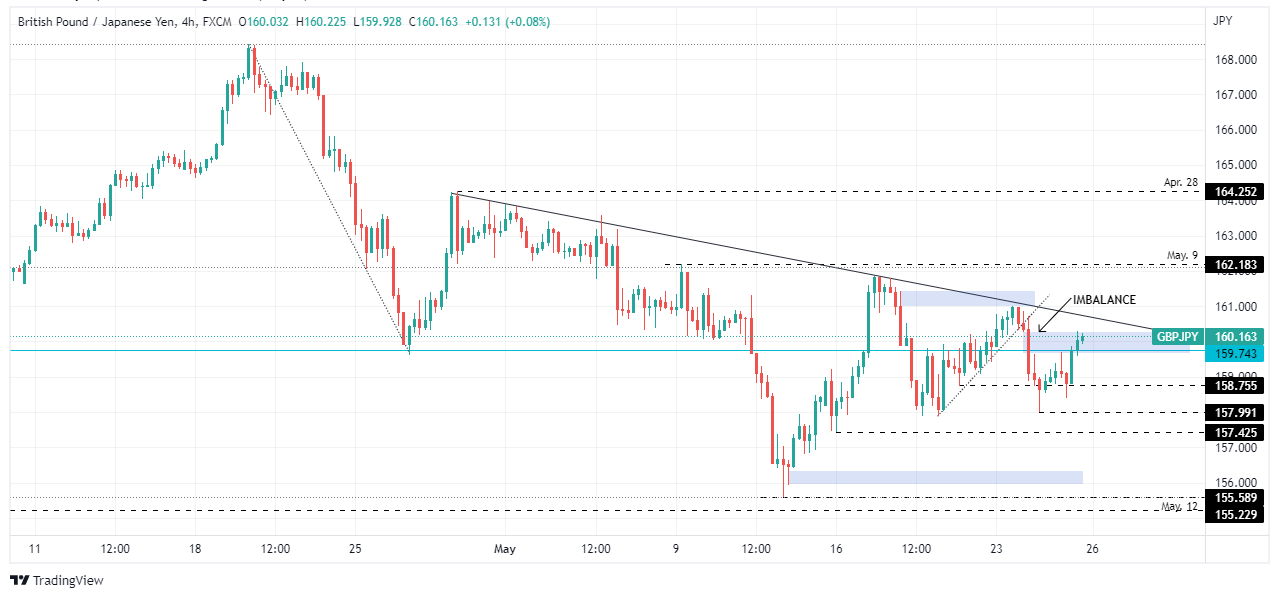
GBP/JPY Price Analysis: Range-bound, consolidates around the top of the 158.00-160.30 area
  • The GBP/JPY remains positive in the week, up some 0.28%.
  • Sentiment remains upbeat, as Asian stocks are poised to open higher.
  • GBP/JPY Price Forecast: In the short term is downward biased and would aim towards 157.99; otherwise, expect upward pressure and a test near 161.00.

The GBP/JPY recovered some ground on Wednesday as the New York session waned and the Asian session took over, courtesy of an upbeat sentiment after the US Federal Reserve released its May monetary policy meeting minutes. At 160.16, the GBP/JPY records minimal gains of 0.08%.

A risk-on market mood keeps global equities bid. In the FX space, safe-haven peers remain on the defensive as risk-sensitive currencies rise. At the same time, Asian equity futures are poised for higher open after the Fed’s minutes message coincided with Fed official’s expressions after the May meeting.

On Wednesday, the GBP/JPY began trading near the daily lows, around 159.00. However, during the European session dipped towards the 158.50 area, reaching a new daily low. Nevertheless, the GBP/JPY encountered bids around the area and rallied above 160.00, as risk sentiment prevailed positively.

GBP/JPY Price Forecast: Technical outlook

The GBP/JPY daily chart depicts the pair neutral-downward biased. At the time of writing, the cross-currency is trading above April’s 27 159.63 swing low, aiming to extend the rally that started on May 19 and capped on May 24. A GBP/JPY daily close above 160.00 would open the door toward the May 17 daily high at 161.85.

Meanwhile, the GBP/JPY is downward biased in the short term. The 4-hour chart depicts an imbalance zone which was mitigated in the last two candles, well within the blueish painted rectangle. The upward impulse would find solid resistance at the May 25 daily high at 160.30. If the previously-mentioned level gives way, a rally towards fresh highs is on the cards.

GBP/JPY failure at 160.30 would open the door for further losses. The GBP/JPY first support would be 160.00. A breach of the latter would expose the 158.39 swing low, followed by the May 24 daily low at 157.99.


22:32
WTI Price Analysis: Braces for volatility contraction on Symmetrical Triangle formation
  • A breakout of the Symmetrical Triangle will be followed by volatility expansion with volumes and wider ticks.
  • The RSI (14) is oscillating in a 40.00-60.00 range, which signals a consolidation ahead.
  • Advancing 50- and 200 EMAs add to the upside filters.

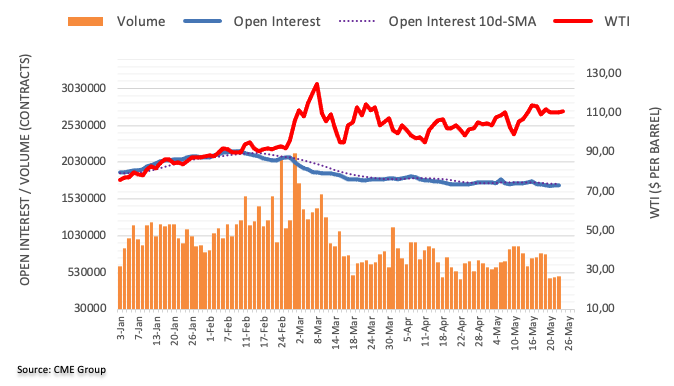
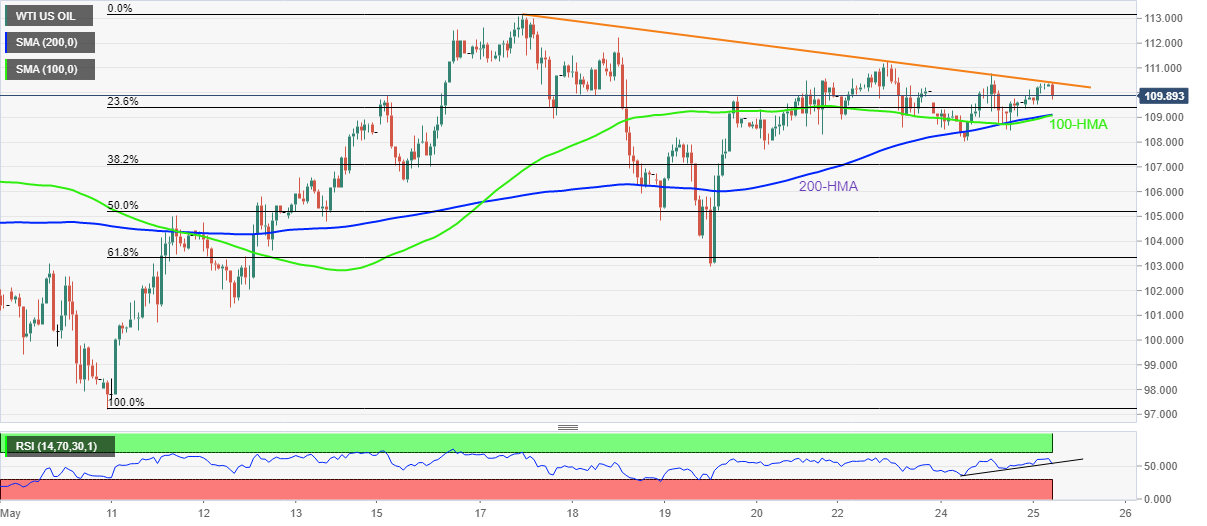
West Texas Intermediate (WTI), futures on NYMEX, is facing barricades near the round-level resistance of $110.00. On a broader note, the oil prices are trading in a wider range of $107.93-110.95 this week. A $3 range move this week is indicating a volatility squeeze in the counter.

On a four-hour scale, oil prices are auctioning in a two-month-long Symmetrical Triangle whose ascending trendline is placed from April 11 low at $92.65 while the downward sloping trendline is plotted from March 24 high at $115.87. Usually, a symmetrical triangle formation denotes volatility contraction, which results in its expansion, displayed by rising volume and wider ticks.

The 50- and 200-period Exponential Moving Averages (EMAs) at $108.92 and $105.58 respectively are scaling higher, which adds to the upside filters.

Meanwhile, the Relative Strength Index (RSI) (14) is oscillating in the 40.00-60.00 range, which signals a consolidation ahead.

A sheer upside move above May 17 high at $113.18 will bolster the oil bulls and may drive the asset towards March 24 high at $115.87, followed by March 7 closing price at $118.43.

Alternatively, bears could gain dominance if the asset drops below Tuesday’s low at $107.89. This may drag the black gold towards May 19 and May 11 low at $102.95 and $98.30 respectively.

WTI four-hour chart


22:30
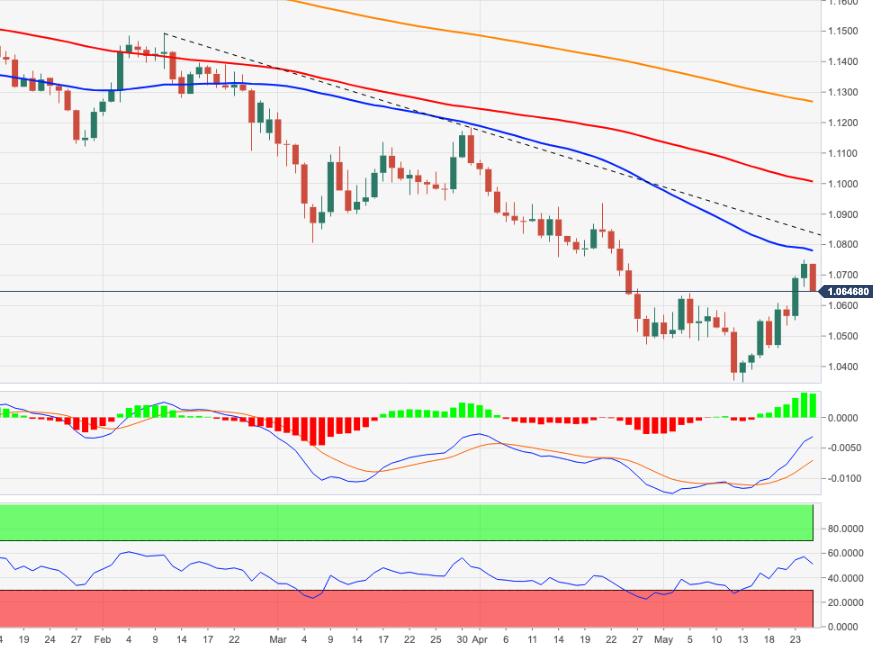
EUR/USD eyes to regain 1.0700 post-Fed Minutes, US GDP in focus EURUSD
  • EUR/USD reverses pullback from monthly low, edges higher of late.
  • Fed Minutes raised doubts on rate hikes after September, policymakers discussed 50 bps moves in next two meetings.
  • ECB policymakers remain hawkish despite downbeat FSR statement.
  • Second reading of Q1 2022 US GDP, Jobless Claims and housing data to decorate calendar amid multiple holidays in Europe.

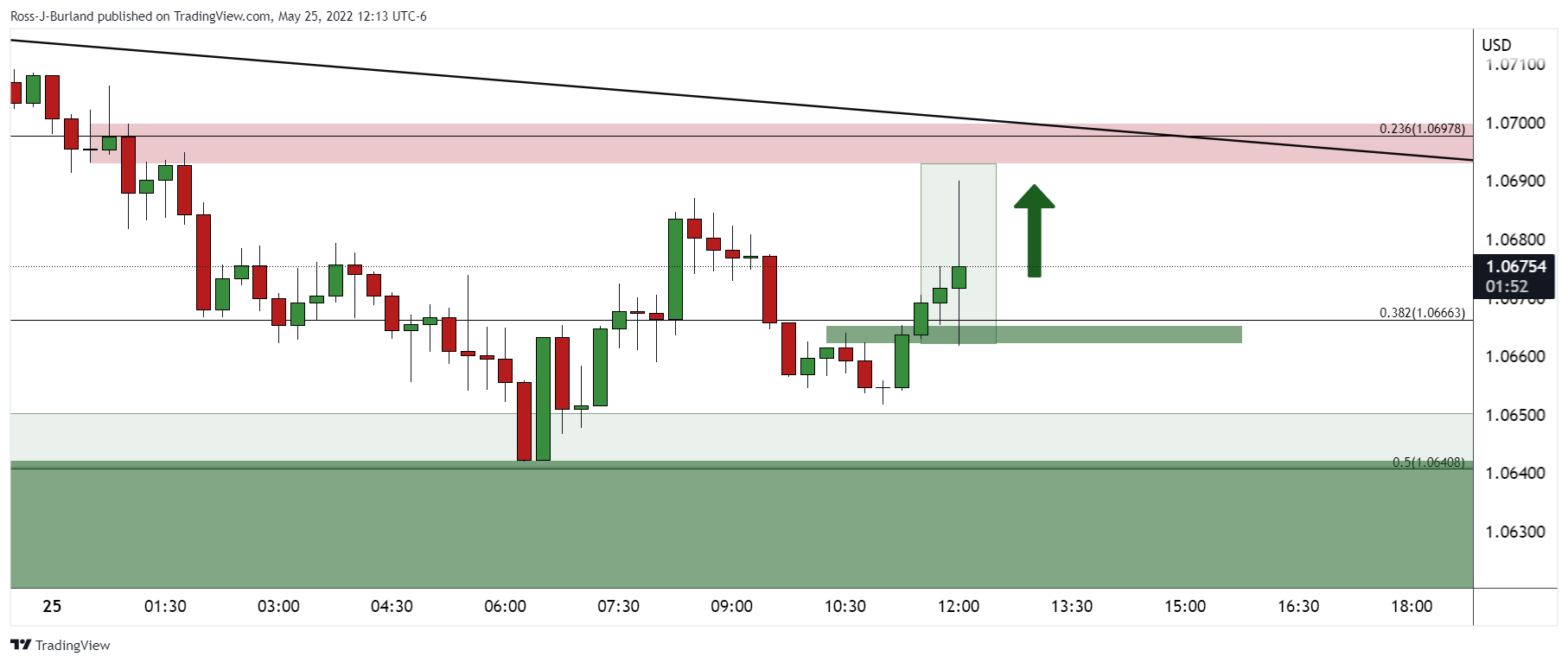
EUR/USD stays on the way to reverse the pullback from a monthly high, picking up bids to 1.0685 during early Thursday morning in Asia. That said, the US dollar’s failures to cheer the latest Federal Open Market Committee (FOMC) Minutes contradict the Euro’s ability to cheer hawkish ECBSpeak to recall the pair buyers.

As per the Minutes of the May 03-04 Fed meeting, policymakers endorsed the 50 basis points (bps) of rate hikes for the next couple of meetings. However, statements like, “it would be appropriate to consider sales of mortgage-backed securities,” seemed to have raised doubts about the rate increases past September, which in turn weighed on the US dollar after release.

Additionally drowning the greenback was the US Durable Goods Orders for April. As per the latest US Durable Goods Orders, the growth slowed down to 0.4% MoM versus market forecasts and revised down prior readings of 0.6%. Also, the Core Durable Goods Orders rose 0.3% MoM versus 0.6% expected and 1.1% prior (revised).

On the other hand, European Central Bank (ECB) policymakers were more hawkish and underpinned the bloc’s currency despite the economic fears raised by the region’s Financial Stability Review (FSR). That said, Governing Council member Klass Knot mentioned, “A 50 bps rate hike in July is not off the table, he continued, while the option of holding rates steady is off the table.” On the same line, ECB Chief Economist Philip Lane reiterated on Wednesday that it was appropriate to normalize the monetary policy, as reported by Reuters. It should be noted that the FSR warned about an abrupt increase in real interest rates suggesting it could induce corrections in the real estate market.

Amid these plays, Wall Street closed on the positive side but the US 10-yer Treasury yields struggled to defend the bounce off the monthly low.

Looking forward, holidays in Europe and a light calendar in Asia may restrict catalysts for the EUR/USD pair. However, preliminary readings of the US Q1 2022 GDP, Weekly US Jobless Claims and the Pending Home Sales for April, coupled with the Fedspeak, may entertain traders during the late Thursday. Furthermore, Sino-American tussles, the Russia-Ukraine crisis and covid headlines are extra factors to watch for clear directions.

Technical analysis

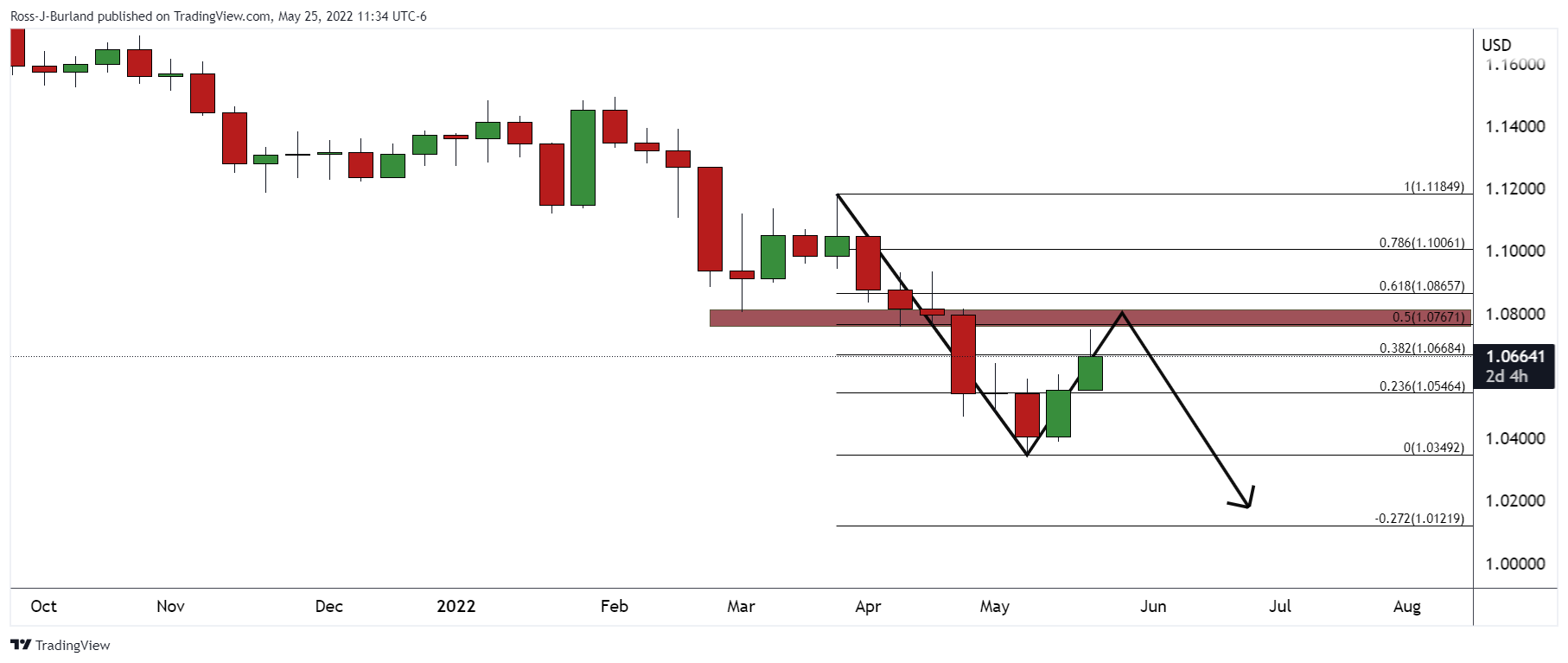
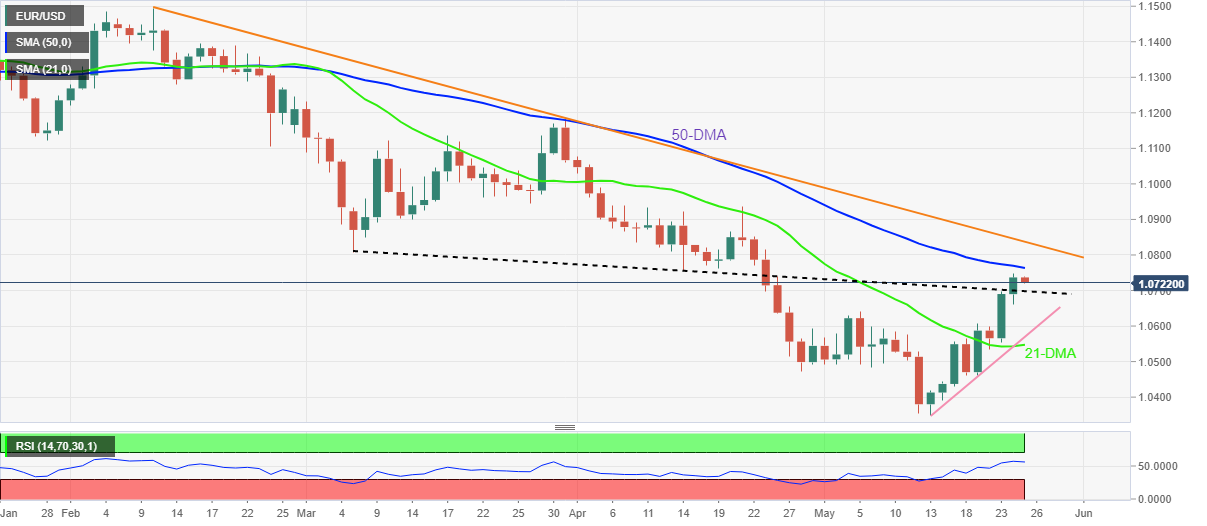
Despite the latest rebound, the EUR/USD pair needs to cross the immediate hurdle, namely the 50-day EMA level surrounding 1.0740, to convince buyers to attack a downward sloping trend line from early February, near 1.0830 by the press time.

Alternatively, the early-month top around 1.0640 and a two-week-old rising support line, close to 1.0600, restrict the major currency pair’s short-term upside.


21:56
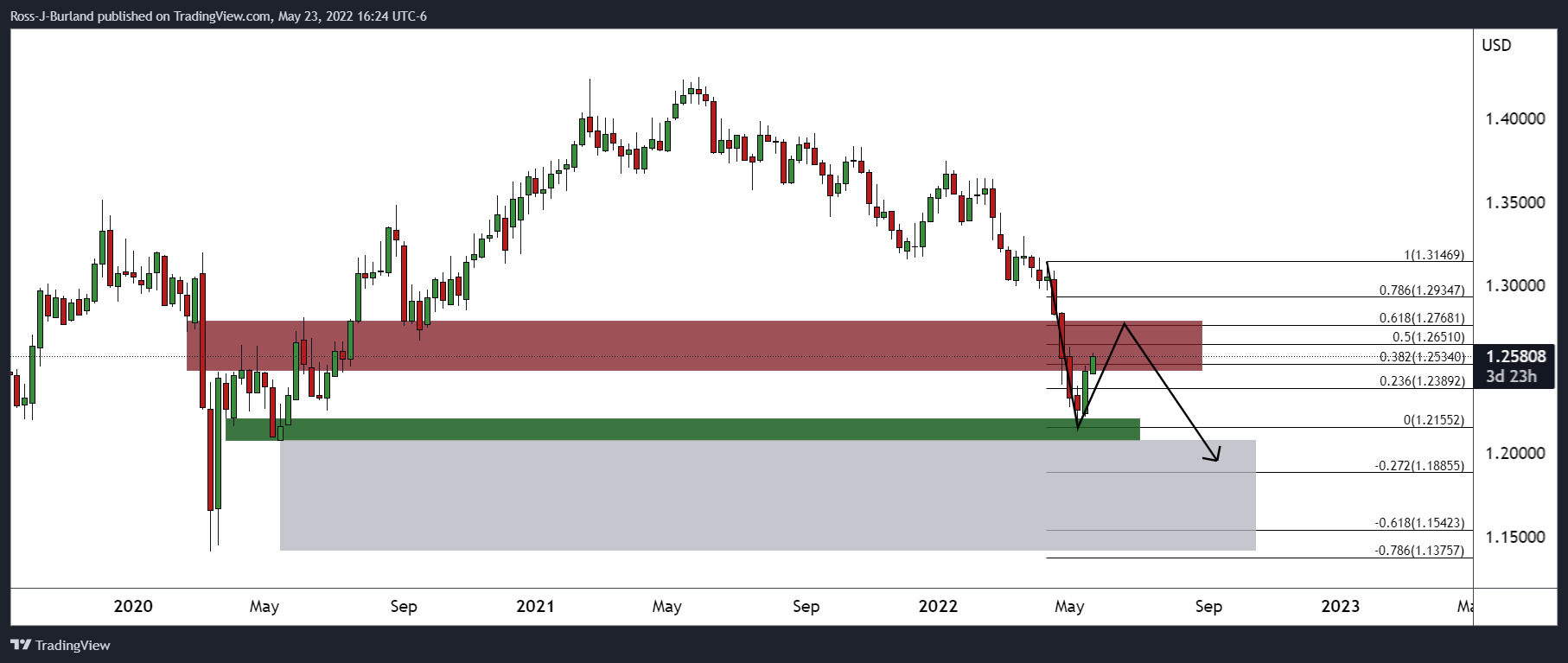
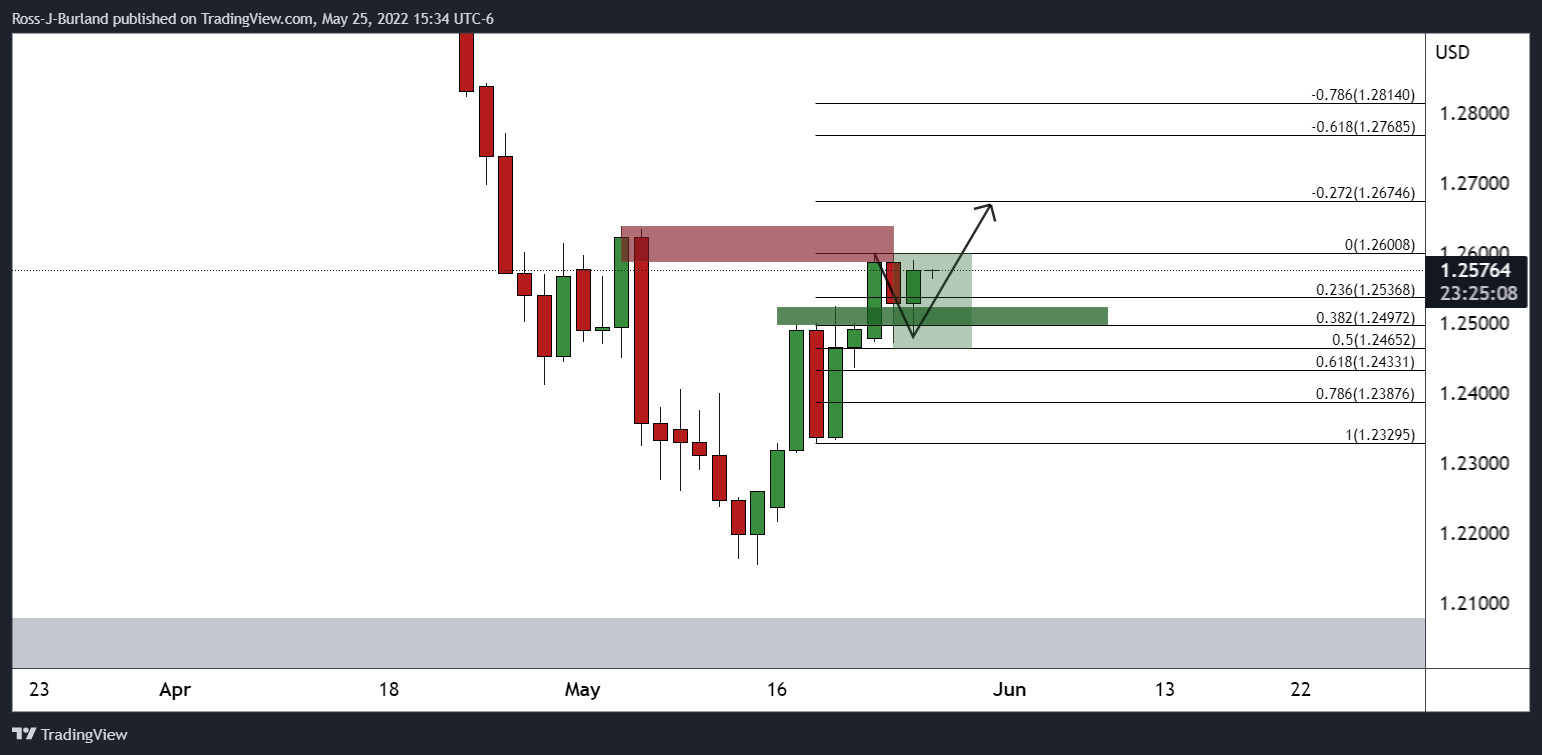
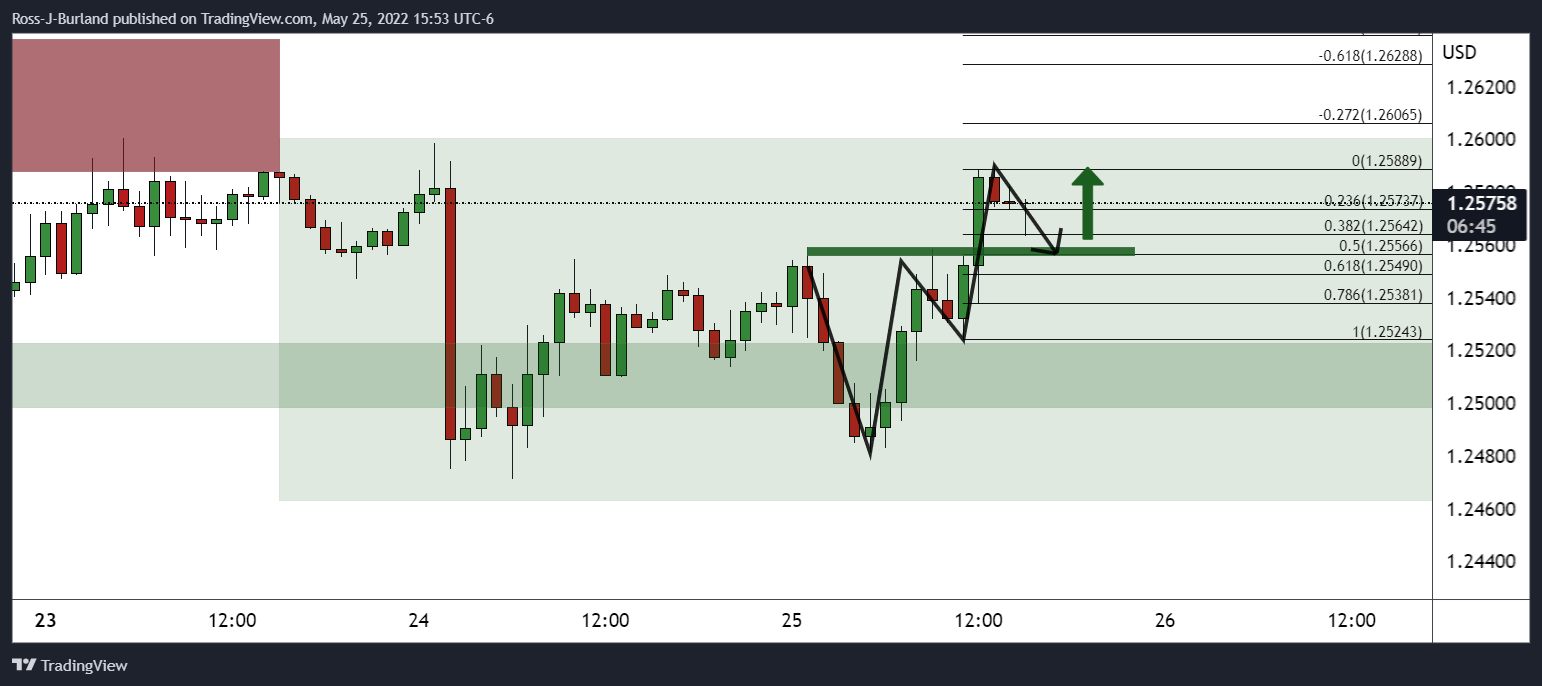
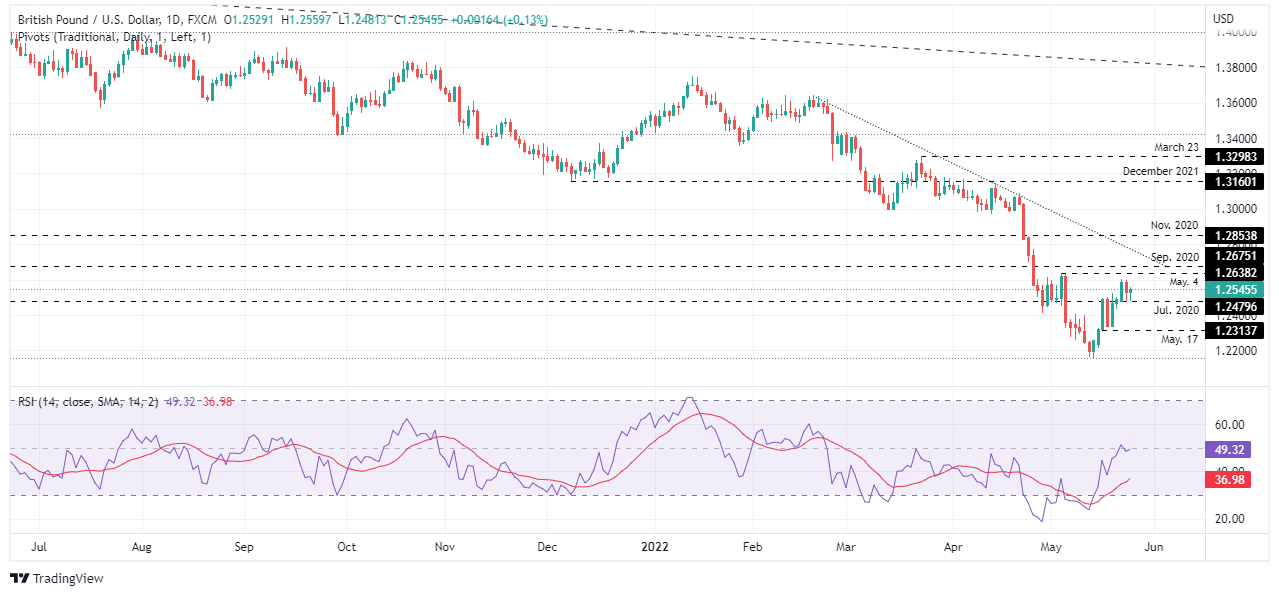
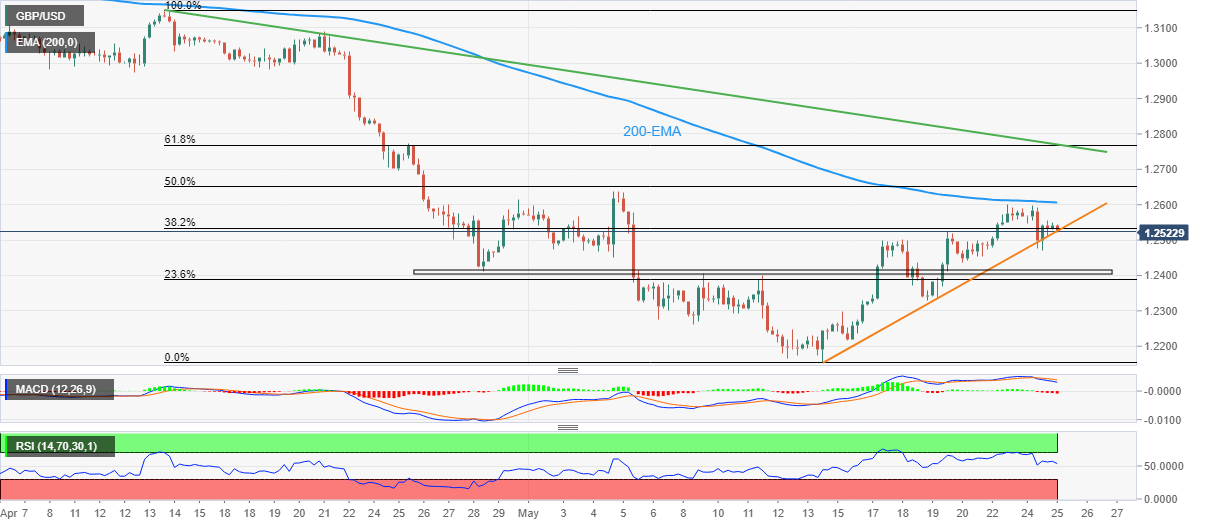
GBP/USD Price Analysis: Bulls seeking a discount from daily support structure GBPUSD
  • GBP/USD bulls waiting to move in at a discount. 
  • The price is on the verge of moving higher within the weekly corrective phase. 

GBP/USD is attempting to extend higher, as per the prior analysis, GBP/USD Price Analysis: Bulls pushing against a key level of resistance, 1.2650 eyed.

GBP/USD daily chart, prior analysis

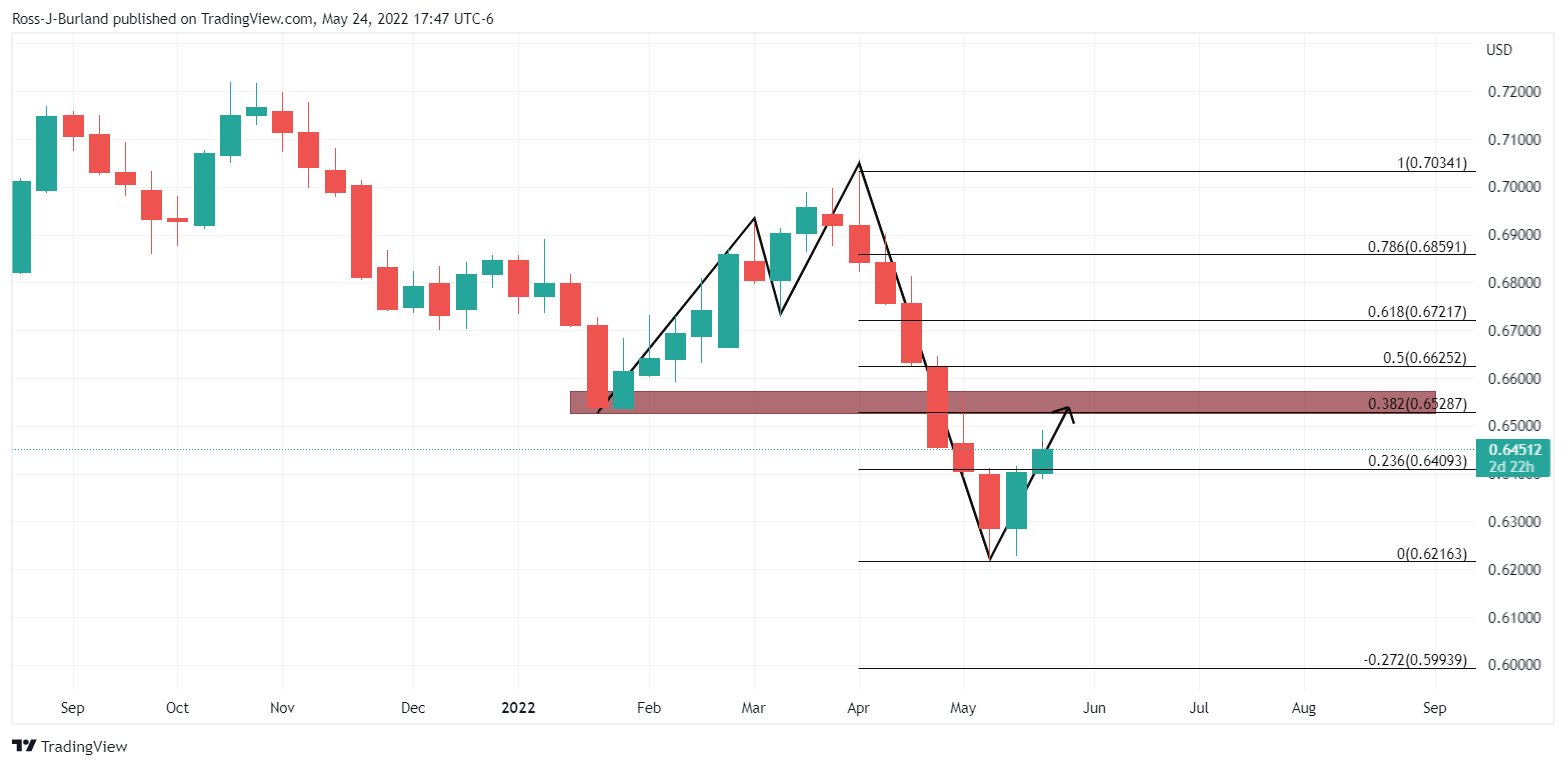
It was explained that ''the bulls have broken the first layer of resistance that would now be expected to act as a support on a retest. If the bulls commit, then a break of 1.2650 would expose the void of bids between there and the 1.30s.''

The outlook coincides with a bullish outlook on the weekly chart as the prior analysis illustrated as follows:

GBP/USD live market 

GBP/USD H1 chart

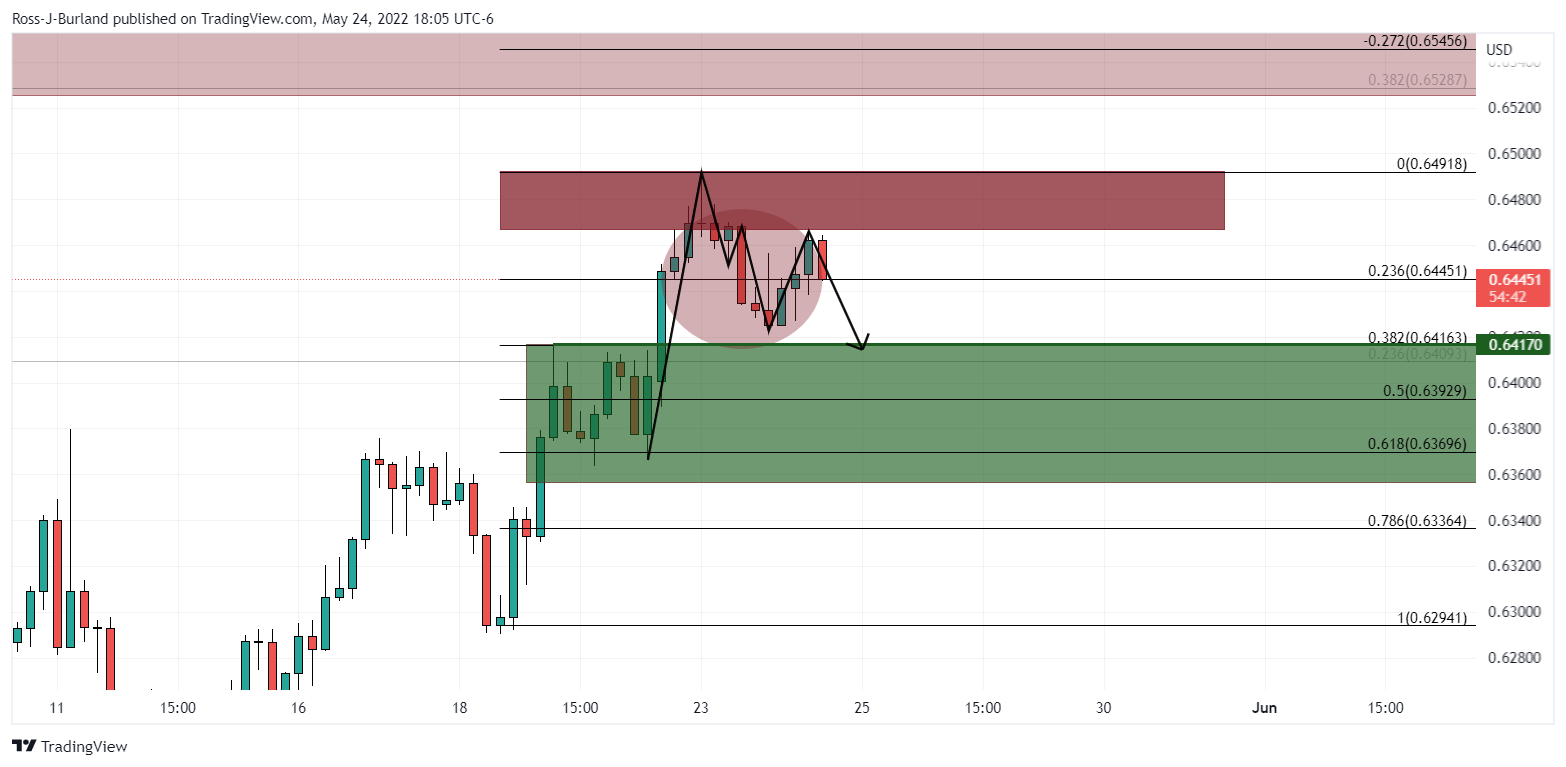
From an hourly perspective, the price is on the verge of a significant correction of bullish impulses. However, cheaper prices may only encourage more bulls to the table and ultimately result in a continuation to the upside in confluence with the bullish outlook on the higher time frames. 

21:50
AUD/JPY sees a cushion around 90.00 on a positive market mood
  • AUD/JPY is going through a minor correction but sees support around 90.00.
  • The RBA is expected to feature more rate hikes ahead.
  • Japan’s Unemployment Rate could deteriorate to 2.7%.

The AUD/JPY pair is witnessing a gradual decline after sensing resistance at around 90.40. A modest fall and a decent upside rally indicate a minor correction, which may find buyers near the psychological resistance of 90.00. A soaring market mood considering a firmer rebound in Wall Street is expected to underpin the risk-sensitive currencies in the Asian session.

The Reserve Bank of Australia (RBA) has just started its rate hike cycle to tackle the soaring inflation by elevating its Official Cash Rate (OCR) by 25 basis points (bps). Officially, their interest rates are at 35 bps and RBA policymakers have started betting on more rate hikes in the remaining year.

On Wednesday, RBA Assistant Governor (Economic) Luci Ellis bolstered the expectations of more rate hike announcements by the RBA in its upcoming monetary policy. His speech was roaming around the housing market, which is imbalanced on the demand-supply mechanism and is needed to be balanced through policy tightening.

On the Japanese yen front, a continuation of an ultra-loose monetary policy will keep the yen bulls on the edge. The Bank of Japan (BOJ) has failed to resort to pre-pandemic growth levels despite the uninterrupted quantitative easing. Therefore, a continuation of the deployment of stimulus packages is highly required. Going forward, investors’ focus will remain on employment data from the Statistics Bureau of Japan. The Unemployment Rate is expected to deteriorate to 2.7% against the prior print of 2.6%.


21:43
RBNZ Orr: Can't rule out a recession

Following yesterday's Reserve Bank of New Zealand's interest rate decisions, the governor, Adrian Orr, is crossing the wires and has said he can't rule out a recession but he doe not predict one. 

He said an increasing labour force will push the jobless rate up and that government spending is adding to aggregate demand at present.

A deeper dive into the RBNZ 

Analysts at ANZ Bank wrote a note with respect to the outcome of the Reserve Bank of New Zealand explaining that the RBNZ Monetary Policy Committee yesterday described themselves as “resolute” in their inflation fight, while acknowledging “strong” growth headwinds.

Key notes:

The 50bp rise was expected, but the OCR track reaching as high as 3.95% wasn’t, nor was its steepness, which implied further 50bp hikes in both July and August.

''There’s clearly been a big change of mood since April, when 'The Committee remained comfortable with the outlook for the OCR as outlined in … February.' It’s not entirely clear what the driver of that change has been, given inflation and labour data has actually come in much as the RBNZ expected.''

''Some of it will be due to the bigger-spending Budget (though in the press conference the Governor described the extra fiscal spending as small beer in the greater scheme of things); QES wage pressure also picked up markedly (not the RBNZ’s preferred measure, but the big upward revision to the RBNZ’s wage forecast was notable).''


20:24
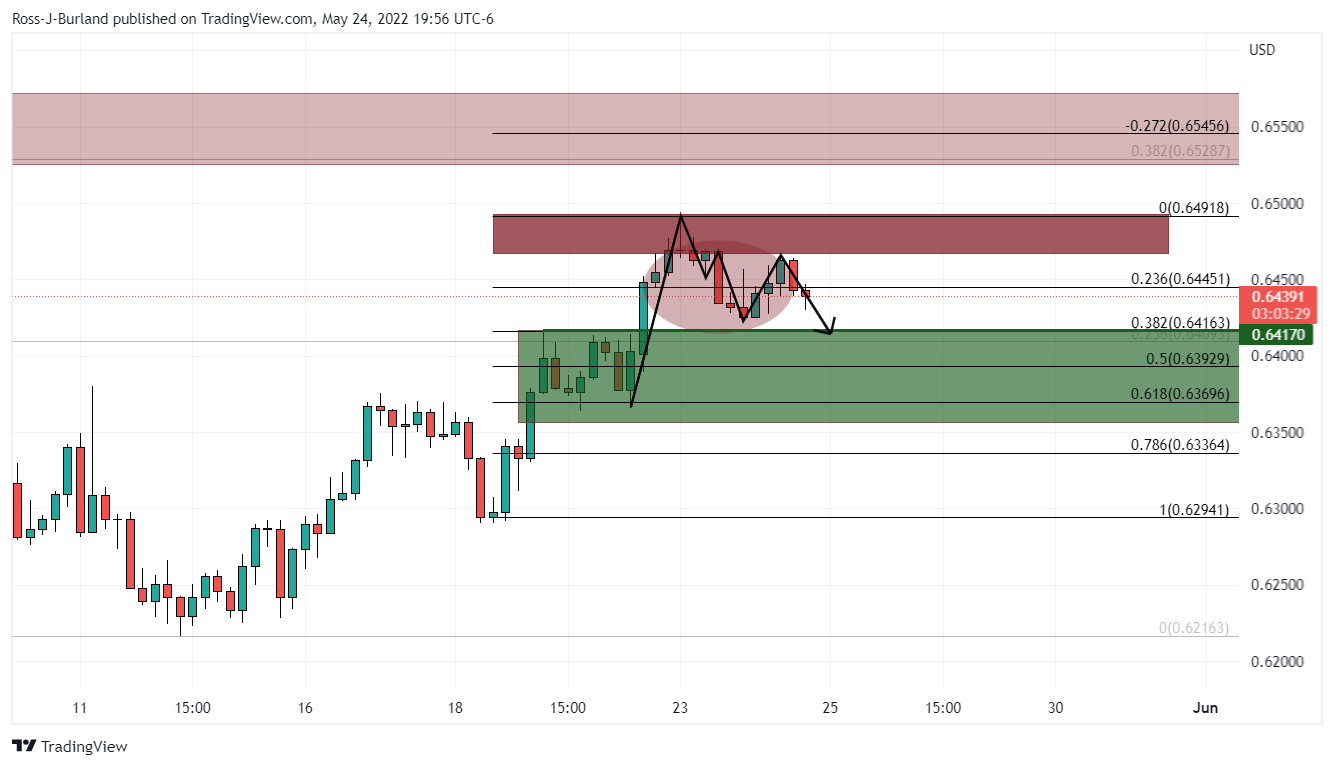
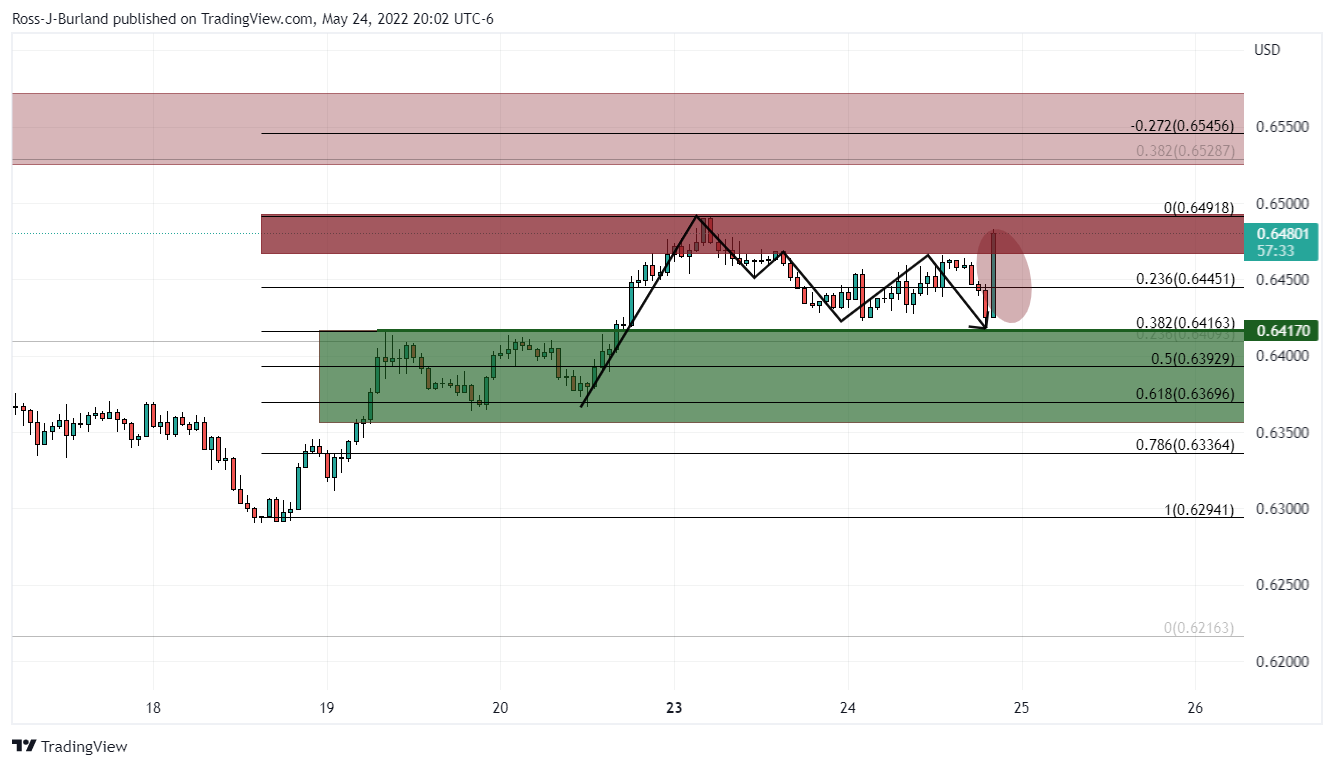
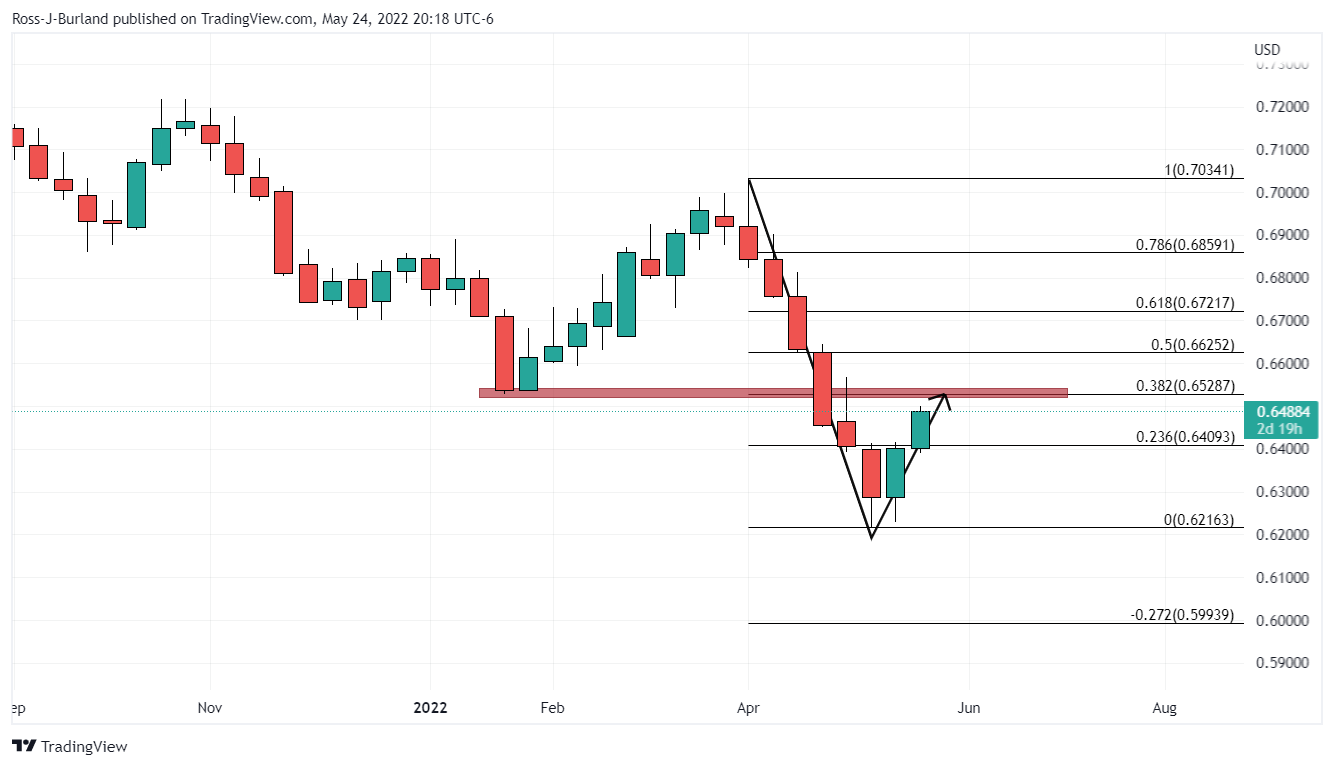
NZD/USD finds its bullish flight coordinates again NZDUSD
  • NZD/USD bulls were saved by softness in the US dollar again.
  • The Fed minutes failed to support the greenback and the kiwi resumed its bullish flight path. 

NZD/USD is ending in North American markets some 0.22% higher after recovering from the lows of 0.6417 to close around 0.6477. The bird fell from the post-Reserve Bank of New Zealand highs of 0.6514 as the US dollar found a bid ahead of the FOMC minutes.

The US dollar fought its way out of a two-day losing streak on Wednesday ahead of the release of the May meeting minutes, momentarily gaining a high of 102.449. Fed minutes largely endorsed the need for 50bp hikes in the near term, however, the minutes failed to mention prospects of larger rate hikes. That took some wind out of the US dollar's sails. Consequently, risk assets rallied, including the kiwi.

A deep dive into the RBNZ 

Analysts at ANZ Bank wrote a note with respect to the outcome of the Reserve Bank of New Zealand explaining that the RBNZ Monetary Policy Committee yesterday described themselves as “resolute” in their inflation fight, while acknowledging “strong” growth headwinds.

Key notes:

The 50bp rise was expected, but the OCR track reaching as high as 3.95% wasn’t, nor was its steepness, which implied further 50bp hikes in both July and August.

''There’s clearly been a big change of mood since April, when 'The Committee remained comfortable with the outlook for the OCR as outlined in … February.' It’s not entirely clear what the driver of that change has been, given inflation and labour data has actually come in much as the RBNZ expected.''

''Some of it will be due to the bigger-spending Budget (though in the press conference the Governor described the extra fiscal spending as small beer in the greater scheme of things); QES wage pressure also picked up markedly (not the RBNZ’s preferred measure, but the big upward revision to the RBNZ’s wage forecast was notable).''


19:58
USD/CAD struggles at weekly highs around 1.2870 and slips towards 1.2810 post-Fed minutes USDCAD
  • The USD/CAD retreats from weekly highs, extending its losses in the week to 0.18%.
  • Fed minutes confirmed that the June and July meetings would witness a 50 bps rate hike, each.
  • USD/CAD Price Forecast: In the short term is downward biased, and a break below 1.2713 would send the pair towards 1.2630.

The USD/CAD pares earlier gains and gains traction to the downside on Wednesday after the Federal Reserve’s Open Market Committee minutes showed that “all participants” agreed to 50 bps rate hikes in the June and July meetings while emphasizing that inflation has not peaked. At the time of writing, the USD/CAD is trading at 1.2816, down a minimal 0.04%.

On Wednesday, risk-appetite rules the markets. Global equities extended their gains, as reflected by US stock indexes gaining between 0.90% and 2.07%. In the meantime, the greenback stays positive but retraces from weekly highs, as the US Dollar Index record gains of 0.34%, sitting at 102.110.

FOMC Minutes confirmed Fed speaking rhetoric

Digging into the FOMC minutes, Fed officials agreed that the central bank needs to move “expeditiously” to a neutral posture and stated that a “restrictive” policy was appropriate. Most participants emphasized that they were “highly attentive” to inflation risks and added that those risks were skewed to the upside. Those officials reiterated that prices remained elevated and that it is “early” to be confident that inflation peaked.

Additionally, all Fed officials added that they agreed that the US economy was “very strong” and inflation “very high.” Moreover, FOMC members added that the Ukraine conflict and China’s lockdowns posed high risks and reiterated that restoring price stability would be challenging when the central bank scrambles to keep a solid labor market.

An absent Canadian docket would let USD/CAD traders adrift to US economic data. On the US front, the economic docket would feature Initial Jobless Claims and the Fed’s favorite gauge of inflation, the Personal Consumption Expenditure (PCE).

USD/CAD Price Forecast: Technical outlook

The USD/CAD is still upward biased, as depicted by the daily chart. However, on Wednesday, the 20-day moving average (DMA) at 1.2869 was a difficult resistance to break for USD/CAD buyers, as the exchange rate tumbled as high oil prices boosted the oil-linked currency, the Canadian dollar. If USD/CAD bears achieve a daily close below 1.2800, that will open the door for further downward pressure, and the major could aim towards 1.2600.

The 4-hour chart depicts the USD/CAD as neutral-downward biased in the short term. From a market structure perspective, USD/CAD bears need to break below the confluence of the May 23 swing low and the 200-SMA around the 1.2765-76 area. If that scenario plays out, that will send the pair towards the  1.2713 swing low; once cleared would expose the February 10 daily low at 1.2636.


19:57
Forex Today: Dollar hit by a not-that-aggressive Fed

 What you need to take care of on Thursday, May 26:

The greenback aimed to recover ground but pared its advance during US trading hours, ahead of the FOMC Meeting Minutes. The document showed that all members supported plans to reduce the balance sheet, while some added that, after the runoff was well underway, it would be appropriate to consider sales of mortgage-backed securities.

Also, all participants at the central bank’s May policy meeting agreed that a half-percentage-point interest rate hike was appropriate, while most judged such a hike would be appropriate at the next couple of meetings. Chances of a 0.50% rate increase in September have decreased sharply with the news, which in turn gave a late boost to Wall Street. Indexes posted substantial gains ahead of th