- Phân tích
- Tin tức và các công cụ
- Tin tức thị trường
Tin tức thì trường
USD/MXN fades the corrective bounce off the one-week low marked the previous day as it retreats to 16.87 amid the early hours of Friday’s Asian session. In doing so, the Mexican Peso (MXN) pair braces for the weekly loss while reversing the previous week’s corrective bounce off the lowest levels since December 2015.
It’s worth noting that the pair’s recovery on Thursday and the options market bias take clues from a strong rally in the US Dollar prices backed by the recent US data. However, the comparatively upbeat Mexican fundamentals favor the MXN.
That said, the one-month Risk Reversal (RR) of the USD/MXN pair, a measure of the spread between call and put prices, reverse the previous day’s downbeat print by posting the 0.027 figure by the end of Thursday’s North American trading session.
With this, the options market figures flag the hopes of witnessing a corrective bounce in the USD/MXN price as the weekly RR braces for the second consecutive positive print with the latest number being 0.080.
However, the US Core Personal Consumption Expenditure (PCE) Price Index for June, expected 4.2% YoY versus 4.6% prior, also known as the Fed’s preferred inflation gauge, is scheduled for publishing on Friday and can offer a volatile day and move the USD/MXN pair.
Also read: USD/MXN Price Analysis: Bears have the upper hand near 200-hour SMA/61.8% Fibo. confluence
Early Friday morning in Asia, the Statistics Bureau of Japan released monthly prints of the Tokyo Consumer Price Index for July.
That said, the headline Tokyo CPI improves to 3.2% YoY from 3.1% prior, versus 2.8% market forecasts, whereas the Tokyo CPI ex Fresh Food, Energy rises to 4.0% from 3.8% previous readings. More importantly, Tokyo CPI ex Fresh Food eases from 3.2% to 3.0% for the said month compared to analysts’ estimations of 2.9%.
USD/JPY drops back to 139.00
Following the upbeat Japan inflation clues, USD/JPY recollects the previous day’s chatters about the Bank of Japan’s likely edit to the +/- 0.50% limit of the 10-year Japanese Government Bond (JGB) yields ahead of Japan inflation data and the BoJ monetary policy announcements. With this, the Yen pair retreats to 139.00 by marking an initial fall of 25 pips on the data.
Also read: USD/JPY Price Analysis: Bears occupy driver’s seat near 139.00 amid talks of BoJ’s YCC tweak
- EUR/USD stays defensive at three-week low after posting the biggest daily loss since March 15.
- ECB announces 0.25% rate hike, as expected, but absence of clear forward guidance and chance in statement prod Euro bears.
- Strong US Q2 GDP Annualized growth bolsters US Dollar strength ahead of Fed’s favorite inflation gauge.
- Preliminary German Q2 GDP and inflation data for July eyed ahead of US Core PCE Price Index for June.
EUR/USD seesaws around 1.0980-70 during the early hours of Friday’s Asian session while licking its wounds after declining the most in 4.5 months the previous day. In doing so, the Euro pair portrays the market’s cautious mood ahead of the top-tier data from Germany and the US at the lowest level in three weeks.
On Thursday, the European Central Bank (ECB) matches market forecasts by announcing 25 basis points (bps) increase in the benchmark rates. That said, the policy statement showed the board is “open-minded” about further tightening.
However, the ECB statement dumped reference to the need to bring the rates to a level that cuts inflation quickly enough and gained the attention of the Euro bears, especially when backed by ECB President Christine Lagarde’s comments stating, “The wording change in the statement was not random or irrelevant.”
On the same line, ECB’s Lagarde also signaled the nearness to the end of the inflation battle by suggesting smaller grounds to cover while also showing data-dependency of the next rate decision as well.
Elsewhere, the preliminary readings of the US Gross Domestic Product (GDP) Annualized for the second quarter (Q2) improved to 2.4% from 2.0% prior, versus 1.8% market forecast. On the same line, the US Durable Goods Orders also jumps 4.7% for June compared to 1.0% expected and 1.8% expected (revised). Additionally, Initial Jobless Claims declines to 221K for the week ended on July 21 versus 235K prior and analysts’ estimations of 228K. It should be observed that the US Pending Home Sales for June also improved to 0.3% MoM versus -0.5% expected and -2.5% prior (revised).
However, the first estimations of the US Q2 Core Personal Consumption Expenditure eases to 3.8% QoQ from 4.9% prior and 4.0% market forecasts whereas GDP Price Index edges lower to 2.6% from 4.1% previous readings and 3.0% expected.
Against this backdrop, US Dollar Index (DXY) posted the biggest daily jump since March 15 the previous day, not to forget mentioning a stellar rebound from the weekly low, as the US statistics recall the Fed hawks and bolstered the Treasury bond yields. It’s worth noting that the Wall Street benchmarks closed with nearly half a percent of daily losses whereas the benchmark US 10-year Treasury bond yields marked the biggest daily jump in a month to refresh a three-week high near 4.02%, close to 4.0% by the press time.
Looking ahead, the preliminary readings of Germany’s Q2 GDP and Consumer Price Index , as well as Harmonized Index of Consumer Prices (HICP), for July will be crucial to watch for immediate directions amid looming concerns of the bloc’s recession. Following that, the Fed’s favorite inflation gauge, namely the Core Personal Consumption Expenditure (PCE) Price Index for June, expected 4.2% YoY versus 4.6% prior, could direct the EUR/USD moves as traders seek clues to confirm the September rate hike.
Technical analysis
Despite Thursday’s heavy slump, the 50-day Exponential Moving Average (EMA) and a two-month-old rising support line, respectively near 1.0970 and 1.0955, restrict the EUR/USD pair’s further downside. The recovery moves, however, remain elusive unless providing a clear upside break of a five-week-old horizontal resistance surrounding 1.1010-20.
- NZD/USD loses momentum and currently trades around 0.6188, gaining 0.1% for the day.
- The US GDP expanded 2.4% in the second quarter, beating expectations of 1.8% and 2.0% prior.
- Market players will monitor the US Core Personal Consumption Expenditure (PCE) index.
The NZD/USD pair loses its traction and holds below the 0.6200 area in the early Asian session after retreating from a weekly high of 0.6275. The US dollar Index (DXY), a measure of the value of the Greenback against six other major currencies, jumps to its highest level since July 11, near 101.70, as upbeat US economic figures boosts the Greenback on Friday.
As widely expected, the Federal Reserve (Fed) raised interest rates by 25 basis points (bps) to 5.25%–5.5% on Wednesday. The rate was last seen just before the housing market collapse in 2007 and marked the highest level in more than 22 years.
On Thursday, the US Bureau of Economic Analysis (BEA) first estimate reported that the US real Gross Domestic Product(GDP) expanded at a 2.4% annualized rate, beating the market expectation of 1.8% and following the 2% growth reported in the first quarter. Meanwhile, Durable Goods Orders rose 4.7% on a monthly basis to $302.5 billion. Initial Jobless Claims declined by 7,000 to 221,000 in the week ending July 22. It is the lowest reading in five months.
Due to the lack of significant data released from the New Zealand docket this week, it is difficult for the Kiwi to construct a bullish narrative, and the offshore events will be in the spotlight. However, the market expects a more hawkish stance from the Reserve Bank of New Zealand (RBNZ), which might raise the risk of a hard landing. This, in turn, could weigh on the Kiwi and act as a headwind for NZD/USD.
Looking ahead, the USD's valuation will likely continue to influence the pair's movement later in the day. Market participants will keep an eye on the US Core Personal Consumption Expenditure (PCE) index, the Fed's preferred inflation gauge. The figure is expected to drop from 4.6% to 4.2% annually.
- Gold Price licks its wounds after falling the most in eight weeks amid firmer US Dollar.
- US Dollar bulls cheer upbeat prints of United States Q2 GDP Annualized, dovish ECB hike.
- Firmer US Core PCE Price Index can weigh on XAU/USD as Fed showed readiness for September rate hike if needed.
Gold Price (XAU/USD) steadies around the mid-$1,900s amid the early hours of Friday’s Asian session, after posting the biggest daily slump in two months the previous day. In doing so, the XAU/USD portrays the market’s consolidation ahead of the top-tier US data following a whippy day that initially propelled the Gold Price towards the weekly top on the softer US Dollar and risk-on mood before drowning it on the strong United States data and firmer Treasury bond yields.
Gold Price drops as US Dollar rises on firmer United States data, ECB moves
Gold Price aptly justified the word “turnaround Thursday” as it initially rose to the highest levels in a week while poking a 2.5-month-old horizontal resistance before breaking a multi-day-old support line. It’s worth noting that the XAU/USD remains defensive around the 21-DMA level near $1,945 by the press time.
That said, the market’s easing fears of the Federal Reserve’s (Fed) rate hike and upbeat China Industrial Profits, as well as hopes of more stimulus from Beijing, fuelled the Gold Price to refresh the weekly top. However, strong prints of the United States data and upbeat yields drowned the XAU/USD afterward. On the same line could be the dovish hike of the European Central Bank (ECB) and the cautious mood ahead of the Fed’s preferred inflation data.
On Thursday, the preliminary readings of the US Gross Domestic Product (GDP) Annualized for the second quarter (Q2) improved to 2.4% from 2.0% prior, versus 1.8% market forecast. On the same line, the US Durable Goods Orders also jumps 4.7% for June compared to 1.0% expected and 1.8% expected (revised). Additionally, Initial Jobless Claims declines to 221K for the week ended on July 21 versus 235K prior and analysts’ estimations of 228K. It should be observed that the US Pending Home Sales for June also improved to 0.3% MoM versus -0.5% expected and -2.5% prior (revised).
However, the first estimations of the US Q2 Core Personal Consumption Expenditure eases to 3.8% QoQ from 4.9% prior and 4.0% market forecasts whereas GDP Price Index edges lower to 2.6% from 4.1% previous readings and 3.0% expected.
That said, the European Central Bank (ECB) matches market forecasts by announcing 25 basis points (bps) increase in the benchmark rates. That said, the policy statement showed the board is “open-minded” about further tightening. However, the statement dumped reference to the need to bring the rates to a level that cuts inflation quickly enough and gained the attention of the Euro bears, especially when backed by ECB President Christine Lagarde’s comments stating, “The wording change in the statement was not random or irrelevant.” On the same line, ECB’s Lagarde also signaled the nearness to the end of the inflation battle by suggesting smaller grounds to cover while also showing data-dependency of the next rate decision as well. It’s worth noting that the Euro’s slump strengthens the US Dollar and weighs on the Gold Price.
Amid these plays, US Dollar Index (DXY) posted the biggest daily jump since March 15 the previous day, not to forget mentioning a stellar rebound from the weekly low, as the US statistics recall the Fed hawks and bolstered the Treasury bond yields. It’s worth noting that the Wall Street benchmarks closed with nearly half a percent of daily losses whereas the benchmark US 10-year Treasury bond yields marked the biggest daily jump in a month to refresh a three-week high near 4.02%, close to 4.0% by the press time.
Looking ahead, the risk catalysts may entertain the Gold traders ahead of the Fed’s favorite inflation gauge, namely the Core Personal Consumption Expenditure (PCE) Price Index for June, expected 4.2% YoY versus 4.6% prior, will be crucial to watch for clear directions.
Also read: PCE Inflation Preview: Price pressures set to fade in Fed favorite figures, US Dollar to follow suit
Gold Price Technical Analysis
Gold Price justifies multiple failures to cross the 10-week-old horizontal resistance, as well as the downside break of an upward-sloping support line from late June, while welcoming the bears after their three-week vacation.
Also favoring the XAU/USD sellers is the looming bear cross on the Moving Average Convergence and Divergence (MACD) indicator, as well as the Relative Strength Index (RSI) line’s pullback.
It’s worth noting, however, that a sustained downside break of the 21-DMA support surrounding $1,945 becomes necessary for the Gold bears to keep the reins. Even so, a slew of peaks and troughs marked since mid-June around $1,930-25 can test the XAU/USD sellers before directing them to the yearly low registered the last month around $1,893.
On the flip side, a daily closing beyond the support-turned-resistance line of around $1,955 may allow the Gold Price to pare weekly loss, if backed by the aforementioned United States inflation clues.
However, the 38.2% Fibonacci retracement level of the metal’s May-June downside and the previously stated 2.5-month-old horizontal resistance, respectively near $1,965 and $1,985, will challenge the Gold buyers before giving them control.
Overall, the Gold Price is likely to witness further downside but the road towards the south is long and bumpy.
Gold Price: Daily chart
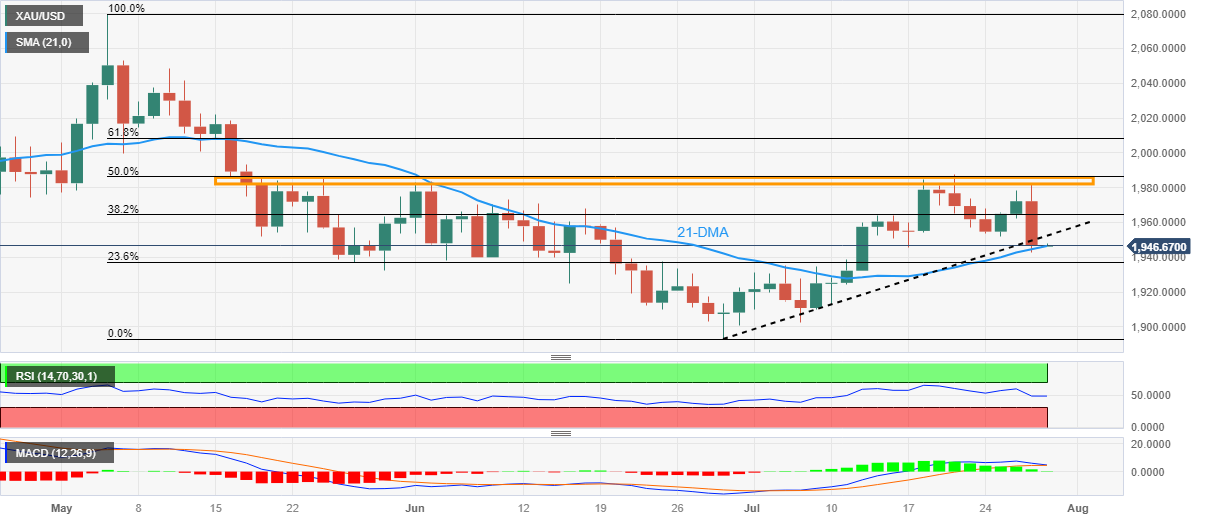
Trend: Further downside expected
- USD/JPY remains pressured at the lowest level in a week, prints five-day downtrend ahead of Japan inflation, BoJ.
- Chatters that BoJ will drop its 0.5% limit on the 10-year JGB bolstered Yen during late Thursday.
- Bears approach yearly horizontal support within rising trend channel established since December 2022, recovery remains elusive below May’s peak.
- Bearish MACD signals, downside break of 50% Fibonacci retracement keep Yen pair sellers hopeful.
USD/JPY bears flirt with the 139.00 round figure during a five-day losing streak ahead of Friday’s Tokyo open. In doing so, the Yen pair justifies the latest chatters surrounding the Bank of Japan’s (BoJ) likely edit to the +/- 0.50% limit of the 10-year Japanese Government Bond (JGB) yields ahead of Japan inflation data and the BoJ monetary policy announcements.
Also read: Breaking: USD/JPY bears firm on a strong hint that BoJ will drop 0.5% cap in 10Y JGB yields
Technically, the bearish MACD signals join the Yen pair’s downside break of the 50% Fibonacci retracement level of October 2022 to January 2023 fall, near 139.60 by the press time, to favor the USD/JPY sellers.
With this, the Yen pair appears well set to prod the horizontal area comprising multiple levels marked since December 2022, close to 138.00-137.80.
Following that, a convergence of the 200-DMA and 38.2% Fibonacci retracement, close to 136.70, will precede the bottom line of a seven-month-old rising channel surrounding 135.60, to limit the USD/JPY downside.
On the contrary, a 50% Fibonacci retracement level of 139.60 and the 140.00 round figure may initially restrict the USD/JPY recovery ahead of directing the bulls to May’s high of near 140.95, quickly followed by the 141.00 round figure.
It’s worth noting, however, that the Yen pair buyers will remain confused unless witnessing a clear upside break of the 61.8% Fibonacci retracement level of 142.52, backed by the dovish BoJ stand.
USD/JPY: Daily chart
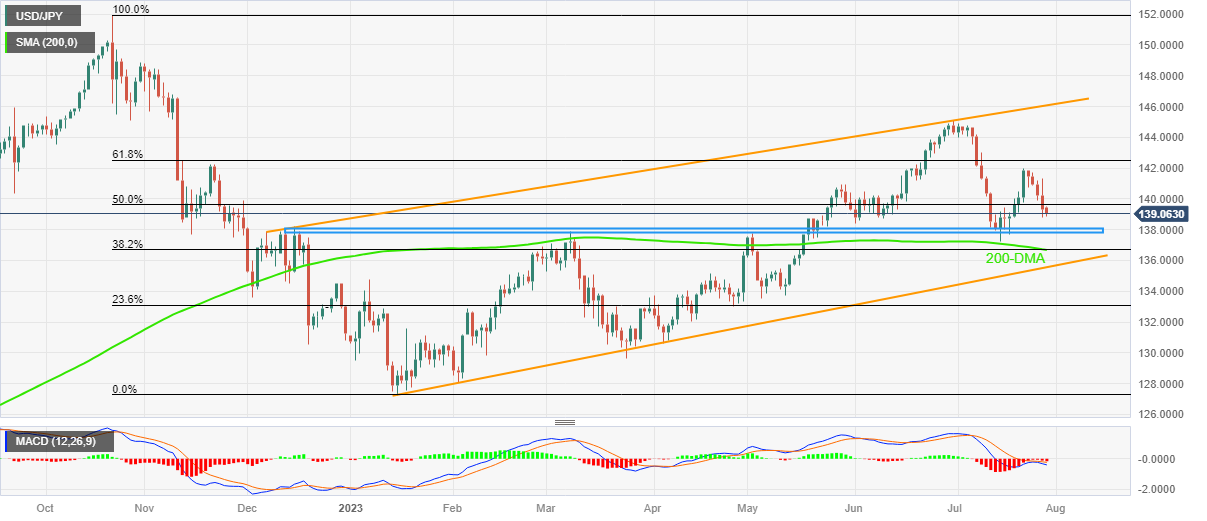
Trend: Limited downside expected
- AUD/USD licks its wounds at 13-day low after a volatile day that ended on a negative side with heavy losses.
- Aussie pair initially cheered Fed-inspired US Dollar weakness and China backed risk-on mood before slumping on US GDP-led greenback rally.
- Australia’s Q2 PPI, Retail Sales for June may entertain Aussie pair traders ahead of US Core PCE Price Index for June.
- Recently firmer US data renew hawkish Fed bets and can offer more US Dollar strength on upbeat inflation clues.
AUD/USD bears attack two-month-old support amid early hours of Friday’s Asian session after a volatile day for the pair that initially refreshed the weekly high before closing with the biggest daily loss in a week to around 0.6700. That said, the quote currently portrays pre-data anxiety following a whippy day that ran from firmer sentiment and softer US dollars to a jump in the greenback and mixed mood.
AUD/USD initially cheered the market’s easing fears of the Federal Reserve’s (Fed) rate hike and upbeat China Industrial Profits, as well as hopes of more stimulus from Beijing, to refresh the weekly top before the US GDP-led slump. Also weighing on the Aussie pair could be the cautious mood ahead of today’s top-tier Aussie and the US data.
US Dollar Index (DXY) posted the biggest daily jump since March 15 the previous day, not to forget mentioning a stellar rebound from the weekly low, as the US statistics recall the Fed hawks and bolstered the Treasury bond yields. It’s worth noting that the Wall Street benchmarks closed with nearly half a percent of daily losses whereas the benchmark US 10-year Treasury bond yields marked the biggest daily jump in a month to refresh a three-week high near 4.02%, close to 4.0% by the press time.
That said, the preliminary readings of the US Gross Domestic Product (GDP) Annualized for the second quarter (Q2) improved to 2.4% from 2.0% prior, versus 1.8% market forecast. On the same line, the US Durable Goods Orders also jumps 4.7% for June compared to 1.0% expected and 1.8% expected (revised). Additionally, Initial Jobless Claims declines to 221K for the week ended on July 21 versus 235K prior and analysts’ estimations of 228K. It should be observed that the US Pending Home Sales for June also improved to 0.3% MoM versus -0.5% expected and -2.5% prior (revised).
However, the first estimations of the US Q2 Core Personal Consumption Expenditure eases to 3.8% QoQ from 4.9% prior and 4.0% market forecasts whereas GDP Price Index edges lower to 2.6% from 4.1% previous readings and 3.0% expected.
At home, Australia’s Export Price Index slumped to -8.5% QoQ while the Import Price Index improved to -0.8% QoQ versus 1.6% and -4.2% respective priors. That said, China's Industrial Profits for the January-June period improve to -16.8% compared to the -18.8% figure marked for the first five months of the year 2023, per China’s National Bureau of Statistics (NBS) data.
Looking ahead, AUD/USD pair traders may witness a lackluster day as top-tier data/events are scheduled for publishing in Asia, as well as in the US session. That said, Australia’s Q2 Producer Price Index, expected to ease to 3.9% YoY from 5.2% prior, will precede the Aussie Retail Sales for June, bearing downbeat forecasts of 0.0% MoM versus 0.7% prior, to entertain traders in Asia. Following that, the Fed’s favorite inflation gauge, namely the Core Personal Consumption Expenditure (PCE) Price Index for June, expected 4.2% YoY versus 4.6% prior, will be crucial to watch for clear directions.
Technical analysis
AUD/USD clings to a two-month-old rising support line surrounding 0.6700 after providing the first daily closing beneath the 200-SMA, around 0.6730 by the press time, in more than two weeks.
- GBP/USD bulls are under pressure following a rally in the Greenback.
- The bears are testing commitments at critical technical structures on the daily chart.
GBP/USD followed EUR/USD lower on strong US data and the European Central Babk's dovish 25bp hike. The pair dropped from 1.2995 to a low of 1.2781 while the markets reduce more hawkish Bank of England rate expectations for the August 3 interest rate meeting. This leaves the technical structure complicated and two-fold for Cable as the following illustrates:
GBP/USD technical analysis
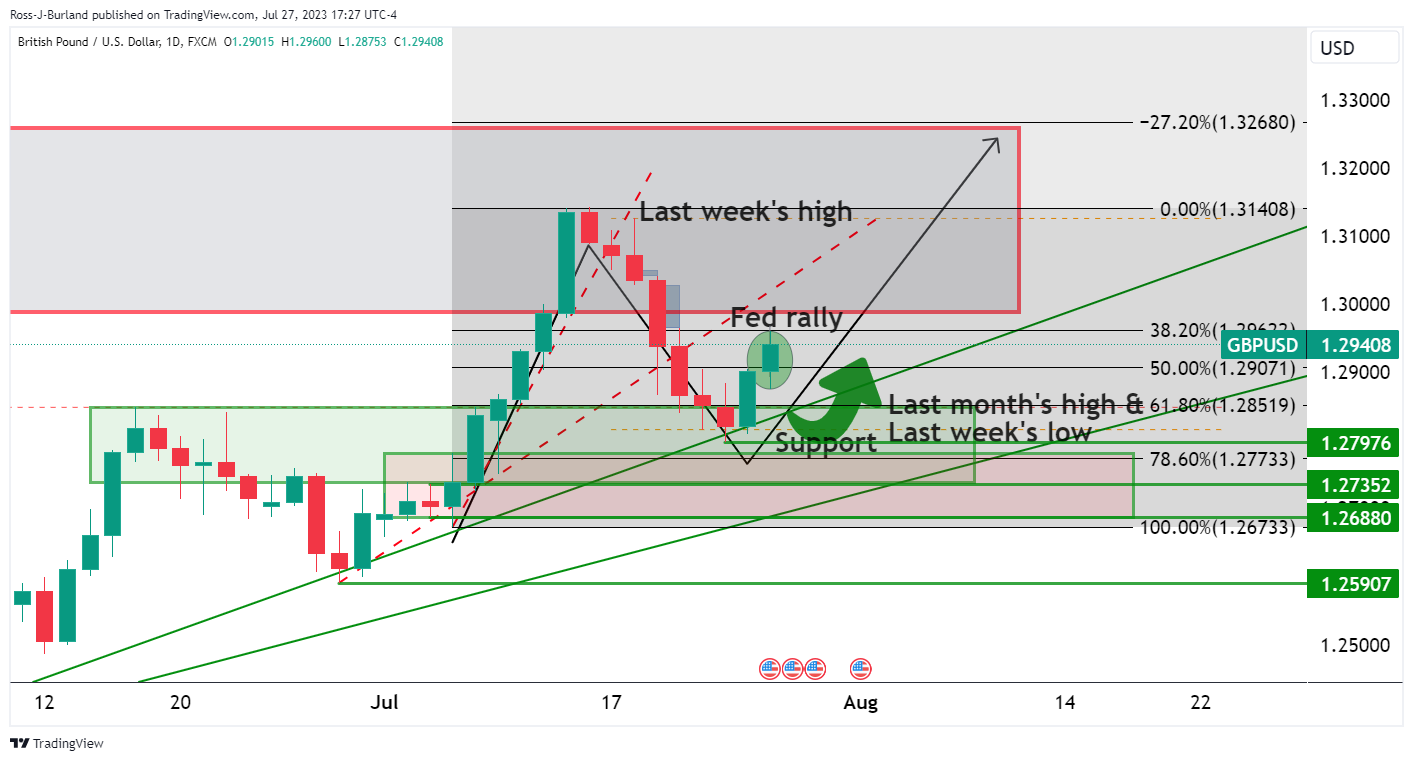
Prior to the Thursday sell-off, Cable was rallying in line with the bullish trend on the back of the Fed's move and subsequent market take on the meeting. However, along came Thursday:
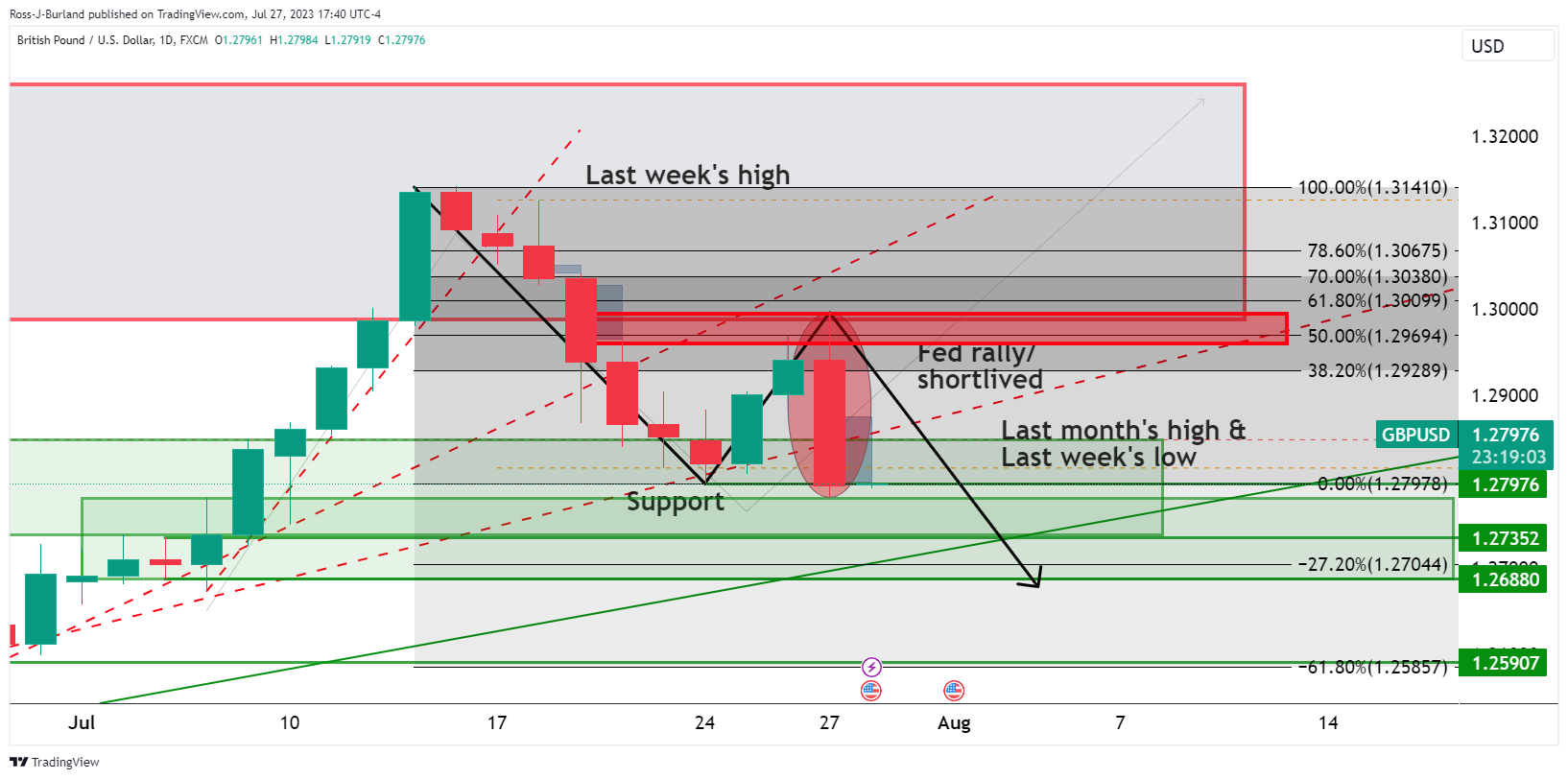
This has seen the pair drop hard into support and leaves a bearish prospect on the charts for a deeper test of the broader bullish cycle for the days ahead.
According to media reports, the Bank of Japan will discuss making a tweak to its yield curve control (YCC) on Friday; the BoJ meeting will be the highlight of the Asian session. The Tokyo Consumer Price Index is due, and in Australia, the Producer Price Index. Later in the day, attention will turn to preliminary inflation figures from France, Spain, and Germany. The US will also release inflation data, including the Core Personal Consumption Expenditure (PCE) index.
Here is what you need to know on Friday, July 28:
Upbeat economic data from the US boosted the US dollar on Thursday. The economy expanded at a 2.4% annualized rate, above the expected 1.8% and also higher than the 2% of market consensus. Additionally, Initial Jobless Claims, Durable Goods Orders, and Pending Home Sales posted better-than-expected readings. Wall Street initially cheered the data, but main indices failed to hold onto gains and finished with losses of 0.60% on average.
The US Dollar Index jumped to 101.85, reaching the highest level since July 11 but then pulled back on the back of the USD/JPY decline. US Treasury yields also rose, with the 10-year rising above 4.0% and the 2-year hitting 4.95%
On Friday, the US Core Personal Consumption Expenditure index for June is due. The annual rate is expected to decline from 4.6% to 4.2%. It is the Fed's preferred inflation gauge. Also due are income and spending data, the Employment Cost Index, and the final University of Michigan Consumer Sentiment index. Next week, the official US employment report is due.
The Japanese Yen rose sharply during the American session and became the biggest gainer of the day. Nikkei reported that the Bank of Japan (BoJ) will discuss a tweak in its Yield Curve Control policy to allow rates over 0.5%. USD/JPY tumbled from above 141.00 to 138.80 in a few hours. The BoJ will have its monetary policy meeting on Friday, which gained attention following recent speculations. The Tokyo Consumer Price Index (CPI) is also due.
The Euro weakened after the European Central Bank (ECB) decision to raise rates by 25 basis points, as expected. The fact that Lagarde offered no forward guidance and kept all options on the table for the next meeting in September weighed on the common currency. The key driver in EUR/USD, however, was the stronger US dollar. Spain, France, and Germany will release the preliminary July Consumer Price Index. EUR/USD tumbled to 1.0960, having its worst day in months.
Jörg Krämer, Chief Economist at Commerzbank:
The ECB switched off the autopilot at today's Council meeting. From now on the data will determine whether the ECB raises its interest rates again or not. Because we expect a significant decline in inflation and a recession in the second half of the year, we continue to not forecast a rate hike in September. On the other hand, we doubt the market's view that the ECB will cut rates as early as 2024.
GBP/USD resumed the downside, falling below 1.2800 to the lowest level in three weeks. EUR/GBP bottomed at 0.8545 but then erased losses, rising to 0.8575.
USD/CAD rose, boosted by the Greenback, and hit weekly highs at 1.3245 but still remains capped by the 1.3250 resistance zone. On Friday, Canada's monthly GDP for May is due, with a 0.3% expansion expected.
NZD/USD retreated a hundred pips from the top and closed below 0.6200. AUD/USD posted its lowest close since July 11, near 0.6700 and below the 20-day Simple Moving Average (SMA). Both currency pairs are under pressure amid stronger Dollar and technicals. Australia will release the Producer Price Index on Friday.
Metals collapsed following the US data. Silver lost more than 3%, falling to $24.00, and Gold plummeted from $1,980 to $1,942. Cryptocurrencies also suffered from a stronger dollar, with Bitcoin falling 1.60% to $29,100 and Ethereum 1.24% to $1,858.
Like this article? Help us with some feedback by answering this survey:
- EUR/USD bulls eye a move to test key resistance from key support.
- EUR/USD bears are in the market to test critical structure.
EUR/USD was offered as the US Dollar index, DXY, recovered from early losses and ended the New York session higher by some 0.7% at 101.77 after claiming between a low of 100.551 and 101.840 which was a 2-week high.
Meanwhile, stronger-than-expected US economic data supported a hawkish Federal Reserve thesis for the remainder of the year and further out. The second quarter Gross Domestic Product, Weekly Jobless Claims, and June's Pending Home Sales sent the US Treasury note yields higher, supporting the Greenback. EUR/USD also dropped to a 2-week low on dovish comments from ECB President Lagarde.
EUR/USD technical analysis
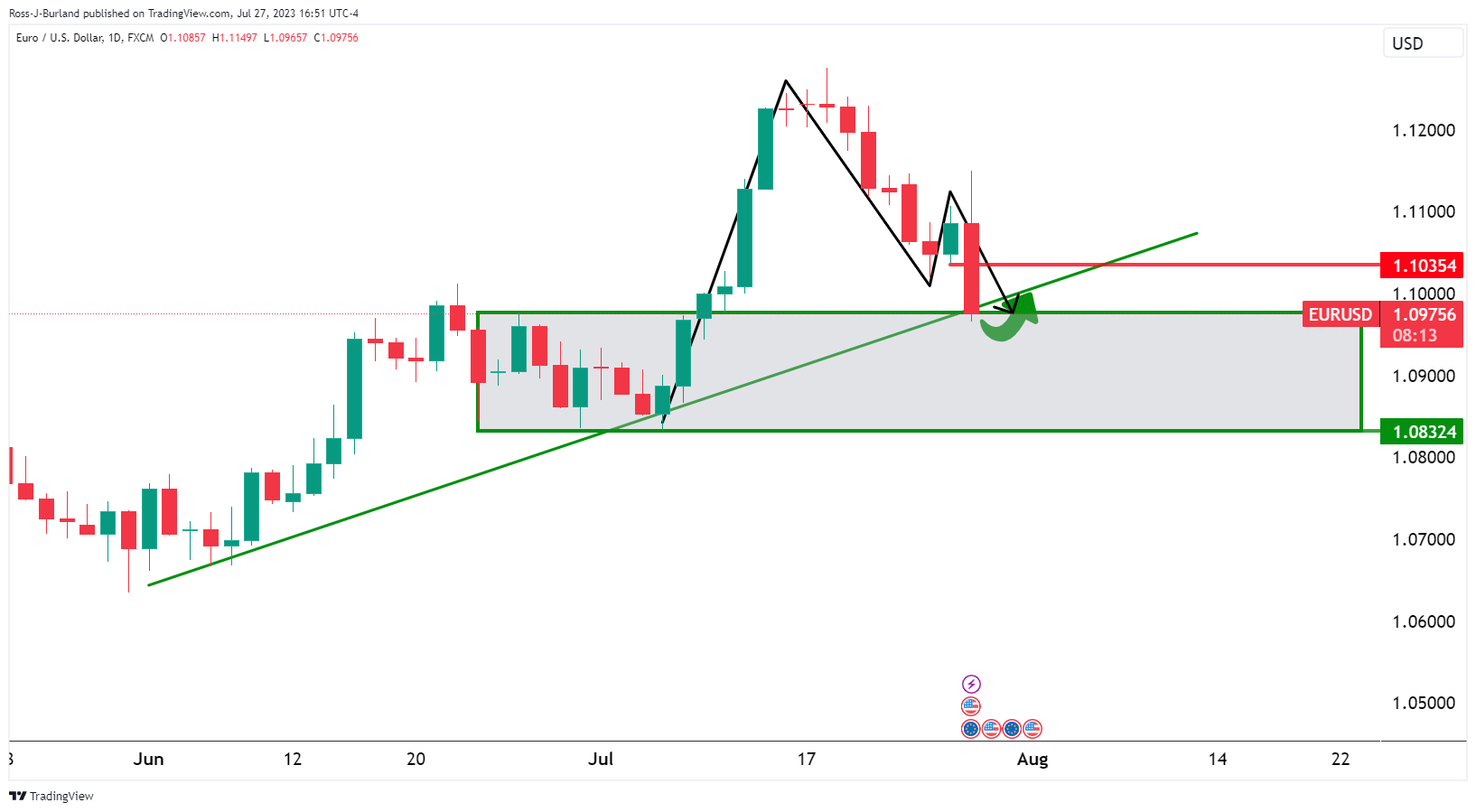
EUR/USD is at a critical structure point as per the trendline support that meets prior highs from back in late June. However, the momentum is strong and there are possibilities of a continuation:
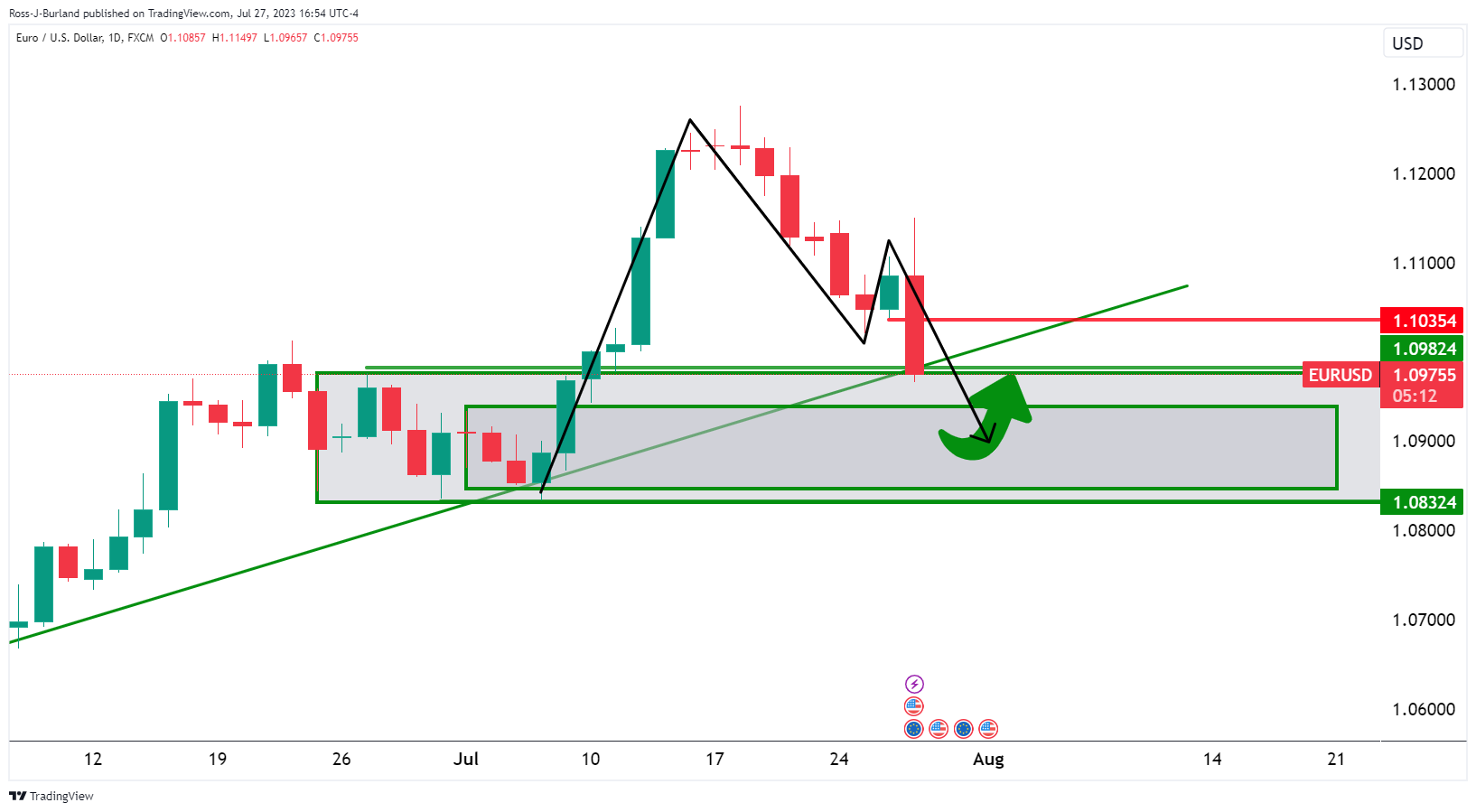
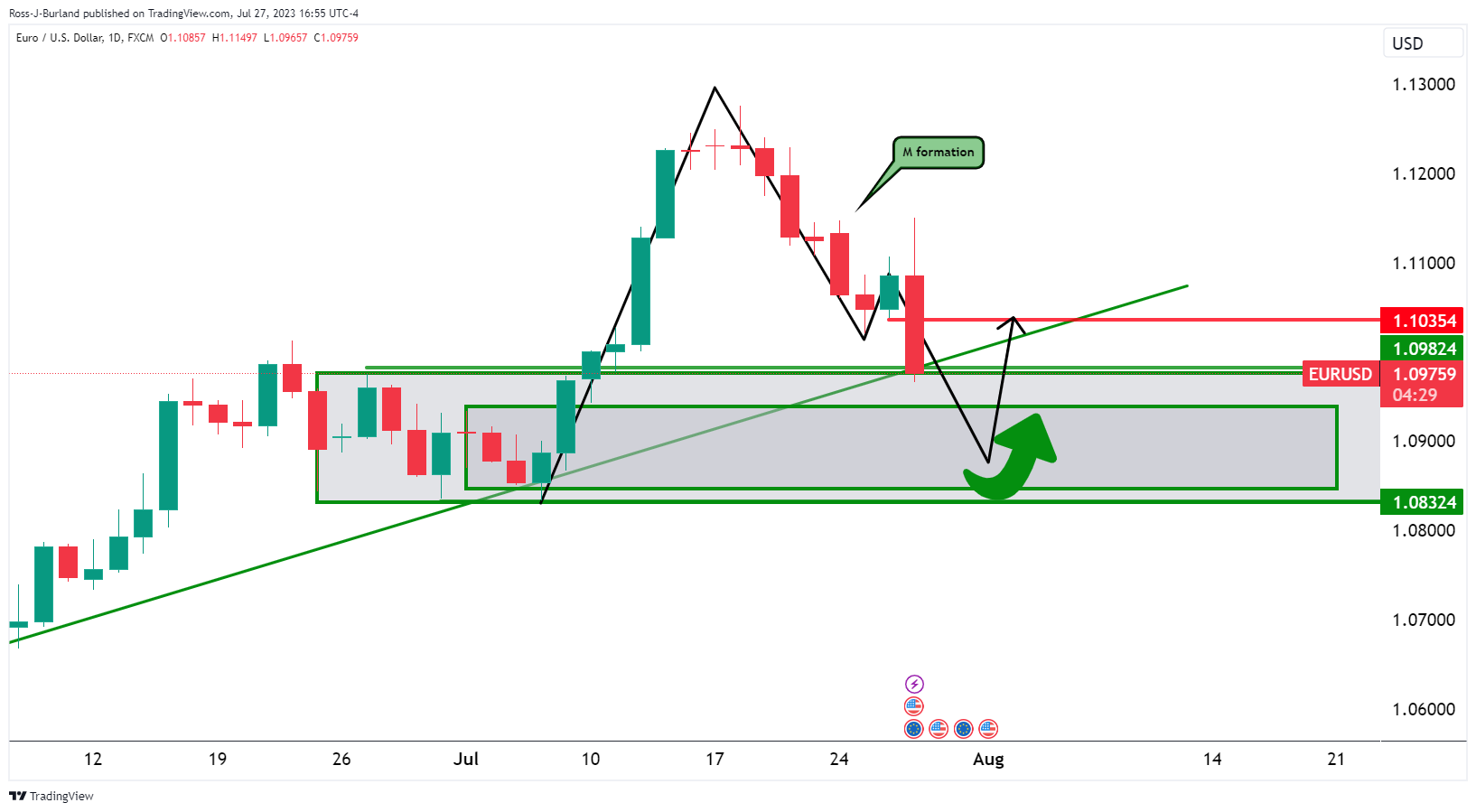
Such a move would be in line with creating an M-formation, a reversion pattern that would likely see a correction back towards the neckline and origin of the last bearish impulse.
- XAU/USD fell more than 1.40% on Thursday and lost the 100 and 20-day SMA near $1,940.
- Robust US data fueled hawkish bets on the Fed, increasing US yields.
- The USD DXY jumped back above 101.00.
On Thursday, non-yielding precious metals faced selling pressure amid strong data from the US, which made markets start to place bets on a possible hike by the Federal Reserve (Fed) in September, which increased US treasury yields.
It's worth mentioning that Jerome Powell claimed on Wednesday that in September, the Fed may hike or pause, adding that the decision will depend solely on incoming data. In that sense, on Thursday, the US reported that the Q2 Gross Domestic Product (GDP) expanded at a higher annualised pace than expected by increasing monthly Durable Goods Orders in June. In addition, Jobless Claims in the third week of July rose but were lower than anticipated hinting that the US economy is holding firm and may give the Fed room to deliver an additional hike.
As a reaction, US Treasury yields, which could be seen as the opportunity cost of holding Gold, increased across the board, applying pressure on the XAU/USD. The 2-year rate rose to 4.92%, the 5-year yield to 4.23%, and the 10-year to 4.00%, with all three seeing more than 1% increases.
XAU/USD Levels to watch
The daily chart suggests that the technical outlook for the XAU/USD has turned bearish for the short term. The Relative Strength Index (RSI) collapsed into negative territory, while the Moving Average Convergence Divergence (MACD) prints fading green bars, suggesting that the bears are in command. In addition, the price has fallen below the 20 and 100-day Simple Moving Averages (SMAs).
Support levels: $1,930, $1,915, $1,900.
Resistance levels: $1,945 (20-day SMA), $1,965 (100-day SMA), $1,980.
-638260872859459500.png)
- GBP/JPY sells-off on BoJ sentiment ahead of Friday's meeting.
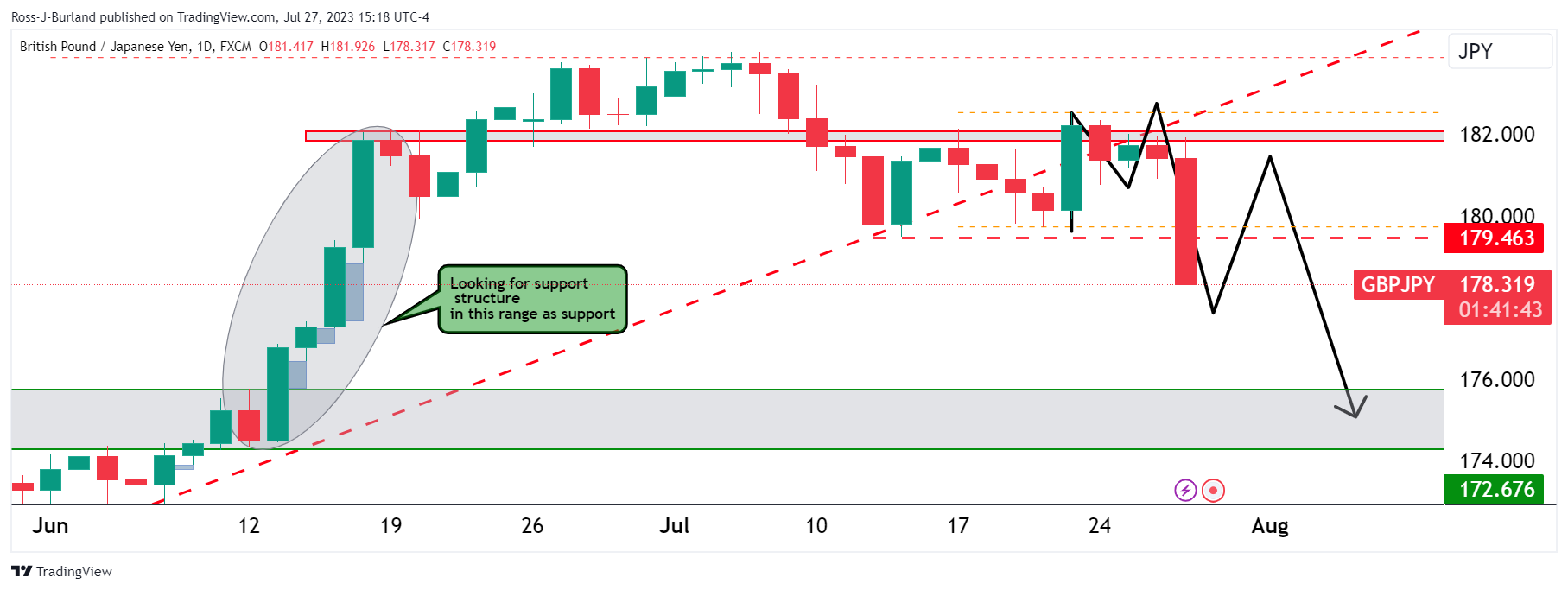
- GBP/JPY drops into a potentially strong area of support in the 177.70/90s as per the hourly structure.
- Bears also eye the Point of Control near 177.00 and then a swing support area at 176.50.
GBP/JPY collapses on a strong hint from Nikkei news that the BoJ will discuss dropping the 0.5% cap in 10Y JGB yields in Friday's meeting. The article has shaken up the sentiment surrounding the Bank of Japan whereby it was otherwise recently telegraphed by the BOJ Governor Ueda that there was "still some distance to sustainably achieve 2% inflation target" and that unless their assumptions on need to sustainably achieve 2% target changes the BoJ's "narrative on monetary policy won't change."
However, that narrative has flipped in New York trade on Thursday and USD/JPY fell from 141.10 to a low of 139.09 when the Nikkei reported '' the Bank of Japan will discuss tweaking its yield curve control policy at a policy board meeting Friday to let long-term interest rates rise beyond its cap of 0.5% by a certain degree, Nikkei has learned, in what would be a shift toward a more flexible policy approach.'' Consequently, GBP/JPY has been dragged deeper below trendline resistance as follows:
GBP/JPY technical analysis
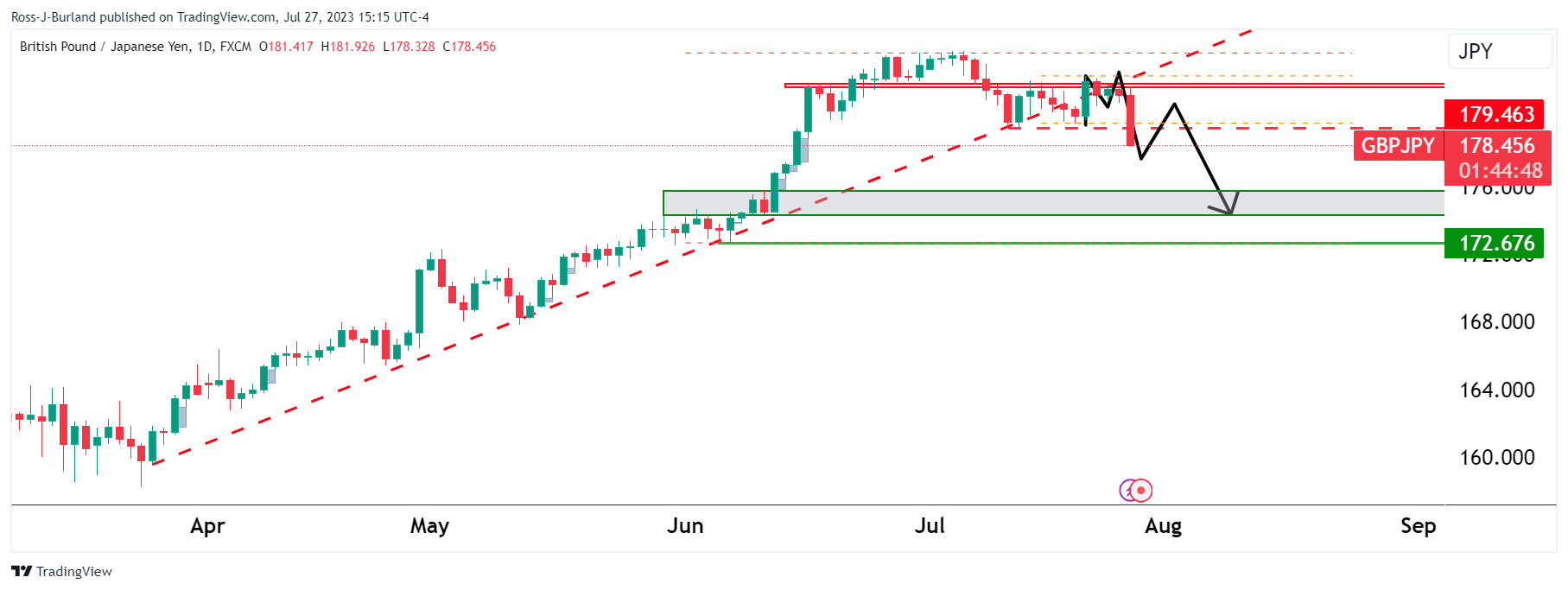
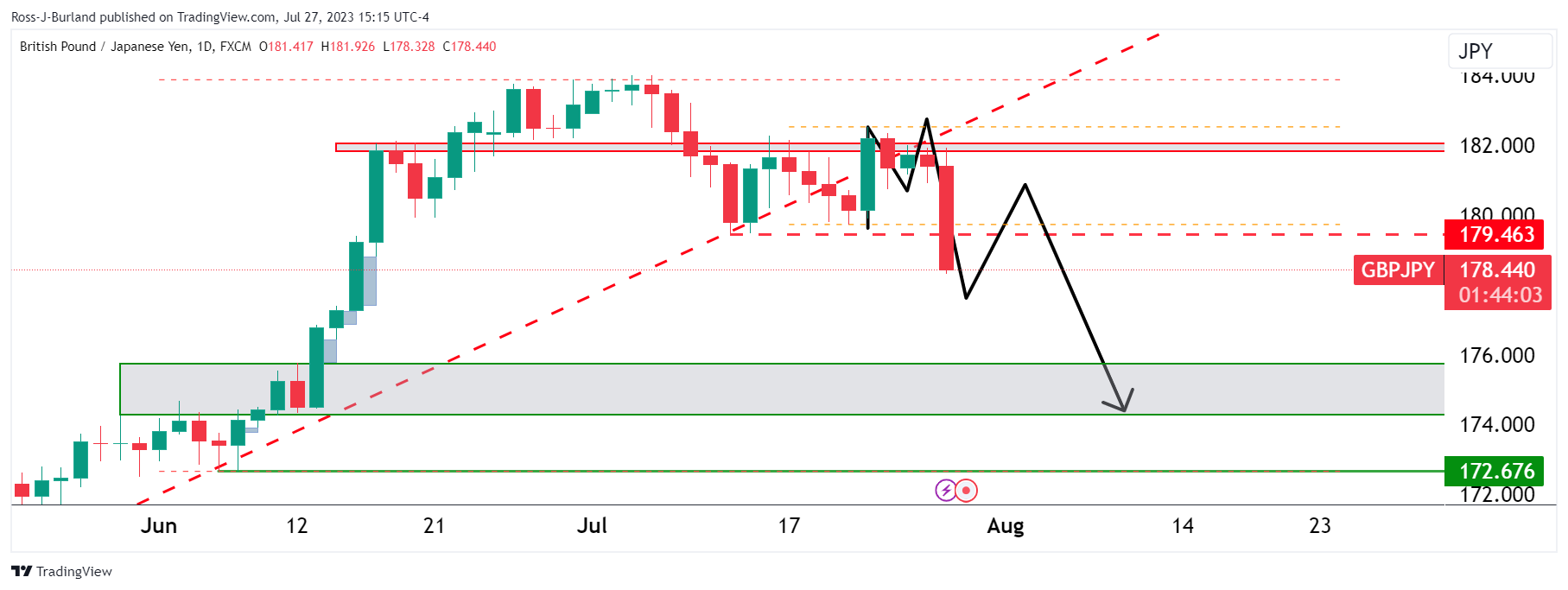
As can be seen, the price is falling but is leaving an M-pattern on the daily chart. A correction is inevitable but we just don't know when this horse will settle down.
GBP/JPY H1 chart

We can see a potentially strong area of support in the 177.70/90s as per the hourly structure back in the prior bullish cycle where volumes are starting to deplete. Below there, we have the Point of Control near 177.00 and then a swing support area at 176.50.
- EUR/JPY fell to its lowest point since mid-june seeing more than 1.30% losses falling below 154.00.
- ECB hiked by 25 bps, but Christine Lagarde didn’t commit to a hike in September.
- All eyes are now on BoJ’s decision on Friday. Reports suggest that the bank will consider a policy pivot.
The EUR/JPY cross tallied a fourth consecutive day of losses, weakened by Christine Lagarde’s neutral stance following the European Central Bank (ECB) decision to hike rates by 0.25% as expected. The Euro is seeing losses agains most of its rivals, including the JPY, while investors await the Bank of Japan (BoJ) decision early in the Asian session on Friday.
When asked if the bank had more ground to cover, Lagarde stated, “At this point, I wouldn't say so”. In addition, regarding the September decision, she confirmed that it would depend on the economy's evolution and inflation. She also added that the Council would not use forward guidance and would have the choice of raising or maintaining interest rates.
On the Japanese side, markets await the BoJ to maintain its dovish stance in Friday’s meeting. However, Nikkei reported on Thursday that the bank would consider keeping a rate ceiling but allow moderate rises beyond that level, which gave the JPY a significant boost. In addition, investors will eye the updated macro projections to continue modelling their expectations regarding the bank’s next steps.
EUR/JPY Levels to watch
According to the daily chart, the technical outlook is bearish. The Relative Strength Index (RSI) fell into negative territory, while the Moving Average Convergence Divergence (MACD) prints higher red bars indicating that the bears are in command.
Support levels: 153.00, 151.00, 150.00
Resistance levels: 156.00 (20-day Simple Moving Average), 157.00, 157.50.
EUR/JPY Daily chart
-638260776961677036.png)
USD/JPY bears jumped in on a Nikkei news article ahead of the Bank of Japan's meeting on Friday that took USD/JPY down from 141.10 to a low of 139.20 in a flash. The Nikkei reported, '' The Bank of Japan will discuss tweaking its yield curve control policy at a policy board meeting Friday to let long-term interest rates rise beyond its cap of 0.5% by a certain degree, Nikkei has learned, in what would be a shift toward a more flexible policy approach.''
This has flipped sentiment around that had otherwise been expecting a non-event in Friday's meeting considering it was only recently that the BOJ Governor Ueda said there was "still some distance to sustainably achieve 2% inflation target" and that unless their assumptions on the need to sustainably achieve 2% target change the BoJ's "narrative on monetary policy won't change."
The shift in sentiment is playing into a downtrend in USD/JPY on the charts as follows:
USD/JPY daily chart

With the price being on the backside of the bullish trendline, already breaking below the structure in mid-July, the test of the counter-trendline resistance has led to a sell-off. This down-trend cycle could well continue, especially if the BoJ does indeed communicate a change in the narrative on monetary policy. 134.00 is eyed as a potential support area.
- EUR/GBP peaked at a daily high of 0.8600 and then retreated below 0.8550.
- As expected, ECB hikes rates by 0.25% but didn’t commit to a hike in September.
- The 2-year German yield fell more than 1% to 3.23%.
On Thursday, the Euro weakened against most of its rivals, including the USD, GBP, AUD, and JPY, following the European Central Bank's (ECB) decision to hike rates by 0.25% as investors perceived a dovish tone in Christine Lagarde’s presser making German yields decrease.
Like Federal Reserve (Fed) Chair Jerome Powell on Wednesday, Christine Lagarde confirmed she was “open-minded” towards the September meeting as the decision will depend on the economic and inflation outlook. In addition, she stated that the Council will not engage in forward guidance and will have the option of either increasing or maintaining interest rates.
On the other hand, the GBP traded weak on Thursday against most of its rivals as investors continue to bet on a less aggressive Bank of England (BoE). Ahead of the August 3 decision, the World Interest Rate Possibilities (WIRP) suggest that the odds of a 50 basis point (bps) increase dropped nearly to 35%, and markets are discounting a terminal rate of 5.75-6.0% vs. 6.5% early in July.
EUR/GBP Levels to watch
From a technical perspective, the EUR/GBP pair retains the short-term bearish bias according to indicators on the daily chart. The Relative Strength Index (RSI) remains in negative territory. At the same time, the Moving Average Convergence Divergence (MACD) printed a red bar following two consecutive weeks of green bars, indicating that the bears are in the driver’s seat.
Support levels: 0.8540, 0.8530, 0.8500 (cycle low).
Resistance levels: 0.8582 (20-day Simple Moving Average), 0.8600, 0.8630.
EUR/GBP Daily chart
-638260736459765947.png)
Nikkei reported that the Bank of Japan (BoJ) “will discuss tweaking its yield curve control policy at a policy board meeting Friday to let long-term interest rates rise beyond its cap of 0.5% by a certain degree”. If materialized, it would be a shift from the BoJ to a more flexible monetary policy approach.
The BoJ meets on Friday, and until this report, no change in its monetary policy stance was expected.
Market reaction:
The Japanese Yen jumped across the board after the Nikkei report. The USD/JPY dropped more than a hundred pips in a few minutes, falling from above 141.00 to 139.80. The pair remains under pressure, looking at the daily low at 139.37.
- WTI jumped above $80.00 for the first time since mid-April.
- Tighter global supply and Chinese stimulus support the rise in Oil prices.
- Hawkish bets on the Fed may limit the price’s momentum.
On Thursday, the West Texas Intermediate (WTI) rose more than 1% to its highest level since mid-April, above $80.00. Investors seem to be weighing the fact that the Chinese economic stimulus would bolster local economic activity and drive Oil prices up on higher demand. In addition, expectations of Organization of the Petroleum Exporting Countries (OPEC) production cuts give further traction to the black gold.
On the negative side, the USD strength following the Federal Reserve (Fed) hike on Wednesday and the release of robust economic activity data on Thursday may limit the WTI’s advance. In that sense, as Jerome Powell opened a hike in September as the decision will be based on data, strong US data fuel hawkish bets on the Fed favouring the USD.
In that sense, it was reported that the Q2 Gross Domestic Product (GDP) increased at an annualised rate of 2.4%, exceeding the 1.8% expected and the previous 2%. Durable goods saw a notable increase in June. The headline number increased by 4.7% MoM, exceeding the market expectation of 1%, while orders excluding Defense and Transportation increased by 6.2% and 0.6%, respectively, despite expectations for them to remain unchanged.
In addition, Jobless Claims for the week ending on July 21 decreased further, coming in at 221,000 rather than the predicted 235,000 and the previous 228,000. According to the CME FedWatch tool, markets are discounting low odds of a hike in September (24%).
WTI Levels to watch
From a technical standpoint and according to the daily chart, the WTI holds a short-term bullish perspective. The price remains trading above its main moving averages, while its indicators edge higher but stand near overbought conditions to a downward correction shouldn’t be taken off the table.
Resistance levels: $82.00,$82.30,$82.50.
Support levels: $76.66 (200-day SMA), $74.96 (20-day SMA),$73.52 (100-day SMA).
WTI Daily chart
-638260698103410065.png)
- The NZD/USD peaked at a daily high of 0.6272 and then settled below 0.6200.
- US Q2 GDP, Durable Goods and Jobless Claims data came in strong, beating expectations.
- Investors digest Wednesday’s Fed decision and start to model their expectations.
On Thursday, the NZD/USD saw volatility and retreated from a daily high of 0.6272 and then fell below 0.6200. In that sense, the USD gained traction following robust high-tier economic data while investors asses the latest Federal Reserve (Fed) decision.
On Wednesday's press conference, Jerome Powell noted that future decisions will depend “solely” on incoming data after the Fed announced a 25 basis point hike to the 5.25-5.50% target range. In that sense, as the US reported an additional set of robust data, investors are starting to place bets on a possible hike in the September or November meeting, which seems to fuel the USD.
That being said, the Q2 Gross Domestic Product (GDP) from the US, was reported to expand at an annualised rate of 2.4%, above the 1.8% expected and the previous 2%, while Durable Goods notably grew in June. The headline figure saw a 4.7% MoM increase beating the 1% expected, while orders excluding Defense and Transportation expanded by 6.2% and 0.6%, respectively, while markets expected them to remain steady.
In addition, Jobless Claims for the week ending on July 21 continued to decelerate, coming in at 221,000, below the 235,000 expected and the previous 228,000. As for now, according to eh CME FedWatch tool, markets are discounting 24% odds of a hike in September and a 33% possibility of an increase in the November meeting.
NZD/USD Levels to watch
From a technical perspective, the NZD/USD short-term outlook turned bearish for the short term, with indicators standing in the negative ground on the daily chart while the pair has fallen below the 20,100 and 200-day Simple Moving Averages (SMA).
The daily Relative Strength Index (RSI) holds a neutral slope just below its midline, while the Moving Average Convergence Divergence (MACD) prints soft red bars indicating a mild bear dominance.
Resistance levels:0.6227 (20-day SMA), 0.6217 (200-day SMA), 0.61978 (100-day SMA).
Support levels: 0.6190,0.6170, 0.6150
NZD/USD Daily chart
-638260658998299192.png)
EUR/USD moved sharply lower on the dovish market interpretation of the ECB meeting. Economists at Danske Bank expect the pair to remain under pressure.
Relative strength of the US economy to weigh on the EUR/USD in the coming months
In contrast to the relatively robust US economy, we think the Euro area economy looks fragile and it has already been showing weakening signs, especially in the manufacturing sector. We expect that to be a headwind for the EUR in the coming months.
Overall, we maintain our strategic case for a lower EUR/USD based on relative terms of trade, real rates and relative unit labour costs.
We expect the relative strength of the US economy to weigh on the EUR/USD in the coming months, and we continue to forecast the cross at 1.06/1.03 in 6/12M.
In the near-term, continued data dependence from both the Fed and the ECB will likely keep EUR/USD jumpy around US and Euro area data releases in the next couple of months.
The biggest contributor to the Euro’s rise since September has been the Yuan. Kit Juckes, Chief Global FX Strategist at Société Générale, expects USD/CNH to dictate the path of EUR/USD.
EUR/USD, anchored by the Yuan, hurt by lack of growth
The USD/CNH stalling gives the Euro some support in the face of headwinds it faces from market positioning (long), recent European data (weak) and fading expectations of further ECB rate hikes beyond September.
Where USD/CNH goes next may decide whether EUR/USD spends August below 1.10 or re-testing 1.13.
Economists at HSBC see further modest USD weakness.
Sticky US inflation or a more marked deceleration in activity will likely see the USD rally
The key for the USD will be whether inflation continues its descent toward target and whether this can be achieved without prompting a deeper economic downturn.
If the US data supports this ‘Goldilocks’ scenario, which it mostly has done lately, then the grind lower in the USD could extend, especially if we see fewer data disappointments from outside the US. However, sticky US inflation or a more marked deceleration in activity will likely see the USD rally through rates and risk aversion.
The Bank of Japan (BoJ) will hold its Monetary Policy Committee (MPC) meeting on Friday, July 28 and as we get closer to the Interest Rate Decision, here are the expectations forecast by the economists and researchers of nine major banks.
Will the BoJ tweak its policy on Friday? Despite likely inaction of the Japanese central bank, some banks expect the BoJ to widen Yield Curve Control (YCC).
Standard Chartered
We expect the BoJ to keep the policy rate unchanged. While some market participants are expecting a change in YCC amid JPY weakness, we think the BoJ will adopt a wait-and-see stance for at least the next couple of months. Considering Japan’s long-standing deflation, the BoJ may want to remain dovish for now. While Q1 GDP growth was strong, it is yet to be seen if such growth momentum is sustainable. Japan’s core CPI inflation has stayed above 3% since September 2022 but is likely to moderate below 3% in the second half. The BoJ will likely want to see a stronger wage growth path to keep inflation consistently above 2%. While wage growth for big corporates is higher than 3%, real wage growth remains negative, highlighting the challenge of achieving sustained wage growth.
ING
We believe that recent swings in the FX and Japanese government bond markets reflect market expectations for policy adjustment. It is a close call, but we still think YCC tweaks are possible, given that recent data support steady inflation growth and a sustained economic recovery.
Credit Suisse
We expect the BoJ to maintain the status quo. Market expectations are mixed and have recently tilted toward a small adjustment in the YCC. We would not rule out such a small change as a risk case but do not foresee any substantial change that could be perceived as an end to monetary easing. Therefore, any modification should be akin to operational fine-tuning to continue easing. The BoJ has consistently reiterated that the Japanese economy still needs further monetary easing and that positive real wage growth in particular is important. In our view, any sudden hawkish shift away from this stance would undermine the credibility of forward guidance and thus increase the risk of long-term interest rates overshooting.
TDS
We expect the Bank to leave all policy levers unchanged with no tweaks to its YCC. Ueda's comments have been dovish of late, with Uchida also cautioning against a premature policy shift. We will get updated forecasts and expect the FY24 inflation forecast (the more relevant forecast for policy) to remain unchanged at 2% which may suggest no imminent shift in the BoJ's stance.
ANZ
Although Ueda pushed back on expectations of a change in its policy settings at the July BoJ monetary policy meeting, he continues to say any change to YCC must come as a surprise. So, if the BoJ were to surprise the market we think it could either: widen further the trading band around the 10y target of 0% or shorten the tenor of the YCC target to 2y JGB. We assign a higher probability to the latter. We maintain our view that BoJ will shorten the tenor of its YCC target to 2y from 10y in coming meetings, with a low expectation of that happening this week.
Deutsche Bank
We see some policy revision as a c.40% probability event but continue to expect no change in monetary stance as his baseline. For the Outlook Report, we expect the BoJ to increase the inflation outlook for FY2023 but lower it for FY 2024, continuing to emphasise downside risks, but with no changes to the growth outlook.
SocGen
We expect the BoJ to maintain its main monetary policy, i.e. YCC and ETF purchases. We expect that the BoJ will have to revise its inflation outlook upwards at this meeting. However, given the current price pass-through stance of the non-manufacturing industry, the BoJ will repeat its stance that wages are likely to rise as the results of this year's spring wage negotiations are reflected in salaries through the summer, but the outlook is uncertain. It will add that there is a change in firms' pricing and wage settings when looking at recent price developments, but there is uncertainty as to how long it will last. In addition, an upward revision to the inflation outlook is unlikely to be a reason to widen the range. This is because until now, the BoJ has explained that the YCC tweak is not a tightening of monetary policy, but rather a change to enhance the sustainability of monetary easing. Going forward, we still think that the BoJ could widen the range at its September meeting.
Citi
We expect the BoJ to maintain monetary policy, YCC included. The focus is on whether there are adjustments to YCC. Market participants expecting adjustment have very different views on upside to Japan’s inflation outlook from those expecting no adjustment. We expect the policy board member median projection in the July Outlook Report to show three years of inflation above 2% starting in FY22. However, given that the BoJ still cannot be sure of FY24 inflation staying around 2%, it will likely prefer being behind the curve along with the risk of inflation exceeding 2%, to an early tightening cycle that risks dampening economic recovery and prolonging low inflation.
Wells Fargo
We believe this month might be too early for the BoJ to make further adjustment to its policy stance. Specifically, we forecast the central bank will hold its policy rate at -0.10%. Importantly, we also expect the BoJ to maintain its 10-year Japanese government bond yield target at 0.00%, with a tolerance band of +/- 50 bps. However, we do acknowledge the July meeting is a closer call than usual and will be paying close attention to the BoJ's updated CPI forecasts. Should those forecasts be at, or above, 2% for the next two fiscal years, that could be a signal of an impending policy shift in the months ahead. Indeed, we currently expect the BoJ to make a further tweak to its YCC policy at its October announcement.
The ECB has switched off the autopilot. Economists at Commerzbank note that from now on, interest rate hikes would depend on the macroeconomic data.
Autopilot switched off
The ECB switched off the autopilot at today's Council meeting. From now on the data will determine whether the ECB raises its interest rates again or not.
Because we expect a significant decline in inflation and a recession in the second half of the year, we continue to not forecast a rate hike in September. On the other hand, we doubt the market's view that the ECB will cut rates as early as 2024.
The FOMC delivered a well-telegraphed 25 bps rate hike. Any further increase will be data dependent, economists at Nordea report.
Data dependent
The FOMC unanimously raised interest rates by 25 bps. Despite the lower June CPI reading, they still see inflation as being elevated and kept the hiking bias.
Further rate hikes will be data dependent and could come as soon as September.
See:
- Fed: Current interest rate level to be the rate peak – Commerzbank
-
Persistent inflation will keep the Fed from cutting rates this year – Rabobank
- USD/CHF gallops above 0.8660 as upbeat US economic data supports interest rate hike by Fed in September.
- US GDP for the second quarter and Durable Goods Orders for June surprisingly beat expectations.
- More action is expected in the US Dollar Index as the core PCE Price Index for June will release on Friday.
The USD/CHF pair has recovered swiftly above the critical resistance of 0.8660 as the United States Gross Domestic Product (GDP) for the second quarter and Durable Goods Orders for June surprisingly beat expectations. Also, jobless claims registered by individuals for the first time were below consensus.
S&P500 opens on a bullish note as investors hope that the interest rate hike of 25 basis points (bps) by the Federal Reserve (Fed) announced on Wednesday was the last one in the current tightening cycle. Sentiment for US equities is positive while appeal for risk-sensitive currencies has faded.
The US Dollar Index (DXY) has printed a fresh two-week high at 101.71 as upbeat economic indicators have renewed hopes of one more interest rate hike from the Fed in its September meeting. Fed Chair Jerome Powell conveyed in his commentary that the interest rate decision for September will be data-dependent.
The upbeat expansion of GDP in the second quarter, robust demand for Durable Goods, and elongated tight labor market conditions indicate that the Fed could look for raising interest rates further. Economic resilience indicates that inflationary pressures could remain stubborn and more interest rates would be warranted.
More action is expected in the US Dollar Index as the core Personal Consumption Expenditure (PCE) Price Index for June will release on Friday at 12:00 GMT.
On the Swiss Franc front, more interest rates by the Swiss National Bank (SNB) are in the pipeline as inflation would take time to come below 2% steadily.
Economists at TD Securities discuss the Bank of Japan (BoJ) Interest Rate Decision and their implications for the USD/JPY pair.
Shift in Yield Target to the front-end (10%)
A shift in the Yield Target to the front-end (2y/5y) implies a big shift in the BoJ's easing stance. The Bank is likely to upgrade its FY24 inflation forecast above 2% and cite evidence that inflation expectations are nearing its 2% inflation equilibrium. Further, the BoJ is likely to emphasize that the economy is likely to run above potential (positive output gap) at a much faster pace than expected and bring about stronger price pressures. USD/JPY -3.0%.
Widening the 10yr Yield Target Band (25%)
BoJ could widen the band from the current 50bp range. The Bank upgrades its FY2024 inflation forecast above 2%, citing that the balance of risk has tilted towards a higher inflation outcome which supports a gradual tweak to the YCC framework. At the last Summary of Opinions, members highlighted that firms pricing behaviour have clearly changed, which suggests a shift in corporate wage-price setting behaviour after firms offered the biggest wage hikes in 30 years. USD/JPY -2.5%.
Base Case: No change to policy settings (65%)
BoJ keeps all policy settings unchanged and Governor Ueda reiterates the BoJ's stance that there is still some distance to achieve its 2% inflation target. This should likely be clear from the FY24 inflation forecast which we expect to be left unchanged at 2% given the uncertainty over the inflation outlook, especially on the demand side. The BoJ would take its time to assess the wage outlook and avoid any premature shift in its YCC policy, especially when the Bank has planned for policy review workshops with foreign experts in Dec'23. USD/JPY -0.5%.
Christine Lagarde, President of the European Central Bank (ECB), is delivering her remarks on the policy outlook and responding to questions from the press following the Governing Council's decision to hike key rates by 25 basis points in July.
Key takeaways
"The key instrument in the current circumstance is the interest rate."
"There is a possibility of a hike or a pause, it's a maybe."
"Do we have more ground to cover? At this point I wouldn't say so."
About ECB's press conference
Following the ECB´s monetary policy decisions, the ECB President delivers a prepared statement and responds to questions from the press on the policy outlook. Her comments may influence the volatility of EUR and determine a short-term positive or negative trend. Her hawkish view is considered as positive, or bullish for the EUR, whereas her dovish view is considered as negative, or bearish.
- USD/JPY surpasses 140.50 as US Dollar Index discovers strength after upbeat US GDP and Durable Goods Orders data.
- US GDP expanded surprisingly at a higher pace of 2.4% and Durable Goods Orders data rose extremely higher by 4.7%.
- The BoJ is expected to deliver a strong message that the end of YCC is not far.
The USD/JPY pair jumps above the crucial resistance of 140.50 as the United States Bureau of Economic Analysis reports that the economy remained resilient in the second quarter. The asset discovers strength as the US Dollar Index (DXY) has rebounded swiftly after diving to near 100.60.
US Gross Domestic Product (GDP) was expanded surprisingly at a higher pace of 2.4% vs. 2.0% recorded for the first quarter. Investors were expecting that GDP expanded at 1.8% on an annualized basis. In addition to that, Durable Goods Orders data for June rose extremely higher by 4.7% against expectations of 1.05 and May’s figure of 1.8%. This indicates that the economic outlook of the US economy is extremely strong.
Also, weekly jobless claims for July 21 remained below expectations. For the week ending July 21, 221k claims were received from first-timers while expectations were of 235K. Tight labor market conditions and US economic resilience could force the Federal Reserve (Fed) to announce one more interest rate hike in September.
Fed Chair Jerome Powell mentioned in his commentary that September’s monetary policy will be largely dependent on economic data and upbeat economic indicators could open doors for one more interest rate hike, which will push interest rates to 5.50-5.75%.
Meanwhile, the US Dollar Index is marginally far from a two-day high of 101.58, prompted by upbeat economic data. S&P500 is expected to open on a bullish note following positive cues from overnight futures.
The Japanese Yen is expected to remain on tenterhooks ahead of the interest rate decision by the Bank of Japan (BoJ), which will be announced on July 28. Economists at Credit Suisse expect the FX market is clearly pricing in a significant probability of a hawkish development such as widening the YCC trading band for the 10-year JGB or sending a strong message that the end of YCC is not far.
- Metals under pressure following stronger-than-expected US data.
- Rising US yields and an appreciation of the Greenback weigh on silver.
- XAG/USD has erased daily and weekly gains in a few minutes.
Silver has reversed sharply following the release of US economic data that came in above expectations. XAG/USD dropped from weekly highs above $25.00 to the $24.50 area in a few minutes, falling 1.50% on a daily basis. The metal also erased weekly gains.
A strong US economy
The US economy grew at a 2.4% annual rate during the second quarter, above the market consensus of 1.8%. The report showed that the GDP deflator declined from 4.1% to 2.6% and the Core Personal Consumption Expenditures Index from 4.9% to 3.8%. The June Durable Goods Order report showed a 4.7% increase, above the estimated 1%. Initial Jobless Claims dropped to 221K, the lowest in five months.
The numbers triggered a rally for the US dollar across the board and sent US yields to the upside. Metals tumbled after the report, with Gold losing more than $20 since the data came out and trading at $1,955.
XAG/USD is testing the $24.50 area and below, with attention turning to the weekly low at the $24.25 area. The next support is seen at $24.00/23.95. The short-term outlook for Silver has turned negative, and a rebound above $25.00 would be needed to reverse it. Before that, an interim resistance emerges at $24.70.
Technical levels
The FOMC matched market expectations, lifting rates by 25 bps to 5.25%-5.50%. Economists at Rabobank analyze the odds of additional rate increases.
Powell keeps his options open
As widely expected, the FOMC raised the target range for the federal funds rate to 5.25-5.50%. The decision was unanimous.
During the press conference, Powell kept his options open for the September meeting and stressed the data-dependence of that decision. This has increased the upside risk to our forecast that the Fed is now done hiking for the year.
However, if core inflation continues to decline, there is no rush for the Fed to hike in September. By November, we expect the economy to have deteriorated, preventing further hikes. At the same time, we expect that persistent inflation will keep the Fed from cutting rates this year.
Christine Lagarde, President of the European Central Bank (ECB), is delivering her remarks on the policy outlook and responding to questions from the press following the Governing Council's decision to hike key rates by 25 basis points in July.
Key takeaways
"Starting to see transmission of policy to economy."
"Wage increases are definitely playing a role in driving inflation."
"Not seeing signs of strengthening second round effects."
About ECB's press conference
Following the ECB´s monetary policy decisions, the ECB President delivers a prepared statement and responds to questions from the press on the policy outlook. Her comments may influence the volatility of EUR and determine a short-term positive or negative trend. Her hawkish view is considered as positive, or bullish for the EUR, whereas her dovish view is considered as negative, or bearish.
Christine Lagarde, President of the European Central Bank (ECB), is delivering her remarks on the policy outlook and responding to questions from the press following the Governing Council's decision to hike key rates by 25 basis points in July.
Key takeaways
"The wording change in the statement was not random or irrelevant."
"Data and our assessment of data will tell us if any and how much ground we'll have to cover."
"We are open-minded."
"We are not in the domain of forward guidance."
"Minium reserve remuneration rate cut has no impact on policy stance."
"We have not discussed a balance sheet cut."
About ECB's press conference
Following the ECB´s monetary policy decisions, the ECB President delivers a prepared statement and responds to questions from the press on the policy outlook. Her comments may influence the volatility of EUR and determine a short-term positive or negative trend. Her hawkish view is considered as positive, or bullish for the EUR, whereas her dovish view is considered as negative, or bearish.
Economists at MUFG Bank expect to see further USD weakness.
Has the Fed reached the end of its hiking cycle?
Market participants remain confident that the Fed has delivered the final rate hike in their tightening cycle overnight when the policy rate was raised by 0.25 point.
If inflation continues to slow in the coming months, we expect the Fed to signal a pause to their hiking cycle at either the Jackson Hole symposium towards the end of August or at the September FOMC meeting.
The developments do not alter our outlook for the US Dollar to weaken further this year. The risk of a more hawkish Fed policy update has now passed leaving it vulnerable to further weakness.
Christine Lagarde, President of the European Central Bank (ECB), is delivering her remarks on the policy outlook and responding to questions from the press following the Governing Council's decision to hike key rates by 25 basis points in July.
Key takeaways
"Domestic price pressures are becoming important drivers of inflation."
"Some long-term inflation indicators remain elevated; they need to be monitored closely."
"Economic and inflation outlook remain highly uncertain."
"Food and energy prices are potential upside risks to inflation."
"Adverse weather may push up food prices more than projected."
About ECB's press conference
Following the ECB´s monetary policy decisions, the ECB President delivers a prepared statement and responds to questions from the press on the policy outlook. Her comments may influence the volatility of EUR and determine a short-term positive or negative trend. Her hawkish view is considered as positive, or bullish for the EUR, whereas her dovish view is considered as negative, or bearish.
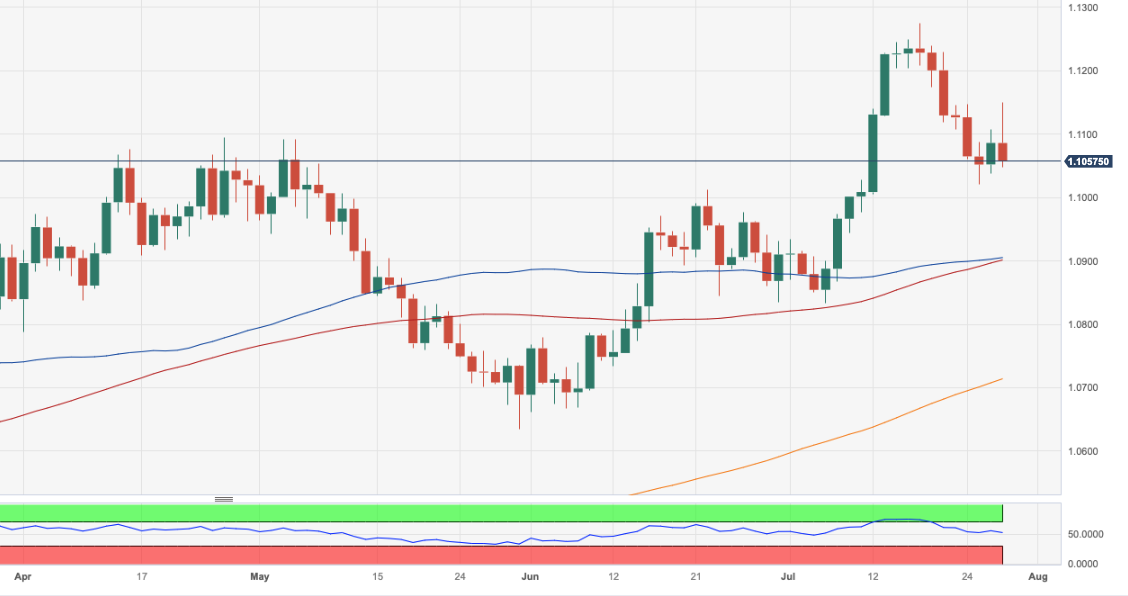
- EUR/USD reverses the early move to tops near 1.1150.
- Next on the downside emerges the weekly low at 1.1020.
EUR/USD trades in a volatile fashion and trims initial gains to the 1.1150 zone, leaving the door open to further retracement in the very near term.
Considering the recent price action, extra weakness should not be discarded and could motivate the pair to revisit the psychological support at 1.1000 the figure once the weekly low of 1.1020 (July 25) is cleared.
Looking at the longer run, the positive view remains unchanged while above the 200-day SMA, today at 1.0712.
EUR/USD daily chart
Christine Lagarde, President of the European Central Bank (ECB), is delivering her remarks on the policy outlook and responding to questions from the press following the Governing Council's decision to hike key rates by 25 basis points in July.
Key takeaways
"The near-term outlook has deteriorated."
"Manufacturing held down by weak external demand."
"Services is more resilient but momentum slowing."
"The labour market remains robust."
"We welcome the Eurogroup statement on the Euro area fiscal stance."
About ECB's press conference
Following the ECB´s monetary policy decisions, the ECB President delivers a prepared statement and responds to questions from the press on the policy outlook. Her comments may influence the volatility of EUR and determine a short-term positive or negative trend. Her hawkish view is considered as positive, or bullish for the EUR, whereas her dovish view is considered as negative, or bearish.
A lot of interest is building in Friday’s Bank of Japan meeting. Economists at ING analyze market implications for the JPY.
USD/JPY could break lower if the BoJ surprises the market with a YCC tweak
If the BoJ decides to leave the current policy settings unchanged, then USD/JPY looks as though it can push back to the recent high at 145.
While we cannot rule out a brief foray above 145 this summer, we doubt gains would be sustained - largely because US disinflation bells will ring increasingly louder during the summer and by September we would expect a broad Dollar bear trend to be underway.
If the BoJ surprises the market with a YCC tweak as we forecast, or gives a hint of possible policy adjustment in the near future, then USD/JPY could break lower – perhaps even lower than the recent low of 137 as the market would be taken by surprise. We have 3Q23 and 4Q24 USD/JPY forecasts at 135 and 130, respectively.
- Initial Jobless Claims decreased by 7,000 in the week ending July 22.
- Continuing Jobless Claims decline by 59,000 in the week ending July 15.
- US Dollar Index erases daily losses and rises back above 101.00 after Jobless Claims, Q2 GDP and Durable Goods Orders.
Initial Jobless claims totaled 221,000 in the week ending July 22, the weekly data published by the US Department of Labor (DOL) showed on Thursday. It is the lowest reading in five months.
The print follows the previous week's 228,000 (unrevised) and came in below market expectations of 235,000. Further details showed that “the 4-week moving average was 233,750, a decrease of 3,750 from the previous week's unrevised average of 237,500.”
Continuing Claims decline by 59,000 in the week ended July 15 to 1.69 million, a reading better than market estimates of 1.75 million. It is the lowest level since January. The four-week moving average was 1,719,500, a decrease of 10,750 from the previous week's average.
Market reaction:
Along with the Jobless Claims, the Q2 GDP data and the Durable Goods Order report were released. The US Dollar Index jumped from 100.55 to 101.10, erasing daily losses. US yields jumped following US economic reports that overall surpassed expectations.
- Durable Goods Orders in the US rose by 4.7% in June.
- US Dollar Index rises across the board after economic reports from the US.
Durable Goods Orders in the US increased 4.7%, or $13.6 billion, in June to $302.5 billion, the US Census Bureau reported on Thursday. This reading followed the 2.0% increase recorded in May (revised from 1.8%) and came in better than the market expectation for an increase of 1%.
The report added that “excluding transportation, new orders increased 0.6 percent. Excluding defense, new orders increased 6.2 percent. Transportation equipment, also up four consecutive months, led the increase, $12.4 billion or 12.1 percent to $115.3 billion.”
Market reaction:
Along with the Durable Goods Orders report, the Q2 GDP and weekly Jobless Claims were released. The US Dollar Index rebounded, erasing daily losses, rising back above 101.00 as US yields jumped to fresh daily highs.
- EUR/GBP is expected to continue its downside momentum as the ECB raised interest rates by 25 bps to 4.25%.
- An interest rate hike of 25 bps was expected as inflationary pressures in Eurozone are almost thrice the required rate.
- The Pound Sterling is in a bullish trajectory as the BoE is preparing to raise interest rates consecutively for the 14th time.
The EUR/GBP pair as the European Central Bank (ECB) has hiked interest rates on refinancing operations by 25 basis points (bps) to 4.25% as expected by the market participants. Also, deposit facility rates rose by 25 bps to 3.75%. The interest rate hike announcement from ECB President Christine Lagarde was warranted as core price pressures in the Eurozone are still stubborn.
In June headline inflation was softened to 5.5% as energy prices are consistently declining while core inflation seems stubborn due to rising wages. Investors are worried that headline inflation could rebound as global oil prices have recovered well in the past month and could propel inflationary pressures again.
As an interest rate hike of 25 bps by the ECB was highly anticipated, investors will now turn cautious about September monetary policy meeting. Going forward, investors will focus on preliminary German Gross Domestic Product (GDP) data for the second quarter. As per the preliminary report, GDP expanded at a nominal pace of 0.1% in the second quarter. In the first quarter, the German GDP contracted by 0.3%. On an annualized basis, consecutive contraction is expected in GDP by 0.3%.
Meanwhile, the Pound Sterling is in a bullish trajectory as the Bank of England (BoE) is preparing to raise interest rates consecutively for the 14th time. The United Kingdom's economy is facing the burden of BoE’s aggressive monetary policy. Advisers to UK Finance Minister Jeremy Hunt have flagged concerns over deepening recession risks as the BoE has sharply raised interest rates.
- The Australian Dollar rebounds after Powell refuses to commit to further rate hikes, notes Core CPI is down; labor market strong.
- The Aussie had lost ground after lower-than-expected Q2 inflation data on Wednesday.
- The FOMC raised the Fed Funds rate by 0.25% and upgraded its assessment of the US economy from showing “modest” to “moderate” growth.
The Australian Dollar (AUD) recovers against the US Dollar (USD) on Thursday, after faintly optimistic comments from the Federal Reserve (Fed) Chairman Jerome Powell in the press conference which weighed on the USD.
The Fed Chair refused to commit to confirming rate hikes in the future, and noted how core inflation had come down whilst the labor market remained resilient. Even though he continued to reiterate that more work needed to be done to get inflation back to target, the market interpreted his overall tone as leaning on the dovish, i.e. suggesting interest rates might fall sooner than previously thought. This weighed on USD, helping AUD/USD rise.
AUD/USD trades in the upper 0.67s at the start of the US session on Thursday.
Australian Dollar news and market movers
- The Australian Dollar rebounds following the Fed meeting. The FOMC raised rates by 0.25% – as expected. However, Chairman Powell showed more-than-expected optimism in his post-meeting press conference.
- Powell noted how core inflation was coming down, how the labor market was showing remarkable resilience, and how the Fed would be taking a meeting-by-meeting approach to policy from now on. The market interpreted this as a dovish turn.
- The release of Australian Consumer Price Index (CPI) data for Q2 dragged the Aussie lower early Wednesday after it showed a steeper-than-expected slowdown in inflation.
- Australian CPI inflation came out at 6.0% in Q2 YoY when 6.2% had been forecast versus the 7.0% in Q1.
- The Reserve Bank of Australia’s (RBA) preferred gauge, RBA Trimmed Mean CPI, measured quarterly, increased by 5.8% YoY in Q2 versus the 6.0% rise estimated and the 6.6% of Q1.
- There is a risk that the RBA will have to cut rates in 2024 because the Australian housing market is dominated by variable-rate mortgages so it is more sensitive to interest rates, and homeowners have recently been adversely affected by higher mortgage repayments, according to Bloomberg Intelligence, as quoted by Financial Review.
- The RBA’s Cash Rate is 4.1%, which is below the Fed’s 5.50%, overall favoring capital flows to the Greenback versus the Aussie.
- China’s pledge to increase support for the economy on Monday has helped the Australian Dollar since it is Australia’s largest trading partner.
Australian Dollar technical analysis
AUD/USD is in a sideways trend on both the long and medium-term charts. The February high at 0.7158 is a key hurdle, which if vaulted, will alter the outlook to one that is more bullish longer term.
Likewise, the 0.6458 low established in June is a key level for bears, which if breached decisively, would give the chart a more bearish overtone from a longer-term perspective.
-638260576661119937.png)
Australian Dollar vs US Dollar: Weekly Chart
A confluence of support made up of all the major daily simple moving averages (50, 100 and 200) exists in the upper 0.66s and lower 0.67s. This is expected to provide a rigid cordon of support, acting as a barrier to further losses.
The exchange rate has already bounced off the 200-day Simple Moving Average (SMA) at 0.6725 and completed a pivot higher. However, it is not clear if this reversal will extend.
-638260576192955901.png)
Australian Dollar vs US Dollar: Daily Chart
A decisive break above the June 16 high at 0.6900 would provide stronger confirmation of a more bullish outlook.
Likewise, a decisive break below the 200 first and then the 50 and 100-day Simple Moving Averages (SMA) would confirm a continuation of the recent bear move lower to a speculative target at the June and July lows in the mid-0.64s.
A decisive break consists of a long daily candlestick, which pierces cleanly above or below the critical level in question and then closes near to the high or low of the day. It can also mean three up or down days in a row that break cleanly above or below the level, with the final day closing near its high or low and a decent distance away from the level.
Australian Dollar FAQs
What key factors drive the Australian Dollar?
One of the most significant factors for the Australian Dollar (AUD) is the level of interest rates set by the Reserve Bank of Australia (RBA). Because Australia is a resource-rich country another key driver is the price of its biggest export, Iron Ore. The health of the Chinese economy, its largest trading partner, is a factor, as well as inflation in Australia, its growth rate and Trade Balance. Market sentiment – whether investors are taking on more risky assets (risk-on) or seeking safe-havens (risk-off) – is also a factor, with risk-on positive for AUD.
How do the decisions of the Reserve Bank of Australia impact the Australian Dollar?
The Reserve Bank of Australia (RBA) influences the Australian Dollar (AUD) by setting the level of interest rates that Australian banks can lend to each other. This influences the level of interest rates in the economy as a whole. The main goal of the RBA is to maintain a stable inflation rate of 2-3% by adjusting interest rates up or down. Relatively high interest rates compared to other major central banks support the AUD, and the opposite for relatively low. The RBA can also use quantitative easing and tightening to influence credit conditions, with the former AUD-negative and the latter AUD-positive.
How does the health of the Chinese Economy impact the Australian Dollar?
China is Australia’s largest trading partner so the health of the Chinese economy is a major influence on the value of the Australian Dollar (AUD). When the Chinese economy is doing well it purchases more raw materials, goods and services from Australia, lifting demand for the AUD, and pushing up its value. The opposite is the case when the Chinese economy is not growing as fast as expected. Positive or negative surprises in Chinese growth data, therefore, often have a direct impact on the Australian Dollar and its pairs.
How does the price of Iron Ore impact the Australian Dollar?
Iron Ore is Australia’s largest export, accounting for $118 billion a year according to data from 2021, with China as its primary destination. The price of Iron Ore, therefore, can be a driver of the Australian Dollar. Generally, if the price of Iron Ore rises, AUD also goes up, as aggregate demand for the currency increases. The opposite is the case if the price of Iron Ore falls. Higher Iron Ore prices also tend to result in a greater likelihood of a positive Trade Balance for Australia, which is also positive of the AUD.
How does the Trade Balance impact the Australian Dollar?
The Trade Balance, which is the difference between what a country earns from its exports versus what it pays for its imports, is another factor that can influence the value of the Australian Dollar. If Australia produces highly sought after exports, then its currency will gain in value purely from the surplus demand created from foreign buyers seeking to purchase its exports versus what it spends to purchase imports. Therefore, a positive net Trade Balance strengthens the AUD, with the opposite effect if the Trade Balance is negative.
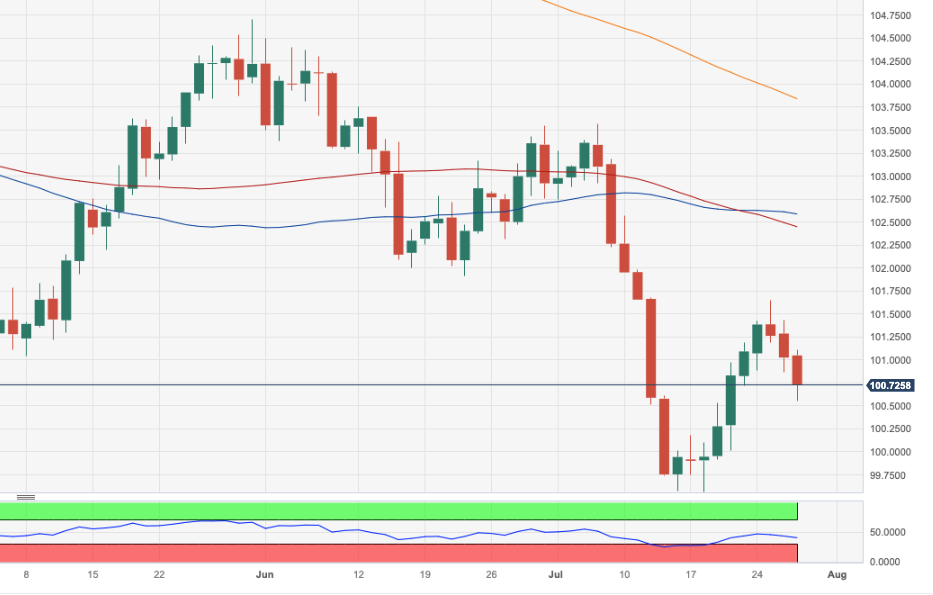
- DXY keeps the bearish note unchanged below 101.00.
- A deeper pullback could revisit the key 100.00 zone.
DXY drops for the third straight session and breaches the key support at 101.00 the figure to print new multi-day lows.
The continuation of the downward bias could initially drag the index to the 100.00 neighbourhood. The loss of the latter should leave the dollar vulnerable to a potential test of the 2023 low near 99.50 (July 14).
Looking at the broader picture, while below the 200-day SMA at 103.83 the outlook for the index is expected to remain negative.
DXY daily chart
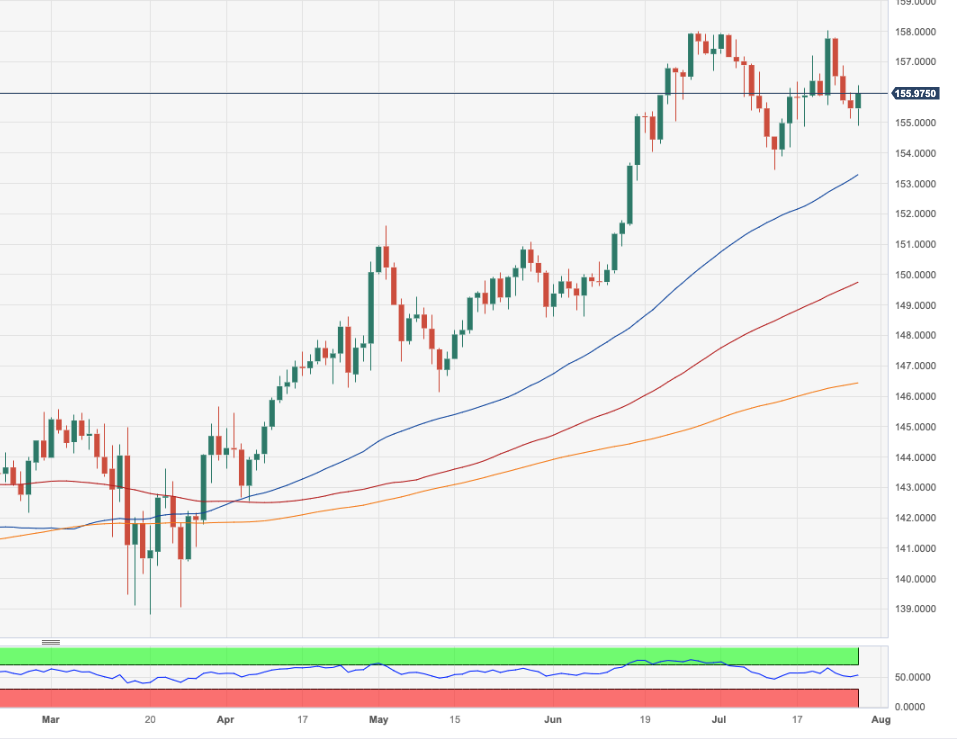
- EUR/JPY reverses part of the recent weakness and regains 156.00.
- The continuation of the recovery could dispute the 158.00 region.
EUR/JPY leaves behind three consecutive sessions of losses and manages to reclaim the area beyond the 156.00 hurdle on Thursday.
In case the rebound gathers extra impulse, a potential test of the 2023 high in the 158.00 zone could start emerging on the horizon in the near term.
So far, the longer term positive outlook for the cross appears favoured while above the 200-day SMA, today at 146.40.
EUR/JPY daily chart
The CAD has picked up a little ground against a generally softer USD. Economists at Scotiabank maintain a neutral/bearish USD/CAD stance.
Trend signals are weak on the intraday and daily oscillators
‘Neutral’ because the sideways pattern of trade is extending a little further below resistance in the low/mid-1.32s. And ‘bearish’ because the broader pattern of short-term trading is still shaping up negatively (bearish wedge) for the USD, with the base of the pattern (1.3160) coming under a little pressure.
Trend signals are weak on the intraday and daily oscillators, suggesting that a significant push outside of the range is needed to generate more directional momentum from here.
- USD/CHF struggles to maintain an auction above 0.8550 amid positive market sentiment.
- A power-pack action is expected in the USD Index amid the release of the US GDP data.
- USD/CHF is looking for a cushion near the horizontal support plotted around 0.8557.
The USD/CHF pair is struggling to maintain auction after printing a fresh eight-year low around 0.8552 in the European session. The Swiss Franc asset is facing pressure as the market mood is extremely upbeat amid expectations that interest rates by the Federal Reserve (Fed) are pealed for the entire year.
S&P500 futures have generated significant gains in London as fears of a recession in the United States economy have faded significantly. The US Dollar Index (DXY) has extended its sell-off to near 100.60 and is expected to continue its downside move.
A power-pack action is expected in the USD Index amid the release of the US Gross Domestic Product (GDP) data, which will release at 12:00 GMT.
USD/CHF is looking for a cushion near the horizontal support plotted from July 18 low around 0.8557 on an hourly scale. The 20-period Exponential Moving Average (EMA) at 0.8594 is acting as a barricade for the US Dollar bulls.
The Relative Strength Index (RSI) (14) is oscillating in the bearish range of 20.00-40.00, which indicates that the downside momentum is active.
Should the asset break below immediate support of 0.8557, Swiss Franc bulls would drag the asset to a fresh eight-year low near round-level support at 0.8500. A slippage below the latter would further drag the asset toward Jun 2011 low at 0.8275.
In an alternate scenario, a confident break above July 24 high at 0.8700 would drive the asset toward a 20-day EMA at 0.8750 followed by July 12 high around 0.8800.
USD/CHF hourly chart
-638260559607166844.png)
GBP/USD rebound stalls just below 1.30 but underlying trend remains bullish, economists at Scotiabank report.
GBP should remain well-supported on dips
Generally high UK interest rates and positive yield spreads over US Treasurys remain a key source of strength for sterling.
The broadly bullish pattern of short-term trade noted previously – the rounded low which formed in the low 1.28 area – remains valid. Short-term setbacks are not uncommon for these sorts of patterns but are typically resolved positively.
Bullish trend signals suggest the GBP should remain well-supported on dips.
Gains through 1.30 put a renewed push on to 1.31+ on the radar.
Short-term support is 1.2950/55.
EUR/USD progresses ahead of ECB. Economists at Scotiabank analyze the shared currency outlook.
More progress is required to bolster the short-term outlook
Solid gains off this week’s low came in the nick of time to reinvigorate the daily DMI reading and renew a bullish alignment of short, medium and long-term trend oscillators for the EUR.
The intraday study is barely into bull mode at this point so more progress is required to bolster the short-term outlook. But the broader pattern of trade – successive higher highs and higher lows plus the DMI alignment – suggests the underlying bull trend remains intact and will extend.
Resistance is 1.1200 and 1.1275/80. Support is 1.1075/1.1100.
The most important aspect of today’s ECB policy meeting is any guidance on what happens next. Economists at Rabobank analyze EUR outlook.
Risks for EUR/GBP seen as being well balanced
It is our house view that ECB rates could reach their peak today, though we acknowledge that the risk of one more hike is finely balanced.
The market is positioned long of the EUR, meaning that a lack of hawkishness in the ECB’s commentary today could leave the EUR on the back foot.
On the assumption that ECB rates are close to peaking, we see EUR/USD trading down to the EUR/USD 1.08 area on a three-month view. We see the risks for EUR/GBP as being well balanced.
See – ECB Preview: Forecasts from 12 major banks, the final 25 bps?
Senior Economist at UOB Group Alvin Liew reviews the latest industrial production figures in Singapore.
Key Takeaways
Singapore’s Jun industrial production (IP) contracted by less than forecast while May’s contraction was also revised smaller, both factors likely to affirm the economy avoided a technical recession in 1H. IP contracted by -4.9% y/y in Jun, better than Bloomberg’s median forecast of -6.0% y/y and our more bearish forecast of -13.7% y/y. The May IP contraction was also revised to a smaller 10.5% y/y (versus the prelim estimate of -10.8% y/y).
This was the ninth consecutive month of y/y decline and marked the worst streak since 2015 (11 months of y/y declines), but based on the latest IP data, this implies that manufacturing contracted by -7.3% y/y in 2Q, a slight improvement from MTI’s advance estimate of -7.5% y/y which was released on 14 Jul. This means that there is likelihood for a small upward revision to 2Q 2023 GDP growth advance estimate of 0.7% y/y (by 0.1ppt) to 0.8% y/y, assuming no significant changes to the growth of services and construction in 2Q.
IP Outlook – While we are heartened by the surprise rebound in semiconductors output in Jun, it may be too soon to call for a turnaround in the electronics downcycle. The slower growth in the transport engineering components of aerospace and marine & offshore, also add caution to the manufacturing outlook. With IP contracting by -6.3% YTD, we maintain our forecast for Singapore 2023 manufacturing to contract by -5.4%, which implies a tepid recovery profile in 2H. We still expect Singapore’s full year GDP growth at 0.7% in 2023 (lower end of the official growth forecast range) reflecting our more cautious external outlook and manufacturing weakness.
Economists at Crédit Agricole expect EUR/USD to trade in a stable range.
Short-lived Eurozone growth
After the Fed hits its peak, the ECB is expected to follow suit. This synchronicity may limit any substantial widening in the EUR/USD rate spread, constraining any significant upside for the EUR against the USD.
Any outperformance by the Eurozone over the US in terms of economic growth might be both modest and temporary, challenging sustained EUR appreciation.
EUR/USD will hover between 1.09 and 1.12 for the foreseeable future.
The Franc continued to strengthen against the Euro in July. However, economists at Commerzbank still see a moderately weaker CHF in the course of the year.
SNB should increasingly tolerate a weaker Franc
We have adjusted our EUR/CHF forecast slightly downwards, but maintain the view that the Franc should weaken moderately medium-term.
Price pressures and the risk of second-round effects should continue to ease in the coming months so that the SNB could tolerate a weakening of the Franc to some extent. And with the ECB likely to remain quite hawkish, the EUR should be supported from that side.

Source: Commerzbank Research
- USD/CAD has gauged a temporary cushion, however, the downside bias is still solid.
- For September’s monetary policy, Fed policymakers decided to remain dependent on incoming data.
- Upbeat oil prices infuse strength in the Canadian Dollar.
The USD/CAD pair found intermediate support after correcting swiftly to near 1.3160 in the London session. The Loonie asset is expected to continue its downside move as the US Dollar Index (DXY) is under pressure after less-hawkish interest rate guidance delivered by the Federal Reserve (Fed) on Wednesday.
S&P500 futures have posted significant gains in Europe, portraying an increase in the risk appetite of the market participants. US equities remained choppy on Wednesday after the Fed raised interest rates by 25 basis points (bps) to 5.25-5.50%. An interest rate hike of 25 bps was already expected by the market participants.
For September’s monetary policy, Fed policymakers decided to remain dependent on incoming data. The market mood turned upbeat after Fed Chair Jerome Powell conveyed that policymakers are not expecting a recession amid a tight labor market.
Action in the US Dollar Index is expected to continue ahead of the release of the second quarter Gross Domestic Product (GDP) numbers and June’s Durable Goods Orders data. As per the preliminary report, GDP and Durable Goods Orders were expanded at a pace of 1.8% and 1.0% respectively.
Meanwhile, the Canadian Dollar looks solid against the US Dollar due to upbeat oil prices. West Texas Intermediate (WTI) oil futures are gathering strength to climb above the crucial resistance of $80.00 as investors hope that July’s interest rate hike by the Fed is the last nail in the coffin. It is worth noting that Canada is the leading exporter of oil to the United States and higher oil prices support the Canadian Dollar.
- The US Dollar continued to weaken against its major rivals on Thursday.
- The US Dollar Index dropped to its lowest level in a week below 101.00.
- US Gross Domestic Product (GDP) data could drive USD's valuation in the second half of the day.
The US Dollar stays under persistent selling pressure on Thursday as risk flows dominate the financial markets following the Federal Reserve's policy announcements on Thursday. The USD index – which tracks the USD's valuation against a basket of six major currencies – dropped to its lowest level in a week below 101.00 in the European session, reflecting the broad-based USD weakness.
The US Bureau of Economic Analysis will release the first estimate of the second-quarter Gross Domestic Product (GDP) growth, which is forecast to show an annual expansion of 1.8% following the 2% growth recorded in the first quarter. The US Census Bureau will publish Durable Goods Orders data for June and the US Department of Labor will release the weekly Initial Jobless Claims data.
Daily digest market movers: US Dollar suffers losses after Fed July meeting
- The Fed raised its policy rate by 25 basis points (bps) to the range of 5.25%-5.5% following the July policy meeting as expected. The Fed made little adjustments to the policy statement from June and the publication failed to trigger a market reaction. In the post-meeting press conference, Powell's cautious comments on further policy tightening caused the USD to come under renewed selling pressure.
- Powell refrained from confirming another rate hike this year and said that every policy meeting will be live. "If we see inflation coming down credibly, we can move down to a neutral level and then below neutral at some point," Powell told reporters and noted that the policy was already restrictive.
- Commenting on the Fed event, "Fed Chair Jerome Powell refused to give forward guidance and stressed the importance of data. The bank will make decisions on a meeting-by-meeting basis. While it upgraded its comments on the economy – moderate instead of modest growth – it sees expansion as a good thing," said FXStreet Analyst Yohay Elam. "Regarding the burning topic of inflation, the Fed is holding off the champagne bottles, saying the latest report could be a one off. Nevertheless, it sees current policy as restrictive. "
- According to the CME Group FedWatch Tool, the probability of one more rate increase this year is less than 30%.
- Wall Street's main indexes registered small losses on Wednesday. US stock index futures trade in positive territory early Thursday, with Nasdaq Futures leading the risk rally with a gain of more than 1%.
- Consumer sentiment in the US continued to improve in July, with the Conference Board's Consumer Confidence Index rising to 117.0 from 110.1 (revised from 109.7) in June.
- Further details of the publication showed that the Present Situation Index climbed to 160.0 from 155.3 and the Consumer Expectations Index advanced to 88.3 from 80.
- The benchmark 10-year US Treasury bond yield holds above 3.85% following Wednesday's pullback.
- US S&P Global Manufacturing PMI improved to 49.0 in July's flash estimate from 46.3 in June. Services PMI edged lower to 52.4 from 54.4 in the same period. Finally, Composite PMI declined to 52.0 from 53.2, pointing to an ongoing expansion in the private sector's business activity, albeit at a softening pace.
- Commenting on PMI surveys' findings, "July is seeing an unwelcome combination of slower economic growth, weaker job creation, gloomier business confidence and sticky inflation," said Chris Williamson, Chief Business Economist at S&P Global Market Intelligence. "The overall rate of output growth, measured across manufacturing and services, is consistent with GDP expanding at an annualized quarterly rate of approximately 1.5% at the start of the third quarter," he added.
Technical analysis: US Dollar Index turns bearish as key support fails
The US Dollar Index (DXY) broke below 101.00 (static level, psychological level) and the Relative Strength Index (RSI) indicator on the daily chart dropped to 40, pointing to a buildup of bearish momentum. On the downside, 100.50 (static level) aligns as immediate support before 100.00 (psychological level, static level) and 99.60 (multi-year low set on July 18).
In case DXY rises above 101.00 and starts using that level as support, it could stage a rebound toward 101.40 (20-day SMA). A daily close above that level could open the door for an extended recovery toward 102.00 (static level, former support) and 102.50-102.60 (50-day SMA, 100-day SMA).
Fed FAQs
What does the Federal Reserve do, how does it impact the US Dollar?
Monetary policy in the US is shaped by the Federal Reserve (Fed). The Fed has two mandates: to achieve price stability and foster full employment. Its primary tool to achieve these goals is by adjusting interest rates.
When prices are rising too quickly and inflation is above the Fed’s 2% target, it raises interest rates, increasing borrowing costs throughout the economy. This results in a stronger US Dollar (USD) as it makes the US a more attractive place for international investors to park their money.
When inflation falls below 2% or the Unemployment Rate is too high, the Fed may lower interest rates to encourage borrowing, which weighs on the Greenback.
How often does the Fed hold monetary policy meetings?
The Federal Reserve (Fed) holds eight policy meetings a year, where the Federal Open Market Committee (FOMC) assesses economic conditions and makes monetary policy decisions.
The FOMC is attended by twelve Fed officials – the seven members of the Board of Governors, the president of the Federal Reserve Bank of New York, and four of the remaining eleven regional Reserve Bank presidents, who serve one-year terms on a rotating basis.
What is Quantitative Easing (QE) and how does it impact USD?
In extreme situations, the Federal Reserve may resort to a policy named Quantitative Easing (QE). QE is the process by which the Fed substantially increases the flow of credit in a stuck financial system.
It is a non-standard policy measure used during crises or when inflation is extremely low. It was the Fed’s weapon of choice during the Great Financial Crisis in 2008. It involves the Fed printing more Dollars and using them to buy high grade bonds from financial institutions. QE usually weakens the US Dollar.
What is Quantitative Tightening (QT) and how does it impact the US Dollar?
Quantitative tightening (QT) is the reverse process of QE, whereby the Federal Reserve stops buying bonds from financial institutions and does not reinvest the principal from the bonds it holds maturing, to purchase new bonds. It is usually positive for the value of the US Dollar.
EUR/USD recovers to 1.11. Economists at Société Générale analyze the pair’s technical outlook.
Phase of decline could extend on failure to defend 1.1000/1.0970
A bounce is underway; 1.1180, the 61.8% retracement of the recent pullback is the first resistance. Cross above this hurdle would be essential to affirm a retest of previous highs.
In case the pair fails to defend 1.1000/1.0970, the phase of decline could extend towards a multi-month trend line near 1.0880 and 1.0785.
See – EUR/USD: 1.1150 looks good intra-day resistance – ING
Economists at Citi analyze EUR/GBP outlook ahead of ECB and BoE meetings.
ECB likely to keep rates higher for longer than BoE
A more hawkish ECB vs a BoE facing UK recession risks may support the medium-term outlook for EUR vs GBP as ECB keeps financial conditions tighter for longer than most other central banks, including the BoE. This then leads to a significant narrowing in EUR/GBP rate differentials in 2024 and a stronger EUR/GBP cross.
A risk to this more positive EUR view is the lack of a Chinese recovery given Euro area’s closer links to China via the export channel. But this risk is likely outweighed by the sharp and sustained rebound in Euro area’s terms of trade from the lows in August 2022 as Europe successfully weans itself from Russian gas.
- Euro accelerates its advance beyond 1.1100 against the US Dollar.
- Stocks in Europe trade with marked gains on Thursday.
- EUR/USD extends further the recent breakout of the 1.1100 barrier.
- Germany’s Consumer Confidence improved a tad in August.
- The ECB is expected to hike rates by 25 bps later in the session.
- US Flash Q2 GDP takes centre stage in the docket.
The Euro (EUR) adds to the optimism seen on Wednesday against the US Dollar (USD) and lifts EUR/USD to the area of weekly highs well north of 1.1100 the figure on Thursday.
The strong advance in the pair comes on the back of extra weakness in the Greenback, which was particularly magnified after the FOMC event on Wednesday. On this, it is worth recalling that the Federal Reserve unanimously hiked rates by 25 bps as widely expected, taking the Fed Funds Target Range (FFTR) to 5.25%-5.50%.
In addition, at his press conference, Chair Jerome Powell confirmed live meetings for policy statements, citing little change from May and June iterations, while contractionary interest rates now support slower tightening if needed.
Later in the session, the European Central Bank (ECB) is forecast to follow suit and raise its policy rates by a quarter point. However, the subsequent press conference by President Christine Lagarde and the bank’s intentions regarding its current tightening campaign beyond the summer are seen grabbing the centre of the debate in the afternoon of the old continent.
In the domestic data space, Germany’s Consumer Confidence gauged by GfK rose to -24.4 for the month of August, while the Unemployment Rate in Spain dropped to 11.6 and Consumer Confidence in Italy eased to 106.7 in July.

Across the pond, advanced Q2 GDP Growth Rate, usual weekly Initial jobless Claims, Durable Goods Orders, Pending Home sales, and advanced Goods Trade Balance are all due.
Daily digest market movers: Euro gathers extra steam post-FOMC
- The EUR regains composure and surpasses 1.1100 vs. the USD.
- The USD Index faces extra selling pressure and breaches 101.00.
- Investors will scrutinize the ECB plans for the summer.
- US, German 10-year yields advance modestly so far.
- Consensus expects the ECB to raise rates by a quarter point.
Technical Analysis: Euro now targets the 2023 peak at 1.1275
EUR/USD finally leaves behind the 1.1100 barrier on Thursday and opens the door to the continuation of the rebound in the very near term.
The next hurdle for EUR/USD appears at the 2023 high at 1.1275 (July 18). Once this level is cleared, there are no resistance levels of significance until the 2022 peak of 1.1495 recorded on February 10.
In case sellers regain the initiative, EUR/USD should meet immediate contention at the so far weekly low of 1.1020 (July 25) ahead of the psychological 1.1000 mark, all seconded by provisional support at the 55-day and 100-day SMAs at 1.0905 and 1.0901, respectively. The loss of this region could open the door to a potential visit to the July low of 1.0833 (July 6) ahead of the key 200-day SMA at 1.0713 and the May low of 1.0635 (May 31). South from here emerges the March low of 1.0516 (March 15) before the 2023 low of 1.0481 (January 6).
Furthermore, the constructive view of EUR/USD appears unchanged as long as the pair trades above the key 200-day SMA.
Euro FAQs
What is the Euro?
The Euro is the currency for the 20 European Union countries that belong to the Eurozone. It is the second most heavily traded currency in the world behind the US Dollar. In 2022, it accounted for 31% of all foreign exchange transactions, with an average daily turnover of over $2.2 trillion a day.
EUR/USD is the most heavily traded currency pair in the world, accounting for an estimated 30% off all transactions, followed by EUR/JPY (4%), EUR/GBP (3%) and EUR/AUD (2%).
What is the ECB and how does it impact the Euro?
The European Central Bank (ECB) in Frankfurt, Germany, is the reserve bank for the Eurozone. The ECB sets interest rates and manages monetary policy.
The ECB’s primary mandate is to maintain price stability, which means either controlling inflation or stimulating growth. Its primary tool is the raising or lowering of interest rates. Relatively high interest rates – or the expectation of higher rates – will usually benefit the Euro and vice versa.
The ECB Governing Council makes monetary policy decisions at meetings held eight times a year. Decisions are made by heads of the Eurozone national banks and six permanent members, including the President of the ECB, Christine Lagarde.
How does inflation data impact the value of the Euro?
Eurozone inflation data, measured by the Harmonized Index of Consumer Prices (HICP), is an important econometric for the Euro. If inflation rises more than expected, especially if above the ECB’s 2% target, it obliges the ECB to raise interest rates to bring it back under control.
Relatively high interest rates compared to its counterparts will usually benefit the Euro, as it makes the region more attractive as a place for global investors to park their money.
How does economic data influence the value of the Euro?
Data releases gauge the health of the economy and can impact on the Euro. Indicators such as GDP, Manufacturing and Services PMIs, employment, and consumer sentiment surveys can all influence the direction of the single currency.
A strong economy is good for the Euro. Not only does it attract more foreign investment but it may encourage the ECB to put up interest rates, which will directly strengthen the Euro. Otherwise, if economic data is weak, the Euro is likely to fall.
Economic data for the four largest economies in the euro area (Germany, France, Italy and Spain) are especially significant, as they account for 75% of the Eurozone’s economy.
How does the Trade Balance impact the Euro?
Another significant data release for the Euro is the Trade Balance. This indicator measures the difference between what a country earns from its exports and what it spends on imports over a given period.
If a country produces highly sought after exports then its currency will gain in value purely from the extra demand created from foreign buyers seeking to purchase these goods. Therefore, a positive net Trade Balance strengthens a currency and vice versa for a negative balance.
- NZD/USD shows a decline in volatility after a rally move propelled by less-hawkish Fed policy.
- The US Dollar Index has extended its correction sharply as fears of a recession in the US have eased significantly.
- NZD/USD tests the strength of the breakout of the consolidation formed around 0.6235.
The NZD/USD pair demonstrates signs of volatility contraction around 0.6250 in the London session. The Kiwi asset turns sideways after a solid upside move as investors are awaiting the United States Gross Domestic Product (GDP) data, which will release at 12:00 GMT.
Meanwhile, strength in the Kiwi asset has been propelled by less-hawkish monetary policy by the Federal Reserve (Fed) announced on Wednesday. Fed hikes interest rates by 25 basis points (bps) to 5.25-5.50%. Investors are taking July’s interest rate as the last one in the current tightening spell.
The US Dollar Index (DXY) has extended its correction sharply to near 100.58 as fears of a recession in the United States have eased significantly.
NZD/USD tests the strength of the breakout formed around 0.6235 on an hourly scale. The asset delivered the breakout of the consolidation formed in a range of 0.6180-0.6230, which results in wider ticks and heavy volume. Upward-sloping 20-period Exponential Moving Average (EMA) at 0.6240 is providing support to the New Zealand Dollar bulls.
The Relative Strength Index (RSI) (14) has shifted into the bullish range of 60.00-80.00, which indicates that the bullish momentum is active.
A decisive break above July 27 high at 0.6274 would drive the asset toward July 20 high around 0.6310 followed by July 17 high at 0.6369.
On the flip side, a downside move below the weekly low at 0.615 would send the major toward the round-level support at 0.6100. Slippage below the latter would expose the asset to June 29 low at 0.6050.
NZD/USD hourly chart

Economists at the Bank of America analyze how the expected a 25 bps hike by the ECB in the upcoming meeting could impact the Euro.
Emphasis remains on underlying inflation, making a September hike a possibility
A 25 bps increase on all three rates by the ECB is expected, which the market has already priced in.
Given the steady outlook since June, significant directional guidance is not anticipated.
Despite some optimistic undertones, the ECB's primary concern remains underlying inflation, keeping the prospect of a September rate hike alive.
The imminent hike has been fully accounted for by the market, and with the ECB's reluctance to firmly commit for September, any significant impact on the EUR is not expected. The currency remains primarily influenced by data.
See – ECB Preview: Forecasts from 12 major banks, the final 25 bps?
UOB Group’s Economist Lee Sue Ann and Markets Strategist Quek Ser Leang noted that the downside pressure in USD/CNH has increased.
Key Quotes
24-hour view: Yesterday, we held the view that USD could test 7.1240 before stabilising. USD did not test 7.1240, but traded sideways in a range of 7.1370/7.1636. The underlying tone still appears to be soft, and we continue to hold the view that USD could test 7.1240. Resistance is at 7.1550, followed by 7.1600.
Next 1-3 weeks: After USD plummeted to a low of 7.1259, we highlighted yesterday (26 Jul, spot at 7.1465) that “downward momentum has increased, and there is room for USD to weaken further.” We added, “it is worth noting that there are a couple of strong support levels at 7.1240 and 7.1000.” We continue to hold the same view. The downside risk is intact as long as USD stays below 7.2000 (no change in ‘strong resistance’ level).
- AUD/USD climbs to a one-week high and draws support from sustained USD selling bias.
- Bets that the Fed will end its rate hike cycle and the risk-on mood undermine the USD.
- The technical setup supports prospects for further intraday gains to the 0.6845-50 area.
The AUD/USD pair regains positive traction following the previous day's softer Australian consumer inflation-inspired losses and climbs to a one-week during the first half of trading on Thursday. The pair maintains its strong bid tone through the early European session and is currently placed around the 0.6815-0.6820 region, up over 0.80% for the day.
In the absence of any fresh hawkish signals from the Federal Reserve (Fed), the US Dollar (USD) prolongs its retracement slide from a two-week peak for the third successive day and turns out to be a key factor acting as a tailwind for the AUD/USD pair. In fact, market participants now seem convinced that the US central bank is nearing the end of its current rate-hiking cycle. This, along with the risk-on environment, bolstered by hopes for more stimulus from China and the fact that Fed Chair Jerome Powell downplayed expectations for a US recession this year, undermines the safe-haven buck and benefits the risk-sensitive Aussie.
From a technical perspective, the recent corrective decline from the vicinity of the 0.6900 mark, which constituted the formation of a bearish double-top pattern on the daily chart, stalled near the very important 200-day Simple Moving Average (SMA). The subsequent move up and acceptance above the 0.6800 mark now seems to have shifted the bias back in favour of bulls. Traders, however, seem reluctant to place aggressive bets ahead of the Advance Q2 GDP report from the US, due later during the early North American session. Nevertheless, the setup suggests that the path of least resistance for spot prices is to the upside.
Hence, some follow-through strength towards testing the next relevant hurdle, around the 0.6845-0.6850 region, looks like a distinct possibility. The momentum could get extended further and allow the AUD/USD pair to make a fresh attempt towards conquering the 0.6900 round figure. A sustained move beyond the said handle will negate the bearish pattern and push spot prices to the 0.6970-0.6975 resistance en route to the 0.7000 psychological mark. The momentum could get extended towards the 0.7050-0.7055 area, the 0.7100 round figure and the YTD peak, around the 0.7155-0.7160 region touched in February.
On the flip side, any intraday pullback below the 0.6800 mark now seems to find decent support near the 0.6760-0.6755 region. This is followed by the 200-day SMA pivotal support, currently pegged around the 0.6730 area, which if broken decisively will shift the bias in favour of bearish traders. The AUD/USD pair might then turn vulnerable to weaken further below the 0.6700 mark and drop to the 0.6695-0.6690 confluence support, comprising the 100-day and the 50-day SMAs. Some follow-through selling will validate the bearish double-top pattern and expose the monthly low, around the 0.6600 round figure.
AUD/USD daily chart
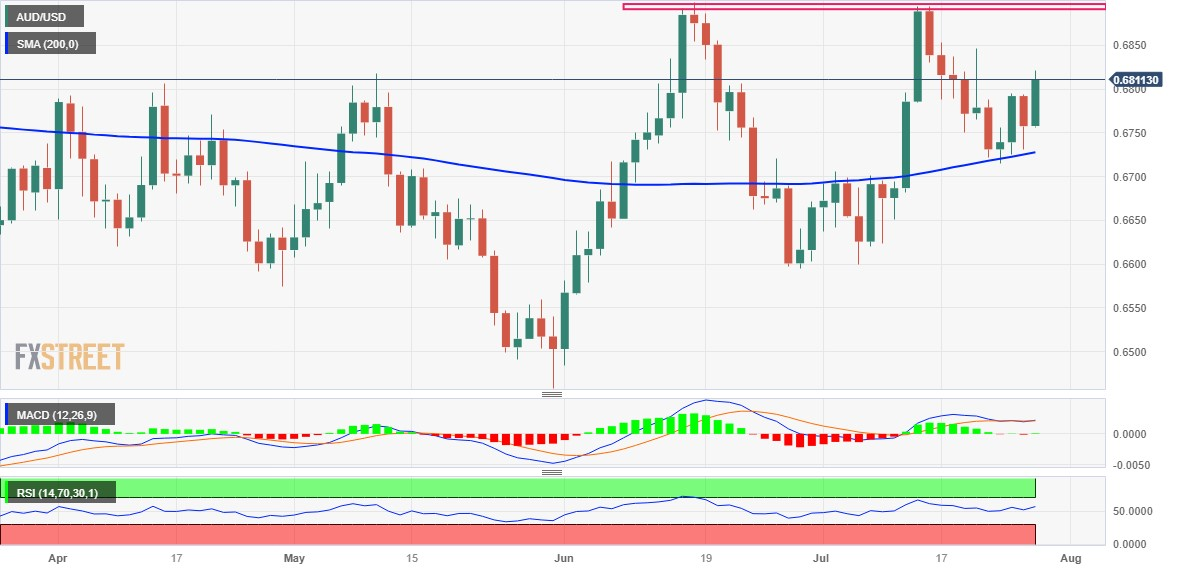
Key levels to watch
- Gold price strengthens as the scale of interest-rate hike by the Fed met expectations.
- The US Dollar Index is facing wrath due to the Fed’s less-hawkish guidance.
- Investors will keenly watch GDP numbers, Durable Goods Orders, and weekly Jobless claims on Thursday.
Gold price (XAU/USD) recovers firmly as investors hope that the Federal Reserve (Fed) pushed interest rates higher for the final time this year on Wednesday. The precious metal remains on the buying list on Wednesday after the Fed raised interest rates by 25 basis points (bps) to 5.25%-5.50%, as expected by market participants. Also, the Fed delivered less-hawkish guidance for the September meeting and passed on responsibility for any further action on economic data.
The US Dollar Index (DXY) is going through tough times as investors hope that the United States central bank has put the last nail in the coffin. Markets see the interest-rate hike in July as the last one in the current aggressive policy tightening spell, and expect that the Fed will keep rates steady ahead. Adding to that, receded fears of a recession in the United States acts as the cherry on the cake for US Dollar bears.
Daily Digest Market Movers: Gold price accelerates as Fed interest rates look to have peaked
- Gold price rebounds after a corrective move prompted by less-hawkish guidance from the Federal Reserve in its July monetary policy decision announced on Wednesday.
- The Fed raised interest rates by 25 bps to 5.25%-5.50% as expected by market participants.
- About interest rate guidance, Fed Chair Jerome Powell left the door open for more interest-rate hikes if economic indicators remain supportive.
- Less-hawkish monetary policy from the Fed has improved the risk appetite of market participants.
- The US Dollar Index (DXY) retreats after a less-confident pullback move to near the 101.00 resistance level as investors hope that interest rates by Fed are peaked for this year.
- Also, fears of a recession in the United States have receded significantly as Fed Chair Jerome confirmed the central bank's staff no longer expects an economic downturn.
- The odds of a recession in the US economy have faded meaningfully due to the tight labor market.
- US firms are consistently adding fresh talent even at higher wages to offset labor shortages. This indicates that the economy is resilient despite tight credit conditions and aggressive policy tightening.
- Fears of a rebound in consumer inflation expectations are increasing as a tight labor market could support consumer spending.
- After Fed policy decisions, investors are awaiting Gross Domestic Product (GDP) figures for the second quarter, June’s Durable Goods Orders, and core Personal Consumption Expenditure (PCE) data.
- As per the preliminary report, US GDP is expected to expand at a pace of 1.8%, slower than the 2.0% pace recorded in the previous quarter.
- The Congressional Budget Office (CBO) revised its forecast for US economic growth for 2023 substantially upward to 0.9% compared with the 0.1% forecast released in February. Economic prospects were lifted in the face of a stronger-than-expected labor market, Reuters reported.
- Meanwhile, Durable Goods Orders for June are expected to expand by 1.0% on month, easing from the 1.8% increase recorded in May. Decent momentum in demand for durable goods might keep core inflation stubborn ahead.
- Core PCE data, used by the Fed to gauge inflation, is expected to drop to 4.2% in June vs. the 4.6% figure released in May. PCE data will be published on Friday.
Technical Analysis: Gold price approaches $2,000
Gold price shifts into a bullish trajectory after a breakout of the consolidation formed in a range between $1,955 and $1,968. The precious metal is swiftly approaching its monthly high of $1,987.35 as investors expect that the Fed has ended the policy-tightening spell for the year. The yellow metal is expected to recapture the psychological resistance of $2,000.00.
Gold price tests the 50% Fibonacci retracement (plotted from May 4 high at $2,067.00 to June 29 low at $1,893) at $1,980.00. Momentum oscillators have climbed into bullish territory, indicating strength in the upside momentum.
Fed FAQs
What does the Federal Reserve do, how does it impact the US Dollar?
Monetary policy in the US is shaped by the Federal Reserve (Fed). The Fed has two mandates: to achieve price stability and foster full employment. Its primary tool to achieve these goals is by adjusting interest rates.
When prices are rising too quickly and inflation is above the Fed’s 2% target, it raises interest rates, increasing borrowing costs throughout the economy. This results in a stronger US Dollar (USD) as it makes the US a more attractive place for international investors to park their money.
When inflation falls below 2% or the Unemployment Rate is too high, the Fed may lower interest rates to encourage borrowing, which weighs on the Greenback.
How often does the Fed hold monetary policy meetings?
The Federal Reserve (Fed) holds eight policy meetings a year, where the Federal Open Market Committee (FOMC) assesses economic conditions and makes monetary policy decisions.
The FOMC is attended by twelve Fed officials – the seven members of the Board of Governors, the president of the Federal Reserve Bank of New York, and four of the remaining eleven regional Reserve Bank presidents, who serve one-year terms on a rotating basis.
What is Quantitative Easing (QE) and how does it impact USD?
In extreme situations, the Federal Reserve may resort to a policy named Quantitative Easing (QE). QE is the process by which the Fed substantially increases the flow of credit in a stuck financial system.
It is a non-standard policy measure used during crises or when inflation is extremely low. It was the Fed’s weapon of choice during the Great Financial Crisis in 2008. It involves the Fed printing more Dollars and using them to buy high grade bonds from financial institutions. QE usually weakens the US Dollar.
What is Quantitative Tightening (QT) and how does it impact the US Dollar?
Quantitative tightening (QT) is the reverse process of QE, whereby the Federal Reserve stops buying bonds from financial institutions and does not reinvest the principal from the bonds it holds maturing, to purchase new bonds. It is usually positive for the value of the US Dollar.
A widely expected 25 bps hike from the Fed initially caused barely a ripple for the Dollar. However, the USD did soften marginally through Chair Powell’s press conference. Economists at ING analyze Greenback’s outlook.
EUR/USD should drift up to 1.12 and 1.15 by the end of September and December respectively
As elsewhere in the world it looks increasingly like the Dollar trend will be driven more by the data than central bank communication. Indeed, we may not hear much from the Fed before the Jackson Hole Fed symposium on 24-26 August.
In terms of the data, our house call for further signs of US disinflation and slowing activity may deliver a gentle Dollar bear trend into the next FOMC meeting in late September. The problem for Dollar bears like ourselves is that growth prospects overseas do not look particularly compelling – especially in the Eurozone where stagnation is at risk of turning into a contraction. On balance, we think the US disinflation story will dominate, however, and that EUR/USD should drift up to 1.12 and 1.15 by the end of September and December respectively.
Given quite a few unanswered questions it is no surprise that cross market volatility remains quite low and that investors remain enamored with the carry trade. This will keep the JPY on the back foot – unless the Bank of Japan surprises on Friday – and maintain the demand for the market’s favourite EM high yielders such as the MXN and the HUF.
Economists at MUFG Bank analyze how the ECB’s policy update could impact the Euro.
Will the ECB commit to another hike later this year?
The ECB will deliver another 25 bps hike today but we do not expect the ECB to commit strongly to hiking rates again at the next policy meeting in September.
The ECB will still leave the door open to one final hike later this year but it will emphasize that future policy decisions will be data dependent. One reason why the ECB could still deliver a final hike in September is that it has been focusing on core inflation and wage growth recently which are expected to remain uncomfortably strong over the summer.
Without a strong commitment to another hike in September, the Euro could sell off and drag EUR/USD back towards the 1.1000 level. The Euro should weaken more though against other G10 currencies today.
See – ECB Preview: Forecasts from 12 major banks, the final 25 bps?
- Silver scales higher for the third straight day and climbs to a fresh weekly high on Thursday.
- The technical setup seems tilted in favour of bulls and supports prospects for further gains.
- A sustained break below the $24.00 mark is needed to negate the near-term positive bias.
Silver gains strong follow-through positive traction for the third successive day on Thursday and climbs to a fresh weekly top during the early part of the European session. The white metal currently trades just above the $25.00 psychological mark and remains well within the striking distance of over a two-month peak touched last week.
The technical setup, meanwhile, favours bullish traders and suggests that the path of least resistance for the XAG/USD is to the upside. The positive outlook is reinforced by the fact that oscillators on hourly/daily charts are holding comfortably in bullish territory and are still far from being in the overbought zone. That said, it will still be prudent to wait for some follow-through buying beyond the $25.25 area, or the monthly peak, before positioning for any further appreciating move.
The XAG/USD might then accelerate the positive momentum towards the $25.50-$25.55 intermediate hurdle and eventually aim towards reclaiming the $26.00 round figure. This is closely followed by the YTD peak, around the $26.10-$26.15 area touched in May. A sustained strength beyond will be seen as a fresh trigger for bullish traders and pave the way for additional gains.
On the flip side, any corrective pullback is more likely to attract some buying near the $24.85-$24.80 region. This should help limit the downside for the XAG/USD near the $24.60 zone. Failure to defend the said support will expose the weekly low, around the $24.25 region, which if broken decisively will negate the positive outlook and shift the bias in favour of bearish traders. Silver might then drop further below the $24.00 mark, towards the $23.65-$23.60 support.
The XAG/USD could then extend the downward trajectory further towards the $23.20-$23.15 region. Some follow-through selling below the $23.00 mark, nearing the very important 200-day SMA, will make silver vulnerable to challenge the multi-month low, around the $22.15-$22.10 area.
Silver daily chart
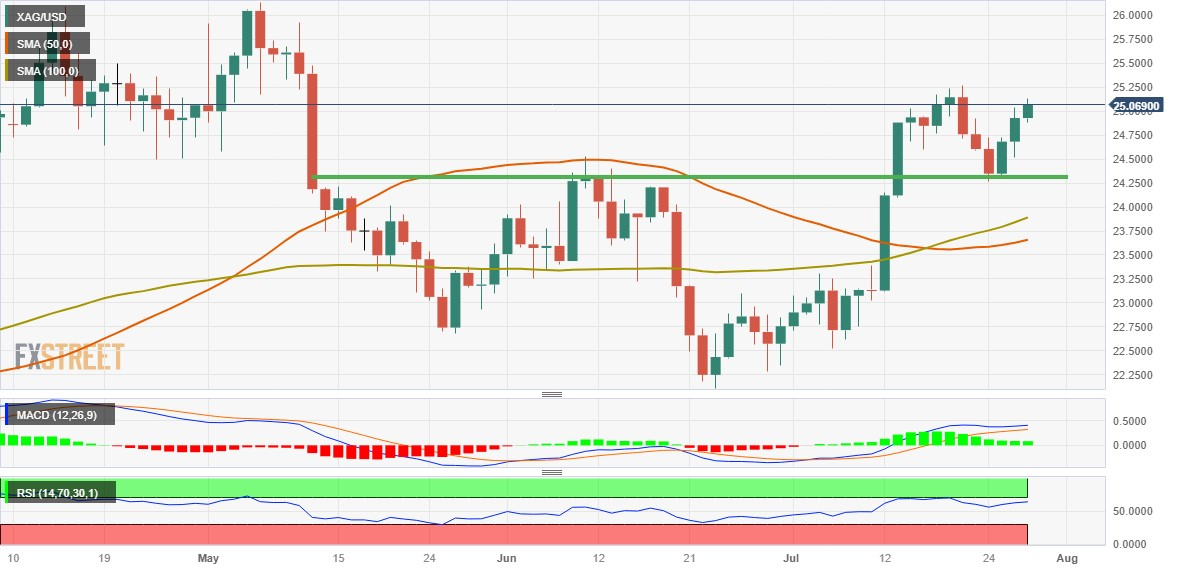
Key levels to watch
- The index loses further ground post-FOMC.
- The dollar retreats to multi-session lows near 100.60.
- Flash Q2 GDP, Durable Goods Orders, weekly Claims next on tap.
The greenback, in terms of the USD Index (DXY), extends the weekly decline to the area of multi-session lows near 100.60 on Thursday.
USD Index looks at data, ECB
The index trades on the defensive for the third consecutive session and breaks below the 101.00 support with certain conviction on Thursday.
The dollar exacerbates its decline as investors continue to assess Wednesday’s FOMC event, where the Fed raised the Fed Funds Target Range (FFTR) by 25 bps as widely anticipated, and Chief Powell stressed at his press conference that further decisions on rates will depend on upcoming data.
Very interesting session in the US docket with the releases of flash Q2 GDP figures, usual weekly Claims, Durable Goods Orders, Pending Home sales, and advanced Goods Trade Balance.
What to look for around USD
The index loses further impulse and retreats to sub-101.00 levels in the wake of the largely telegraphed Fed’s decision to hike rates on Wednesday.
In the meantime, the dollar appears poised to face extra headwinds in response to the data-dependent stance from the Fed against the current backdrop of persistent disinflation and cooling of the labour market.
Furthermore, speculation that the July hike might have been the last of the current hiking cycle is also expected to keep the price action around the dollar depressed for the time being.
Key events in the US this week: Durable Goods Orders, Advanced Q2 GDP Growth Rate, Initial Jobless Claims, Flash Goods Trade Balance, Pending Home Sales (Thursday) – PCE, Core PCE, Personal Income, Personal Spending, Final Michigan Consumer Sentiment (Friday).
Eminent issues on the back boiler: Persistent debate over a soft/hard landing of the US economy. Terminal Interest rate near the peak vs. speculation of rate cuts in late 2023/early 2024. Geopolitical effervescence vs. Russia and China. US-China trade conflict.
USD Index relevant levels
Now, the index is down 0.37% at 100.66 and faces immediate contention at 100.00 (psychological level) prior to 99.57 (2023 low July 13) and then 97.68 (weekly low March 30). On the flip side, the breakout of 101.64 (weekly high July 25) would open the door to 102.57 (55-dat SMA) and finally 103.54 (weekly high June 30.
The FOMC hiked the fed funds target range by 25 bps to 5.25-5.50%. The decision lifted EUR/USD close to 1.11. Economists at Danske Bank analyze the pair’s outlook.
Relative strength of the US economy to weigh on the EUR/USD
The Fed hiked rates by 25 bps to 5.25-5.50% as widely anticipated. We make no changes to our Fed call and still think this was the final hike of the cycle.
Powell’s tone was balanced, as he gave few new signals on the future rate outlook. Markets interpreted this slightly dovish, as the latest ‘dots’ from June were still clearly in favour of one more hike beyond July.
There were no surprises from the Fed, and hence it does not give us reason to change our FX view. We maintain our strategic case for a lower EUR/USD.
We expect the relative strength of the US economy to weigh on the EUR/USD in the coming months, and we continue to forecast the cross at 1.06/1.03 in 6/12M. Today, we expect a relatively muted market reaction on the back of the ECB meeting. If anything, EUR/USD could move lower if the ECB does not deliver any firm signs of a September hike.
- USD/MXN is seen consolidating in a narrow trading band through the early European session.
- The technical setup favours bearish traders and supports prospects for a retest of the YTD low.
- A move back above the 23.6% Fibo. level is needed to negate the near-term bearish outlook.
The USD/MXN pair lacks any firm intraday direction on Thursday and oscillates in a narrow trading band, below the 16.85 level through the early European session.
From a technical perspective, spot prices currently hover around the confluence comprising of the 200-hour Simple Moving Average (SMA) and the 61.8% Fibonacci retracement level of the recent modest recovery from the lowest level since December 2015. Some follow-through selling below the overnight swing low, around the 16.80 area, will be seen as a fresh trigger for bearish traders and pave the way for a further near-term depreciating move.
Meanwhile, oscillators on the daily chart - though have been recovering - are still holding in the bearish territory and have again started gaining negative traction on hourly charts. This, in turn, suggests that the path of least resistance for the USD/MXN pair is to the downside. Hence, a subsequent slide back towards challenging the multi-year low, around the 16.70 region touched last week, looks like a distinct possibility.
Sustained weakness below the latter will be seen as a fresh trigger for bearish traders and expose the next relevant support near the 16.60 region. The USD/MXN pair could extend the downward trajectory and eventually drop to October/November 2015 lows, around the 16.3555-16.3250 area.
On the flip side, the 50% Fibo. level, around the 16.8740-16.8745 region now seems to act as an immediate strong barrier. A sustained strength beyond might trigger a short-covering move towards the 16.9200 zone en route to the 16.9600-16.9700 supply zone. The latter coincides with the 23.6% Fibo. level, which if cleared decisively will negate the negative outlook and lift the USD/MXN back above the 17.00 mark.
USD/MXN 1-hour chart
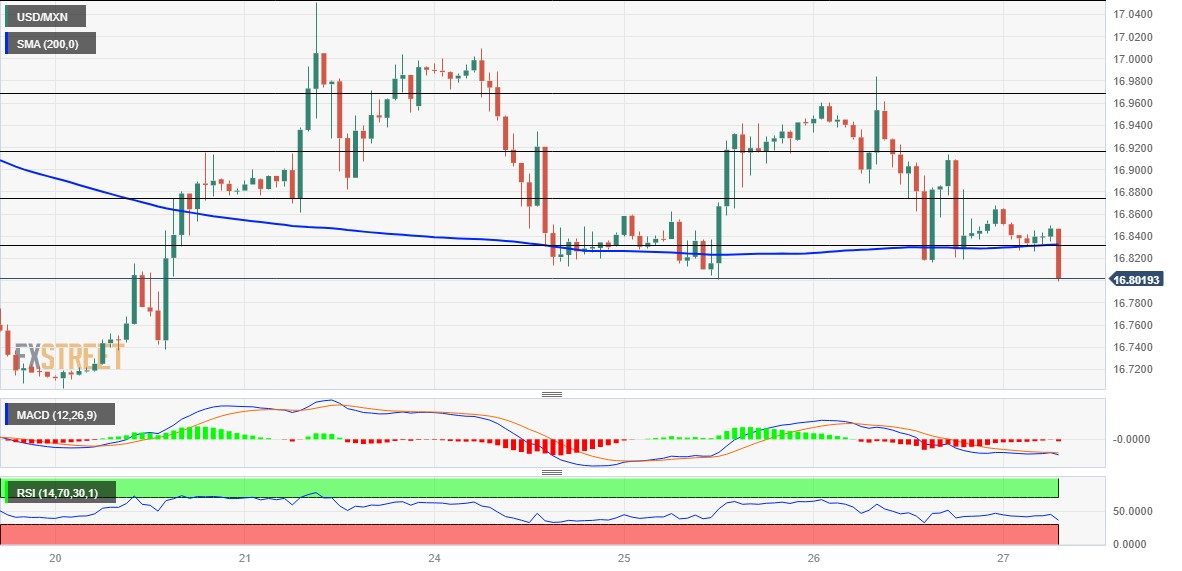
Key levels to watch
There are no changes to the consolidative mood in USD/JPY for the next few weeks, comment UOB Group’s Economist Lee Sue Ann and Markets Strategist Quek Ser Leang.
Key Quotes
24-hour view: We did not anticipate USD to drop sharply to a low of 139.91 yesterday (we were expecting range-trading). Despite the rebound from the low, the risk is tilted to the downside. However, as downward momentum is not strong, any decline is unlikely to break clearly below 139.50. Resistance is at 140.80, followed by 141.10.
Next 1-3 weeks: After USD surged to a high of 141.95 last week, we highlighted on Monday (24 Jul, spot at 141.70) that USD could rise to 143.00. USD did not make any further advance, and yesterday (26 Jul, spot at 141.00), we indicated that “the chance of USD rising to 143.00 has decreased.” In NY trade, USD fell below our ‘strong support’ level of 140.00 (low of 139.91). The breach of the ‘strong support’ level indicates that upward pressure has eased. The current price movements are likely part of a consolidation, and we expect USD to trade in a range of 138.50/141.95 for now.
CME Group’s flash data for natural gas futures markets noted traders reduced their open interest positions for yet another session on Wednesday, now by around 9.6K contracts. Volume followed suit and dropped by nearly 53K contracts, partially reversing the previous daily build.
Natural Gas: Further consolidation appears on the cards
Wednesday’s negative price action in natural gas prices was on the back of shrinking open interest and volume, which hints at the idea that a near-term rebound appears on the cards with the immediate target initially around the $2.80 mark per MMBtu.
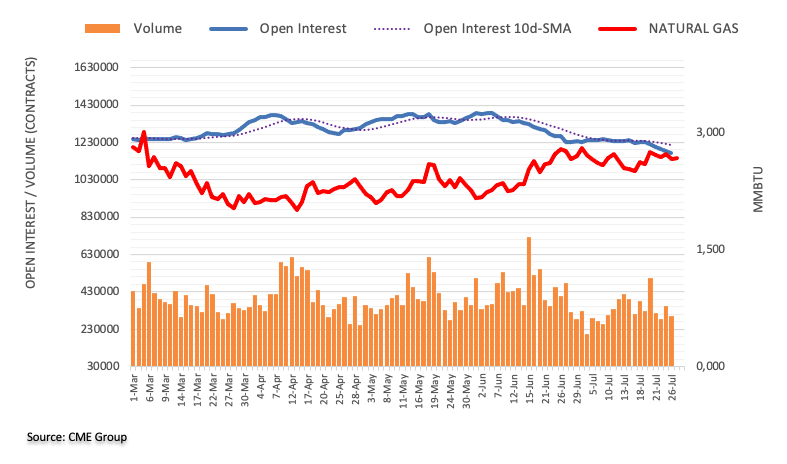
Economists at TD Securities discuss the European Central Bank (ECB) interest rate decision and their implications for the EUR/USD pair.
Hawkish (5%): 25 bps hike & bias to Sep hike
No material change to the decision vs. June. 25 bps hike and no change to balance sheet policy. President Lagarde suggests that the base case should be a hike in September and that the data has to prove otherwise. EUR/USD +0.25%.
Base Case (70%): 25 bps hike & cautious language
No material change to the decision vs. June. 25 bps hike and no change to balance sheet policy. Lagarde remains ambiguous about September – if data supports it, then the Governing Council will hike. This isn't about surprises to the data vs the June projections, but a broader statement that puts the onus on macro-dynamics to justify a hike. Lagarde says that policy moves beyond September are purely a function of data. EUR/USD -0.15%.
Dovish (25%): 25 bps hike & high bar to further hikes
No material change to the decision vs. June. 25 bps hike and no change to balance sheet policy. Lagarde makes it clear that the data has to surprise to the upside (vs ECB June projections) to see a hike in September. In other words, while it's not impossible, there's a relatively high bar to it. She doesn't say that the ECB has reached its terminal rate, but that's the implication. EUR/USD -0.75%.
A move above 0.6255 should mitigate the selling bias in NZD/USD in the short term, suggest UOB Group’s Economist Lee Sue Ann and Markets Strategist Quek Ser Leang.
Key Quotes
24-hour view: Yesterday, we expected NZD to trade in a range between 0.6185 and 0.6235. Our view was not wrong, as NZD traded close to our expected range (0.6184/0.6235). The price actions appear to be consolidative, and we continue to expect NZD to trade in a range of 0.6185/0.6235.
Next 1-3 weeks: On Monday (24 Jul, spot at 0.6175), we highlighted that improved downward momentum is likely to lead to NZD weakness to 0.6125. Since then, NZD has not been able to make any headway on the downside. Downward pressure is beginning to wane. However, only a breach of 0.6255 (no change in ‘strong resistance’ level) would suggest NZD is not weakening further.
Considering advanced prints from CME Group for crude oil futures markets, open interest extended the uptrend for yet another session on Wednesday, now by nearly 3K contracts. Volume, instead, retreated for the second session in a row, this time by around 70.6K contracts.
WTI remains capped by $80.00 so far
Prices of WTI reversed four sessions of gains on Wednesday. The daily decline came on the back of increasing open interest and a strong drop in volume and points to a potential consolidation around current levels. In the meantime, the immediate target remains at the key $80.00 mark per barrel for the time being.
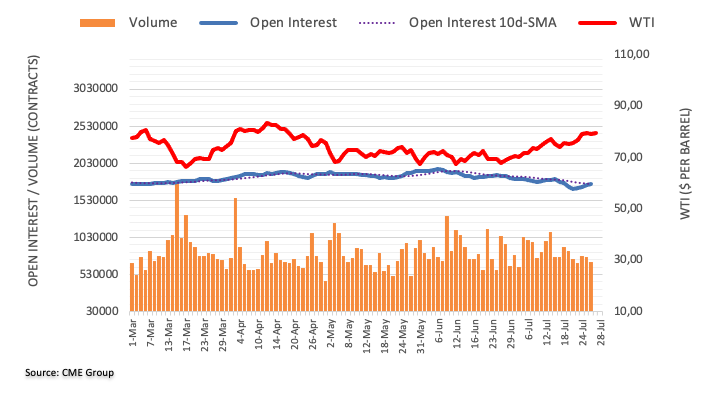
The Dollar tracked US yields and marginally softened after Wednesday's FOMC rate decision and press conference. Economists at ING analyze Greenback’s outlook.
DXY should trade within a 100.60-101.20 range
While the Dollar is a little lower today post-Fed, we would not chase the move just yet and prefer to take our cue from the data, starting with tomorrow's ECI. As we discussed in our FOMC review, the carry trade environment will still be popular and with overnight deposit rates at 5.25%, the Dollar is clearly not a funding currency.
Barring any hawkish surprise from the ECB today, DXY should trade within a 100.60-101.20 range.
- USD/JPY loses momentum after reaching the 140.25 mark in the Asian session.
- Investors have closely watched the trajectory of Japan's ultra-loose monetary policy.
- The US dollar fell across the board following the Federal Reserve's (Fed) decision.
- Market players will focus on US Q2 GDP, weekly Jobless claims, and Durable Goods Orders later in the day.
The USD/JPY pair remains under pressure and struggles to gain above the 140.00 mark heading into the early European session on Thursday. The major drops for the fourth consecutive day and currently trades around 139.85, down 0.28% for the day.
Market participants have been closely monitoring the direction of Japan's ultra-loose monetary policy. The Bank of Japan (BoJ) will announce its interest rate decision on Friday, and investors widely anticipate the BoJ keeping monetary policy unchanged while maintaining its yield curve control (YCC) objectives of -0.1% for short-term interest rates and 0% for 10-year bond yields.
Japan's core inflation rate surpassed that of the United States for the first time in eight years. The figure came in at 3.3% in June, up from 3.2% the prior month and 3.5% expected. This report revealed that Japan's inflation remained above the BoJ's target of 2% for the 15th consecutive month.
The Japanese inflation data suggest that policymakers will likely maintain a dovish stance in order to keep inflation above 2%. BoJ officials added that central banks prefer to examine more data before adjusting monetary policy. The monetary policy divergence between the BoJ and Fed might exert pressure on the Japanese Yen against its major rivals and could be a headwind for the USD/JPY pair.
On the US Dollar front, the Federal Reserve raised interest rates by a quarter percentage point to a target range of 5.25%–5.5%. The Greenback fell across the board following the Fed's decision and statement. The US dollar Index (DXY), a measure of the value of the Greenback against six other major currencies, weakened to 100.65 and rebounded to 100.90 on Wednesday.
Fed Chairman Jerome Powell stated following the rate decision that inflation has moderated somewhat since the middle of last year, but the Fed's 2% target has a long way to go. Powell reiterated that another rate hike is possible. He added that the Fed will consider the incoming data for additional rate hikes if needed. The hints that the Fed could be close to the end of its rate-hike cycles might cap the upside in the US Dollar.
Moving on, market participants will focus on the US preliminary GDP QoQ, the weekly Jobless Claims and Durable Goods Orders for June, which are due later in the day. The focus will shift to the BoJ meetings scheduled for Friday. Investors will monitor this development and find opportunities around the USD/JPY pair.
Today, all eyes will be on the ECB. Economists at ING analyze EUR/USD outlook ahead of the Monetary Policy Decision.
Hawkish ECB, but will we hear more about QT?
Assuming the ECB does maintain market expectations that the deposit rate (now 3.50%) will be close to 4.00% by the end of the year, what else could we see?
One intriguing idea is that the hawks, in exchange for backing off from subsequent rate hikes, will be given something on quantitative tightening. Currently, re-investments of the APP scheme ended last month. PEPP reinvestments are targeted to continue until the end of 2024. Could PEPP reinvestments be cut shorter, or could the discussion move onto outright asset sales – moves that might upset both peripheral government bond markets and European credit markets? The market reaction might be tricky, but presumably, EUR/CHF could stay under pressure should this be the case.
We do not have a strong conviction call on EUR/USD today but would say 1.1150 looks good intra-day resistance and 1.1000/1020 is now the lower end of the near-term trading range.
See – ECB Preview: Forecasts from 12 major banks, the final 25 bps?
- European Central Bank is set to deliver another 25 bps rate hike on Thursday.
- Lagarde could fan expectations of a September rate hike pause.
- The ECB decision and Lagarde’s presser likely to ramp up volatility around the Euro.
European Central Bank (ECB) is expected to keep up the rate hike path when it meets on July 27, Thursday, to decide on its monetary policy. EUR/USD is flirting with 1.1100 after reaching its highest level in 17 months above 1.1200 last week, as we progress toward the ECB policy announcements.
There are no updated staff projections due for publication following the July meeting but ECB President Christine Lagarde will address the usual post-meeting news conference at 12:45 GMT.
European Central Bank interest rate decision: What to know in markets on Thursday, July 27
- EUR/USD is keeping its range around 1.1100, as the US Dollar (USD) nurses losses induced by the US Federal Reserve’s (Fed) dovish rate outlook.
- The Fed raised rates by the widely expected 25 basis points (bps) to a 22-year high of 5.25%-5.50% and left doors open for more tightening without committing to the timing of the next lift-off.
- Powell refrained from providing any forward guidance, emphasizing a ‘data-dependent’ and ‘meeting-by-meeting’ approach.
- US S&P 500 futures capitalize on risk flows while the benchmark 10-year US Treasury bond yield holds lower ground near 3.85%.
- On Tuesday, Germany’s IFO Business Climate Index declined to 87.3 in July versus last month's 88.6 and the consensus forecast of 88.0. the Institute’s Economist Klaus Wohlrabe said that the “German GDP likely to shrink in the 3rd quarter.”
- US Conference Board's Consumer Confidence Index rose to 117.0 from 110.1 (revised from 109.7) in June. The gauge showed the continued improvement in the US consumer sentiment in July.
- The ECB event will likely provide short-term direction in the EUR/USD pair while the markets will seek fresh trading incentives from the US advance Q2 GDP and Jobless Claims data.
ECB interest rates expectations and implications for EUR/USD
European Central Bank is likely to increase interest rates by 25 basis points (bps) on Thursday at 12:15 GMT, raising the Deposit Rate from 3.50% to 3.75%. Such a rate hike is fully baked in, with probability standing at roughly 97%. The central bank delivered a 25 bps rate hike in June, slowing down its pace of increase amid mounting recession fears.
Early July, President Lagarde said in an interview with La Provence, “we still have work to do to bring inflation back down to our target.” “We need to bring rates into “sufficiently restrictive” territory to lock in our policy tightening, she mentioned in her introductory speech at the ECB Forum on Central Banking, in Sintra, last month.
Meanwhile, at the July post-meeting press conference, Lagarde argued, "Are we done? Have we finished the journey? No. We're not at our destination. Do we still have ground to cover? Yes, we still have ground to cover.”
Lagarde stuck to her hawkish rhetoric that the ECB remains committed to bringing down inflation to its 2.0% target, and thus, justifying the expected 25 bps rate hike this month.
Heading into the critical ECB decision, Eurozone Harmonised Index of Consumer Prices (HICP) inflation stands at 5.5% in June, sharply down from May’s 6.1% increase. The bloc’s Core HICP showed a softer-than-expected increase of 5.4% YoY in June, compared with forecasts of a 5.5% clip.
Soft Eurozone inflation data prompted several ECB policymakers to push back against expectations of another rate increase in September. It was the dovish remarks from a notable hawk, Governing Council member Klaas Knot, last week that paused the ongoing uptrend in the EUR/USD pair. Knot said rate hikes beyond July are likely but not certain.” His colleague Ignazio Visco noted that “inflation may drop more quickly than forecast.”
When asked in an interview with CGTN Europe, what would argue in favor of ending the rate increases rather than going further, ECB policymaker Yannis Stournaras said, "the argument that inflation is falling and we have found out that we are at the optimal point that further increases of interest rates might damage the economy."
The recent dovish shift in the ECB communication suggests that the Bank’s cues on the interest rates path in September are expected to be of utmost importance for the next direction in the Euro, eventually impacting the EUR/USD valuations.
Further, the dovish ECB expectations are justified by the disappointing Eurozone and German preliminary Manufacturing and Services PMIs for July, which added credence to the view that the bloc is heading for a recession.
The Euro could see a sharp correction on Lagarde’s dovish signals on a probable rate hike pause after July, smashing the EUR/USD pair toward 1.1000. Conversely, the main currency pair could scale new peaks beyond 1.1300 if the policy guidance reads hawkish and indicates another rate hike in September.
Meanwhile, Dhwani Mehta, Asian Session Lead Analyst at FXStreet, offers a brief technical outlook for the major and explains: “EUR/USD is trading on the front foot, although lacks follow-through ahead of the key ECB event. The 14-day Relative Strength Index (RSI) is sitting above the 50 level, keeping the bullish potential intact for Euro buyers.”
Outlining important technical levels to trade the EUR/USD pair, Dhwani notes: “On the upside, EUR/USD buyers need to resist above the 1.1100 barrier on a sustained basis to take out the static resistance near 1.1150. Euro buyers will then target a break above the 1.1200 round level. Alternatively, the bullish 21-Daily Moving Average (DMA) at 1.1051 will offer strong support to the pair, below which a sharp sell-off toward the 1.1000 psychological mark cannot be ruled out. The July 11 low of 1.0977 will be the next relevant downside cushion.”
About the ECB interest rate decision
ECB Interest Rate Decision is announced by the European Central Bank. Usually, if the ECB is hawkish about the inflationary outlook of the economy and rises the interest rates it is positive, or bullish, for the EUR. Likewise, if the ECB has a dovish view on the European economy and keeps the ongoing interest rate, or cuts the interest rate it is seen as negative, or bearish.
- USD/CAD prints the first daily loss in three but lacks momentum of late.
- Two-week-old triangle restricts immediate Loonie moves at yearly low.
- Month-long horizontal support, 1.3250 resistance confluence act as additional trading filters.
- US Q2 GDP eyed after Fed failed to impress pair buyers.
USD/CAD remains on the back foot around the intraday low, despite lacking downside momentum heading into Thursday’s European session.
In doing so, the Loonie pair prints the first daily loss in three as markets await the first readings of the US Gross Domestic Product (GDP) Annualized for the second quarter (Q2), expected to ease to 1.8% from 2.0%. Also important to watch is the US Durable Goods Orders for June, likely easing to 1.0% from 1.8% prior (revised), as well as the monetary policy announcements from the European Central Bank (ECB).
That said, the Loonie pair remains within a fortnight-old triangle formation, currently between 1.3150 and 1.3225, following its corrective bounce off the lowest levels since September 2022 marked during mid-July.
It’s worth noting that the RSI (14) conditions suggest a continuation of a slower grind toward the south.
However, a one-month-old horizontal support zone near 1.3120-15 and the 1.3100 round figure may provide additional checks to the USD/CAD bears before directing them to the tops marked during May and June of 2022, close to 1.3080-75.
On the flip side, a convergence of the 200-Exponential Moving Average (EMA) and a descending resistance line from May 31, close to 1.3250 at the latest, appears a tough nut to crack for the USD/CAD bulls, apart from the stated triangle’s top line surrounding 1.3225.
In a case where the Loonie pair manages to remain firmer past 1.3225, the odds of witnessing a rally toward the monthly high of around 1.3390 can’t be ruled out.
USD/CAD: Four-hour chart
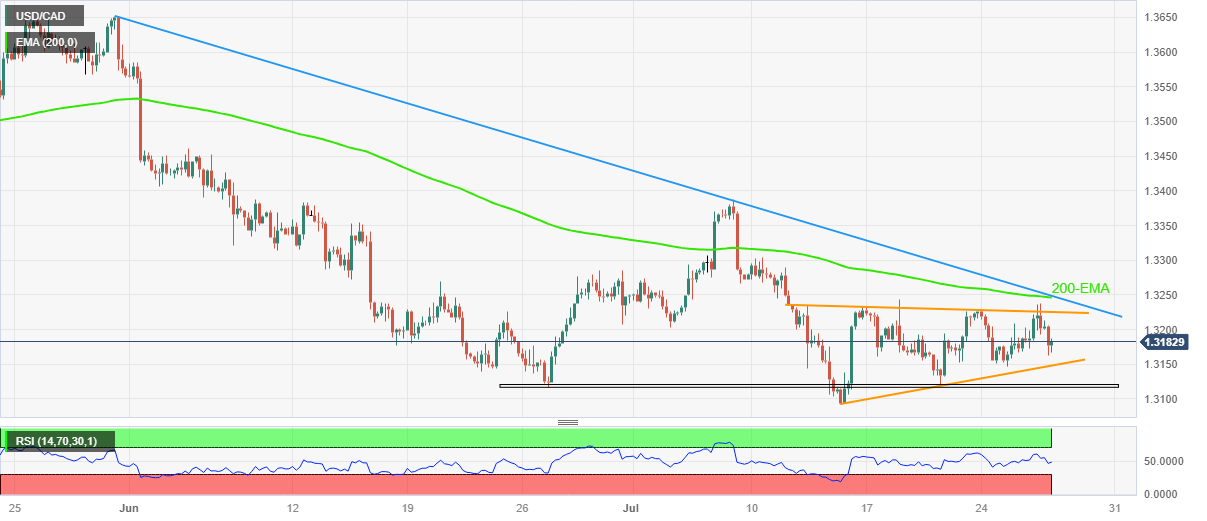
Trend: Limited downside expected
Here is what you need to know on Thursday, July 27:
The US Dollar is struggling to find demand on Thursday following the Federal Reserve's policy announcements and Chairman Jerome Powell's press conference. Although markets seem to have calmed down in the European morning, the European Central Bank's (ECB) interest rate decision and the second-quarter Gross Domestic Product (GDP) data from the US could ramp up volatility in the second half of the day. The US economic docket will also feature Durable Goods Orders, weekly Initial Jobless Claims and Pending Home Sales data for June.
As expected, the Fed raised its policy rate by 25 basis points to the range of 5.25-5.5% after July policy meeting. There were only minor changes to the policy statement when compared to June. In the post-meeting press conference, Chairman Jerome Powell acknowledged that the policy was already restrictive and refrained from confirming another rate hike later in the year, triggering a decline in US T-bond yield and weighing on the USD. Early Thursday, the US Dollar Index consolidate its losses slightly below 101.00 and the 10-year US T-bond yield stays in negative territory at around 3.85%.
Federal Reserve Analysis: Quiet end to hikes? Powell calls for patience, markets set to party.
The ECB is also forecast to raise key rates by 25 bps. President Christine Lagarde's comments on policy outlook in the face of growing signs of economic slowdown in the Euro area will be scrutinized by participants.
ECB Preview: Another hike, but what next?
The US economy is forecast to grow at an annual rate of 1.8% in Q2 following the 2% expansion recorded in the first quarter.
US Q2 GDP Preview: Strong figures could help US Dollar in a “data-dependent” world.
EUR/USD snapped a seven-day losing streak on Wednesday and continued to push higher toward 1.1100 early Thursday.
GBP/USD closed in positive territory on Wednesday and touched its highest level in over a week near 1.2980 in the Asian session on Thursday. The pair stays in a consolidation phase and trades below 1.2950 in the European session.
USD/JPY extended its weekly downtrend and fell below 140.00 before recovering above that level on Thursday. The Bank of Japan will announce its monetary policy decisions in the Asian trading hours on Friday.
Gold benefited from retreating T-bond yields and advanced to a fresh weekly high above $1,980 in the Asian session on Thursday. Ahead of the key US data releases, however, XAU/USD lost its bullish momentum and retreated toward $1,970.
Bitcoin showed no noticeable reaction to the Fed policy decisions and extended its sideways grind at around $29,500. Ethereum registered small gains on Wednesday but lost its traction after testing $1,900.
The Fed decided to raise key interest rates by another 25 bps. Economists at Commerzbank see the peak in key rates as having been reached.
The Fed hikes another 25 bps
As expected, the Fed raised its key interest rates by 25 bps. The target range for Fed funds now stands at 5.25%-5.50%.
The Fed kept the option open for further interest rate hikes; anything else would also have been very surprising.
We expect weaker economic and inflation data in the coming months and therefore see the peak in key rates as having been reached.
FX option expiries for July 27 NY cut at 10:00 Eastern Time, via DTCC, can be found below.
- EUR/USD: EUR amounts
- 1.0950 2.6b
- 1.0970 1b
- 1.0990 1.1b
- 1.1000 450m
- 1.1025 1.4b
- 1.1100 3.4b
- 1.1150 1b
- 1.1250 1.2b
- GBP/USD: GBP amounts
- 1.3020 320m
- USD/JPY: USD amounts
- 139.50 886m
- 140.00 973m
- 140.50 357m
- 141.00 1b
- 142.00 929m
- 143.00 381m
- 143.15 351m
- 143.40 570m
- USD/CHF: USD amounts
- 0.8675 540m
- 0.8790 360m
- 0.8975 379m
- AUD/USD: AUD amounts
- 0.6615 484m
- 0.6730 835m
- 0.6750 475m
- 0.6825 563
- 0.6840 543m
- 0.6900 657m
- USD/CAD: USD amounts
- 1.3150 415m
- NZD/USD: NZD amounts
- 0.6035 880b
- 0.6100 360m
- 0.6135 508m
- EUR/GBP: EUR amounts
- 0.8650 997m
- 0.8900 607m
The Kiwi rallied a touch following Fed Chair Powell’s post FOMC press conference. Economists at ANZ Bank analyze NZD outlook.
NZD no longer has carry in its corner
With no major local data for the remainder of the week, the focus remains on offshore events (especially the ECB meeting) and on longer term themes. Regarding the latter, it’s becoming harder to build a bullish NZD story, and perhaps stability is the best that might come.
A stronger economy would warrant more hikes, increasing the risk of a hard landing, but equally a slowing economy could weigh on the Kiwi, especially as global policy tightening bites.
With the Fed policy rate now on par with the OCR, the NZD no longer has carry in its corner either, but going the other way, oil and commodity prices are bouncing, so it’s all very mixed.
GBP/USD is now seen within the 1.2800-1.3100 range in the next few weeks according to UOB Group’s Economist Lee Sue Ann and Markets Strategist Quek Ser Leang.
Key Quotes
24-hour view: We highlighted yesterday that GBP “could rebound further to 1.2950”. We added, “The major resistance at 1.3000 is unlikely to come into view.” In line with our expectations, GBP rebounded further (high was 1.2960). Upward momentum has improved a tad, and today, GBP could rise to 1.2975 before the risk of a pullback increases. The major resistance at 1.3000 is still unlikely to come under threat. On the downside, if GBP breaks below 1.2880 (minor support is at 1.2900), it would mean that the current upward pressure has eased.
Next 1-3 weeks: Our update from yesterday (26 Jul, spot at 1.2895) is still valid. As highlighted, the recent downward pressure has faded. For now, we expect GBP to trade in a range, probably between 1.2800 and 1.3100.
- EUR/GBP remains on the back foot at weekly low during four-day losing streak, holds lower ground of late.
- Oversold RSI (14) conditions, pre-ECB anxiety check pair sellers targeting six-week-old horizontal support.
- Intraday buyers need validation from 0.8585 to retake control.
EUR/GBP languishes near the weekly low surrounding 0.8560 as bears struggle ahead of Thursday’s all-important European Central Bank (ECB) monetary policy decision. Even so, the cross-currency pair remains bearish for the fourth consecutive day, poking the lowest level since July 14 of late.
It should be noted that the pre-ECB consolidation joins the oversold conditions of the Relative Strength Index (RSI) line, placed at 14, to challenge the EUR/GBP bears. However, the bearish MACD signals join dovish expectations from the ECB, despite a likely 0.25% rate hike, to keep the sellers hopeful.
Also favoring the EUR/GBP bears is the pair’s inability to cross the key moving averages during early Wednesday’s corrective bounce.
With this, the cross-currency pair appears well set to test the 10-week-old horizontal support zone surrounding 0.8520. However, the 11-month low near 0.8500, marked earlier in July, could test the EUR/GBP bears afterward.
In a case where the quote remains bearish past 0.8500, it becomes vulnerable to drop toward the February 2022 peak of near 0.8475.
On the flip side, the 200-SMA level of 0.8580 guards the immediate upside of the EUR/GBP pair ahead of the convergence of the 100-SMA and one-week-old descending resistance line, close to 0.8585 by the press time.
Following that, the quote may aim for the tops marked on June 22 and 28, respectively near 0.8635 and 0.8660, before challenging the monthly top of 0.8700.
EUR/GBP: Four-hour chart
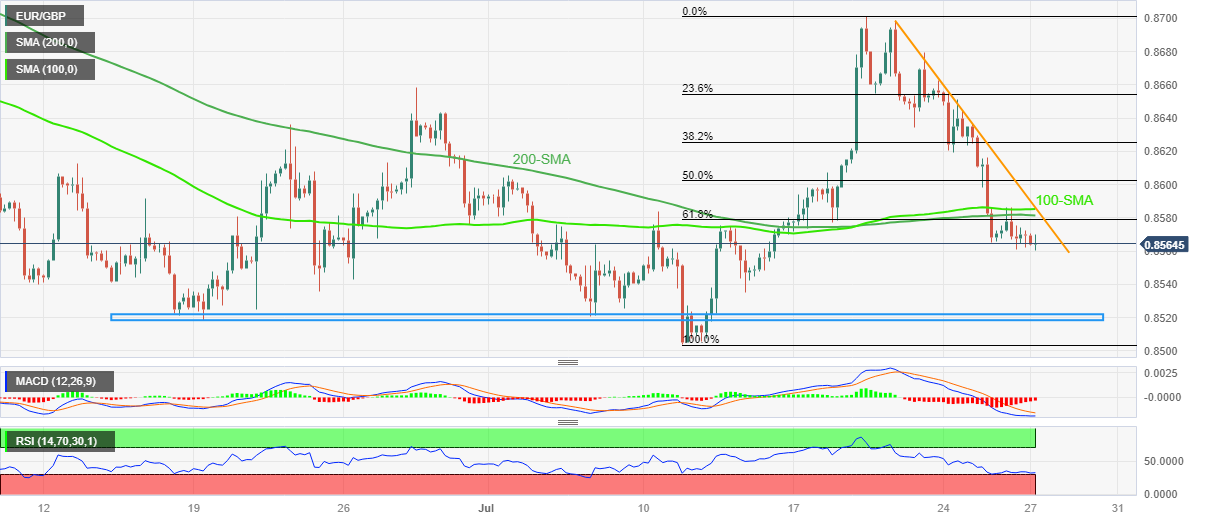
Trend: Limited downside expected
EUR/DKK has climbed steadily in July after a short-lived dip below 7.4460 on 30 June. Economists at ING analyze the pair’s outlook.
DN to follow the ECB with a 25 bps hike in September
It seems quite likely that DN can keep stirring away from FX intervention and continue to follow the ECB’s pace of tightening.
We expect the DN to follow the ECB with a 25 bps hike in September.
In line with our call for a higher EUR/USD, we expect EUR/DKK to keep inching higher and round up to 7.46 around the turn of the year.
- Gold price recovery lost momentum after climbing to the $1,982 mark.
- Additional rate hikes from the central banks might cap the upside in the gold price.
- Market participants are watching the development of a stimulus plan in China.
- Traders will focus on the second quarter's US Gross Domestic Product (GDP).
Gold price (XAU/USD) loses its traction after rising towards $1,982 heading into the early European session. Precious metals trade on a positive note for the third successive day on Thursday. XAU/USD currently trades near $1,975, up 0.19% for the day.
As expected, the Federal Open Market Committee (FOMC) hiked its interest rate by 25 basis points (bps) to a target range of 5.25%–5.5%. The rate was last seen just before the housing market collapse in 2007 and marked the highest level in more than 22 years.
Fed Chairman Jerome Powell stated following the rate decision that inflation has moderated somewhat since the middle of last year but that the Fed's 2% target "has a long way to go. Even so, Powell left room for the Fed to keep rates unchanged at its September meeting. He added that the Fed will consider the incoming data for additional rate hikes if needed. The hints that the Fed could be close to the end of its rate-hike cycles might cap the downside in precious metals. It’s worth noting that gold is sensitive to rising interest rates as they raise the opportunity cost of holding non-yielding bullion.
Nevertheless, the ECB is expected to raise interest rates by 25 basis points (bps) on Thursday. Market participants speculate that the ECB will raise borrowing costs in July and September to bring inflation back to target. However, concern about the economic slowdown in the Eurozone might convince the central bank to pause rate hikes. Investors will take cues from ECB President Christine Lagarde about further monetary policy. A hawkish stance from the ECB might be a headwind for the gold price.
On the other hand, China, the world's largest gold consumer, signaled additional support for the real estate sector and a series of measures to stimulate domestic consumption amid a sluggish post-COVID recovery. This, in turn, supports further upside in the gold price. The development of an additional stimulus plan in China will be in the spotlight for gold traders.
Moving on, market participants will focus on the first readings of the US Gross Domestic Product (GDP) for the second quarter (Q2), the core Personal Consumption Expenditure (PCE) Price Index MoM, Durable Goods Orders, and Initial Jobless Claims data later in the day. These data might influence the USD price dynamics and determine short-term trading opportunities around the gold price.
Open interest in gold futures markets rose by just 140 contracts on Wednesday according to preliminary readings from CME Group. In the same line, volume went up by around 45.7K contracts, keeping the erratic performance well in place for the time being.
Gold: Next up-barrier emerges around $1987
Gold prices added to the previous daily gains on Wednesday. The move was on the back of increasing open interest and volume and is supportive of extra upside in the very near term. Against that, the immediate target appears at the July high at $1987 (July 20).
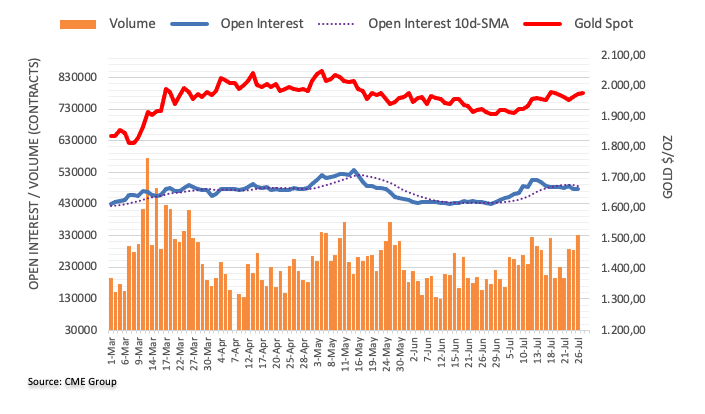
In the view of UOB Group’s Economist Lee Sue Ann and Markets Strategist Quek Ser Leang, a drop below 1.1000 in EUR/USD seems unlikely for the time being.
Key Quotes
24-hour view: Our expectations for EUR to dip to 1.1010 was incorrect as it popped briefly to a high of 1.1106 in NY trade. The current price movement are likely part of a consolidation. Today, we expect EUR to trade sideways in a range of 1.1045/1.1110.
Next 1-3 weeks: We turned negative in EUR last Friday (21 Jul), when it was trading at 1.1135. At that time, we indicated that “any decline is likely to face solid support at 1.1010.”. After EUR dropped to a low of 1.1019, we highlighted yesterday that EUR could dip below 1.1010. We added, “The probability of EUR dropping to the next major support at 1.0965 is not high for now.” We continue to hold the same view. However, it is worth noting that after the rebound yesterday (EUR closed higher for the first time in 6 days), downward momentum has slowed somewhat. Overall, only a breach of 1.1135 (no change in ‘strong resistance’ level) would indicate that 1.1010 is not coming into view.
- USD/CHF remains pressured for the third consecutive day while declining toward multi-year low marked the last week.
- US Dollar weakness fades amid cautious mood ahead of ECB, US GDP.
- Fed announces 0.25% increase in interest rates but markets expect its to be the last.
- Swiss Franc pair’s recovery remains elusive as US statistics fail to underpin September rate hike concerns.
USD/CHF bears jostle with the key support around 0.8580 as markets brace for the European Central Bank (ECB) monetary policy decision during early Thursday, making rounds to 0.8600 round figure by the press time.
Even so, the Swiss Franc (CHF) pair stays bearish for the third consecutive day amid the broad US Dollar weakness, as well as due to the market’s cautious optimism. That said, the US Dollar Index (DXY) prints a three-day downtrend despite the Federal Reserve’s (Fed) 0.25% interest rate hike, as well as readiness for an interest rate increase in September, amid fears of a sooner end to the tightening spell. Also likely to have weighed on the greenback could be expectations of witnessing further easing in the US data, which in turn will challenge the Fed from lifting the rates in September.
It’s worth observing that the US stock futures regain upside momentum targeting the yearly high marked the previous day while equities in the Asia-Pacific zone also edge higher as market participants sense a sooner end to the rate hike trajectory at the major central banks. Additionally, improvements in China data and the International Monetary Fund’s (IMF) rejection of the recession woes also underpin the market’s mildly positive outlook.
It should be noted that the Swiss National Bank (SNB) appears more hawkish compared to the Fed and hence exert downside pressure on the USD/CHF prices.
Looking ahead, the first readings of the US Gross Domestic Product (GDP) Annualized for the second quarter (Q2), expected to ease to 1.8% from 2.0%, will be important to watch for clear directions. Also crucial will be the US Durable Goods Orders for June, likely easing to 1.0% from 1.8% prior (revised), as well as the monetary policy announcements from the European Central Bank (ECB).
Technical analysis
A seven-week-old rising support line, around 0.8580 by the press time, challenges USD/CHF bears from refreshing the lowest level since 2015 by breaking the 0.8555 mark. That said, the nearly oversold RSI also prods the Swiss Franc (CHF) buyers. However, a corrective bounce remains elusive unless crossing May’s bottom of 0.8820.
- EUR/USD prints mild gains despite retreating from intraday high, up for the second consecutive day.
- US Dollar fails to cheer Fed’s 0.25% rate hike, signals for September amid fears of nearness to policy pivot.
- Recently mixed Eurozone, German data prod ECB hawks even as Lagarde might try hard to defend restrictive policy.
- US Q2 GDP, Durable Goods Orders are also important for clear directions as Fed Chair Powell rejects dovish concerns.
EUR/USD retreats from intraday high as it struggles to defend buyers around the 1.1100 round figure heading into Thursday’s European session. In doing so, the Euro pair remains firmer for the second consecutive day but lacks upside momentum amid a cautious mood ahead of the European Central Bank (ECB) monetary policy decision.
The recent growth and inflation data from Eurozone and Germany hasn’t been too positive, mostly suggesting recession, which in turn limits the ECB’s capacity to increase the benchmark interest rates even if markets are too hawkish. That said, the consensus suggests the bloc’s central bank to lift the benchmark rates by 0.25%. However, major attention will be given to ECB President Christine Lagarde’s speech as markets want to confirm future rate trajectory amid chatters of policy pivot.
That said, the US Dollar Index (DXY) prints a three-day downtrend despite the Federal Reserve’s (Fed) 0.25% interest rate hike, as well as readiness for an interest rate increase in September, amid fears of a sooner end to the tightening spell. Also likely to have weighed n the greenback could be expectations of witnessing further easing in the US data, which in turn will challenge the Fed from lifting the rates in September.
It’s worth observing that interest rate futures marked an increasing push towards a September Fed rate hike as the CME’s FedWatch Tool shows 23% chances of the same versus 21% marked on Tuesday and 13.7% a week ago. However, the odds of witnessing rate hikes past September have been mostly nil amid recently mixed data.
It should be noted that the Conference Board’s (CB) Consumer Confidence Index for July has been positive but the housing numbers for June are mixed. That said, the previously released inflation and employment clues haven’t been impressive and prod the US Dollar Index. Even so, the International Monetary Fund (IMF) raised the US economic growth forecast for 2023 to 1.8% from 1.6% forecasted in April, which in turn challenges the DXY sellers ahead of the first readings of the US Gross Domestic Product (GDP) for the second quarter (Q2). That said, the US Q2 GDP Annualized is expected to ease to 1.8% from 2.0%.
Additionally important to watch will be the US Durable Goods Orders for June, likely easing to 1.0% from 1.8% prior (revised), as well as German GfK Consumer Confidence and US Initial Jobless Claims.
Technical analysis
A one-week-old bearish channel, currently between 1.1100 and 1.0990, restricts immediate EUR/USD moves ahead of the ECB Interest Rate Decision.
- AUD/USD gains traction and reclaims the 0.6800 mark on Thursday.
- Federal Reserve (Fed) hiked the interest rate by 25 basis points (bps) to a target range of 5.25%–5.5%.
- Market participants will focus on the US Q2 GDP, Australian Retail Sales MoM.
The AUD/USD pair attracts some buyers and surges above the 0.6800 area during the Asian session on Thursday. The prevalent US Dollar selling bias supports the uptick in AUD/USD. The major pair currently trades around 0.6807, gaining 0.75% for the day.
On Thursday, the Australian Bureau of Statistics showed that the Import Price Index QoQ in the second quarter dropped 0.8%, against the market consensus of a 7.3% decline and a 4.2% drop in the previous reading. Meanwhile, the Export Price Index fell 8.5%, worse than expected, with a 7.8% rise and a 1.6% increase in the first quarter.
The softer Australian data on Wednesday suggests reasons for the Reserve Bank of Australia (RBA) to pause the additional rate hikes. Earlier this week, the Australian Bureau of Statistics (ABS) reported that the country's Consumer Price Index (CPI) rose 0.8% in the second quarter of 2023, compared to a 1.4% increase in the first quarter and the market consensus of 1.0% growth.
In the meantime, the fear of the economic slowdown in China might be a headwind for the China-proxy Aussie. On Tuesday, Chinese news agency Xinhua reported that Chinese policymakers would take up economic policy adjustments, strengthening confidence and mitigating risks. However, concern is high over whether China will deliver on its policy pledges.
Across the pond, the Federal Open Market Committee (FOMC) hiked its interest rate by 25 basis points (bps) to a target range of 5.25%–5.5%. Fed Chairman Jerome Powell stated following the rate decision that the FOMC will assess the totality of incoming data, along with its implications for economic activity and inflation. He added that it's possible to raise the Fed funds rate again at the September meeting if the data warrants it.
Market participants will digest the FOMC statement and shift their attention to the economic data. Later in the day, the US Initial Jobless Claims, Durable Good Orders for June, Advanced Gross Domestic Product (GDP) QoQ, and Core Personal Consumption Expenditure (PCE) Price Index MoM will be due. The Retail Sales MoM and the Producer Price Index (PPI) will be released on the Australian docket on Friday.
- GBP/JPY recovers from 180.80 as the BoE looks set to deliver the 14th consecutive interest rate hike.
- The IMF said on Tuesday that the BoJ should look for moving away from supportive monetary policy.
- Wage rise could force the BoJ to discuss a tweak in YCC in the next policy meetings.
The GBP/JPY pair discovered strength around 180.80 and recovered sharply in the Asian session. The cross attracts significant bids as the Bank of England (BoE)-Bank of Japan (BoJ) policy divergence is set to widen further.
Central banks in Japan and the United Kingdom are set to announce monetary policy on July 28 and August 03 respectively in which the former is expected to keep interest rates unchanged while the latter is set to tighten monetary policy further so that stubborn inflation could return to 2%.
A few days back market participants were expecting that BoJ Governor Kazuo Ueda will maintain an ultra-dovish interest rate policy along with expansionary guidance as the agenda is to keep inflation steadily above 2%.
Inflationary pressures in Japan were majorly driven by the higher cost of imported goods while domestic support was absent. The situation is changing now due to a shift in corporate behavior towards wage hikes, which is supporting domestic demand. Novel circumstances could force the BoJ to discuss a tweak in Yield Curve Control (YCC) in the next policy meetings. Also, the International Monetary Fund (IMF) said on Tuesday that the BoJ should look for moving away from supportive monetary policy.
Meanwhile, the Pound Sterling picks support as the BoE is preparing for a 14th straight interest rate hike as a victory against sticky inflation is far from sight. BoE Governor Andrew Bailey is expected to announce a 25 basis point (bp) interest rate hike, which will push interest rates to 5.25%. A poll from Reuters conveyed that interest rates in the United Kingdom will peak around 5.75%.
- Asian stocks remain firmer after Wall Street’s mixed close as central bank policy pivot looms.
- Chatters about BoJ policy tweak fails to weigh on Nikkei, stocks in China cheer reductions in industrial losses.
- Fed’s rate hike, readiness for September move can’t push back concerns suggesting nearness to peak rates.
- ECB, BOJ monetary policy decisions, US Q2 GDP eyed for clear directions.
Market sentiment in the Asia-Pacific region remains firmer, despite mixed closing of the Wall Street benchmarks, amid concerns supporting a sooner end to the rate hike spell at the major central banks. Adding strength to the optimism could be China’s upbeat industrial profits.
While portraying the mood, MSCI’s index of the Asia-Pacific shares outside Japan jumps to a five-month high while Japan’s Nikkei 225 rises 0.80% intraday to near 32,890 by the press time of early Thursday morning in Europe. It’s worth noting that US Dollar Index (DXY) fails to cheer the Fed’s 0.25% rate hike and readiness to lift the rates in September if needed while falling for the third consecutive day whereas the S&P500 Futures reverse the previous day’s pullback from the 16-month high.
Elsewhere, Australia’s ASX 200 also rise 0.80% amid mixed inflation clues whereas New Zealand’s NZX50 rises 0.70% on a day by the press time. Further, stocks in China and Hong Kong are upbeat as China's Industrial Profits for the January-June period improve to -16.8% compared to the -18.8% figure marked for the first five months of the year 2023, per China’s National Bureau of Statistics (NBS) data.
Furthermore, South Korea’s KOSPI cheers the Bank of Korea’s push for liquidity while Indonesia’s IDX Composite bucks the trend amid geopolitical concerns. Moving on, India’s GIFT Nifty and BSE Sensex also track major optimism. Additionally, the latest quarterly results from Facebook’s parent company Meta and Google's parent Alphabet have been promising to equity traders.
It should be noted that the prices of Gold and Crude Oil also remain firmer during the overall cautiously optimistic markets.
Moving on, downbeat prints of the recent Eurozone and German statistics highlight today's ECB meeting as they push it towards ending the monetary policy tightening soon even if the bloc’s central bank is expected to announce a 0.25% rate hike on Thursday.
Also downbeat expectations from the scheduled US Q2 GDP and Durable Goods Orders for June allow the market players to remain hopeful.
Also read: S&P500 Futures stay firmer around 4,600, yields edge lower as markets expect sooner end to rate hikes
- USD/INR edges lower on Thursday and stalls a two-day recovery trend from a multi-month low.
- The technical setup seems tilted in favour of bears and supports prospects for a further downfall.
- A sustained move back above the 200-day SMA is needed to negate the near-term negative bias.
The USD/INR pair struggles to capitalize on its recovery gains registered over the past two days, from the 81.65 region, or the lowest level since early May and attracts some sellers during the Asian session on Thursday. Spot prices, however, manage to recover a few pips from the daily low and currently trade around the 82.00 mark, down less than 0.10% for the day.
From a technical perspective, the recent breakdown through ascending trend-line support extending from November 2022, which coincided with the very important 200-day Simple Moving Average (SMA), favours bearish traders. Moreover, oscillators on the daily chart have just started gaining negative traction and add credence to the outlook. This, along with the prevalent US Dollar (USD) selling bias, suggests that the path of least resistance for the USD/INR pair is to the downside.
Hence, a slide back towards testing a multi-month low, around the 81.65 area touched on Tuesday, looks like a distinct possibility. The USD/INR could slide further towards the next relevant support near the 81.50 zone. Spot prices could eventually drop to test sub-81.00 levels or the YTD low set in January.
On the flip side, the 200-day SMA, currently pegged around the 82.20 region, might continue to act as an immediate strong barrier. A sustained move beyond might trigger a short-covering rally and lift the USD/INR pair towards the 82.70-82.80 supply zone. Some follow-through buying might then allow bulls to make a fresh attempt to conquer the 83.00 round-figure mark, which has been acting as a strong barrier since the beginning of this year.
Hence, a convincing breakthrough will be seen as a fresh trigger for bullish traders and set the stage for an extension of the USD/INR pair's well-established uptrend witnessed since August 2022. Spot prices might then surpass the all-time peak, around the 83.40-83.45 region touched in October 2022, and aim to reclaim the 84.00 mark.
USD/INR daily chart
-638260291904161358.png)
Key levels to watch
- EUR/JPY holds below the 50- and 100-hour EMAs on the one-hour chart.
- The immediate resistance level is located at 155.40; 154.90–155.00 is the crucial support zone.
- Investors await the European Central Bank (ECB) and Bank of Japan (BoJ) decisions.
The EUR/JPY pair loses momentum and remains on the defensive above 155.00 in the Asian session. Market participants await the outcome of the European Central Bank (ECB) and Bank of Japan (BoJ) meetings scheduled for Thursday and Friday.
The ECB is expected to raise interest rates by 25 basis points (bps) on Thursday. Market participants speculate that the ECB will raise borrowing costs in July and September to bring inflation back to target. The concern about the economic slowdown in the Eurozone exerts pressure on the Euro against its rivals. However, ECB President Christine Lagarde will offer hints about further monetary policy and might allow the Euro to stay firmer.
On the other hand, BoJ Governor Kazuo Ueda put an end to speculation of a Yield Control Curve policy change and said that there was still some way to go before reaching the 2% inflation target. Japanese policymakers are likely to maintain an ultra-easy monetary policy on Friday. This, in turn, might lead to the weakening of the Japanese Yen against its major rivals due to monetary policy divergences.
According to the one-hour chart, EUR/JPY holds below the 50- and 100-hour Exponential Moving Averages (EMAs), which means further downside looks favorable. Meanwhile, the Relative Strength Index (RSI) stands below 50, within bearish territory, suggesting that sellers will likely retain control soon.
Therefore, the cross could meet the immediate resistance level of 155.40 (50-hour EMA), followed by 155.50 (100-hour EMA). The additional upside filter to watch is 155.75 (High July 26). The 156.00 area appears to be a tough nut to crack for EUR/JPY.
On the flip side, any extended weakness below the 154.90–155.00 zone (a psychological round mark and low of July 27) will challenge the initial support level of 154.50 (Low of July 14). Further south, the cross will see a drop to 154.00, highlighting a psychological round figure and a low of July 13.
EUR/JPY one-hour chart
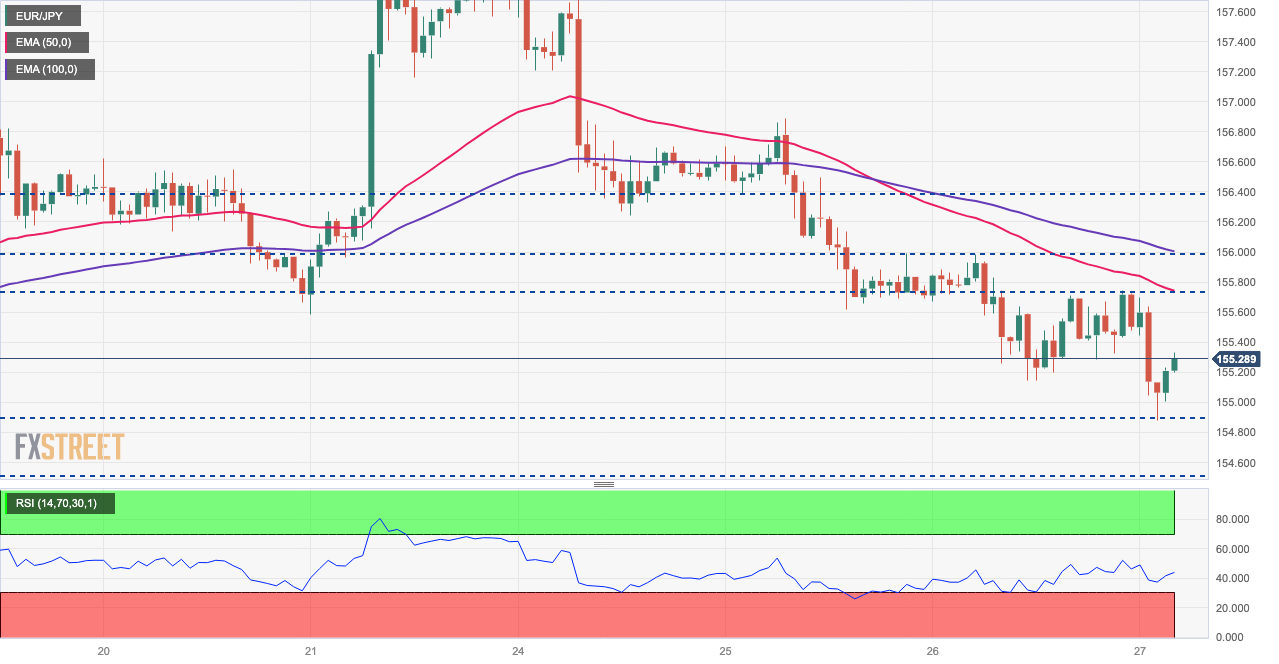
- A combination of factors prompts fresh selling around USD/CAD on Thursday.
- Bullish Oil prices underpin the Loonie and exert pressure amid a weaker USD.
- Traders now look to the important US macro data for some meaningful impetus.
The USD/CAD pair extends the overnight pullback from the 1.3235-1.3240 area, or over a one-week high and continues losing ground through the Asian session on Thursday. The downward trajectory drags spot prices to a fresh daily low, around the 1.3165-1.3160 area in the last hour and is sponsored by a combination of factors.
Following the previous day's modest downtick, Crude Oil prices catch fresh bids and jump back closer to over a three-month high touched on Tuesday. The recently announced supply cuts by the world’s largest Oil producers - Saudi Arabia and Russia - and hopes that more stimulus from China to support its fragile economy will boost fuel demand act as a tailwind for the black liquid. This, in turn, is seen underpinning the commodity-linked Loonie, which, along with the prevalent US Dollar (USD) selling bias, exerts some downward pressure on the USD/CAD pair.
In fact, the USD Index (DXY), which tracks the Greenback against a basket of currencies, drifts lower for the third successive day and retreats further from a two-week high touched on Tuesday. A general consensus that the Federal Reserve (Fed) is nearing the end of its rate-hiking cycle in the wake of a further moderation in inflation continues to weigh on the buck. Apart from this, the risk-on environment turns out to be another factor weighing on the safe-haven USD, which, in turn, is seen contributing to the offered tone surrounding the USD/CAD pair.
The USD bulls, meanwhile, seem rather unimpressed by the fact that the Fed left the door open for one more interest rate hike in September or November. It is worth mentioning that Fed Chair Jerome Powell, speaking to the post after the widely expected 25 bps lift-off on Wednesday, said that the economy still needs to slow and the labour market to weaken for inflation to credibly return to the 2% target. This, in turn, suggests that the path of least resistance for the USD is to the downside and supports prospects for a further intraday slide for the USD/CAD pair.
Market participants now look to the US economic docket - featuring the release of the Advance Q2 GDP report, Durable Goods Orders, the usual Weekly Initial Jobless Claims and Pending Home Sales. The data might drive the USD demand and provide some impetus to the USD/CAD pair later during the early North American session. Apart from this, Oil price dynamics should contribute to producing short-term opportunities.
Technical levels to watch
- Gold Price renews weekly top during three-day uptrend.
- Fed fails to impress US Dollar buyers despite 0.25% rate hike, showing readiness for further tightening in September.
- China data, hopes of witnessing slower US GDP growth numbers propel XAU/USD ahead of eventful days.
- ECB needs to defend hawks to keep Gold buyers hopeful of crossing $1,985 key hurdle via softer USD.
Gold Price (XAU/USD) remains on the front foot for the third consecutive day as bulls cheer a fresh weekly top ahead of some more top-tier data/events, after marking a bullish reaction to the Federal Reserve (Fed) Interest Rate Decision.
In doing so, the XAU/USD fails to justify the Fed’s 0.25% interest rate hike, as well as readiness for an interest rate increase in September, amid fears of a sooner end to the tightening spell. Additionally favoring the Gold price could be the recent improvement in China's industrial profits and cautious optimism in the equity markets, mainly due to the upbeat earnings of global tech giants like Meta and Alphabet.
Furthermore, hopes of witnessing softer readings of the first readings of the US Gross Domestic Product (GDP) Annualized for the second quarter (Q2), as well as the ECB’s inability to convince hawks, also seem to propel the XAU/USD price. Also important to watch will be the US Durable Goods Orders and monetary policy meeting announcements of the Bank of Japan (BoJ).
Above all, the easing fears of higher rates can keep the Gold buyers hopeful but a clear upside break of the $1,985 resistance confluence becomes necessary to stretch the bull’s dominance.
Also read: Gold Price Forecast: Fed Powell’s patience powers XAU/USD toward $2,000, US GDP eyed
Gold Price: Key levels to watch
Our Technical Confluence indicator signals that the Gold Price remains on the front foot after crossing short-term key hurdles and has fewer challenges in extending the north run.
That said, the previous monthly high of around $1,985 prods immediate upside of the XAU/USD ahead of the $1,988 resistance confluence comprising the Pivot Point one-day R2 and previous weekly high.
Following that, there prevails an empty space unless the Gold Price hits the $2,000 psychological magnet.
On the contrary, Pivot Point One-month R1 joins the Fibonacci 38.2% on one-day and one-week to highlight $1,972 as immediate support to watch during the fresh Gold Price weakness.
However, major attention is given to the $1,965 support confluence comprising the 100-DMA and middle band of the Bollinger on the four-hour chart.
Overall, the Gold Price remains on the bull’s radar unless breaking $1,965 support.
Here is how it looks on the tool
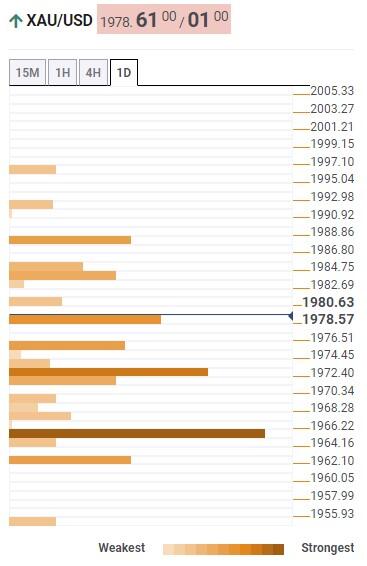
About Technical Confluences Detector
The TCD (Technical Confluences Detector) is a tool to locate and point out those price levels where there is a congestion of indicators, moving averages, Fibonacci levels, Pivot Points, etc. If you are a short-term trader, you will find entry points for counter-trend strategies and hunt a few points at a time. If you are a medium-to-long-term trader, this tool will allow you to know in advance the price levels where a medium-to-long-term trend may stop and rest, where to unwind positions, or where to increase your position size.
- GBP/USD scales higher for the third straight day and climbs to over a one-week high.
- The ongoing USD retracement slide from a two-week top act as a tailwind for the pair.
- Diminishing odds for more aggressive rate hikes by BoE warrant some caution for bulls.
The GBP/USD pair builds on this week's goodish rebound from sub-1.2800 levels and gains some follow-through positive traction for the third successive day on Thursday. Spot prices jump to over a one-week high during the Asian session and currently trade around the 1.2965 region, up just over 0.20% for the day.
The US Dollar (USD) is seen prolonging its retracement slide from a two-week high touched on Tuesday and turning out to be a key factor acting as a tailwind for the GBP/USD pair. Despite the fact that the Federal Reserve (Fed) left the door open for one more rate hike in September or November, consensus that the US central bank is nearing the end of its current policy tightening cycle drag the Greenback lower for the third straight day.
It is worth recalling that Fed Chair Jerome Powell, speaking to the press after the widely expected 25 bps lift-off on Wednesday, said that the economy still needs to slow and the labour market to weaken for inflation to credibly return to the 2% target. That said, further moderation in inflation and weaker economic data might force the Fed to pause. Apart from this, a generally positive risk tone further undermines the safe-haven Greenback.
Investors continue to cheer China's pledge to step up support for its fragile economy, which remains supportive of the bullish sentiment across the global equity markets. It is worth recalling that state news agency Xinhua cited the Politburo - the top decision-making body of the ruling Communist Party - saying that China will step up economic policy adjustments, focusing on expanding domestic demand, boosting confidence and preventing risks.
That said, diminishing odds for more aggressive rate hikes by the Bank of England (BoE), bolstered by last week's softer UK consumer inflation figures, could cap the British Pound (GBP). This, in turn, might hold back bulls from placing fresh bets around the GBP/USD pair. Hence, it will be prudent to wait for a move back above the 1.3000 psychological mark before confirming that the corrective decline from a 15-month peak has run its course.
In the absence of any relevant market-moving economic data from the UK, the USD price dynamics will continue to act as an exclusive driver of the GBP/USD pair's intraday movement. Later during the early North American session, traders will take cues from the US economic docket - featuring the release of the Advance Q2 GDP report, Durable Goods Orders, the usual Weekly Initial Jobless Claims and Pending Home Sales data.
Technical levels to watch
- USD/JPY renews weekly low after breaking fortnight-old rising support line.
- Bearish MACD signals, U-turn from 200-SMA adds strength to downside bias.
- Talks of BoJ policy tweak, downbeat US Dollar direct Yen pair towards 137.90 support confluence.
USD/JPY drops for the fourth consecutive day as it breaks a two-week-old rising support line, now immediate resistance, to refresh the weekly low near 139.40, close to 139.70 by the press time of early Thursday morning in Europe.
In doing so, the Yen pair also justifies the market’s chatters that the Bank of Japan (BoJ) is overdue for a policy tweak. Also exerting downside pressure on the Yen price could be the broad-based US Dollar weakness despite the Federal Reserve’s (Fed) hawkish rate hike amid fears of a sooner end to the tightening spell. That said, the DXY prints a three-day losing streak, down 0.24% intraday near 100.78 by the press time.
Amid these plays, the USD/JPY pair is likely to extend the latest fall towards the 50% Fibonacci retracement of its May-June upside, near 139.30.
However, a convergence of an ascending support line from early May and the 61.8% Fibonacci retracement, near 137.90, appears a tough nut to crack for the Yen pair sellers.
Alternatively, a corrective bounce needs validation from the previous support line stretched from mid-July, close to 140.40, as well as a downward-sloping resistance line from early June, close to 141.15 by the press time.
Even so, the 200-SMA level of around 141.65 at the latest will act as the final defense of the USD/JPY bears.
USD/JPY: Four-hour chart
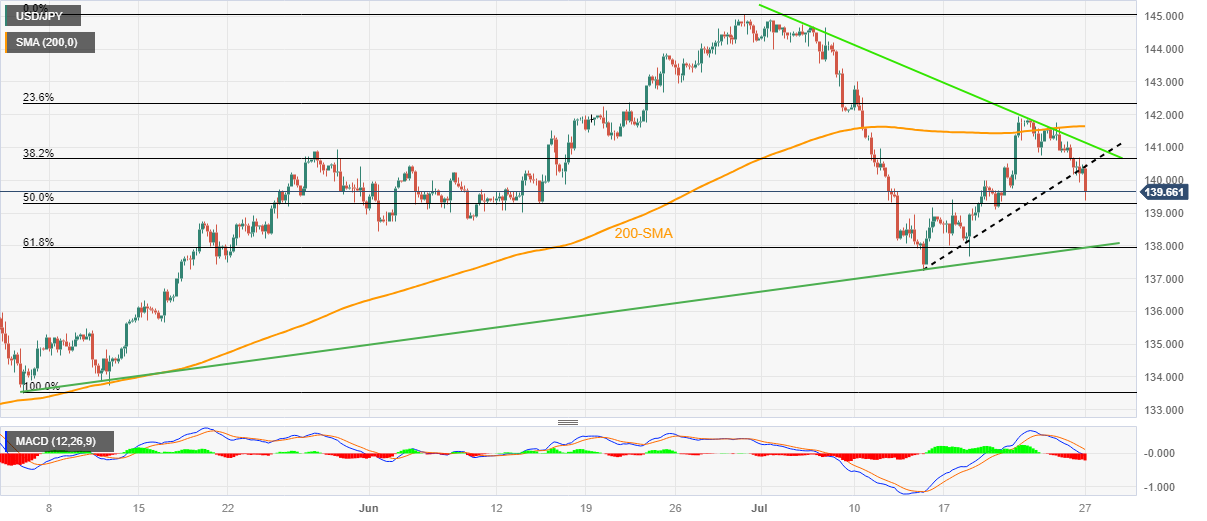
Trend: Further downside expected
- NZD/USD takes the bids to renew weekly top, prints the biggest daily gains in a fortnight.
- Easing downward trajectory of China Industrial Profits join risk-on mood, hopes of Fed policy pivot to weigh on US Dollar.
- First readings of US Q2 GDP, Durable Goods Orders for June eyed for clear directions.
NZD/USD prints the biggest daily gains in two weeks, so far, as it rises to 0.6274 amid early Thursday morning in Europe. In doing so, the Kiwi pair not only cheers the broad-based US Dollar weakness but also justifies a recovery in China’s industrial losses.
That said, China's Industrial Profits for the January-June period shrink 16.8% compared to the -18.8% figure marked for the first five months of the year 2023, per China’s National Bureau of Statistics (NBS) data released early Thursday. It’s worth noting that numbers for June came in as -8.3% YoY versus -12.6% prior.
Elsewhere, the US Dollar Index (DXY) fails to cheer the Federal Reserve’s (Fed) hawkish rate hike amid fears of a sooner end to the tightening spell. With this, the DXY prints a three-day losing streak, down 0.24% intraday near 100.78 by the press time.
It’s worth observing that the Fed announced the widely anticipated interest rate hike toward the multi-year high in the range of 5.25%-5.50%. Following the rate decision, Fed Chairman Jerome Powell tried to lure the hawks by showing readiness for a September rate hike as he said, that the June inflation Consumer Price Index was welcomed but “was only one month's report.” It should be noted that the rejection of recession fears was also an effort to please the US Dollar buyers but failed.
Apart from that, the mixed US data flag concerns about the end of the Fed’s rate hike trajectory and exert downside pressure on the greenback, especially amid the market’s cautious optimism.
US Conference Board’s (CB) Consumer Confidence Index for July has been positive but the housing numbers for June are mixed. That said, the previously released inflation and employment clues haven’t been impressive and prod the US Dollar Index buyers. Even so, the International Monetary Fund (IMF) raised the US economic growth forecast for 2023 to 1.8% from 1.6% forecast in April.
Moving on, the first readings of the US Gross Domestic Product (GDP) Annualized for the second quarter (Q2), expected to ease to 1.8% from 2.0%, will be important to watch for clear directions. Also crucial will be the US Durable Goods Orders for June, likely easing to 1.0% from 1.8% prior (revised), as well as the monetary policy announcements from the European Central Bank (ECB).
Technical analysis
A clear upside break of a two-week-old descending trend line and sustained rebound from the 50-DMA, currently intersecting each other around 0.6170, keeps the NZD/USD buyers hopeful.
- EUR/USD scales higher for the second straight day and draws support from sustained USD selling.
- Bets that the Fed will soon end its rate-hiking cycle and the upbeat market mood undermine the buck.
- Investors now look to the crucial ECB meeting for a fresh impetus ahead of the key US macro data.
The EUR/USD pair gains some positive traction for the second straight day on Thursday and moves back above the 1.1100 round-figure mark during the Asian session. Spot prices recover further from a nearly two-week low, around mid-1.1000s touched on Tuesday and remain well supported by some follow-through US Dollar (USD) selling.
In fact, the USD Index (DXY), which tracks the Greenback against a basket of currencies, extends its pullback from a two-week high touched on Tuesday in the wake of firming expectations that the Federal Reserve (Fed) is nearing the end of its rate-hiking cycle. The USD bulls, meanwhile, seem rather unimpressed by the fact that the Fed left the door open for one more interest rate hike in September or November. It is worth mentioning that Fed Chair Jerome Powell, speaking to the post after the widely expected 25 bps lift-off on Wednesday, said that the economy still needs to slow and the labour market to weaken for inflation to credibly return to the 2% target.
Furthermore, hopes for more stimulus from China remain supportive of the underlying bullish sentiment across the global equity markets. This is seen as another factor weighing on the safe-haven USD, which, in turn, acts as a tailwind for the EUR/USD pair. It, however, remains to be seen if bulls can capitalize on the move or opt to lighten the bets ahead of the crucial European Central Bank (ECB) meeting this Thursday. The markets have been pricing in the possibility that the ECB will increase borrowing costs in July and September.
Moreover, the minutes of the ECB meeting held in June revealed that policymakers remain determined to continue the current hiking cycle to bring inflation back to target. That said, ECB officials recently delivered mixed signals regarding the next policy moves on the back of emerging signs of a cooling economy. The fears were further fueled by this week's disappointing release of the flash Euro Zone PMIs, which pointed to a sharp slowdown in business activity across the region. This, in turn, might cap gains for the EUR/USD pair.
Traders might also refrain from placing aggressive bets heading into the key central bank event risk and ahead of important US macro releases, due later during the early North American session. Thursday's US economic docket features the Advance Q2 GDP print, Durable Goods Order, the usual Weekly Initial Jobless Claims and Pending Home Sales data. This, along with the post-ECB volatility, should provide some meaningful impetus to the EUR/USD pair and contribute to producing short-term trading opportunities.
Technical levels to watch
- USD/CNH drops to the fresh 10-week low on breaking short-term key support.
- US Dollar weakness supersedes China offshore Yuan’s ignorance to downbeat China industrial profits for January-June period.
- Four-month-old rising support line lures USD/CNH bears; bulls need validation from 50-DMA, falling trend line from late June, 50-DMA.
USD/CNH takes offers to refresh the 2.5-month low around 7.1160, bouncing off 7.1210 by the press time of very early Thursday morning in Europe.
In doing so, the offshore Chinese Yuan (CNH) justifies the quote’s downside break of a 10-week-old rising support line, now immediate resistance around 7.1320.
That said, bearish MACD signals and the broad US Dollar weakness, amid expectations of no more rate hikes from the top-tier central banks keep the USD/CNH bears hopeful.
With this, the US Dollar Index (DXY) fails to cheer the Federal Reserve’s (Fed) hawkish rate hike amid fears of a sooner end to the tightening spell.
On the contrary, downbeat prints of China's Industrial Profit for the January-June period, down 16.8% compared to an 18.8% fall in the profits during the first five months of the year 2023, per China’s National Bureau of Statistics (NBS) data released early Thursday.
It should be noted that a clear downside break of the stated support line and aforementioned oscillators, as well as fundamentals, favor the USD/CNH bears to aim for a four-month-old rising support line, close to 7.0730 by the press time.
On the contrary, an upside break of the previous support line, close to 7.1320, isn’t going to welcome the USD/CNH bulls as the 50-DMA and a one-month-old falling resistance line challenge the north-run around 7.1640 and 7.2150 in that order.
USD/CNH: Daily chart

Trend: Further downside expected
| Raw materials | Closed | Change, % |
|---|---|---|
| Silver | 24.92 | 0.99 |
| Gold | 1972.12 | 0.37 |
| Palladium | 1261.88 | -1.92 |
- USD/CHF remains under pressure around 0.8600 amid the weakening of the USD.
- As expected, the Federal Reserve (Fed) raised interest rates by 25 basis points (bps).
- The headlines surrounding the Chinese stimulus plan, Sino-US relations remain in focus.
The USD/CHF pair remains under pressure below the 0.8600 region during the early Asian session on Thursday. The US dollar is weakening broadly following the Federal Open Market Committee (FOMC) meeting. The US dollar Index (DXY), a measure of the value of the Greenback against six other major currencies, dropped to 100.85. The pair currently trades around 0.8596, down 0.13% for the day.
Following the FOMC meeting, the central bank raised interest rates by 25 basis points (bps) to a target range of 5.25%–5.5%, as expected. Federal Reserve (Fed) Chairman Jerome Powell stated that the FOMC will assess the totality of incoming data, along with its implications for economic activity and inflation. He added that it's possible to raise the Fed funds rate again at the September meeting if the data warrants it. After the FOMC meeting and statement, the US dollar weakened broadly, which acted as a headwind for USD/CHF.
On the Swiss franc front, the Swiss ZEW Survey Expectations data by the Centre for European Economic Research reported that the figure came in at -32.6 versus -30.8 prior and worse-than-expected 31.1.
Meanwhile, concern is high over whether China will deliver on its policy pledges, as China is the world's second-biggest economy. On Tuesday, Chinese news agency Xinhua reported that Chinese policymakers would take up economic policy adjustments, strengthening confidence and mitigating risks. Market players will keep an eye on the headlines surrounding the Chinese stimulus plan. The Swiss Franc, a traditional safe-haven currency, could benefit from the absence of this development. Also, the renewed tension between China and the US remains in focus.
Moving on, the KOF Leading Indicator for July could offer clues about the Swiss Franc movement. Market players will also monitor US Advance GDP QoQ and the core Personal Consumption Expenditure (PCE) Price Index MoM for fresh impetus. Traders will monitor this development and find opportunities around the USD/CHF pair.
- AUD/USD catches fresh bids on Thursday and draws support from sustained USD selling.
- Expectations that the Fed is nearing the end of its rate-hiking cycle weigh on the Greenback.
- Hopes for more stimulus from China boost the Aussie and remain supportive of the move up.
The AUD/USD pair regains positive traction on Thursday and jumps to a one-week high, beyond the 0.6800 round-figure mark during the Asian session. Spot prices currently trade with strong intraday gains of over 0.80% and remain well supported by the prevalent US Dollar (USD) selling bias.
In fact, the USD Index (DXY), which tracks the Greenback against a basket of currencies, drifts lower for the third straight day and retreats further from a two-week high touched on Tuesday. A general consensus that the Federal Reserve (Fed) is nearing the end of its current policy tightening cycle is seen as a key factor weighing on the Greenback. Apart from this, the latest optimism over hopes for more stimulus measures from China undermines the safe-haven buck and benefits antipodean currencies, including the Australian Dollar (AUD).
The downside for the USD, however, seems limited as the Fed left the door open for one more rate hike in September or November. It is worth recalling that Fed Chair Jerome Powell, speaking at the post-meeting press conference, said that the economy still needs to slow and the labour market to weaken for inflation to credibly return to the 2% target. The comments follow the widely expected decision to hike interest rates by 25 bps, to the 5.25%-5.50% range, or the highest level in 22 years, and support prospects for the emergence of some USD dip-buying.
Furthermore, the softer Australian consumer inflation figures released on Wednesday strengthen the case for the Reserve Bank of Australia (RBA) to pause future rate hikes. This, along with China's economic woes, could act as a headwind for the China-proxy Aussie. The National Bureau of Statistics (NBS) reported that profits at China's industrial firms contracted by 16.8% in the first half from a year earlier in the wake of waning demand at home and abroad. This warrants caution before placing fresh bullish bets around the AUD/USD pair.
Hence, it remains to be seen if bulls are able to capitalize on the move beyond the 0.6800 round figure or opt to take some profits off the table ahead of the important US macro data. Thursday's US economic docket features the releases of the Advance Q2 GDP report, Durable Goods Orders, the usual Weekly Initial Jobless Claims and Pending Home Sales. The data might influence the USD price dynamics and allow traders to grab short-term opportunities around the AUD/USD pair later during the early North American session.
Technical levels to watch
Japan Chief Cabinet Secretary Hirokazu Matsuno crossed wires, via Reuters, amid early Thursday morning in Asia.
The top diplomat conveyed expectations from the Bank of Japan (BoJ) during the latest speech while saying that he expects the BoJ to communicate closely with the government.
The policymaker also anticipates the BoJ to conduct the monetary policy in a way that achieves the nation’s inflation target stably, as well as sustainably.
Market reaction
USD/JPY renews intraday low to around 139.40 following the news as the US Dollar drops across the board amid the market’s expectations of sooner end to the rate hike trajectory across the major central banks.
Also read: S&P500 Futures stay firmer around 4,600, yields edge lower as markets expect sooner end to rate hikes
- Market sentiment remains mildly bid as traders expect major central banks to end rate hike trajectory soon.
- Fed announces 0.25% increase in benchmark rates, signals September lift in interest rates but fail to propel yields, US Dollar.
- Earnings from Meta, Alphabet allow Wall Street to remain optimistic, S&P500 Futures follow the orders without fresh news.
- China industrial profits fall, early clues for Japan inflation rise ahead of ECB, US GDP.
The risk appetite improves on early Thursday as market players reassess the tone of the US Federal Reserve (Fed) after it matched market forecasts of a 0.25% rate hike and left the door open for further rate hikes in September if inflation improves. Also contributing to the cautious optimism is the dovish bias about the European Central Bank (ECB) and upbeat earnings from global tech giants. However, downbeat China data and cautious mood ahead of the first readings of the US Gross Domestic Product (GDP) for the second quarter (Q2) prod the optimists.
While portraying the mood, S&P500 Futures picks up bids to reverse the previous day’s pullback from a 16-month high, mildly bid near 4,604 by the press time of early Thursday in Asia. That said, the US 10-year and two-year Treasury bonds declined the previous day after the Fed’s announcements but have been steady afterward. With this, the benchmark 10-year bond coupon seesaws near 3.87% while the two-year counterpart makes rounds to 4.86% by the press time.
Elsewhere, the US Dollar Index (DXY) stays pressured for the third consecutive day while the stocks in the Asia-Pacific zone edge higher. It should be noted that the prices of Gold and Crude Oil also remain firmer during the overall cautiously optimistic markets.
On Wednesday, the US Federal Reserve (Fed) announced the widely anticipated interest rate hike toward the multi-year high in the range of 5.25%-5.50%. Following the rate decision, Fed Chairman Jerome Powell tried to lure the hawks by showing readiness for a September rate hike as he said, that the June inflation Consumer Price Index was welcomed but “was only one month's report.” It should be noted that the rejection of recession fears was also an effort to please the US Dollar buyers but failed.
Following the Fed announcements and Powell’s speech, interest rate futures marked an increasing push towards a September rate hike as the CME’s FedWatch Tool shows 23% chances of the same versus 21% marked on Tuesday and 13.7% a week ago. However, the odds of witnessing rate hikes past September have been mostly nil and hence challenge the US central bank hawks.
Elsewhere, downbeat prints of the recent Eurozone and German statistics push the ECB towards ending the monetary policy tightening soon even if the bloc’s central bank is expected to announce a 0.25% rate hike on Thursday.
Furthermore, downbeat expectations from the scheduled US Q2 GDP and Durable Goods Orders for June allow the market players to remain hopeful. It should be noted that the latest quarterly results from Facebook’s parent company Meta and Google's parent Alphabet have been promising to equity traders.
Also read: Forex Today: Dollar weakens modestly after the Fed, focus turns to ECB and US data
- USD/MXN licks its wounds within one-week-old trading range.
- MACD, RSI signals prod short-term Mexican Peso buyers but falling trend channel from mid-May keeps the bulls hopeful.
- Fortnight-old horizontal support acts as additional trading filter, bulls need validation from 17.42 to retake control.
USD/MXN stabilizes near 16.85 amid an inactive Thursday morning in Asia, after posting heavy losses the previous day. With this, the Mexican Peso (MXN) pair stays within its one-week-long trading range between the 21-DMA and 10-DMA.
Given the Mexican Peso pair’s latest rebound from the 10-DMA gaining support from the bullish MACD signals and the steady RSI (14) line, the USD/MXN price is likely to improve.
However, a clear upside break of the 21-DMA hurdle of around 16.95 becomes necessary to convince the pair buyers.
Even so, a 10-week-old bearish trend channel, currently between 17.14 and 16.35, will restrict the USD/MXN upside.
It’s worth observing that a horizontal area comprising multiple levels marked since mid-May, around 17.38-42, acts as the last defense of the USD/MXN bears.
On the contrary, a downside break of the 10-DMA support of around 16.82 isn’t an open welcome for the USD/MXN bears as a fortnight-old horizontal support near 16.70 acts as a tough nut to crack for the sellers.
Following that, the bottom line of the previously mentioned bearish channel, near 16.35, will lure the pair bears ahead of highlighting the 16.00 round figure.
USD/MXN: Daily chart
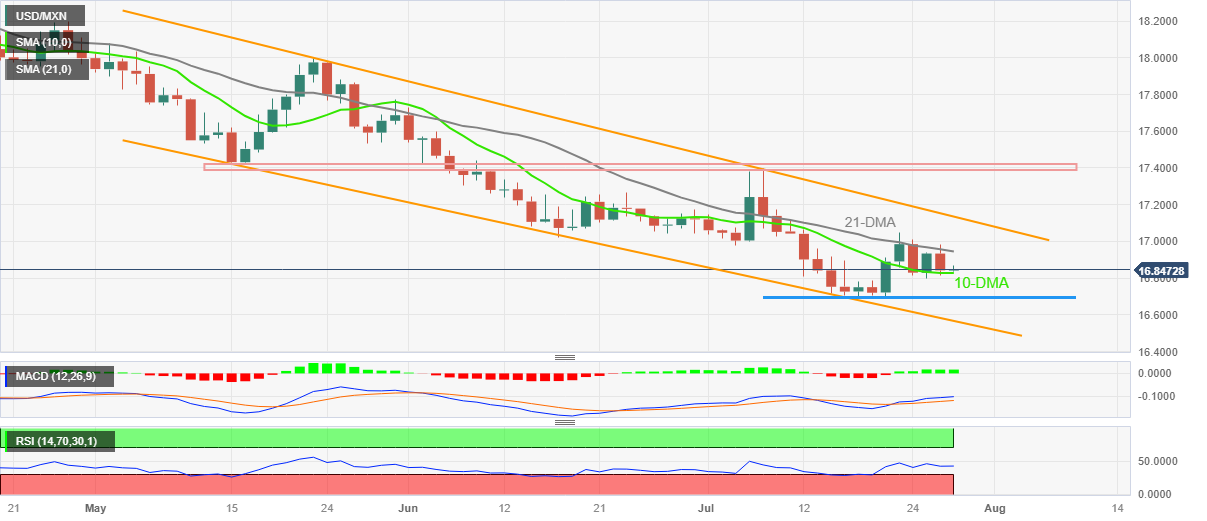
Trend: Limited recovery expected
- Gold price trades with positive bias for the third straight day and hovers near the weekly high.
- Looming recession risks benefit the safe-haven metal ahead of the ECB and key US macro data.
- Bets for additional rate hikes by major central banks might act as a headwind for the XAU/USD.
Gold price gains some positive traction for the third successive day on Thursday and climbs to the $1,975 area during the Asian session, back closer to the weekly high touched the previous day. The XAU/USD might now look to build on this week's positive move from the vicinity of the $1,950 level and remains well within the striking distance of over a two-month high set last week.
The Federal Reserve (Fed) on Wednesday, as was expected, raised interest rates by 25 basis points (bps) to the 5.25%-5.50% range, or the highest level in 22 years, citing still-elevated inflation as the rationale. In the post-meeting press conference, Fed Chair Jerome Powell said that the economy still needs to slow and the labour market to weaken for inflation to credibly return to the 2% target. This leaves the door open for one more rate hike in September or November, which assists the US Dollar (USD) to stall its corrective decline from a two-week high touched on Tuesday and might turn out to be a key factor capping the Gold price.
Furthermore, expectations for additional rate hikes by the European Central Bank (ECB) and the Bank of England (BoE) further contribute to keeping a lid on the non-yielding yellow metal, for now. In fact, investors seem convinced that the ECB will increase borrowing costs in July and September. The BoE, meanwhile, is anticipated to hike interest rates by 25 bps in every meeting through November. The bets were lifted by the recent upside surprise to pay growth, though softer consumer inflation figures from the United Kingdom (UK) last week pushed back against expectations for a more aggressive policy tightening by the central bank.
The downside for the Gold price, however, remains cushioned in the wake of a general consensus that the Fed is getting closer to the end of its current interest rate-hiking cycle. Apart from this, worries about a global economic downturn, geopolitical risks and the worsening relations between the United States (US) and China - the world's two largest economies - should continue to lend support to the safe-haven precious metal. The aforementioned mixed fundamental backdrop, meanwhile, warrants some caution before placing aggressive bets around the XAU/USD and positioning for a firm near-term directional move.
Market participants now look forward to the ECB policy decision, which, along with important US macro data, should provide some meaningful impetus to the Gold price. Thursday's US economic docket features the release of the Advance GDP report for the second quarter, Durable Goods Orders, the usual Weekly Initial Jobless Claims and Pending Home Sales data. This might influence the USD price dynamics and produce short-term trading opportunities around the XAU/USD. The market focus will then shift to the release of the Fed's preferred inflation gauge, the Core Personal Consumption Expenditures (PCE) Price Index, due on Friday.
Key levels to watch
- WTI retreats from a three-month high and consolidates gains near $79.20 per barrel.
- EIA reports showed that US crude inventories decreased by 600,000 barrels.
- Russia's projection is to produce 515 million metric tonnes of crude in 2023.
Western Texas Intermediate (WTI), the US crude oil benchmark, is trading around the $79.20 mark so far this Thursday. WTI retreats from a three-month high and consolidates its recent gains following the decreasing US crude oil stockpiles and the outcome of the Federal Reserve (Fed) meeting.
According to data from the U.S. Energy Information Administration (EIA), US crude inventories decreased by 600,000 barrels in the week ended July 21, compared to forecasts of a 2.35 million barrel decrease.
Apart from the data, the Federal Open Market Committee (FOMC) hiked its interest rate by 25 basis points (bps) to a target range of 5.25%–5.5%. Fed Chairman Jerome Powell stated following the rate decision that the FOMC will assess the totality of incoming data, along with its implications for economic activity and inflation. He added that it's possible to raise the Fed funds rate again at the September meeting if the data warrants it. It’s worth noting that higher interest rates increase borrowing costs, which can slow the economy and diminish oil demand.
Meanwhile, concern is high over whether China, also the world's second-biggest oil consumer, will deliver on its policy pledges. On Tuesday, Chinese news agency Xinhua reported that Chinese policymakers would take up economic policy adjustments, strengthening confidence and mitigating risks.
Nevertheless, Deputy Prime Minister Alexander Novak told reporters that Russia's projection to produce 515 million metric tonnes of crude in 2023 remains subject to reduction decisions. Additionally, Energy Minister Nkolai Shulginov told Tass news agency that Russian 2023 oil output might reach 515 million metric tonnes, depending on the OPEC+ quota decision. He added that the output in 2022 stood at 535 million metric tonnes, a 2 percent year-on-year rise.
Moving on, oil traders will keep an eye on US Advance GDP QoQ, and the core Personal Consumption Expenditure (PCE) Price Index MoM for fresh impetus. This key event could significantly impact the USD-denominated WTI price.
People’s Bank of China (PBoC) set the USD/CNY central rate at 7.1265 on Thursday, versus the previous fix of 7.1295 and market expectations of 7.1486. It's worth noting that the USD/CNY closed near 7.1371 the previous day.
Apart from the USD/CNY fix, the PBoC also unveiled details of its Open Market Operations (OMO) while saying that the Chinese central bank injects 114 billion Yuan via 7-day reverse repos (RRs) at 1.90% vs prior 1.90%.
However, the 26 billion Yuan of RRs mature today, which in turn suggests a net 88 billion Yuan injection on the day in OMOs.
About PBOC fix
China maintains strict control of the yuan’s rate on the mainland.
The onshore yuan (CNY) differs from the offshore one (CNH) in trading restrictions, this last one is not as tightly controlled.
Each morning, the People’s Bank of China (PBOC) sets a so-called daily midpoint fix, based on the yuan’s previous day's closing level and quotations taken from the inter-bank dealer.
- EUR/JPY clings to mild gains during the first positive day in four, stays defensive at the lowest level in a week.
- Lackluster yields, mixed sentiment and ECB positioning allow cross-currency pair to trim latest losses.
- ECB could follow Fed with 0.25% rate hike but the odds of dovish hike and further Euro weakness are high.
- IMF’s urge to BoJ, increasing inflation pressure allow JPY buyers to remain hopeful despite likely inaction of Japanese central bank.
EUR/JPY portrays the typical pre-data consolidation during early Thursday as it prints the first daily gains in four around 155.60 while bracing for the European Central Bank (ECB) Interest Rate Decision. Also important will be the Bank of Japan (BoJ) monetary policy decision, scheduled for Friday. It should be noted that a pause in the Treasury bond yields also contributed to the cross-currency pair’s latest rebound.
That said, the US 10-year and two-year Treasury bonds declined the previous day after the Federal Reserve (Fed) failed to impress markets with a 0.25% rate hike and showed readiness for the September rate hike. That said, the benchmark 10-year bond coupon seesaws near 3.87% while the two-year counterpart makes rounds to 4.86% by the press time.
Additionally, downbeat outcomes of foreign investments into Japanese stocks and bonds during the week ended on July 21 also put a floor under the EUR/JPY price.
On Wednesday, an anonymous Japanese government official quoted Bank of Japan (BoJ) Governor Kazuo Ueda as defending the yield curve control (YCC) policy when it comes to the stability of Japan's long-term yield rate. BoJ’s Ueda was also said to show the BoJ’s readiness to maintain an accommodative monetary environment for firms.
Further, the Japanese Cabinet Office published its monthly economic assessment portraying an upbeat picture of the business sentiment.
However, the International Monetary Fund (IMF) warned of higher inflation from Japan and urged the Bank of Japan (BoJ) to exit its easy-money policy.
It’s worth noting that the mildly bid S&P500 Futures and Japan’s Nikkei suggest cautious optimism in the market and also underpin the EUR/JPY rebound.
Moving on, the ECB is expected to follow the Fed while announcing a 0.25% increase in the benchmark interest rates. However, President Christine Lagarde’s ability to defend the hawks will be crucial to allow the Euro in staying firmer.
Technical analysis
A seven-week-old rising support line restricts immediate EUR/JPY downside near 155.55 but major attention is given to the latest swing low of around 153.40 due to the double tops marked near 158.00.
- Silver Price retreats from fortnight-old resistance to print the first daily loss in three.
- RSI pullback from overbought territory, looming bear cross on MACD tease XAG/USD sellers.
- 200-SMA, three-week-old rising support line challenges Silver bears before putting them in the driver’s seat.
- US GDP, Durable Goods Orders need to back recently hawkish Fed concerns to defend XAG/USD sellers.
Silver Price (XAG/USD) sticks to mild losses around $24.90 amid early Thursday morning in Asia, after rising in the last two consecutive days to refresh the weekly top.
That said, the XAG/USD’s latest pullback could be linked to the metal’s inability to cross a two-week-old horizontal resistance area around $25.00-05 by the press time.
Also luring the Silver sellers is the looming bear cross on the MACD and the RSI (14) line’s retreat from the overbought territory.
However, the 200-SMA level of around $24.80 restricts further downside of the XAG/USD, a break of which will highlight an upward-sloping support line from early July, close to $24.55 at the latest, for the Silver sellers to watch.
In a case where the Silver Price remains bearish past $24.55, the weekly bottom of around $24.25 will act as the final defense of the Silver buyers.
Meanwhile, a clear upside break of the aforementioned horizontal resistance area surrounding $25.00-05 will need validation from the monthly peak close to $25.30 to welcome the XAG/USD bulls.
Following that, a run-up to challenge the yearly top of around $26.15 will be in the spotlight.
Overall, the market’s cautious mood ahead of the first readings of the US Gross Domestic Product (GDP) for the second quarter (Q2), US Durable Goods Orders for June and the monetary policy meeting of the European Central Bank (ECB) prod the Silver buyers of late.
Silver Price: Hourly chart
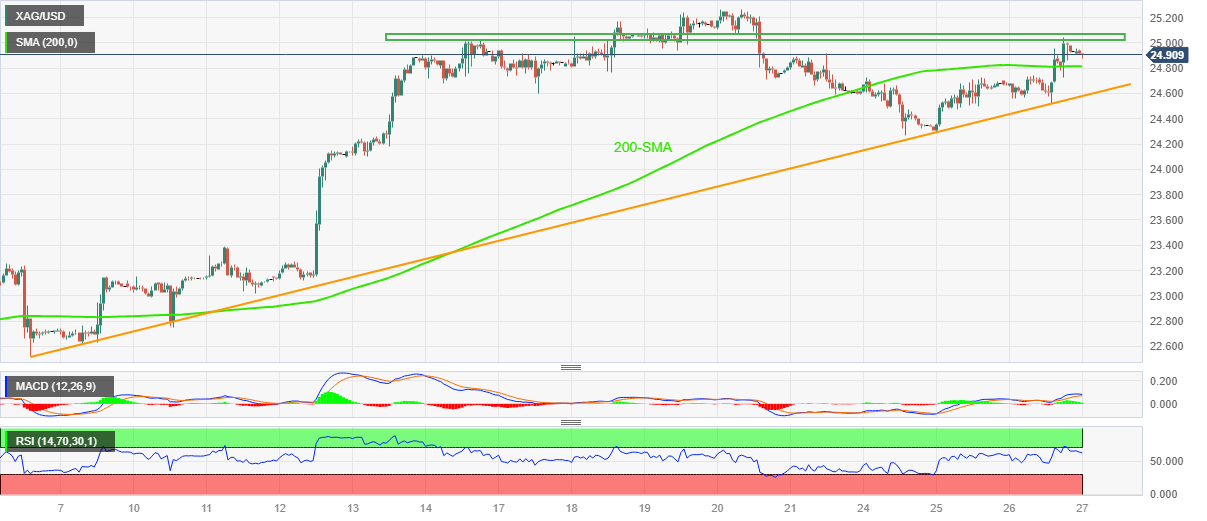
Trend: Further downside expected
- USD/JPY gains some positive traction during the Asian session, albeit lacks bullish conviction.
- The prospects for another Fed rate hike in September lend some support to the USD and the pair.
- Investors now look to the US Q2 GDP for a fresh impetus ahead of the BoJ decision on Friday.
The USD/JPY pair attracts some buying during the Asian session on Thursday and reverses a part of the previous day's slide to the weekly low touched in the aftermath of the highly-anticipated FOMC decision. Spot prices currently trade just below mid-140.00s, up 0.15% for the day, and for now, seems to have stalled the recent pullback from the vicinity of the 142.00 mark.
The Federal Reserve (Fed) as was widely expected, raised interest rates by 25 bps to the 5.25%- to 5.50% range, or the highest in 22 years, citing still-elevated inflation as a rationale. In the accompanying policy statement, the Fed said that the committee will continue to assess additional information and its implications for monetary policy. Furthermore, Fed Chair Jerome Powell, during his post-meeting press conference, said the economy still needs to slow and the labour market to weaken for inflation to credibly return to the 2% target, leaving the door open for another rate hike in September. This, in turn, is seen lending some support to the US Dollar (USD) and acting as a tailwind for the USD/JPY pair.
The Japanese Yen (JPY), on the other hand, is undermined by expectations that the Bank of Japan (BoJ) will retain its easy-money policy. The BoJ Governor Kazuo Ueda, however, reiterated on Wednesday that the central bank will stick to its accommodative monetary stance and added that the long-term yield rate remains stable under the yield curve control (YCC) policy. This, along with the underlying bullish sentiment across the global equity markets, dents the JPY's relative safe-haven status and further contributes to a mildly positive tone surrounding the USD/JPY pair.
The intraday uptick, however, lacks bullish conviction, warranting some caution before positioning for any further intraday appreciating move. Market participants now look to the release of the Advance US Q2 GDP print for a fresh impetus later during the early North American session. Thursday's US economic docket also features the release of the usual Weekly Initial Jobless Claims, Durable Goods Orders and Pending Home Sales data. The focus, however, will remain on the BoJ monetary policy update and the US Core PCE Price Index - the Fed's preferred inflation gauge on Friday.
Technical levels to watch
| Index | Change, points | Closed | Change, % |
|---|---|---|---|
| NIKKEI 225 | -14.17 | 32668.34 | -0.04 |
| Hang Seng | -69.26 | 19365.14 | -0.36 |
| KOSPI | -44.1 | 2592.36 | -1.67 |
| ASX 200 | 62.3 | 7402 | 0.85 |
| DAX | -80.13 | 16131.46 | -0.49 |
| CAC 40 | -100.38 | 7315.07 | -1.35 |
| Dow Jones | 82.05 | 35520.12 | 0.23 |
| S&P 500 | -0.71 | 4566.75 | -0.02 |
| NASDAQ Composite | -17.28 | 14127.28 | -0.12 |
- US Dollar Index remains sidelined after declining in the last two consecutive days from the highest level in a fortnight.
- Federal Reserve announces 0.25% rate hike, as expected, but leaves door open for September rate hike.
- Cautious mood ahead of US Q2 GDP, ECB also prod DXY bears amid sluggish session.
- Yields, US Dollar stabilizes as interest rate futures suggest increased odds for September rate hike after Powell’s speech.
US Dollar Index (DXY) licks its wounds near 101.00 as traders take a breather after a volatile Wednesday while bracing for the top-tier data/events amid early Thursday. In doing so, the greenback’s gauge versus the six major currencies takes clues from the sluggish yields and the market’s increasing hawkish bets on the Federal Reserve’s (Fed) next move even if the US central bank failed to impress the greenback buyers with its 25 basis points (bps) rate hike on Wednesday.
The US Federal Reserve (Fed) announced the widely anticipated interest rate hike toward the multi-year high in the range of 5.25%-5.50% on Wednesday. Following the rate decision, Fed Chairman Jerome Powell tried to lure the hawks by showing readiness for a September rate hike as he said, that the June inflation Consumer Price Index was welcomed but “was only one month's report.” It should be noted that the rejection of recession fears was also an effort to please the US Dollar buyers but failed.
Following the Fed announcements and Powell’s speech, interest rate futures marked an increasing push towards a September rate hike as the CME’s FedWatch Tool shows 23% chances of the same versus 21% marked on Tuesday and 13.7% a week ago.
It should be noted that the Conference Board’s (CB) Consumer Confidence Index for July has been positive but the housing numbers for June are mixed. That said, the previously released inflation and employment clues haven’t been impressive and prod the US Dollar Index buyers. Even so, the International Monetary Fund (IMF) raised the US economic growth forecast for 2023 to 1.8% from 1.6% forecasted in April, which in turn challenges the DXY sellers ahead of the first readings of the US Gross Domestic Product (GDP) for the second quarter (Q2). That said, the US Q2 GDP Annualized is expected to ease to 1.8% from 2.0%.
Apart from the US GDP concerns, the expectations that the European Central Bank (ECB) will also fail to lure the Euro buyers despite announcing the widely anticipated 0.25% rate hike also tease the US Dollar Index buyers ahead of the event. Additionally important to watch is the US Durable Goods Orders for June, likely easing to 1.0% from 1.8% prior (revised).
It’s worth noting that the latest challenges for the US-China ties jostle with headlines from Beijing suggesting more stimulus, which in turn defends the market’s optimists and test the US Dollar bulls. While portraying the mood the S&P500 Futures remain positive around 4,600 even as Wall Street benchmarks edged lower while the US 10-year Treasury bond yields marked the first daily loss in three by closing around 3.87%.
Technical analysis
In additional to the early-week reversal from the 21-DMA hurdle, around 101.52 by the press time, the downside break of a one-week-old rising support line, now immediate resistance near 101.15, keeps the US Dollar Index bears hopeful.
| Pare | Closed | Change, % |
|---|---|---|
| AUDUSD | 0.67579 | -0.49 |
| EURJPY | 155.433 | -0.24 |
| EURUSD | 1.10869 | 0.29 |
| GBPJPY | 181.459 | -0.19 |
| GBPUSD | 1.29429 | 0.33 |
| NZDUSD | 0.62097 | -0.21 |
| USDCAD | 1.32076 | 0.24 |
| USDCHF | 0.86034 | -0.39 |
| USDJPY | 140.206 | -0.51 |
- USD/CAD loses momentum following the Federal Reserve (Fed) meeting.
- The Fed hiked its rate by 25 basis points (bps) to a target range of 5.25%–5.5%.
- Market players anticipated that the BoC will likely not see the need to raise rates further this year.
- Investors await preliminary Q2 US GDP growth.
The USD/CAD pair struggles to gain and loses momentum above the 1.3200 mark during the early Asian session on Thursday. The major pair currently trades around 1.3204, down 0.03% for the day. The US Dollar is weakening following the Federal Open Market Committee (FOMC) meeting.
The Federal Open Market Committee (FOMC) hiked its interest rate by a quarter percentage point to a target range of 5.25%–5.5%, a move markets had fully priced in. This is the 11th rate hike since the FOMC began tightening policy in March 2022.
Following the rate decision, Fed Chairman Jerome Powell stated that the FOMC will assess the totality of incoming data, along with its implications for economic activity and inflation. He added that it's possible to raise the fed funds rate again at the September meeting if the data warrants it.
The data released earlier this week revealed that the Conference Board's Consumer Confidence Index rose to 117 in July from 110.1 (revised from 109) in June. On the same line, the House Price Index for May YoY came in at 2.8%, above expectations of 2.6% but below the prior month's data. Investors will digest the data from the Fed meeting and take cues from the upcoming economic data later in the week.
On the Canadian Dollar front, the Bank of Canada (BoC) increased interest rates by 25 basis points (bps) to a 22-year high of 5.0% on July 12. The central bank has hiked rates ten times since March 2022. Despite this, market players anticipated that the BoC would likely not see the need to raise rates further this year.
According to a survey of market participants released by the central bank on Monday, a median of the participants anticipate the bank to maintain interest rates at a 22-year high of 5.00% until the end of 2023 before cutting the rates in March.
In the meantime, the Canadian Dollar might attract some follow-through buying amid upbeat oil prices. It’s worth noting that Canada is the leading oil exporter to the United States, and higher crude prices strengthen the Canadian Dollar.
Looking ahead, market participants will focus on the release of US Advanced Gross Domestic Product (GDP) QoQ, core Personal Consumption Expenditure (PCE) Price Index MoM, Durable Goods Orders, and Initial Jobless Claims data later in the day. Also, the Canadian Gross Domestic Product for May MoM will be due on Friday. These data could give the USD/CAD pair a clear direction.







© 2000-2026. Bản quyền Teletrade.
Trang web này được quản lý bởi Teletrade D.J. LLC 2351 LLC 2022 (Euro House, Richmond Hill Road, Kingstown, VC0100, St. Vincent and the Grenadines).
Thông tin trên trang web không phải là cơ sở để đưa ra quyết định đầu tư và chỉ được cung cấp cho mục đích làm quen.
Giao dịch trên thị trường tài chính (đặc biệt là giao dịch sử dụng các công cụ biên) mở ra những cơ hội lớn và tạo điều kiện cho các nhà đầu tư sẵn sàng mạo hiểm để thu lợi nhuận, tuy nhiên nó mang trong mình nguy cơ rủi ro khá cao. Chính vì vậy trước khi tiến hành giao dịch cần phải xem xét mọi mặt vấn đề chấp nhận tiến hành giao dịch cụ thể xét theo quan điểm của nguồn lực tài chính sẵn có và mức độ am hiểu thị trường tài chính.
Sử dụng thông tin: sử dụng toàn bộ hay riêng biệt các dữ liệu trên trang web của công ty TeleTrade như một nguồn cung cấp thông tin nhất định. Việc sử dụng tư liệu từ trang web cần kèm theo liên kết đến trang teletrade.vn. Việc tự động thu thập số liệu cũng như thông tin từ trang web TeleTrade đều không được phép.
Xin vui lòng liên hệ với pr@teletrade.global nếu có câu hỏi.


 Chuyển khoản
 ngân hàng


