- Phân tích
- Tin tức và các công cụ
- Tin tức thị trường
Tin tức thì trường
- EUR/USD bears take a breather after refreshing multi-day low.
- Clear break of the key Fibonacci retracement support hints at further downside.
- Late June 2020 low offers immediate support ahead of 78.6% Fibonacci retracement level.
- 1.1500, 200-week SMA adds to the upside filters.
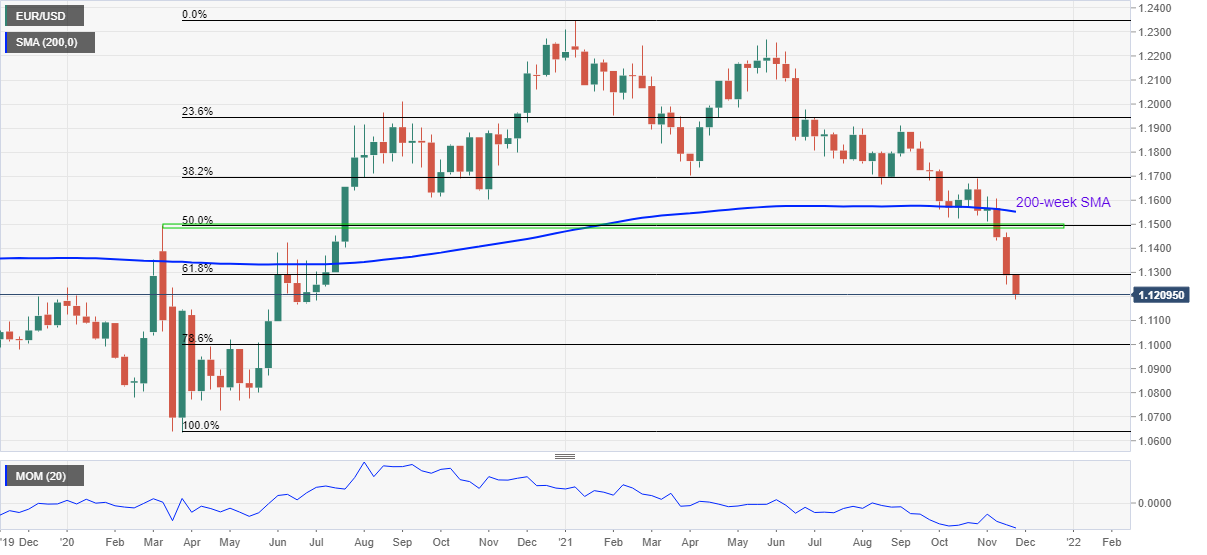
EUR/USD picks up bids to refresh intraday high around 1.1215 during the initial Asian session on Friday. The major currency pair dropped to the fresh low since July 2020 before consolidating on Thursday.
The corrective pullback, however, remains below the 61.8% Fibonacci retracement (Fibo.) of March 2020 to January 2021 upside, which in turn suggests the pair’s further declines.
In addition to the stated key Fibonacci retracement level around 1.1295, a convergence of the 50% Fibo. and March 2020 high near 1.1500, as well as the 200-week SMA level of 1.1552, also challenge the EUR/USD buyers.
On the contrary, lows marked during the late June 2020, surrounding 1.1170, question the sellers before the re-entry.
Following that the 1.1100 round figure may act as a buffer during the south-run towards 78.6% Fibonacci retracement near 1.1000 round figure.
To sum up, EUR/USD bears keep reins until witnessing a weekly closing beyond 1.1552.
EUR/USD: Weekly chart
Trend: Bearish
Retail Sales overview
Early Friday, the market sees preliminary readings of the Australia Retail Sales for October month at 00:30 GMT. Market consensus suggests an upbeat MoM print of +2.5% versus +1.3% prior readings, suggesting the sustained improvement in economic activity after positing the first positive figure in the last four months during September.
Given the recently strong inflation data crossing roads with the Aussie jobs report, not to forget the Reserve Bank of Australia’s (RBA) cautious optimism, today’s Retail Sales figures become all the more important for AUD/USD traders.
Ahead of the data, TD Securities said,
We expect retail sales to extend its turnaround in Oct, rising by 2.2% m/m (cons: 2.2%). The reopening in NSW should give a strong boost to spending but we are cautious on extrapolating overall strength as Vic's restrictions only began to ease towards month-end. Nonetheless, we are optimistic on the consumer spending outlook over the next couple of months as year-end celebrations are likely to boost sales while further easing of restrictions and opening of international borders could give another leg up to spending domestically.
How could it affect AUD/USD?
AUD/USD remains on the back foot around a three-month low amid a quiet Asian session ahead of the key data. While an off in the US and a light calendar challenges momentum traders, the RBA v/s Fed battle keeps the Aussie pair sellers hopeful. Also weighing on the quote could be the recent coronavirus woes and the Sino-American tussles.
The Reserve Bank of Australia’s (RBA) intent to wait for further details before announcing rate hike plans will join the Aussie data disappointment and fresh covid fears to weigh on the quote should the Retail Sales reverse the previous month’s expansion. However, the recent unlocks in Australia tame fears of any such downbeat figures. Hence, a corrective pullback can be witnessed if the scheduled figure arrive as better than expected.
Technically, a sustained trading below a three-month-old support line, now resistance around 0.7260, joins downbeat MACD signals and a bear cross of the 20-DMA to 100-DMA to keep AUD/USD sellers hopeful.
Key Notes
AUD/USD bears head towards Oct daily lows
AUD/USD Forecast: Lower lows hint at a new leg south towards yearly lows
About Australian Retail Sales
The Retail Sales released by the Australian Bureau of Statistics is a survey of goods sold by retailers is based on a sampling of retail stores of different types and sizes and it''s considered as an indicator of the pace of the Australian economy. It shows the performance of the retail sector over the short and mid-term. Positive economic growth anticipates bullish trends for the AUD, while a low reading is seen as negative or bearish.
- GBP/USD struggles to overcome the 2021 bottom, stays inside bearish chart pattern.
- MACD conditions hint at seller’s exhaustion but bulls need validation from 50-SMA, falling resistance line from November 09.
- 61.8% FE guards immediate downside amid oversold RSI conditions.
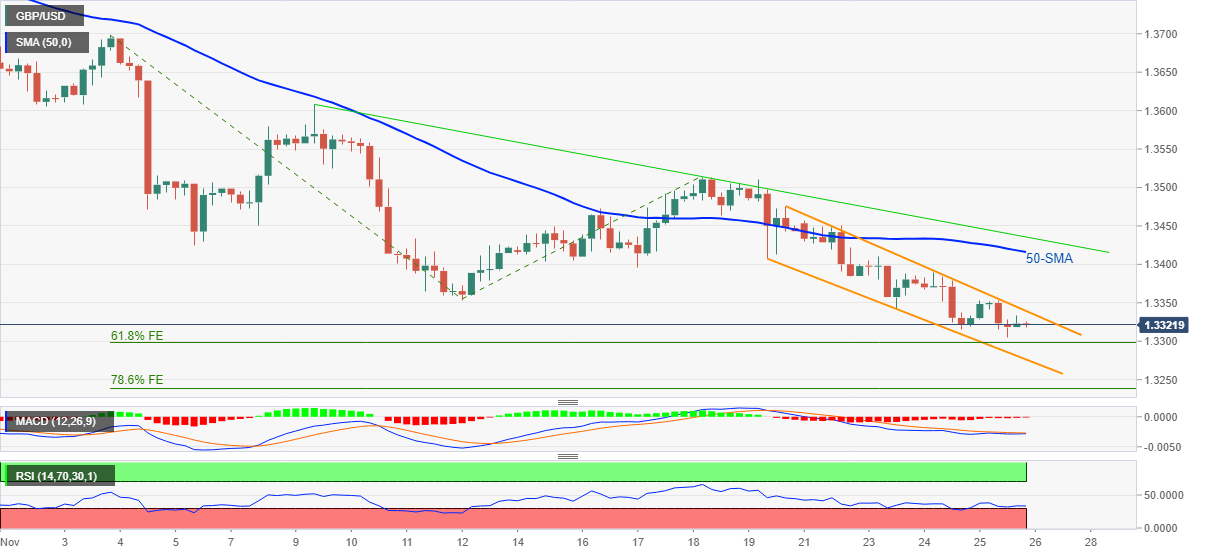
GBP/USD defends the 1.3300 threshold, taking rounds to the recently flashed yearly low during the early Asian session on Friday. In doing so, the cable stays inside a one-week-old falling trend channel.
Although the bearish channel keeps sellers hopeful, MACD and RSI conditions signal a corrective pullback targeting the channel’s upper line near 1.3340.
It’s worth noting that the quote’s upside momentum past 1.3340 need not only cross the 50-SMA level of 1.3415 but a 13-day-old falling trend line near 1.3435 to recall the GBP/USD buyers.
Following that, a run-up to the mid-November’s swing high close to 1.3515 can’t be ruled out.
Alternatively, 61.8% Fibonacci Expansion (FE) of the pair’s moves between November 03 and 18, around 1.3300 offers strong immediate support to the GBP/USD prices.
Even if the sellers manage to conquer the psychological magnet, the stated channel’s lower line may act as an extra filter to the south, around 1.3275, before directing the quote towards the 78.6% FE level of 1.3240.
GBP/USD: Four-hour chart
Trend: Corrective pullback expected
- EUR/JPY is range-bound as the Asian session begins, within the 129.20-52 range.
- EUR/JPY has a downward bias, but a daily close below Thursday’s low at 129.19 would expose the 128.00 figure.
The EUR/JPY is flat as the Asian Pacific session begins, is trading at 129.19 during the day at the time of writing. On Thursday, during the overnight session, the EUR/JPY remained in a choppy trading range, within the 129.20-52 range, as the market is headed towards a thin liquidity session In the observance of the US Thanksgiving.
At press time, the market sentiment is a mixed bag. Asian equity futures fluctuate between gainers and losers, while European and US stock futures rise.
The Japanese economic docket featured the Coincident Index and the Leading Economic Index, both readings for September. The Coincident Index rose to 88.7, higher than the 87.5 foreseen, while the Leading Economic Index increased to 100.9, higher than 99.7, estimations.
Concerning the Eurozone economic docket, the Gfk Consumer Confidence Survey for December contracted more than the foreseen, dropping to 1.6, lower than the 0.5. In the meantime, the German Gross Domestic Product for the Q3 rose by 1.7%, a tick lower than the 1.8% estimated.
That said, the EUR/JPY pair would lean on market sentiment, as long as the monetary policy between the European Central Bank (ECB) and the Bank of Japan (BoJ) converges. On the other hand, if the ECB moves towards a more neutral stance, the EUR would be favored by flows, as it would be viewed as a hawkish signal for investors.
EUR/JPY Price Forecast: Technical outlook
The EUR/JPY pair has a bearish bias, confirmed by the daily moving averages (DMA’s), which have a downslope, and remain above the spot price. Furthermore, the Relative Strength Index (RSI) at 40 flattish suggests EUR/JPY bears are taking a breather, before resuming the downtrend.
In that outcome, the first demand area would be the November 24 cycle low at 128.68, followed by the October 6 swing low at 128.33, and then the November 19 low at 127.97.
- NZD/USD licks its wounds around lowest levels since August, eyes biggest weekly loss in three months.
- Post-RBNZ disappointment spreads amid light calendar, US holiday.
- RBNZ’s Hawksby sounds cautiously optimistic, ANZ – Roy Morgan Consumer Confidence eased for November,
- No major data/events in sight, Aussie Retail Sales may entertain traders.
NZD/USD sellers take a breather following the south-run to smash September’s bottom and test the lowest levels in three months. That said, the Kiwi pair stays sidelined around 0.6860 by the press time of early Friday morning in Asia.
The US Thanksgiving Day holiday offered no respite to the NZD/USD prices as the quote dropped for the fifth consecutive day on its way to register the biggest weekly fall since mid-August.
While tracing the catalysts, the fresh covid concerns and the market’s dislike for the Reserve Bank of New Zealand’s (RBNZ) 0.25% rate hike could be linked. Also on the negative side were hawkish statements from the Fed officials and Fed Minutes, before the US markets closed for the holiday.
Recently, RBNZ Assistant Governor Christian Hawkesby crossed wires via an interview with Bloomberg TV and tried to defend the tighter monetary policy despite citing downside risk from covid.
Read: RBNZ's Hawkesby: We need to continue removing stimulus
It’s worth noting that the Sino-American tussles slowly escalates following the virtual meeting between US President Joe Biden and his Chinese counterpart Xi Jinping. While China’s inability to perform the phase one deal terms sparked initial fears of another round of the US-China tussles, issues relating to Vietnam and Taiwan recently added fuel to the fire. The US invites Taiwan to one of its home events and keeps its warships moving in the troubled water surrounding the Asian nation, which in turn hints at political jitters with Beijing. Given China’s close trade proximity to New Zealand, as well as the status of the world’s largest commodity user, such events challenge the Antipodeans.
Additionally, the recent jump in the covid numbers in Europe and a steady rise in infections in the UK signals the returns of the pandemic and renews fears of lockdowns that crippled the global economy a few months back.
Amid these plays, Gilts and Bunds were mildly offered while the stocks in Europe and the UK printed softer gains amid a sluggish day. However, gold remained mostly unchanged and the NZD/USD kept declining.
Looking forward, a light calendar may not entertain the momentum traders but the return of the US traders and Aussie Retail Sales will be important for the NZD/USD. Above all, the RBNZ-led disappointment may weigh on the quote while covid woes, US-China tension and fears of the Fed action can exert additional downside pressure on the pair.
Technical analysis
Having conquered a 14-month-old support line, NZD/USD bears smashed 61.8% Fibonacci retracement (Fibo.) of September 2020 to February 2021 upside, which in turn suggests the quote’s further weakness towards the yearly bottom of 0.6805. Alternatively, 61.8% Fibonacci retracement level of 0.6875 and the previous support line near 0.6900 guards short-term NZD/USD upside.
“New Zealand's economy is quite resilient,” said RBNZ Assistant Governor Christian Hawkesby during an interview with the Bloomberg TV amid early Friday morning In Asia.
More to come..
- AUD/USD bears intent on the Oct lows on a strong USD theme.
- RBA and the Fed are a focus for this pair with a hawkish bias towards the latter.
AUD/USD is flat on the day in quiet Thanksgiving market conditions, although that did not prevent the pair from sliding deeper towards the daily 0.7191 lows printed back in October. The price fell from a high of 0.7209 to a low of 0.7179 on the day. The majority of the supply happening in the London open with lows made in the New York open from where the pair has drifted sideways ever since.
The greenback edged lower on the day. It was drifting from its highest level since July 2020 that was printed against the euro, despite the covid concerns in Europe and the expectations that the US Federal Reserve will raise rates sooner than other major central banks. The DXY index, a measure of the US dollar vs a basket of rival major currency pairs fell to 96.652 from a high of 96.806 on the day and 96.887 the cycle high post-FOMC minutes.
The minutes from the Fed's Nov. 2-3 meeting boosted the dollar as it was confirmed that the Fed had become more concerned about rising inflation. Various policymakers said they would be open to speeding-up the taper of their bond-buying programme, including Fed's Mary Daly who now also advocates for a faster pace.
Meanwhile, with the central banks in focus, the Reserve Bank of Australia's tightening could be elongated, analysts at ANZ Bank argued
''RBA Governor Phillip Lowe’s recent statements about the level of the neutral rate and the flatness of the Phillips curve could combine to imply a faster and more aggressive start to the tightening cycle when it eventually comes. If the RBA goes on slowly regardless of what it ‘should’ do, we may find that the tightening cycle is very elongated.''
- AUD/JPY slides for the second day in a row, despite risk-on market sentiment.
- On Thursday, the AUD/JPY remained subdued, without clear direction.
The AUD/JPY falls during the day, down some 0.15%, trading at 82.93 during the day at the time of writing. Despite thin liquidity conditions, the market sentiment remains upbeat as the US Markets remain closed in the observance of Thanksgiving. Major US equity futures indices rise between 0.11% and 0.23%, carrying on with the market mood witnessed in the European session.
On Thursday, during the overnight session, the AUD/JPY pair remained dull, trading in a choppy range, with the 50, the 100, and the 200-hour simple moving average (HSMA) are located within the 82.90-83.17 area, implying that in the near-term the AUD/JPY is range-bound.
That said, the AUD/JPY in the near term would lie mostly in pure market sentiment unless the Reserve Bank of Australia (RBA), which has been more dovish than expected, changes its dovish posture towards a hawkish one. That would originate flows towards the Australian dollar without considering as much the market sentiment.
AUD/JPY Price Forecast: Technical outlook
The AUD/JPY has an upward bias, despite the ongoing correction, that has witnessed a test of the 50-day moving average (DMA), which was pierced on Wednesday but regained by AUD bulls on Thursday. At press time, the 50-DMA sits at 82.98, a level that would need to be reclaimed by AUD bulls.
The outcome of a daily close above 83.00 could pave the way for further upside. The first resistance for AUD/JPY traders to overcome would be the November 19 swing high at 83.35, followed by the November 16 cycle high at 84.15.
On the other hand, failure to reclaim 83.00 would open the door towards the 100-DMA at 81.85, though it would find some hurdles on the way down, like the November 19 swing low at 82.15.
-637734710899580898.png)
| Time | Country | Event | Period | Previous value | Forecast |
|---|---|---|---|---|---|
| 00:30 (GMT) | Australia | Retail Sales, M/M | October | 1.3% | 2.5% |
| 07:45 (GMT) | France | Consumer confidence | November | 99 | 98 |
| 08:00 (GMT) | Switzerland | Gross Domestic Product (YoY) | Quarter III | 7.7% | 3.2% |
| 08:00 (GMT) | Switzerland | Gross Domestic Product (QoQ) | Quarter III | 1.8% | 2% |
| 08:00 (GMT) | Eurozone | ECB President Lagarde Speaks | |||
| 09:00 (GMT) | Eurozone | Private Loans, Y/Y | October | 4.1% | |
| 09:00 (GMT) | Eurozone | M3 money supply, adjusted y/y | October | 7.4% | 7.4% |
What you need to know on Friday, November 26:
Little happened on Thursday, as US markets were closed due to the Thanksgiving holiday. Markets will work shortened hours on Friday, and muted trading is expected to continue. The bullish dollar's momentum took a breather, but the American currency maintained its leadership.
The EUR/USD pair surged to 1.1229, ending the day just above the 1.1200 figure. The coronavirus is taking its toll on the region, spurring concerns about the economic recovery.
So far, some Eastern European countries opted for strict lockdowns, while France announced on Thursday booster shots, refraining from imposing restrictions. Portugal declared a state of calamity and announced new restrictions due to the rise in cases, while Germany is expected to announce a decision on the matter on Friday, as cases in the country stand at record highs.
The GBP/USD fell to 1.3304, a fresh 2021 low, to end the day pretty much unchanged in the 1.3320 price zone, undermined by Brexit jitters. The French Fishing Association Body would be taking action on Friday to block French ports, and the Channel tunnel as the UK failed to grant fishing licenses.
USD/JPY trades in the 115.30 area, unchanged on a daily basis. Commodity-linked currencies remained unchanged vs the greenback, with the AUD being the weakest.
There was no activity in gold markets, with the bright metal steady around $1,790 a troy ounce. Crude oil prices ticked lower, although the barrel of WTI held above $78.00.
Top 3 Price Prediction Bitcoin, Ethereum, Ripple: Money flows back into cryptos
Like this article? Help us with some feedback by answering this survey:
- GBP/JPY has traded within tight 153.50-154.00ish ranges on Thursday amid US market closures for Thanksgiving.
- The pair has formed a pennant, however, raising the risk of a technical break in the coming days.
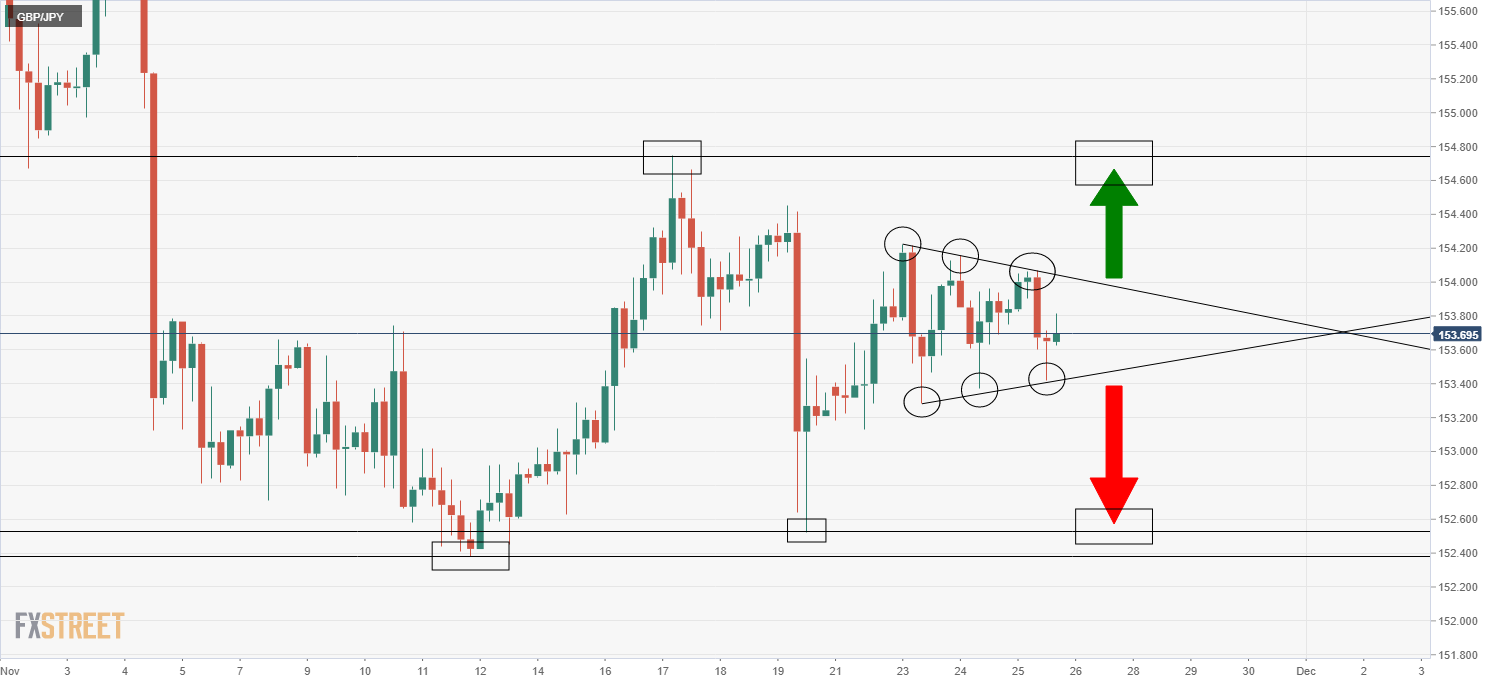
GBP/JPY has remained stuck within recent ranges on Thursday, unable to surpass or even test weekly highs in the 154.10-20 area and finding good support below 153.50. FX market conditions have been tame on Thursday amid a lack of US market participants, with markets there closed for Thanksgiving. The pair continues to trade close to its 50-day moving average, which currently resides around 153.60. On the day, the pair trades broadly flat, despite further Brexit jawboning by the UK regarding triggering article 16 of the Northern Ireland protocol and despite news that French fishermen will be taking action to block UK/EU trade via sea and the channel tunnel on Friday.
Remarks from Bank of England Governor Andrew Bailey earlier in the session, who said that the supply chain problems causing inflation should be temporary, were broadly ignored by FX markets. Bailey added that the risk is that inflation expectations become embedded and, before noting that we have a very tight labour market in the UK. Policy guidance is more hazardous to give in times of elevated uncertainty, he said.
Technicians will note that over the past three days, GBP/JPY has formed a pennant structure. A break on the upside would likely see prices move back towards the 17 November highs on the 154.700s, while a break to the downside would open the door to a move towards recent lows around 152.50. This area also coincides with the 200DMA, and thus might present a good entry point for the dip buyers.
- USD/JPY bulls eye higher levels to come on Fed sentiment.
- The Fed is turning more and more hawkish as inflation fears ramp up.
USD/JPY is holding in the 115 area around 115.35 and sat in a Thanksgiving range of 115.24/45 as it consolidates the recent Federal Reserve sentiment as the hawks circle over 2051 Constitution Ave.
Some short-squeezing in JPY seemed warranted by some support to US 10-year yields in mid-November and also given how overstretched the yen’s net-short positioning was.
The US dollar slipped slightly on Thursday with traders away for the holidays, but it remains in a positive territory around the highest levels seen since July 2020 against the euro and in the DXY index. The greenback has strengthened due to the markets anticipating that the US Federal Reserve will hike rates sooner than other major central banks.
On Wednesday, the minutes of the Fed's Nov. 2-3 meeting were supporting the case for a higher US dollar but did little on the day to send it much higher. There could be a delayed reaction here, perhaps with investors taking profits on long positions overall ahead of the long weekend.
However, the minutes have indicated that board members had become more concerned about rising inflation. p The December meeting will be a significant meeting whereby the pace of tapering of their bond-buying programme could start as many members have already advocated. as such the markets are getting set for a sooner than first anticipated liftoff.
USD/JPY levels
The hawkish bias is expected to keep USD/JPY afloat. Analysts at Commerzbank expect more from the pair with the 115.60 61.8% Fibonacci retracement of the move down from 2015 being in focus. ''Above here is the 117.56 level, the 1998-2021 resistance line and 119.41, the downtrend from 1975. We have a near term uptrend at 113.92.''
- EUR/GBP remains trapped around the 0.8375-0.8430 range, with no clear direction.
- Eurozone: COVID-19 fourth wave could severely impact Europe, as Germany prepares for the possibility of enacting lockdowns.
- Brexit: The EU and the UK, seem far for getting an agreement in the near term.
The EUR/GBP cuts some weekly losses during the day, up some 0.06%, trading at 0.8411 at the time of writing. On Thursday’s overnight session, the euro gained some ground against the British pound, shrugging off COVID-19 fourth wave Europe woes, while negotiations between the EU and the UK seem stuck regarding Brexit.
The fourth wave of COVID-19 is impacting severely in Europe, with cases rising at record levels. Austria −which reimposed a two-week lockdown−, and Germany who’s started to impose tighter rules amid the country’s worst COVID-19 surge, are studying mandatory vaccines measures throughout both countries. Also, Slovakia, the Czech Republic, Netherlands, and Hungary reported new highs in daily infections as winter approaches Europe.
Talking about Brexit jitters that could weigh on the British pound, a UK government spokesperson said that the UK PM had told the Irish PM that he was concerned about a substantial gap that remained between the UK and EU on the implementation of the Northern Ireland Protocol. Furthermore, the French Fishing Association threatened to take action on Friday, blocking French ports and the Channel tunnel, as the UK has faltered to get what they wanted. That would exacerbate supply chain disruptions that are already plaguing the UK economy.
That said, alongside central bank policy divergence, it seems to favor GBP bulls as the Bank of England prepares to tighten monetary policy conditions. However, Brexit jitters could cap any downside moves on the EUR/GBP pair.
EUR/GBP Price Forecast: Technical outlook
The EUR/GBP daily chart depicts the pair is range-trading between the 0.8370-0.8430 region, failing to break over/under the range. According to the daily moving averages (DMA’s), favors a bearish bias, as the DMA’s reside well above the spot price, with a downward slope, indicating that selling pressure could be mounting.
Further, the candlesticks of Monday and Wednesday left two large wicks on top of the real bodies, suggesting that sellers are under control, despite the strong support found around the 0.8370s area.
In the continuation of the downtrend, the first support would be the November 22 swing low at 0.8380. A breach of the latter would expose the January 2020 swing lows around 0.8281
On the other hand, the first resistance would be the August 10 swing low-turned resistance at 0.8449, followed by the 50-DMA dynamic resistance at 0.8492.
- EUR/USD bears are testing bullish commitments at 1.12 the figure.
- EUR/USD is well on its way to the June 19 2020 lows of 1.1168.
- US Fed minutes are under review and divergence between Fed and ECB in play.
Despite the Thanksgiving holidays, markets have reacted in kind to the FOMC minutes of the Wednesday US session and we are seeing follow-throughs in currency trends. EUR/USD, however, is stubbornly holding above yesterdays low of 1.1186 although bears continue to pressure the 1.12 figure. At the time of writing, the single currency trades at 1.1209 and has travelled between a high of 1.1229 and 1.1193 on the day so far.
The greenback has gained around 2.8% this month, but the dollar index on the day is down 0.0.7% at 96.770 at compared to the 16-month high of 96.938 it reached late on Wednesday. in general, the greenback remains better bid but has been soft on the day, below the highest levels since July 2020 against the euro.
Minutes from the Fed's Nov. 2-3 meeting boosted the dollar on Wednesday as Fed members are showing concerns over rising inflation threats. A number of policymakers said they would be open to speeding up the taper of their bond-buying programme if high inflation held and move more quickly to raise interest rates.
Additionally, data on Wednesday showed that US jobless claims were at a 52-year low and consumer spending increased more than expected in October and inflation was rising. Also pressuring the pair, a surge in coronavirus infections in Germany and unusually high inflation rates are weighing on the consumer morale in Europe's largest economy, a survey showed on Thursday.
Medium-term, we continue to favour the USD., analysts at Rabobank said. ''However, with the market now long USD and short EUR and the money market very aggressively positioned for Fed rate hikes next year, there is scope for pullbacks in the currency pair.'
''Technically'', the analysts argue that, ''EUR/USD could recover back towards the 1.15 area and still remain in the downtrend that has been in play since early June. Potential triggers could be the next round of US data including the December 3 payrolls release. The guidance and tone of the December 15 FOMC meeting is also in view. While there is growing risk that EUR/USD will reach the 1.10 area next year, the risk of pullbacks means that we are holding off from changing our 1.12 target for the time being.''
- NZD/USD extends its losses to five days straight, hovering around 0.6850s.
- The disappointment of the RBNZ failing to hike 50 basis points spurred a sell-off of the NZD.
- NZD/USD: A break of an upslope trendline fueled the downward move further, down to 0.6940.
The New Zealand dollar extends its free-fall to five days in a row, down 0.28%, trading at 0.6854 during the day at the time of writing.
In the overnight session, the pair attempted to reclaim the 0.6900 but failed, retreating towards the mid 0.6800s for the fifth consecutive day. On Wednesday, the Reserve Bank of New Zealand (RBNZ) hiked 25 basis points to the Overnight Cash Rate, though it fell short of investors’ expectations. The NZD/USD reaction to the downside seemed like a “buy the rumor, sell the fact” event.
The market sentiment is upbeat on Thursday, so the risk-sensitive NZD should be headed to the upside. However, FOMC last meeting minutes unveiled on Wednesday showed that some Fed policymakers would like to increase the pace of the bond taper so that the US central bank could have room to maneuver, in the case of inflation running hot. That, alongside thin liquidity conditions in the FX market, due to the observance of the US Thanksgiving holidays, capped the NZD upside move.
Also, the greenback is trading barely down during the day, with the US Dollar Index losing 0.08%, sitting at 96.76.
On Friday, an absent economic docket from New Zealand and the US would let NZD/USD traders leaning on the greenback dynamics and market sentiment, which could offer some fresh impetus on the NZD/USD pair.
NZD/USD Price Forecast: Technical outlook
Wednesday’s price action, witnessing the NZD/USD pair breaking an upslope trendline around 0.6932, which once broken, accelerated the downtrend towards 0.6850s until printing a close at 0.6870. The NZD/USD is tilted to the downside, as depicted by the daily moving averages (DMA’s) remain above the spot price, with a downslope, confirming the bearish bias.
In the outcome of the NZD/USD extending its free fall, the first support would be the September 28 swing low at 0.6859. A daily close below the latter would expose the August 20 cycle low at 0.6805.
On the other hand, the psychological 0.6900 figure would be the first resistance on the way north. A breach of that level would expose 0.6932.
Bank of England Governor Andrew Bailey said on Thursday that the supply chain problems causing inflation should be temporary, according to Reuters. The risk, he continued, is that inflation expectations become embedded and we have a very tight labour market in the UK. Policy guidance is more hazardous to give in times of elevated uncertainty, he said.
Market Reaction
Pound sterling has not seen a notable reaction to these comments. Liquidity conditions are very thin amid US market closures. FX markets will close between 1800GMT and 2300GMT.
- USD/TRY is consolidating around the 12.00 level on Thursday.
- The CBRT minutes, as well as a meeting of CBRT, bank regulators and Turkish banks, was ignored.
- The bank isn't showing any signs of a hawkish policy shift just yet, but strategists remain hopeful.
After a highly volatile few weeks, USD/TRY is finally able to take a breather on Thursday amid thin liquidity conditions given US market closures. The pair has spent most of the day consolidating around the 12.00 level and current trades lower by about 0.5%.
The pair hit record highs close to 13.50 earlier in the week as Turkish President Recep Erdogan defended his pressure tactics on the CBRT, where he is essentially forcing them to cut interest rates despite surging inflation. But speculation has built that, amid the lira’s tumble (it is now lost nearly 40% of its value versus the US dollar this year), a policy response will be forthcoming.
The minutes of last week’s CBRT policy meeting were released on Thursday. To recap, the bank opted to cut interest rates by a further 100bps to 14.0% (taking total cuts since September to 400bps) last week. The minutes did not impact the lira and contained the usual empty promises; the CBRT said will continue to use all available instruments decisively until inflation falls back to the bank’s medium-term 5.0% target.
Meanwhile, officials from the CBRT, Turkish bank regulators and Turkish banks met on Thursday. Following the meeting, the CBRT governor said that the banking sector was very strong and that he had informed banking officials about recent rate cuts. The discussions were routine, governor Şahap Kavcıoğlu said and surrounded on general evaluations on the economy and banking sector.
Those hoping that the meeting might have resulted in an immediate hawkish turnaround in CBRT policy in wake of the lira’s recent sharp depreciation were left down. Still, many analysts expect that over the coming months, as inflation continues to accelerate in Turkey, the CBRT will have its hands forced and rate hikes will eventually be forthcoming.
- GBP/USD has tentatively bounced from annual lows at 1.3300 ahead of a short market closure for Thanksgiving.
- Markets have been keeping one eye on Brexit developments, with French fishermen port/tunnel blockades now expected.
- While the pair has been under heavy selling pressure recently, it isn't yet in oversold territory.
Ahead of a five-hour FX market closure lasting between 1800GMT and 2300GMT due to the Thanksgiving holiday in the US, GBP/USD is trying to tentatively regain some composure. The pair had hit fresh annual lows just to the north of the 1.3300 level earlier on during Thursday’s session but has since bounced to the 1.3320s.
On the day, the pair is now flat. The tone of Brexit developments seems to be tacking a tone for the worse again. A UK government spokesperson on Wednesday evening said that the UK PM had told the Irish PM that he was concerned about a substantial gap that remained between the UK and EU on the implementation of the Northern Ireland Protocol.
Meanwhile, the French Fishing Association Body was scathing of the UK on Thursday, saying that they had still not got what they wanted regarding licenses. The body said that French fishermen would be taking action on Friday to block French ports and the Channel tunnel. The blockades will disrupt UK/EU trade and are likely to exacerbate the supply chain disruptions already plaguing the UK economy.
Data from the ONS released earlier in the morning showed that 14% of businesses in the UK had reported a shortage of workers in late November. Further evidence of a strong UK labour market likely increases the chances that the BoE will hike interest rates by 15bps to 0.25% next month and this might be helping to negate the impact of negative Brexit newsflow for GBP.
But UK money markets don’t seem to have viewed the ONS data this way. Three-month sterling LIBOR futures for December 2021 (a proxy of the market’s expectations of the BoE’s Bank Rate next month) rose to their highest since late September on Thursday at 99.820, up from 99.765 at the start of the week. That implies markets only anticipate about 8bps of rate hikes next month, or are only pricing slightly above a 50% chance that the bank will hike rates.
Sterling losses have further to run
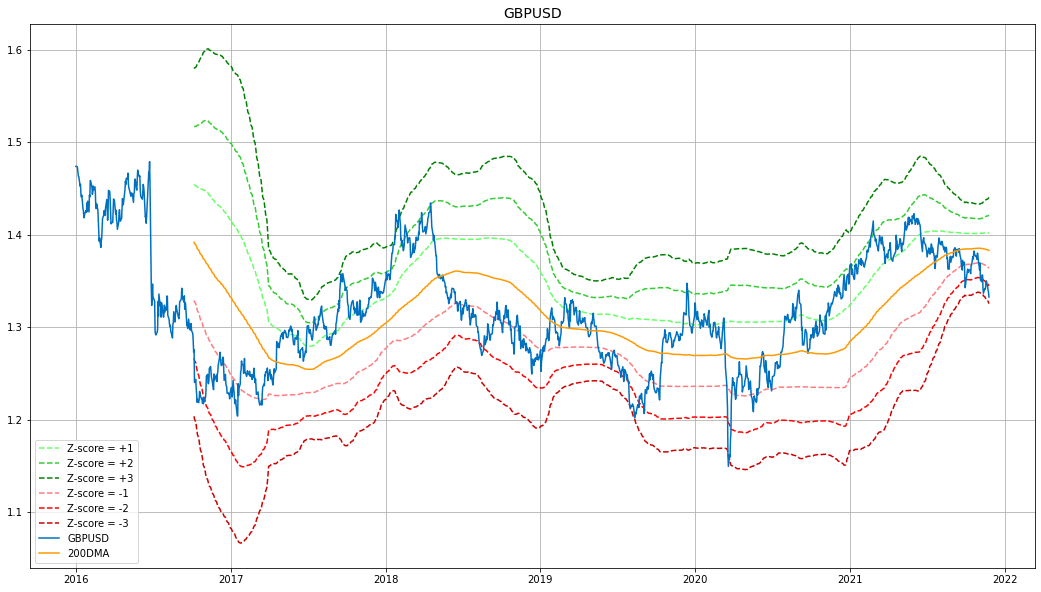
If the BoE does disappoint expectations next month by refusing once again to hike interest rates, then GBP will see a negative reaction as hawkish bets are unwound. Though GBP/USD has come under heavy selling pressure in recent weeks and is down 2.6% on the month, the pair isn't yet in oversold territory.
Its 14-day Relative Strength Index score is 33.3, above the oversold 30 mark, while its Z-score to its 200DMA (the number of standard deviations away) is at -2.61. In the last five years, the GBP/USD’s Z-score has only been under -2.50 on two occasions and on both those occasions it needed to fall under -3.0 before GBP/USD rebounded.
- USD/CHF extends its rally to five consecutive days.
- USD/CHF: A break of a 4-month old downslope resistance trendline opened the door for a renewed test of 2021 year-to-date high.
The USD/CHF extends its gains the fifth consecutive day, up 0.25%, trading at 0.9355 during the day at the time of writing. Thin liquidity conditions in observance of Thanksgiving in the US keep the pair subdued.
Despite the abovementioned, European bourses closed in the green depicting risk appetite towards equities. Further, US equity futures are trading in the green, while the US Dollar Index, which tracks the buck’s performance against a basket of six rivals, slides 0.11%, sitting at 96.74.
USD/CHF Price Forecast: Technical outlook
The USD/CHF has an upward bias in the daily chart, as shown by the daily moving averages (DMA’s) with an upslope, residing well beneath the spot price. Furthermore, the break of an eight-month-old downslope resistance trendline indicates that the USD/CHF is tilted to the upside, though it would need a daily close above the abovementioned.
In that outcome, the first resistance on the way up would be the psychological 0.9400 figure. A breach of the former would expose the April 1 swing high at 0.9473, followed by the June 29, 2020 cycle high at 0.9528.
On the other hand, failure to hold above 0.9330 would expose the 0.9300 figure. A break below that level would reveal the confluence of the 50-DMA and the November 19 swing low around the 0.9225-50 region, which, once giving way, would leave the 0.9200 as the last line of defense for USD bulls.
- XAU/EUR recovers some of its weekly losses, barely up 0.01.%.
- Falling German 10-year bunds and German Real Yields keep the EUR pressured to the downside.
- XAU/EUR: Tilted to the upside, as long as it remains above €1,575.
Gold (XAU/EUR) vs. the euro trims some of its weekly losses, advances 0.01%, trading at €1,596 during the day at the time of writing. Thin liquidity conditions with the US on Thanksgiving holiday, and an upbeat market, put a lid on the yellow-metal free fall. European stock indices are in the green, while US equity futures point to the upside.
Meanwhile, the German 10-year bund, which significantly influences the EUR, falls almost three basis points, sitting at -0.248%. Also, German Real Yields drop seven basis points, down to -1.93%, weighing on the EUR fall against the non-yielding metal.
Choppy trading conditions in the XAU/EUR keep gold trading in a narrow range of €1,594-€1,600; amid thin liquidity conditions, US Stock and Money Markets remain closed, in the observance of Thanksgiving.
On Thursday, the Eurozone economic docket featured the German GFK Consumer Confidence Survey for December showed a further contraction than expected. The number came at –1.6, lower than the -0.5 expected. Further, the Gross Domestic Product for Germany for the Q3 came at 1.7%, a tenth lower than the 1.8% expected, which caused no meaningful impact on XAU/EUR.
XAU/EUR Price Forecast: Technical outlook
The daily chart depicts that gold corrected beneath the top-trendline of the Pitchfork’s channel, from YTD tops around €1,650, down to around €1,580, near the middle-trendline of Pitchfork’s channel, which acted as support. Since then, gold has stabilized around the €1,575-€1,600 range, though XAU/EUR still tilted to the upside, per the daily moving averages (DMA’s) residing below the spot price with an upward slope.
On the upside, the first resistance would be €1,600. A breach of the latter would expose Pitchfork’s top-trendline to around €1,640. Otherwise, the first support would be Pitchfork’s middle-trendline around €1,575, followed by the confluence of the 50-DMA and the July 16 swing high at €1,550.
-637734542216934745.png)
The November US employment report will be released on the first Friday of December. At the moment, analysts at Wells Fargo expect an increase in jobs of around 600.000.
Key Quotes:
“Total nonfarm payrolls increased by 531K during October, a gain that was well ahead of expectations. The net revisions to the previous two months were also positive and added another 235K to job growth in August and September. Stronger job growth recently is evidence that some of the headwinds holding back employment growth, namely the Delta variant of COVID and labor shortages, are beginning to die down. Higher wages may be helping in this regard. Average hourly earnings rose 0.4% during the month, and earnings are now up 4.9% over the past year.”
“We expect labor availability to continue to be a constraint on hiring in the coming months. That noted, workers do appear to be slowly reentering the labor force. More discernable improvement should come next spring when COVID risks are lower and childcare issues are better resolved. The growing distance between fiscal support as well as inflation chipping away at individuals' spending power should provide the financial imperative to return to work. These factors should help hiring continue at a robust pace and keep the level of employment on track to recover around the end next year.”
“In terms of the November employment report, we look for a 600K gain, which as of this writing, is above consensus expectations.”
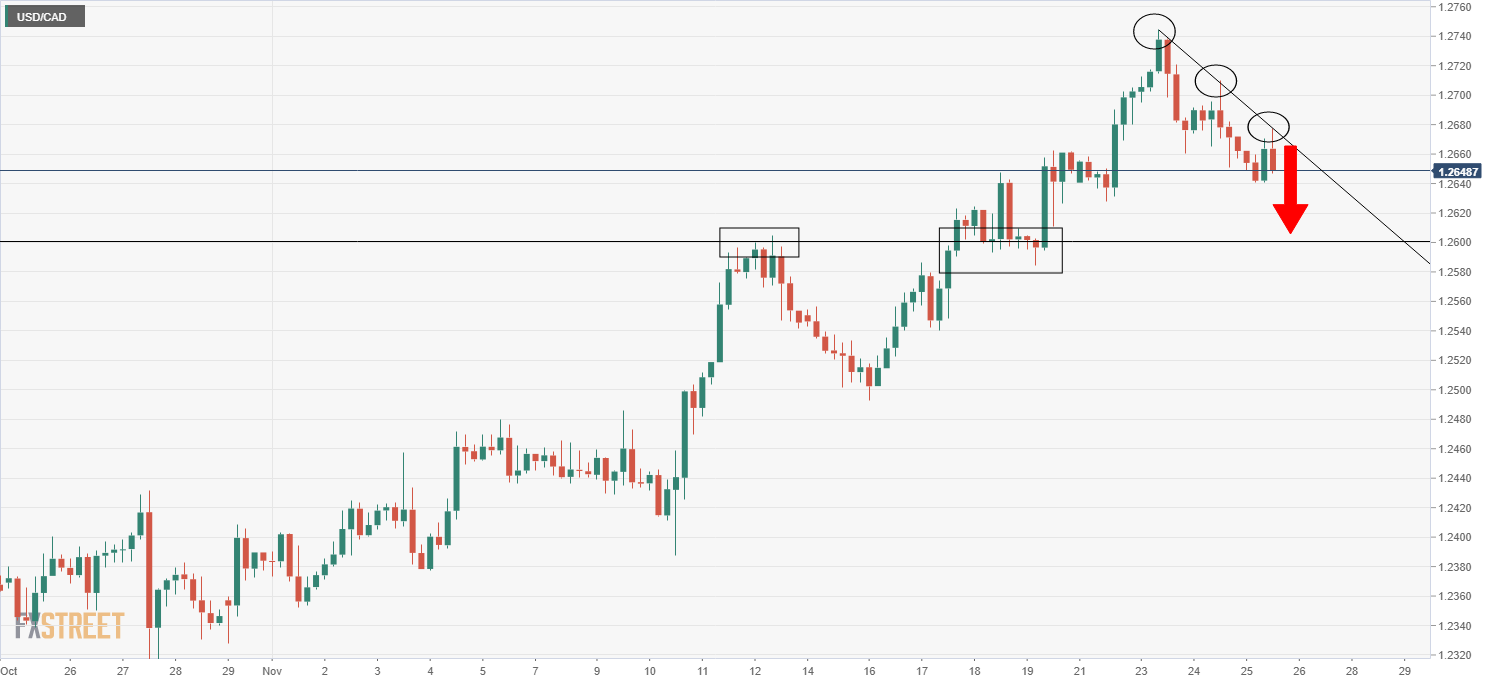
- USD/CAD continues to gradually push lower, with the price action capped by a downtrend from the weekly higher.
- At present, the pair trades around 1.2600, but if oil continues to recover next week the pair could return to 1.2600.
USD/CAD has slipped back under the 1.2650 level in recent trade from earlier session highs around 1.2680. The pair appears to have run into resistance in the form of a downtrend that has formed since the pair slipped back from earlier weekly highs close to 1.2750. Technicians will now eye a retest of earlier session lows around 1.2640, though market conditions are currently very thin amid the absence of US participants for Thanksgiving, meaning any decisive break lower will probably have to wait for next week.
At current levels around 1.2650, USD/CAD is nearly back to flat on the week. Given that the pair, when it was trading close to 1.2750, was nearly up by 1.0% on Monday, that is a pretty decent reversal lower. And that reversal lower comes despite a continued broad strengthening of the US dollar amid hawkish Fed vibes (comments from FOMC’s Mary Daly and the Fed minutes) and more strong US macro data.
The reason why CAD has been able to perform well is due to the recovery in oil prices after Tuesday’s underwhelming US (and global) crude oil reserve release. There is speculation that OPEC+ could shift output policy to compensate for the reserve releases at their meetings next week and this has helped oil markets recover. WTI is up more than 3.0% on the week.
Should OPEC+ refrain from further output hikes next week (to the anger of the US and other nations) and send oil prices shooting higher again, this could lend further support to the loonie and the recent bearish technical trend may continue. Traders would likely target a move back down towards the next key area of support at 1.2600.
The European Central Bank (ECB) will likely end the net purchases under PEPP to end March 2022, affirms Jan von Gerich, Chief Analyst at Nordea. They o not see the ECB going for a totally new asset purchase programme.
Key Quotes:
“The December meeting will be very interesting, especially as judging by the recent speeches, many Governing Council members have become more worried about the inflation outlook, and the voices to the monetary policy focus away from asset purchases has increased.”
“There is probably not much disagreements about signalling that rate hikes are very unlikely as early as next year. However, there are likely to be more disagreements on what to do with the asset purchases. Even amidst the weakened Covid-19 outlook, the net purchase pace of the Pandemic Emergency Purchase Programme (PEPP) still looks likely to end in March 2022.”
“We continue to expect the ECB to complement EUR 20bn monthly pace in the Asset Purchase Programme with a fixed-size envelope of around EUR 200bn, as a compromise between the doves and the hawks. The current forward guidance on the APP, stating that net purchases are expected to end shortly before rate hikes start, is likely to be retained for now.”
“An idea about a totally new bond purchase programme has also been floated – one that would be able to respond to market shocks and would not necessarily need to follow the capital key. We do not believe the ECB will introduce such a programme, but will rather opt at using the PEPP reinvestments for this purpose, which will continue at least until the end of 2023.”
- Mexican peso tumbles on Banxico’s headlines.
- USD/MXN overbought, but still no signs of correction.
- The 21.50 area is the key zone to watch.
Mexican President Andres Manuel Lopez Obrador added more fuel to the USD/MXN rally on Wednesday by changing his nominee for the next head of the central bank. It triggered a new leg higher that peaked at 21.62, the new high since March.
From the new top, USD/MXN pulled back, finding support above 21.35. Currently, the pair is hovering around 21.50, a key area. A consolidation above should lead the road open to more gains. The next strong resistance is located at 21.90 that should hold.
Technical indicators are at extreme readings but no signs of correction are seen. The RSI is above 70 but still looking north; a similar situation occurs with Momentum. Despite showing no signs, the 21.50 zone should limit the upside for the time being, particularly if overall market conditions help.
If USD/MXN fails to hold above 21.50, it could pullback initially to 21.20 and then to the more relevant and strong support seen at 20.90. A slide below would alleviate the bullish pressure.
The constructive outlook for USD/MXN will remain intact while price stays above the uptrend line, today at 20.35.
-637734504688983287.png)
- AUD/USD edges lower 0.14% amid thin liquidity conditions, in the observance of US Thanksgiving.
- AUD/USD remained subdued in the overnight session, within the 0-7170-0-7200 range.
- AUD/USD is tilted to the downside, as long as it remains below 0.7250.
The AUD/USD grinds lower versus the greenback, down 0.15%, trading at 0.7188 during the day at the time of writing. The market sentiment as the European session advances is upbeat, as European indices are in the green, despite thin liquidity conditions, attributed to the Thanksgiving celebration in the US.
However, it is crucial noticing that Europe is the new COVID-19 epicenter, with cases rising at record levels. Countries like Slovakia, the Czech Republic, Netherlands, and Hungary reported new highs in daily infections as winter approaches Europe. They added to Austria −that reimposed a two-week lockdown−, and Germany who’s started to impose tighter rules amid the country’s worst COVID-19 surge.
In the overnight session, the AUD/USD pair traded sideways within the 0.7170-0.7200 range, with a light economic docket our of Australia. The Private Capital Expenditure for the Third Quarter, which shrank 2.2%, more than the 2% contraction estimated by analysts, did not have any meaningful impact on the AUD/USD pair. On the US front, the observance of Thanksgiving would not offer new macroeconomic data until the following week.
On Friday, the economic docket for Australia would feature the Retail Sales for October. That data, alongside US dollar dynamics and market sentiment, would be the factors that could move the AUD/USD pair.
AUD/USD Price Forecast: Technical outlook
The AUD/USD has a downward bias, as the daily moving averages (DMA’s) are well located with a downslope, above the spot price. Also, the break of an upslope trendline on last week’s Friday, followed by intense selling pressure on Monday, dented the AUD bullish prospects, as AUD bulls have struggled to reclaim the 0.7250 level.
In the outcome of extending the downtrend, the first support would be the September 30 swing low at 0.7169. A breach of the latter would open the door for a retest of the 2021 year-to-date low at 0.7105.
- Spot silver prices are seeing subdued trade on Thursday and this is likely to remain the case for the rest of the week.
- XAG/USD is set to end the week around 4.0% lower, amid a hawkish shift in the market’s expectations for Fed policy.
Financial markets are trading with a lack of conviction in the Thursday European afternoon, due to the lack of US market participants on account of market closures there for the Thanksgiving holiday. Conforming to the broadly subdued tone, spot silver (XAG/USD) prices have been going sideways for the majority of Thursday's session within a $23.50-70 range. Volumes and volatility seem unlikely to pick up too substantially on Friday, given that US markets shut early and, as a result, many US market participants will have taken the opportunity to get in a long-weekend holiday.
If XAG/USD does close down around current levels, that would have marked a roughly 4.0% decline on the week. The primary driver of this weakness has been 1) a stronger US dollar (the DXY is up about 0.7% on the week) and 2) higher real yields. The US 5-year TIPS rose about 9bps to just under -1.70% 10-year TIPS rose more than 10bps to above -1.0%. Driving the gains was a combination of further strong US macro data which supports the case for an accelerated monetary tightening timeline, as well as further indications from Fed members that they are increasingly open to accelerate monetary tightening.
Hawkish Fed
One of the highlights this week with regards to the Fed were comments from San Fransico Fed President Mary Daly on Tuesday saying she was open to a faster QE taper and earlier rate hikes, subject to the data. The minutes of the 3 November FOMC meeting, released on Wednesday, was another highlight and underlined the hawkish shift occurring within the Fed even prior to the release of the hot October inflation Consumer Price Inflation report.
Markets are now increasingly positioning themselves for a hawkish Fed shift. Goldman Sachs on Thursday said they expect the Fed to double the pace of its QE taper to $30B per month from January, meaning the QE taper would be complete by the end of Q1 2022. Moreover, the bank now sees the Fed hiking the Fed funds target range three times (by 25bps each time) in 2022, starting in June. Money markets seem to agree.
The Chicago Board of Trade (CBoT) 30-day Fed funds interest rate future for next June now trades at 99.68, nearly 10 points below where it ended last week. That implies a 25bps rate hike in June is nearly fully priced. The December Fed funds future, by comparison, trades around 99.27 and is also down about 10 points on the week, implying (roughly) 65bps of tightening by the end of 2022.
Chance for precious metal recovery
Some analysts suggested on Thursday that the scope for a further hawkish shift in the market’s expectations for Fed monetary policy in 2022 is now fairly limited. This implies the dollar may struggle to gain further ground. In such a scenario, precious metals like silver may be offered a chance to recoup recently lost ground. Short-term silver bulls would target a move back towards recent highs in the $25.40s.
EUR/USD breached the 1.12 level on Wednesday. In the view of economists at Rabobank, the momentum behind the recent move in the USD does raise the possibility of pullbacks.
Technically, EUR/USD could recover back towards the 1.15 area
“Medium-term, we continue to favour the USD. However, with the market now long USD and short EUR and the money market very aggressively positioned for Fed rate hikes next year, there is scope for pullbacks in the currency pair.”
“Technically EUR/USD could recover back towards the 1.15 area and still remain in the downtrend that has been in play since early June. Potential triggers could be the next round of US data including the December 3 payrolls release. The guidance and tone of the December 15 FOMC meeting is also in view.”
“While there is growing risk that EUR/USD will reach the 1.10 area next year, the risk of pullbacks means that we are holding off from changing our 1.12 target for the time being.”
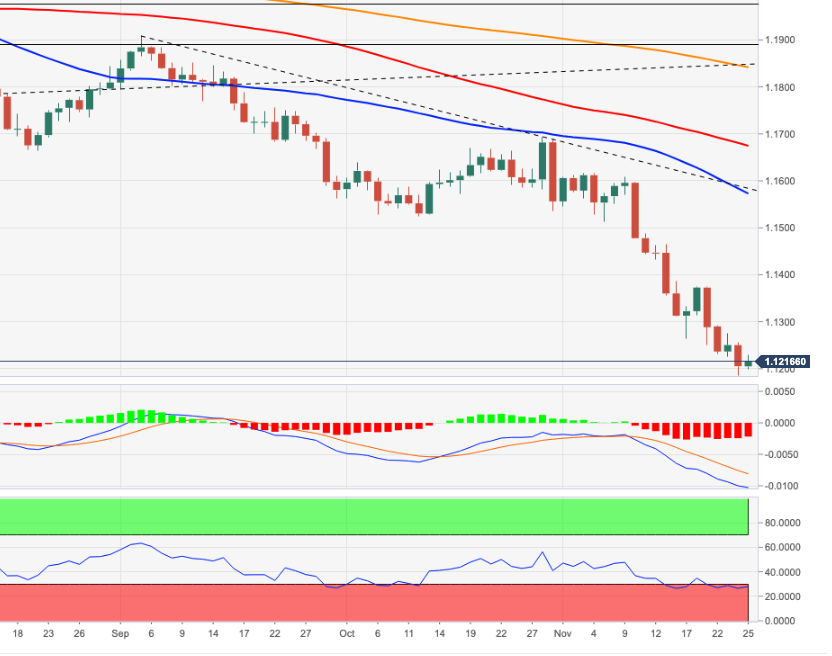
- EUR/USD bounces off cycle lows and retests 1.1230.
- Below the YTD the pair should target 1.1168.
EUR/USD manages to find some dip buyers and advances further north of the 1.1200 mark on Thursday.
If spot breaches the 2021 low at 1.1186 (November 24) then the next target of note emerges at July’s 2020 low at 1.1185 (July 1) before 1.1168 (June 19 2020). The ongoing technical correction also comes in response to the current oversold condition of the pair.
The probability of further losses remains unchanged as long as EUR/USD trades below the 2-month resistance line (off September’s peak) near 1.1580. In the longer run, the offered stance in spot is expected to persist while below the 200-day SMA at 1.1840.
EUR/USD daily chart
- Oil markets are subdued on Thursday amid thin liquidity conditions.
- WTI has been trading close to the $78.00 level.
Oil markets are unsurprisingly subdued on Thursday amid thin liquidity conditions due to US market closures for Thanksgiving. Front-month WTI futures have spent most of what has thus far been a very quiet session ranging in the low-$78.00s/just under $78.00 area, with prices remaining well within recent ranges. Futures trade will halt at 1800GMT and then restart at 2300GMT. Ahead of the market closure, conditions are likely to remain subdued, especially once any remaining European market participants depart after European market closures from 1630GMT.
In terms of fresh fundamentals, the most notable development on Thursday was reports that the US continues to exert pressure on Russia to increase output. The news had little effect on crude oil markets at the time but might be a sign that the Biden administration remains frustrated with its inability to push prices lower. That might mean further reserve releases are on the cards. The main focus for markets remains the response by OPEC+ officials to this week’s oil reserve release announcement from the US and other major consumers.
A Wall Street Journal report on Wednesday suggested that Russia and Saudi Arabia, the two OPEC+ nations who produce the most oil each day, were mulling halting the cartel’s preplanned output hikes in December. But Reuters, citing three sources, subsequently reported that OPEC+ is not discussing slowing output hikes. The organisation meets next week.
Elsewhere, oil markets have broadly ignored pandemic updates. In terms of the latest with regards to the European Covid-19 outbreak and government response; health experts in the Netherlands have reportedly advised that the government order a closure of restaurants and non-essential stores. Outgoing German Chancellor Angela Merkel, meanwhile, has again reiterated her call for tighter restrictions, saying that every day counts to slow the spread. Her calls come after Italy on Wednesday approved new curbs on unvaccinated individuals.
GBP/USD pressures the 1.33 level. In the view of economists at Scotiabank, the cable could fall as low as 1.30.
The 1.3350/55 range will stand as resistance
“The GBP’s slide from its failed break of 1.35 last week is on track to a test of 1.33.”
“The five-day losing streak in the pound has left it trading just shy of oversold in the RSI with the eventual move likely to prevent a test of 1.32 in the coming days if losses past 1.33 extend.”
“Technical signals are still pointing to further losses ahead toward 1.30.”
“The 1.3350/55 range will stand as resistance ahead of the 1.3380 zone and then the figure.”
The EUR/USD pair corrects oversold conditions after its decline past 1.12. Nonetheless, the undertone remains bearish, in the view of economists at Scotiabank.
Break above 1.13 needed to alleviate downside pressure
“The overall trend in the EUR remains clearly bearish and it would take a cross of 1.13 to at least suggest that the EUR/USD will not continue its drop to 1.10/11.”
“After the 1.12 zone, yesterday’s low of 1.1186 is support followed by 1.1165/70 (summer 2020 lows).”
The French Fishing Association Body on Thursday said that it still does not have what it wanted regarding post-Brexit fishing licenses, according to Reuters. The body added that it would take retaliatory measures as soon as possible if its demands were not met regarding the licenses.
The body said that its fishermen will be taking action on Friday at 1400GMT at the port of Caen-Ouistreham, which may lead to the blockade of some boats. Protest action will also take place at St Malo and in the Eurotunnel, the body said.
- Some USD profit-taking assisted gold to gain some positive traction on Thursday.
- Hawkish Fed expectations kept a lid on any meaningful gains for the commodity.
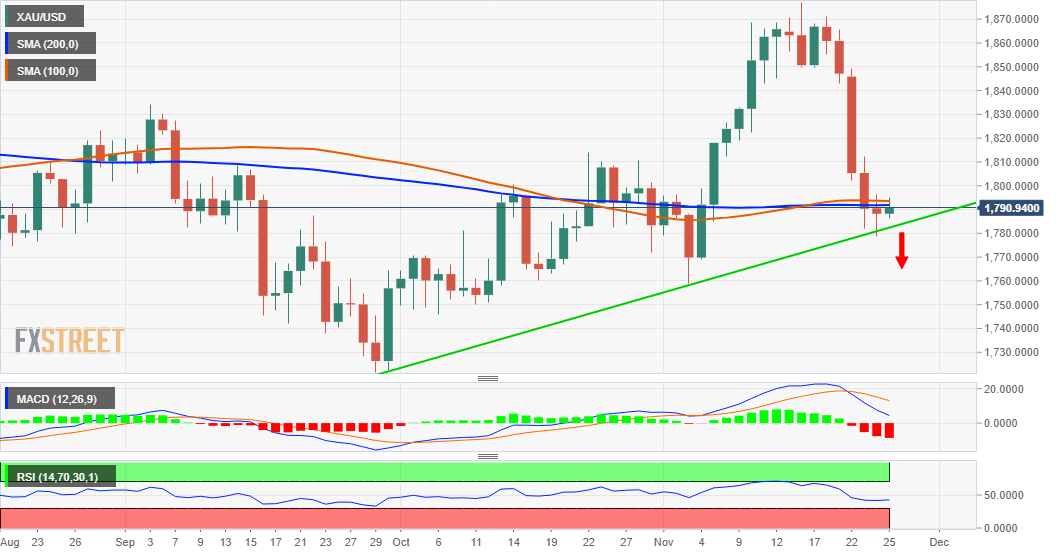
- Weakness below an ascending trend-line is needed to confirm a fresh breakdown.
- Gold Price Forecast: Thanksgiving Day unlikely to offer respite to XAU/USD bulls amid a bear flag
Gold gained some positive traction on Thursday, albeit lacked any follow-through and remained well within the striking distance of a three-week low touched in the previous day. The US dollar witnessed some profit-taking following the recent strong runup to the highest level since July 2020. This, in turn, was seen as a key factor that extended some support to the dollar-denominated commodity. Apart from this, concerns about the economic fallout from the rising number of COVID-19 cases and the imposition of fresh lockdown measures in Europe further underpinned the safe-haven gold. That said, stable performance in the equity markets, along with hawkish Fed expectations kept a lid on any further gains for the non-yielding yellow metal.
The markets seem convinced that the Fed would be forced to tighten its monetary policy sooner rather than later to contain stubbornly high inflation. The bets were reinforced by Wednesday's release of the US PCE Price Index, which accelerated to a 30-year high in October. Adding to this, the minutes of the November FOMC meeting revealed that were open to speeding up the tapering of the bond-buying program and moving quickly to raise interest rates if high inflation persists. The Fed funds futures indicate the possibility for an eventual rate hike move by mid-2022 and a high likelihood of another raise in November. This warrants some caution for bullish traders and before confirming that gold prices might have bottomed out in the near term.
The fundamental backdrop remains tilted firmly in favour of bears, though relatively thin liquidity conditions on the back of the Thanksgiving holiday in the US held back traders from placing fresh bets. Even from a technical perspective, gold, so far, has managed to defend a short-term ascending trend-line support extending from the September monthly swing low, around the $1,722 area. This further makes it prudent to wait for a convincing break below the mentioned support before positioning for any further depreciating move.
Gold daily chart
Technical levels to watch
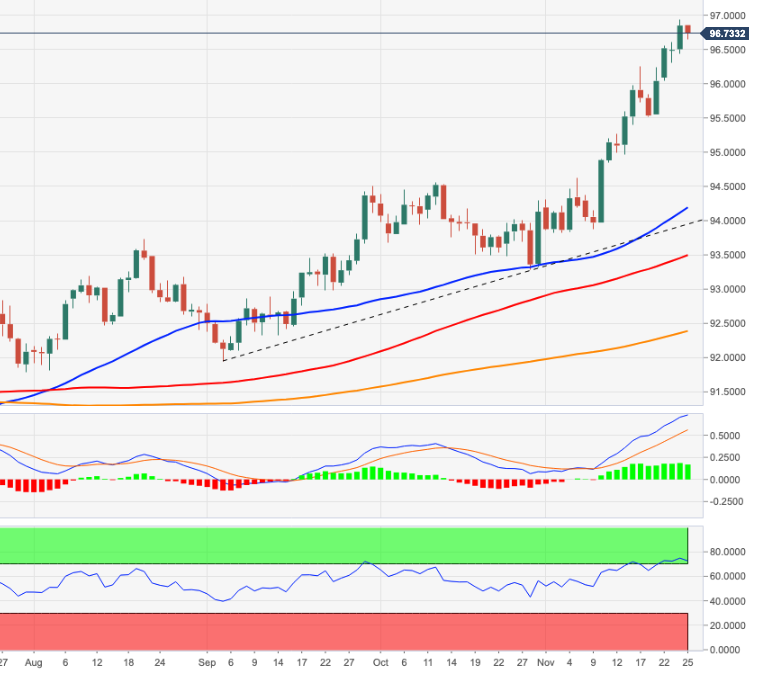
- DXY gives away part of the recent gains, back near 96.70.
- Further upside is seen testing the 97.00 yardstick.
DXY corrects lower after hitting new cycle peaks in the area just below the 97.00 yardstick on Wednesday.
The continuation of the uptrend looks the most likely scenario despite the ongoing and temporary knee-jerk. That said, the round level at 97.00 now emerges as the immediate target for dollar bulls ahead of 97.80 (June 30 2020).
In the meantime, while above the 2-month support line (off September’s low) just below 94.00, extra gains in DXY remain well on the table. The broader constructive stance remains underpinned by the 200-day SMA at 92.38.
DXY daily chart
- EUR/USD continues to trade slightly to the north of the 1.1200 level and did not react to the ECB minutes.
- Technical indicators increasingly point to near-term consolidation following the pair’s recent run of losses.
EUR/USD has not seen any notable reaction to the release of the latest ECB minutes, which did not contain any surprises. The pair continues to consolidate slightly to the north of the 1.1200 level, with the euro one of the better performers in G10 FX markets on Thursday amid otherwise broadly subdued trading conditions. Volumes are thin given that US market participants are away for Thanksgiving and US markets shut.
Historic losses
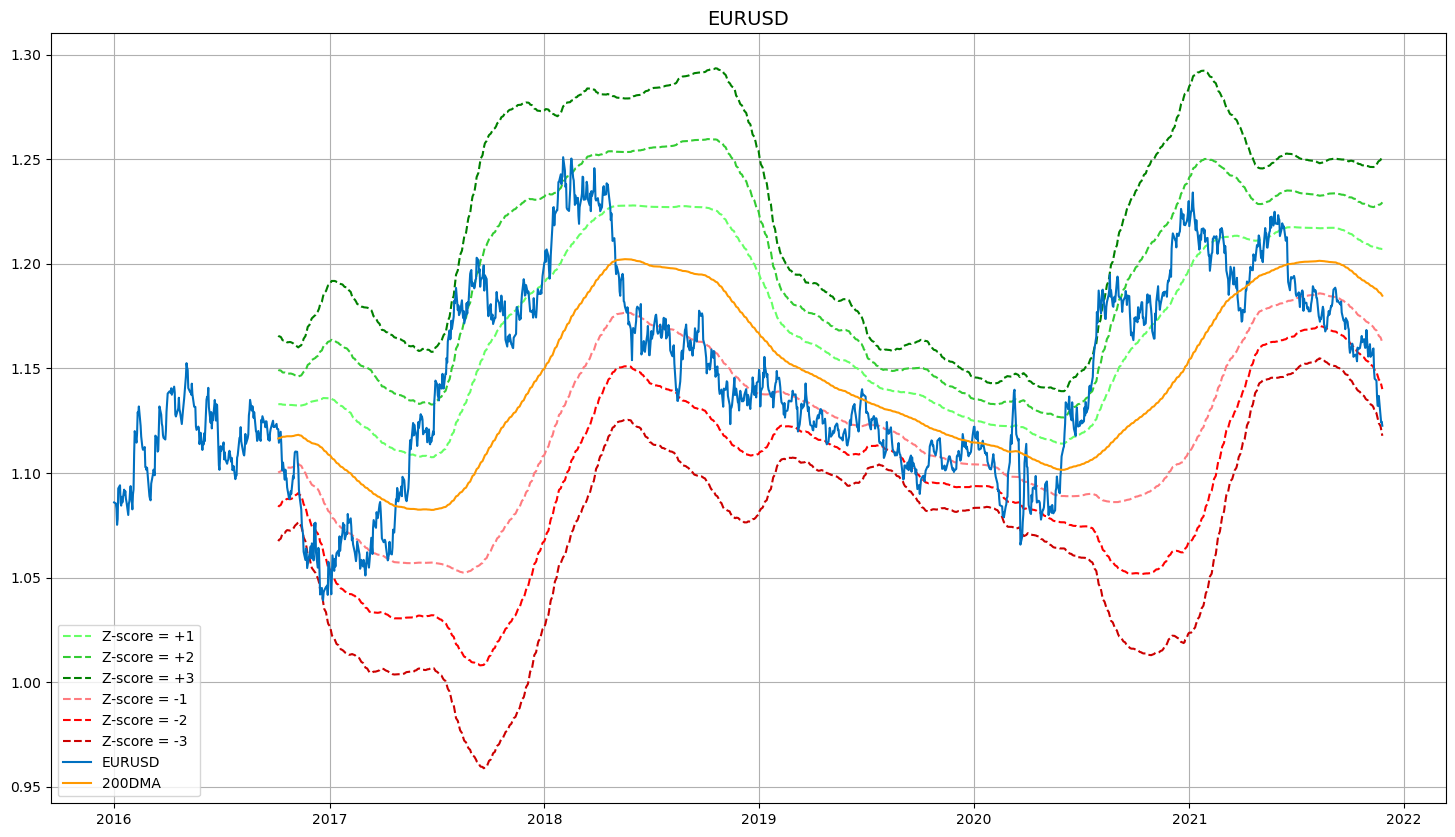
EUR/USD’s 3.2% drop over the last 21 trading session ranks in the second from bottom percentile, when compared against the rolling 21-session change over the past five years. Moreover, the pair on Thursday was trading more than 5.0% below its 200DMA, which ranks in the bottom percentile when compared with EUR/USD’s rolling percentage differences to the 200DMA over the last five years.
Case for consolidation
But with the euro bears having thus far failed to push EUR/USD as low as the mid-June 2020 lows around 1.1170 this week and the euro looking increasingly oversold by most metrics. In all but one of the last nine-session, EUR/USD’s 14-day Relative Strength Index score has been under 30. A close at the end of this week abvoe 1.1200 might be taken as signal for short-covering.
Meanwhile, the pair’s Z-score to the 200DMA (the number of standard deviations away from it) is approaching -3.0. Over the last five years, a Z-score to the 200DMA at around -3.0 has been a good signal of near-term consolidation lays ahead, or in many instances, a substantial bounce. The mean five-day return in EUR/USD from days when its Z-score to 200DMA was below -2.5 is +0.4%, while the mean 21-day return is 0.3% and the mean 65-day return is 1.3%. The case for near-term consolidation is clearly growing.
- EUR/JPY leaves behind Wednesday’s negative session.
- Sellers could still drag the cross to the 128.00 area.
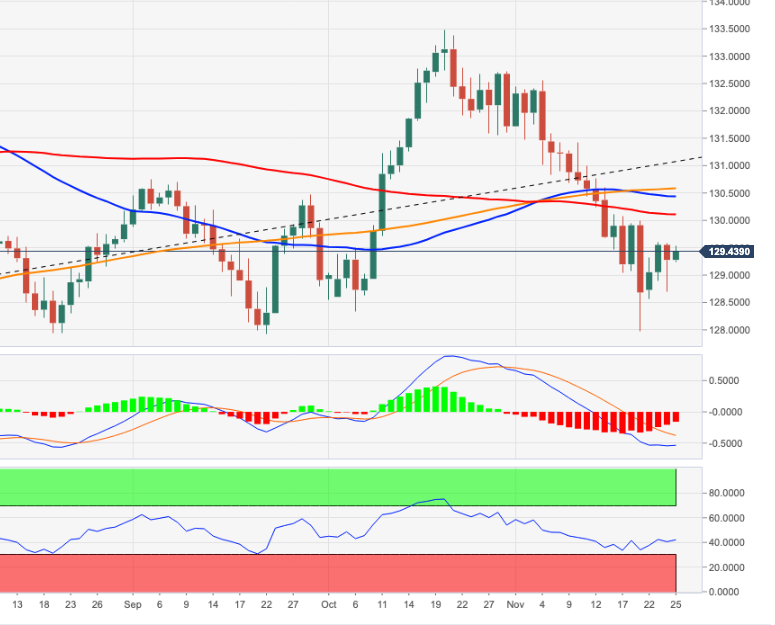
EUR/JPY regains the upside traction and returns to the positive territory near 129.50 on Thursday.
The resumption of the downside should not be ruled out yet and therefore another visit to the monthly low at 127.97 (November 19) remains well on the cards for the time being. A move further south should see the August and September low around 127.93 retested.
Looking at the broader picture, the outlook for the cross is expected to remain negative while below the 200-day SMA, today at 130.54.
EUR/JPY daily chart
The benchmark 10-year US Treasury bond yield has come close to the May and October highs at 1.71%. Above here, the April peak at 1.78% and also the 200-week moving average at 1.83% beckon, analysts at Commerzbank report.
Long-term bullish forecast while above 1.25%
“The US 10Y yield tested the eight-month resistance line at 1.70% and nearly probed the May and October highs at 1.71%, a rise above which would push the April peak at 1.78% and also the 200-week moving average at 1.83% to the fore. Further up the 55-month moving average can be found at 1.89% and the September 2017 low and November 2019 high at 1.98/2.01%.”
“The 1.98/2.01%target area will remain in play while the yield stays above the last reaction low at 1.51% on a daily chart closing basis Below it lies the 1.48/45% region, made up of the mid-October low, 200-day moving average and four-month support line. Further down sits the current November low at 1.41%.”
“Overall upside pressure should prevail while the August-to-mid-September highs at 1.39% continue to underpin on a daily chart closing basis. Further support is seen at the June low at 1.35%.”
“While the yield remains above the 1.25% mid-September low we will retain our long-term bullish forecast.”
- EUR/GBP regained positive traction on Thursday and recovered further from YTD low.
- Brexit uncertainties undermined the sterling and remained supportive of the move up.
- Some USD profit-taking benefitted the euro and further extended support to the cross.
- Dovish ECB outlook might hold back bulls from placing fresh bets and cap further gains.
The EUR/GBP cross continued gaining traction through the mid-European session and climbed to an over one-week high, around the 0.8430-35 region.
The cross caught fresh bids on Thursday and is now looking to build on this week's recovery move from the 0.8280 support area, or the lowest level since February 2020. The British pound's relative underperformance against its European counterpart comes amid the worsening row over the post-Brexit fishing rights between France and Britain.
This, to a larger extent, overshadowed the latest report, indicating that Britain would hold off suspending parts of the Brexit divorce deal relating to Northern Ireland for as long as talks with the EU remain constructive. Even the prospects for an imminent interest rate hike by the Bank of England did little to impress the GBP bulls.
On the other hand, the shared currency benefitted from some US dollar profit-taking from a 16-month peak. That said, the rising number of COVID-19 cases and the imposition of fresh lockdown measures might act as a headwind for the euro. This, in turn, could hold back bullish traders from placing aggressive bets around the EUR/GBP cross.
Fresh COVID-19 jitters have fueled concerns about a significant slowdown in the Eurozone economic activity, which could be another reason for the European Central Bank (ECB) to be more dovish. It is worth mentioning that the ECB officials have been pushing back against bets for tighter policy and talked down the need for any action to counter inflation.
This was reinforced by the accounts (minutes) of the October ECB monetary policy meeting, which stated: "It was deemed important for the governing council to avoid an overreaction as well as unwarranted inaction, and to keep sufficient optionality in calibrating its monetary policy measures to address all inflation scenarios that might unfold."
The fundamental backdrop warrants some caution before confirming that the EUR/GBP cross has bottomed out in the near term and positioning for any meaningful recovery. Hence, the move up might still be categorized as a short-covering bounce, which runs the risk of fizzling out rather quickly amid absent relevant fundamental catalyst.
Technical levels to watch
According to the accounts of the October European Central Bank monetary policy meeting, the view was held that, judging on the basis of the current developments, net purchases under the Pandemic Emergency Purchase Programme could be expected to come to an end by March 2022, according to Reuters.
Additional Takeaways:
"At the current juncture, the accommodative monetary policy stance had to be reconfirmed."
"Monetary policy had to be patient."
"The view was held that judging on the basis of the current developments, net purchases under the PEPP could be expected to come to an end by March 2022."
"It was highlighted that monetary policy decisions needed to be data-driven and all incoming data during the coming months needed to be taken into account."
"It was conjectured that there had been no fundamental changes in the underlying causes of the low growth and low inflation environment."
"It was cautioned that the data available in December would not resolve all the uncertainties around the medium-term inflation outlook."
"It was seen as important that the governing council should keep sufficient optionality to allow for future monetary policy actions, including beyond its December meeting."
"The remark was made that, at some point in the future, the very generous monetary policy support to the economy would need to be reassessed."
"It was deemed important for the governing council to avoid an overreaction as well as unwarranted inaction, and to keep sufficient optionality in calibrating its monetary policy measures to address all inflation scenarios that might unfold."
"Concerns were voiced that expectations regarding the future path of short-term money market interest rates."
"The uncertainty around the medium-term prospects was seen as elevated."
"By explicitly stressing the need for the durability of the underlying inflation developments, the governing council’s forward guidance was particularly well suited to looking through “cost-push”."
"Members agreed that price pressures were more persistent than had been foreseen in the September ECB staff projections."
"It was judged that second-round effects were not visible so far."
“It was pointed out that this was only a gradual move towards levels more in line with the new inflation target and that such re-anchoring should not be confused with an unanchoring on the upside.”
“Doubts were expressed about the use of typically downward-sloping oil price futures curves as projection assumptions when fossil fuel prices were bound to remain elevated or rise further.”
“Members widely agreed on the expected hump-shaped pattern in the shorter-term inflation outlook.”
“It was argued that price effects could be greater than currently estimated if labour force participation did not return to pre-crisis levels.”
“Likely that in the December 2021 Eurosystem staff projections the shorter-term inflation outlook for the euro area would once again be revised upwards.”
“Against this background, it was seen as likely that in the December 2021 Eurosystem staff projections the shorter-term inflation outlook for the euro area would once again be revised upwards.”
“Members discussed the notion of “stagflation” in relation to risks to the economic outlook.”
“It was recalled that stagflation experienced in the 1970s occurred in a different environment.”
Market Reaction
The euro has not seen any sustained reaction to the latest minutes.
- EUR/JPY has nudged higher on Thursday amid thin US holiday trade, but has again failed to brea above 129.50.
- Ahead, ECB minutes are set for release and ECB’s Lagarde is scheduled to speak.
EUR/JPY has been nudging higher on Thursday, with the euro outperforming in the G10 space as traders cite short-covering after its recent period of pandemic-related underperformance. The pair is currently trading slightly in the green in the 129.30s, but has run into resistance for a third day running in the 129.50 area.
Failure to break above a key short-term area of resistance this Thursday is not really too surprising given thin liquidity conditions on account of US markets being shut for the Thanksgiving holiday. When volumes come back next week, that is when technical breakouts are going to become more likely.
Pandemic
Focus in the Eurozone remains on the broad trend towards tighter lockdown restrictions, with Italy the latest to unveil curbs on the unvaccinated. This likely isn't helping the euro, though a lot of bad pandemic-related news is now arguably in the price.
Thursday morning saw a slightly larger than expected drop in GfK’s December German Consumer Climate index to -1.6 from 1.0 in November, versus an expected drop to -0.5. Survey data is likely to weaken/remain weak in the coming months as the pandemic situation worsens into the year’s end.
Ahead
Looking ahead to the rest of the session, the ECB releases the minutes of its latest policy meeting at 1230GMT. There is then a speech from ECB President Christine Lagarde at 1330GMT. After that, the calendar is empty and markets are set to be quiet.
- GBP/USD struggled to preserve modest intraday gains and refreshed YTD low on Thursday.
- Mixed Brexit signals attracted bears at higher levels despite some USD profit-taking slide.
- The fundamental backdrop supports prospects for a further near-term depreciating move.
The GBP/USD pair refreshed YTD low during the mid-European session, albeit lacked follow-through and so far, has managed to hold above the 1.3300 round-figure mark.
The British pound drew some support on Thursday from the latest signs that a further breakdown of the post-Brexit UK-EU relations is not imminent. Reports indicate that Britain would hold off suspending parts of the Brexit divorce deal relating to Northern Ireland for as long as talks with the EU remain constructive. This, along with the firming expectations for an interest rate hike by the Bank of England in December, assisted the GBP/USD pair to gain some positive traction during the early part of the trading action on Thursday.
On the other hand, the US dollar witnessed some profit-taking following the recent strong runup to a 16-month peak and contributed to the GBP/USD pair's early uptick. That said, the worsening row over the post-Brexit fishing rights between France and Britain kept a lid on any meaningful gains for the sterling. In the latest development, French fishermen were reportedly planning to block British vessels' access to French ports in protest against Britain's refusal to grant them more licences to operate in UK territorial waters.
Meanwhile, the USD corrective pullback remained cushioned amid growing market acceptance that the Fed would be forced to adopt a more aggressive policy response to contain rising inflationary pressures. The bets were reinforced by Wednesday's release of the US PCE Price Index, which accelerated to a 30-year high in October. Adding to this, the minutes of the November FOMC meeting revealed that were open to speeding up the tapering of the bond-buying program and moving quickly to raise interest rates if high inflation persists.
The fundamental backdrop favours bearish traders, though relatively thin liquidity conditions on the back of the Thanksgiving holiday in the US warrant some caution. This makes it prudent to wait for a sustained break through the 1.3300 round figure before positioning for an extension of the recent decline from levels just above the key 1.3500 psychological mark.
Technical levels to watch
Economist at UOB Group Lee Sue Ann reviews the latest RBNZ event, where the central bank hiked the OCR to 0.75%.
Key Takeaways
“The Reserve Bank of New Zealand (RBNZ), at its last meeting of the year, decided to increase the Official Cash Rate (OCR) to 0.75%. In the accompanying press release, the RBNZ stated that ‘the Committee agreed it remains appropriate to continue reducing monetary stimulus so as to maintain price stability and support maximum sustainable employment’, adding that ‘further removal of monetary policy stimulus is expected over time given the medium-term outlook for inflation and employment’.
“Today’s hike of 25bps reinforces our view that any further tightening is likely to occur in a steady approach, with incoming data key to determining future moves. The RBNZ now expects to raise its benchmark rate to 2.50% by the third quarter of 2023, according to the latest monetary policy statement (November 2021). Previously, it projected the cash rate plateauing at around 2.00% from late 2023. For now, we are comfortable with our call for follow-up 25bps hikes in February, May, August and November, taking the OCR to 1.25% by mid-2022, and for it to reach 1.75% by end-2022.”
French Health Minister Olivier Veran said on Thursday that they will not announce any new coronavirus-related lockdown or curfew, as reported by Reuters.
Additional takeaways
"COVID-19 is spreading again, quickly."
"We still have fate in our hands."
"The virus will continue to circulate actively in the coming weeks."
"France will roll out COVID vaccine booster shots for all aged 18 and over."
"Gap between earlier COVID vaccine jab and booster shot cut to 5 months."
Market reaction
These comments don't seem to be having a significant impact on the euro's performance against its rivals. As of writing, the EUR/USD pair was up 0.2% on the day at 1.1220.
UOB Group’s FX Strategists suggested USD/CNH could edge higher and visit the 6.4070 level in the next weeks.
Key Quotes
24-hour view: “USD traded between 6.3867 and 6.3984 yesterday, narrower than our expected sideway-trading range of 6.3800/6.4000. The underlying tone has improved somewhat and the bias for today is on the upside. A break of 6.4000 is not ruled but the major resistance at 6.4070 is unlikely to come under threat. Support is at 6.3890 followed by 6.3840.”
Next 1-3 weeks: “We have held the same view since Monday (22 Nov, spot at 6.3920) where ‘shorter-term momentum is beginning to build but any advance in USD is expected to face solid resistance at 6.4070’. However, USD has not been able to make any headway on the upside. That said, the underlying tone still appears to be a tad firm and we see chance for USD to edge higher to 6.4070. On the downside, a breach of 6.3750 would indicate that the current mild upward pressure has dissipated.”
USD/CHF has finally broken above the confirmed downtrend from 2019 at 0.9315. Economists at Credit Suisse look for further gains to 0.9473/97.
Near-term support moves higher to 0.9250/30
“We see scope for 0.9473/97 next, however, we now look for this area to prove a tougher barrier given the break lower in EUR/CHF, which means that USD/CHF is no longer viewed as a particularly efficient expression of USD strength.”
“Near-term support moves higher to 0.9250/30, which we look to hold to maintain the latest breakout.”
Should EUR/USD extend beyond 1.1019/02 (not our base case) or EUR/CHF reverse its breakdown, a move to 0.9672 over the medium-term would become more plausible again.”
- EUR/USD moves higher and approaches 1.1230.
- The dollar stays side-lined near recent tops.
- Inactivity in the US markets are likely to keep markets flat.
The single currency manages to regain the smile somewhat and lifts EUR/USD to the daily peaks around 1.1230 on Thursday.
EUR/USD bottomed out near 1.1180 on Wednesday
EUR/USD picks up some upside traction although the sentiment surrounding the pair stays largely tilted towards the bearish side and the door remains wide open for the continuation of the downtrend for the time being.
In the meantime, the pair is on the way to close the third consecutive week with losses, trading in levels last seen in June 2020, and always on the back of the unabated rally in the greenback.
The latter remains propped up by rising speculations of a Fed’s lift-off sooner than anticipated. Indeed, this view was supported further by the release of the FOMC Minutes on Wednesday, where the majority of members signalled that the Fed might need to trim its bond-purchase programme at a faster pace.
In the calendar, the German Gfk Consumer Confidence deteriorated to -1.6 in December, while the final Q3 GDP came in at 2.5% YoY. Later in the session, the ECB will release its Accounts of the latest meeting and Chairwoman Lagarde is due to speak.
What to look for around EUR
EUR/USD seems to have found some contention in the 1.1190/85, or fresh cycle lows, so far this week. The pair continues to suffer the ECB-Fed policy divergence, while the sharp increase in COVID-19 cases in Europe also adds to the deteriorated outlook for the single currency in the last part of the year. Also weighing on the pair, the loss of momentum in the economic recovery in the euro area - as per some weakness observed in key fundamentals – is also seen pouring cold water over investors’ optimism on the economic recovery.
Key events in the euro area this week: German GfK Consumer Confidence, German Final Q3 GDP, ECB Accounts, ECB’s Lagarde (Thursday) – ECB’s Lagarde (Friday).
Eminent issues on the back boiler: Asymmetric economic recovery post-pandemic in the region. Increasing likelihood that elevated inflation could last longer. Pick-up in the political effervescence around the EU Recovery Fund in light of the rising conflict between the EU, Poland and Hungary on the rule of law. ECB tapering speculations.
EUR/USD levels to watch
So far, spot is gaining 0.22% at 1.1222 and faces the next up barrier at 1.1300 (10-day SMA) followed by 1.1374 (high November 18) and finally 1.1429 (20-day SMA). On the other hand, a break below 1.1186 (2021 low Nov.24) would target 1.1185 (monthly low Jul.1 2020) en route to 1.1168 (low Jun.19 2020).
- AUD/USD failed to preserve its modest intraday gains, or find acceptance above the 0.7200 mark.
- The divergent Fed-RBA monetary policy outlooks support prospects for additional near-term losses.
The AUD/USD pair witnessed some selling during the first half of the European session and dropped to a near three-month low, around the 0.7180 region in the last hour.
Having struggled to find acceptance above the 0.7200 mark, the AUD/USD pair met with fresh supply on Thursday and now seems all set to prolong a near one-month-old bearish trend. The intraday US dollar profit-taking slide remained cushioned amid hawkish Fed expectations, which, in turn, acted as a headwind for the major.
The markets seem convinced that the Fed would be forced to raise interest rates sooner rather than later to contain stubbornly high inflationary pressures. The bets were reinforced by Wednesday's release of the US PCE Price Index – which accelerated to a 30 year high in October – and the FOMC monetary policy meeting minutes.
In fact, the Fed officials were open to speeding up the tapering of the bond-buying program and move quickly to raise interest rates if high inflation persists. Conversely, the Reserve Bank of Australia has made every effort to push back expectations for a rate hike. The Fed-RBA divergent policy outlooks favour the AUD/USD bears.
That said, relatively thin liquidity conditions on the back of the Thanksgiving holiday in the US might hold back traders from positioning for any further intraday slide. Nevertheless, the AUD/USD pair seems vulnerable to breakthrough intermediate support near the 0.7170 region and challenge YTD low, around the 0.7100 mark touched in August.
Technical levels to watch
- Gold price rebounds but not out of the woods yet while below $1,800.
- Range play is likely to continue in gold amid Thanksgiving Holiday.
- Gold could stage a deep correction if $1,850 becomes resistance.
Gold is in the green zone for the first time this week, attempting to recover a part of Wednesday’s sell-off to three-week lows of $1,779. Thanksgiving Holiday in the US offers little motivation to the dollar bulls, as they consolidate the hawkish Fedspeak and minutes-led upside. The sluggish price action in the yields and the greenback is aiding the rebound in gold price. Although the further upside appears elusive, as the $1,800 mark is likely to be a tough nut to crack for gold bulls.
Read: Gold Price Forecast: Thanksgiving Day unlikely to offer respite to XAU/USD bulls amid a bear flag
Gold Price: Key levels to watch
The Technical Confluences Detector shows that the gold price is defending critical support around $1,790, which is the intersection of the SMA50 one-day, Fibonacci 38.2% one-month and Fibonacci 61.8% one-day.
If the sellers find a strong foothold below the latter, then the recent downtrend could resume towards the Fibonacci 38.2% one-day at $1,785.
Further south, the confluence of the Fibonacci 23.6% one-day and Bollinger Band one-hour Lower at $1,782 will guard the downside.
The next stop for gold sellers is envisioned at $1,779, the meeting point of the previous day’s low and the pivot point one-day S1.
On the flip side, gold bulls need acceptance above the powerful $1,797 hurdle, which is the convergence of the Fibonacci 23.6% one-month, pivot point one-day R1 and the previous day’s high.
The next relevant upside target is seen at $1,800, the pivot point one-week S3.
The additional advances will then challenge the bearish commitments near $1,807, where the SMA200 four-hour, Fibonacci 161.8% one-day and pivot point one-day R2 merge.
Here is how it looks on the tool
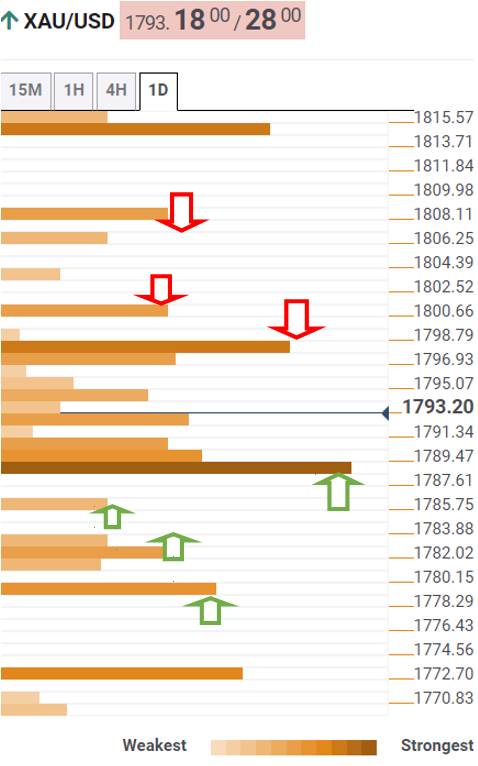
About Technical Confluences Detector
The TCD (Technical Confluences Detector) is a tool to locate and point out those price levels where there is a congestion of indicators, moving averages, Fibonacci levels, Pivot Points, etc. If you are a short-term trader, you will find entry points for counter-trend strategies and hunt a few points at a time. If you are a medium-to-long-term trader, this tool will allow you to know in advance the price levels where a medium-to-long-term trend may stop and rest, where to unwind positions, or where to increase your position size.
- Retreating oil prices undermined the loonie and assisted USD/CAD to reverse an early dip.
- Hawkish Fed expectations helped cushion the USD downside and extended some support.
- The set-up favours bullish trades and supports prospects for a move to the 1.2700 mark.
The USD/CAD pair quickly recovered around 25-30 pips from the early European session low and shot to the 1.2665-70 region in the last hour.
The pair attracted some buying near the 1.2640 area on Thursday and for now, seems to have stalled this week's retracement slide from the highest level since late September. Crude oil prices moved further away from a weekly high touched the previous day and undermined the commodity-linked loonie. This, in turn, was seen as a key factor that acted as a tailwind for the USD/CAD pair.
Meanwhile, the prospects for an early policy tightening by the Fed helped limit any meaningful US dollar profit-taking slide and further extended some support to the USD/CAD pair. The markets have been pricing in the possibility for an eventual Fed rate hike move by July 2022 amid persistent inflationary pressures. The bets were reinforced by the FOMC minutes released on Wednesday.
In fact, policymakers were open to speeding up the tapering of the bond-buying program and moving quickly to raise interest rates if high inflation persists. This followed the release of the US PCE Price Index for October, which accelerated to the highest level since December 1990. The fundamental backdrop favours the USD bulls and supports prospects for a further appreciating move for the USD/CAD pair.
That said, investors might be reluctant to place aggressive bets amid relatively thin liquidity conditions on the back of the Thanksgiving holiday in the US. Nevertheless, the USD/CAD pair seems poised to reclaim the 1.2700 round-figure mark. Some follow-through buying should pave the way for a move back towards testing the recent swing high, around the 1.2745-50 region.
Technical levels to watch
Iraq’s Oil Ministry is out with a statement on Thursday, lauding the efforts of OPEC to maintain the oil market stability.
Key quotes
“OPEC strategy has been successful so far.”
“OPEC is cautious about pumping and reducing oil supply.”
“OPEC does not want to lose this success because oil markets remain fragile.”
“Any additional quantities can lead to collapse in price or oversupply.”
Related reads
- US oil export ban would backfire, further slow response – Goldman Sachs
- WTI Price Analysis: 50-DMA guards immediate upside
EUR/CHF has so far dropped to 1.0448. The pair is seeing a small rebound, however, EUR/CHF is set to resume its decline towards 1.0375, economists at Société Générale report.
Down move likely to persist
“EUR/CHF has formed a tweezer bottom near 1.0445 after which an initial bounce is under way, however, daily Kijun line at 1.0600 should cap.”
“Next potential objective is at projections of 1.0375.”
- NZD/USD failed to preserve its modest intraday recovery gains to the 0.6900 neighbourhood.
- The disappointment from RBNZ’s decision on Wednesday acted as a headwind for the major.
- Bulls seemed rather unimpressed by a generally positive risk tone and some USD profit-taking.
The NZD/USD pair surrendered its intraday recovery gains and dropped to a fresh three-month low, around mid-0.6800s during the early European session.
The pair struggled to capitalize on its attempted recovery move on Thursday, instead met with fresh supply in the vicinity of the 0.6900 mark and turned lower for the fifth successive day. The Reserve Bank of New Zealand (RBNZ) increased its official cash rate (OCR) by 25 basis points on Wednesday, though disappointed investors anticipating a 50 bps hike. This, in turn, was seen as a key factor that continued acting as a headwind for the NZD/USD pair and capped the early uptick.
Bulls seemed unimpressed by a generally positive risk tone, which tends to benefit the perceived riskier kiwi, and even shrugged off some US dollar profit-taking from a 16-month peak. Following the recent strong bullish run, investors seem inclined to lighten their USD bullish bets amid relatively thin liquidity on the back of the Thanksgiving holiday in the US. That said, expectations for an early policy tightening by the Fed should help limit any meaningful USD corrective slide.
Investors seem convinced that the Fed would be forced to tighten its monetary policy sooner rather than later amid rising inflationary pressures. The bets were reinforced by Wednesday's data, showing that the US PCE Price Index accelerated a 30-year high in October, and hawkish FOMC monetary policy minutes. In fact, policymakers were open to speeding up the tapering of the bond-buying program and moving quickly to raise interest rates if high inflation persists.
Apart from this, concerns about the potential economic fallout from the rising number of COVID-19 cases and the imposition of fresh lockdown measures in Europe should underpin the safe-haven USD. The fundamental backdrop supports prospects for the emergence of some dip-buying around the greenback and an extension of the NZD/USD pair's downtrend witnessed over the past one month or so. That said, oversold RSI (14) on the daily chart warrants some caution for aggressive bearish traders.
Technical levels to watch
- GBP/USD extends range play around 1.3350 amid light trading.
- The cable remains supported as DXY weakness offsets Brexit woes.
- RSI is sitting just beneath the midline, favoring the downside.
GBP/USD is defending minor bids while wavering around 1.3350 so far this Thursday, as it lacks a trading impetus amid a Thanksgiving Day holiday in the US.
The US dollar remains sluggish across its major peers, correcting some of its previous gains and lending support to the cable. Meanwhile, ongoing Brexit concerns, with France's pledge to continue its row over fishing rights with the UK, cap the upside attempts in the major.
Markets now look forward to Bank of England (BOE) Governor Andrew Bailey’s appearance scheduled later this Thursday for fresh insights on the central bank’s rate hike outlook.
Looking at GBP/USD’s hourly chart, the bull-bear tug-of-war is seen extending between the bearish 50-Hourly Moving Average (HMA) and the descending 21-HMA, which are placed at 1.3357 and 1.3337 respectively.
A breakout in either direction is needed to trigger some action in the cable, which is trading lackluster since mid-Asia.
However, with the Relative Strength Index (RSI) still holding below the midline, the downside appears more favored.
An hourly closing below the 21-HMA support will fuel a fresh drop towards the 11-month troughs of 1.3316.
Deeper declines could threaten the 1.3300 level.
GBP/USD: Hourly chart
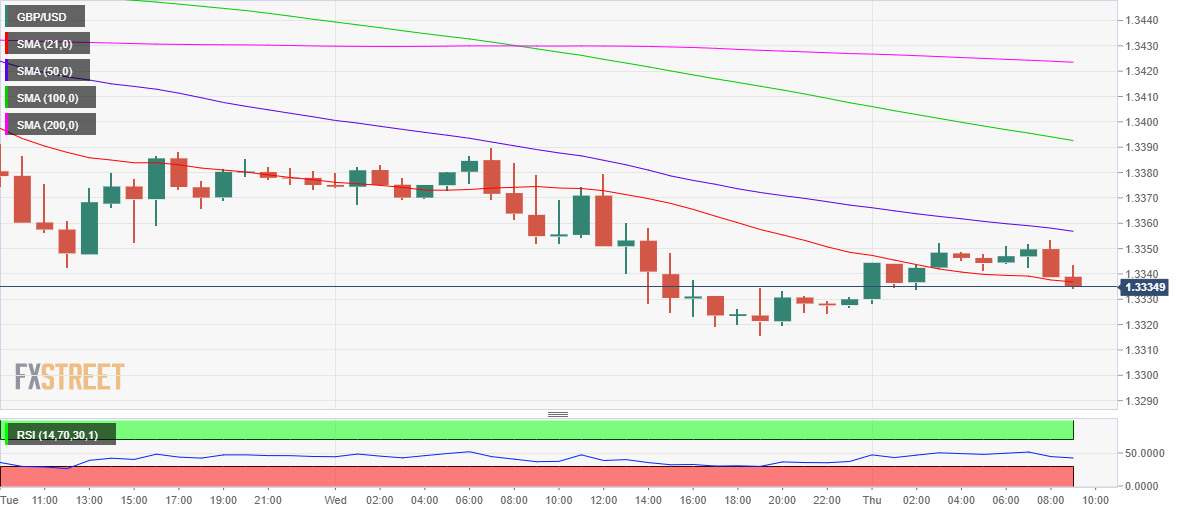
Alternatively, acceptance above 50-HMA is critical to extending the recovery momentum towards 1.3400.
The next significant resistance awaits at the 1.3450 psychological mark.
GBP/USD: Additional levels to consider
EUR/SEK has staged an impressive rebound after forming a low near 9.86 earlier this month. Economists at Société Générale expect the pair to extend its move higher towards the 10.33 mark.
August peak at 10.33 is likely to be an important hurdle
“Ongoing up move could persist towards graphical levels of 10.33 representing peak of August. This is likely to be an important hurdle.”
“Failure to cross the 10.33 can result in an initial pullback towards the MA near 10.15/10.13.”
See: EUR/SEK to head higher towards 10.20 as Riksbank is unlikely to rescue the krona – ING
EUR/USD dropped to its lowest level since June 2020 at 1.1185 on Wednesday. Renewed restrictions against resurging COVID-19 cases are outweighing potential of a shift in European Central Bank (ECB) rhetoric, ahead of their December meeting and keeping EUR under pressure, economists at Westpac report.
EUR/USD rebounds are unlikely to regain 1.13
“Concerns over rising COVID-19 cases and restrictions in core Europe are now impacting regional optimism and weighing on EUR into month-end, despite activity reports remaining solid.”
“ECB’s Dec meeting, with its updated staff projections, may now be seen as even more ‘live’ after Vice Pres. De Guindos suggested that supply-driven price gains might now be structural. A shift in projections could materially alter Dec discussions from merely the ending of PEPP in March and possible APP recalibration.”
“Directional bias for EUR/USD into early Dec is likely to be driven by perceived growth and yield differentials to US given the region’s struggles with rising covid cases.”
“The recent decline in the Bobl-T-Note spread suggests further downside pressure on EUR/USD. EUR/USD rebounds are unlikely to regain 1.13 unless spreads tighten and the recent break of 1.1250 risks an early test of 1.1000-50 area.”
USD/KRW is currently trading around the 1190 region. The pair faced resistance near 1200 last month and is set to surpass this level and test the 1210 mark, economists at Société Générale report.
Initial support seen at 1178/75
“USD/KRW has successfully defended interim support of 1165, the 38.2% retracement from June. As long as this remains defended, a deeper pullback is not envisaged.”
“Short-term, the pair looks poised to head towards the recent peak at 1200 and perhaps even towards projections of 1210.”
“Last week’s low of 1178/1175 is first support.”
This month, the Swedish krona has also weakened (-2.8%) against the euro. It has been the worst period of performance for the krona since September of last year. The Riksbank will deliver its latest policy update today. Economists at MUFG Bank expect the SEK to appreciate against the euro as the divergence between their central banks intensifies.
The domestic COVID-19 situation in Sweden does not appear so bad
“New covid cases have risen less sharply in Sweden over the past month and are still well below levels recorded last winter and during the first half of this year. It puts less pressure on the Swedish government to re-tighten restrictions. The Swedish krona has though failed to benefit so far from this relatively favourable COVID-19 trend.”
“We expect the Riksbank to follow other central banks by delivering a more hawkish policy signal but the planned pace of tightening should remain relatively slow.”
“We expect the Riksbank to begin raising rates in 2023, and policy tightening next year is more likely to focus on shrinking their balance sheet. It should lead to greater policy divergence with the ECB placing modest downward pressure on EUR/SEK in the year ahead.”
“We expect the Swedish krona to rebound against the euro once current market fears subside. However, it should continue to underperform more broadly as the Riksbank lags other G10 central banks in tightening policy alongside the ECB.”
In light of the recent price action, USD/JPY could now attempt an assault to the 116.00 area in the next weeks, comment FX Strategists at UOB Group.
Key Quotes
24-hour view: “Yesterday, we highlighted that USD ‘could edge above the major resistance at 115.25 but a sustained rise above this level is unlikely’. We added, ‘the next resistance is at 115.55’. The subsequent USD strength exceeded our expectations as it soared to within a few pips of 115.55 (high of 115.51). Deeply overbought conditions suggest that USD is unlikely to strengthen much further. For today, USD is more likely to consolidate and trade between 115.00 and 115.55.”
Next 1-3 weeks: “We have expected USD to strengthen since Tuesday. As USD rose, we highlighted yesterday (24 Nov, spot at 115.10) that ‘while upward momentum has improved, conditions are overbought and USD has to close above 115.25 before an advance to 115.55 can be expected’. USD subsequent rose to 115.51 before closing on a firm note at 115.41. Further USD strength appears likely but overbought conditions could lead to 1 to 2 days of consolidation first. Looking ahead, a break of 115.55 would shift the focus to 116.00. On the downside, a break of 114.60 (‘strong support’ level was at 114.30 yesterday) would indicate that the current upward pressure has eased.”
- DXY gives away part of the recent strong gains.
- The dollar clinched fresh cycle highs near 97.00 on Wednesday.
- US markets are closed due to the Thanksgiving Day holiday.
The greenback navigates within a tight range and amidst thin trading conditions in the 96.70 region when tracked by the US Dollar Index (DXY).
US Dollar Index in fresh cycle highs just below 97.00
The index clinched new 2021 highs in levels just shy of 97.00 the figure on Wednesday, just to come under some mild downside pressure so far on Thursday.
In the meantime, elevated inflation continues to dominate the scenery and took centre stage among the FOMC members, as noted by the publication of the Minutes of the November 2-3 meeting on Wednesday.
Indeed, many members now seem inclined to accelerate the pace of the tapering process, at the time when a lift-off in interest rates has been brought forward. On the latter, market participants now pencil in three 25 bps interest rate hikes during the next year, likely at the June, September and December events.
In addition, auspicious results from the US docket also prop up the ongoing upside momentum in the dollar coupled with the move higher in US yields across the curve.
What to look for around USD
The index clinched new cycle tops in the vicinity of 97.00 earlier in the week. The intense move higher in the buck remains well underpinned by the “higher-for-longer” narrative around current elevated inflation, which in turn lend wings to US yields and bolsters speculations of a sooner-than-estimated move on interest rates by the Federal Reserve. Further support for the dollar comes in the form of the solid recovery in the labour market, Biden’s infrastructure bill and positive results in US fundamentals.
Eminent issues on the back boiler: US-China trade conflict under the Biden’s administration. Debt ceiling issue. Geopolitical risks stemming from Afghanistan.
US Dollar Index relevant levels
Now, the index is retreating 0.17% at 96.67 and a break above 96.93 (2021 high Nov.24) would open the door to 97.00 (round level) and then 97.80 (high Jun.30 2020). On the flip side, the next down barrier emerges at 95.51 (low Nov.18) followed by 94.96 (weekly low Nov.15) and finally 94.56 (monthly high Oct.12).
GBP/USD has extended its weekly slide toward 1.3300. “Finely balanced risks” into MPC’s December meeting may be altered by strong business surveys, but in the interim GBP/USD remains at risk of sliding towards 1.3150-75, in the view of economists at Westpac.
UK Business is doing fine
“This week’s CBI (Confederation of British Industry) Nov Trends survey provided an upside surprise in terms of business activity and persistently strong optimism. Critical for the BoE Dec meeting will be whether consumer confidence also holds up and whether BoE Agents’ Report shows similar output and optimism. Such profiles would normally swing the current ‘finely balanced’ discussions towards a hike. However, covid cases and any renewed restrictions will also be critical.”
“EU/UK tensions are a lingering source of uncertainty for GBP but are less acute as discussions continue.”
“USD strength is currently dominant and GBP seems likely to struggle to regain levels above 1.3350.”
“A retracement (basis Mar 2020 low) around 1.3150-75 appears to be a likely target on further USD strength.”
A dovish Reserve Bank of New Zealand (RBNZ) policy outcome this week, accompanied by a bloated NZD long positioning sees the kiwi breaking under a protracted 18- month trend support. As Benjamin Wong, Strategists at DBS Bank, notes, support is arriving at a prior confluence zone pegged in the 0.6793-0.6776 zone.
Prior support confluence just ahead
“NZD has fallen post the RBNZ risk event, as it tracks the 12 bps decline on the barometer NZD 2-year yields. Speculative accounts have built persistently long NZD positions from early September. This would cap NZD’s performance given growth potential is starting to diverge against NZ, and that the long positioning is indeed bloated at this juncture.”
“For now, NZD is still under pressure given the break of the 18-month trend support as a key support peg at 0.6930 has caved in. This brings attention to the late August lows at 0.6805.”
“NZD/USD is expected to drift lower towards the 0.6805 lows and perhaps even the 61.8% Fibonacci retracement of the run-up from June’s 0.6377 lows to the 0.7465 spike high that calibrates at 0.6793. The prior confluence zone around Fibonacci markers 0.6793-0.6776 is likely the soft-landing zone that would match the increasingly oversold readings. Look for support to hold up.”
“China reserves the right to take necessary countermeasures on US sanctions,” the country’s Foreign Ministry said in a statement on Thursday.
The Foreign Ministry said that they “will take all necessary measures to firmly defend rights of Chinese companies.”
In the last hour, the Commerce Ministry also came out with some comments, citing
US' entity list not helpful for US-China relations.
Opposes US sanctions on Chinese companies.
This comes after the US added 12 Chinese companies to its trade blacklist on Wednesday, citing national security and foreign policy concerns.
Market reaction
AUD/USD pays little heed to these comments, as it trades modestly flat on the day just above the 0.7200 level.
Meanwhile, the S&P 500 futures add 0.31% on the day, currently trading at 4,715.
The release of oil from strategic reserves ramps up competition for control of the oil market amongst the world’s biggest producers. Strategists at ANZ Bank do not expect OPEC will stand by idly as the market enters a critical period. They expect Brent Oil to find support at the $80 level.
OPEC likely to restrict supply amid inventory releases
“The most likely scenario is that the OPEC+ alliance suspends its scheduled 400kb/d increase for January at its meeting next week. This would buffer the market from the peak of seasonal weakness in January, just as governments are adding barrels of oil from reserves.”
“It comes amid risks to demand as a pandemic wave hits Europe and the US. Restrictions on travel are already being implemented across the continent in a bid to suppress spread.”
“Such a move would be welcomed by the market, which has been increasingly pricing-in the likelihood of oil reserve releases pushing the market into surplus. This would see the market remain in deficit in Q1 2022 and likely support Brent crude prices at $80/bbl.”
- A combination of factors assisted GBP/JPY to gain some follow-through traction on Thursday.
- The GBP drew support from easing fears about a breakdown of the post-Brexit EU-UK relations
- A positive risk tone undermined the safe-haven JPY and remained supportive of the modest uptick.
The GBP/JPY cross maintained its bid tone through the early European session, albeit lacked follow-through and so far, has struggled to capitalize on the move beyond the 154.00 mark.
The cross built on the previous day's bounce from 153.35 area and gained some positive traction on Thursday amid a goodish pickup in demand for the British pound. Reports indicated that Britain would hold off suspending parts of the Brexit divorce deal relating to Northern Ireland for as long as talks with the EU remain constructive. This helped ease fears about a further breakdown of the post-Brexit UK-EU relations.
Meanwhile, the prospects for an imminent rate hike by the Bank of England turned out to be another factor that provided a modest lift to the sterling. Adding to this, a generally positive tone around the equity markets undermined the Japanese yen's relative safe-haven status and remained supportive. That said, the worsening row over the post-Brexit fishing rights between France and Britain capped gains for the GBP/JPY cross.
In the latest development, French fishermen were reportedly planning to block British vessels' access to French ports in protest against Britain's refusal to grant them more licences to operate in UK territorial waters. This warrants some caution for bullish traders and positioning for any further appreciating move for the GBP/JPY cross amid absent relevant market-moving economic releases from the UK on Thursday.
Traders now look forward to the BoE Governor Andrew Bailey's scheduled speech for some impetus later this Thursday. Apart from this, fresh Brexit-related developments will influence the sentiment surrounding the sterling. Traders will further take cues from the broader market risk sentiment, which will drive demand for the safe-haven JPY and produce some meaningful trading opportunities around the GBP/JPY cross.
Technical levels to watch
The US Dollar Index (DXY) heads into the Thanksgiving holiday on track for a third consecutive strong weekly gain. The US economy’s Q4 is shaping up as booming and key Federal reserve officials are talking about speeding up tapering. DXY’s Fed fuelled gains are likely to extend into the mid-December FOMC, economists at Westpac report.
USD's twin booster shots: faster Fed taper and earlier Fed hikes
“A strong payrolls for November seems likely now that the economy is finding its footing again. All the signs point to persistent price pressures and another strong CPI print too.”
“The prospect of faster pace of tapering and earlier Fed hikes should provide the DXY with ongoing yield driven upside into the mid-Dec FOMC.”
“DXY dips have been few and far between, but anything into the low 95s is a clear buying opportunity for a run-up into the 16th Dec FOMC.”
“98.0 offers some resistance for DXY, but beyond that, it’s blue sky into 100.”
FX option expiries for November 25 NY cut at 10:00 Eastern Time, via DTCC, can be found below.
- EUR/USD: EUR amounts
- 1.1300 438m
- 1.1350 545m
- 1.1400 700m
- GBP/USD: GBP amounts
- 1.3700 664m
- USD/JPY: USD amounts
- 114.25 935m
- 115.00 963m
- 115.50 795m
Copper (LME) remains unchanged and is still holding above the 200-day moving average at $9,441. Strategists at Credit Suisse expect the metal to move back higher towards the $11,000 level.
Support moves higher toward the critical 200-DMA at $9,441
“Copper has again managed to remain above the previously highlighted crucial 200-DMA support, currently at $9,441. Although a further consolidation around that level should be allowed for, our bias is still for a turn back higher from here and an eventual sustained closing break in due course above the previous record high at $10,748, with resistance then seen next at the psychological $11,000 level.”
“Support moves higher toward the crucial 200-DMA at $9,441, which we would expect to floor the market. Below, we would then identify supports at $8,878/77 next, before more important $8,810/740.”
The Japanese Cabinet Office announced Thursday that it has kept the economic assessment unchanged in the month of November.
However, the government remained downbeat on the economic recovery.
Key takeaways
“Japan raised its view on consumption for the first time in 13 months as service spending picked.”
“Japan downgraded that on exports and production due to persistent supply issues and a slowdown in China's economy.”
"The economy continues to show weakness in recovery, although severe conditions due to the coronavirus are gradually easing.”
"The pandemic-induced severe situations, such as in foot traffic, have been easing after the lifting of COVID-19 state of emergency curbs," a government official told reporters before the cabinet's approval of the report.
USD/JPY ranges below 115.50
USD/JPY is keeping its range play intact around 115.30, virtually unchanged on the day, as investors remain on the sidelines amid the Thanksgiving Holiday in the US.
The pair hit a fresh four-year high of 115.53 in the US last session following the hawkish Fed official daily and the minutes of the November meeting.
AUD/USD seesaws around 0.7200. A likely extension of broad USD gains near-term suggests a test of 0.7170, perhaps even 0.7106, according to economists at Westpac.
Daily correlation between the AUD and commodity prices has softened
“Most eye-catching is iron ore, up about $15 in 4 days to $103/t as expectations grow for loosening of curbs on China’s property market. While the daily correlation between the aussie and commodity prices has softened over recent weeks, it is a helpful development, especially given the substantial spec short AUD positions on CME.”
“GDP dominates Australia’s data calendar, even though so much has changed since lockdown pummelled Q3. Westpac has raised its forecast to a 2.5% QoQ contraction after resilience in construction and capex. Unusually, GDP precedes the RBA meeting, but it shouldn’t cause a policy reassessment.”
“Likely extension of broad USD gains near-term suggests a test of 0.7170, perhaps even 0.7106 (20 Aug low). But Australia’s rebounding economy should help the pair on crosses near-term and vs USD into year-end.”
EUR/USD has been moving lower with some momentum. The pair dropped to its lowest level since June 2020 at 1.1185 on Wednesday and clings to modest daily gains above 1.1200 on Thursday. Economists at ING expect the pair to pungle to the 1.10 level on a break below 1.1170.
ECB sticking to PEPP end date
“Temporary support seems to have been found around the 1.1200 area, but the only factor supporting it seems to be oversold technical readings. Presumably more selling interest would emerge were a correction to be seen to the 1.1280/1350 area.”
“Next support is at 1.1170 and below that we are not getting far from 1.10 at all. This looks the state of play into December when, in the early weeks, we will see if any slowing in the relentless demand for USD funding (for year-end balance sheet purposes) takes some upside pressure off the dollar.”
“Look out for a variety of ECB speakers today and also the release of the minutes to the 28 October ECB meeting. Despite the fourth wave in Europe, the ECB seems to be sticking to the view that the PEPP scheme will end in March.”
Equity market indices have risen impressively in the recent period. Some investors are concerned about this rise in share prices and fear a downward correction. Analysts at Natixis believe that on the contrary, equity markets will continue to rise.
Corporate profit margins are very high
“Despite the rise in the prices of commodities and companies’ intermediate consumption and, in the US, rising labour costs, corporate profit margins and earnings are very high. In Europe, labour costs are not accelerating, while companies in the US are able to pass on increases in their costs to their selling prices. So given the downturn in the prices of many commodities, profit margins will remain high.”
Long-term interest rates will remain low, well below growth rates
“The Federal Reserve has decided to reduce the size of its Treasury purchases, but will not raise the Fed Funds rate until 2023. Given, moreover, that it is the size of the central bank’s balance sheet that determines long-term interest rates, long-term interest rates will remain low in the US. The ECB will continue its bond purchases in 2022 and will not raise its key interest rates until 2024. The ECB appears to have no intention of exiting its highly expansionary monetary policy. Long-term interest rates will therefore remain much lower than growth rates for at least another two years.”
Abundant liquidity remains to be invested in equities
“After a period of vigorous money supply growth, portfolio rebalancing is complete once the proportion of money in wealth has returned to normal. As long as the proportion of money in wealth is abnormally high, the prices of the other asset classes that make up wealth (including equities) will continue to rise.”
The kiwi got whacked after the Reserve Bank of New Zealand (RBNZ) hiked OCR by “only” 25bps and it could face further headwinds if still lofty expectations for hikes fade, economists at ANZ Bank report.
>25bp hikes still priced in over the next three RBNZ meetings
“A 25bp hike and 2.6% peak in the RBNZ’s projected track is of course comparatively ‘dovish’.”
“Despite clear overtones that 25bp increments are likely from here, markets are still pricing in >25bp steps at the next 3 meetings. As that ‘illogic’ gets priced out (which seems likely), the NZD could fly into further headwinds.”
Palladium is already holding a top and now at risk to a break of its 200-week average at $1,846/06. XPD/USD could fall as low as $1,495, according to strategists at Credit Suisse.
Consolidation seen as a temporary pause prior to a fresh leg lower
“Palladium already holds a top from the summer and the recent consolidation is seen as a temporary pause prior to a fresh leg lower.”
“Key remains the recent low, 200-week average and potential long-term uptrend at $1,846/06.”
“Below $1,846/06 should confirm a resumption of the downtrend for the year, with support seen next at $1,735 ahead of $1,670/65 and eventually $1,495.”
See – Palladium Price Analysis: XPD/USD looks vulnerable, support at $1,850 is exposed – Commerzbank
- AUD/USD gained some positive traction on Thursday and reversed a part of the overnight decline.
- A positive risk tone prompted some USD profit-taking and benefitted the perceived riskier aussie.
- The Fed-RBA monetary policy divergence should keep a lid on any meaningful gains for the major.
The AUD/USD pair held on to its modest recovery gains through the early European session, albeit seemed struggling to capitalize on the move beyond the 0.7200 mark.
The pair gained some positive traction during the early part of the trading action on Thursday and recovered a part of the previous day's slide to the lowest level since early October. Following the recent strong runup to a 16-month peak, the US dollar witnessed some profit-taking and extended some support to the AUD/USD pair.
Apart from this, a generally positive tone around the equity markets further benefitted the perceived riskier aussie. The uptick, however, lacked bullish conviction amid the divergence in monetary policy stance between the Reserve Bank of Australia (RBA) and the Fed. This, along with COVID-19 jitters, capped gains for the AUD/USD pair.
The RBA has made every effort to push back expectations for a rate hike as early as next year. On the other hand, investors seem convinced that the Fed would raise interest rates sooner rather than later to contain stubbornly high inflation. The bets were lifted further after Wednesday's release of the US PCE Price Index and the FOMC minutes.
In fact, the headline US PCE Price Index accelerated to the highest level since December 1990, while the Core PCE Price Index also rose to a 30-year high in October. Moreover, the FOMC minutes showed that policymakers were open to speeding up the tapering of the bond-buying program and moving quickly to hike rates if high inflation persists.
Meanwhile, investors remain worried about the potential economic fallout from the rising number of cases and the imposition of fresh lockdown measures in Europe. The fundamental backdrop supports prospects for the emergence of some USD dip-buying and warrants caution before positioning for any meaningful recovery for the AUD/USD pair.
Given that the US banks will remain closed on Thursday in observance of Thanksgiving Day, relatively thin liquidity should further hold back traders from placing bullish bets around the AUD/USD pair. Hence, a strong follow-through buying is needed to confirm that AUD/USD pair formed a near-term bottom near the 0.7185-80 region.
Technical level to watch
USD/JPY is approaching the March 2017 high at 115.51. Karen Jones, Team Head FICC Technical Analysis Research at Commerzbank, expects the pair to move slightly lower on Thanksgiving Day. However, USD/JPY targets the 119.41 mark in the long run.
Nearby support below 113.92 lies at 112.73/112.56
“USD/JPY is pushing slowly higher, directly overhead lies the March 2017 high at 115.51 as well as the 115.60 61.8% Fibonacci retracement of the move down from 2015 being in focus and for now we will cover our remaining longs.”
“Above here is the 117.56 level, the 1998-2021 resistance line and 119.41, the downtrend from 1975.”
“We have a near-term uptrend at 113.92. Nearby support below 113.92 lies at 112.73/112.56, then the 111.66 July high which should hold the downside.”
Gold price attempts a dead cat bounce towards $1,800 amid retreating yields. But in the view of FXStreet’s Dhwani Mehta, Thanksgiving Day is unlikely to offer respite to XAU/USD bulls amid a bear flag.
Gold confirmed a bear flag on the 4H chart, impending bear cross lurks
“Gold is attempting a tepid bounce amid a brief pullback in the greenback. The US currency lacks the follow-through upside bias, as investors switch onto the sidelines amid a Thanksgiving Day holiday in the US. Despite the rebound, the risks remain skewed to the downside as the Fed’s hawkishness will continue to underpin the sentiment around the dollar and yields.”
“Growing covid concerns in the European countries could keep the investors unnerved and scurrying for safety in the dollar at gold’s expense. Further, a sustained technical break below the $1,800 threshold continues to keep the sellers motivated.”
“XAU/USD confirmed a bear flag formation on the four-hour chart Wednesday after closing the candlestick below the rising trendline support, then at $1,790. With the bearish technical setup in play, all eyes remain on the pattern target measured at $1,707. Ahead of that, the November 4 low of $1,769 could come to the rescue of gold bulls. The $1,750 psychological level could be the next stop for the bears.”
“The rising trendline support now resistance at $1,794, offers an immediate upside barrier. Acceptance above the latter will enhance the recovery momentum towards the $1,800 level. Further up, powerful resistance around $1,807 will be a nut to crack for gold bulls. At that point, the 200 and 21-SMAs coincide.”
See – Gold Price Forecast: Rising US real yields to increase the downside pressure on XAU/USD – Credit Suisse
- USD/CAD refreshes intraday low, extends latest fall from two-month top.
- DXY eases from 16-month top as inflation expectations weigh on yields.
- Canada criticizes US trade policies for Ottawa, hints at stimulus.
- Thanksgiving Day holiday to restrict market moves amid a light calendar.
USD/CAD takes offers to renew the day’s bottom level around 1.2650 as European traders brace for Thursday’s bell.
The loonie pair cheers the US dollar weakness, as well as mild gains of Canada’s main export item WTI crude oil, to print the third daily loss after reversing from the highest levels since September on Tuesday.
The US Dollar Index (DXY) drops 0.12% intraday to 96.73 at the latest, marking the first daily loss in five, not to forget reversing from the highest levels since July 2020. In doing so, the greenback gauge tracks sluggish inflation expectations that weighed on the US Treasury yields the previous day. The 10-year breakeven inflation rate per the St. Louis Federal Reserve (FRED) data, reversed Tuesday’s bounce off a three-week low on Wednesday to print a 2.61% level.
Elsewhere, WTI crude oil prices print mild gains above $78.00 amid concerns that the US-led push for releasing the Strategic Petroleum Reserves (SPR) will push the OPEC to cut the output targets. Also favoring the black gold are the latest comments from the United Arab Emirates (UAE) suggesting no favor for supply increase.
It’s worth noting that the Canadian Trade Minister Mary Ng conveyed dislike for the US duties on the lumber while saying, “We are extremely disappointed in the United States' decision to increase its unjustified duties on our softwood lumber. We will always stand up for the
Moving on, USD/CAD may remain sidelined amid the Thanksgiving Day holiday and a light calendar elsewhere. However, oil prices and chatters concerning US-Canada trade, as well as inflation, may direct short-term moves, mostly towards the south.
Technical analysis
The Loonie pair confirmed a rising wedge bearish chart pattern the previous day and the downward sloping RSI, not oversold, added strength to the fall afterward. That said, the quote currently drops towards 50-SMA around 1.2620 but the early November highs near 1.2600 will challenge the bears afterward. Meanwhile, corrective pullback needs to cross the immediate resistance line from Tuesday, close to 1.2700, before recalling the USD/CAD bulls.
NZD/USD is forecast to extend the current weakness into the next weeks, noted FX Strategists at UOB Group.
Key Quotes
24-hour view: “We did not anticipate the sharp sell-off that sent NZD plunging to 0.6856. The sharp and rapid decline appears to be overdone and NZD is unlikely to weaken much further. For today, NZD is more likely to trade between 0.6850 and 0.6925.”
Next 1-3 weeks: “While we highlighted yesterday (24 Nov, spot at 0.6940) that ‘the odds for NZD to drop below the next support at 0.6900 has increased’, we did expect the manner by which NZD sliced through 0.6900 and plunged to 0.6856. Further weakness is not ruled but oversold conditions suggest that the next major support at 0.6810 could be out of reach this time round (0.6850 is already quite a strong support level). Overall, the downside risk is deemed intact as long as NZD does not move above 0.6960 (‘strong resistance’ level was at 0.7005 yesterday).”
- USD/CAD remained confined in a range below mid-115.00s through the Asian session.
- A modest USD profit-taking from a 16-month peak acted as a headwind for the major.
- A generally positive risk tone, hawkish Fed expectations should help limit the downside.
The USD/JPY pair consolidated its recent strong gains to a near five-year high and oscillated in a narrow band, below mid-115.00s through the Asian session.
The US dollar witnessed some profit-taking following the recent runup to the highest level since July 2020, which, in turn, was seen as a key factor that acted as a headwind for the USD/JPY pair. The downside, however, remains cushioned amid a generally positive tone around the equity markets, which tends to undermine demand for the safe-haven Japanese yen. Meanwhile, the prospects for an early policy tightening by the Fed should help limit any meaningful USD pullback and continue lending some support to the major.
The market expectations were reinforced by hawkish FOMC monetary policy minutes released on Wednesday. In fact, policymakers were open to speeding up the tapering of the bond-buying program and moving quickly to raise interest rates if high inflation persists. This comes on the back of data, which showed that the US PCE Price Index accelerated a 30-year high in October. This, in turn, supports prospects for the emergence of some dip-buying around the greenback and an extension of the recent appreciating move for the USD/JPY pair.
That said, relatively thin liquidity conditions on the back of the Thanksgiving holiday in the US might hold back traders from placing aggressive bullish bets. Moreover, slightly overstretched conditions on short-term charts makes it prudent to wait for some near-term consolidation before the next leg up. Nevertheless, the bias remains tilted in favour of bullish traders and any corrective pullback is likely to be short-lived.
Technical levels to watch
Considering advanced prints from CME Group for natural gas futures markets, open interest dropped for the fourth session in a row on Wednesday, this time by around 11.2K contracts. On the other hand, volume resumed the upside and increased by around 35.2K contracts.
Natural Gas: Consolidative phase expected to prevail
Prices of natural gas rebounded further on Wednesday amidst diminishing open interest, which is indicative that a more serious bullish attempt appears out of favour for the time being. Instead, the commodity seems poised to extend the side-lined mood in place since early November. On the downside, the $4.70 mark per MMBtu should still offer decent contention.
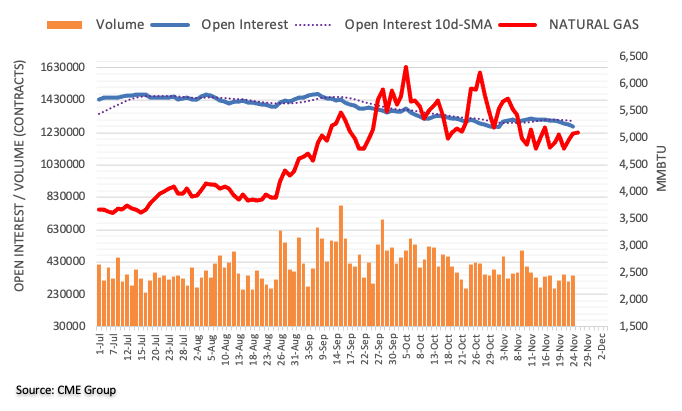
Here is what you need to know on Thursday, November 25:
The dollar continued to gather strength against its major rivals following the high-tier data releases from the US and the US Dollar Index came within a touching distance of 97.00 before going into a consolidation on Thursday. The European Central Bank (ECB) will release its Monetary Policy Meeting Accounts, ECB President Christine Lagarde and Bank of England Governor Bailey will be delivering speeches as well. Market conditions are likely to remain thin in the second half of the day due to the Thanksgiving holiday in the US.
The data from the US revealed on Wednesday that the Core Personal Consumption Expenditures (PCE) Price Index climbed to 4.1% on a yearly basis as expected. The FOMC's November meeting minutes revealed that some policymakers wanted the Fed to be prepared to adjust the pace of reductions in asset purchases to counter persistently high inflation. In the meantime, San Francisco Fed President Mary Daly said that she would support an acceleration of tapering if the economic recovery and the inflation outlook remains unchanged.
The benchmark 10-year US Treasury bond yield continued to climb higher toward 1.7% and Wall Street's main indexes closed mixed.
EUR/USD dropped to its lowest level since June 2020 at 1.1185 on Wednesday and clings to modest daily gains in the early European session above 1.1200 on Thursday.
GBP/USD extended its weekly slide toward 1.3300 but managed to stage a modest rebound. Ireland reportedly sees a "window of opportunity" to reach an agreement on Brexit's Northern Ireland protocol.
USD/JPY capitalized on rising US Treasury bond yields and renewed multi-year highs near 115.50. The pair was last seen moving sideways around 115.40.
Gold briefly dipped below $1,780 on Thursday pressured by rising US Treasury bond yields. XAU/USD is currently posting recovery gains above $1,790.
USD/CAD, which advanced to its strongest level in nearly two months at 1.2745 earlier in the week, is edging lower toward 1.2650 on recovering crude oil prices on Thursday.
Cryptocurrencies: Bitcoin stays directionless below $60,000 on Thursday and Ethereum consolidates its weekly losses while holding above $4,000.
- WTI fades bounce off intraday low, grinds around weekly top.
- Easing bearish bias of MACD, 100-DMA challenges sellers.
- Monthly falling trend line offers extra hurdle for the bulls to tackle.
WTI crude oil prices fade the early Asian gains, easing to $78.23 ahead of Thursday’s European session.
The black gold posted its first daily loss of the week the previous day following its failures to cross the 50-DMA hurdle. Even so, the MACD conditions hint at further challenges for the oil sellers.
Also challenging the oil prices is the latest swing low, also the monthly trough, surrounding $74.65, as well as the 100-DMA level of $74.00.
It’s worth noting that a horizontal area comprising multiple levels marked in September around $72.90 becomes important for WTI sellers to watch for confirmation.
Meanwhile, a daily closing past 50-DMA level of $78.75 will aim for a one-month-old resistance line near $80.50.
Following that the monthly peak near $84.00 and the recently flashed multi-month high around $85.00 will be in focus.
Overall, WTI crude oil prices remain lackluster but the bears seem running out of steam of late.
WTI: Daily chart
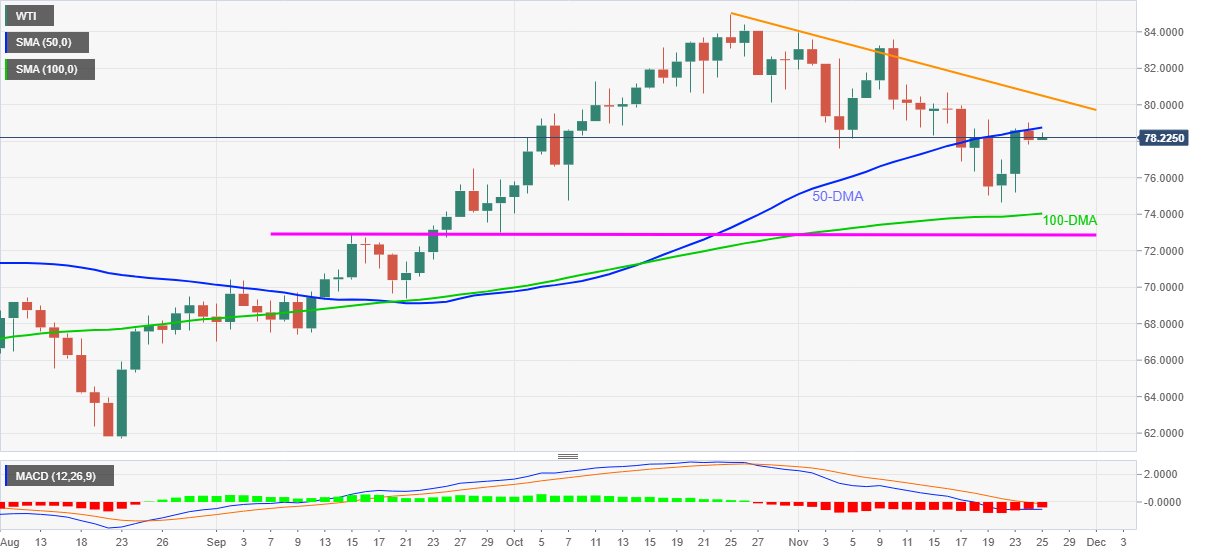
Trend: Recovery expected
- XAU/EUR looks to extend the recent rebound from two-week lows.
- Gold buyers remain hopeful while above the 21-DMA.
- RSI sits above the midline, supporting the recovery mode in gold.
XAU/EUR is looking to build onto the recovery from two-week lows of $1,582 reached earlier this week.
The spot is currently flirting with the $1,600 threshold despite a minor pullback in the euro, as markets reassess the potential risks emerging out of the European covid curbs.
Looking at it technically, XAU/EUR stalled its four-day losing streak on Wednesday, having found strong support at the ascending 21-Daily Moving Average (DMA), now at $1,592.
A daily closing below the latter is needed to resume the correction from the 14-month top at 1,653.90.
The two-week lows will be retested below the 21-DMA support, opening floors for a drop towards $1,575, November 10 lows.
If the selling momentum accelerates, then the bears will target the upward-sloping 50-DMA at $1,550.
XAU/EUR daily chart
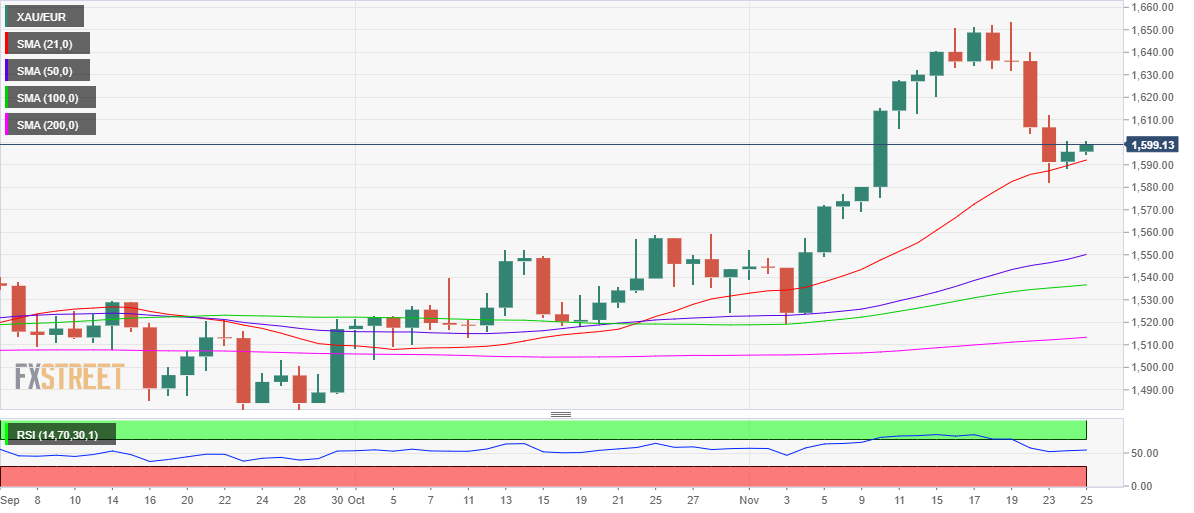
On the upside, Wednesday’s high at $1,612 will offer immediate resistance, above which the $1,650 psychological will draw buyers’ attention.
The 14-day Relative Strength Index (RSI) sits above the midline, suggesting that there is scope for the rebound to gain traction.
Acceptance above $1,650 could trigger a fresh upswing towards the $1,700 threshold.
Cable remains under pressure and could grind lower to the 1.3260 region in the short-term horizon.
Key Quotes
24-hour view: “The sharp drop in GBP to 1.3317 yesterday came as a surprise (we were expecting GBP to trade between 1.3350 and 1.3410). While the rapid drop has room to dip below the major support at 1.3300, a sustained decline below this level is unlikely. The next support is at 1.3260. Resistance is at 1.3365 but only a breach of 1.3385 would indicate that the current weakness has stabilized.”
Next 1-3 weeks: “Yesterday (24 Nov, spot at 1.3375), we highlighted that ‘risk is still on the downside but slim chance for GBP to move to 1.3300’. We did not anticipate the subsequent sharp drop to 1.3317. In view of the improved downward momentum, a break of 1.3300 would not be surprising. The next level to focus on below 1.3300 is at 1.3260. Overall, the downside risk is deemed intact as long as GBP does not move above 1.3410 (‘strong resistance’ level was at 1.3445 yesterday).”
CME Group’s flash data for crude oil futures markets noted traders added around 4.2K contracts to their open interest positions on Wednesday. Volume, instead, extended the choppy activity and went down by more than 537K contracts, the largest single-day drop since July 2.
WTI still targets the $80.00 mark
Crude oil prices charted an inconclusive session midweek amidst rising open interest and a marked drop in volume. Against this, it appears that extra range bound remains on the table for WTI in the very near term, with intermittent bullish attempts still targeting the key $80.00 mark per barrel.
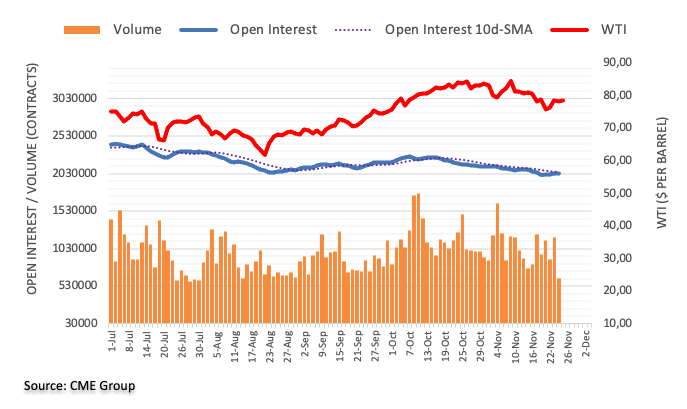
- EUR/GBP struggles for clear direction during second day of small losses.
- ECB policymakers remain divided over next moves, covid woes weigh on policy tightening.
- BOE’s Bailey has more positives even as New Year surge warning challenges the hawks.
- Germany’s final Q3 GDP, covid headlines become key amid US holiday.
EUR/GBP remains lackluster, slightly weak, during the early European morning on Thursday. The cross-currency pair takes rounds to yearly low flashed on Monday amid fresh coronavirus fears from the Eurozone.
After Austria and the Netherlands, record-high cases in Germany triggered multiple warnings to recall the lockdowns from the region. “Coronavirus infections broke records in parts of Europe on Wednesday, with the continent once again the epicenter of a pandemic that has prompted new curbs on movement and seen health experts push to widen the use of booster vaccination shots,” said Reuters.
It’s worth noting that the virus resurgence eases the pressure off the European Central Bank (ECB) to follow their Western counterparts and hence exert additional downside pressure on the EUR/GBP.
In the latest comments, governing council member and Slovenian central bank head Boštjan Vasle joins policymaker Fabio Panetta and Robert Holzmann to shrug off tapering and rate hike talks. On the contrary, European Central Bank governing council member and Bundesbank head Jens Weidmann said on Wednesday that upside risks to inflation dominate in both Germany and the rest of the Eurozone.
While the bloc struggles from covid, the UK isn’t much behind as the daily infections jump above 43,000 while the virus-led death toll eased to 149. That said, Sky News quotes British Health Experts to cite a risk of New Year surge in the COVID-19 cases.
Other than the coronavirus-led pessimism and the resulting more pressure on the ECB to extend easy money policies, versus the upbeat British fundamentals, the recent Brexit headlines also favor the Sterling to stay firmer. Although the No.10 Downing Street spokesperson cites a substantial gap between the UK and EU views regarding Northern Ireland, the British Prime Minister Boris Johnson’s readiness, per Reuters, to work hard to solve the issue on hand keeps market players optimistic. That said, the British policymakers have also given consent to Irish PM Michael Martin that they won’t trigger Article 16 until the talks collapse.
Even so, US holiday and a light calendar, with only final readings of the German Q3 GDP, expected to confirm 1.8% forecast, challenge the EUR/GBP moves ahead of the speeches from ECB President Christine Lagarde and BOE Governor Andrew Bailey.
While Bailey is likely to cheer the latest improvement in the UK’s fundamentals to back the hawkish hopes, ECB’s Lagarde may have to accept the downside risks to the bloc’s economy due to the coronavirus, which in turn could weigh on the EUR/GBP prices.
Technical analysis
EUR/GBP needs to cross the 0.8425 hurdle, comprising multiple levels marked since mid-October, to convince short-term buyers. Until then, risks to witness a price plunge towards a 2020 low near 0.8280 can’t be ruled out.
In opinion of FX Strategists at UOB Group, the recent price action in EUR/USD opens the door to further decline to 1.1160 in the next weeks.
Key Quotes
24-hour view: “Our expectations for EUR to ‘trade sideways’ was incorrect as it plummeted to 1.1184 before closing on a weak note at 1.1197 (-0.44%). Further weakness appears likely but oversold conditions suggest that the next major support at 1.1160 is likely out of reach for today (there is a minor support at 1.1180). Resistance is at 1.1220 followed by 1.1240.”
Next 1-3 weeks: “On Monday (22 Nov, spot at 1.1285), we highlighted that further EUR weakness is likely but ‘oversold conditions suggest that 1.1200 may not come into the picture so soon’. While our view for a weaker EUR was not wrong, we did not quite expect the ease by which EUR cracked 1.1200 yesterday (24 Nov) and dropped to 1.1184. While conditions remain oversold, the breach of 1.1200 has opened up the way for EUR to weaken to 1.1160. All in, EUR is expected to stay weak as long as it does not move above 1.1270 (‘strong resistance’ level was at 1.1325 yesterday). Looking ahead, the next support level of note below 1.1160 is at 1.1100.”
Fresh headlines are crossing the wires from the UAE official, via Reuters, citing that it is fully committed to OPEC and its allies (OPEC+) agreement.
The UAE said that it has no "prior stance" ahead of the upcoming OPEC+ meeting.
The OPEC+ is due to meet next week to discuss output policy.
Market reaction
WTI is trading modestly flat around $78.50, as of writing, lacking a fresh impetus amid holiday-thinned markets.
Open interest in gold futures markets extended the downtrend for yet another session on Wednesday, this time by around 3.8K contracts according to preliminary readings from CME Group. In the same line, volume shrank for the second session in a row, now by around 159.6K contracts.
Gold looks supported near $1,780
Gold prices dropped for the fifth session in a row on Wednesday. The daily downtick was on the back of shrinking open interest and volume and leaves the door open to a rebound in the very near term. That said, the $1,780 area per ounce troy still remains quite a decent support for occasional bearish moves in the precious metal.
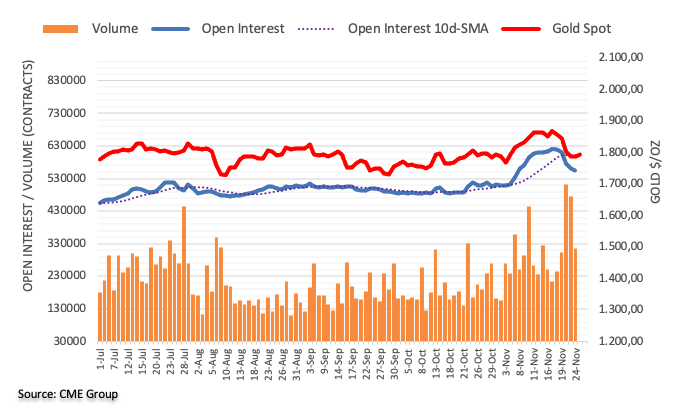
- USD/TRY remains pressured for the second consecutive day after refreshing record top.
- 100-HMA, weekly support line limits immediate downside as MACD teases bulls.
- 200-HMA adds to the downside filter, $12.80 guards recovery moves.
USD/TRY stays depressed around $12.00, sidelined near $11.93 ahead of Thursday’s European session.
In doing so, the Turkish lira (TRY) pair extends pullback moves from the all-time high marked on Tuesday.
However, a convergence of the 100-HMA and an ascending trend line from November 18, near $11.80-75, becomes a tough nut to crack for the bears considering recently improving MACD conditions.
Even if the quote drops below $11.75, the 61.8% Fibonacci retracement (Fibo.) of November 18-23 upside and 200-HMA, respectively around $11.60 and $11.10 will challenge the USD/TRY bears.
Alternatively, 38.2% Fibo. limits immediate recovery of the pair around $12.35, a break of which will direct USD/TRY buyers towards a confluence of two-day-old resistance line and 23.6% Fibonacci retracement level of $12.80.
In a case where the pair rises past $12.80, Thursday’s high of $13.20 may act as a buffer during the run-up to refresh the record top, currency around $13.50.
USD/TRY: Hourly chart
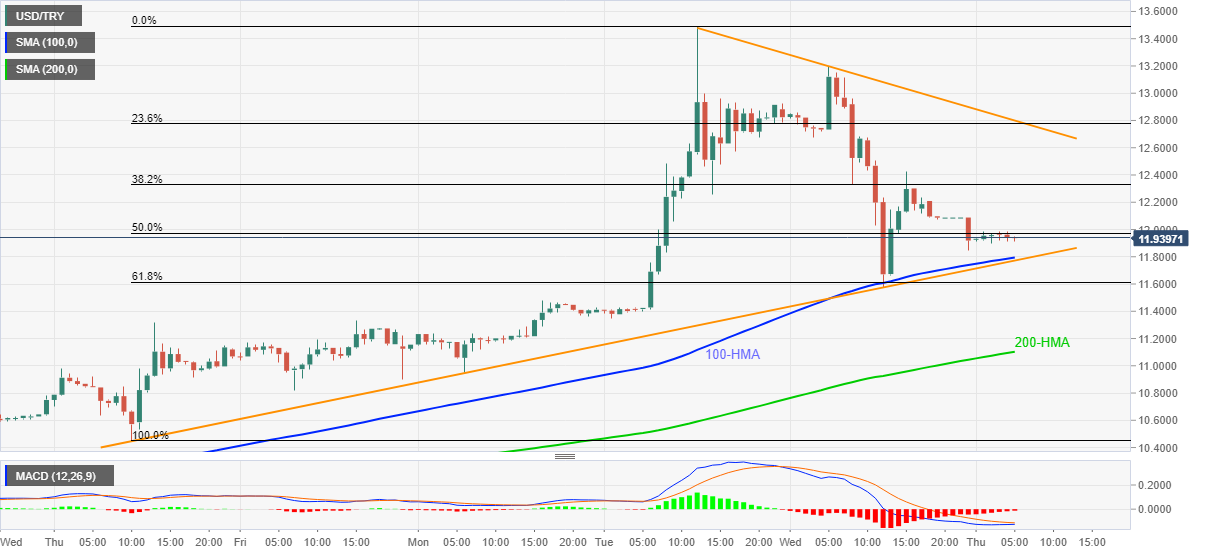
Trend: Bullish
- GBP/USD snaps four-day downtrend to bounce off yearly low.
- Britain won’t trigger Article 16 until talks collapse, EU’s Sefcovic will visit London for negotiations on Friday.
- UK experts predict New Year surge in covid cases, virus-led death toll declines.
- BOE’s Bailey eyed for rate hike clues following the firmer jobs report, inflation and PMI data.
GBP/USD consolidates recent losses around the 11-month low, grinding higher around 1.3350 ahead of Thursday’s London open.
While a pullback in the US dollar could be well-cited for the latest rebound in the cable pair amid a sluggish Asian session, hopes of overcoming the Brexit deadlock also favor the quote of late.
Although the No.10 Downing Street spokesperson cites a substantial gap between the UK and EU views regarding Northern Ireland, the British Prime Minister Boris Johnson’s readiness, per Reuters, to work hard to solve the issue on hand keeps market players optimistic. That said, the British policymakers have also given consent to Irish PM Michael Martin that they won’t trigger Article 16 until the talks collapse.
On the same line were the lines from Bloomberg suggesting the positive progress over the Brexit talks. “Brexit Minister David Frost is pushing for a significant overhaul of the existing treaty, while European Commission Vice-President Maros Sefcovic is offering concessions within the framework of the existing deal.” It’s worth noting that the UK and the Eurozone were discussing relief for medical aids traveling through Northern Ireland and were hopeful of a solution ahead of the UK visit by EU’s Sefcovic, scheduled for Friday.
Also positive for the GBP/USD prices was a pullback in the US Treasury yields following the recently sluggish US inflation expectations, as measured by the 10-year breakeven inflation rate per the St. Louis Federal Reserve (FRED) data.
Alternatively, Sky News quotes British Health Experts to cite a risk of New Year surge in the covid cases after the latest daily infections jump to 43,676 while the death toll eased to 149.
Amid these plays, stock futures are mildly bid tracking the previous day’s first negative daily close in three by the US 10-year Treasury yields. While the same pull the US Dollar Index (DXY) back from a 16-month high, the GBP/USD pair’s further rebound depends upon comments from Bank of England (BOE) Governor Andrew Bailey amid Thanksgiving Day Holiday.
Considering the latest improvement in the UK jobs and inflation data, not to forget firmer preliminary readings of November PMIs, BOE’s Bailey might reiterate his bullish bias for the rate hike and can help the GBP/USD to extend the corrective pullback. However, covid woes may challenge the policymakers, which in turn can drag the quote ahead of tomorrow’s key Brexit talks.
Technical analysis
Given the cable pair’s failures to rebound following the downside break of the September 2020 high, coupled with the bearish MACD signals, sellers are likely to keep the reins. However, a convergence of the 100-week SMA and a descending trend line from late July, around 1.3290-75 appears a major challenge for the pair bears. Meanwhile, corrective pullback remains elusive until crossing September 2020 top of 1.3482.
Quek Ser Leang at UOB Group’s Global Economics & Markets Research comments on the recent price action around the US Dollar Index (DXY).
Key Quotes
“Two weeks ago, USD Index surged above the Sep’s high of 94.74. This level is also near the top of the weekly Ichimoku cloud and the breach of this key technical level resulted in a sharp and swift rally (note that this is the first time USD Index is above the Ichimoku cloud since Jun last year). Weekly ADX has risen above the 25 level which indicates that the current rally is in a ‘trending’ mode. In other words, USD Index could continue to advance at a rapid clip.”
“The next resistance level of note is at 97.80, the high in Jun 2020. This level is also near to the 61.8% retracement of the multi-month decline from last March (high of 102.99) to the low of 89.21 in Jan this year. On the downside, the previous resistance at 94.74 is acting as solid support now but only an unlikely break of the 55-week exponential moving average would indicate that USD Index is not ready to trend upwards in the months ahead.”
- EUR/USD licks its wounds above 1.1200 but remains vulnerable.
- Hawkish Fed, European covid curbs will continue to undermine EUR/USD.
- Downside risks remain intact while below 21-SMA on the 4H chart.
EUR/USD is advancing above 1.1200, on a steady recovery from the 2021 lows of 1.1186. The US dollar retreats in tandem with the Treasury yields despite a cautious mood on Thanksgiving Day.
The European covid curbs and the Fed-ECB policy divergence is expected to keep the euro on the edge ahead of the ECB minutes and speeches from several ECB policymakers, including President Christine Lagarde.
After Austria announced a nationwide lockdown last week, France is set to announce new covid measures, as the government spokesperson warned the country's Covid-19 incidence rate is likely to rise past 200 per 100K in the next few days.
Meanwhile, reports are doing rounds that Germany is set to decide on tougher Covid-19 restrictions and could even opt for a full lockdown amid record daily infections and mounting pressure on hospitals.
On the USD side of the story, hawkish comments from the Fed official Mary Daly combined with the Fed minutes showing preference to faster tapering and earlier rate hikes will continue to underpin the shorter duration yields and, in turn, the dollar.
Looking at EUR/USD’s four-hour chart, the downside bias remains intact so long as the price holds below the downward-sloping 21-Simple Moving Average (SMA) at 1.1239.
At the time of writing, the spot is trading at 1.1214, up 0.16% on the day. A four-hourly candlestick closing above the 21-SMA is needed to unleash the additional recovery towards 1.1300.
The Relative Strength Index (RSI) is trading flat just above the oversold territory, suggesting that the downside bias remains intact.
EUR/USD: Four-hour chart
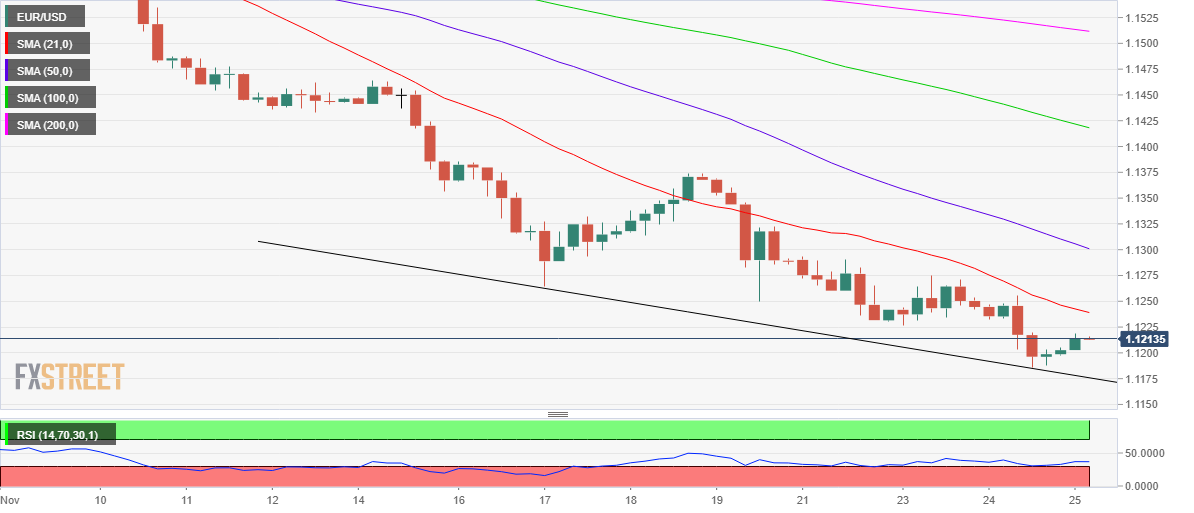
On the flip side, the 2021 lows will get retested on selling resurgence, below which the falling trendline support at 1.1175 will be on the sellers’ radars.
Further down, the 1.1150 psychological barrier will come into play.
EUR/USD: Additional levels to consider
- Asia-Pacific shares remain mostly steady, grind higher of late.
- US Yields retreat despite hawkish Fed Minutes, strong inflation data.
- Japan services PPI jump to 20-year high, China urges local governments to spend more.
- BOK announces 0.25% rate hike, Kaisa seeks to extend maturity on $400 million bonds.
Asian equities remain lackluster during the early hours of the Thanksgiving Day holiday on Thursday. Even so, mildly bid S&P 500 Futures and downbeat yields favor the buyers amid mixed catalysts.
Japan’s Corporate Services Price Index for October rose past 0.9 prior level but eased below 1.2% forecast to arrive at 1.0, the highest levels since 2001. The same joins chatters over Japan’s extra budget worth $312 billion to propel Japan’s Nikkei 225, up 0.75% by the press time. Even so, MSCI’s index of Asia-Pacific shares outside Japan remains indecisive with 0.06% intraday gains.
China’s push to local government for more spending, to battle the growth slowdown, joins the filling from a struggling Beijing-based firm Kaisa to favor the buyers. “Kaisa said it would exchange its 6.5% offshore bonds due Dec. 7 for new notes due June 6, 2023, at the same interest rate if at least 95% of holders accept,” per Reuters. These catalysts helped stocks in Australia, New Zealand and China to print mild gains amid a lack of major data/events.
Further, South Korea followed New Zealand in a rush to rate hike, as the Bank of Korea increased benchmark rates by 0.25% but couldn’t much fuel the national equity index named KOSPI. Elsewhere, Indonesia’s IDX Composite tracks gains in China and Pacific markets while India fails to cheer upbeat comments from global rating giant Moody’s.
On Thursday, the US stocks benefited from the 10-year bond coupon’s U-turn from a monthly peak to mark the first negative day in three. In doing so the yields ignore the Federal Open Market Committee (FOMC) Minutes that said, “Some participants said faster taper could be warranted.”
Additionally, portraying the inflation pressured, challenging equity bulls, was a 30-year high print of the Fed’s preferred inflation gauge. The US Personal Consumption Expenditures - Price Index that jumped to 5.0% YoY in October, surpassing 4.6% expected figures and 4.4% prior.
However, the recently sluggish US inflation expectations, as measured by the 10-year breakeven inflation rate per the St. Louis Federal Reserve (FRED) data seem to have favored the bond buyers. The stated inflation gauge reversed the previous day’s bounce off a three-week low on Wednesday to print a 2.61% level.
Read: Yields ignore hawkish Fed minutes as US inflation expectations contradict PCE data
Japan's government is expected to announce on Friday its first extra budget worth of 36 trillion yen ($312.04 billion) for this fiscal year ending March, Reuters reports, citing a draft document.
Japan’s government will issue additional new bonds worth 22 trillion yen in FY2021/22 extra budget, the draft noted.
Market reaction
USD/JPY is off the multi-year highs of 115.51, currently trading flat at 115.36. The pair remains depressed amid a pullback in the US dollar, despite the hawkish Fedspeak.
- USD/INR snaps four-day uptrend, extends pullback from three-week top.
- MACD teases bulls above short-term EMA, descending trend line from October 12 guards immediate upside.
USD/INR bounces off intraday low to 74.54, down 0.05% on a day during early Thursday. In doing so, the Indian rupee (INR) pair keeps the previous day’s pullback from the highest levels since November 03.
While a U-turn from the multi-day high justifies the pair’s inability to provide a daily close beyond a six-week-old resistance line, the quote’s sustained trading beyond 20-day EMA keeps buyers hopeful. Also favoring the USD/INR bulls is the MACD line that recently marked a bullish cross and inches towards the positive region.
That said, the pair buyers will seek a daily closing past the stated trend line resistance, around 74.62 by the press time, to extend the weekly run-up.
Following that, the 75.00 threshold and the monthly high near 75.15 may probe the USD/INR upside ahead of the previous monthly peak of 75.65.
Alternatively, a clear downside break of the 20-day EMA level of 74.45 will direct the USD/INR sellers towards an ascending support line from early September, near 74.08 by the press time.
Also acting as important support levels are the lows marked during the last week around the 74.00 round figure and the monthly trough of 73.85.
USD/INR: Daily chart
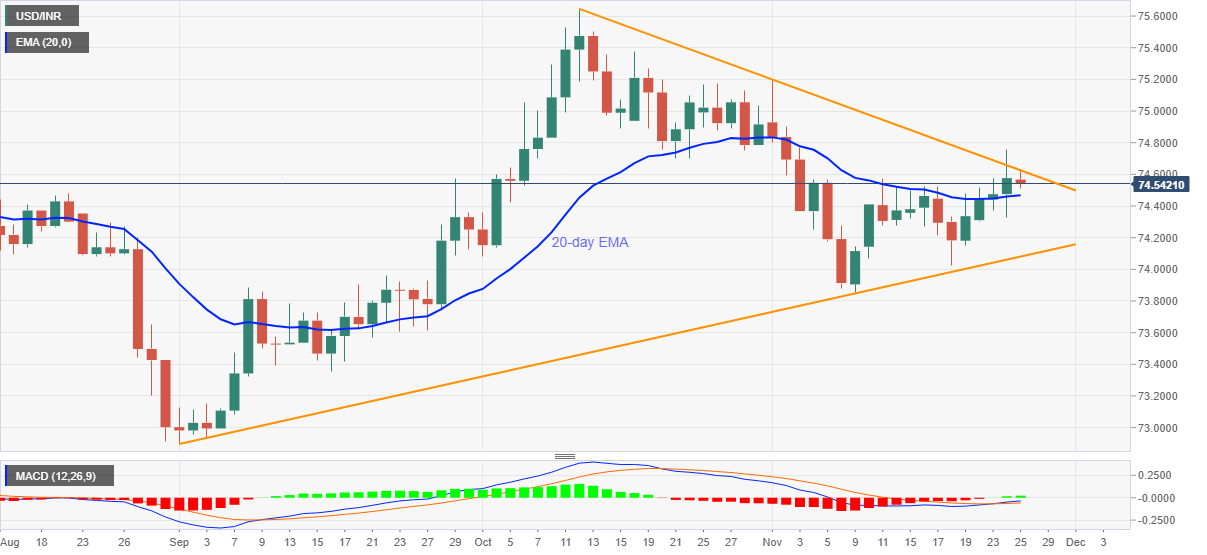
Trend: Further upside expected
- Gold grinds higher around intraday top following a bounce off three-week low.
- Sluggish market conditions trigger corrective pullback from the near-term key support level.
- Yields failed to cheer hawkish Fed Minutes, inflation data on Wednesday.
Gold (XAU/USD) snaps a five-day downtrend while printing 0.25% intraday gains around $1,792 during early Thursday.
The yellow metal dropped to the lowest level since November 04 the previous day before bouncing off $1,778. While a pullback in the US Treasury yields could be linked to the gold’s rebound, strong technical support around $1,780 also played its role to trigger the corrective pullback. That said, the recovery moves remain lackluster during Asia as the US markets are off due to the Thanksgiving Day holiday and there are no major releases from elsewhere.
The US 10-year Treasury dropped 2.2 basis points (bps) to 1.64% after refreshing monthly high the previous day even as the Federal Open Market Committee (FOMC) Minutes said, “Some participants said faster taper could be warranted.” Further, Federal Reserve Bank of San Francisco President and FOMC member Mary Daly who sees, per Reuters, the case for speeding up the QE taper and expects rate hikes at end of 2022 also portrayed hawkish bias at the Fed.
Additionally, a 30-year high print of the Fed’s preferred inflation gauge, namely the US Personal Consumption Expenditures - Price Index, also should have favored the yields. The stated inflation indicator jumped to 5.0% YoY in October, surpassing 4.6% expected figures and 4.4% prior.
The reason for the bond buyers to keep the reins could be linked to the recently sluggish US inflation expectations, as measured by the 10-year breakeven inflation rate per the St. Louis Federal Reserve (FRED) data. The stated gauge reversed the previous day’s bounce off a three-week low on Wednesday to print a 2.61% level.
While the inflation woes are likely not to have any fresh catalysts today, gold traders may keep eyes on the latest covid woes, which if escalated can pull the commodity back to the key support. . After Austria and the Netherlands, record-high cases in Germany triggered multiple warnings to recall the lockdowns from the region.
“Coronavirus infections broke records in parts of Europe on Wednesday, with the continent once again the epicenter of a pandemic that has prompted new curbs on movement and seen health experts push to widen the use of booster vaccination shots,” said Reuters.
Technical analysis
A clear downside break of a one-month-old horizontal area and 200-SMA weighed on the gold prices during the early week.
However, oversold RSI conditions favor a corrective pullback from a two-month-long ascending support line and 61.8% Fibonacci retracement (Fibo.) of September-November upside, near $1,780.
The recovery moves remain elusive until crossing the 200-SMA and the aforementioned support-turned-resistance area, respectively near $1,806 and $1,810-13.
Should gold buyers dominate past $1,813, November 09 swing high around $1,833 will join the tops marked in July and September near $1,834 to offer a tough nut to crack. Following that, the mid-November swing low near $1,850 will be in focus.
Meanwhile, a clear downside past $1,780 will aim for the multiple lows near $1,759 before jostling with multiple supports near $1,748-47.
In a case where gold sellers conquer the $1,747 support, the odds of a slump targeting September’s low around $1,721 can’t be ruled out.
Gold: Four-hour chart
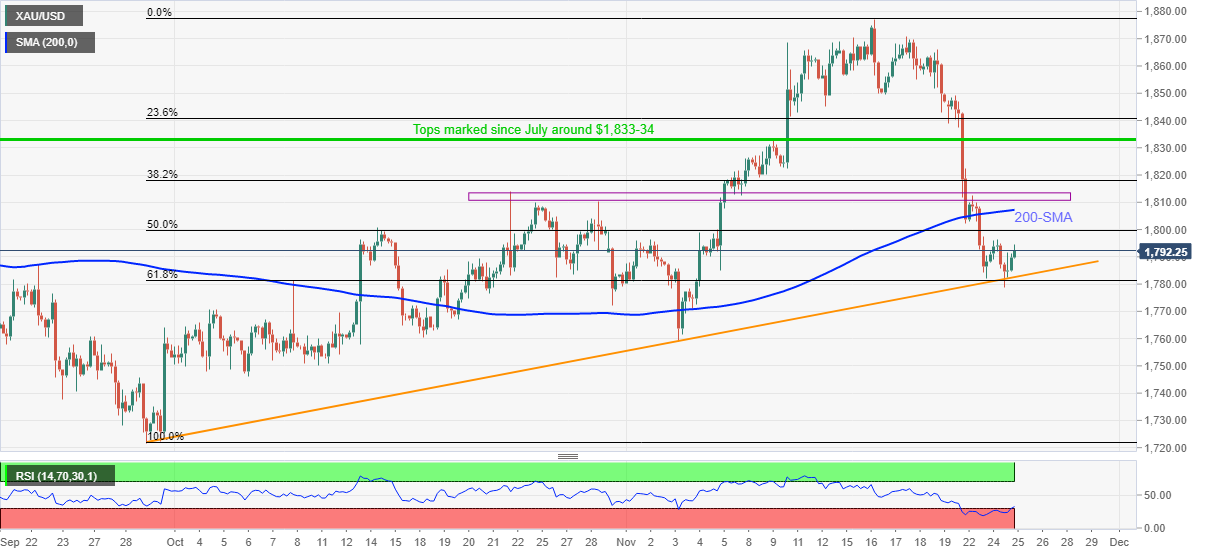
Trend: Further recovery expected
In its latest research report, the Federal Reserve Bank of New York underscores financial stress building up in China.
Key quotes
“Globally, financial market stresses have eased significantly since the spring of 2020. Although Chinese financial conditions are at historically average levels, they have trailed the rest of the world.”
“Given the relatively large degree of comovement in financial conditions across countries, this suggests that a potentially significant build-up in Chinese domestic financial market stresses has been masked by conditions abroad.”
“The domestic component from our index of financial market stress in China indeed reveals that domestically driven financial market stresses have moved higher since the start of 2021.”
“Although its peak in October was below the levels seen in early 2020, the still-high stress level signaled a substantial downside risk to the Chinese growth outlook.”
During a post-monetary policy meeting press conference on Thursday, the Bank of Korea (BOK) Governor Lee Ju-yeol said that the “policy interest rate is still accommodative.”
Additional quotes
Thursday's rate decision was not unanimous.
Board member Joo Sang-Yong dissented to Thursday’s rate decision.
Shouldn't consider political context into account in monetary policy decision including the presidential election.
Current policy rate below neutral interest rate.
Read: BOK raises key rates by 25bps to 1%, ups inflation forecasts
| Raw materials | Closed | Change, % |
|---|---|---|
| Brent | 81.44 | -0.04 |
| Silver | 23.519 | -0.43 |
| Gold | 1788.478 | -0.03 |
| Palladium | 1844.76 | -1.06 |
Analysts at Goldman Sachs offer their take on the US oil release from the Strategic Petroleum Release (SPR) and any ban of oil exports from the US.
Key quotes
“Both the release of oil from reserves and any ban of oil exports from the US are ineffective.”
“At present, the US exports around 3m barrels of crude a day. If this export stopped domestic pipelines would be unable to reroute that crude to US refiners. The refiners do not have enough capacity to process it.”
"This would leave excess U.S. crude supply quickly reaching tank tops and forcing shut-in production, with investment and production soon to enter significant declines."
One-month risk reversal (RR) of USD/CHF, a gauge of calls to puts, eases to -0.1000 for the week to end on November 26, per the latest data from Reuters. The daily figures are down for the second consecutive day, -0.025 at the latest.
It’s worth noting that the weekly RR jumped to the highest since the latest September 2020 during the first week of November, before stepping back afterward.
Hence, it appears that the options market bears are retaking controls amid indecision over the Fed’s next move and fresh covid woes.
Also favoring the USD/CHF pullback is the recent decline of the US Treasury yields, tracking the inflation expectations.
That said, USD/CHF ticked up to the highest levels since April the previous day before closing with mild gains around 0.9340. The Swiss currency (CHF) pair remains pressured around an intraday low of 0.9336 by the press time of early Thursday.
Read: USD/CHF Price Analysis: Break of a 4-month old trendline, opens the door for a re-test of 0.9473
- AUD/USD struggles to extend bounce off two-month low inside bullish chart pattern.
- Oversold RSI hints at a corrective pullback, key DMA convergence challenges the bulls.
AUD/USD trades flirt with 78.6% % Fibonacci retracement (Fibo.) of August-October upside within a month-long falling wedge bullish formation during early Thursday. That said, the quote retreats from an intraday high 0.7210 while keeping the rebound from a two-month low of 0.7183 by the press time.
Given the oversold RSI conditions, odds favoring the corrective pullback are high, suggesting a U-turn towards the stated pattern’s resistance line near 0.7270.
However, a daily closing past 0.7270 will confirm the theoretical run-up targeting the late June’s high close to 0.7620. During the run-up 61.8% Fibo. and convergence of the key DMAs, respectively around 0.7280 and 0.7350 will precede October’s peak of 0.7557 to challenge the AUD/USD bulls.
Alternatively, further weakness past the 78.6% Fibonacci retracement level of 0.7200 will direct the quote towards September’s monthly bottom of 0.7169. Also challenging the quote is the support line of the stated wedge near 0.7165.
In a case where AUD/USD sellers dominate past 0.7165, the yearly low of 0.7105 should return to the charts.
AUD/USD: Daily chart
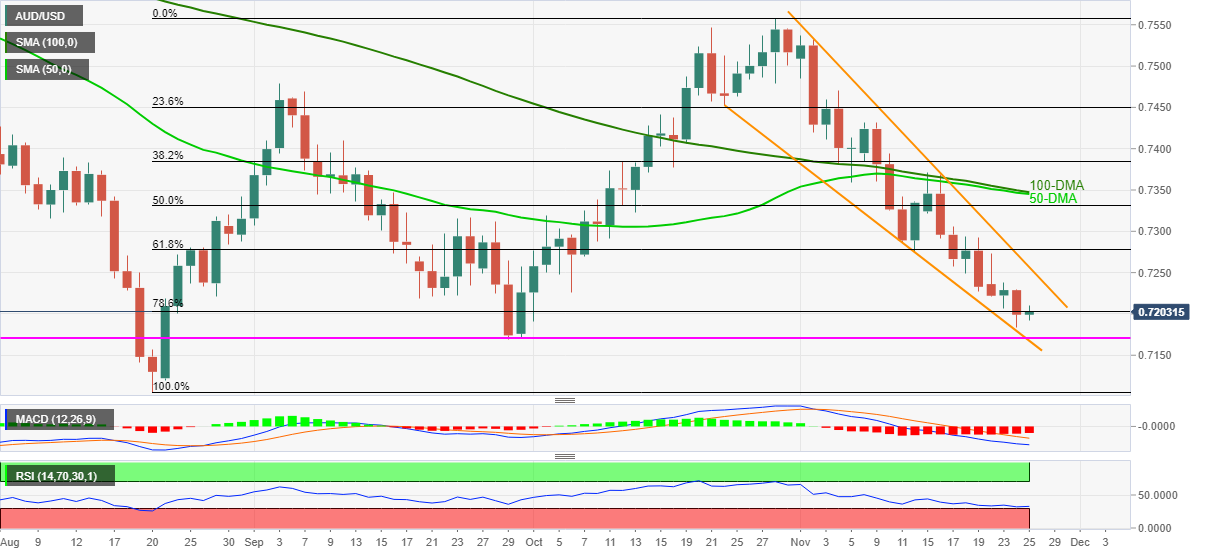
Trend: Further recovery expected
- US Treasury yields reversed from monthly high despite upbeat catalysts.
- FOMC Minutes, Core PCE Inflation favored bond bears.
- US inflation expectations drop back to three-week low.
- Thanksgiving Day holiday restricts intraday moves, covid, inflation in focus.
With the US Thanksgiving Day restricting the market moves, Thursday’s Asian session becomes a dull affair. While portraying the mood, S&P 500 Futures print mild gains but the Treasury yields stay intact amid an off in the bond trading. It’s worth noting that the chatters surrounding the Fed rate hike and coronavirus keep the driver’s seat of late.
That said, the US 10-year Treasury dropped 2.2 basis points (bps) to 1.64% after refreshing monthly high the previous day even as the Federal Open Market Committee (FOMC) Minutes said, “Some participants said faster taper could be warranted.”
Also on the positive side was a 30-year high print of the Fed’s preferred inflation gauge. The US
Personal Consumption Expenditures - Price Index jumped to 5.0% YoY in October, surpassing 4.6% expected figures and 4.4% prior.
The reason for the bond buyers to keep the reins could be linked to the recently sluggish US inflation expectations, as measured by the 10-year breakeven inflation rate per the St. Louis Federal Reserve (FRED) data. The stated gauge reversed the previous day’s bounce off a three-week low on Wednesday to print a 2.61% level.
Other than the data and inflation expectations, fears of fresh coronavirus waves, mainly emanating from the Eurozone, also challenge the bond buyers and may soon renew the yields, likely underpinning the US dollar strength. Though, upbeat equities and lower gold prices may divert market players from the greenback.
To sum up, market sentiment is likely to remain cautious amid virus woes and Fed rate hike chatters even as the latest weakness in yields probe greenback bulls. For the day, an off in the US and a light calendar elsewhere will challenge the momentum traders and can trigger the consolidation.
The Canadian trade minister says 'extremely disappointed' that the US decided to increase duties it is imposing on Canadian softwood lumber from most producers to 17.9%.
In a statement, it read... “Canada’s softwood lumber industry is an economic anchor for communities across the country and a key component of Canada’s forestry sector, which contributed more than $25 billion to the country’s GDP in 2020 and employed nearly 185,000 workers. The United States has long relied on Canadian lumber products to meet its domestic needs for high-quality building materials.''...
Read the full statement and quick fats in the following link.
Quick facts
- On November 24, 2021, the US. Department of Commerce issued the final results of the second administrative reviews of its anti-dumping and countervailing duty orders regarding certain softwood lumber products from Canada.
- Going forward, the new combined “all others” rate that will apply to exports from companies that are subject to the second administrative reviews is 17.9%. The current “all others” rate for most companies is 8.99%.
- Following completion of any legal challenges under the Canada-United States-Mexico Agreement’s (CUSMA) Chapter 10 or in US courts, these new anti-dumping and countervailing duty rates will apply retroactively to softwood lumber exports to the United States from companies that were subject to the second administrative reviews.
- The US Department of Commerce conducts an annual review of anti-dumping and countervailing duty orders. The annual review process is similar to the process used for initial investigations but applies only to companies that are subject to review.
Market implications
We have seen this before from the US and this is just the latest volley in the long-running lumber trade dispute between the two countries. US President Donald Trump went down this line also when he was in power during a decades-long dispute over trade between the two nations.
The lumber disputes have been a significant trade irritant between the US and Canada since Confederation 150 years ago. This specific dispute, however, dates back over 30 years to the early 1980s.
Therefore, this should come as no surprise but it will be something to keep an eye on over the coming sessions to see how things develop in terms of risk apatite surrounding the Canadian dollar.
The Bank of Korea (BOK) raised the benchmark interest rates by 25bps to 1% at its monetary policy review meeting held on Thursday.
The policy action by the South Korean central bank was widely anticipated amid rising household debt and inflationary concerns.
Key takeaways from the Summary
Sees 2021 growth at 4.0% vs 4.0% before.
Sees 2021 inflation at 2.3% vs 2.1% before.
Sees 2022 growth at 3.0%.
Sees 2022 growth at 3.0%.
Sees 2022 inflation at 2.0% vs 1.5% before.
Sees 2023 inflation at 1.7%.
Sees 2023 growth at 2.5%.
Consumption to improve gradually.
Exports, investment to sustain buoyancy.
To monitor build up of financial imbalances.
To monitor pace of growth and inflation.
To monitor monetary policies abroad.
To monitor coronavirus spread.
S. Korea's inflation to run far above 2%.
S. Korea's core inflation to increase to upper-1% level this year.
Growth in household lending slowed slightly.
Market reaction
USD/KRW spikes to daily highs of 1,190.73 on the expected BOK rate hike, leaving won traders will little surprise.
The spot was last seen trading at 1,190, up 0.11% on a daily basis.
- USD/CAD prints three-day downtrend as sellers attack weekly low.
- Confirmation of the bearish chart pattern joins descending RSI line to favor sellers.
- 50-SMA acts as immediate support ahead of early monthly swing high.
- Descending trend line from Tuesday adds to the upside filters.
USD/CAD remains on the back foot for the third consecutive day, taking offers around 1.2650 to refresh intraday low during early Thursday.
The Loonie pair confirmed a rising wedge bearish chart pattern the previous day and the downward sloping RSI, not oversold, added strength to the fall afterward.
That said, the quote currently drops towards 50-SMA around 1.2620 but the early November highs near 1.2600 will challenge the USD/CAD bears afterward.
It should be noted that the theoretical target hints at a fresh monthly low under 1.2350 wherein the one-month-old rising support line can add to the downside filters near 1.2480.
Meanwhile, corrective pullback needs to cross the immediate resistance line from Tuesday, close to 1.2700, before recalling the USD/CAD bulls.
Following that, the monthly peak of 1.2744 and late September’s high near 1.2775 will be in focus.
USD/CAD: Four-hour chart
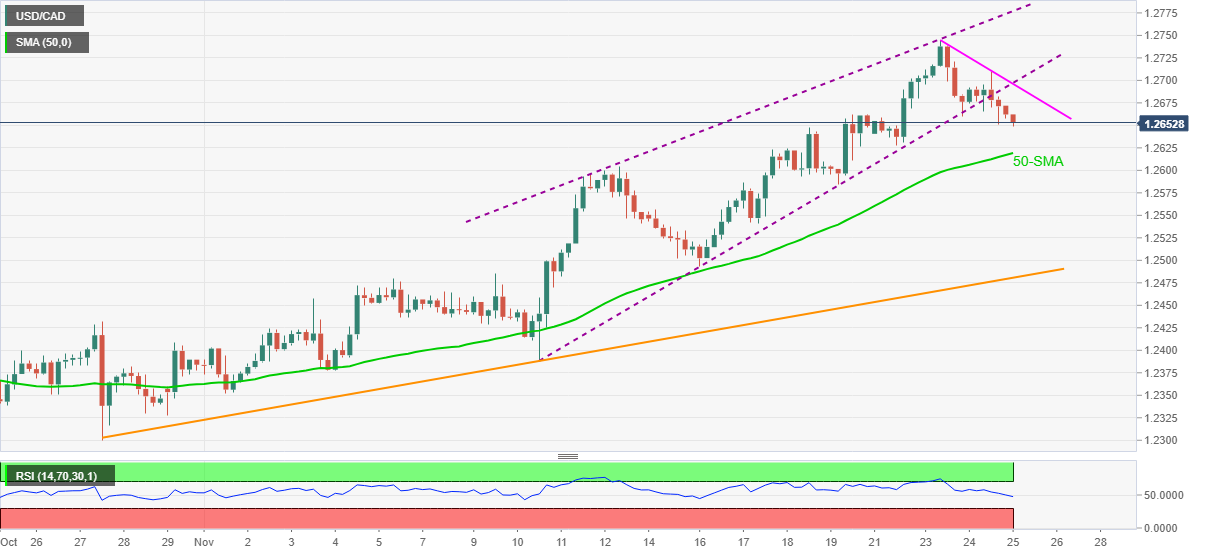
Trend: Further weakness expected
| Time | Country | Event | Period | Previous value | Forecast |
|---|---|---|---|---|---|
| 00:30 (GMT) | Australia | Private Capital Expenditure | Quarter III | 3.4% | -2% |
| 05:00 (GMT) | Japan | Coincident Index | September | 91.3 | |
| 05:00 (GMT) | Japan | Leading Economic Index | September | 101.3 | |
| 07:00 (GMT) | Germany | Gfk Consumer Confidence Survey | December | 0.9 | -0.5 |
| 07:00 (GMT) | Germany | GDP (YoY) | Quarter III | 9.8% | 2.5% |
| 07:00 (GMT) | Germany | GDP (QoQ) | Quarter III | 1.6% | 1.8% |
| 12:30 (GMT) | Eurozone | ECB Monetary Policy Meeting Accounts | |||
| 13:30 (GMT) | Eurozone | ECB President Lagarde Speaks | |||
| 14:00 (GMT) | Belgium | Business Climate | November | 4 | |
| 17:00 (GMT) | United Kingdom | BOE Gov Bailey Speaks | |||
| 23:30 (GMT) | Japan | Tokyo CPI ex Fresh Food, y/y | November | 0.1% | 0.4% |
| 23:30 (GMT) | Japan | Tokyo Consumer Price Index, y/y | November | 0.1% |
In recent trade today, the People’s Bank of China (PBOC) set the yuan (CNY) at 6.3980 vs the previous fix of 6.3903 and the prior close of 6.3921.
About the fix
China maintains strict control of the yuan’s rate on the mainland.
The onshore yuan (CNY) differs from the offshore one (CNH) in trading restrictions, this last one is not as tightly controlled.
Each morning, the People’s Bank of China (PBOC) sets a so-called daily midpoint fix, based on the yuan’s previous day closing level and quotations taken from the inter-bank dealer.
- NZD/USD bulls stepping in for a test of the bear's commitments following RBNZ flush out.
- The 50% mean reversion near 0.6920 is in focus.
As per the technical observations in the Reserve Bank of New Zealand yesterday, the bird fell out of the sky is what was regarded as a less hawkish outcome.
''A dovish hike,'' it was stated, ''could consist of concern over covid contagion, geopolitical risks, the guidance of incremental 25bps hikes, contingent on various factors.''
it was the 25pbs incremental rate hike road map that really upset the bulls.
RBNZ projections for the path ahead
- Official cash rate at 0.94% in March 2022 (previously 0.86%).
- This moves to 2.14% in December 2022 (vs the prior 1.62%).
- Then 2.3% in March 2023 (prior 1.77%).
- Then 2.61% in December 2024.
On the technical side of things, 0.6950 was said to be a line in the sand in this regard and a break there was expected to open risk to a restest of the 0.6880s and then 0.68 the figure.
We have seen 0.6880s already well and truly tested:

At this juncture, we may need to wait for next week and the market's full response to the uber hawkishness at the Federal Reserve following today's mooted response to the minutes. A correction could be in order at this juncture prior to a continuation to the downside:
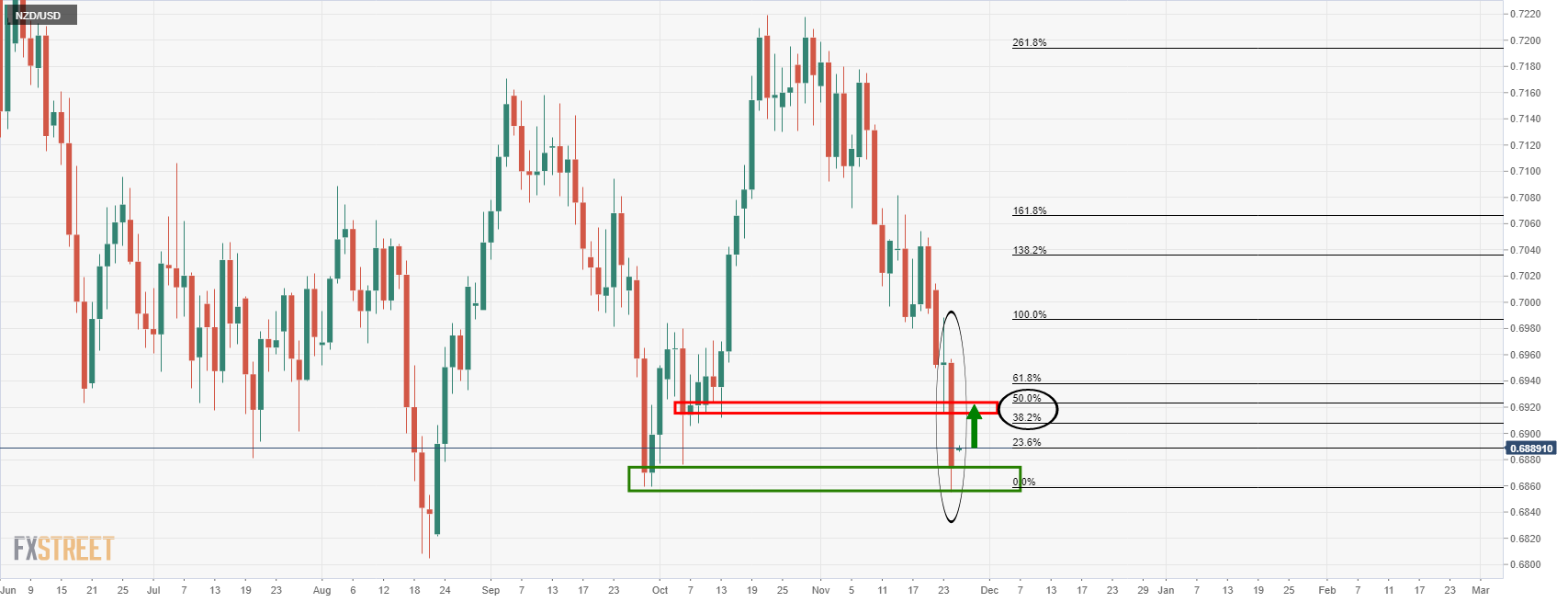
The 50% mean reversion near 0.6920 is in focus.
While following the likes of Morgan Stanley, Capital Economics and JP Morga, Goldman Sachs (GS) also raised their US Q4 GDP forecast in the latest analytical piece.
That said, the US bank estimates 6.0% QoQ growth for the world’s largest economy during the fourth quarter (Q4).
GS cites larger expected contributions from inventories and goods exports, as well as a strong Q3 pace of gross domestic income (+6.7% annualized), to back the hawkish forecasts.
It's worth noting that the Atlanta Fed GDP gauge shows the Q4 GDP forecasts as 8.6% versus previously expected 8.2%. It’s worth noting that the official second reading of the Q3 US GDP reading from 2.2% to 2.1% on an annualized basis.
Read: Forex Today: Dollar’s rally continues and is far from over
- EUR/USD takes the bids to refresh intraday high, bounce off 16-month low.
- Bullish MACD signals, firmer Momentum line favor rebound.
- 100-SMA, one-week-old horizontal line add to the upside filters.
EUR/USD consolidates recent losses around multi-month low, picking up bids to refresh daily top to 1.1211 during early Thursday.
The major currency pair dropped to the fresh low since July 2020 the previous day before bouncing off the 1.1186 level.
The recovery moves gain support from the bullish MACD signals and upward sloping Momentum line to direct buyers towards a one-week-long descending trend line near 1.1220.
However, a convergence of the 100-SMA and a weekly horizontal resistance, previous support, challenges the EUR/USD pair’s further advances around 1.1235.
Should the quote manage to cross the 1.1235 hurdle, the weekly high of 1.1290 will be in focus.
On the flip side, EUR/USD bears will take fresh entries on witnessing a clear downside break of the 1.1200 threshold but lows marked during July 2020, as well as recently, highlight 1.1185 as the key support.
Even if the pair drops below 1.1185, June 2020 swing low will challenge the further declines around 1.1168.
EUR/USD: 30-minute chart
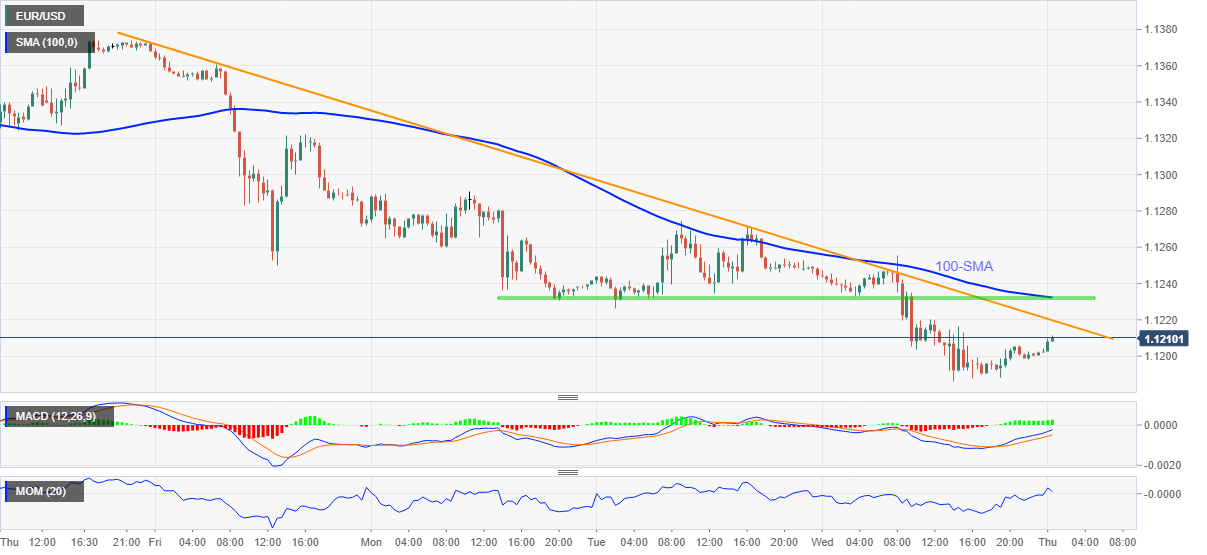
Trend: Further recovery expected
- USD/JPY seesaws around multi-day top during inactive Asian session.
- Japan Corporate Services Price Index jumps to highest since November 2001 in October.
- Virus woes escalate even as Japan’s daily covid infections print yearly low.
- US data, Fed Minutes keep rate hike hopes on the table but Thanksgiving Day may challenge the bulls.
Having refreshed a multi-day top on Wednesday, USD/JPY hovers around 115.40-50 as Tokyo opens for trading on Thursday. The lackluster moves could be linked to mixed catalysts and an off in the US, due to the Thanksgiving Day holiday.
That said, Japan’s Corporate Services Price Index for October rose past 0.9 prior level but eased below 1.2% forecast to arrive at 1.0, the highest in two decades. On Wednesday, Japan’s Jibun Bank Manufacturing PMI crossed 53.2 prior level with 54.2 figures but lagged behind 54.5 market consensus.
On the other hand, Fed’s preferred inflation gauge, namely Core PCE Price Index, jumped to a 30-year high and the Initial Weekly Jobless Claims also printed welcome readings. Joining the line were upbeat comments from Federal Reserve Bank of San Francisco President and FOMC member Mary Daly, as well as hawkish FOMC Minutes. Alternatively, Durable Goods Orders and GDP figures eased but couldn’t tame the reflation fears.
In addition to the fears of a jump in inflation, COVID-19 woes also underpin the US dollar’s safe-haven demand, helping the USD/JPY buyers. After Austria and the Netherlands, record-high cases in Germany triggered multiple warnings to recall the lockdowns from the region. It’s worth noting though that the virus numbers in Japan dropped recently. “The Tokyo metropolitan government reported five new coronavirus cases on Wednesday, the lowest level on record for this year,” said Kyodo News.
Also challenging the USD/JPY buyers is the latest pullback in the US Treasury yields, from monthly high, as well as an absence of the bond trading due to the US holiday. Even so, Japan’s benchmark equity index Nikkei 225 rises 0.70% on a day while tracking mildly bid S&P 500 Futures.
Amid these plays, the USD/JPY prices are likely to hold the higher range with Japan’s Coincident Index and Leading Index for September likely offering immediate direction. Even so, headlines concerning the covid, inflation and stimulus will be the key to watch.
Technical analysis
A five-week-old ascending trend line near 115.05, coupled with the 115.00 threshold, restricts the USD/JPY pair’s short-term moves. Meanwhile, the late January 2017 peak near 115.65 becomes a tough nut to crack for the bulls considering overbought RSI conditions.
- GBP/JPY imbalances in view from lower to longer time frame perspectives.
- Bulls seeking a breakout out of longer-term dynamic resistance.
There is little to be said on the shorter-term time frames for GBP/JPY as the cross gyrates with no clear directional bias as the price rounds-off the downtrend and teases with a change of trajectory:
GBP/JPY H1 chart
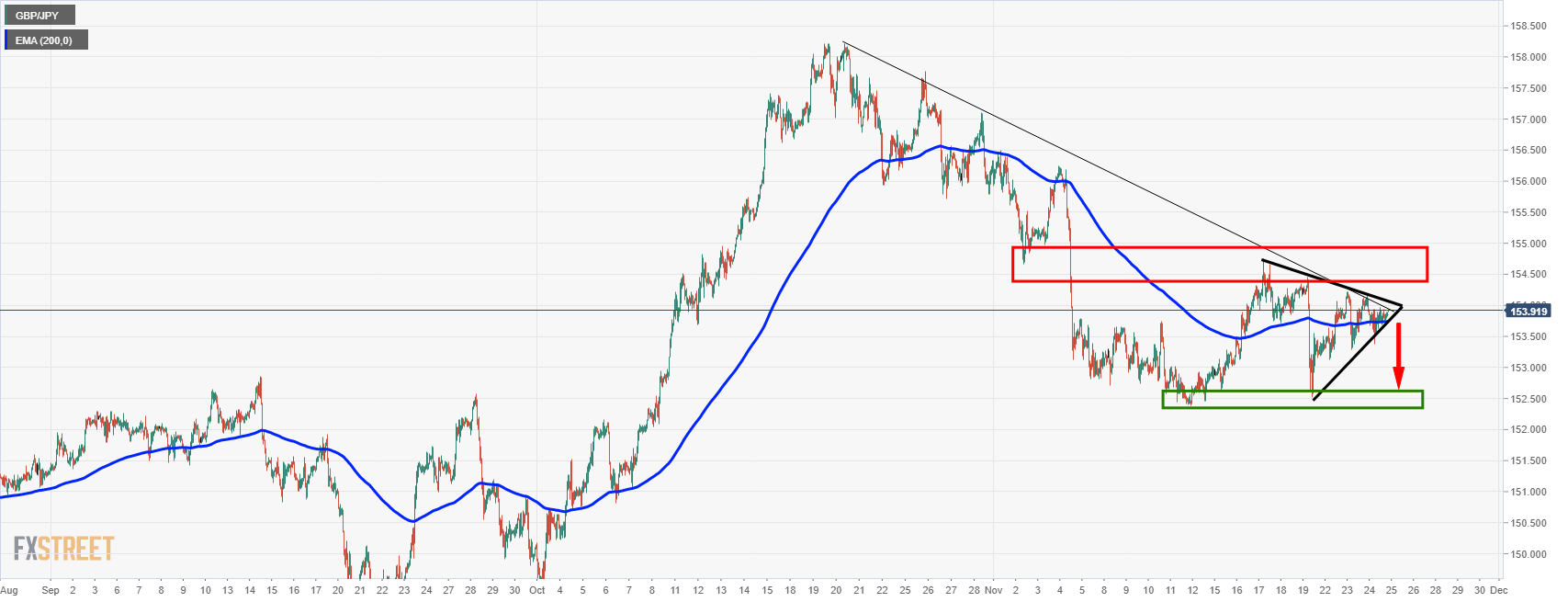
The price is wedged between dynamic support and resistance in the near term and trapped between horizontal support and resistance as well. The real meat on the bone will come from a break of these horizontal areas that would be expected to equate into a fresh trend, above or below the 50-EMA, one way or the other.
GBP/JPY weekly W-formation
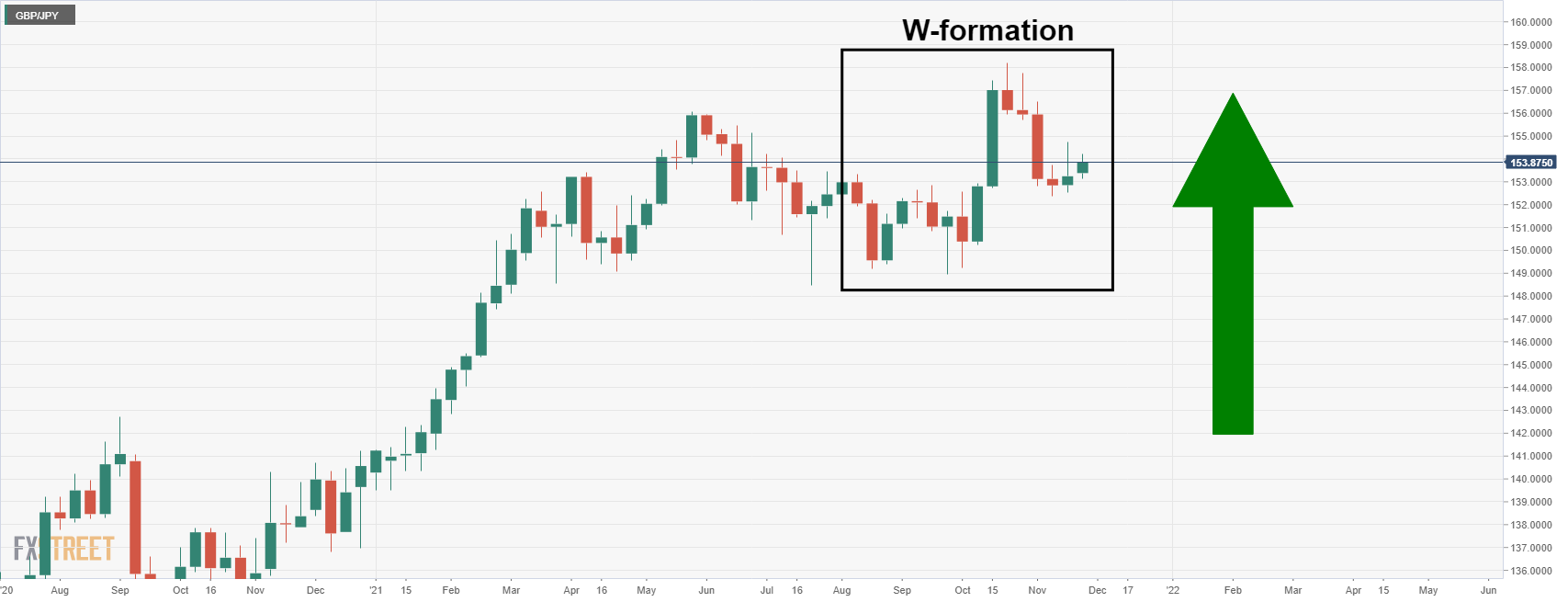
This brings us to the longer-term charts to give us some context. As illustrated, the price is in an overall uptrend. It has just completeda test of the neckline of the W-formation within the dominant uptrend which leaves the upside bias a favoured outcome.
GBPJPY weekly bullish outlook
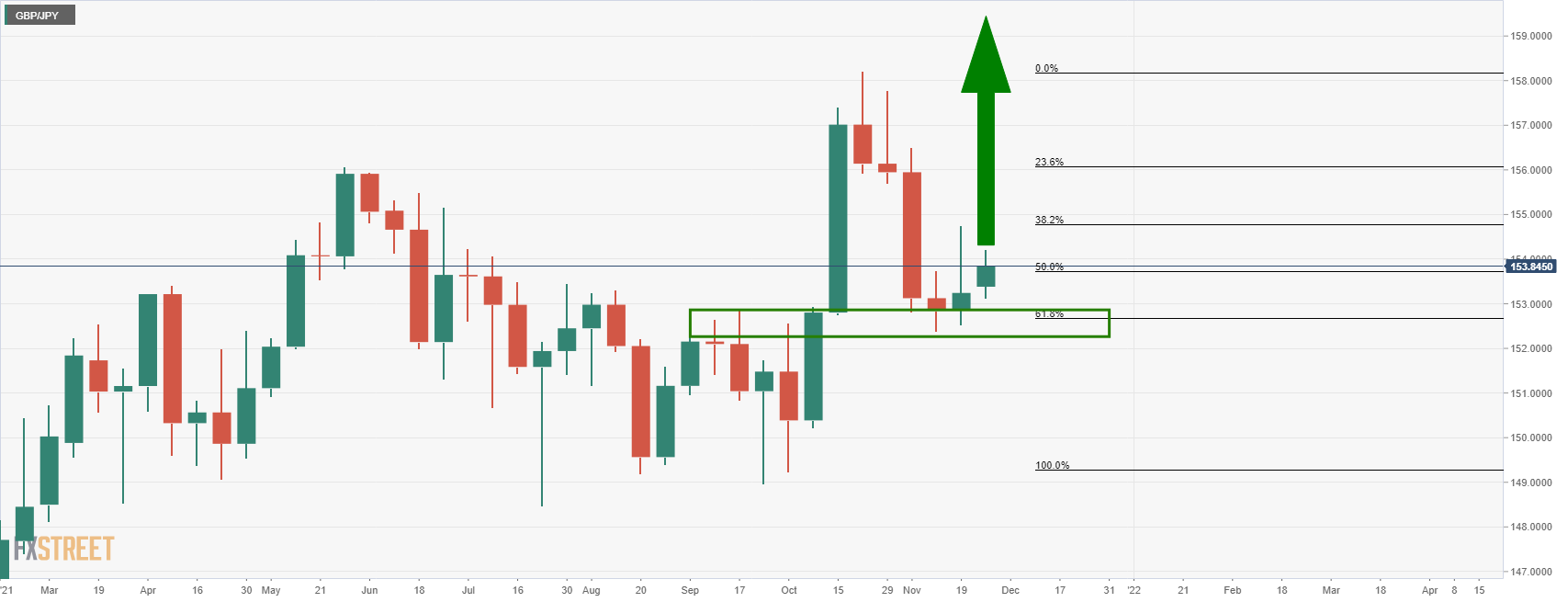
The price fell sharply to the nose of the W-formation in a 61.8% Fibonacci retracement. This means there is little volume between here and the 156.20's for which bulls will look to exploit. We can also see this clearly n the hourly chart:
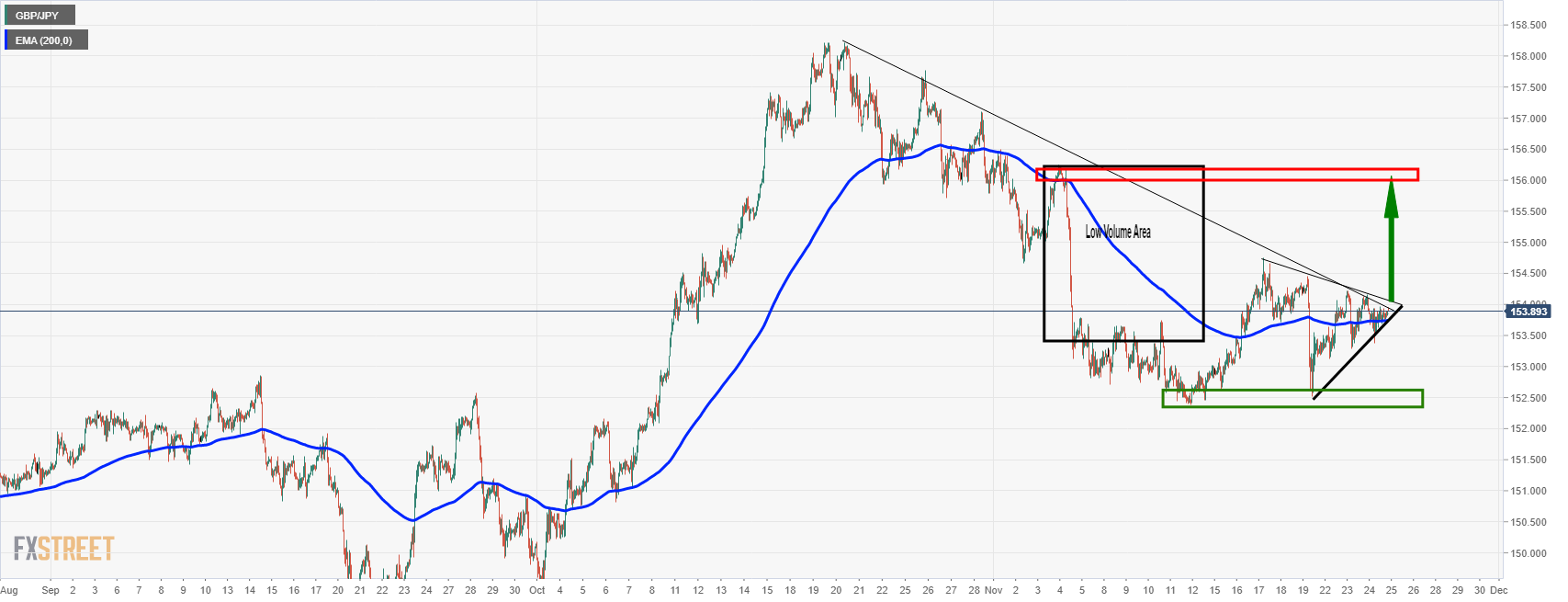
This leaves the bias to the upside while the price pushes against the longer-term trendline resistance.
GBP/JPY weekly bearish alternative
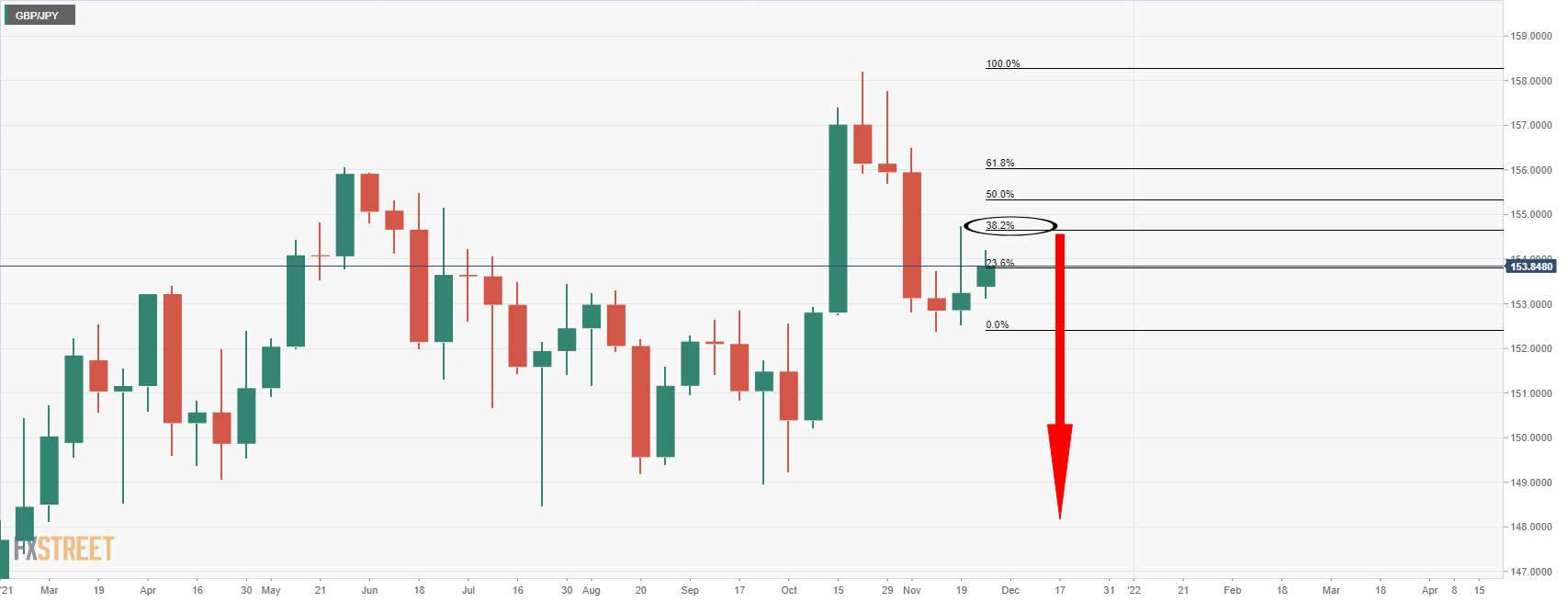
However, that is not to say that the bears are out of the game. Given the 38.2% Fibonacci retracement that we have seen already, subsequent attempts to sell into the strength as bears fade the bullish commitments could lead to a sharp sell-off. The imbalance between the 150.15 and 152.70s could be mitigated by the bears as well. However, the path of least resistance does currently appear to be to the upside.
| Pare | Closed | Change, % |
|---|---|---|
| AUDUSD | 0.71934 | -0.44 |
| EURJPY | 129.247 | -0.15 |
| EURUSD | 1.11981 | -0.42 |
| GBPJPY | 153.808 | -0.1 |
| GBPUSD | 1.33258 | -0.34 |
| NZDUSD | 0.68713 | -1.12 |
| USDCAD | 1.26627 | -0.02 |
| USDCHF | 0.93396 | 0.09 |
| USDJPY | 115.41 | 0.26 |
- WTI picks up bids to reverse the pullback from weekly top.
- OPEC panel anticipates 1.1 mbd excess supplies due to SPR.
- Asia follows the US-led release of strategic oil reserves, EIA stockpiles increase.
- Off in US, the light calendar will restrict intraday moves.
WTI prints mild gains above $78.00, near $78.20 during Thursday’s Asian session on the hawkish hopes from the Organization of the Petroleum Exporting Countries (OPEC).
The black gold took a U-turn from the weekly high to snap a two-day uptrend the previous day after supply concerns escalated. Also adding to the upside filter was the weekly official oil inventories from the US Energy Information Administration (EIA). It should be noted that the EIA Crude Oil Stocks Change rose to +1.017M versus -0.481M forecasts and -2.101M prior.
That said, Bloomberg came out with the OPEC panel forecasts while saying, “SPR (Strategic Petroleum Reserves) releases may massively swell global oil surplus. The news adds, “Oil excess in world markets may increase by 1.1 million barrels a day (MBD) in January and February.”
Given the OPEC’s fear of supply increase and a resultant price decline, chatters are loud that the cartel will cut the output goals and help the oil prices.
Even so, fears of the Fed rate hike and fresh covid woes from the Eurozone challenge the oil buyers.
To sum up, the oil prices are likely to stay sidelined with mixed catalysts. Adding to the indecision the Thanksgiving Day Holiday in the US and a light calendar elsewhere.
Technical analysis
Wednesday’s bearish spinning top teases WTI sellers but a 50-day EMA level of $78.00 restricts short-term moves, a break of which will direct oil sellers to a 100-day EMA level of 74.90.







© 2000-2026. Bản quyền Teletrade.
Trang web này được quản lý bởi Teletrade D.J. LLC 2351 LLC 2022 (Euro House, Richmond Hill Road, Kingstown, VC0100, St. Vincent and the Grenadines).
Thông tin trên trang web không phải là cơ sở để đưa ra quyết định đầu tư và chỉ được cung cấp cho mục đích làm quen.
Giao dịch trên thị trường tài chính (đặc biệt là giao dịch sử dụng các công cụ biên) mở ra những cơ hội lớn và tạo điều kiện cho các nhà đầu tư sẵn sàng mạo hiểm để thu lợi nhuận, tuy nhiên nó mang trong mình nguy cơ rủi ro khá cao. Chính vì vậy trước khi tiến hành giao dịch cần phải xem xét mọi mặt vấn đề chấp nhận tiến hành giao dịch cụ thể xét theo quan điểm của nguồn lực tài chính sẵn có và mức độ am hiểu thị trường tài chính.
Sử dụng thông tin: sử dụng toàn bộ hay riêng biệt các dữ liệu trên trang web của công ty TeleTrade như một nguồn cung cấp thông tin nhất định. Việc sử dụng tư liệu từ trang web cần kèm theo liên kết đến trang teletrade.vn. Việc tự động thu thập số liệu cũng như thông tin từ trang web TeleTrade đều không được phép.
Xin vui lòng liên hệ với pr@teletrade.global nếu có câu hỏi.


 Chuyển khoản
 ngân hàng


