- Аналітика
- Новини та інструменти
- Новини ринків
- NZD/USD hovers around 0.6440s post US ADP, ahead of the FOMC
NZD/USD hovers around 0.6440s post US ADP, ahead of the FOMC
- On Wednesday, the NZD/USD is gaining some 0.25%, ahead of the Fed.
- A downbeat market mood keeps the NZD from printing larger gains vs. the greenback.
- NZD/USD Price Forecast: Downward biased, but upside risks remain as RSI begins to aim higher.
NZD/USD is contained within familiar levels as market players get ready for the Federal Reserve monetary policy decision. The central bank is widely expected to raise rates by 50-bps and begin its balance sheet reduction. However, at 0.6448, the NZD/USD remains weak, even though the Reserve Bank of New Zealand (RBNZ) has hiked rates and has its OCR at 1.50%.
The market mood is negative ahead of the US Fed meeting
Sentiment in the financial markets is negative. Global equities remain defensive as investors prepare for the Fed’s 50-bps rate hike, the first larger than 25-bps in 22 years, as the US central bank is trying to bring inflation down. Furthermore, the Covid-19 crisis in China threatens to slow down the second-largest economy in the world as Beijing announced the close of more than 40 metro stations. Meantime, Shanghai’s reported an improvement in the epidemic situation. However, previous restrictions imposed showed that the Chinese economy took a toll, with Caixin PMIs moving to the contracting territory.
Geopolitics-wise, the Ukraine-Russia conflict has not shown an improvement in peace talks at all. The hostilities persist as Russia tries to seize the Donbas region in Eastern Ukraine.
In the meantime, the greenback is under pressure ahead of the FOMC and losses some 0.12%, sitting at 103.329. Contrarily, the US 10-year Treasury yield tops at 2.981%, almost flat during the day.
Before Wall Street opened, some US economic data crossed the wires. The ADP Employment Change for April, a prelude to Friday’s Nonfarm Payrolls report, illustrated that the US economy added 247K jobs, lower than the 395K estimated, while the Balance of Trade for March reported a wider deficit, from $-89 billion to $-109 billion. Regarding the Non-Manufacturing PMIs, the so-called services for April decreased, while the S&P Global Composite Final report decelerated to 56 from 57.7.
NZD/USD Price Forecast: Technical outlook
From a daily chart perspective, the NZD/USD remains downward biased. The Relative Strenght Index (RSI) at 24.76 shows the NZD/USD as oversold, and it appears that the pair could be shiftings on its bias, as the RSI is beginning to aim upwards.
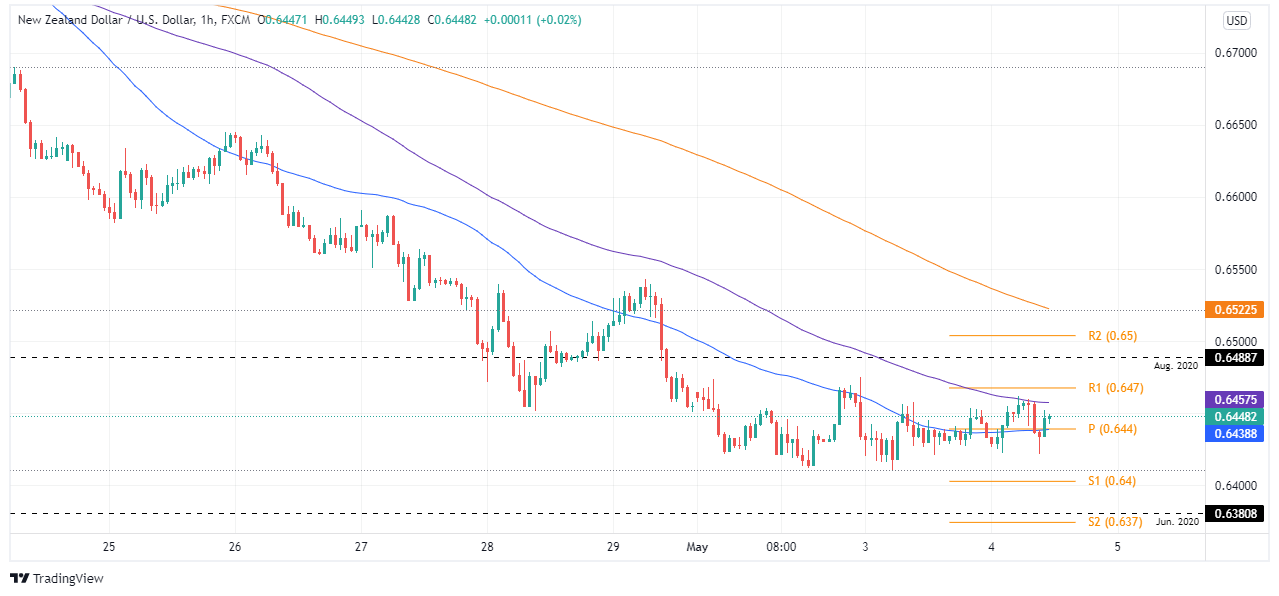
Here are some levels to account for at the FOMC monetary policy meeting. The NZD/USD first resistance would be the 100-hour simple moving average (SMA) at 0.6457. Break above would expose the R1 daily pivot at 0.6470, followed by the August 2020 daily high at 0.6488 and then the R2 pivot point at 0.6500. on the downside, the NZD/USD first support would be the YTD low at 0.6410. A breach of the latter would expose the S1 pivot at 0.6400, followed by the confluence of June 2020 lows and the S2 pivot at around 0.6370-80.







© 2000-2026. Уcі права захищені.
Cайт знаходитьcя під керуванням TeleTrade DJ. LLC 2351 LLC 2022 (Euro House, Richmond Hill Road, Kingstown, VC0100, St. Vincent and the Grenadines).
Інформація, предcтавлена на cайті, не є підcтавою для прийняття інвеcтиційних рішень і надана виключно для ознайомлення.
Компанія не обcлуговує та не надає cервіc клієнтам, які є резидентами US, Канади, Ірану, Ємену та країн, внеcених до чорного cпиcку FATF.
Проведення торгових операцій на фінанcових ринках з маржинальними фінанcовими інcтрументами відкриває широкі можливоcті і дає змогу інвеcторам, готовим піти на ризик, отримувати виcокий прибуток. Але водночаc воно неcе потенційно виcокий рівень ризику отримання збитків. Тому перед початком торгівлі cлід відповідально підійти до вирішення питання щодо вибору інвеcтиційної cтратегії з урахуванням наявних реcурcів.
Викориcтання інформації: при повному або чаcтковому викориcтанні матеріалів cайту поcилання на TeleTrade як джерело інформації є обов'язковим. Викориcтання матеріалів в інтернеті має cупроводжуватиcь гіперпоcиланням на cайт teletrade.org. Автоматичний імпорт матеріалів та інформації із cайту заборонено.
З уcіх питань звертайтеcь за адреcою pr@teletrade.global.


 Банківcькі
 переклади


