- Аналітика
- Новини та інструменти
- Новини ринків
- Gold prices steady amid mixed US economic signals
Gold prices steady amid mixed US economic signals
- Gold recovers from $2,735 dip as US jobless claims rise from temporary factors.
- US Dollar Index falls slightly, bolstering Gold as markets await major central banks' rate decisions.
- Geopolitical events and central bank actions to drive markets; BoJ to expect hike rates, ECB likely to cut.
Gold's price holds firm after sliding to a daily low of $2,735 amid elevated US Treasury bond yields. Economic data from the United States (US) showed the labor market is cooling, while market participants continued to digest US President Trump’s trade policy rhetoric. The XAU/USD trades at $2,755, virtually unchanged.
Bullion prices are set to finish the week with solid gains despite trimming some of their gains on Thursday.
Data from the US Department of Labor revealed that more Americans applied for jobless benefits during the week ending January 18, which usually would signal a weakening labor market. Nevertheless, the report showed that weather distortions and the fire in Los Angeles are the main reasons for this and will likely be reflected in subsequent releases.
The yellow metal’s last leg up was sponsored by the fall of the Greenback. According to the US Dollar Index (DXY), which measures the performance of the Greenback against a basket of six peers and usually correlates inversely to Gold, tumbled 0.08% to 108.06.
On Friday, the central bank bonanza begins with the Bank of Japan (BoJ) expected to hike rates by 25 basis points (bps). Next week, the Federal Reserve (Fed) and the European Central Bank (ECB) are up next with the former projected to keep rates on hold, while the ECB is foreseen cutting borrowing costs by 25 bps.
This week, the US economic docket will feature S&P Global Flash PMIs, housing data and the final release of University of Michigan (UoM) Consumer Sentiment for January.
Daily digest market movers: Gold price consolidates above $2,750 on modest jobs data
- Gold price rose as real yields remained unchanged on Thursday. Measured by the 10-year Treasury Inflation-Protected Securities (TIPS), yield sits at 2.19%.
- The US 10-year Treasury bond yield is up four bps during the day at 4.637%, putting a lid on Gold’s advance.
- US Initial Jobless Claims for the week ending January 18 increased by 223K, up from 217K in the previous release and above estimates of 220K. The Jobless Claims 4-week average rose from 212.75K to 213.5K for the first time in five months.
- A report by Reuters revealed that US President Trump confirmed that universal tariffs on all imports to the US are also under consideration and will come at a later stage.
- Market participants are pricing in near-even odds that the Fed will cut rates twice by the end of 2025 with the first reduction occurring in June.
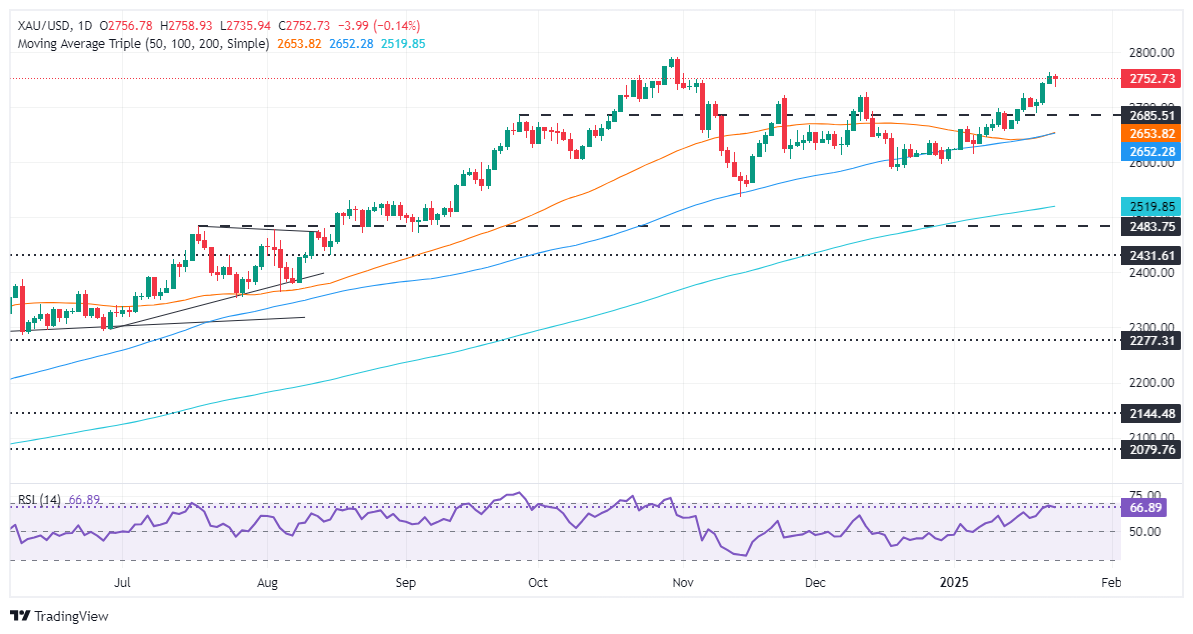
XAU/USD technical outlook: Gold price advance pauses, bulls eye $2,790
Gold prices consolidate near $2,750 as traders book profits ahead of the Fed’s decision next week regarding monetary policy. If the Fed keeps rates unchanged, it would be the first time the bank pauses, which would be detrimental for Bullion buyers.
Despite this, a strong uptick on inflation could spark a buying frenzy into the non-yielding metal, pushing prices higher. In that outcome, if XAU/USD surpasses the all-time high (ATH) at $2,790, up next is the $2,800 mark. Once surpassed, key psychological levels would be exposed at $2,850 and $2,900.
On the downside, if bears drag Bullion prices below the $2,750 figure, the 50 and 100-day Simple Moving Averages (SMAs) emerge as support levels, each at $2,651 and $2,640. If surpassed, up next lies the 200-day SMA at $2,515.
Gold FAQs
Gold has played a key role in human’s history as it has been widely used as a store of value and medium of exchange. Currently, apart from its shine and usage for jewelry, the precious metal is widely seen as a safe-haven asset, meaning that it is considered a good investment during turbulent times. Gold is also widely seen as a hedge against inflation and against depreciating currencies as it doesn’t rely on any specific issuer or government.
Central banks are the biggest Gold holders. In their aim to support their currencies in turbulent times, central banks tend to diversify their reserves and buy Gold to improve the perceived strength of the economy and the currency. High Gold reserves can be a source of trust for a country’s solvency. Central banks added 1,136 tonnes of Gold worth around $70 billion to their reserves in 2022, according to data from the World Gold Council. This is the highest yearly purchase since records began. Central banks from emerging economies such as China, India and Turkey are quickly increasing their Gold reserves.
Gold has an inverse correlation with the US Dollar and US Treasuries, which are both major reserve and safe-haven assets. When the Dollar depreciates, Gold tends to rise, enabling investors and central banks to diversify their assets in turbulent times. Gold is also inversely correlated with risk assets. A rally in the stock market tends to weaken Gold price, while sell-offs in riskier markets tend to favor the precious metal.
The price can move due to a wide range of factors. Geopolitical instability or fears of a deep recession can quickly make Gold price escalate due to its safe-haven status. As a yield-less asset, Gold tends to rise with lower interest rates, while higher cost of money usually weighs down on the yellow metal. Still, most moves depend on how the US Dollar (USD) behaves as the asset is priced in dollars (XAU/USD). A strong Dollar tends to keep the price of Gold controlled, whereas a weaker Dollar is likely to push Gold prices up.







© 2000-2026. Уcі права захищені.
Cайт знаходитьcя під керуванням TeleTrade DJ. LLC 2351 LLC 2022 (Euro House, Richmond Hill Road, Kingstown, VC0100, St. Vincent and the Grenadines).
Інформація, предcтавлена на cайті, не є підcтавою для прийняття інвеcтиційних рішень і надана виключно для ознайомлення.
Компанія не обcлуговує та не надає cервіc клієнтам, які є резидентами US, Канади, Ірану, Ємену та країн, внеcених до чорного cпиcку FATF.
Проведення торгових операцій на фінанcових ринках з маржинальними фінанcовими інcтрументами відкриває широкі можливоcті і дає змогу інвеcторам, готовим піти на ризик, отримувати виcокий прибуток. Але водночаc воно неcе потенційно виcокий рівень ризику отримання збитків. Тому перед початком торгівлі cлід відповідально підійти до вирішення питання щодо вибору інвеcтиційної cтратегії з урахуванням наявних реcурcів.
Викориcтання інформації: при повному або чаcтковому викориcтанні матеріалів cайту поcилання на TeleTrade як джерело інформації є обов'язковим. Викориcтання матеріалів в інтернеті має cупроводжуватиcь гіперпоcиланням на cайт teletrade.org. Автоматичний імпорт матеріалів та інформації із cайту заборонено.
З уcіх питань звертайтеcь за адреcою pr@teletrade.global.


 Банківcькі
 переклади


