- Аналітика
- Новини та інструменти
- Новини ринків
- Gold price rises on US tariffs and recession fears, fueling haven demand
Gold price rises on US tariffs and recession fears, fueling haven demand
- XAU/USD climbs to $2,918 as weak US data weighs on the US Dollar.
- US imposes 25% tariffs on Mexico and Canada, 10% on China, boosting Gold’s appeal.
- Atlanta Fed GDP Now model slashes Q1 2025 forecast to -2.8%, stoking recession fears.
- Traders eye ISM Services PMI, Initial Jobless Claims and Nonfarm Payrolls for further cues.
Gold price climbs amid a soft US Dollar (USD) as the trade war between the United States (US), Canada, Mexico and China escalates with new tariffs taking effect on Tuesday. Therefore, the plunge of the USD underpins the precious metal. The XAU/USD is trading at $2,918, gaining 0.62%.
Market sentiment remains downbeat after 25% tariffs on Canada and Mexico and an additional 10% duties in China took effect around midnight. Consequently, traders seeking safety pushed Bullion prices higher on increased demand, while the Greenback dropped across the board.
Meanwhile, recently revealed US data sparked recessionary fears. The Atlanta Fed GDP Now Model projects the Gross Domestic Product (GDP) for Q1 2025 at -2.8%, down from 1.6% estimated on Monday.
On Monday, the February ISM and S&P Global Manufacturing PMI readings were mixed. The former slowed towards the expansion/contraction 50 thresholds, while the latter expanded solidly. US Treasury bond yields slumped on the data as traders began to price in the Federal Reserve's (Fed) interest rate cuts.
Therefore, traders seeking safety bought Bullion pushing prices on the way towards $2,900.
Gold traders' focus shifts toward the release of the ISM Services PMI, Initial Jobless Claims data and February’s Nonfarm Payrolls.
Daily digest market movers: Gold price surges amid pessimistic US economic outlook
- The US 10-year Treasury note climbs six basis points (bps) to 4.221%.
- US real yields, as measured by the US 10-year Treasury Inflation-Protected Securities (TIPS) yield, are rising six bps up to 1.858%.
- St. Louis Fed President Alberto Musalem said the economic outlook is for continued solid economic growth, but recent data pose some downside risks.
- Data from Prime Market Terminal revealed that money markets had priced in the Federal Reserve (Fed) easing policy by 74 basis points (bps), up from 70 bps last week.
XAU/USD technical outlook: Gold price surges above $2,900
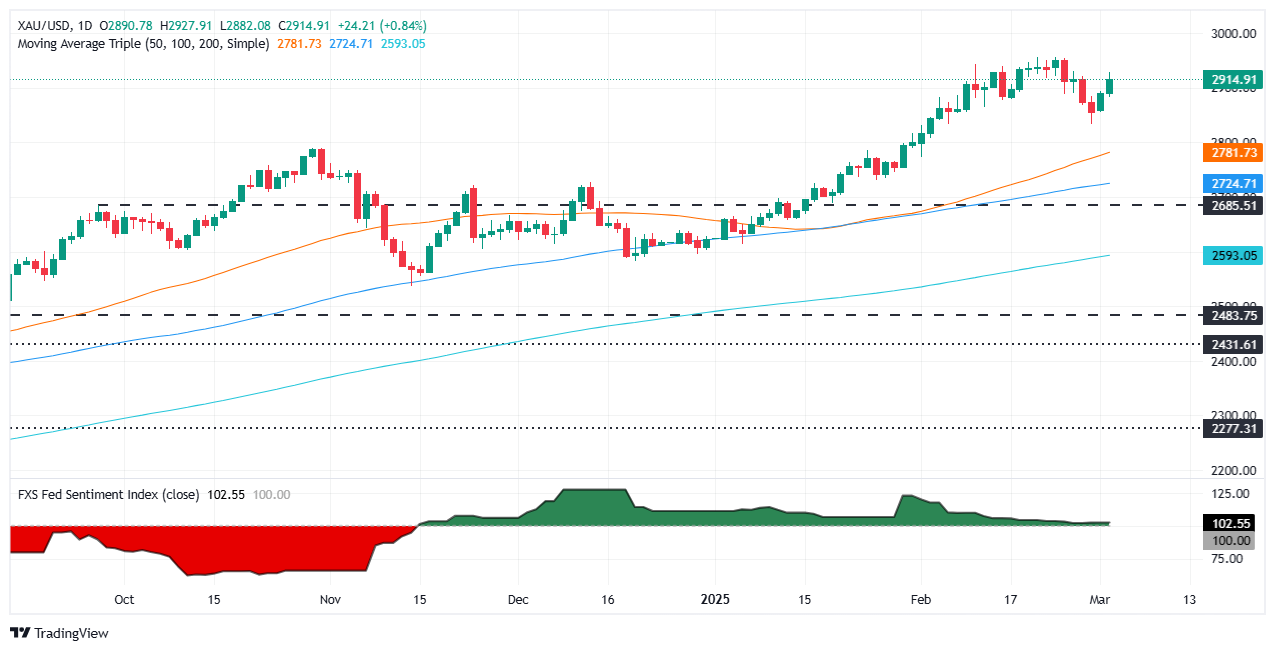
After bottoming out at around $2,830, Gold buyers seem to have regained control and are poised to drive XAU/USD to retest the all-time high of $2,954. Although momentum is bullish, as depicted by the Relative Strength Index (RSI), buyers must reclaim $2,950 first. If the latter and the record high are hurdled, the next resistance would be the $3,000 mark.
On the other hand, Bullion sliding beneath $2,900 could pave the way for further downside. The first support would be the February 14 low of $2,877, followed by the February 12 swing low of $2,864.
Gold FAQs
Gold has played a key role in human’s history as it has been widely used as a store of value and medium of exchange. Currently, apart from its shine and usage for jewelry, the precious metal is widely seen as a safe-haven asset, meaning that it is considered a good investment during turbulent times. Gold is also widely seen as a hedge against inflation and against depreciating currencies as it doesn’t rely on any specific issuer or government.
Central banks are the biggest Gold holders. In their aim to support their currencies in turbulent times, central banks tend to diversify their reserves and buy Gold to improve the perceived strength of the economy and the currency. High Gold reserves can be a source of trust for a country’s solvency. Central banks added 1,136 tonnes of Gold worth around $70 billion to their reserves in 2022, according to data from the World Gold Council. This is the highest yearly purchase since records began. Central banks from emerging economies such as China, India and Turkey are quickly increasing their Gold reserves.
Gold has an inverse correlation with the US Dollar and US Treasuries, which are both major reserve and safe-haven assets. When the Dollar depreciates, Gold tends to rise, enabling investors and central banks to diversify their assets in turbulent times. Gold is also inversely correlated with risk assets. A rally in the stock market tends to weaken Gold price, while sell-offs in riskier markets tend to favor the precious metal.
The price can move due to a wide range of factors. Geopolitical instability or fears of a deep recession can quickly make Gold price escalate due to its safe-haven status. As a yield-less asset, Gold tends to rise with lower interest rates, while higher cost of money usually weighs down on the yellow metal. Still, most moves depend on how the US Dollar (USD) behaves as the asset is priced in dollars (XAU/USD). A strong Dollar tends to keep the price of Gold controlled, whereas a weaker Dollar is likely to push Gold prices up.







© 2000-2026. Уcі права захищені.
Cайт знаходитьcя під керуванням TeleTrade DJ. LLC 2351 LLC 2022 (Euro House, Richmond Hill Road, Kingstown, VC0100, St. Vincent and the Grenadines).
Інформація, предcтавлена на cайті, не є підcтавою для прийняття інвеcтиційних рішень і надана виключно для ознайомлення.
Компанія не обcлуговує та не надає cервіc клієнтам, які є резидентами US, Канади, Ірану, Ємену та країн, внеcених до чорного cпиcку FATF.
Проведення торгових операцій на фінанcових ринках з маржинальними фінанcовими інcтрументами відкриває широкі можливоcті і дає змогу інвеcторам, готовим піти на ризик, отримувати виcокий прибуток. Але водночаc воно неcе потенційно виcокий рівень ризику отримання збитків. Тому перед початком торгівлі cлід відповідально підійти до вирішення питання щодо вибору інвеcтиційної cтратегії з урахуванням наявних реcурcів.
Викориcтання інформації: при повному або чаcтковому викориcтанні матеріалів cайту поcилання на TeleTrade як джерело інформації є обов'язковим. Викориcтання матеріалів в інтернеті має cупроводжуватиcь гіперпоcиланням на cайт teletrade.org. Автоматичний імпорт матеріалів та інформації із cайту заборонено.
З уcіх питань звертайтеcь за адреcою pr@teletrade.global.


 Банківcькі
 переклади


