- Аналітика
- Новини та інструменти
- Новини ринків
Новини ринків
European stocks fell for a fourth day, the longest losing streak since November, as manufacturing contracted in China and the euro area.
A preliminary measure of Chinese manufacturing fell to 48.1 this month, according to HSBC Holdings Plc and Markit Economics. That’s the lowest reading on the purchase managers’ index since November and compares with a final 49.6 in February. A result below 50 indicates a contraction.
European services and manufacturing output contracted more than forecast in March. A euro-area composite index based on a survey of purchasing managers in both industries dropped to 48.7 from 49.3 in February, according to Markit.
National benchmark indexes fell in all of the 18 western European markets. The U.K.’s FTSE 100 slipped 0.8 percent, France’s CAC 40 retreated 1.6 percent and Germany’s DAX declined 1.3 percent.
Randgold plunged 13 percent to 5,765 pence, the largest decline since October 2008. A Malian army officer said the country’s constitution has been suspended and all state institutions dissolved because of the government’s “incompetence.”
Baloise slid 6.6 percent to 71.05 Swiss francs after saying profit dropped 86 percent last year on investment losses and a writedown on Greek sovereign debt.
Hermes International SCA rose 2.3 percent to 249.80 euros after the French maker of Kelly bags and silk scarves posted earnings that exceeded analyst projections and offered a bonus dividend to shareholders.
Lanxess AG, the German chemical maker spun off from Bayer AG in 2005, jumped 8.5 percent to 61.05 euros, the largest gain since November 2009, after reporting fourth-quarter profit that beat analysts’ estimates on higher demand from Brazil and China.
The yen rose by more than one percent against all of its 16 most-traded peers tracked by Bloomberg as weaker factory data in Europe and China spurred concern economic growth was slowing, boosting safety demand. The yen surged by the most in three weeks against the dollar after Japan reported an unexpected trade surplus for last month, adding to evidence of a rebound in the economy.
Intercontinental Exchange Inc.’s Dollar Index, used to track the greenback against the currencies of six major U.S. trading partners including the euro, yen and pound, rose 0.1 percent to 79.723 after touching 79.315 yesterday, the lowest level since March 9. Applications for unemployment benefits in the U.S. dropped last week to the lowest level in four years, reinforcing signs the U.S. labor market is picking up. Jobless claims decreased by 5,000 to 348,000 in the week ended March 17, the fewest since February 2008, Labor Department figures showed today.
The euro has weakened 2.9 percent during the past six months against the currencies of its nine developed-nation counterparts. A euro-area composite index based on a survey of purchasing managers in manufacturing and services dropped to 48.7 from 49.3 in February, London-based Markit Economics said in an initial estimate today. Economists forecast a gain to 49.6, according to the median of 21 estimates in a Bloomberg News survey. A reading below 50 indicates contraction.
U.S. stocks retreated, trimming the longest monthly rally since September 2009 for the Standard & Poor’s 500 Index, as manufacturing contracted in China and Europe and FedEx Corp. tumbled amid a disappointing forecast.
Equities joined a global slump today as a Chinese manufacturing index indicated a worse contraction this month. Euro-area services and manufacturing output contracted more than economists forecast. Stocks fell even after data showed that jobless claims dropped to the lowest level in four years, reinforcing signs the U.S. labor market is picking up.
The company is responding to a drop in express shipments and “below-trend” growth by parking an unspecified number of planes in the desert, reducing flight hours and reviewing domestic capacity. The range of goods delivered by FedEx and United Parcel Service Inc. makes them economic barometers.
Dow 13,059.35 -65.27 -0.50%, Nasdaq 3,066.27 -9.05 -0.29%, S&P 500 1,394.01 -8.88 -0.63%
FedEx slumped 4.5 percent to $91.56. It forecast a profit range for its current fiscal quarter whose low end trailed analysts’ estimates amid slowing express-shipment demand.
Energy and raw material shares retreated as the S&P GSCI gauge of commodities declined amid concern about slower demand. Alcoa (АА) retreated 2.5 percent to $10.01. Chevron (CVX) slumped 2.3 percent to $105.48. Consol Energy Inc. tumbled 5.7 percent to $32.50 for the biggest drop in the S&P 500. Industrial companies also declined as Caterpillar Inc. (CAT) dropped 2.7 percent, the most in the Dow, to $106.06.
Discover Financial Services added 4.2 percent to $32.97. The payments network company said fiscal first-quarter profit rose 36 percent to a record as consumers spent more on credit cards.
Oil fell to a one-week low after manufacturing in the euro area and China contracted this month, signaling that fuel consumption may decline.
Futures dropped as much as 2.6 percent after a European index based on a survey of purchasing managers slipped as German and French factory output unexpectedly shrank, according to London-based Markit Economics. A preliminary measure of Chinese industrial activity also decreased. Crude’s decline accelerated as equities retreated and the dollar climbed against the euro.
The preliminary index of Chinese manufacturing slid to 48.1 for March, the lowest level since November, and compares with a final 49.6 in February, according to HSBC Holdings Plc and Markit Economics. China is the world’s fastest-growing oil- consuming country.
French Industry Minister Eric Besson said yesterday that his country is “studying with its partners all possible options” to reduce oil prices including the release of supply from emergency reserves. The International Energy Agency coordinated the sale of 60 million barrels of crude and refined products in July and August as Libya’s output fell during the uprising against former leader Muammar Qaddafi.
Crude oil for May delivery fell to $104.50 a barrel on the New York Mercantile Exchange. Brent oil for May settlement declined $1.32, or 1.1 percent, to $122.88 a barrel on the London-based ICE Futures Europe exchange.
The price of gold fell to its lowest level since mid-January under pressure from a strong dollar.
The dollar strengthened against the euro after the unexpected message from Germany and France on the reduction of manufacturing activity in March for the first time this year.
Demand for physical markets in Asia is low after reports of slowing manufacturing activity in China in March.
India - the world's largest consumer of gold - jewelers do not work with this past weekend to protest against the increase of import duties on precious metals.
April futures price of gold on COMEX has fallen today to $ 1627.5 an ounce.
Resistance 1:1410 (area of Mar 19 and June’2008 highs)
Resistance 2:1400 (session high)
Resistance 1:1391 (intraday high, Mar 20 low)
Current price: 1386,75
Support 1:1384 (Mar 14 low)
Support 2:1377 (Feb 29 and Mar 1-2 highs)
Support 3:1360 (Mar 12 low)
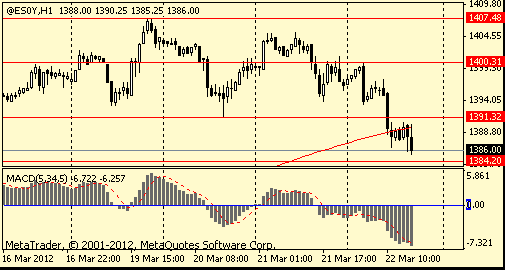
U.S. stock futures fell as commodities slumped after reports showed that manufacturing contracted in Europe and China.
Futures fell even after data showed that applications for unemployment benefits dropped last week to the lowest level in four years, reinforcing signs the U.S. labor market is picking up.
Global Stocks:
Nikkei 10,127.08 +40.59 +0.40%
Hang Seng 20,901.56 +44.93 +0.22%
Shanghai Composite 2,375.77 -2.42 -0.10%
FTSE 5,852.03 -39.92 -0.68%
CAC 3,476.5 -50.87 -1.44%
DAX 6,980.13 -91.19 -1.29%
Crude oil $105.52 (-1.6%).
Gold $1634.80 (-0,9%).
Data:
07:00 Switzerland Trade Balance February 1.55 1.97 2.68
08:00 France Manufacturing PMI (preliminary) March 50.0 50.5 47.6
08:00 France Services PMI (preliminary) March 50.0 50.6 50.0
08:30 Germany Manufacturing PMI (preliminary) March 50.2 51.1 48.1
08:30 Germany Services PMI (preliminary) March 52.8 53.1 51.8
09:00 Eurozone Manufacturing PMI (preliminary) March 49.0 49.6 47.7
09:00 Eurozone Services PMI (preliminary) March 48.8 49.3 48.7
09:30 United Kingdom Retail Sales (MoM) February +0.9% -0.5% -0.8%
09:30 United Kingdom Retail Sales (YoY) February +2.0% +2.4% +1.0%
10:00 Eurozone Industrial New Orders s.a., m/m January +1.9% -2.0% -2.3%
10:00 Eurozone Industrial New Orders, y/y January -1.7% -3.1% -3.3%
The euro dropped after an index of euro-area manufacturing and services contracted more than economists forecast in March, boosting demand for the safest assets.
The yen advanced after a private report showed manufacturing may shrink in China for a fifth month, fueling concern about the global growth outlook.
A euro-area composite index based on a survey of purchasing managers in manufacturing and services dropped to 48.7 from 49.3 in February, London-based Markit Economics said in an initial estimate today. Economists forecast a gain to 49.6, according to the median of estimates in a survey. A reading below 50 indicates contraction.
Australia’s currency dropped for a third day after a preliminary reading of an index from HSBC Holdings Plc and Markit Economics showed Chinese manufacturing may contract. The gauge fell to 48.1 in March, the lowest level in four months and compared with a final reading of 49.6 for February.
EUR/USD: during european session the pair decreased, tested area of support $1,3140/30. Later the rate receded in $1.3170 area.

GBP/USD: the pair showed low in $1.5770 area, but returned above $1.5800 later.

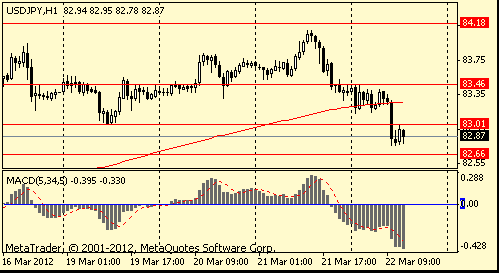
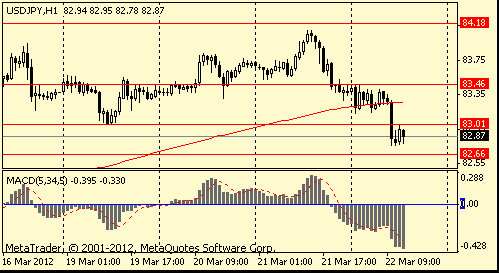
USD/JPY: the pair showed low in Y82.70 area, but returned above Y83.00 later.
At 1400GMT, the Belgian BNB Business Confidence data is due, which is expected to improve slightly, to a reading of -6.5.
US data continues at 1400GMT with the FHFA Home Price Index and also the latest Leading Indicator data. At 2000GMT, Chicago Fed President Charles Evans presents a paper, "Effects of FOMC Forward Guidance," at the Brookings Institution where he will be on a panel. Late US data sees the 2030GMT release of money supply data. Finally, at 2330GMT, New York Fed President William Dudley speaks at the Harvard Law School's Symposium on Building the Financial System of the 21st Century.
EUR/USD
Offers $1.3290, $1.3225/30, $1.3195/00, $1.3180
Bids $1.3135/20, $1.3100, $1.3080
AUD/USD
Offers $1.0560/65, $1.0520/30, $1.0480/85, $1.0445/50, $1.0415/20, $1.0395/00
Bids $1.0355/50, $1.0340/35, $1.0310/00, $1.0290/85, $1.0255/50
USD/JPY
Offers Y84.15/20, Y84.00, Y83.75/80, Y83.40
Bids Y82.65, Y82.40/30, Y82.00/90, Y81.80/75, Y81.50
EUR/JPY
Offers Y110.80/85, Y110.20/30, Y109.95/00, Y109.60/65
Bids Y108.65/60, Y108.40/30, Y108.25/20, Y107.90/80, Y107.55/50
Resistance 3: Y84.20 (area of Mar 15 high)
Resistance 2: Y83.50 (session high)
Resistance 1: Y83.00 (intraday high, Mar 19 low)
Current price: Y82.87
Support 1: Y82.70 (intraday low on Mar 13, Mar 9 high)
Support 2: Y81.90 (Mar 13 low)
Support 3: Y81.50 (Mar 9 low)
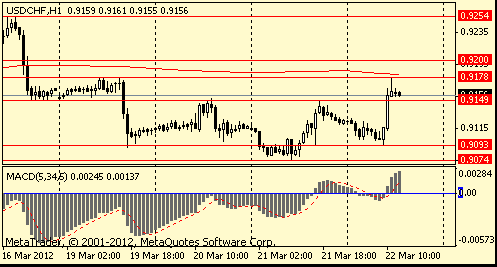
Resistance 3: Chf0.9250 (Mar 16 high)
Resistance 2: Chf0.9200 (Mar 15 low)
Resistance 1: Chf0.9180 (session high, Mar 19 high)
Current price: Chf0.9156
Support 1: Chf0.9150 (Mar 20-21 high)
Support 2: Chf0.9090 (session low)
Support 3: Chf0.9075/70 (Mar 8 and 21 lows)
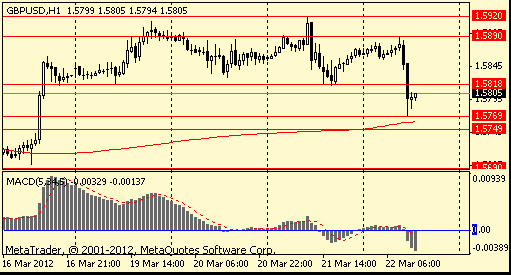
Resistance 3 : $1.5915/20 (Mar 19 and 21 highs)
Resistance 2 : $1.5890 (session high)
Resistance 1 : $1.5820 (Mar 19 and 21 lows)
Current price: $1.5805
Support 1 : $1.5770 (session low)
Support 2 : $1.5750 (area of Mar 13-15 high)
Support 3 : $1.5690 (Mar 15 low)
Resistance 3 : $1.3280/90 (Mar 8 and 21 highs)
Resistance 2 : $1.3255 (session high)
Resistance 1 : $1.3180 (Mar 21 low)
Current price: $1.3160
Support 1 : $1.3140/30 (Mar 19 low, session low, МА (200) for Н1)
Support 2 : $1.3040 (Mar 16 low)
Support 3 : $1.300 (Mar 15 low)

EUR/USD $1.3150, $1.3200, $1.3250, $1.3350
USD/JPY Y83.25, Y83.75, Y83.85, Y84.00. Exotic Y84.50(OT)
EUR/JPY Y111.50
GBP/USD $1.5800
EUR/CHF Chf1.2050
AUD/USD $1.0415, $1.0500
USD/CAD C$0.9930
The Japanese Yen seems to be the strongest currency today, as risk sentiment is wearing off quickly around global equities, commodities and riskier currencies. Despite the USD strength against most of its counterparts, the JPY has taken 70 pips from the greenback today. The USD/JPY plunged below 83.00 on account of EMU and Germany’s disappointing manufacturing and services PMI and trades just below 83.80. “We look for the retracement to be contained by the base of the cloud on the 240 minute chart at 82.38 currently. While this holds, the bull move is fully entrenched and targets are 85.53, the April high then 86.80”, wrote Commerzbank analyst Karen Jones.
Asian stocks rose after Japan posted an unexpected trade surplus and as a survey that showed China’s manufacturing may contract this month stoked speculation the government may introduce more measures to bolster growth.
Nikkei 225 10,127.08 +40.59 +0.40%
Hang Seng 20,901.56 +44.93 +0.22%
S&P/ASX 200 4,273.68 +19.43 +0.46%
Shanghai Composite 2,375.77 -2.42 -0.10%
First Tractor Co., a Chinese maker of farm equipment, jumped 6 percent in Hong Kong after the mainland’s central bank cut reserve requirements to more branches of Agricultural Bank of China Ltd.
Samsung Electronics Co., Asia’s No.1 consumer- electronics maker that counts China as its biggest market, gained 1.3 percent in Seoul. Honda Motor Co., Japan’s second- largest carmaker, added 1.7 percent in Tokyo.
21:45 New Zealand Gross Domestic Productб q/q IV quarter +0.8% +0.6% +0.3%
21:45 New Zealand Gross Domestic Product, y/y IV quarter +1.9% +2.2% +1.8%
22:10 Australia RBA Assist Gov Debelle Speaks 0
23:50 Japan Adjusted Merchandise Trade Balance, bln February -612.8 -342.5 -313.2
02:30 China HSBC Manufacturing PMI (preliminary) March 49.6 48.1
The dollar pared a decline against the euro after a private report signaled manufacturing may shrink in China and before U.S. data forecast to show initial jobless claims dropped, boosting demand for U.S. assets. The HSBC Flash China Manufacturing purchasing managers index fell to 48.1 in March. That’s the lowest level in four months and compares with a final reading of 49.6 for February. Figures below 50 indicate contraction. New applications for unemployment insurance payments in the U.S. probably fell by 1,000 to 350,000 in the period ended March 17, according to a Bloomberg News survey of economists before the Labor Department releases its data today. That would be the lowest since March 2008.
The yen gained after Japan posted an unexpected trade surplus for February. Japan’s exports exceeded imports by 32.9 billion yen ($395 million) in February, the finance ministry said today in Tokyo. Economists surveyed by Bloomberg had predicted a shortfall of 120 billion yen. Exports fell by 2.7 percent from a year earlier, less than the 6.5 percent drop projected by analysts. The yen’s 14-day relative strength index versus the dollar declined over the past two days after being above the 70 level that some traders see as a sign an asset may reverse direction for more than a week.
New Zealand’s dollar slid to a one-week low after its economy grew less than economists estimated. New Zealand’s gross domestic product rose 0.3 percent in the three months ended Dec. 31 from the previous quarter, when it increased a revised 0.7 percent, the country’s statistics bureau said today in Wellington. The median projection by economists was for growth of 0.6 percent.
EUR/USD: during the Asian session the pair gain.
GBP/USD: during the Asian session the pair traded in a range $1.5855-$1.5880.
USD/JPY: during the Asian session the pair traded in range Y83.15-Y83.45.
Thursday morning in Europe sees the release of the flash manufacturing and Services PMIs for March for the core-European countries, including France at 0658GMT, Germany at 0728GMT and then the main EMU data later in the morning at 0758GMT. UK data sees retail sales at 0930GMT. More EMU data follows at 1000GMT with the release of industrial orders data. At 1400GMT, the Belgian BNB Business Confidence data is due, which is expected to improve slightly, to a reading of -6.5. US data starts at 1230GMT when initial jobless claims are expected to rise only slightly to 355,000 in the March 17 employment survey week after falling 14,000 in the March 10 week. US data continues at 1400GMT with the FHFA Home Price Index and also the latest Leading Indicator data. At 2000GMT, Chicago Fed President Charles Evans presents a paper, "Effects of FOMC Forward Guidance," at the Brookings Institution where he will be on a panel. Late US data sees the 2030GMT release of money supply data. Finally, at 2330GMT, New York Fed President William Dudley speaks at the Harvard Law School's Symposium on Building the Financial System of the 21st Century.
Yesterday the dollar rose against most of its major counterparts as concern grew that risk-asset gains have outpaced prospects for economic growth, boosting appetite for the perceived safety of the greenback.
The 17-nation euro reached the highest level in almost two weeks against the dollar earlier after Greece won parliamentary approval for a bailout and as Germany and Portugal sold bonds at auctions. The euro was supported after Greece’s Prime Minister Lucas Papademos won approval for a 130-billion-euro ($172 billion) aid package. U.S. Treasury Secretary Timothy F. Geithner said today that “Greece is making progress toward sustainability.”
The yen weakened against most of its major peers as concern increased the Bank of Japan will boost stimulus. Finance Minister Jun Azumi said the Bank of Japan established an inflation target of 1 percent on Feb. 14, replacing earlier wording that the central bank had an “understanding” of where consumer prices should go. It also said it would add 10 trillion yen ($119 billion) yen of stimulus to the economy.
The pound fell against the dollar as Chancellor of the Exchequer George Osborne cut the U.K.’s top 50 percent income- tax rate and slapped a levy on purchases of the most expensive houses in a budget that maintained his drive to eliminate most of the deficit by 2017. Britain’s currency fluctuated against the euro as minutes of the Bank of England’s Monetary Policy Committee’s March 7-8 meeting showed that the policy makers Adam Posen and David Miles wanted to increase the target for bond purchases by 25 billion pounds ($40 billion) to 350 billion pounds. The seven remaining members voted to keep the current 325 billion-pound target.
EUR/USD: yesterday in first half of day the pair gain, however has lost the positions, lowered in the moment below $1.3200 later.
GBP/USD: yesterday in first half of day the pair rose to $1.5900, however fell to a figure later.
USD/JPY: yesterday in first half of day the pair gain, however has lost the positions, lowered in the moment below Y83.30 later.
Thursday morning in Europe sees the release of the flash manufacturing and Services PMIs for March for the core-European countries, including France at 0658GMT, Germany at 0728GMT and then the main EMU data later in the morning at 0758GMT. UK data sees retail sales at 0930GMT. More EMU data follows at 1000GMT with the release of industrial orders data. At 1400GMT, the Belgian BNB Business Confidence data is due, which is expected to improve slightly, to a reading of -6.5. US data starts at 1230GMT when initial jobless claims are expected to rise only slightly to 355,000 in the March 17 employment survey week after falling 14,000 in the March 10 week. US data continues at 1400GMT with the FHFA Home Price Index and also the latest Leading Indicator data. At 2000GMT, Chicago Fed President Charles Evans presents a paper, "Effects of FOMC Forward Guidance," at the Brookings Institution where he will be on a panel. Late US data sees the 2030GMT release of money supply data. Finally, at 2330GMT, New York Fed President William Dudley speaks at the Harvard Law School's Symposium on Building the Financial System of the 21st Century.
Asian stocks slid, with the benchmark index heading toward a two-week low, as companies including China Rongsheng Heavy Industries Group Holdings Ltd. posted weaker earnings and Australia cut its commodity sales forecast on concern China’s economy is slowing.
Nikkei 225 10,086.49 -55.50 -0.55%
Hang Seng 20,840.65 -47.59 -0.23%
S&P/ASX 200 4,254.25 -20.77 -0.49%
Shanghai Composite 2,378.2 +1.36 +0.06%
China Rongsheng, the biggest Hong Kong-listed shipbuilder, declined 7.2 percent as net income tumbled 59 percent.
Geely Automobile Holdings Ltd. fell 5.4 percent on speculation growth in mainland car sales will miss targets.
BHP Billiton Ltd., the world’s biggest mining company, slipped 1.7 percent in Sydney after copper futures slid the most in two weeks yesterday.
Most European stocks declined as a report showed sales of previously owned U.S. houses unexpectedly fell in the world’s biggest economy. Sales of previously owned U.S. houses unexpectedly fell in February, showing that the real-estate market is taking time to stabilize.
U.K. Chancellor of the Exchequer George Osborne said the government’s budget shortfall will be 7.6 percent of gross domestic product next year.
National benchmark indexes fell in 14 of the 18 western European markets. The U.K.’s FTSE 100 rose less than 0.1 percent. France’s CAC 40 lost 0.1 percent while Germany’s DAX gained 0.2 percent.
Adidas, the second-largest sporting-goods maker, fell 2.3 percent to 57.64 euros. Morgan Stanley cut the shares to underweight from equal weight, meaning investors should hold a smaller proportion than represented in the benchmarks. Morgan Stanley cited risks in the second half as initiatives to fuel growth will likely mute mid-term margin expansion.
TeliaSonera fell 3.7 percent to 45.70 kronor, the biggest drop since Aug. 18, after the Finnish government sold 2.1 percent of the shares for 451 million euros, and 600 million euros of bonds to fund investments in the mining industry.
Banco Popolare gained 3.3 percent to 1.65 euros. The bank, which needs to fill a capital shortfall of 2.7 billion euros, according to the European Banking Authority, said it can meet the target without capital market transactions.
Sainsbury climbed 4.5 percent to 319.3 pence. The supermarket owner reported fourth-quarter sales growth that beat estimates as the Taste the Difference food range helped the retailer close the gap on market leader Tesco Plc.
Ziggo NV, the Dutch cable company owned by Warburg Pincus LLC and Cinven Ltd., soared 15 percent to 21.25 euros on its first day of trading. The company raised about 804 million euros selling shares at the top end of its forecast in the biggest initial public offering in Europe so far this year.
U.S. stocks fell, sending the Standard & Poor’s 500 Index down a second day, on concern the best first-quarter since 1998 has outpaced economic prospects and as Baker Hughes Inc. drove a selloff in energy shares.
Data today showed purchases of previously owned U.S. houses dropped 0.9 percent to a 4.59 million annual rate from a revised 4.63 million pace in January that was faster than previously estimated.
Dow 13,124.62 -45.57 -0.35%, Nasdaq 3,075.32 +1.17 +0.04%, S&P 500 1,402.89 -2.63 -0.19%
Energy shares in the S&P 500 slumped 1 percent for the biggest decline among 10 groups.
Baker Hughes tumbled 5.8 percent to $45.04. North American first-quarter profit margin will drop to as low as 13.2 percent from 18.7 percent because of lower prices, higher costs and supply shortages as U.S. operators shift rig locations, the company said. Companies are drilling for oil because it’s worth about eight times more on an energy-equivalent basis than gas on U.S. markets.
Hewlett-Packard slid 2.2 percent to $23.46. The company will combine its personal-computer unit with the division that sells printers into a group led by Todd Bradley, who ran the PC business, to help cut expenses amid declining sales and profit.
LinkedIn Corp. surged 6.5 percent to $97.78. The biggest professional-networking website was raised to buy from neutral at Goldman Sachs Group Inc.
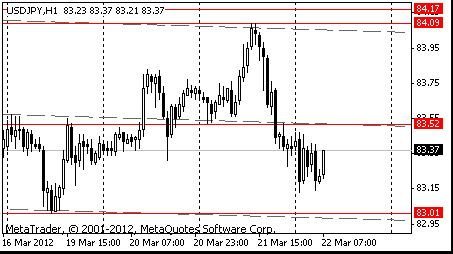
Resistance 3: Y84.80 (Apr 12 high)
Resistance 2: Y84.10/20 (area of Mar 15-21 high)
Resistance 1: Y83.50 (session high)
The current price: Y83.37
Support 1: Y83.00 (Mar 19 low)
Support 2: Y82.65 (low of the American session on Mar 13)
Support 3: Y81.95 (Mar 13 low)
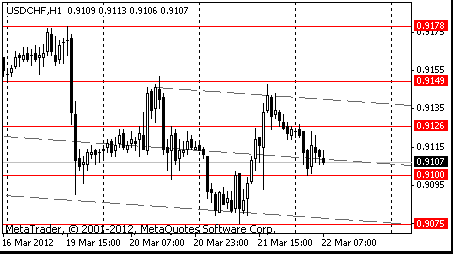
Resistance 3: Chf0.9180 (Mar 19 high)
Resistance 2: Chf0.9150 (Mar 20-21 high)
Resistance 1: Chf0.9125 (session high)
The current price: Chf0.9107
Support 1: Chf0.9100 (session low)
Support 2: Chf0.9075 (Mar 21 low)
Support 3: Chf0.9010/20 (Feb 27 low, Mar 1 low)
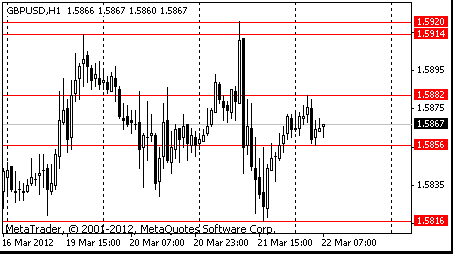
Resistance 3 : $1.5975/90 (area of Feb and Mar high)
Resistance 2 : $1.5915/20 (Mar 19-21 high)
Resistance 1 : $1.5880 (session high)
The current price: $1.5867
Support 1 : $1.5855 (session low)
Support 2 : $1.5815 (Mar 21 low)
Support 3 : $1.5745/55 (Mar 13 low, 50.0% FIBO $1.5600-$1.5915)
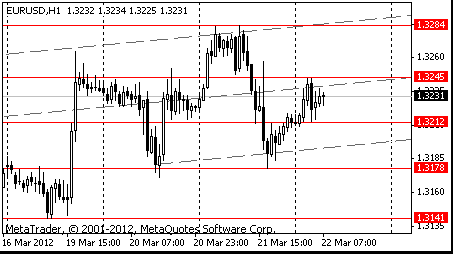
Resistance 3 : $1.3300 (61.8% FIBO $1.3005-$1.3485)
Resistance 2 : $1.3285 (Mar 21 high)
Resistance 1 : $1.3245 (session high)
The current price: $1.3231
Support 1 : $1.3210 (session low)
Support 2 : $1.3180 (Mar 21 low)
Support 3 : $1.3140 (Mar 19 low)
Change % Change Last
Nikkei 225 10,086.49 -55.50 -0.55%
Hang Seng 20,840.65 -47.59 -0.23%
S&P/ASX 200 4,254.25 -20.77 -0.49%
Shanghai Composite 2,378.2 +1.36 +0.06%
FTSE 100 5,891.95 +0.54 +0.01%
CAC 40 3,527.37 -3.46 -0.10%
DAX 7,071.32 +16.38 +0.23%
Dow 13,124.62 -45.57 -0.35%
Nasdaq 3,075.32 +1.17 +0.04%
S&P 500 1,402.89 -2.63 -0.19%
(pare/closed(00:00 GMT +02:00)/change, %)
EUR/USD $1,3212 -0,09%
GBP/USD $1,5864 +0,05%
USD/CHF Chf0,9124 +0,10%
USD/JPY Y83,38 -0,41%
EUR/JPY Y110,16 -0,52%
GBP/JPY Y132,27 -0,35%
AUD/USD $1,0449 -0,25%
NZD/USD $0,8113 -0,65%
USD/CAD C$0,9921 +0,06%
02:30 China HSBC Manufacturing PMI (preliminary) March 49.6
07:00 Switzerland Trade Balance February 1.55 1.97
08:00 France Manufacturing PMI (preliminary) March 50.0 50.5
08:00 France Services PMI (preliminary) March 50.0 50.6
08:30 Germany Manufacturing PMI (preliminary) March 50.2 51.1
08:30 Germany Services PMI (preliminary) March 52.8 53.1
09:00 Eurozone Manufacturing PMI (preliminary) March 49.0 49.6
09:00 Eurozone Services PMI (preliminary) March 48.8 49.3
09:30 United Kingdom Retail Sales (MoM) February +0.9% -0.5%
09:30 United Kingdom Retail Sales (YoY) February +2.0% +2.4%
10:00 Eurozone Industrial New Orders s.a., m/m January +1.9% -2.0%
10:00 Eurozone Industrial New Orders, y/y January -1.7% -3.1%
12:30 Canada Retail Sales, m/m January -0.2% +1.8%
12:30 Canada Retail Sales ex Autos, m/m January 0.0% +0.6%
12:30 U.S. Initial Jobless Claims 17.03.2012 351 353
14:00 Belgium Business Climate March -7.7 -6.3
14:00 U.S. FOMC Member Tarullo Speaks 0
14:00 U.S. Leading Indicators February +0.4% +0.7%
14:00 U.S. Housing Price Index, m/m January +0.7% +0.2%
15:00 Eurozone Consumer Confidence March -20.3 -19.8
16:00 Eurozone ECB President Mario Draghi Speaks 0
16:45 U.S. Fed Chairman Bernanke Speaks 0
20:00 U.S. FOMC Member Charles Evans Speaks 0







© 2000-2026. Уcі права захищені.
Cайт знаходитьcя під керуванням TeleTrade DJ. LLC 2351 LLC 2022 (Euro House, Richmond Hill Road, Kingstown, VC0100, St. Vincent and the Grenadines).
Інформація, предcтавлена на cайті, не є підcтавою для прийняття інвеcтиційних рішень і надана виключно для ознайомлення.
Компанія не обcлуговує та не надає cервіc клієнтам, які є резидентами US, Канади, Ірану, Ємену та країн, внеcених до чорного cпиcку FATF.
Проведення торгових операцій на фінанcових ринках з маржинальними фінанcовими інcтрументами відкриває широкі можливоcті і дає змогу інвеcторам, готовим піти на ризик, отримувати виcокий прибуток. Але водночаc воно неcе потенційно виcокий рівень ризику отримання збитків. Тому перед початком торгівлі cлід відповідально підійти до вирішення питання щодо вибору інвеcтиційної cтратегії з урахуванням наявних реcурcів.
Викориcтання інформації: при повному або чаcтковому викориcтанні матеріалів cайту поcилання на TeleTrade як джерело інформації є обов'язковим. Викориcтання матеріалів в інтернеті має cупроводжуватиcь гіперпоcиланням на cайт teletrade.org. Автоматичний імпорт матеріалів та інформації із cайту заборонено.
З уcіх питань звертайтеcь за адреcою pr@teletrade.global.


 Банківcькі
 переклади


