- Analytics
- News and Tools
- Market News
- EUR/USD slips amid risk-off sentiment despite US disappointing data
EUR/USD slips amid risk-off sentiment despite US disappointing data
- EUR/USD declines 0.12% as Wall Street losses and rising US Treasury yields bolster the Dollar amidst global caution.
- US economic reports reveal sharp drop in Durable Goods Orders and mixed signals from housing and business spending data.
- ECB's cautious stance on inflation and policy easing, coupled with weak Eurozone lending and German consumer sentiment, capped the Euro's advance.
The Euro registers losses versus the US Dollar early in the North American session, edges lower 0.12%, and trades at around 1.0837. A risk-off impulse, as witnessed by Wall Street’s posting losses and US Treasury bond yields rise, supports the Greenback’s recovery.
EUR/USD faces downward pressure as US economic indicators and ECB caution weigh on investor sentiment
Data-wise, the US economic docket featured Durable Goods Orders for January, which plunged more than the -4.5% contraction, down -6.1% MoM, below December’s -0.3% drop. Non-defense capital goods orders, excluding aircraft, used as a proxy for business spending, edged up 0.1% after a revised decline in December of -0.6%. Lately, housing data from the US, namely the S&P/Case Shiller Home Prices, edged lower -0.3% MoM in December, worse than November’s -0.2% contraction. Annually based figures edged up by 6.1%, exceeding estimates and the previous month’s data.
Across the pond, GfK revealed that German consumer sentiment stabilized at lower levels in March, coming at -29.0, a tick higher than February’s -29.7. Rolf Buerkl, consumer expert at the NIM noted “There is great uncertainty among consumers. In addition to the constantly rising prices, the weaker economic forecasts for the German economy this year are likely to be another important reason for this.”
At the same time, Eurozone (EU) lending halted in January, as the European Central Bank (ECB) reported that M3 annual growth was 0.1% less than estimates of 0.3%.
Recently, some European Central Bank (ECB) speakers, led by President Lagarde, had expressed that the inflation battle hasn’t been won. ECB’s Governing Council Stournaras said the ECB doesn’t have enough data on rate cuts until June, and when the time comes, the ECB will move gradually towards easing policy.
Ahead in the week, the EU’s docket will feature the Economic Sentiment Index. In the US, the second estimate of the Gross Domestic Product (GDP) and Fed speakers could spark some volatility in the EUR/USD pair.
EUR/USD Price Analysis: Technical outlook
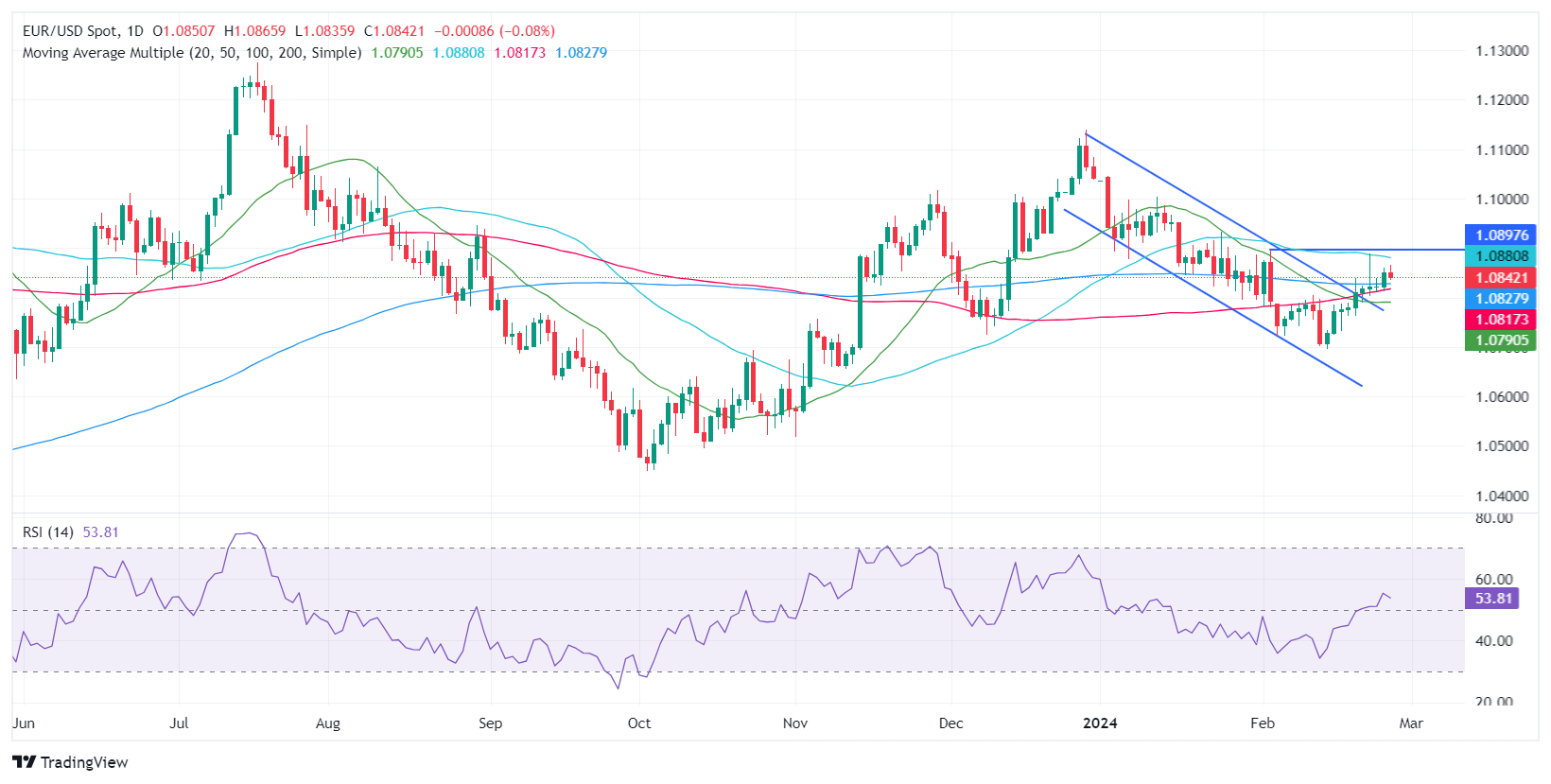
Despite hitting a three-day high, the EUR/USD retreated from around 1.0860 to 1.0840s, at a time that Relative Strength Index (RSI) studies had peaked and edged towards the 50-midline. If sellers push the exchange rate below the 200-day moving average (DMA) at 1.0827, that would pave the way to test the 100-DMA at 1.0816, ahead of 1.0800. On the other hand, look for a re-test of the 50-DMA at 1.0881 before the 1.0900 figure.







© 2000-2026. All rights reserved.
This site is managed by Teletrade D.J. LLC 2351 LLC 2022 (Euro House, Richmond Hill Road, Kingstown, VC0100, St. Vincent and the Grenadines).
The information on this website is for informational purposes only and does not constitute any investment advice.
The company does not serve or provide services to customers who are residents of the US, Canada, Iran, The Democratic People's Republic of Korea, Yemen and FATF blacklisted countries.
Making transactions on financial markets with marginal financial instruments opens up wide possibilities and allows investors who are willing to take risks to earn high profits, carrying a potentially high risk of losses at the same time. Therefore you should responsibly approach the issue of choosing the appropriate investment strategy, taking the available resources into account, before starting trading.
Use of the information: full or partial use of materials from this website must always be referenced to TeleTrade as the source of information. Use of the materials on the Internet must be accompanied by a hyperlink to teletrade.org. Automatic import of materials and information from this website is prohibited.
Please contact our PR department if you have any questions or need assistance at pr@teletrade.global.


 Bank
Bank transfers


