- Analytics
- News and Tools
- Market News
- GBP/USD gains ground ahead of UK labor figures
GBP/USD gains ground ahead of UK labor figures
- GBP/USD climbed one and a third percent on Monday.
- Markets are selling off the Greenback after President Donald Trump caved on day-one tariffs.
- Pound Sterling traders await UK labor and employment figures early Tuesday.
GBP/USD rose 1.35% on Monday, gaining ground and climbing back over the 1.2300 handle as markets breathe a collective sigh of relief after freshly-minted US President Donald Trump made a last-minute pivot away from a broad, sweeping policy of day-one trade tariffs. Back for a second term, Donald Trump is still actively pursuing a policy of reviewing trade circumstances with most of the US’ strongest allies in trade terms, however the returning president has already begun waffling on his campaign promises to use executive orders to apply tariffs of at least 20% across the board, with a 65% import tariff threatened against China specifically.
UK Claimant Count change figures are expected to climb 10.3K in December, a sharp uptick from the previous month’s 0.3K print. However the UK’s ILO Unemployment Rate for the three months ended in November is still expected to hold steady at 4.3%.
Data releases on the US side remain tepid until Friday’s S&P Global Purchasing Managers Index (PMI). Median market forecasts are expecting a mixed bag result, with the Services component expected to decline but survey results from the Manufacturing component expected to tick upwards slightly.
GBP/USD price forecast
With the Pound Sterling catching a bid on Monday, GBP/USD rose over 1.3% and cleared the 1.2300 handle, though near-term bullish momentum rests purely on the shoulders of broad-market Greenback weakness. GBP/USD is still trading well below the 200-day and 50-day Exponential Moving Averages (EMA) near 1.2730 and 1.2540, respectively.
Cable knocked into a fresh 15-month low at the 1.2100 handle last week, capping off a four-month backslide. The pair has closed either flat or in the red for all but two of the last 15 consecutive trading weeks.
GBP/USD daily chart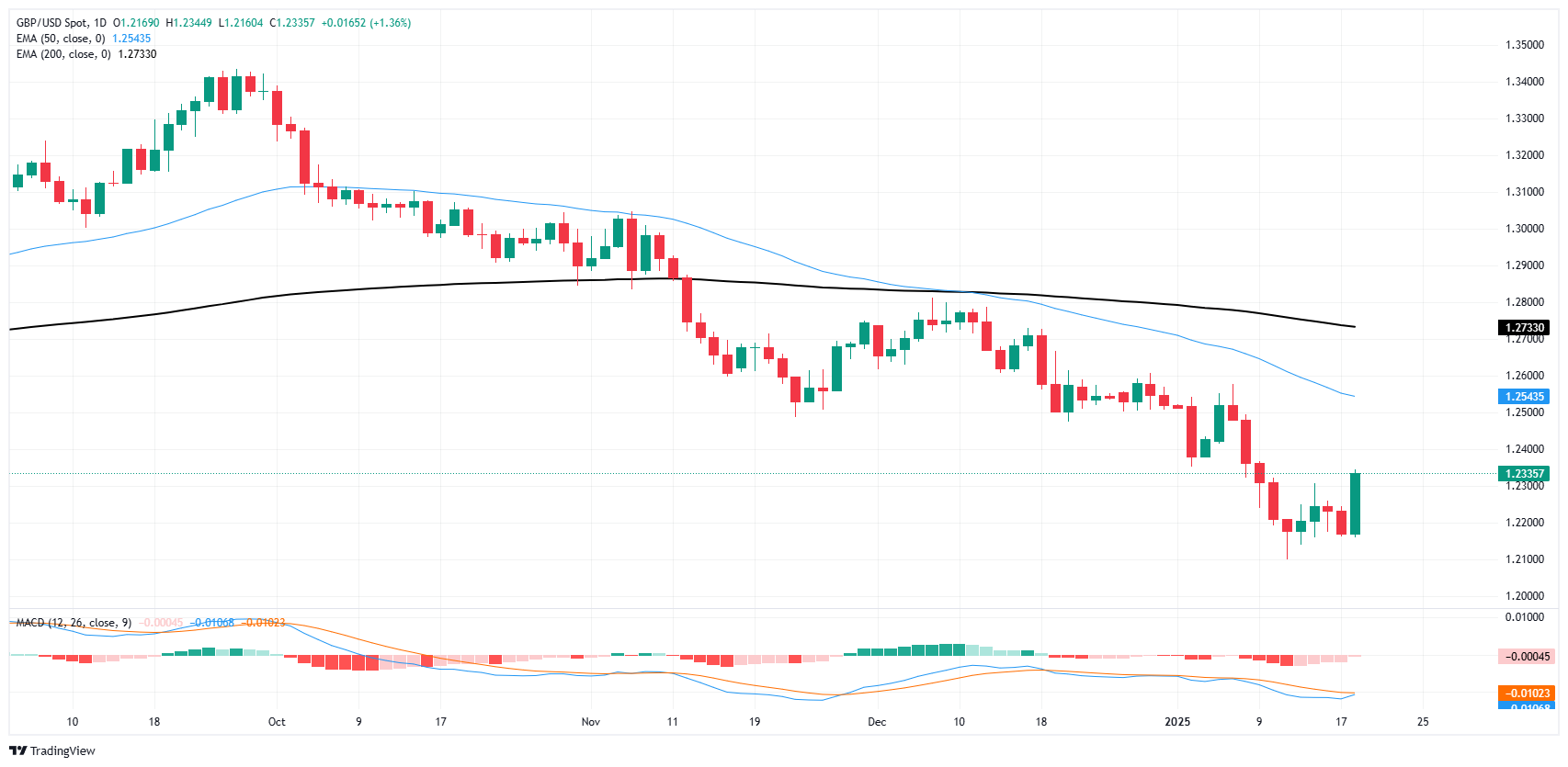
Pound Sterling FAQs
The Pound Sterling (GBP) is the oldest currency in the world (886 AD) and the official currency of the United Kingdom. It is the fourth most traded unit for foreign exchange (FX) in the world, accounting for 12% of all transactions, averaging $630 billion a day, according to 2022 data. Its key trading pairs are GBP/USD, also known as ‘Cable’, which accounts for 11% of FX, GBP/JPY, or the ‘Dragon’ as it is known by traders (3%), and EUR/GBP (2%). The Pound Sterling is issued by the Bank of England (BoE).
The single most important factor influencing the value of the Pound Sterling is monetary policy decided by the Bank of England. The BoE bases its decisions on whether it has achieved its primary goal of “price stability” – a steady inflation rate of around 2%. Its primary tool for achieving this is the adjustment of interest rates. When inflation is too high, the BoE will try to rein it in by raising interest rates, making it more expensive for people and businesses to access credit. This is generally positive for GBP, as higher interest rates make the UK a more attractive place for global investors to park their money. When inflation falls too low it is a sign economic growth is slowing. In this scenario, the BoE will consider lowering interest rates to cheapen credit so businesses will borrow more to invest in growth-generating projects.
Data releases gauge the health of the economy and can impact the value of the Pound Sterling. Indicators such as GDP, Manufacturing and Services PMIs, and employment can all influence the direction of the GBP. A strong economy is good for Sterling. Not only does it attract more foreign investment but it may encourage the BoE to put up interest rates, which will directly strengthen GBP. Otherwise, if economic data is weak, the Pound Sterling is likely to fall.
Another significant data release for the Pound Sterling is the Trade Balance. This indicator measures the difference between what a country earns from its exports and what it spends on imports over a given period. If a country produces highly sought-after exports, its currency will benefit purely from the extra demand created from foreign buyers seeking to purchase these goods. Therefore, a positive net Trade Balance strengthens a currency and vice versa for a negative balance.







© 2000-2026. All rights reserved.
This site is managed by Teletrade D.J. LLC 2351 LLC 2022 (Euro House, Richmond Hill Road, Kingstown, VC0100, St. Vincent and the Grenadines).
The information on this website is for informational purposes only and does not constitute any investment advice.
The company does not serve or provide services to customers who are residents of the US, Canada, Iran, The Democratic People's Republic of Korea, Yemen and FATF blacklisted countries.
Making transactions on financial markets with marginal financial instruments opens up wide possibilities and allows investors who are willing to take risks to earn high profits, carrying a potentially high risk of losses at the same time. Therefore you should responsibly approach the issue of choosing the appropriate investment strategy, taking the available resources into account, before starting trading.
Use of the information: full or partial use of materials from this website must always be referenced to TeleTrade as the source of information. Use of the materials on the Internet must be accompanied by a hyperlink to teletrade.org. Automatic import of materials and information from this website is prohibited.
Please contact our PR department if you have any questions or need assistance at pr@teletrade.global.


 Bank
Bank transfers


