- Analytics
- News and Tools
- Market News
- Mexican Peso stages recovery amid easing Trump’s tariffs concerns
Mexican Peso stages recovery amid easing Trump’s tariffs concerns
- Mexican Peso stabilizes after a volatile session due to Trump’s review of US trade policy.
- Mexican Foreign Affairs Minister and US Secretary of State discuss security and immigration in first diplomatic contact.
- Market anticipates upcoming Mexican economic reports on mid-month Inflation and Economic Activity.
The Mexican Peso (MXN) recovered on Wednesday after depreciating by 0.65% against the Greenback on Tuesday. Fears over Unites States (US) President Donald Trump's threats of imposing tariffs on Mexico faded and sponsored a leg-down in the USD/MXN pair, which trades at 20.50, down 0.24%.
Trump’s first days in office have kept the Peso volatile as traders assess his trade policy threats. In the meantime, President Trump ordered a comprehensive review of US trade policy, setting an April 1 deadline for recommendations that could significantly transform the country’s trade relations, including the US-Mexico-Canada Agreement (USMCA), which is set for its first revision in 2026.
Meanwhile, Mexican Foreign Affairs Minister Juan Ramon de la Fuente spoke with US Secretary of State Marco Rubio about security and immigration issues in the first official contact between the two diplomats.
Data-wise the Mexican and US economic dockets remained scarce. However, Citi revealed its Expectations Survey, which witnessed Mexican private economists downward review Gross Domestic Product (GDP) figures for 2025. Regarding inflation expectations, analysts estimate both headlines and core to dip below 4%, and the exchange rate to hoover near 21.00.
On Thursday, Mexico’s docket will feature January’s mid-month inflation figures and the November Economic Activity Indicator.
Daily digest market movers: Mexican Peso rises ahead of inflation data
- The Mexican Peso shrugs off harsh Trump’s tariffs rhetoric and appreciates against the Greenback.
- Citi Mexico Expectations Survey suggests that economists expect 2025 GDP to be 1%, while headline inflation will dip to 3.91% by the year’s end. Underlying inflation is foreseen to dip to 3.68%, while the USD/MXN is expected to finish the year at 20.95.
- Economists estimate that Banco de Mexico (Banxico) will lower rates by 25 basis points (bps) from 10.00% to 9.75%, though some analysts expect a 50 bps cut at the February 6 meeting.
- Reuters revealed, “In an interview following the central bank's December rate decision, Banxico Deputy Governor Jonathan Heath said the monetary authority may consider a rate cut of up to 50 basis points in its next session, scheduled for Feb. 6.”
- The divergence between Banxico and the US Federal Reserve (Fed) favors further upside in the USD/MXN pair.
- Mid-month inflation in January is foreseen to drop from 4.44% to 3.93%. Underlying inflation is expected to rise modestly from 3.62% to 3.69%.
- Money market futures have priced in 41.5 bps of Fed rate cuts in 2025, according to CME FedWatch Tool data.
USD/MXN technical outlook: Mexican Peso climbs as USD/MXN tumbles below 20.60
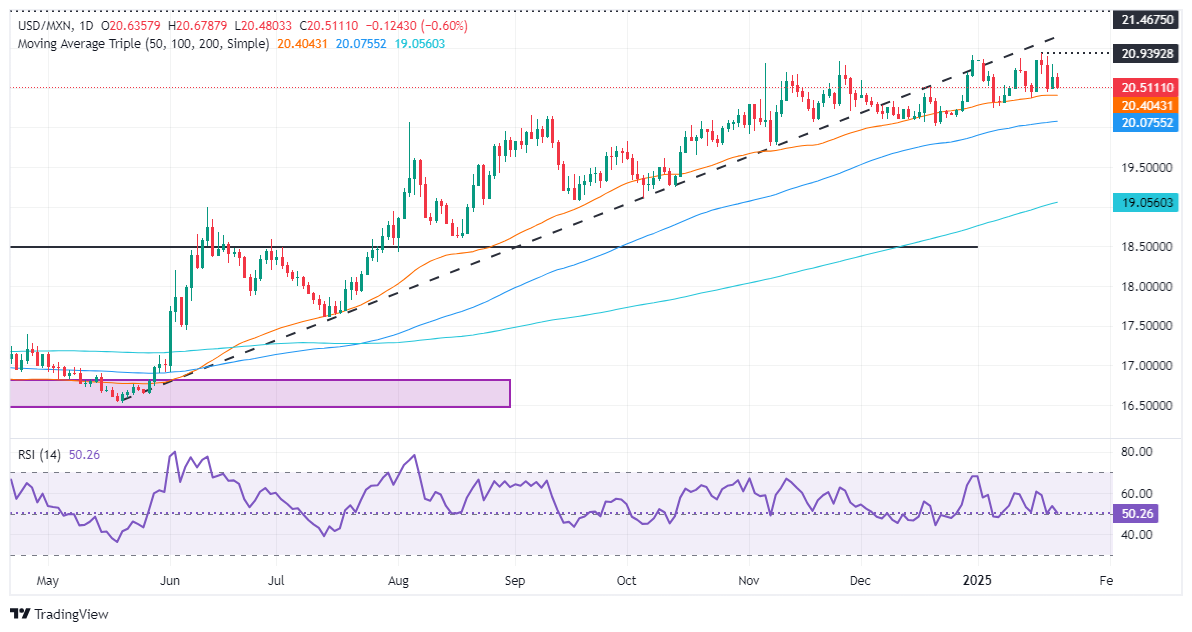
The USD/MXN remains upward biased despite falling below the 20-day Simple Moving Average (SMA) at 20.55. The pair travels around the 20.45 – 20.55 range amid the lack of a clear bias, but the Relative Strength Index (RSI) hints that in the near term sellers are in charge.
If bears push the USD/MXN below 20.45, look for a test of the 50-day SMA at 20.37. On further weakness, the exotic pair might challenge the 100-day SMA at 20.05, ahead of 20.00. On the other hand, if bulls clear the 20.55 ceiling level, this could pave the way to test the year-to-date (YTD) high at the 20.90 mark. If surpassed, the 21.00 mark would be exposed, followed by March 8, 2022 peak at 21.46 ahead of the 22.00 figure.
Mexican Peso FAQs
The Mexican Peso (MXN) is the most traded currency among its Latin American peers. Its value is broadly determined by the performance of the Mexican economy, the country’s central bank’s policy, the amount of foreign investment in the country and even the levels of remittances sent by Mexicans who live abroad, particularly in the United States. Geopolitical trends can also move MXN: for example, the process of nearshoring – or the decision by some firms to relocate manufacturing capacity and supply chains closer to their home countries – is also seen as a catalyst for the Mexican currency as the country is considered a key manufacturing hub in the American continent. Another catalyst for MXN is Oil prices as Mexico is a key exporter of the commodity.
The main objective of Mexico’s central bank, also known as Banxico, is to maintain inflation at low and stable levels (at or close to its target of 3%, the midpoint in a tolerance band of between 2% and 4%). To this end, the bank sets an appropriate level of interest rates. When inflation is too high, Banxico will attempt to tame it by raising interest rates, making it more expensive for households and businesses to borrow money, thus cooling demand and the overall economy. Higher interest rates are generally positive for the Mexican Peso (MXN) as they lead to higher yields, making the country a more attractive place for investors. On the contrary, lower interest rates tend to weaken MXN.
Macroeconomic data releases are key to assess the state of the economy and can have an impact on the Mexican Peso (MXN) valuation. A strong Mexican economy, based on high economic growth, low unemployment and high confidence is good for MXN. Not only does it attract more foreign investment but it may encourage the Bank of Mexico (Banxico) to increase interest rates, particularly if this strength comes together with elevated inflation. However, if economic data is weak, MXN is likely to depreciate.
As an emerging-market currency, the Mexican Peso (MXN) tends to strive during risk-on periods, or when investors perceive that broader market risks are low and thus are eager to engage with investments that carry a higher risk. Conversely, MXN tends to weaken at times of market turbulence or economic uncertainty as investors tend to sell higher-risk assets and flee to the more-stable safe havens.







© 2000-2026. All rights reserved.
This site is managed by Teletrade D.J. LLC 2351 LLC 2022 (Euro House, Richmond Hill Road, Kingstown, VC0100, St. Vincent and the Grenadines).
The information on this website is for informational purposes only and does not constitute any investment advice.
The company does not serve or provide services to customers who are residents of the US, Canada, Iran, The Democratic People's Republic of Korea, Yemen and FATF blacklisted countries.
Making transactions on financial markets with marginal financial instruments opens up wide possibilities and allows investors who are willing to take risks to earn high profits, carrying a potentially high risk of losses at the same time. Therefore you should responsibly approach the issue of choosing the appropriate investment strategy, taking the available resources into account, before starting trading.
Use of the information: full or partial use of materials from this website must always be referenced to TeleTrade as the source of information. Use of the materials on the Internet must be accompanied by a hyperlink to teletrade.org. Automatic import of materials and information from this website is prohibited.
Please contact our PR department if you have any questions or need assistance at pr@teletrade.global.


 Bank
Bank transfers


