- Analytics
- News and Tools
- Market News
- Canadian Dollar weakens on fresh tariff threats by Trump
Canadian Dollar weakens on fresh tariff threats by Trump
- Loonie weakens amid Trump tariff fears, BoC rate-cut uncertainty
- USD/CAD stays firm above 1.4200 as risk aversion lifts US Dollar.
- Canada’s rising inflation may delay BoC easing, adding uncertainty.
- Traders await FOMC minutes for Fed’s stance on rate-cut timing.
The Canadian Dollar (CAD) retreats against the US Dollar on Wednesday, with the USD/CAD pair remaining afloat above the 1.4200 handle amid renewed fears about US President Donald Trump's tariff threats. The lack of Canadian data left traders adrift to the economic docket in the United States (US), particularly housing data for January.
The Canadian economic docket was empty, yet the latest round of inflation data witnessed an uptick, indicating that the Bank of Canada (BoC) might re-think twice before easing policy. In the US, Housing Starts in January disappointed investors, though Building Permits showed that construction continued to edge higher, although at an anemic pace.
Today’s US economic docket will also feature the release of the Federal Reserve’s (Fed) latest monetary policy meeting minutes. On January 27-28, the Fed decided to hold rates firm, pausing its easing cycle as inflation gathered steam. It should be said that Fed Jerome Powell turned slightly hawkish, saying that they’re not in a rush to cut interest rates.
Since then, most Fed officials have turned slightly cautious, adopting a wait-and-see mode regarding inflation.
Daily digest market movers: Canadian Dollar struggles to rally amid mixed US data
- US Housing Starts fell sharply by 9.6% in January, dropping from 1.515 million to 1.366 million, as adverse weather conditions impacted construction activity.
- In contrast, US Building Permits edged slightly higher, rising 0.1% from 1.482 million to 1.483 million during the same period, signaling resilience in future construction plans.
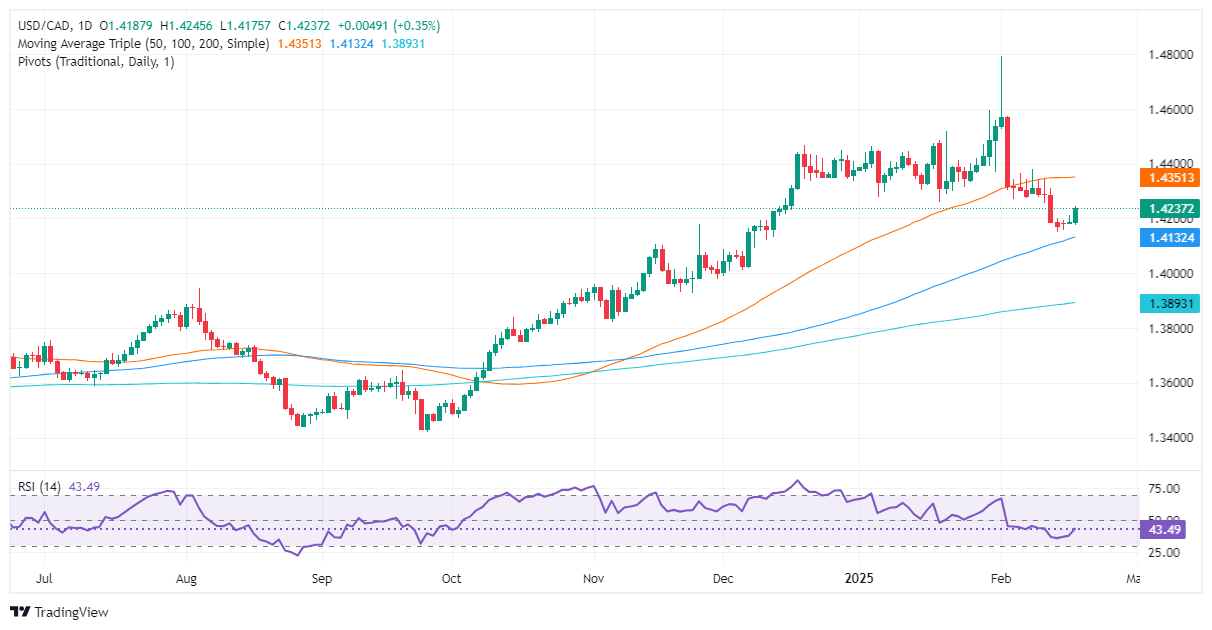
- Interest rate differentials between Canada and the United States continued to weigh on the Loonie, which remained pressured for the third straight day. The USD/CAD hit a weekly high of 1.4244.
- However, a reversal looms as the BoC might keep rates in check following the release of January’s CPI data. In that outcome, the USD/CAD could aim lower as the Canadian Dollar appreciates versus the Greenback.
USD/CAD price forecast: Canadian Dollar set to appreciate further, despite posting losses
The USD/CAD uptrend lost steam after the pair peaked near 1.4800. Since then, sellers have taken over, pushing prices below the 50-day Simple Moving Average (SMA) at 1.4338 and clearing the January 20 daily low of 1.4260, a crucial level for buyers. Further downside lies ahead if bears push spot prices below the 100-day SMA at 1.4111.
Otherwise, if buyers lift USD/CAD past 1.4300, they must reclaim the 50-day SMA to remain hopeful of higher prices.
Canadian Dollar FAQs
The key factors driving the Canadian Dollar (CAD) are the level of interest rates set by the Bank of Canada (BoC), the price of Oil, Canada’s largest export, the health of its economy, inflation and the Trade Balance, which is the difference between the value of Canada’s exports versus its imports. Other factors include market sentiment – whether investors are taking on more risky assets (risk-on) or seeking safe-havens (risk-off) – with risk-on being CAD-positive. As its largest trading partner, the health of the US economy is also a key factor influencing the Canadian Dollar.
The Bank of Canada (BoC) has a significant influence on the Canadian Dollar by setting the level of interest rates that banks can lend to one another. This influences the level of interest rates for everyone. The main goal of the BoC is to maintain inflation at 1-3% by adjusting interest rates up or down. Relatively higher interest rates tend to be positive for the CAD. The Bank of Canada can also use quantitative easing and tightening to influence credit conditions, with the former CAD-negative and the latter CAD-positive.
The price of Oil is a key factor impacting the value of the Canadian Dollar. Petroleum is Canada’s biggest export, so Oil price tends to have an immediate impact on the CAD value. Generally, if Oil price rises CAD also goes up, as aggregate demand for the currency increases. The opposite is the case if the price of Oil falls. Higher Oil prices also tend to result in a greater likelihood of a positive Trade Balance, which is also supportive of the CAD.
While inflation had always traditionally been thought of as a negative factor for a currency since it lowers the value of money, the opposite has actually been the case in modern times with the relaxation of cross-border capital controls. Higher inflation tends to lead central banks to put up interest rates which attracts more capital inflows from global investors seeking a lucrative place to keep their money. This increases demand for the local currency, which in Canada’s case is the Canadian Dollar.
Macroeconomic data releases gauge the health of the economy and can have an impact on the Canadian Dollar. Indicators such as GDP, Manufacturing and Services PMIs, employment, and consumer sentiment surveys can all influence the direction of the CAD. A strong economy is good for the Canadian Dollar. Not only does it attract more foreign investment but it may encourage the Bank of Canada to put up interest rates, leading to a stronger currency. If economic data is weak, however, the CAD is likely to fall.







© 2000-2026. All rights reserved.
This site is managed by Teletrade D.J. LLC 2351 LLC 2022 (Euro House, Richmond Hill Road, Kingstown, VC0100, St. Vincent and the Grenadines).
The information on this website is for informational purposes only and does not constitute any investment advice.
The company does not serve or provide services to customers who are residents of the US, Canada, Iran, The Democratic People's Republic of Korea, Yemen and FATF blacklisted countries.
Making transactions on financial markets with marginal financial instruments opens up wide possibilities and allows investors who are willing to take risks to earn high profits, carrying a potentially high risk of losses at the same time. Therefore you should responsibly approach the issue of choosing the appropriate investment strategy, taking the available resources into account, before starting trading.
Use of the information: full or partial use of materials from this website must always be referenced to TeleTrade as the source of information. Use of the materials on the Internet must be accompanied by a hyperlink to teletrade.org. Automatic import of materials and information from this website is prohibited.
Please contact our PR department if you have any questions or need assistance at pr@teletrade.global.


 Bank
Bank transfers


