- Analytics
- News and Tools
- Market News
- US Dollar in whipsaw move as traders assess German election results
US Dollar in whipsaw move as traders assess German election results
- The US Dollar is red across the board against most major currencies on Monday.
- The far-right AfD party cannot book enough seats to claim the lead in Germany.
- The US Dollar Index (DXY) recovers initial losses and looks ready to shoot higher.
The US Dollar Index (DXY), which tracks the performance of the US Dollar (USD) against six major currencies, recovers the nearly 0.50% loss it incurred in the opening hours in the Asian markets and trades flat near 106.60 at the time of writing on Monday. The initial move down in the US Dollar came in due to euphoria for the Euro (EUR) after the first German election results showed a firm lead for the Christian Democratic Union of Germany (CDU), which will take the lead in forming a coalition. As the dust settles, this means that fundamentally, no big changes will take place in Germany regarding leadership and political agenda, which triggers the Euro to pare back gains and the DXY to turn flat to positive.
The US economic calendar starts off the week slowly, with all eyes on the US Gross Domestic Product (GDP) release for the fourth quarter of 2024 on Thursday and Personal Consumption Expenditures (PCE) for January on Friday. However, the Chicago Fed National Activity Index for January is due this Monday. Later in the day, United States (US) President Donald Trump is also due to deliver a speech.
Daily digest market movers: That was quick
- Halfway through the European trading session, the Euro (EUR) has given up nearly all its gains against the US Dollar (USD) as traders are not impressed with the possible lack of major reforms or changes in the German political landscape for the new government formation.
- At 13:30 GMT, the Chicago Fed National Activity Index for January is due. No forecast is available, with the previous reading at 0.15.
- The US Treasury will auction a 3-month, 6-month Bills, and a 2-year Note auction this Monday.
- US President Donald Trump is set to hold a press conference with President of France Macron near 19:00 GMT.
- Equities are breathing a sigh of relief after the German election outcome, though the German Dax is starting to fade its intraday gains halfway through the European trading session.
- The CME FedWatch tool shows a 41.2% chance that interest rates will remain unchanged at current levels in June against a bigger 46.2% for a 25 basis points (bps) rate cut.
- The US 10-year yield trades around 4.43%, down over 3% from last week’s high at 4.574%.
US Dollar Index Technical Analysis: False note
The US Dollar Index (DXY) portrays a textbook element here, with the German election outcome as a catalyst. During the Asian session, a sigh of relief and support for the Euro was outpacing the Greenback in the idea that a crisis was averted with the Far-Right not having enough seats to secure the lead in Germany. However, now that the dust settles, markets start to realise that the current coalition probability is dull and the same politics markets saw in the past few decades is due, which is seen as not enough to trigger substantial additional upside in Euro.
On the upside, the 100-day Simple Moving Average (SMA) could limit bulls buying the Greenback near 106.61. From there, the next leg could go up to 107.35, a pivotal support from December 2024 and January 2025. In case US President Trump has some surprise comments on Monday, even 107.96 (55-day SMA) could be tested.
On the downside, the 106.52 (April 16, 2024, high) level has seen a false break for now. However, that does mean quite a few stops might have been triggered in the markets, with a few bulls having been washed out of their long US Dollar positions. Another leg lower might be needed to entice those Dollar bulls to reenter at lower levels, near 105.89 or even 105.33.
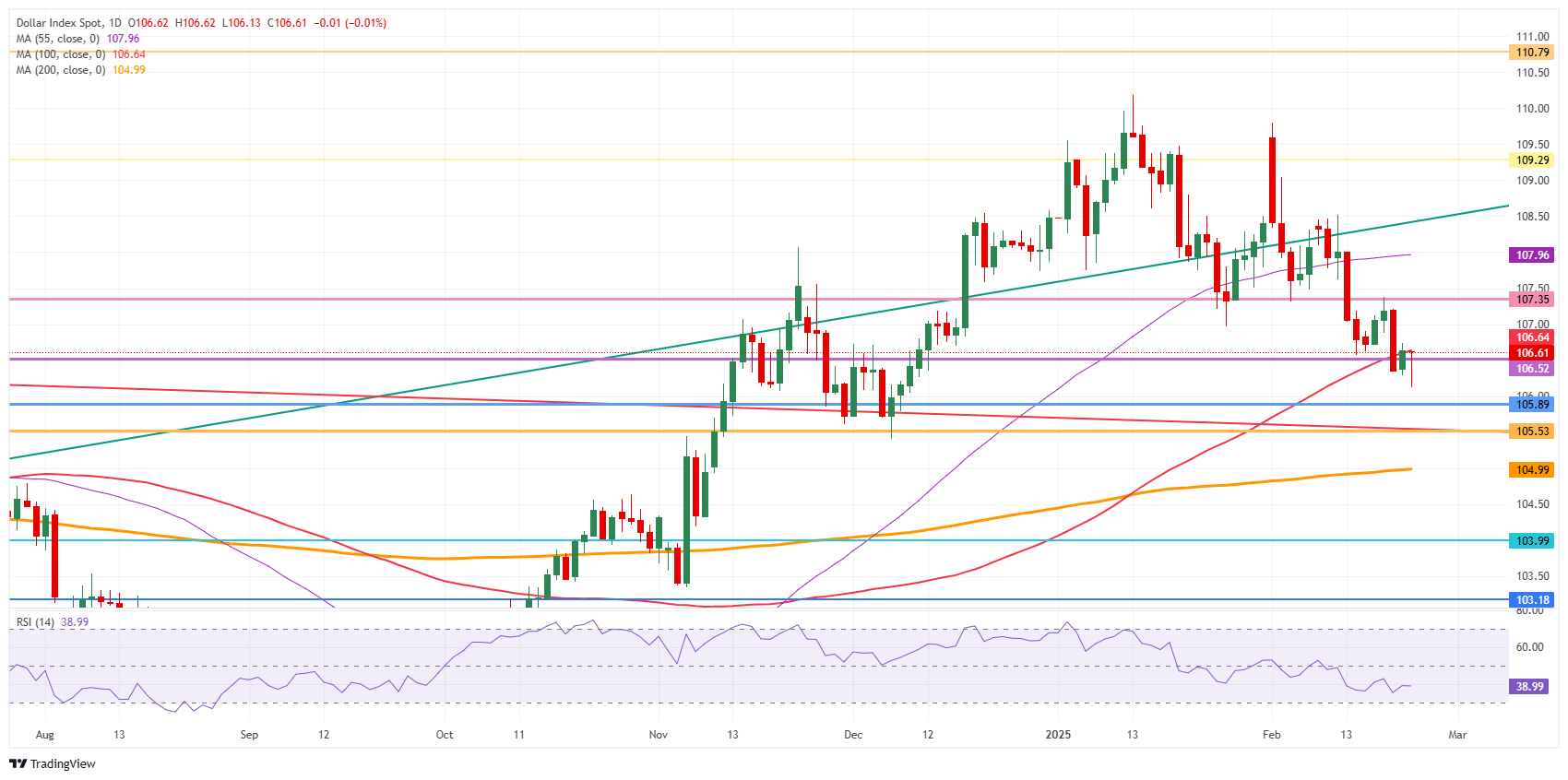
US Dollar Index: Daily Chart
US Dollar FAQs
The US Dollar (USD) is the official currency of the United States of America, and the ‘de facto’ currency of a significant number of other countries where it is found in circulation alongside local notes. It is the most heavily traded currency in the world, accounting for over 88% of all global foreign exchange turnover, or an average of $6.6 trillion in transactions per day, according to data from 2022. Following the second world war, the USD took over from the British Pound as the world’s reserve currency. For most of its history, the US Dollar was backed by Gold, until the Bretton Woods Agreement in 1971 when the Gold Standard went away.
The most important single factor impacting on the value of the US Dollar is monetary policy, which is shaped by the Federal Reserve (Fed). The Fed has two mandates: to achieve price stability (control inflation) and foster full employment. Its primary tool to achieve these two goals is by adjusting interest rates. When prices are rising too quickly and inflation is above the Fed’s 2% target, the Fed will raise rates, which helps the USD value. When inflation falls below 2% or the Unemployment Rate is too high, the Fed may lower interest rates, which weighs on the Greenback.
In extreme situations, the Federal Reserve can also print more Dollars and enact quantitative easing (QE). QE is the process by which the Fed substantially increases the flow of credit in a stuck financial system. It is a non-standard policy measure used when credit has dried up because banks will not lend to each other (out of the fear of counterparty default). It is a last resort when simply lowering interest rates is unlikely to achieve the necessary result. It was the Fed’s weapon of choice to combat the credit crunch that occurred during the Great Financial Crisis in 2008. It involves the Fed printing more Dollars and using them to buy US government bonds predominantly from financial institutions. QE usually leads to a weaker US Dollar.
Quantitative tightening (QT) is the reverse process whereby the Federal Reserve stops buying bonds from financial institutions and does not reinvest the principal from the bonds it holds maturing in new purchases. It is usually positive for the US Dollar.







© 2000-2026. All rights reserved.
This site is managed by Teletrade D.J. LLC 2351 LLC 2022 (Euro House, Richmond Hill Road, Kingstown, VC0100, St. Vincent and the Grenadines).
The information on this website is for informational purposes only and does not constitute any investment advice.
The company does not serve or provide services to customers who are residents of the US, Canada, Iran, The Democratic People's Republic of Korea, Yemen and FATF blacklisted countries.
Making transactions on financial markets with marginal financial instruments opens up wide possibilities and allows investors who are willing to take risks to earn high profits, carrying a potentially high risk of losses at the same time. Therefore you should responsibly approach the issue of choosing the appropriate investment strategy, taking the available resources into account, before starting trading.
Use of the information: full or partial use of materials from this website must always be referenced to TeleTrade as the source of information. Use of the materials on the Internet must be accompanied by a hyperlink to teletrade.org. Automatic import of materials and information from this website is prohibited.
Please contact our PR department if you have any questions or need assistance at pr@teletrade.global.


 Bank
Bank transfers


