- Analytics
- News and Tools
- Market News
- Gold price tumbles on profit-taking amid falling US yields
Gold price tumbles on profit-taking amid falling US yields
- XAU/USD traders book profits as US Treasury yields decline further.
- Trump’s tariff threats on Mexico and Canada fuel market uncertainty.
- Weak US Consumer Confidence, layoffs raise stagflation fears.
Gold prices plummeted on Tuesday during the North American session as traders booked profits amid falling US Treasury bond yields. The Greenback also extended its losses as traders remained uneasy about United States (US) President Donald Trump's changing trade policies. XAU/USD trades at $2,905 after hitting a daily low of $2,888.
Uncertainty about US President Donald Trump's use of tariffs as a negotiation tool keeps traders risk-averse. On Monday, Trump hinted that tariffs on Mexican and Canadian imports will start next week, despite efforts made by both nations to fight fentanyl and illegal migration.
Data-wise, the Conference Board (CB) revealed that Consumer Confidence deteriorated. The report depicted Americans' pessimism due to the current controversial policies of the Trump administration. Additionally, unprecedented layoffs of federal workers are keeping consumers on the sidelines.
This report and last week’s University of Michigan (UoM) Consumer Sentiment fueled concerns about a stagflationary scenario in the United States.
This week, the US economic docket will feature Federal Reserve (Fed) speakers, Durable Goods Orders, the second reading of Q4 GDP, and the release of the Fed’s preferred inflation gauge, the Core Personal Consumption Expenditures (PCE) Price Index.
Daily digest market movers: Gold and US Treasury yields plunge
- The CB Consumer Confidence dropped to an eight-month low from 104.1 to 98.3 in February. It was the sharpest pace of deterioration in three and a half years. Consumers' inflation expectations average over 12 months jumped from 5.2% to 6%, revealed the Conference Board.
- Richmond Fed President Thomas Barkin revealed that he’s taking a wait-and-see approach to adjusting interest rates until it becomes clear that inflation is moving lower to the Fed’s 2% goal.
- Money markets had priced in that the Federal Reserve (Fed) would ease policy by 58 basis points (bps), up from 40 bps last week, revealed data from Prime Market Terminal.
- The US 10-year Treasury note yield plunges ten basis points (bps) to 4.294% capping Bullion prices fall. US real yields, as measured by the yield in the US 10-year Treasury Inflation-Protected Securities (TIPS), edge lower six and a half bps to 1.907%.
- Last week, Goldman Sachs upwardly revised Gold price projections to $3,100 by the end of 2025.
- Money market fed funds futures are pricing in 50 basis points of easing by the Fed in 2025.
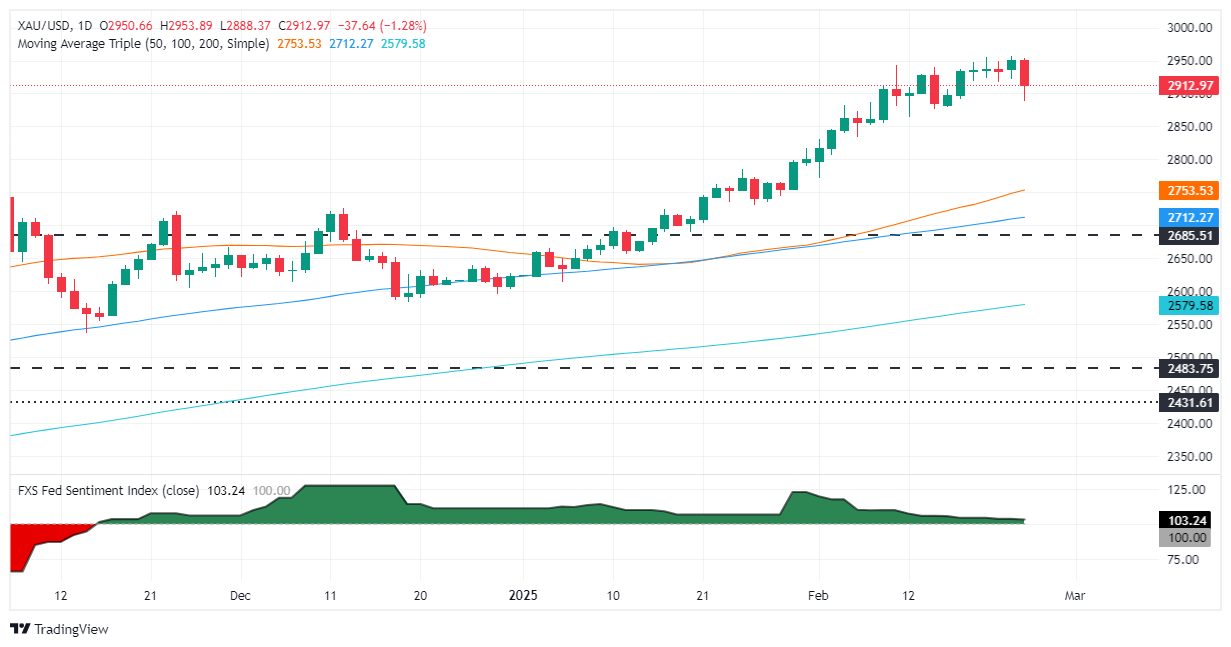
XAU/USD technical outlook: Gold price retraces towards $2,900
Gold prices fell on Tuesday, exposing the precious metal to heavy selling pressure, yet bears seem not to have the strength to achieve a daily close of XAU/USD below $2,900. If sellers achieve that outcome, the February 14 daily low of $2,877 will be exposed, followed by the February 12 swing low of $2,864. Despite this, the uptrend remains intact unless Gold falls below $2,800.
Conversely, if Bullion rises past the year-to-date (YTD) high of $2,956, the next resistance would be $3,000.
Gold FAQs
Gold has played a key role in human’s history as it has been widely used as a store of value and medium of exchange. Currently, apart from its shine and usage for jewelry, the precious metal is widely seen as a safe-haven asset, meaning that it is considered a good investment during turbulent times. Gold is also widely seen as a hedge against inflation and against depreciating currencies as it doesn’t rely on any specific issuer or government.
Central banks are the biggest Gold holders. In their aim to support their currencies in turbulent times, central banks tend to diversify their reserves and buy Gold to improve the perceived strength of the economy and the currency. High Gold reserves can be a source of trust for a country’s solvency. Central banks added 1,136 tonnes of Gold worth around $70 billion to their reserves in 2022, according to data from the World Gold Council. This is the highest yearly purchase since records began. Central banks from emerging economies such as China, India and Turkey are quickly increasing their Gold reserves.
Gold has an inverse correlation with the US Dollar and US Treasuries, which are both major reserve and safe-haven assets. When the Dollar depreciates, Gold tends to rise, enabling investors and central banks to diversify their assets in turbulent times. Gold is also inversely correlated with risk assets. A rally in the stock market tends to weaken Gold price, while sell-offs in riskier markets tend to favor the precious metal.
The price can move due to a wide range of factors. Geopolitical instability or fears of a deep recession can quickly make Gold price escalate due to its safe-haven status. As a yield-less asset, Gold tends to rise with lower interest rates, while higher cost of money usually weighs down on the yellow metal. Still, most moves depend on how the US Dollar (USD) behaves as the asset is priced in dollars (XAU/USD). A strong Dollar tends to keep the price of Gold controlled, whereas a weaker Dollar is likely to push Gold prices up.







© 2000-2026. All rights reserved.
This site is managed by Teletrade D.J. LLC 2351 LLC 2022 (Euro House, Richmond Hill Road, Kingstown, VC0100, St. Vincent and the Grenadines).
The information on this website is for informational purposes only and does not constitute any investment advice.
The company does not serve or provide services to customers who are residents of the US, Canada, Iran, The Democratic People's Republic of Korea, Yemen and FATF blacklisted countries.
Making transactions on financial markets with marginal financial instruments opens up wide possibilities and allows investors who are willing to take risks to earn high profits, carrying a potentially high risk of losses at the same time. Therefore you should responsibly approach the issue of choosing the appropriate investment strategy, taking the available resources into account, before starting trading.
Use of the information: full or partial use of materials from this website must always be referenced to TeleTrade as the source of information. Use of the materials on the Internet must be accompanied by a hyperlink to teletrade.org. Automatic import of materials and information from this website is prohibited.
Please contact our PR department if you have any questions or need assistance at pr@teletrade.global.


 Bank
Bank transfers


