- Analytics
- News and Tools
- Market News
Analytics, News, and Forecasts for CFD Markets: currency news — 02-11-2020.
| Time | Country | Event | Period | Previous value | Forecast |
|---|---|---|---|---|---|
| 00:00 (GMT) | U.S. | Presidential Election | |||
| 03:30 (GMT) | Australia | Announcement of the RBA decision on the discount rate | 0.25% | 0.10% | |
| 07:30 (GMT) | Switzerland | Consumer Price Index (MoM) | October | 0% | 0.0% |
| 07:30 (GMT) | Switzerland | Consumer Price Index (YoY) | October | -0.8% | -0.6% |
| 15:00 (GMT) | U.S. | Factory Orders | September | 0.7% | 1% |
| 21:30 (GMT) | Australia | AiG Performance of Construction Index | October | 45.2 | |
| 21:45 (GMT) | New Zealand | Employment Change, q/q | Quarter III | -0.4% | -0.8% |
| 21:45 (GMT) | New Zealand | Unemployment Rate | Quarter III | 4.0% | 5.4% |
| 23:50 (GMT) | Japan | Monetary Policy Meeting Minutes |
FXStreet reports that Lee Sue Ann, Economist at UOB Group, reviewed the latest ECB event and its prospects of extra easing in December.
“Whilst further monetary policy easing by the ECB has been largely priced in by financial markets, Lagarde nonetheless surprised on the dovish side, on the strength and the scope of the signalled easing. She essentially not only pre-committed to easing in December (Governing Council is in unanimous agreement that more needs to be done at the next meeting); but also clarified that the ECB is looking at all instruments.”
“We continue to believe the bar for further cuts in policy rates remain high. The ECB is likely to extend and increase the Pandemic Emergency Purchase Programme (PEPP) in December. At present, only EUR616.9 billion of the EUR1.35 trillion potential size of the PEPP is being utilized and spread across Eurozone members. Hence, the implementation period could stretch an extra six months beyond the current guidance that purchases will be made until at least June 2021 with reinvestment “at least” to the end of 2022”. We also expect the ECB to include further easing of the TLTROs or similar cheap liquidity providing operations.”
The Commerce
Department announced on Monday that construction spending increased 0.3 percent
m-o-m in September after a revised 0.8 percent m-o-m advance in August
(originally a 1.4 percent m-o-m climb). This marked the smallest monthly gain
in construction spending in four months.
Economists had
forecast construction spending increasing 0.9 percent m-o-m in September.
According to
the report, spending on private construction rose 0.9 percent m-o-m, while
investment in public construction fell 1.7 percent m-o-m.
A report from
the Institute for Supply Management (ISM) showed on Monday the U.S.
manufacturing sector’s activity continued its rebuilding in October.
The ISM's index
of manufacturing activity came in at 59.3 percent last month, 3.9 percentage
points from the September reading of 55.4 percent. The October reading pointed
to the sixth straight month of growth in factory activity and its strongest expansion
since September 2018.
Economists' had
forecast the indicator to increase to 55.8 percent.
A reading above
50 percent indicates expansion, while a reading below 50 percent indicates
contraction.
According to
the report, the New Orders Index stood at 67.9 percent, an advance of 7.7
percentage points from the September reading, while the Production Index
registered 63 percent, an increase of 2 percentage points compared to the
September reading, the Employment Index was at 53.2 percent, a surge of 3.6
percentage points from the September reading and the Supplier Deliveries Index
came in at 60.5 percent, up 1.5 percentage points from the September figure.
Timothy R.
Fiore, Chair of the ISM Manufacturing Business Survey Committee, noted that the
manufacturing economy continued its recovery in October. “Survey Committee
members reported that their companies and suppliers continue to operate in
reconfigured factories; with every month, they are becoming more proficient at
expanding output,” he said. “Panel sentiment was optimistic (two positive
comments for every cautious comment), a slight decrease compared to September”.
He also added that the past relationship between the PMI and the overall
economy indicates that the PMI for October (59.3 percent) corresponds to a
4.8-percent increase in real gross domestic product (GDP) on an annualized
basis.
- Flexibility embedded in the PEPP cannot be unconstrained
- PEPP purchases are separate from and cannot be consolidated with APP purchases
- We may also decide to discontinue some of the exceptional supervisory measures
- Unless we conclude that the banks’ capital projections remain clouded by exceptionally high uncertainty, we should revert to assessing the planned distribution of dividends on bank-by-bank basis
FXStreet reports that EUR/JPY maintains its break of a cluster of key supports at 122.38/23 and analysts at Credit Suisse stay biased lower for the 200-day average (DMA) at 121.26/16.
“A poor week last week for EUR/JPY has seen the market remove with ease key support at 122.38/23 - the late September low, 38.2% retracement of the entire rally from the May low and 61.8% retracement of the rally from late June. This reinforces the existing top below 123.01 and we maintain our bearish view outlook with support seen next at 121.26/16 – the rising 200-day average and the back of broken trend support from June. We look for an attempt to then hold here. A closing break though would instead see the immediate risk stay lower with support seen next at the 50% retracement of the entire rally from May at 120.75/73.”
- We understand people are disappointed virus is taking such a long time
- The light at end of the tunnel is quite far away
- 30% of Germany's population is in a risk group for coronavirus
- There are some doubts, scepticism and rejection of coronavirus restrictions
- At lower temperatures, coronavirus reacts differently, more aggressively
- In the last 10 days, the number of people with coronavirus in the ICUs has doubled
- We cannot allow the quick spread of the virus to keep overwhelming health authorities
- It was with a heavy heart we decided on measures but they are necessary
- We have to do without many things that make life nice in next 4 weeks
- Many of the restrictions are on private life so we are reliant on the participation and understanding of citizens
- If lockdown works, we have a bearable December
- We have positive prospects for coronavirus vaccine being approved in the coming months
FXStreet notes that S&P 500 approaches the US election, as is often the way at major events, just above its key support at 3209/3199, which needs to hold post the election to avoid an important top. Meanwhile, the VIX maintains its base to mark a more concerning rise in volatility, per Credit Suisse.
“The sell-off in the S&P 500 as we approach the election has bought the market to within touching distance of its pivotal support at 3209/3199, which includes the key September low. With the market already showing some near-term signs of stabilization we think likely to now hold until results of the election start to emerge.”
“Key technically will be whether this 3209/3199 support remains intact post the election, as a conclusive break would see a significant top established, exposing the 200-day average, currently at 3129. Worryingly, weekly RSI momentum already looks to be holding a top."
“The VIX maintains a base with resistance next at 44.44.”
FXStreet reports that Lee Sue Ann, economist at UOB Group, suggests the RBA could cut its policy rate to 0.10% at its Tuesday’s meeting.
“We expect the RBA to ease policy further to revive the economy by cutting the cash rate, 3-year yield target and the Term Funding Facility (TFF) rate by 15 bps.”
“We also expect the RBA to announce further QE purchases ahead.”
| Time | Country | Event | Period | Previous value | Forecast | Actual |
|---|---|---|---|---|---|---|
| 08:30 | Switzerland | Manufacturing PMI | October | 53.1 | 52.3 | |
| 08:50 | France | Manufacturing PMI | October | 51.2 | 51 | 51.3 |
| 08:55 | Germany | Manufacturing PMI | October | 56.4 | 58 | 58.2 |
| 09:00 | Eurozone | Manufacturing PMI | October | 53.7 | 54.4 | 54.8 |
| 09:30 | United Kingdom | Purchasing Manager Index Manufacturing | October | 54.1 | 53.3 | 53.7 |
EUR traded mixed against its major rivals in the European session on Monday as investors weighed soaring coronavirus cases and solid factory activity data from Europe while preparing for a presidential election in the U.S. The euro rose against USD, CHF, GBP and NZD, but fell against CAD, AUD and JPY.
According to Reuters, new coronavirus cases in Europe have doubled in five weeks, with total infections surpassing 10 million. Several European countries such as France, Germany, Belgium, Austria, Portugal and Greece, have announced partial lockdowns amid soaring COVID-19 cases in Europe, while Italy implemented a curfew. Investors worry about the impact of the new lockdown measures on the region's economy.
The latest survey from IHS Markit showed that Europe's manufacturing activity expanded to a two-and-a-half-year high in October, due in part to Germany's rebound following summer business restrictions linked to the COVID-19 pandemic. The manufacturing Purchasing Managers' Index (PMI) rose to 54.8 in October from 53.7 in September and better than the earlier flash reading of 54.4. October’s number was also the best recorded by the survey since July 2018. According to the survey, Eurozone's output growth accelerated to an over two-and-a-half year high and new orders rose by the most since the beginning of 2018.
Ahead of Tuesday's election, polls show a strong lead (by 10 points) in national polls for former Vice President Joe Biden, but narrowing gaps between the Democratic candidate and the U.S. President Donald Trump in many of the seven key "swing states" that will ultimately decide the elections' outcome.
- Hopes that ECB will adopt "clearly" symmetrical target
- Says inflation expectations are stuck too low
- Monetary policy strategy should be reviewed every five years going forward
- This will divide the country into three areas based on degree of risk
- It will limit movement between high risk regions
- It will set nighttime curfew nationwide
FXStreet reports that the U.S. dollar is continuing to benefit from the deteriorating outlook for growth in Europe. It has helped to lift the dollar index back towards the top of its recent trading range between the 92.000 and 94.000-levels ahead of the US Presidential election. The latest polls released over the weekend have not materially altered expectations that Joe Biden is on course to become President, which would be a bad outcome for the USD outlook, economists at MUFG Bank brief.
“The latest polls released over the weekend have not materially altered expectations that Joe Biden is on course to become President. Bloomberg has reported that New York Times/Siena College polls showed Biden ahead in the key battleground states of Pennsylvania, Florida, Arizona and Wisconsin. A CNN poll showed Biden ahead in Arizona, Michigan and North Carolina. Florida though still appears more evenly balanced. An ABC/Washington Post poll showed that President Trump has narrowly ahead in Florida by 2 percentage points. The races in Ohio and Iowa are also seen as closer.”
“According to polling experts Five Thirty-Eight, Joe Biden has around a 90% probability of becoming President. But they are warning that Donald Trump can still win. One area of concern for Joe Biden is his lead in Pennsylvania, the most likely tipping point state, which has averaged about 5 percentage points. A solid but not spectacular lead.”
“We continue to believe that the worst outcome for the US dollar would be if there was a Blue Wave and the Democrats took control of the Senate. Expectations for larger fiscal stimulus and improving global trade relations would support risk assets and help weaken the US dollar. However, if there is a surprise and the Democrats fail to take control of the Senate and/or Donald Trump remains President, it could reinforce US dollar strength.”
FXStreet notes that EUR/CHF is seeing the expected break of the pivotal 200-day moving average (DMA) at 1.0676 on Monday. A close beneath 1.0676 would see an acceleration of downside momentum with the next support at 1.0662, analysts at Credit Suisse apprise.
“EUR/CHF is testing below the pivotal 200-day average this morning, currently at 1.0677. With EUR/USD also establishing a top and with daily MACD momentum still moving lower we look for a clear close beneath here, with support seen next at the 61.8% retracement of the entire 2020 upswing at 1.0662, where fresh buyers are expected at first.”
“Beyond 1.0662 in due course though would see 1.0650 next, ahead of the low of July and psychological inflection point at 1.0607/00, where we would expect to see another initial attempt to hold. With the large top still in place though, an eventual move beyond here is still very much possible, with the ‘measured objective’ at 1.0580/77.”
- Significant proportion of legal text has been agreed across multiple chapters
- Both sides are confident that we are on track for comprehensive agreement
- We are in a good position to move forward after U.S. election
Reuters reports that the DIW economic institute said the German economy will likely shrink by 1% in the fourth quarter due to a second partial lockdown imposed by the government to halt a sharp rise in coronavirus infections.
The measures in Germany will cost the economy 19 billion euros in the fourth quarter, DIW said, adding that the number of people unemployed will rise by around 50,000 compared with the first lockdown in the spring.
FXStreet reports that FX Strategists at UOB Group noted the upside bias in USD/CNH could lose momentum if 6.6750 is cleared in the next weeks.
Next 1-3 weeks: “Our latest narrative was from last Thursday (29 Oct, spot at 6.7225) wherein ‘upward momentum has improved and if USD were to break 6.7450, the next level to focus on is at 6.7650’. We indicated that USD ‘is expected to trade with an upward bias as long as it does not move below 6.6750’. However, USD did not break 6.7450 but came close to taking out the ‘strong support’ level at 6.6750 (low of 6.6770 on Friday). The surprisingly soft price actions have dented the momentum but only a break of 6.6750 would indicate that the upside risk has dissipated. Meanwhile, USD has to move and stay above 6.7150 within these 1 to 2 days or the odds for a break of 6.7450 would diminish quickly.”
Reuters reports that Goldman Sachs sharply cut Europe's fourth quarter economic forecasts as a surge in COVID-19 cases led to major countries announcing partial nationwide lockdowns for November.
Goldman Sachs said it expects the euro area's real GDP to shrink 2.3% in the fourth quarter, a sharp reversal from its earlier projection of 2.2% growth.
Similarly, it cut UK GDP growth forecasts to minus 2.4% from a 3.6% expansion it had earlier expected.
FXStreet reports that economists at Rabobank see risk that long EUR positions will be pared back further as covid-19 takes another swipe at the Eurozone’s economy.
“We see scope for a move towards the 1.16 level on a one-to-three month view. Dependent on the path of the pandemic and on the results of the US election, we see scope for a drop to the 1.14 area in the coming months.”
“The ECB is promising further monetary action soon and the market is speculating that a deposit rate cut could be a measure under consideration. Pushing the deposit rate further into negative territory would likely weigh on the EUR and serve as a reminder that the Fed is the only G10 central bank that has explicitly steered away from a negative interest rate policy.”
“Despite the progress made by the EU in announcing its Recovery Fund this summer, going forward the EUR could still be weighed down by a lack of fresh developments with respect to reforming the fiscal framework in the region.”
“There are concerns that a contested election this year could be a far more volatile event which, on the heels of Black Lives Matter protests and elevated unemployment, could trigger social unrest. Such a result would likely fuel demand for safe-haven assets including the USD.”
According to the report from IHS Markit/CIPS, the recovery in the UK manufacturing sector continued at the start of the final quarter, as output and new orders rose again supported by improved demand from both domestic and overseas sources. That said, the upturn showed further signs of losing impetus, as the initial boost to growth from the economy reopening faded and job losses accelerated.
The seasonally adjusted IHS Markit/CIPS PMI fell to 53.7 in October, down from 54.1 in September but above the earlier flash estimate of 53.3. The PMI has remained at an above-50.0 level, signalling expansion, for five months running.
Manufacturing output rose at an above survey-average rate in October, despite growth easing to a four-month low. The latest expansion reflected improved intakes of new work and companies catching up on orders delayed during lockdown. The trend in new export business meanwhile strengthened, reflecting increased demand from China and the US and a temporary boost from Brexit stock building by clients in Europe.
Sector data highlighted a growing disparity between the performances of the main product categories covered by the survey. The intermediate and investment goods industries both saw marked expansions of production and new order volumes in October. In contrast, the consumer goods sector slipped back into contraction, with output and new business falling for the first time since the onset of their respective recoveries.
Manufacturers maintained a positive outlook in October. Over 60% of companies expect output to rise over the coming year, compared to only 10% forecasting a decline. Positive sentiment reflected hopes of economic recovery and a reduction in COVID-19 disruption. However, some firms also raised concerns about the potential impact of both the ongoing pandemic and Brexit uncertainty.
According to the report from IHS Markit, Eurozone Manufacturing PMI indicated a further improvement in manufacturing sector growth during October.
After accounting for seasonal factors, the headline index moved up to 54.8, from 53.7 in September and better than the earlier flash reading. October’s number was also the best recorded by the survey for 27 months and maintained the current run of continuous growth that began in July.
Growth was seen across all three market groups during October, albeit to varying degrees. The fastest expansion was seen in investment goods, where growth improved to its highest level for over two years. A solid gain was seen in intermediate goods, but growth weakened to a marginal pace amongst consumer goods producers.
A fourth successive monthly increase in manufacturing production was recorded during October, with the rate of growth strengthening to its sharpest for over two-and-a-half years. A similarly sized increase in new orders was also recorded, with growth in October the best seen since the start of 2018.
Gains in overall new orders reflected stronger demand from both domestic and external clients. New export business rose at a noticeable rate that was the best recorded by the survey since February 2018.
Sharply rising levels of new business helped to drive growth of work outstanding for a third successive month. Moreover, the rate of increase was the sharpest recorded by the survey since February 2018. Despite this, employment levels continued to be cut, extending the current period of contraction to a year-and-a-half.
Looking ahead to future production, business confidence remained positive for a fifth successive month. Italian and German manufacturers were the most optimistic about output over the coming 12 months.
Bloomberg reports that Japan’s car sales surged in October, rising at the fastest pace in more than eight years as the economy continues to bounce back in the fourth quarter.
Vehicle sales rose 31.6% from a year earlier, according to the Japan Automobile Dealers Association. The large jump partly reflects the distortion of a -26.4% drop 12 months ago after a sales tax increase triggered a sharp drop in spending on big ticket items.
“Auto sales are showing a stronger pickup than expected,” said Taro Saito, head of economic research at NLI Research Institute. “Automakers are back in production and many Japanese households have extra money to spend thanks to the government’s cash handouts.”
Like the overall recovery in the economy, the pace of sales is unlikely to continue at the current rapid pace. An increasing number of Japanese businesses are announcing sharp profit falls that point to lower winter bonuses and smaller wage increases.
| Time | Country | Event | Period | Previous value | Forecast | Actual |
|---|---|---|---|---|---|---|
| 00:30 | Australia | ANZ Job Advertisements (MoM) | October | 8.3% | 9.4% | |
| 00:30 | Australia | Building Permits, m/m | September | -2.2% | 1.3% | 15.4% |
| 00:30 | Japan | Manufacturing PMI | October | 47.7 | 48 | 48.7 |
| 01:00 | Australia | MI Inflation Gauge, m/m | October | 0.1% | -0.1% | |
| 01:45 | China | Markit/Caixin Manufacturing PMI | October | 53.0 | 53 | 53.6 |
During today's Asian trading, the US dollar rose against major world currencies amid demand for safe haven assets due to a jump in the incidence of coronavirus and the approach of the US presidential election.
Since the beginning of the COVID-19 pandemic, 46.5 million cases of coronavirus infection have been recorded worldwide, according to data from the American Johns Hopkins University. On Friday, a record number of cases were detected in the United States - more than 99 thousand.. Since the beginning of the pandemic, more than 9 million infections have been recorded in the country, including 1 million in the last two weeks.
British Prime Minister Boris Johnson on Saturday announced the introduction of a light version of the self-isolation regime for four weeks in England from November 5 due to the growing rate of spread of the COVID-19 coronavirus.
Traders this week are waiting for the results of the meeting of the US Federal reserve and the Bank of England.
The yuan is stable against the dollar. The purchasing managers' index (PMI) in China's industry in October was 51.4 points compared with 51.5 points a month earlier, which is the highest level since March, according to data from the National Bureau of Statistics. Meanwhile, the PMI for services and construction reached its highest level in seven years in October. The indicator was 56.2 points against 55.9 points a month earlier. The indicator is above the 50-point mark for the eighth consecutive month.
The ICE index, which tracks the dynamics of the US dollar against six currencies (Euro, Swiss franc, yen, canadian dollar, pound sterling and Swedish Krona), rose 0.14%, being near the highest level in the last four weeks.
CNBC reports that long-time market bull Ed Yardeni believes the painful sell-off is running out of steam.
“I don’t expect more than a garden variety correction, which would be a 10-15% drop,” the Yardeni Research president told CNBC.
Yardeni contends the pullback actually started Sept. 3 — a day after the S&P 500 and tech-heavy Nasdaq hit their all-time highs. As of Friday’s close, the S&P 500 is off 9% since then while the Nasdaq is off 9.5%
He cites frothiness in the tech sector as one of the original major catalysts.
“We’re still seeing that,” said Yardeni. “And then, of course, we’ve got the renewed concerns about the pandemic and when we’re finally going to get a [coronavirus] vaccine. So, it’s not as though the election is going to fix everything.”
Yardeni’s base case is Tuesday’s presidential election will have a clear result within days, and it will help set the stage for a year-end rally. He speculates the S&P 500 will reach 3,500, a level that’s 2.5% below the all-time high hit Sept. 2.
FXStreet reports that analysts at Royal Bank of Canada (RBC) offer a sneak peek at what to expect from Tuesday’s Reserve Bank of Australia (RBA) monetary policy decision.
“Q3 CPI ... adds pressure on the RBA to deliver further easing at its next board meeting on 3 Nov, especially given its recent shift in focus to actual rather than forecast inflation.”
“Given the degree of excess capacity amid an uncertain recovery, rising labor market slack and persistent low productivity, we think core inflation is likely to edge towards 1% in the coming quarters with a disinflationary pulse remaining.”
"This will keep pressure on the RBA to deliver further easing beyond the next board meeting where expectations are higher for multiple measures.”
RTTNews reports that survey results from IHS Markit showed that China's manufacturing sector expanded at the strongest pace since January 2011 on robust output and new work.
The Caixin manufacturing PMI rose to 53.6 in October, the highest reading since January 2011, from 53.0 in September. A score above 50 indicates expansion in the sector.
The official survey, released over the weekend showed that the manufacturing PMI fell marginally to 51.4 from 51.5 in September. At the same time, the non-manufacturing PMI climbed to 56.2 from 55.9 a month ago.
New orders expanded at the strongest pace since November 2010. However, growth in new export sales softened notably amid a resurgence of the coronavirus disease 2019 virus across a number of export markets.
The substantial increase in overall workloads led manufacturers to ramp up their output again in October, with the rate of growth among the sharpest seen over the past decade.
Companies maintained a cautious approach to staff numbers in October amid reports of efforts to contain costs. As a result, firms raised their staffing levels only slightly.
Reflective of the strong improvement in overall market conditions, business confidence regarding the 12-month outlook for output improved to its highest since August 2014.
EUR/USD
Resistance levels (open interest**, contracts)
$1.1722 (539)
$1.1702 (401)
$1.1686 (103)
Price at time of writing this review: $1.1637
Support levels (open interest**, contracts):
$1.1624 (1659)
$1.1607 (2019)
$1.1583 (849)
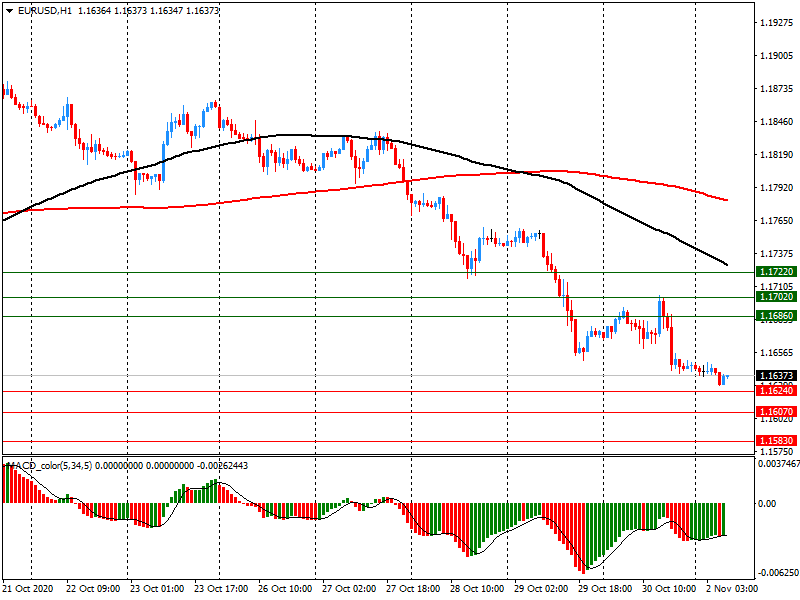
Comments:
- Overall open interest on the CALL options and PUT options with the expiration date November, 6 is 60024 contracts (according to data from October, 30) with the maximum number of contracts with strike price $1,1800 (4269);
GBP/USD
Resistance levels (open interest**, contracts)
$1.3077 (2574)
$1.3029 (265)
$1.2997 (800)
Price at time of writing this review: $1.2902
Support levels (open interest**, contracts):
$1.2884 (648)
$1.2860 (560)
$1.2832 (549)
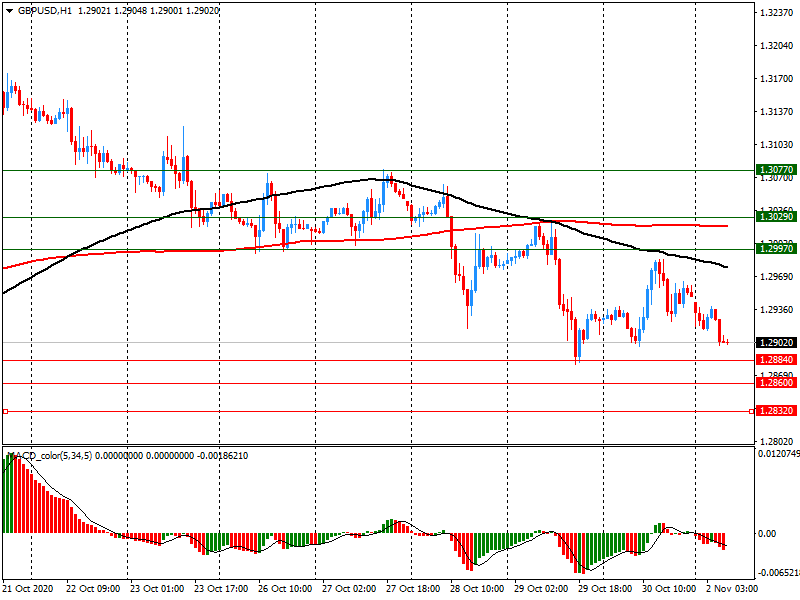
Comments:
- Overall open interest on the CALL options with the expiration date November, 6 is 33149 contracts, with the maximum number of contracts with strike price $1,3950 (3784);
- Overall open interest on the PUT options with the expiration date November, 6 is 26554 contracts, with the maximum number of contracts with strike price $1,2050 (2018);
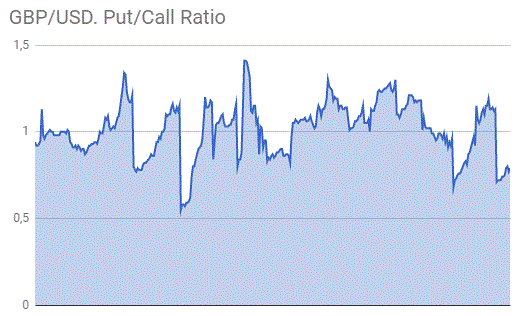
- The ratio of PUT/CALL was 0.80 versus 0.80 from the previous trading day according to data from October, 30
* - The Chicago Mercantile Exchange bulletin (CME) is used for the calculation.
** - Open interest takes into account the total number of option contracts that are open at the moment.
| Time | Country | Event | Period | Previous value | Forecast |
|---|---|---|---|---|---|
| 00:30 (GMT) | Australia | ANZ Job Advertisements (MoM) | October | 7.8% | |
| 00:30 (GMT) | Australia | Building Permits, m/m | September | -1.6% | 1.3% |
| 00:30 (GMT) | Japan | Manufacturing PMI | October | 47.7 | 48 |
| 01:00 (GMT) | Australia | MI Inflation Gauge, m/m | October | 0.1% | |
| 01:45 (GMT) | China | Markit/Caixin Manufacturing PMI | October | 53.0 | 53 |
| 08:30 (GMT) | Switzerland | Manufacturing PMI | October | 53.1 | |
| 08:50 (GMT) | France | Manufacturing PMI | October | 51.2 | 51 |
| 08:55 (GMT) | Germany | Manufacturing PMI | October | 56.4 | 58 |
| 09:00 (GMT) | Eurozone | Manufacturing PMI | October | 53.7 | 54.4 |
| 09:30 (GMT) | United Kingdom | Purchasing Manager Index Manufacturing | October | 54.1 | 53.3 |
| 14:45 (GMT) | U.S. | Manufacturing PMI | October | 53.2 | 53.3 |
| 15:00 (GMT) | U.S. | Construction Spending, m/m | September | 1.4% | 0.9% |
| 15:00 (GMT) | U.S. | ISM Manufacturing | October | 55.4 | 55.8 |
| Pare | Closed | Change, % |
|---|---|---|
| AUDUSD | 0.70269 | -0.03 |
| EURJPY | 121.893 | -0.16 |
| EURUSD | 1.16457 | -0.23 |
| GBPJPY | 135.531 | 0.24 |
| GBPUSD | 1.29492 | 0.18 |
| NZDUSD | 0.66112 | -0.25 |
| USDCAD | 1.33238 | 0.03 |
| USDCHF | 0.91659 | 0.13 |
| USDJPY | 104.659 | 0.07 |







© 2000-2026. All rights reserved.
This site is managed by Teletrade D.J. LLC 2351 LLC 2022 (Euro House, Richmond Hill Road, Kingstown, VC0100, St. Vincent and the Grenadines).
The information on this website is for informational purposes only and does not constitute any investment advice.
The company does not serve or provide services to customers who are residents of the US, Canada, Iran, The Democratic People's Republic of Korea, Yemen and FATF blacklisted countries.
Making transactions on financial markets with marginal financial instruments opens up wide possibilities and allows investors who are willing to take risks to earn high profits, carrying a potentially high risk of losses at the same time. Therefore you should responsibly approach the issue of choosing the appropriate investment strategy, taking the available resources into account, before starting trading.
Use of the information: full or partial use of materials from this website must always be referenced to TeleTrade as the source of information. Use of the materials on the Internet must be accompanied by a hyperlink to teletrade.org. Automatic import of materials and information from this website is prohibited.
Please contact our PR department if you have any questions or need assistance at pr@teletrade.global.


 Bank
Bank transfers


