- Analytics
- News and Tools
- Market News
Analytics, News, and Forecasts for CFD Markets: currency news — 11-03-2013.
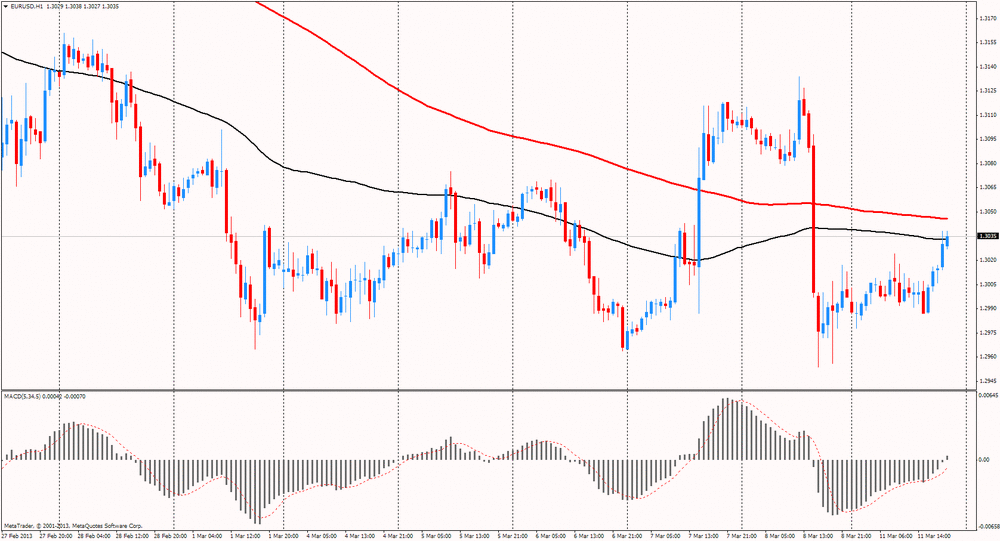
The dollar is trading with little change against the yen, while being close to the maximum values in August 2009, as signs that the U.S. economy is gaining momentum, increased demand for the U.S. currency.
The dollar index (DXY) is trading near the highest level in seven months, as many market participants are awaiting a report on retail sales in the U.S., which is expected to show improvement following February. Also, the attention of traders this week will be focused on data on consumer prices, which are likely to show an increase.
The euro rose against the dollar, after playing with a portion of the losses suffered on Friday. Note that the dynamics of bidding auction results influenced the U.S.. As it became known, the Treasury sold 3-month and 6-month U.S. government bonds, the average yield has declined from 0.11% to 0.095% and from 0.12% to 0.115%, respectively.
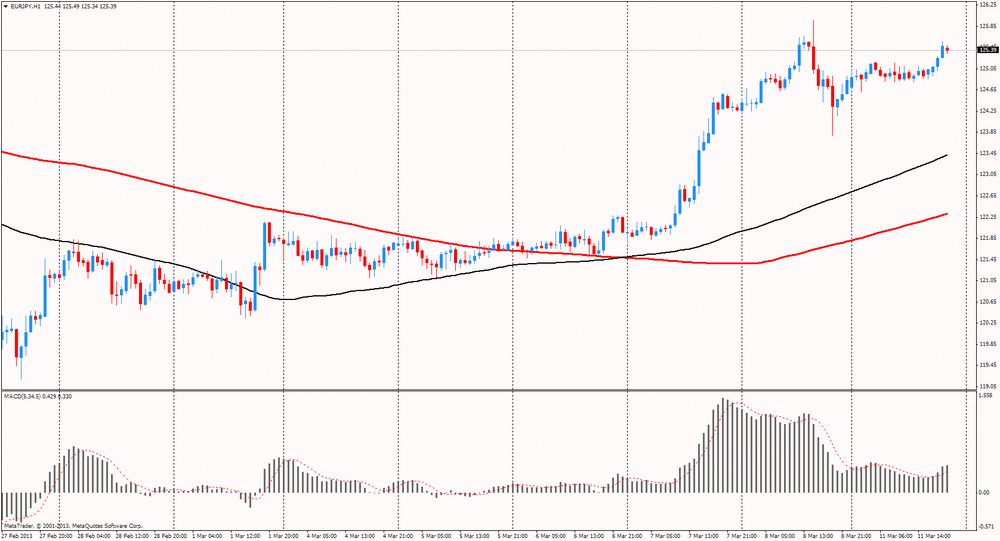
The yen traded near a three-week low against the euro after the release of negative statistics from Japan. It is learned that orders for industrial equipment in the country fell by 13% in January in monthly terms, which was the strongest decline in eight months. Analysts had expected a drop of 1.7%. In addition, the monthly results can have a strong influence major equipment orders. In the IV quarter of last year, Japan returned to growth by reducing the yen and the efforts of Prime Minister Shinzo Abe to fight deflation and recession in the country.
Additional pressure on the yen have word candidate to head the Bank of Japan Haruhiko Kuroda, who considers it necessary to pursue a more aggressive monetary policy. According to him, the main objective should be to achieve the inflation rate of 2%
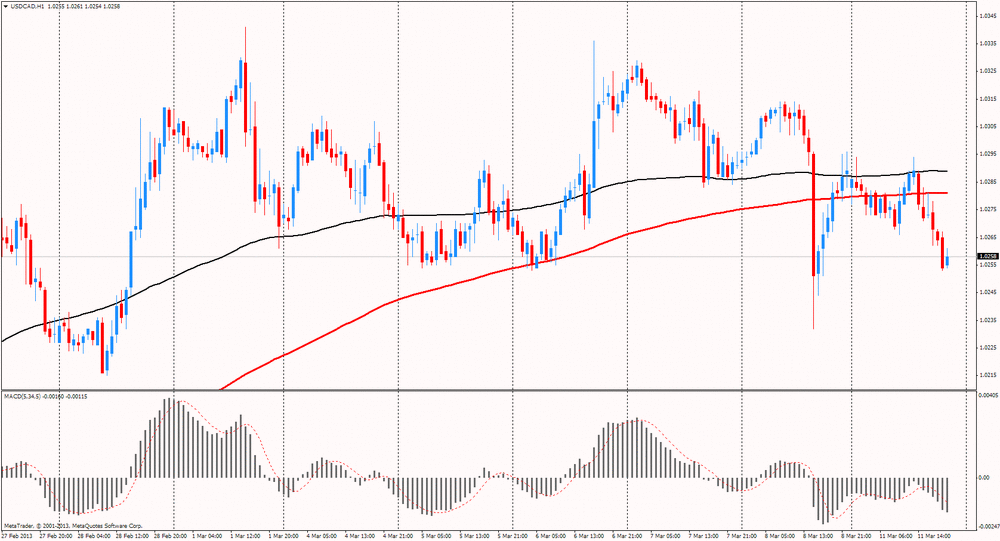
The Canadian dollar was up against most of the most traded currencies, after a report submitted on Friday by the U.S. showed that the number of employees rose much more than expected, prompting speculation that the economic recovery is gaining momentum.
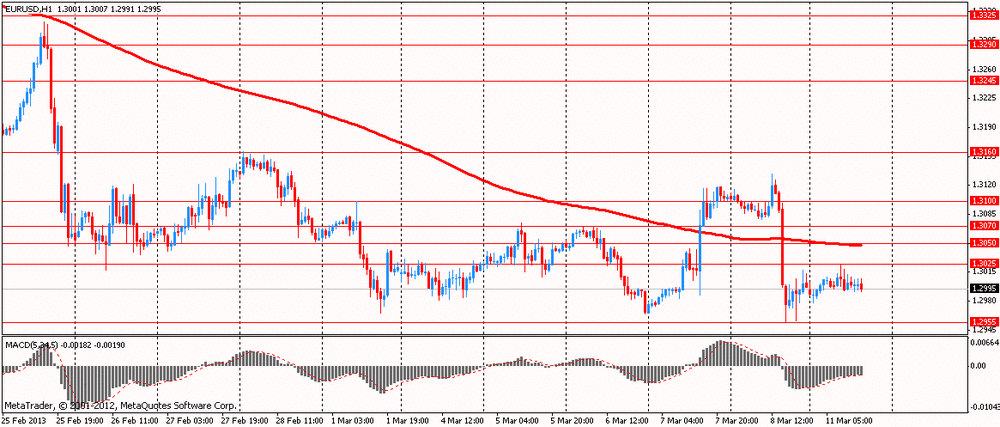
EUR/USD $1.2850, $1.2900, $1.2950, $1.3000, $1.3050, $1.3100, $1.3150, $1.3175
USD/JPY Y94.80, Y95.50, Y95.80, Y96.00, Y96.50, Y97.00
EUR/JPY Y124.70
GBP/USD $1.4925, $1.5020
AUD/USD $1.0100, $1.0195, $1.0225, $1.0245, $1.0270
AUD/NZD NZ$1.2400
07:00 Germany Current Account January 20.2 10.5 11.3
07:00 Germany Trade Balance January 16.9 17.9 15.7
07:45 France Industrial Production, m/m January -0.1% -0.1% -1.2%
07:45 France Industrial Production, y/y January -2.1% -2.7% -3.5%
08:15 Switzerland Retail Sales Y/Y January +4.7% +3.7% +1.9%
The euro fell against the dollar amid risk aversion, which was caused by news that Fitch downgraded Italy's sovereign rating to the level of BBB + with a negative outlook, which increased political uncertainty. In addition, in the 4th quarter of Italy's economy shrank by 0.9% q / q in line with expectations, while the annual rate was 2.8% against expectations of 2.7% from a revised -2.7 % to 2.8% the previous value.
Also, the negative sentiment in the market have increased after the release of statistics from Germany and France. In Germany, the trade surplus narrowed by € 16.9 billion to € 15.7 billion, while imports (+3.3% vs. +1.0%) grew stronger exports (+1.4% vs. +0.3%. Industrial production in France fell by 1.2 % vs. +0.1%.
The situation is exacerbated concerns about the U.S. budget and trade-offs between the two parties.
Yen against the euro traded near three-week low after the release of negative statistics from Japan. Orders for industrial equipment in the country fell by 13% in January in monthly terms, which was the strongest decline in eight months. Analysts had expected a drop of 1.7%. In addition, the monthly results can have a strong influence major equipment orders. In the IV quarter of last year, Japan returned to growth by reducing the yen and the efforts of Prime Minister Shinzo Abe to fight deflation and recession in the country.
Additional pressure on the yen have word candidate to head the Bank of Japan Haruhiko Kuroda, who considers it necessary to pursue a more aggressive monetary policy. According to him, the main objective should be to achieve the inflation rate of 2%. "We are in a situation where we can not lower interest rates more.'s Why we have direct effect on market expectations," - said Kuroda.
EUR / USD: during the European session the pair fell to $ 1.2991.
GBP / USD: during the European session the pair fell to a 32-month low of $ 1.4864.
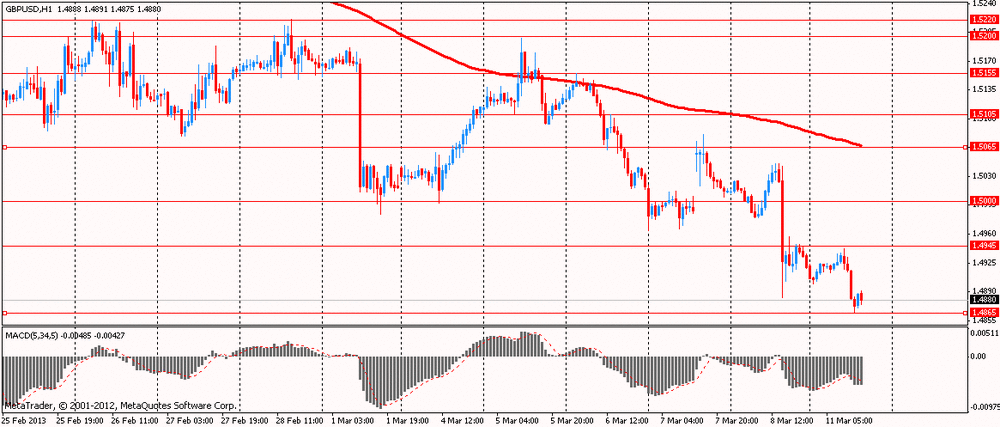
USD / JPY: during the European session, the pair traded in a narrow range of Y95.98 - Y96.08.
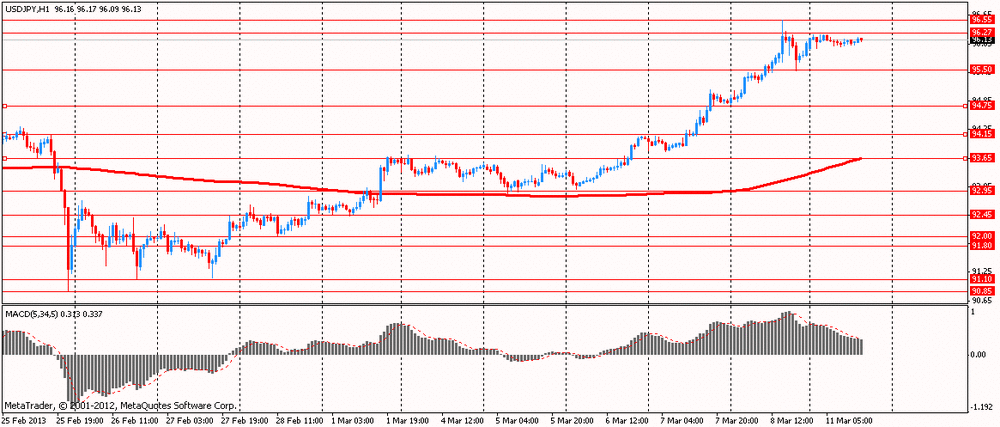
At 23:50 GMT, Japan will provide BSI index of business conditions for large manufacturers and business conditions index (BSI) for large enterprises in all sectors of the 1st quarter. Also during this time will be published minutes of the meeting of the Bank of Japan on monetary policy and the index of activity in the service in January.
EUR/USD
Offers $1.3090/100, $1.3060/65, $1.3050, $1.3025/30
Bids $1.2980, $1.2955/50, $1.2935/25, $1.2900, $1.2880, $1.2865-50
GBP/USD
Offers $1.5100/10, $1.5050/60, $1.5000/10, $1.4980/85, $1.4950/65, $1.4900/10
Bids $1.4855/50, $1.4830/20, $1.4800
AUD/USD
Offers $1.0375/80, $1.0340/50, $1.0330, $1.0300/10, $1.0250/60
Bids $1.0200, $1.0170/60, $1.0150, $1.0120/15, $1.0100-070, $1.0050
EUR/GBP
Offers stg0.8800, stg0.8750/60
Bids stg0.8650, stg0.8575/70, stg0.8555/50
EUR/JPY
Offers Y125.60
Bids Y124.10, Y123.85/75, Y123.40-20, Y122.60/50
USD/JPY
Offers Y97.00, Y96.80, Y96.70, Y96.25/40
Bids Y95.50/40, Y95.25/20, Y94.80, Y94.50/40, Y94.15/00
Swiss retail sales growth eased sharply in January, the latest figures published by the Federal Statistical Office revealed Monday.
Retail sales increased 1.9 percent year-on-year in real terms in January, much slower than a 4.7 percent gain in December. Excluding fuel, sales were up 1.9 percent.
Retail sales of food, drinks and tobacco registered an increase in real turnover of 1.4 percent while the non-food sector registered a growth of 1.7 percent.
In January, seasonally adjusted turnover in the retail sector fell 0.5 percent compared with the previous month. Excluding fuel, the retail sector showed a month-on-month decline of 0.1 percent in sales.
Germany sold E3.24bln 6-month Bubill at average yield 0.0103% (0.0203%), cover 2.0 (1.9) and E0.76bln or 19% held for secondary market operations vs 15% previously.
France's industrial production declined more than expected in January, the latest figures from statistical office Insee showed Monday.
Production fell 3.5 percent year-on-year in January, compared to expectations for a 2.8 percent decline. Also, the rate of fall was steeper than the 1.9 percent decrease in the previous month.
Manufacturing output dropped 4.5 percent year-on-year, faster than the 3.1 percent decrease in the previous month.
Month-on-month, total industrial production declined 1.2 percent following a 0.9 percent gain in December. Economists expected a 0.2 percent fall.
Manufacturing output decreased 1.4 percent, faster than the expected 0.2 percent decrease. In January, factory output was up 1.3 percent.
Germany's exports grew at the fastest pace since August 2012 and imports recovered strongly in January, boosting hopes of recovery at the start of the year.
Shipments grew 1.4 percent in January from a month ago, when it rose 0.2 percent, data from the Federal Statistical Office showed Monday. The increase in exports far exceeded the 0.5 percent rise forecast by economists.
Likewise, imports advanced 3.3 percent, sharper than the 0.7 percent growth expected by economists. Moreover, the import performance reversed December's 1.5 percent drop. The import growth outpaced the export growth in January.
The trade surplus increased less than expected to EUR 13.7 billion in January from EUR 12.1 billion in the previous month. The surplus was expected at EUR 14.4 billion.
Trade with the euro area countries remained weak. Germany's exports to euro area rose only 0.4 percent annually, while exports to non-Eurozone countries advanced 5.5 percent. At the same time, imports from Eurozone increased 2.8 percent compared to the 8.7 percent jump in imports from non-Eurozone nations.
On a yearly basis, overall exports grew 3.1 percent after declining 6.9 percent in December. Similarly, imports rose 2.9 percent following a 7.5 percent drop in the previous month.
The current account surplus totaled EUR 11.3 billion compared to a EUR 20.2 billion surplus a month ago.
EUR/USD $1.2850, $1.2900, $1.2950, $1.3000, $1.3050, $1.3100, $1.3150, $1.3175
USD/JPY Y94.80, Y95.50, Y95.80, Y96.00, Y96.50, Y97.00
EUR/JPY Y124.70
GBP/USD $1.4925, $1.5020
AUD/USD $1.0100, $1.0195, $1.0225, $1.0245, $1.0270
AUD/NZD NZ$1.2400The dollar gained versus major curencies as U.S. employers added more jobs than forecast last month, boosting optimism the economy is withstanding higher taxes and lower government spending. The U.S. currency rose after the Labor Department reported the nation’s jobless rate unexpectedly fell to a four-year low of 7.7% and employment rose 236,000 last month after a revised 119,000 gain in January. The median forecast of economists projected an advance of 158,000. The jobless rate dropped from 7.9%. Federal Reserve policy makers at their last meeting debated curtailing bond-buying that is seen as debasing the dollar, a move Chairman Ben S. Bernanke has opposed as he seeks to drive down unemployment to 6.5%.
06:00 Japan Prelim Machine Tool Orders, y/y February -26.1% -21.5%
The dollar approached its highest level in 3 1/2 years versus the yen as signs of a strengthening recovery in the world’s biggest economy boosted demand for the U.S. currency.
The Dollar Index traded near its strongest in seven months on prospects data in two days will show a gain in retail sales, following reports last week that said the jobless rate dropped and payrolls increased. Sales at U.S. retailers probably rose 0.5 percent last month after a 0.1 percent gain in January, according to the median estimate of economists surveyed by Bloomberg News before the Commerce Department releases the figures on March 13.
The yen was 0.8 percent from its lowest level in three weeks against the euro after Japan’s machine orders fell more than expected and Haruhiko Kuroda, the nominee for central bank governor, said current monetary easing efforts aren’t enough to beat deflation. Japan’s Cabinet Office said today machine orders fell 13.1 percent in January, exceeding the median forecast in a Bloomberg survey for a 1.7 percent drop. Today’s report adds to evidence of a slowdown in Asia’s second-biggest economy. Kuroda, who currently serves as president of the Asian Development Bank, told Japanese lawmakers today the central bank should consider buying large amounts of longer-term debt to achieve its 2 percent inflation target as soon as possible. The yen won’t weaken forever amid expectations for monetary easing, he said.
In Europe, economists surveyed by Bloomberg News predict France’s statistics office will say today industrial production fell 0.2 percent in January after a 0.1 percent drop in the previous month.
Australia’s dollar fell after data showed industrial production in China, the South Pacific nation’s biggest trading partner, had its slowest start to a year since 2009.
EUR / USD: during the Asian session the pair was trading around $ 1.3000.
GBP / USD: during the Asian session, the pair traded in the range of $ 1.4900-25.
USD / JPY: during the Asian session, the pair traded in the range of Y95.95-25.
There is a muted calendar Monday, with only second tier releases expected in the US. However, there is plenty to focus on in Europe. Firstly, markets will have to take on board the Italy downgrade by Fitch seen after the markets closed Friday. The data calendar gets underway at 0700GMT, with the release of German fourth quarter labour costs and the January trade balance numbers. At 0745GMT, French January industrial output numbers will hit the screens. At 0900GMT, European Central Bank Vice President Vitor Constancio is set to give a keynote speech at a London conference entitled "Financial Regulation: Towards a global regulatory framework?" Further Italy data is expected at 1000GMT, when fourth quarter final GDP data is expected. GDP is seen down 0.9% q/q and down 2.7% on year. At 1100GMT, the OECD January leading indicator numbers will cross the wires. A light data calendar for the UK Monday, interest this week seen Tuesday with release of UK IP and NIESR's GDP forecast.
06:00 Japan Prelim Machine Tool Orders, y/y February -26.1%
07:00 Germany Current Account January 17.3 10.5
07:00 Germany Trade Balance January 16.8 17.9
07:45 France Industrial Production, m/m January -0.1% -0.1%
07:45 France Industrial Production, y/y January -2.1% -2.7%
08:00 China New Loans February 1070 750
08:15 Switzerland Retail Sales Y/Y January +5.1% +3.7%
20:30 New Zealand REINZ Housing Price Index, m/m February -1.0%
23:50 Japan BSI Manufacturing Index Quarter I -10.3 -6.2
23:50 Japan Monetary Policy Meeting Minutes March
23:50 Japan Tertiary Industry Index January +1.4% -0.1%






© 2000-2026. All rights reserved.
This site is managed by Teletrade D.J. LLC 2351 LLC 2022 (Euro House, Richmond Hill Road, Kingstown, VC0100, St. Vincent and the Grenadines).
The information on this website is for informational purposes only and does not constitute any investment advice.
The company does not serve or provide services to customers who are residents of the US, Canada, Iran, The Democratic People's Republic of Korea, Yemen and FATF blacklisted countries.
Making transactions on financial markets with marginal financial instruments opens up wide possibilities and allows investors who are willing to take risks to earn high profits, carrying a potentially high risk of losses at the same time. Therefore you should responsibly approach the issue of choosing the appropriate investment strategy, taking the available resources into account, before starting trading.
Use of the information: full or partial use of materials from this website must always be referenced to TeleTrade as the source of information. Use of the materials on the Internet must be accompanied by a hyperlink to teletrade.org. Automatic import of materials and information from this website is prohibited.
Please contact our PR department if you have any questions or need assistance at pr@teletrade.global.


 Bank
Bank transfers


