- Analytics
- News and Tools
- Market News
Analytics, News, and Forecasts for CFD Markets: currency news — 11-03-2019.
| Time | Country | Event | Period | Previous value | Forecast |
|---|---|---|---|---|---|
| 00:30 | Australia | National Australia Bank's Business Confidence | February | 4 | 3 |
| 00:30 | Australia | Home Loans | January | -6.1% | 1% |
| 06:30 | France | Non-Farm Payrolls | Quarter IV | 0.1% | |
| 07:00 | Australia | RBA Assist Gov Debelle Speaks | |||
| 09:30 | United Kingdom | Industrial Production (MoM) | January | -0.5% | 0.1% |
| 09:30 | United Kingdom | Industrial Production (YoY) | January | -0.9% | -1.4% |
| 09:30 | United Kingdom | Manufacturing Production (MoM) | January | -0.7% | 0% |
| 09:30 | United Kingdom | Manufacturing Production (YoY) | January | -2.1% | -2.1% |
| 09:30 | United Kingdom | GDP m/m | January | -0.4% | 0.2% |
| 09:30 | United Kingdom | Total Trade Balance | January | -3.229 | |
| 10:45 | Eurozone | ECB's Lautenschläger Speech | |||
| 12:30 | U.S. | CPI, m/m | February | 0% | 0.2% |
| 12:30 | U.S. | CPI excluding food and energy, m/m | February | 0.2% | 0.2% |
| 12:30 | U.S. | CPI excluding food and energy, Y/Y | February | 2.2% | 2.2% |
| 12:30 | U.S. | CPI, Y/Y | February | 1.6% | 1.6% |
| 12:45 | U.S. | FOMC Member Brainard Speaks | |||
| 14:00 | United Kingdom | NIESR GDP Estimate | February | 0.2% | |
| 21:45 | New Zealand | Food Prices Index, y/y | February | 0.8% | |
| 23:30 | Australia | Westpac Consumer Confidence | March | 103.8 | |
| 23:50 | Japan | Core Machinery Orders, y/y | January | 0.9% | -2.3% |
| 23:50 | Japan | Core Machinery Orders | January | -0.1% | -1.7% |
| Time | Country | Event | Period | Previous value | Forecast |
|---|---|---|---|---|---|
| 00:30 | Australia | National Australia Bank's Business Confidence | February | 4 | 3 |
| 00:30 | Australia | Home Loans | January | -6.1% | 1% |
| 06:30 | France | Non-Farm Payrolls | Quarter IV | 0.1% | |
| 07:00 | Australia | RBA Assist Gov Debelle Speaks | |||
| 09:30 | United Kingdom | Industrial Production (MoM) | January | -0.5% | 0.1% |
| 09:30 | United Kingdom | Industrial Production (YoY) | January | -0.9% | -1.4% |
| 09:30 | United Kingdom | Manufacturing Production (MoM) | January | -0.7% | 0% |
| 09:30 | United Kingdom | Manufacturing Production (YoY) | January | -2.1% | -2.1% |
| 09:30 | United Kingdom | GDP m/m | January | -0.4% | 0.2% |
| 09:30 | United Kingdom | Total Trade Balance | January | -3.229 | |
| 10:45 | Eurozone | ECB's Lautenschläger Speech | |||
| 12:30 | U.S. | CPI, m/m | February | 0% | 0.2% |
| 12:30 | U.S. | CPI excluding food and energy, m/m | February | 0.2% | 0.2% |
| 12:30 | U.S. | CPI excluding food and energy, Y/Y | February | 2.2% | 2.2% |
| 12:30 | U.S. | CPI, Y/Y | February | 1.6% | 1.6% |
| 12:45 | U.S. | FOMC Member Brainard Speaks | |||
| 14:00 | United Kingdom | NIESR GDP Estimate | February | 0.2% | |
| 21:45 | New Zealand | Food Prices Index, y/y | February | 0.8% | |
| 23:30 | Australia | Westpac Consumer Confidence | March | 103.8 | |
| 23:50 | Japan | Core Machinery Orders, y/y | January | 0.9% | -2.3% |
| 23:50 | Japan | Core Machinery Orders | January | -0.1% | -1.7% |
- proposes to raise defense spending by 4 percent to $750 billion
- proposes to cut foreign aid a by $13 billion
- proposes a $1.9 trillion cut to mandatory spending over 10 years
(The U.S. fiscal year (FY) runs from October 1st to September 30th)
The Federal Reserve Bank of New York reported on Monday the consumers’ inflation expectations fell to 2.8 percent in February from 3.0 percent for the one- and three-year periods.
The inflation expectations have remained essentially unchanged since April 2018 until today.
Meanwhile, the expected earnings growth for one-year rose to 2.5 percent from 2.4 percent, the survey showed.
UK May told EU's Junker Sunday night her cabinet had rejected latest Brexit backstop proposals from the EU
EU had offered Britain could unilaterally leave backstop, deal seems to close on Saturday but UK cabinet rejected it
May has not ruled out making another proposal on Brexit on Monday
EU-27 leaders will discuss Brexit in Brussels on March 21, should not negotiate with May directly at Summit
The Commerce Department reported on Monday that business inventories rose 0.6 percent m-o-m in December, following a revised flat reading in November (originally a drop of 0.1 percent m-o-m).
That was in line with economists’ forecast.
According to the report, retail (+0.9 percent m-o-m) and wholesale (+1.1 percent m-o-m) inventories increased in December, while manufacturing inventories were unchanged.
- Welcome EU Commission's proposals for legal clarity on backstop Brexit talks
- It is now up to the UK to provide answers on Brexit
- EU 27 market partnership with the UK after Brexit
- There are obstacles to getting a deal
- Withdrawal agreement can't be changed
- We want to be helpful
- No-deal Brexit is unlikely
- EU trying to put packets together to provide UK parliament with reassurance there looking for
- EU will not compromise on core issues in trying to ease UK concerns on Irish border backstop
The Commerce
Department announced the sales at U.S. retailers rose 0.2 percent m-o-m in January
2019, following a revised 1.6 percent m-o-m decline in December 2018
(originally a drop of 1.2 percent m-o-m). That was the first monthly gain since
October last year.
Economists had
expected total sales would be flat m-o-m in January.
Excluding auto, retail
sales increased 0.9 percent m-o-m after a revised 2.1 percent m-o-m decrease in
the previous month (originally a fall of 1.8 percent m-o-m), exceeding
economists’ forecast for a 0.3 percent m-o-m advance.
Meanwhile, closely
watched core retail sales, which exclude automobiles, gasoline, building
materials and food services, and are used in GDP calculations, climbed 1.1
percent m-o-m in January, following a revised 2.3 percent m-o-m plunge in December
(originally a 1.7 percent m-o-m decrease).
In y-o-y terms, the
U.S. retail sales rose 2.3 percent in January, the same pace as in the previous
month.
- Growth in the U.S. will be slower than last year
- Evidence that retail sales picked up again in January
- Would not overreact to inflation modestly above 2-percenе target
- Does not believe President Trump can fire him
- Banks have double or more capital to absorb losses
- Globalization and technology factors behind low labor force participation rate
- Brexit meaningful vote will take place on Tuesday; government will publish motion later today
- Cautions against speculation as to what the motion will be
- PM spoke to European Commission President Jean-Claude Juncker
- PM is focused on getting on with Brexit
- PM spoke to several EU leaders over the weekend
- Thinks there remains a desire in both sides for the UK to leave the EU with a deal
- EU and UK will remain in close contact this week
- EU made new assurances that backstop is temporary
- EU open and willing to meet UK negotiators at any time
- EU committed to ratifying deal before March 29th
- Up to UK parliament to take important decisions this week
- Brexit extension would have to be with a purpose
- It is too late for the UK to tell the EU what it wants
Germany's federal government internally revised its growth outlook for Europe's biggest economy in 2019 to 0.8 percent, the second revision in less than two months, business daily Handelsblatt said on Monday, citing a government document.
A weakening world economy, risks such as an escalation of trade conflicts, and political risks in Europe such as Brexit and Italy's financial situation were reasons for the economic slowdown the note had mentioned, Handelsblatt said.
The German government had in January lowered its growth expectations for 2019 to 1.0 percent from a previously expected 1.8 percent.
TD Securities analysis team notes that the German IP disappointed significantly in January (-0.8% m/m), after other euro area countries posted strong upside surprises on Friday.
“Component-wise, Manufacturing fell 1.2% m/m, while capital goods were down 2.5%. Energy production was up 3.6% while consumer goods rose 1.5% m/m. Today's disappointment comes against signs that Sales had picked up sharply in the last two months, and many of the sectors held back by previous one-off factors appear to have rebounded, with newfound weakness in the construction and mining sectors.”
Union Bank of Switzerland’s analysis team us advising against fighting this latest euro fall under the current circumstances.
“We expect this trend to reverse somewhere above EUR/USD 1.10 and do not expect 1.10 to be broken. Further out, we are bullish on the euro, both if Eurozone economy starts to recover from its current weakness and if the risk case of a more serious downturn materializes, because in the latter case the US Fed has scope to cut rates and the ECB has limited ammunition to ease further. We forecast EUR/USD at 1.15 over 6 months and 1.20 over 12 months.”
By 2024, the Organization of Petroleum Exporting Countries’ capacity to pump crude will actually shrink because of declines in Iran and Venezuela, according to the International Energy Agency.
As rivals grow, the amount of crude the world needs from the cartel each year won’t recover to pre-2016 levels -- before OPEC started cutting production -- throughout the period.
“The United States continues to dominate supply growth in the medium term,” said the IEA.
With American supply growth to be supplemented by Brazil, Norway and Guyana, the IEA substantially raised forecasts for new crude supplies outside OPEC, by as much as 3.3 million barrels a day by 2024.
As a result, estimates for the crude needed from OPEC’s 14 members were slashed. By 2024, the world will still need less crude from the group than it was pumping before production cuts started. That suggests that the group will need to persist with its current output restraints into the next decade, the IEA said.
An EU document last week showed that EU finance ministers are set to ditch a plan to introduce an EU-wide digital tax but agree to work on a global reform of the taxation of internet companies.
Iris Pang, economist at ING, notes that the China’s Central bank (PBoC) governor, Yi Gang, commented that there will be fewer required reserve ratio (RRR) cuts in 2019 compared to 2018.
“We see two possibilities from his comments. One is that each RRR cut will be 0.5 percentage points, not 1 percentage point, in which case we can still have 3 more RRR cuts this year. Another is that there will be fewer RRR cuts in 2019, but each still within a range from 0.5 percentage points to 1 percentage points. We believe that as long as the trade negotiation does not turn into a deal that lasts for a long time, then China still needs three more 0.5 percentage point RRR cuts at the beginning of each quarter. This could spread out the easing, and will not put massive downward pressure on the interbank interest rate compared to a 1 percentage point RRR cut.”
China’s automobile sales fell 13.8 percent in February from the same month a year earlier, marking the eighth consecutive month of decline, the country’s biggest auto industry association said.
The China Association of Automobile Manufacturers (CAAM) said sales fell to 1.48 million vehicles last month, after declines of 16 percent in January and 13 percent in December. Sales of new energy vehicles, such as electric cars, rose 53.6 percent year-on-year in February, the group said.
“The trend experienced last year has continued into this year, and the economic situation has also been weak. This has dragged down consumption. Consumers are also waiting for more government policies." CAAM’s Deputy Secretary General Shi Jianhua told.
Mikael Olai Milhoj, senior analyst at Danske Bank, suggests that the EUR/GBP cross is likely move a bit lower towards, but not below, the 0.85 mark in case of an extension of Brexit, as an extension is probably already priced in.
“There also seems to be some support around 0.85. If, against our expectation, May’s deal passes, we expect the cross to move down to 0.83. If the House of Commons supports a no-deal Brexit, we expect the cross to move back to the old 0.87-0.90 range.”
According to Karen Jones, analyst at Commerzbank, USD/JPY pair has failed to maintain a break above the 200 day MA at 111.41 and is now downside corrective near term.
“The market has eroded the 20 day MA and near term uptrend and we will have to allow for a deeper retracement to the 55 day MA and the 2 month uptrend at 110.00/109.87, which should hold for an upside bias to be preserved. Immediate resistance is 112.23, the 6 th December low, the 112.43 55 quarter moving average and recent high at 113.71. We have a 5 month resistance line also at 113.14.”
Beneath the headline figures showing a strong British labour market, the ebb and flow of jobs and businesses being created and destroyed is showing a pattern associated with the onset of recession, research suggested.
Employers in Britain created almost 400,000 jobs last year - a bright spot in a slowing economy weighed down by Brexit worries and weakening global trade.
But academics at the Enterprise Research Centre said there were some unpromising signals when looking at the jobs data split between new and existing firms.
Start-up businesses contributed roughly 1 million jobs in 2018, cancelling out a net 613,000 drop in employment across established companies. This looks unlikely to be sustained, with the rates of business "births" and "deaths" now converging - often a poor omen for the economy, particularly if the death rate overtakes the birth rate. The authors of the report said this trend should be viewed in a longer-term context, rather than as a result of temporary Brexit uncertainty sweeping the economy.
“As we deem that the US is closer to turning cyclically than the euro zone, if data starts to surprise on the upside, e.g. retail sales today where we have an above-consensus call, it could send EUR/USD towards new lows. After the ECB’s dovish signals, we think the cross could slide towards 1.10 near term. Meanwhile, IMM Positioning data suggested that speculators continue to prefer longs in cyclical commodities like oil and copper – a hint that markets are increasingly positioning for a trade deal and a Chinese growth stabilisation. This hints that the knee-jerk to a trade deal may be limited.” Mikael Olai Milhoj, senior analyst at Danske Bank, said.
According to the report from Bank of France, the business sentiment indicator in services stood at 101 in February, like in January. Analysts had expected a decline to 100.
The business sentiment indicator in manufacturing industry stood at 104 in February, after 102 in January.
The business sentiment indicator in construction stood at 101 in February, after 100 in January.
According to the monthly index of business activity (MIBA), GDP is expected to increase by 0.4% in the first quarter of 2017 (second estimate, revised upwards by 0.1 percentage point).
According to provisional data from Destatis, Germany exported goods to the value of 108.9 billion euros and imported goods to the value of 94.4 billion euros in January 2019. Exports increased by 1.7% and imports by 5.0% in January 2019 year on year. After calendar and seasonal adjustment, exports remained almost unchanged and imports were up 1.5% compared with December 2018.
The foreign trade balance showed a surplus of 14.5 billion euros in January 2019. In December 2018, the surplus amounted to 14.3 billion euros. In calendar and seasonally adjusted terms, the foreign trade balance recorded a surplus of 18.5 billion euros in January 2019.
In January 2019, Germany exported goods to the value of 65.3 billion euros to the Member States of the European Union (EU), while it imported goods to the value of 51.7 billion euros from those countries. Compared with January 2018, exports to the EU countries increased by 0.6%, and imports from those countries by 3.7%. Goods to the value of 41.4 billion euros (+1.0%) were exported to the Euro area countries in January 2019, while the value of the goods imported from those countries was 33.8 billion euros (+4.7%). In January 2019, goods to the value of 23.9 billion euros (+0.0%) were exported to EU countries not belonging to the Euro area, while the value of the goods imported from those countries was 17.9 billion euros (+2.0%).
According to provisional data of the Federal Statistical Office (Destatis), in January 2019, production in industry was down by 0.8% from the previous month on a price, seasonally and calendar adjusted basis. Economists had expected a 0.5% increase. The revised figure shows an increase of 0.8% (primary -0.4%) from December 2018.
In January 2019, production in industry excluding energy and construction was down by 1.2%. Within industry, the production of capital goods decreased by 2.5% and the production of intermediate goods by 0.7%. The production of consumer goods showed an increase of 1.5%. Outside industry the energy production was up by 3.6% in January 2019 and the production in construction increased by 0.2%.
Italy is only euro-area country in technical recession
Italy must be part of europe debate
Central banks have been given too many responsibilities considering what we can do and the mandate they have given us in the first place
May and Juncker spoke by phone last night
No plans yet for May to visit Brussels
Respective negotiating teams are continuing to talk
EUR/USD
Resistance levels (open interest**, contracts)
$1.1441 (1469)
$1.1412 (1282)
$1.1389 (470)
Price at time of writing this review: $1.1235
Support levels (open interest**, contracts):
$1.1176 (3025)
$1.1135 (4008)
$1.1090 (935)
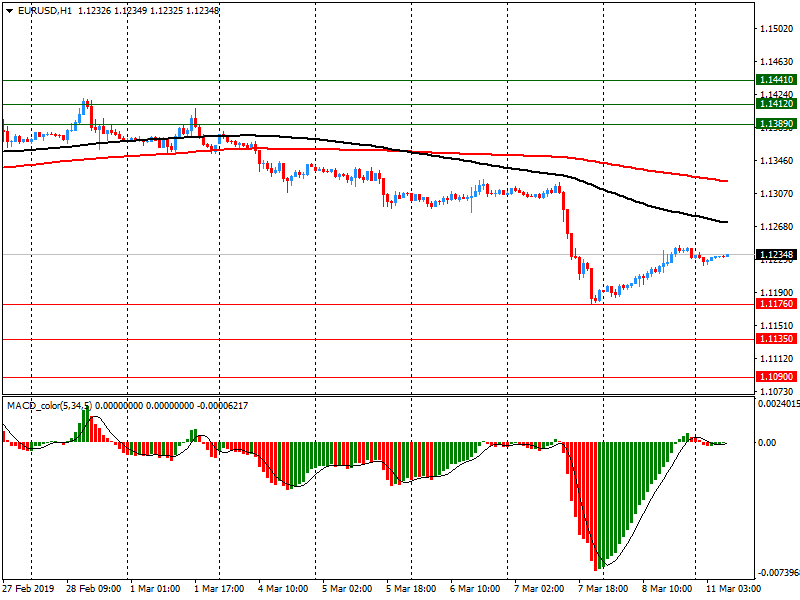
Comments:
- Overall open interest on the CALL options and PUT options with the expiration date April, 5 is 69201 contracts (according to data from March, 8) with the maximum number of contracts with strike price $1,1550 (4271);
GBP/USD
Resistance levels (open interest**, contracts)
$1.3265 (296)
$1.3220 (307)
$1.3184 (804)
Price at time of writing this review: $1.2982
Support levels (open interest**, contracts):
$1.2913 (1108)
$1.2858 (948)
$1.2794 (1555)
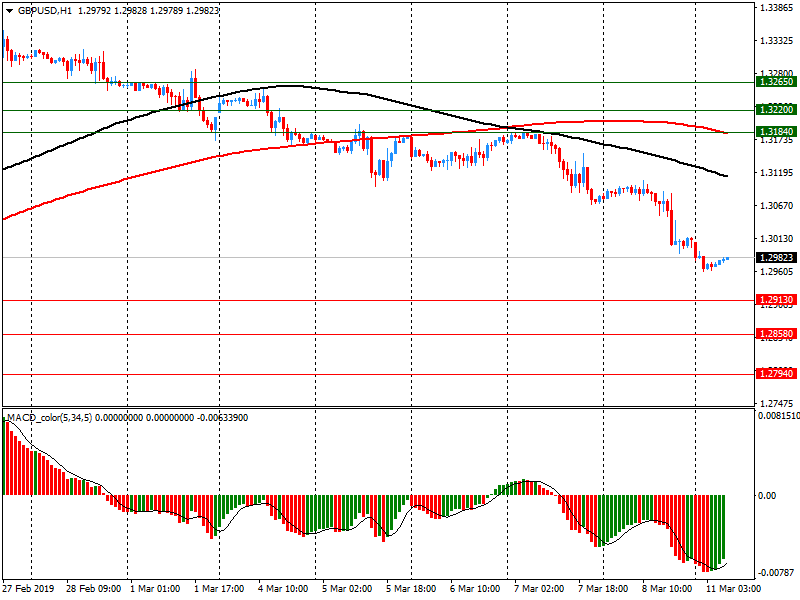
Comments:
- Overall open interest on the CALL options with the expiration date April, 5 is 23239 contracts, with the maximum number of contracts with strike price $1,3400 (4286);
- Overall open interest on the PUT options with the expiration date April, 5 is 20937 contracts, with the maximum number of contracts with strike price $1,2500 (1715);
- The ratio of PUT/CALL was 0.90 versus 0.86 from the previous trading day according to data from March, 8
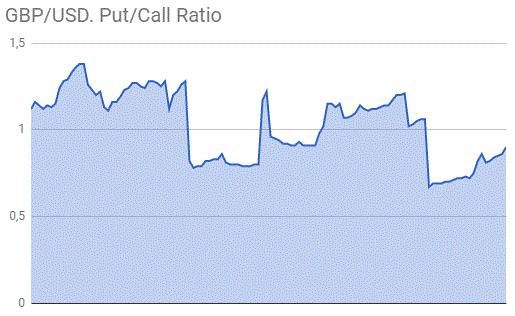
* - The Chicago Mercantile Exchange bulletin (CME) is used for the calculation.
** - Open interest takes into account the total number of option contracts that are open at the moment.
| Pare | Closed | Change, % |
|---|---|---|
| AUDUSD | 0.70426 | 0.4 |
| EURJPY | 124.802 | -0.06 |
| EURUSD | 1.12311 | 0.34 |
| GBPJPY | 144.581 | -0.93 |
| GBPUSD | 1.30111 | -0.53 |
| NZDUSD | 0.68043 | 0.76 |
| USDCAD | 1.34056 | -0.34 |
| USDCHF | 1.00797 | -0.32 |
| USDJPY | 111.116 | -0.4 |







© 2000-2026. All rights reserved.
This site is managed by Teletrade D.J. LLC 2351 LLC 2022 (Euro House, Richmond Hill Road, Kingstown, VC0100, St. Vincent and the Grenadines).
The information on this website is for informational purposes only and does not constitute any investment advice.
The company does not serve or provide services to customers who are residents of the US, Canada, Iran, The Democratic People's Republic of Korea, Yemen and FATF blacklisted countries.
Making transactions on financial markets with marginal financial instruments opens up wide possibilities and allows investors who are willing to take risks to earn high profits, carrying a potentially high risk of losses at the same time. Therefore you should responsibly approach the issue of choosing the appropriate investment strategy, taking the available resources into account, before starting trading.
Use of the information: full or partial use of materials from this website must always be referenced to TeleTrade as the source of information. Use of the materials on the Internet must be accompanied by a hyperlink to teletrade.org. Automatic import of materials and information from this website is prohibited.
Please contact our PR department if you have any questions or need assistance at pr@teletrade.global.


 Bank
Bank transfers


