- Analytics
- News and Tools
- Market News
Analytics, News, and Forecasts for CFD Markets: currency news — 12-09-2018.
| Pare | Closed | % change |
| EUR/USD | $1,1627 | +0,24% |
| GBP/USD | $1,3045 | +0,22% |
| USD/CHF | Chf0,97003 | -0,28% |
| USD/JPY | Y111,24 | -0,32% |
| EUR/JPY | Y129,37 | -0,07% |
| GBP/JPY | Y145,104 | -0,11% |
| AUD/USD | $0,7172 | +0,78% |
| NZD/USD | $0,6560 | +0,60% |
| USD/CAD | C$1,29944 | -0,51% |
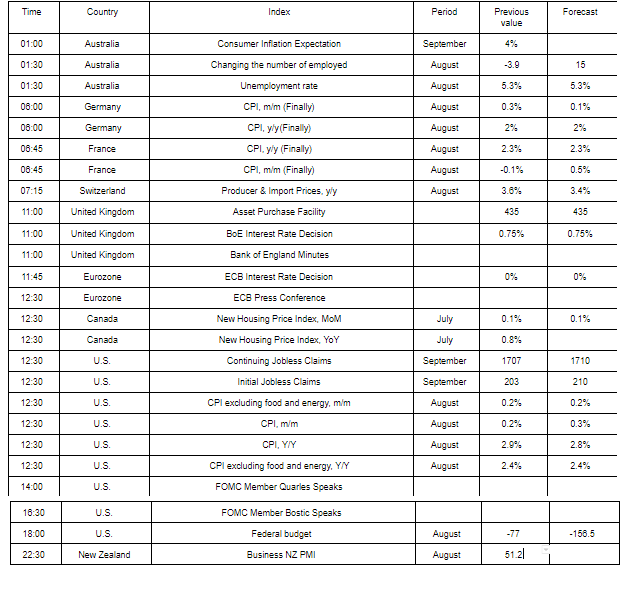
-
Yield curve inversion would likely up recession risk
Canadian industries operated at 85.5% of their production capacity in the second quarter, up from 83.7% in the first quarter. This follows a slight decrease in capacity utilization in the first quarter of 2018 from the fourth quarter of 2017.
The increase in the second quarter of 2018 was led by the mining, quarrying and oil and gas extraction sector and, to a lesser extent, the manufacturing sector.
The capacity utilization rate of the oil and gas extraction subsector increased for a fifth consecutive quarter, rising from 82.7% in the first quarter to 87.1% in the second quarter. The rate has risen 7.6 percentage points since the first quarter of 2017, due to lower oil transportation capacity combined with higher oil prices in the second quarter, resulting in increased production.
The Producer Price Index for final demand declined 0.1 percent in August, seasonally adjusted, the U.S. Bureau of Labor Statistics reported today. Final demand prices were unchanged in July and increased 0.3 percent in June. (See table A.) On an unadjusted basis, the final demand index rose 2.8 percent for the 12 months ended in August.
In August, the decline in the final demand index can be attributed to a 0.1-percent decrease in prices for final demand services. The index for final demand goods was unchanged.
The index for final demand less foods, energy, and trade services edged up 0.1 percent in August after advancing 0.3 percent in both July and June. For the 12 months ended in August, prices for final demand less foods, energy, and trade services rose 2.9 percent.
The unemployment rate decreased compared to both the previous quarter and the previous year, as well as the rate of inactivity. In the monthly data for July 2018, compared to the previous month, the decrease in the unemployment rate was associated with the increase in the inactivity rate.
In the yearly comparison, for the fifth consecutive quarter, the decrease in the number of unemployed continued, albeit with less intensity, (-34 thousand in one year, -1.2%). It only concerned the South, affected both genders and individuals up to 49 years of age. The strong downward trend of inactive people aged 15-64 (- 394 thousand, -2.9%) was instead widespread by gender, territory and age group.
In July 2018 compared with June 2018, seasonally adjusted industrial production fell by 0.8% in the euro area (EA19) and by 0.7% in the EU28, according to estimates from Eurostat, the statistical office of the European Union. In June 2018, industrial production fell by 0.8% in the euro area and by 0.5% in the EU28. In July 2018 compared with July 2017, industrial production decreased by 0.1% in the euro area and increased by 0.8% in the EU28.
The decrease of 0.8% in industrial production in the euro area in July 2018, compared with June 2018, is due to production of durable consumer goods falling by 1.9%, non-durable consumer goods by 1.3% and intermediate goods by 0.8%, while production of capital goods rose by 0.8% and energy by 0.7%.
In July 2018 the seasonally adjusted industrial production index decreased by 1.8% compared with the previous month. The percentage change of the average of the last three months with respect to the previous three months was -0.2.
The calendar adjusted industrial production index decreased by 1.3% compared with July 2017 (calendar working days being 22 versus 21 days in July 2017); in the period January-July 2018 the percentage change was +2.0 compared with the same period of 2017.
The unadjusted industrial production index increased by 1.8% compared with July 2017.
-
Brexit Negotiations Being Masterfully Handled By Barnier For 27 EU Member States
-
But We Regret Brexit Deeply
-
We Will Leave The Single Market And Customs Union When We Leave The EU
The dollar declines slightly on Wednesday, as Canada said it was ready to make a concession to resolve the negotiations for the the North American Free Trade Agreement, although concern about the tension in trade between the US and China dragged on.
China asked the World Trade Organization on Tuesday to grant permission to impose sanctions against the United States in response to Washington's non-compliance with the ruling in the dispute over American dumping duties.
The dollar index. DXY, which measures the dollar against six major counterparts, fell 0.1% to 95.133 in early trading.
The dollar declined, especially sharply against the Canadian currency, after two Canadian sources familiar with the strategy of talks said that Canada is ready to offer the United States limited access to the Canadian dairy market as a concession.
The protected dairy industry in Canada is a stumbling block in the NAFTA negotiations between the two countries. Canadian Foreign Minister Cristia Freeland returned to Washington on Tuesday for talks aimed at saving NAFTA.
However, concern about the trade dispute between China and the United States - the world's largest economies - has kept many investors from taking risks.

This is the weakest sentiment read since November last year. While the Index is still in positive territory, it is now only just above the 100 level. The detail suggests that confidence has been affected by increases in mortgage interest rates; political instability and household budget pressures. We expect there has been a partial offset from the strong growth figures which were announced during the survey period last week. It is also encouraging that respondents have boosted their confidence in the labour market with a significant improvement coming in the mining states.
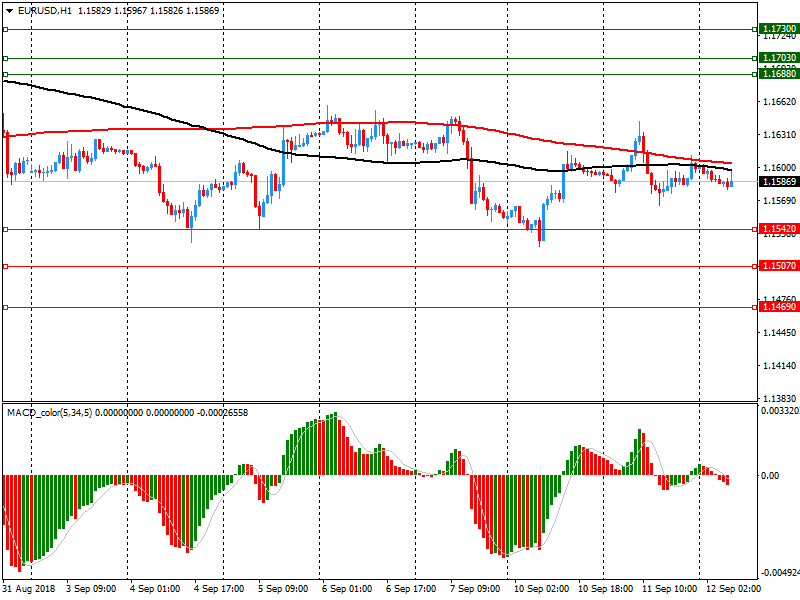
EUR/USD
Resistance levels (open interest**, contracts)
$1.1730 (890)
$1.1703 (640)
$1.1688 (448)
Price at time of writing this review: $1.1587
Support levels (open interest**, contracts):
$1.1542 (5278)
$1.1507 (2914)
$1.1469 (3487)
Comments:
- Overall open interest on the CALL options and PUT options with the expiration date October, 15 is 88112 contracts (according to data from September, 11) with the maximum number of contracts with strike price $1,1600 (5278);
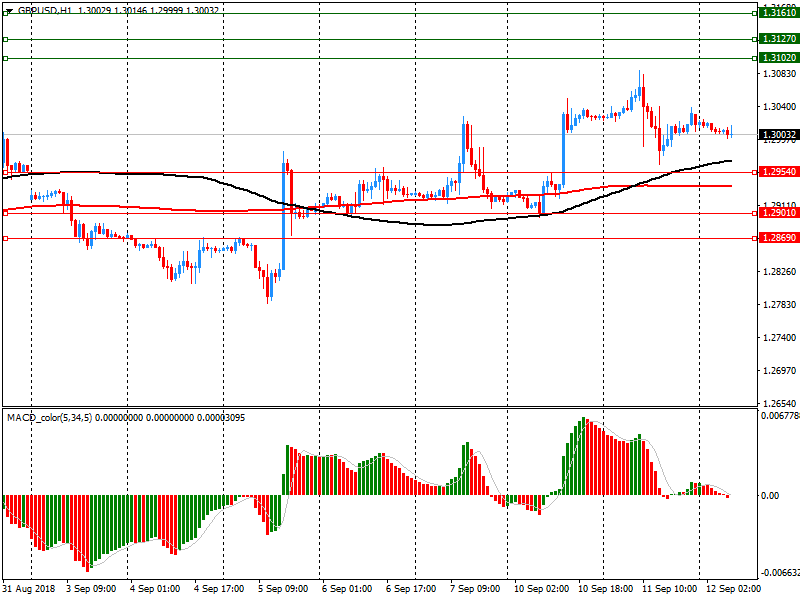
GBP/USD
Resistance levels (open interest**, contracts)
$1.3161 (1748)
$1.3127 (716)
$1.3102 (658)
Price at time of writing this review: $1.3003
Support levels (open interest**, contracts):
$1.2954 (572)
$1.2901 (1429)
$1.2869 (1566)
Comments:
- Overall open interest on the CALL options with the expiration date October, 15 is 25700 contracts, with the maximum number of contracts with strike price $1,3200 (2749);
- Overall open interest on the PUT options with the expiration date October, 15 is 27635 contracts, with the maximum number of contracts with strike price $1,2800 (2441);
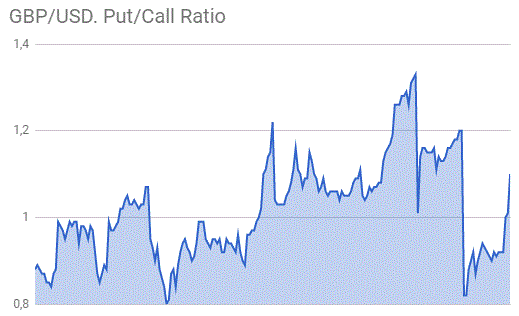
- The ratio of PUT/CALL was 1.08 versus 1.08 from the previous trading day according to data from September, 11.
* - The Chicago Mercantile Exchange bulletin (CME) is used for the calculation.
** - Open interest takes into account the total number of option contracts that are open at the moment.







© 2000-2026. All rights reserved.
This site is managed by Teletrade D.J. LLC 2351 LLC 2022 (Euro House, Richmond Hill Road, Kingstown, VC0100, St. Vincent and the Grenadines).
The information on this website is for informational purposes only and does not constitute any investment advice.
The company does not serve or provide services to customers who are residents of the US, Canada, Iran, The Democratic People's Republic of Korea, Yemen and FATF blacklisted countries.
Making transactions on financial markets with marginal financial instruments opens up wide possibilities and allows investors who are willing to take risks to earn high profits, carrying a potentially high risk of losses at the same time. Therefore you should responsibly approach the issue of choosing the appropriate investment strategy, taking the available resources into account, before starting trading.
Use of the information: full or partial use of materials from this website must always be referenced to TeleTrade as the source of information. Use of the materials on the Internet must be accompanied by a hyperlink to teletrade.org. Automatic import of materials and information from this website is prohibited.
Please contact our PR department if you have any questions or need assistance at pr@teletrade.global.


 Bank
Bank transfers


