- Analytics
- News and Tools
- Market News
Analytics, News, and Forecasts for CFD Markets: currency news — 13-01-2023.
- USD/CAD finished Friday’s session with gains, though it faltered to clear 1.3400.
- USD/CAD Price Analysis: Exposed to selling pressure below 1.3400.
The USD/CAD prolonged its weekly losses and tumbled for the fourth consecutive week, losing 0.36%, but on the day, the USD/CAD is up 0.22%. After the University of Michigan (UoM) Consumer Sentiment release showed that sentiment improved, it weighed on the US Dollar (USD). Therefore, the USD/CAD is trading at 1.3393, below its opening price by 0.37%.
USD/CAD Price Analysis: Technical outlook
Once the USD/CAD dropped below the 100-day Exponential Moving Average (EMA) at 1.3425, it was the seller’s excuse to drag the exchange rate below the 1.3400 mark. The Relative Strength Index (RSI) is still in bearish territory, suggesting that sellers are in charge. The Rate of Change (RoC) shows sellers are gathering momentum, as they outweighed buyers in Friday’s session, though it wasn’t enough to keep the pair in the green.
The USD/CAD first support level would be the November 24 daily low of 1.3316. A breach of the latter will expose the 200-day Exponential Moving Average (EMA) at 1.3239, followed by the 1.3200 figure.
On the other hand, the USD/CAD first resistance would be 1.3400. Once cleared, the bear’s next line of defense would be the 100-day EMA at 1.3425, ahead of the confluence of the 20-day EMA and the 1.3500 mark.
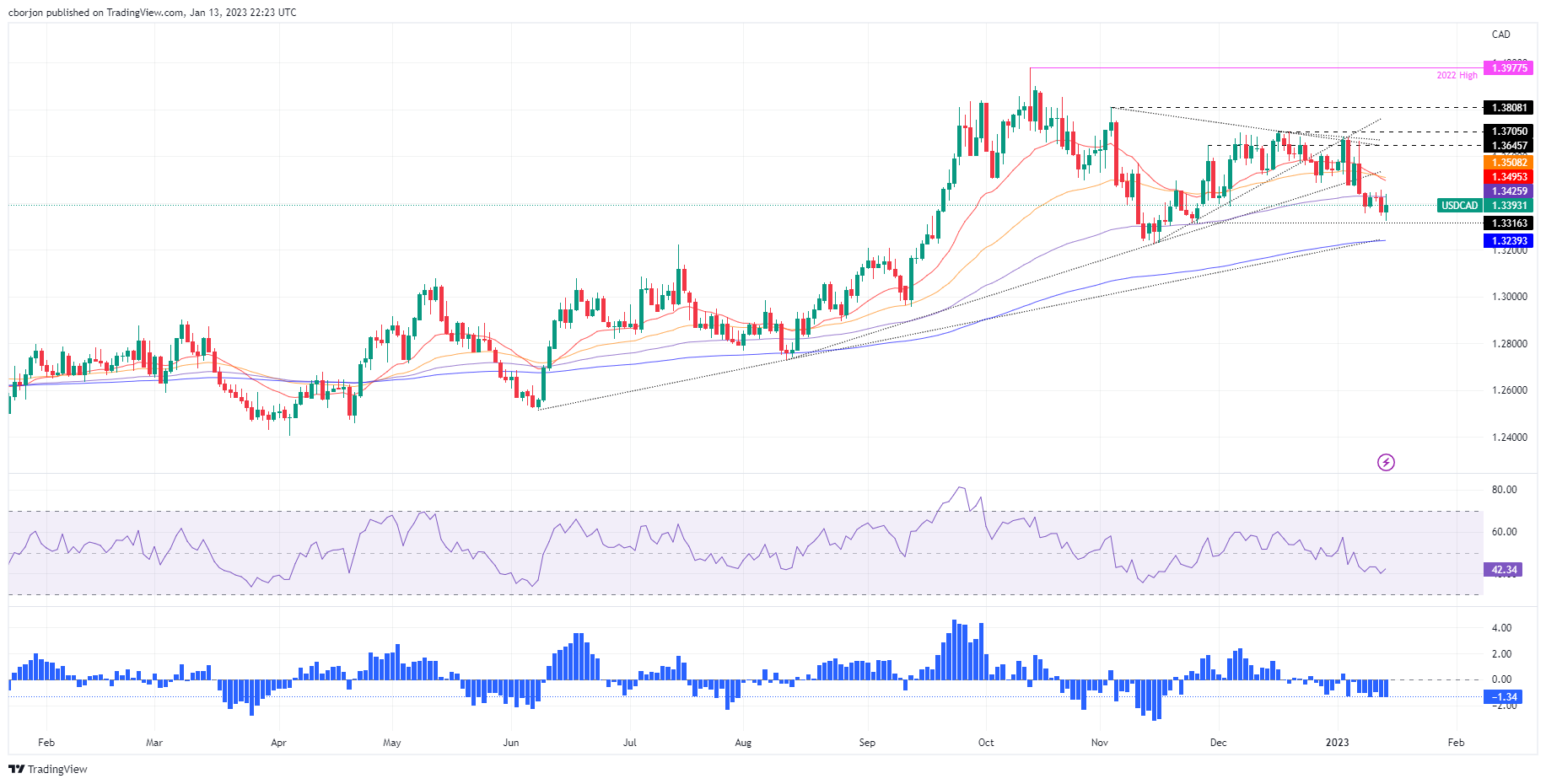
USD/CAD Key Technical Levels
- NZD/USD finished the week with solid gains of 0.6700%, spurred by softer US CPI data.
- Consumer inflation expectations in the US edged lower and weighed on the US Dollar.
- NZD/USD Technical Analysis: Failure at 0.6400, cheered by sellers, eyeing a fall to 0.6300.
The NZD/USD retraced after testing the current week’s high of 0.6417, dropped beneath the 0.6400 mark, as the pair consolidated in the 0.6300-0.6420 range during the last week’s. Positive US consumer sentiment readings proved to be harmful to the American Dollar (USD), which will end the week on a lower note. At the time of writing, the NZD/USD spot price is 0.6389, slightly down by 0.03%.
NZD/USD trimmed its daily gains, despite a risk-on impulse
Wall Street held to its gains as the week came to an end. The release of US inflation data on Thursday was cheered by investors and spurred hopes for slower rate hikes by the US Federal Reserve (Fed), weakening the US Dollar (USD). The CME FedWatchTool shows that the Fed’s probabilities for a 25 bps rate hike lie at 94.2%, which would lift the Federal Funds rate(FFR) to the 4.50% - 4.75% range.
The University of Michigan (UoM) Consumer Sentiment survey showed that sentiment improved, exceeding expectations of 60.5, coming at 64.6. Meanwhile, Americans’ inflation expectations for one year were revised to 4% from 4.4% in December, while for a five-year horizon, inflation is estimated to reach 3% from 2.9% in the previous month.
Elsewhere, the US Dollar Index (DXY), which measures the buck’s performance against a basket of six rivals, erases its earlier gains, down 0.06%, at 102.184.
NZD/USD Technical Analysis
Therefore, the NZD/USD shifted downwards though it remained supported by the 20-day Exponential Moving Average (EMA) around0.6329. Nevertheless, failure at 0.6400 exposed the NZD/USD to further selling pressure, with bears eyeing a break below the 20-day EMA ahead of testing the 0.6300 mark.
On the flip side, if the NZD/USD reclaims 0.6400, that could set the pair poised to test December 2022 high at 0.6513.
NZD/USD Key Technical Levels
- USD/CHF retraced earlier gains after printing a daily high of 0.9316.
- Upbeat US economic data is bad for the greenback as the US Dollar weakens.
- USD/CHF Price Analysis: A break / daily close below 0.9300 would expose the pair to further selling pressure.
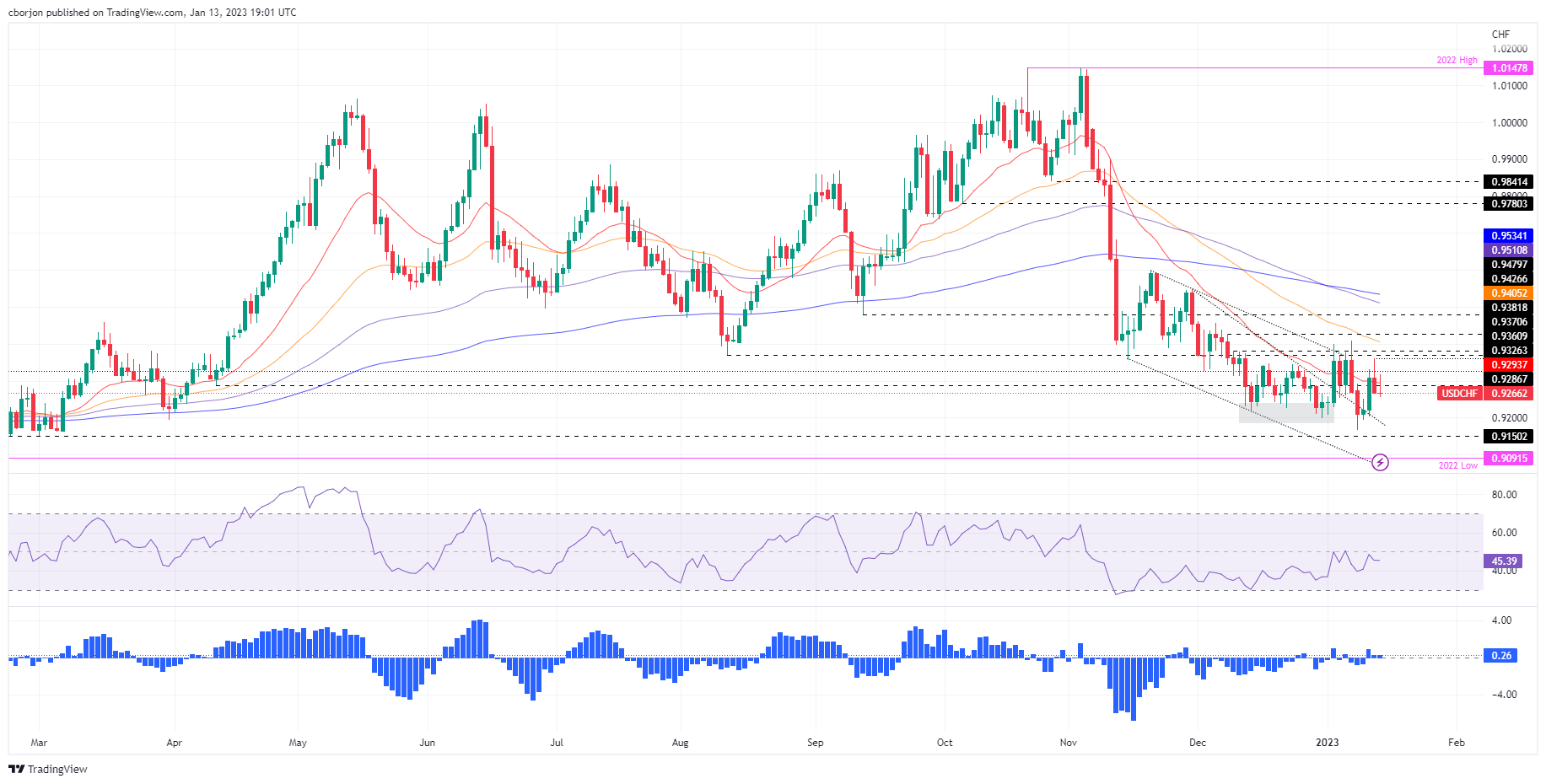
The USD/CHF is trading below its opening price, though it failed to crack the 20-day Exponential Moving Average (EMA) and missed to hold to 0.9300, albeit upbeat US data crossed newswires. Therefore, the USD/CHF is exchanging hands at 0.9265 at the time of writing.
Wall Street has resumed its uptrend after a brief hiccup that witnessed the S&P 500 and the Nasdaq turning red. Thursday’s release of softer inflation in the United States (US) spurred hopes for a less aggressive US Federal Reserve (Fed); hence the US Dollar (USD) weakened. A University of Michigan (UoM) survey showed that consumer sentiment improved, as it exceeded estimates of 60.5, hitting 64.6. In the same poll, inflation expectations for one year were revised to 4% from 4.4% in December, while for a five-year horizon, inflation is foreseen to hit 3% from 2.9% in the previous month.
In the meantime, the US Dollar Index (DXY), which measures the buck’s performance against a basket of six rivals, erases its earlier gains, down 0.04%, at 102.201.
During the session, the USD/CHF cleared the 20-day EMA at 0.9293 and cleared the 0.9300 mark. Nevertheless, as the greenback weakened, the major retreated those gains and is tumbling to fresh two-day lows around 0.9255.
USD/CHF Price Analysis: Technical outlook
From a technical perspective, the USD/CHF would likely continue its downtrend, though it’s fair to say that if not for the US CPI report missing estimates, the USD/CHF had momentum, and it could have tested the 50-day EMA at 0.9405. Aside from this, oscillators like the Relative Strength Index (RSI) and the Rate of Change (RoC) suggest that sellers remain in charge. Therefore, the USD/CHF key support levels would be 0.9200, followed by the current week’s low of 0.9167, ahead of the 2022 low of 0.9091.
- Consumer Sentiment in the United States improved and capped AUD/USD rally.
- The US last inflation report, spurred speculation that the Fed would decelerate the pace of interest rate increases.
- Improvement in Australia – China relations is a tailwind for the Australian Dollar.
The Australian Dollar (AUD) hit a fresh six-month high against the US Dollar (USD) on Friday, though it has paired some of its earlier gains, albeit Thursday’s US data showed that inflation continued to grind lower. Therefore, the AUD/USD is trading at 0.6964, almost flat at the time of typing.
Investors’ mood is mixed as US equities fluctuate between gains/losses. Hence, the AUD/USD erased its earlier gains, albeit a slowdown in core inflation data in the US suggests the US Federal Reserve might slow the pace of rate hikes ahead of the February 1 decision.
In the meantime, the US economic docket featured the Consumer Sentiment, revealed by a poll of the University of Michigan, showed an improvement, exceeding estimates of 60.5, hitting 64.6. Delving into the report, inflation expectations by US consumers were mixed, reduced in the near term, while uptick to 3% from 2.9% for a five-year period.
“Inflation is easing in the US, with markets taking that as a sign that the Fed will be able to pause, and that as the economy starts to react to the monetary tightening put into place, the Fed will cut rates in the second half of the year,” NAB analysts said.
Meanwhile, a hotter-than-expected CPI reading in Australia augmented speculations for further tightening by the Reserve Bank of Australia (RBA), bolstering the AUD/USD to fresh multi-month highs. However, money market futures shifted on the release of US CPI data, and traders expect rates to peak at around 3.73%, from 4% last week.
Another factor that underpinned the AUD was China’s easing restrictions on coal imports, which should be positive as the largest Asian economy reopens.
What to watch?
Australia: the calendar will feature Building Permits, inflation data, Consumer Confidence, and employment data.
United States: the docket will unveil Fed speaking, Retail Sales, the Producer Price Index, and housing data.
AUD/USD Key Technical Levels
Analysts at MUFG Bank have a bullish outlook for the EUR/CHF cross, considering it could benefit from a further scaling back of fears over recession in the Eurozone.
Key quotes:
“After trading within a narrow range between 0.9800 and 0.9950 throughout most of Q4, the pair has broken higher in recent days as it first climbed above the 200-day moving average at 0.9940 and then above parity for the first time since the middle of last year. We expect a further move higher back towards levels that were in place during Q2 of last year between 1.0200 and 1.0500.”
“The release today of the latest German GDP data for Q4 has provided further evidence that euro-zone economies are proving more resilient over the winter period.”
“Given the CHF’s role as a regional safe haven currency, the CHF should weaken as downside risks in the euro-zone continue to ease. We also believe there is room for EUR/CHF to play catch up with the move higher in EUR/USD since late last year. The SNB has been intervening to support the CHF recently. With inflation pressure globally and in Switzerland now easing, the SNB could become more tolerant of allowing the CHF to weaken somewhat.”
According to analysts at MUFG Bank, the Japanese Yen is set to gain further ground on the back of monetary policy expectations from the Bank of Japan. They consider possible a slide under 120.00 for later in 2023.
Key quotes:
“USD/JPY has fallen further still today and is now 15.5% down from the peak on 21st October – each of the three months in Q4 brought reason to buy the yen – intervention by the BoJ in October and November and the YCC change in December. On top of that US inflation has fallen faster than expected. Will we get another clear reason to sell USD/JPY in January too? That looks very plausible at this juncture. YCC as a policy is only sustainable if credible and has the confidence of the market. That confidence is unravelling quickly.”
“USD/JPY today broke below the 61.8% Fibonacci level (128.61) of the retracement of the entire move from March last year to the high in October and suggests further downside ahead. Positioning could be turning excessive in anticipation of a YCC change next week so a risk of a near-term correction is increasing. Nonetheless, the downside move suggests a complete reversal of the 2022 move is feasible this year implying levels below 120.00 are plausible for later this year.”
Data released on Friday showed a significant increase in Consumer Confidence in January according to the preliminary report from the University of Michigan. Analysts at Wells Fargo point out the 64.6 reading for consumer sentiment in January marks the top print in the past year. The see that the relief on the inflation front and wage growth are lifting spirits, but warn the still-sour buying conditions suggest the good vibes in this report may not translate into a spending surge.
Key quotes:
“Consumers may not feel awesome about their finances, but they are undoubtedly less worried than they were when gas prices were north of $4/gallon and wage growth wasn't keeping up with inflation. Current assessments of personal finances surged 16% to its highest reading in eight months thanks to higher incomes and easing inflation...and a bit of a bounce in the stock market certainly did not hurt either.”
“The euphoria did not extend to the housing market. Home buying conditions improved slightly but are still very near the lowest levels on record. Elsewhere, buying conditions improved somewhat in January, potentially on the back of some recent reprieve in inflation, but a majority of households still view it as a bad time to buy a major household item or vehicle. We take this as a sign that higher financing costs are weighing on the purchases of these traditionally bigger ticket items. More plainly, the good vibes in this report may not translate into a spending surge.”
“The consumer price data for December showed signs that inflation is continuing to slow and thus suggest the Fed will slow the pace of tightening at its next policy meeting on February 1 by electing to bring the federal funds rate up just 25 bps.”
- US Consumer Sentiment improved, while inflation expectations edged lower.
- UK’s GDP for the fourth quarter contracted and flashed a gloomy economic outlook.
- GBP/USD traders are eyeing UK CPI, Retail Sales, and US Retail Sales data.
The Pound Sterling (GBP) slid slightly vs. the US Dollar (USD) Friday, following the release of the University of Michigan (UoM) Consumer Sentiment for January in the US, which exceeded estimates, while the poll showed that inflation expectations for one-year were downward revised. At the time of writing, the GBP/USD is trading at 1.2204 after hitting a daily low of 1.2150.
GBP/USD range-bound awaiting next week’s data
The GBP/USD languished late in the European session/early New York session after printing a four-week high. Data released on Thursday flashed that inflation in the United States (US) is indeed cooling down. With December’s Consumer Price Index (CPI) dropping beneath 7% and core CPI below 6%, spurring hopes that the US Federal Reserve would shift to lower-sized rate hikes, in the amount of 25 bps.
Later, the University of Michigan (UoM) revealed that Consumer sentiment for January was better than expected, with the reading hitting 64.6 vs. forecasts of 60.5. Americans estimate inflation for one year would edge to 4%, from December’s 4.4%, while estimates for five years uptick to 3%, from 2.9%.
In the UK, the Gross Domestic Product (GDP) on a monthly basis beat estimates, rising by 0.1%, while for a three-month changed was at -0.3%, cementing the case for a gloomy economic outlook.
Looking ahead to next week, the UK economic docket will feature labor market data, the Consumer Price Index, and Retail Sales. Across the pond, the US economic docket will unveil Retail Sales, US Housing Starts, Initial Jobless Claims, and Existing Home Sales.
GBP/USD Key Technical Levels
- EUR/USD about to post the highest weekly close since May 2022.
- US Dollar back under pressure, heads for sharp weekly losses.
- US Consumer Confidence rises more than expected in January.
The EUR/USD trimmed daily losses during Friday’s American session, rising back above 1.0800. The euro was holding onto significant weekly gains, headed toward the biggest close since May 2022.
US Dollar recovers but remains under pressure
The US Dollar rebounded modestly on Friday after a sharp decline the day before, following US inflation data. The numbers showed the Consumer Price Index slowed down further in December, increasing expectations that the Federal Reserve will hike by 25 basis points in February, instead of 50 bps.
Data released on Friday showed the University of Michigan Consumer Sentiment Index rose in January to 64.6, surpassing expectations of 60.5 and above the 59.7 of December. The numbers helped risk appetite but not the Dollar that pulled back.
EUR/USD resumes uptrend
After pulling back last week, EUR/USD resumed the upside breaking the 1.0700 area decisively. The chart shows the euro clearly bullish but many technical indicators are in overbought territory.
“Should the pair advance beyond 1.0870, the bullish case will gain adepts. 1.0950 and 1.1020 are the next resistance levels to watch, ahead of the afore mentioned 1.1106. A daily close below 1.0745 will discourage buyers, and could trigger a downward corrective extension, initially towards 1.0640 and later to 1.0515, the 50% retracement of the 2022 slump”, says Valeria Bednarik, Chief Analyst at FXStreet.
Technical levels
Gold has climbed above $1,900 for the first time in seven months ahead of the weekend. But the technical outlook suggests XAU/USD eyes correction before extending rally, FXStreet’s Eren Sengezer reports.
$1,880 aligns as initial support
“XAU/USD's near-term technical outlook points to overbought conditions with the pair trading slightly above the ascending regression channel coming from early November and the daily Relative Strength Index (RSI) holding above 70. Hence, Gold could stage a technical correction before extending its uptrend.”
“On the downside, $1,880 aligns as initial support ahead of $1,860. In case the latter support fails, XAU/USD could continue to fall toward $1,830.”
“In case Gold price stabilizes above $1,900 and confirms that level as support, it could target $1,920, $1,940 and $1,960, all static levels from April 2022.”
Economists at TD Securities think the Yen will trade with an asymmetric bias that is tilted to the upside.
EUR/JPY: Downside towards 130 in the coming months is likely
“With the Fed ceding leadership on policy to the ECB and the BoJ, JPY trading bias remains asymmetric and with considerable room for gains.”
“We expect USD/JPY to register a 120-125 handle this quarter. We think rallies to 133/134 in will make for an attractive short.”
“We are biased to appreciable strategic EUR/JPY downside towards 130 in the coming months.”
- Gold price continued to extend its weekly gains, above the $1,900 mark.
- Trader’s speculations that the US Federal Reserve would slow rate hikes pace boosted Gold prices.
- Gold Price Analysis: Daily close above $1,920 could pave the way toward $2,000.
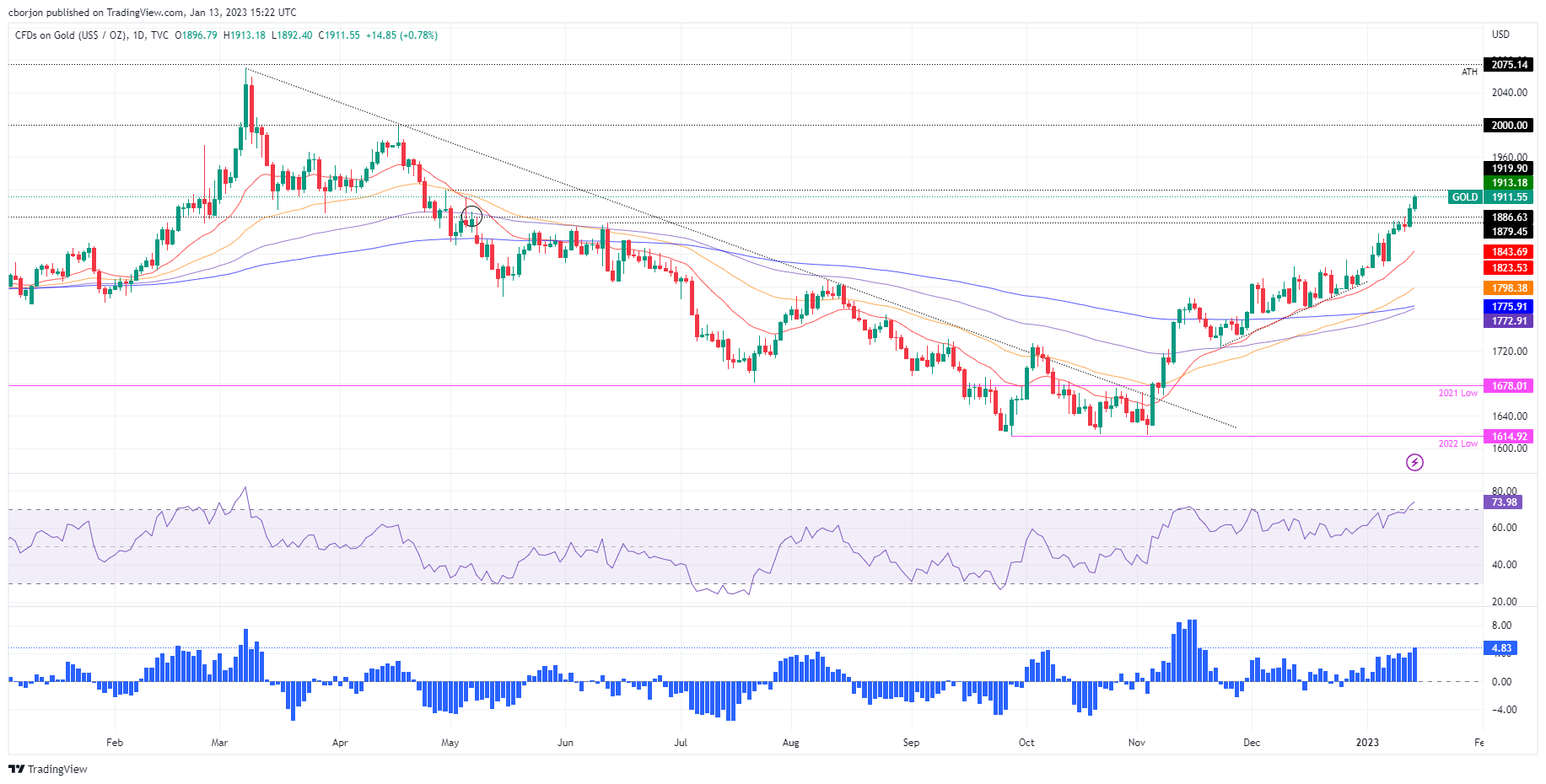
Gold price hit a new 9-month high at $1,913.18 on Friday, amidst investors’ speculations that the US Federal Reserve (Fed) could shift to a less aggressive stance following the release of softer inflation data. Therefore, XAU/USD is trading at $1,912, gains 0.82%, headed for a fourth consecutive week of gains.
XAU/USD got bolstered by speculations of a less hawkish Fed, falling US bond yields
Global equities remain mixed, while Wall Street is headed for a soft opening. Earnings season began in the United States (US), with banks like Bank of America and JP Morgan topping expectations, while Wells Fargo missed estimates, as reported by Q4 results. Thursday’s US inflation report, which witnessed December’s Consumer Price Index (CPI) dropping beneath 7% and core CPI below 6%, was cheered by the financial markets.
In the meantime, the greenback is staging a recovery though it’s been ignored by Gold traders. The US Dollar Index, which tracks the buck’s value against a basket of peers, is trimming some of its weekly losses, gaining 0.18%, at 102.418.
Another reason bolstering XAU/USD’s recent price action is US Treasury bond yields. The 10-year benchmark note rate tumbles one bps, down at 3.434%, though it has fallen 12 bps in the week.
According to the CME FedWatch Tool, odds for a 25 bps rate hike by the Federal Reserve lie at a 94.2% chance after the release of US inflation.
Meanwhile, the University of Michigan’s Consumer Sentiment for January beat estimates of 60.5 and reached 64.6. Regarding consumer inflation expectations, for one year, it dropped from 4.4% to 4%, while for a 5-year horizon ticked to 3% from 2.9%.
Gold Price Analysis: Technical outlook
From a daily chart perspective, XAU/USD would likely continue to edge higher, as it has broken May 5, 2022, daily high of $1909.80. Oscillators like the Relative Strength Index (RSI) at overbought conditions but still beneath the 80 mark suggest the uptrend continues to gain strength. While the Rate of Change (RoC), portrays that buyers are gathering momentum.
Gold key resistance levels would be the April 29 high of $1,919.90, followed by April 18 at $1,998.39, slightly below $2,000.
Despite 2022’s drawdown, analysts at Barclays believe that global equity markets have room to drop further.
Cash should be the real winner of 2023
“We observe that US stocks tend to bottom out 30-35% below peak in the middle of a recession. That suggests fair value of 3200 on the S&P500 sometime in H1 23. European valuations look more reasonable, but that is offset by a considerably worse macro outlook than in the US.”
“Bonds have massively underperformed equities in 2022, and our analysts now see limited downside in longer US fixed income. If forced to choose between stocks and bonds, we would be overweight core fixed income over equities.”
“But cash should be the real winner of 2023, with US front-end yields likely to go to 4.5% or higher and stay there for several quarters. The ability to earn over 4% while taking virtually no risk is a factor that should drag on both stock and bond markets next year.”
- Japanese yen extends gains across the board on Friday.
- US Dollar up for the day, sharply lower for the week.
- USD/JPY drops for the second day in a row.
The USD/JPY is falling sharply for the second day in a row and it is trading under 128.00 at the lowest level since late May of last year. The decline takes place even amid a modest recovery of the US Dollar following Thursday’s slide after US CPI data.
After a short-lived recovery, USD/JPY resumed the downside, breaking below 128.00. As of writing, it is trading at fresh lows at 127.70/75, as the recovery of the greenback losses momentum and Wall Street moves off lows.
Japanese Yen among the top performers
The divergence between the Federal Reserve and the Bank of Japan that has been boosting the USD/JPY pair for months has now partially reversed, not because of clear action but on the back of a change in expectations. The Fed is seen near the end of its rate hike cycle while there are growing speculations about a shift at the Bank of Japan. Some reports indicate the BoJ could review the side effects of its ultra-accommodative policy as soon as next week.
Japanese bond yields soared also helping the JPY. The 10-year yield rose to the highest since 2015. On the contrary, the decline in US yields weighed on USD/JPY. The US 10-year yield stands at 3.46% compared to 3.70% from a week ago.
On Friday, the deterioration in risk sentiment contributed to the strength of the Japanese currency. The Dow Jones is falling by 0.15% while the Nasdaq declines by 0.35%.
The latest economic report of the week showed the US Michigan Consumer Sentiment Index rose in January to 64.6 surpassing expectations of 60.5.
Technical levels
- Consumer confidence in the US continued to rise in early January.
- US Dollar Index holds in daily range above 102.00 after the data.
Consumer sentiment improved in the US in early January with the University of Michigan's (UoM) Consumer Confidence Index rising to 64.6 from 59.7 in December. This reading came in better than the market expectation of 60.5.
"Year-ahead inflation expectations receded for the fourth straight month, falling to 4.0% in January from 4.4% in December," the UoM noted in its publication. "The current reading is the lowest since April 2021 but remains well above the 2.3-3.0% range seen in the two years prior to the pandemic."
Finally, long-run inflation expectations were little changed from December at 3.0%, again staying within the narrow 2.9-3.1% range for 17 of the last 18 months.
Market reaction
The US Dollar Index showed no immediate reaction to this report and was last seen trading little changed on the day at 102.28.
USD/JPY accelerates the downfall to 128.00. The pair could dive as low as 124.00, economists at Société Générale report.
Channel at 134/134.80 should cap short-term upside
“Daily MACD has flattened recently however signals of an extended bounce are not yet visible.”
“The pair is likely to drift towards next projections at 128 and 126.80. Peak of 2015 near 125.85/124.00 could be the next significant support zone.”
“The channel at 134/134.80 should cap short-term upside.”
See: USD/JPY looks set to challenge the 126.50 mark – ING
- The index reverses part of the recent acute sell-off.
- US yields remain directionless across the curve on Friday.
- Flash Michigan Consumer Sentiment will be next on tap.
The greenback’s recovery picks up extra pace and revisits the 102.65/70 band when gauged by the USD Index (DXY) on Friday.
USD Index meets contention around 102.00
Following the earlier retracement to levels just below the 102.00 mark, the index manages to regain some composure and advance to the 102.60 region on the back of the profit talking sentiment in the risk complex.
In the US money markets, yields across the curve advance marginally as market participants continue to assess Thursday’s soft US inflation figures for the month of December and the expected impact on the Fed’s tightening cycle.
Later in the session, the advanced reading of the Michigan Consumer Sentiment is predicted to have improved a tad to 60.5 for the current month.
What to look for around USD
The dollar remains under pressure despite the firm rebound from post-US CPI lows near 102.00, an area last visited back in June 2022.
Another soft prints from US inflation figures in December prop up the idea of a probable pivot in the Fed’s policy in the next months, which also comes in contrast to the hawkish message from the latest FOMC Minutes and recent rate-setters, all pointing to the need to remain within a restrictive stance for longer, at the time when the likelihood any interest rate reduction in the current year remains near zero.
On the latter, the tight labour market and the resilience of the economy are also seen supportive of the firm message from the Federal Reserve and its hiking cycle.
Key events in the US this week: Flash Michigan Consumer Sentiment (Friday).
Eminent issues on the back boiler: Hard/soft/softish? landing of the US economy. Prospects for further rate hikes by the Federal Reserve vs. speculation of a recession in the next months. Fed’s pivot. Geopolitical effervescence vs. Russia and China. US-China trade conflict.
USD Index relevant levels
Now, the index is gaining 0.14% at 102.38 and faces the next hurdle at 105.63 (monthly high January 6) followed by 106.39 (200-day SMA) and then 107.19 (weekly high November 30). On the other side, the breach of 102.07 (monthly low January 12) would open the door to 101.29 (monthly low May 30) and finally 100.00 (psychological level).
In the view of economists at Wells Fargo, end to monetary tightening should bring the US Dollar's gains to an end by early 2023.
Eventual US recession to soften the greenback
“An end to rate hikes will coincide with an end to USD gains during early 2023. Indeed, we believe a peak in the trade-weighted US Dollar for the current cycle has already been reached.”
“Over time, we forecast a trend of USD depreciation to gather pace. Initially, that depreciation may be modest during the latter part of 2023, as the US economy falls into recession while other international economies stabilize.”
“We forecast a somewhat more pronounced pace of USD depreciation in 2024, once the Fed begins cutting its policy interest rate by early next year.”
Bank of Korea (BoK) decided to hike its policy rate today by 25 bps to 3.50%. Economists at TD Securities expect the Won to strengthen in the weeks ahead.
Less urgency to tighten further
“BoK hiked its 7-day repo rate by 25 bps to 3.50% as widely expected. The decision was not unanimous however, with two members opposing the decision voting for rates to remain on hold.”
“While there was no clear signal that BoK has reached terminal we think the bar is high for another hike in the months ahead. Weakening growth, eating inflation pressures and a stronger KRW suggest less urgency to tighten further. Markets are also pricing no further tightening. However, we concur that rate pricing for a cut in the next 6 months is premature.”
“Meanwhile, KRW is likely to remain a key beneficiary of USD weakness in the weeks ahead.”
China FX has front-loaded the China reopening and economists at Société Générale are cautious about chasing a CNY rally.
Neutral on Yuan
“As USD/CNY has already reversed more than 50% of the rise in 2022, it would be necessary to feed more positive surprises to the market to deepen a CNY rally to the 6.30 level, but we are sceptical.”
“Our year-end USD/CNY forecast of 6.80 incorporates a ‘gradual’ turnaround in major policies including Zero-COVID. However, nearly all major policies that were seen as negative to the market have been reversed in the past two weeks.”
“The FX market has selectively front-loaded the positive policy surprises and their future implications for the economy.”
- USD/CAD stages a solid intraday recovery amid a strong pickup in the USD demand.
- Rebounding US bond yields and the risk-off impulse lifts the safe-haven greenback.
- Positive crude oil prices could underpin the Loonie and cap the upside for the major.
The USD/CAD pair rebounds sharply from the 1.3320 area, or its lowest level since November 25 touched earlier this Friday and scales higher through the early North American session. The momentum lifts spot prices further beyond the 1.3400 mark and is sponsored by a goodish pickup in the US Dollar demand.
The USD Index, which measures the greenback's performance against a basket of currencies, stages a solid recovery from a seven-month low and draws support from a combination of factors. Concerns about a deeper global economic downturn continue to cap any optimism in the markets. This is evident from a fresh wave of the global risk-aversion trade and benefits the safe-haven status buck. Apart from this, an intraday rally in the US Treasury bond yields offers additional support to the USD.
That said, growing acceptance that the Federal Reserve will soften its hawkish stance could act as a headwind for the US bond yields and the greenback. In fact, the markets are now pricing in a smaller 25 bps rate hike in February. The bets were lifted by Thursday's release of the US consumer inflation figures and comments by several Fed officials. This, in turn, might hold back the USD bulls from placing aggressive bets and keep a lid on any meaningful upside for the USD/CAD pair.
Apart from this, positive crude oil prices could underpin the commodity-linked Loonie and contribute to capping the USD/CAD pair. Hence, it will be prudent to wait for strong follow-through buying before confirming that spot prices have formed a near-term bottom and positioning for further gains. Traders now look to the Preliminary Michigan Consumer Sentiment Index from the US for some impetus. This, along with oil price dynamics, could allow traders to grab short-term opportunities.
Technical levels to watch
- EUR/USD sees its recent strong advance momentarily halted.
- The resumption of the bullish bias should target the 1.0900 level.
EUR/USD comes under pressure soon after hitting fresh 9-month peaks around 1.0870 on Friday.
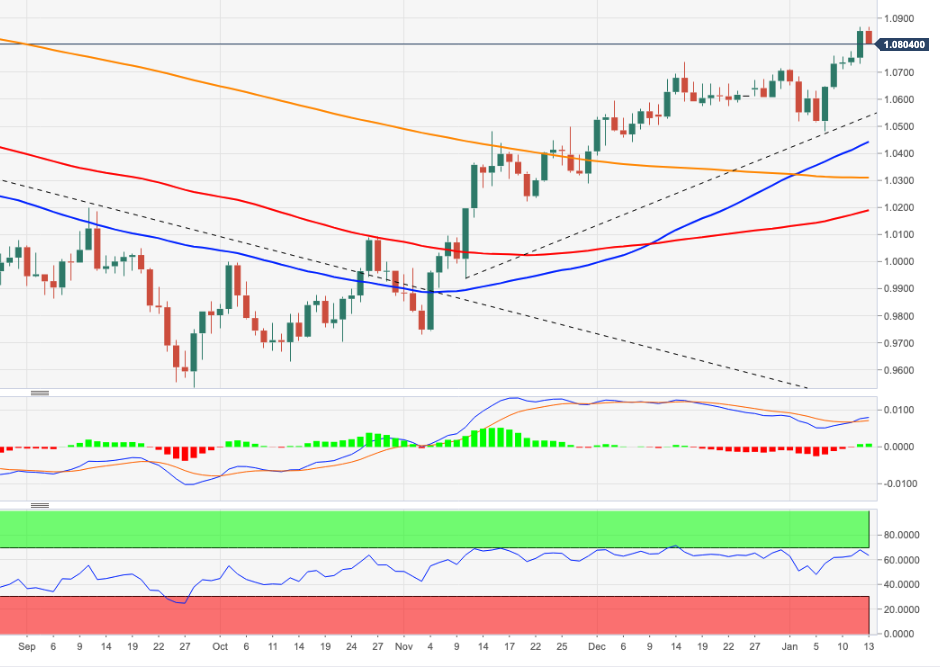
Despite the ongoing knee-jerk, bulls remain well in control of the mood around the pair for the time being. Against that, further north of the so far YTD high at 1.0867 (January 13) should appear the round level at 1.0900 in the short-term horizon.
Furthermore, while above the short-term support line near 1.0550, the pair should maintain its bullish outlook.
In the longer run, the constructive view remains unchanged while above the 200-day SMA at 1.0308.
EUR/USD daily chart
US Treasury Secretary Janet Yellen told the NPR on Friday that inflation has been quite moderate for the last six months but noted that rent indexes were still rising.
Yellen further added that she was expecting rent indexes to come down substantially in next six months and said that she sees a path to loft landing for the US economy.
Market reaction
The US Dollar Index showed no immediate reaction to these comments and was last seen rising 0.2% on a daily basis at 102.45.
White House economic adviser Brian Deese told CNBC on Friday that the investment environment for the next two-to-five years in the US looks promising, as reported nu Reuters.
"We have seen real progress in price reductions for households in past six months, including gas price moderation," Deese noted and added that Congress will need to address US debt limit without conditions or drama.
Market reaction
These comments don't seem to be having a significant impact on the US Dollar's performance against its rivals. As of writing, the US Dollar Index was up 0.15% on a daily basis at 102.40.
- AUD/USD fails ahead of the 0.7000 mark and corrects from a multi-month top touched on Friday.
- A combination of factors helps revive the USD demand and exerts downward pressure on the pair.
- The technical setup favours bulls and supports prospects for the emergence of some dip-buying.
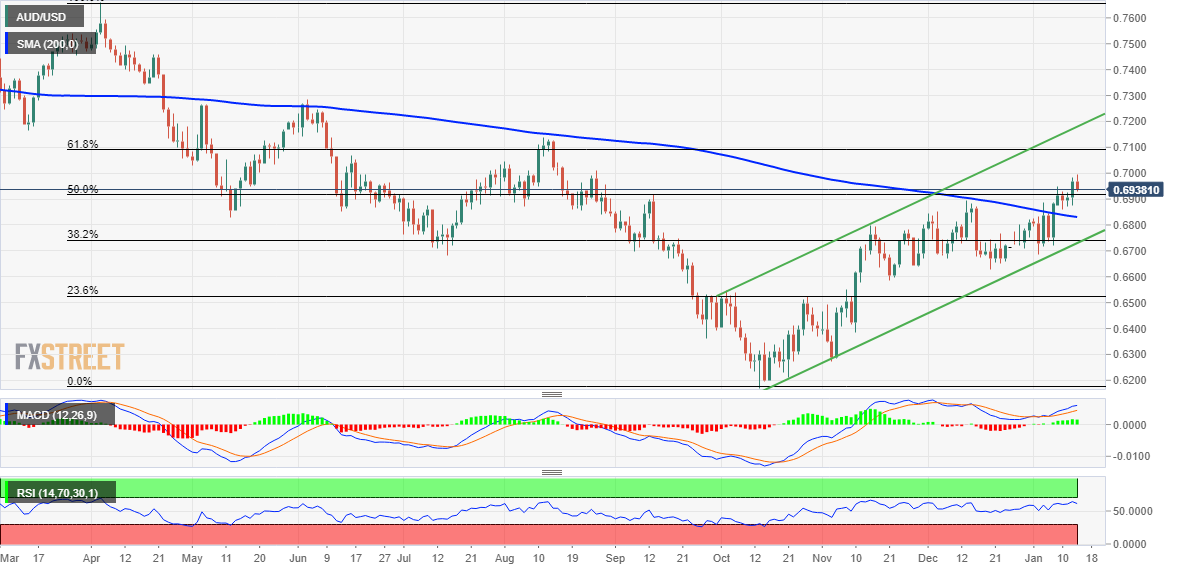
The AUD/USD pair retreats from the vicinity of the 0.7000 psychological mark or the highest level since August 26 and continues losing ground through the early North American session. The pair drops to a fresh daily low, around the 0.6935 region in the last hour, eroding a part of the previous day's post-US CPI gains and snapping a two-day winning streak.
A modest bounce in the US Treasury bond yields helps the US Dollar to stall its recent decline to a seven-month low. Apart from this, the risk-off impulse - as depicted by a sharp fall in the equity markets - further benefits the greenback's relative safe-haven status and weighs on the risk-sensitive Aussie. That said, rising bets for smaller Fed rate hikes might keep a lid on any meaningful gains for the buck and limit deeper losses for the major, at least for the time being.
From a technical perspective, the AUD/USD pair has been scaling higher along an ascending channel over the past three months or so, which points to a well-established uptrend. Adding to this, the recent breakout through the very important 200-day SMA and the overnight strength beyond the 50% Fibonacci retracement level of the April-October 2022 downfall favours bullish traders. This, along with positive oscillators on the daily chart, supports prospects for the emergence of some dip-buying.
Hence, any subsequent slide is more likely to find decent support near the 0.6900 mark ahead of the 0.6870-0.6865 horizontal zone. This is followed by support near the 0.6830 region (200- DMA), which should now act as a pivotal point for the AUD/USD pair. A convincing break below could accelerate the fall towards the 0.6800 mark en route to the trend-channel support. The latter is pegged around the mid-0.6700s and nears the 38.2% Fibo. level, which should protect any further decline.
On the flip side, bulls might now wait for a sustained strength beyond the 0.7000 mark before placing fresh bets. The AUD/USD pair might then aim to surpass an intermediate hurdle near the 0.7030-0.7035 region and the 0.7070-0.7075 zone before eventually climbing to the 0.7100 round figure.
AUD/USD daily cahrt
Key levels to watch
Gold has continued on the road to recovery this week. However, economists at Commerzbank expect the yellow metal to struggle to extend its gains.
Short-term-oriented investors are optimistic
“We believe that the market will initially take a breather until it becomes clearer whose prediction of the future course of US monetary policy is more accurate – the market’s or the Fed’s.”
“The CFTC’s data are likely to confirm once again that short-term-oriented investors in particular are optimistic; by contrast, the stagnating ETF holdings indicate that ETF investors remain sceptical.”
- The index manages to regain some poise near 102.00.
- Further losses remain on the cards below 102.00.
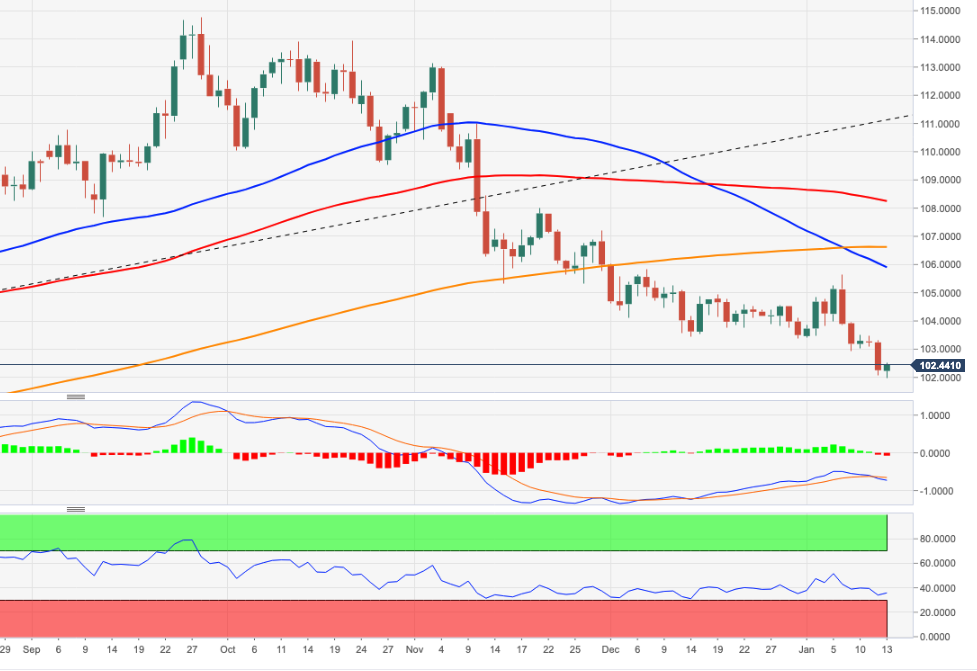
Finally, some respite for the dollar sees the index pick up some upside traction and leave the area of recent lows near the 102.00 yardstick on Friday.
In case bears regain the upper hand, the loss of the January low at 101.98 (January 13) should put a potential deeper drop to the May 2022 low around 101.30 (May 30) back on the investors’ radar prior to the psychological 100.00 level.
In the meantime, while below the 200-day SMA at 106.39 the outlook for DXY should remain tilted to the negative side.
DXY daily chart
- EUR/JPY adds to Thursday’s strong pullback and breaches 140.00.
- The loss of the 200-day SMA opens the door to extra decline.
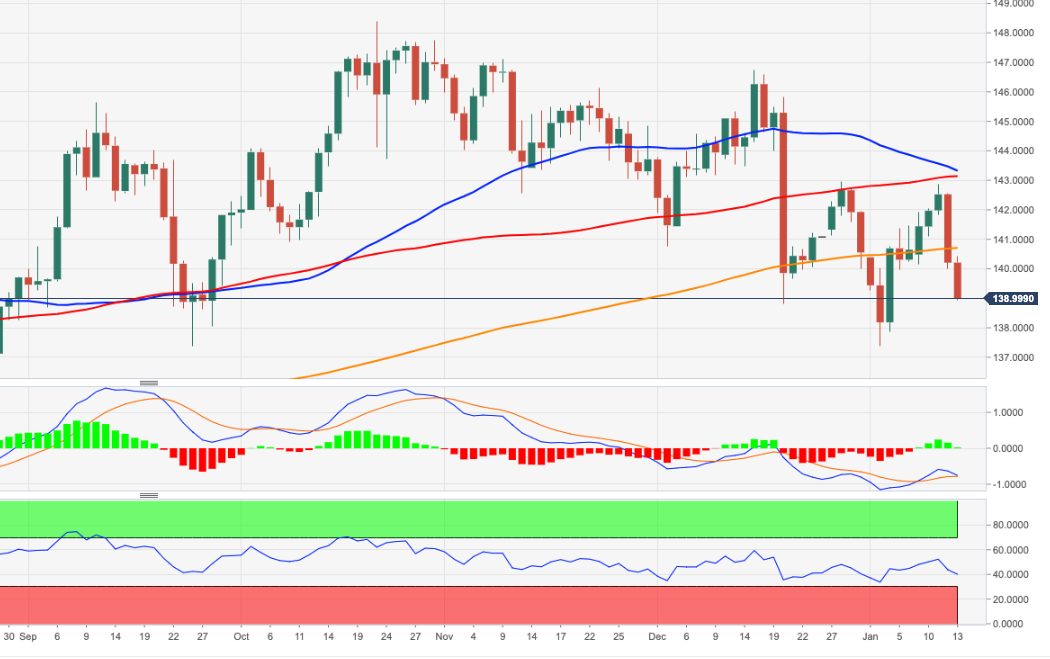
EUR/JPY extends the weekly leg lower and drops to multi-session lows just below the 139.00 mark on Friday.
The acute correction forces the cross to break below the key 200-day SMA (140.67) and paves the way for a deeper retracement in the short term. Against that, EUR/JPY could revisit the so far YTD low at 137.38 (January 3), which also coincides with the September 2022 low.
The outlook for EUR/JPY should remain negative while below the 200-day SMA.
EUR/JPY daily chart
GBP/USD drifts from the 1.2250 area. A dip under 1.2180 could drag the pair down a little more, in the view of economists at Scotiabank.
Resistance is seen at 1.2250
“A sharp rebound from last week’s low and additional gains in Cable this week are positive developments for the Pound but Cable gains are struggling to overcome still weak or bearish longer run trend oscillators which may hamper progress unless or until spot can better the Dec peak at 1.2450.”
“Intraday losses below 1.2180 may see the Pound dip a little more.”
“Resistance is 1.2250. Firmer support is 1.2100/10.”
EUR/USD consolidates gains above 1.08. Economists at Scotiabank expect the world’s most popular currency pair to test the 1.10 level.
Minor dips set to remain well-supported
“A solid, technical bull trend in the EUR/USD pair is developing and minor dips are set to remain well-supported as a consequence.”
“EUR gains through the 1.0700/50 zone this week imply more near-term upside risk towards the 1.1000/50 area at least.”
“Resistance is seen at 1.0900/10.”
See: EUR/USD could extend its race higher to the 1.0950 mark – ING
- GBP/USD struggles to capitalize on its modest intraday gains to a nearly one-month high.
- A modest USD recovery attracts fresh sellers amid a bleak outlook for the UK economy.
- Bets for smaller Fed rate hikes could cap the greenback and lend support to the major.
The GBP/USD pair retreats from nearly a one-month high, around mid-1.2200s set earlier this Friday and hits a fresh daily low during the mid-European session. Spot prices drop to the 1.2170 region in the last hour, reversing a part of the previous day's positive move.
A combination of factors assists the US Dollar to stage a goodish recovery from its lowest level since June, which, in turn, attracts fresh sellers around the GBP/USD pair. An uptick in the US Treasury bond yields, along with a softer risk tone, help revive demand for the safe-haven greenback. The worst COVID-19 outbreak in China, which overshadows the optimism led by the country's pivot away from its zero-COVID policy. Apart from this, the protracted Russia-Ukraine war has been fueling worries about a deeper global economic downturn and weighing on investors' sentiment.
The GBP bulls, meanwhile, seem rather unimpressed by the better-than-expected UK monthly GDP print, which showed that the domestic economy posted a modest 0.1% growth in November. This, however, was largely offset by the disappointing release of the UK Manufacturing and Industrial Production figures. The data adds to a bleak outlook for the domestic economy and fuels speculations that the Bank of England (BoE) is nearing the end of the current rate-hiking cycle. This exerts additional downward pressure on the GBP/USD pair, though the downside seems limited, at least for now.
The UK consumer inflation figures released on Thursday reinforced market expectations that the Fed will soften its hawkish stance. Adding to this, several FOMC members backed the case for a smaller 25 bps rate hike in February. This might keep a lid on any meaningful upside for the US bond yields and act as a headwind for the greenback, warranting some caution before placing aggressive bearish bets around the GBP/USD pair. Market participants now look forward to the US economic docket, featuring the Preliminary Michigan Consumer Sentiment Index for a fresh trading impetus.
Technical levels to watch
Another surprise policy change by the Bank of Japan next week it is not a high probability outcome. In the view of economists at Credit Suisse, an unchanged outcome might cause some disappointment.
Fading USD/JPY strength towards the top end of the target range at 135.00
“Ahead of next week’s BoJ rate decision, markets are aware of the risk of further possible tweaks to YCC policy, but do not seem to attribute a high probability to it.”
“While we acknowledge some potential for disappointment in the event of an unchanged policy outcome, we continue to see the USD/JPY outlook as asymmetrical to the downside, we hold on to our 125.00 Q1 target and remain committed to fading USD/JPY rallies to the top of our 120.00-135.00 target range.”
The US Dollar is weaker but trading has been choppy following the US December inflation data. Economists at Scotiabank expect USD weakness to linger in 2023.
USD yield support has peaked
“Peak US inflation means peak US yields which in turn means peak USD.”
“Friction between Fed messaging and market pricing may keep the USD trend choppy in the near-term.”
“Positioning and sentiment have shifted against the USD in the past month or two but there is ample room for this trend to develop.”
EUR/CHF has broken out above the sideways range since October affirming extension in up move. Economists at Société Générale expect the pair to extend its advance.
0.9970/0.9950 to be important support near term
“The pair is expected to head higher gradually towards 1.0130 and projections of 1.0240/1.0260; this could be an interim resistance zone.”
“Upper end of previous consolidation zone and the 200-Day Moving Average at 0.9970/0.9950 is likely to be an important support near term.”
See: EUR/CHF could extend its advance back to levels between 1.02 and 1.04 – MUFG
Brent has dropped just below $80/b territory recently. Strategists at TD Securities expect the global benchmark crude to trade at $100/b in the latter part of 2023.
China reopening and OPEC rightsizing to place bid under Oil
“The prospects for crude oil should materially improve as the New Year matures. Once China normalizes post-COVID, the Middle Kingdom's consumption should jump by as much as one million b/d over the next six months from recent lows, with demand increasing another 0.5 million b/d by year-end. At the same time, the worst of the demand erosion in the Western world should also end.”
“Supply side will likely help to tighten conditions to support prices. Saudi Arabia and friends may right-size production to match any demand growth decline later in the year. It is possible that OPEC will cut production just as Chinese demand starts to bounce higher. Plus, at the same time, the market will price the Fed tilting toward a more dovish policy, which should attract specs back into the market en masse.”
“We judge that $100/b Brent is within reach in the latter part of 2023.”
USD/JPY remains the stand-out interest. Economists at ING expect the pair to nosedive towards the 126.50 mark.
Plenty of downside in USD/JPY
“The BoJ may be on the verge of its biggest policy change in decades. Even short-dated JPY Interest Rate Swaps have started to move and are at the highest levels (near 30 bps) since 2008!”
“Clearly, USD/JPY has come a long way very fast, but some of the longer-term skews in the FX options market point to a structural shift in the market’s view in USD/JPY.”
“We suspect few will want to stand in the way of the USD/JPY downside.”
“126.50 looks like the clear near-term target for USD/JPY.”
- USD/CAD drops to its lowest level since November and is pressured by a combination of factors.
- Bullish oil prices underpin the Loonie and act as a headwind amid the prevalent USD selling bias.
- The fundamental backdrop favours bearish traders and supports prospects for additional losses.
The USD/CAD pair attracts fresh sellers in the vicinity of the 1.3400 mark on Friday and drops to its lowest level since November 25 during the first half of the European session. The pair is currently placed just below mid-1.3300s, down around 0.15% for the day, and is pressured by a combination of factors.
Crude oil prices trade with modest gains near a one-and-half-week high amid hopes that China's pivot away from its zero-COVID policy will boost fuel demand. This, in turn, is seen underpinning the commodity-linked Loonie, which, along with the prevalent US Dollar selling bias, drags the USD/CAD pair lower for the second straight day.
The USD Index, which measures the greenback's performance against a basket of currencies, languishes near a seven-month low amid expectations that the Fed will soften its hawkish tone. The bets for smaller Fed rate hikes were lifted by the US consumer inflation figures and comments by several FOMC officials on Thursday.
In fact, the markets now seem convinced that the Fed will further slow the pace of its rate-hiking cycle and deliver a smaller 25 bps lift-off in February. This, in turn, keeps the US Treasury bond yields depressed near a multi-week low, which, along with a positive risk tone, continues to weigh on the safe-haven greenback.
Traders now look to the US economic docket, featuring the release of the Preliminary Michigan Consumer Sentiment Index later during the early North American session. This, along with oil price dynamics, could provide some impetus to the USD/CAD pair. Nevertheless, spot prices remain on track to end in the red for the fourth straight week.
Technical levels to watch
The Australian Dollar is likely to remain the favoured G10 expression of the bullish implications for China-sensitive currencies. Thus, the AUD/USD pair could hit the 0.74 level sooner than economists at Société Générale expected.
Asia should benefit from China’s recovery, lifting the Aussie
“As Australia is a major exporter of raw materials, including energy, metals and agriculture, there are clear direct benefits to a rapid Chinese re-opening, but they may be less important than the impact of improved broader Asian economic prospects, which would help the Australian economy.”
“The Aussie has been held back by the RBA being less aggressive in tightening monetary policy than other central banks, but a boost to exports in the months ahead, when the Federal Reserve is approaching the end of its tightening cycle, could see a move in AUD/USD to our year-end target (0.74) sooner than expected.”
Economists at ING recaps their forecasts for the CEE currencies. In their view, the region could enjoy mild gains.
Higher EUR/USD is a small boost for region
“On the FX market, we found the CEE currencies almost unchanged after yesterday's US inflation number. However, higher EUR/USD today will give them a chance to erase this week's losses. But still, it shouldn't change much in the picture of a flat week.”
“For the Polish Zloty we see a return below 4.680 EUR/PLN and for the Czech Koruna levels below 24.00 EUR/CZK.”
“Hungarian inflation numbers should be good news for Forint and we can go back below 396 EUR/HUF.”
Economist at UOB Group Ho Woei Chen assesses the latest inflation figures in China and potential moves by the PBoC.
Key Takeaways
“Headline CPI inflation edged higher to 1.8% y/y in Dec in line with expectation. This was helped by a low base comparison arising from the decline in food prices in the year-ago period. However, the broader price pressure has continued to be contained in Dec, with core inflation at a modest 0.7% y/y and services inflation at 0.6% y/y.”
“Meanwhile, the deflation trend in the PPI is likely to continue through 1H23. Despite the boost to demand from China’s Covid reopening, the recovery in prices would still be affected by a high base comparison and drag from weaker global demand.”
“For the full year in 2022, headline and core inflation registered 2.0% and 0.9% respectively. We forecast headline inflation to rise to 2.8% this year given the low base comparison and expected recovery in consumption demand which will gain more traction ahead with the borders reopening. For the PPI, we expect it to be flat in 2023 after rising 4.1% y/y in 2022.”
“We see prospects for the 1Y LPR to fall to 3.55% and 5Y LPR to 4.20% by end1Q23. Consensus forecast is factoring in the possibility of a 5-15 bps decline in the 5Y LPR at the upcoming fixing on 20 Jan, which will reduce mortgage costs for homebuyers. Meanwhile, the 1Y LPR may stay unchanged this month given flushed domestic liquidity.”
“The loosening bias for the monetary policy may start to reverse in 2H23 should the economy show stronger rebound and inflation quickens. Our end-4Q23 forecast for the 1Y LPR is at 3.60% to reflect this potential shift.”
- EUR/USD gives away part of the recent advance.
- The dollar’s price action looks inconclusive near 102.00.
- Germany’s Full Year GDP Growth surprised to the upside.
Investors appear to be cashing up part of the recent strong advance in EUR/USD and force the pair to recede to the 1.0830 region at the end of the week.
EUR/USD: Upside looks limited around 1.0870
Following an earlier move to fresh tops near 1.0870, EUR/USD comes under some modest selling pressure and gives away part of those gains against the backdrop of the vacillating price action in the dollar and alternating risk appetite trends on Friday.
Indeed, the greenback remains under scrutiny following weak US inflation figures for the month of December (released on Thursday), while some profit taking mood appears to be hitting the euro.
In the domestic calendar, France’s final headline CPI contracted 0.1% MoM in December and rose 5.9% over the last twelve months. In Germany, the Full Year GDP Growth expanded 1.9% in November, while Industrial Production in Italy contracted 0.3% MoM also in November and 3.7% from a year earlier.
Later in the session, Balance of Trade figures and Industrial Production in the broader Euroland will be in the limelight.
Across the pond, the advanced readings of the Michigan Consumer Sentiment for the month of January will be the salient event.
What to look for around EUR
EUR/USD extends the solid rebound to levels last seen in late April 2022 around 1.0870 at the end of the week.
Price action around the European currency should continue to closely follow dollar dynamics, as well as the impact of the energy crisis on the euro bloc and the Fed-ECB divergence.
Back to the euro area, the increasing speculation of a potential recession in the bloc emerges as an important domestic headwind facing the euro in the short-term horizon.
Key events in the euro area this week: France final Inflation Rate, Germany Full Year GDP Growth, EMU Balance of Trade/Industrial Production (Friday).
Eminent issues on the back boiler: Continuation of the ECB hiking cycle vs. increasing recession risks. Impact of the war in Ukraine and the protracted energy crisis on the region’s growth prospects and inflation outlook. Risks of inflation becoming entrenched.
EUR/USD levels to watch
So far, the pair is retreating 0.15% at 1.0835 and the breach of 1.0481 (monthly low January 6) would target 1.0443 (weekly low December 7) en route to 1.0442 (55-day SMA). On the upside, the next barrier comes at 1.0867 (monthly high January 13) followed by 1.0900 (round level) and finally 1.0936 (weekly high April 21 2022).
- Gold price continues scaling higher on Friday and touches a fresh multi-month peak.
- Bets for smaller Fed rate hikes continue to weigh on the USD and remain supportive.
- A sustained strength above $1,900 supports prospects for a further appreciating move.
Gold price catches fresh bids during the early part of the European session on Friday and appreciates further beyond the $1,900 round-figure mark. The XAU/USD now trades with gains of over 0.60% for the day and is currently placed just below the $1,910 level, or its highest level since May 2022.
Weaker US Dollar continues to benefit Gold price
The US Dollar (USD) remains depressed near a seven-month low amid growing acceptance that the Federal Reserve (Fed) will soften its hawkish stance amid signs of easing price pressures. A weaker Greenback turns out to be a key factor benefitting the US Dollar-denominated Gold price. In fact, inflation in the United States (US), as measured by the Consumer Price Index (CPI), dipped 0.1% in December, marking the first decline since May 2020. Adding to this, the yearly rate decelerated from 7.1% rate in November to 6.5% or the lowest level since October 2021. Furthermore, core inflation, which excludes food and energy prices, rose 0.3% and slowed to the 5.7% YoY rate from 6.0% in November.
Bets for smaller rate hikes by Federal Reserve further lend support
The markets started pricing in a smaller 25 bps Fed rate hike in February. The bets were lifted by Philadelphia Fed President Patrick Harker's comments that hikes of 25 bps will be appropriate going forward. Separately, Richmond Fed President Thomas Barkin suggested that it made sense to steer more deliberately as the central bank works to bring inflation down. This overshadows more hawkish remarks by St. Louis Fed president James Bullard, reaffirming that rates would be north of 5% by the end of 2023. Nevertheless, the prospects for less aggressive policy tightening by the Fed keep the US Treasury bond yields depressed near a multi-week low and further lend support to the non-yielding gold price.
Technical buying contributes to the ongoing positive move
Apart from this, the prevalent cautious market mood - amid worries about a deeper global economic downturn - underpins the safe-haven Gold price. This, along with some technical buying above the $1,900 mark, contributes to the latest leg-up witnessed over the past hour or so. Nevertheless, the fundamental and technical setup supports prospects for additional near-term gains for the XAU/USD. Market participants now look forward to the US economic docket, featuring the Preliminary Michigan Consumer Sentiment Index later during the early North American session. Traders will further take cues from the US bond yields and the broader market risk sentiment to grab short-term opportunities.
Gold price technical outlook
From a technical perspective, some follow-through buying beyond the $1,910 area will validate a fresh bullish breakout and lift the Gold price to the $1,920 horizontal zone. The momentum could get extended further towards the next relevant hurdle near the $1,935-$1,936 region. On the flip side, any meaningful pullback below the $1,900 mark could attract fresh buyers near the $1,885-$1,880 zone. This, in turn, should help limit the downside near the $1,865 level or the weekly low. A convincing break below the latter might shift the near-term bias in favour of bearish traders and prompt aggressive selling around the XAU/USD.
Key levels to watch
The key macro event of the week – US Consumer Price Index – is behind us. And the weak Dollar trend is set to persist, according to economists at MUFG Bank.
EUR/USD reverting back significantly to entertain the idea of testing parity again
“The Dollar remains on a w eaker footing because the CPI data was not enough to change the forw ard rates markets. The data wasn’t as big a surprise as the October and November CPI reports but did still contain elements that are encouraging for those believing inflation will fall further.”
“The hawkish Fed view that would encourage renewed USD strength seems further away now and with it the prospects of EUR/USD reverting back significantly to entertain the idea of testing parity again.”
Germany’s preliminary Gross Domestic Product (GDP) expanded by 1.9% on an annualized basis in 2022 when compared to the +1.8% market consensus and +2.6% previous, Statistisches Bundesamt Deutschland reported on Friday.
Key takeaways
German economy likely stagnated in the fourth quarter of 2022.
Measured as a percentage of nominal GDP, there was a 2.6% deficit ratio of the general government for 2022.
German government budget recorded a financial deficit of EUR117.6 billion at end of 2022.
Market reaction
The Euro is picking up fresh bids on the upbeat German data, with EUR/USD adding 0.07% on the day to 1.0854, at the press time.
The US Dollar is having a difficult time finding demand with the US Dollar Index trading flat slightly above 102.00. Soft US consumer sentiment and softening inflation expectations should keep the Dollar bias bearish today, in the view of economists at ING.
Slip sliding away
“It is a quiet day for US data, and a soft University of Michigan consumer sentiment plus declining inflation expectations can keep the Dollar on the back foot.”
“With USD/JPY expected to stay under pressure into next Wednesday’s Bank of Japan meeting, the DXY can stay biased to the 102.00 area near term.”
People’s Bank of China (PBOC) Vice-Governor said in a statement on Friday, the central bank “will keep the Yuan exchange rate basically stable.”
Additional comments
Impact from rate hikes in developed countries on China's economy will be limited.
Expects China inflation to remain moderate in 2023.
Inflation pressure under control in the near-term.
Central bank will closely monitor price rises.
Rising demand may boost prices, should also guard against imported inflation.
Expects M2 money supply growth to be stable this year.
Market reaction
At the time of writing, USD/CNY is trading at 6.7068, down 0.46% on the day.
Economist Lee Sue Ann and Markets Strategist Quek Ser Leang at UOB Group note that a convincing breach of 6.7000 in USD/CNH remains unlikely.
Key Quotes
24-hour view: “Yesterday, we highlighted that USD ‘could break the major support at 6.7500’. We added, ‘the next support at 6.7000 is unlikely to come into view’. Our view was not wrong as USD dropped to a low of 6.7250. Despite the relatively large decline, downward momentum has not improved significantly. While there is room for USD to weaken to 7.0000, a sustained decline below this major support is unlikely today. Overall, only a breach of 6.7620 (minor resistance is at 6.7480) would indicate that the USD weakness has stabilized.”
Next 1-3 weeks: “We have expected USD to weaken since last week. As USD fell, we indicated in our most recent narrative from Tuesday (10 January, spot at 6.7850) that USD is likely to weaken further and that a break of 6.7500 will shift the focus to 6.7000. USD took out 6.7500 in NY trade yesterday and plummeted to a low of 6.7250. We continue to expect USD weakness even though after such a large decline over a short period, the prospect of a sustained drop below 6.7000 is not high. On the upside, a breach of 6.7920 (‘strong resistance’ level was at 6.8250 yesterday) would indicate that the USD weakness has run its course.”
- USD/JPY drifts lower for the second straight day and drops to a fresh multi-month low.
- Bets for smaller Fed rate hikes continue to weigh on the USD and exert some pressure.
- Speculations for another BoJ policy tweak boost the JPY and contribute to the decline.
The USD/JPY pair breaks down from its intraday consolidative range and drops to the lowest level since late May during the early part of the European session. The pair currently trades just above the 128.00 mark and seems vulnerable to extending its depreciating move.
The US Dollar struggles to capitalize on its modest recovery and languishes near a seven-month low, which, in turn, drags the USD/JPY pair lower for the second straight day. The US consumer inflation figures released on Thursday reinforced expectations that the Fed will soften its hawkish stance. Adding to this, several FOMC members backed the case for a smaller 25 bps lift-off in February and continue to weigh on the greenback.
The Japanese Yen, on the other hand, draws support from speculations that the Bank of Japan (BoJ) could unwind its ultra-loose monetary policy in 2023. Furthermore, reports on Thursday indicated that BoJ will review the side effects of its ultra-loose policy and may take measures to correct distortions in the yield curve. This, in turn, pushes the 10-year Japanese government bond to the highest since mid-2015 and provides an additional lift to the JPY.
The selloff around Japanese government bonds forces the BoJ to announce two rounds of emergency buying. This, along with extremely oversold conditions on intraday charts, could help limit any further losses for the USD/JPY pair, at least for the time being. Market participants now look forward to the US economic docket, featuring the Preliminary Michigan Consumer Sentiment Index for a fresh impetus later during the early North American session.
Technical levels to watch
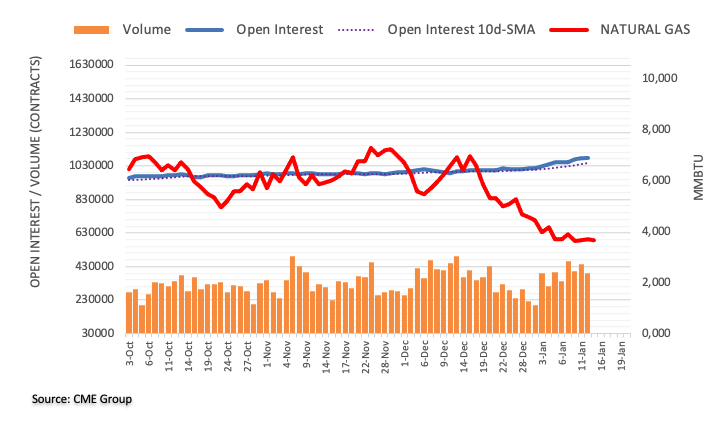
Considering advanced prints from CME Group for natural gas futures markets, traders added just 754 contracts to their open interest positions on Thursday, extending further the ongoing uptrend. Volume, instead, remained choppy and dropped by nearly 57K contracts.
Natural Gas looks supported around $3.50
Natural gas prices charted an inconclusive session on Thursday in tandem with a small uptick in open interest and diminishing volume. Against that, extra consolidation appears the most likely scenario for the commodity for the time being, with decent contention around the $3.50 mark per MMBtu.
Following Thursday's impressive rally, EUR/USD touched its highest level since April at 1.0868 early Friday. Economists at ING believe that the pair could hit 1.0950.
ECB will be happy with the stronger Euro
“The ECB’s trade-weighted Euro has now returned to levels seen last February. And actually, the year-on-year change in EUR/USD is now mildly positive. This will be welcome news to the ECB, where last summer’s 6% YoY EUR/USD decline was contributing to the inflation problem.”
“With short-dated (two-year) USD swaps drifting to new lows for the move, EUR/USD swap differentials continue to move in favour of EUR/USD. And this is a theme which we suspect will play a greater role in EUR/USD pricing over the next 12 months.”
“EUR/USD remains on course for 1.0900 and possibly 1.0950. Weekend profit-taking may pose the biggest risk to EUR/USD, but 1.0750 should now be a good near-term base.”
The Bank of Japan (BoJ) announced on Friday that it will conduct additional long-term Japanese Government Bonds (JGB) purchases on Monday.
“The amount to be bought will be based on prevailing market conditions,” the BoJ added.
Market reaction
USD/JPY keeps pushing lower, as the US Dollar resumes its downtrend so far this Friday. The pair is down 0.77% on the day to trade at 128.22, as of writing.
Further downside could force USD/JPY to grind lower and revisit the 128.00 region in the near term, comment Economist Lee Sue Ann and Markets Strategist Quek Ser Leang at UOB Group.
Key Quotes
24-hour view: “While we expected USD to head lower yesterday, we were of the view that ‘a sustained decline below 131.30 appears unlikely’. We underestimated the downward momentum as USD nose-dived to a low of 128.86 before closing on a weak note at 129.22 (-2.45%). While the outsized decline appears to be overdone, the USD weakness is not showing any signs of stabilizing. In other words, USD could continue to weaken even though it remains to be seen if it has enough momentum to carry it lower to the next support at 128.00. Resistance is at 129.70, but only a breach of 130.50 would indicate the weakness in USD has stabilized.”
Next 1-3 weeks: “Our most recent narrative was from Monday (09 Jan, spot at 132.10) where we highlighted that USD is likely to trade within a broad range of 130.50 and 134.50. The sharp sell-off yesterday that sent it plunging below 130.50 (low of 128.86) came as a surprise. While the price actions suggest the risk for USD has shifted to the downside, the pace of any further decline is likely to be slower. Support is at 128.00, followed by 126.35. On the upside, a breach of 131.30 would indicate that the current increase in downward momentum has subsided.”
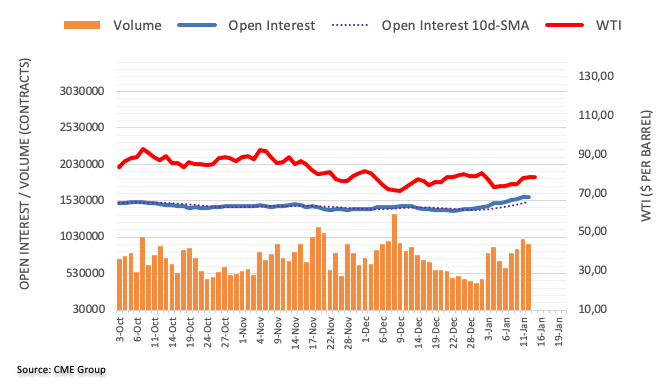
Open interest in crude oil futures markets shrank by nearly 1.1K contracts on Thursday, printing the first drop since December 22 according to preliminary readings from CME Group. In the same line, volume left behind three daily builds in a row and went down by around 77.3K contracts.
WTI: Another visit to $72.50 is not ruled out
Thursday’s uptick in prices of the WTI was on the back of shrinking open interest and volume and undermined the continuation of the ongoing bounce. That said, renewed weakness in the commodity carries the potential to drag prices to the recent contention region around $72.50 (January 5).
In the opinion of Economist Lee Sue Ann and Markets Strategist Quek Ser Leang at UOB Group, further upside could encourage AUD/USD to reclaim the area above the 0.7000 barrier in the short term.
Key Quotes
24-hour view: “We expected AUD to strengthen yesterday but we were of the view that ‘any advance is expected to face solid resistance at 0.6950’. However, in NY trade, AUD took out 0.6950 without much difficulty as it soared to a high of 0.6984. Despite the advance, there is no significant improvement in upward momentum. That said, as long as AUD stays above 0.6920 (minor support is at 0.6940), it could rise above 0.7000. While AUD could break 0.7000, it is not expected to challenge the next major resistance at 0.7070.”
Next 1-3 weeks: “Our latest narrative was from Tuesday (10 Jan, spot at 0.6910) where we highlighted that while momentum continues to point to a higher AUD, it must break and stay above 0.6950 before a move to 0.7000 is likely. AUD soared above 0.6950 yesterday before closing at 0.6967 (+0.88%). The price actions suggest AUD is likely to advance above 0.7000. As there is no marked improvement in momentum for now, the next resistance at 0.7070 is unlikely to come into view so soon. On the downside, a break of 0.6890 (‘strong support’ level was at 0.6835 yesterday) would indicate that AUD is not advancing further.”
FX option expiries for Jan 13 NY cut at 10:00 Eastern Time, via DTCC, can be found below.
- EUR/USD: EUR amounts
- 1.0500 941m
- 1.0600 474m
- 1.0750 830m
- 1.0775 844m
- 1.0800 331m
- 1.0850 924m
- 1.0900 402m
- GBP/USD: GBP amounts
- 1.1800 411m
- 1.2000 402m
- 1.2500 381m
- AUD/USD: AUD amounts
- 0.6900 403m
- 0.6950 633m
- 0.7000 743m
- 0.7125 817m
USD/JPY fell sharply on Thursday. As economists at Rabobank expect the Bank of Jpan to tweak YCC again, the Yen is set to thrive.
Will they, won't they?
“While the doves may require a lot of convincing, ahead of the December BoJ policy meeting which brough a tweak to the YCC policy, speculation for a change appeared to already have found some support.”
“No change in policy this month would be a set back for the JPY. However, we would look to buy the JPY vs. the USD on dips on anticipation of another move in YCC in the spring.”
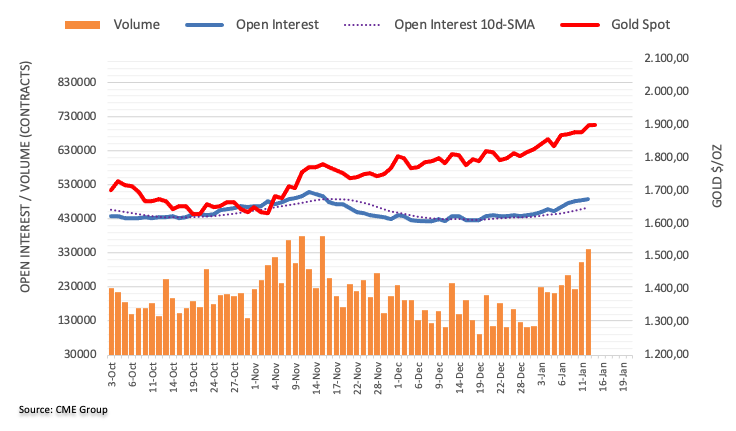
CME Group’s flash data for gold futures markets noted open interest rose for the fifth consecutive session on Thursday, this time by around 3.2K contracts. Volume followed suit and went up for the second straight session, now by around 38.4K contracts.
Gold continues to target $2000
Gold prices extended the uptrend on Thursday amidst increasing open interest and volume, indicating that extra gains look likely in the very near term. That said, the yellow metal keeps targeting the key $2000 mark per ounce troy for the time being.
GBP/USD needs to break above the 1.2270 level to allow for extra gains in the near term, according to Economist Lee Sue Ann and Markets Strategist Quek Ser Leang at UOB Group.
Key Quotes
24-hour view: “We highlighted yesterday that GBP ‘may continue to trade sideways but a breach of the 1.2200 resistance could potentially lead to a sharp rise to 1.2270’. While GBP took out 1.2200, the anticipated sharp rise did not materialize as GBP traded choppily in NY session (high has been 1.2248). Upward momentum has improved a tad but while GBP is likely to trade with an upward bias, it is unlikely to break 1.2270 today. Support is at 1.2175, followed by 1.2140.”
Next 1-3 weeks: “On Tuesday (10 Jan, spot at 1.2180), we highlighted that the odds of GBP breaking the major resistance have increased. While GBP has not been able to make much headway on the upside, we continue to hold the same view for now. However, in order to keep the momentum going, GBP must break 1.2270 these 1-2 days or the prospect of further GBP strength would diminish quickly. Conversely, a break of 1.2100 (‘strong support’ level was 1.2050 yesterday) would indicate that GBP is not advancing further. Looking ahead, above 1.2270, there is a significant resistance level at 1.2305.”
- EUR/GBP struggles to gain any meaningful traction and oscillates in a narrow band on Friday.
- A bleak outlook for the UK economy undermines the Sterling and continues to lend support.
- The recent hawkish ECB rhetoric underpins the Euro and supports prospects for further gains.
The EUR/GBP cross consolidates its recent gains to the highest level since September 29 touched earlier this Friday and seesaws between tepid gains/minor losses through the early European session. The cross remains below the 0.8900 round-figure mark following the release of the UK macro data, though seems poised to prolong the uptrend witnessed since the beginning of this week.
The UK Office for National Statistics reported that the economy expanded a modest 0.1% in November as compared to estimates for a 0.2% contraction. This, however, marked a notable slowdown from the 0.5% growth recorded in October. Moreover, weaker-than-expected UK industrial and manufacturing production data adds to the bleak outlook for the UK economy, which has been fueling speculations that the Bank of England (BoE) is nearing the end of the current rate-hiking cycle. This, in turn, could undermine the British Pound and lend some support to the EUR/GBP cross.
The shared currency, on the other hand, continues to draw support from more hawkish signals from the European Central Bank (ECB). In fact, several ECB officials spoke this week and confirmed that they will have to raise interest rates further in the coming months to tame inflation. That said, a modest US Dollar recovery keeps a lid on the Euro and holds back traders from placing aggressive bullish bets around the EUR/GBP cross. Nevertheless, the aforementioned fundamental backdrop suggests that the path of least resistance for spot prices is to the upside.
Even from a technical perspective, the overnight convincing breakout through the 0.8865-0.8875 supply zone supports prospects for a further near-term appreciating move. Some follow-through buying beyond the 0.8900 round figure will reaffirm the positive outlook and allow the EUR/GBP cross to reclaim the 0.9000 psychological mark.
Technical levels to watch
The US inflation data yesterday did not provide any surprise whatsoever and as a result, the market was initially indecisive. However, economists at Commerzbank remain cautious and do not expect a further up-move in EUR/USD.
Some caution might be advisable
“After the EUR/USD rally seen over the past months, the question increasingly arises as to how much scope is still available, in particular, if there is no new momentum due to new developments. Of course, it is possible that EUR/USD might rise a little further but it makes increasing sense to question this move.”
“It cannot be excluded that the Fed might be correct in the end. If future data publications suggest that inflation might be more stubborn EUR/USD might come under increasing downside pressure as the market might then have to adjust its rate expectations. That means that the surprise potential on the downside in EUR/USD is likely to be much higher, suggesting that some caution might be advisable.”
- The index attempts a tepid rebound just above 102.00.
- Investors keep pricing in a 25 bps rate hike by the Fed in February.
- Advanced Michigan Consumer Sentiment only due later in the docket.
The greenback, when tracked by the USD Index (DXY), advances marginally on Friday following a marked drop to the 102.00 neighbourhood in the previous session.
USD Index remains under pressure in multi-month lows
Despite the mild bullish attempt ahead of the opening bell in the old continent on Friday, the index appears well under pressure, particularly after US inflation gave further signs of cooling down in the year to December (headline CPI +6.5%, Core CPI +5.7%).
Indeed, speculation around a potential pivot in the Fed’s monetary policy stance continues to run high and maintains the price action around the buck depressed for the time being.
Indeed, this view has gathered extra steam especially since the publication of the December Nonfarm Payrolls (+223K jobs) and it has magnified in the wake of the US inflation figures (released on Thursday). Against that, the probability of a 25 bps rate hike at the Fed’s February 1 meeting is now near 95%, always according to the FedWatch Tool by CME Group.
In the US data space, the flash prints of the Michigan Consumer Sentiment for the month of January will be the sole release later in the NA session.
What to look for around USD
The dollar remains under pressure and looks to rebound from post-US CPI lows near 102.00, an area last visited back in June 2022.
Another soft prints from US inflation figures in December prop up the idea of a probable pivot in the Fed’s policy in the next months, which also comes in contrast to the hawkish message from the latest FOMC Minutes and recent rate-setters, all pointing to the need to remain within a restrictive stance for longer, at the time when the likelihood any interest rate reduction in the current year remains near zero.
On the latter, the tight labour market and the resilience of the economy are also seen supportive of the firm message from the Federal Reserve and its hiking cycle.
Key events in the US this week: Inflation Rate, Initial Jobless Claims, Monthly Budget Statement (Thursday) – Flash Michigan Consumer Sentiment (Friday).
Eminent issues on the back boiler: Hard/soft/softish? landing of the US economy. Prospects for further rate hikes by the Federal Reserve vs. speculation of a recession in the next months. Fed’s pivot. Geopolitical effervescence vs. Russia and China. US-China trade conflict.
USD Index relevant levels
Now, the index is gaining 0.03% at 102.28 and faces the next hurdle at 105.63 (monthly high January 6) followed by 106.39 (200-day SMA) and then 107.19 (weekly high November 30). On the other side, the breach of 102.07 (monthly low January 12) would open the door to 101.29 (monthly low May 30) and finally 100.00 (psychological level).
A gradual depreciation of HUF vs. EUR is likely, but analysts at TD Securities still expect the Forint to record positive returns when accounting for carry.
May and June will likely be a period of increased EUR/HUF volatility
“We don't see any room for EUR/HUF to permanently move below 400. We think that a gradual HUF spot depreciation in the order of magnitude of 5-10% is in the interest of the NBH. As such, we think that EUR/HUF will gradually move higher through 2023 and end the year at 425.”
“Unless EUR/HUF falls notably below 400, the NBH will probably attempt to ease the longer-term rates first, rather than the overnight rate.”
“May and June will likely be a period of increased EUR/HUF volatility as EU member states will need to extend the current sanctions on Russia linked to Russia's invasion of Ukraine.”
Here is what you need to know on Friday, January 13:
After having suffered heavy losses against its major rivals on Thursday, the US Dollar is having a difficult time finding demand early Friday with the US Dollar Index trading flat slightly above 102.00. As investors assess how the December inflation data from the US will shape the Federal Reserve's rate outlook, the benchmark 10-year US Treasury bond yield stays below 3.5% and US stock index futures trade marginally lower on the day. The European economic docket will feature Industrial Production and Trade Balance data for November. In the second half of the day, the University of Michigan's Consumer Sentiment Survey for January and the Fed's Index of Common Inflation Expectations for the third quarter will be looked upon for fresh impetus.
The US Bureau of Labor Statistics announced on Friday that the annual Consumer Price Index declined to 6.5% in December from 7.1% in November. The Core CPI, which excludes volatile food and energy prices, edged lower to 5.7% from 6% in the same period. Following these data releases, the probability of a 25 basis points Fed rate hike jumped above 90%, according to the CME Group FedWatch Tool, from 75% early Thursday. Additionally, several Fed policymakers voiced their support for a 25 bps rate hike at the next meeting.
During the Asian trading hours on Friday, the data from China revealed that the trade surplus widened to $78 billion from $69.8 billion in November. With this reading surpassing the market expectation for a trade surplus of $76.2 billion, the Shanghai Composite Index gained traction and was last seen gaining more than 1% on the day.
Following Thursday's impressive rally, EUR/USD touched its highest level since April at 1.0868 early Friday before retreating below 1.0850.
GBP/USD gained more than 50 pips on Thursday but seems to have gone into a consolidation phase at around 1.2200 early Friday. The UK's Office for National Statistics reported that the Gross Domestic Product (GDP) expanded by 0.1% in November following October's 0.5% growth. Although this reading came in better than the market expectation for a contraction of 0.2%, it failed to help the Pound Sterling regather its bullish momentum.
USD/JPY fell sharply on Thursday and continued to push lower during the Asian trading hours on Friday. The pair was last seen trading at around 128.70, down 0.4% on the day.
Fueled by falling US Treasury bond yields, Gold price rose above $1,900 for the first time in nearly 8 months. In the early European morning, XAU/USD is moving sideways slightly above $1,890.
Bitcoin capitalized on improving market mood and advanced beyond $19,000 on Thursday, gaining more than 5% on a daily basis. BTC/USD stays in a consolidation phase at around $18,800 early Friday. Ethereum extended its winning streak into a fifth straight day on Thursday and rose above $1,400 before staging a technical correction on Friday.
In light of the recent price action, EUR/USD could now dispute the 1.0900 hurdle in the next few weeks, suggest Economist Lee Sue Ann and Markets Strategist Quek Ser Leang at UOB Group.
Key Quotes
24-hour view: “We highlighted yesterday that EUR ‘is likely to trade with an upward bias but it remains to be seen if EUR can maintain a foothold above the major resistance at 1.0785’. The anticipated EUR strength exceeded our expectations as EUR surged to 1.0866 before closing on a strong note at 1.0846 (+0.85%). Despite the relatively large gains, momentum has not improved by much. That said, the risk for EUR is still on the upside even though 1.0900 is expected to offer solid resistance. Above 1.0900, there is another significant resistance level at 1.0930. Support is at 1.0825; a breach of 1.0800 would indicate that the current upward pressure has eased.”
Next 1-3 weeks: “On Tuesday (10 Jan, spot at 1.0730), we highlighted that EUR is likely to take a crack at another strong resistance level at 1.0785. Our view was not wrong as EUR cracked 1.0785 yesterday and soared to 1.0866. The improved upward momentum suggests further EUR strength. The next resistance is at 1.0900, followed by a key level at 1.0930. The upside risk is intact as long as EUR stays above 1.0760 (‘strong support’ level was at 1.0665 yesterday).”
- GBP/USD is seen oscillating in a narrow trading band through the early European session on Friday.
- A modest USD recovery from a multi-month low acts as a headwind amid dovish BoE expectations.
- The mixed UK macro data fails to impress traders or provide any meaningful impetus to the major.
The GBP/USD pair struggles to capitalize on the previous day's positive move to a nearly four-week top and witnessed subdued price action on Friday. Spot prices seesaw between tepid gains/minor losses, around the 1.2200 mark through the early European session and moves little following the release of the UK macro data.
The UK Office for National Statistics reported that the economy expanded a modest 0.1% in November as compared to estimates for a 0.2% contraction. This, however, marked a notable decline from the 0.5% growth recorded in October and was accompanied by the disappointing release of the UK industrial and manufacturing production data. This comes on the back of a bleak outlook for the UK economy, which has been fueling speculations that the Bank of England (BoE) is nearing the end of the current rate-hiking cycle and undermines the British Pound. Apart from this, a modest US Dollar recovery from a seven-month low further contributes to capping the GBP/USD pair.
A modest uptick in the US Treasury bond yields and a softer tone around the equity markets offer some support to the safe-haven greenback. That said, rising bets for smaller Fed rate hikes going forward continue to act as a headwind for the USD and lend some support to the GBP/USD pair, at least for the time being. Investors now seem convinced that the Fed will soften its hawkish stance and the bets were reinforced by the latest US consumer inflation figures released on Thursday. This, in turn, makes it prudent to wait for strong follow-through selling around the major before traders start positioning for any meaningful corrective downfall in the near term.
Market participants now look forward to the US economic docket, featuring the Preliminary Michigan Consumer Sentiment Index later during the early North American session. This, along with the US bond yields and the broader risk sentiment, will drive the USD demand and provide some impetus to the GBP/USD pair. Nevertheless, spot prices seem poised to end in the green for the third successive week and remain at the mercy of the USD price dynamics.
Technical levels to watch
The industrial sector faded its recovery momentum in November, the latest UK industrial and manufacturing production data published by Office for National Statistics (ONS) showed on Friday.
Manufacturing output arrived at -0.5% MoM in November versus -0.2% expectations and 0.7% registered in October while total industrial output came in at -0.2% MoM vs. -0.3% expected and -0.1% last.
On an annualized basis, the UK manufacturing production figures came in at -5.9% in November, missing expectations of -4.8%. Total industrial output plunged by 5.1% in the eleventh month of the year against -3.0% expected and the previous -4.7% print.
Separately, the UK goods trade balance numbers were published, which arrived at GBP- 15.623 billion in November versus GBP-14.90 billion expectations and GBP-12.258 billion last. The total trade balance (non-EU) came in at GBP-4.666 billion in November versus GBP-2.999 billion previous.
Related reads
- UK GDP expands 0.1% MoM in November vs. -0.2% expected
- UK GDP arrived at 0.1% MoM in November vs. -0.2% expected.
- GBP/USD keeps its range above 1.2200 on UK GDP positive surprise.
The UK Gross Domestic Product (GDP) monthly release showed on Friday that the economy unexpectedly expanded in November, arriving at 0.1% vs. -0.2% expectations and 0.5% previous.
Meanwhile, the Index of services (November) came in at -0.1% 3M/3M vs. -0.4% estimate and -0.1% prior.
The UK November GDP came in 0.3% below the pre-COVID 19 level of February 2020.
Market reaction
The Cable remains little changed just above 1.2200 on the encouraging UK growth numbers. The spot is trading almost unchanged on the day.
About UK GDP
The Gross Domestic Product released by the National Statistics is a measure of the total value of all goods and services produced by the UK. The GDP is considered a broad measure of the UK economic activity. Generally speaking, a rising trend has a positive effect on the GBP, while a falling trend is seen as negative (or bearish).
Gold price struggle with $1,900 extends. The yellow metal needs a close above the latter to add credence to the bullish potential, FXStreet’s Dhwani Mehta reports.
XAU/USD yearns for acceptance above $1,900
“Gold now looks to find a strong foothold above the $1,900 threshold. Daily closing above that mark is critical to unleashing the further upside toward May 2022 high at $1,910. A fresh upswing toward the $1,950 psychological level cannot be ruled out should Gold buyers regain complete control.”
“The 14-day Relative Strength Index (RSI) is peeping into the overbought territory, suggesting that there is enough room to the upside before a sustained correction kicks in.”
“Failure to yield a weekly close above the $1,900 level could put Thursday’s low at $1,872 under threat. Fresh weakness in XAU/USD could prompt sellers to target the $1,850 psychological level going forward.”
- Silver is seen consolidating in a narrow trading band below the $24.00 mark on Friday.
- The recent two-way price moves warrant some caution before placing directional bets.
- A convincing break below the 200-SMA on H4 should pave the way for deeper losses.
Silver struggles to gain any meaningful traction on Friday and oscillates in a narrow trading band through the early European session. The white metal is currently placed around the $23.75 area, nearly unchanged for the day, and remains well within a broader trading range held over the past three weeks or so.
From a technical perspective, this week's repeated failures to find acceptance above the $24.00 round figure warrants some caution for bullish traders. The XAG/USD, however, has managed to hold its neck above the 200-period SMA on the 4-hour chart. The latter is currently pegged near the $23.20 region and coincides with the lower end of the trading range, which, in turn, should now act as a pivotal point for short-term traders.
A convincing break below will mark a bearish breakdown, though it will be prudent to wait for some follow-through selling below the $23.00 mark before positioning for a further depreciating move. The XAG/USD might then extend the recent pullback from a multi-month top and accelerate the fall towards the $22.60-$22.55 region. The downfall could eventually drag spot prices to the next relevant support near the $22.10-$22.00 zone.
On the flip side, any intraday positive move beyond the $24.00 mark might confront some resistance near the overnight swing high, around the $24.20 region. This is followed by the multi-month high, around the $24.50-$24.55 region touched last week, which if cleared decisively will be seen as a fresh trigger for bullish traders. The XAG/USD could then aim towards reclaiming the $25.00 psychological mark for the first time since April 2022.
Silver 4-hour chart
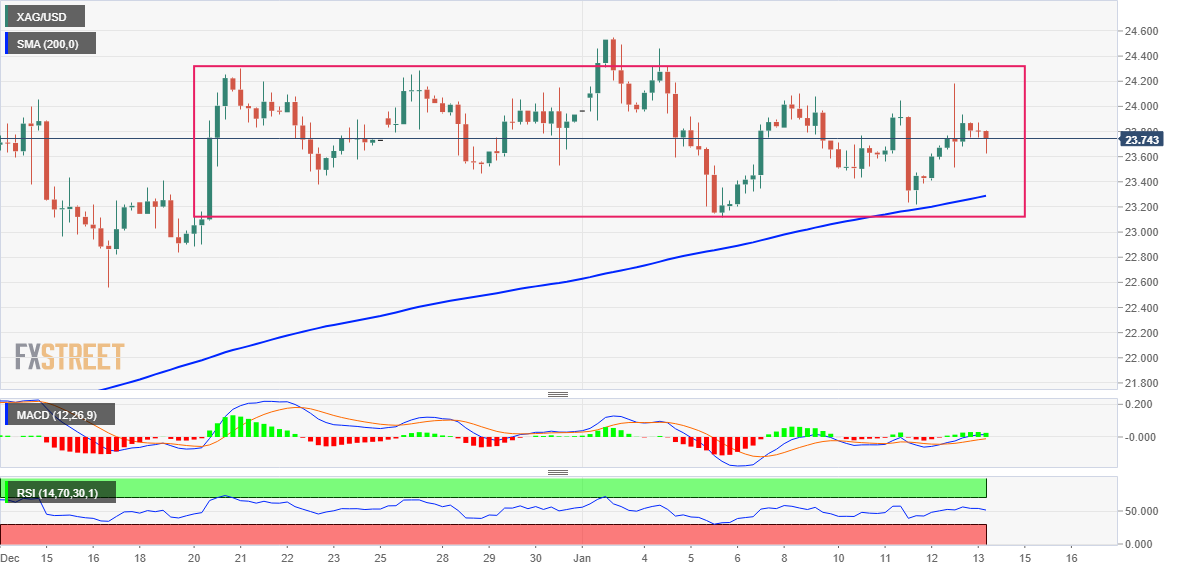
Key levels to watch
- Oil prices have turned sideways after failing to extend recovery to near $80.00.
- The black gold price has not run out of steam as the US administration is ceasing oil supply to China.
- Falling US inflation has triggered odds of a slowdown in the pace of the Fed’s policy tightening.
West Texas Intermediate (WTI), futures on NYMEX, have sensed a lack of strength in its upside journey toward the critical resistance of $80.00. The oil price has faced barricades in stretching its rally further around $79.40 amid profit-booking, however, the upside bias is still solid.
The oil price has been in a bullish trajectory from the past week as the Chinese economy has picked the path of recovery after remaining locked for a lengthy period to augment lockdown curbs to cease the further spread of the Covid-19 epidemic. The reopening measures by the Chinese economy after dismantling restrictions on the movement of men, materials, and machines and allowance of international travelers is going to spurt the economic growth ahead.
Meanwhile, a fresh decline in the United States inflation figures led by a recent fall in gasoline and used car prices has accelerated the odds of further recovery in oil demand ahead. According to Bill Diviney, Sr. Economist at ABN – AMRO, data released on Thursday in the US confirmed a slowdown in inflation, with the annual CPI rate falling to 6.5%, the lowest level since October 2021. And, falling inflation paves way for a 25 basis points (bps) Federal Reserve (Fed) interest rate hike, instead of a 50 bps hike.
The oil price is likely to get strengthened further as the US administration is ceasing oil supply to China from its Strategic Petroleum Reserve (SPR). In this scenario, the Chinese administration will be forced to look for alternative suppliers to augment their oil demand, which could trigger short-term pain for the oil supply but will strengthen oil prices further.
- AUD/USD retreats from a multi-month high touched on Thursday amid a modest USD uptick.
- Rebounding US bond yields and a softer risk tone helps revive demand for the safe-haven buck.
- Rising bets for smaller Fed rate hikes should cap the USD and limit the downside for the major.
The AUD/USD pair comes under some selling pressure on Friday and erodes a part of the previous day's strong gains to the highest level since August 26. The pair remains depressed heading into the European session and is currently placed near the daily low, around mid-0.6900s.
A combination of factors assists the US Dollar to stage a modest bounce from a seven-month low, which, in turn, acts as a headwind for the AUD/USD pair. A modest uptick in the US Treasury bond yields, along with a softer tone around the equity markets, offers some support to the greenback. The worst COVID-19 outbreak in China overshadows the optimism led by the country's pivot away from its zero-COVID policy. Apart from this, the protracted Russia-Ukraine war has been fueling worries about a deeper global economic downturn and weighing on investors' sentiment. This, in turn, drives some haven flows towards the buck and undermines the risk-sensitive Australian Dollar.
That said, any meaningful USD recovery still seems elusive amid rising bets for smaller Fed rate hikes going forward. Investors now seem convinced that the US central bank will soften its hawkish stance and the expectations were reaffirmed by Thursday's release of the latest US consumer inflation figures. Furthermore, several FOMC members backed the case for a 25 bps lift-off in February, which should keep a lid on the US bond yields and hold back the USD bulls on the back foot. Apart from this, odds for an additional interest rate hike by the Reserve Bank of Australia (RBA) in February support prospects for the emergence of some dip-buying around the AUD/USD pair.
Hence, it will be prudent to wait for strong follow-through selling before confirming that the major has formed a near-term top and positioning for a deeper corrective pullback. Market participants now look forward to the release of the Preliminary Michigan Consumer Sentiment Index from the US, due later during the early North American session. This, along with the US bond yields and the broader risk sentiment, will drive the USD demand and provide some impetus to the AUD/USD pair. Nevertheless, spot prices remain on track to end in the green for the fourth successive week.
Technical levels to watch
- USD/CAD has picked strength amid caution in the market mood, however the overall sentiment is still positive.
- Federal Reserve is likely to trim the pace of policy tightening due to a downward trend in US inflation.
- A sheer recovery in oil prices led by expectations of economic recovery in China may strengthen the Canadian Dollar.
- USD/CAD is likely to continue its downside journey toward the horizontal support plotted at 1.3226.
USD/CAD has picked strength and has extended its recovery to near the round-level resistance of 1.3400 in the early European session. Earlier, the Loonie asset picked up demand after dropping to near 1.3345 as the risk appetite of the market participants dropped. Investors trimmed their longs in risk-sensitive assets after a stretched rally.
The S&P500 futures have sensed selling pressure after remaining extremely bullish consecutively in the past three trading sessions, portraying caution in the overall positive market mood. A decline in the risk appetite has also impacted the demand for US government bonds, which has increased the 10-year US Treasury yields to 3.47%. The US Dollar Index (DXY) has turned sideways below 102.00 after registering a fresh seven-month low at 101.65.
Soften US Inflation supports lower interest rate hike by the Fed
Thursday’s release of the United States Consumer Price Index (CPI) has provided confidence that the price pressures are softening and the Federal Reserve (Fed)’s blueprint of achieving price stability is operating effectively. From a peak of 9.1%, the annual headline price index has dropped to 6.5% in a few months. Thanks to the declining gasoline and used car prices have decelerated the pace of inflation in the United States economy.
A meaningful decline in the US price index has triggered odds of further deceleration in the pace of the interest rate hike already after slowing in December’s monetary policy meeting as Federal Reserve chair Jerome Powell and his teammates are working in the right direction. Philadelphia Fed Bank President Patrick Harker said on Thursday that it was time for future Fed rate hikes to shift to 25 basis points (bps) increments, as reported by Reuters.
S&P500 to achieve recovery if Fed trims policy tightening pace
The equity domain in the United States economy witnessed an intense sell-off in CY2022 as the Federal Reserve was on a trip of hiking interest rates to achieve the 2% inflation target. The US central bank hiked the borrowing rates with four 75 basis points (bps), two 50 bps, and one 25 bps rate hike announcements to 4.25-4.50%. As inflation is getting under control gradually and the Federal Reserve won’t be so hard on interest rates, it looks like the S&P500 will get back into the picture.
The slowdown in the pace of the interest rate hike will allow firms to achieve a sense of optimism, which will support them in executing expansion plans and boosting operations. No doubt, the pace of policy tightening will be trimmed but short-term pain will stay. Philadelphia Fed Bank President Patrick Harker cited that recession in the United States economy is not into the picture but the Gross Domestic Product (GDP) could slow to 1% this year.
Oil faces barricades for around $79.00
After a perpendicular rally led by support from recovery in the Chinese economy led by sheer reopening measures and expectations of further sanctioning on Russia, oil prices are facing a halt around $79.00. Moscow is expected to face further sanctions from Western countries for oil supply as nations want to restrict it from getting liquidity to fund arms and ammunition in its fight against Ukraine.
Further upside in the oil price looks likely amid a decline in US inflation, which will trim the policy tightening pace of the Fed. Meanwhile, the United States administration has denied oil supply to China from its Strategic Petroleum Reserve (SPR). This will force the Chinese economy to look for alternative suppliers, which could accelerate oil prices in a short span of time.
It is worth noting that Canada is a leading exporter of oil to the United States and higher oil prices will strengthen the Canadian Dollar.
USD/CAD technical outlook
-638091857408866534.png)
USD/CAD has delivered a breakdown of inventory distribution placed in a range of 1.3500-1.3700 on a four-hour scale. A breakdown of the inventory distribution phase results in extreme volatility expansion which triggers wider ticks to the downside. The Lonnie asset is likely to find a cushion around the horizontal support plotted from November 15 low at 1.3226.
Meanwhile, downward-sloping 20-and 50-period Exponential Moving Averages (EMAs) at 1.3414 and 1.3460 respectively, add to the downside filters.
A bearish momentum will be triggered if the Relative Strength Index (RSI) (14) will slip into the bearish range of 20.00-40.00.
On Friday, the Bank of Japan (BoJ) resorted to a second unplanned Japanese Government Bonds (JGB) purchase operation.
Also read: BoJ announces unplanned bond-buying on Friday
Key details
BoJ offers to buy 100 billion yen in 3-5 year JGBs.
BoJ offers to buy 200 billion yen in 5-10 year JGBs.
BoJ offers to buy 100 billion yen in 10-25 year JGBs.
BoJ offers zero-interest loans to banks in order to cap yields.
Market reaction
USD/JPY was last seen trading at 129.22, modestly flat on the day.
- USD/INR has displayed a responsive buying action amid a recovery in US Treasury yields.
- The 20-and 50-EMAs are on the verge of delivering a bearish crossover around 82.15.
- A bearish range shift by the RSI (14) has triggered the downside momentum.
The USD/INR pair has witnessed a responsive buying action to near the critical support of 81.00 in the Asian session. The Indian Rupee asset has witnessed buying interest again amid a recovery in the US Treasury yields. Also, a marginal rebound in the US Dollar Index (DXY) has supported USD/INR.
Meanwhile, the S&P500 futures have sensed selling pressure as investors have trimmed their longs in Asia after remaining bullish in the past three trading sessions. The US Dollar Index is aiming to shift its auction profile above the critical resistance of 102.00.
USD/INR has witnessed a sell-off after a breakdown of the consolidation formed in a range of 82.56-82.96 on a daily scale. On a broader note, the formation of the Double Top chart pattern around 83.29 triggered a bearish reversal.
The 20-and 50-period Exponential Moving Averages (EMAs) are on the verge of delivering a bear cross around 82.10, which will be added to the downside bias.
Also, the Relative Strength Index (RSI) (14) has shifted into the bearish range of 20.00-40.00, which indicates that the downside momentum is solid.
Going forward, a decisive break below the December low at 81.00 will further drag the asset towards September 23 low at 80.78 followed by November 11 low at 80.48.
On the flip side, a rebound move above November 21 high at around 82.00 will drive the asset toward December 15 low at 82.42. A breach above the latter will expose the asset to reach January high around 83.00.
USD/INR daily chart
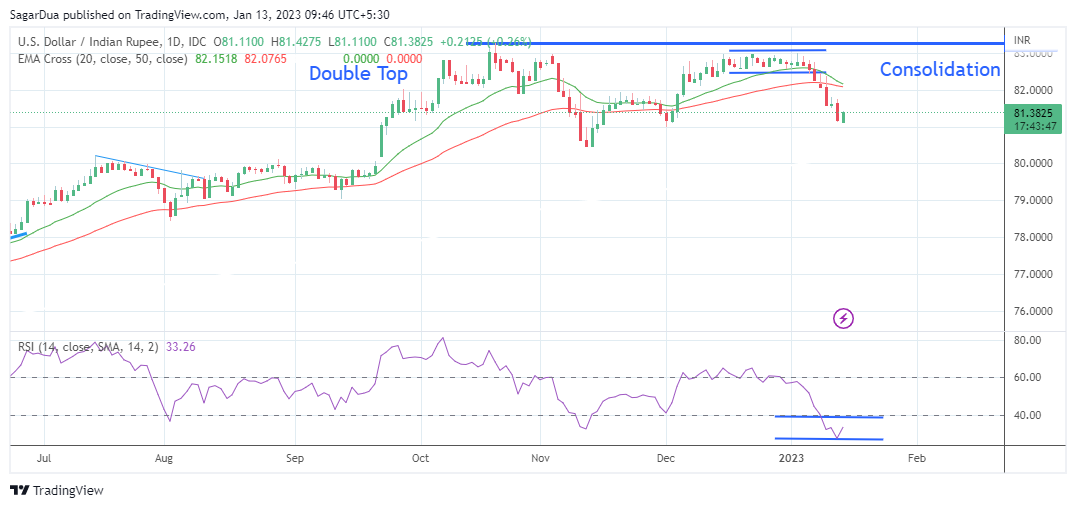
- EUR/USD has slipped marginally to near 1.0860 as the strength of the risk-on mood has eased.
- Fed Bostic has favored a 25 bps rate hike culture amid slowing US inflation.
- The ECB is expected to reach the terminal rate by the Summer.
The EUR/USD pair has sensed marginal selling pressure after failing to surpass the immediate resistance of 1.0860 in the Tokyo session. The major currency pair is demonstrating signs of a loss in the upside momentum amid a recovery in the alpha generated by the US Treasury bonds. The 10-year US Treasury yields have rebounded to near 3.46%.
An interim rebound in the risk-aversion theme is impacting the S&P500 futures. The US equities are facing pressure after three-day consecutive bullish sessions, portraying a short-term caution amid an overall upbeat market mood. The US Dollar Index (DXY) is hovering below 102.00, displaying a lackluster profile.
After a meaningful downtrend in the United States inflation, it would be worthy to claim that the Federal Reserve (Fed) is in a comfortable position now and might look to scale down the extent of the interest rate hike ahead. Thursday’s release of lower inflation print has already changed the viewpoint of Fed policymakers.
Atlanta Fed Bank President Raphael Bostic who said on Monday that it is ''fair to say that the Fed is willing to overshoot,'' is now saying that he would be comfortable moving with 25 basis points (bps) interest rate hike culture. He further added that data showing inflation slowed in December "was really welcome news" that may allow the U.S. Fed to scale back to quarter-point rate increases at its upcoming meeting.
On the Eurozone front, the spree of the interest rate hike by the European Central Bank (ECB) is expected to terminate by the Summer. After ECB governing council member Mario Centeno, another ECB member, and French central bank governor Francois Villeroy de Galhau cited, the central bank should aim to reach the terminal rate by the summer. He further added that ECB needs to be pragmatic about the pace of rate hikes.
China's Trade Balance for December, in Chinese Yuan terms, came in at CNY550.1 billion versus CNY494.3 billion last.
The exports dropped by 0.5% last month vs. 0.9% previous.
The country’s imports rebounded by 2.2% vs. -1.1% prior.
In US Dollar terms,
China reported a widening of the trade surplus, as exports and imports showed a smaller-than-expected slump.
Trade Balance came in at +78B versus +76.2B expected and +69.84B previous.
Exports (YoY): -9.9% vs. -10.0% exp. and -8.7% prior.
Imports (YoY): -7.5% vs. -9.8% exp. and -10.6% last.
Meanwhile, China's trade surplus with the United States was $29.5 billion in December, compared with a $24.33 billion surplus in November.
FX implications
AUD/USD remains under heavy selling pressure on mixed Chinese trade figures, keeping its range around 0.6950. The spot is losing 0.28% on the day, as of writing.
- Gold price remains firmer around multi-month high, fades upside momentum of late.
- Challenges to sentiment, market’s post-inflation consolidation probe XAU/USD bulls.
- Further upside hinges on successful break of $1,918 and more clues for Fed’s next moves.
Gold price (XAU/USD) stabilizes after refreshing the eight-month high as traders seek more clues to defend the weekly rally, the fourth one in a row. Also likely to have weighed the Gold price could be the trade-related fears surrounding China and the Federal Reserve (Fed) policymakers’ hesitance in backing the pivot talks. It’s worth noting, however, that the Fed talks signaled easy rate hikes after a downbeat US Consumer Price Index (CPI) and propelled the XAU/USD prices the previous day. That said, additional US consumer-centric data, like Michigan Consumer Sentiment Index and Retail Sales, eyed to confirm the recent bullish bias over the precious metal.
Also read: Gold Price Forecast: XAU/USD bulls need validation from $1,902 and US inflation expectations
Gold Price: Key levels to watch
The Technical Confluence Detector shows that the gold price is gathering pace around the $1,900 key hurdle, where the pivot point one-week R2 and Bollinger Band 15-minute Upper merge.
The XAU/USD upside past $1,900 could aim for the $1,917-18 resistance confluence where pivot point one-month R3 acts as the last defense of the Gold bears, a break of which could quickly propel prices to a late March 2022 peak surrounding $1,965.
That said, the pivot-point one-day R1, near $1,910, also acts as an upside filter for the Gold price.
Alternatively, the upper Bollinger Band on one-day joins the Fibonacci 23.6% on one-day to highlight $1,896 as nearby key support.
Following that, a slump towards the $1,881 key level, encompassing the Fibonacci 61.8% on one-day and pivot-point one-week R1, can’t be ruled out.
In a case where the Gold price remains bearish past $1,881, the pivot-point one-month R2, close to $1,875, will act as the last defense of XAU/USD bulls.
Overall, the Gold price remains on the bull’s radar unless breaking $1,875. However, the road towards the north isn’t smooth.
Here is how it looks on the tool
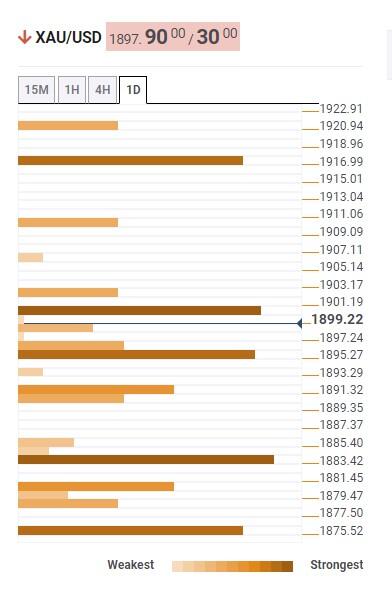
About Technical Confluences Detector
The TCD (Technical Confluences Detector) is a tool to locate and point out those price levels where there is a congestion of indicators, moving averages, Fibonacci levels, Pivot Points, etc. If you are a short-term trader, you will find entry points for counter-trend strategies and hunt a few points at a time. If you are a medium-to-long-term trader, this tool will allow you to know in advance the price levels where a medium-to-long-term trend may stop and rest, where to unwind positions, or where to increase your position size.
- USD/JPY has gauged intermediate support around 129.00 after a vertical fall.
- Ease in risk-on market mood has provided support to the US Treasury yields.
- A downtrend in the US inflation has accelerated the odds of less hawkish monetary policy by the Fed.
The USD/JPY pair has sensed support around 129.00 in the Tokyo session after a vertical downfall below the critical support of 132.30 on Thursday. The asset witnessed extreme selling pressure after the continuation of the downward spree of the United States inflation.
After a massive selloff, the asset has gauged an intermediate cushion as the risk-sensitive asset has sensed long liquidation. The S&P500 futures have picked offers in Asia after a three-day consecutive rally, portraying a loss of strength in the risk-appetite theme. This has led to a decline in the demand for US government bonds. The 10-year US Treasury yields have gained to near 3.49%.
Meanwhile, the US Dollar Index (DXY) is attempting to overstep the immediate resistance of 102.00. A rebound move in the USD Index has been supported by the ease in the cheerful market mood. However, the downside bias for the USD Index is still solid as the headline US inflation has dropped to 6.5% from its peak of 9.1% in a few months.
A meaningful downtrend in the US Consumer Price Index (CPI) has triggered odds of less-hawkish commentary by Federal Reserve (Fed) chair Jerome Powell in the upcoming monetary policy meeting. While other Fed policymakers have trimmed their expectations for the continuation of a higher interest rate announcement. Philadelphia Fed Bank President Patrick Harker said on Thursday that it was time for future Fed rate hikes to shift to 25 basis points (bps) increments, as reported by Reuters.
On the Tokyo front, the Bank of Japan (BoJ) has announced that it will review the side effects of a secular period-long ultra-expansionary monetary policy. This doesn’t convey that the central bank will start turning hawkish on interest rates as the maintenance of the 2% inflation target is still difficult for the BoJ. However, the central bank will restrict sheer liquidity leakage to improve market functioning.
- GBP/USD retreats from intraday high to pare the biggest weekly gain since late November.
- RSI pullback from nearly overbought conditions adds strength to the pullback moves.
- 200-SMA, weekly support line appears crucial challenge for bears.
- UK monthly GDP, output and trade numbers for November will be crucial to watch.
GBP/USD prints mild losses around 1.2200 as bulls take a breather at the monthly high ahead of the key UK data on early Friday. In doing so, the Cable pair consolidates the biggest weekly gains in six while printing the double top bearish chart formation on the four-hour play.
Also read: GBP/USD picks demand around 1.2200 as risk appetite improves further
Additionally, teasing the GBP/USD bears could be the sluggish MACD signals and the RSI (14) retreat from the nearly overbought region.
However, the 200-SMA and an upward-sloping trend line from January 06, respectively near 1.2140 and 1.2115, appear tough nuts to crack for the GBP/USD pair sellers.
Following that, a downward trajectory toward the monthly low of 1.1841 can’t be ruled out.
It’s worth noting that the GBP/USD weakness past 1.1841 will confirm the “double tops” and will theoretically signal a south-run to 1.1440.
Alternatively, an upside clearance of the 1.2250 level will defy the bearish chart pattern, which in turn will direct GBP/USD buyers towards the previous monthly high surrounding 1.2445-50.
In case where the Cable pair remains firmer past 1.2450, its run-up towards May 2022 high near 1.2665 can’t be ruled out.
GBP/USD: Four-hour chart
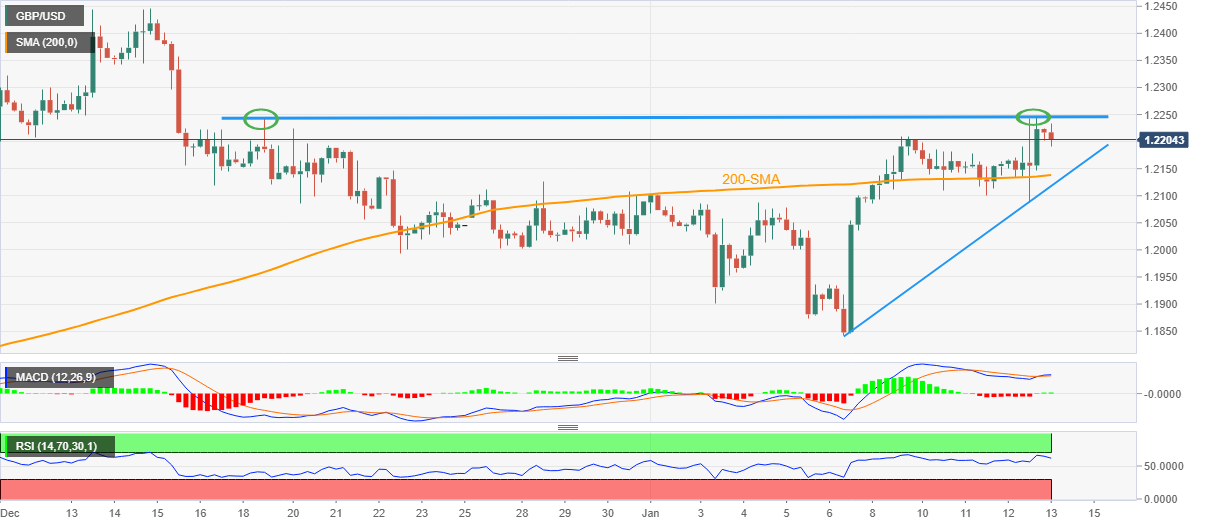
Trend: Further downside expected
- AUD/USD takes offers to refresh intraday low even as China reported record trade volume in 2022.
- Chatters surrounding US-backed hardships of Chinese chipmakers, cautious Fed talks add strength to the pullback moves.
- Rebound in Treasury bond yields, lackluster session also weighs on AUD/USD prices.
- US consumer-centric data, Fed talks eyed for clear directions.
AUD/USD fails to cheer China’s housing policy support, as well as upbeat trade numbers for 2022, amid fears of hardships in 2023. In doing so, the Aussie pair reverses the US CPI-inspired gains to 0.6950 amid a lackluster Asian session on Friday.
That said, China’s Trade Balance figures jumped to a record high in Yuan terms for 2022, up 7.7% YoY. However, China Customs Spokesperson Lyu Daliang mentioned that China's foreign trade will continue to face a number of challenges and difficulties in 2023, per Reuters. While conveying the data, Xinhua mentioned that China's total goods imports and exports hit a record high again in 2022, expanding 7.7% year on year to 42.07 trillion yuan (about 6.25 trillion U.S. dollars).
In addition to the upbeat trade numbers, China’s plan to announce $15 billion in support to the housing market, via rental housing loans, also appears a positive that should have favored the AUD/USD pair to extend the previous day’s gains. However, headlines suggesting fresh US-China tussles and mixed comments from the Fed policymakers seem to have triggered the quote’s profit-booking moves.
Reuters cites anonymous sources to state that the White House will discuss a recent crackdown on exports of chip-making tools to China with Japanese and Dutch officials during upcoming visits. The news also mentions that the White House Officials will not result in "immediate" pledges from the two countries to impose similar curbs.
On the other hand, Atlanta Federal Reserve Bank President Raphael Bostic mentioned that he would be comfortable moving at 25 basis points if conversations with business leaders are consistent with slowing inflation. Fed’s Bostic previously stated that it is ''fair to say that the Fed is willing to overshoot.'' Even so, the policymaker refrained from backing the talks that the Fed will stop rate hikes in 2023. The same could be witnessed in the previous comments from Federal Reserve Bank of Philadelphia President Patrick Harker and Richmond Federal Reserve President Thomas Barkin.
Alternatively, St. Louis Federal Reserve leader James Bullard also said that the most likely scenario is inflation remaining above 2%, so the policy rate will need to be higher for longer.
Amid these plays, the S&P 500 Futures print mild losses even if Wall Street closed with gains while the US 10-year Treasury yields lick their wounds near 3.46% by the press time, following a slump to the monthly low of 3.44% the previous day.
Looking forward, the first prints of the US Michigan Consumer Sentiment Index (CSI) for January, as well as the 5-year US Consumer Inflation Expectations, will be important to watch for AUD/USD traders.
Technical analysis
Failure to provide a daily closing beyond the two-month-old ascending resistance line, around 0.6975 by the press time, joins the RSI retreat to favor the AUD/USD pair’s pullback. However, bears remain confused unless the quote stays beyond the December 2022 peak of 0.6932.
Chinese state media, Xinhua News Agency, reported on Friday, China is planning to issue further policies to support the housing rental market, including a 100 billion Yuan (USD15 billion) housing rental loan plan.
Additional takeaways
China will increase financing to quality developers via loans and bond issuance.
China's plan to improve developers' balance sheets mainly targets high quality property firms with relatively big size, and systemic importance.
China will encourage financial institutions to negotiate with quality developers on debt extension on a reasonable basis.
China will support developers' offshore debt repayment by providing policy support such as better forex management.
Related reads
- China Customs: 2022 exports rise by 10.5%, foreign trade still faces many challenges
- AUD/USD drops back to 0.6950 as China Customs resists cheering upbeat trade figures for 2022
- NZD/USD takes offers to pare weekly gains strong China trade figures.
- China Customs fail to cheer the strong trade volume in 2022 as figures jumped 40 trillion Yuan.
- Weekly resistance line guards immediate upside, 100-HMA probes bears.
- MACD, RSI also favor the pullback moves despite firmer China trade numbers for 2022.
NZD/USD slides towards the intraday low of 0.6369 as it takes offers to 0.6372 despite firmer China trade numbers for December, published early Friday.
That said, China’s Trade Balance figures jumped to a record high in Yuan terms for 2022. However, China Customs Spokesperson Lyu Daliang mentioned that China's foreign trade will continue to face a number of challenges and difficulties in 2023, per Reuters.
It should be noted that China's Trade Balance grew 7.7% in 2022. “China's total goods imports and exports hit a record high again in 2022, expanding 7.7% year on year to 42.07 trillion yuan (about 6.25 trillion U.S. dollars), official data showed Friday,” per Xinhua.
Technically, NZD/USD extends the early-day pullback from the weekly resistance line, around 0.6420 at the latest to poke 100-HMA support of 0.6370.
In doing so, the Kiwi pair fades the previous day’s bounce off the 200-HMA, at 0.6325 by the press time.
Given the looming bear cross on the MACD and RSI (14) retreat, as well as the China Customs’ pessimism surrounding trade conditions in 2023, the NZD/USD pair is likely to witness further downside. Though, the sellers might have a tough time in breaking the 200-HMA support.
NZD/USD: Hourly chart
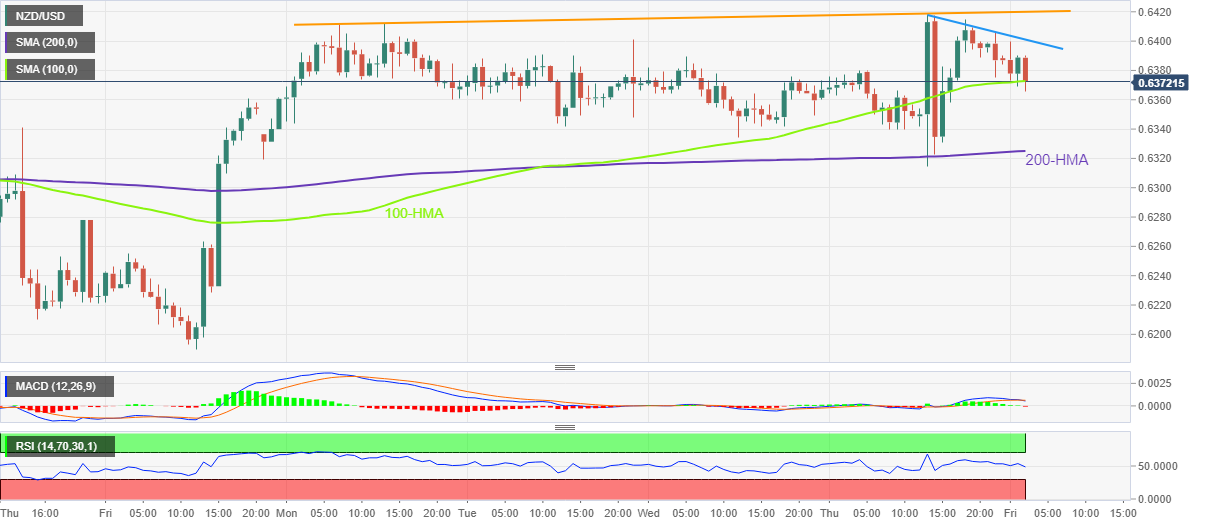
Trend: Further downside expected
A spokesperson from China Customs said on Friday, “foreign trade still faces many challenges and difficulties this year.”
“Fundamentals of long-term improvement remain unchanged, and the economy is expected to rebound as a whole this year,” the spokesperson added.
The comments come after China Customs reported the 2022 trade balance data, showing that the country’s exports rose 10.5% in Yuan terms in 2022 compared to the previous year while imports grew 4.3% over the same period.
Meanwhile, China’s Jan-Dec Trade Balance expanded by +5.87 trillion Yuan. For the first time, China's trade volume in 2022 exceeded 40 trillion Yuan.
Market reaction
AUD/USD is unimpressed by the above data, keeping its range near daily lows of 0.6948, down 0.31% on the day.
Japan Economy Minister Shigeyuki Goto announced on Friday that eight economists are expected to join the upcoming special sessions of the council on economic and fiscal policy to discuss longer-term macroeconomic policies.
Additional takeaways
To attend World Economic Forum annual meeting in Davos, to explain Japan's economic, fiscal policies.
Polices that are not extension of exisitng measures are required amid factors like global economic slowdown, Russia’s invasion of Ukraine.
Not planning to discuss BoJ’s exit strategy, when asked about whether special sessions would also consider monetary policy measures.
Don't think CEFP members will discuss a new govt-BoJ policy accord at least under current regime.
Related reads
- BoJ announces unplanned bond-buying on Friday
- USD/JPY drops to fresh lows on BoJ sentiment, scarred by US CPI also
- USD/CHF picks up bids to consolidate the previous day’s losses even if bulls lack upside momentum.
- Fed policymakers’ hesitance in backing pivot calls, despite favoring easy rate hikes, trigger US Treasury yield rebound.
- More clues for US inflation eyed for confirmation of bearish bias.
USD/CHF adds to the weekly gains around 0.9285, despite previous slump to a 10-month low, as traders await more clues to confirm the dovish bias from the Federal Reserve (Fed). Also likely to have probed the Swiss Franc (CHF) bears could be the latest chatters surrounding the US-China ties and a light calendar.
Recently, Atlanta Federal Reserve Bank President Raphael Bostic mentioned that he would be comfortable moving at 25 basis points if conversations with business leaders are consistent with slowing inflation. Fed’s Bostic previously stated that it is ''fair to say that the Fed is willing to overshoot.'' Even so, the policymaker refrained from backing the talks that the Fed will stop rate hikes in 2023.
The same could be witnessed in the previous comments from Federal Reserve Bank of Philadelphia President Patrick Harker and Richmond Federal Reserve President Thomas Barkin. On the contrary, St. Louis Federal Reserve leader James Bullard also said that the most likely scenario is inflation remaining above 2%, so the policy rate will need to be higher for longer.
It’s worth noting that headlines suggesting fresh US-China tussles also underpinned the USD/CHF consolidation during a sluggish session. That said, Reuters cites anonymous sources to state that the White House will discuss a recent crackdown on exports of chip-making tools to China with Japanese and Dutch officials during upcoming visits. The news also mentions that the White House Officials will not result in "immediate" pledges from the two countries to impose similar curbs.
While portraying the market’s mood, the S&P 500 Futures print mild losses even if Wall Street closed with gains while the US 10-year Treasury yields lick their wounds near 3.46% by the press time, following a slump to the monthly low of 3.44% the previous day.
It should be observed that the US Dollar slumped after the US Consumer Price Index (CPI) matched 6.5% YoY forecasts for December, versus 7.1% prior. More importantly, CPI ex Food & Energy also proved the market consensus of 5.7% YoY figure right, compared to 6.0% previous readings. It’s worth noting that the CPI MoM marked the first negative figure since June 2020 while marking a -0.1% figure for the stated month, versus 0.0% forecast and 0.1% prior.
That said, the recent short-covering appears elusive ahead of China trade numbers for December and the first prints of the US Michigan Consumer Sentiment Index (CSI) for January, as well as the 5-year US Consumer Inflation Expectations.
Technical analysis
A daily closing beyond the seven-week-old resistance line, around 0.9325 by the press time, becomes necessary for the USD/CHF bulls to retake control.
- USD/CAd bears take over and eye the 1.3300 target.
- A 50% mean reversion could be on the cards if the bears don't commit sooner.
USD/CAD is under pressure following the US Consumer Price Index outcome and a rally in the oil price. As per the prior analysis, USD/CAD bears take out last month's low, but bulls could emerge, where the M-formation supported a meanwhile bullish thesis at the start of the week to pull in bulls only to shake them out for a mid-week setup, the price action has played out as follows:
USD/CAD prior analysis
The reversion pattern was eyed that was expected to draw in the price towards the anticipated resistance near 1.3470s:
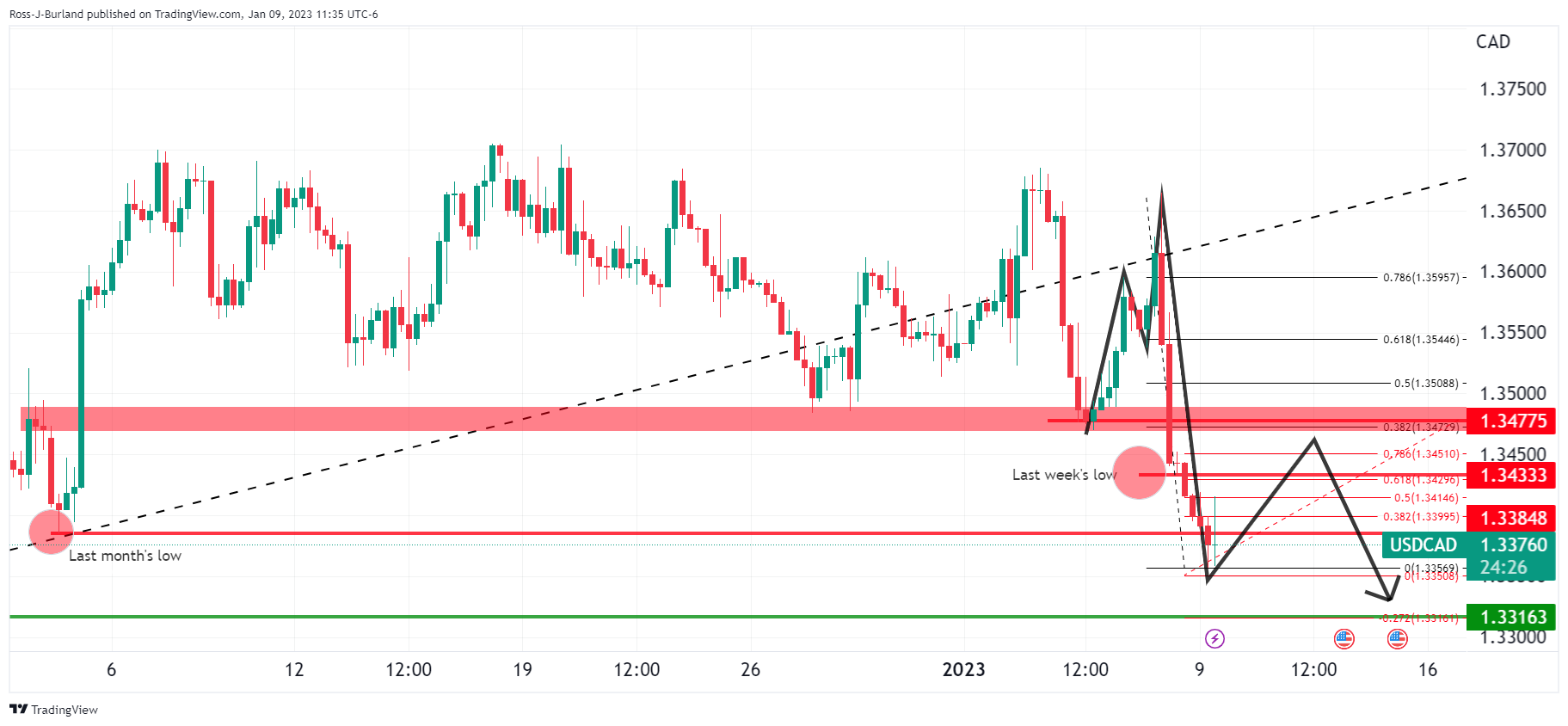
Zoomed in...
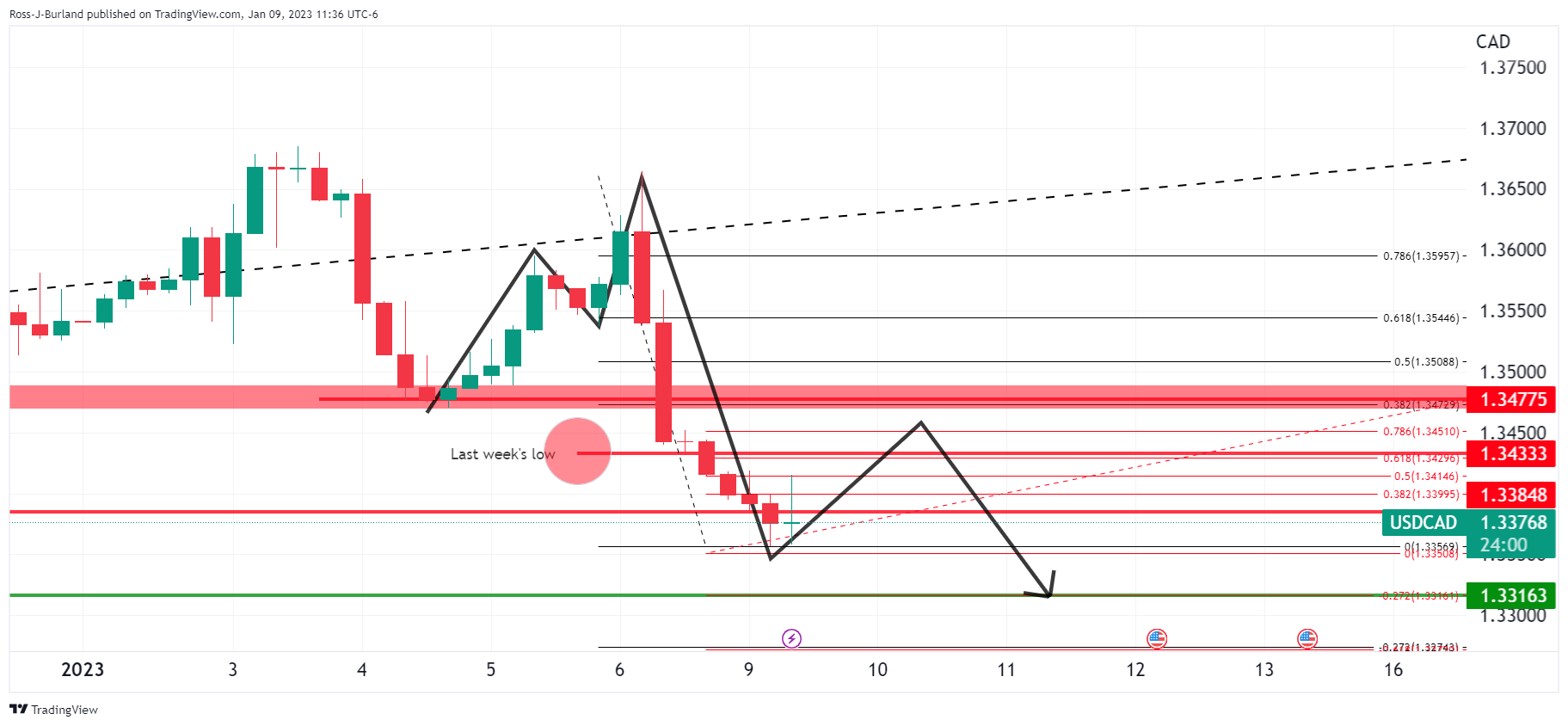
USD/CAD update
A lot has gone on since the start of the week's analysis as follows:
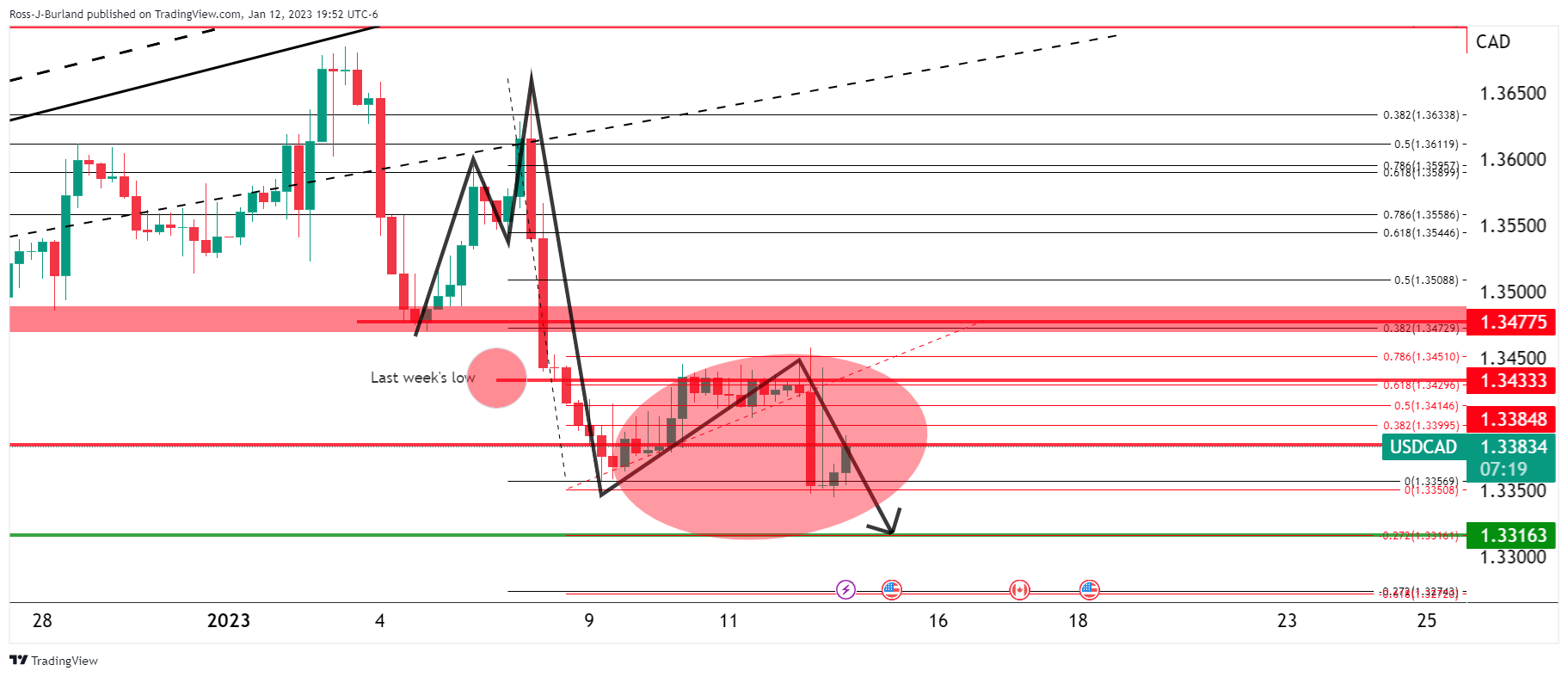
The bears are in charge now and the 1.3350s guard a run to the 1.3300 target:
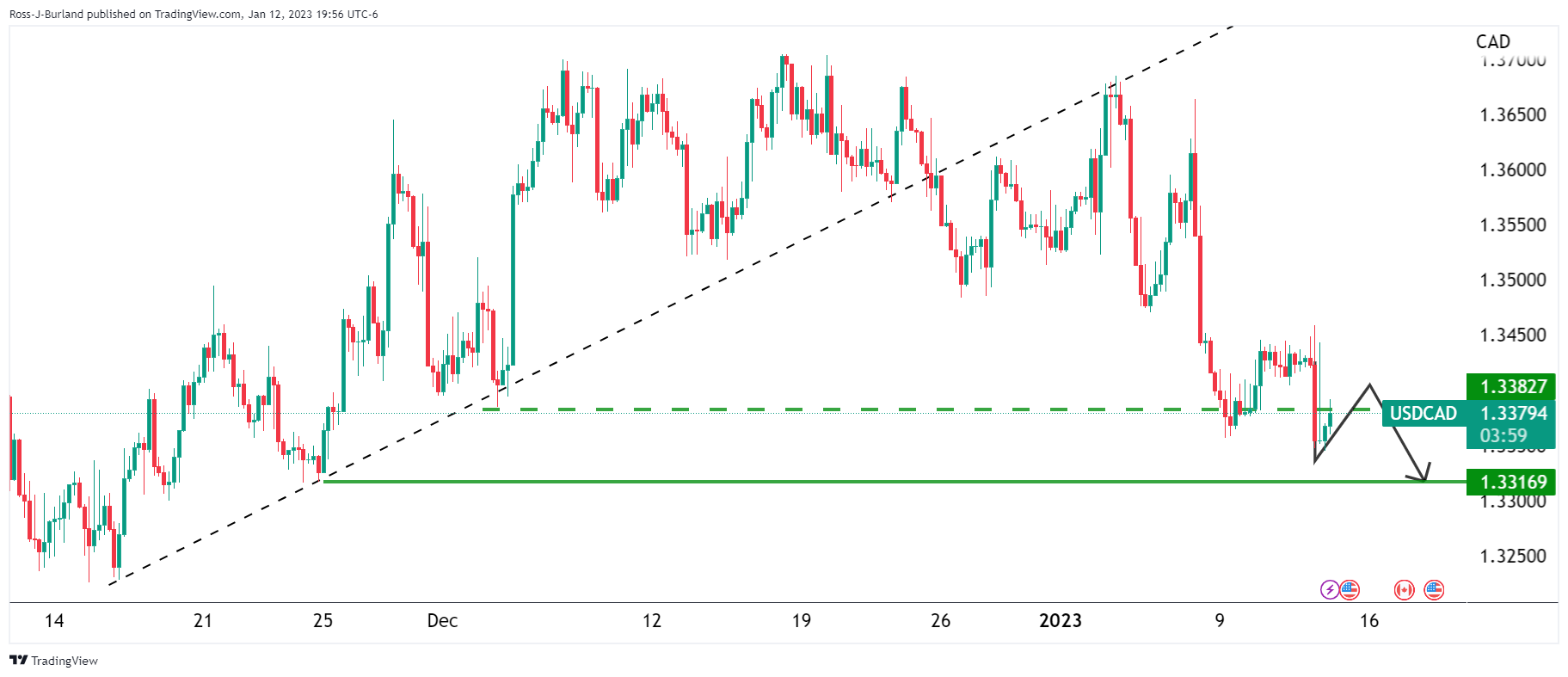
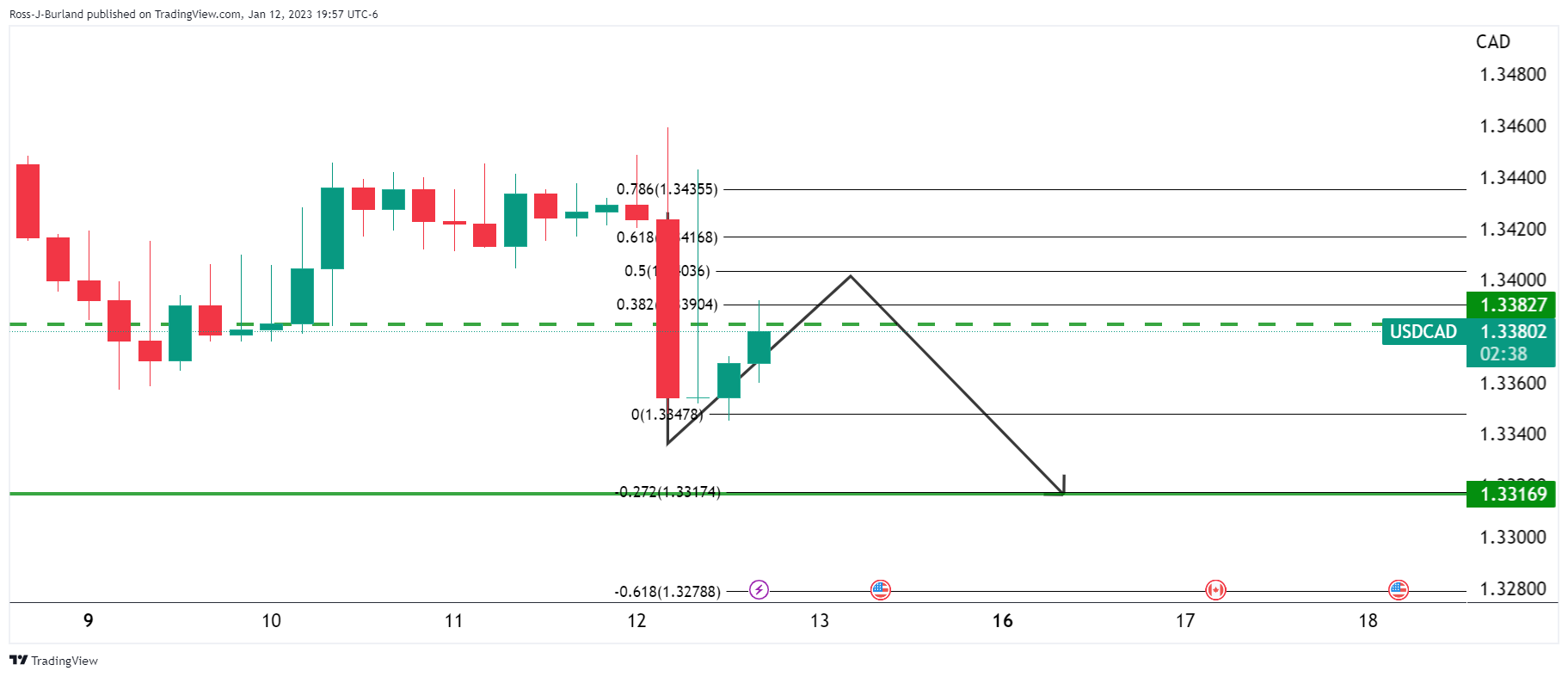
A 50% mean reversion could be on the cards if the bears don't commit sooner.
The Bank of Korea (BoK), the South Korean central bank, raised the benchmark interest rate by 25 basis points (bps) from 3.0% to 3.50% at its January monetary policy meeting, as widely expected.
Summary of the statement
Economic growth to slow.
Gdp growth to be slower than expected.
Inflation to slow gradually.
Housing price decline accelerated.
Has no reference to need for more rate hikes.
Assessment of recent rate hikes to factors to be considered going forward.
Polcy focus will remain on containing inflation.
Extends existing measures to support short-term money markets by three months.
Market reaction
USD/KRW dropped to fresh nine-month lows of 1,234.31 in an initial reaction to the BoK announcement before recovering some ground to trade at 1,239, where it now wavers. The pair is trading modestly flat on the day.
Reuters reported earlier that the Bank of Japan (BoJ) announced an unplanned bond purchases operation on Friday.
No further details are provided about the same.
Elsewhere, Japanese Chief Cabinet Secretary Hirokazu Matsuno said that it is “extremely regrettable that China has imposed one-sided border controls against Japan for reasons apparently unrelated to COVID-19 measures.”
Market reaction
Despite a minor uptick in the US Dollar Index and the US Treasury bond yields, USD/JPY is battling 129.00, losing 0.19% on the day.
- Silver price struggles to extend the previous day’s run-up.
- Convergence of 50-HMA, two-day-old support line restricts immediate downside.
- Sluggish oscillators and failure to cross weekly resistance lure XAG/USD bears.
Silver price (XAG/USD) stays defensive around $23.80, after rising the most in a week, as buyers fail to defend the first daily gains in a week below the short-term key resistance line.
In addition to the failure to cross the downward-sloping resistance line from January 03, sluggish MACD signals and steady RSI (14) also back the latest pullback in the bright metal price.
However, the 50-Hour Moving Average (HMA) joins an upward-sloping support line from Wednesday to highlight the $23.70 as the short-term key support that can restrict the metal’s further declines.
Following that, the monthly low of around $23.10 and the $23.00 round figure could probe the Silver sellers.
It’s worth noting that the XAG/USD weakness past $23.00 won’t hesitate to challenge the mid-December low of $22.55 before highlighting the last defense of the buyers, namely the November 2022 peak of $22.25.
On the contrary, a one-week-old descending trend line, around $23.90 by the press time, precedes the $24.00 round figure to restrict short-term XAG/USD upside.
In a case where the Silver price remains firmer beyond $24.00, the monthly high and tops marked during January 2022, respectively near $24.55 and $24.70, will be crucial to watch as they hold the key to the metal’s rally towards April 2022 high near $26.25.
Silver: Hourly chart
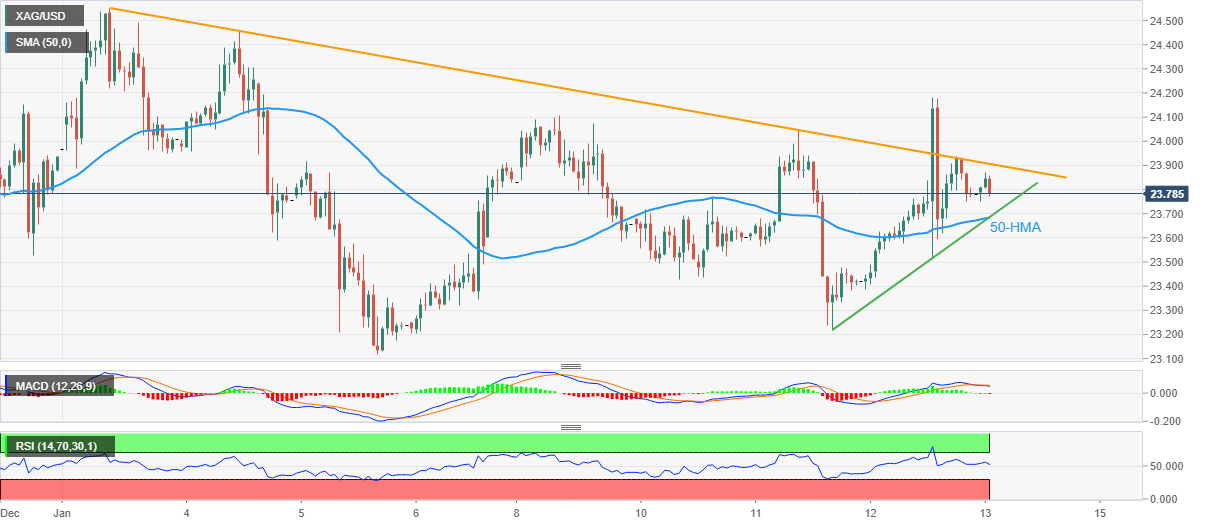
Trend: Pullback expected
In recent trade today, the People’s Bank of China (PBOC) set the yuan (CNY) at 6.7292 vs the last close of 6.7260.
About the fix
China maintains strict control of the yuan’s rate on the mainland.
The onshore yuan (CNY) differs from the offshore one (CNH) in trading restrictions, this last one is not as tightly controlled.
Each morning, the People’s Bank of China (PBOC) sets a so-called daily midpoint fix, based on the yuan’s previous day's closing level and quotations taken from the inter-bank dealer.
- GBP/JPY is oscillating in a narrow range below 158.00 as the focus shifts to US economic data.
- An expression of exit from the secular period-long ultra-expansionary monetary policy by the BoJ is supporting the Japanese Yen.
- UK production activities have been declining consecutively for the past four months.
The GBP/JPY pair is displaying topsy-turvy moves below the crucial resistance of 158.00 in the Asian session. The cross is showing a balanced profile as investors are awaiting the release of the United Kingdom economic data for fresh impetus.
On Thursday, GBP/JPY was dumped by the market participants after the Bank of Japan (BoJ) announced that the central bank will review the side effects of a decade-long easy monetary policy approach in spurring economic growth and inflation.
Chatters about a shift in the approach of the BoJ towards the price index are growing after the central bank stretched the range of 10-year Japan Government Bonds (JGSs). In a policy statement, the BOJ said the move was intended to “improve market functioning and encourage a smoother formation of the entire yield curve while maintaining accommodative financial conditions. “
Meanwhile, International Monetary Fund (IMF) Managing Director Kristalina Georgieva crossed wires, via Reuters, early Friday morning in Asia suggesting an accommodative policy stand for the BOJ. The pressure from labor on increases in labor compensation has not led to any dramatic change. In other words, there is no driver for inflation from there.
An adjustment to the central bank's debt yield curve control regime was not driven by an increase in inflation, which remains very close to the bank's 2% target.
On the United Kingdom front, investors are keeping an eye on the release of economic data. According to the consensus, the Industrial and Manufacturing Production (Nov) will contract by 3.0% and 4.8% on an annual basis. It is worth noting that UK production activities have been declining consecutively for the past four months. A spree of slowdown could weaken inflation expectations further, which will ease some troubles for the Bank of England (BOE) policymakers.
- EUR/USD pauses five-day uptrend at the highest level since late April 2022.
- Rebound in US Treasury yields, Fed policymakers’ hesitance to back policy pivot probe pair buyers.
- Downbeat US CPI bolstered expectations of Fed’s easy rate hikes and pleased EUR/USD bulls previously.
- US Michigan CSI, 5-year Inflation expectations eyed for clear directions.
EUR/USD retreats from a nine-month high as bulls take a breather after posting the five-day winning streak amid a light calendar on Friday. Even so, the major currency pair refrains from welcoming bears amid dovish hopes from the US Federal Reserve (Fed), backed by the previous day’s US inflation data. That said, the major currency pair seesaws around 1.0850-55 by the press time.
Although multiple US Fed policymakers backed a 0.25% rate hike after Thursday’s downbeat US Consumer Price Index (CPI) data for December, none of them signaled the policy pivot, which in turn raised doubts about the US Dollar’s slump after the CPI matched wide forecasts. As a result, the EUR/USD bulls await more clues to back the expectations of the Fed’s policy pivot in 2023. The same highlights today’s China trade numbers for December and the first prints of the US Michigan Consumer Sentiment Index (CSI) for January, as well as the 5-year US Consumer Inflation Expectations.
In addition to the pre-data caution, headlines suggesting fresh US-China tussles also probe the EUR/USD prices. That said, Reuters cites anonymous sources to state that the White House will discuss a recent crackdown on exports of chip-making tools to China with Japanese and Dutch officials during upcoming visits. The news also mentions that the White House Officials will not result in "immediate" pledges from the two countries to impose similar curbs.
Amid these plays, the S&P 500 Futures remains indecisive even if Wall Street closed with gains while the US 10-year Treasury yields lick their wounds near 3.46% by the press time, following a slump to the monthly low of 3.44% the previous day.
That said, the US CPI matched 6.5% YoY forecasts for December, versus 7.1% prior. More importantly, CPI ex Food & Energy also proved the market consensus of 5.7% YoY figure right, compared to 6.0% previous readings. It’s worth noting that the CPI MoM marked the first negative figure since June 2020 while marking a -0.1% figure for the stated month, versus 0.0% forecast and 0.1% prior.
Following the data, Federal Reserve Bank of Philadelphia President Patrick Harker was the first to flag easy rate hikes after the US CPI and weighed on the US Dollar. On the same line, Richmond Federal Reserve President Thomas Barkin mentioned that it "makes sense" to steer more deliberately as the Fed works to bring inflation down. However, St. Louis Federal Reserve leader James Bullard also said that the most likely scenario is inflation remaining above 2%, so the policy rate will need to be higher for longer.
Recently, Atlanta Federal Reserve bank president Raphael Bostic mentioned that he would be comfortable moving at 25 basis points if conversations with business leaders are consistent with slowing inflation. Fed’s Bostic previously stated that it is ''fair to say that the Fed is willing to overshoot.''
Moving on, anticipated strength in China trade numbers for December could help EUR/USD buyers but likely improvement in the US consumer confidence figures might probe the pair’s upside. It’s worth noting that the US 5-year Consumer Inflation Expectations, Eurozone Industrial Production for November and final prints of the bloc’s inflation data will also be crucial to watch for clear directions.
Technical analysis
Unless declining back below May 2022 top near 1.0785, the EUR/USD bulls are on the way to poking the late April 2022 peak surrounding 1.0935.
- Aussie bulls are aiming to recapture the psychological resistance of 0.7000 amid an upbeat market mood.
- A breakout of the Rising Channel has strengthened the Australian Dollar.
- The RSI (14) has shifted into the bullish range of 60.00-80.00, which conveys that the bullish momentum has been activated.
The AUD/USD pair is inches far from recapturing the critical resistance of 0.6980 in the Asian session and is likely to extend further to near 0.7000. The Aussie asset has sensed buying interest as risk-sensitive assets like S&P500 futures are extending their gains further. Despite three consecutive bullish trading sessions, S&P500 futures are still aiming higher, which indicates that bulls are not out of steam.
The US Dollar Index (DXY) is hovering around a fresh seven-month low at 101.80 and is not expected to display any meaningful rebound move amid the risk appetite theme. A spree of inflation softening in the United States is going to force the Federal Reserve (Fed) to employ a less-hawkish tone in announcing February’s monetary policy.
On a four-hour scale, the Aussie asset has delivered a breakout of the Rising Channel, which indicates volatility expansion. The 20-and 50-period Exponential Moving Averages (EMAs) at 0.6916 and 0.6817 respectively are upward-sloping, which adds to the upside filters.
Also, the Relative Strength Index (RSI) (14) has shifted into the bullish range of 60.00-80.00, which conveys that the bullish momentum has been activated.
A decisive move above the psychological resistance of 0.7000 will drive the Aussie towards August high at 0.7137. A break above August high will send the major toward June 9 high around 0.7200.
On the contrary, a downside move below December 29 low at 0.6710 will drag the major further towards December 22 low at 0.6650 followed by November 21 low at 0.6585.
AUD/USD four-hour chart
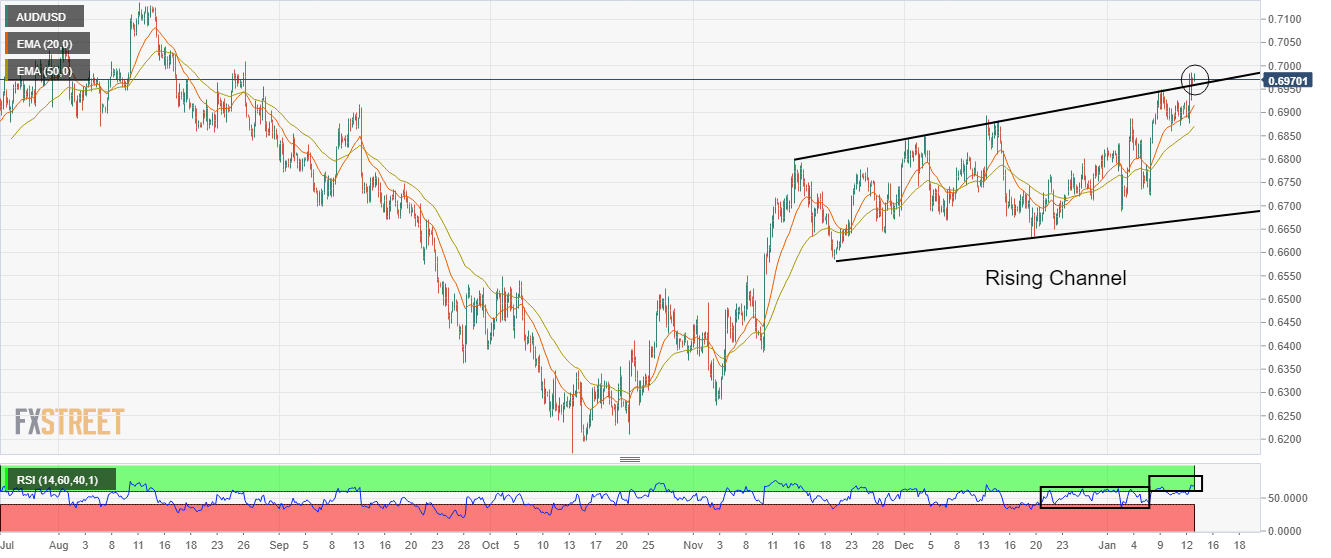
Atlanta Federal Reserve bank president Raphael Bostic who said on Monday that it is ''fair to say that the Fed is willing to overshoot,'' is now saying that he would be comfortable moving at 25 basis points if conversations with business leaders are consistent with slowing inflation. He said that the signs of slowing wage increases "also positive".
Data showing inflation slowed in December "was really welcome news" that may allow the U.S. Federal Reserve to scale back to quarter-point rate increases at its upcoming meeting, Atlanta Federal Reserve Bank president Raphael Bostic said on Thursday.
"It really suggests inflation is moderating and that gives me some comfort that we might be able to move more slowly," Bostic said in an interview on CBS News' Prime Time with John Dickerson.
Key comments
Inflation report today was welcome news and may allow Fed to move more slowly.
Would be comfortable moving at 25 basis points if conversations with business leaders are consistent with slowing inflation.
Signs of slowing wage increases "also positive".
Economy still producing more than 200k a month, means a lot of momentum in the economy; baseline is economy will not see significant job dislocation.
Business leaders almost unanimously feel business is strong and don't expect layoffs.
US Dollar update
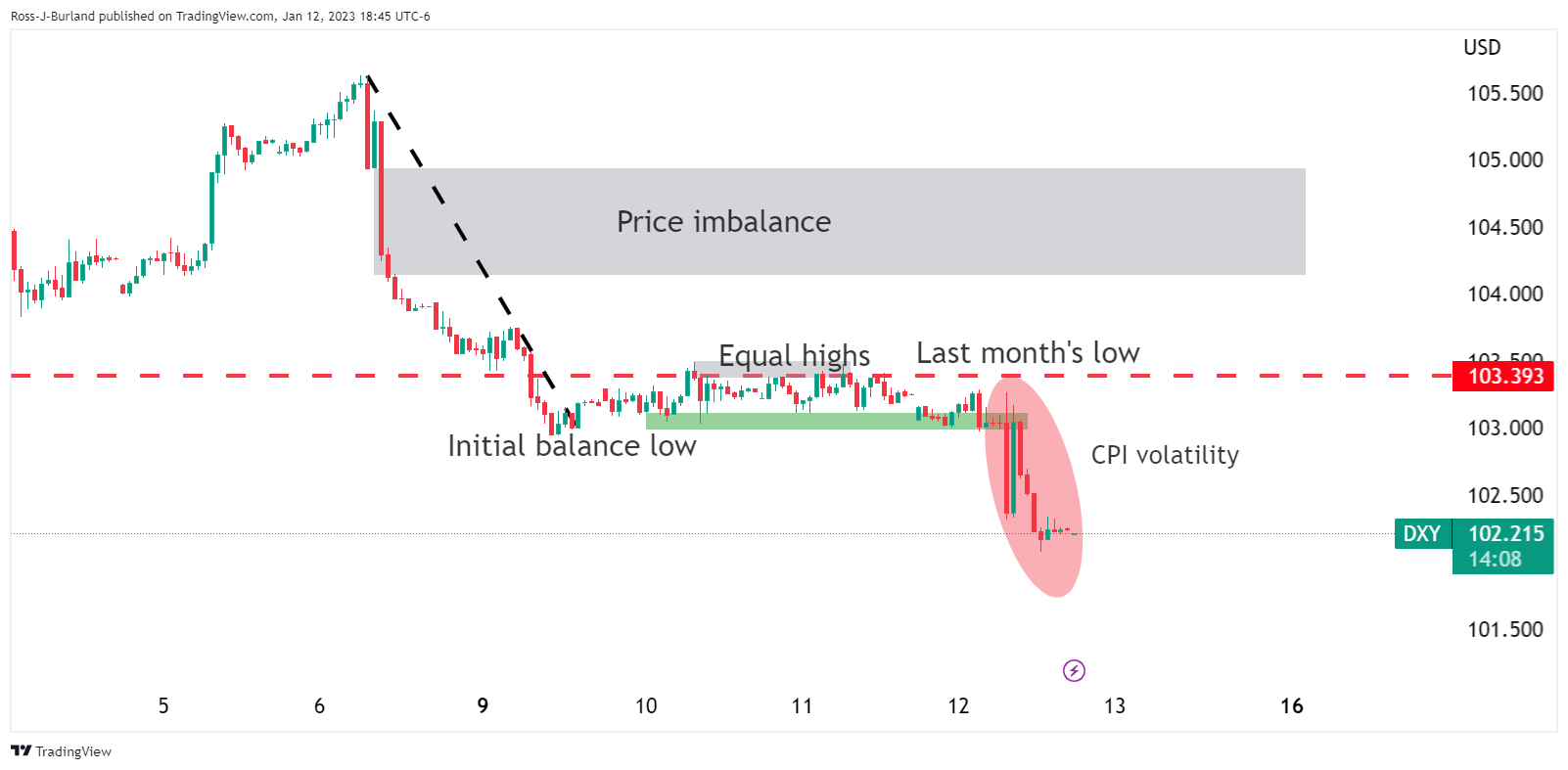
The US Dollar has been falling to the lowest levels for several months following the CPI event.
However, there are observers that are sceptical of the Federal Reserve. Analysts at Brown Brothers Harriman argued that ''core PCE has largely been in a 4.5-5.5% range since November 2021 and we think the Fed needs to see further improvement before even contemplating any sort of pivot.''
''WIRP suggests a 25 bp hike February 1 is fully priced in, with nearly 30% odds of a larger 50 bp move. Another 25 bp hike March 22 is fully priced in, while one last 25 bp hike in Q2 is nearly 45% priced in that would take the Fed Funds rate ceiling up to 5.25%. However, the swaps market continues to price in an easing cycle by year-end and we just don’t see that happening,'' the analysts added.
- Gold price remains mildly bid around eight-month high.
- Mixed concerns, wait for more clues to raise bets on Fed policy pivot probe XAU/USD bulls.
- China trade numbers, US Michigan CSI also appear important for fresh impulse.
Gold price (XAU/USD) remains steady around $1,900 as bulls take a breather around the eight-month high during early Friday, following the US inflation-inspired rally. In doing so, the yellow metal also portrays the market’s cautious mood ahead of more clues for the US inflation conditions and consumer sentiment. Additionally, the fresh fears surrounding the US-China ties act as additional challenges for the XAU/USD buyers.
That said, Reuters cites anonymous sources to state that the White House will discuss a recent crackdown on exports of chip-making tools to China with Japanese and Dutch officials during upcoming visits. The news also mentions that the White House Officials will not result in "immediate" pledges from the two countries to impose similar curbs. The news refreshes the geopolitical tussles between the United States and China and puts a floor under the Gold price.
On the same line could be the cautious mood ahead of China’s trade numbers for December and the first prints of the US Michigan Consumer Sentiment Index (CSI) for January will be important for immediate direction. Also important will be the US 5-year Consumer Inflation Expectations.
While portraying the mood the S&P 500 Futures remains indecisive even if Wall Street closed with gains while the US 10-year Treasury yields lick its wounds near 3.46% by the press time.
On Thursday, the US CPI matched 6.5% YoY forecasts for December, versus 7.1% prior. More importantly, CPI ex Food & Energy also proved the market consensus of 5.7% YoY figure right, compared to 6.0% previous readings. It’s worth noting that the CPI MoM marked the first negative figure since June 2020 while marking a -0.1% figure for the stated month, versus 0.0% forecast and 0.1% prior.
Following the US CPI, the Fed Fund Futures tied to the policy rate implied a nearly 100% chance of a 0.25% Fed rate hike in February while the odds favoring a 50 bps rate hike in the said month slumped to 8.0%.
Talking about the Fedspeak, Federal Reserve Bank of Philadelphia President Patrick Harker was the first to flag easy rate hikes after the US CPI and weighed on the US Dollar. On the same line, Richmond Federal Reserve President Thomas Barkin mentioned that it "makes sense" to steer more deliberately as the Fed works to bring inflation down. However, St. Louis Federal Reserve leader James Bullard also said that the most likely scenario is inflation remaining above 2%, so the policy rate will need to be higher for longer.
Looking forward, anticipated strength in China trade numbers for December could help Gold buyers but likely improvement in the US consumer confidence figures might probe the XAU/USD upside. It’s worth noting that the US 5-year Consumer Inflation Expectations will be crucial to watch.
Gold price technical analysis
Gold price pokes the top line of a three-week-old bullish channel as the RSI (14) line stays inside the overbought territory, which in turn suggests the metal’s pullback towards a one-week-old support line, close to $1,880 by the press time.
However, the lower line of the stated channel and the one-month-old horizontal support area, respectively near $1,855 and $1,825, could challenge the Gold bears afterward.
Alternatively, the stated channel's top near $1,901 and the previous day's high near $1,902 restricts the metal's immediate upside. That said, highs marked during May and late April 2022, respectively near $1,910 and $1,920, could act as additional resistances to watch for the yellow metal traders.
In a case where the Gold buyers keep the reins past $1,920, the odds of witnessing a run-up towards the late March 2022 high near $1,966 can’t be ruled out.
Overall, Gold buyers seem to run out of steam but the bears are nowhere to find.
Gold price: Four-hour chart
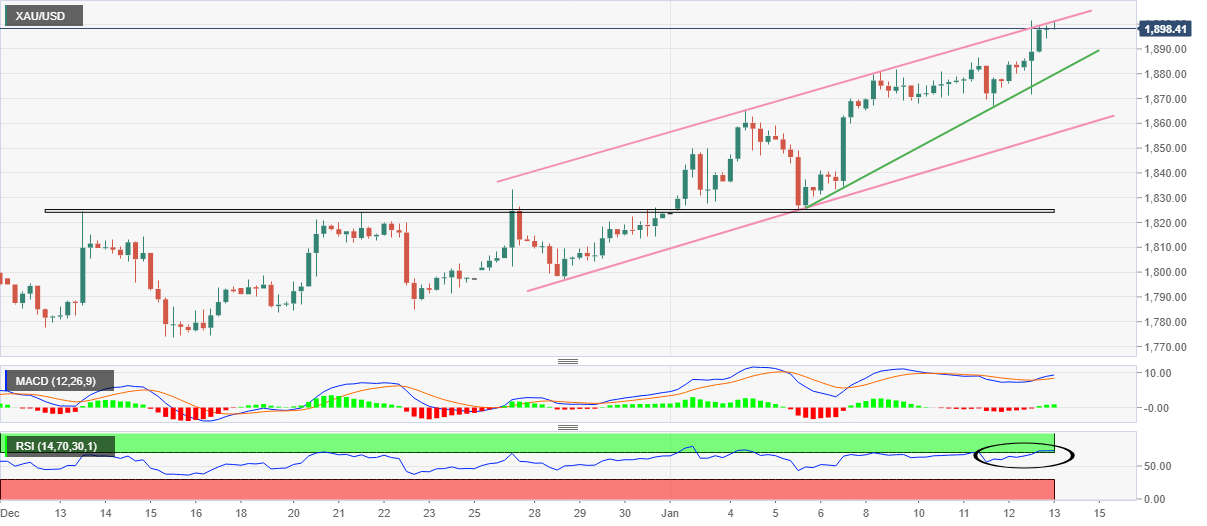
Trend: Pullback expected
- USD/JPY bears take on the bulls and extend the downside.
- A fresh low has been pointed as the BoJ and Fed sentiment run over the bulls.
USD/JPY is pressured and on the offer following a series of impactful macro events, both scheduled and unscheduled, including the Bank of Japan headlines (Wednesday) and US Consumer Price Index (Thursday). At the time of writing, the pair is lower by some 0.20% trading around 129.00 and within a range of 128.64 and 129.42.
BoJ sentiment steering yen higher
USD/JPY fell out of bed on Wednesday before the highly anticipated Consumer Price Index event on Thursday when a headline did the rounds that the Bank of Japan, as reported by Japanese media Yomiuri, was about to make another hawkish move during its next week’s monetary policy meeting. The news signalled that the Japanese central bank is up for reviewing the side effects of massive monetary easing in the monetary policy meeting next week. “BoJ reviews due to skewed interest rates in markets even after last month's tweak in bond yield control policy,” adds Yomiuri per Reuters. As a consequence, the yen rallied hard from trendline resistance to break 130 and reached 129.60. In trade today, the yen is benefiting from Japanese Government Bond yields rising on the hawkish sentiment.
US CPI nails in the coffin for USD/JPY
On Thursday, the yen gained more ground to a high of 128.85 following the Consumer Price Index data that came in as expected on the whole. The data have helped cement expectations for a 25bp Fed hike next month, and the resulting drop in US bond yields has weighed on the greenback. The year-over-year CPI print landed at 6.5% or 0.6 of a percentage point cooler than the November number. The one exception was a positive surprise. On a monthly basis, the headline number actually decreased by a nominal 0.1% instead of remaining unchanged, as analysts expected.
USD/JPY upside risks
However, there are observers that are sceptical of the Federal Reserve.
Analysts at Brown Brothers Harriman argued that ''core PCE has largely been in a 4.5-5.5% range since November 2021 and we think the Fed needs to see further improvement before even contemplating any sort of pivot.''
''WIRP suggests a 25 bp hike February 1 is fully priced in, with nearly 30% odds of a larger 50 bp move. Another 25 bp hike March 22 is fully priced in, while one last 25 bp hike in Q2 is nearly 45% priced in that would take the Fed Funds rate ceiling up to 5.25%. However, the swaps market continues to price in an easing cycle by year-end and we just don’t see that happening.''
- US Dollar Index remains pressured at seven-month low after declining the most in over a week.
- United States Consumer Price Index marked the first contraction since June 2020 and lured DXY bears.
- Federal Reserve officials backed slower interest rate hikes but retreated from policy pivot talks.
- Strong prints of US Michigan Consumer Price Index, 5-year Consumer Inflation Expectations could trigger US Dollar short-covering.
US Dollar Index (DXY) licks its wounds at the seven-month low as bears await more clues to extend the United States inflation-inflicted losses ahead of other key statistics from the world’s biggest economy. Also likely to have probed the DXY bears could be the recent lack of data and fresh geopolitical fears surrounding the US and China. That said, the US Dollar Index seesaws near 102.20 by the press time of early Friday, after falling the most in a week the previous day.
United States Consumer Price Index drowned US Dollar Index
On Thursday, the United States Consumer Price Index (CPI) amplified concerns about the Federal Reserve’s slower rate hikes by printing downbeat numbers for December, which in turn pushed the US Dollar Index to refresh a multi-month low. That said, the headline CPI matched 6.5% YoY forecasts versus 7.1% prior. More importantly, CPI ex Food & Energy also proved the market consensus of 5.7% YoY figure right, compared to 6.0% previous readings. It’s worth noting that the CPI MoM marked the first negative figure since June 2020 while marking a -0.1% figure for the stated month, versus 0.0% forecast and 0.1% prior.
Federal Reserve officials favor slower rate hikes but not pivot talks
Following the downbeat United States inflation data, Federal Reserve Bank of Philadelphia President Patrick Harker was the first to flag easy rate hikes after the US CPI and weighed on the US Dollar. On the same line, Richmond Federal Reserve President Thomas Barkin mentioned that it "makes sense" to steer more deliberately as the Fed works to bring inflation down. However, St. Louis Federal Reserve leader James Bullard also said that the most likely scenario is inflation remaining above 2%, so the policy rate will need to be higher for longer.
That said, the Fed Fund Futures tied to the policy rate implied a nearly 100% chance of a 0.25% Fed rate hike in February while the odds favoring a 50 basis points (bps) rate hike in the said month slumped to 8.0%.
US-China tussles put a floor under the DXY price
Reuters cites anonymous sources to state that the White House will discuss a recent crackdown on exports of chip-making tools to China with Japanese and Dutch officials during upcoming visits. The news also mentions that the White House Officials will not result in "immediate" pledges from the two countries to impose similar curbs. The news refreshes the geopolitical tussles between the United States and China and underpins the US Dollar Index rebound, or at least a pause to the further downside.
More data eyed to confirm US Dollar Index fall
Although the US CPI and comments from the Fed policymakers have highlighted the odds of the Federal Reserve’s (Fed) easy rate hikes from February, talk of the policy pivot need more proofs to gain the market’s attention. Among them, China’s trade numbers for December and the first prints of the US Michigan Consumer Sentiment Index (CSI) for January will be important for immediate direction. Also important will be the US 5-year Consumer Inflation Expectations.
To sum up, US Dollar Index (DXY) remains on the bear’s radar but the room towards the south hinges on more data.
US Dollar Index technical analysis
With its downside break of 103.00, the US Dollar Index smashed the key support line stretched from May 2021. However, the 50% Fibonacci retracement level of the DXY’s May 2021 to September 2022 upside, near 102.15, restricts the quote’s immediate declines.
Even so, the bearish signals from the Moving Average Convergence and Divergence (MACD) indicator keep the US Dollar Index bears hopeful of breaking the immediate support, which in turn highlights May 2022 low surrounding 101.30.
It should be noted, however, that the Relative Strength Index (RSI) line, placed at 14, is near the oversold territory and suggests limited downside room, which in turn adds strength to the 101.30 support.
In a case where the DXY drops below 101.30, the 101.00 and the 100.00 thresholds could probe the bears before directing them to the 61.8% Fibonacci retracement level, also known as the “Golden Ratio”, surrounding 99.20.
Alternatively, the US Dollar Index corrective bounce remains elusive unless the quote stays below the aforementioned multi-month-old support line, now resistance around 103.05.
Following that, the 38.2% Fibonacci retracement and the monthly high could test the DXY bulls around 105.15 and 105.65 respectively.
However, the US Dollar Index remains on the bear’s radar unless the quote stays below the 200-Day Moving Average (DMA) level of 106.65.
DXY: Daily chart
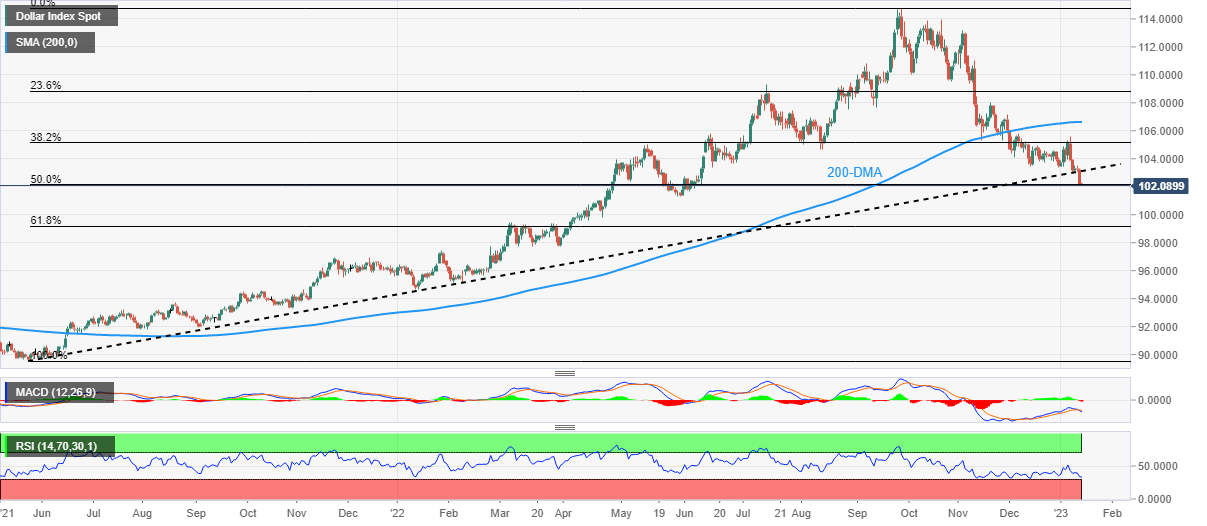
Trend: Further downside expected
- GBP/USD has displayed recovery after correcting to near 1.2200 as a risk-on impulse has strengthened further.
- Fed Harker doesn’t see any recession but GDP could slow to 1% in CY2023.
- UK’s annual Industrial and Manufacturing Production (Nov) are expected to contract by 3.0% and 4.8% respectively.
The GBP/USD pair has rebounded after a corrective move to near the round-level support at 1.2200 in the early Toyo session. The Cable has resumed its upside journey as the risk appetite of the market participants has improved further.
After three consecutive bullish trading sessions, the S&P500 futures are extending gains, portraying a cheerful market mood. Also the demand for US government bonds has improved as 10-year US Treasury yields have eased further to near 3.44%. The US Dollar Index (DXY) has turned sideways after refreshing its seven-week low at 101.68.
Investors dumped the USD Index after further softening of the United States inflation, released on Thursday. The annual headline US Consumer Price Index (CPI) dropped to % while the core CPI that excludes oil and food prices was trimmed to 5.7%, in line with expectations. A spree of inflation softening indicates that the long-term blueprint designed by the Federal Reserve (Fed) chair Jerome Powell and his teammates for achieving price stability is in the right direction.
No doubt, Fed policymakers have started considering further deceleration in the pace of the interest rate hike already after slowing in December’s monetary policy meeting. Philadelphia Fed Bank President Patrick Harker said on Thursday that it was time for future Fed rate hikes to shift to 25 basis points (bps) increments, as reported by Reuters. He further added that recession is not in the picture but the Gross Domestic Product (GDP) could slow to 1% this year.
On the United Kingdom front, investors are awaiting the release of the economic activities-related data, which will result in a power-pack action in the Pound Sterling. Annual Industrial and Manufacturing Production (Nov) are expected to contract by 3.0% and 4.8% respectively.
| Pare | Closed | Change, % |
|---|---|---|
| AUDUSD | 0.69674 | 0.92 |
| EURJPY | 140.334 | -1.46 |
| EURUSD | 1.08501 | 0.93 |
| GBPJPY | 157.95 | -1.71 |
| GBPUSD | 1.22125 | 0.64 |
| NZDUSD | 0.63939 | 0.48 |
| USDCAD | 1.33665 | -0.37 |
| USDCHF | 0.92747 | -0.32 |
| USDJPY | 129.338 | -2.33 |







© 2000-2026. All rights reserved.
This site is managed by Teletrade D.J. LLC 2351 LLC 2022 (Euro House, Richmond Hill Road, Kingstown, VC0100, St. Vincent and the Grenadines).
The information on this website is for informational purposes only and does not constitute any investment advice.
The company does not serve or provide services to customers who are residents of the US, Canada, Iran, The Democratic People's Republic of Korea, Yemen and FATF blacklisted countries.
Making transactions on financial markets with marginal financial instruments opens up wide possibilities and allows investors who are willing to take risks to earn high profits, carrying a potentially high risk of losses at the same time. Therefore you should responsibly approach the issue of choosing the appropriate investment strategy, taking the available resources into account, before starting trading.
Use of the information: full or partial use of materials from this website must always be referenced to TeleTrade as the source of information. Use of the materials on the Internet must be accompanied by a hyperlink to teletrade.org. Automatic import of materials and information from this website is prohibited.
Please contact our PR department if you have any questions or need assistance at pr@teletrade.global.


 Bank
Bank transfers


