- Analytics
- News and Tools
- Market News
Analytics, News, and Forecasts for CFD Markets: currency news — 15-04-2020.
| Time | Country | Event | Period | Previous value | Forecast |
|---|---|---|---|---|---|
| 01:00 | Australia | Consumer Inflation Expectation | April | 4% | |
| 01:30 | Australia | Changing the number of employed | March | 26.7 | -40 |
| 01:30 | Australia | Unemployment rate | March | 5.1% | 5.5% |
| 06:00 | Germany | CPI, m/m | March | 0.4% | 0.1% |
| 06:00 | Germany | CPI, y/y | March | 1.7% | 1.4% |
| 06:30 | Switzerland | Producer & Import Prices, y/y | March | -2.1% | |
| 09:00 | Eurozone | Industrial production, (MoM) | February | 2.3% | -0.2% |
| 09:00 | Eurozone | Industrial Production (YoY) | February | -1.9% | -2% |
| 12:30 | Canada | Manufacturing Shipments (MoM) | February | -0.2% | -0.1% |
| 12:30 | U.S. | Continuing Jobless Claims | April | 7455 | 14000 |
| 12:30 | U.S. | Philadelphia Fed Manufacturing Survey | April | -12.7 | -30 |
| 12:30 | U.S. | Housing Starts | March | 1.599 | 1.3 |
| 12:30 | U.S. | Building Permits | March | 1.452 | 1.3 |
| 12:30 | U.S. | Initial Jobless Claims | April | 6606 | 5100 |
| 13:30 | United Kingdom | MPC Member Tenreyro Speaks |
FXStreet reports that analysts at TD Securities think the dollar's rise in response to the pinch of pain felt by global risk assets highlights that market sentiment may remain highly levered to price action as their causality works both ways.
“Gold has held the highest beta to pandemic sentiment in our cross-asset framework, suggesting that a further deterioration in sentiment is can put a dent in the yellow metal.”
“We expect that gold will ultimately outperform, as the Fed's massive QE program and the fiscal impulse will ultimately continue to suppress real rates.”
“We expect marginal short covering in silver, but don't expect much impact on price action with very minimal flow estimated.”
- Says commodity-producing countries are being hit twice right now
- Balance of risks is a decline in inflation
- Risk of sustained deflation in Canada is low
- Repeats that 0.25% in effective lower bound
- There has been some improvement in market functioning
- Corporate bond market continues to show signs of strain
- BoC has so far accumulated over CAD200 billion of new assets, amounting to about 10% of Canada's GDP
- Extending repo program should help banks and lower mortgage rates
The Commerce Department announced on Wednesday that business inventories fell 0.4 percent m-o-m in February, following a revised 0.3 percent m-o-m decline in January (originally, a drop of 0.1 percent m-o-m).
That was in line with economists' forecast for a 0.4 percent m-o-m decrease.
According to the report, stocks at wholesalers fell 0.7 percent m-o-m in February, while those at manufacturers reduced 0.4 percent m-o-m, and retail inventories declined 0.3 percent m-o-m.
In y-o-y terms, business inventories edged down 0.1 percent in February.
The U.S. Energy Information Administration (EIA) revealed on Wednesday that crude inventories jumped by 19.248 million barrels in the week ended April 10. Economists had forecast a surge of 11.676 million barrels.
At the same time, gasoline stocks climbed by 4.914 million barrels, while analysts had expected a gain of 6.386 million barrels. Distillate stocks surged by 6.280 million barrels, while analysts had forecast an increase of 1.437 million barrels.
Meanwhile, oil production in the U.S. reduced by 100,000 barrels a day to 12.300 million barrels a day.
U.S. crude oil imports averaged 5.7 million barrels per day last week, down by 194 thousand barrels per day from the previous week.
The National Association of Homebuilders (NAHB) announced on Wednesday its housing market index (HMI) fell 42 points to 30 in April from an unrevised March reading of 72. This drop is the largest one-month decline in the history of the index and marks the lowest builder confidence reading since June 2012.
Economists had forecast the HMI to drop to 55.
A reading over 50 indicates more builders view conditions as good than poor.
All three HMI components registered declines this month. The indicator gauging current sales conditions decreased 43 points to 36 in April, while the component measuring traffic of prospective buyers also fell 43 points to 13 and the measure charting sales expectations dropped 39 points to 36.
NAHB Chairman Dean Mon noted: "This unprecedented drop in builder confidence is due exclusively to the coronavirus outbreak across the nation, as unemployment has skyrocketed and gaps in the supply chain have hampered construction activities."
Meanwhile, NAHB Chief Economist Robert Dietz said: "While the virus is severely disrupting residential construction and the overall economy, the need and demand for housing remains acute. As social distancing and other mitigation efforts show signs of easing this health crisis, we expect that housing will play its traditional role of helping to lead the economy out of a recession later in 2020".
The Bank of Canada (BoC) left its benchmark interest rates unchanged at 0.25 percent on Wednesday, as widely expected.
In its policy statement, the Canadian central bank also unveiled new measures to provide additional support to Canada's financial system. In particular, the Bank:
- will continue to purchase at least $5 billion in Government of Canada securities per week in the secondary market, and will increase the level of purchases as required to maintain proper functioning of the government bond market;
- is temporarily increasing the amount of Treasury Bills it acquires at auctions to up to 40 percent, effective immediately;
- is also announcing the development of a new Provincial Bond Purchase Program of up to $50 billion, to supplement its Provincial Money Market Purchase Program, and announcing a new Corporate Bond Purchase Program, in which the Bank will acquire up to a total of $10 billion in investment-grade corporate bonds in the secondary market. Both of these programs will be put in place in the coming weeks;
- is further enhancing its term repo facility to permit funding for up to 24 months
It was also noted that the BoC's Governing Council is ready to adjust the scale or duration of its programs if necessary.
The Bank sees the level of real activity was down 1-3 percent in the first quarter of 2020, and will be 15-30 percent lower in the second quarter than in fourth-quarter 2019. CPI inflation is seen to be close to 0 percent in the second quarter of 2020.
The Federal Reserve reported on Wednesday the U.S. industrial production reduced 5.4 m-o-m in March, following a revised 0.5 percent m-o-m decline in February (originally a 0.6 percent m-o-m gain). That was the largest drop since January 1946.
Economists had forecast industrial production would decrease by 4.0 percent m-o-m in March.
According to the report, the COVID-19 pandemic led many factories to suspend operations late in the month, causing the March decline in total industrial production. Manufacturing output fell 6.3 percent m-o-m, the most since February 1946, as most major industries recorded decreases, with motor vehicles and parts posting the largest decline. In addition, the indexes for utilities and mining dropped 3.9 percent and 2.0 percent, respectively.
Capacity utilization for the industrial sector decreased 4.3 percentage points m-o-m to 72.7 percent in March. That was 4.3 percentage point below economists' forecast and 7.1 percentage points below its long-run (1972-2019) average.
In y-o-y terms, the industrial output fell 5.5 percent in March, following a flat performance in the prior month. That was the biggest decline since November 2009.
The report from the New York Federal Reserve showed on Wednesday that manufacturing activity in the New York region contracted dramatically in early April.
According to the survey, NY Fed Empire State manufacturing index tumbled from -21.5 in March to -78.2 in April, its lowest level in the history of the survey.
Economists had expected the index to come in at -35.0
Anything below zero signals contraction.
According to the report, new orders, shipments and employment fell at a record pace, while delivery times lengthened, and inventories declined modestly. On the price front, input price increases slowed considerably, while selling prices declined modestly.
The Commerce Department announced on Wednesday the sales at U.S. retailers plummeted 8.7 percent m-o-m in March, following a revised 0.4 percent m-o-m decline in February (originally a 0.5 percent m-o-m drop). That was the biggest monthly plunge on record.
Economists had expected total sales would tumble 8.0 percent m-o-m in March.
According to the report, online retailers and grocery stores and pharmacies saw a surge of demand last month as consumers stocked up on household essentials, but it was outweighed by a sharp decline in most other retail categories as businesses shuttered and shoppers restricted their spending.
Excluding auto, retail sales also dropped 4.5 percent m-o-m in March after an unrevised 0.4 percent m-o-m decline in the previous month, better than economists' forecast of a 4.8 percent m-o-m fall.
In y-o-y terms, the U.S. retail sales declined 6.2 percent in March, following a revised 4.6 jump in the previous month (originally a 4.3 percent increase).
FXStreet reports that strategists at Credit Suisse believe in oil prices not much driven by the agreed production cuts in the coming months, but rather by the level of virus-stricken demand.
“Given uncertainty of the immediate demand and always questionable quota discipline of producers, Brent prices may fall to between $25 and $30 per barrel of Brent.”
“The future of oil prices will depend on whether the probable V-shaped restoration of demand would be met by supply both from production and storages. Assuming the pandemic does not take a new turn for the worse after early summer, Brent prices may revert to above $40 per barrel by the end of the year.”
| Time | Country | Event | Period | Previous value | Forecast | Actual |
|---|---|---|---|---|---|---|
| 06:45 | France | CPI, y/y | March | 1.4% | 0.6% | 0.7% |
| 06:45 | France | CPI, m/m | March | 0% | 0.0% | 0.1% |
| 08:00 | France | IEA Oil Market Report |
USD appreciated against other major currencies in the European session on Wednesday as demand for safe-haven currencies increased amid growing fears that the global economy is facing a long and hard road of recovery from coronavirus hit.
The U.S. dollar index (DXY), measuring the value of USD relative to the value of a basket of foreign currencies, rose by 0.61% to 99.49.
The International Monetary Fund (IMF) said that the global economy is expected to contract 3% this year, much worse than during the 2008-09 financial crisis, impacted by COVID-19 containment efforts. The Fund, however, noted that the risks for even more severe outcomes are substantial.
While trading lower against USD, JPY and CHF, other currencies with safe-haven status, rose against the rest of the major currencies.
U.S. Retail Sales: Projecting an eye-catching drop – TDS
FXStreet reports that economists at TD Securities apprise that social distancing likely resulted in dramatic weakening in total retail sales.
“We are projecting an eye-catching 7.5% m/m drop in the headline number for March, which would beat the largest decline on record at -6.5% in Jan 1987.”
“Although a good chunk of the decline in total sales is likely to be explained by tumbling auto sales, we expect the headline ex-auto segment to also post a significant decline (-5.0% m/m).”
“The weakest reading on record for the headline index in the Empire State survey, with data back to 2001, is -34.3 in February 2009. We expect a new record at -40 for April.”
“Industrial production will probably show a huge decline. We project a sharp 6% m/m decline for April.”
U.S. weekly mortgage applications climb 7.3 percent
The Mortgage Bankers Association (MBA) reported on Wednesday the mortgage application volume in the U.S. surged 7.3 percent in the week ended April 10, following a 17.9 percent plunge in the previous week.
According to the report, refinance applications jumped 10.1 percent, while applications to purchase a home decreased 1.8 percent.
Meanwhile, the average fixed 30-year mortgage rate fell to 3.45 percent from 3.49 percent. That was the lowest level in the MBA's survey.
"The decline in rates - despite Treasury yields rising - is a sign that the mortgage-backed securities market is stabilizing and lenders are successfully working through their lending pipelines," noted Joel Kan, an MBA economist. "The purchase market is still expected to rebound, as long as the public health measures to reduce the pandemic's spread are successful and result in a broader recovery," Kan added.
FXStreet reports that analysts at Credit Suisse believe that, if the S&P 500 moves below its pivotal long-term 200-week average on a sustained basis, there is clearly a risk we may be seeing a more significant bear trend develop.
“Even though the S&P 500 is back above its 200-week average, we continue to view this as a corrective rebound, with major levels of what we expect to be tough resistance seen at 2855/2934, including the price gap from early March and 61.8% retracement of the Q1 collapse.”
“Above 2934 though should see a test of the 200-day average at 3015, but with a weekly close above here needed to suggest this is in fact not a corrective rally and a more important low is already in place.”
“Below 2447 is needed to mark an end to the recovery and a resumption of the downtrend, with support then seen back at 2192 and eventually 2030/2000.”
FXStreet notes that the Bank of Canada (BoC) rate decision will be in focus, expected to be announced at 14:00 GMT. USD/CAD trades 1% higher at 1.4020, per TD Securities.
“We see a small risk of a surprise from the BoC, but it is not our baseline scenario.”
“BoC will be the first major Central Bank to quantify the pandemic shock. This could hit broader sentiment, particularly if US data & earnings reports continue to weigh.”
“USD/CAD has traded up to test trendline resistance around 1.4025. We think the balance of risks favors further upside and think spot could trade up to test the waters above 1.4260 without too much difficulty if market confidence deteriorates further.”
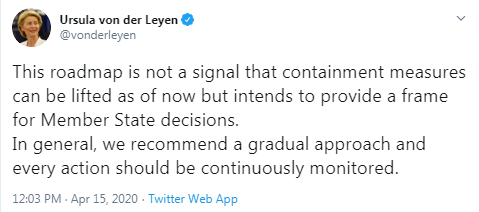
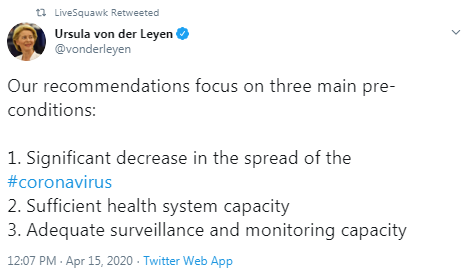
- Sees relative stability in the euro exchange rate

FXStreet reports that the recent strength in AUD/USD has come to a halt at the 61.8% retracement of the fall from December 2019 at 0.6451, with the market now weakening relatively sharply, per Credit Suisse.
"With the daily RSI now in overbought territory, we are watching for signs of a top. With this in mind, support is seen initially at 0.6332/27, beneath which would now see a small intraday top complete."
"Furthermore, a close today below 0.6375 would also complete a 'bearish engulfing' candlestick reversal to add weight to the view that the corrective rebound may now be over."
"Next supports would then be seen at 0.6221/20, ahead of 0.6195, removal of which would potentially see a more important top established and add pressure for a more important move lower."
"A closing break above 0.6451 and then the potential 2020 downtrend at 0.6494 would instead turn the short -term risk to the upside to see a move back to the 200-day average and 78.6% retracement at 0.6706/21."
-
Doesn't expect a V-shaped recovery
-
Expects something more like negative quarters of growth this year, then gradual return to positive growth next year
-
It will take time for governments to lift restrictions and people to regain confidence
-
Uncertainty is the central issue surrounding the economy's future
-
Fed is committed to near-zero rates until after the crisis passes
-
Until price pressures move higher and unemployment data reverse its course
FXStreet reports that the S&P 500 has rebounded by around 25% since the March lows, with around half of that rally coming last week, the biggest weekly gain since 1974. This has prompted the question of whether the low is in for stocks, Mark Haefele from UBS informs.
"We think the market is currently pricing in close to our central scenario, that severe restrictions to limit the spread of the virus are lifted by mid-May in Europe and by early June in the US, but they are partially re-imposed later in the year."
"We think further upside for the broader equity markets would be better supported once we have more evidence that stimulus measures are working, we get greater clarity about the "exit strategies" governments are beginning to develop, or a medical breakthrough takes place."
"We cannot rule out our downside scenario, in which repeated virus outbreaks prove difficult to control, leading to severe lockdown restrictions being re-imposed intermittently. We would expect further equity losses in this scenario and estimate the S&P 500 could finish the year at 2,100."
"We believe there are plenty of reasons to stay invested, given the unprecedented speed and scale of the support measures announced by governments and central banks, as well as signs of containment of the virus in Europe."
Reuters reports that the rate of new claims for benefits in Britain has slowed but is still running above the normal level, Department for Work and Pensions Director General Neil Couling said on Wednesday, underlining the impact of the coronavirus outbreak on jobs.
Couling, who runs Britain's universal credit system which groups together six benefits into one payment, said his department was working flat out to deal with the increased number of claims which, at one point, was running at 10 times the normal level. The number is now down to around two or three times.
NAB Research discusses AUD/USD technical outlook and highlights the importance of the weekly close above 0.6200 to signal a further short squeeze towards 0.6451 ahead of 0.6660/90.
"AUD/USD remains in a multi-year downtrend, however ST risk is currently on the topside. Weekly RSI broke above its previous multi-month range, amid a positive shift in MT momentum. This confirms a bullish multi-week bias," NAB notes.
"While weekly closes remain above 0.6180/0.6200 we anticipate a further short squeeze. Initial resistance at 0.6434/51 is likely to be tested in the coming one to two weeks. Only a break of 0.6451 would imply a test of 0.6660/90," NAB adds.
FXStreet reports that FX Strategists at UOB Group believe USD/CNH could grind lower and reach the 7.0100 level if 7.0350 is cleared.
24-hour view: "USD traded between 7.0429 and 7.0673 yesterday, a wider range than our expected 7.0460/7.0650. The price action is still viewed as an on-going consolidation phase. In other words, USD is likely to continue to trade sideways for now. Expected range for today; 7.0350/7.0650."
Next 1-3 weeks: "In our latest update from last Wednesday (08 Apr, spot at 7.0720), we held the view that 'last month's 7.1652 high could remain as a top for a while more; risk for USD has shifted to the downside towards 7.0350'. USD subsequently dropped to 7.0370 last Friday. While reaching oversold, the outlook for USD is still weak. That said, 7.0350 is a solid support and USD has to close below this level before further weakness towards the next support at 7.0100 can be expected. Overall, USD has to move back above 7.0820 in order to indicate that the current downward pressure has eased."
FXStreet reports that France's lockdown is now scheduled to continue until at least 11 May, which is roughly four weeks longer than the original end date of 15 April. Aline Schuiling, a Senior Economist at ABN Amro, forecast the growth outlook for the French economy.
"Using the methodology of the BdF, we have estimated what the impact of the extension of the lockdowns until 11 May would be, and found that GDP will contract by about 12.5% in Q2 and that annual growth in 2020 would be around -6%."
"A much sharper contraction of GDP in Q2 (of around 20% qoq - non-annualised!) seems to be on the cards, which would reduce annual growth in 2020 to around -7.5%. This is in line with the French government's newly published estimate of -8% for this year."
CNBC reports, citing an expert, that an increasing number of countries could default on their debt in the coming 12-18 months as governments globally increase spending to limit the economic damage from the coronavirus pandemic.
"I do think we will see some issues there, possibly we could see a euro zone crisis come back with countries like Greece or Italy ... likely to be at the center of that," Simon Baptist, global chief economist at consultancy The Economist Intelligence Unit, told CNBC.
"Across the emerging world, I'll pick out countries like South Africa and Brazil as being likely to suffer a further crisis as a result of this," he added. "And, of course, Argentina has effectively gone back into sovereign default already."
The coronavirus, which has infected more than 1.9 million people globally, has caused governments to take unprecedented actions to lock down entire countries or cities - bringing much of the world's economic activity to a halt.
Many governments have announced large amounts of stimulus to support their respective economies, with some taking up more debt to fund those expenditure. The U.S. has raised its issuance of Treasury securities, while the usually fiscally conservative Germany said it plans to increase borrowing by as much as 150 billion euros.
But Baptist said not all governments could get the funding that they seek. In particular, he said those in emerging economies would face "a big challenge" in convincing international investors to lend them more money at a time when investors are seeking safer places to park their funds.
FXStreet reports that the great lockdown recession, as termed by the IMF, tips a global recession of 3% for 2020, which will be worse than during the Global Financial Crisis (GFC), per OCBC Bank.
"The worst hit economies from the Covid-19 pandemic include the US at -5.9% (2021: 4.7%), Euro area at -7.5% (2021: 4.7%), Japan at -5.2% (2021: 3.0%) and UK at -6.5% (2021: 4.0%)."
"In Asia, China and India will see 2020 growth sink to just 1.2% and 1.9% respectively, before rebounding to 9.2% and 7.4% in 2021, whilst ASEAN-5 will shrink 0.6% (2021: 7.8%)."
"Global trade growth will also contract 11.0% this year, with the epicentre of the demand shock concentrated in the advanced economies as exports and imports slump 11.5% and 12.8% respectively."
| Time | Country | Event | Period | Previous value | Forecast | Actual |
|---|---|---|---|---|---|---|
| 00:30 | Australia | Westpac Consumer Confidence | April | 91.9 | 75.6 | |
| 06:45 | France | CPI, y/y | March | 1.4% | 0.6% | 0.7% |
| 06:45 | France | CPI, m/m | March | 0% | 0.0% | 0.1% |
The US dollar rose against the euro and declined against the yen. US President Donald Trump said that public restrictions imposed in the country due to the coronavirus pandemic may begin to be lifted before May 1. "Plans for opening up the country will soon be finalized," Trump said. According to him, he plans to talk with the governors of all 50 States, each will have its own plan for removing restrictions.
On Wednesday, traders expect the release of data from the US Department of Commerce on retail sales in March.
The yuan fell against the dollar after the People's Bank of China lowered the rate on loans issued under the medium-term lending program (MLF), hoping to reduce the cost of borrowing for businesses in the face of the spread of the coronavirus. As reported in the press release, the rate on one-year loans will be reduced to 2.95% from 3.15% per annum. In addition, the PBOC on Wednesday poured 100 billion yuan into the banking system as part of the MLF program.
The ICE Dollar index, which shows the value of the dollar against six major world currencies, rose 0.17% from the previous day.
According to the report from Insee, in March 2020, the Consumer Price Index (CPI) rose by 0.1% over a month, after a stability in the previous month. Experts expected prices to remain unchanged.
Manufactured product prices accelerated (+1.4% after +0.2%), due to the end of winter sales in February. Tobacco prices increased by 6.6%, because of a tax increase. Contrariwise, the drop in energy prices was sharper (−3.9% after −2.0%), in the wake of petroleum product prices. Services prices fell by 0.2% after +0.2% in February. Finally, food prices edged down by 0.1%, after a stability in the previous month. Seasonally adjusted, consumer prices fell by 0.6% in March, after −0.1% in February.
Year on year, consumer prices sharply slowed down, to +0.7%, after +1.4% in February. Economists had expected a 0.6% increase. The strong drop in inflation came from a sharp downturn in the prices of energy and manufactured products and a slowdown in services and tobacco prices. Food prices rose, year on year, barely more than in February.
Year on year, core inflation sharply fell in March: +0.7% after +1.3% in the previous month. The Harmonised Index of Consumer Prices (HICP) rose by 0.1% over a month, after a stability in February; year on year, it strongly slowed down, to +0.8%, after +1.6% in the previous month.
FXStreet reports that cable's upside momentum is seen surpassing the 1.2700 mark in the next weeks, suggested FX Strategists at UOB Group.
24-hour view: "We highlighted yesterday GBP 'could advance above 1.2550' but added, 'a move beyond 1.2600 would come as a surprise'. The subsequent strength in GBP surprised us as it surged to an overnight high of 1.2648. While overbought, the current rally appears to have room for another up leg towards 1.2670. The next resistance at 1.2725 is likely out of reach. On the downside a break of 1.2560 would indicate the rally in GBP is ready to take a breather (minor support is at 1.2590)."
Next 1-3 weeks: "While we indicated on Monday (13 Apr, spot at 1.2460) that GBP could strengthen towards 1.2550, the ease by which GBP cracked this level and the next resistance at 1.2600 came as a surprise. The rapid build-up in momentum indicates that the previously "mild upward pressure" is not mild anymore and from here, GBP could extend its advance to 1.2725 (next resistance is at 1.2800). Overall, GBP is expected to trade on a firm footing unless it moves below 1.2500 ('strong support' level has moved markedly higher from yesterday's level of 1.2390)."
CNBC reports that the U.S. will suspend funding to the World Health Organization while it reviews the agency's response to the Covid-19 pandemic, President Donald Trump announced Tuesday, saying the international health agency made mistakes that "caused so much death" as the coronavirus spread across the globe.
"Today I'm instructing my administration to halt funding of the World Health Organization while a review is conducted to assess the World Health Organization's role in severely mismanaging and covering up the spread of the coronavirus," Trump said at a White House press conference.
Trump criticized the international agency's response to the outbreak, saying "one of the most dangerous and costly decisions from the WHO was its disastrous decision to oppose travel restrictions from China and other nations" that Trump imposed early on in the outbreak.
"Fortunately, I was not convinced and suspended travel from China saving untold numbers of lives," he said.
It's unclear exactly what mechanism Trump intends to use to withhold WHO funding, much of which is appropriated by Congress. The president typically does not have the authority to unilaterally redirect congressional funding.
eFXdata reports that MUFG Research discusses the oil outlook and sees a slim scope for a sustained oil price rally, and expects another correction lower in oil-related currencies such as CAD, NOK, RUB.
"Oil-related currencies have also derived support from the largest oil-supply agreement in history. The oil production agreement saw OPEC+ commit to i) reduce exports by 9.7m b/d in May and June; (ii) followed by a relaxation to 7.7m b/d in H2 2020, and to; (iii) 5.8m b/d between January 2021-April 2022. Meanwhile, other non-OPEC+ members are "committing" to "involuntarily" reduce output by 3.7m b/d. However, our oil analyst Ehsan Khoman believes that "the prospects of a sustained oil price rally are vanishingly slim". We maintain our view that the unprecedented oil price collapse is not yet over," MUFG notes.
"The recent rally in oil-related currencies such as the Canadian dollar, Norwegian krone and Russian rouble are built on shaky foundations and vulnerable to another correction lower," MUFG adds.
-
CNBC reports that at least 125,678 people around the world have succumbed to the coronavirus, according to the latest information from Johns Hopkins University.
-
Singapore's health ministry said as of 14 April noon, there were 334 new confirmed cases of Covid-19, the respiratory disease caused by the coronavirus.
-
United Nations Secretary General Antonio Guterres has called for unity and solidarity, and said that now is not the time to reduce resources in the fight against the coronavirus.
-
Global cases: More than 1.97 million
-
Global deaths: At least 125,678
-
Most cases reported: United States (602,989), Spain (172,541), Italy (162,488), France (131,361), Germany (131,359)
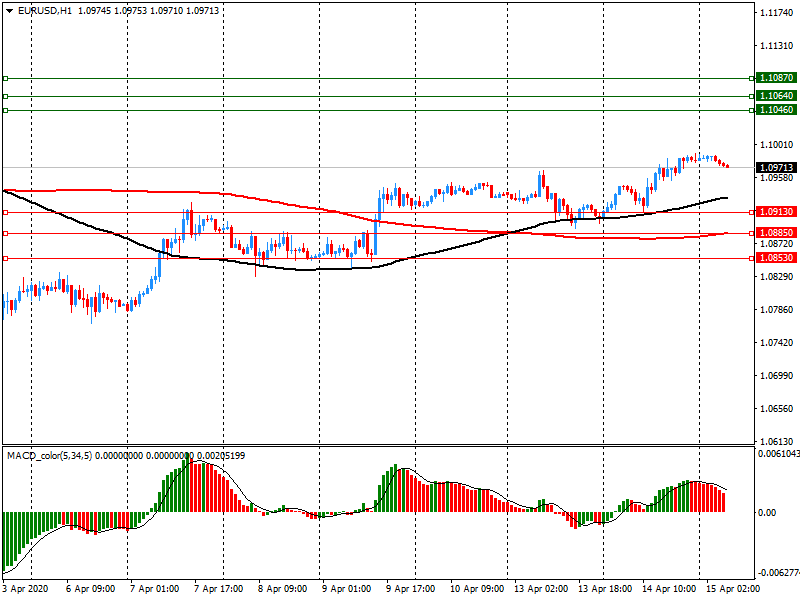
EUR/USD
Resistance levels (open interest**, contracts)
$1.1087 (1431)
$1.1064 (820)
$1.1046 (686)
Price at time of writing this review: $1.0971
Support levels (open interest**, contracts):
$1.0913 (1314)
$1.0885 (1163)
$1.0853 (1659)
Comments:
- Overall open interest on the CALL options and PUT options with the expiration date May, 8 is 66017 contracts (according to data from April, 14) with the maximum number of contracts with strike price $1,1200 (3277);
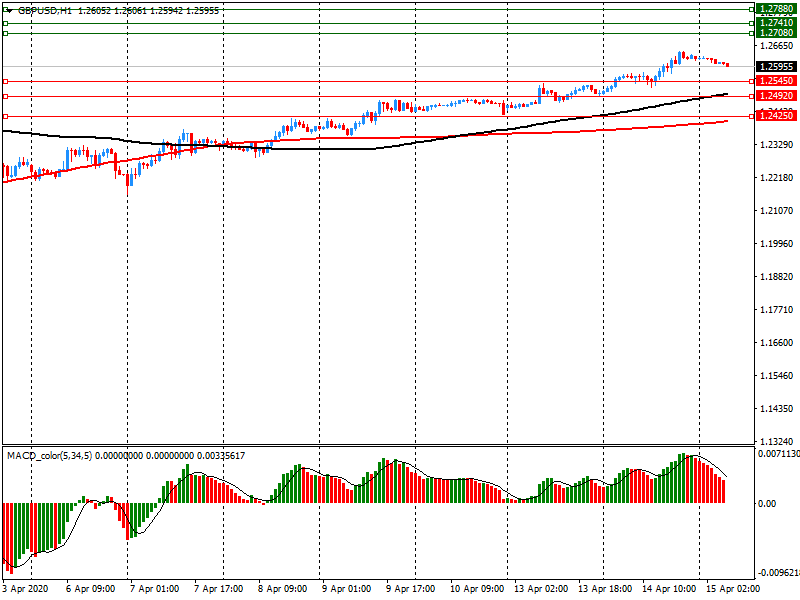
GBP/USD
Resistance levels (open interest**, contracts)
$1.2788 (1306)
$1.2741 (948)
$1.2708 (632)
Price at time of writing this review: $1.2596
Support levels (open interest**, contracts):
$1.2545 (679)
$1.2492 (245)
$1.2425 (300)
Comments:
- Overall open interest on the CALL options with the expiration date May, 8 is 14934 contracts, with the maximum number of contracts with strike price $1,2700 (1306);
- Overall open interest on the PUT options with the expiration date May, 8 is 15946 contracts, with the maximum number of contracts with strike price $1,2850 (1073);
- The ratio of PUT/CALL was 1.07 versus 1.14 from the previous trading day according to data from April, 14
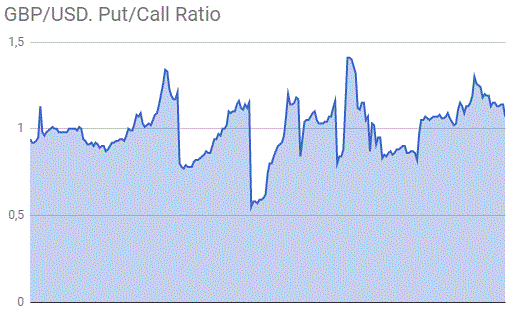
* - The Chicago Mercantile Exchange bulletin (CME) is used for the calculation.
** - Open interest takes into account the total number of option contracts that are open at the moment.
| Time | Country | Event | Period | Previous value | Forecast |
|---|---|---|---|---|---|
| 00:30 | Australia | Westpac Consumer Confidence | April | 91.9 | |
| 06:45 | France | CPI, y/y | March | 1.4% | 0.6% |
| 06:45 | France | CPI, m/m | March | 0% | 0.0% |
| 08:00 | France | IEA Oil Market Report | |||
| 12:30 | U.S. | Retail sales | March | -0.5% | -8% |
| 12:30 | U.S. | NY Fed Empire State manufacturing index | April | -21.5 | -35 |
| 12:30 | U.S. | Retail Sales YoY | March | 4.3% | |
| 12:30 | U.S. | Retail sales excluding auto | March | -0.4% | -4.9% |
| 13:15 | U.S. | Capacity Utilization | March | 77% | 73.8% |
| 13:15 | U.S. | Industrial Production YoY | March | 0% | |
| 13:15 | U.S. | Industrial Production (MoM) | March | 0.6% | -4% |
| 14:00 | U.S. | NAHB Housing Market Index | April | 72 | 55 |
| 14:00 | U.S. | Business inventories | February | -0.1% | -0.4% |
| 14:00 | Canada | Bank of Canada Monetary Policy Report | |||
| 14:00 | Canada | Bank of Canada Rate | 0.25% | 0.25% | |
| 14:30 | U.S. | Crude Oil Inventories | April | 15.177 | 11.6 |
| 15:15 | Canada | BOC Press Conference | |||
| 17:00 | U.S. | FOMC Member Bostic Speaks | |||
| 18:00 | U.S. | Fed's Beige Book | |||
| 20:00 | U.S. | Net Long-term TIC Flows | February | 20.9 | |
| 20:00 | U.S. | Total Net TIC Flows | February | 122.9 |
| Pare | Closed | Change, % |
|---|---|---|
| AUDUSD | 0.644 | 0.94 |
| EURJPY | 117.624 | 0.14 |
| EURUSD | 1.09801 | 0.69 |
| GBPJPY | 135.221 | 0.37 |
| GBPUSD | 1.26217 | 0.94 |
| NZDUSD | 0.61046 | 0.3 |
| USDCAD | 1.38828 | -0.14 |
| USDCHF | 0.95995 | -0.75 |
| USDJPY | 107.118 | -0.55 |







© 2000-2026. All rights reserved.
This site is managed by Teletrade D.J. LLC 2351 LLC 2022 (Euro House, Richmond Hill Road, Kingstown, VC0100, St. Vincent and the Grenadines).
The information on this website is for informational purposes only and does not constitute any investment advice.
The company does not serve or provide services to customers who are residents of the US, Canada, Iran, The Democratic People's Republic of Korea, Yemen and FATF blacklisted countries.
Making transactions on financial markets with marginal financial instruments opens up wide possibilities and allows investors who are willing to take risks to earn high profits, carrying a potentially high risk of losses at the same time. Therefore you should responsibly approach the issue of choosing the appropriate investment strategy, taking the available resources into account, before starting trading.
Use of the information: full or partial use of materials from this website must always be referenced to TeleTrade as the source of information. Use of the materials on the Internet must be accompanied by a hyperlink to teletrade.org. Automatic import of materials and information from this website is prohibited.
Please contact our PR department if you have any questions or need assistance at pr@teletrade.global.


 Bank
Bank transfers


