- Analytics
- News and Tools
- Market News
Analytics, News, and Forecasts for CFD Markets: currency news — 26-05-2021.
| Time | Country | Event | Period | Previous value | Forecast |
|---|---|---|---|---|---|
| 01:30 (GMT) | Australia | Private Capital Expenditure | Quarter I | 3% | 2% |
| 06:00 (GMT) | Switzerland | Trade Balance | April | 3.9 | |
| 06:00 (GMT) | Germany | Gfk Consumer Confidence Survey | June | -8.8 | -5.2 |
| 11:00 (GMT) | United Kingdom | MPC Member Vlieghe Speaks | |||
| 12:00 (GMT) | Germany | German Buba President Weidmann Speaks | |||
| 12:30 (GMT) | U.S. | Continuing Jobless Claims | May | 3751 | 3680 |
| 12:30 (GMT) | U.S. | Durable Goods Orders | April | 0.5% | 0.7% |
| 12:30 (GMT) | U.S. | Durable goods orders ex defense | April | 0.5% | |
| 12:30 (GMT) | U.S. | Durable Goods Orders ex Transportation | April | 1.6% | 0.8% |
| 12:30 (GMT) | U.S. | Initial Jobless Claims | May | 444 | 425 |
| 12:30 (GMT) | U.S. | GDP, q/q | Quarter I | 4.3% | 6.5% |
| 14:00 (GMT) | U.S. | Pending Home Sales (MoM) | April | 1.9% | |
| 23:30 (GMT) | Japan | Tokyo CPI ex Fresh Food, y/y | May | -0.2% | -0.2% |
| 23:30 (GMT) | Japan | Unemployment Rate | April | 2.6% | 2.7% |
| 23:30 (GMT) | Japan | Tokyo Consumer Price Index, y/y | May | -0.6% |
FXStreet reports that Karen Jones, Team Head FICC Technical Analysis Research at Commerzbank, notes that palladium (XPD/USD) has stabilised above the 38.2% retracement at $2706. Looking ahead, the metal is well-placed to resume its up move.
“Palladium has been correcting lower and has sold off to the 55-day ma at $2753, where it is attempting to stabilise. It has steadied just ahead of the 38.2% retracement at $2706. We suspect that this was the end of its corrective phase and that the market is well placed to resume its up move.”
“Initial resistance is $2944 ahead of the $3020 recent high.”
“Support lies $2706 and this guards $2516/11 the November and January highs and the 200-day ma at $2452.”
The U.S. Energy Information Administration (EIA) revealed on Wednesday that crude inventories declined by 1.662 million barrels in the week ended May 21, following a build of 1.321 million barrels in the previous week. Economists had forecast a draw of 1.050 million barrels.
At the same time, gasoline stocks dropped by 1.745 million barrels, while analysts had expected a decrease of 0.614 million barrels. Distillate stocks tumbled by 3.013 million barrels, while analysts had forecast a fall of 1.900 million barrels.
Meanwhile, oil production in the U.S. remained unchanged at 11.000 million barrels a day.
U.S. crude oil imports averaged 6.3 million barrels per day last week, down by 138,000 thousand barrels per day from the previous week.
FXStreet notes that NOK has weakened even though stock markets have been sideways and oil prices have hovered in the range 65-70 USD/barrel. A lower NIBOR could be the explanation. However, economists at Nordea believe NIBOR will turn higher from the summer onwards and they expect to see a lower EURNOK by year-end.
“The reason behind the lower NIBOR-premium is much better structural liquidity in the NOK market, a situation we expect to last one more month, before structural liquid again becomes tighter from July onwards. Lower liquidity should push NIBOR higher. Moreover, we expect Norges Bank to raise the key rate by 25bp in September, this will give rise to an even higher NIBOR. This means that the current headwinds for NOK from lower short-term rates will turn to tailwinds in a few months’ time.”
“On the upside, the first resistance level to watch is 10.25. On the downside, 10.10 is a support level. The biggest risk for NOK – as a fairly small and vulnerable currency – remains the development in the stock market.”
“We still expect EUR/NOK to come somewhat down over time. A combination of somewhat higher oil prices and higher rates in Norway is why we hold our view that the cross will come down to 9.75 by year-end.”
NZD/USD to extend its rally towards 0.75 as RBNZ makes a hawkish pivot - TDS
FXStreet notes that the Reserve Bank of New Zealand (RBNZ) delivered a firm hawkish pivot. The kiwi leaped over 1% after the RBNZ left its interest rate unchanged and implied a rate hike is on the agenda, perhaps even for later this year. Economists at TD Securities see more upside in NZD/USD.
“The RBNZ was fairly hawkish across the board, positively revising its growth, inflation and employment projections. Most notably, the Bank brought back its traditional OCR profile as we thought they might, which penciled in a hike by Q3-2022. This is, of course, where market pricing currently resides. Consequently, we have revised our call for the first RBNZ hike to come in August 2022 from Q3-2023.”
“We are tactically long NZD/USD this week, but we think there could be larger gains ahead towards 0.75.”
FXStreet notes that weaker US macro data and higher inflation have driven a fall in real yields, weighing on the dollar. Nonetheless, economists at ABN Amro expect the pair to end the year trading around 1.15 due to a dovish Federal Reserve and an American economic outperformance.
“We think that the Fed will be less dovish than the ECB, and that ECB rate hikes will be priced out.”
“We expect US economic outperformance to support the dollar in the medium-term.”
“Our year-end 2021 forecast for EUR/USD stands at 1.15.”
FXStreet notes that, while China’s announcement that it will crackdown on speculation and market irregularities has taken some of the froth out of the iron ore market in recent weeks, strategists at Capital Economics think the price of iron ore will ultimately be driven even lower by less favourable fundamentals over the rest of the year.
“While the government’s actions look to have taken a bit of the froth out of the iron ore market in the near term, history suggests that they won’t have much of an influence in the longer term.”
“We doubt that this current crackdown on speculation will have much of an effect on the price of iron ore over the months ahead. However, we think that market fundamentals point to the iron ore price falling further before the end of 2021.”
“We expect the price of iron ore to drop back to around $140 per tonne by end-2021, and $120 per tonne by end-2022 as the market shifts into a surplus.”
NFXStreet reports that the USD/CHF pair continues to trend lower and although short-term momentum is a slight concern, economists at Credit Suisse stay bearish.
“USD/CHF has continued its downtrend and made another new low, although a minor RSI divergence is still in place. Despite this, we maintain our downside bias following the recent break below the 200-day average, which suggested the medium-term downtrend was resuming.”
“Next support is seen at 0.8922/10, which is the 78.6% retracement of the Q1 recovery, before 0.8871/62, which is an important price low. A test of the 2021 low at 0.8757 now seems increasingly likely given the deteriorating trend-following setup, following the recent cross into outright bearish territory for weekly MACD, with daily MACD also remaining outright bearish, albeit worryingly curling higher.”
“Near-term resistance is seen at 0.9049/53. The 200-day average at 0.9078 should ideally continue to cap."
| Time | Country | Event | Period | Previous value | Forecast | Actual |
|---|---|---|---|---|---|---|
| 06:45 | France | Consumer confidence | May | 95 | 97 | 97 |
| 08:00 | Switzerland | Credit Suisse ZEW Survey (Expectations) | May | 68.3 | 72.2 |
NZD rose against its major rivals in the European session on Wednesday after the Reserve Bank of New Zealand (RBNZ) unexpectedly signaled that it might increase its interest rates as early as September 2022.
The RBNZ announced that at its latest meeting its Monetary Policy Committee decided to leave the official cash rate (OCR) at 0.25%, as widely expected. It also pledged to keep the Large Scale Asset Purchase and Funding for Lending programmes unchanged. At the same time, the Committee’s OCR projections showed that it expects the rate to rise to 0.49% by September 2022 and 0.67% by December 2022. The RBNZ's hawkish statement contrasts with dovish comments from the U.S. Federal Reserve and the neighboring Reserve Bank of Australia (RBA), which has continued to repeat that its interest rates will be on hold at the current near-zero levels until 2024 at the earliest.
FXStreet reports that the Credit Suisse analyst team notes that NZD/USD has completed a clear bullish “pennant” pattern following the break above 0.7272, which suggests a move to 0.7353. The next target would be seen at the 0.7465 level.
“A closing break above early March highs at 0.7306 and the new bullish pattern should reassert the broader uptrend, with the next resistance seen at the 78.6% retracement of the Q1 fall at 0.7353, where we would expect another temporary pause.”
“The ‘measured objective’ to new bullish pattern suggests a move towards the 0.7465 high.”
“The market should now ideally hold above 0.7272 and certainly above 0.7151/38 to maintain the new bullish pattern. Below here would leave the market back trapped in a range.”
FXStreet notes that gold (XAU/USD) has maintained a bull run following the recent break of the 2020-2021 downtrend. Karen Jones, Team Head FICC Technical Analysis Research at Commerzbank, expects the yellow metal to target the $1959/65 region next, with scope to overcome the $2072 2020 peak.
“Gold remains bid, it has recently eroded the 200-day ma, the 55-week ma and the 2020-2021 trendline. We target the $1959/65 November 2020 high and the 2021 high. These guard the $1987/78.6% retracement and the $2072 2020 peak. Longer-term, we believe that this will also be overcome.”
“Dips lower will ideally be contained by the $1825 six-week uptrend. This guards the 20-day ma at $1779 and while above here the market should continue to maintain upside pressure.”
“Key support is the 2019-2021 uptrend at $1714 and the $1670.49 June 2020 low.”
The
Mortgage Bankers Association (MBA) reported on Wednesday the mortgage
application volume in the U.S. decreased 4.2 percent in the week ended May 21,
following a 1.2 percent gain in the previous week. This marked the biggest drop
since the week ended April 2.
According
to the report, refinance applications plunged 7.2 percent, while applications
to purchase a home rose 1.7 percent.
Meanwhile,
the average fixed 30-year mortgage rate increased from 3.15 percent to 3.18
percent, the largest level since the end of April.
“Demand
is robust throughout the country, but homebuyers continue to be held back by
the lack of homes for sale and rapidly increasing home prices,” noted Joel Kan,
an MBA economist.
FXStreet reports that the EUR/JPY pair has moved to a new high for its uptrend and analysts at Credit Suisse stay biased higher for 134.13/16 next.
“EUR/JPY has not only moved to a new high for the uptrend but is also moving above the key 133.13/49 highs of April and September 2018. We look for a close above here to reinforce the uptrend to clear the way for further strength with resistance seen next at 134.13/17 ahead of 134.50/60 and eventually and more importantly at the 137.50 high of 2018.”
“Support moves to 133.13 initially then more importantly at the recent low and 13-day exponential average at 132.76/51, which we look to ideally hold.”
FXStreet notes that the Reserve Bank of New Zealand (RBNZ) sounded more optimistic at May’s meeting and signalled that it will start to hike rates in the second half of next year. The kiwi stands out surging above 0.73 – analysts at Capital Economics expect the NZD/USD pair to continue inching higher in the coming months.
“The RBNZ kept policy settings unchanged at today’s meeting. However, the statement sounded more optimistic. The Monetary Policy Committee noted that activity remained “uneven” and argued that it had evolved broadly in line with the forecasts from February. However, the MPC noted that it now had greater confidence in the outlook given the rapid vaccine rollout overseas.”
“The Bank continued to downplay the marked slowdown in its bond purchases, arguing that it largely reflects lower issuance of government bonds. The Bank noted that the reduction in bond issuance means a lower scope of purchases within the limits of the indemnity provided by the Ministry of Finance.”
“The Bank is now more hawkish than we are as it believes that rates may need to be lifted to around 1.5% by end-2023 instead of the 1.0% level we have currently pencilled in.”
“With the RBNZ set to become one of the first central banks in advanced economies to hike rates, we think that the New Zealand dollar will continue to strengthen. Our end-2023 forecast for the NZD/USD pair is 0.78, from 0.73 today.”
FXStreet notes that despite sharp pullbacks in some corners of the market, most US stock indexes remain near all-time highs. Here’s why investors shouldn’t be lulled into complacency, according to Lisa Shalett, Chief Investment Officer, Wealth Management at Morgan Stanley.
“April’s Consumer Price Index (CPI) and Producer Price Index (PPI) readings came in much higher than projections, with several ‘core’ CPI inputs concerningly high. While aspects of recent inflation are likely transitory, a number of secular shifts now underway suggest that higher prices could persist. In addition to boosting corporate borrowing costs, higher interest rates, which often accompany inflation, may hamper equity valuations.”
“The Citi US Economic Surprise Index, which measures data surprises relative to market expectations, has slid from 92.2 to 14.7, having briefly hit negative territory shortly after last week’s disappointing housing-starts report. Waning upside momentum in economic data may indicate decelerating growth.”
“Supply-chain imbalances, rising input costs and higher wages could pressure company earnings in some industries. This could exacerbate less favorable year-over-year comparisons, as we move more than a full year beyond the onset of the pandemic in 2020.”
“These factors, along with the potential for higher taxes and central bank bond-purchase tapering, increase odds of an equity market correction and ongoing volatility. However, bouts of volatility can create opportunities for investors to shift portfolios toward quality stocks, especially those with high and defensible returns on equity and free-cash-flow yields, as well as those with favorable prospects for growth at a reasonable price.”
CNBC reports that according to the U.S.-based Peterson Institute for International Economics, as the trade deal between the U.S. and China runs into its second year, Chinese purchases are still running short of the agreed amount.
Both countries signed a phase one trade agreement in January 2020, just weeks before Covid-19 began to spread rapidly in China and subsequently turned into a global pandemic. The deal stipulated that relative to imports from the U.S. in 2017, China needed to buy at least $200 billion more in U.S. goods and services over the next two years.
To stay on track with the agreement, China would have needed buy $64.5 billion worth of U.S. goods during the first four months of this year, Peterson Institute senior fellow Chad P. Bown estimated, citing Chinese customs data.
However, the data showed China’s purchases of U.S. goods reached only 73% of the year-to-date target as of April, the report said.
Based on U.S. data, the level of progress falls to 60%, the institute said.
The two-year agreement is set to end in December. Chinese purchases of U.S. goods fell more than 40% short in 2020, according to the institute.
Bloomberg reports that Japan’s government cut its assessment of the economy for the first time in three months, after the country was forced to extend its third state of emergency following a jump in coronavirus cases.
The Cabinet Office said it saw further weaknesses in some parts of the economy, using stronger language than last month to describe the frailness. Still, it continued to describe overall conditions as improving from a severely low base.
The government downgraded its view of business conditions and also consumer spending, noting weakness in service-related outlays.
Japan’s domestic economy is mired in a third state of emergency to try to contain the virus, with local media reporting the government may extend restrictions for a second time, until June 20, just about a month before the Tokyo Olympics are set to start.
FXStreet reports that economists at Credit Suisse discuss EUR/USD prospects.
“EUR/USD has seen a clear break above the 1.2243 February high to resolve the near-term range higher. We look for this to reassert the rally to expose the top of the broader range, the YTD high and the potential downtrend from 2018 at 1.2323/1.2350. For now, our bias is to look for a fresh rejection from here for a correction to the strength of the past two months.”
“Big picture, bullish pressure is seen building and a clear break above 1.2350 in due course should open the door to a move to long-term resistance at 1.2511/1.2598 – the 2018 high, 38.2% retracement of the entire 2008/2017 bear market and 61.8% retracement of the 2014/2017 fall.”
Reuters reports that the Bank of Japan is heading in the right direction in "stealth- tapering" its huge asset purchases given the damaging side-effects of prolonged monetary easing, said opposition heavyweight Banri Kaieda.
"Negative rates helped stem unwelcome yen rises, which is an accomplishment that must be recognised," Kaieda told Reuters in an interview on Monday.
"We now need to fix the side-effects, though this will take time," he said, pointing to the pain that years of ultra-low rates is inflicting on financial institutions' profits.
The comments highlight changing public sentiment over the role of monetary policy, as years of heavy money printing have failed to fire up inflation towards the central bank's 2% target and forced it to maintain its radical stimulus longer than expected.
Kaieda said the BOJ made the right move by fine-tuning its policy framework in March, allowing bond yields to move more flexibly and ditching a numerical target for the pace of its purchases of exchange-traded funds (ETF).
"The BOJ is already stealth-tapering," Kaieda said, adding that it was an "absolutely right decision" to start with its ETF purchases in heading toward an exit from ultra-loose policy.
FXStreet reports that economists at MUFG Bank said that the US dollar is lurching lower with some key developments pointing to further weakness over the short-term.
“Onshore, the CNY advanced to its highest level versus USD since June 2018 encouraged by a PBOoC reference rate that indicates the authorities are comfortable with the move. One of the implications of China’s complaint this week of excessive speculation in the commodities markets is the belief that the authorities have become more concerned over the threat of inflation and therefore CNY appreciation will be met with less opposition.”
“Of course, the authorities in China have greater freedom to allow for the break lower in USD/CNY given the overall relative stability of its currency on a trade-weighted basis.”
“This break in USD/CNY is important and does open up the potential for broader USD weakness and at the margin means a little less concern from the ECB over EUR appreciation.”
Bloomberg reports that ECB Executive Board member Fabio Panetta said he sees no signs of sustained inflation pressures that would allow for a reduction in bond purchases.
“Only a sustained increase in inflationary pressures, reflected in an upward trend in underlying inflation and bringing inflation and inflation expectations in line with our aim, could justify a reduction in our purchases,” Panetta said.
“But this is not what we projected in March. And, since then, I have not seen changes in financing conditions or the economic outlook that would shift the inflation path upward,” he said.
Panetta also noted the recent rise in the euro, saying that “in this environment, it is not surprising that we have also seen a persistent, non-negligible appreciation of the exchange rate, which -- if sustained -- would weaken inflationary pressures.”
FXStreet reports that economists at Capital Economics continue to think the euro will weaken against the US dollar this year.
“While we expect the economy in the eurozone will continue to recover, our view is that the underlying prospects for growth and inflation there remain less strong than in the US. The strength of economic data in the eurozone compared to the US appears to be feeding through to relative expectations for monetary policy in the two economies, which only recently levelled off even as the euro has continued to strengthen. We do not expect the ECB to raise rates until 2026. As a result, we expect the euro to weaken against the greenback as market expectations adjust to reflect the underlying economic prospects for the two economies.”
| Time | Country | Event | Period | Previous value | Forecast | Actual |
|---|---|---|---|---|---|---|
| 01:30 | Australia | Construction Work Done | Quarter I | 0.4% | 2.2% | 2.4% |
| 02:00 | New Zealand | RBNZ Interest Rate Decision | 0.25% | 0.25% | 0.25% | |
| 03:00 | New Zealand | RBNZ Press Conference | ||||
| 05:00 | Japan | Coincident Index | March | 89.9 | 93.0 | |
| 05:00 | Japan | Leading Economic Index | March | 98.9 | 102.5 | |
| 06:45 | France | Consumer confidence | May | 95 | 97 | 97 |
During today's Asian trading, the US dollar rose slightly against the euro and the yen, but fell against the Australian and New Zealand dollars.
The focus of traders this week is on US GDP data for the first quarter of 2021. As part of the GDP report, the dynamics of the PCE Core index, a key indicator of inflation tracked by the Federal Reserve System (Fed), is traditionally published. The consensus forecast of experts provides for the growth of the PCE Core index in the first quarter by 2.3%,. In the fourth quarter of last year, the index increased by 1.3%. Traders are closely watching the inflation figures, believing that the acceleration in consumer price growth, together with the improvement in the labor market and the economy as a whole, may force the Federal Reserve System (Fed) to start scaling back stimulus earlier than markets expected.
Fed Vice Chairman Richard Clarida said yesterday that the Fed could begin discussions on reducing the volume of asset repurchases under the quantitative easing (QE) program at the next meetings, as the US economy is recovering quickly from the coronavirus pandemic.
The ICE index, which tracks the dollar's performance against six currencies (euro, swiss franc, yen, canadian dollar, pound sterling and swedish krona), rose 0.03%.
The New Zealand dollar rose more than 1% against the US dollar on the back of the results of the RBNZ meeting. New Zealand's central bank held interest rates, but hinted at a hike as early as September next year. The hawkish stance contrasts with persistently dovish comments from the U.S. Federal Reserve and the neighbouring Reserve Bank of Australia, which has said there would be no rate rises until 2024 at the earliest. The Reserve Bank of New Zealand (RBNZ) held rates at a record low 0.25%, but said it sees at least one 25 basis point rate hike by September 2022.
According to the report from Insee, in May 2021, households’ confidence in the economic situation has increased. At 97, the synthetic index has gained two points but remains below its long-term average (100).
In May, the households’ opinion balance related to their future financial situation has gained three points and goes back above its long-term average. Stable, the opinion balance related to their personal past financial situation remains above its average. The share of households considering it is a suitable time to make major purchases has been stable and remains above its long-term average.
In May, households’ opinion balance related to their current saving capacity has increased by four points. Households’ opinion balance related to their future saving capacity has also increased, by three points. These two balances reach a new all-time high in May. On the contrary, the share of households considering it is a suitable time to save has decreased. The corresponding balance has lost three points after reaching its historic high last month.
Households' fears about unemployment trend have clearly decreased in May. The corresponding balance has lost thirteen points and reaches its lowest level since March 2020. It however remains above its long-term average.
In May, households considering that prices will be on the rise during the next twelve months have been a bit more numerous than in April. The corresponding balance has gained six points, and remains above its long-term average. Households considering that prices were on the rise during the past twelve months has been also a bit more numerous. The corresponding balance has gained five points but remains well below its average.
EUR/USD
Resistance levels (open interest**, contracts)
$1.2366 (1903)
$1.2329 (2634)
$1.2301 (1733)
Price at time of writing this review: $1.2247
Support levels (open interest**, contracts):
$1.2179 (418)
$1.2139 (558)
$1.2095 (1147)
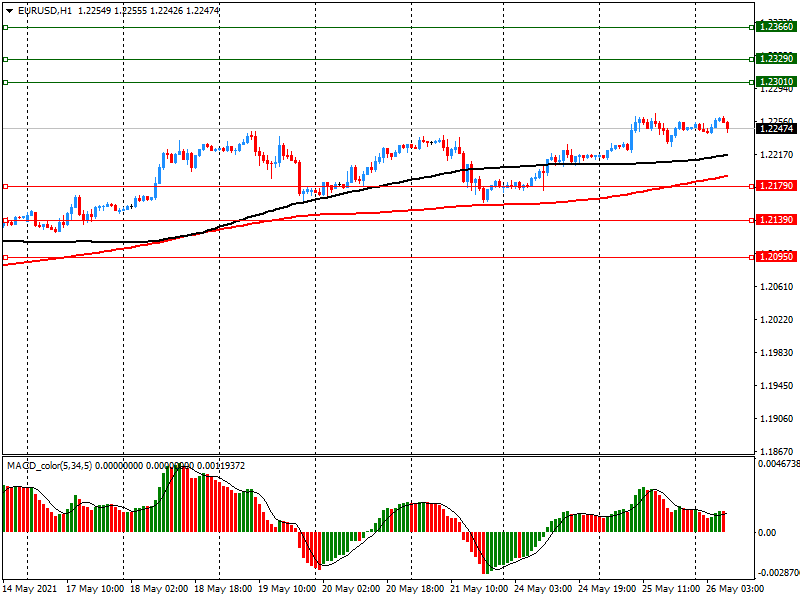
Comments:
- Overall open interest on the CALL options and PUT options with the expiration date June, 4 is 66399 contracts (according to data from May, 25) with the maximum number of contracts with strike price $1,2100 (3614);
GBP/USD
$1.4213 (958)
$1.4191 (1861)
$1.4176 (1023)
Price at time of writing this review: $1.4153
Support levels (open interest**, contracts):
$1.4108 (116)
$1.4086 (136)
$1.4058 (535)
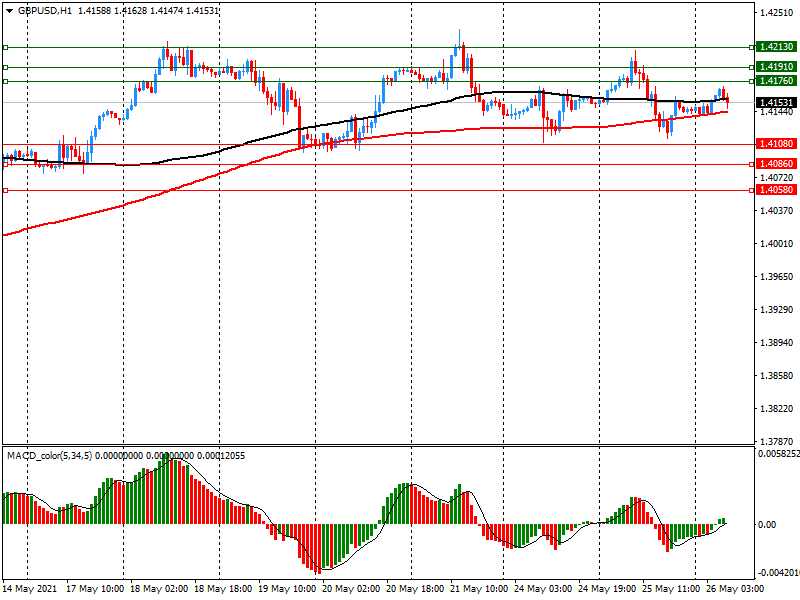
Comments:
- Overall open interest on the CALL options with the expiration date June, 4 is 21217 contracts, with the maximum number of contracts with strike price $1,4350 (2977);
- Overall open interest on the PUT options with the expiration date June, 4 is 32377 contracts, with the maximum number of contracts with strike price $1,3100 (3957);
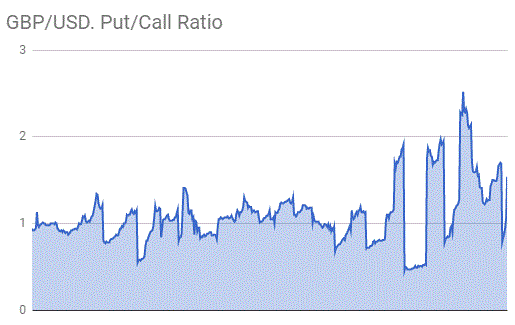
- The ratio of PUT/CALL was 1.53 versus 1.52 from the previous trading day according to data from May, 25
* - The Chicago Mercantile Exchange bulletin (CME) is used for the calculation.
** - Open interest takes into account the total number of option contracts that are open at the moment.
CNBC reports that an investment strategist from Citi Private Bank said that the renewed rise in Covid-19 cases across Asia is not a big worry and the region’s economy will get back on track when the outbreak eases.
Against such a backdrop, investors could go after “Covid-impaired” stocks such as airlines and other companies in the travel and leisure sector, said Ken Peng, the bank’s head of Asia investment strategy.
Peng told that Asia is not experiencing a resurgence in Covid for the first time.
“That’s a movie we’ve seen before. It happened in the winter (that) just passed and it also happened last third quarter when we had these waves, and then once the cases come down, you see the economic recovery back on track. So I think that’s not something we need to worry about too extensively,” he added.
In addition to sectors that have been hit hard in the pandemic, Peng said he sees opportunities to buy Chinese tech stocks on the dip. He added that the share prices of some of those stocks have declined as a result of regulatory scrutiny.
The strategist also said he’s “very positive” on the commodities space, with demand from China, the U.S. and Europe likely staying resilient.
FXStreet reports that Morgan Stanley Chief Executive Officer James Gorman discusses the Fed's policy outlook.
“My personal view is rates are likely to rise in the early part of next year, and not in 2023 which is currently the projection. The Federal Reserve will be driven by whatever their numbers tell them. I am just giving you my opinion.”
“Fed remains cautious and doesn’t think there will be long-term inflation pressure. Yet signs of inflation are rising. After many years of no inflation, we clearly see price increases. Increasingly people are starting to think it may be more structural, long term. If that is the case, the Federal Reserve will have to raise interest rates at some point.”
Reuters reports that New Zealand's central bank held interest rates, but hinted at a hike as early as September next year.
The hawkish stance contrasts with persistently dovish comments from the U.S. Federal Reserve and the neighbouring Reserve Bank of Australia, which has said there would be no rate rises until 2024 at the earliest.
The Reserve Bank of New Zealand (RBNZ) held rates at a record low 0.25%, but said it sees at least one 25 basis point rate hike by September 2022.
It projected the official cash rate (OCR) would reach 1.5% by the end of 2023 and 1.78% by the end of 2024, underscoring expectations that recent positive data will lead policymakers to tighten rates sooner rather than later.
RBNZ Governor Adrian Orr emphasised that more patience was needed on policy and that OCR projections were "highly conditional" to the economy panning out as expected.
"We are talking about the second half of next year. Who knows where we will be by then," he told a press conference following the decision.
| Time | Country | Event | Period | Previous value | Forecast |
|---|---|---|---|---|---|
| 01:30 (GMT) | Australia | Construction Work Done | Quarter I | -0.9% | 2.2% |
| 02:00 (GMT) | New Zealand | RBNZ Interest Rate Decision | 0.25% | 0.25% | |
| 03:00 (GMT) | New Zealand | RBNZ Press Conference | |||
| 05:00 (GMT) | Japan | Coincident Index | March | 89.9 | |
| 05:00 (GMT) | Japan | Leading Economic Index | March | 98.9 | |
| 06:45 (GMT) | France | Consumer confidence | May | 94 | 97 |
| 08:00 (GMT) | Switzerland | Credit Suisse ZEW Survey (Expectations) | May | 68.3 | |
| 14:00 (GMT) | U.S. | FOMC Member Quarles Speaks | |||
| 14:30 (GMT) | U.S. | Crude Oil Inventories | May | 1.321 | -1.279 |
| 19:00 (GMT) | U.S. | FOMC Member Quarles Speaks |
| Pare | Closed | Change, % |
|---|---|---|
| AUDUSD | 0.77515 | 0.02 |
| EURJPY | 133.217 | 0.29 |
| EURUSD | 1.2249 | 0.29 |
| GBPJPY | 153.842 | -0.04 |
| GBPUSD | 1.41446 | -0.05 |
| NZDUSD | 0.72239 | 0.17 |
| USDCAD | 1.20624 | 0.15 |
| USDCHF | 0.895 | -0.17 |
| USDJPY | 108.753 | 0 |







© 2000-2026. All rights reserved.
This site is managed by Teletrade D.J. LLC 2351 LLC 2022 (Euro House, Richmond Hill Road, Kingstown, VC0100, St. Vincent and the Grenadines).
The information on this website is for informational purposes only and does not constitute any investment advice.
The company does not serve or provide services to customers who are residents of the US, Canada, Iran, The Democratic People's Republic of Korea, Yemen and FATF blacklisted countries.
Making transactions on financial markets with marginal financial instruments opens up wide possibilities and allows investors who are willing to take risks to earn high profits, carrying a potentially high risk of losses at the same time. Therefore you should responsibly approach the issue of choosing the appropriate investment strategy, taking the available resources into account, before starting trading.
Use of the information: full or partial use of materials from this website must always be referenced to TeleTrade as the source of information. Use of the materials on the Internet must be accompanied by a hyperlink to teletrade.org. Automatic import of materials and information from this website is prohibited.
Please contact our PR department if you have any questions or need assistance at pr@teletrade.global.


 Bank
Bank transfers


