- Analytics
- News and Tools
- Market News
Analytics, News, and Forecasts for CFD Markets: currency news — 30-01-2019.
| Time | Country | Event | Period | Previous value | Forecast |
|---|---|---|---|---|---|
| 00:01 | United Kingdom | Gfk Consumer Confidence | January | -14 | -15 |
| 00:30 | Australia | Export Price Index, q/q | Quarter IV | 3.7% | |
| 00:30 | Australia | Import Price Index, q/q | Quarter IV | 1.9% | 0.3% |
| 00:30 | Australia | Private Sector Credit, y/y | December | 4.4% | |
| 00:30 | Australia | Private Sector Credit, m/m | December | 0.3% | 0.3% |
| 01:00 | China | Non-Manufacturing PMI | January | 53.8 | 53.9 |
| 01:00 | China | Manufacturing PMI | January | 49.4 | 49.3 |
| 05:00 | Japan | Construction Orders, y/y | December | -10.7% | |
| 05:00 | Japan | Housing Starts, y/y | December | -0.6% | 2.2% |
| 07:00 | Germany | Retail sales, real adjusted | December | 1.4% | -0.6% |
| 07:00 | Germany | Retail sales, real unadjusted, y/y | December | 1.1% | |
| 07:45 | France | CPI, m/m | January | 0% | -0.2% |
| 07:45 | France | CPI, y/y | January | 1.6% | |
| 08:55 | Germany | Unemployment Rate s.a. | January | 5% | 5% |
| 08:55 | Germany | Unemployment Change | January | -14 | -10 |
| 10:00 | Eurozone | Unemployment Rate | December | 7.9% | 7.9% |
| 10:00 | Eurozone | GDP (QoQ) | Quarter IV | 0.2% | 0.2% |
| 10:00 | Eurozone | GDP (YoY) | Quarter IV | 1.6% | 1.2% |
| 13:30 | Canada | Industrial Product Price Index, y/y | December | 2.8% | |
| 13:30 | Canada | Industrial Product Price Index, m/m | December | -0.8% | 0.2% |
| 13:30 | U.S. | Continuing Jobless Claims | 1713 | 1735 | |
| 13:30 | Canada | GDP (m/m) | November | 0.3% | -0.1% |
| 13:30 | U.S. | Initial Jobless Claims | 199 | 215 | |
| 14:45 | U.S. | Chicago Purchasing Managers' Index | January | 65.4 | 61.5 |
| 16:00 | Germany | German Buba President Weidmann Speaks | |||
| 17:45 | Canada | Gov Council Member Wilkins Speaks | |||
| 21:30 | Australia | AIG Manufacturing Index | January | 49.5 | |
| 23:30 | Japan | Unemployment Rate | December | 2.5% | 2.4% |
| Time | Country | Event | Period | Previous value | Forecast |
|---|---|---|---|---|---|
| 00:01 | United Kingdom | Gfk Consumer Confidence | January | -14 | -15 |
| 00:30 | Australia | Export Price Index, q/q | Quarter IV | 3.7% | |
| 00:30 | Australia | Import Price Index, q/q | Quarter IV | 1.9% | 0.3% |
| 00:30 | Australia | Private Sector Credit, y/y | December | 4.4% | |
| 00:30 | Australia | Private Sector Credit, m/m | December | 0.3% | 0.3% |
| 01:00 | China | Non-Manufacturing PMI | January | 53.8 | 53.9 |
| 01:00 | China | Manufacturing PMI | January | 49.4 | 49.3 |
| 05:00 | Japan | Construction Orders, y/y | December | -10.7% | |
| 05:00 | Japan | Housing Starts, y/y | December | -0.6% | 2.2% |
| 07:00 | Germany | Retail sales, real adjusted | December | 1.4% | -0.6% |
| 07:00 | Germany | Retail sales, real unadjusted, y/y | December | 1.1% | |
| 07:45 | France | CPI, m/m | January | 0% | -0.2% |
| 07:45 | France | CPI, y/y | January | 1.6% | |
| 08:55 | Germany | Unemployment Rate s.a. | January | 5% | 5% |
| 08:55 | Germany | Unemployment Change | January | -14 | -10 |
| 10:00 | Eurozone | Unemployment Rate | December | 7.9% | 7.9% |
| 10:00 | Eurozone | GDP (QoQ) | Quarter IV | 0.2% | 0.2% |
| 10:00 | Eurozone | GDP (YoY) | Quarter IV | 1.6% | 1.2% |
| 13:30 | Canada | Industrial Product Price Index, y/y | December | 2.8% | |
| 13:30 | Canada | Industrial Product Price Index, m/m | December | -0.8% | 0.2% |
| 13:30 | U.S. | Continuing Jobless Claims | 1713 | 1735 | |
| 13:30 | Canada | GDP (m/m) | November | 0.3% | -0.1% |
| 13:30 | U.S. | Initial Jobless Claims | 199 | 215 | |
| 14:45 | U.S. | Chicago Purchasing Managers' Index | January | 65.4 | 61.5 |
| 16:00 | Germany | German Buba President Weidmann Speaks | |||
| 17:45 | Canada | Gov Council Member Wilkins Speaks | |||
| 21:30 | Australia | AIG Manufacturing Index | January | 49.5 | |
| 23:30 | Japan | Unemployment Rate | December | 2.5% | 2.4% |
U.S. commercial crude oil inventories (excluding those in the Strategic Petroleum Reserve) increased by 0.9 million barrels from the previous week. At 445.9 million barrels, U.S. crude oil inventories are about 7% above the five year average for this time of year.
Total motor gasoline inventories decreased by 2.2 million barrels last week and are about 5% above the five year average for this time of year. Finished gasoline and blending components inventories both decreased last week.
Distillate fuel inventories decreased by 1.1 million barrels last week and are about 2% below the five year average for this time of year. Propane/propylene inventories decreased by 3.6 million barrels last week and are about 2% above the five year average for this time of year. Total commercial petroleum inventories decreased last week by 4.8 million barrels last week.
“The labor market has continued its pattern of strong growth with little sign of a slowdown in sight,“ said Ahu Yildirmaz, vice president and co-head of the ADP Research Institute. “We saw significant growth in nearly all industries, with manufacturing adding the most jobs in more than four years. Midsized businesses continue to lead job creation, however the share of jobs was spread a bit more evenly across all company sizes this month.”
Mark Zandi, chief economist of Moody’s Analytics, said, “The job market weathered the government shutdown well. Despite the severe disruptions, businesses continued to add aggressively to their payrolls. As long as businesses hire strongly the economic expansion will continue on.”
The inflation rate in Germany as measured by the consumer price index is expected to be 1.4% in January 2019. Based on the results available so far, the Federal Statistical Office (Destatis) also reports that consumer prices are expected to decline by 0.8% compared with December 2018.
In January 2019, the harmonised index of consumer prices for Germany, which is calculated for European purposes, is expected to increase by 1.7% year on year and to decrease by 1.0% on December 2018.
Annual consumer credit growth slowed to 6.6% in December, reflecting the continuation of relatively weak flows of new lending. The net monthly flow in December fell to £0.7 billion, reflecting less extra borrowing on credit cards.
UK businesses increased their borrowing through bank lending and commercial paper in December. But they made large net redemptions of bonds in for the second month in a row, contrasting with strong issuance earlier in the year.
Households significantly increased their deposits in interest-bearing instant access savings accounts in December, contributing to an increase in households’ money holdings.
This renewed decline is especially attributable to negative developments within the manufacturing industry and the service industry. In addition, export prospects cloud over. On the other hand, indicators for the hotel and catering sector, the banking and insurance sector as well as the construction sector send positive signals.
In the goods producing sector (manufacturing and construction), indicators on the competitive position and order backlogs are mainly responsible for its negative development. Furthermore, indicators for the development of production reinforce this signal. However, indicators for the development of production capacity curb this downward movement slightly.
The Consumer Price Index (CPI) rose 0.5 per cent in the December quarter 2018, according to the latest Australian Bureau of Statistics (ABS) figures. This follows a rise of 0.4 per cent in the September quarter.
The most significant rises in the December quarter are tobacco (+9.4 per cent), domestic holiday travel and accommodation (+6.2 per cent), fruit (+5.0 per cent), new dwellings purchased by owner-occupiers (+0.4 per cent) and furniture (+1.8 per cent). The rise is partially offset by falls in automotive fuel (-2.5 per cent), audio visual and computing equipment (-3.3 per cent), wine (-1.9 per cent) and telecommunications equipment and services (-1.5 per cent).
While automotive fuel rose 3.3 per cent in October, falls in November and December of 10.8 per cent and 5.0 per cent respectively resulted in a decrease across the quarter of 2.5 per cent.
This on the back of talk of Lega officials putting pressure on Salvini to call early elections
Household consumption expenditures recovered (+0.4% after −0.2%). Total gross fixed capital formation grew almost as quickly as in the previous quarter (GFCF: +0.9% after +0.9%). Overall, final domestic demand excluding inventory changes accelerated: it contributed 0.5 points to GDP growth, after 0.2 points in the previous quarter.
Imports stepped back in Q3 (−0.3% after +0.5%), whereas exports recovered (+0.4% after −0.1%). All in all, foreign trade balance contributed positively to GDP growth, +0.2 points, after −0.2 points in Q2. Conversely, changes in inventories contributed negatively to GDP growth (−0.3 points after +0.2 points).
Income expectations and propensity to buy have once more exceeded their already high level. Conversely, general prospects of economic growth were assessed less optimistically for the fourth time in a row. For February, GfK is predicting a consumer climate value of 10.8 points, following January's revised figure of 10.5 points. Based on the good start to the year, GfK is predicting an increase in private consumption in Germany of 1.5 percent for 2019.
The gap between the economic outlook and income expectations continues to grow at the start of the year. In addition, propensity to buy has also managed to fully compensate for the losses of the previous month in the wake of rising income expectations. Since propensity to save is also falling in January, the consumer climate has managed to gain 0.3 points.
As reported by the Federal Statistical Office (Destatis), the index of import prices increased by 1.6% in December 2018 compared with the corresponding month of the preceding year. In November and in October 2018 the annual rates of change were +3.1% and +4.8%, respectively. From November 2018 to December 2018 the index fell by 1.3%.
On an annual average in 2018 the index of import prices rose by 2.6% compared with 2017 (2017: +3.5% compared with 2016).
The index of import prices, excluding crude oil and mineral oil products, increased in December 2018 by 1.8% compared to December 2017 and in comparison with November 2018 it fell by 0.4%.
On an annual average in 2018 it was 1.2% above the level of a year earlier.
EUR/USD
Resistance levels (open interest**, contracts)
$1.1541 (3173)
$1.1517 (3560)
$1.1499 (649)
Price at time of writing this review: $1.1442
Support levels (open interest**, contracts):
$1.1408 (2962)
$1.1375 (4103)
$1.1336 (4350)
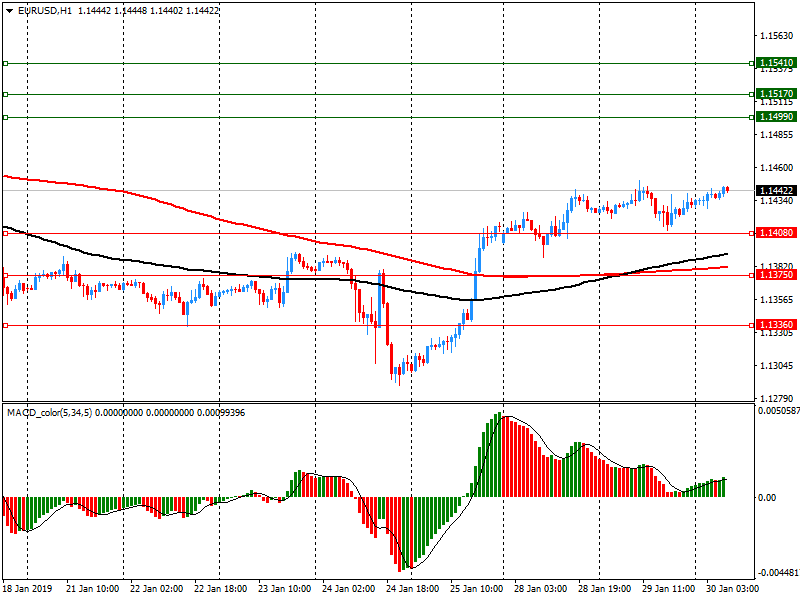
Comments:
- Overall open interest on the CALL options and PUT options with the expiration date February, 8 is 70385 contracts (according to data from January, 29) with the maximum number of contracts with strike price $1,1700 (4521);
GBP/USD
Resistance levels (open interest**, contracts)
$1.3225 (1427)
$1.3188 (1944)
$1.3150 (1206)
Price at time of writing this review: $1.3088
Support levels (open interest**, contracts):
$1.3031 (414)
$1.3005 (317)
$1.2975 (340)
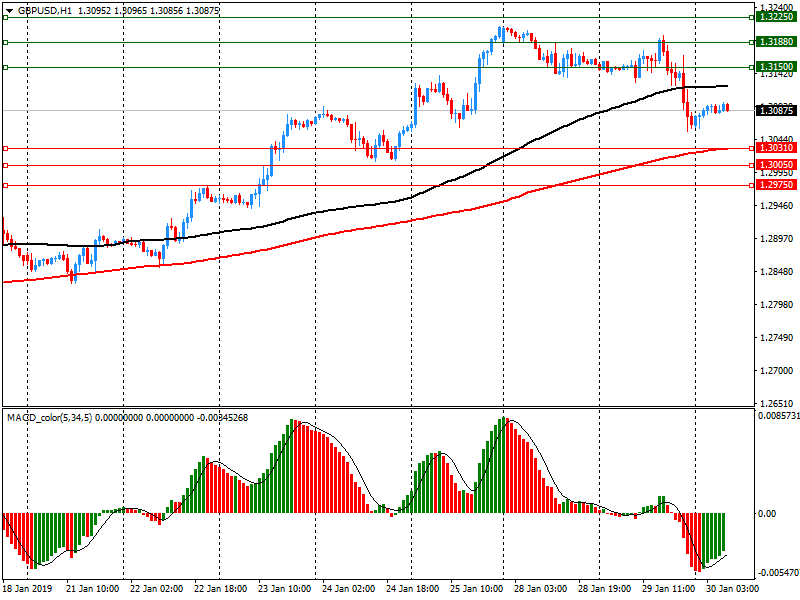
Comments:
- Overall open interest on the CALL options with the expiration date February, 8 is 23671 contracts, with the maximum number of contracts with strike price $1,3000 (1944);
- Overall open interest on the PUT options with the expiration date February, 8 is 28304 contracts, with the maximum number of contracts with strike price $1,2600 (1930);
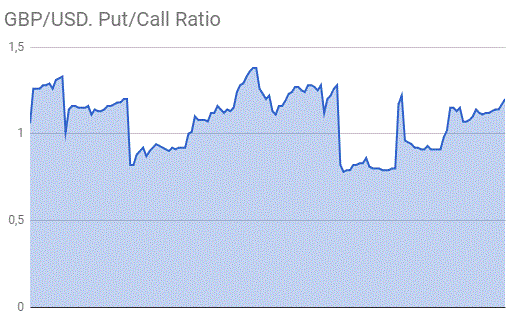
- The ratio of PUT/CALL was 1.20 versus 1.17 from the previous trading day according to data from January, 29
* - The Chicago Mercantile Exchange bulletin (CME) is used for the calculation.
** - Open interest takes into account the total number of option contracts that are open at the moment.
| Pare | Closed | Change, % |
|---|---|---|
| AUDUSD | 0.71551 | -0.12 |
| EURJPY | 125.022 | 0.09 |
| EURUSD | 1.14313 | 0.06 |
| GBPJPY | 142.893 | -0.64 |
| GBPUSD | 1.30661 | -0.68 |
| NZDUSD | 0.68326 | 0.06 |
| USDCAD | 1.32682 | 0.06 |
| USDCHF | 0.99462 | 0.29 |
| USDJPY | 109.36 | 0.03 |







© 2000-2026. All rights reserved.
This site is managed by Teletrade D.J. LLC 2351 LLC 2022 (Euro House, Richmond Hill Road, Kingstown, VC0100, St. Vincent and the Grenadines).
The information on this website is for informational purposes only and does not constitute any investment advice.
The company does not serve or provide services to customers who are residents of the US, Canada, Iran, The Democratic People's Republic of Korea, Yemen and FATF blacklisted countries.
Making transactions on financial markets with marginal financial instruments opens up wide possibilities and allows investors who are willing to take risks to earn high profits, carrying a potentially high risk of losses at the same time. Therefore you should responsibly approach the issue of choosing the appropriate investment strategy, taking the available resources into account, before starting trading.
Use of the information: full or partial use of materials from this website must always be referenced to TeleTrade as the source of information. Use of the materials on the Internet must be accompanied by a hyperlink to teletrade.org. Automatic import of materials and information from this website is prohibited.
Please contact our PR department if you have any questions or need assistance at pr@teletrade.global.


 Bank
Bank transfers


