- Analytics
- News and Tools
- Market News
CFD Markets News and Forecasts — 10-06-2020
| Time | Country | Event | Period | Previous value | Forecast |
|---|---|---|---|---|---|
| 01:00 | Australia | Consumer Inflation Expectation | June | 3.4% | 4.2% |
| 05:30 | France | Non-Farm Payrolls | Quarter I | 0.4% | -2.3% |
| 08:00 | Eurozone | Eurogroup Meetings | |||
| 12:30 | U.S. | Continuing Jobless Claims | May | 21487 | 20000 |
| 12:30 | U.S. | Initial Jobless Claims | June | 1877 | 1550 |
| 12:30 | U.S. | PPI excluding food and energy, m/m | May | -0.3% | -0.1% |
| 12:30 | U.S. | PPI excluding food and energy, Y/Y | May | 0.6% | 0.4% |
| 12:30 | U.S. | PPI, y/y | May | -1.2% | -1.2% |
| 12:30 | U.S. | PPI, m/m | May | -1.3% | 0.1% |
| 22:30 | New Zealand | Business NZ PMI | May | 26.1 | |
| 22:45 | New Zealand | Food Prices Index, y/y | May | 4.4% |
According to ActionForex, analysts at By RBC Financial Group notes that the U.S. inflation remained a tug-of-war between lower prices for goods and services consumers are buying less of (gasoline, apparel, airfares, hotels) and higher prices for essentials like food at home, which posted its largest back-to-back monthly increase since the 1970s.
"Disinflationary forces prevailed once again in May, with lower gasoline prices dragging headline inflation down to nearly zero, while CPI ex food and energy is growing at its slowest year-over-year pace since 2011 (core prices having fallen in three consecutive months for the first time in history)."
"Downward pressure from gasoline prices should start to ease in June as reopening supports demand (pump prices are already starting to pick up)."
"But we expect core inflation will remain contained by persistently soft overall demand, even as an economic recovery gets underway over the second half of the year."
"The Fed isn’t expected to make any major policy announcements this afternoon, but is likely to reiterate a “do whatever it takes” approach to supporting the US economy through the coronavirus crisis and during the recovery. Updated economic forecasts (the first since December) will give some idea of how quickly policymakers expect the economy to recover, and how long disinflationary forces are likely to persist."
"At some point in the near future the central bank is likely to commit to that more explicitly by providing forward guidance on the path of interest rates and QE."
The U.S. Energy
Information Administration (EIA) revealed on Wednesday that crude inventories surged
by 5.720 million barrels in the week ended June 5. Economists had forecast a decrease
of 1.738 million barrels.
At the same
time, gasoline stocks rose by 0.866 million barrels, while analysts had
expected a gain of 0.071 million barrels. Distillate stocks increased by 1.568
million barrels, while analysts had forecast a build of 2.957 million barrels.
Meanwhile, oil
production in the U.S. decreased by 100,000 barrels a day to 11.100 million
barrels a day.
U.S. crude oil
imports averaged 6.9 million barrels per day last week, increased by 0.7
million barrels per day from the previous week.
FXStreet notes that The sharp sell-off in EUR/JPY stabilised at the 121.37/26 support and analysts at Credit Suisse see the pair returning to its trend higher with a break of the 122.51 level needed to underpin this view.
“Although the market remains below the ‘neckline’ to the medium-term base at 122.52, our bias remains to view this weakness for now as a correction to the aggressive rally seen from early May.”
“Above 122.51/59 is needed to add weight to this view as this would mark a fresh minor base, as well as put the market back above the ‘neckline’ to the larger base to reassert an upward bias for strength back to 123.21/27. Above here is needed to suggest the setback is over and uptrend resumed, with resistance then seen at 124.44, then 125.13/23.”
“Near-term support moves to 121.86, then 121.68. Below 121.26 can see weakness extend further with the 13-day average at 121.06, but with 120.60/56 needing to be removed to end the basing story – the 38.2% retracement of the entire May/June rally.”
FXStreet notes that gold is struggling to resume the uptrend with momentum still poor but strategists at Credit Suisse think the yellow metal will eventually pop higher to test the $1800.
“Gold is struggling to extend its uptrend with poor momentum and current lack of falling real yield support weighing on the market. Further consolidation should be allowed for, but we look for the bull trend to resume in due course post this phase for a test of $1796/1803 next.”
“Big picture, as per our original spotlight from June 2019 we continue to eventually look for new highs above $1921, with resistance then seen next at $2000, then $2075/80.”
“Support at $1660 needs to hold to avoid a near-term top.”
- Says May survey show some signs of bottoming out
- ECB ready to adjust all instruments including PEPP
- PEPP boost gets inflation closer to pre-crisis path
- Forceful fiscal action at European level needed
- We welcome competition with Britain, as non-EU state, but must be balanced, fair
- Britain is in a unique position in terms of proximity and trade to EU
- Relationship with Britain wont' be the same as EU's with Canada and Japan
- Coronavirus outbreak makes reaching Brexit deal with UK even more important
U.S. stock-index futures rose on Wednesday ahead of the announcement of the Fed meeting outcome later today.
Global Stocks:
Index/commodity | Last | Today's Change, points | Today's Change, % |
Nikkei | 23,124.95 | +33.92 | +0.15% |
Hang Seng | 25,049.73 | -7.49 | -0.03% |
Shanghai | 2,943.75 | -12.36 | -0.42% |
S&P/ASX | 6,148.40 | +3.50 | +0.06% |
FTSE | 6,356.31 | +20.59 | +0.32% |
CAC | 5,102.44 | +7.33 | +0.14% |
DAX | 12,649.12 | +31.13 | +0.25% |
Crude oil | $38.33 | -1.57% | |
Gold | $1,729.60 | +0.45% |
(company / ticker / price / change ($/%) / volume)
3M Co | MMM | 167.07 | 0.37(0.22%) | 1937 |
ALCOA INC. | AA | 12.57 | -0.02(-0.16%) | 46171 |
ALTRIA GROUP INC. | MO | 42.45 | 0.27(0.64%) | 24188 |
Amazon.com Inc., NASDAQ | AMZN | 2,638.00 | 37.14(1.43%) | 80699 |
American Express Co | AXP | 110.51 | 0.05(0.05%) | 9922 |
AMERICAN INTERNATIONAL GROUP | AIG | 38.17 | 0.43(1.13%) | 3616 |
Apple Inc. | AAPL | 348.45 | 4.46(1.30%) | 479008 |
AT&T Inc | T | 32.77 | 0.15(0.46%) | 59404 |
Boeing Co | BA | 215 | -1.74(-0.80%) | 1007778 |
Caterpillar Inc | CAT | 134.4 | 0.21(0.16%) | 1806 |
Chevron Corp | CVX | 100.57 | -0.96(-0.95%) | 39185 |
Cisco Systems Inc | CSCO | 47.7 | -0.35(-0.73%) | 70234 |
Citigroup Inc., NYSE | C | 59.72 | 0.22(0.37%) | 121297 |
E. I. du Pont de Nemours and Co | DD | 56.92 | 0.99(1.77%) | 3548 |
Exxon Mobil Corp | XOM | 53.07 | -0.45(-0.84%) | 164425 |
Facebook, Inc. | FB | 241.11 | 2.44(1.02%) | 262549 |
FedEx Corporation, NYSE | FDX | 145 | 0.31(0.21%) | 1914 |
Ford Motor Co. | F | 7.38 | 0.14(1.93%) | 1135810 |
Freeport-McMoRan Copper & Gold Inc., NYSE | FCX | 11.47 | 0.20(1.77%) | 51758 |
General Electric Co | GE | 8.05 | 0.03(0.37%) | 744182 |
General Motors Company, NYSE | GM | 29.97 | 0.11(0.37%) | 32220 |
Goldman Sachs | GS | 219.03 | 0.93(0.43%) | 13841 |
Google Inc. | GOOG | 1,470.00 | 13.84(0.95%) | 12619 |
Hewlett-Packard Co. | HPQ | 17.15 | -0.35(-1.98%) | 3006 |
Home Depot Inc | HD | 257.7 | 0.94(0.37%) | 2653 |
HONEYWELL INTERNATIONAL INC. | HON | 158.75 | 0.65(0.41%) | 788 |
Intel Corp | INTC | 62.65 | -0.39(-0.62%) | 49602 |
International Business Machines Co... | IBM | 132.4 | 0.53(0.40%) | 8358 |
Johnson & Johnson | JNJ | 146.8 | 0.84(0.58%) | 7822 |
JPMorgan Chase and Co | JPM | 111.08 | 0.54(0.49%) | 62232 |
McDonald's Corp | MCD | 199.57 | 0.05(0.03%) | 9456 |
Merck & Co Inc | MRK | 82.35 | 0.09(0.11%) | 14761 |
Microsoft Corp | MSFT | 191.57 | 1.77(0.93%) | 224908 |
Nike | NKE | 102.95 | 0.32(0.31%) | 806 |
Pfizer Inc | PFE | 36.37 | 0.16(0.44%) | 73050 |
Procter & Gamble Co | PG | 118.52 | 0.18(0.15%) | 2088 |
Starbucks Corporation, NASDAQ | SBUX | 79.99 | -2.38(-2.89%) | 319610 |
Tesla Motors, Inc., NASDAQ | TSLA | 992.3 | 51.63(5.49%) | 926733 |
The Coca-Cola Co | KO | 49.29 | 0.29(0.59%) | 36961 |
Twitter, Inc., NYSE | TWTR | 36.4 | 0.48(1.34%) | 97346 |
UnitedHealth Group Inc | UNH | 311.1 | 1.89(0.61%) | 1369 |
Verizon Communications Inc | VZ | 57.95 | 0.09(0.16%) | 23662 |
Visa | V | 200.4 | 1.32(0.66%) | 9214 |
Wal-Mart Stores Inc | WMT | 121.64 | 0.29(0.24%) | 41321 |
Walt Disney Co | DIS | 124.31 | 0.42(0.34%) | 44112 |
Yandex N.V., NASDAQ | YNDX | 42.5 | 0.51(1.21%) | 1848 |
Amazon (AMZN) target raised to $3100 from $2800 at Jefferies
Apple (AAPL) target raised to $350 at Deutsche Bank
Tesla (TSLA) target raised to $1000 from $800 at Wedbush; Neutral
Cisco (CSCO) downgraded to Neutral from Outperform at Robert W. Baird; target $48
Chevron (CVX) downgraded to Underperform from Sector Perform at RBC Capital Mkts; target $100
- BoE will have to consider some reform of non-bank sector after COVID
- Banking sector can aid recovery by continuing to lend
The Labor
Department announced on Wednesday the U.S. consumer price index (CPI) edged down
0.1 percent m-o-m in May, following an unrevised 0.8 percent m-o-m decline in
the previous month.
Over the last
12 months, the CPI rose 0.1 percent y-o-y last month, following an unrevised 0.3
percent m-o-m advance in the 12 months through April. That the lowest inflation
rate since September 2015.
Economists had
forecast the CPI to be flat m-o-m and to increase 0.2 percent y-o-y in the
12-month period.
According to
the report, declines in the indexes for motor vehicle insurance (-8.9 percent
m-o-m), energy (-1.8 percent m-o-m), and apparel (-2.3 percent m-o-m) more than
offset increases in food (+0.7 percent m-o-m) and shelter (+0.2 percent m-o-m) indexes
to result in the monthly decrease in the seasonally adjusted all items index.
Meanwhile, the
core CPI excluding volatile food and fuel costs also dropped 0.1 percent m-o-m
in May after a 0.4 percent m-o-m fall in the previous month.
In the 12
months through May, the core CPI rose 1.2 percent, following a 1.4 percent
advance in the 12 months ending April. That was the lowest rate since March
2011.
Economists had
forecast the core CPI to be unchanged m-o-m and to rise 1.3 percent y-o-y last
month.
| Time | Country | Event | Period | Previous value | Forecast | Actual |
|---|---|---|---|---|---|---|
| 06:45 | France | Industrial Production, m/m | April | -16.2% | -20% | -20.1% |
| 12:30 | U.S. | CPI excluding food and energy, m/m | May | -0.4% | 0.0% | -0.1% |
| 12:30 | U.S. | CPI, m/m | May | -0.8% | 0.0% | -0.1% |
| 12:30 | U.S. | CPI excluding food and energy, Y/Y | May | 1.4% | 1.3% | 1.2% |
| 12:30 | U.S. | CPI, Y/Y | May | 0.3% | 0.2% | 0.1% |
USD weakened against other major currencies in the European session on Wednesday as market participants await the announcement of the Fed meeting outcome later today.
The U.S. Federal Reserve will announce the results of its two-day policy meeting today at 18:00 GMT, and its Chairman Jerome Powell will hold a news conference at 18:30 GMT.
The U.S. central bank is not expected to make any major policy changes, with its benchmark rate near zero and the asset purchasing programs continuing.
However, some investors believe that the Fed could decide to implement yield curve control (YCC) to guide the yields of the 10-year U.S. government bonds, which climbed to their highest level in nearly three months on hopes of faster economic recovery, lower.
Another point of interest will be economic forecasts and "dot plots" for interest rate projections from the Fed's policymakers.
The Fed is set to provide its first forecast for the U.S. economy since the COVID-19 pandemic pushed the country into recession. Markets will be curious to see when the central bankers expect to see single-digit employment and a return to pre-pandemic output. Its "dot plots" are expected to reaffirm the Fed's commitment to keeping interest rates low for the next few years.
FXStreet reports that economists at Credit Suisse note that Nasdaq 100 is at a new record high as yesterday closed at 9953.75 but is seen highly overextended near-term with 100% of the stocks above their medium-term average.
“Nasdaq 100 has moved to a new record high but is now well above its ‘typical’ extreme - 15% above the 200-day average – now at 9737. We remain of the view the market is highly overstretched and due a consolidation/correction and thus do not look to chase near-term strength from here. Weakness though will be seen as a corrective mover lower.”
“Resistances are seen at the psychological 10000 level, then 10200/20.”
“Below 9577 is needed to ease the immediate upside bias, but only below 9182 would set a top, with support then seen back at 8860 initially.”
“As of Friday last week, 100% of Nasdaq 100 stocks were above their medium-term 63-day average, something rarely seen. Whilst this points to strong market breadth, it also speaks to the current highly overextended state of the rally.”
- Wants to reopen hospitality as quickly as possible, but no earlier than July 4
- Aiming to reopen pubs and cafes on July 4
- Wants to make sure that 2-meter social distancing rule is under constant review
FXStreet reports that the Credit Suisse analyst team notes that USD/CAD is back under pressure as the loonie maintains the break below the 1.3465 200-day average, with next support seen at 1.3365/57.
“The market is now pushing towards the pivotal 50% retracement of the 2017/2020 surge and recent lows at 1.3365/57. Although the broader downtrend remains well supported, with daily RSI momentum still in heavily oversold territory, further short-term consolidation should be allowed for at this point.”
“Removal of 1.3365/57 in due course though would then see support next at the ‘neckline’ to the November/December 2019 base and 78.6% retracement of the 2020 surge at 1.3331/15.”
“Resistance moves 1.3428, then to the 200-day average at 1.3465, which ideally holds to keep the downside bias intact. Above here would see resistance at 1.3513, then 1.3572/85, where we would expect to see another attempt to cap.”
- Evidence is increasingly pointing towards protracted impact of crisis on both demand and supply conditions in euro area and beyond
- Flexibility is key element of PEPP and will be maintained throughout its lifetime
- We see clear evidence of the success of allocating purchases flexibly across market segments
- The European recovery fund proposal is promising step in right direction
- Surveys point to significant take-up for TLTRO III, in order of € 1.4 trillion
- Given high uncertainty regarding second-round effects, our decision appears to be appropriate and proportional course of action
The Mortgage
Bankers Association (MBA) reported on Wednesday the mortgage application volume
in the U.S. surged 9.3 percent in the week ended June 5, following a 3.9
percent drop in the previous week. That was the biggest rise in mortgage
applications since the last week of March.
According to
the report, refinance applications climbed 11.4 percent, while applications to
purchase a home increased 5.3 percent.
Meanwhile, the
average fixed 30-year mortgage rate rose to 3.38 percent from a record low 3.37
percent.
“The recovery
in the purchase market continues to gain steam, with the seasonally adjusted
index rising to its highest level since January,” noted Joel Kan, an MBA
economist. “Purchase activity increased for the eighth straight week.”
Petr Krpata, an FX strategist at ING, notes that the key focus of the day is the FOMC meeting.
"Following the stunning US May employment report, there is a degree of uncertainty whether the Federal Reserve considers the improvement in data as an opportunity to signal a less loose monetary policy and thus take the liquidity punchbowl away from markets. We don’t think so."
"According to our economists Fed preview, we expect the Fed to err on the side of caution given the uncertainty about the recovery, with the central bank unlikely rocking the boat for risk assets."
"While the new set of economic forecasts is published, given the huge amount of uncertainty the Fed is likely to refrain from, firm forward guidance. The potential indication of the 2022 hike in the new forecast is more likely to do with dispelling the odds of negative rates rather than the potential for a meaningful policy reversal."
"All this should keep the dollar soft and further help to facilitate the genal widespread USD bear trend as the mix of the Fed’s accommodative policy stance, the gradual recovery in the global economy and the stretched USD valuation weigh on the dollar in the months to come."
FXStreet notes that AUD/USD is set to experience some near-term consolidation but analysts at Credit Suisse expect a break of the December 2019 and current year highs at 0.7024/32.
“AUD/USD is still consolidating ahead of the pivotal December 2019 and current year highs at 0.7024/32. With daily RSI momentum still in heavily overbought territory, we expect further near-term consolidation, before an eventual resumption of the uptrend.”
“An eventual sustained closing break above 0.7032 and then 0.7041 would further reinforce the view of a broader change in trend to the upside, with resistance then seen initially at the July 2019 high and 78.6% retracement of the April 2019/March 2020 downfall at 0.7082/92, before the 61.8% retracement of the fall from 2018 at 0.7133/40.”
“Support moves initially to 0.6933, then 0.6899, ahead of 0.6883/57, which now ideally holds to keep the upside bias intact. Removal of here would see a correction (rather than just consolidation) and a move back to the 200-day average at 0.6665, where we expect to see a concerted effort to hold.”
FXStreet reports that economists at Danske Bank expect EUR/GBP to move higher near-term, trading at 0.90 in next quarter. Longer-term, though, they see the pair moving lower to the 0.86 level.
“While we target EUR/GBP at 0.90 in one-to-three month, we would not be surprised to see the cross move as high as 0.92. Key risks to this call are a trade deal landing more smoothly than we envisage, an extension and/or global risk sentiment continuing to improve on the back of reopenings backed by past extensive policy stimulus.”
“If we are right about the two sides reaching an agreement eventually, we think the cross will move lower again to something like 0.86 in six-to-twelve months.”
FXStreet reports that in opinion of FX Strategists at UOB Group, USD/CNH could drop and test the 7.0400 region in the next weeks.
24-hour view: “While our expectation for USD to strengthen yesterday was correct, our view that it ‘is unlikely to move above 7.0850’ was not. USD soared to a high of 7.0912 before easing off quickly. Momentum indicators are mostly ‘neutral’ now and for today, USD is expected to consolidate and trade between 7.0640 and 7.0950.”
Next 1-3 weeks: “Our latest narrative was from last Wednesday (03 Jun, spot at 7.1050) wherein ‘a daily closing below 7.0850 could signal the start of a deeper decline in USD’. USD plummeted last Friday (05 Jun) and closed on a weak note at 7.0685. While oversold shorter-term conditions could lead to a couple of days of consolidation first, barring a move above 7.1210 (‘strong resistance’ level), USD could weaken further to 7.0400 in the coming days.”
Reuters reports that Germany should make provisions to ensure banks have sufficient capital in case of a wave of bankruptcies in Europe's largest economy caused by the coronavirus crisis, a senior OECD economist said on Wednesday.
"The German corporate sector is very heavily financed through bank loans," OECD economist Isabell Koske said in an interview.
"Banks are therefore at greater risk of not seeing their loans again in the event of a wave of bankruptcies," Koske said, adding that German banks in general had relatively low returns and were weakly capitalised.
The OECD said on Wednesday that the global economy will suffer the biggest peace-time downturn in a century before it emerges next year from a coronavirus-inflicted recession.
FXStreet reports that Brent Crude Oil has confirmed a base as expected at $37.28 and strategists at Credit Suisse expect some consolidation while below $43.86. A break of this level would open the path towards the 200-day ma at $50.45.
“Brent Crude has extended its strong recovery as expected from its multi-year price support from the 1990’s and early 2000’s at $16.65/14.53 and has managed to remain above the 38.2% retracement of the Q1 collapse at $37.28, establishing a base.”
“Near-term, consolidation should be allowed for below the 50% retracement at $43.86. Above here in due course though should see resistance next at $45.18/50 and then more importantly at $50.45/99, where the 200-day average is hovering, which we expect to cap the market at least temporarily.”
“Near-term support is seen at $37.18/35.37, the May/June price gap, with $33.62 now ideally holding further weakness. Only below $28.86 would see the base negated though.”
CNBC reports that the coronavirus pandemic is on track to cause the worst recession outside of wartime in 100 years, the Organization for Economic Cooperation and Development warned on Wednesday.
The strict lockdowns and travel restrictions imposed by countries around the world have led to a steep decline in business activity. Global supply chains have been halted, inequality and debt levels have soared, and confidence levels have fallen.
“Economic impacts are dire everywhere,” the OECD summarized in its Economic Outlook, published Wednesday.
“The recovery will be slow and the crisis will have long-lasting effects, disproportionately affecting the most vulnerable people.”
The OECD published two forecasts for global growth: the first assuming there is a second wave of Covid-19 infections; the second assuming a second wave is avoided.
In its first scenario, the OECD said global growth will contract by 7.6% in 2020, and “remain well short” of its pre-crisis level by the end of next year. If there is no second wave, the OECD said the world economy will still contract by 6% in 2020, but will recover to almost pre-crisis levels by the end of 2021.
“Both scenarios are sobering, as economic activity does not and cannot return to normal under these circumstances,” the OECD said.
It added that “by the end of 2021, the loss of income exceeds that of any previous recession over the last 100 years outside wartime, with dire and long-lasting consequences for people, firms and governments.”
France, the United Kingdom, Spain and Italy are expected to face the sharpest economic contractions this year. These countries are among those worst-hit by the health crisis so far.
The OECD also warned about the impact of the pandemic on young people. Those aged between 15 and 24 represent the biggest share of workers in the hardest-hit sectors, such as tourism.
Furthermore, emerging economies are also expected to be badly hit. Countries such as Brazil and Argentina rely on demand from advanced countries, which are also struggling.
FXStreet reports that in its latest client note, analysts at the Wall Street banking giant, Goldman Sachs, argued against recommending long positions in commodities, with the exception of metals, as the recent rally has gotten ahead of fundamentals.
“Sees downside risks in agricultural and energy markets, citing the recent strength as surprising given the massive inventory overhangs and depressed demand.
Without a shift in balances, any rally in physical commodity markets is unsustainable, adding the climb was “too much, too fast in oil, but not metals.
Combined with COVID-19-related supply disruptions and a lack of scrap availability due to the lockdown, metals markets are left with relatively little inventory.
Forecasts 3-month returns of 0.8% for industrial metals, -9.5% for energy complex, -8.6% for precious metals and -7.4% for agriculture.
On a 3, 6 and 12-month horizon, the bank sees returns of -7.5%, 2.7% and 13.1% on commodities over the S&P GSCI index.
The year-to-date return on commodities is seen at -34.2%, compared with 17.4% in 2019.
Expect gold to reach $1,800 per ounce on a 12-month basis and the tail risk of above-target inflation as a potential driver for prices to climb beyond $2,000.”
Reuters reports that house sales in England have rebounded since the government allowed estate agents to reopen last month, and in much of the country they are back to where they were in the first week of March, property website Zoopla said on Wednesday.
Across Britain as a whole, newly agreed sales in the first week of June were 12% below where they were in the first week of March, reflecting the ongoing closure of the property market in Scotland and Wales due to coronavirus restrictions.
In central and northern England, sales have returned to pre-coronavirus levels, Zoopla said.
Sales in London have lagged behind as some buyers look at moving outside the British capital, where a reliance on public transport has made it harder for life to return to normal.
Bank of England data showed mortgage approvals for house purchases slumped in April to their lowest since records began in 1997, at just a fifth of their level in February, as prospective buyers were unable to visit properties for sale.
Mortgage lender Nationwide reported a 1.7% monthly fall in prices in May, the biggest drop since the financial crisis in 2009.
Zoopla said pricing in June was stronger, with asking prices 6% higher than a year earlier. But it warned weakness was likely later in the year.
"We still believe that this spike in demand will be short-lived as the economic impacts of COVID start to feed through into market sentiment and levels of market activity in 2020 H2," said Zoopla's research director, Richard Donnell.
FXStreet reports that NZD/USD is back above 0.65 this morning and analysts at ANZ Bank believe the kiwi is going to march higher as the Fed is set to continue supporting the economy.
“We do see scope for an extended pop higher. Given where US inflation and unemployment sit (and are going), despite payroll data being better than expected, in level terms it’s still dire and miles from the Fed’s mandated targets, so they have no choice to keep the pedal to the metal. That being the case, tomorrow’s FOMC will likely only further fuel risk appetite.”
“Of course the RBNZ can’t sit and watch the NZD go up ad infinitum, but that’s a story for later.”
“Support 0.6370/6500 Resistance 0.6765”
According to the report from INSEE, in April 2020, output plummeted sharply again in the manufacturing industry (−21.9%, after −18.3%), as well as in the whole industry (−20.1%, after −16.2%). Economists had expected a 20% decrease in the whole industry. Compared to February (the last month before the start of the general lockdown), output fell by 36.2% in manufacturing and 33.1% in the whole industry.
Over the last three months, manufacturing output declined markedly in manufacturing industry (−17.4%), as well as in the whole industry (−15.8%).
Over this period, output slumped in the manufacture of transport equipment (−34.1%). It plunged in the manufacture of machinery and equipment goods (−19.1%), in “other manufacturing”(−17.1%) and in the manufacture of coke and refined petroleum products (−19.2%). It decreased more moderately in mining and quarrying, energy, water supply (−6.4%) and in the manufacture of food products and beverages (−3.7%).
In the manufacturing industry, cumulative output over the last three months declined sharply compared to the same months a year ago (−19.4%), as well as in the whole industry (−17.7%).
Over a year, output plummeted in the manufacture of coke and refined petroleum products (−44.2%). It fell markedly in “other manufacturing” (−18.0%), in the manufacture of transport equipment (−36.7%) and in the manufacture of machinery and equipment goods (−23.2%). It declined more moderately in mining and quarrying, energy, water supply (−8.1%) and in the manufacture of food products and beverages (−4.1%).
| Time | Country | Event | Period | Previous value | Forecast | Actual |
|---|---|---|---|---|---|---|
| 00:30 | Australia | Westpac Consumer Confidence | June | 88.1 | 93.7 | |
| 01:30 | China | PPI y/y | May | -3.1% | -3.3% | -3.7% |
| 01:30 | China | CPI y/y | May | 3.3% | 2.7% | 2.4% |
| 06:45 | France | Industrial Production, m/m | April | -16.2% | -20% | -20.1% |
The US dollar is falling against the euro and the yen, while traders are waiting for the outcome of the Federal reserve meeting. The pound is rising against the dollar and euro.
Meanwhile, Bank of America analysts expect the dollar to continue to strengthen against the backdrop of growing demand for safe haven assets in the coming months, as the pace of global economic recovery is likely to disappoint the market.
The Fed on Wednesday will sum up its two-day meeting and release forecasts for the US economy for the first time in six months. The Fed declined to publish economic forecasts in March amid extremely high uncertainty about how the situation in the us economy will develop in the context of the coronavirus pandemic.
Many economists expect that the Federal reserve will publish a forecast of a significant decline in US GDP in 2020, while assuring markets that the base interest rate will remain at the current level-0-0. 25% per annum-for the next few years. This will confirm the" dovish " attitude of the Fed and its commitment to maintaining a very soft monetary policy, experts say.
The ICE Dollar index, which shows the value of the dollar against six major world currencies, fell by 0.14% compared to the previous day.
CNBC reports that stocks in Asia have the potential to outperform even as tensions between the U.S. and China have escalated in recent months, according to Swiss wealth management giant UBS.
That’s because any potential move that U.S. President Donald Trump may take against China will likely be “more bark than bite,” Kelvin Tay, regional chief investment officer at UBS Global Wealth Management, said on Wednesday.
“We don’t think the ratcheting up of U.S.-China tensions will be a risk simply because this is (an election) year and the U.S. is in a recession,” he told CNBC.
“Therefore, any further significant action that the U.S. might have to take will largely be symbolic rather than on the tariff front,” he added. “If that’s the case, it should not be a big impediment for Asian equities to outperform.”
Recent disputes between the world’s top two economies include China’s handling of the coronavirus outbreak — which first emerged in the Chinese city of Wuhan — and Beijing’s growing influence over Hong Kong, a semi-autonomous Chinese territory which has a special trading relationship with the U.S.
Such developments raised concerns among investors that the two countries would resume a tariff war that’s damaging to the global economy.
FXStreet reports that David Kostin, Chief US Equity Strategist at Goldman Sachs, warns there could be downside ahead in the S&P 500 index following its 40% surge from mid-March.
“I think you’ve got three issues that are on the table with fund managers with whom I speak.
The first issue is the momentum, which is the broadening of the rally that I talked about before.
The second is valuation.
And the third is taxes. And those three things to me suggest that the market is at the high end of the range at 3,200.
And our target for the end of the year the S&P 500 is around 3,000, and there’s more downside than upside as a result.”
eFXdata reports that Barclays Research discusses its expectations for today's FOMC policy meeting.
“At the June FOMC meeting we expect the Fed to clarify its intentions on asset purchases. At present, the Fed is purchasing Treasury and agency MBS securities to support market functioning and has scaled its purchases back as overall functioning has improved. We expect the Fed will shift its asset purchases from a daily announced rate – currently $4.5bn per day for Treasuries and $4.5bn per day for agency MBS – to a monthly purchase rate of $80bn per month in Treasuries and $60bn per month in agency MBS, as well as shift the intent of these purchases to support an accommodative policy stance. We think these purchases will be open-ended and loosely tied toward progress on the dual mandate.
We do not expect a change in forward guidance at the June meeting since the coronavirus outbreak has apparently delayed the completion of the framework review. Elsewhere, we expect the median FOMC member’s assessment of appropriate monetary policy to include keeping the funds rate at the zero-lower bound through the end of 2022 in the Summary of Economic Projections.
We read FOMC communication as suggesting the Fed has a similar outlook to our own: a sizable loss in GDP in 2020 that takes several years to recover, as well as elevated unemployment and below-target inflation over the three-year projection horizon," Barclays adds.
EUR/USD
Resistance levels (open interest**, contracts)
$1.1505 (1184)
$1.1474 (1046)
$1.1448 (1406)
Price at time of writing this review: $1.1354
Support levels (open interest**, contracts):
$1.1272 (217)
$1.1243 (974)
$1.1209 (617)
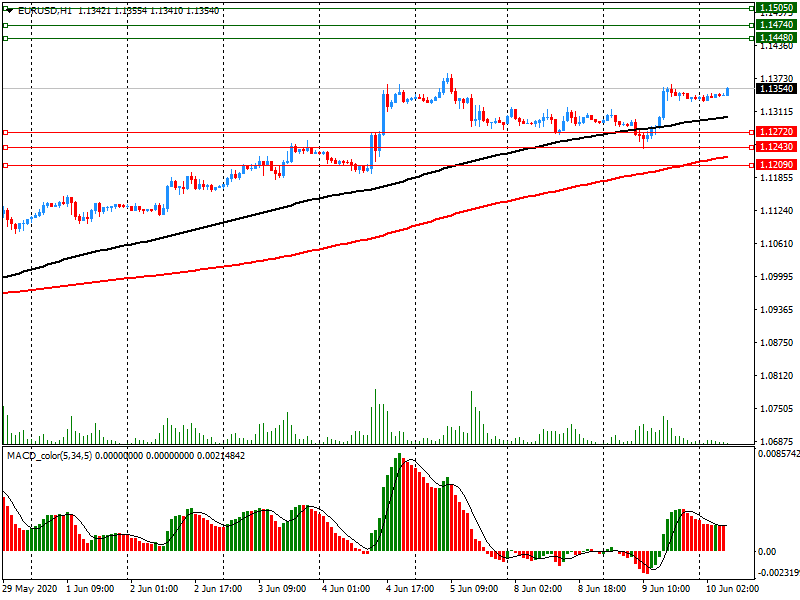
Comments:
- Overall open interest on the CALL options and PUT options with the expiration date July, 2 is 42261 contracts (according to data from June, 9) with the maximum number of contracts with strike price $1,0900 (2042);
GBP/USD
Resistance levels (open interest**, contracts)
$1.2867 (1348)
$1.2845 (1479)
$1.2827 (562)
Price at time of writing this review: $1.2760
Support levels (open interest**, contracts):
$1.2602 (315)
$1.2570 (711)
$1.2497 (1463)
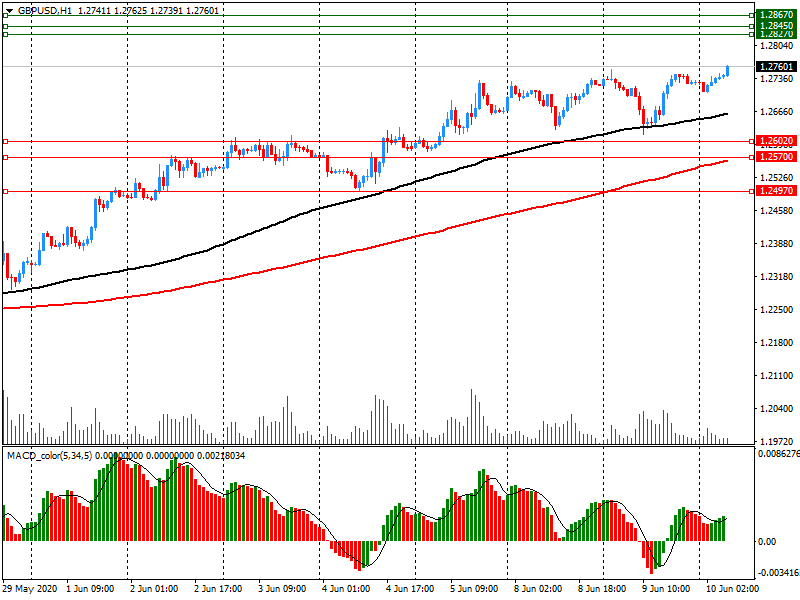
Comments:
- Overall open interest on the CALL options with the expiration date July, 2 is 13748 contracts, with the maximum number of contracts with strike price $1,2900 (1508);
- Overall open interest on the PUT options with the expiration date July, 2 is 14805 contracts, with the maximum number of contracts with strike price $1,2550 (1463);
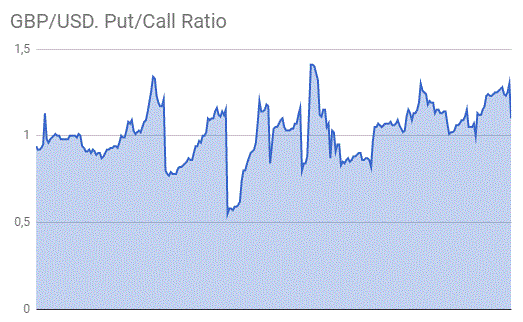
- The ratio of PUT/CALL was 1.08 versus 1.10 from the previous trading day according to data from June, 9
* - The Chicago Mercantile Exchange bulletin (CME) is used for the calculation.
** - Open interest takes into account the total number of option contracts that are open at the moment.
| Raw materials | Closed | Change, % |
|---|---|---|
| Brent | 40.47 | -0.76 |
| Silver | 17.51 | -1.24 |
| Gold | 1713.99 | 0.95 |
| Palladium | 1942.14 | -2.98 |
| Index | Change, points | Closed | Change, % |
|---|---|---|---|
| NIKKEI 225 | -87.07 | 23091.03 | -0.38 |
| Hang Seng | 280.45 | 25057.22 | 1.13 |
| KOSPI | 4.63 | 2188.92 | 0.21 |
| ASX 200 | 146.2 | 6144.9 | 2.44 |
| FTSE 100 | -136.87 | 6335.72 | -2.11 |
| DAX | -201.6 | 12617.99 | -1.57 |
| CAC 40 | -80.41 | 5095.11 | -1.55 |
| Dow Jones | -300.14 | 27272.3 | -1.09 |
| S&P 500 | -25.21 | 3207.18 | -0.78 |
| NASDAQ Composite | 29 | 9953.75 | 0.29 |
| Time | Country | Event | Period | Previous value | Forecast |
|---|---|---|---|---|---|
| 00:30 | Australia | Westpac Consumer Confidence | June | 88.1 | |
| 01:30 | China | PPI y/y | May | -3.1% | -3.3% |
| 01:30 | China | CPI y/y | May | 3.3% | 2.7% |
| 06:45 | France | Industrial Production, m/m | April | -16.2% | -20% |
| 12:30 | U.S. | CPI excluding food and energy, m/m | May | -0.4% | 0.0% |
| 12:30 | U.S. | CPI, m/m | May | -0.8% | 0.0% |
| 12:30 | U.S. | CPI excluding food and energy, Y/Y | May | 1.4% | 1.3% |
| 12:30 | U.S. | CPI, Y/Y | May | 0.3% | 0.2% |
| 14:30 | U.S. | Crude Oil Inventories | June | -2.077 | -1.45 |
| 18:00 | U.S. | Federal budget | May | -738 | -625 |
| 18:00 | U.S. | FOMC Economic Projections | |||
| 18:00 | U.S. | Fed Interest Rate Decision | 0.25% | 0.25% | |
| 18:30 | U.S. | Federal Reserve Press Conference | |||
| 23:50 | Japan | BSI Manufacturing Index | Quarter II | -17.2 |
| Pare | Closed | Change, % |
|---|---|---|
| AUDUSD | 0.69538 | -0.86 |
| EURJPY | 122.079 | -0.26 |
| EURUSD | 1.13347 | 0.4 |
| GBPJPY | 137.06 | -0.61 |
| GBPUSD | 1.27268 | 0.04 |
| NZDUSD | 0.65062 | -0.67 |
| USDCAD | 1.3416 | 0.25 |
| USDCHF | 0.95018 | -0.75 |
| USDJPY | 107.686 | -0.66 |







© 2000-2026. All rights reserved.
This site is managed by Teletrade D.J. LLC 2351 LLC 2022 (Euro House, Richmond Hill Road, Kingstown, VC0100, St. Vincent and the Grenadines).
The information on this website is for informational purposes only and does not constitute any investment advice.
The company does not serve or provide services to customers who are residents of the US, Canada, Iran, The Democratic People's Republic of Korea, Yemen and FATF blacklisted countries.
Making transactions on financial markets with marginal financial instruments opens up wide possibilities and allows investors who are willing to take risks to earn high profits, carrying a potentially high risk of losses at the same time. Therefore you should responsibly approach the issue of choosing the appropriate investment strategy, taking the available resources into account, before starting trading.
Use of the information: full or partial use of materials from this website must always be referenced to TeleTrade as the source of information. Use of the materials on the Internet must be accompanied by a hyperlink to teletrade.org. Automatic import of materials and information from this website is prohibited.
Please contact our PR department if you have any questions or need assistance at pr@teletrade.global.


 Bank
Bank transfers


