- Analytics
- News and Tools
- Market News
CFD Markets News and Forecasts — 28-04-2022
- USD/CAD traders now await the Fed as the US dollar consolidates below 20-year highs.
- Bears have moved in and eye a significant correction towards 1.2720/50.
At the time of writing, USD/CAD is trading at 1.2805 and consolidated in resistance territories. The US dollar rose against most G10 currencies, tailing off towards the end of the day and offering some relief to the commodity complex. nevertheless, DXY, a measure of the greenback vs. a basket of currencies, rose to a 20-year high as investors price in a series of relatively bg interest rates from the Federal Reserve.
A bounce in risk appetite set in during the Wall Street session as investors observed evidence of strong consumer demand obscured by the unexpected decrease in Gross Domestic Product growth for the last quarter, the first since 2020. Nevertheless, the risk-off tones are well set and have sunk the S&P 500 more than 5% in April, on track to be the worst month since the 1987 bear market.
The worries over China's fight to curb COVID combined with the Ukraine crisis against a backdrop of hawkish central banks set on tightening monetary policy is feeding into recession concerns. Treasury Secretary Janet Yellen spoke up overnight and said that the global pandemic and Russia’s invasion of Ukraine highlight the possibility of big economic shocks in the future, adding that downturns are “likely to continue to challenge the economy.”
Meanwhile, supportive of CAD, the price of crude oil price has advanced to USD107/bbl amid the rising possibility of a European embargo on Russian oil. ''Germany is preparing to halt Russian oil imports in a phased manner, which would lead to a broader sanction by the region. Germany’s minister has already said that the country could manage without Russian oil,'' analysts at ANZ Bank explained.
''Investors are concerned about replacing the lost barrels due to the upcoming European sanctions. Oil product prices are rallying as well, lifting refiners’ margins. However, oil-product demand remains subdued in China due to rising COVID case numbers.''
All eyes on the Fed
All eyes will now turn to the Fed next week. Fed tightening expectations are robust. Markets are looking for at least a 50 bp hike at the May 3-4 meeting and again at the June 14-15 meeting. This is fully priced in, with nearly 25% odds of a possible 75 bp move in June. the surprise will come if there is anything short or above this consensus at next week's meeting.
''Looking ahead, swaps market is pricing in 275 bp of tightening over the next 12 months that would see the policy rate peak near 3.25%. While this almost meets our own call for a 3.5% terminal rate, we continue to see risks that the expected terminal rate moves even higher if inflation proves to be even more stubborn than expected,'' analysts at Brown Brothers Harriman said.
USD/CAD technical analysis
USD/CAD is consolidating in resistance territory and could be on the verge of a significant correction towards 1.2720/50 as per the following analysis:
-
Bears are growling back at the US dollar bulls
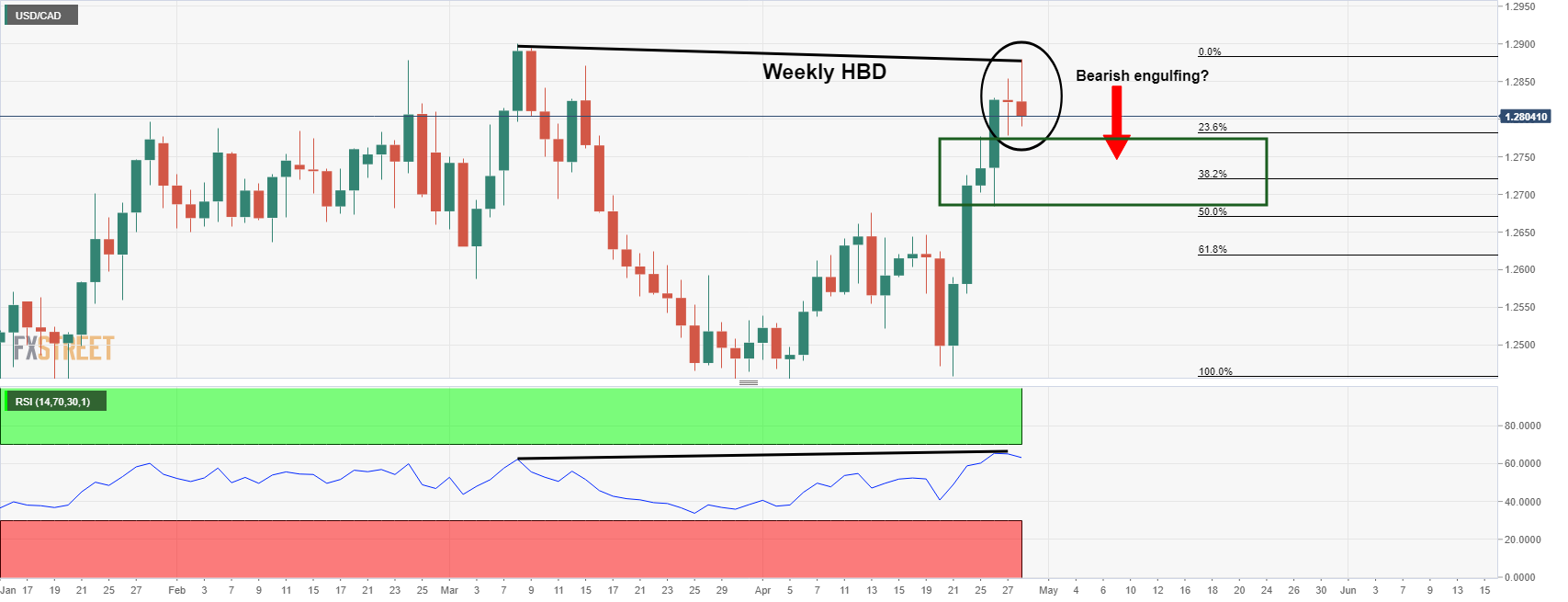
''The current price action is leaving the prospects of a bearish engulfing daily close following the prior day's doji. This is regarded as bearish and a prelude for the next days. There are expectations of a correction to test the 1.2770s, and then potentially as deep as a 38.2% Fibonacci retracement below 1.2750.''
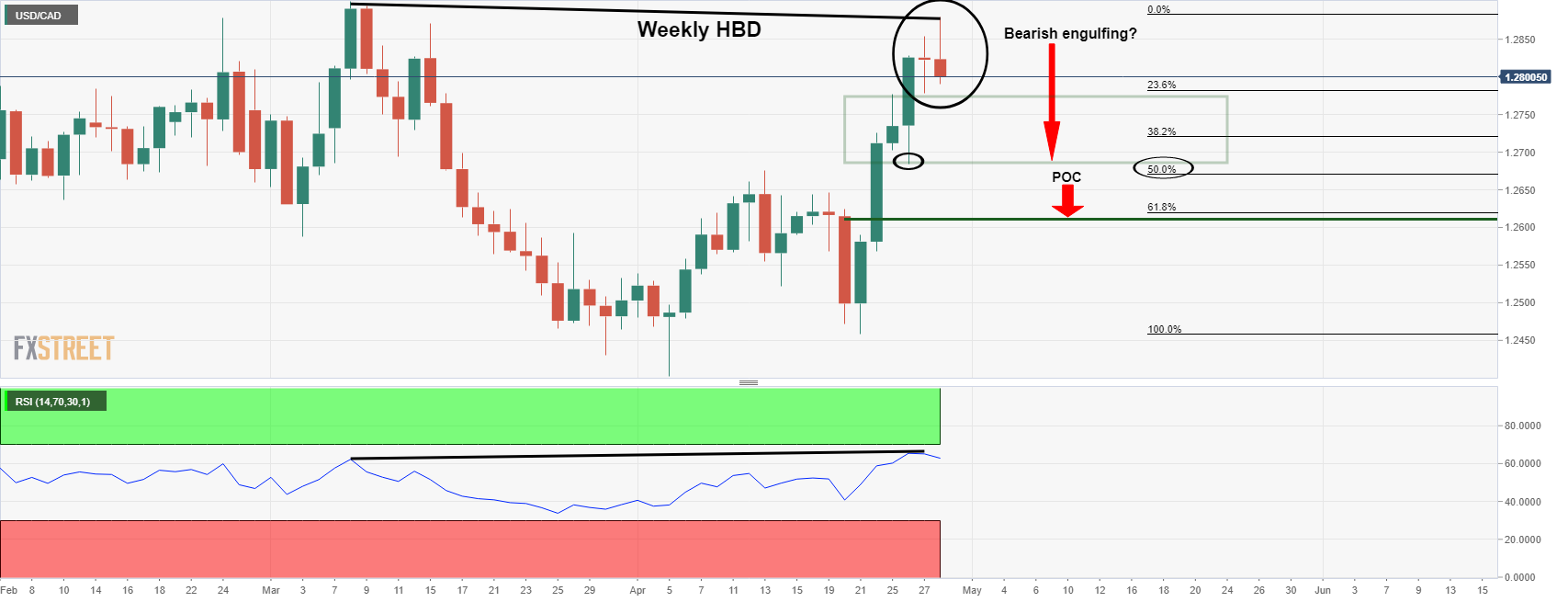
''1.2650 comes thereafter but the point of control of where the majority of business was transacted for the month of April is much lower, down to the neckline of the W-formation at 1.2611.''
- The Aussie is set to finish the month with gains, up so far by 1.43%.
- The lack of New Zealand economic data and the hot Australian inflation report boosted the prospects of the AUD.
- AUD/NZD Price Forecast: Solid resistance around 1.0960-1.1000 might put a lid on the AUD/NZD upside.
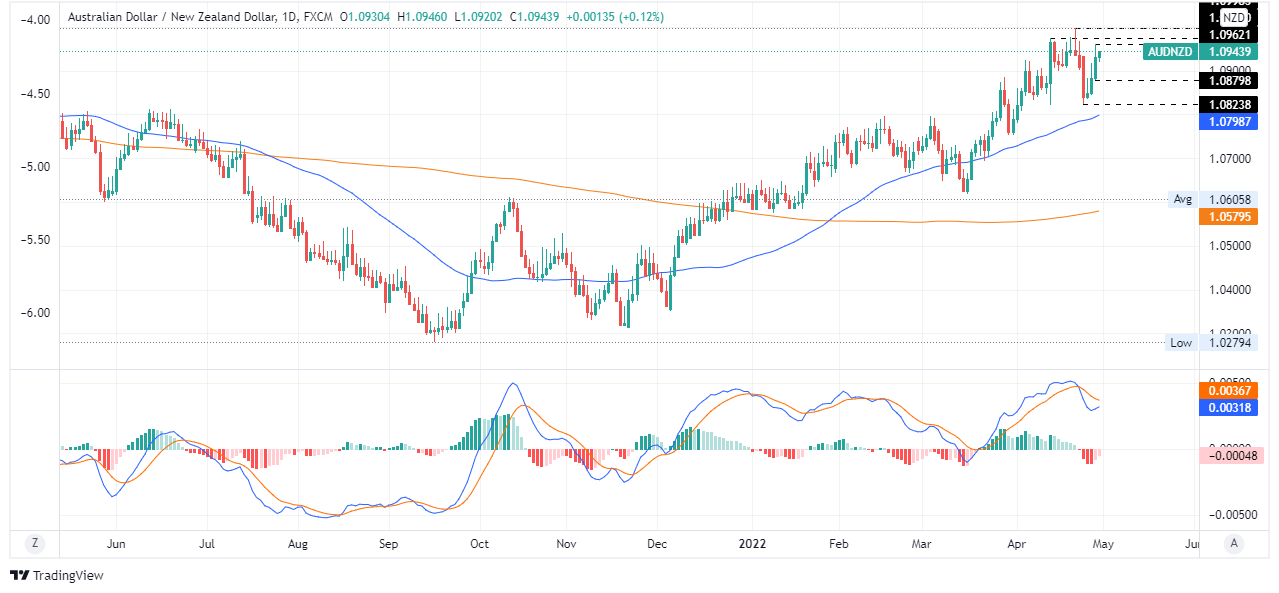
The AUD/NZD seems poised to pare earlier week losses and is rising for the third consecutive day in the week, up a modest 0.13% as the Asian Pacific session begins. At the time of writing, the AUD/NZD is trading at 1.0943.
The week’s lack of New Zealand data left the AUD/NZD adrift to the Australian economic docket, which showed that inflation rose by 5.1% y/y, higher than the 4.6% estimations and smashing the 3.5% previous reading on the headline. Core inflation accelerated to its fastest pace since 2009, to 3.7%, from an earlier 2.6% reading.
Aside from this, sentiment improved throughout the day, and the Asian session carried on Wall Street’s mood. The coronavirus woes in China kept investors on their toes. Meanwhile, the Ukraine-Russian tussles alongside a weaker than expected US growth report were put aside by market players as appetite for riskier assets increased.
Therefore, the AUD/NZD appreciated in the week on expectations that the Reserve Bank of Australia (RBA) would hike rates in May. Nevertheless, a Federal Election in Australia could deter the RBA from taking action despite a high inflationary reading.
AUD/NZD Price Forecast: Technical outlook
The AUD/NZD bias is tilted to the upside. The daily moving averages (DMAs) below the exchange rate depict the pair in an uptrend. However, Thursday’s price action encountered solid resistance around 1.0962, a zone clouded by resistance levels around the 1.0960-1.1000 area.
Upwards, the AUD/NZD’s first resistance would be April’s 28 daily high at 1.0962. Once cleared, the next supply zones would be 1.0975, followed by 1.0998.
On the other hand, the AUD/NZD first demand zone would be 1.0900. Break below would expose April’s 28 at 1.0880, followed by April’s 25 swings low at 1.0824.
Key Technical Levels
US inflation expectations, as per the 10-year breakeven inflation rate per the St. Louis Federal Reserve (FRED) data, rose for the second consecutive day to 2.97% by the end of Thursday’s US session.
In doing so, the inflation gauge extends the mid-week recovery towards the record top marked on April 21, at 3.02%.
The following is the graphical representation of the 10-year and 5-year gauges of inflation expectations:
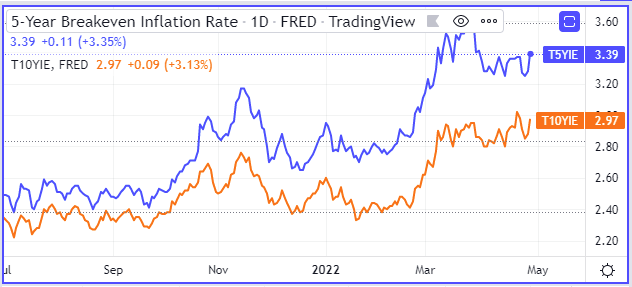
That being said, the same can bolster the odds of the Fed’s 0.50% rate hike on further upside moves, which in turn signals the US dollar’s additional north-run. It’s worth noting that the US Dollar Index (DXY) jumped to the highest level in 20 years while poking the 104.00 threshold.
Other than the FRED figures, today’s US Core Personal Consumption Expenditures Price Index for March also becomes important for the inflation view and the US dollar in turn, expected to ease to 5.3% YoY versus 5.4% prior.
Also read: USD/JPY dribbles around 20-year high near 131.00 with eyes on US PCE inflation
- EUR/JPY is consolidating in the 18-pips range as investors await EU GDP numbers.
- BOJ’s ultra-loose monetary policy has drifted the asset higher.
- EU is inching closer to embargoing Russian oil.
The EUR/JPY pair is oscillating in a narrow range of 137.32-137.50 in the Asian session as investors are awaiting the release of the Gross Domestic Product (GDP) numbers in the eurozone. The quarterly GDP numbers are seen at 0.3% in-line with the prior print while the annual GDP may outperform. A preliminary reading for the yearly GDP is 5% against the previous figure of 4.3%.
The cross is advancing firmly post dovish tone from the Bank of Japan (BOJ). A prudent monetary policy has been dictated by BOJ Governor Haruhiko Kuroda on Thursday. The BOJ kept interest rates unchanged but warns the impact of higher energy bills and commodity prices on the real income of the households in Japan. The central bank will continue to advocate more stimulus to ramp up the aggregate demand and inflation in the economy going forward. On the weakening yen front, the BOJ commented that corporate profits will remain solid but vulnerable domestic currency could have an adverse impact on the economy.
Meanwhile, the shared currency is expected to face a lot of heat amid its progressive moves towards an embargo on Russian oil imports. The majority of the criticism was coming from Germany in the last discussions but the automobile-maker nation is dropping its opposition as reported by its government officials, according to the WSJ. This will quicken the required paperwork and the prohibition of Russian oil on short notice will spurt the unemployment issues in the eurozone.
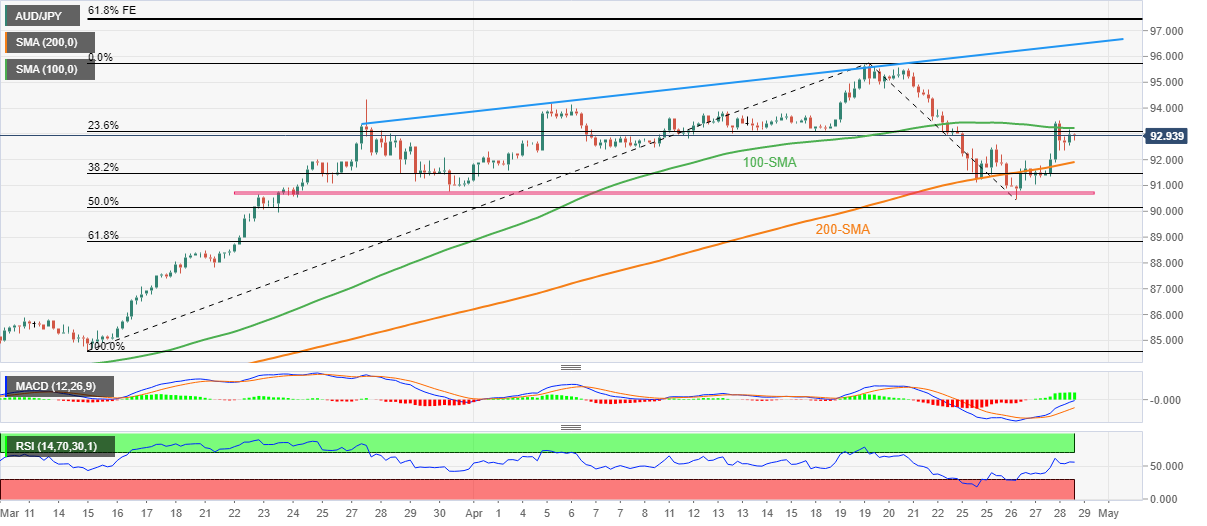
- AUD/JPY remains mildly bid above 200-SMA, up for the third consecutive day.
- Firmer RSI, bullish MACD signals also keep buyers hopeful.
- Monthly high, one-month-old resistance line lure bull ahead of 61.8% FE.
- Bears need to break five-week-long horizontal area for fresh entry.
AUD/JPY holds on to the mid-week rebound as buyers battle with the key moving average during Friday’s initial Asian session, up 0.10% near 93.00 by the press time. In doing so, the cross-currency pair pokes the 100-SMA hurdle, around 93.25 at the latest.
Given the bullish MACD signals and upbeat RSI line, not overbought, not to forget the pair’s rebound from a horizontal area comprising multiple levels marked since late March, AUD/JPY prices remain on the way to the monthly peak of 95.74.
However, multiple hurdles around 94.25 and an upward sloping trend line from March 28, close to 96.45, can test the short-term bulls.
In a case where the quote rises past-96.45, the 61.8% Fibonacci Expansion (FE) of March 15 to April 25 moves, near 97.50, will be in focus.
Alternatively, pullback moves may initially aim for the 200-SMA level of 91.90 before retesting the aforementioned horizontal support area near 90.70-60.
Following that, the 90.00 threshold will be crucial to watch as a clear break of which can direct prices towards the late March swing low near 87.30.
AUD/JPY: Four-hour chart
Trend: Further upside expected
- The momentum oscillator RSI (14) seems losing the downside momentum.
- Pound bulls have seen a minor pause after a six-day losing streak.
- A pullback towards 1.2500 will activate responsive sellers.
The GBP/USD pair is displaying a minor pause from 1.2411 after a sheer downside move. The cable is experiencing some signs of cushion after a six-day losing streak however, the overall context is still extremely bearish.
A bullish divergence formation on an hourly scale has made the pound bulls hopeful. The asset is continued with its lower high lower low formation, however, the momentum oscillator Relative Strength Index (RSI) shows a loss of downside momentum after forming higher lows and has raised the odds of a reversal.
It is critical to note that a bullish reversal is empowered with wider bullish ticks, which are not visible on the chart. Therefore, it’s too early to claim it a reversal but a pullback towards the psychological resistance of 1.2500 looks likely. The asset is expected to face barricades near the supply zone placed in a range of 1.2500-1.2600.
The 20- and 50-period Exponential Moving Averages (EMAs) at 1.2477 and 1.2534 respectively are scaling lower, which adds to the downside filters.
Should the asset test the supply zone in a range of 1.2500-1.2600, responsive sellers may attack the cable, which could drag the major towards Thursday’s low at 1.2411, followed by the 19 June 2020 low at 1.2342.
On the flip side, pound bulls could regain control if the asset oversteps the supply zone confidently. This will drive the asset towards the round level resistance and Tuesday’s high at 1.2700 and 1.2773 respectively.
GBP/USD hourly chart
-637867830942427252.png)
- The GBP/JPY is registering gains of 2.03% in April as the end of the month looms.
- Thursday’s Bank of Japan interest rate decision weighed on the JPY as the BoJ doubled down on stimulus, despite a worldwide high inflationary scenario.
- GBP/JPY Price Forecast: Bear’s failure to push the pair below 160.00 opened the door for further upside; further gains lie ahead.
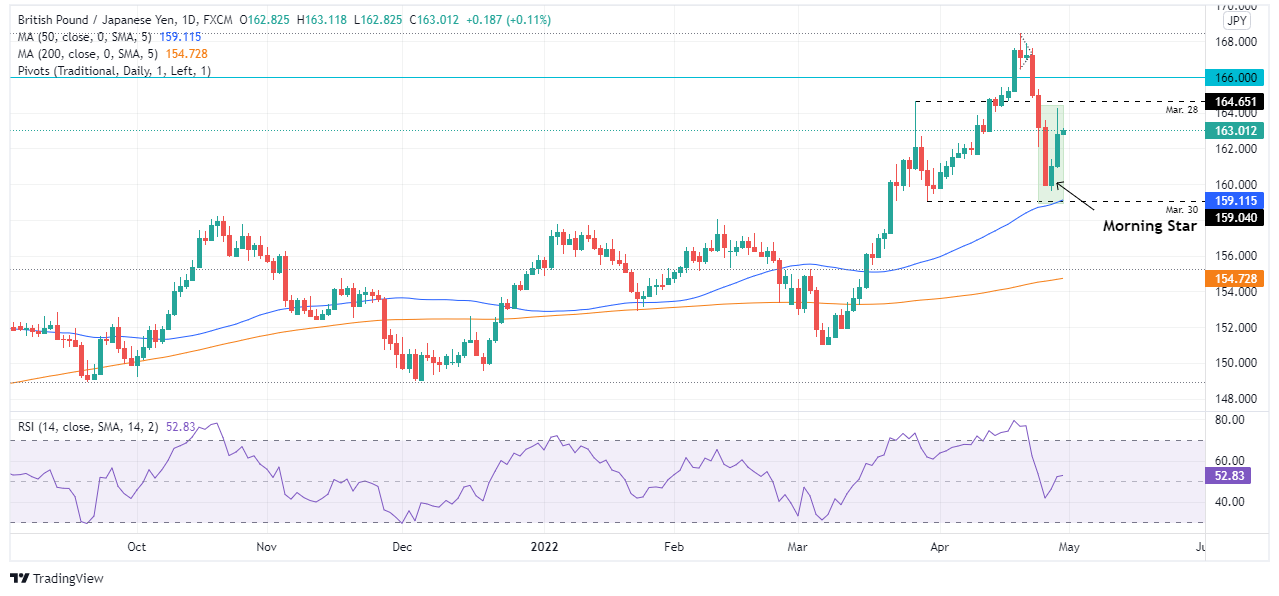
The GBP/JPY stages a comeback but fails to reclaim 164.00 despite an upbeat market mood and a dovish Bank of Japan (BoJ), which kept rates unchanged and reiterated its accommodative stance on Thursday amidst a worldwide environment of elevated prices. At the time of writing, the GBP/JPY is trading at 163.01.
Asian equity futures have followed Wall Street’s mood, leading to a higher open. China’s coronavirus woes which tempered investors’ mood, appear to ease as Shanghai relaxed restrictions while the Russia-Ukraine conflict continues. Alongside global central bank tightening, those factors cloud an environment that could trigger a recession. On Thursday, the US Department of Commerce reported that the Q1’s GDP contracted by 1.4%.
Elsewhere, on Thursday’s session, the GBP/JPY opened near the open at around 161.00 and rallied on fundamental news that weighed on the JPY, lifting the pair towards 164.25, the daily high for a 300-pip gain. However, the GBP/JPY retreated and settled around the 163.00 mark.
GBP/JPY Price Forecast: Technical outlook
The GBP/JPY remains upward biased after plummeting 800-pips in the week, though the 160.00 thresholds put a lid on the GBP/JPY fall. On Wednesday, the GBP/JPY bounced off those lows, helped by the Relative Strength Index (RSI) shift from bearish to the bullish territory. Along with a morning star pattern (a three-candlestick formation), those factors could pave the way for further GBP/JPY gains.
The GBP/JPY’s first resistance would be the 164.00 mark. A break above would expose March’s 28 daily high at 164.65, followed by the figure at 165.00. Once cleared, GBP/JPY’s bear’s next challenge would be 166.00.
Key Technical Levels
- USD/JPY bulls take a breather at the two-decade top in search of fresh clues, amid off in Japan.
- Strong yields, safe-haven demand and Fed v/s BOJ divergence propel the pair.
- US GDP details, BOJ’s double-down on easy money recently favored the bulls.
- Risk catalysts, US data to direct intraday traders amid Japan’s Showa Day Holiday.
USD/JPY seesaws around 131.00 during the early Friday morning in Asia, after rising to the highest levels since April 2002 the previous day. The pair’s latest inaction could be linked to the off in Japan, as well as a cautious sentiment ahead of the Fed’s preferred gauge of inflation.
The yen pair rallied the most since March 2020 the previous day after the Bank of Japan (BOJ) showed readiness for unlimited bond-buying to maintain the yield target. The Japanese central bank also cited the sustained inflation below the 2.0% target as the reason to support their dovish move. Furthermore, the BOJ also lacked economic optimism within the forecasts and added weakness to the JPY.
On the other hand, the US Q1 2022 GDP details and risk-aversion wave added to the USD/JPY pair’s north-run. Although the headline Annualized GDP marked the first contraction in two years with -1.4% figures versus 1.1% forecast and 6.9% prior, the details relating to the personal consumption, inventories and Net trade flashed positive signs.
Following the firmer data, CME’s FedWatch Tool showed around a 96% probability of a 0.50% rate hike during the May monthly meeting. Additionally favoring the odds of a faster Fed normalization was the rising inflation expectations, as per the 10-year breakeven inflation rate per the St. Louis Federal Reserve (FRED) data.
Elsewhere, the Russia-Ukraine crisis and the West versus Moscow tussles, due to the invasion of Kyiv, join China’s covid concerns to weigh on the risk appetite and support the US dollar’s safe-haven demand.
Amid these plays, Wall Street benchmarks rose for the second consecutive day, backed by upbeat earnings, whereas the US 10-year Treasury yields rose 1.5 basis points (bps) to 2.83%.
Looking forward, an absence of bond moves in Asia may challenge the USD/JPY buyers and can trigger the pair’s pullback. However, major attention will be given to the Fed’s preferred gauge of inflation, namely the US Core Personal Consumption Expenditures Price Index for March, expected to ease to 5.3% YoY versus 5.4% prior.
Technical analysis
The USD/JPY pair’s rebound from 127.00, followed by a clear upside break of the early-month high surrounding 129.40, enables the buyers to aim for the 100% Fibonacci Expansion (FE) of April 12-27 moves, near 131.60 by the press time.
Alternatively, the pullback can initially aim for the 130.00 round figure ahead of challenging the 129.40 and the 10-DMA support near 128.60.
- Gold Price is facing barricades near the $1,890.21-1,895.15 range and 20-EMA.
- The DXY is driving higher on an adrenaline rush from uncertainty over the rate decision by the Fed.
- Apart from the interest rate decision, balance sheet reduction and further guidance will be in focus.
Gold Price (XAU/USD) has rebounded sharply after hitting a low of $1,872.22 on Thursday. The rebound in the gold prices looks very confident, which claims the availability of responsive buyers who found the precious metal a value bet near the $1,870s area and paddle the bright metal prices to the upside. However, the precious metal is still inside the woods as it has not established above the psychological resistance of $1,900 yet and may get considered as a pullback, not a reversal as fundamentals are still unfavorable.
Meanwhile, the US dollar index (DXY) is witnessing a minor pause after hitting a high of 103.93 in the Asian session but the overall structure is still promising. The DXY has delivered a six-day winning streak and is likely to advance further despite weak US economic data. The annualized Gross Domestic Product (GDP) numbers have delivered a poor performance after printing at -1.4% against the forecasts of 1.1% and the prior print of 6.8%. Also, the Core Personal Consumption Expenditure (PCE) has landed at 5.2% in mid the expectations and the previous figure of 5.4% and 5% respectively.
Also read: Gold Price Forecast: XAUUSD to enjoy robust investment demand this year – Commerzbank
Well, the real catalyst which is driving the DXY and barricading the gold prices in a broader context is the interest rate decision by the Federal Reserve (Fed), which will be announced next week. An interest rate elevation by 50 basis points (bps) is expected to be announced by Fed chair Jerome Powell as signaled in his testimony at the International Monetary Fund (IMF) meeting. It would be interesting to see the dictation from Fed policymakers on the balance sheet reduction as liquidity contraction from the economy is the real agenda. Also, the roadmap dictating reversion to neutral rates will be keenly watched by the market participants.
In today’s session, investors will eye on the release of the Michigan Consumer Sentiment Index (CSI), which is likely to land at 62 against the prior print of 65.7.
Gold technical analysis
On a four-hour scale, XAU/USD is bid around the supply zone placed in a narrow range of $1,890.21-1,895.15. The asset is facing barricades near the 20-period Exponential Moving Average (EMA) at $1,898.10. While the downward trending 50-EMA at $1,917.90 is still advocating bears. The Relative Strength Index (RSI) (14) is attempting a range shift from 20.00-40.00 to 40.00-60.00, which could signal a short-lived reversal.
Gold four-hour chart
-637867808465475622.png)
- The US dollar rallied to the highest point in two decades on Thursday.
- NZD/USD shows a firm case for the upside for the session ahead.
NZD/USD has dropped to come close to meet the March 20 high of 0.6447, a long term key level. The low of the cycle was made today at 0.6451 after falling from a high of 0.6543. The US dollar rallied to the highest point in two decades on Thursday with the yen tumbling to its lowest since 2002 following after the Bank of Japan doubled down on its ultra-loose monetary policy. This transpired into a whitewash in commodities that sent the antipodeans lower.
''The Kiwi initially fell further versus the dollar, amid broad USD strength overnight. This was compelled by the US GDP number,'' analysts at ANZ Bank said. ''While the economy shrank in Q1, private domestic demand remains strong. This crystallised hawkish expectations for the Federal Reserve. In fact, pricing for Fed hikes increased, which underlay the USD strength. Any reversal in this trend will likely need to wait until the FOMC meeting next week, at least.''
Meanwhile, the focus will also be on New Zealand employment next week and what it will mean for the Reserve Bank of New Zealand. ''We’re picking that the Unemployment Rate fell slightly to 3.1%, versus 3.2% in the fourth quarter, Q4. But with Omicron peaking in the March quarter, uncertainty is high,'' analysts at ANZ Bank said.
''Whatever the headline numbers, we expect the details of the release will confirm what we saw in the Q1 QSBO – that the labour market is becoming increasingly stretched, and will be a key source of domestic inflationary pressure of 2022''
For the RBNZ, the analyst say that the data should affirm that another 50bp OCR hike is needed in May to get in front of domestic inflation. ''The strong labour market is the keystone for our forecast of a soft landing for the economy. With housing markets softening across the country, ongoing low unemployment and rising wages will be key.''
NZD/USD technical analysis
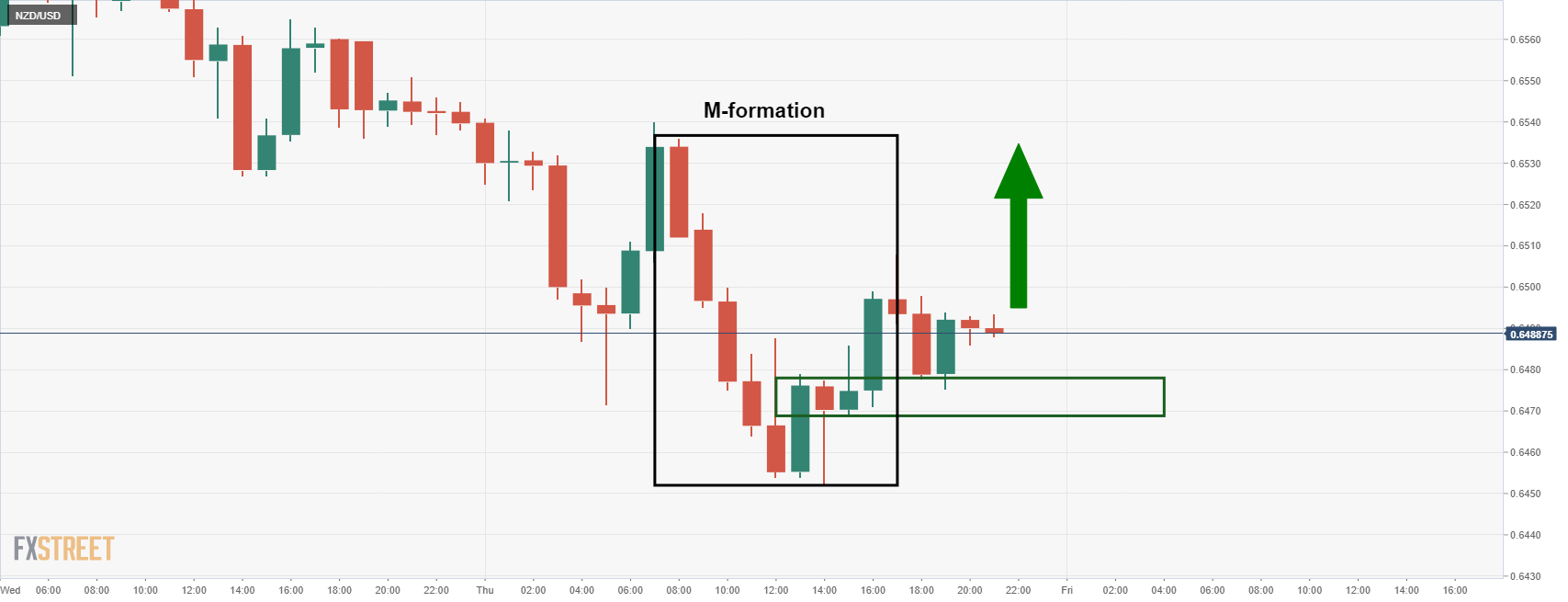
The price formed a W-formation that drew in the bears until the neckline that is so far rating as support. So long as this holds, then there is a firm case for the upside for the session ahead.
- EUR/USD is meeting a very key monthly area on the charts.
- The US dollar could be in for a correction into the Fed next week.
EUR/USD remains in the red despite a pick-up in global shares. The single currency is taking some of the brunt due to the volatility in the forex space following the Bank of Japan's dovish announcements and a subsequent dash for the US dollar.
At the time of writing, EUR/USD is trading off its cycle lows but is still down some 0.48% at 1.0505. The pair has travelled from a high of 1.0564 to a low of 1.0470 so far. Earlier, the US dollar touched its highest level since 2002 while Wall Street rose and European shares moved off six-week lows as strong earnings reports offset some of the gloomy US economic data. Additionally, US government bonds rose after signs of strength in the US job market that has superseded an expected decline in economic growth in the first quarter.
The advance estimate of Q1 Gross Domestic Product dropped 1.4% saar, versus consensus expectations for a 1.0% lift. However, traders cheered the details that were reasonably robust, with personal consumption up 2.7% saar, disposable income rising 4.8% and gross private investment up 2.3%.
''So underlying private demand growth remains firm,'' analysts at ANZ Bank argued. However, other components of GDP swamped those gains. Excessive domestic demand drove a 17% saar lift in imports, while exports contracted 5.9%. That meant net trade subtracted 3.2% from GDP.''
Nevertheless, the dollar stays firm along with the higher yields, which can be chalked up to the dollar smile theory that suggests the dollar will gain during periods of strong U.S. data and rising U.S. rates as well as bouts of risk-off sentiment, analysts at Brown Brothers Harriman said.
''Furthermore, we must stress that negative developments in the rest of the world (Russian gas supplies, dovish BOJ, etc.) are playing a big part in the dollar’s strength by highlighting relative fundamentals that favour the greenback.''
For next week, Fed tightening expectations have been robust leading into the meeting. Markets are looking for at least a 50 bp hike at the May 3-4 meeting and again at the June 14-15 meeting. This is fully priced in, with nearly 25% odds of a possible 75 bp move in June. the surprise will come if there is anything short or above this consensus at next week's meeting.
''Looking ahead, swaps market is pricing in 275 bp of tightening over the next 12 months that would see the policy rate peak near 3.25%. While this almost meets our own call for a 3.5% terminal rate, we continue to see risks that the expected terminal rate moves even higher if inflation proves to be even more stubborn than expected,'' analysts at BBH said.
As for the eurozone, German headline inflation is surging. The war in Ukraine and sent energy and commodity prices through the roof and inflationary pressure broadens. According to a first estimate based on the regional inflation data, German headline inflation arrived at 7.4% YoY in April, from 7.3% YoY in March. The HICP measure came in at 7.8% YoY, from 7.6% in March.
Observes are now calling for double-digit inflation in the summer. this will put pressure on the European Central Bank to act in order to normalise policy. However, will the sentiment be enough to prevent parity in EUR/USD for the first time since October 2002?
EUR/USD technical analysis
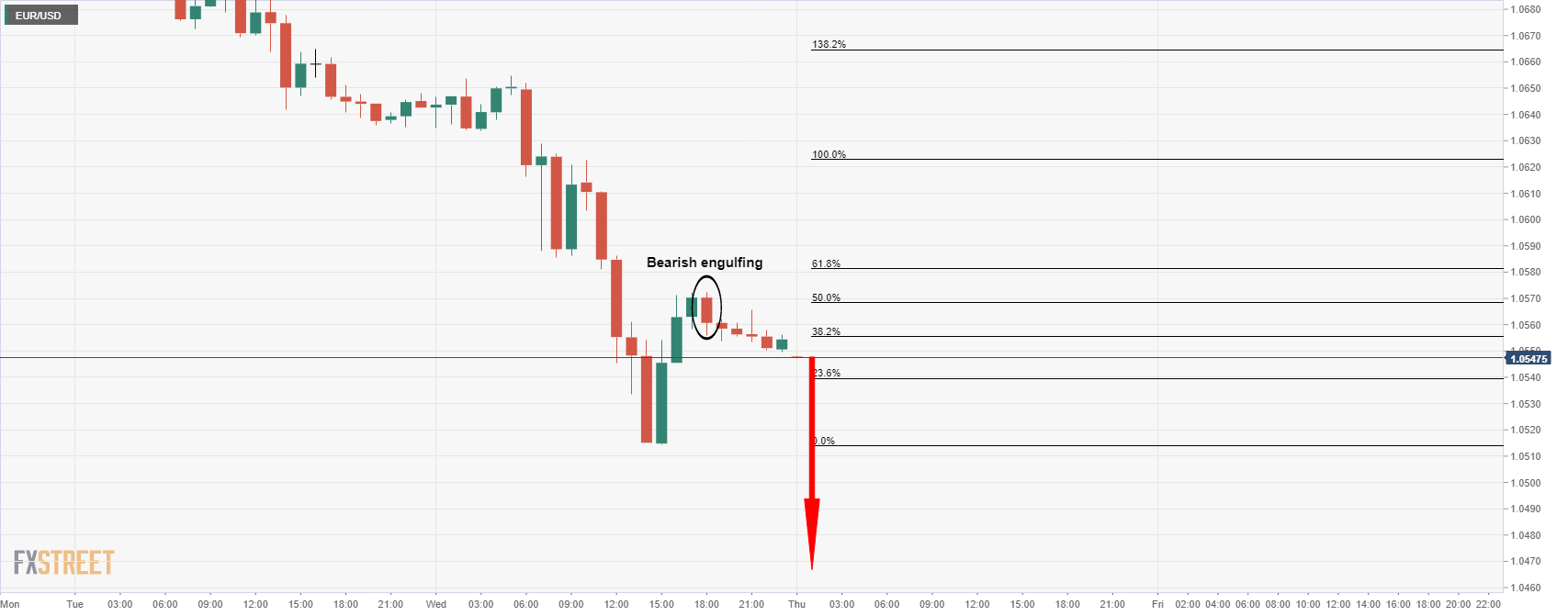
As per the prior sessions analysis, calling for further downside, EUR/USD bears refuelling from a 50% mean reversion, eye US GDP, the bears did indeed start up their engines and took the euro fir another ride even lower:
Prior analysis:
''From an hourly perspective, there is the potential for a downward continuation as per the correction meeting the 50% mean reversion mark, a bearish engulfing and drift to the downside again:''
Live market:
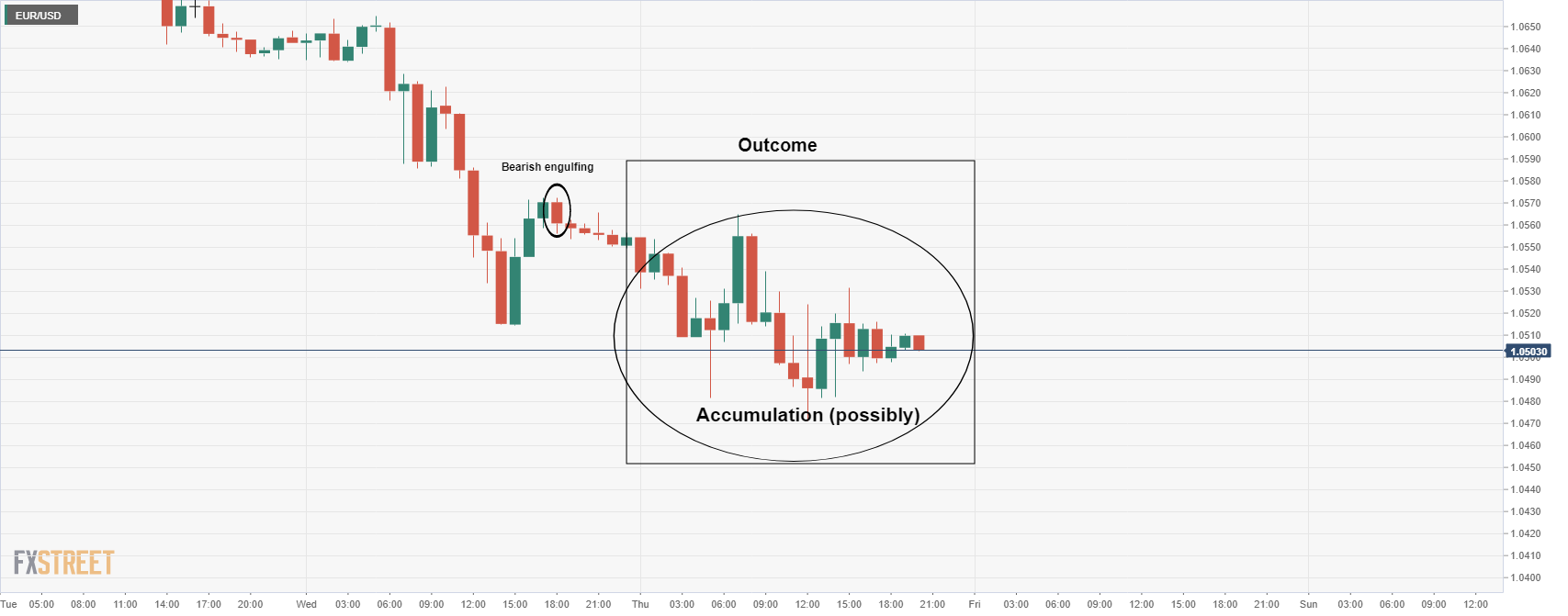
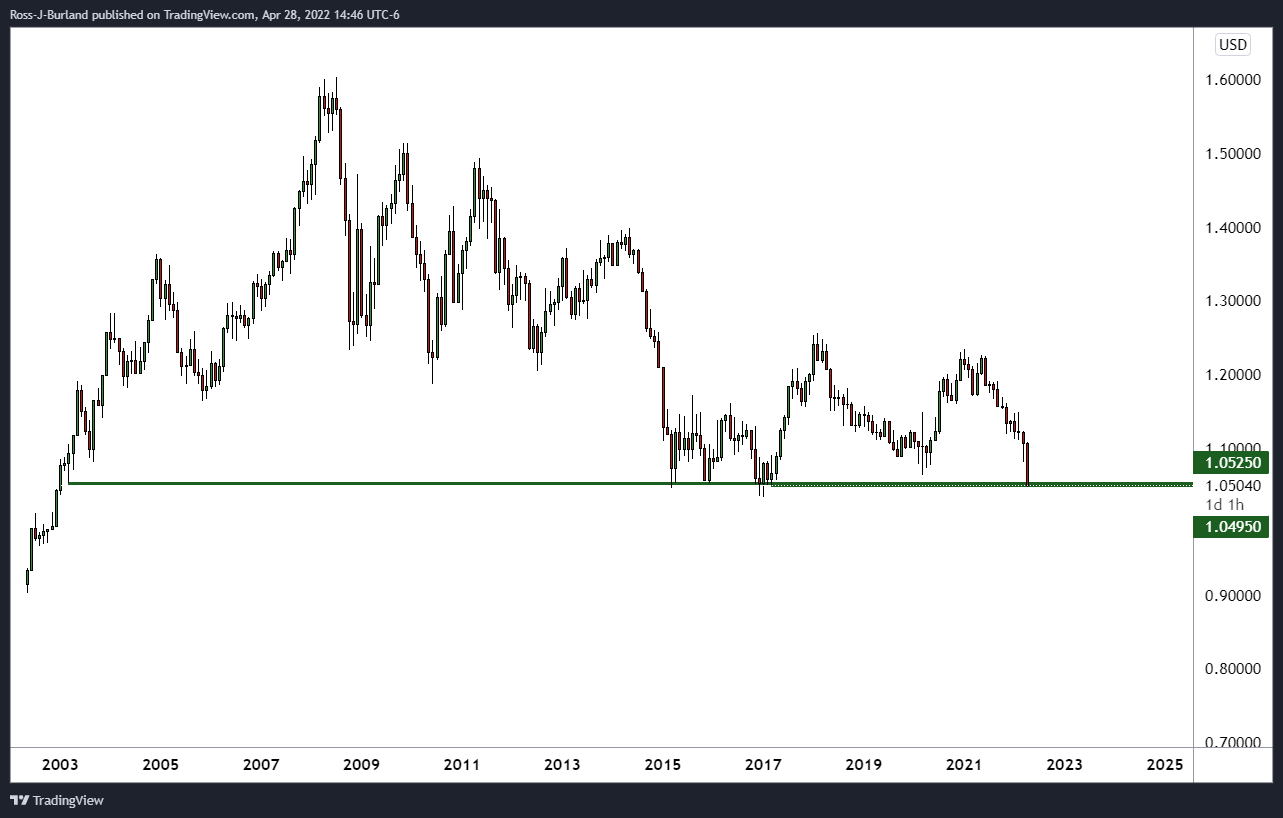
As seen, the price has melted some more, however, there is no bias and this could be the beginning to the end of the downside, at least for the meantime. After all, these are very key monthly levels that could protect parity, for now.
- In April, the AUD/USD is recording losses of 5.11%
- The US economy shrank in Q1, though it won’t stop the Fed from hiking rates.
- AUD/USD Price Forecast: A daily close under 0.7100 could send the pair tumbling towards 0.7000.
AUD/USD is losing some ground after on Wednesday, AUD/USD bears took a breather before pushing the pair beyond the 0.7100 mark, reaching a fresh two-month low around 0.7055, though late as the Wall Street close looms, the Aussie is back above the 0.7100 mark. At the time of writing, the AUD/USD is trading at 0.7100.
Sentiment improves, US economy contracts, but the USD stays resilient and rose
Global equities rallied for a second straight trading session amidst a positive market sentiment. China’s coronavirus outbreak seems to give a respite to investors, while the Ukraine-Russia conflict continues to escalate on Russia’s desire for victory. Aside from the macro environment, the US Gross Domestic Product for the first quarter showed that the US economy shrank 1.4% on an annualized pace, the first in nearly two years, though it’s unlikely to stop the Federal Reserve from hiking interest rates of 0.50 bps, as it attempts to tame inflation.
Stagflation talks began once the report hit the wires. Analysts of ING wrote in a note that domestic demand held up firmly when considering the hit to the economy momentum caused by the Omicron variant last year. Furthermore, they added that “consumer spending grew 2.7%, while non-residential investment expanded 9.2% and residential investment posted a 2.1% gain.” They attributed the negative figure to the drop in exports and imports surplus.
At the same time, the US Department of Labour released the Initial Jobless Claims for the week ending on April 22, which rose by 180K, lower than the 182K estimated.
The week ahead, the Australian economic docket will feature the Producer Price Index (PPI) for the first quarter, which is expected to rise by 1.6%. On a yearly basis is estimated to increase by 4%. On the US docket, the Fed’s favorite gauge of inflation, the Core Personal Consumption Expenditure (PCE), is estimated to downtick to 5.3%, while the headline is estimated to rose near the 7% threshold.
AUD/USD Price Forecast: Technical outlook
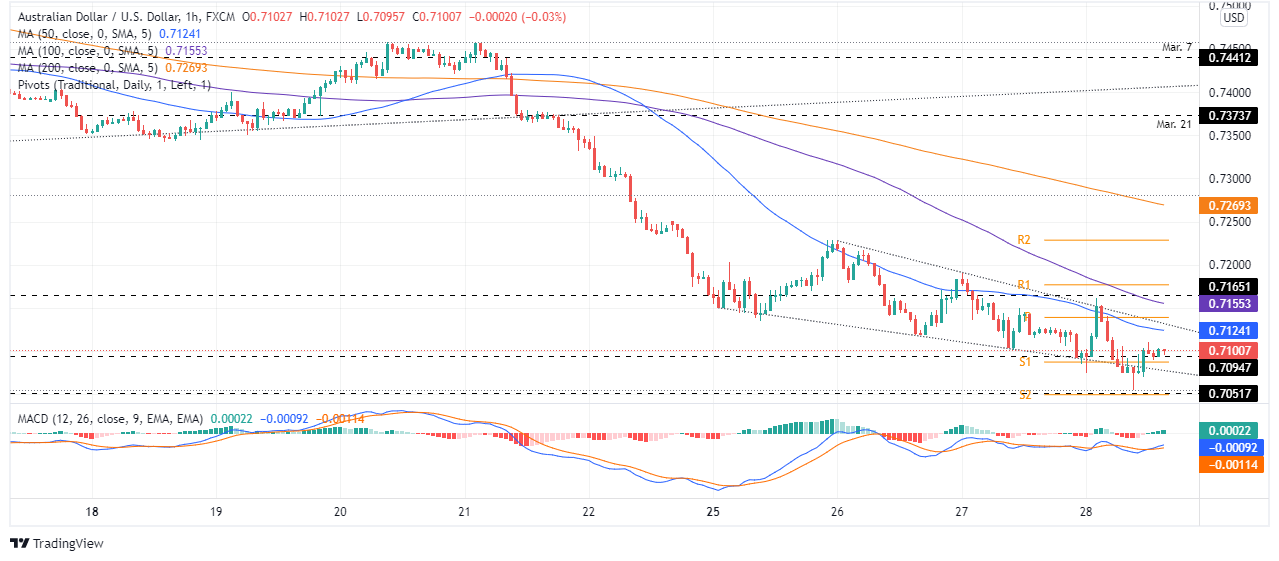
The AUD/USD remains downward biased, as illustrated by its daily chart. Both MACD lines are heading south while its histogram is expanding to the downside, even though the AUD/USD jumped off monthly lows around 0.7050, shy of February’s 4 cycle lows around 0.7051.
The AUD/USD 1-hour chart depicts the pair is consolidating near the 0.7100 figure. The last three days’ AUD/USD price action formed a falling wedge, briefly broken downwards, though the major recovered and reclaimed the bottom-trendline. However, the hourly simple moving averages (SMAs) above the spot price could keep the pair downward pressured.
That said, the AUD/USD first support would be 0.7100. Break below would expose the confluence of February’s four daily low and the S2 daily pivot at 0.7051, followed by February’s 1 daily low at 0.7033, followed by the S3 daily pivot at the triple-zero figure at 0.7000.
What you need to know on Friday 29 April:
Despite a surprise decline in inflation-adjusted economic activity in the US in Q1 2022 according to the latest GDP release, the US dollar advanced across the board on Thursday. The Dollar Index (DXY), a trade-weighted basket of major USD currency pairs, surpassed its 2017 highs to come within a whisker of hitting 104.00, its highest level since December 2002. This was primarily a result of a steep sell-off in the yen that launched USD/JPY to fresh multi-decade highs of at one point above 131.00. At current levels around 130.90, the pair looks on course to post a gain of about 1.9%, its largest one-day move since March 2020.
The catalyst for the latest leg lower in the yen, which saw all major G10/JPY pairs surge, not just USD/JPY, was Thursday’s dovish BoJ policy announcement. As expected, the bank doubled down on its intent to stick with its ultra-dovish policies of negative interest rates and yield curve control for the foreseeable future given continued pessimism about its ability to meet its long-term inflation remit. Some market commentators said this served as a “green light” for traders to continue selling the yen.
Elsewhere, most other major G10 currencies also continued to depreciate versus the rampant US dollar. NZD/USD dropped another 0.8% to fresh lows in July 2020 under 0.6500, EUR/USD dropped a further 0.5% and briefly dipped under 1.0500 for the first time since March 2017, GBP/USD dropped a further 0.6% to the mid-1.2400s and AUD/USD fell another 0.4% to probe 0.7100. Expectations for the BoE and RBA to both lift interest rates by 25 and 15 bps each next week, with the RBA motivated by spicey Australian Q1 inflation data out earlier this week, have done little to stem the recent slide.
Indeed, both of these hikes pale in comparison to the 50 bps move expected from the Fed at not only next week’s meeting, but also the next few. CAD was the only major G10 currency not to succumb to the US dollar’s advances on Thursday. USD/CAD reversed back from earlier session highs near 1.2900 back to trading a tad lower on the day near 1.2800 amid a surge in crude oil prices to their highest levels in more than a week.
- The AUD/JPY to finish April with gains of 2.08%.
- A risk-on market sentiment boosted the prospects of the Aussie, while the BoJ kept the yen downward pressured.
- AUD/JPY Price Forecast: A daily close above 93.00 could rally the pair towards 94.00.
The Australian dollar advances vs. the Japanese yen as market sentiment leans risk-on, with US equities recording gains as 75% of the US companies’ earnings topped Wall Street. At 92.90, the AUD/JPY gains 1.61% and approaches, for the second time during the day, the 93.00 barrier.
Wednesday’s risk appetite carried on to Thursday as global equities rose. In the FX space, the Japanese yen depreciated after the Bank of Japan (BoJ) committed to its dovish stance keeping rates unchanged and offered to buy an unlimited amount of 10-year JGBs at a fixed 0.25% rate.
On Thursday, BoJ’s Governor Haruhiko Kuroda said currencies should move stably, reflecting fundamentals. He added that the 2% inflation target would not be sustained as energy prices fade and stated that he would watch FX moves carefully.
AUD/JPY Price Forecast: Technical outlook
The AUD/JPY bias remains upward, as the daily chart confirms. The daily moving averages (DMAs) reside below the exchange rate, aiming higher, and the MACD trending lower further confirms the aforementioned.
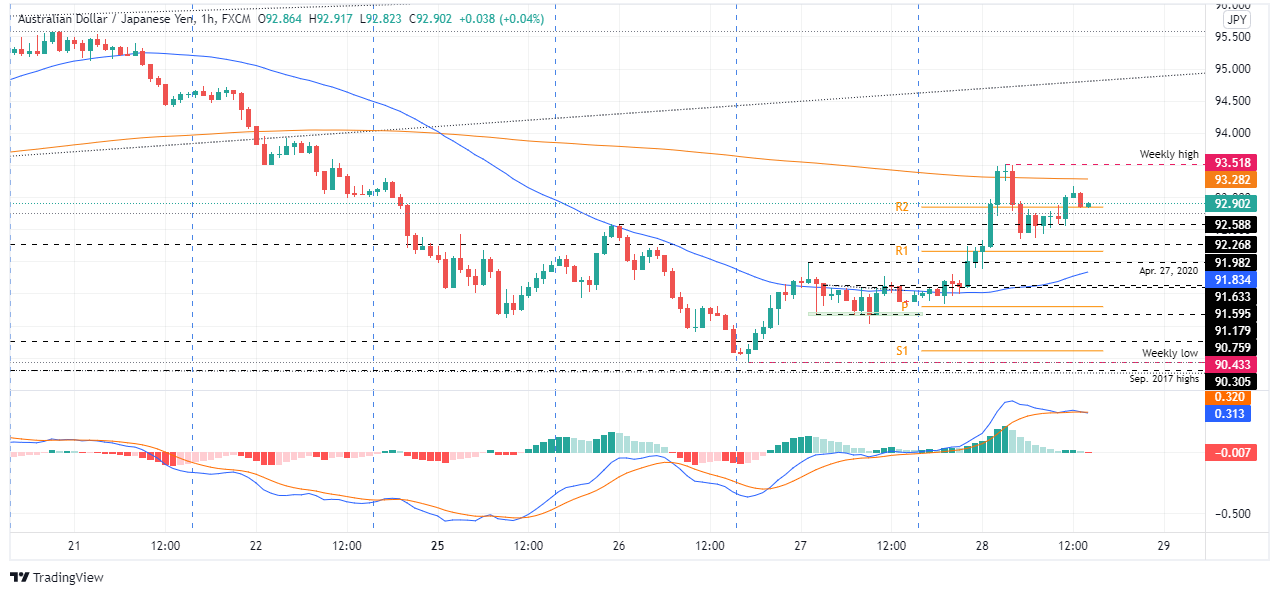
The AUD/JPY 1-hour chart depicts the pair as neutral-downward, opposite to the higher time-frame, though the 50-hour simple moving average (SMA) at 91.83 begins to aim higher, while the 200-hour SMA is horizontal above the exchange rate at 93.28.
The MACD is neutralizing, as shown by MACD-line/signal line and the histogram, which means the pair might be consolidating, just above the R2 daily pivot at 92.90.
Upwards, the AUD/JPY’s first resistance would be the 93.00 mark. A breach of the latter would expose the 200-hour SMA at 93.28, followed by the weekly high around 93.52, which, once cleared, would expose the 94.00 mark.
On the flip side, the AUD/JPY’s first support would be 92.58. Break below will send the pair tumbling towards the R1 daily pivot at 92.17, followed by April’s 27 daily high at 91.98.
Key Technical Levels
- US equities have enjoyed a strong tech-led rebound on Thursday after stronger than expected Meta Platforms earnings.
- The S&P 500 was last up nearly 3.0% and above 4,300 and the Nasdaq 100 was last up nearly 4.0%.
- But the major US indices remain on course to post hefty on-the-month losses and the macro backdrop remains difficult.
Stronger than expected earnings results from Facebook parent company Meta Platforms that saw FB shares last trading up by more than 18% on the session ignited a tech-led rally in US equity markets on Thursday. Tech behemoths Microsoft (+2.1%), Alphabet (+4.1%), Apple (+4.2%) and Amazon (+5.0%) all surge, with other large tech names also posting solid gains. As a result, the Information Technology index was last trading up around 4.0%, Communication Services gained 4.4% and Consumer Discretionary gained 2.9%.
Bullishness in the tech space was infectious and all eight of the remaining major sectors also gained at least 1.0% on the day, with Energy performing notably well with a 3.0% gain as crude oil prices rallied. In terms of the major US indices, the S&P 500 index was last trading higher by just shy of 3.0% having reclaimed the 4,300 level for the first time this week. Technicians said a break above this key level could open the door next week to a push towards resistance in the upper 4,300s in the form of mid-April lows (in the 4,380s) and the 50-Day Moving Average (near 4,390).
Amid the outperformance in big tech, the Nasdaq 100 was last trading just shy of 4.0% higher near 13,500, which would mark the indices best one-day performance of the year. The Dow, meanwhile, was last trading a respectable 2.0% higher near 34,000. US equities were unfazed by data that showed a surprise contraction in US GDP in Q1, which analysts explained away as a temporary weakness as a result of elevated imports and due to rampant Covid-19 infections at the time. Some cited month-end flows as supportive, with major asset managers and pension funds likely needing to up their exposure to equities to mitigate the impact of this month’s severe losses.
Indeed, while Thursday’s strong rebound does lighten the mood a little for US equity investors, its still been a torrid month. The S&P 500 is currently on course to post a more than 5.0% drop, similar in scale to January’s decline. The Nasdaq 100 index, meanwhile, is on course to post a slightly more than 9.0% decline, which would mark the worst one-month drop since 2008 and leaves the index flirting once again with “bear market” territory (i.e. more than 20% below recent highs). The Dow, meanwhile, is on course for a more modest 2.0% monthly loss.
A combination of bearish factors including nerves about aggressive monetary tightening from the Fed, a global growth slowdown, prolonged inflation, geopolitics (Russo-Ukraine war & sanctions) and China lockdown risk have all been cited as weighing on the market this month. Given recent developments on the latter two fronts, pessimism about prolonged elevation of inflation and slowing global growth likely arent going anywhere any time soon and the Fed seems to be on autopilot until it gets rates back to neutral.
May is likely to be another difficult month for investors. One reason for optimism would be if the earnings season continues to go well, which net-net, it has up until now. According to Reuters citing Refinitiv data, as of Thursday 81% of the 237 S&P 500 companies to report earnings had beaten analyst expectations, above the historical average beat rate of 66%.
- USD/CAD bears moving in for the kill as US dollar strength is faded into month-end.
- The bears are eyeing the downside market structures for the coming days/week.
As per the prior analysis, USD/CAD Price Analysis: The end of the rally is nigh according to market structure, despite a surge higher in the greenback to 20-year highs, the bears are growling back and a bearish outlook persists for the pair as follows:
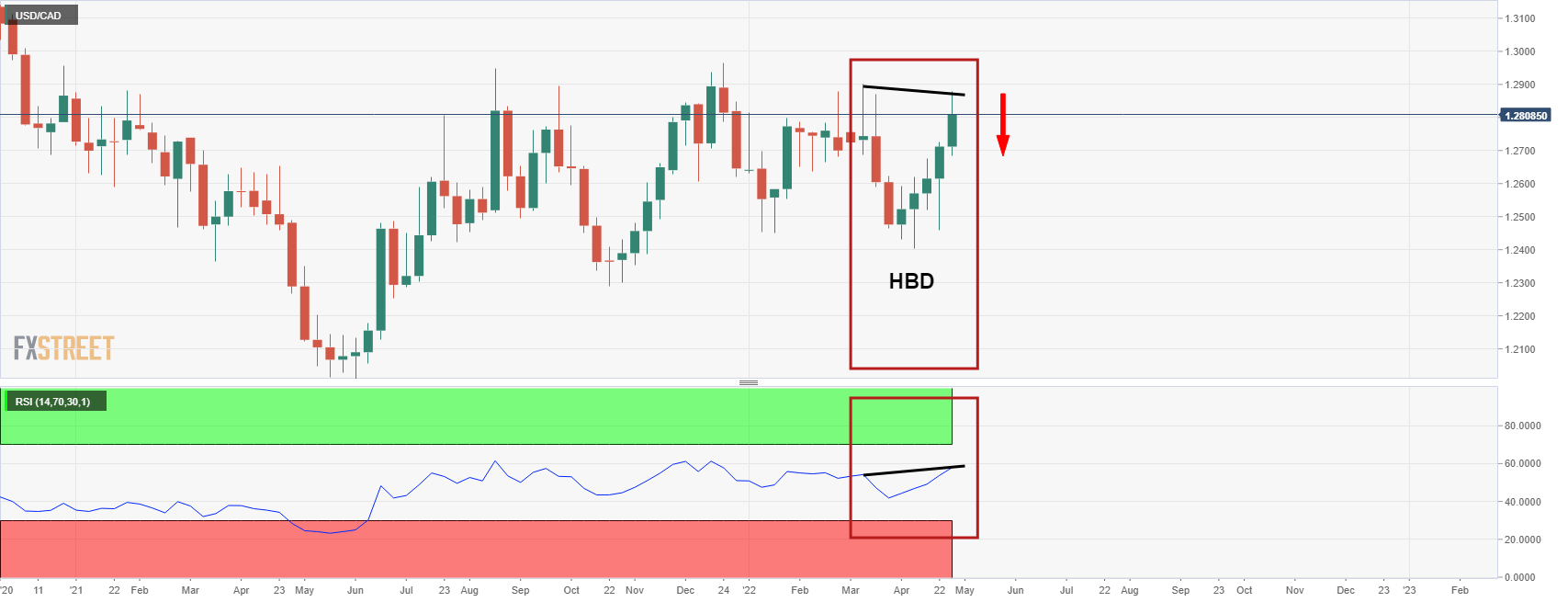
The monthly outlook is bearish given the wicks and the weekly chart still shows hidden divergence despite the higher high printed since Wednesday's analysis.
USD/CAD weekly chart
With that being illustrated, there is still time to go for the weekly close, so, theoretically, that really needs to be discounted until the close but is worth some consideration nonetheless.
USD/CAD daily chart
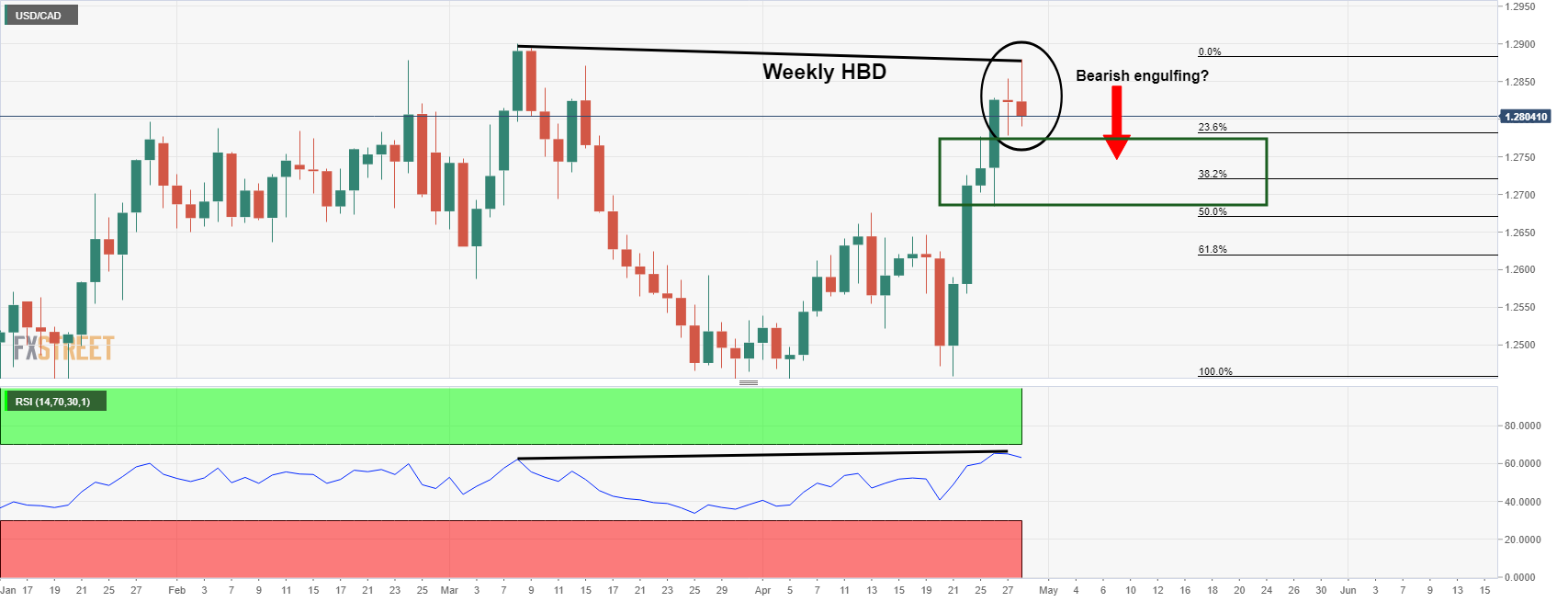
The current price action is leaving the prospects of a bearish engulfing daily close following the prior day's doji. This is regarded as bearish and a prelude for the next days. There are expectations of a correction to test the 1.2770s, and then potentially as deep as a 38.2% Fibonacci retracement below 1.2750.
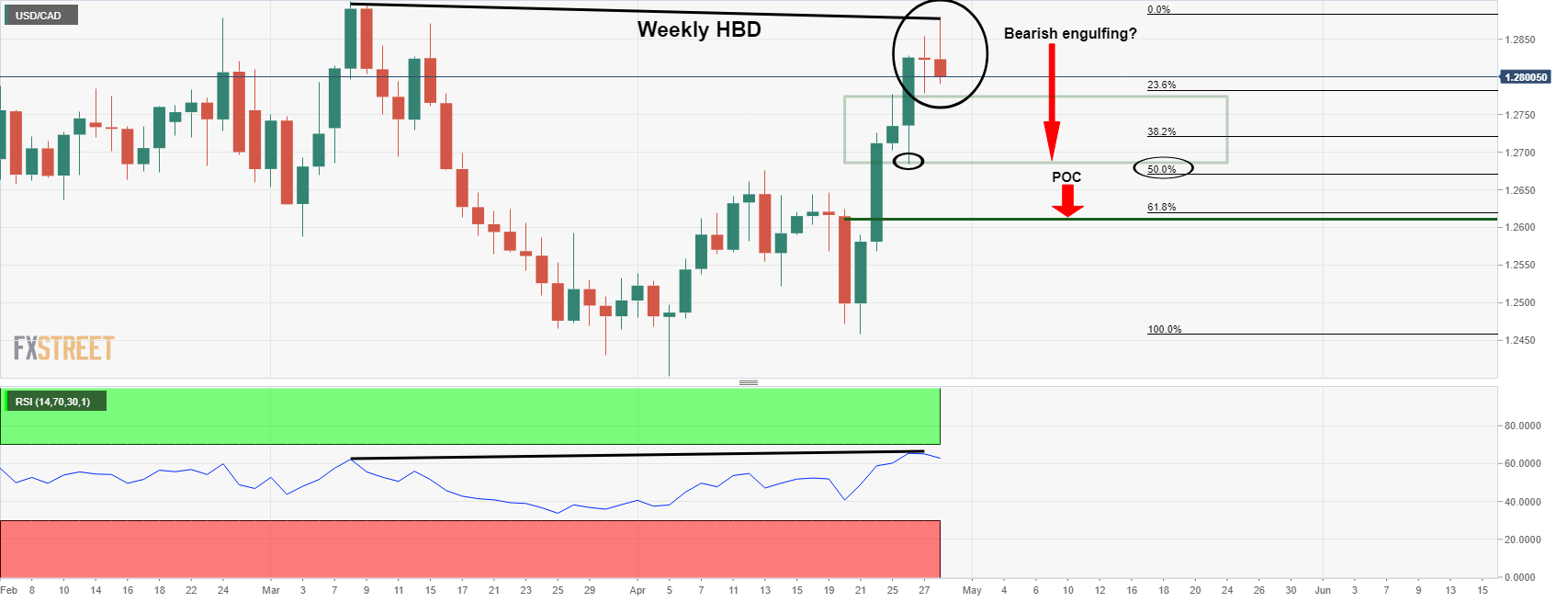
1.2650 comes thereafter but the point of control of where the majority of business was transacted for the month of April is much lower, down to the neckline of the W-formation at 1.2611.
- The USD/CHF advances In the week so far gain 1.50%.
- During the day, the US Dollar Index reached a 20-year high at around 103.928
- USD/CHF Price Forecast: Forming an inverted hammers
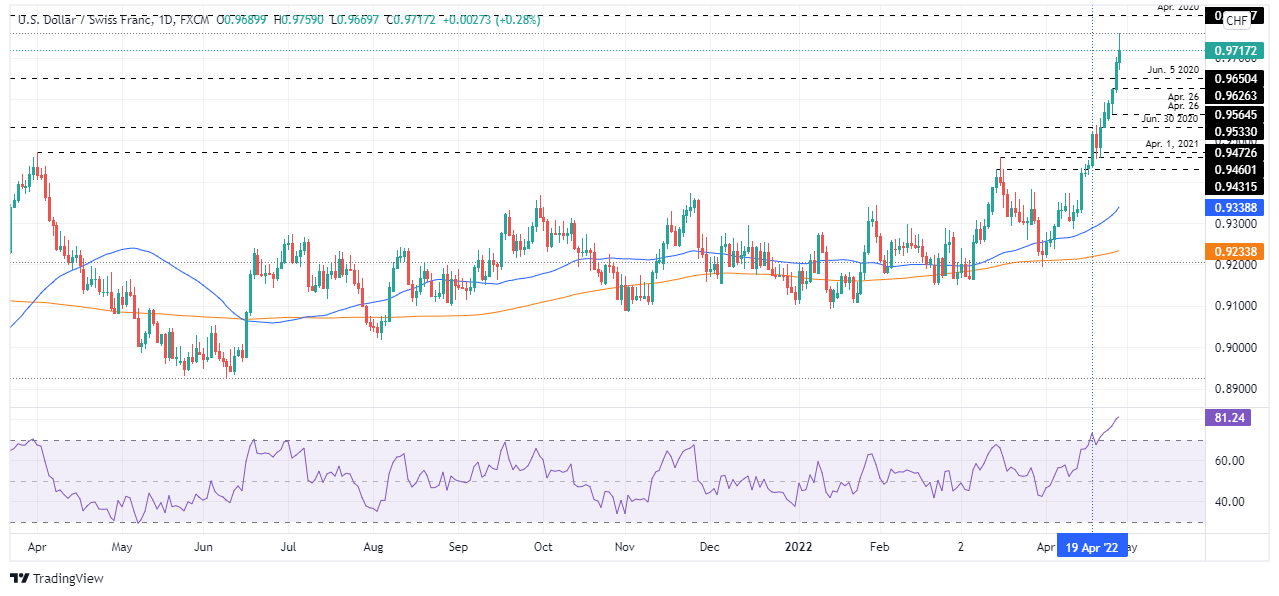
The USD/CHF surged some 100-pips and reached a fresh two-year high around 0.9759 during the day, though it has retraced but stays above the 0.9700 figure in the North American session. At the time of writing, the USD/CHF is trading at 0.9717, up some 0.27%.
The mood remains positive during the day, as European bourses closed with gains and US equities are set to finish in the green for the second consecutive day. China’s coronavirus outbreak seems to get under control, while geopolitics-wise, the Ukraine-Russia conflict continues to escalate.
On Thursday, the USD/CHF surged 90-pips and reached a two-year high. Late in the North American session, the pair retreated towards the 0.9710s area as traders booked profits as April’s about to end.
In the meantime, the US Dollar Index, a gauge of the greenback’s measure of value against other currencies, edges up some 0.61% sitting at 103.627. The US 10-year Treasury yield edges up and is gaining three basis points, sitting at 2.865%.
USD/CHF Price Forecast: Technical outlook
On Wednesday’s note, I wrote that the “USD/CHF uptrend appears to be overextended,” and despite that conditions, alongside the Relative Strength Index (RSI) showing that the pair is overbought with readings around 81.00, the pair recorded another leg-up reaching a fresh two-year high. Nevertheless, Thursday’s price action of the USD/CHF appears to form an inverted hammer in an uptrend, usually, a sign of exhaustion and possible consolidation of the USD/CHF near the 0.9660s-9750 area.
If the USD/CHF extends its rally, the next resistance would be April’s 28 daily high at 0.9759. A breach of the latter would expose April’s 2020 swing high at 0.9802, followed by March’s 23, 2020 daily high at 0.9900.
On the flip side, the USD/CHF first support would be the 0.9700 mark. Once cleated, the next support would be the April 26 daily high at 0.9626. Break below would expose the April 26 daily low at 0.9564, followed by the June 30, 2020 cycle high-turned-support at 0.9533.
Key Technical Levels
- WTI rallied to its highest level since last Tuesday above $105.00 and eyes a retest of recent near $110 highs.
- Traders cited a WSJ report alleging that the EU nearing agreement on a Russian oil import embargo as supporting prices.
Oil prices hit their highest levels since last Tuesday, with front-month WTI futures rallying to the north of the $105.00 per barrel mark, with traders citing a report from the WSJ alleging that the EU is on the cusp of agreeing to implement a blanket ban on Russian oil imports. At current levels in the mid-$105.00s, WTI is trading higher by nearly $3.40 on the day, with tailwinds also coming from a decent rebound in US equity markets amid earnings optimism.
Regarding the latest reports of an EU embargo on Russian crude, the WSJ reported that Germany has dropped its opposition to an embargo on Russian oil imports. According to the WSJ, this "clears the way" for a wider EU ban on oil imports from Russia, given that Berlin had been one of the main opponents on an embargo up until now. The change in stance comes after Russia earlier in the week cut off gas flows to Poland and Bulgaria after the two countries refused to pay for the gas in roubles, as has been Russia's demand. EU officials accused Moscow of using fossil fuels to blackmail Europe over its support of Ukraine.
Fears about the impact of an EU embargo on Russian oil are, for now, helping to negate fears about demand weakness as a result of lockdowns in China as restrictions in Beijing spread and after the latest weaker than expected US Q1 2022 GDP numbers. The WTI bulls will be eyeing a retest of last week’s highs near $110 and oil may well get a helping hand this way if EU/Russia tensions continue to escalate.
Elsewhere, focus will shift back to OPEC+ next week, with the cartel set to meet on 5 May and likely to agree on another 400K barrel per day output hike in June. Analysts note that OPEC+’s sluggish output hiking policy, which many nations have been struggling to keep up with anyway, doesn’t come close to making up for the loss of as much as 3M BPD in Russian output expected from May due to sanctions.
Analysts at Danske Bank continue to expect the Federal Reserve will hike interest rates by 50bp three meetings in a row (May -next week-, June and July) and 25bp on each of the last three meetings (September, November and December). They are still of the view that risks are skewed toward faster and more rate hikes.
Key Quotes:
“We expect the Federal Reserve to hike the target range by 50bp, a view shared by consensus and market pricing. We expect the Fed to signal that more 50bp rate hikes are likely in coming months in order to get quicker back to neutral.”
“We expect the Fed to announce the balance sheet runoff to start in mid-May. We expect the cap to be set at USD95bn as outlined in the minutes.”
“Our current Fed call is that the Fed will hike by 50bp in May, June and July and 25bp in September, November and December (a total of 225bp). We still see risks skewed towards faster rate hikes, as monetary policy remains too accommodative.”
“We do not expect a substantial USD strengthening on the announcement of a 50bp hike - but rather view the USD strength as continuous; as it has been over the last one and a half year.”
- Better risk appetite and more favourable commodity market conditions is helping the risk/commodity-sensitive Aussie resist the buck’s latest advances.
- AUD/USD pared earlier losses and is back to trading above 0.7100, though still a tad lower on the day.
- Ahead of next week’s Fed and RBA meetings, bears are eyeing annual lows just under 0.7000.
Better risk appetite in US equity markets and stabilisation in the broader commodity complex is helping the risk and commodity-sensitive Aussie resist the US dollar’s latest advances and is outperforming the likes of the euro, pound and yen. AUD/USD was last trading just above the 0.7100 level, down about 0.3% on the day, having pared earlier losses that saw the pair hit its lowest levels since early February in the 0.7060s.
FX volatility remains elevated with the US dollar the clear winner and, though better on Thursday, the general tone to risk appetite in recent weeks has been weak as investors fret about weakening global growth, central bank tightening, geopolitics and China lockdown risks. Regarding growth fears, US Q1 GDP numbers released earlier in the session weren't pretty and showed a surprise drop in output, though analysts put this down to surging imports and a slowing of inventory building.
Nonetheless, against this backdrop, many AUD/USD bears will continue to target a test of sub-0.7000 annual lows in the coming weeks. The Fed will likely hike interest rates by 50 bps next week, will likely signal that further 50 bps moves are coming and will announce plans on monetary tightening. This could easily keep the USD rally going, analysts suspect.
But one fact that might make a breakout below 0.7000 a little more difficult to muster is the fact that the RBA might also be raising interest rates next week, more than one month earlier than expected by most analysts just one week ago. Wednesday’s spicey Q1 2022 Australian Consumer Price Inflation numbers are the reason for the hawkish shift in policy expectations.
A 15 bps rate hike to 0.25% is now fully priced in and rates seen ending the year at 2.5%, roughly in line with where the Fed has interest rates. Should the RBA live up to or even exceed the hawkish hype, this lessens the argument for AUD/USD to head lower in the near term, suggesting 0.7000 could become a key area of support.
The US economy contracted at an annualized rate of 1.4% during the first quarter, data showed on Thursday. According to analysts from TD Securities, GDP growth was impacted by large setbacks in net exports and inventories. They point out that the details of the report were actually much stronger than the headline suggests.
Key Quotes:
“Real GDP fell by a notable 1.4% q/q AR in Q1, below the +1.0% consensus and our 0.0% estimate. This is the economy's first contraction since COVID first impacted output in Q2 2020 and follows a robust, inventory-led 6.9% q/q AR expansion in Q4.”
“GDP contracted in Q1, but the details were actually much stronger than the headline suggests. Final sales to private domestic purchasers (a better gauge for domestic demand) actually rose to a robust 3.7% q/q AR pace after rising 2.6% and 1.4% in Q4 and Q3 2021, respectively. This supports our view of a rebound in Q2 output as inventory rebuilding normalizes and imports become less of a drag amid still strong domestic demand.”
“We forecast a 1.9% Q4/Q4 pace in 2022, down from 5.5% in 2021, with 3% in Q2, 1.9% in Q3 and 2% in Q4. We expect core PCE inflation to slow as well, with the y/y change in core PCE prices down to 4.1% in 22Q4.”
- The EUR/JPY is about to close in April with gains of 2.25% in the month.
- An upbeat market mood weighed on the JPY, alongside a “dovish” Bank of Japan (BoJ).
- The BoJ would remain dovish, despite further JPY weakness and looks forward to overshooting the 2% inflation target.
- EUR/JPY Price Forecast: Remains bullish biased, about to form a morning-star pattern.
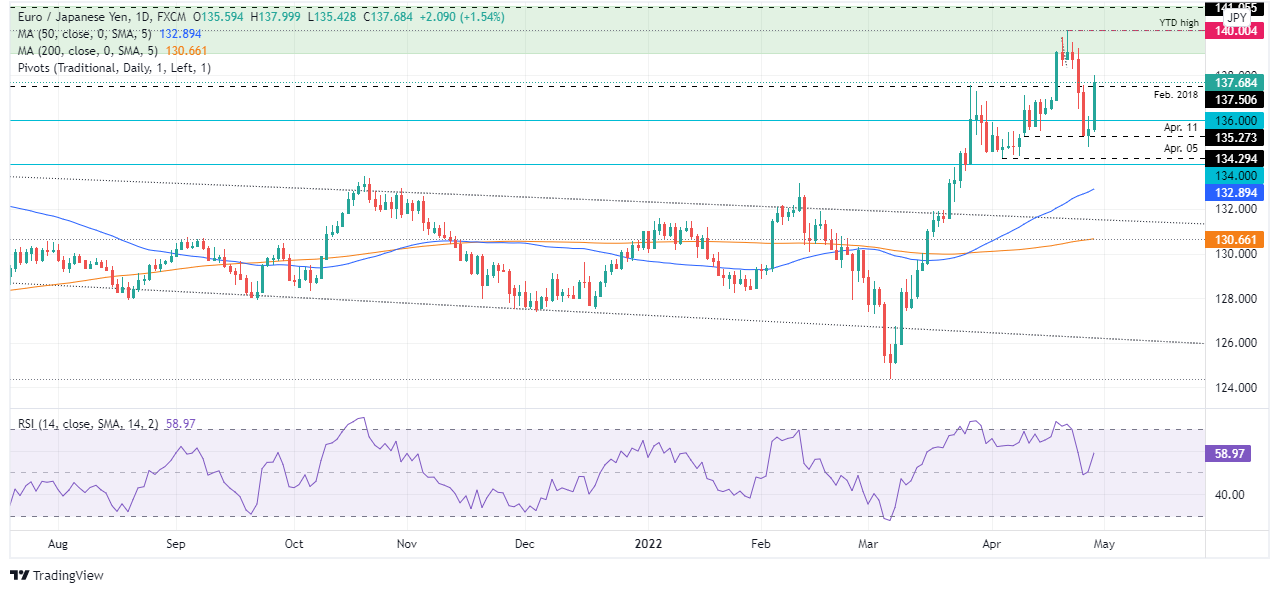
The shared currency is rallying against the Japanese yen after the Bank of Japan (BoJ) committed to its dovish stance, despite expressions of the Japanese Minister of Finance that FX volatility is undesirable and calling recent moves “extremely worrying.” At 137.68, the EUR/JPY is up 1.55% in the day, up almost 200-pips in the trading session.
Global equities remain trading with gains after China’s recent Covid-19 outbreak seems to be controlled. The Ukraine-Russia tussles have taken the backseat so far, as hostilities would continue amidst Russia’s appetite for victory.
Meanwhile, in the Asian session, the Bank of Japan held rates unchanged and doubled down to the Yield Curve Control (YCC), offering to buy an unlimited amount of 10-year JGBs at a fixed 0.25% rate. The BoJ’s expressed that they will ease policy without hesitations as needed with an eye on pandemic impact.
The BoJ Governor Haruhiko Kuroda, in his press conference, said that it is appropriate for Western central banks to tighten given higher inflation and their relatively quick recovery from the pandemic. Kuroda added that there is nothing wrong with diverging monetary policy between Japan and Western nations.
Also read: Breaking: Bank of Japan keeps policy steady, tweaks forward guidance, yen at fresh session lows, 129.52+
On the Eurozone side, inflation in Germany surprisingly rose to its fastest pace since the early 1990s, as shown by the Consumer Price Index at 7.8% y/y, beating the 7.6% forecasts by analysts.
Elsewhere, the European Central Bank (ECB) Vice-President Luis de Guindos said that he had not seen any signs of wage dynamics, adding that wage increases are quite prudent and are compatible with the ECB’s target. In the meantime, ECB’s Visco expressed that a rate hike in the third quarter could happen, as reported by CNBC.
EUR/JPY Price Forecast: Technical outlook
On Wednesday’s note, I wrote, “As long as the EUR/JPY sits above 134.29,” the EUR/JPY “would stay bullish.” The Bank of Japan helped in fulfilling the aforementioned, being the only bank without tightening monetary policy. The EUR/JPY, on its way north, broke all the resistance levels mentioned on Wednesday’s vote, opening the door for further upside.
With that said, the EUR/JPY’s first resistance would be 138.00. Break above would expose 139, followed by April’s 25 daily high at 139.23, which, once cleared, will push the EUR/JPY towards the YTD high at 140.00.
Key Technical Levels
- US dollar holds onto daily gains, trading at the highest level in years.
- NZD/USD finds support at 0.6450, holds a negative bias.
- AUD/NZD approaches 1.1000 and retreats.
The NZD/USD dropped further after the beginning of the American session and bottomed at 0.6450, the lowest level since June 2020. Then it rebounded, unable to rise back above 0.6500, showing the bearish momentum is still high.
Dollar keeps running
The key driver in NZD/USD continues to be the stronger greenback. Economic data released on Thursday showed an unexpected contraction in the US economy during the first quarter. The numbers weakened the dollar only for a few minutes.
The DXY hit the highest level since 2002 at 103.92 and then pulled back modestly; is it hovering around 103.65. US yields are up on, even after the negative GDP reading. The US 10-year stands at 2.87% and the 30-year at 2.94%.
The Kiwi is also down versus the Australian dollar, although it trimmed losses during the last hours. The AUD/NZD is up for the third day and peaked at 1.0962, near the multi-year high it hit last week below 1.1000. The move off highs could show the Aussie is not ready to break 1.1000. If it manages to do, the kiwi will likely weaken across the board.
NZD/USD with support at 0.6450
The pair found support on Thursday at the 0.6450 area which is a relevant barrier; the next considerable resistance might be seen at 0.6375 (interim support at 0.6400). The kiwi needs to rise and hold above 0.6530 to alleviate the bearish pressure. Above the following resistance stands at 0.6585.
Technical levels
- The GBP/USD is recording its worst monthly losses since March 2020, down some 5.43%.
- The US economy contracted by 1.4% and missed economists’ 1% expansion foreseen.
- GBP/USD Price Forecast: To remain downward pressured unless bulls reclaim 1.2700
The British pound keeps plunging, extending its April monthly fall to 5.43%, and it is approaching the 1.2400 figure on Thursday amidst an upbeat tilted mood, despite that some US and European indices record losses. At the time of writing, the GBP/USD is trading at 1.2440
US economy contracts for the first time in two years, sentiment improves
Sentiment improved as China’s Covid-19 outbreak got under some control while the Russia-Ukraine conflict continued. Aside from this, recent US economic data crossed the wires, as the Gross Domestic Product for the first quarter showed a contraction of 1.4% on an annualized pace, the first in nearly two years, though it’s unlikely to deter the Federal Reserve from hiking interest rates as it attempts to tackle inflation.
Stagflation talks began once the report hit the wires. However, analysts at ING wrote that domestic demand held up firmly when considering the hit to the economy momentum caused by the Omicron variant last year.
They added that “consumer spending grew 2.7%, while non-residential investment expanded 9.2% and residential investment posted a 2.1% gain.” They attributed the negative figure to the drop in exports and imports surplus.
Also in the US docket, the Department of Labour released the Initial Jobless Claims for the week ending on April 22, which rose by 180K, lower than the 182K estimated.
Meanwhile, back to geopolitics, Russia’s Foreign Ministry said that Russia had not received a response from Ukraine on a potential agreement and also informed that Russia will hold an informal UN Security Council meeting on May 6th regarding the situation in Ukraine.
Due to the market sentiment, the GBP/USD should rise as the GBP is considered a risk-sensitive currency, opposite the safe-haven US dollar. Nevertheless, the Fed’s pace of tightening appears more aggressive than the Bank of England’s, and with both banks having interest rates decision in the next week, it would be prudent to wait and see before opening fresh bets.
GBP/USD Price Forecast: Technical outlook
The GBP/USD is bearish biased and seems poised to extend to lower price levels. The Relative Strength Index (RSI) is at 18.61, well within the oversold territory, but its slope remains headed south, meaning that the GBP/USD might continue sliding.
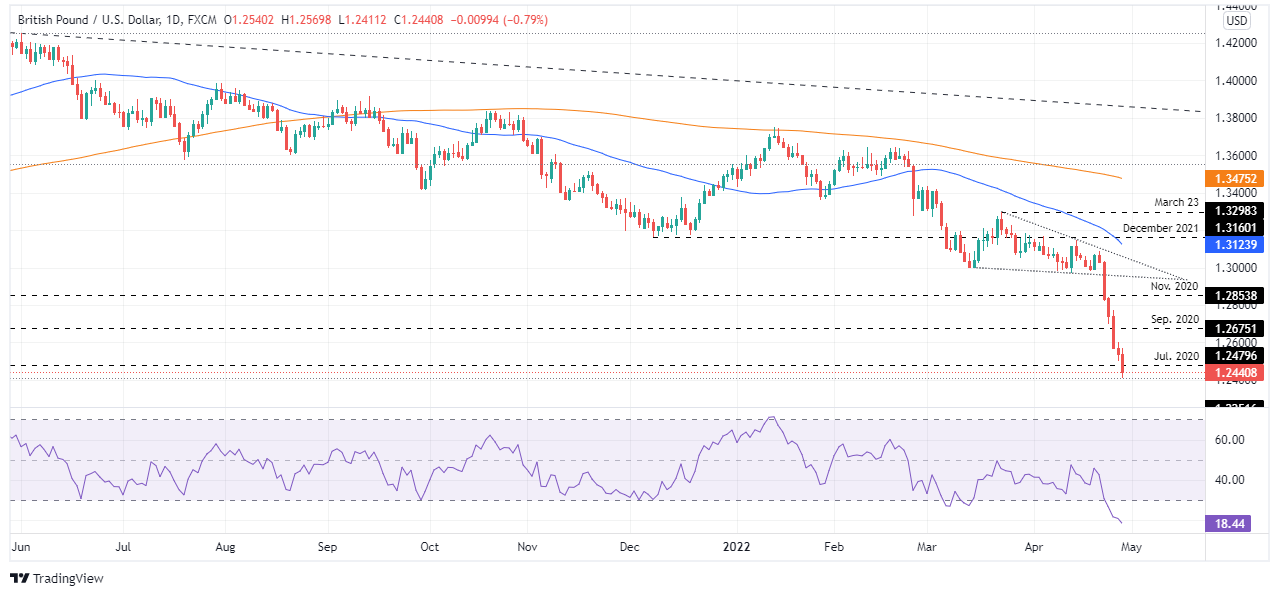
That said, the GBP/USD first support would be 1.2411. A breach of the latter would expose the 1.2400 figure, followed by 1.2300, and then June’s 29, 2020, daily low at 1.2251.
- GBP/JPY is trading around 163.00, just under its 21DMA and more than 100 pips below earlier session highs.
- Sterling bulls remain hard to find as pessimism about the UK economic and BoE tightening outlooks build.
- But the pair still trades with gains of well over 1.0% on the day with the yen battered post-dovish BoJ.
Though the pair still trades more than 1.0% higher on the day as the yen continues to suffer in wake of the BoJ latest just as dovish as anticipated policy announcement during Thursday’s Asia Pacific session, GBP/JPY has reversed more than 100 pips lower from earlier session highs to the north of the 164.00 level and now trades back to the south of its 21-Day Moving Average at 163.25 near the 163.00 level.
Pound sterling has seen substantial weakness in recent trade, despite a lack of any definitive trigger of fundamental catalyst. Seemingly, the market remains very much in the mood to sell sterling in wake of a run of concerning data releases including last week’s dour March Retail Sales report and this week’s shocking UK government borrowing figures.
Hand and hand with UK growth concerns as the country suffer through its worst cost-of-living squeeze in decades is a growing sense that beyond a few more 25 bps rate hikes at upcoming meetings, there likely won’t be much more by way of monetary tightening from the BoE. As a result, it probably shouldn’t come as too much of a shock to see GBP/JPY’s bullish momentum fade.
Failure to reconquer the 21DMA might prove a bearish sign going forward, with some bears perhaps betting on an eventual retracement back lower to this week’s sub-160.00 lows and even a test of the 50DMA at 158.98 just below it. Of course, much will depend on whether the yen continues to crater. If the recent leg lower is the start of another larger bearish push, then GBP/JPY might find itself gradually moving higher towards last week’s highs above 168.00.
- EUR/USD drops further and breaks below 1.0500.
- Extra losses could now extend to the 1.0340 area.
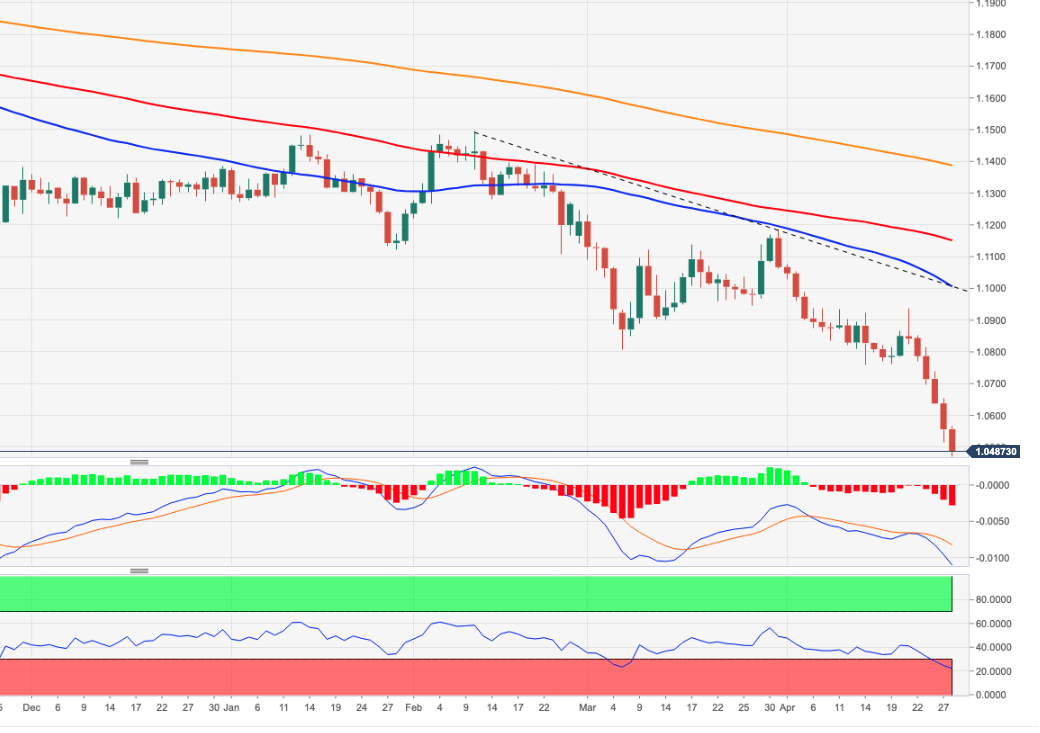
EUR/USD remains well into the negative territory and tests lows in the 1.0470 zone, an area last traded back in January 2017.
The downside momentum in the pair remains well and sound and now the door looks wide open to a potential visit to the 2017 low at 1.0340 (April 3) sooner rather than later.
While below the 2-month line around 1.1000, extra losses remain well on the cards for the pair.
EUR/USD daily chart
Germany has dropped its opposition to an embargo on Russian oil imports, government officials reportedly said according to the WSJ. According to the WSJ, this "clears the way" for a wider EU ban on oil imports from Russia, given that Berlin had been one of the main opponents on an embargo up until now.
The change in stance comes after Russia earlier in the week cut off gas flows to Poland and Bulgaria after the two countries refused to pay for the gas in roubles, as has been Russia's demand. EU officials accused Moscow of using fossil fuels to blackmail Europe over its support of Ukraine.
Germany recently made a U-turn on its policy of military support for Ukraine and will now send heavy weaponry to the country as it seeks to hold off Russian aggression that is primarily concentrated in its East and South.
- DXY prints tops in levels last seen 19 years ago.
- Further gains in the dollar could see 104.00 revisited.
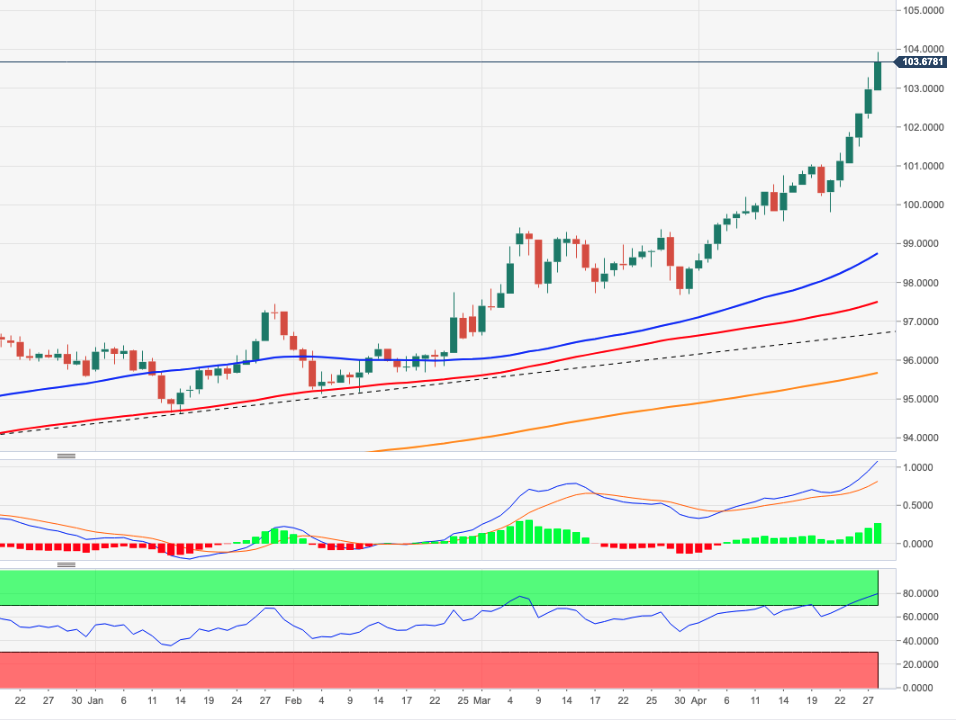
There are no changes to the bullish stance in the greenback, while DXY’s upside faltered just below the 104.00 yardstick on Thursday, an area last seen in January 2002.
The intense move higher in the dollar remains in the overbought territory – as per the daily RSI around 80 - and this could be a prologue to a potential near-term technical correction. Against that, initial contention emerges at the weekly low in the 99.80 zone (April 21).
The current bullish stance in the index remains supported by the 7-month line near 96.70, while the longer-term outlook for the dollar is seen constructive while above the 200-day SMA at 95.65.
DXY daily chart
- USD/JPY continues to trade close to session highs just under 131.00 as the buck remains resilient and yen weak post-BoJ.
- The buck seems to be the preferred currency safe-haven at the moment, thanks to Fed/BoJ divergence.
- January 2002 highs just above 135.00 look there for the taking.
The yen continues to reel in wake of the latest dovish BoJ policy announcement, that saw the bank double down on its dovish policy pledge to maintain negative interest rates and yield curve control for the foreseeable future. Traders seemingly took this as a green light to resume selling the yen, which, combined with continued broad US dollar strength, has launched USD/JPY to the north of the psychologically important 130.00 level for the first time in over two decades.
In more recent trade, the pair has even managed to break to the north of the 131.00 mark, despite fresh jawboning about yen weakness from officials at Japan’s Ministry of Finance in wake of the BoJ meeting, and despite the latest weaker than expected US Q1 2022 GDP growth figures. At current levels around 131.10, USD/JPY trades with on-the-day gains of about 2.1%, the largest single day gain since March 2020.
Meanwhile, USD/JPY now trades more than 3.0% higher versus Wednesday’s sub-127.00 lows, and looks on course to close out April with a 7.5% gain, the best one-month performance since November 2016. April’s historic rally comes on the heels of a nearly as impressive 5.8% gain in March, marking the strongest two-month run of gains since 1995.
And against the current macro backdrop, the highs of this century from January 2002 just above 135.00 look there for the taking. The BoJ’s insistence that it not move towards tighter monetary policy in tandem with its global peers (most notably, the Fed) suggests the yen may continue to suffer from unfavourable moves in rate differentials. This has seemingly robbed the yen of its status as the market’s preffered safe-haven asset, with the buck instead seemingly in vogue.
Risk appetite remains ropey with major US equity indices continuing to trade near multi-week lows as the month-end approaches, with investors citing fears about global growth and central bank tightening, with the latest US GDP figures only likely to exacerbate the former. Given the USD’s status as the top currency safe-haven, this might only add further tailwinds to USD/JPY in the coming weeks.
- EUR/JPY adds to Wednesday’s advance and reaches 138.00.
- Further gains could see the 2022 high around 140.00 retested.
EUR/JPY pushes further up and reaches the key 138.00 region on Thursday.
The continuation of the upside momentum looks likely in the very near term, with the immediate hurdle at the 2022 peak around 140.00 (April 21). In case the cross clears this level, it should then refocus on the June 2015 high at 141.05. Beyond this level, there are no hurdles of note until the 2014 top at 149.78 (December 2014).
In the meantime, while above the 200-day SMA at 130.66, the outlook for the cross is expected to remain constructive.
EUR/JPY daily chart

- The relentless USD buying pushed USD/CAD to a fresh multi-week high on Thursday.
- The disappointing release of the US GDP capped the upside for the USD and spot prices.
- Softer crude oil prices, aggressive Fed rate hike bets support prospects for further gains.
The USD/CAD pair trimmed a part of its intraday gains during the early North American session and was last seen trading around the 1.2855-1.2860 region, just a few pips below the highest level since March 9.
The pair attracted fresh buying near the 1.2800 mark on Thursday and prolonged its recent strong rally witnessed over the past one week or so amid the relentless US dollar buying. Investors seem convinced that the Fed would adopt a more aggressive policy response to combat stubbornly high inflation and have been pricing in a 50 bps rate hike at the upcoming meeting on May 3-4.
The markets also expect the US central bank to continue tightening its monetary policy when it meets again in June and July and ultimately lift rates to around 3.0% by the end of the year. The USD, however, eased a bit from the five-year peak following the disappointing release of the US GDP report, which showed that the economy unexpectedly contracted by 1.4% during the first quarter.
That said, additional details revealed that the GDP Price Index accelerated to 8% in Q1 and reaffirmed the prospects of rapid Fed rate hikes. This, along with a fresh leg up in the US Treasury bond yields, acted as a tailwind for the buck. On the other hand, a softer tone around crude oil prices undermined the commodity-linked loonie and offered additional support to the USD/CAD pair.
This, in turn, favours intraday bulls and supports prospects for a move back towards testing the YTD high, around the 1.2900 mark touched in March. Some follow-through buying will mark a fresh bullish breakout and set the stage for a further near-term appreciating move for the USD/CAD pair. This, in turn, suggests that any meaningful pullback might still be seen as a buying opportunity.
Technical levels to watch
GBP/USD has dropped under 1.25. Economists at Scotiabank expect the cable to lose another two or three cents if next week’s Bank of England (BoE) policy decision is dovish.
BoE to signal a much narrower path for hikes than markets are anticipating
“Sterling one-week risk reversals show the largest downside risk for the GBP over the following week since the initial days of the Russian invasion of Ukraine.”
“A BoE rate hold cannot be ruled out – though it is far from being our base case. The BoE will likely signal a much narrower path for hikes than markets are anticipating, which presents the main GBP downside risk.”
“The pound may still hold around 1.25 over the coming days, but a dovish BoE and weak macro figures over the coming weeks could see the GBP fall another two or three cents; with the broad dollar tone an important unknown.”
EUR’s drop under 1.05 this morning was followed by a solid recovery to 1.0565, the daily high, that then triggered steady selling to the low 1.05s where it stands. Economists at Scotiabank expect to see an eventual break below 1.05 to open up the 2017 low of 1.0341.
Oversold conditions may stall the drop
“The EUR is clearly still under downward pressure, and while the first decline under 1.05 didn’t hold, the trend favours an eventual break under the figure that leaves limited support markers until the 2017 low of 1.0341.”
“The mid-figure and figure zone may stand as a floor and oversold conditions (which could still go a bit lower) may stall its drop.”
“After the daily high at 1.0565, the 1.06 area stands as resistance followed by ~1.0625 and the mid-1.06s.”
USD/CHF has broken above the resistance level at 0.9672 with ease. Analysts at Credit Suisse maintain a tactically bullish outlook for the pair and see scope for a move to 0.9800/03 next and eventually 0.9900/21 over the medium-term.
USD/CHF continues to show sustained strength
“We expect the advance to be maintained in the medium-term, with resistance seen at 0.9720/37 initially, then at 0.9760 and eventually at the April 2021 highs at 0.9800/03. Whilst a short corrective pause is likely given the steepness of the current climb, above 0.9800/03 would see scope to reach the 2020 high at 0.9902 in due course, which we expect to act as a key medium-term indicator to define the market’s further course.”
Supports remain located at the cluster of intraday lows at 0.9665/9526, which ideally hold “any sharp near-term correction. Only a quick fall back all the way to 0.9473/54 though would negate the upside and signal further weakness, first to 0.9417/13 and then potentially to 0.9383/69.”
- Silver only saw a very modest bounce from their lowest levels since mid-February under $23.00 after weak US GDP data.
- As US yields move higher and USD remains resilient, XAG/USD remains at risk of t4esting earlier 2022 lows at $22.00.
Spot silver (XAG/USD) prices only saw a very modest bounce from their lowest levels since mid-February under $23.00 in wake of data showing a surprise drop in US GDP in Q1, with the US dollar having pulled back from highs. But any more meaningful rebound does not appear to be forthcoming, with XAG/USD for now still only trading just above the $23.00 mark and still nursing on the day losses of about 1.0%.
The US dollar has been on a rampage higher in recent days with the US Dollar Index (DXY) hitting five-year highs above 103.00 this week and nearing 104.00 earlier on Thursday amid worries about geopolitics, global growth and expectations for aggressive Fed tightening. This has weighed heavily on the precious metal complex, with both silver and gold being battered.
Indeed, at current levels near $23.00, XAG/USD trades with on-the-week losses of nearly 5.0% and trades nearly 12% below last week’s highs above $26.00. Some analysts might interpret the latest US GDP numbers as lessening the likelihood that the Fed in the coming months signals a further hawkish shift in its rate guidance towards outright restrictive interest rates (i.e. above the 2.5% neutral level).
But, for now, markets do not appear to be reading things this way. US yields continue to press higher and the buck looks likely to remain buoyant, perhaps given the latest inflation readings for Q1 that came out alongside the GDP growth figures showed another rise. XAG/USD remains vulnerable to retesting annual lows around $22.00 and returning to Q4 2021 lows in the mid-$21.00s.
- EUR/USD reclaims the area above the 1.0500 level.
- German flash CPI seen at 7.4% YoY in April.
- US GDP expected to have contracted 1.4% YoY in Q1.
The single currency abandons the area of recent lows and encourages EUR/USD to advance past 1.0500 following unexpected results in the US calendar.
EUR/USD bounces off lows on US data
EUR/USD now attempts some tepid bounce after the first revision of US GDP showed the economy is expected to have contracted 1.4% on an annualized view during the January-March period.
However, the negative performance of the pair appears unchanged against the backdrop of a stronger dollar, while yields on both sides of the ocean now left behind the initial pessimism and returned to the positive territory.
In the domestic calendar, preliminary inflation figures in Germany noted the CPI is seen rising 7.4% in the year to April and 0.8% vs. the previous month.
What to look for around EUR
EUR/USD’s price action shows further deterioration and revisits the sub-1.0500 area for the first time since January 2017. The outlook for the pair still remains tilted towards the bearish side, always in response to dollar dynamics, geopolitical concerns and the Fed-ECB divergence. Occasional pockets of strength in the single currency, in the meantime, should appear reinforced by speculation the ECB could raise rates at some point around June/July, while higher German yields, elevated inflation and a decent pace of the economic recovery in the region are also supportive of an improvement in the mood around the euro.
Key events in the euro area this week: ECB 2021 Annual Report, Consumer Confidence, Economic Sentiment, Germany Flash Inflation Rate (Thursday) – Germany, EMU Flash Q1 GDP Growth Rate, EMU Flash Inflation Rate (Friday).
Eminent issues on the back boiler: Asymmetric economic recovery post-pandemic in the euro area. Speculation of ECB tightening/tapering later in the year. Second round of the presidential elections in France (April 24). Impact on the region’s economic growth prospects of the war in Ukraine.
EUR/USD levels to watch
So far, spot is down 0.48% at 1.0504 and a break below 1.0480 (2022 low April 28) would target 1.0453 (low January 11 2017) en route to 1.0340 (2017 low January 3 2017). On the upside, the next hurdle appears at 1.0936 (weekly high April 21) seconded by 1.1000 (round level) and finally 1.1005 (55-day SMA).
- Weekly initial claims and continued claims were broadly in line with expectations according to the latest report.
- The US dollar weakened as a result of weak US GDP data and ignored the latest jobless claims figures.
There were 180,000 initial claims in the US economy in the week ending on 23 April, in line with consensus estimates and a slight decline from last week's 185,000 reading which was revised up from 184,000, according to data released by the US Department of Labour on Thursday. That meant that the four-week average of initial claims rose to 179,750 from 177,500 a week prior.
Continued claims in the week ending on 16 April saw a slight fall to 1.408M from 1.409M a week prior, a little above the expected drop to 1.403M. The insured unemployment rate thus came in at 1.0% in the week ending on 16 April, unchanged from a week earlier.
Market Reaction
FX markets did not react to the latest broadly as expected jobless claims report but rather reacted to weak US growth numbers, with the US dollar weakening slightly.
- AUD/USD dropped to over a two-month low on Thursday amid the relentless USD buying.
- The prospects for more aggressive Fed rate hikes continued acting as a tailwind for the buck.
- The USD bulls seemed rather unaffected by the disappointing release of the US Q1 GDP.
The AUD/USD pair witnessed an intraday turnaround from the 0.7160 area and dropped to its lowest level since February 7 during the early North American session. The pair, however, managed to rebound a few pips in reaction to the dismal US GDP print and was last seen trading just below the 0.7100 mark, down over 0.40% for the day.
Broad-based US dollar strength remains a key theme in the FX market on Thursday and growing acceptance that the Fed would tighten its monetary policy at a faster pace to curb soaring inflation. The bets were reaffirmed by hawkish remarks from influential FOMC members last week, including Fed Chair Jerome Powell.
The Fed is expected to hike interest rates by 50 bps when it meets on May 3-4, and again in June and July, and ultimately lift rates to around 3.0% by the end of the year. The USD buying remained unabated after the Advance US GDP report showed that the economy unexpectedly contracted by 1.4% in the first quarter of 2022.
This, along with the risk-on impulse in the markets, acted as a headwind for the safe-haven USD and extended some support to the perceived riskier aussie. The disappointment, however, was largely offset by a sharp rise in the GDP Price Index, which jumped to 8% in Q1 and reaffirmed the prospects of rapid Fed rate hikes.
The fundamental backdrop seems tilted firmly in favour of the USD bulls and supports prospects for a further near-term depreciating move for the AUD/USD pair. The emergence of fresh selling on Thursday adds credence to the negative outlook, suggesting that any attempted recovery is more likely to be short-lived.
Technical levels to watch
- The US economy unexpectedly shrank at an annualised pace of 1.4% in Q1 2022 versus expectations for a 1.1% growth rate.
- The downbeat growth data triggered weakness in the US dollar, with the DXY dropping back from the upper 103.00s to around 103.50.
The annualised pace of US real GDP growth in Q1 2022 came in at negative 1.4%, according to data released by the US Bureau of Economic Analysis on Thursday. That was a big miss on expectations that the economy had grown at an annualised pace of 1.4% in Q1 and marked a significant turnaround in fortunes from Q4 2021's robust 6.9% annualised growth rate.
Meanwhile, the GDP Price Index for Q1 saw a bigger than expected jump to 8.0% from 7.1% in Q4 versus an expected rise to 7.3%, though Core PCE Prices saw a slightly smaller than expected rise to 5.2% from 5.0%, versus forecasts for a 5.4% rise.
Market Reaction
The US Dollar Index (DX) immediately dropped back from the upper 103.00s and is now trading just above 103.50 in wake of the massive miss on growth expectations for last quarter. Some might argue that the data might deter the Fed from raising interest rates quite so aggressively in the coming quarters. At the very least, it diminishes the argument for the Fed to take interest rates back into outright restrictive territory (i.e. above 2.5%).
The Riksbank completed its shift towards the hawkish side of the spectrum by delivering a surprise 25bp rate hike today. EUR/SEK fell from the 10.40 area to slightly below 10.30 after the Riksbank’s statement was released. A series of gradual hikes are set to come, providing support to the krona, economists at ING report.
Riksbank will start QT from July
“Sweden’s central bank surprised with a 25bp rate hike today after a U-turn in the inflation assessment. Rate projections signal two to three more hikes this year and a terminal rate slightly below 2% by 2025; balance sheet reduction in 2H22 was also announced. All of this means more support to the krona in the medium-term”
“The recent instability in global risk sentiment and lingering geopolitical concerns in Europe are keeping a lid on the high-beta krona. This may not change in the near term, and we still struggle to see EUR/SEK trade sustainably below 10.20 in the coming weeks.”
“In the longer run, the Riksbank’s policy shift is set to offer sustained support to the krona, and periods of stabilised market sentiment (especially in Europe) could see the widening EUR/SEK rate differential push the pair materially lower. We now expect a move below 10.00 in EUR/SEK in the second half of the year.”
EUR/USD has broken below the 2020 low at 1.0635. However, analysts at Credit Suisse see scope for a short-term rebound from channel support at 1.0485.
EUR/USD to find a floor at first in the 1.0485/1.0341 zone
“Our bias remains to try and look for a better floor to be found the lower end of the potential broad downtrend channel from 2016 and price support at 1.0496/85 at first and for a consolidation/recovery phase to emerge to unwind the oversold condition. Should weakness directly extend though, this would be seen to expose the 1.0341 low of 2017.”
“Big picture, we suspect the decline ultimately extends to the 78.6% retracement of the entire 2000/2008 bull trend and psychological floor at 1.00/0.99.”
“Resistance is seen initially at 1.0573, with 1.0623/33 ideally capping to keep the immediate risk lower. Above 1.0656 though is needed to mark a near-term exhaustion point and a deeper recovery to 1.0739/60.”
- Annual HICP inflation in Germany was 7.8% in April, a tad above expected.
- FX markets did not react to the latest figures, which didn't deviate to much from expectations.
Inflation in Germany according to the Harmonised Index of Consumer Prices (HICP) rose at a YoY pace of 7.8% in April, according to a preliminary data release from the Destatis, the Statistical Office of the EU, on Thursday. That was higher than median economist forecasts for the YoY rate of inflation to have stayed unchanged at 7.6%. The MoM gain in HICP in April was 0.7%, a little above expectations for a 0.4% gain but marking a deceleration after March's 2.5% jump.
Inflation in Germany according to the Consumer Price Index came in at 7.4% in April, above the expected drop to 7.2% from 7.3% in March. MoM, the CPI rose 0.8%, above expectations for a 0.6% rise, but also marking a deceleration after prices rose at a MoM pace of 2.5% in March.
Market Reaction
FX markets were unreactive to the latest national German inflation numbers, which were only slightly higher than expected, but will nonetheless keep the pressure on the ECB to start lifting interest rates in Q3.
US Q1 GDP Overview
Thursday's economic docket highlights the release of the Advance first-quarter US GDP report, or the first estimate, scheduled at 12:30 GMT. Growth in the world's largest economy is expected to have decelerated sharply from the 6.9% rise recorded in the last quarter of 2021 to a 1.1% annualized pace during the January-March period. This would mark the slowest rate since mid-2020, suggesting that lingering supply chain constraints, inflation, and disruptions led by Russia's war in Ukraine weighed on growth.
Given that the Fed looks more at inflation than growth, investors also will keep a close eye on the GDP Price Index. The gauge is expected to edge higher to 7.3% during the first quarter from the 7.1% previous. As Yohay Elam, FXStreet's own Analyst explains: “Even if this is a relative deceleration, a level above 7% still implies high inflation. In turn, this publication serves as a reminder for investors that the Federal Reserve is set to raise interest rates at a rapid pace.”
How Could it Affect EUR/USD?
Heading into the key release, sustained US dollar buying dragged the EUR/USD pair to its lowest level since January 2017, below the 1.0500 psychological mark. Stronger growth figures would be enough to provide a fresh lift to the greenback and pave the way for a further near-term depreciating move for the major. Conversely, any disappointment is more likely to be overshadowed by concerns about a brewing energy crisis in Europe. This should continue to act as a headwind for the shared currency, suggesting that the path of least resistance for the pair is to the downside.
Eren Sengezer, Editor FXStreet, outlined important technical levels to trade the EUR/USD pair: “The one-week-old descending trend line forms the initial resistance at 1.0600. In case the pair rises above that level and starts using it as support, it could target 1.0650 (20-period SMA) and 1.0700 (psychological level, static level) next.”
“On the downside, the first support is located at 1.0500 (psychological level, static level) before 1.0460 (static level) 1.0400 (psychological level),” Eren added further.
Key Notes
• US GDP Preview: Three reasons to expect dollar-boosting figures
• EUR/USD Forecast: Bulls looking out for overdue dollar correction
• Forex Today: Relentless dollar buying continues ahead of US GDP
About US GDP
The Gross Domestic Product Annualized released by the US Bureau of Economic Analysis shows the monetary value of all the goods, services and structures produced within a country in a given period of time. GDP Annualized is a gross measure of market activity because it indicates the pace at which a country's economy is growing or decreasing. Generally speaking, a high reading or a better than expected number is seen as positive for the USD, while a low reading is negative.
- GBP/USD bears remain in control and the pair has now fallen below 1.2500, as the rampant buck continues its surge.
- The pair has now fallen over 4.5% in the last six session, which also reflects growing pessimism about UK growth.
After some nascent signs of stabilisation on Wednesday, the GBP/USD bulls are fully back in control on Thursday and have most recently pushed the pair below the 1.2500 level for the first time since June 2020 and on towards 1.2450. At current levels near 1.2470, the pair is trading with losses of slightly more than 0.5% on the day and is on course to post a sixth successive day of losses during which time it has dropped more than 4.5% from close to 1.3100.
The US dollar continues to strengthen across the board amid a combination of safe-haven demand within the currency space, as well as demand for yield with the Fed expected to raise interest rates at a more aggressive pace in the coming quarters compared to most of its G10 counterparts. That includes versus the BoE, which is expected to raise interest rates by 25 bps again next week, though some analysts have warned may signal a slowdown in the pace of rate hikes ahead, as concerns about the health of the UK economy grow.
Recent data relating to consumer health (last week’s March Retail Sales report and this week’s April CBI Distributive Trades survey) suggest the current severe cost-of-living squeeze, the worst in the UK in decades, is weighing heavily on consumption. Aside from USD strength, growing pessimism about the UK economic and monetary policy tightening outlook has been a key driver of GBP/USD’s recent pullback.
Some technicians are warning that the recent move in the pair is looking a little overstretched, and there could soon be a modest positioning-related pullback in the rampant US dollar. But the prospect for a lasting rebound in GBP/USD doesn’t look great right now. In the immediate future, traders will be watching the release of US Q1 GDP and weekly jobless claims data at 1330BST ahead of the release of US March Core PCE inflation on Friday.
Two sources familiar with the matter told Reuters on Thursday that no big European companies have so far started to pay for Russian gas in roubles. "Several traders, maybe more than five, have started payments," one of the sources added.
Meanwhile, a senior European Union official noted that opening an account in roubles at GazpromNank could be a breach of sanctions "at first sight."
Market reaction
These comments don't seem to be having a noticeable impact on market sentiment. As of writing, the Euro Stoxx 600 Index was up 0.9% on a daily basis.
- USD/CAD held steady near the multi-week high amid sustained USD buying.
- The prospects for rapid Fed rate hikes continued underpinning the greenback.
- The deteriorating global economic outlook also acted as a tailwind for the buck.
The USD/CAD pair seesawed between tepid gains/minor losses through the first half of the European session and was last seen trading with a mild positive bias, around the 1.2835 region.
The pair continued with its struggle to gain any meaningful traction for the second successive day on Thursday and oscillated in range just below the six-week high touched the previous day. The downside, however, remains cushioned amid the prevalent strong bullish sentiment surrounding the US dollar, bolstered by the prospects for aggressive policy tightening by the Fed.
The Fed is expected to hike interest rates by 50 bps when it meets on May 3-4, and again in June and July, and ultimately lift rates to around 3.0% by the end of the year. The bets were reaffirmed by comments from influential FOMC members last week, including Fed Chair Jerome Powell. Apart from this, the deteriorating global economic outlook pushed the USD to a five-year high.
Investors now seem worried that a brewing energy crisis in Europe could impact the economic growth in the region. Moreover, the latest COVID-19 outbreak and prolonged lockdowns in China have been fueling fears about stalling global growth. This, in turn, was seen as another factor that boosted the greenback's reserve currency status and acted as a tailwind for the USD/CAD pair.
That said, the risk-on impulse - as depicted by strong rally in the equity markets - kept a lid on any further gains for the buck. Meanwhile, an escalation in the Russia-Ukraine conflict continued lending some support to crude oil prices. This, in turn, underpinned the commodity-linked loonie and further contributed to capping the upside for the USD/CAD pair, at least for the time being.
Market participants now look forward to the US economic docket, highlighting the release of the Advance Q1 GDP report and the usual Weekly Initial Jobless Claims. Traders will further take cues from the broader market risk sentiment, which will influence the USD. This, along with oil price dynamics, should produce some short-term opportunities around the USD/CAD pair.
Technical levels to watch
A senior European Union (EU) official said Thursday, “what we cannot accept is that gas payments sent in euros are only considered complete after they are converted into roubles.”
This comes after the Financial Times (FT) reported, earlier on, energy companies in Germany, Austria, Hungary and Slovakia are preparing to comply with a new payment system for Russian gas sought by the Kremlin, threatening the European Union’s (EU) unity and sanctions.
Market reaction
EUR/USD is fading the dead cat bounce, now trading at 1.0520, down 0.33% on a daily basis.
FX option expiries for April 28 NY cut at 10:00 Eastern Time, via DTCC, can be found below.
- EUR/USD: EUR amounts
- 1.0700 668m
- 1.0800 522m
- 1.0850 773m
- 1.0900 626m
- GBP/USD: GBP amounts
- 1.3000 487m
- 1.3100 573m
- USD/JPY: USD amounts
- 127.00 540m
- AUD/USD: AUD amounts
- 0.7400 1.4b
- USD/CAD: USD amounts
- 1.2450 425m
- 1.2475 526m
- 1.2500 770m
- 1.2550 500m
- 1.2650 1.9b
- 1.2750 515m
- The post-BoJ selling around the JPY provided strong boost to GBP/JPY on Thursday.
- The risk-on impulse was seen as another factor that weighed on the safe-haven JPY.
- Extremely overstretched conditions provided respite to the JPY and capped gains.
The GBP/JPY cross trimmed a part of its strong intraday gains to the three-day high and retreated below mid-163.00s during the first half of the European session.
The cross built on the previous day's goodish rebound from the 159.60 area, or the monthly low and caught aggressive bids on Thursday in reaction to a dovish Bank of Japan statement. As was expected, the Japanese central bank stuck to its ultra-loose policy setting and vowed to conduct daily operations to defend its “near-zero” target for 10-year bond yields.
In the post-meeting press conference, the BoJ Governor Haruhiko Kuroda said that risks to the economy are skewed to the downside for the time being and showed readiness to ease policy further if necessary. Apart from this, the risk-on impulse - as depicted by strong move up in the equity markets - weighed on the safe-haven Japanese yen and acted as a tailwind for the GBP/JPY cross.
That said, extremely overstretched conditions offered some support to the JPY amid speculations that the recent freefall in the domestic currency could trigger verbal intervention. Apart from this, the relentless US dollar buying weighed on the British pound. The combination of factors attracted some selling around the GBP/JPY cross and led to a sharp intraday pullback of nearly 100 pips.
In the absence of any major market-moving economic releases from the UK, the sentiment surrounding the Japanese currency will continue to play a key role in influencing the GBP/JPY cross. Traders will further take cues from the broader market risk sentiment to grab some short-term opportunities.
Technical levels to watch
An official at Japan’s Finance Ministry said Thursday, the recent FX moves are 'extremely worrying'.
Additional comments
Important for forex rates to move stably reflecting fundamentals.
Excess FX volatility is undesirable.
Will take appropriate action if needed.
Communicating closely with BOJ, currency authorities of other countries.
Market reaction
In an immediate reaction to the Japanese jawboning, USD/JPY dropped nearly 65-pips to 130.20 before recapturing 130.50.
The spot is currently trading at 130.56, up 1.65% on the day, having hit 131.00 for the first time in 20 years in the last hour.
Gao Feng, spokesman of the Ministry of Commerce said at an online media briefing on Thursday, “it is in line with the fundamental interests of American enterprises and consumers to cancel the additional tariffs imposed on Chinese products by the US,” in the face of raging inflation, per China Daily.
“Normal communication between the two sides' economic and trade teams are ongoing,” he added.
His comments come as a response to US Treasury Secretary Janet Yellen's statement. Yellen said that the US is re-examining its trade strategy toward China, and is open to lowering US tariffs on Chinese goods to address inflation.
- USD/JPY caught aggressive bids on Thursday after the BoJ stuck to its ultra-dovish stance.
- The prospects for faster Fed rate hikes continued boosting the USD and remained supportive.
- The strong momentum pushed spot prices through the key 130.00 psychological barrier.
The USD/JPY pair continued scaling higher through the first half of the European session and rallied to the 131.00 neighbourhood, or a fresh two-decade high in the last hour.
The pair built on the previous day's goodish rebound from sub-127.00 levels and gained strong follow-through traction for the second successive day on Thursday. The sharp intraday rally followed after the Bank of Japan announced its monetary policy decision and reaffirmed its dovish stance.
In fact, the Japanese central bank vowed to keep its existing ultra-loose monetary policy settings and promised to conduct daily operations to defend its “near-zero” target for 10-year bond yields. The BoJ believes that Japan’s underlying economy is too fragile to tighten monetary policy. In the post-meeting press conference, the BoJ Governor Haruhiko Kuroda said that risks to the economy are skewed to the downside for the time being and showed readiness to ease policy further if necessary. This, along with the risk-on impulse, weighed heavily on the safe-haven Japanese yen.
On the other hand, the US dollar climbed to a five-year peak and remained supported by the prospects of a faster policy tightening by the Fed. This reflects the widening BoJ-Fed policy divergence and pushed the USD/JPY pair through a key psychological barrier near the 130.00 round-figure mark. Hence, the strong move up could further be attributed to some technical buying above the aforementioned handle. That said, speculations that the recent freefall in the JPY could trigger verbal intervention might hold back bulls from placing fresh bets amid extremely overbought conditions.
Market participants now look forward to the US economic docket, highlighting the release of the Advance Q1 GDP report and the usual Weekly Initial Jobless Claims. This data might influence the USD, which, along with the broader risk sentiment, should provide some impetus to the USD/JPY pair.
Technical levels to watch
In his appearance on Thursday, the Central Bank of the Republic of Turkey (CBRT) Governor Şahap Kavcıoğlu said, “developments show rate cuts were a correct decision.”
Additional quotes
“Expect a decline in inflation after May.”
“Expect a rise in tourism this year.”
Market reaction
The Turkish lira caught a fresh bid on the above comments, sending USD/TRY to fresh session lows of 14.72. The pair was last seen trading at 14.80, down 0.05% on the day.
German Chancellor Olaf Scholz said Thursday that Russian President Vladimir “Putin is clinging to the idea of 'forced peace' in Ukraine; that will not work.”
Further comments
“Decoupling of the global economy is not working.”
“We must watch out that deglobalization does not become decoupling or an excuse for protectionism.”
“We are seeking closer relations with countries that have shared values and interests, such as Japan, Australia, New Zealand, South Korea and India.”
“On climate protection, says we must take care that decarbonization does not bring competitive disadvantages or result in international trade conflicts.”
“Must take more care that our supply chains are diversified.”
“Germany must reorganize part of its trade relations in energy.”
“We need our military to be strong enough for Russia not to consider attacking us.”
Related reads
- EU energy groups prepare to pay for Russian gas in roubles – FT
- ECB Economic Bulletin: Russia’s aggression in Ukraine is causing enormous suffering
In an Economic Bulletin article published on Thursday; the European Central Bank (ECB) noted that Russia’s aggression in Ukraine is causing enormous suffering.
Additional takeaways
Global economic activity remained resilient at the start of 2022, with survey data indicating that the Omicron variant of the coronavirus (COVID-19) may only have a short-lived impact on advanced economies.
Several factors point to slow growth also in the period ahead. The war is already weighing on the confidence of businesses and consumers, including through the uncertainty it brings.
Fiscal and monetary policy support remains critical, especially in this difficult geopolitical situation.
Market-based indicators suggest that energy prices will stay high in the near term but will then moderate to some extent. Food prices have also increased sharply.
Supply bottlenecks and the normalization of demand as the economy reopens also continue to put upward pressure on prices.
Market reaction
EUR/USD was last seen trading at 1.0530, stalling its rebound from over five-year lows amid the rampant US dollar surge.
- EUR/USD rebounds from multi-year lows around 1.0480.
- The dollar climbed to levels last seen in 2017 earlier on Thursday.
- Germany Flash CPI, ECB-speak next on note in the domestic docket.
Further downside saw EUR/USD drop to levels last seen in January 2017 around 1.0480 on Thursday.
EUR/USD remains depressed on USD-strength
Following the earlier drop to the sub-1.0500 region, EUR/USD managed to regain some composure and looks to retake the 1.0500 hurdle and beyond in a context still dominated by the solid performance of the greenback.
On the latter, the US Dollar Index (DXY) reached an area last traded back in January 2017 around 103.70, although the sharp move seems to have fizzled out somewhat later.
In the German cash market, the 10y benchmark bund yields so far reverse three daily pullbacks and look to revisit the 0.85% region, while US yields drop modestly during the European morning.
Earlier in the session, ECB Vice-president L. De Guindos stressed that the central bank does not target any exchange rate level and added that the economic growth is expected to be positive this year. De Guindos also noted that higher energy prices affect demand and lift production costs.
In the euro calendar, advanced German inflation figures will take centre stage later in the session along with speeches by McCaul and Elderson. Across the pond, all the attention is expected to be on the publication of the preliminary Q1 GDP as well as Initial Claims.
What to look for around EUR
EUR/USD’s price action shows further deterioration and revisits the sub-1.0500 area for the first time since January 2017. The outlook for the pair still remains tilted towards the bearish side, always in response to dollar dynamics, geopolitical concerns and the Fed-ECB divergence. Occasional pockets of strength in the single currency, in the meantime, should appear reinforced by speculation the ECB could raise rates at some point around June/July, while higher German yields, elevated inflation and a decent pace of the economic recovery in the region are also supportive of an improvement in the mood around the euro.
Key events in the euro area this week: ECB 2021 Annual Report, Consumer Confidence, Economic Sentiment, Germany Flash Inflation Rate (Thursday) – Germany, EMU Flash Q1 GDP Growth Rate, EMU Flash Inflation Rate (Friday).
Eminent issues on the back boiler: Asymmetric economic recovery post-pandemic in the euro area. Speculation of ECB tightening/tapering later in the year. Second round of the presidential elections in France (April 24). Impact on the region’s economic growth prospects of the war in Ukraine.
EUR/USD levels to watch
So far, spot is down 0.14% at 1.0540 and a break below 1.0480 (2022 low April 28) would target 1.0453 (low January 11 2017) en route to 1.0340 (2017 low January 3 2017). On the upside, the next hurdle appears at 1.0936 (weekly high April 21) seconded by 1.1000 (round level) and finally 1.1005 (55-day SMA).
Today has seen the World Gold Council (WGC) publish its report on gold demand trends in the first quarter. The data shows high first-quarter gold demand thanks to strong investment demand, which is set to remain in place for the rest of the year, economists at Commerzbank report.
Gold demand at three-year high
“Global gold demand soared by 34% YoY to 1,234 tons, its highest level since the fourth quarter of 2018. It was driven solely by strong investment demand, which tripled YoY to 551 tons. This is attributable in turn to the high ETF demand amid the Ukraine war and the steep rise in inflation.”
“For as long as the geopolitical uncertainties and the high inflation environment continue, the WGC envisages robust investment demand this year.”
“Jewellery demand is expected to remain largely constant. The lockdown measures in China will prevent it from recovering to the average levels seen in the past, as they are contributing to lower consumer demand there.”
“Central banks are set to remain net buyers of gold this year, albeit on a lower level.”
- AUD/USD rebounded swiftly from over a two-month low touched earlier this Thursday.
- RBA rate hike bets, the risk-on impulse extended support to the perceived riskier aussie.
- Modest USD pullback from the multi-year peak remained supportive of the recovery move.
- Investors now look forward to the US Q1 GDP report for some meaningful trading impetus.
The AUD/USD pair staged a goodish intraday rebound from the 0.7075 region, or its lowest level since February 7 touched earlier this Thursday. The recovery momentum extended through the early European session and pushed spot prices to a fresh daily high, around the 0.7160 region in the last hour.
The Australian Bureau of Statistics reported on Wednesday that consumer prices in Australia surged at the fastest annual pace in two decades during the first quarter. The data fueled speculation the Reserve Bank of Australia could hike interest rates from record lows as soon as next week. This, along with the risk-on impulse, extended support to the perceived riskier aussie.
On the other hand, the US dollar eased a bit from a five-year high amid a softer tone surrounding the US Treasury bond yields. This, in turn, was seen as another factor that prompted some intraday short-covering around the AUD/USD pair. That said, the prospects for a more aggressive policy tightening by the Fed should act as a tailwind for the buck and cap gains for the major.
The markets now seem convinced that the Fed will hike interest rates by 50 bps when it meets on May 3-4, and again in June and July, and ultimately lift rates to around 3.0% by the end of the year. Apart from this, the deteriorating global economic outlook favours the USD bulls, warranting some caution before positioning for any further appreciating move for the AUD/USD pair.
Market participants now look forward to the US economic docket, highlighting the release of the Advance Q1 GDP report and the usual Weekly Initial Jobless Claims. Traders will further take cues from the US bond yields and the broader market risk sentiment, which will influence the USD price dynamics. This, in turn, should produce some short-term opportunities around the AUD/USD pair.
Technical levels to watch
USD/JPY is trading at its highest level in more than 20 years. In the view of economists at Westpac, a move to 135 is not outside realms of possibility.
Sustained trade above 130 appears just a matter of time
“With the Fed set to execute a series of 50bp moves, and commence an aggressive QT program next week, it’s hard to imagine that we have seen the highs for USD/JPY, and sustained trade above 130 appears just a matter of time.”
“We would have to argue that a move to 135 is not outside the realms of possibility, though of course would expect to see topside barriers being defended and MoF commentary as factors that may slow the pace.”
The US Dollar Index (DXY) is finally forging ahead in more decisive fashion. Economists at Westpac expect DXY to stay bid for some weeks, with potential to reach 107 – a level last seen in 2002.
DXY should stay bid
“DXY should stay bid for sometime yet as Eurozone and China growth expectations are marked lower, while the Fed remains resolutely hawkish.”
“DXY likely tests 104+ into next week’s FOMC, a break of that level opening the door to a test of 107, last seen in 2002.”
AUD/USD is probing lows since February despite a couple of key fundamental positives this week. Economists at Westpac expect the pair to test support around 0.7050, then 0.6985.
China’s economy is weighing on the aussie
“AUD’s underperformance despite high CPI and energy price surge suggests China covid situation is weighing, a cloud unlikely to lift near-term.”
“In the week ahead, risks are for a test of support around 0.7050, then 0.6985. But year-end target remains 0.76.”
- EUR/SEK sinks to the 10.25 area, or new multi-day lows.
- The Riksbank raised the policy rate by 25 bps to 0.25%.
- Sweden flash GDP contracted 0.4% QoQ in Q1.
The Swedish krona gathers extra steam and drags EUR/SEK to fresh lows in the 10.25 region, or 4-day lows, on Thursday.
EUR/SEK weaker on data, Riksbank
EUR/SEK loses ground for the second session in a row and flirts with the key 200-day SMA (10.27) in the wake of the Riksbank’s decision to hike the policy rate by 25 bps at its meeting on Thursday.
Indeed, SEK picked up pace after the Scandinavian central bank signalled that further rate hikes remain in store and that the policy rate is now seen somewhat below 2% in a three years’ time. The Riksbank will also reduce the pace of bond purchases from the second half of the year.
Additional releases in the Swedish docket saw the advanced Q1 GDP contract 0.4% QoQ and expand 3.0% on a yearly basis, while Retail Sales expanded 0.2% MoM and 1.2% YoY in March. Furthermore, the Consumer Confidence improved to 74.9 in April (from 73.5).
EUR/SEK levels to consider
So far, the cross is losing 1.09% at 10.2535 and faces the next support at 10.2209 (April 22 low) followed by 10.2118 (2022 low January 13) and finally 9.8636 (2021 low November 1). On the other hand, a breakout of 10.3732 (monthly high April 26) would expose 10.9049 (2022 high March 7) and then 10.9746 (high April 21 2021).
Sharply business and consumer surveys and retail sales suggest guidance for more measured hiking from the Bank of England (BoE). Subsequently, the GBP/USD pair could nosedive to the 1.21 level, economists at Westpac report.
Crunch lower in consumer confidence and retail sales to temper BoE’s hiking cycle
“Survey data ahead of next week’s BoE meeting has underscored UK cost-of-living crisis hit. CBI’s Business Optimism fell to -34 (-9 in Jan, 2021 peak of +38) and Reported Retail Sales fell to -35 (printed +28 in Jan, peak of 60 in Aug 2021).”
“MPC will receive updated forecasts in their Monetary Policy Review, views from internal agents on regional businesses and regular Decision Maker data. Weakening demand is likely to feature and further dampen BoE’s hiking path.”
“GBP/USD still has potential to breach 1.2475-00 for a flush to 1.2100. Such downside pressure would be reduced by a close above 1.2850.”
Heightened tensions with Russia and the risk of an early EU-wide end to dependency on Russian oil are downgrading eurozone growth prospects and weighing on the euro. The EUR/USD pair is set to test the 2017 low of 1.0340, economists at Westpac report.
EUR/USD needs to regain levels above 1.0760 to reduce downside risks
“The increased costs of energy transition and security, the hit to confidence and potential for further downgrading of regional growth towards recession triggered the slump through 2020’s 1.0635-40 lows and raise potential for a sharp test of 2017’s 1.0340 low, with interim levels of note at 1.0450 and 1.0415.”
“It is difficult to see what data out of eurozone can stem the slide in EUR ahead of the EC’s Eurogroup and FOMC meetings next week.”
“EUR would now need to regain levels above 1.0760 to reduce downside risks.”
- DXY advances to fresh 5-year highs well north of 103.00.
- US yields reverse part of Wednesday’s rebound.
- Advanced Q1 GDP figures, weekly Claims next of note in the docket.
The US Dollar Index (DXY), which gauges the greenback vs. a bundle of its main rivals, keeps pushing higher and reaches an area last seen mor than five years ago around 103.70 on Thursday.
US Dollar Index looks to data, Fed
The index so far advances for the sixth consecutive session on Thursday, or nearly 4% since weekly lows in the 99.80 region recorded on April 21.
The acute climb in the dollar comes almost exclusively in response to firmer conviction that the Federal Reserve will embark on a more aggressive tightening cycle starting as soon as in May and with an already telegraphed 50 bps rate hike.
Daily gains in the buck comes against the backdrop of a corrective knee-jerk in US yields along the curve, while the steady stance from the BoJ and the subsequent depreciation of the Japanese yen also collaborates with the upbeat note in DXY.
In the US data space, the first revision of the Q1 GDP will take centre stage seconded by usual weekly Claims.
What to look for around USD
The dollar picks up extra pace and quickly surpasses the key 103.00 barrier in quite a convincing fashion for the first time since January 2017. Persevering risk aversion, geopolitics and the bounce in US yields all collaborate with the upside momentum in the buck. In the meantime, the likelihood of a tighter adjustment to the Fed’s monetary conditions continues to be the main driver behind the sharp move higher in the index in past sessions, which also appears reinforced by the current elevated inflation narrative and the solid health of the labour market.
Key events in the US this week: Advanced Q1 GDP Growth Rate, Initial Claims (Thursday) – Core PCE, PCE, Final Consumer Sentiment, Personal Income/Spending (Friday).
Eminent issues on the back boiler: Escalating geopolitical effervescence vs. Russia and China. Fed’s rate path this year. US-China trade conflict. Future of Biden’s Build Back Better plan.
US Dollar Index relevant levels
Now, the index is advancing 0.18% at 103.17 and the breakout of 103.69 (2022 high April 28) would open the door to 103.82 (2017 high January 3) and finally 104.00 (round level). On the other hand, initial contention emerges at 99.81 (weekly low April 21) seconded by 99.57 (weekly low April 14) and then 97.68 (weekly low March 30).
- GBP/USD staged modest intraday recovery from sub-1.2500 levels or the fresh YTD low.
- The risk-on impulse acted as a headwind for the safe-haven USD and extended support.
- Investors now look forward to the Advance US Q1 GDP report for a fresh trading impetus.
The GBP/USD pair reversed an intraday dip to its lowest level since July 2020, and climbed to a fresh daily high, around the 1.2560-1.2565 area during the early European session.
The pair showed some resilience below the 1.2500 psychological mark and witnessed some intraday short-covering move, though any meaningful recovery still seems elusive. Some cross-driven strength stemming from a sharp spike in the GBP/JPY cross - following the Bank of Japan's ultra-dovish policy stance - turned out to be a key factor that extended support. That said, the prevalent strong bullish sentiment surrounding the US dollar should cap the upside for the GBP/USD pair.
The USD rallied to a five-year high and continued drawing support from expectations that the Fed would tighten its monetary policy at a faster pace to curb soaring inflation. In fact, the US central bank is expected to hike interest rates by 50 bps when it meets on May 3-4, and again in June and July, and ultimately lift rates to around 3.0% by the end of the year. This, along with the deteriorating global economic outlook, boosted the greenback's reserve currency status.
Investors now seem worried that a brewing energy crisis in Europe could impact the economic growth in the region. The concerns resurfaced after Russia announced a plan to halt gas flows to Poland and Bulgaria on Wednesday amid a standoff over fuel payments from “unfriendly” buyers in rubles. Moreover, the latest COVID-19 outbreak and prolonged lockdowns in China have been fueling fears about stalling global growth, which, in turn, benefitted the safe-haven buck.
That said, the risk-on impulse - as depicted by a generally positive tone around the equity markets - acted as a headwind for the USD. Market participants now look forward to the US economic docket, highlighting the release of the Advance Q1 GDP report and the usual Weekly Initial Jobless Claims data later during the early North American session. The data might influence Fed rate hike expectations, which, in turn, will drive the USD and provide some impetus to the GBP/USD pair.
Technical levels to watch
Here is what you need to know on Thursday, April 28:
The US Dollar Index advanced to its highest level in more than five years above 103.00 early Thursday and is already up more than 2% on a weekly basis, boosted by risk-aversion and hawkish Fed expectations. Investors await Consumer Confidence and business sentiment data from the eurozone, the German inflation report and the first-quarter Gross Domestic Product (GDP) data from the US. Although the impressive gains witnessed in US stock index futures point to an improving market mood in the European morning, the greenback preserves its strength against its major rivals, especially the JPY.
US GDP Preview: Three reasons to expect dollar-boosting figures.
As the European Union is preparing to respond to Russia's decision to stop exporting gas to Poland and Bulgaria, Russian President Vladimir Putin said that the west's plan to suffocate Russia's economy had failed and reiterated that they will reach all of their objectives in Ukraine. Meanwhile, the Financial Times reported earlier in the day that energy companies in Germany, Austria, Hungary and Slovakia were planning to pay for Russian gas in roubles, which European Commission President Ursula von der Leyen said would be a breach of sanctions imposed against Russia.
EUR/USD plunged below 1.0500 for the first time since January 2017 in the early European morning on Thursday before staging a modest rebound.
The Bank of Japan (BOJ) announced on Thursday that it kept the monetary policy settings unchanged as widely expected. BOJ Governor Haruhiko Kuroda said that they need to continue the current powerful monetary easing in a patient way. "Western central banks are normalising their policy but Japan is not in such a situation given its economy and price trend," Kuroda further noted, highlighting the policy divergence. In turn, USD/JPY was last seen trading at its highest level in more than 20 years at around 130.50, gaining 1.5% on a daily basis.
GBP/USD dipped below 1.2500 during the Asian trading hours on Thursday but managed to rebound modestly in the early European session. In the absence of high-tier macroeconomic data releases from the UK, the pair remains at the mercy of the dollar's market valuation.
Gold turned south and closed deep in negative territory on Wednesday after having posted modest daily gains on Tuesday. XAU/USD extended its slide to a fresh 10-week low in the early Asian session before turning flat on the day near $1,885.
Bitcoin rose nearly 3% on Wednesday but continues to trade below the key $40,000 level. Ethereum fluctuates in a relatively tight range at around $2,900 early Thursday following Wednesday's rebound.
How low can EUR/USD go? As the rising possibility of a Russian gas ban could erase the European Central Bank (ECB) hikes expected by markets, economists at Scotiabank believe the pair could tumble to parity.
Difficult to envision gains above 1.10 over the remainder of the year
“We think that building economic pessimism and a clearly disadvantageous monetary policy divergence between the ECB and the Fed places the EUR at a clear risk of testing its early-2017 low of 1.0341 in the coming days or weeks.”
“If Russia shuts off energy flows, the bloc’s industrial complex may have to heavily reduce output, flipping the Eurozone into recession. This would pave the way to a test of parity for the EUR as Eurozone financial outflows mount due to a worsening economic outlook which forces the ECB to put off hikes.”
“Beyond the ECB, the only major source of EUR support would be a material easing of Ukraine war risks that does away with recession fears, with a broad improvement in risk sentiment in markets (and a widespread weakening of the USD) acting as additional support.”
“Given the monetary policy outlook and sluggish growth, it’s difficult to envision EUR gains above 1.10 over the remainder of the year amid ongoing geopolitical risks.”
Open interest in natural gas futures markets reversed the previous drop and rose by around 19K contracts on Wednesday according to advanced prints from CME Group. In the same line, volume went up for the second consecutive session, this time by 51.7K contracts.
Natural Gas continues to target the 2022 peaks
Prices of the natural gas extended the weekly advance on Wednesday. The uptick was amidst rising open interest and volume and continue to favour further upside in the very near term. Against that, the next hurdle emerges at the YTD high past the $8.00 mark per MMBtu recorded on April 18.
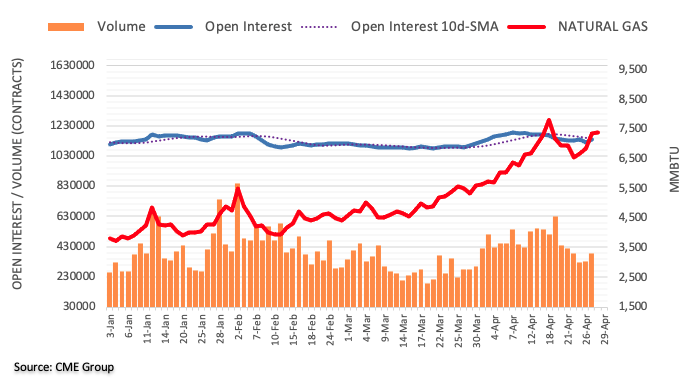
The yen has resumed its sharp sell-off lifting USD/JPY above the 130.00 level for the first time since April 2002 as the Bank of Japan (BoJ) loose policy stance. Economists at MUFG Bank believe that the pair has a clear way to reach the 135.00 mark.
BoJ strongly commits to maintaining loose policy hitting yen hard
“There appears little technical resistance now until the highs from back in early 2002 at close to the 135.00 level.”
“BoJ remains committed to maintaining loose policy. The BoJ’s belief that the pick-up in inflation will prove only temporary explains why they remain committed to maintaining loose policy.”
“The BoJ will continue to cap Japanese yields even if yields outside of Japan continue to head higher. It leaves open the door for yield spreads between Japan and the rest of the world to move further against the yen which is already encouraging further yen weakness.”
“With the yen now resuming its sharp weakening trend, it places the Japanese government in a difficult position. Intervention would likely be ineffective right now when the BoJ has just doubled down on their loose policy stance and the Fed is set to step up the pace of policy tightening. If the yen continues to sell-off rapidly it will further increase pressure on Japan to intervene and/or adjust policy settings especially as the yen becomes even more deeply undervalued.”
UOB Group’s Economist Barnabas Gan assesses the recently published results from the industrial production in Singapore.
Key Takeaways
“Industrial production expanded 3.4% y/y (-12.6% m/m sa) in Mar 2022, beating market expectations for a weaker growth of 2.0% y/y (although the sequential decline is worse than the projected -11.9% m/m sa). Excluding biomedical manufacturing, industrial production rose 9.7% y/y.”
“Manufacturing activities remains underpinned by the global trade recovery as well as the gradual reopening of international borders. This was seen as the transport engineering cluster grew 20.7% y/y on the back of higher production of aircraft parts and offshore projects activities. Meanwhile, sustained demand from 5G markets and data centres led the semiconductor segment in the electronic cluster.”
“Given the latest industrial production data, Singapore’s manufacturing growth clocked 7.1% y/y in the first quarter of 2022, against the recent MTI’s advance estimates of 6.0% y/y expansion. This suggests that Singapore’s GDP in 1Q22 will likely be revised higher to 3.6% y/y (from MTI’s advance estimates of 3.4% y/y).”
“In all, our outlook is for full-year manufacturing to grow by an average of 4.0% in 2022. This suggests that despite the high-base growth rate seen in 2021, global trade activity is expected to stay buoyant in the year ahead.”
Global events are conspiring to send the dollar a lot higher. The 2022 dollar boom may well turn into a bust in 2023, but economists at ING are a long way from calling a top in the dollar now.
Dollar booming in 2022, bust in '23?
“The Federal Reserve looks set to embark on an aggressive tightening cycle this year to stamp out inflation. War in Europe and the risk of an abrupt cut-off in Russian gas are damaging European growth prospects and local currencies, while Asia is dealing with its own growth problems and the likes of both China and Japan are still in monetary easing mode. It is hard to see this environment changing in the next six months, meaning that this dollar boom looks set to continue.”
“The Achilles Heel of this dollar rally is that the strong dollar and strong domestic demand are sucking in imports and widening the trade deficit. One developing narrative is that rather like the 1980s, Fed efforts to stamp out inflation send the dollar through the roof and the 2022 dollar boom turns into the 2023 dollar bust if, as we suspect, the Fed might be cutting rates by the end of '23. For now, the dollar boom will very much be the story.”
“Closes above 104 DXY warn that this dollar rally goes into hyper-drive.”
The “surge in energy prices is reducing demand and raising production costs,” European Central Bank (ECB) Vice President Luis de Guindos said on Thursday.
Additional quotes
Developments point to slower growth in the period ahead.
Over the medium term most survey and market-based measures of inflation expectations indicate inflation rates around our two percent target.
Initial signs of above-target revisions in those measures warrant close monitoring.
Market reaction
The EUR/USD recovery from over five-year lows of 1.0483 seems to be picking up pace, as the pair trades at 1.0530, as of writing. The pair is still down 0.21% on the day.
Considering preliminary readings from CME Group, traders added around 21.2K contracts to their open interest positions on Wednesday. Volume, instead, went down for the second session in a row, this time by 140.5K contracts.
WTI faces initial support around $95.30
Crude oil prices charted an inconclusive session on Wednesday. The price action was accompanied by rising open interest, which could be indicative that the commodity might face some consolidative mood in the very near term. Immediately to the downside, WTI should find support arouund recent lows in the $95.30 region (April 25).
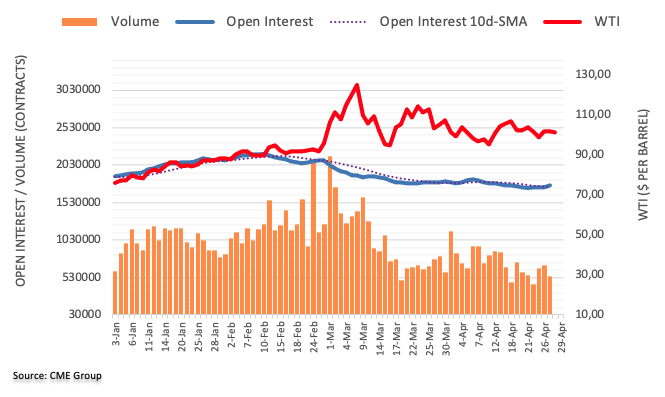
EUR/USD has briefly traded below 1.0500, sitting at the lowest level since January 2017. A clear break under this level would open up the 1.0350 area, economists at ING report.
35% chance priced of EUR/USD hitting parity this year
“The FX options market assigns a 35% probability to EUR/USD trading 1.00 at any time before year-end. This is up from 25% earlier this week and just 15% a couple of weeks ago.”
“Of the many concerns facing European currencies, the most pressing is an abrupt cut-off in Russian gas more broadly in Europe. How this story plays out and the degree to which the eurozone economy is hit (estimates range in the 1-3% of eurozone GDP on a complete cut-off) will help determine EUR/USD levels.”
“EUR/USD remains fragile and a clean break of 1.0500 opens up the 1.0350 area.”
Economists at ING expect the Swedish krona to find it difficult to advance in the coming weeks. They expect the EUR/SEK to move above the 10.20/30 area.
Unstable risk sentiment and lingering geopolitical risks to keep a lid on SEK
“Unstable risk sentiment and lingering geopolitical risks affecting Europe may keep a lid on high-beta currencies like SEK in the coming weeks.”
“We think EUR/SEK may struggle to trade sustainably below 10.20-10.30 in the current environment.”
GBP/USD has crumbled. 1.25 is a big support for cable, economists at ING report.
EUR/GBP can trade back down to the 0.8350 area
“Big support can be found at 1.25.”
“Perhaps the only thing supporting cable at 1.25 is the fact that it has come a long way quite quickly. We cannot rule out cable breaking lower, but again we think this is more a dollar than a sterling move.”
“Assuming that the Bank of England does not cave into the dovish minority at next week's meeting, we suspect EUR/GBP can probably trade back down to the 0.8350 area.”
UOB Group’s Economist Ho Woei Chen, CFA, reviews the latest release of the GDP figures in South Korea.
Key Takeaways
“South Korea’s advance GDP for 1Q22 was better-than-expected at 3.1% y/y, 0.7% q/q seasonally adjusted (Bloomberg est: 3.0% y/y, 0.6% s/a q/q) as the economy continued to recover from the COVID-19 pandemic. Korea’s GDP rose sequentially for the 7th consecutive quarter though momentum has moderated in 1Q22.”
“As the external demand outlook weakens, South Korea’s exports and investments will find it increasingly difficult to outperform. However, private consumption will be lifted as the country moves towards endemicity with pent-up demand and improvements in the labour market underlying the recovery. Growth in the subsequent quarters will likely moderate to below 3.0% y/y.”
“We maintain our full-year GDP growth forecast for South Korea at 2.7% and raise our inflation forecast to 3.9% from 3.3% previously, with inflation likely to stay above 4.0% in 2Q-3Q.”
Investors may be making flawed assumptions about the path of inflation, monetary policy and corporate earnings. Lisa Shalett, Chief Investment Officer, Wealth Management at Morgan Stanley, analyzes what that could mean for markets going forward.
Inflation will soon start to cool
“We shouldn’t write off the potential for persistent inflation. Rents are still growing, and inflation in services businesses, especially linked to travel, is significant. Also, the intensification of the Russia-Ukraine conflict leaves little room for relief in rising energy, metals and food prices, while the renewed COVID-related shutdowns in China are re-igniting supply chain-related price squeezes.”
Earnings growth will continue to be strong
“We believe earnings pressures continue to grow and current profit-margin expectations may be overly optimistic. Costs continue to rise, and inventories are now outpacing new orders. The inflationary environment may be eroding consumer purchasing power, particularly for lower-income households. The strength of the US dollar also creates headwinds for exporters and pressures the value of the income earned from international markets.”
US stocks must be the best place to invest
“Valuations are rich today at a time when growth is decelerating and policy is tightening. Markets elsewhere may provide more attractive relative value. In regions such as China, equities trade at trough valuations against recessionary conditions. As for emerging markets, headwinds from commodities inflation may ease, while expectations are modest and currencies may strengthen as well. In Europe, a more dovish central bank, combined with possibly more coherent fiscal policy responses in the wake of the military conflict, could support a recovery.”
Bank of Japan Chief Haruhiko Kuroda said, "desirable for currencies to move stably reflecting economic fundamentals" while commenting on the exchange rate value at the post-policy press conference.
Additional quotes
No comment on fx levels.
Want to closely watch impact of currencies on economy, prices.
Need to consider negative impact of excessive currency moves.
Need to fully pay attention to risks from the Ukraine crisis and coronavirus infections.
Downgrade to Japan’s growth projections was in tandem with IMF’s downgrade on global economy.
Related reads
- BOJ’s Kuroda: Need to patiently continue current powerful monetary easing
- USD/JPY tops 130.00 for the first time in 2O years, as BOJ stays dovish
All eyes will be on the Riksbank today and whether they deliver their first rate hike. The Swedish krona could see mild gains if the central bank announces a faster rate path, economists at Commerzbank report.
What is the Riksbank going to do?
“If the Riksbank were to signal a faster rate path this would be positive for SEK; as the market is already expecting a reasonably tight Riksbank approach for the second half of the year anyway, SEK gains are likely to be limited, though.”
“If whatever the Riksbank is going to signal seems too little to the market SEK, which has come under pressure during the last days due to rising risk aversion, is likely to fall a bit further.”
See – Riksbank Preview: Forecasts from seven major banks, positioning for its first-rate hike
CME Group’s flash data for gold futures markets noted open interest rose by nearly 4K contracts on Wednesday, reaching the second daily advance in a row. Volume followed suit and resumed the uptrend, this time increasing by almost 15K contracts.
Gold now targets the 200-day SMA
Gold prices extended the weekly leg lower on Wednesday on the back of rising open interest and volume, leaving the yellow metal vulnerable to further pullbacks in the short-term horizon. That said, the next support of note for bullion emerges at the 200-day SMA, today at $1833.

More comments are flowing in from Bank of Japan (BOJ) Haruhiko Kuroda, as he continues to speak on the monetary policy outlook at the post-policy meeting press conference.
Appropriate to maintain current powerful monetary easing to support economy.
Need to patiently continue current powerful monetary easing.
Excessive currency moves as seen recently will make it hard for business planning.
Western central banks are normalising policy but japan is not in such situation given its economy, price trend.
Takes more time to achieve 2% inflation target in virtuous cycle of rising corporate profits, wages
Watching closely impact of fx moves on Japan’s economy, prices.
USD/JPY reaction
USD/JPY is consolidating the recent upsurge just below the 20-year highs of 130.27, currently trading at 130.18. The spot is gaining 1.37% so far.
USD/CAD is pulling higher from a recent 1.2403 low. As Benjamin Wong, Strategist at DBS Bank, notes, there are signs that it is attempting to breakout of its prior compression range of 1.2288-1.2964, resolving USD higher.
BoC’s rate hikes do not appear to aid CAD strength
“There are some indications that the range compression of 1.2288-1.2964 needs a resolution. The chances are that we are getting closer to a breakout move for a medium-term trend change, and is likely to resolve in a bullish USD outlook. Momentum should build up once the MACD (moving average convergence/divergence) signal awakens.”
“Bank of Canada’s rate hikes do not appear to aid CAD strength as it is masked out by a hawkish Fed. Rather, Canadian terms of trade and domestic oil prices are the determinants.”
“Looking at the long-term quarterly chart, one can see that a move for a change in wind direction for USD/CAD has typically ranged from 18-24%, and if 1.2062-1.2007 is a tradeable double bottom, a prolonged USD spike can build the case for a move towards the 1.40 line. Naturally, that requires USD to first break the 38.2% Fibonacci retracement of its recent 1.4668-1.2007 at 1.3024.”
Economist at UOB Group Ho Woei Chen, CFA, and Senior FX Strategist Peter Chia assess the recent decision by the PBoC.
Key Takeaways
“The People’s Bank of China (PBoC) announced a 100 bps cut to the reserve requirement ratio for foreign currency deposits (FC RRR) to 8% from current 9% with effect from 15 May.”
“The move will release more foreign currency liquidity into the onshore market and ease pressure on the CNY depreciation, coming on the back of recent measures to stabilise market and prevent a hard-landing to the economy as China struggles to contain the spread of COVID-19.”
“Capital outflows from China have accelerated in Mar with a record amount of outflows driven by more hawkish Fed while uncertainty from the Russia-Ukraine conflicts and worsening outlook in China are also spurring greater outflow pressure.”
“The FC RRR cut may stabilise CNY in the near term but unlikely to change the longer term weakening trend.”
“We clarified fixed-rate operations to ensure the upper cap on 10-year yield target,” Bank of Japan Chief Haruhiko Kuroda, said while addressing the post-monetary policy decision press conference.
Additional quotes
Risks to economy skewed to downside for time being but will be balanced thereafter.
Won't hesitate to easy monetary policy further if necessary.
2% inflation will not be sustained as energy hikes fade.
More time is needed to achieve 2% price target.
Recent rise in raw material prices lead to downward pressure in prices by bringing negative effect to economy.
Market reaction
USD/JPY is holding fort above 130.00, as investors digest the BOJ’s dovish stance. The pair rallied hard from near the 128.60 region to hit fresh 20-year highs at 130.27.
At the time of writing, the pair is trading at 130.08, up 1.30% on the day.
The Bank of Japan (BoJ) kept its policy settings and forward guidance unchanged. Nonetheless, there was an outside chance that the Bank would widen its Yield Curve Control (YCC) band and/or shift the target of YCC to a lower maturity. JPY reacted negatively (falling around 1% vs USD). This outcome keeps the door open to further JPY declines ahead, economists at TD Securities report.
The lone dove
“BoJ maintained its policy balance rate as expected, but doubled down on its YCC, countering some speculation that it would widen the band. The outcome highlights that BoJ is far away from any shift in policy settings in terms of YCC targeting, let alone its policy rate.”
“BoJ inflation forecast was revised higher but it maintains that any increase in CPI above 2% will be temporary.”
“BoJ inaction keeps door open to further JPY declines. We view 135+ as a formidable line in the sand.”
- USD/CHF shoots above 0.9700 on soaring DXY.
- The uncertainty over the rate decision by the Fed next week is fueling a rally in the greenback.
- Investors are focusing on the speech from SNB’s Jordan, which is due on Friday.
The USD/CHF pair is scaling higher in the early European session as the market participants are underpinning the greenback on a risk-off impulse. The asset is establishing above the round level resistance of 0.9700 and has recorded a high of 0.9720 in today’s session. The major has continued its five-day winning streak on Thursday and is likely to accelerate further amid broader strength in the US dollar index (DXY).
The DXY has touched 103.70, at the press time, and is not showing any signs of exhaustion yet. The asset is likely to reclaim its five-year high at 103.82. Uncertainty ahead of the interest rate decision by the Federal Reserve (Fed) has infused fresh blood in the DXY. Next week’s monetary policy decision will focus on squeezing liquidity from the economy swiftly to corner the soaring inflation. The US Consumer Price Index (CPI) has climbed to 8.5% and a jumbo rate hike is highly required to fix the inflation mess.
On the Swiss franc front, investors are eyeing the speech from Swiss National Bank (SNB)’s Thomas J. Jordan, which is due on Friday. It is worth noting that the inflation in the Swiss area has overstepped its 13-year high to 2.2%, which is above the targeted figure of 2.2%. Therefore, a slightly hawkish tone from the SNB’s Jordan cannot be ruled out.
Gold Price remains heavy below $1,900 with more downside exposed towards $1,850, FXStreet’s Dhwani Mehta reports.
XAUUSD downside opening up towards $1,850
“Attention turns towards the all-important preliminary release of the US Q1 growth figures. The American economy is seen expanding 1.1% QoQ in Q1 vs. 6.9% previous. The US GDP data is unlikely to deter the Fed’s rate hike path, which is likely to keep the downbeat tone around Gold Price intact going forward.”
“The immediate support of the rising 100-Daily Moving Average (DMA) at $1,876 appears at risk, below which the February 17 low of $1,868 remains on sellers’ radars. A fresh downswing could be kicked off below the latter, exposing the $1,850 psychological level.”
“If the 100-DMA support holds, then a brief pullback towards the March 29 low of $1,890 will be inevitable. The next critical barrier for bulls aligns at $1,900, above which the previous day’s high of $1,907 could be challenged again.”
See – US GDP Preview: Forecasts from eight major banks, reading to be soft for Q1
USD/JPY is accelerating its bullish momentum, having climbed above 130.00 for the first time in 20 years.
The slump in the yen got accentuated after the Bank of Japan (BOJ) backed its ultra-loose monetary policy while doubling down on bond purchases.
The central bank left the key policy settings unadjusted but pledged to buy unlimited bonds at fixed-rate every business day to defend the 0.25% yield cap on 10-year Japanese Government Bonds (JGB).
The BOJ’s dovish stance widened the yield differential between the US and Japan, as the Fed remain on track for double-dose rate hikes at its May and June meetings.
more to come ...
The advance release of Q1 Gross Domestic Product (GDP) on Thursday, April 28 at 12:30 GMT data will grab market attention. Here you can find the expectations as forecast by the economists and researchers of eight major banks regarding the upcoming US growth data.
The rate of US economic growth is expected to mark a slowdown from 6.9% annualized expansion to a mere 1% in Q1.
Westpac
“The US economy experienced a dramatic deceleration in Q1 2022, with annualised growth slowing from 6.9% to 1.5% on our forecast – or to 1.0% as expected by the market. The slowdown is the consequence of a large negative contribution from trade, with exports soft and imports strong over the three months to March, as well as a significant reduction in the pace of inventory accrual over the period. Through mid–2022, growth will bounce back. However, each quarter that passes will see support from income growth slow; any remaining fiscal cash spent; tighter financial conditions bite. So into end-2022, we expect growth to slow towards trend and, come 2023, for it to fall below that mark.”
Commerzbank
“Growth probably slowed to 0.8% (annualized rate versus previous quarter) in Q1. However, this masks the fact that private consumption and investment increased significantly. However, inventory accumulation has eased and imports have increased strongly.”
ING
“1Q GDP data is expected to show the economy expanded at a 1-1.5% annualised rate, which would mark quite a deceleration from 4Q 2021’s 6.9% rate, reflecting the Omicron wave of the pandemic that impacted people movement quite considerably. However, recent data has pointed to a renewed uptick in activity and we expect to see stronger GDP growth for the second quarter.”
TDS
“Real GDP likely slowed sharply in Q1 following a significant increase to 6.9% AR in Q4 from 2.3% in Q3. We look for real GDP growth to have slowed sharply to 0.5% QoQ AR following the significant increase to 6.9% AR in Q4..”
RBC Economics
“We expect a 1.5% increase in US Q1 GDP – down from 6.9% in Q4 2021. Consumer spending is tracking a 4% increase and business equipment investment likely jumped higher. But a surge in imports and falling exports will leave net trade as a large subtraction.”
SocGen
“Q1 GDP growth is likely to be modest. We forecast 0.7% SAAR, which does not address concerns. The meager growth rate is more the outcome of inventory timing than any change in demand.”
NBF
“The pace of the recovery likely decelerated in the quarter as the level of production moved closer to potential. Positive contributions are nonetheless expected from consumption spending, business investment in machinery and equipment as well as residential investment. Trade and inventories, on the other hand, might have weighed heavily on growth. Our call is for a 0.9% annualized expansion.”
CIBC
“With Omicron stifling the movement of US goods abroad and domestic inventory replenishment, growth in the US economy likely decelerated to 1.8% annualized in the first quarter. The headline growth rate would mask an acceleration in consumption, with contributions from both goods and service sectors, as auto unit sales rose and spending on food and travel services gained momentum as Omicron faded. Residential investment also likely boosted growth, as housing starts and construction spending climbed, while progress in capital goods imports and domestic shipments of such goods suggests a lift from capital spending. Excluding inventories, real final sales likely grew by a more robust 3½% annualized. We’re above the consensus forecast, but likely not be enough to cause a material market reaction.”
- EUR/USD is flirting with five-year lows, the downside bias remains intact
- The US dollar remains elevated following the USD/JPY upsurge.
- EU-Russia energy crisis eyed ahead of German inflation, US GDP.
EUR/USD is trading below 1.0500, sitting at the lowest level since January 2017, as bears look to extend the losing streak into the sixth straight day this Thursday.
The US dollar strength remains the dominant underlying theme, which continues to exert bearish pressure on the EUR/USD pair. The safe-haven dollar remains attractive in times of growing concerns over global growth amidst China’s lockdowns and aggressive Fed rate hike bets.
The latest leg higher in the greenback, however, is triggered by the surge in USD/JPY on the Bank of Japan’s (BOJ) decision to stick with its ultra-loose monetary policy decision, despite a weaker yen and rising inflation.
EU-Russia energy crisis in focus
On the euro side of the story, the Financial Times (FT) reported that the European Union (EU) energy producers in Germany, Austria, Hungary and Slovakia are preparing to comply with a new payment system for Russian gas sought by the Kremlin.
Tensions surrounding the EU-Russia energy crisis have had a significant downside impact on the euro a day before, accentuating the decline in EUR/USD to five-year lows near 1.0510.
The downside remains compelling for the pair, as investors continue ignoring the ECB’s hawkish pivot amid unrelenting US dollar strength and aggressive Fed tightening calls.
It’s a busy calendar ahead, as EUR traders watch out for the German Preliminary Inflation data following a bunch of sentiment reports from the bloc. The main event risk for Thursday remains the US Q1 advance GDP release, which is likely to show slowing growth in the world’s biggest economy.
EUR/USD Technical levels to watch
- AUD/USD has tumbled to near 0.7081 on a souring market mood.
- Above-expectation Australian inflation has failed to support aussie.
- The DXY is soaring sharply amid uncertainty ahead of the Fed meeting.
The AUD/USD pair has tested Wednesday’s low at 0.7101 after slippage and has resumed scaling lower amid negative market sentiment. The pair is continuously declining in the last five trading sessions as the greenback has been underpinned ahead of the interest rate decision announcement by the Federal Reserve (Fed) next week.
Interest rate hike expectations for the Fed are on the rooftop as the US Consumer Price Index (CPI) figure of 8.5% is not going to be handled easily by other quantitative measures. It would not be wrong to claim that along with a jumbo rate hike, Fed can also schedule balance sheet reduction to squeeze liquidity from the market vigorously.
Rising odds of a 50 basis point (bps) interest rate hike by the Fed has pushed the US dollar index (DXY) to much higher levels. The DXY has crossed 103.50 swiftly, is continuing its five-day winning streak, and is expected to reclaim a two-decade high at 103.82 sooner.
On the Aussie front, a higher CPI figure has failed to provide a cushion to the antipodean. The Australian Bureau of Statistics reported yearly Australian inflation at 5.1%, well above the forecast of 4.6% and the prior print of 3.5%. This has elevated the odds of a rate hike by the Reserve Bank of Australia (RBA) for the very first time post the pandemic. In their last meet, RBA Governor Philip Lowe dictated that the RBA doesn’t see any price pressures that could compel the central bank to elevate rates. It looks like the data-dependent approach of the RBA will be triggered next week.
- EUR/USD is teasing five-year lows, the downside bias remains intact
- The US dollar remains elevated following the USD/JPY upsurge.
- EU-Russia energy crisis eyed ahead of German inflation, US GDP.
EUR/USD is testing 1.0500, sitting at the lowest level since March 2017 even as bears look to extend the losing streak into the sixth straight day this Thursday.
The US dollar strength remains the dominant underlying theme, which continues to exert bearish pressure on the EUR/USD pair. The safe-haven dollar remains attractive in times of growing concerns over global growth amidst China’s lockdowns and aggressive Fed rate hike bets.
Latest leg higher in the greenback, however, is triggered by the surge in USD/JPY on the Bank of Japan’s (BOJ) decision to stick with its ultra-loose monetary policy decision, despite a weaker yen and rising inflation.
EU-Russia energy crisis in focus
On the euro side of the story, the Financial Times (FT) reported that the European Union (EU) energy producers in Germany, Austria, Hungary and Slovakia are preparing to comply with a new payment system for Russian gas sought by the Kremlin.
Tensions surrounding the EU-Russia energy crisis have had a significant downside impact on the euro a day before, accentuating the decline in EUR/USD to five-year lows near 1.0510.
Despite the minor uptick seen in the major over the last hour, the downside remains compelling, as investors continue ignoring the ECB’s hawkish pivot amid unrelenting US dollar strength and aggressive Fed tightening calls.
It’s a busy calendar ahead, as EUR traders watch out for the German Preliminary Inflation data following a bunch of sentiment reports from the bloc. The main event risk for Thursday remains the US Q1 advance GDP release, which is likely to show slowing growth in the world’s biggest economy.
EUR/USD Technical levels to watch
Energy companies in Germany, Austria, Hungary and Slovakia are preparing to comply with a new payment system for Russian gas sought by the Kremlin, threatening the European Union’s (EU) unity and sanctions, the Financial Times (FT) reports, citing people with knowledge of the preparations.
Additional takeaways
“Negotiations between utilities and Gazprom, the Russian state-controlled gas supplier, have intensified as payment deadlines approach.”
“Italy’s Eni, another of Gazprom’s large customers, is evaluating its options.”
“The Rome-backed company has until the end of May, when its next payment for Russian supplies is due, to make a final call.”
“The preparations show the impact of Russian efforts to weaponize gas supplies and challenge the EU’s ability to maintain a united front against Moscow.”
Market reaction
EUR/USD is looking to break below 1.0500, under heavy pain from the relentless US dollar buying and EU-Russia energy crisis. The spot is down 0.41% on the day.
- GBP/USD skids to near yearly lows at 1.2513 as DXY strengthens on risk-off impulse.
- The uncertainty ahead of the Fed’s rate decision has improved safe-haven appeal.
- An interest rate hike by 25 bps is expected from the BOE.
A rangebound move was displayed by the GBP/USD pair in the early Tokyo session in a narrow range of 1.2528-1.2545, which has been broken down and may mark a fresh leg of weakness in the major. The asset has remained in negative territory for the past few trading sessions amid broader strength in the greenback.
The cable is expected to continue its five-day losing streak on Thursday as the risk appetite of the market participants is diminishing strongly amid uncertainty over the interest rate decision by the Federal Reserve (Fed) next week. Investors should brace for higher uncertainty ahead of the monetary policy announcement by the Fed as a jumbo rate hike (as expected) from the fed will bring a transition phase of a tight liquidity environment from loose monetary policy culture. The Fed is likely to elevate its interest rates by 50 basis points (bps).
Also, the Bank of England (BOE) will announce its monetary policy next week but investors are hoping for a standard rate hike of 25 (bps). The BOE raised its interest rates by 50 bps last time but a little less dovish tone is expected this time.
Meanwhile, the US dollar index (DXY) has renewed its five-year high at 103.47 as investors see US Core Personal Consumption Expenditure (PCE) at elevated levels. The US Core PCE is seen at 5.4% against the prior print of 5%. Apart from that, the US GDP will also remain focused. The quarterly and yearly GDP are seen at 7.3% and 1.1% respectively.
- GBP/JPY holds above 162.00 on unchanged monetary policy by the BOJ.
- Further guidance from the BOJ indicates a continuation of an ultra-loose monetary policy.
- Pound bulls will have an upper hand on rising hawkish BOE bets.
The GBP/JPY pair has advanced sharply above 162.00 and has printed an intraday high of 162.51 on an unchanged monetary policy stance by the Bank of Japan (BOJ). The BOJ has continued its ultra-loose monetary policy stance to shore up inflation and aggregate demand in its economy. The decision of adopting a neutral stance on policy is akin to the market consensus.
The dictations from BOJ Governor Haruhiko Kuroda to ease policy further if required in order to return to pre-pandemic growth rates may bring further weakness in the Japanese yen. On the inflation front, the economy is facing the headwinds of higher commodity prices, which are hurting the real income of the households. Although weakening yen will elevate corporate profits as exports will be cheaper but its impact on the economy will also elevate. On the inflation front, Board's core Consumer Price Index (CPI) median forecast for fiscal 2022 at +1.9% (not +0.9%) vs. +1.1% in Jan, still not able to compel the BOJ for a dovish tone.
Meanwhile, pound bulls have strengthened on expectations of interest rate elevation by the Bank of England (BOE) next week. The BOE is expected to raise its interest rates by 25 basis points (bps) in order to tame the galloping inflation in the UK. It is worth noting that the BOE raised its interest rates by 50 bps in its last monetary policy meeting.
- Yen is hit hard n the back of a uber dovish BoJ.
- AUD/JPY rockets but there is daily resistance on the horizon.
The yen has dropped across the board following an uber dovish Bank of Japan meeting that has seen USD/JPY shoot towards 130 the figure in a parabolic rally of around 130 pips. This has pulled AUD/JPY higher within its correction on the daily chart by some 65 pips so far.
AUD/JPY is currently 0.66% higher on the session so far at 92.07 and has travelled from a low of 91.32 to a high of 92.24. While the BoJ was expected to keep its existing ultra-loose policy settings, the yen tumbled as the central bank announced its plan to conduct unlimited fixed-rate bond purchase operations every business day "until it is highly likely that no bids will be submitted".
-
Breaking: Bank of Japan keeps policy steady, tweaks forward guidance, yen at fresh session lows, 129.52+
Meanwhile, this leaves a compelling opportunity on the charts of the contrarian traders, if considering the risks to global growth and the Aussies' high beta status. While there is a case for a supported AUD on the back of hotter than expected inflation and a faster rate hike timetable from the Reserve Bank of Australia, the backdrop is pessimistic in the global economy and external factors are weighing the currency down. If yen weakness is faded, then there would be prospects of a downside continuation as per the following daily chart:
AUD/JPY technical analysis
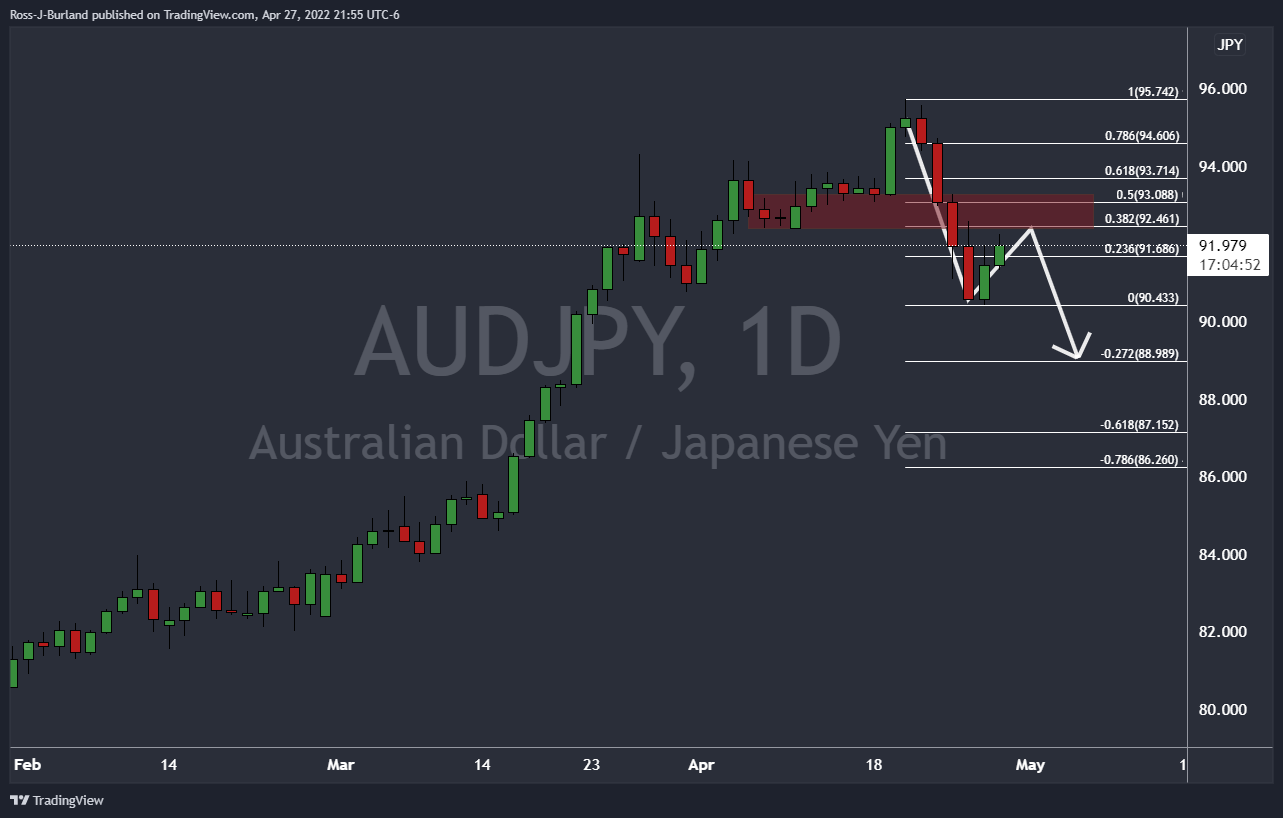
A correction of the bearish impulse into resistance and the confluence of the Fibonacci levels could be the fuel for bears to move in again for a downside extension in due course. the 38.2% and 50% ratio retracements align with prior lows on the daily chart.
- EUR/JPY recaptures 136.00 and beyond on BOJ’s inaction.
- BOJ reaffirms loose monetary policy, yen bulls thrown out of the window.
- Focus shifts to BOJ’s Kuroda’s pressure and German inflation.
EUR/JPY is holding the higher ground above 136.50, staging a sharp 100+ pips rally after the Bank of Japan (BOJ) refrained from making any monetary policy adjustment, which smashed the yen further across the board.
The BOJ decided to keep its loose monetary policy, shrugging off the weakening of the yen and rising inflationary concerns. The BOJ’s dovish stance widened the yield differential between the US and Japan and powered the USD/JPY pair almost towards the 130.00 level.
The Japanese central bank did tweak its forward guidance on the monetary policy bias but maintained its stance to hold the YYC at 0.25%. The disparity between the BOJ and the other major global central bank increased, with the European Central Bank (ECB) also seen going for the first-rate hike as early as this July,
EUR/JPY, therefore, benefits from the central banks’ divergence theme. Further, reports that the EU gas producers are preparing to pay Russia in roubles also aid the euro to pause its downslide vs. the US dollar.
Looking ahead, BOJ Governor Haruhiko Kuroda’s press conference will be eagerly awaited for his views on the yen decline and the reason to stand pat on the policy. Germany’s preliminary inflation reading will be also watched out for fresh trading impetus on the cross.
EUR/JPY technical levels
- USD/JPY shoots to near 129.54 on a neutral stance dictated by the BOJ in its monetary policy meeting.
- The decision is in-line with the market expectations as inflation is well below the target of 2%.
- The DXY is likely to advance further on higher expectations of the US Core PCE on Thursday.
The USD/JPY pair has attracted significant bids and has overstepped 129.50 as the Bank of Japan (BOJ) has kept a neutral stance on the policy rates. The BOJ has kept the rates unchanged at -0.1%.
The announcement from BOJ Governor Haruhiko Kuroda is in-line with the expectations of the street. Market participants were expecting the maintenance of a status quo amid lower inflation and aggregate demand in Japan. The recent print of the Consumer Price Index (CPI) at 1.2% is the highest in the last three years but extremely lower than the targeted figure of 2%. Therefore, a neutral stance was expected from the central bank.
The Japanese yen is facing the heat of ultra-loose monetary policy recently. Also, the stimulus package of 6.2 trillion yen ($48.2 billion) on additional gasoline subsidies, low-interest loans, and cash assistance announced on Tuesday, clearly states the need to shoring up inflation and aggregate demand in Japan.
Meanwhile, the US dollar index (DXY) is holding above the psychological support of 103.00 amid broader strength. The DXY has printed a fresh five-year high at 103.30 on Wednesday and is likely to elevate further on a higher reading of the US Core Personal Consumption Expenditure (PCE) on Thursday. The US Core PCE is seen at 5.4% against the prior print of 5%. Going forward, investors will majorly focus on the monetary policy action by the Federal Reserve (Fed) next week. The Fed is expected to adopt an aggressive hawkish stance and will elevate the interest rates by 50 basis points (bps).
The Bank of Japan was expected and has maintained its key interest rates at today’s meeting, continuing to defend low rates with bond-buying but is uber dovish and pessimistic in its guidance.
The yen is now pushed above 129 the figure and that is where it will need to stay for a convincing prospect of a continuation for the foreseeable future.
BoJ decision, statement & outlook
What we know so far, as comments and statements are dripped fed through the wires vs Reuters as follows...
- BOJ LEAVES UNCHANGED ITS FORWARD GUIDANCE ON INTEREST RATES, SAYS EXPECTS SHORT- AND LONG-TERM POLICY RATES TO REMAIN AT 'PRESENT OR LOWER' LEVELS
- 27-Apr-2022 21:09:32 - BOJ TWEAKS FORWARD GUIDANCE ON MONETARY POLICY BIAS
- 27-Apr-2022 21:10:39 - BOJ: BOJ WILL EASE POLICY WITHOUT HESITATION AS NEEDED WITH EYE ON PANDEMIC IMPACT, WHILE STRIVING TO SUSTAIN MARKET STABILITY AND SUPPORT CORPORATE FUNDING
- 27-Apr-2022 21:11:04 - BOJ CLARIFIES OPERATION ON UNLIMITED FIXED RATE BOND BUYING
- 27-Apr-2022 21:11:47 - BOJ: WILL OFFER TO BUY 10-YEAR JGB AT 0.25% EVERY BUSINESS DAY VIA FIXED RATE OPERATIONS UNLESS IT IS HIGHLY LIKELY THAT NO BIDS WILL BE SUBMITTED
More to come...
USD/JPY update
Prior to the decision, the yen was on the backfoot, testing hourly resistance:
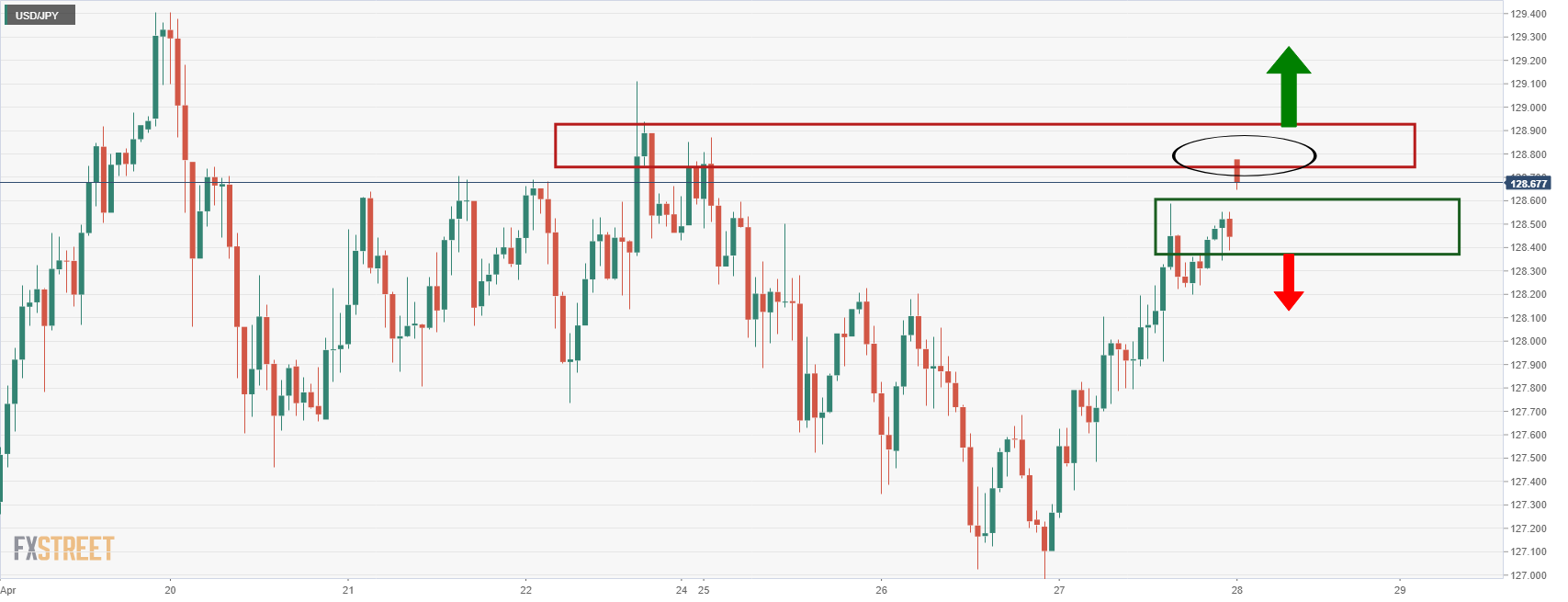
The pair was already breaking the ceiling of the bull-flag n the daily chart:
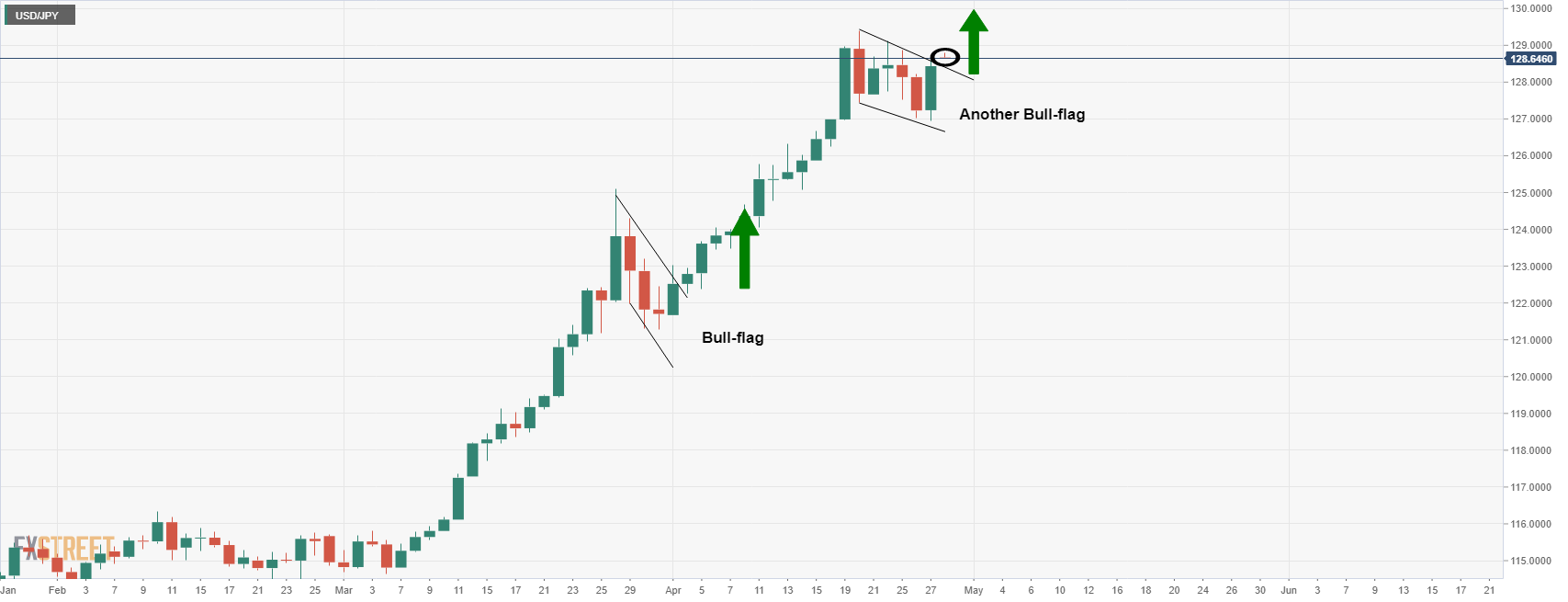
Meanwhile, the yen has dropped and is now through 129 the figure, scoring a high of 129.47 so far:
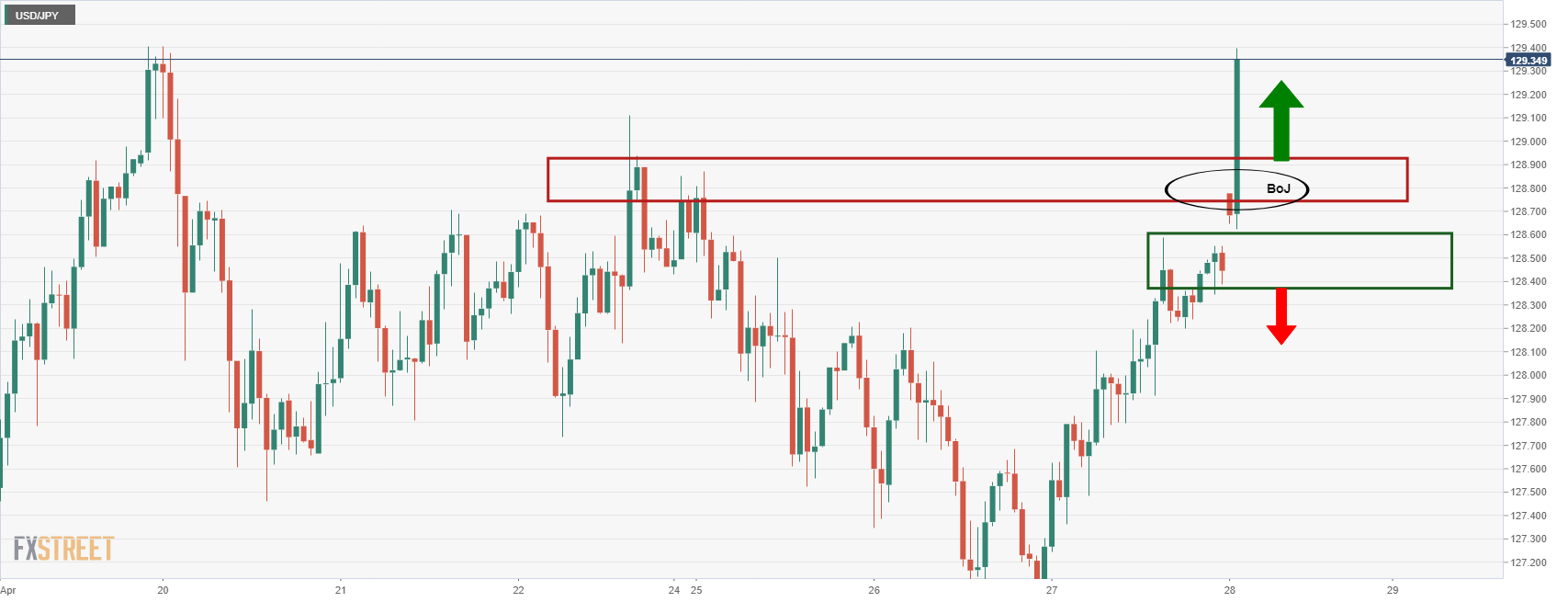
About the BoJ interest rate decision
BoJ Interest Rate Decision is announced by the Bank of Japan. Generally, if the BoJ is hawkish about the inflationary outlook of the economy and rises the interest rates it is positive, or bullish, for the JPY. Likewise, if the BoJ has a dovish view on the Japanese economy and keeps the ongoing interest rate, or cuts the interest rate it is negative, or bearish.
- West Texas Intermediate (WTI) is on the back foot, although risks continue to cascade across the energy complex.
- US oil inventories rose last week, but the black gold bleeds.
West Texas Intermediate (WTI) spot is down some 1.25% in Asia but had ended in the North American futures markets with a small gain on Wednesday following a report that US oil inventories rose last week. At the time of writing, the black gold is trading at $100.71 spot and has fallen from a high of $102.08bbls to a low of $110.63bbls.
West Texas Intermediate crude for June delivery settled up US$0.32 to US$102.02 per barrel with the focus has been on Russia's suspension of natural-gas deliveries to Bulgaria and Poland. This has raised concerns over the use of its energy exports as a weapon while the two countries declined to pay for the shipments in rubles despite Russian demands.
''While the flows into Germany via the Yamal-Europe pipeline have routinely been at zero since mid-December, reductions to other customers can add further pressures on an energy system already under extreme pressure,'' analysts at TD Securities explained.
''Furthermore, four countries have already paid in rubles and ten firms have opened accounts to meet the requirements. Europe also plans to temporarily increase purchases via these avenues to offset lost flow to Poland and Bulgaria, suggesting the fundamental impact may be muted for now, although risks to the region continue to grow,'' the analysts added.
''These risks will continue to cascade across the energy complex, as noted by a record surge in heating oil prices as shortages wreak havoc around the globe.''
Meanwhile, US oil inventory data showed an increase of 0.692mbbl. This was lower than the expected increase of 2mbbl. Gasoline inventories dropped by 1.573mbbl against expectations of 0.89mbbl build up. ''Further, US oil companies are signalling they will raise oil production from the US shale basin, which could see production ramping up by end of this year,'' analysts at ANZ Bank said.
| Raw materials | Closed | Change, % |
|---|---|---|
| Brent | 105.17 | -0.65 |
| Silver | 23.282 | -1.06 |
| Gold | 1885.67 | -1.08 |
| Palladium | 2203.29 | 2.1 |
At around 0300 GMT, (as there is no fixed time as usual for the decision, but traders will be looking for it around this time), the Bank of Japan is expected to maintain its key interest rates at today’s meeting. The BOJ continues to defend low rates with bond buying.
''Quarterly forecasts should show inflation for FY2022 revised up from 1.1% to nearer 2% but probably lower in 2023 and with Gross Domestic Product growth revised down,'' analysts at Westpac explained. ''The BoJ views the pickup in inflation as very much cost-push, not demand-pull. Governor Kuroda will be asked about the Japanese yen at the press conference.''
How might the BoJ affect USD/JPY?
While the decision itself is probably a non-mover for the yen, FX intervention themes surrounding a much stronger US dollar could be. The US dollar has rallied to five-year highs and the BoJ and US Treasury are a phone call away from collaborating on any such practice as to try and take on the market. However, jawboning has been a theme of late, as recent as early Asia with Japan's finance minister Suzuki out again commenting on the price, saying that rapid yen moves are undesirable.
Meanwhile, the bid in the US dollar has seen the price of the yen pushed to the ceiling of a short-term descending channel, drawn off the April 20 cycle high. As with the flag of late March business, the bulls will be looking for a firm close outside of the channel and the subsequent formation of a bull flag, signalling the potential for continuations for the foreseeable future.
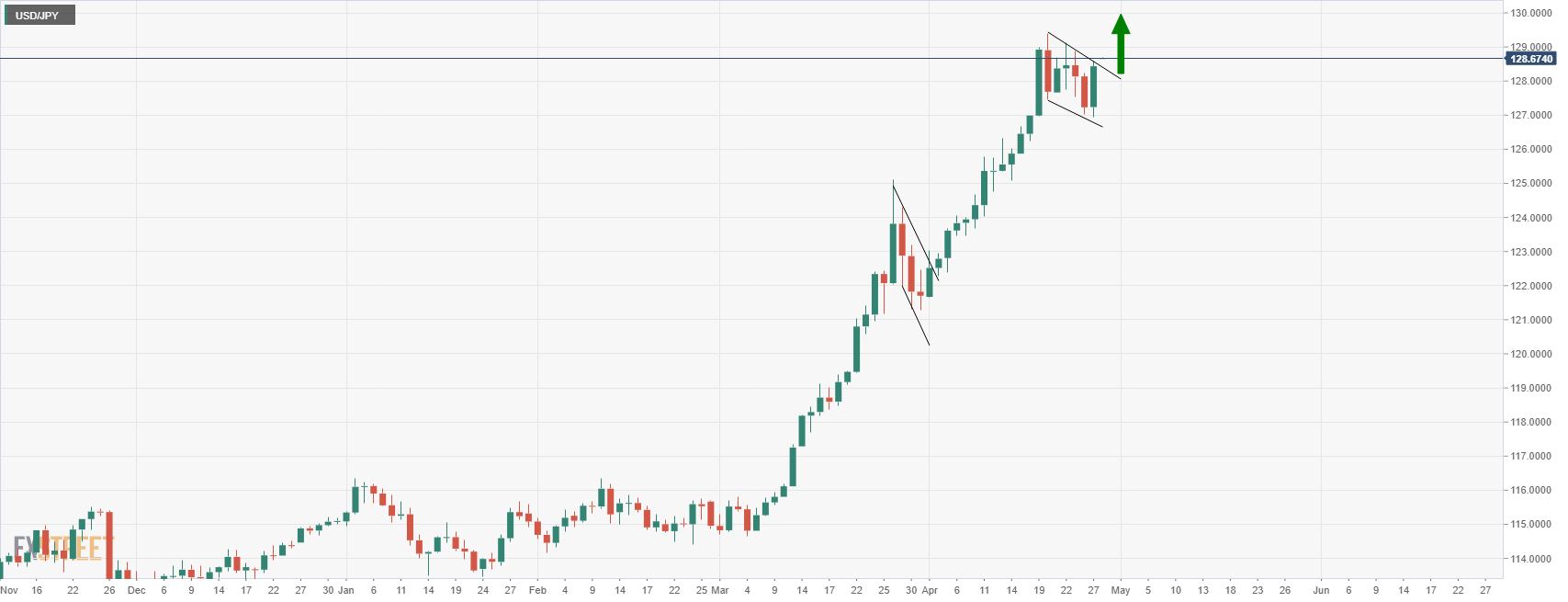
From an hourly perspective:
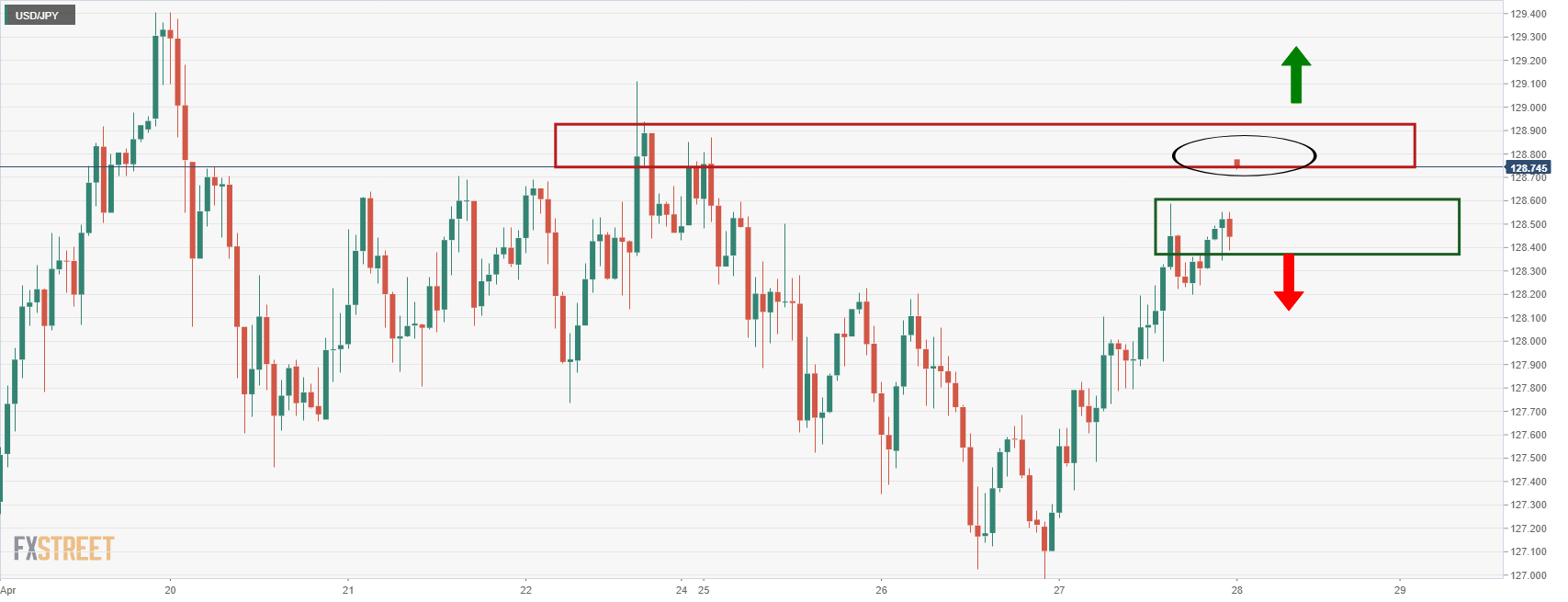
...the price is testing the key resistance area ahead of the event. Bulls will need to get through 129.00 and hold the fort above there for a convincing case for higher for longer. On a switchback, a break below the prior lows near 128.35 could be important.
About the BoJ interest rate decision
BoJ Interest Rate Decision is announced by the Bank of Japan. Generally, if the BoJ is hawkish about the inflationary outlook of the economy and rises the interest rates it is positive, or bullish, for the JPY. Likewise, if the BoJ has a dovish view on the Japanese economy and keeps the ongoing interest rate, or cuts the interest rate it is negative, or bearish.
Heading into the Bank of Japan (BOJ) policy decision, analysts at Bank of America (BofA) provide their expectations amidst the recent sharp moves in the yen.
Key quotes
"We expect the BOJ to keep all YCC settings, including the +/-25bp band around the 10yr target, unchanged at its 28 Apr MPM...Heading into the BoJ meeting, we think risks are balanced for USD/JPY...A dovish BOJ could weaken JPY toward 130 but from a macro perspective, the elevated oil price and a hawkish Fed seem to be largely priced into USD/JPY for now.
"That said, we think it will take some time before pressure over the yen dissipates. Japan's trade deficit has expanded and remains wide. Japanese companies have accelerated outward M&A activity since March. The new university fund is likely to invest into foreign assets. A dip in USD/JPY is likely to be bought from Japanese companies and investors.”
- AUD/USD is holding higher ground as Australian inflation hits 20-year highs.
- RBA May rate hike bets gain momentum amid a cautious market mood.
- Acceptance above 0.7200 is critical to cementing a recovery from two-month lows.
AUD/USD is defending the 0.7100 level so far this Thursday, as the US dollar consolidates the recent upsurge amid stabilizing risk appetite.
The aussie continues to find a floor despite the buoyant US dollar, as the 20-year Australian Inflation rate keeps an RBA May rate lift-off on the table. Analysts at JP Morgan now expected the Australian central bank to deliver a 15-basis points (bps) rate hike next week.
Australian Consumer Price Index (CPI) climbed 2.1% QoQ in Q1 vs. 1.7% expected and 1.3% previous. Moreover, the Trimmed Mean CPI rose to 1.4% vs. 1.2% expected and 1.0% seen in Q4 2021.
Meanwhile, more economic support coming from China amid covid lockdowns, in terms of stabilizing employment, monetary policy measures and infrastructure projects, also seems to comfort AUD bulls.
Despite aussie’s resilience, the broad US dollar demand is likely to weigh on the major, with further downside likely on the cards should the American Q1 advance GDP reading beat estimates.
Technically, AUD/USD is clinging onto the 0.7100 demand area, which if caved in can trigger a sharp move lower towards mid-0.7000s or February 4 lows.
Further south, the February lows of 0.7032 could come into play.
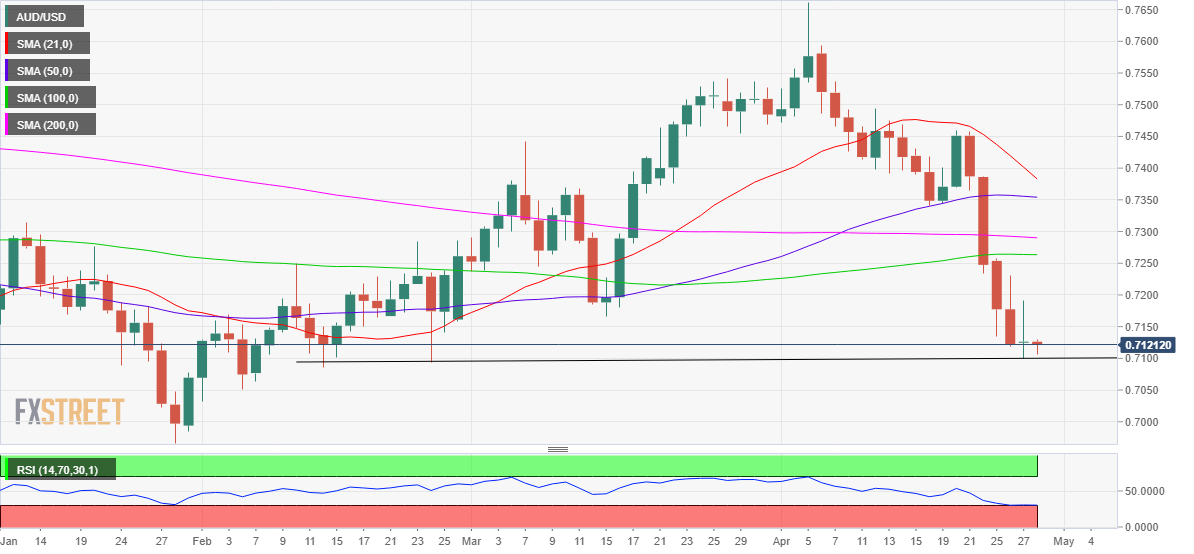
AUD/USD: Daily chart
The 14-day Relative Strength Index (RSI) is flattening out, sitting just above the oversold territory, supporting the bulls for now.
Should the recovery gain momentum, the immediate resistance is seen at 0.7150, the psychological level, above which the previous day’s high of 0.7191 will be retested.
Only a daily closing above 0.7200 could help reverse the ongoing downtrend in the aussie.
AUD/USD: Additional levels to consider
Japanese Finance Minister Shunichi Suzuki is making some comments on the latest slump in the yen, noting that “rapid yen moves are undesirable.”
Suzuki said that he expects “the Bank of Japan (BOJ) to guide policy appropriately.”
Market reaction
USD/JPY was last seen trading at 128.75, up 0.22% on the day. The yen plunged, snapping the recent recovery rally, as the US dollar demand dominated across the board. The pair looks to recapture 129.00 on dovish BOJ policy decision .
- BOJ Rate Decision: Sharp yen moves grab attention
- EUR/JPY has inched higher to 136.00 as investors await monetary policy announcement by the BOJ.
- Japan has announced more stimulus packages to spurt households’ real income.
- Weaponry shipments to Ukraine by the US and Europe have escalated uncertainty in the eurozone.
The EUR/JPY pair has moved towards the north after displaying back and forth moves in a narrow range of 135.41-135.68 right from the New York session as investors are awaiting the announcement of the interest rate decision by the Bank of Japan (BOJ).
Considering the lower inflation in Japan at 1.2% recorded for March 2022 against the targeted inflation of 2%, the BOJ is expected to dictate a neutral stance in its monetary policy statement. The Japanese yen has been performing vulnerable for the past few trading weeks amid its ultra-loose monetary policy. Advancing energy bills and food prices have resulted in a reduction in the real income of the households and henceforth lower aggregate demand.
On Tuesday, Japan’s administration announced that it is planning to spend 6.2 trillion yen ($48.2 billion) on additional gasoline subsidies, low-interest loans, and cash assistance to alleviate the pain of consumers and small businesses facing rising prices, as per Nikkei Asia. More stimulus from the Japanese agencies is hurting Tokyo’s currency.
Meanwhile, the shared currency is facing the heat of lower risk appetite as comments from Russia are weighing pressure on the risk-sensitive currencies. Russian foreign minister Lavrov has stated that the threat of nuclear war is “real” after shipments of weaponry aid from the US and Europe to Ukraine. Also, Moscow announced that Poland and Bulgaria would face natural gas supply cuts on failing to pay in rubles.
- The DXY has reclaimed 103.00 amid broader strength in the Fx domain.
- The advancing odds of an extremely tight monetary policy by the Fed are strengthening the DXY.
- US Core PCE and GDP will remain in focus.
The US dollar index (DXY) has rebounded sharply from 102.83 as indicators turned oversold on the smaller timeframes and investors went along with broader strength in the concerned index. The DXY is marching towards the latest five-year high at 103.30 firmly. In a while, it is worth noting that the DXY is printing fresh highs after minor pullbacks backed by progressing odds of a jumbo rate hike by the Federal Reserve (Fed).
Expectations of a 50 basis point (bps) have been bolstered after Fed chair Jerome Powell dictated that a rate hike by 50 bps is on the table. Well, much confident tone from the highest rank of the Fed is sufficient to claim certainty of an aggressive hawkish stance from the central bank in May.
US Core PCE and GDP
Next trigger that will guide investors for the likely direction of the DXY is the release of the US Core Personal Consumption Expenditure (PCE) on Thursday. The core PCE is seen at 5.4% against the prior print of 5%. Higher core PCE reading will bolster the odds of a hawkish Fed guidance. Along with that, US Gross Domestic Product (GDP) will also release on Thursday. The quarterly and yearly GDP are seen at 7.3% and 1.1% respectively.
Key events this week: Core PCE, GDP, Initial Jobless Claims, Michigan Consumer Sentiment Index (CSI), and Personal Income.
Eminent issues on the back boiler: Russia-Ukraine Peace Talks, Bank of Japan (BOJ) interest rate decision, Swiss National Bank (SNB) chairman Thomas J. Jordan’s speech.
In recent trade today, the People’s Bank of China (PBOC) set the yuan (CNY) at 6.5628 vs. the last close of 6.5615.
About the fix
China maintains strict control of the yuan’s rate on the mainland.
The onshore yuan (CNY) differs from the offshore one (CNH) in trading restrictions, this last one is not as tightly controlled.
Each morning, the People’s Bank of China (PBOC) sets a so-called daily midpoint fix, based on the yuan’s previous day closing level and quotations taken from the inter-bank dealer.
- AUD/JPY has climbed to near 91.68 on an expectation of a neutral stance from the BOJ.
- The BOJ will keep the rates unchanged backed by lower inflation and growth rate.
- Higher inflation in the Aussie area could compel the RBA for a rate hike.
The AUD/JPY pair has attracted offers near 91.60 in the early Tokyo session as investors are eyeing the monetary policy announcement by the Bank of Japan (BOJ) on Thursday. The pair is oscillating in a narrow range of 91.02-91.98 from Wednesday as the uncertainty over the announcement of the interest rate decision by the BOJ has sidelined the market participants.
As per the market consensus, the BOJ will maintain the status quo by keeping the interest rates unchanged. Inflation in Japan at 1.2% has been the highest recorded figure since October 2018 but is still significantly lower than the targeted inflation of 2%. Along with that, the growth rate in Japan has yet not reached its pre-pandemic levels, therefore a rate hike decision is completely out of the sight. So, an ultra-loose monetary policy will remain the key and more stimulus packages could be announced.
Meanwhile, the odds of a rate hike by the Reserve Bank of Australia (RBA) have spurted principally after the Australian Bureau of Statistics reported yearly Australian inflation at 5.1%. The Consumer Price Index (CPI) print came well above the forecast of 4.6%. Also, the quarterly CPI came in at 2.1% against the estimates of 1.7%. The RBA, in its last monetary policy meeting, dictated that they don’t see any real price pressure, which could compel them to announce a rate hike, and adapted a data-dependent approach for further guidance. Now, the table could turn in the favor of hawkish monetary policy in May.
- EUR/USD bulls are mauled by the bears and there could be more to go to the downside.
- The focus is on the US GDP for the day ahead.
At 1.0552, EUR/USD is around flat in the Tokyo open as the price consolidates below 50% mean reversion of the prior session sell-off. The pair, however, remains in the hands of the bears amid the Ukraine crisis and risk-off markets that favour the US dollar.
The greenback was a lot stronger versus its major trading partners mid-week as traders await the advance Gross Domestic Product reading for Q1 that will be released today along with weekly initial jobless claims, followed by Personal Income and Spending, the Michigan Sentiment Index on Friday and the Federal Reserve next week.
While Fed members remain in a quiet period before the May 3-4 Federal Open Market Committee meeting, the focus has turned towards the Chinese covid lockdowns and the Ukraine crisis with risks to eurozone economic growth.
Russia cut off gas supplies to parts of the region. Russia's Gazprom (GAZP) halted gas supplies to Poland and Bulgaria on Wednesday over their failure to pay in roubles, cranking up an economic war with Europe in response to Western sanctions imposed for Moscow's invasion of Ukraine.
Meanwhile, as China enacts lockdowns in a bid to stem the spread of COVID-19, Beijing has ramped up mass testing for COVID-19 and the combination of expectations of 50 basis points at the Fed's May 3-4 meeting is weighing in the single currency. WIRP suggests 50 bp hikes at the May 3-4 and June 14-15 meetings are fully priced in, with nearly 25% odds of a possible 75 bp move in June.
US dollar on fire
The dollar index against a basket of currencies (DXY) reached 103.282, the highest since Jan. 2017. ''We continue to target the March 2020 high near 103 but have gotten here much sooner than we expected,'' analysts at Brown Brothers Harriman said.
''As such, we have to start looking ahead as we think the strong dollar trend will remain in play through Q2 and into Q3. After 103, there's the December 2016 high near 103.65 but that's really not that far off either. After that, there really aren't any significant chart points until we get to the September 2002 high near 109.24.''
''This seems to be a bridge too far. Yes, we are dollar bulls but we don't think it can rally another 6-7% from current levels. Perhaps we can get up to 105 before topping out but that's really just a guess at this point, pure and simple.''
In contrast to the Fed and expectations in the markets, the European Central Bank's tightening path is a bit behind. Some ECB officials are calling for the next rate increase in July. Traders, in this respect, will be looking to EU inflation data that will be released on Friday.
EUR/USD technical analysis
From an hourly perspective, there is the potential for a downward continuation as per the correction meeting the 50% mean reversion mark, a bearish engulfing and drift to the downside again:
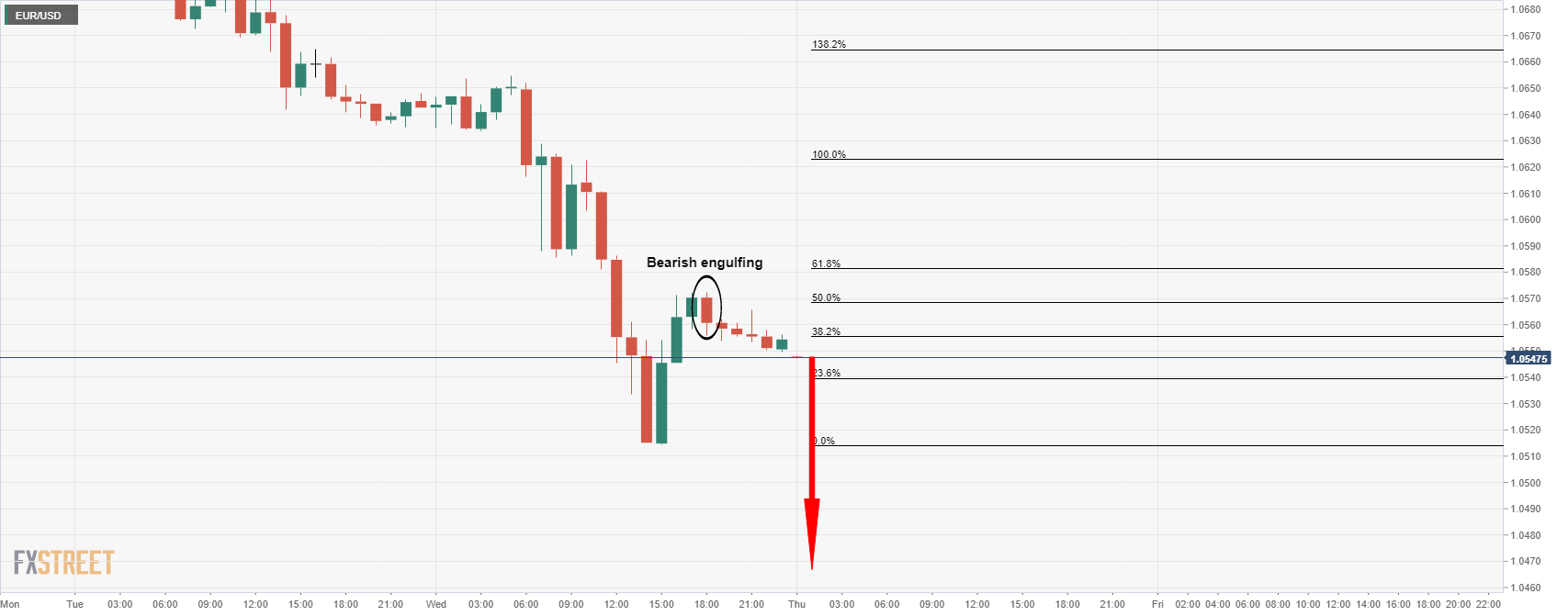
| Index | Change, points | Closed | Change, % |
|---|---|---|---|
| NIKKEI 225 | -313.48 | 26386.63 | -1.17 |
| Hang Seng | 11.65 | 19946.36 | 0.06 |
| KOSPI | -29.25 | 2639.06 | -1.1 |
| ASX 200 | -64.5 | 7253.5 | -0.88 |
| FTSE 100 | 39.41 | 7425.61 | 0.53 |
| DAX | 37.54 | 13793.94 | 0.27 |
| CAC 40 | 30.69 | 6445.26 | 0.48 |
| Dow Jones | 61.75 | 33301.93 | 0.19 |
| S&P 500 | 8.76 | 4183.96 | 0.21 |
| NASDAQ Composite | -1.81 | 12488.93 | -0.01 |
| Pare | Closed | Change, % |
|---|---|---|
| AUDUSD | 0.71224 | -0.03 |
| EURJPY | 135.582 | 0.31 |
| EURUSD | 1.05534 | -0.83 |
| GBPJPY | 161.072 | 0.85 |
| GBPUSD | 1.25409 | -0.26 |
| NZDUSD | 0.6543 | -0.33 |
| USDCAD | 1.28143 | -0.03 |
| USDCHF | 0.96853 | 0.67 |
| USDJPY | 128.449 | 1.12 |
- USD/CAD is hovering around 1.2824 ahead of US Core PCE and GDP.
- Investors should brace for a hawkish stance along with hawkish guidance from the Fed.
- Lonnie bulls are performing lackluster as oil prices consolidate.
The USD/CAD pair is trading lackluster in the early Asian session amid uncertainty over the release of the US core Personal Consumption Expenditures (PCE) on Thursday. As per the market forecasts, a reading of 5.4% is seen against the prior print of 5%. This may raise the odds of an extremely aggressive tone from the Federal Reserve (Fed) chair Jerome Powell in May.
The asset has been scaling higher from the last week as expectations of an interest rate hike by the Fed have bolstered. After the statement from Fed chair Jerome Powell at the International Monetary Fund (IMF) meeting that a rate hike of 50 basis points (bps) by the Fed in May is on the cards, an announcement of the same has remained a formality now. Therefore, investors are more focused on the further guidance to be dictated by the Fed in May’s monetary policy. Considering the ramping up inflation and consistency in the maintenance of full employment, investors should brace for a tight liquidity environment for the rest of the year.
Meanwhile, loonie bulls are less effective amid steady oil prices. The supply worries from Russia vs. reduction in global growth forecasts and a pandemic fear in China is restricting the black gold from any major movement in these trading sessions.
Apart from the US Core PCE, investors will also focus on the US Gross Domestic Product (GDP) numbers, which are also due on Thursday. A preliminary estimate for the annualized GDP at 1.1% indicates underperformance against the prior print of 6.9%.







© 2000-2026. All rights reserved.
This site is managed by Teletrade D.J. LLC 2351 LLC 2022 (Euro House, Richmond Hill Road, Kingstown, VC0100, St. Vincent and the Grenadines).
The information on this website is for informational purposes only and does not constitute any investment advice.
The company does not serve or provide services to customers who are residents of the US, Canada, Iran, The Democratic People's Republic of Korea, Yemen and FATF blacklisted countries.
Making transactions on financial markets with marginal financial instruments opens up wide possibilities and allows investors who are willing to take risks to earn high profits, carrying a potentially high risk of losses at the same time. Therefore you should responsibly approach the issue of choosing the appropriate investment strategy, taking the available resources into account, before starting trading.
Use of the information: full or partial use of materials from this website must always be referenced to TeleTrade as the source of information. Use of the materials on the Internet must be accompanied by a hyperlink to teletrade.org. Automatic import of materials and information from this website is prohibited.
Please contact our PR department if you have any questions or need assistance at pr@teletrade.global.


 Bank
Bank transfers


