- Analytics
- News and Tools
- Market News
Analytics, News, and Forecasts for CFD Markets: raw news — 13-02-2017.
(raw materials / closing price /% change)
Oil 52.87 -0.11%
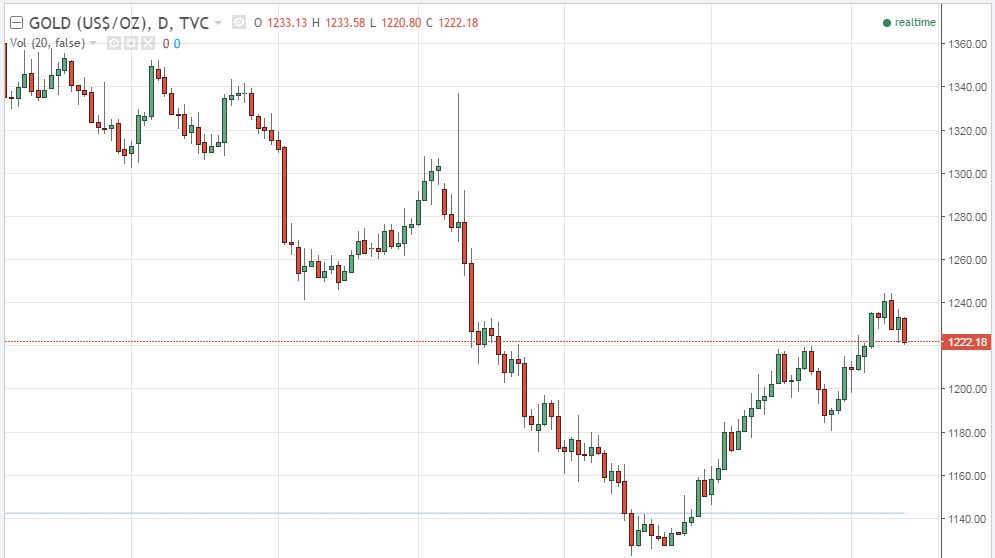
Gold 1,226.10 +0.02%
Gold prices fell to a more than one-week low on Monday, as a stronger dollar weighed on the metal and investors awaited a meeting from the Federal Reserve later this week, says Dow Jones.
Spot gold fell by 0.43% to $1,230.60 a troy ounce in midmorning trade in Europe, the lowest price since Feb. 3.
On Monday, the WSJ Dollar Index, which weighs the dollar against a basket of other currencies, was up 0.08%. A stronger dollar is often bearish for gold and other dollar-denominated commodities, because it makes the metal more expensive for investors who hold other currencies.
Investors were waiting for comments from Federal Reserve Chairwoman Janet Yellen on Tuesday and Wednesday. However, a rate increase isn't expected until June, according to Fed fund futures tracked by CME.
The OPEC Reference Basket averaged $52.40/b in January, representing a gain of 73¢ over the previous month. NYMEX WTI and ICE Brent also saw gains, increasing by 44¢ and 53¢ to average $52.61/b and $55.45/b, respectively. Production adjustments by OPEC and some non-OPEC producers supported the market, although gains were capped by increased drilling activity in the US. The Brent-WTI spread widened slightly to average $2.84/b in January.
Global economic growth expectations remain at 3.0% in 2016 and 3.2% in 2017. OECD growth in 2017 was revised up to 1.9%, following upward adjustments in the Euro-zone and UK. US economic growth remains unchanged at 2.2%. Forecasts for China and India in 2017 also remain unchanged at 6.2% and 7.1%, respectively. Russia's 2017 growth was revised up to 1.0%, while Brazil's growth forecast remains unchanged at 0.4%.
World oil demand growth in 2016 is expected to increase by 1.32 mb/d, following an upward adjustment of 70 tb/d to reflect continued better-than-expected consumption in OECD Europe and Asia Pacific. Total oil demand is now estimated to average 94.62 mb/d, taking into account base line adjustments to China of around 0.12 mb/d. In 2017, world oil demand growth is seen to reach 1.19 mb/d, representing an upward revision of 35 tb/d to now average 95.81 mb/d.
This morning, the New York futures for Brent fell 0.78% to $ 56.26 and WTI fell 0.84% to $ 53.42. Recall OPEC members and Russia agreed to reduce production by about 1.8 million barrels per day in order to restore balance in the global supply. Russia in January has reduced production to 11.11 million bpd from 11.21 million bpd in December 2016.
At the same time, drilling rigs in the US rose by 8 to 591 units, Baker Hughes data. This is the highest since October 2015.







© 2000-2026. All rights reserved.
This site is managed by Teletrade D.J. LLC 2351 LLC 2022 (Euro House, Richmond Hill Road, Kingstown, VC0100, St. Vincent and the Grenadines).
The information on this website is for informational purposes only and does not constitute any investment advice.
The company does not serve or provide services to customers who are residents of the US, Canada, Iran, The Democratic People's Republic of Korea, Yemen and FATF blacklisted countries.
Making transactions on financial markets with marginal financial instruments opens up wide possibilities and allows investors who are willing to take risks to earn high profits, carrying a potentially high risk of losses at the same time. Therefore you should responsibly approach the issue of choosing the appropriate investment strategy, taking the available resources into account, before starting trading.
Use of the information: full or partial use of materials from this website must always be referenced to TeleTrade as the source of information. Use of the materials on the Internet must be accompanied by a hyperlink to teletrade.org. Automatic import of materials and information from this website is prohibited.
Please contact our PR department if you have any questions or need assistance at pr@teletrade.global.


 Bank
Bank transfers


