- Analytics
- News and Tools
- Market News
- The price of oil rose slightly
The price of oil rose slightly
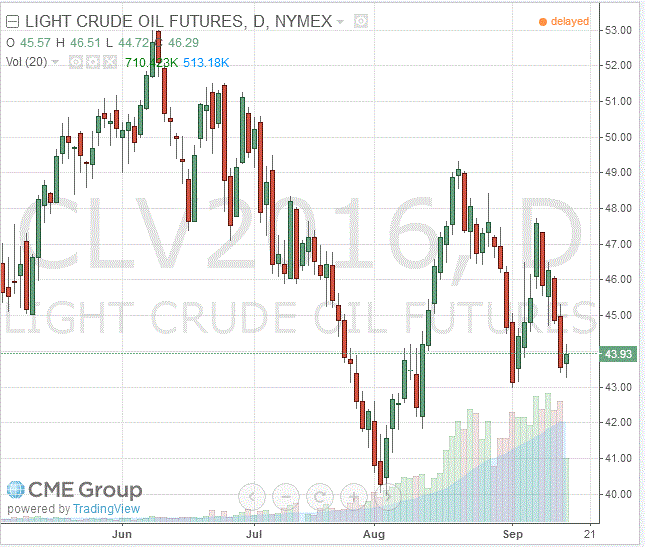
Oil futures rose slightly, helped by the partial closure of short positions after the two-day drop. However, further price growth is limited by a stronger dollar and concerns about the resumption of crude oil deliveries from Nigeria and Libya.
Over the previous two sessions, the price of oil fell by about 6 percent, being under the pressure of the mixed data from the Ministry of Energy, as well as forecasts from the IEA and OPEC, which signaled the possibility of maintaining a global oversupply of oil next year.
Today, the US dollar index showing the US dollar against a basket of six major currencies, rose 0.1%. Since gold prices are tied to the dollar, a stronger dollar makes oil more expensive for holders of foreign currencies.
In addition, it became known that the State Oil Corporation of Libya has removed restrictions on the supply of oil from a number of ports, the total capacity of 300 thousand barrels per day. Meanwhile, Exxon Mobil and Royal Dutch Shell said that were ready to resume the supply of Nigerian grade Qua Iboe. According to estimates, Libya and Nigeria may return to the market about 800 thousand barrels per day, resulting in a tripling of the global oversupply.
"The absence of factors that could affect the oil market and lead to a significant increase in prices will lead to a range trange in $ 45-50 next 12 months", - says Goldman Sachs analyst Jeffrey Currie.
The cost of the October futures for US light crude oil WTI (Light Sweet Crude Oil) rose to 43.93 dollars per barrel on the New York Mercantile Exchange.
October futures price for North Sea petroleum mix of Brent rose to 46.60 dollars a barrel on the London Stock Exchange ICE Futures Europe.







© 2000-2026. All rights reserved.
This site is managed by Teletrade D.J. LLC 2351 LLC 2022 (Euro House, Richmond Hill Road, Kingstown, VC0100, St. Vincent and the Grenadines).
The information on this website is for informational purposes only and does not constitute any investment advice.
The company does not serve or provide services to customers who are residents of the US, Canada, Iran, The Democratic People's Republic of Korea, Yemen and FATF blacklisted countries.
Making transactions on financial markets with marginal financial instruments opens up wide possibilities and allows investors who are willing to take risks to earn high profits, carrying a potentially high risk of losses at the same time. Therefore you should responsibly approach the issue of choosing the appropriate investment strategy, taking the available resources into account, before starting trading.
Use of the information: full or partial use of materials from this website must always be referenced to TeleTrade as the source of information. Use of the materials on the Internet must be accompanied by a hyperlink to teletrade.org. Automatic import of materials and information from this website is prohibited.
Please contact our PR department if you have any questions or need assistance at pr@teletrade.global.


 Bank
Bank transfers


