- Analytics
- News and Tools
- Market News
- USD/CAD drops from around 1.3700 to 1.3605 after the BoC 50 bps rate hike
USD/CAD drops from around 1.3700 to 1.3605 after the BoC 50 bps rate hike
- The Loonie appreciates against the US Dollar following the Bank of Canada 50 bps rate hike.
- The Bank of Canada expects further tightening as core CPI persists at 5%.
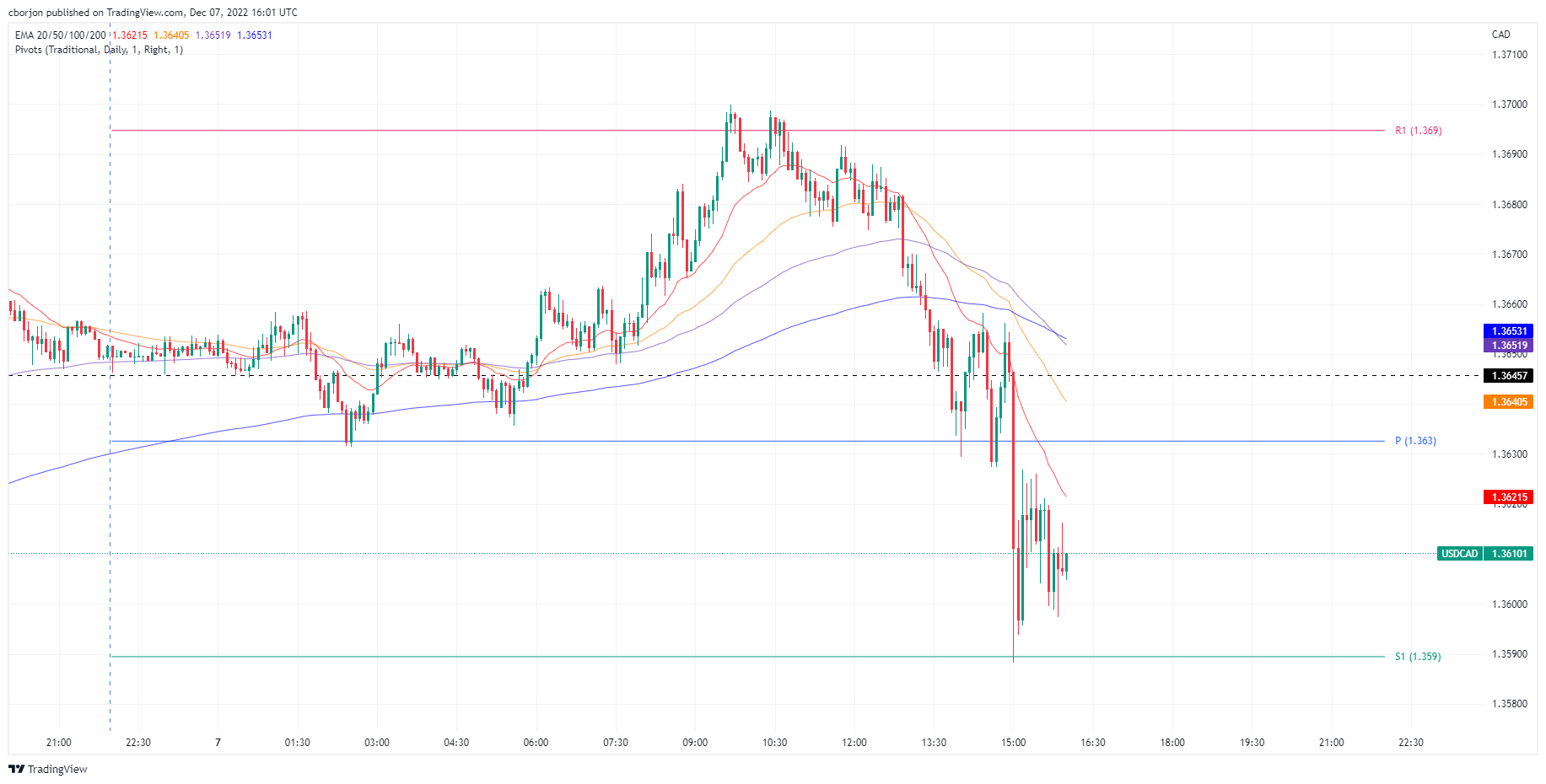
- After the BoC’s decision, the USD/CAD tumbled from around 1.3660 to its daily low of 1.3588.
The USD/CAD tumbled during the North American session after the Bank of Canada (BoC) lifted rates by 50 bps, from 3.75% to 4.25%, in line with analysts’ expectations, triggering a fall from around 1.3700 to 1.3505. At the time of writing, the USD/CAD remains volatile, trading around 1.3600-1.3615.
Bank of Canada remarks of its monetary policy statement
The Bank of Canada mentioned that inflation worldwide remains high and broadly based. Even though growth is slowing, the BoC said that the US economy is proving to be resilient, with consumption rising and the labor market “overheated.” They commented that supply bottlenecks are easing, though geopolitical events could disrupt it.
The BoC acknowledged that the labor market is tight, and the Q3 GDP was stronger than expected and commented that “there is growing evidence that tighter monetary policy is restraining domestic demand, consumption moderated in the third quarter, and housing market activity continues to decline.”
The Governing Council noted that inflation remains too high, and short-term inflation expectations remain elevated. Traders should know that CPI is at 6.9%, while core CPI is around 5%.
The BoC finished its statement by saying that further rate hikes would be needed to bring supply and demand into balance, adding that Quantitative Tightening (QT) “is complementing increases in the policy rate.”
USD/CAD Reaction to the Bank of Canada decision
The USD/CAD 5-minute chart portrayed the pair as seesawing around the daily pivot point at 1.3630 and the 1.366 area before the decision crossed newswires. After the headline, the USD/CAD tumbled towards its daily low of 1.3587 before stabilizing in the 1.3600-1.3620 range, below the 20-Exponential Moving Average (EMA) at 1.3623.







© 2000-2026. All rights reserved.
This site is managed by Teletrade D.J. LLC 2351 LLC 2022 (Euro House, Richmond Hill Road, Kingstown, VC0100, St. Vincent and the Grenadines).
The information on this website is for informational purposes only and does not constitute any investment advice.
The company does not serve or provide services to customers who are residents of the US, Canada, Iran, The Democratic People's Republic of Korea, Yemen and FATF blacklisted countries.
Making transactions on financial markets with marginal financial instruments opens up wide possibilities and allows investors who are willing to take risks to earn high profits, carrying a potentially high risk of losses at the same time. Therefore you should responsibly approach the issue of choosing the appropriate investment strategy, taking the available resources into account, before starting trading.
Use of the information: full or partial use of materials from this website must always be referenced to TeleTrade as the source of information. Use of the materials on the Internet must be accompanied by a hyperlink to teletrade.org. Automatic import of materials and information from this website is prohibited.
Please contact our PR department if you have any questions or need assistance at pr@teletrade.global.


 Bank
Bank transfers


