- Analytics
- News and Tools
- Market News
- NZD/USD deepens decline as sentiment wanes and US Dollar strengthens
NZD/USD deepens decline as sentiment wanes and US Dollar strengthens
- NZD/USD prints a daily high of 0.5869 before dropping to 0.5825, losing 0.30% amidst strong USD.
- US Dollar Index (DXY) gains 0.11%, reaching 106.35, boosted by the Middle East conflict and strong US economic data.
- New Home Sales in the US rose 12.3% MoM in September, contributing to the Greenback's strength.
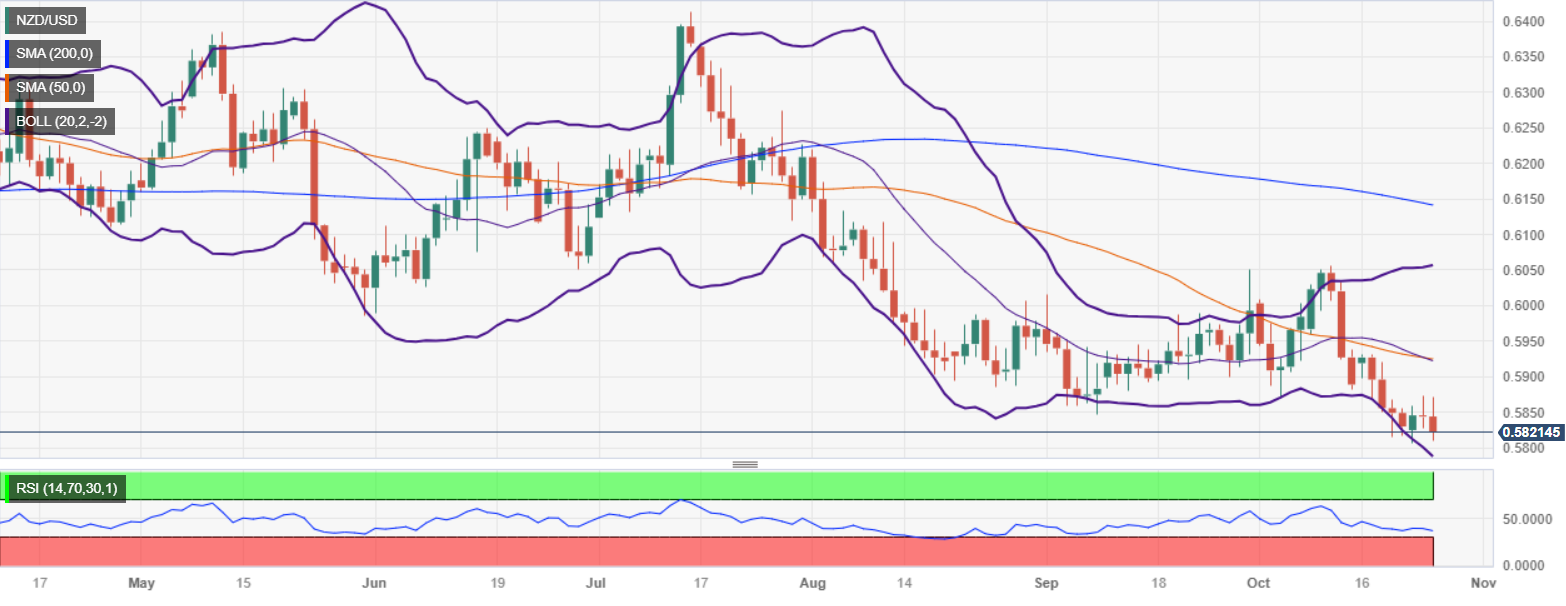
NZD/USD extended its losses during the North American session after printing a daily high of 0.5869, but market sentiment deterioration and a strong US Dollar (USD) dragged the exchange rate towards 0.5825, as the pair is losing 0.30%.
NZD/USD drops to 0.5825, losing 0.30% as US Dollar strengthens and Middle East conflict looms
Risk aversion continued to dominate price action as the Greenback (USD) continued to climb, with the US Dollar Index (DXY) gaining 0.11%, up at 106.35, boosted by the Middle East conflict. Although Israel has not begun its ground offensive in Gaza, an escalation that could involve more participants besides Israel and Hamas looms.
Data-wise, the US economic docket featured New Home Sales, which surprisingly rose 12.3% MoM in September, crushing the prior month’s -8.2% contraction, the fastest pace since early 2022. This data, along with Tuesday’s S&P Global PMIs in the US, revealing that business activity is improving, underpins the Greenback as the chances for a soft-landing increase.
On the Kiwi front, news from China sponsored a leg-up in the NZD/USD towards its daily high, as President Xi Jinping visited the People’s Bank of China (PBoC), China’s central bank aimed to issue additional sovereign debt, as the country struggles to recover from the Covid-19 pandemic measures. Nevertheless, the recovery was short-lived as sentiment shifted sour.
NZD/USD Price Analysis: Technical outlook
After forming an ‘evening-star’ chart pattern, the NZD/USD is resuming its downward bias, though it remains shy of extending its downtrend past the October 23 low of 0.5807. A breach of the latter will expose the 0.588 figure, followed by the November 3, 2022, swing low of 0.5740. Conversely, if buyers reclaim the October 24 high at 0.5872, a challenge of the 0.5900 mark is on the cards.







© 2000-2026. All rights reserved.
This site is managed by Teletrade D.J. LLC 2351 LLC 2022 (Euro House, Richmond Hill Road, Kingstown, VC0100, St. Vincent and the Grenadines).
The information on this website is for informational purposes only and does not constitute any investment advice.
The company does not serve or provide services to customers who are residents of the US, Canada, Iran, The Democratic People's Republic of Korea, Yemen and FATF blacklisted countries.
Making transactions on financial markets with marginal financial instruments opens up wide possibilities and allows investors who are willing to take risks to earn high profits, carrying a potentially high risk of losses at the same time. Therefore you should responsibly approach the issue of choosing the appropriate investment strategy, taking the available resources into account, before starting trading.
Use of the information: full or partial use of materials from this website must always be referenced to TeleTrade as the source of information. Use of the materials on the Internet must be accompanied by a hyperlink to teletrade.org. Automatic import of materials and information from this website is prohibited.
Please contact our PR department if you have any questions or need assistance at pr@teletrade.global.


 Bank
Bank transfers


