- Analytics
- News and Tools
- Market News
Analytics, News, and Forecasts for CFD Markets: currency news — 01-02-2018.
(pare/closed(GMT +2)/change, %)
EUR/USD $1,2505 +0,74%
GBP/USD $1,4262 +0,49%
USD/CHF Chf0,9262 -0,53%
USD/JPY Y109,40 +0,21%
EUR/JPY Y136,81 +0,94%
GBP/JPY Y156,03 +0,69%
AUD/USD $0,8078 +0,27%
NZD/USD $0,7394 +0,41%
USD/CAD C$1,2266 -0,39%
00:30 Australia Producer price index, q / q Quarter IV 0.2% 0.2%
00:30 Australia Producer price index, y/y Quarter IV 1.6% 1.2%
09:30 United Kingdom PMI Construction January 52.2 52.0
10:00 Eurozone Producer Price Index, MoM December 0.6% 0.1%
10:00 Eurozone Producer Price Index (YoY) December 2.8% 2.3%
13:30 U.S. Government Payrolls January 2
13:30 U.S. Manufacturing Payrolls January 25 20
13:30 U.S. Average workweek January 34.5 34.5
13:30 U.S. Private Nonfarm Payrolls January 146 180
13:30 U.S. Labor Force Participation Rate January 62.7% 62.8%
13:30 U.S. Average hourly earnings January 0.3% 0.3%
13:30 U.S. Unemployment Rate January 4.1% 4.1%
13:30 U.S. Nonfarm Payrolls January 148 180
15:00 U.S. Factory Orders December 1.3% 0.6%
15:00 U.S. Reuters/Michigan Consumer Sentiment Index
(Finally) January 95.9 95
18:00 U.S. Baker Hughes Oil Rig Count February 759 758
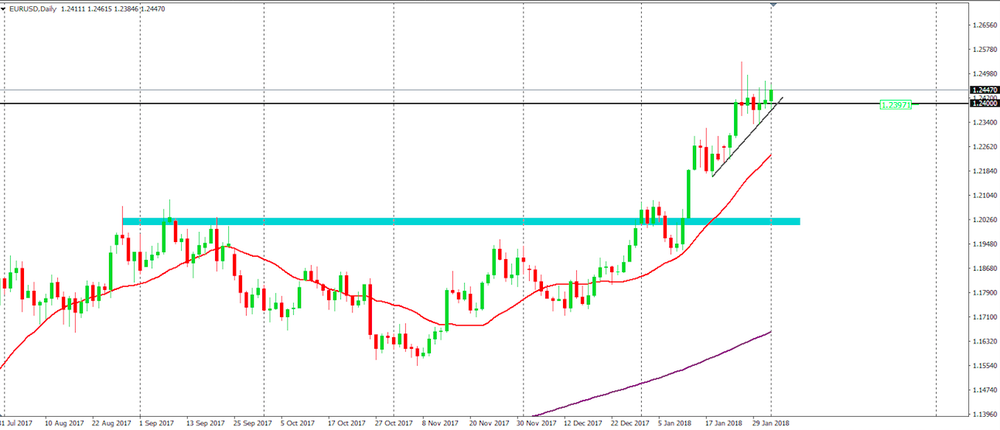
EUR/USD is currently in a relatively important are close to 1.24.
On daily time frame chart, we can see that the price has been shown some indecision.
However, that below the price it has formed a upside trend line which the price has been respecting quite well.
Therefore, if the price keeps above the resistance level at 1.24 and the upside trend line, then we can expect a further bullish movement on eur/usd.
Economic activity in the manufacturing sector expanded in January, and the overall economy grew for the 105th consecutive month, say the nation's supply executives in the latest Manufacturing ISM Report On Business.
The report was issued today by Timothy R. Fiore, Chair of the Institute for Supply Management: "The January PMI registered 59.1 percent, a decrease of 0.2 percentage point from the seasonally adjusted December reading of 59.3 percent. The New Orders Index registered 65.4 percent, a decrease of 2 percentage points from the seasonally adjusted December reading of 67.4 percent. The Production Index registered 64.5 percent, a 0.7 percentage point decrease compared to the seasonally adjusted December reading of 65.2 percent. The Employment Index registered 54.2 percent, a decrease of 3.9 percentage points from the seasonally adjusted December reading of 58.1 percent".
Nonfarm business sector labor productivity decreased 0.1 percent during the fourth quarter of 2017, the U.S. Bureau of Labor Statistics reported today, as
output increased 3.2 percent and hours worked increased 3.3 percent. (All quarterly percent changes in this release are seasonally adjusted annual rates.) From the fourth quarter of 2016 to the fourth quarter of 2017, productivity increased 1.1 percent, reflecting a 3.2-percent increase in output and a 2.1-percent increase in hours worked.
Annual average productivity increased 1.2 percent from 2016 to 2017.
In the week ending January 27, the advance figure for seasonally adjusted initial claims was 230,000, a decrease of 1,000 from the previous week's revised level. The previous week's level was revised down by 2,000 from 233,000 to 231,000. The 4-week moving average was 234,500, a decrease of 5,000 from the previous week's revised average. The previous week's average was revised down by 500 from 240,000 to 239,500.
-
Revises 10-year U.S. treasury yield forecasts upwards, now expects 2.90 percent by end-2018 (pvs 2.70 pct)
The start of 2018 saw a further easing in the rate of expansion of the UK manufacturing sector. At 55.3 in January, the seasonally adjusted IHS Markit/CIPS Purchasing Managers' Index was down further from November's 51-month high and at its lowest level since June last year. That said, the PMI remained well above its long-run average of 51.7. The latest survey was conducted from 12-26 January.
Manufacturing output continued to rise at a solid pace, although the rate of expansion eased to a six-month low. Higher production reflected rising new order intakes, albeit the slowest in seven months, which increased through robust demand from both domestic and export clients.
The eurozone manufacturing sector made a strong start to 2018. Although January saw rates of growth in output and new orders ease from near-record highs at the end of last year, they remained among the best seen since the survey began in 1997.
The final IHS Markit Eurozone Manufacturing PMI posted a three-month low of 59.6 in January, down from December's record high of 60.6 and identical to the earlier flash estimate. The PMI has signalled expansion in each of the past 55 months.
The final IHS Markit/BME Germany Manufacturing PMI - a single-figure snapshot of the performance of the manufacturing economy - registered 61.1 in January, down from a surveyrecord high of 63.3 in December but still signalling one the greatest improvements in overall business conditions since the survey began in 1996.
Although easing to a three-month low in January, the rate of output growth at German factories remained strong and faster than at any other time since April 2011. Furthermore, there were sharp increases in overall production levels across each of the three main industry groupings covered by the survey: consumer, intermediate and investment.
Italy's manufacturing sector enjoyed a strong start to 2018, registering the highest growth in output since early 2011 and one of the greatest rises in new orders of the past 18 years. Jobs were created at a faster rate as capacity came under further strain, but inflationary pressures intensified in line with growing supply-side shortages.
The headline IHS Markit Italy Manufacturing Purchasing Managers' Index improved to a near seven-year high of 59.0 in January. That was up from December's 57.4 and represented a substantial improvement in operating conditions. The PMI has now continuously posted above the 50.0 no-change mark for 17 months.
Turnover in the retail sector rose by 1.5% in nominal terms in December 2017 compared with the previous year. Seasonally adjusted, nominal turnover fell by 0.8% compared with the previous month. These are provisional findings from the Federal Statistical Office (FSO).
Real turnover in the retail sector also adjusted for sales days and holidays rose by 0.6% in December 2017 compared with the previous year. Real growth takes inflation into consideration. Compared with the previous month, real, seasonally adjusted retail trade turnover registered a decline of 0.7%.
EUR/USD
Resistance levels (open interest**, contracts)
$1.2493 (2391)
$1.2477 (1684)
$1.2453 (4007)
Price at time of writing this review: $1.2395
Support levels (open interest**, contracts):
$1.2354 (727)
$1.2321 (1823)
$1.2282 (2511)
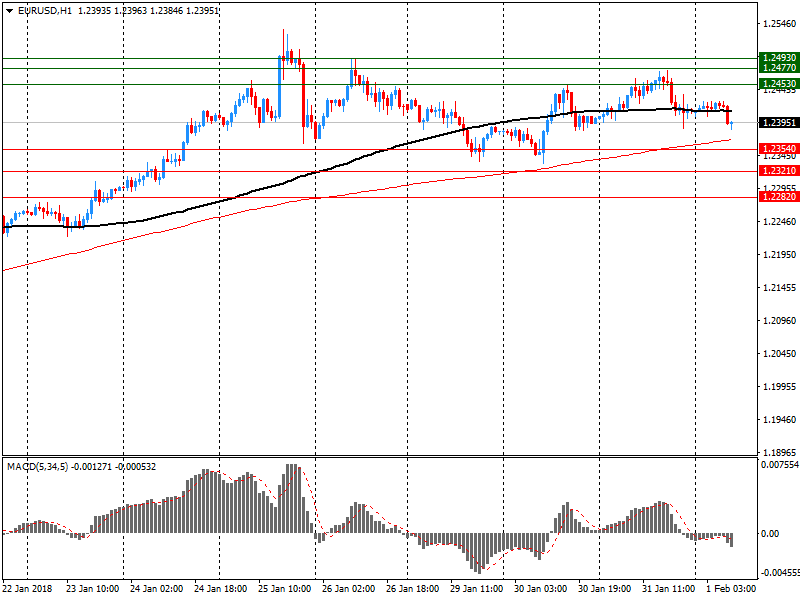
Comments:
- Overall open interest on the CALL options and PUT options with the expiration date February, 9 is 133747 contracts (according to data from January, 31) with the maximum number of contracts with strike price $1,1850 (7036);
GBP/USD
Resistance levels (open interest**, contracts)
$1.4295 (1246)
$1.4271 (748)
$1.4238 (561)
Price at time of writing this review: $1.4175
Support levels (open interest**, contracts):
$1.4128 (149)
$1.4105 (191)
$1.4079 (406)
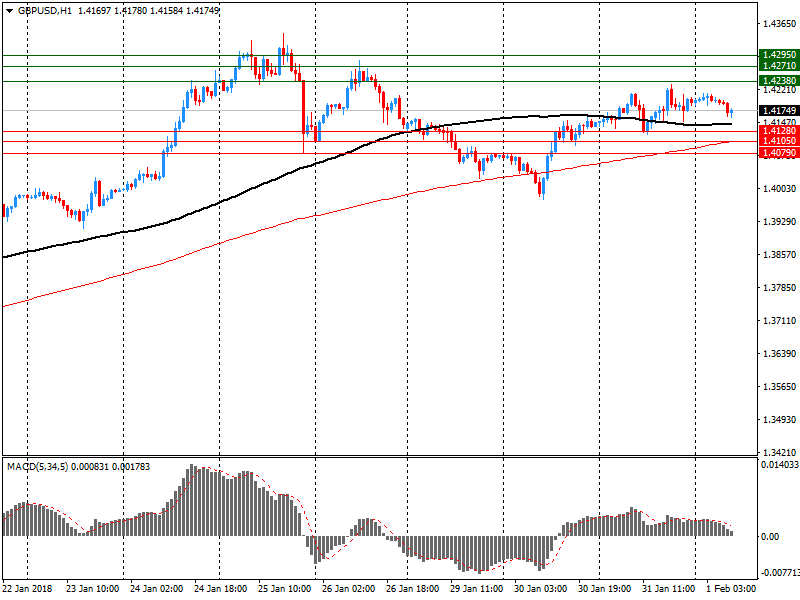
Comments:
- Overall open interest on the CALL options with the expiration date February, 9 is 45341 contracts, with the maximum number of contracts with strike price $1,3600 (3462);
- Overall open interest on the PUT options with the expiration date February, 9 is 43132 contracts, with the maximum number of contracts with strike price $1,3400 (3038);
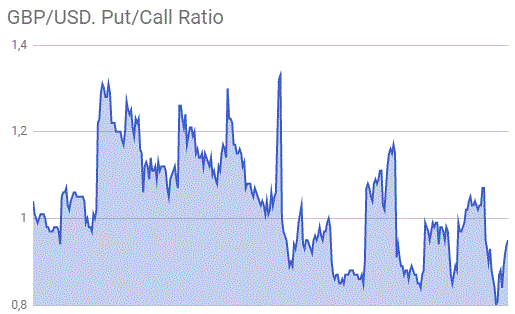
- The ratio of PUT/CALL was 0.95 versus 0.94 from the previous trading day according to data from January, 31
* - The Chicago Mercantile Exchange bulletin (CME) is used for the calculation.
** - Open interest takes into account the total number of option contracts that are open at the moment.
Commenting on the figures, Robert Gardner, Nationwide's Chief Economist, said: "The annual rate of house price growth picked up to 3.2% at the start of 2018, compared with 2.6% at the end of 2017. House prices increased by 0.6% over the month, after taking account of seasonal factors, the same increase as December.
The acceleration in annual house price growth is a little surprising, given signs of softening in the household sector in recent months. Retail sales were relatively soft over the Christmas period, as were key measures of consumer confidence, as the squeeze on household incomes continued to take its toll".
Output and new order growth rates accelerated, while businesses raised employment amid rising backlogs of work. Robust demand also encouraged firms to pass on part of the sharp rise in cost burdens to customers.
In line with stronger business confidence, firms increased input buying and were less cautious over inventory levels.
The headline Nikkei Japan Manufacturing Purchasing Managers' IndexTM - a composite single-figure indicator of manufacturing performance - increased to 54.8 in January, up from 54.0 in December. The headline PMI has risen for three successive months and the latest reading signalled the sharpest improvement in the health of the Japanese manufacturing sector since February 2014.
Looking ahead, companies were generally optimistic that output would rise over the next year. Moreover, the degree of confidence strengthened to a four-month high. The seasonally adjusted Purchasing Managers' Index - a composite indicator designed to provide a single-figure snapshot of operating conditions in the manufacturing economy - was unchanged from December's reading of 51.5 in January, to signal a further modest improvement in overall operating conditions. The health of the sector has now strengthened in each of the past eight months, while the pace of improvement was slightly stronger than the long-run trend.
-
Updated longer-run goals and strategies statement to incorporate december's median estimate for longer-run unemployment rate
-
Says gains in employment, household spending, business fixed investment have been solid
-
Fed says overall inflation and inflation excluding food and energy continued to run below 2 pct
-
Market-based measures of inflation compensation have increased in recent months but remain low
-
Inflation on a 12-month basis is expected to move up this year; drops language on expecting inflation to remain below 2 pct in near term







© 2000-2026. All rights reserved.
This site is managed by Teletrade D.J. LLC 2351 LLC 2022 (Euro House, Richmond Hill Road, Kingstown, VC0100, St. Vincent and the Grenadines).
The information on this website is for informational purposes only and does not constitute any investment advice.
The company does not serve or provide services to customers who are residents of the US, Canada, Iran, The Democratic People's Republic of Korea, Yemen and FATF blacklisted countries.
Making transactions on financial markets with marginal financial instruments opens up wide possibilities and allows investors who are willing to take risks to earn high profits, carrying a potentially high risk of losses at the same time. Therefore you should responsibly approach the issue of choosing the appropriate investment strategy, taking the available resources into account, before starting trading.
Use of the information: full or partial use of materials from this website must always be referenced to TeleTrade as the source of information. Use of the materials on the Internet must be accompanied by a hyperlink to teletrade.org. Automatic import of materials and information from this website is prohibited.
Please contact our PR department if you have any questions or need assistance at pr@teletrade.global.


 Bank
Bank transfers


