- Analytics
- News and Tools
- Market News
Analytics, News, and Forecasts for CFD Markets: currency news — 01-03-2018.
The report was issued today by Timothy R. Fiore, Chair of the Institute for Supply Management Manufacturing:
"The February PMI registered 60.8 percent, an increase of 1.7 percentage points from the January reading of 59.1 percent. The New Orders Index registered 64.2 percent, a decrease of 1.2 percentage points from the January reading of 65.4 percent. The Production Index registered 62 percent, a 2.5 percentage point decrease compared to the January reading of 64.5 percent. The Employment Index registered 59.7 percent, an increase of 5.5 percentage points from the January reading of 54.2 percent".
-
All other models available however if UK willing to accept balance of rights and obligations
-
Hope May on friday will help move Brexit negotiations forward
Canada's current account deficit (on a seasonally adjusted basis) declined by $2.2 billion in the fourth quarter to $16.3 billion, mainly on a lower goods deficit.
In the financial account (unadjusted for seasonal variation), transactions in the form of currency and deposits led the inflow of funds into the economy in the quarter as portfolio and direct investment activity mostly offset each other.
For the year 2017, the current account deficit reached $63.9 billion, which was $1.4 billion less than the deficit recorded in 2016. In the financial account, transactions in securities generated a significant net inflow of funds in 2017, which was largely offset by an outflow from direct investment transactions as direct investment abroad exceeded direct investment in Canada.
Personal income increased $64.7 billion (0.4 percent) in January according to estimates released today by the Bureau of Economic Analysis. Disposable personal income (DPI) increased $134.8 billion (0.9 percent) and personal consumption expenditures (PCE) increased $31.2 billion (0.2 percent).
Real DPI increased 0.6 percent in January and Real PCE decreased 0.1 percent. The PCE price index increased 0.4 percent. Excluding food and energy, the PCE price index increased 0.3 percent.
Personal income increased 3.1 percent in 2017 (that is, from the 2016 annual level to the 2017 annual level), compared with an increase of 2.4 percent in 2016. DPI increased 2.9 percent in 2017 compared with an increase of 2.6 percent in 2016. In 2017, PCE increased 4.5 percent, compared with an increase of 4.0 percent in 2016.
Real DPI increased 1.2 percent in 2017, compared with an increase of 1.4 percent in 2016. Real PCE increased 2.7 percent, the same increase as in 2016.
In the week ending February 24, the advance figure for seasonally adjusted initial claims was 210,000, a decrease of 10,000 from the previous week's revised level. This is the lowest level for initial claims since December 6, 1969 when it was 202,000. The previous week's level was revised down by 2,000 from 222,000 to 220,000. The 4-week moving average was 220,500, a decrease of 5,000 from the previous week's revised average. This is the lowest level for this average since December 27, 1969 when it was 219,750. The previous week's average was revised down by 500 from 226,000 to 225,500.
The euro area (EA19) seasonally-adjusted unemployment rate was 8.6% in January 2018, stable compared to December 2017 and down from 9.6% in January 2017. This is the lowest rate recorded in the euro area since December 2008. The EU28 unemployment rate was 7.3% in January 2018, stable compared to December 2017 and down from 8.1% in January 2017. This remains the lowest rate recorded in the EU28 since October 2008. These figures are published by Eurostat, the statistical office of the European Union. Eurostat estimates that 17.931 million men and women in the EU28, of whom 14.111 million in the euro area, were unemployed in January 2018. Compared with December 2017, the number of persons unemployed decreased by 19 000 in the EU28 and by 10 000 in the euro area. Compared with January 2017, unemployment fell by 1.867 million in the EU28 and by 1.429 million in the euro area.
At 55.2, the seasonally adjusted IHS Markit/CIPS Purchasing Managers' Index fell to an eight-month low and lost further ground after hitting a 51-month high last November.
Manufacturing production increased at the slowest pace for 11 months in February, with decelerations seen across the consumer, intermediate and investment goods sectors. Brighter news was provided by the trend in new orders, which rose at a faster pace than in January. Companies indicated that domestic demand strengthened, while new export business rose at a solid (albeit slower) pace.
The final IHS Markit Eurozone Manufacturing PMI eased to a four-month low of 58.6 in February, down from 59.6 in January, better than the earlier flash estimate of 58.5 and well above its long-run average of 51.8. The PMI has remained above the 50.0 nochange mark, signalling expansion, for 56 months.
Commenting on the final Manufacturing PMI data, Chris Williamson, Chief Business Economist at IHS Markit said: "Although the Eurozone Manufacturing PMI fell for a second successive month in February, the survey data indicate that factories are still enjoying their best growth spell for 18 years. The average PMI for the first quarter so far is the second-highest since the spring of 2000, falling just short of the nearrecord peak seen in the fourth quarter of last year".
Germany's booming manufacturing sector grew at a slightly slower rate in February, according to the latest PMI survey data from IHS Markit and BME, with reports of supply-chain bottlenecks helping drive up costs and prices charged at the factory gate.
The headline IHS Markit/BME Germany Manufacturing PMI - a single-figure snapshot of the performance of the manufacturing economy - dipped to 60.6 in February, from January's 61.1. The latest reading was well above the 50.0 nochange mark, indicating another month of strong growth within the sector. However, since reaching a record-high at the end of 2017, the PMI has retreated for two consecutive months, down to its lowest level since last October.
Growth momentum in the Spanish manufacturing sector improved in February, with both output and new orders rising at faster rates than at the start of the year. Linked to this were further sharp increases in employment and purchasing activity. Meanwhile, higher raw material costs resulted in a further sharp increase in input prices, with output charges also continuing to rise.
At 56.0 in February, the PMI was at a level indicative of a strong monthly improvement in the health of the manufacturing sector. Moreover, the index rose from 55.2 in January and signalled the most marked strengthening of business conditions in three months.
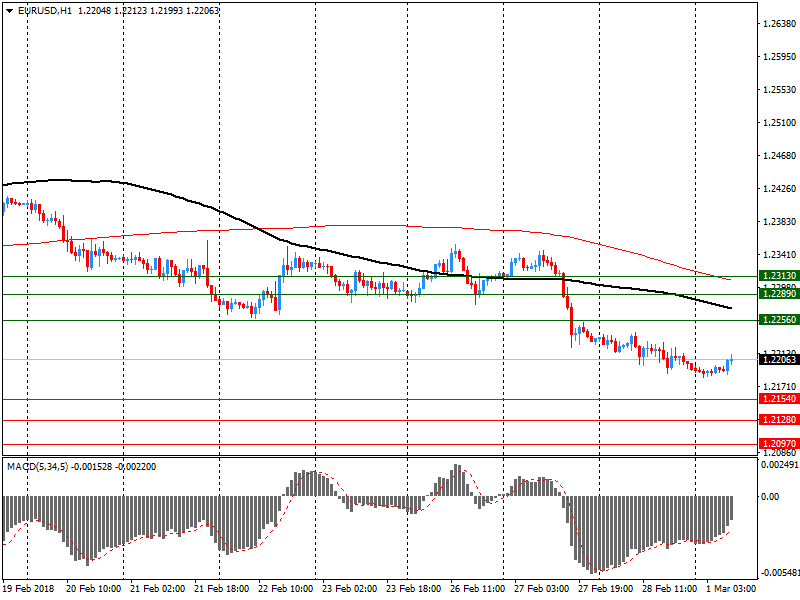
EUR/USD
Resistance levels (open interest**, contracts)
$1.2313 (3354)
$1.2289 (1305)
$1.2256 (953)
Price at time of writing this review: $1.2206
Support levels (open interest**, contracts):
$1.2154 (3031)
$1.2128 (4942)
$1.2097 (3155)
Comments:
- Overall open interest on the CALL options and PUT options with the expiration date March, 9 is 132426 contracts (according to data from February, 28) with the maximum number of contracts with strike price $1,2400 (6695);
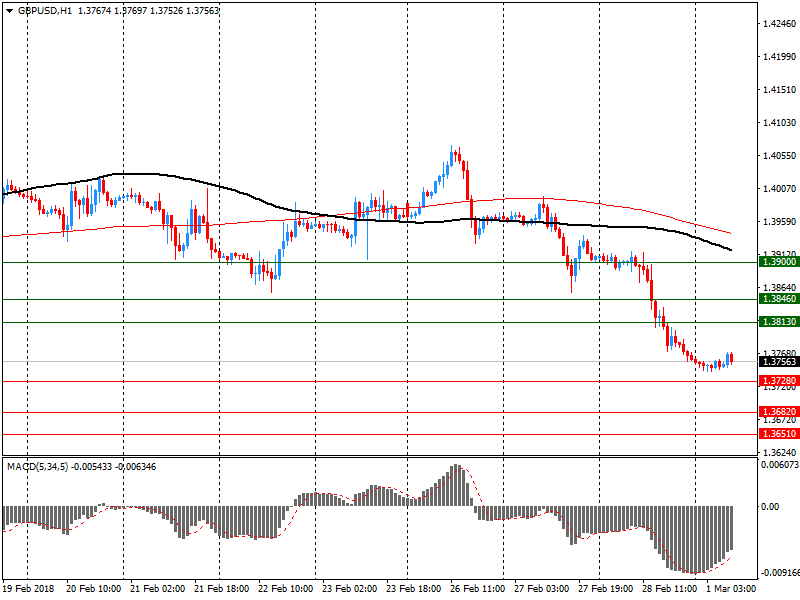
GBP/USD
Resistance levels (open interest**, contracts)
$1.3900 (1890)
$1.3846 (1166)
$1.3813 (635)
Price at time of writing this review: $1.3756
Support levels (open interest**, contracts):
$1.3728 (2258)
$1.3682 (1847)
$1.3651 (1831)
Comments:
- Overall open interest on the CALL options with the expiration date March, 9 is 52849 contracts, with the maximum number of contracts with strike price $1,3900 (3810);
- Overall open interest on the PUT options with the expiration date March, 9 is 49996 contracts, with the maximum number of contracts with strike price $1,3900 (2417);
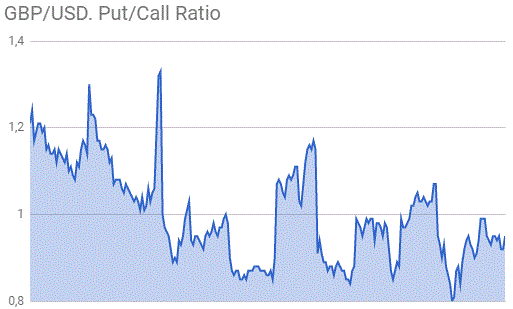
- The ratio of PUT/CALL was 0.95 versus 0.92 from the previous trading day according to data from February, 28
* - The Chicago Mercantile Exchange bulletin (CME) is used for the calculation.
** - Open interest takes into account the total number of option contracts that are open at the moment.
-
The trend volume estimate for total new capital expenditure rose by 0.8% in the December quarter 2017 while the seasonally adjusted estimate fell by 0.2%.
-
The trend volume estimate for buildings and structures fell by 0.2% in the December quarter 2017 while the seasonally adjusted estimate fell by 2.1%.
-
The trend volume estimate for equipment, plant and machinery rose by 2.1% in the December quarter 2017 while the seasonally adjusted estimate rose by 2.2%.
The headline Nikkei Japan Manufacturing Purchasing Managers' IndexTM (PMI) edged slightly lower to 54.1 in February, from 54.8 in January. This was consistent with a solid, albeit weaker, rate of improvement in business conditions for Japanese manufacturers.
Output continued along an expansionary path during February, however the rate of growth slowed for the first time since July 2017 to a four-month low. Nonetheless, firms increased production during February in line with greater new business inflows. New order growth was strong overall, despite easing. Similarly, new business from abroad rose to a weaker extent following January's 92-month high. China and the US were cited as sources of foreign demand.
Although growth in production softened from that seen in January, total new work expanded at a slightly faster pace.
Adjusted for seasonal factors, including the Chinese New Year, the headline Purchasing Managers' Index - a composite indicator designed to provide a single-figure snapshot of operating conditions in the manufacturing economy - edged up to 51.6 in February, from 51.5 in January, to signal a further improvement in the health of the sector. Though only modest, the latest reading signalled the strongest improvement in operating conditions for six months.
Switzerland's real gross domestic product (GDP) grew by an above-average 0.6% in the 4th quarter of 2017. Growth was broad-based across the various business sectors, with manufacturing, construction and most service sectors, particularly financial services, providing momentum.
On the expenditure side, growth was underpinned by consumption and investment in construction but was hindered by investment in equipment and foreign trade. 2017 as a whole saw a real GDP growth rate of 1.0%. After a sluggish start to the year, the economic recovery became more broad-based and gained momentum in the second half of the year.
-
Annual house price growth slows to 2.2%
-
Prices fall 0.3% month-on-month
Commenting on the figures, Robert Gardner, Nationwide's Chief Economist, said: "After picking up unexpectedly in January, UK house price growth fell back in February, to 2.2% from 3.2% the previous month. House prices fell by 0.3% over the month, after taking account of seasonal factors. "Month-to-month changes can be volatile, but the slowdown is consistent with signs of softening in the household sector in recent months. Retail sales were relatively soft over the Christmas period and at the start of the new year, as were key measures of consumer confidence, as the squeeze on household incomes continued to take its toll".







© 2000-2026. All rights reserved.
This site is managed by Teletrade D.J. LLC 2351 LLC 2022 (Euro House, Richmond Hill Road, Kingstown, VC0100, St. Vincent and the Grenadines).
The information on this website is for informational purposes only and does not constitute any investment advice.
The company does not serve or provide services to customers who are residents of the US, Canada, Iran, The Democratic People's Republic of Korea, Yemen and FATF blacklisted countries.
Making transactions on financial markets with marginal financial instruments opens up wide possibilities and allows investors who are willing to take risks to earn high profits, carrying a potentially high risk of losses at the same time. Therefore you should responsibly approach the issue of choosing the appropriate investment strategy, taking the available resources into account, before starting trading.
Use of the information: full or partial use of materials from this website must always be referenced to TeleTrade as the source of information. Use of the materials on the Internet must be accompanied by a hyperlink to teletrade.org. Automatic import of materials and information from this website is prohibited.
Please contact our PR department if you have any questions or need assistance at pr@teletrade.global.


 Bank
Bank transfers


