- Analytics
- News and Tools
- Market News
Analytics, News, and Forecasts for CFD Markets: currency news — 09-08-2018.
| Pare | Closed | % change |
| EUR/USD | $1,1527 | -0,75% |
| GBP/USD | $1,2827 | -0,46% |
| USD/CHF | Chf0,9935 | +0,11% |
| USD/JPY | Y111,09 | +0,16% |
| EUR/JPY | Y128,06 | -0,59% |
| GBP/JPY | Y142,505 | -0,30% |
| AUD/USD | $0,7378 | -0,76% |
| NZD/USD | $0,6617 | -1,32% |
| USD/CAD | C$1,3044 | +0,21% |
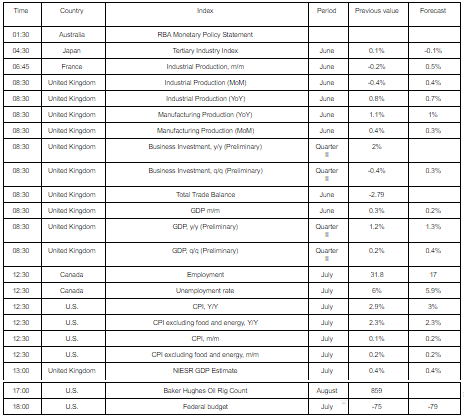
Total inventories of merchant wholesalers, except manufacturers' sales branches and offices, after adjustment for seasonal variations but not for price changes, were $632.4 billion at the end of June, up 0.1 percent from the revised May level. Total inventories were up 5.1 percent (±3.9 percent) from the revised June 2017 level. The May 2018 to June 2018 percent change was revised from the advance estimate of virtually unchanged to up 0.1 percent.
The June inventories/sales ratio for merchant wholesalers, except manufacturers' sales branches and offices, based on seasonally adjusted data, was 1.25. The June 2017 ratio was 1.31.
-
Says Russian Financial System Is Stable
The national trend in housing starts decreased in July, reflecting a decline in the SAAR of multi-unit dwellings in urban centres from the near-historical high registered in June. Despite decreasing in July, the trend remains well-above historical averages, reflecting elevated levels of multi-unit starts in most major markets that has more-than-offset declining single starts.
The trend in housing starts was 219,988 units in July 2018, compared to 221,738 units in June 2018, according to Canada Mortgage and Housing Corporation (CMHC). This trend measure is a six-month moving average of the monthly seasonally adjusted annual rates (SAAR) of housing starts.
Nationally, new house prices edged up 0.1% in June, largely due to rising construction costs across the country. The cost of softwood lumber, which is widely used in residential construction, has been on the rise. According to the Industrial Product Price Index, the price of softwood lumber (except tongue and groove and other edge worked lumber) rose 34.3% year over year in June.
Among the 11 surveyed census metropolitan areas (CMAs) reporting growth in June, the largest increases were in Montréal (+1.0%) and Ottawa (+0.7%). Builders in both markets linked the gains to rising construction and land development costs. Other notable rises occurred in St. Catharines-Niagara (+0.5%) and Greater Sudbury (+0.4%).
In the west, prices for new homes were up in Calgary (+0.3%), Edmonton (+0.2%) and Vancouver (+0.2%). The increase in Vancouver follows five months of flat prices
The Producer Price Index for final demand was unchanged in July, seasonally adjusted, the U.S. Bureau of Labor Statistics reported today. Final demand prices advanced 0.3 percent in June and 0.5 percent in May. On an unadjusted basis, the final demand index increased 3.3 percent for the 12 months ended in July.
In July, a 0.1-percent rise in the index for final demand goods offset a 0.1-percent decline in prices for final demand services.
The index for final demand less foods, energy, and trade services moved up 0.3 percent in July, the same as in June. For the 12 months ended in July, prices for final demand less foods, energy, and trade services climbed 2.8 percent.
In the week ending August 4, the advance figure for seasonally adjusted initial claims was 213,000, a decrease of 6,000 from the previous week's revised level. The previous week's level was revised up by 1,000 from 218,000 to 219,000. The 4-week moving average was 214,250, a decrease of 500 from the previous week's revised average. The previous week's average was revised up by 250 from 214,500 to 214,750.
The Russian ruble falls to a two-year low against the dollar, taking USD/RUB to a high of 66.7190, following U.S. sanctions in response to a nerve agent attack in the U.K. Danske Bank says USD/RUB could rise to 72.0 if sanctions become law and Russia retaliates. "Any major selloff of Russian local debt, local credit and stocks would amplify outflows from the RUB." EUR/RUB, which reached a near four-month high of 77.33 on Thursday, could rise to 83.50 in this scenario, it says.
-
Threat of protectionism remains prominent
-
Risk of heightened market volatility needs monitoring
-
If all threatened tariff measures are implemented, average US tariff rate would rise to highest in 50 years
-
Indicators point to broad-based growth still but at a somewhat slower pace than that in 2017
Sterling extends its slide on Thursday, reaching its lowest against the dollar in nearly a year at 1.2842, according to FactSet. Commerzbank describes sterling movements as "dangerous," warning its fall risks becoming "self-reinforcing." It notes the lack of an "obvious trigger" for Wednesday's sharp drop--albeit linked to concerns the U.K. could leave the European Union without agreeing a deal--which it describes as "worrying." If sterling develops "self-reinforcing tendencies" then expect "an acceleration of the downtrend," Commerzbank says. EUR/GBP trades flat at 0.9012, having reached a high of 0.9032 overnight, according to FactSet.
Statement by Reserve Bank Governor Adrian Orr:
"The Official Cash Rate (OCR) remains at 1.75 percent. We expect to keep the OCR at this level through 2019 and into 2020, longer than we projected in our May Statement. The direction of our next OCR move could be up or down.
While recent economic growth has moderated, we expect it to pick up pace over the rest of this year and be maintained through 2019.
Robust global growth and a lower New Zealand dollar exchange rate will support export earnings. At home, capacity and labour constraints promote business investment, supported by low interest rates. Government spending and investment is also set to rise, while residential construction and household spending remain solid.
The labour market has tightened over the past year and employment is roughly around its maximum sustainable level. We expect the unemployment rate to decline modestly from its current level.
There are welcome early signs of core inflation rising. Inflation will increase towards 2 percent over the projection period as capacity pressures bite. This path may be bumpy however, with one-off price changes from global oil prices, a lower exchange rate, and announced petrol excise tax rises expected. We will look through this volatility as appropriate, and only respond to any persistent movements in inflation".
Consumer prices in China were up 2.1 percent on year in July, according to rttnews.
That exceeded expectations for 2.0 percent and was up from 1.9 percent in June.
On a monthly basis, CPI added 0.3 percent after easing 0.1 percent in June.
The bureau also said that producer prices jumped an annual 4.6 percent - beating forecasts for 4.5 percent and down from 4.7 percent in the previous month.
Registered unemployment in July 2018 - According to SECO surveys, at the end of July 2018, 106,052 unemployed people were enrolled in the Regional Employment Centers (RAV), 527 less than in the previous month. The unemployment rate remained at 2.4% in the month under review. Compared to the same month of the previous year, unemployment fell by 27,874 (-20.8%). Youth unemployment in July 2018 Youth unemployment (aged 15-24) increased by 1'070 (+ 10.0%) to 11'807. Compared to the same month of the previous year, this represents a decrease of 3,856 persons (-24.6%).
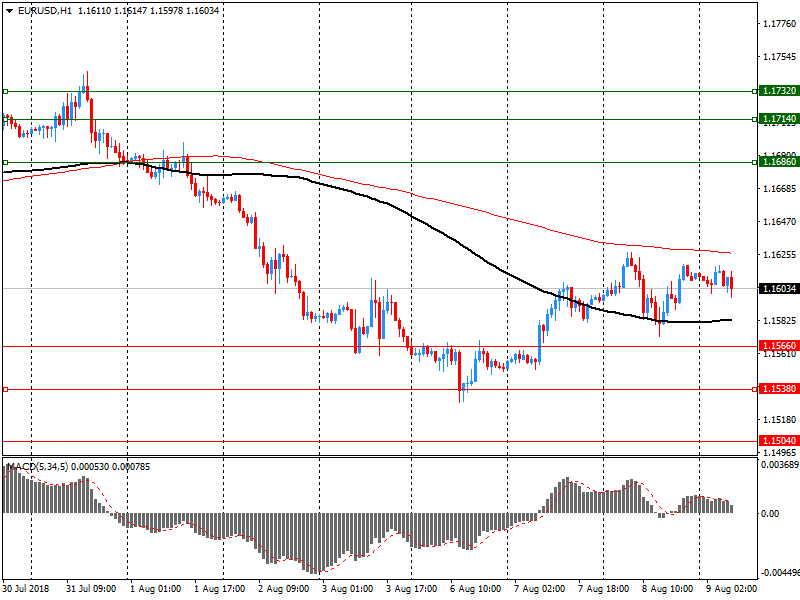
EUR/USD
Resistance levels (open interest**, contracts)
$1.1732 (3066)
$1.1714 (1548)
$1.1686 (2762)
Price at time of writing this review: $1.1603
Support levels (open interest**, contracts):
$1.1566 (1180)
$1.1538 (4143)
$1.1504 (5477)
Comments:
- Overall open interest on the CALL options and PUT options with the expiration date September, 7 is 123728 contracts (according to data from August, 8) with the maximum number of contracts with strike price $1,1500 (10906);
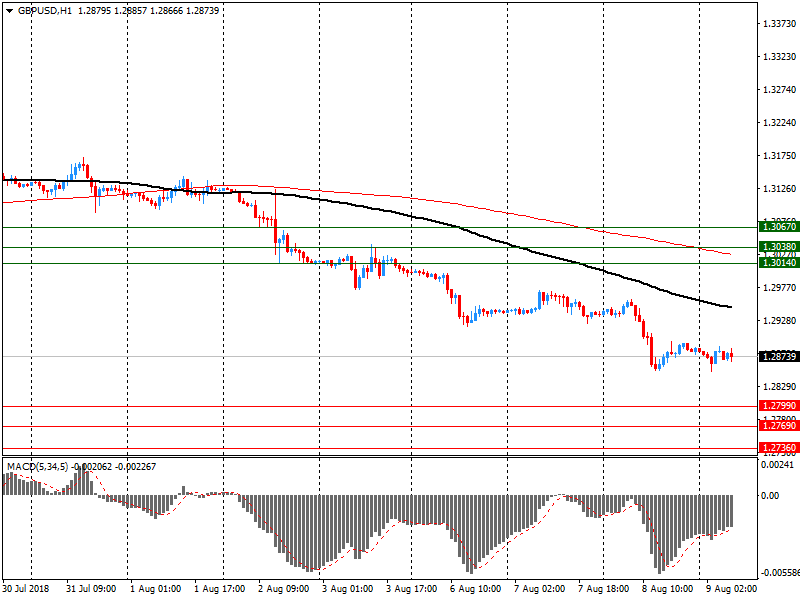
GBP/USD
Resistance levels (open interest**, contracts)
$1.3067 (870)
$1.3038 (713)
$1.3014 (554)
Price at time of writing this review: $1.2874
Support levels (open interest**, contracts):
$1.2799 (3068)
$1.2769 (2710)
$1.2736 (1276)
Comments:
- Overall open interest on the CALL options with the expiration date September, 7 is 31295 contracts, with the maximum number of contracts with strike price $1,3450 (3338);
- Overall open interest on the PUT options with the expiration date September, 7 is 28229 contracts, with the maximum number of contracts with strike price $1,2900 (3068);
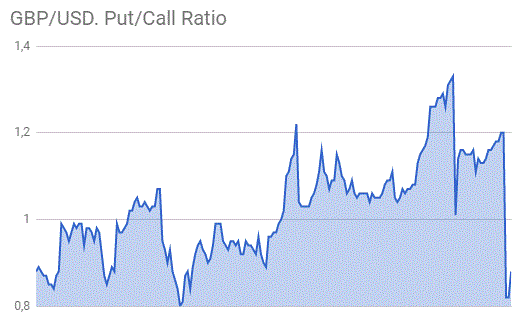
- The ratio of PUT/CALL was 0.90 versus 0.88 from the previous trading day according to data from August, 8.
* - The Chicago Mercantile Exchange bulletin (CME) is used for the calculation.
** - Open interest takes into account the total number of option contracts that are open at the moment.







© 2000-2026. All rights reserved.
This site is managed by Teletrade D.J. LLC 2351 LLC 2022 (Euro House, Richmond Hill Road, Kingstown, VC0100, St. Vincent and the Grenadines).
The information on this website is for informational purposes only and does not constitute any investment advice.
The company does not serve or provide services to customers who are residents of the US, Canada, Iran, The Democratic People's Republic of Korea, Yemen and FATF blacklisted countries.
Making transactions on financial markets with marginal financial instruments opens up wide possibilities and allows investors who are willing to take risks to earn high profits, carrying a potentially high risk of losses at the same time. Therefore you should responsibly approach the issue of choosing the appropriate investment strategy, taking the available resources into account, before starting trading.
Use of the information: full or partial use of materials from this website must always be referenced to TeleTrade as the source of information. Use of the materials on the Internet must be accompanied by a hyperlink to teletrade.org. Automatic import of materials and information from this website is prohibited.
Please contact our PR department if you have any questions or need assistance at pr@teletrade.global.


 Bank
Bank transfers


