- Analytics
- News and Tools
- Market News
Analytics, News, and Forecasts for CFD Markets: currency news — 10-02-2021.
| Time | Country | Event | Period | Previous value | Forecast |
|---|---|---|---|---|---|
| 09:00 (GMT) | France | IEA Oil Market Report | |||
| 10:00 (GMT) | Eurozone | EU Economic Forecasts | |||
| 13:30 (GMT) | U.S. | Continuing Jobless Claims | January | ||
| 13:30 (GMT) | U.S. | Initial Jobless Claims | February | ||
| 21:30 (GMT) | New Zealand | Business NZ PMI | January | 48.7 | |
| 21:45 (GMT) | New Zealand | Food Prices Index, y/y | January | 2.9% |
According to ActionForex, analysts at TD Bank Financial Group note that consumer prices rose 0.3% month-on-month in January as prices at the pump were once again a key upward force in CPI inflation.
"Consumer prices rose 0.3% month-on-month in January, right on expectations. Total CPI was up 1.4% year-on-year in January, unchanged from December.""
Prices at the pump were once again a key upward force in CPI inflation. Gasoline prices rose 7.4% month/month in January (seasonally adjusted), but remain 8.6% below year-ago levels. In contrast, food prices had heated up through the pandemic, but rose a much milder 0.1% m/m in January. Overall, food prices are up 3.8% versus a year ago, one of the hottest categories in the consumer basket."
"Core prices ex-food and energy were flat for the second straight month in January. As a result, core inflation has lost steam on a year-on-year basis to 1.4%, matching the headline measure."
"The weak reading on core inflation was due to another flat reading for core services prices. Core services inflation continues to lose steam on a year/year basis, running at only 1.3% in January, down from 1.6% in December. Core goods prices rose 0.1% m/m, and are up 1.7% versus a year ago, unchanged from December."
"There has been a lively debate in economic circles recently about whether the significant fiscal package proposed by the Biden Administration (see report on Biden’s American Rescue Plan) will trigger an undesirable acceleration in inflation. With inflation still well below the Fed’s 2% target, there is room for inflation to heat up before it reaches a concerning pace."
The U.S. Energy
Information Administration (EIA) revealed on Wednesday that crude inventories fell
by 6.644 million barrels in the week ended February 5. Economists had forecast
a build of 0.985 million barrels.
At the same
time, gasoline stocks surged by 4.259 million barrels, while analysts had
expected a build of 1.814 million barrels. Distillate stocks decreased 1.731
million barrels, while analysts had forecast a drop of 0.790 million barrels.
Meanwhile, oil
production in the U.S. rose by 100,000 barrels a day to 11.000 million barrels
a day.
U.S. crude oil
imports averaged 5.9 million barrels per day last week, decreased by 0.7
million barrels per day from the previous week.
The Commerce
Department announced on Wednesday the U.S. wholesale inventories went up 0.3
percent m-o-m in December, better than the preliminary estimate of a 0.1 percent
m-o-m gain.
Economists had
forecast the reading to stay unrevised at +0.1 percent m-o-m.
In November,
wholesale inventories were flat m-o-m.
According to
the report, durable goods inventories edged up 0.1 percent m-o-m in December,
while stocks of nondurable goods rose 0.6 percent m-o-m.
In y-o-y terms,
wholesale inventories declined 1.6 percent in December.
FXStreet reports that strategists at Credit Suisse note that gold (XAU/USD) is expected to extend its consolidation for a while yet above $1765
“Gold outlook remains unchanged and we expect further consolidation above key price support at $1765. Big picture, we remain of the view this is a correction within the long-term bull trend, but we need to see the $1966 November high removed to suggest the core trend is indeed turning higher again for strength back to $2075 and eventually our $2300 long-term objective.”
- Inflation not converging to goal over medium term
- We will look through short-term shifts in prices
- It will take awhile before the ECB must worry about inflation
- Favorable financing conditions are the ECB's compass
- It's not the time to slow down the fiscal support
- We need fiscal support at least through year end
- ECB can scale up PEPP if needed
The Labor Department
announced on Wednesday the U.S. consumer price index (CPI) rose 0.3 percent
m-o-m in January, following a revised 0.2 percent m-o-m gain in the previous
month (originally a 0.4 percent m-o-m increase).
Over the last
12 months, the CPI increased 1.4 percent y-o-y, the same advance as for the
period ending in December.
Economists had
forecast the CPI to increase 0.3 percent m-o-m and 1.5 percent y-o-y in the
12-month period.
According to
the report, a 7.4 percent m-o-m climb in the gasoline index accounted for most
of the seasonally adjusted increase in the all items index in January. Although
the indexes for electricity and natural gas declined, the energy index rose 3.5
percent m-o-m. The food index edged up 0.1 percent m-o-m in January, as an increase
in the index for food away from home more than offset a drop in the index for
food at home.
Meanwhile, the
core CPI excluding volatile food and fuel costs was flat m-o-m in January after
a revised unchanged figure in the previous month (originally a 0.1 percent m-o-m
uptick).
In the 12
months through January, the core CPI surged 1.4 percent compared to an
unrevised 1.6 percent surge for the 12 months ending December.
Economists had
forecast the core CPI to increase 0.2 percent m-o-m and to jump 1.5 percent
y-o-y last month.
| Time | Country | Event | Period | Previous value | Forecast | Actual |
|---|---|---|---|---|---|---|
| 07:00 | Germany | CPI, m/m | January | 0.5% | 0.8% | 0.8% |
| 07:00 | Germany | CPI, y/y | January | -0.3% | 1% | 1% |
| 07:45 | France | Industrial Production, m/m | December | -0.7% | 0.2% | -0.8% |
| 13:00 | Eurozone | ECB President Lagarde Speaks | ||||
| 13:30 | U.S. | CPI excluding food and energy, m/m | January | 0.1% | 0.2% | 0% |
| 13:30 | U.S. | CPI, m/m | January | 0.4% | 0.3% | 0.3% |
| 13:30 | U.S. | CPI, Y/Y | January | 1.4% | 1.5% | 1.4% |
| 13:30 | U.S. | CPI excluding food and energy, Y/Y | January | 1.6% | 1.5% | 1.4% |
USD rose against its major rivals in the European session on Wednesday as investors cheered the UK's progress on the rollout of coronavirus vaccines, which is expected to support the country's fairly fast economic recovery this year. Britain is vaccinating people way faster than the U.S. and the EU. According to Bloomberg’s vaccine tracker, 18.9% of the British population has received at least one dose. The U.S. has given 10.2% of its population at least one shot; while France and Germany are each at around 3%.
The pound also continued to see support from the Bank of England’s (BoE) last week upbeat prediction that the UK's economy will regain its pre-COVID size by the first quarter of 2022.
FXStreet reports that the Credit Suisse analyst team notes that USD/CHF deteriorated sharply on Tuesday, closing beneath the crucial “neckline” to the recent base, currently at 0.8934, and thus negating this base to sharply increase the risk of an early resumption of the core downtrend.
“We shift our bias in favor of further weakness and a potential early resumption of the core downtrend. Support moves initially to the 55-day average at 0.8901, where we would expect to see a brief pause at first.”
“Removal of 0.8901 would open the door to 0.8896, ahead of a cluster of supports at 0.8874/70. Beyond here could subsequently expose the late January low at 0.8839, where we would expect to see another breather at first.”
“Resistance is seen initially at 0.8901, then 0.8991, removal of which would ease the recent downside pressure and see a move back to 0.9020 and 0.9046.”
The EU says that it still needs more time to ensure that the agreement is available in all 24 European languages for scrutiny by parliament members and the European Council (EC). The EU-UK Partnership Council, which was formed after the trade deal, is expected to meet to assess the request.
The Mortgage
Bankers Association (MBA) reported on Wednesday the mortgage application volume
in the U.S. dropped 4.1 percent in the week ended February 5, following an 8.1
percent climb in the previous week.
According to
the report, refinance applications decreased 4.2 percent, while applications to
purchase a home declined 4.7 percent.
Meanwhile, the
average fixed 30-year mortgage rate rose from 2.92 percent to 2.96 percent, the
highest since the week ended November 13.
“Despite some
weekly volatility, Treasury rates have been driven higher by expectations of
faster economic growth as the Covid-19 vaccine rollout continues,” noted Joel
Kan, MBA’s Associate Vice President of Economic and Industry Forecasting.
- Says Iraq's oil exports should average around 2.9 million barrels per day in February
- Sees Brent prices ranging between $58 and $63
FXStreet notes that EUR/USD maintains its recovery after the bullish “reversal day” from the 23.6% retracement of the entire 2020/2021 rally at 1.1945/14 and analysts at Credit Suisse look for a test of 1.2156/90.
“EUR/USD maintains the strong tone following the bullish ‘reversal day’ from our target at 1.1945/14 - the 23.6% retracement of the entire 2020/2021 uptrend and first ‘measured top objective’ – and has cleared with ease the 38.2% retracement of the January/February fall at 1.2104. This sees the immediate risk stay higher with resistance seen next at the 55-day average at 1.2138, ahead of price resistance from the late January highs at 1.2156/90 zone, with this then expected to cap at first to define the top of a range.”
“Support is seen at 1.2108 initially, then 1.2088, with 1.2046/19 now ideally holding to keep the immediate risk higher. Below can see a fall back to potential trend support at 1.1968.”
- ECB prepared to adjust all instruments as needed to reach inflation target
- Eurozone economic recovery is fragile, faces downside risks
- This is due to uncertainty surrounding evolution of the pandemic
RTTNews reports that Sweden's central bank maintained its key interest rate and the asset purchase programme, in order to facilitate the recovery and bring inflation back to the target.
The Executive Board of Riksbank decided to hold the repo rate at zero percent. The rate is projected to remain at this level in the years to come.
The board also kept the envelope of the asset purchase programme unchanged at SEK 700 billion.
The bank vowed to formulate the monetary policy so that it supports the recovery and inflation as long as necessary.
The bank upgraded its inflation forecast for both 2021 and 2022 to 1.3 percent, from 0.8 percent and 1.2 percent, respectively.
The growth outlook for 2021 was raised to 3 percent from 2.6 percent but that for 2022 was lowered to 3.9 percent from 5 percent.
FXStreet reports that Credit Suisse analyst team expect further AUD/USD strength.
“With a bullish ‘reversal day’ in place and daily MACD momentum breaking higher again, we look for further upside, with resistance seen initially at 0.7764/70. Beyond here would negate the prior bearish ‘reversal day’ and expose 0.7782, where we would expect to see fresh sellers at first.”
“Above 0.7782, the aussie can see a fresh test of the April 2018 and current 2021 high at 0.7816/20, which could also prove a tougher barrier to break at first. Nevertheless, above here would reassert the core bull uptrend for 0.7917 next.”
Reuters reports that according to two reports issued on Wednesday, Britain's tax receipts from its huge financial services sector are set to fall from this year as the City of London loses business to the European Union and fallout from the coronavirus pandemic continues.
The City of London Corporation, which administers the capital's financial district, said the tax contribution of 75.6 billion pounds in the year to March 2020 was little changed from 75.5 billion pounds in the prior period, despite uncertainties over Britain's future relations with the European Union.
"However, the future is uncertain, and we do not yet know the long-term impacts of the pandemic, Brexit and changes in ways of working," City leader Catherine McGuinness said.
The 135 billion pound financial sector accounts for more than 10% of UK tax receipts.
Receipts are expected to ease in the current financial year that ends next month to between 71.1 billion and 75.7 billion, consultants PwC estimated in a report for the City.
FXStreet reports that economists at ANZ Bank discussing NZD/USD prospects.
“The Kiwi is off Tuesday’s highs seen in the wake of stronger than expected inflation expectations data, but remains lofty as the broad USD DXY index dips further. It isn’t one-way traffic, but with the NZ yield curve now very steep as NZ 10-20yr bond yields widen on a spread to their US and AU counterparts, and the market thematic still that the NZ economy is doing better and the RBNZ will likely be an earlier ‘hiker’, the path of least resistance remains higher – at least before the MPS on 24 February.”
eFXdata reports that Credit Agricole CIB Research discussing CAD prospects.
"The currency is primarily driven by external factors such as global risk sentiment in general and commodity prices in particular. At the same time, elevated speculative long positioning suggests the CAD is unlikely to keep strong sensitivity to risk-on sentiment with downside risks remaining intact. As of now, we stick to a more cautious stance on the currency, especially compared to its commodity bloc peers," CACIB adds.
FXStreet reports that FX Strategists at UOB Group see USD/CNH facing a deeper decline if 6.4130 is cleared in the next weeks.
24-hour view: “We highlighted yesterday that ‘strong downward momentum suggests USD is likely to weaken further to 6.4280’. The subsequent weakness in USD exceeded our expectation as it plunged to 6.4180 before closing on a weak note at 6.4189 (-0.39%). Further USD weakness is not ruled out severely oversold conditions suggest that any decline is likely limited to a test of last month’s low near 6.4130. The next support at 6.4000 is not expected to come into the picture. On the upside, a break of 6.4450 (minor resistance at 6.4350) would indicate the current downward pressure has eased.”
Reuters reports that a draft agreement for talks between Chancellor Angela Merkel and leaders of the 16 federal states on Wednesday showed that Germany plans to extend restrictions to curb the spread of the coronavirus until March 14.
The number of new daily infections in Germany has been falling, leading some regional leaders to push for a timetable to ease the lockdown, but concerns are growing about the impact of more infectious strains of the virus on case numbers.
The draft document for the talks, which start in the afternoon, says that hairdressers could reopen under strict conditions from March 1. The draft is subject to change.
Merkel has made clear that primary schools and nurseries will take priority in any easing. The draft agreement said that individual states can decide on how to re-start classes.
Merkel has in the past also made clear she wants a seven-day incidence of 50 cases per 100,000 people to be the benchmark for restrictions to be lifted. That number currently stands at 68, according to data published by the Robert Koch Institute for infectious diseases on Wednesday.
FXStreet reports that economists at Standard Chartered raise their 2021 US GDP forecast to 5.5% (previously 2.1%) and 2022 to 4.0% (3.8%) as the economy has proven more resilient to COVID-19 restrictions in 2021 than in 2020.
“Surveys suggest the economy has been much more resilient to pandemic restrictions than in Q2-2020, in part thanks to the late December COVID-19 relief package. Meanwhile the US vaccination programme could cover 60-70% of the population by the end of Q2.”
“Our expectation that growth will accelerate from late spring is further supported by the prospect of another fiscal package – we expect it to total $1.2 trn.”
“We now forecast Q4-2021 GDP growth of 6.5% YoY (previously 3.5%), taking GDP back to its trend level, and now expect Q4-2022 GDP growth to be 2% YoY. This could allow some 8 M jobs to be created and a return to the pre-pandemic level of employment by late 2022, although still short of full employment.”
| Time | Country | Event | Period | Previous value | Forecast | Actual |
|---|---|---|---|---|---|---|
| 01:30 | China | PPI y/y | January | -0.4% | 0.4% | 0.3% |
| 01:30 | China | CPI y/y | January | 0.2% | 0.0% | -0.3% |
| 07:00 | Germany | CPI, m/m | January | 0.5% | 0.8% | 0.8% |
| 07:00 | Germany | CPI, y/y | January | -0.3% | 1% | 1% |
| 07:45 | France | Industrial Production, m/m | December | -0.7% | 0.2% | -0.8% |
During today's Asian trading, the US dollar was trading steadily against the euro and the yen.
The ICE Dollar index, which shows the value of the US dollar against six major world currencies (euro, swiss franc, yen, canadian dollar, pound sterling and swedish krona) fell by 0.10%.
Expectations that the U.S. economy will recover faster than other countries, thanks to active vaccination against COVID-19, will support the dollar in the short term, analysts at TD Securities said.
The trend towards a stronger dollar, however, will not last long, as the effects of mass vaccination will begin to affect other countries in the second half of the year.
The focus of traders ' attention is the ongoing discussion in the United States of the $1.9 trillion stimulus package proposed by President Joe Biden. The adoption of a new program of measures to support the economy is extremely important to stimulate consumer spending in the country, promote more active vaccination and, accordingly, strengthen the growth rate of the American economy, analysts say.
According to the report from Insee, in December 2020, output decreased in the manufacturing industry for the first time since April 2020 (−1.7%, after +0.7% in November). In the whole industry, output decreased for the second consecutive month (−0.8%, after −0.7%). Economists had expected a 0.2% increase.
Compared to February (the last month before the first general lockdown), output remained significantly lower in the manufacturing industry (−5.7%), as well as in the whole industry (−4.9%).
In December, output slumped in the manufacture of coke and refined petroleum due to the shutdown of several refineries (−30.5% after −1.7%). It fell back in “other manufacturing” (−1.4% after +0.3%), in the manufacture of machinery and equipment goods (−3.5% after +1.2%) and in the manufacture of food products and beverages (−1.8% after +0.9%). Conversely, it increased in mining and quarrying, energy, water supply (+4.3% after −8.5%) and in the manufacture of transport equipment (+2.0% after +2.2%).
In December, output yet remained below its February level in most industrial activities. It plummeted in the manufacture of coke and refined petroleum (−32.0%). It fell sharply in the manufacture of transport equipment (−10.0%), especially in the manufacture of “other transport equipment” (−15.2%). Compared to February 2020, output also diminished in the manufacture of machinery and equipment goods (−7.8%), in “other manufacturing” (−4.4%) and in the manufacture of food products and beverages (−3.8%).
EUR/USD
Resistance levels (open interest**, contracts)
$1.2243 (2669)
$1.2212 (1926)
$1.2187 (4451)
Price at time of writing this review: $1.2129
Support levels (open interest**, contracts):
$1.2083 (395)
$1.2064 (1751)
$1.2039 (2234)
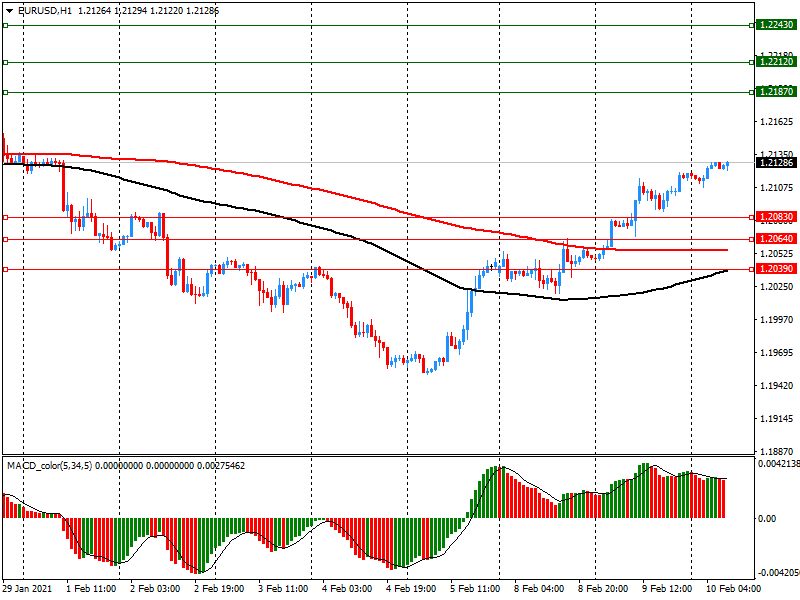
Comments:
- Overall open interest on the CALL options and PUT options with the expiration date March, 5 is 78501 contracts (according to data from February, 9) with the maximum number of contracts with strike price $1,2300 (4457);
GBP/USD
Resistance levels (open interest**, contracts)
$1.3904 (1947)
$1.3883 (999)
$1.3867 (544)
Price at time of writing this review: $1.3817
Support levels (open interest**, contracts):
$1.3647 (1065)
$1.3610 (926)
$1.3570 (442)
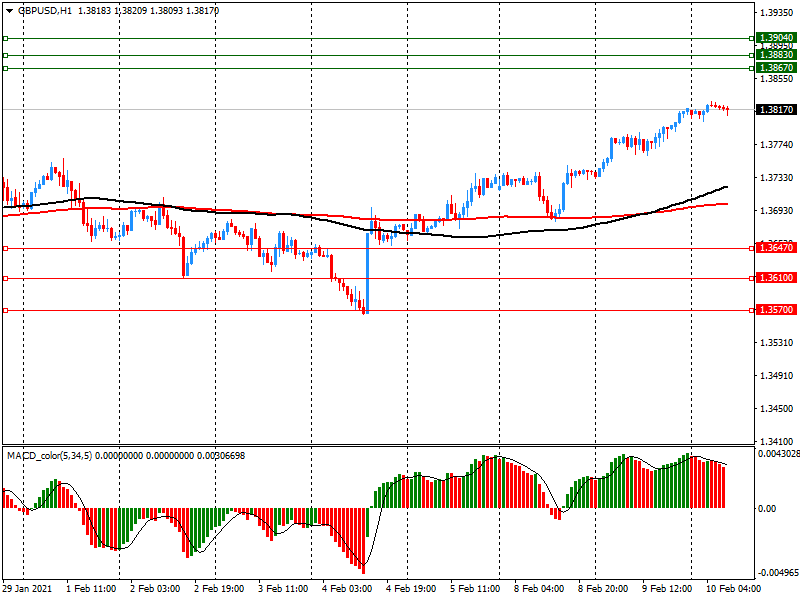
Comments:
- Overall open interest on the CALL options with the expiration date March, 5 is 16125 contracts, with the maximum number of contracts with strike price $1,4200 (3191);
- Overall open interest on the PUT options with the expiration date March, 5 is 13434 contracts, with the maximum number of contracts with strike price $1,3100 (1223);
- The ratio of PUT/CALL was 0.83 versus 0.82 from the previous trading day according to data from February, 9

* - The Chicago Mercantile Exchange bulletin (CME) is used for the calculation.
** - Open interest takes into account the total number of option contracts that are open at the moment.
RTTNews reports that data from the National Bureau of Statistics showed that China's consumer price inflation returned to negative territory at the start of the year due to seasonal factors, while producer prices climbed for the first time in a year on higher raw material cost.
Consumer prices fell 0.3 percent on a yearly basis in January, reversing a 0.2 percent rise in December. Economists had forecast prices to drop 0.1 percent.
Month-on-month, consumer prices advanced 1 percent, in line with expectations, but faster than the 0.7 percent growth posted in December.
Excluding food and energy, core consumer prices slid 0.3 percent annually versus a 0.4 percent rise in December.
Another report from NBS showed that producer prices climbed 0.3 percent annually, in contrast to a 0.4 percent drop in the previous month. This was the first increase since January 2020. Prices were expected to climb 0.4 percent.
According to the report from the Federal Statistical Office (Destatis), the inflation rate in Germany, measured as the year-on-year change in the consumer price index (CPI), stood at +1.0% in January 2021, following a 0.3% decrease in December 2020. A positive inflation rate was last seen in June 2020 (+0.9%). Destatis also reports that consumer prices rose by 0.8% compared with December 2020.
The prices of goods (total) were up 0.6% in January 2021 from January 2020. Food prices rose by 2.2%. As a result, the price increase has markedly accelerated (December 2020: +0.5%). Higher prices were recorded in particular for meat and meat products (+3.5%), fruit (+3.2%) and vegetables (+3.1%). In contrast, the prices of energy products were 2.3% lower than in the same month a year earlier.
Excluding energy prices, the rate of inflation would have been +1.4% in January 2021.
The prices of services (total) were up 1.4% in January 2021 from January 2020. Net rents exclusive of heating expenses, which are important as they account for a large part of household final consumption expenditure, rose by 1.3%.
Compared with December 2020, the consumer price index rose by 0.8% in January 2021. The prices of energy products climbed by 5.4%. Marked price increases were recorded in particular for motor fuels (+10.7%) and heating oil (+13.9%). In addition to the end of the value added tax reduction, the CO2 charge had an upward effect on prices. Apart from that, the prices of food and non-alcoholic beverages rose by 2.6%; price increases were observed especially for vegetables (+7.8%) and coffee (+3.8%).
| Time | Country | Event | Period | Previous value | Forecast |
|---|---|---|---|---|---|
| 01:30 (GMT) | China | PPI y/y | January | -0.4% | |
| 01:30 (GMT) | China | CPI y/y | January | 0.2% | |
| 07:00 (GMT) | Germany | CPI, m/m | January | 0.5% | 0.8% |
| 07:00 (GMT) | Germany | CPI, y/y | January | -0.3% | 1% |
| 07:45 (GMT) | France | Industrial Production, m/m | December | -0.9% | |
| 13:00 (GMT) | Eurozone | ECB President Lagarde Speaks | |||
| 13:30 (GMT) | U.S. | CPI excluding food and energy, m/m | January | 0.1% | 0.2% |
| 13:30 (GMT) | U.S. | CPI, m/m | January | 0.4% | 0.3% |
| 13:30 (GMT) | U.S. | CPI, Y/Y | January | 1.4% | 1.5% |
| 13:30 (GMT) | U.S. | CPI excluding food and energy, Y/Y | January | 1.6% | 1.6% |
| 15:00 (GMT) | U.S. | Wholesale Inventories | December | 0% | 0.1% |
| 15:30 (GMT) | U.S. | Crude Oil Inventories | February | -0.994 | |
| 17:00 (GMT) | United Kingdom | BOE Gov Bailey Speaks | |||
| 19:00 (GMT) | U.S. | Federal budget | January | -144 | |
| 19:00 (GMT) | U.S. | Fed Chair Powell Speaks | |||
| 23:30 (GMT) | Australia | Westpac Consumer Confidence | February | 107 |
| Pare | Closed | Change, % |
|---|---|---|
| AUDUSD | 0.77371 | 0.49 |
| EURJPY | 126.729 | -0.01 |
| EURUSD | 1.21194 | 0.61 |
| GBPJPY | 144.488 | -0 |
| GBPUSD | 1.38177 | 0.61 |
| NZDUSD | 0.72382 | 0.32 |
| USDCAD | 1.26939 | -0.36 |
| USDCHF | 0.89212 | -0.67 |
| USDJPY | 104.562 | -0.58 |







© 2000-2026. All rights reserved.
This site is managed by Teletrade D.J. LLC 2351 LLC 2022 (Euro House, Richmond Hill Road, Kingstown, VC0100, St. Vincent and the Grenadines).
The information on this website is for informational purposes only and does not constitute any investment advice.
The company does not serve or provide services to customers who are residents of the US, Canada, Iran, The Democratic People's Republic of Korea, Yemen and FATF blacklisted countries.
Making transactions on financial markets with marginal financial instruments opens up wide possibilities and allows investors who are willing to take risks to earn high profits, carrying a potentially high risk of losses at the same time. Therefore you should responsibly approach the issue of choosing the appropriate investment strategy, taking the available resources into account, before starting trading.
Use of the information: full or partial use of materials from this website must always be referenced to TeleTrade as the source of information. Use of the materials on the Internet must be accompanied by a hyperlink to teletrade.org. Automatic import of materials and information from this website is prohibited.
Please contact our PR department if you have any questions or need assistance at pr@teletrade.global.


 Bank
Bank transfers


