- Analytics
- News and Tools
- Market News
Analytics, News, and Forecasts for CFD Markets: currency news — 12-03-2021.
On Monday, at 02:00 GMT, China will announce changes in the volume of investment in fixed assets, industrial production and retail trade for February. At 04:30 GMT, Japan will release the index of activity in the service sector for January. At 12:15 GMT, Canada will announce a change in the housing starts for February, and at 12:30 GMT - a change in manufacturing shipments for January. Also at 12: 30 GMT, the US will publish the NY Fed Empire State manufacturing index for March. At 20: 00 GMT, the US will report changes in the net and total volume of purchases of long-term US securities by foreign investors for January. At 20:00 GMT, New Zealand will release the Westpac economic confidence index for the 1st quarter. The Eurogroup will also meet on Monday.
On Tuesday, at 00:30 GMT in Australia, the RBA Meeting's Minutes and the house price index for the 4th quarter will be released. At 04:30 GMT, Japan will report a change in industrial production for January. At 07:45 GMT, France will present the consumer price index for February. At 10:00 GMT, Germany and the euro zone will publish the ZEW Economic Sentiment index for March. At 12:30 GMT, Canada will announce a change in the volume of transactions with foreign securities for January. Also at 12: 30 GMT, the US will announce changes in retail trade for February and release the import price index for February. At 13:15 GMT, the US will report changes in the capacity utilization factor and industrial production volume for February. At 14:00 GMT, the US will announce changes in the business inventories for January and release the NAHB housing market index for March. At 21:45 GMT, New Zealand will report a change in the balance of payments for the 4th quarter. At 23:50 GMT, Japan will announce a change in the foreign trade balance for February.
On Wednesday, at 09:00 GMT, the report of the International Energy Agency on the oil market will be released. At 10:00 GMT, the euro zone will publish the consumer price index for February. At 12:30 GMT, Canada will release the consumer price index for February. Also at 12: 30 GMT, the United States will announce changes to construction permits and housing starts for February. At 14:30 GMT, the United States will announce changes in oil reserves according to the Department of Energy. At 18:00 GMT in the US, the FOMC's interest rate decision will be announced, and the economic forecast from the FOMC will also be released. At 18:30 GMT the FOMC press conference will be held. At 21:45 GMT, New Zealand will report a change in GDP for the 4th quarter.
On Thursday, at 00:30 GMT, Australia will announce changes in the unemployment rate and changing the number of employed for February, as well as release the RBA's quarterly report. At 07:30 GMT, Switzerland will publish the producer and import price index for February. At 10:00 GMT, the euro zone will report a change in the trade balance for January. At 12:00 GMT, in the UK, the Bank of England's interest rate decision and the volume of asset purchases will be announced. At 12:30 GMT, in Canada, the new home price index for February will be released. Also at 12: 30 GMT, the US will publish the Fed-Philadelphia manufacturing index for March and announce a change in the number of initial applications for unemployment benefits. At 14:00 GMT, the US will release the index of leading indicators for February. At 23:30 GMT, Japan will present the consumer price index for February.
On Friday, at 00:01 GMT, in the UK, the GfK consumer confidence indicator for March will be released. At 00:30 GMT, Australia will report the change in retail trade volume for February. At 03:00 GMT in Japan, the Bank of Japan's interest rate decision will be announced, and at 06:30 GMT, the Bank of Japan will hold a press conference. At 07:00 GMT, Britain will announce a change in the net amount of public sector debt for February. Also at 07:00 GMT, Germany will release the producer price index for February. Also at 07:00 GMT, Switzerland will report a change in the trade balance for February. At 12:30 GMT, Canada will announce the change in retail sales for January. At 18:00 GMT, in the United States, the Baker Hughes report on the number of active oil drilling rigs will be released.
Bloomberg reports that the European Union’s pandemic recovery fund has run into early trouble, with the bloc’s executive arm judging that most of the national spending plans submitted so far still need work to get approved, raising the risk of delays in disbursements to some of the region’s battered economies.
Germany’s submission is among those deemed to fall short of expectations, with southern European nations Greece and Spain having the strongest plans, according to officials familiar with the discussions who asked not to be identified. Some countries haven’t made proposals at all yet, and others are way behind, they said.
The German government is in talks with the Commission to reduce some of the hurdles to investment in its plan, one official said.
eFXdata reports that Credit Agricole CIB Research discusses its expectations for next week's FOMC policy meeting.
"We think the FOMC will maintain its cautious inflation outlook even as it presents its upgraded economic projections. Moreover, we believe that the updated Fed dot-plot would largely reaffirm the view that policy rates will remain at their current low levels in the coming years... A more dovish-than-expected outcome from the Fed meeting can boost risk sentiment and weigh on the USD vs risk-correlated and commodity currencies," CACIB notes.
According to the report from University of Michigan, U.S. consumer sentiment improved in early March to its strongest in a year.
Preliminary consumer sentiment index rose to 83.0 in the first half of this month from a final reading of 76.8 in February. Economists had forecast the index rising to 78.5.
The barometer of current economic conditions jumped to 91.5 from 86.2 in February. Its measure of consumer expectations rose to 77.5 from 70.7.
Surveys of Consumers chief economist, Richard Curtin said: "Consumer sentiment rose in early March to its highest level in a year due to the growing number of vaccinations as well as the widely anticipated passage of Biden's relief measures. The gains were widespread across all socioeconomic subgroups and all regions, although the largest monthly gains were concentrated among households in the bottom third of the income distribution as well as those aged 55 or older. Over the past fifty years, the key age group that consistently led recoveries, but was the last age group to indicate a pending recession, was consumers under age 35. The early March gains were not equally shared across all Index components, with consumers voicing no improvement in some key facets of consumer finances. In particular, consumers' judgements about their own financial situation posted no gains in early March, largely due to very small expected gains in household incomes over the next year. In contrast, prospects for the national economy improved significantly. Another important distinction involved greatly improved views of buying conditions for large household durables, but only marginal gains for vehicles and homes. Inflation expectations for the year ahead remained elevated, but consumers thought the inflation rate would fall back to lower levels over the longer term. Overall, the data indicate strong growth in consumer spending during the year ahead, with the largest percentage gains for services, including travel and restaurants, and the smallest increases for vehicles and homes".
Reuters reports that Finance Minister Paschal Donohoe said that Irish consumers will not need government incentives to spend record levels of savings once the economy reopens, as he hopes for "signs" of a rebound in economic growth in the third quarter.
Ireland has been under a third, strict lockdown to slow its deadliest wave of COVID-19 since late December and although its large multinational sector has softened the blow on the economy, one-in-four people are temporarily or permanently out of work.
"I think the role for consumption incentives could have been well made last year, but as we have gone through 2020 and even the early part of 2021, we're seeing such a clear trend in household saving," Donohoe said.
"If that trend continues, little incentive will be needed to encourage broad consumption within the economy. I think the real challenge we're going to face will be where we are with employer viability."
CNBC reports that the head of Germany’s public health agency warned that a third wave of coronavirus infections has already begun.
It comes at a time when the country has started to gradually relax lockdown restrictions, amid a government-led effort to speed up its vaccination roll out to as many adults as possible.
Italy, meanwhile, is reportedly set to impose another near national lockdown over the Easter weekend in an effort to curb the spread of the virus. The move, which is expected to be signed into law on Friday, comes just over a year after it became the first country in the world to impose nationwide lockdown measures.
“We have clear signs: The third wave in Germany has already begun,” Lothar Wieler, head of the Robert Koch Institute for Infectious Diseases, told.
“The virus is not going to disappear, but once we have a base level of immunity in the population, we can control it,” he added.
According to the report from the U.S. Bureau of Labor Statistics, the Producer Price Index for final demand increased 0.5 percent in February, seasonally adjusted. This rise followed advances of 1.3 percent in January and 0.3 percent in December.
On an unadjusted basis, the final demand index moved up 2.8 percent for the 12 months ended in February, the largest increase since rising 3.1 percent for the 12 months ended October 2018.
Most of the February advance in prices for final demand can be traced to a 1.4-percent rise in the index for final demand goods. Prices for final demand services increased 0.1 percent.
Prices for final demand less foods, energy, and trade services moved up 0.2 percent in February, the tenth consecutive advance. For the 12 months ended in February, the index for final demand less foods, energy, and trade services rose 2.2 percent, the largest increase since a 2.4-percent advance for the 12 months ended May 2019.
According to the report from Statistics Canada, the unemployment rate fell 1.2 percentage points to 8.2% in February, the lowest rate since March 2020. Economists had expected a drop to 9.2%.
The number of long-term unemployed—people who had been looking for work or been on temporary layoff for 27 weeks or more—fell by 49,000 (-9.7%) from a record high of 512,000 in January. The labour underutilization rate fell 1.8 percentage points to 16.6%—the lowest level since February 2020.
Employment increased by 259,000 (+1.4%) in February, after falling by 266,000 over the previous two months. Economists had expected a 75,000 increase.
Both part-time (+171,000; +5.4%) and full-time (+88,000; +0.6%) work increased. Among those working part time (less than 30 hours per week) in February, almost one-quarter (23.8%) wanted a full-time job, up from less than one-fifth (18.5%) 12 months earlier.
The number of self-employed workers was unchanged for the second consecutive month and was down 7.4% (-213,000) compared with 12 months earlier. Gains included an increase of 226,000 (+1.9%) among private-sector employees.
Compared with 12 months earlier, there were 599,000 (-3.1%) fewer people employed, and 406,000 (+50.0%) more people working less than half of their usual hours.
In February, total hours worked increased by 1.4%, driven mostly by gains in wholesale and retail trade.
| Time | Country | Event | Period | Previous value | Forecast | Actual |
|---|---|---|---|---|---|---|
| 07:00 | Germany | CPI, m/m | February | 0.8% | 0.7% | 0.7% |
| 07:00 | Germany | CPI, y/y | February | 1% | 1.3% | 1.3% |
| 07:00 | United Kingdom | Manufacturing Production (MoM) | January | 0.3% | -0.8% | -2.3% |
| 07:00 | United Kingdom | Industrial Production (MoM) | January | 0.2% | -0.6% | -1.5% |
| 07:00 | United Kingdom | Manufacturing Production (YoY) | January | -2.5% | -3.6% | -5.2% |
| 07:00 | United Kingdom | Industrial Production (YoY) | January | -3.3% | -4% | -4.9% |
| 07:00 | United Kingdom | GDP m/m | January | 1.2% | -4.9% | -2.9% |
| 07:00 | United Kingdom | Total Trade Balance | January | -6.2 | -1.6 | |
| 07:00 | United Kingdom | GDP, y/y | January | -6.5% | -9.2% | |
| 10:00 | Eurozone | Industrial Production (YoY) | January | -0.2% | -2.4% | 0.1% |
| 10:00 | Eurozone | Industrial production, (MoM) | January | -0.1% | 0.2% | 0.8% |
During today's European trading, the dollar rose as Treasury yields returned to recent highs, but it still looks set to fall for the first time in three weeks.
The ICE index, which tracks the dollar's performance against six currencies (euro, swiss franc, yen, canadian dollar, pound sterling and swedish krona), rose 0.42%.
The euro and the pound were also in the spotlight after the ECB meeting and the publication of data on the growth of the UK economy.
According to the report from Office for National Statistics, UK gross domestic product (GDP) is estimated to have fallen by 2.9% in January 2021, as government restrictions reduced economic activity. Economists had expected a 4.9% decrease. The output approach to GDP shows that January’s level was 9.0% below that seen in February 2020 and was 4.0% below levels seen in October 2020, the initial recovery peak. Overall, all main sectors of GDP remained notably below their pre-pandemic (February 2020) levels and all were lower than in October 2020. GDP contracted by 1.7% in the three months to January 2021, down from a 1.0% growth in the three months to December 2020.
Euro fell by 0.45% against the dollar after the European Central Bank said on Thursday it would accelerate emergency purchases of debt securities in the next quarter to combat rising European bond yields.
The euro was slightly supported by industrial production data. According to the report from Eurostat, in January 2021, the seasonally adjusted industrial production rose by 0.8% in the euro area and by 0.7% in the EU, compared with December 2020. Economists had expected a 0.2% increase in the euro area. In December 2020, industrial production fell by 0.1% in the euro area and remained stable in the EU. In January 2021 compared with January 2020, industrial production increased by 0.1% in the euro area and by 0.3% in the EU.
eFXdata reports that Credit Agricole CIB Research expects US inflation to temporarily overshoot over the coming months.
"Inflation-wise, US CPI looks likely to overshoot beyond 3% in Q2, while Eurozone inflation could reach 2% in November and December with furthermore core inflation approaching 1.5%. These peaks would be very temporary (a few months only), but we expect the market will overreact to these numbers. We still expect inflation fears to intensify further this year, before easing in 2022," CACIB notes.
FXStreet reports that economists at Credit Suisse believe the S&P 500 is now in a choppier phase of the bull trend.
“With US Inflation Breakevens breaking key resistance where we continue to see a strong positive correlation with the US equity market, our bias is to continue to look for the uptrend to directly extend. We would stress though that we remain of the view the next phase of strength is likely to be a more choppy trend higher.”
“Whilst support at 3899/97 holds the immediate risk should stay higher for a move back to 3960, then what we look to be tougher initial resistance at 3975/80, from which we will look for a fresh pullback. Big picture, we continue to look for a move in due course to 4070/75.”
CNBC reports that investment bank JPMorgan expects cyclical stocks to lead the market higher in the medium- to long-term as the business cycle improves.
“You’re going to see cyclicals and more defensive names continue the rally after we get past this period of adjustment,” said James Sullivan, head of Asia ex-Japan equity research at JPMorgan.
Cyclical stocks are companies whose underlying businesses tend to follow the economic cycle of expansion and recession. Some of these include sectors such as finance, energy and industrial. Defensive stocks — such as health care and consumer staples — typically provide consistent earnings and dividends regardless of stock market conditions.
Steepening of the yield curve is positive for the overall profitability of large financial institutions, Sullivan explained, adding that the investment bank is overweight for both the banking and insurance sectors. Financial companies typically benefit from rising interest rates as it expands their profit margin.
JPMorgan is also positive on consumer stocks, according to Sullivan. “We are seeing very strong consumption trends across the board,” he said, adding the bank “would be positive on both financials and consumer as a result.”
Reuters reports that the Spanish cabinet approved on Friday an 11 billion euro relief package for small- and medium-sized companies to help them weather the COVID-19 pandemic-induced crisis, including 7 billion in direct aid.
The package will also include 3 billion euros to be implemented through voluntary debt restructurings of state-backed loans granted by banks to companies hit by the pandemic - many of them in the key tourism sector - and 1 billion euros will come in the form of capital injections.
FXStreet reports that Credit Suisse analyst team discuss EUR/GBP prospects.
“The spotlight is still firmly on key Fibonacci supports, seen starting at 0.8549 and stretching down to 0.8520 – the 38.2% retracement of the entire 2015/2020 bull trend. Although a further hold here should be allowed for, with a large existing top in place we continue to look for an eventual break in due course to see a move to the ‘measured top objective’ at 0.8430 and eventually we think the key lows of 2019 and 2020 at 0.8281/39.
“Whilst the 0.8281/39 area should clearly be respected, a break would mark the completion of a significantly larger top and more important turn lower.”
Reuters reports that Bank of England data showed that the British public’s expectations for inflation over the next 12 months held at their lowest level in more than four years.
Average expectations for inflation over the next 12 months remained at 2.7% - the joint-lowest reading since August 2016 alongside November’s figure, based on a survey conducted between Feb. 9 and Feb. 22.
Asked about inflation for the following year, the public saw it at 2.2%, compared with 2.1% in November, while longer-term inflation expectations held steady at 2.9%, just above a five-year low recorded in August 2020.
Expectations for a move in BoE interest rates over the coming year were little changed from November. Some 35% expected a rise - a low proportion by the standards of recent years - 16% expected a cut and 35% expected rates to stay the same.
eFXdata reports that Bank of America Global Research discusses CHF outlook and sees a scope for further CHF weakness.
"The performance of CHF has been a strong theme through our recent client meetings. One thing is clear in our recent interactions: the investment community is nervous about the current levels of CHF, particularly EUR/CHF. There is a compelling case for further CHF underperformance versus higher beta currencies and USD (given our constructive view on the greenback). Despite having hit our year-end target, we are reluctant to call EUR/CHF materially higher from here unless a clear case of policy divergence between the ECB and the SNB emerges," BofA adds.
FXStreet reports that Credit Suisse discuss GBP/USD prospects.
“GBP/USD has extended its defence of price support at 1.3776 also now essentially the rising 55-day average and a sharp rally has been seen as expected for a retest of the 1.4017 recent reaction higher. Although a fresh pullback from here should be allowed for near-term, we continue to look for a break in due course to suggest a fresh base is in place for a resumption of the core uptrend.”
“We would look for strength back to the 1.4237 current cycle high, then our first core upside target of 1.4302/77, which includes the key highs of 2018 and 50% retracement of the fall from 2014. Whilst we would look for a fresh cap here for now, we look for a break in due course for a move to 1.49/1.51.”
According to the report from Eurostat, in January 2021, the seasonally adjusted industrial production rose by 0.8% in the euro area and by 0.7% in the EU, compared with December 2020. Economists had expected a 0.2% increase in the euro area. In December 2020, industrial production fell by 0.1% in the euro area and remained stable in the EU. In January 2021 compared with January 2020, industrial production increased by 0.1% in the euro area and by 0.3% in the EU.
In the euro area in January 2021, compared with December 2020, production of durable consumer goods rose by 0.8%, non-durable consumer goods by 0.6%, energy and capital goods by 0.4% and intermediate goods by 0.3%. In the EU, production of non-durable consumer goods rose by 0.8%, energy and capital goods by 0.6% and intermediate and durable consumer goods by 0.4%.
In the euro area in January 2021, compared with January 2020, production of intermediate goods rose by 1.8%, durable consumer goods by 1.6%, capital goods by 0.9% and energy by 0.4%, while production of non-durable consumer goods fell by 3.9%.
In the EU, production of durable consumer goods rose by 3.0%, intermediate goods by 2.2% and capital goods by 0.9%, while production of energy fell by 0.5% and non-durable consumer goods by 3.2%.
FXStreet reports that MUFG Bank discuss EUR/USD prospects.
“The fragility of the UST bond market could reflect the probable expiry of the suspension of a rule that includes UST holdings and reserves in the calculation of a bank’s supplementary leverage ratio. This rule was suspended when the COVID crisis hit but is due to expire at the end of the month. The reinstatement of the regulation means some banks may need to reduce UST bond inventories. A surprise extension of the suspension could have a bigger impact on pushing yields lower.”
“The news that Italy, Denmark, Norway and Iceland have suspended the use of the AstraZeneca vaccine due to health concerns is not good news. Take-up of AstraZeneca is going to suffer further and could start to impact take-up overall and investors will inevitably push back further the timing and/or the extent of the recovery in the euro-zone relative to the US and the UK. Further reason to remain cautious over the extent of upside for EUR/USD over the short-term.”
Reuters reports that ECB policymaker Francois Villeroy de Galhau said that the European Central Bank will be flexible at all levels in its bond purchases.
"If we can buy less we will buy less... if we must buy more we will buy more. (There will be) flexibility at all levels, including in our judgments," Villeroy, who is also governor of the Bank of France.
FXStreet reports that UOB Group’s FX Strategists discuss USD/CNH prospects.
Next 1-3 weeks: “We highlighted yesterday that ‘the 3-week positive phase has come to an end’ and we expected USD to ‘trade between 6.4730 and 6.5360’. We did not quite anticipate the rapid manner by which USD is approaching the bottom of the range (overnight low of 6.4769). In view of the improvement in shorter-term downward momentum, USD could move below 6.4730. That said, only a clear break of 6.4580 would increase the risk of a sustained decline in USD.”
RTTNews reports that the International Monetary Fund cautioned that New Zealand housing market is likely to undergo a pronounced correction.
IMF staff said rising speculative demand for housing, along with historically low interest rates and structural housing supply shortages, is amplifying the housing cycle and heightens financial stability and affordability concerns.
Unsustainable house prices relative to income, a tightening of credit standards, or a sharp rise in mortgage rates could trigger an eventual, pronounced correction.
The IMF called for comprehensive approach in tackling supply-demand imbalances in the housing sector. The staff observed that mitigating near-term housing demand, particularly from investors, would help moderate price pressures.
| Time | Country | Event | Period | Previous value | Forecast | Actual |
|---|---|---|---|---|---|---|
| 07:00 | Germany | CPI, m/m | February | 0.8% | 0.7% | 0.7% |
| 07:00 | Germany | CPI, y/y | February | 1% | 1.3% | 1.3% |
| 07:00 | United Kingdom | Manufacturing Production (MoM) | January | 0.3% | -0.8% | -2.3% |
| 07:00 | United Kingdom | Industrial Production (MoM) | January | 0.2% | -0.6% | -1.5% |
| 07:00 | United Kingdom | Manufacturing Production (YoY) | January | -2.5% | -3.6% | -5.2% |
| 07:00 | United Kingdom | Industrial Production (YoY) | January | -3.3% | -4% | -4.9% |
| 07:00 | United Kingdom | GDP m/m | January | 1.2% | -4.9% | -2.9% |
| 07:00 | United Kingdom | Total Trade Balance | January | -6.2 | -1.6 | |
| 07:00 | United Kingdom | GDP, y/y | January | -6.5% | -9.2% |
During today's Asian trading, the US dollar rose moderately against major currencies. The ICE index, which tracks the dollar's performance against six currencies (euro, swiss franc, yen, canadian dollar, pound sterling and swedish krona), rose 0.40%.
The dollar was supported by better-than-expected statistics on the US labor market and the news of the adoption of a $1.9 trillion stimulus package, while concerns about inflation eased.
The number of Americans who applied for unemployment benefits for the first time last week fell by 42 thousand to 712 thousand people, according to a report by the US Department of Labor. This is the lowest level since the first week of November last year. According to the revised data, a week earlier, the number of requests was 754 thousand, and not 745 thousand, as previously reported. Analysts on average expected a decline to 725 thousand.
US President Joe Biden yesterday approved a new package of measures to support the economy in the context of the pandemic of $1.9 trillion. The signing ceremony took place at the White House.
Meanwhile, the European Central Bank (ECB) did not change the volume of the emergency asset purchase program (PEPP), leaving it at 1.85 trillion euros, following the results of yesterday's meeting. The regulator said it would significantly accelerate the repurchase of assets under PEPP in the next quarter compared to the first months of this year.
ECB President Christine Lagarde said the euro zone economy is likely to decline in the first quarter of 2021, but the risks have become more balanced.
FXStreet reports that economists at CIBC Capital Markets discuss USD/CAD prospects.
“Nominal exports will get a nice lift from a run of mid-$60 oil prices, and a general firmness in other resources. Meanwhile, the investment income balance will benefit from the mix of equities and direct investment versus low yielding bonds in our international assets and liabilities.”
“We see oil and some other commodity prices abating as global supply responds. In addition to our view that there’s more room for the market to bring forward expectations for Fed hikes than for the Bank of Canada, that underpins our view that the CAD has some near-term gains in store, but will be giving those back come 2022.”
According to the report from the Federal Statistical Office (Destatis), the inflation rate in Germany, measured as the year-on-year change in the consumer price index, stood at +1.3% in February 2021. After the temporary value added tax cut had ended on 31 December 2020, the inflation rate reached its pre-crisis level for the second month in a row. The Federal Statistical Office (Destatis) also reports that consumer prices rose by 0.7% compared with January 2021.
The prices of goods (total) were up 1.0% in February 2021 on February 2020. Energy products prices (+0.3%) were slightly higher than in the same month a year earlier, after declining by 2.3% in January 2021. In February 2021, year-on-year price increases were recorded especially for motor fuels (+2.4%), natural gas (+2.1%) and heating oil (+1.1%). This was due not only to the CO2 charge introduced at the beginning of the year but also the price increase recorded on the crude oil market. Food prices rose by 1.4%, which means that the increase in food prices slowed down (January 2021: +2.2%). Higher prices were recorded in particular for confectionery and dairy products (+2.7% each). Marked price rises were also observed for tobacco products (+3.9%), although with a lower weight, while notable decreases were recorded, for instance, for mobile phones (-9.2%).
Excluding energy prices, the rate of inflation would have been +1.4% in February 2021.
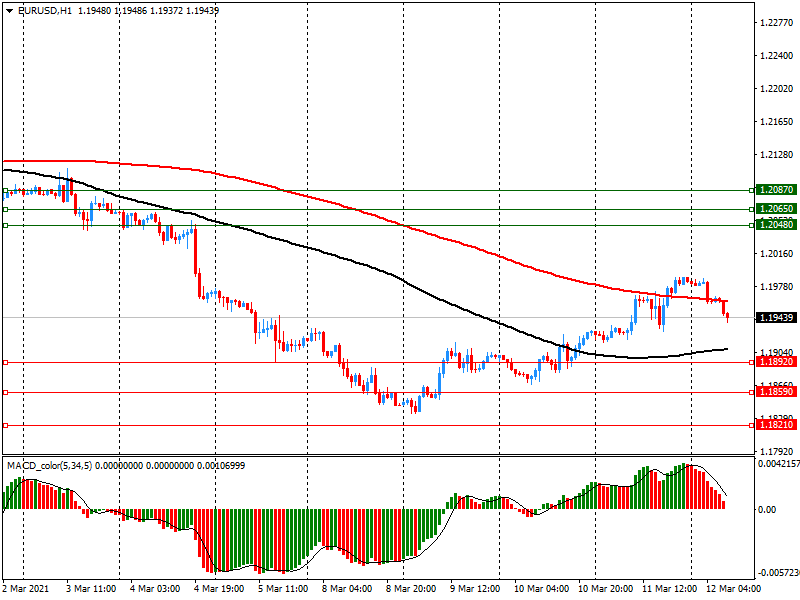
EUR/USD
Resistance levels (open interest**, contracts)
$1.2087 (547)
$1.2065 (634)
$1.2048 (1133)
Price at time of writing this review: $1.1944
Support levels (open interest**, contracts):
$1.1892 (2396)
$1.1859 (4789)
$1.1821 (2934)
Comments:
- Overall open interest on the CALL options and PUT options with the expiration date April, 9 is 52148 contracts (according to data from March, 11) with the maximum number of contracts with strike price $1,1900 (4789);
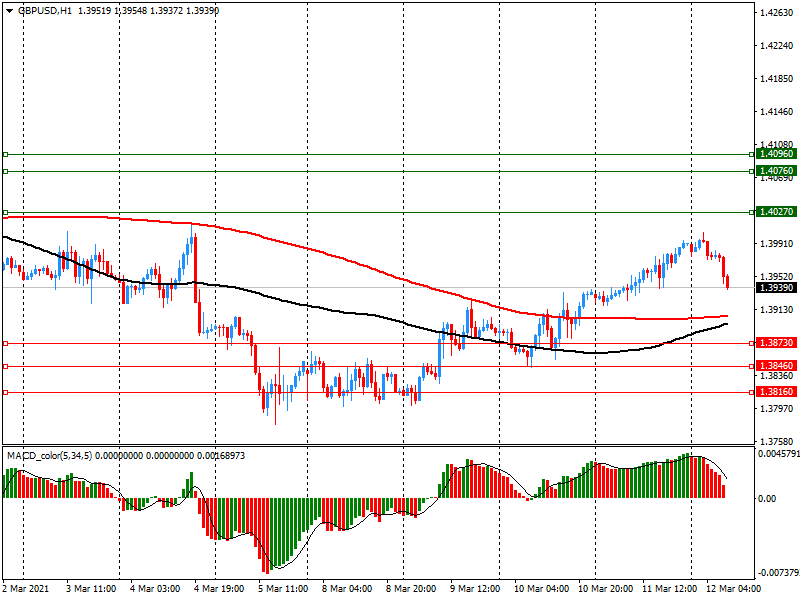
GBP/USD
$1.4096 (503)
$1.4076 (717)
$1.4027 (675)
Price at time of writing this review: $1.3939
Support levels (open interest**, contracts):
$1.3873 (290)
$1.3846 (468)
$1.3816 (570)
Comments:
- Overall open interest on the CALL options with the expiration date April, 9 is 7601 contracts, with the maximum number of contracts with strike price $1,4100 (1277);
- Overall open interest on the PUT options with the expiration date April, 9 is 19183 contracts, with the maximum number of contracts with strike price $1,3200 (5591);
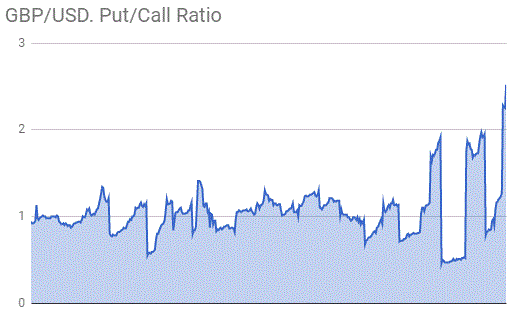
- The ratio of PUT/CALL was 2.52 versus 2.25 from the previous trading day according to data from March, 11
* - The Chicago Mercantile Exchange bulletin (CME) is used for the calculation.
** - Open interest takes into account the total number of option contracts that are open at the moment.
According to the report from Office for National Statistics, monthly production fell by 1.5% in January 2021 meaning it was 5.0% below its level in February 2020, the last month of "normal" trading conditions prior to the coronavirus (COVID-19) pandemic. Economists had expected a 0.6% decrease.
The decline in production was driven by falls of 2.3% in manufacturing and 0.7% in mining and quarrying; these were offset partially by a rise of 0.9% in electricity and gas and 1.2% in water supply and sewage.
The 2.3% fall in manufacturing means it was 5.7% below its level in February 2020; the fall in manufacturing over the month was driven by lower output in 9 of the 13 manufacturing subsectors, the largest being the fall in manufacturing of transport equipment.
Production output for the three months to January 2021 grew by 0.7% compared with the three months to October 2020.
Production output for the three months to January 2021 fell by 4.1% compared with the three months to January 2020.
According to the report from Office for National Statistics, UK gross domestic product (GDP) is estimated to have fallen by 2.9% in January 2021, as government restrictions reduced economic activity. Economists had expected a 4.9% decrease.
The output approach to GDP shows that January’s level was 9.0% below that seen in February 2020 and was 4.0% below levels seen in October 2020, the initial recovery peak. Overall, all main sectors of GDP remained notably below their pre-pandemic (February 2020) levels and all were lower than in October 2020.
The services sector acted as the main drag on growth in January, decreasing by 3.5% as restrictions on activity were reintroduced in response to the coronavirus (COVID-19) pandemic. The services sector was 10.2% below the level of February 2020 compared with 4.9% below the level seen in October 2020.
The production sector fell by 1.5% in January 2021 following eight months of consecutive growth. The sector was 5.0% below its February 2020 level.
The construction sector saw positive growth of 0.9% in January, after a decline of 2.9% in December 2020. The construction sector was 2.6% below the level of February 2020.
GDP contracted by 1.7% in the three months to January 2021, down from a 1.0% growth in the three months to December 2020.
| Time | Country | Event | Period | Previous value | Forecast |
|---|---|---|---|---|---|
| 07:00 (GMT) | Germany | CPI, m/m | February | 0.8% | 0.7% |
| 07:00 (GMT) | Germany | CPI, y/y | February | 1% | 1.3% |
| 07:00 (GMT) | United Kingdom | Manufacturing Production (MoM) | January | 0.3% | |
| 07:00 (GMT) | United Kingdom | Industrial Production (MoM) | January | 0.2% | |
| 07:00 (GMT) | United Kingdom | Manufacturing Production (YoY) | January | -2.5% | |
| 07:00 (GMT) | United Kingdom | Industrial Production (YoY) | January | -3.3% | |
| 07:00 (GMT) | United Kingdom | GDP m/m | January | 1.2% | |
| 07:00 (GMT) | United Kingdom | Total Trade Balance | January | -6.2 | |
| 07:00 (GMT) | United Kingdom | GDP, y/y | January | -6.5% | |
| 10:00 (GMT) | Eurozone | Industrial Production (YoY) | January | -0.8% | |
| 10:00 (GMT) | Eurozone | Industrial production, (MoM) | January | -1.6% | |
| 13:30 (GMT) | Canada | Capacity Utilization Rate | Quarter IV | 76.5% | |
| 13:30 (GMT) | Canada | Wholesale Sales, m/m | January | -1.3% | |
| 13:30 (GMT) | U.S. | PPI, y/y | February | 1.7% | |
| 13:30 (GMT) | U.S. | PPI, m/m | February | 1.3% | 0.3% |
| 13:30 (GMT) | U.S. | PPI excluding food and energy, Y/Y | February | 2% | |
| 13:30 (GMT) | U.S. | PPI excluding food and energy, m/m | February | 1.2% | 0.2% |
| 13:30 (GMT) | Canada | Employment | February | -212.8 | |
| 13:30 (GMT) | Canada | Unemployment rate | February | 9.4% | |
| 14:00 (GMT) | United Kingdom | NIESR GDP Estimate | February | -2.5% | |
| 15:00 (GMT) | U.S. | Reuters/Michigan Consumer Sentiment Index | March | 76.8 | 78.5 |
| 18:00 (GMT) | U.S. | Baker Hughes Oil Rig Count | March |
| Pare | Closed | Change, % |
|---|---|---|
| AUDUSD | 0.77848 | 0.72 |
| EURJPY | 130.031 | 0.61 |
| EURUSD | 1.19846 | 0.48 |
| GBPJPY | 151.807 | 0.6 |
| GBPUSD | 1.39918 | 0.51 |
| NZDUSD | 0.72256 | 0.44 |
| USDCAD | 1.25352 | -0.62 |
| USDCHF | 0.92447 | -0.47 |
| USDJPY | 108.491 | 0.12 |







© 2000-2026. All rights reserved.
This site is managed by Teletrade D.J. LLC 2351 LLC 2022 (Euro House, Richmond Hill Road, Kingstown, VC0100, St. Vincent and the Grenadines).
The information on this website is for informational purposes only and does not constitute any investment advice.
The company does not serve or provide services to customers who are residents of the US, Canada, Iran, The Democratic People's Republic of Korea, Yemen and FATF blacklisted countries.
Making transactions on financial markets with marginal financial instruments opens up wide possibilities and allows investors who are willing to take risks to earn high profits, carrying a potentially high risk of losses at the same time. Therefore you should responsibly approach the issue of choosing the appropriate investment strategy, taking the available resources into account, before starting trading.
Use of the information: full or partial use of materials from this website must always be referenced to TeleTrade as the source of information. Use of the materials on the Internet must be accompanied by a hyperlink to teletrade.org. Automatic import of materials and information from this website is prohibited.
Please contact our PR department if you have any questions or need assistance at pr@teletrade.global.


 Bank
Bank transfers


