- Analytics
- News and Tools
- Market News
Analytics, News, and Forecasts for CFD Markets: currency news — 16-03-2021.
| Time | Country | Event | Period | Previous value | Forecast |
|---|---|---|---|---|---|
| 00:30 (GMT) | Australia | House Price Index (QoQ) | Quarter IV | 0.8% | 2% |
| 00:30 (GMT) | Australia | RBA Meeting's Minutes | |||
| 04:05 (GMT) | Japan | BOJ Governor Haruhiko Kuroda Speaks | |||
| 04:30 (GMT) | Japan | Industrial Production (MoM) | January | -1% | |
| 04:30 (GMT) | Japan | Industrial Production (YoY) | January | -2.6% | |
| 07:45 (GMT) | France | CPI, m/m | February | 0.2% | -0.1% |
| 07:45 (GMT) | France | CPI, y/y | February | 0.6% | 0.4% |
| 10:00 (GMT) | Eurozone | ZEW Economic Sentiment | March | 69.6 | |
| 10:00 (GMT) | Germany | ZEW Survey - Economic Sentiment | March | 71.2 | 74 |
| 12:30 (GMT) | Canada | Foreign Securities Purchases | January | 5.33 | |
| 12:30 (GMT) | U.S. | Retail sales | February | 7.6% | -0.5% |
| 12:30 (GMT) | U.S. | Retail Sales YoY | February | 9.5% | |
| 12:30 (GMT) | U.S. | Retail sales excluding auto | February | 8.3% | -0.1% |
| 12:30 (GMT) | U.S. | Import Price Index | February | 1.4% | 1.2% |
| 13:15 (GMT) | U.S. | Capacity Utilization | February | 75.5% | 75.5% |
| 13:15 (GMT) | U.S. | Industrial Production YoY | February | -2% | |
| 13:15 (GMT) | U.S. | Industrial Production (MoM) | February | 1.1% | 0.3% |
| 14:00 (GMT) | U.S. | NAHB Housing Market Index | March | 84 | 83 |
| 14:00 (GMT) | U.S. | Business inventories | January | 0.8% | 0.3% |
| 21:45 (GMT) | New Zealand | Current Account | Quarter IV | -3.521 | -2.88 |
| 23:30 (GMT) | Australia | RBA Assist Gov Kent Speaks | |||
| 23:50 (GMT) | Japan | Trade Balance Total, bln | February | -323.9 | 420 |
| Time | Country | Event | Period | Previous value | Forecast |
|---|---|---|---|---|---|
| 00:30 (GMT) | Australia | Leading Index | February | 0.3% | |
| 09:00 (GMT) | France | IEA Oil Market Report | |||
| 10:00 (GMT) | Eurozone | Construction Output, y/y | January | -2.3% | |
| 10:00 (GMT) | Eurozone | Harmonized CPI, Y/Y | February | 0.9% | 0.9% |
| 10:00 (GMT) | Eurozone | Harmonized CPI ex EFAT, Y/Y | February | 1.4% | 1.1% |
| 10:00 (GMT) | Eurozone | Harmonized CPI | February | 0.2% | 0.2% |
| 12:30 (GMT) | U.S. | Building Permits | February | 1.886 | |
| 12:30 (GMT) | U.S. | Housing Starts | February | 1.58 | |
| 12:30 (GMT) | Canada | Consumer Price Index m / m | February | 0.6% | |
| 12:30 (GMT) | Canada | Bank of Canada Consumer Price Index Core, y/y | February | 1.6% | |
| 12:30 (GMT) | Canada | Consumer price index, y/y | February | 1% | |
| 14:30 (GMT) | U.S. | Crude Oil Inventories | March | 13.798 | |
| 18:00 (GMT) | U.S. | FOMC Economic Projections | |||
| 18:00 (GMT) | U.S. | Fed Interest Rate Decision | 0.25% | ||
| 18:30 (GMT) | U.S. | Federal Reserve Press Conference | |||
| 21:45 (GMT) | New Zealand | GDP y/y | Quarter IV | 0.4% | |
| 21:45 (GMT) | New Zealand | GDP q/q | Quarter IV | 14.0% |
FXStreet reports that economists at Capital Economics continue to expect developed market (DM) equities to gain ground in the rest of this year.
“Our forecast is for DM government bond yields to fall back a bit this year. And even if yields were to rise further, we suspect that this would be driven mainly by rising inflation compensation, which tends to have a benign impact on equity prices.
“We wouldn’t rule out some further small increases in equity valuations, especially outside the US, where they are generally lower. More importantly, we expect an increase in firms’ earnings as the economy continues to recover from the coronavirus shock to push equities higher. Indeed, we think that the lifting of most restrictions on activity in DMs as vaccinations progress, together with extremely loose monetary and fiscal policy, will cause the global economy to grow strongly this year.”
“We forecast gains of 6-18% in MSCI’s indices for major DMs in the remainder of this year. We also anticipate that the MSCI USA index will generally underperform MSCI’s indices for other DMs.”
According to the report from Census Bureau, manufacturers’ and trade inventories for January, adjusted for seasonal variations but not for price changes, were estimated at an end-of-month level of $1,982.4 billion, up 0.3 percent (±0.1 percent) from December 2020, but were down 1.8 percent (±0.3 percent) from January 2020.
The combined value of distributive trade sales and manufacturers’ shipments for January, adjusted for seasonal and trading day differences but not for price changes, was estimated at $1,568.5 billion, up 4.7 percent (±0.3 percent) from December 2020 and was up 7.1 percent (±0.4 percent) from January 2020.
The total business inventories/sales ratio based on seasonally adjusted data at the end of January was 1.26. The January 2020 ratio was 1.38.
According to the report from NAHB, despite high buyer traffic and strong demand, builder sentiment fell in March as rising lumber and other material prices pushed builder confidence lower. Housing Market Index (HMI) shows that builder confidence in the market for newly built single-family homes fell two points to 82 in March.
“Though builders continue to see strong buyer traffic, recent increases for material costs and delivery times, particularly for softwood lumber, have depressed builder sentiment this month,” said NAHB Chairman Chuck Fowke. “Supply shortages and high demand have caused lumber prices to jump more than 200% since last April. Policymakers must address building material supply chain issues to help the economy sustain solid growth in 2021.”
Derived from a monthly survey that NAHB has been conducting for 35 years, the NAHB/Wells Fargo HMI gauges builder perceptions of current single-family home sales and sales expectations for the next six months as”good,” “fair” or “poor.” The survey also asks builders to rate traffic of prospective buyers as “high to very high,” “average” or “low to very low.” Scores for each component are then used to calculate a seasonally adjusted index where any number over 50 indicates that more builders view conditions as good than poor.
The HMI index gauging current sales conditions fell three points to 87 while the component measuring sales expectations in the next six months increased three points to 83. The gauge charting traffic of prospective buyers held firm at 72.
According to the report from the Federal Reserve, in February, total industrial production decreased 2.2 percent. Economists had expected a 0.3 percent increase. Manufacturing output and mining production fell 3.1 percent and 5.4 percent, respectively; the output of utilities increased 7.4 percent.
The severe winter weather in the south central region of the country in mid-February accounted for the bulk of the declines in output for the month. Most notably, some petroleum refineries, petrochemical facilities, and plastic resin plants suffered damage from the deep freeze and were offline for the rest of the month. Excluding the effects of the winter weather would have resulted in an index for manufacturing that fell about 1/2 percent and in an index for mining that rose about 1/2 percent. Both indexes would have remained below their pre-pandemic (February 2020) levels.[1]
At 104.7 percent of its 2012 average, total industrial production in February was 4.2 percent lower than its year-earlier level. Capacity utilization for the industrial sector decreased 1.7 percentage points in February to 73.8 percent, a rate that is 5.8 percentage points below its long-run (1972–2020) average.
| Time | Country | Event | Period | Previous value | Forecast | Actual |
|---|---|---|---|---|---|---|
| 00:30 | Australia | House Price Index (QoQ) | Quarter IV | 0.8% | 2% | 3% |
| 00:30 | Australia | RBA Meeting's Minutes | ||||
| 04:05 | Japan | BOJ Governor Haruhiko Kuroda Speaks | ||||
| 04:30 | Japan | Industrial Production (MoM) | January | -1% | 4.3% | |
| 04:30 | Japan | Industrial Production (YoY) | January | -2.6% | -5.2% | |
| 07:45 | France | CPI, m/m | February | 0.2% | -0.1% | 0% |
| 07:45 | France | CPI, y/y | February | 0.6% | 0.4% | 0.6% |
| 10:00 | Eurozone | ZEW Economic Sentiment | March | 69.6 | 74.0 | |
| 10:00 | Germany | ZEW Survey - Economic Sentiment | March | 71.2 | 74 | 76.6 |
| 12:30 | Canada | Foreign Securities Purchases | January | 5.08 | 1.27 | |
| 12:30 | U.S. | Retail sales | February | 7.6% | -0.5% | -3% |
| 12:30 | U.S. | Retail Sales YoY | February | 7.4% | 6.3% | |
| 12:30 | U.S. | Retail sales excluding auto | February | 8.3% | -0.1% | -2.7% |
| 12:30 | U.S. | Import Price Index | February | 1.4% | 1.2% | 1.3% |
During today's European trading, the US dollar fell slightly, with market participants showing caution ahead of the meetings of the world's largest central banks.
The ICE index, which tracks the dollar's performance against six currencies (euro, swiss franc, yen, canadian dollar, pound sterling and swedish krona), fell 0.12%.
Central bankers are unlikely to abandon accommodative monetary policy, despite forecasts of rapid economic growth as the COVID-19 vaccine is introduced and $1.9 trillion in U.S. stimulus is approved.
Investors will be closely watching the Fed's comments on bond yields. Government bond yields around the world jumped on expectations that economic growth and inflation could lead to a faster-than-expected normalization of monetary policy.
The pound fell against the US dollar ahead of the Bank of England meeting on Thursday. Analysts predict that the central bank will keep its benchmark interest rate at a historic low of 0.1% and will not change the terms of the bond purchase program.
RTTNews reports that according to the data from the Commerce Department, after reporting a substantial increase in U.S. retail sales in the previous month, retail sales pulled back by much more than anticipated in the month of February.
Retail sales plunged by 3.0 percent in February after soaring by an upwardly revised 7.6 percent in January.
Economists had expected retail sales to dip by 0.5 percent compared to the 5.3 percent spike originally reported for the previous month.
Excluding a steep drop in auto sales, retail sales still tumbled by 2.7 percent in February after surging up by 8.3 percent in January. Ex-auto sales were expected to edge down by 0.1 percent.
FXStreet reports that strategists at Deutsche Bank discusses Brent Oil prospects.
“We remain constructive and expect prices to firm further, to above Brent $70/bbl by the end of the year. This view assumes that OPEC+ supply discipline remains intact in the face of still depressed demand in the US (down 6% YoY) and Europe (down 20%).”
“The recent strength in crude oil prices is principally a result of the slower-than-planned rollback of OPEC+ supply discipline, along with additional unilateral cuts by Saudi Arabia for the Feb-Apr period. We think the risk of a disorderly OPEC+ breakup is small, as Russian cooperation is elicited through exceptions allowing only Russia and Kazakhstan to reintroduce supply.”
Bloomberg reports that a senior central bank official proposed to the national parliament that China should create a new law to better coordinate policies to maintain financial stability and prevent risks.
The suggested new law should make it clear that the Financial Stability Development Committee is in charge of planning and organizing work related to risk prevention, Liu Guiping, deputy governor of the People’s Bank of China, said.
The proposal comes as policymakers look to shift their focus back to controlling risks and and debt in the economy, which is set to rebound this year. Building a system to prevent systemic financial risks will be the priority of the central bank’s work over the next five years, Deputy Governor Chen Yulu said.
“The prevention and resolution of financial risks requires a solid legal foundation,” wrote Liu. “There’s no time for us to delay in establishing a unified, orderly, efficient and authoritative legal system for maintaining financial stability.”
Financial risks have been piling up in China for a long time, creating a grim challenge to financial stability, Liu said, adding that there is still vulnerabilities in the system.
FXStreet reports that strategists at Deutsche Bank see gold investment demand weakening.
“We see downside as investment demand weakens further while rising physical demand in China and India provides an offset but fails to keep pace.”
“The behavior of gold in the first quarter lends credence to the importance of real yields. While the initial rise in nominal yields was neutralized by higher inflation expectations, Feb/Mar steepening outstripped reflation. The lift-off in real risk-free yields from record lows has potential to sustain the gradual unwinding of investment accumulation since early 2020, now about 1/3 of the way through.”
“We do not see demand elasticity of China and India physical demand providing sufficient support before $1,500/oz.”
Reuters reports that BofA’s March fund manager survey showed that investors have slightly increased their cash allocation, deeming that inflation and ‘taper tantrums’ could topple the record rally in financial markets.
Fund managers asked by BofA increased their cash allocation to 4% from 3.8% in February.
A rise above 2% in U.S. 10-year Treasury yield could cause more than a 10% correction in stocks, 43% of investors surveyed by BofA with $630 billion in assets under management said. And a rise to 2.5% could make bonds attractive relative to stocks.
Though the quickfire bond selloff in the last few weeks dented tech stocks wiping hundreds of billions from the sector’s market capitalization, ‘long tech’ remained the most crowded trade in the survey.
Rising rates have also prompted a rush to commodities. Investors are currently their most optimistic on commodities in the survey’s near two-decade history.
FXStreet reports that economists at HSBC see USD/JPY going slightly higher over the near-term, before correcting in the second half of the year.
“The BoJ is currently doing a review of its monetary policy easing and will announce the findings on Friday. The aim is to make monetary policy easing more sustainable for the long haul, as the 2% inflation goal still looks rather elusive, with progress being derailed by the pandemic. We believe the review may cause some temporary volatility in USD/JPY.”
“We can envision USD/JPY falling in a knee-jerk reaction, if the BoJ is interpreted as not being sufficiently dovish (by widening the YCC range, tapering exchange-traded fund (ETF) purchases, and making only minor tweaks to the Negative Interest Rate Policy (NIRP).”
“We believe USD/JPY will fluctuate with an upward bias over the near-term, before correcting slightly in 2H21. The correction could come about as more economies make progress with their vaccination programmes, thereby narrowing the US cyclical advantage, for example.”
According to the report from ZEW, the Indicator of Economic Sentiment for Germany increased again in the current March 2021 survey, climbing 5.4 points to a new reading of 76.6 points compared to February. This means that since December 2020, the indicator has recorded a rise of more than 20 points.The assessment of the economic situation in Germany is also more positive than in the previous month, and currently stands at minus 61.0 points, 6.2 points higher than in February. The assessment of the situation has thus slightly improved by 5.5 points since December 2020.
The financial market experts’ sentiment concerning the economic development of the eurozone also increased again in March, bringing the indicator to a current level of 74.0 points, 4.4 points higher than in February and almost 20 points higher than in December 2020.
The indicator for the current economic situation in the eurozone climbed 4.8 points to a level of minus 69.8 points, which is only about six points higher than in December 2020.
Inflation expectations for the eurozone rose 8.8 points, bringing the indicator to a new value of 80.6 points. For Germany, the inflation indicator increased by 7.5 points and currently stands at 81.0 points. More than 80 per cent of the experts expect the inflation rate both in the euro zone and in Germany to rise in the next six months.
FXStreet reports that Howie Lee, Economist at OCBC Bank, discusses Brent Oil prospects.
“Assuming a typical barrel of US crude oil yields 45% gasoline, on a net basis the total gasoline stocks (crude oil + gasoline) in the US last week stands at 456 M barrels, which means for the first time this year that aggregate is lower than the 5-year average.”
“American consumers are up and about on the move again but supply-side difficulties – with the US refinery utilization rate still at a dismal 69.0% - has added to the oil market’s bullishness. With the $1.9tn fiscal stimulus sealed and the $1400 checks expected to begin arriving as early as this week, the demand for energy looks like it may continue creeping higher. We see Brent possibly closing above $70 by mid-week.”
According to the report from National Institute of Statistics (ISTAT), in February 2021 the rate of change of Italian consumer price index for the whole nation (NIC) was +0.1% on monthly basis and +0.6% on annual basis (from +0.4% in January), confirming the flash estimate.
The slight speed up of All items index was mainly due to the less amplitude of the decrease of prices of Non-regulated energy products (from -6.3% to -3.6%) and to the trend reversal of prices of Services related to transport (from -0.1% to +1.0%); these dynamics were partially offset by the decrease of prices of Food including alcohol (from +0.6% to +0.2%).
Core inflation (excluding energy and unprocessed food) and inflation excluding energy slightly sped up to +0.9% for both (from +0.8% in the previous month).
The increase on monthly basis was mainly due to the prices of Non-regulated energy products (+1.4%), of Tobacco and of Services related to transport (+0.4% for both), only partially offset by the decrease of prices of Food including alcohol (-0.3%). Prices of Grocery and unprocessed food decreased by -0.2% on monthly basis and increased by +0.2% on annual basis (down from +0.4% in the previous month).
Reuters reports that Deutsche Bank has slashed 2021 economic growth forecasts for the euro area, citing spillover of the ongoing pandemic-linked activity restrictions but it upped predictions for Britain, the United States and India.
The investment bank cut gross domestic product (GDP) projections for the euro area to 4.6%, from the 5.6% projected in November. In contrast, it said it saw the UK economy expanding by 5.7%, up from 4.6% previously.
For the United States, Deutsche raised its forecast to 6.6% growth, a sharp jump from 4% it saw in November. It sees global economic growth at 6.8%.
It also now sees India's economy growing 10.2% this year, revising November's prediction of 7.9%
FXStreet reports that Moody’s Investors Service highlighted that the Asia-Pacific (APAC) region continues to drive global growth after the coronavirus pandemic-induced downturn.
“All Asia-Pacific economies are anticipated to record growth in 2021. As of March 11, Moody's Analytics forecasts India to record the strongest growth of 12 percent, followed by China (8.3 percent) and Vietnam (7.5 percent).”
“In the second half of the year, the region is expected to be supported by increased immunity and less social distancing, together with the emergence of North America and Europe from Covid-19 restrictions, which will drive global spending. “
“A recovery in international trade, supportive fiscal policies, and measures to manage COVID-19 are other factors working in the Asia-Pacific region's favor.”
| Time | Country | Event | Period | Previous value | Forecast | Actual |
|---|---|---|---|---|---|---|
| 00:30 | Australia | House Price Index (QoQ) | Quarter IV | 0.8% | 2% | 3% |
| 00:30 | Australia | RBA Meeting's Minutes | ||||
| 04:05 | Japan | BOJ Governor Haruhiko Kuroda Speaks | ||||
| 04:30 | Japan | Industrial Production (MoM) | January | -1% | 4.3% | |
| 04:30 | Japan | Industrial Production (YoY) | January | -2.6% | -5.2% | |
| 07:45 | France | CPI, m/m | February | 0.2% | -0.1% | 0% |
| 07:45 | France | CPI, y/y | February | 0.6% | 0.4% | 0.6% |
During today's Asian trading, the US dollar was trading steadily against the euro, but rose against the yen.
Traders will focus on the two-day meeting of the Federal Reserve System (Fed), starting on March 16, as well as the meetings of the Bank of England and the Bank of Japan, which will be held later this week.
"The upcoming meeting of the Federal Reserve is likely to determine the direction of the dollar, at least for the next few months. The meeting will show whether the Fed's leaders still expect to maintain a soft monetary policy for a very long period of time, or whether the budget incentives adopted in the amount of about 10% of GDP will mean that policy tightening will begin much earlier than the market puts it in the current rates," Goldman Sachs noted.
The ICE index, which tracks the dollar's performance against six currencies (euro, swiss franc, yen, canadian dollar, pound sterling and swedish krona), rose 0.10%.
The pound fell almost 0.5% against the US dollar. Unlike the European Central Bank (ECB), which promised last week to accelerate the pace of asset repurchases under the anti - crisis program, the Bank of England is likely to keep the volume of repurchases at the current level-about 4.4 billion pounds per week.
According to the report from INSEE, in February 2021, the Consumer Price Index (CPI) was stable over one month, after +0.2% in January. The decrease in manufactured goods prices accentuated due to the two-week extension of the winter sales (–0.9% after –0.4%). The food prices fell back (–0.2% after +0.4%) and those of tobacco were stable. The service prices grew (+0.2% after +0.1%) and those of energy accelerated (+2.5% after +1.7%).
Seasonally adjusted, consumer prices fell back by 0.1%, after +0.7% in January.
Year on year, consumer prices rose by 0.6% as in the previous month. This stability in inflation came from a downturn in manufactured goods prices (–0.4% after +0.8%) and a slowdown in food prices (+0.8% after +1.0%), offset by the smaller decline in energy prices than in the last month (–1.6% after –5.8%) and the slight rise in tobacco prices (+12.8% after +12.7%). The service prices increased at the same rate as in the previous month (+0.8%).
Year on year, core inflation fell, in February, down to +0.6% after +1.0% in January. The Harmonised Index of Consumer Prices (HICP) was stable over one month after +0.3% in the previous month; year on year, it increased by 0.8% as in January.
Reuters reports that Bank of Japan Governor Haruhiko Kuroda said it was important to keep long-term interest rates "stably low" as the economy is still suffering from the impact of the COVID-19 pandemic.
He also told parliament the BOJ was buying government bonds across all maturities in a "balanced" manner, brushing aside some views that it was intentionally shortening the average duration of its bond holdings.
"Excessive falls in super-long interest rates would affect returns for insurers and pension funds. On the other hand, it's important to keep the entire yield curve stably low as the pandemic weighs on the economy," Kuroda said.
Kuroda conceded that Japan's inflation expectations remain stubbornly low in contrast to that of the United States, which he said had "heightened quickly and quite a bit".
But he stressed Japan's real borrowing costs remain low thanks in part to the BOJ's aggressive monetary easing.
EUR/USD
Resistance levels (open interest**, contracts)
$1.2059 (595)
$1.2032 (578)
$1.2010 (1152)
Price at time of writing this review: $1.1920
Support levels (open interest**, contracts):
$1.1867 (2235)
$1.1839 (4962)
$1.1806 (2940)
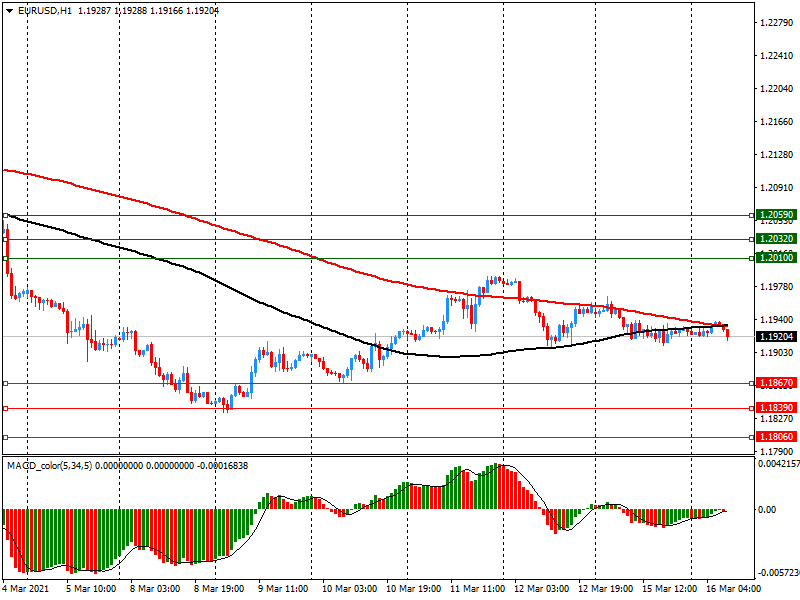
Comments:
- Overall open interest on the CALL options and PUT options with the expiration date April, 9 is 56393 contracts (according to data from March, 15) with the maximum number of contracts with strike price $1,1900 (4962);
GBP/USD
$1.4014 (810)
$1.3943 (675)
$1.3925 (375)
Price at time of writing this review: $1.3832
Support levels (open interest**, contracts):
$1.3779 (578)
$1.3752 (1843)
$1.3721 (479)
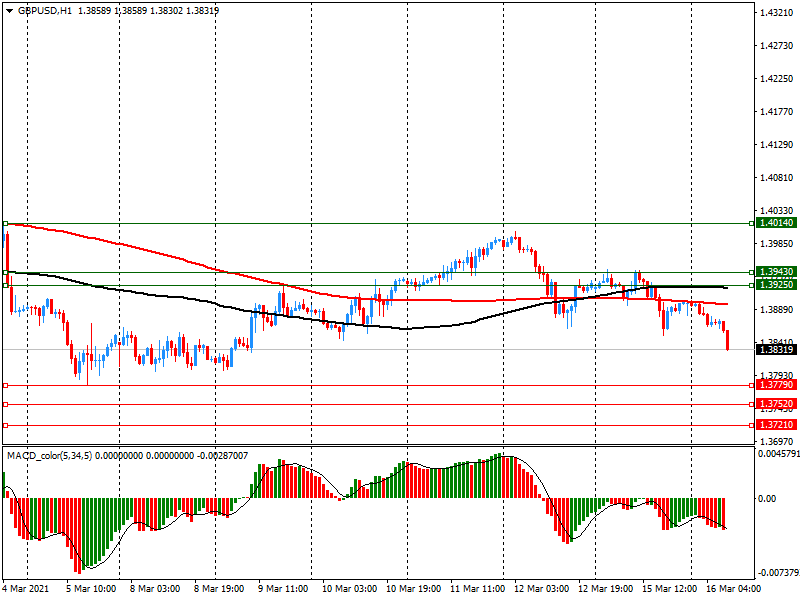
Comments:
- Overall open interest on the CALL options with the expiration date April, 9 is 8464 contracts, with the maximum number of contracts with strike price $1,4100 (1277);
- Overall open interest on the PUT options with the expiration date April, 9 is 19278 contracts, with the maximum number of contracts with strike price $1,3200 (5598);
- The ratio of PUT/CALL was 2.28 versus 2.29 from the previous trading day according to data from March, 15
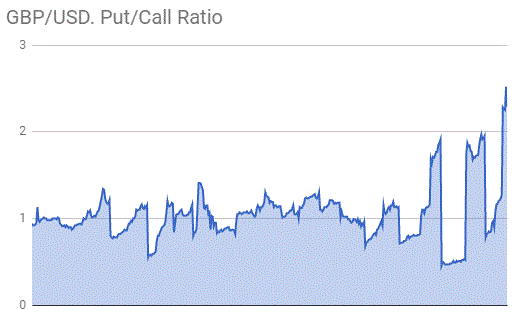
* - The Chicago Mercantile Exchange bulletin (CME) is used for the calculation.
** - Open interest takes into account the total number of option contracts that are open at the moment.
RTTNews reports that the Ministry of Economy, Trade and Industry said that Japan industrial production rose more than estimated in January.
Industrial production increased a seasonally adjusted 4.3 percent month-on-month in January. In the initial estimate, output rose 4.2 percent.
Inventories remained unchanged month-on-month in January. According to the initial estimate, inventories fell 0.2 percent.
The inventory ratio declined 5.7 percent in January versus a 6.3 percent fall in the initial estimate.
On a yearly basis, industrial production decreased 5.2 percent in January. According to the initial estimate, output fell 5.3 percent.
Bloomberg reports that UBS Group AG economists forecast that China’s economy will grow even faster than initially expected in 2021, driven by a strong rebound in the domestic economy and U.S. stimulus that should drive demand for Chinese exports.
The world’s second-largest economy will expand 9% this year, they estimated Tuesday, faster than their earlier forecast of 8.2%. If achieved, that would be the quickest growth in a decade, and would bring forward the time when China’s economy surpasses America’s in size.
“Despite additional mobility restrictions around the CNY holiday period that weakened travel and tourism, China’s overall economic activities were stronger than expected, thanks in part to more working days and robust export demand,” Chief China Economist Wang Tao and others wrote in the report.
| Time | Country | Event | Period | Previous value | Forecast |
|---|---|---|---|---|---|
| 00:30 (GMT) | Australia | House Price Index (QoQ) | Quarter IV | 0.8% | |
| 00:30 (GMT) | Australia | RBA Meeting's Minutes | |||
| 04:05 (GMT) | Japan | BOJ Governor Haruhiko Kuroda Speaks | |||
| 04:30 (GMT) | Japan | Industrial Production (YoY) | January | -2.6% | |
| 04:30 (GMT) | Japan | Industrial Production (MoM) | January | -1% | |
| 07:45 (GMT) | France | CPI, m/m | February | 0.2% | -0.1% |
| 07:45 (GMT) | France | CPI, y/y | February | 0.6% | 0.4% |
| 10:00 (GMT) | Eurozone | ZEW Economic Sentiment | March | 69.6 | |
| 10:00 (GMT) | Germany | ZEW Survey - Economic Sentiment | March | 71.2 | |
| 12:30 (GMT) | Canada | Foreign Securities Purchases | January | 5.08 | |
| 12:30 (GMT) | U.S. | Retail sales | February | 5.3% | -0.4% |
| 12:30 (GMT) | U.S. | Retail Sales YoY | February | 7.4% | |
| 12:30 (GMT) | U.S. | Retail sales excluding auto | February | 5.9% | 0% |
| 12:30 (GMT) | U.S. | Import Price Index | February | 1.4% | |
| 13:15 (GMT) | U.S. | Capacity Utilization | February | 75.6% | 75.7% |
| 13:15 (GMT) | U.S. | Industrial Production YoY | February | -1.8% | |
| 13:15 (GMT) | U.S. | Industrial Production (MoM) | February | 0.9% | 0.5% |
| 14:00 (GMT) | U.S. | NAHB Housing Market Index | March | 84 | 83 |
| 14:00 (GMT) | U.S. | Business inventories | January | 0.6% | 0.4% |
| 21:45 (GMT) | New Zealand | Current Account | Quarter IV | -3.52 | |
| 23:30 (GMT) | Australia | RBA Assist Gov Kent Speaks | |||
| 23:50 (GMT) | Japan | Trade Balance Total, bln | February | -323.9 |
| Pare | Closed | Change, % |
|---|---|---|
| AUDUSD | 0.77512 | -0.11 |
| EURJPY | 130.18 | -0.07 |
| EURUSD | 1.19265 | -0.18 |
| GBPJPY | 151.721 | -0.02 |
| GBPUSD | 1.39012 | -0.14 |
| NZDUSD | 0.71969 | 0.28 |
| USDCAD | 1.24783 | 0 |
| USDCHF | 0.92702 | -0.18 |
| USDJPY | 109.124 | 0.12 |







© 2000-2026. All rights reserved.
This site is managed by Teletrade D.J. LLC 2351 LLC 2022 (Euro House, Richmond Hill Road, Kingstown, VC0100, St. Vincent and the Grenadines).
The information on this website is for informational purposes only and does not constitute any investment advice.
The company does not serve or provide services to customers who are residents of the US, Canada, Iran, The Democratic People's Republic of Korea, Yemen and FATF blacklisted countries.
Making transactions on financial markets with marginal financial instruments opens up wide possibilities and allows investors who are willing to take risks to earn high profits, carrying a potentially high risk of losses at the same time. Therefore you should responsibly approach the issue of choosing the appropriate investment strategy, taking the available resources into account, before starting trading.
Use of the information: full or partial use of materials from this website must always be referenced to TeleTrade as the source of information. Use of the materials on the Internet must be accompanied by a hyperlink to teletrade.org. Automatic import of materials and information from this website is prohibited.
Please contact our PR department if you have any questions or need assistance at pr@teletrade.global.


 Bank
Bank transfers


