- Analytics
- News and Tools
- Market News
Analytics, News, and Forecasts for CFD Markets: currency news — 19-03-2021.
| Time | Country | Event | Period | Previous value | Forecast |
|---|---|---|---|---|---|
| 00:01 (GMT) | United Kingdom | Gfk Consumer Confidence | March | -23 | |
| 00:30 (GMT) | Australia | Retail Sales, M/M | February | 0.3% | 0.4% |
| 03:00 (GMT) | Japan | BoJ Interest Rate Decision | -0.1% | -0.1% | |
| 07:00 (GMT) | Germany | Producer Price Index (YoY) | February | 0.9% | 2% |
| 07:00 (GMT) | Germany | Producer Price Index (MoM) | February | 1.4% | 0.7% |
| 07:00 (GMT) | United Kingdom | PSNB, bln | February | -3.1 | -21 |
| 12:30 (GMT) | Canada | Retail Sales YoY | January | 2.8% | |
| 12:30 (GMT) | Canada | Retail Sales, m/m | January | -3.4% | -3% |
| 12:30 (GMT) | Canada | Retail Sales ex Autos, m/m | January | -4.1% | -2.6% |
| 17:00 (GMT) | U.S. | Baker Hughes Oil Rig Count | March | 309 |
On Monday, at 09:00 GMT, the eurozone will announce a change in current account for January. At 11: 00 GMT, in Germany, the Bundesbank's monthly report will be released. At 13:00 GMT in the US, the head of the Fed Powell will make a speech. At 14:00 GMT, the US will report changes in home sales in the secondary market for February.
On Tuesday, at 07:00 GMT, Britain will announce changes in the number of applications for unemployment benefits for February, as well as the unemployment rate and average earnings for January. At 11:00 GMT, in the UK, the CBI industrial order books balance for March will be released. At 12:30 GMT, the US will announce a change in the balance of payments for the 4th quarter. At 14:00 GMT, the US will report changes in new home sales for February and release the Fed-Richmond manufacturing index for March. At 16:00 GMT in the US, the head of the Fed Powell will make a speech. At 21:45 GMT, New Zealand will announce a change in the foreign trade balance for February. At 23:50 GMT, in Japan, the Bank of Japan's monetary policy meeting minutes will be released.
On Wednesday, at 00:30 GMT, Japan will release the manufacturing PMI and the service sector PMI for March. At 00:30 GMT, Australia will announce a change in the trade balance for February. At 07:00 GMT, the UK will release the consumer price index, the producer purchase price index and the producer selling price index for February. Then the focus will be on the manufacturing and services business activity indices for March: France will report at 08: 15 GMT, Germany at 08: 30 GMT, the eurozone at 09:00 GMT, and Britain at 09:30 GMT. At 12:30 GMT, the US will report a change in the volume of orders for long-term goods for February. At 13:45 GMT, the US will present the index of business activity in the manufacturing sector for March. At 14:00 GMT in the US, the head of the Fed Powell will make a speech. At 14:30 GMT, the US will announce changes in oil reserves according to the Department of Energy. At 15:00 GMT, the eurozone will release the consumer confidence indicator for March. At 15:40 GMT, in the eurozone, ECB President Lagarde will deliver a speech.
On Thursday, at 07:00 GMT, Germany will present the Gfk consumer climate index for April. At 08:30 GMT, in Switzerland, the SNB's interest rate decision will be announced. At 09:00 GMT, in the eurozone, the ECB's economic bulletin will be released. Also at 09:00 GMT, the euro zone will announce changes in the M3 aggregate of the money supply and the volume of lending to the private sector for February. At 11:00 GMT, Britain will publish the retail sales index according to the Confederation of British Industrialists for March. At 12:30 GMT, the US will report changes in GDP for the 4th quarter and the number of initial applications for unemployment benefits. At 14:00 GMT in Belgium, the index of business sentiment for March will be released. At 23:30 GMT, Japan will present the Tokyo consumer price index for March.
On Friday, at 07:00 GMT, Britain will announce the change in retail trade volume for February. At 09:00 GMT, Germany will publish the IFO Business Environment indicator, the IFO assessment of the current situation indicator, and the IFO Economic expectations indicator for March. At 12:30 GMT, the US will release the PCE price index for February, as well as report on changes in the level of household spending and income for February and the balance of goods trade balance for February. At 14:00 GMT, the US will release the Reuters/Michigan Consumer Sentiment Index for March. At 17:00 GMT, in the US, the Baker Hughes report on the number of active oil drilling rigs will be released.
Reuters reports that data from Refinitiv Lipper showed that investment flows into U.S. equity funds jumped to a five-week high in the week ended March 17, buoyed by optimism over a massive stimulus package and on expectations that the Federal Reserve's monetary policy stance would remain dovish.
U.S. equity mutual funds pocketed a net inflow of $20.1 billion in the week, which marked a sixth straight week of net buying.
The inflows were led by U.S. small cap funds and mid-cap funds, seeing net purchases of $3.6 billion and $2.1 billion respectively. On the other hand, large-cap funds had an inflow of just $251 million.
Among sector funds, investors turned net buyers of tech funds this week, purchasing $832 million, as tech stocks appeared attractive at lower valuations after witnessing sharp selling in the prior weeks.
Reuters reports that Britain said that the world’s seven largest advanced economies moved to boost the International Monetary Fund reserves for the first time since 2009, a step aimed at helping developing countries cope with the coronavirus pandemic.
Britain - which is chairing the Group of Seven (G7) this year - said G7 finance ministers had agreed to support a “new and sizeable” increase in the volume of Special Drawing Rights (SDRs), an internal currency used by the IMF.
Any expansion of SDRs will need to be agreed with other countries ahead of the IMF’s spring meeting that takes place in April.
There are currently $293 billion of SDRs in circulation, and the last big expansion took place during the 2009 global financial crisis.
Britain’s finance ministry said extra SDRs would help poorer countries “pay for crucial needs such as vaccines and food imports, and improve the buffers of emerging markets and low-income countries”.
eFXdata reports that TD Research discusses the USD outlook.
"As we continue to note, higher rates that validate a rise in global growth expectations won't invite the USD's exceptionalism 2.0 regime. The result is something new, likely something that most haven't seen before. For the USD, the upshot is more variation under the hood, favoring currencies with growth, value, carry, and positive terms of trade. We discuss these drivers along with the recent central bank shifts. Notably, a backtest of our Global Macro PCA-based USD signal argues to fade extremes, suggesting selling into USD rallies in Q2," TD adds.
CNBC reports that Nokia President and CEO Pekka Lundmark told that the ongoing global chip shortage needs to be closely monitored and supply chain visibility isn’t as good as it used to be.
Lundmark told that the chip market is “tight” at the moment.
“It’s not only telecoms. It’s automotive, it’s consumer gadgets, it’s the emerging IOT (internet of things) devices,” he said. “The whole semiconductor industry is actually very busy finding ways to increase capacity.”
The chip shortage has hit the cost-conscious automotive industry particularly hard as it uses chips in everything from power steering and brake sensors, to entertainment systems and parking cameras. The smarter cars get, the more chips they use.
Several manufacturers including GM, Honda, and Ford have been forced to cut production.
Lundmark added that the medium to long-term visibility on chip supply is not as good as it used to be.
Reuters reports that Japanese government estimate showed that a trade deal among fifteen economies in the Asia Pacific would boost Japan's economy by 2.7% when its benefits fully appear.
15 Asia-Pacific nations signed the Regional Comprehensive Economic Partnership (RCEP) trade agreement in November last year, covering nearly a third of the global population and about 30% of its global gross domestic product. RCEP includes China, Japan, South Korea, Australia, New Zealand and the 10 members of the Association of South East Asian Nations (ASEAN).
The trade deal would lift Japan's gross domestic product (GDP) 2.7%, which would be worth about 15 trillion yen ($137.82 billion) based on the nation's economy in fiscal 2019. It would have the value of creating an additional 570,000 jobs, according to the estimate.
eFXdata reports that Citi discusses its reaction to the BoJ policy assessment.
"The BoJ announced the results of the review of its monetary policy, with some tweaks. Essentially, the BoJ would be aiming to promote the yields going higher gradually, which will be a positive for the Japanese currency. However, while US yields are rising more rapidly, its impact on USDJPY will be limited for now, likely leaving the pair elevated at around 109. If rising US yields, boosted by higher JGB yields following today’s BoJ decisions, hit the US stock markets and dampen risk," Citi adds.
CNBC reports that the European Commission, the executive arm of the EU, proposed Friday a new set of start-up standards for member states to adopt as the bloc seeks to play catch-up with the U.S. and China.
The EU Start-up Nations Standard calls on countries to change their laws on stock options and immigration visas so that start-ups can attract the best talent from anywhere in the world.
So far, 25 countries across Europe have signed up to the framework. The only ones that haven’t are Hungary, Bulgaria and Croatia. Those that have signed up will now be expected to change their rules over time.
Tech founders in Europe have long called for reforms to help start-ups flourish and catch up to the U.S. and China, which have produced the world’s largest digital companies. In the U.S., there’s Google, Facebook, Apple, Amazon and many others, while in China there’s Alibaba, Tencent, Huawei and Xiaomi. All of these firms are substantially bigger than Europe’s largest tech companies.
One key complaint in Europe has been around employee stock options, which give start-up employees the chance to own a slice of their company.
Financial Times reports that the Federal Reserve has announced that it will let looser capital rules for banks introduced at the start of the pandemic expire at the end of March.
Capital rules were eased last year in a temporary change to the supplementary leverage ratio (SLR), and have been the focus of an intense political battle in recent weeks.
While Democrats in Congress had argued that the relief from capital rules should be terminated at the end of this month, many Republicans sided with the banks to argue for an extension.
The Fed said on Friday that the change to the SLR would expire as scheduled on March 31. However, the central bank said it would explore a more permanent overhaul to the rules.
The SLR requires large banks to have capital equal to at least 3 per cent of their assets, or 5 per cent for the largest systemically important institutions. Under the April 2020 rule change, lenders were allowed to temporarily exclude holdings of US Treasuries and cash kept in reserve at the central bank from their assets when calculating the ratio.
Bloomberg reports that according to a person familiar with the plans, Germany is mulling around 70 billion euros in extra debt spending this year to fight the fallout from the coronavirus crisis.
Finance Minister Olaf Scholz needs those additional funds because the country’s lockdown is dragging on much longer than expected, the person said, cautioning that the exact number is still under discussion.
Scholz said earlier this month that Germany will have to increase debt spending in 2021 to help tackle the impact of the coronavirus crisis on Europe’s largest economy.
On Friday, Health Minister Jens Spahn warned that Germany already is in a “third wave of the pandemic” after the contagion rate inched closer to a critical threshold.
Merkel and regional state leaders are due to meet Monday to decide on the next steps in the fight against the coronavirus. Current curbs include billions of aid to companies such as restaurants, hotels and non-essential shops that were forced to close.
According to the report from Statistics Canada, retail sales fell for the second consecutive month, down 1.1% to $52.5 billion in January. Economists had expected a 3.0% decrease. Sales declined in 6 of 11 subsectors, representing 39.4% of retail sales.
Core retail sales—which exclude gasoline stations and motor vehicle and parts dealers—also posted their second consecutive decline, falling 1.4% in January because of lower sales at clothing and clothing accessories stores, furniture and home furnishings stores, and sporting goods, hobby, book and music stores.
In terms of volume, retail sales fell 1.6% in January.
Given the rapidly evolving economic situation, Statistics Canada is providing an advance estimate of retail sales, which suggests that sales increased by 4.0% in February. Owing to its preliminary nature, this figure will be revised.
This unofficial estimate was calculated based on responses received from 58% of companies surveyed. The average final response rate for the survey over the previous 12 months has been 86.5%.
| Time | Country | Event | Period | Previous value | Forecast | Actual |
|---|---|---|---|---|---|---|
| 00:01 | United Kingdom | Gfk Consumer Confidence | March | -23 | -16 | |
| 00:30 | Australia | Retail Sales, M/M | February | 0.3% | 0.4% | -1.1% |
| 03:00 | Japan | BoJ Interest Rate Decision | -0.1% | -0.1% | -0.1% | |
| 07:00 | Germany | Producer Price Index (YoY) | February | 0.9% | 2% | 1.9% |
| 07:00 | Germany | Producer Price Index (MoM) | February | 1.4% | 0.7% | 0.7% |
| 07:00 | United Kingdom | PSNB, bln | February | -3.1 | -21 | -19.1 |
During today's European trading, the dollar consolidated, but continued to receive support from higher treasury yields after the dovish position of the US Federal Reserve.
The yen rose slightly after the Bank of Japan extended its target range for 10-year bond yields by an implicit 5 basis points. The move was noted in the press, with Bank of Japan Governor Haruhiko Kuroda downplaying suggestions that the bank was tightening its policy.
The pound has stabilized after yesterday's decline due to concerns that the vaccination campaign in the UK will slow down. The Bank of England maintained a soft stance at its meeting on Thursday and warned that the outlook for the country's economic recovery remains unclear.
The euro fell 0.15% amid fears of further lockdowns due to the coronavirus in Europe after France imposed a new four-week lockdown from Friday in 16 regions hit hard by the health crisis.
Reuters reports that ECB board member Fabio Panetta said that the ECB could decide around mid-year whether to proceed with a digital euro but the formal launch of the currency may still be around five years away.
If the process gets the go ahead this year, there will a two-year investigation phase and a two to three year implementation phase, Panetta told a conference.
ECB President Christine Lagarde last month said she hoped the digital euro could be read in four years.
FXStreet reports that senior economist Alvin Liew at UOB Group evaluates the recent FOMC meeting.
“The Fed as widely expected, kept its policy rates and asset purchase program unchanged in its March FOMC, even as it significantly upgraded its GDP, unemployment and inflation forecasts.”
“While FOMC Chair Powell noted that “strong (US) data is in front of us”, and that the US avoided some of the very worst outcomes but warned that one should not be complacent and that the Fed will continue to provide support for as long as needed.”
“Going forward, our base case remains for the Fed to stay on hold for most of 2021, at least, and the taper discussion will only start in late 2021/early 2022. This is premised on the continued successful rollout of vaccinations across the US, additional fiscal stimulus in the coming months (which have come to pass), and the subsequent reduction in COVID-19 infections and deaths with the return to economic/social normalcy in the foreseeable future.”
Reuters reports that according to several major bond fund managers, the recent pace of the rise in yields in the U.S. Treasury market has been unsettling.
Managers also cited some issues with liquidity as yields have moved upwards, with the 10-year Treasury yield up 80 basis points since January. It reached a 14-month high of 1.754% this week.
Some analysts have compared the rise in yields to the 2013 “taper tantrum”, when 10-year yields jumped 136 basis points to 3.06%, according to Rabobank.
“This isn’t a market for bond math and market geeks,” said Gregory Peters, head of multi-sector and strategy for PGIM Fixed Income. “It’s not so much the rise in interest rates as it is the volatility and swiftness that’s unsettling. There is real momentum around it.”
“(The 10-year yield) could go as high as 2% and that’s really not more than a few trading days away at this point,” said Gregory Whiteley, a portfolio manager at DoubleLine.
Fed Chair Jerome Powell has thus far brushed off concerns that the recent surge in U.S. Treasury yields might spell trouble for the central bank’s extended easy monetary policy. But a rapid move higher, which can raise borrowing costs for companies and consumers, could eventually compel them to reconsider, said Whiteley.
FXStreet reports that Credit Suisse analyst team discusses AUD/USD prospects.
“We keep our view for further sideways trading intact for now, with a mild downside tilt, based on the potential for a ‘head and shoulders’ top. With this in mind, we see support initially at 0.7724, ahead of the recent low at 0.7699, removal of which would expose 0.7622/21 next.”
“Beyond 0.7622/21 would increase the risk of a more important ‘head and shoulders’ top again, which would be triggered beneath the cluster of supports at 0.7583/57 – the early February lows.”
Reuters reports that German health minister Jens Spahn dampened hopes that further coronavirus restrictions will be lifted soon, saying rising infections could mean that curbs to slow the spread of the virus may have to be re-imposed.
German Chancellor Angela Merkel is due to meet with leaders of Germany’s 16 federal states on Monday to discuss whether to extend a lockdown that has been in place since mid-December.
Earlier this month, the group had laid out plans for a gradual re-opening of the economy, and many shops have since been opened for appointment-only shopping.
But coronavirus infections numbers have been on the rise in recent weeks. The number of confirmed coronavirus cases in Germany increased by 17,482 to 2,629,750, data from the Robert Koch Institute (RKI) for infectious diseases showed on Friday. The reported death toll rose by 226 to 74,358.
According to the report from the National Institute of Statistics (ISTAT), in January 2021, estimates for construction output increased by 4.5% in the month-on-month series, after falling in December (-4.2%).
In the three months to January 2021, the seasonally adjusted index of production in construction contracted by 2.8% when compared with the previous three months.
Year on year, the unadjusted index for construction output dropped by 7.9%, while the calendar adjusted index (19 calendar working days versus 21 in January 2020) decreased by 1.5%.
CNBC reports that according to Jim Caron, global fixed-income portfolio manager at Morgan Stanley, the rise in 10-year Treasury yields is reasonable and a reflection of the growing confidence in the U.S economic outlook.
The recent increase in bond yields does not indicate a tightening of financial conditions, according to Caron.
“The way that I see it is that as we sit here around 1.75%, 1.7% in the 10-year note, I think this is a reasonable area where we can expect some consolidation,” he said Friday, referring to how the yield will likely remain within a range, neither continuing much higher or reversing much.
“Because this is the level that the market had expected that we would get to, on a more dovish than expected Fed announcement. And that’s what we got,” he told.
Michael Spencer, chief economist and head of research Asia-Pacific at Deutsche Bank, echoed a similar view, stating it is “entirely natural that long bond yields are going up.”
“Everybody is wildly bullish on U.S growth. We expect through the course of this year, the economy is going to grow 7.5%. I don’t think what we’ve seen is disorderly. I think we have to expect by the end of the year, 10-year bond yields are going to be two and a quarter (percent), or higher”, he told.
FXStreet reports that economists at Charles Schwab agree that there can be unforeseen consequences from the current policy mix, but the dollar's role as the dominant global currency looks secure.
“Over the years, the euro’s usage in global transactions has grown, the Japanese yen’s usage has been largely stable, and there has been a slight increase in the renminbi’s role. However, none of these currencies seem likely to supplant the dollar any time soon.”
“While we believe the dollar’s role as the world’s reserve currency will remain intact for the foreseeable future, its value will rise and fall with changes in the economic fundamentals.”
“The dollar remains a safe-haven asset. During times of global stress, the dollar generally moves up as investors seek a large, liquid, and reliable place to put their money. When the pandemic struck in early 2020, the dollar soared to its highest level in decades compared to a wide range of other currencies due to global demand.”
Reuters reports that Britain’s record-breaking borrowing to pay for the coronavirus crisis is likely to be a little lower than forecast, after data published on Friday showed the budget deficit grew by less than expected in the first two months of 2021.
The budget deficit in the first 11 months of the financial year has soared to almost 279 billion pounds, the highest relative to the size of the economy since World War Two.
But unless there is a major borrowing surge in March, the deficit looks likely to come in below an estimate set by the Office for Budget Responsibility.
The OBR said this month that the deficit was likely to surpass 350 billion pounds in the financial year which ends on March 31.
The year-to-date figures published on Friday by the ONS do not include the 27.2 billion pounds of COVID loan write-offs that the OBR estimates will need to be made.
Finance minister Rishi Sunak on March 3 announced a budget plan which included 65 billion pounds in further stimulus to help the economy through what he hopes will be a gradual lifting of COVID restrictions by the end of June.
Responding to Friday’s data, Sunak said his 352 billion pounds of total extra spending and tax cuts so far had been the responsible thing to do.
Borrowing in the 2021/22 financial year, which starts in April, is estimated to fall to 234 billion pounds according to the OBR, still more than four times the deficit in 2019/20 which included only one month of the coronavirus crisis.
FXStreet reports that strategists at ANZ Bank believe the market is not entering another commodity ‘super-cycle’.
“The outlook for commodities remains strong. Policy responses from governments worldwide should see global growth push demand for most commodities above long-term levels. At the same time, we see increasing supply-side issues limiting production growth. Combined with relatively low inventories, prices should be well supported in the short-term.”
“A long-term cyclical uptrend looks unlikely at this stage. There have been three major booms in commodity markets since WWII: 1950-55, 1972-80 and 2005-09. The current cycle has all the hallmarks of these previous cycles, in particular, synchronised growth in GDP and industrial production. However, it has some unique features, including climate change policies, which are threatening to push demand in certain commodities even higher.”
| Time | Country | Event | Period | Previous value | Forecast | Actual |
|---|---|---|---|---|---|---|
| 00:01 | United Kingdom | Gfk Consumer Confidence | March | -23 | -16 | |
| 00:30 | Australia | Retail Sales, M/M | February | 0.3% | 0.4% | -1.1% |
| 03:00 | Japan | BoJ Interest Rate Decision | -0.1% | -0.1% | -0.1% | |
| 07:00 | Germany | Producer Price Index (YoY) | February | 0.9% | 2% | 1.9% |
| 07:00 | Germany | Producer Price Index (MoM) | February | 1.4% | 0.7% | 0.7% |
| 07:00 | United Kingdom | PSNB, bln | February | -3.1 | -21 | -19.1 |
During today's Asian trading, the dollar fell against the euro and the yen. The day before, the dollar index rose following the growth of US Treasuries yields, which traditionally supports the dollar.
The rise in US Treasury bond yields is a signal that investors are putting the rapid recovery of the US economy and the strengthening of inflation in the country thanks to mass vaccination and a new stimulus package in the market.
According to experts, the rise in US Treasuries interest rates suggests that traders are concerned about the possibility of increased inflation in the long term. However, the fact that the Chairman of the Federal Reserve System Jerome Powell is not concerned about the growth of US Treasuries yields provides further potential for the dollar to rise.
Following the results of the meeting that ended on Friday, the Bank of Japan kept the short-term interest rate on deposits of commercial banks in the Central Bank at -0.1% per annum, and the target yield on 10- year government bonds of Japan -near zero.
The Bank of Japan has increased the allowed range of fluctuations yields on 10-year government bonds - now it will be from -0.25% to 0,25% (up from -0.2% to 0.2%).
The ICE index, which tracks the dynamics of the dollar against six currencies (euro, swiss franc, yen, canadian dollar, pound sterling and swedish krona), fell by 0.20%.
FXStreet reports that Christian Lawrence Senior, Cross-Asset Strategist at Rabobank, discusses USD/CAD prospects.
“We see room for the current correction in oil to continue with around 5-7% more downside in our sights over coming sessions. This further downside in oil should translate to a retest of the 1.2575 level in USD/CAD and our base case remains a 1.26 print by the end of the month. USD remains at the mercy of real rates and equity performance which are themselves of course closely linked. We could see continued whip saw movements as the market hear more from the Fed with no fewer than seven speeches scheduled next week alone.”
Reuters reports that the Bank of Japan widened the band at which it allows long-term interest rates to move around its target, as part of a raft of measures to make its ultra-easy policy more sustainable amid a prolonged battle to fire up inflation.
The central bank also removed its explicit guidance to buy exchange-traded funds (ETF) at an annual pace of roughly 6 trillion yen ($55 billion), which gives it more room to wind back its market stimulus.
Instead of buying at a set pace, the BOJ said it would buy ETFs only when necessary while maintaining a 12-trillion-yen ceiling for annual purchases.
As widely expected, the BOJ kept intact its target of -0.1% for short-term rates and 0% for the 10-year bond yield under its yield curve control (YCC) policy.
In a review of its policy tools announced on Friday, the BOJ said it would allow long-term rates to move up and down by 0.25% around its target, instead of by 0.2%.
The BOJ will not apply the rule rigidly when yields move below the band temporarily, it said, stressing the near-term priority was to keep borrowing costs stably low to support an economy hit by the COVID-19 pandemic.
The Office for National Statistics said that public sector net borrowing (excluding public sector banks, PSNB ex) is estimated to have been £19.1 billion in February 2021, £17.6 billion more than in February 2020, which is the highest February borrowing since monthly records began in 1993. Economists had expected borrowing at £21.0 billion.
Central government tax receipts are estimated to have been £46.2 billion in February 2021 (on a national accounts basis), £1.5 billion lower than in February 2020, with notable falls in taxes on production such as Value Added Tax (VAT), Business Rates and Fuel Duty.
Central government bodies are estimated to have spent £72.6 billion on day-to-day activities (current expenditure) in February 2021, £14.2 billion more than in February 2020; this includes £3.9 billion expenditure on coronavirus job support schemes.
Public sector net borrowing (excluding public sector banks, PSNB ex) in the financial year-to-February 2021 is estimated to have been £278.8 billion, £228.2 billion more than in the same period last year and the highest public sector borrowing in any April to February period since records began in 1993.
Public sector net debt (excluding public sector banks, PSND ex) rose by £333.0 billion over the 11 months of the financial year-to-February 2021, taking it to £2,131.2 billion or around 97.5% of gross domestic product (GDP); maintaining a level not seen since the early 1960s.
EUR/USD
Resistance levels (open interest**, contracts)
$1.2043 (539)
$1.2014 (573)
$1.1991 (1134)
Price at time of writing this review: $1.1923
Support levels (open interest**, contracts):
$1.1872 (2248)
$1.1845 (4920)
$1.1813 (3140)
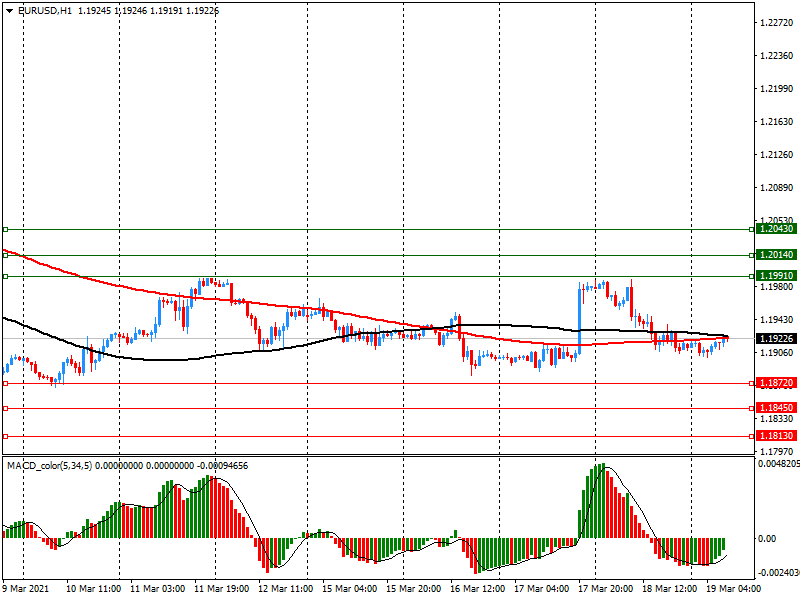
Comments:
- Overall open interest on the CALL options and PUT options with the expiration date April, 9 is 63115 contracts (according to data from March, 18) with the maximum number of contracts with strike price $1,1900 (4920);
GBP/USD
$1.4139 (1277)
$1.4072 (605)
$1.4022 (871)
Price at time of writing this review: $1.3947
Support levels (open interest**, contracts):
$1.3861 (290)
$1.3838 (524)
$1.3781 (1826)
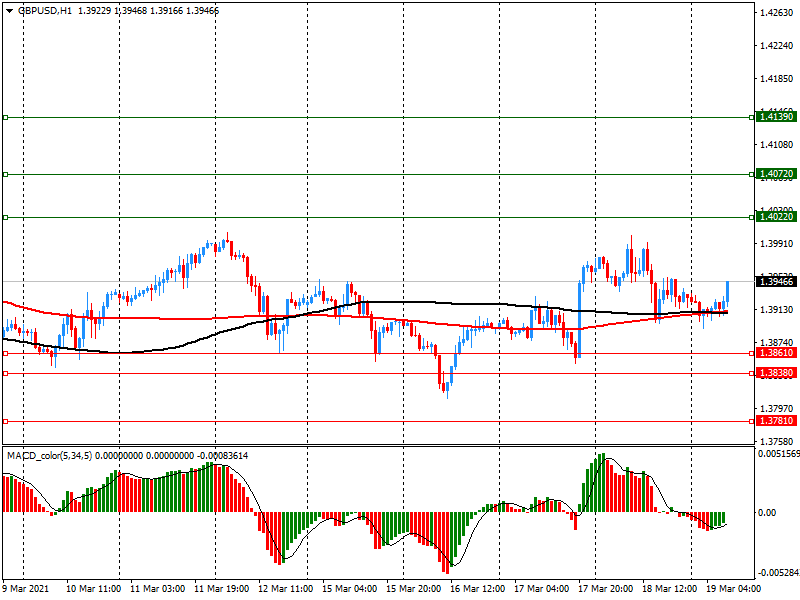
Comments:
- Overall open interest on the CALL options with the expiration date April, 9 is 9327 contracts, with the maximum number of contracts with strike price $1,4100 (1277);
- Overall open interest on the PUT options with the expiration date April, 9 is 19894 contracts, with the maximum number of contracts with strike price $1,3200 (5598);
- The ratio of PUT/CALL was 2.13 versus 2.28 from the previous trading day according to data from March, 18
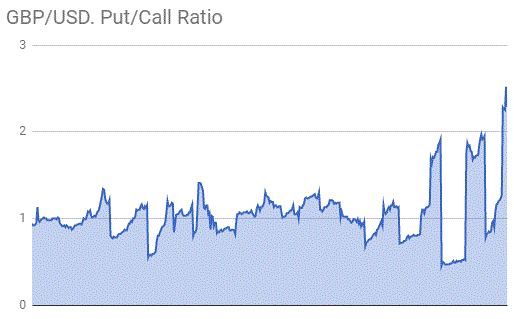
* - The Chicago Mercantile Exchange bulletin (CME) is used for the calculation.
** - Open interest takes into account the total number of option contracts that are open at the moment.
According to the report from the Federal Statistical Office, in February 2021, the index of producer prices for industrial products increased by 1.9% compared with the corresponding month of the preceding year. Economists had expected a 2.0% increase. In January 2021 the annual rate of change all over had been +0.9%. Compared with the preceding month January 2021 the overall index increased by 0.7% in February 2021 (+1.4% in January 2021).
Mainly responsible for the increase of producer prices compared to February 2020 were the prices of intermediate products. Prices of intermediate goods increased by 3.8% compared to February 2020. This was the highest price increase compared to the previous year since November 2017 (+4.0%). Compared to January 2021 these prices were up 1.1 %.
Energy prices as a whole increased by 3.7% compared to February 2020 and by 1.3% compared to January 2021. The price increase from February 2020 to February 2021 is mainly due to the increase of electricity prices (+6.8%), furthermore to the national CO2-pricing that has been introduced in January 2021 on several energy products.
Prices of durable consumer goods increased by 1.4% compared to February 2020, capital goods, such as machines and vehicles, by 0.8%.
| Pare | Closed | Change, % |
|---|---|---|
| AUDUSD | 0.77552 | -0.53 |
| EURJPY | 129.774 | -0.48 |
| EURUSD | 1.19121 | -0.55 |
| GBPJPY | 151.726 | -0.16 |
| GBPUSD | 1.39271 | -0.24 |
| NZDUSD | 0.71626 | -0.91 |
| USDCAD | 1.24918 | 0.69 |
| USDCHF | 0.92726 | 0.52 |
| USDJPY | 108.912 | 0.07 |







© 2000-2026. All rights reserved.
This site is managed by Teletrade D.J. LLC 2351 LLC 2022 (Euro House, Richmond Hill Road, Kingstown, VC0100, St. Vincent and the Grenadines).
The information on this website is for informational purposes only and does not constitute any investment advice.
The company does not serve or provide services to customers who are residents of the US, Canada, Iran, The Democratic People's Republic of Korea, Yemen and FATF blacklisted countries.
Making transactions on financial markets with marginal financial instruments opens up wide possibilities and allows investors who are willing to take risks to earn high profits, carrying a potentially high risk of losses at the same time. Therefore you should responsibly approach the issue of choosing the appropriate investment strategy, taking the available resources into account, before starting trading.
Use of the information: full or partial use of materials from this website must always be referenced to TeleTrade as the source of information. Use of the materials on the Internet must be accompanied by a hyperlink to teletrade.org. Automatic import of materials and information from this website is prohibited.
Please contact our PR department if you have any questions or need assistance at pr@teletrade.global.


 Bank
Bank transfers


