- Analytics
- News and Tools
- Market News
Analytics, News, and Forecasts for CFD Markets: currency news — 22-03-2021.
| Time | Country | Event | Period | Previous value | Forecast |
|---|---|---|---|---|---|
| 05:00 (GMT) | Japan | Leading Economic Index | January | 97.7 | 99.1 |
| 05:00 (GMT) | Japan | Coincident Index | January | 87.4 | 91.7 |
| 09:00 (GMT) | Eurozone | Current account, unadjusted, bln | January | 51.9 | 34.3 |
| 11:00 (GMT) | Germany | Bundesbank Monthly Report | |||
| 12:30 (GMT) | U.S. | Chicago Federal National Activity Index | February | 0.75 | |
| 13:00 (GMT) | Germany | German Buba President Weidmann Speaks | |||
| 13:00 (GMT) | U.S. | Fed Chair Powell Speaks | |||
| 14:00 (GMT) | U.S. | Existing Home Sales | February | 6.66 | 6.49 |
| 23:15 (GMT) | U.S. | FOMC Member Bowman Speaks |
| Time | Country | Event | Period | Previous value | Forecast |
|---|---|---|---|---|---|
| 07:00 (GMT) | United Kingdom | Average earnings ex bonuses, 3 m/y | January | 4.1% | |
| 07:00 (GMT) | United Kingdom | Average Earnings, 3m/y | January | 4.7% | |
| 07:00 (GMT) | United Kingdom | ILO Unemployment Rate | January | 5.1% | |
| 07:00 (GMT) | United Kingdom | Claimant count | February | -20 | |
| 11:00 (GMT) | United Kingdom | CBI industrial order books balance | March | -24 | |
| 12:30 (GMT) | U.S. | Current account, bln | Quarter IV | -178.5 | |
| 13:00 (GMT) | U.S. | FOMC Member James Bullard Speaks | |||
| 14:00 (GMT) | U.S. | Richmond Fed Manufacturing Index | March | 14 | |
| 14:00 (GMT) | U.S. | New Home Sales | February | 0.923 | 0.875 |
| 14:10 (GMT) | U.S. | FOMC Member Bostic Speaks | |||
| 15:00 (GMT) | U.S. | Fed Barkin Speech | |||
| 16:00 (GMT) | U.S. | Fed Chair Powell Testimony | |||
| 19:45 (GMT) | U.S. | FOMC Member Brainard Speaks | |||
| 21:45 (GMT) | New Zealand | Trade Balance, mln | February | -626 | |
| 23:50 (GMT) | Japan | Monetary Policy Meeting Minutes |
Bloomberg reports that according to the latest weekly survey by Nanos Research Group, a record share of Canadians expect home prices will continue hitting new highs, an exuberance that adds to concern the housing market is entering a speculative bubble.
Six in 10 Canadians believe the value of real estate in their neighborhood will increase over the next six months. It’s the first time such readings have surpassed 60% since polling began in 2008, underscoring how the rally in home prices is beginning to feed expectations of future high returns.
The concern is these so-called extrapolative expectations will attract the wrong sort of demand -- from speculators or investors fearing they will miss out -- that will hyper-inflate the market, exacerbate in affordability for young or low-income families, add to rising mortgage debt and amplify the risks of a destabilizing market crash.
eFXdata reports that Credit Agricole CIB Research discusses the USD outlook.
"A continuing spike of UST yields could continue support the USD vs low-yielders like the EUR, JPY and CHF. At the same time, to the extent that the rise in yields does not hurt global risk sentiment, other high-yielding currencies like the AUD, CAD, NZD and NOK could attract some inflows as well. This week, we expect the focus in FX markets to remain on US data, the Fed speakers and the path of UST yields. Higher UST yields will boost the appeal of the USD as an investment currency," CACIB adds.
MarketWatch reports that Fed Chairman Jerome Powell said that bitcoin is lacking key ingredients that would make it a useful currency. As a result, the crypto currency is essentially more of a substitute for gold than the dollar.
“Crypto assets are highly volatile and therefore not really useful as a store of value. They’re not backed by anything. They’re more of an asset for speculation,” Powell said. “It is essentially a substitute for gold rather than the dollar,” he added.
Stable coins are “an improvement” over crypto assets, but their credibility comes from being backed by a sovereign currency, he said.
“Stable coins may have a role to play with appropriate regulation, but that role will not be to form the basis of a new global monetary system,” he said.
One day in the future, the Fed might develop a digital dollar, Powell said, but not until after a lot of careful review and acceptance by the American public and government.
It would be better for Congress to pass laws specifically authorizing the digital currency rather than for the Fed to use existing authority, he said.
Bloomberg reports that Germany aims to lift new borrowing to 240.2 billion euros this year, taking on just over 60 billion euros more debt than initially planned to help mitigate the impact of the coronavirus crisis.
Heavy government spending is set to continue as the country grapples with a fresh wave of the pandemic. Finance Minister Olaf Scholz will propose suspending constitutional borrowing limits for a third straight year when he presents a draft 2022 spending plan alongside his supplementary 2021 budget on Wednesday.
Scholz is targeting new borrowing of 81.5 billion euros in 2022, the officials said. That would take the total for this year and next to more than 320 billion euros.
According to the two officials, German debt will swell to about 75% of GDP this year. The mid-term financing plan through 2025 foresees a restoration of the debt brake from 2023, they added.
eFXdata reports that Citi discuss EUR/USD prospects.
"Risks for EUR/USD remain titled to the downside. We highlight a dovish Fed, the value rotation in equity space, and benign developments on the political and fiscal fronts will support EUR, while being a laggard in global rise in yields, slow vaccination progress, and new lockdown measures point to EUR weakness. This week, we watch the EU Summit on Thursday & Friday where vaccine export restrictions are likely to be front-and-centre." Citi adds.
According to the report from National Association of Realtors, existing-home sales declined in February, following two prior months of gains. Month-over-month, only one major region saw an increase in February, but all four U.S. regions recorded year-over-year gains.
Total existing-home sales, completed transactions that include single-family homes, townhomes, condominiums and co-ops, decreased 6.6% from January to a seasonally-adjusted annual rate of 6.22 million in February. Sales in total climbed year-over-year, up 9.1% from a year ago (5.70 million in February 2020).
"Despite the drop in home sales for February – which I would attribute to historically-low inventory – the market is still outperforming pre-pandemic levels," said Lawrence Yun, NAR’s chief economist.
He cautioned of a possible slowdown in growth in the coming months as higher prices and rising mortgage rates will cut into home affordability.
The median existing-home price for all housing types in February was $313,000, up 15.8% from February 2020 ($270,400), as prices rose in every region. February's national price jump marks 108 straight months of year-over-year gains.
Total housing inventory at the end of February amounted to 1.03 million units, equal to January’s inventory and down 29.5% from one year ago (1.46 million). Unsold inventory sits at a 2.0-month supply at the current sales pace, slightly up from January’s 1.9-month supply and down from the 3.1-month amount recorded in February 2020.
Reuters reports that ECB governing council member Klaas Knot said that the European Central Bank's (ECB) recent decision to accelerate its bond purchases is a temporary move, meant to reduce borrowing costs until growth and inflation in the monetary union pick up.
Knot said that a "major part" of the recent rise in euro zone yields was caused by the improving outlook for growth and inflation in the euro area.
But he described the rest as an unwarranted response to rising yields in the United States, where economic fundamentals have improved faster.
"We thought it would be wise to frontload part of our purchases, as a counterweight in the coming months. But as soon as the improvements that we expect materialise, that reason of course will disappear," Knot told.
| Time | Country | Event | Period | Previous value | Forecast | Actual |
|---|---|---|---|---|---|---|
| 05:00 | Japan | Leading Economic Index | January | 97.7 | 99.1 | 98.5 |
| 05:00 | Japan | Coincident Index | January | 87.4 | 91.7 | 90.3 |
| 09:00 | Eurozone | Current account, unadjusted, bln | January | 51.9 | 34.3 | 5.8 |
| 11:00 | Germany | Bundesbank Monthly Report | ||||
| 12:30 | U.S. | Chicago Federal National Activity Index | February | 0.75 | -1.09 |
During today's European trading, the U.S. dollar fell slightly but remained near a four-month high as rising U.S. Treasury yields fueled demand for the dollar and prompted hedge funds to cut bearish positions.
Turkey's shock decision to replace its hawkish central bank governor has also bolstered demand for the dollar as a safe haven.
Markets have doubted the dollar's gains in recent weeks as investors bet that the global economic recovery will push the purchase of riskier currencies.
But rising US Treasury yields and the prospect of new lockdowns in a number of eurozone countries have led to widespread cuts in short dollar rates.
Later this week, investors will turn their attention to a large number of auctions for US bonds, whose strong sell-offs have been observed recently amid improving prospects for economic growth and inflation.
In addition, Fed Chairman Jerome Powell and Treasury Secretary Janet Yellen are expected to appear together for the first time on Tuesday before the US House of Representatives Financial Services Committee to talk about the policy of the Fed and the Treasury Department during the pandemic.
Reuters reports that Economy Minister Nadia Calvino said that Spain’s economy showed clear signs of a slowdown in the first months of 2021 after a modest recovery in the fourth quarter of 2020.
Despite the slowdown in January and February, Spain will likely still post one of Europe’s fastest annual growth rates after suffering one of the region’s worst economic contraction last year, Calvino said.
She pointed to higher electricity consumption and credit-card spending, as well as a reduction in the number of furloughed workers, as positive signs in March.
The government has projected a 7.2% GDP rebound this year, while the Bank of Spain expects growth of 6.8%. Spain’s economy contracted by 11% in 2020, its worst full year on record.
According to the report from Federal Reserve Bank of Chicago, led by declines in indicators related to production and personal consumption and housing, the Chicago Fed National Activity Index (CFNAI) fell to –1.09 in February from +0.75 in January. Two of the four broad categories of indicators used to construct the index made negative contributions in February, but all four categories decreased from January. The index’s three-month moving average, CFNAI-MA3, decreased to –0.02 in February from +0.46 in January.
The CFNAI Diffusion Index, which is also a three-month moving average, moved down to +0.17 in February from +0.34 in January. Thirty-four of the 85 individual indicators made positive contributions to the CFNAI in February, while 51 made negative contributions. Thirty indicators improved from January to February, while 55 indicators deteriorated. Of the indicators that improved, eight made negative contributions.
FXStreet reports that economists at MUFG Bank said that while there is still scope for further USD gains over the short-term, the upside from here is beginning to diminish.
“The FOMC and Chair Powell could not have provided much more of a dovish communication to the markets but the response is as we had suspected – price action indicating a high degree of scepticism.”
“We believe the financial market implications from the FOMC meeting will be a further steepening of the US yield curve. Our conviction on the USD is relatively low and relative FX trades may provide greater opportunity over the coming months with Fed policy proving successful in anchoring short-term yields, curtailing the extent of USD strength while the macro backdrop remains USD supportive.”
Reuters reports that the Bundesbank said that German economy is likely to shrink sharply this quarter as pandemic-fighting curbs hit the services sector and even the booming construction industry slows.
“The measures to contain the pandemic are more stringent on average in the current quarter than in the previous one,” the Bundesbank said. “Therefore, the economic output in the first quarter of 2021 is likely to decline sharply ... particularly in the contact-intensive service sectors.”
It added that an increase in sales tax, which had been temporarily cut last year, had probably contributed to a substantial decline in construction in January.
Industrial production also eased in the first month of the year but order intake was strong and exports of goods increased, the Bundesbank added.
FXStreet reports that economists at HSBC still expect the USD to decline this year, albeit modestly.
“If the global recovery is assured, cyclical currencies outperform in a cyclical upswing and can tolerate higher US Treasury yields. A lot of this may have played out but the process is not yet complete, in our view, and we see modest USD weakness this year. The median of the FOMC economic projections pointed to a stronger US economy with higher inflation, but no rate hikes through the end of 2023. Nevertheless, markets still expect the Federal Reserve to start raising the policy rate, possibly at the end of 2022.”
“All in all, we believe the new-found fondness for the USD so far in 2021 after a troubled 2020 appears to be premature.”
Reuters reports that Japan's government advisers on Monday urged the Bank of Japan to continue carrying out appropriate monetary policy.
The private-sector members of the Council on Economic and Fiscal Policy, the government's top advisory panel, also said the government should closely monitor the impact of rising U.S. interest rates on financial and capital markets.
FXStreet reports that according to economists at Danske Bank, USD/JPY has further to go.
“We think USD/JPY has further to go, as the US economy will catch up to Asia as it opens up and outpaces Asia and particularly Japan in the vaccine race, although the recent leap has capped upside potential. This will continue to press for higher US yields and BoJ will remain reluctant to let JGB yields drift much higher with inflation so far off target. To take USD/JPY back towards 100, we need a change in risk sentiment causing US rates and commodities to decrease again.”
CNBC reports that according to Quilter Investors Portfolio Manager Sascha Chorley, investor concerns about a rise in inflation are misplaced and bond markets are at their most attractive since 2015.
Inflation worries have led to a sharp rise in bond yields over recent weeks — most notably on the benchmark U.S. 10-year Treasury — and an accompanying fall in bond prices (as prices move inversely to yields).
But Chorley voiced skepticism that a steep incline in inflation is on the way. “If you look at market based expectations for inflation, it is true that indications are above the 2% target many central banks set,” he said. “But crucially it has been a steady increase since 2020 rather than a sharp rise.”
He said that, given current bond yields and the shape of yield curves, “this looks like the best time to add into government bonds since 2015. Starting to add some fixed income exposure might be quite prudent in order to add some ballast to portfolios.”
FXStreet reports that economists at Commerzbank discuss DAX prospects.
“As the DAX has now started moving up with a new higher-level investment buy signal, the technical bull market cycle continues.”
“We have seen a ‘normal’ bull market trend with high momentum in the DAX – since the Corona bear market movement (sell-off at 8255 points in March 2020). This momentum seems set to weaken, especially in H2 2021.”
“Both the new investment buy signal and the appealing DAX market breadth suggest that the former technical interim target for 2021 (entry into the zone from 14500 to 15000 points) is too conservative. The new technical interim target for 2021 should be the zone between 15000 and 15500 points.”
Bloomberg reports that Goldman Sachs strategists said that President Joe Biden’s potential tax hikes will likely deal only a temporary blow to U.S. equities thanks to the tide of fiscal spending, including the prospect of growth-friendly infrastructure outlays.
The S&P 500 is up about 75% over the past year, helped by huge injections of stimulus. Strategists said Biden’s plans for the first major federal tax hike since 1993 for programs like infrastructure and fighting climate change will weigh on company earnings and equity allocations in the short term.
Higher corporate taxes are likely to cut S&P 500 earnings by 3% in 2022, the Goldman strategists said, while a JPMorgan Chase & Co. team led by John Normand said they will be a “drag on earnings growth and buybacks.”
During his campaign, Biden discussed raising the corporate tax rate to 28% from 21% -- still below the pre-Trump 35% -- as well as increasing the top marginal tax rate to 39.6% and taxing capital gains and dividends at the higher ordinary income tax rate.
Higher capital gains taxes for top earners could cut equity allocations, lower stock prices and reverse gains from momentum trading, Goldman said. JPMorgan said they “could trigger pre-emptive selling before the tax year ends.”
According to the report from European Central Bank, the current account of the euro area recorded a surplus of €30 billion in January 2021, decreasing by €7 billion from the previous month. Surpluses were recorded for goods (€39 billion) and services (€12 billion). These were partly offset by deficits for secondary income (€17 billion) and primary income (€4 billion).
In the 12 months to January 2021, the current account recorded a surplus of €263 billion (2.3% of euro area GDP), compared with a surplus of €262 billion (2.2% of euro area GDP) in the 12 months to January 2020. The surplus for goods and for services increased (up from €330 billion to €353 billion and from €48 billion to €49 billion, respectively). The surplus for primary income (from €40 billion to €17 billion) declined and the deficit for secondary income (up from €156 billion to €157 billion) increased slightly.
In financial account, euro area residents’ net acquisitions of foreign portfolio investment securities totalled €681 billion and non-residents’ net acquisitions of euro area portfolio investment securities totalled €126 billion in 12 months to January 2021
FXStreet reports that economists at Nordea discuss US dollar prospects.
“As the Fed seems ‘hands off’ for now with regards to US 10y Treasury bonds, then we would argue this is good news for the dollar. The twin deficit idea can be boiled down to either i) US yields needs to rise, or ii) the USD needs to weaken so as to attract enough foreign funding of the US budget and current deficits. It thus follows that higher US yields means less downside pressure for the dollar.”
“In terms of relative growth forecasts, or in terms of revisions to said forecasts, the USD should be in a very strong spot – rising 20% yoy instead of falling 15% YoY.”
| Time | Country | Event | Period | Previous value | Forecast | Actual |
|---|---|---|---|---|---|---|
| 05:00 | Japan | Leading Economic Index | January | 97.7 | 99.1 | 98.5 |
| 05:00 | Japan | Coincident Index | January | 87.4 | 91.7 | 90.3 |
During today's Asian trading, the US dollar rose against the euro, but declined against the yen.
A combination of extremely loose monetary policy, unprecedented government spending, and successful vaccination in the United States have fueled hopes of accelerating economic growth and inflation, bringing the yield on ten-year US Treasuries to the highest since January 2020.
In addition, the dollar's appeal as a safe haven asset is being boosted by concerns about the surge in COVID-19 cases and the pace of vaccination in Europe.
The ICE index, which tracks the dollar's performance against six currencies (euro, swiss franc, yen, canadian dollar, pound sterling and swedish krona), rose 0.10%.
The Chinese yuan was trading steadily against the US dollar. The People's Bank of China (PBOC) has kept its benchmark loan prime rate (LPR) unchanged for the eleventh consecutive month as the economy continues to recover from the COVID-19 pandemic crisis. The annual LPR remained at 3.85% per annum. The last time this rate was lowered was in April 2020.
FXStreet reports that economists at Rabobank said that EUR/USD pair still risks a move back to 1.20, but it is seen trading at 1.18 on a 12-month view.
“While we continue to expect the Fed to battle with the markets in the months ahead to push through the message that its policy will remain extremely accommodative, market optimism in the US reflation trade is likely to ensure that the USD retains a resilient tone.”
“On the expectation that the Fed will have success in containing inflation fears and bond yields, we do see scope for EUR/USD to push back to 1.20 in the coming weeks. That said on expectations of a strengthening US recovery this year, we have lowered our 12-month forecast to 1.18 from a previous forecast of 1.23.”
CNBC reports that Richmond Federal Reserve Bank President Thomas Barkin said that the U.S. economy is recovering from the Covid-19 recession, but some economic “scarring” may take a long time to heal.
“I’m hopeful we’re on the brink of completing this recovery,” Barkin said.
“Vaccines are rolling out, case rates and hospitalizations are falling, excess savings and fiscal stimulus should help fund pent-up demand from consumers who’re exhausted by isolation and freed up by vaccines and warmer weather,” he added.
The U.S. economy contracted by 3.5% in 2020 compared to a year ago, estimated the Bureau of Economic Analysis. The Organisation for Economic Cooperation and Development or OECD said earlier this month that the U.S. economy is forecast to grow by 6.5% this year and 4% next year.
Reuters reports that the Swiss National Bank said it could further expand its balance sheet if necessary.
The SNB's spending on foreign currencies increased from 13.2 billion francs in 2019 and reached at its highest level since 2012 as it battled renewed upward pressure on the safe-haven franc during the COVID-19 pandemic.
The increased spending has inflated the SNB's balance sheet close to 1 trillion francs - much larger than the size of the Swiss economy.
Still, despite reducing its interventions in the second half of the year, the size of the balance sheet would not deter the SNB from intervening in future, the central bank told .
RTTNews reports that People's Bank of China left its benchmark lending rates unchanged, as widely expected. The one-year loan prime rate was retained at 3.85 percent and the five-year loan prime rate was maintained at 4.65 percent. The one-year and five-year loan prime rates were last lowered in April 2020.
Julian Evans-Pritchard and Sheana Yue, economists at Capital Economics, said that the inaction did not come as a surprise since the People's Bank of China had not adjusted the rate on its medium-term lending facility this month as it did ahead of the past three LPR moves.
The scope for hiking rates this year is diminishing. The PBOC appears to favor quantitative controls on lending instead, they noted. Either way, credit conditions are set to be less favorable this year.
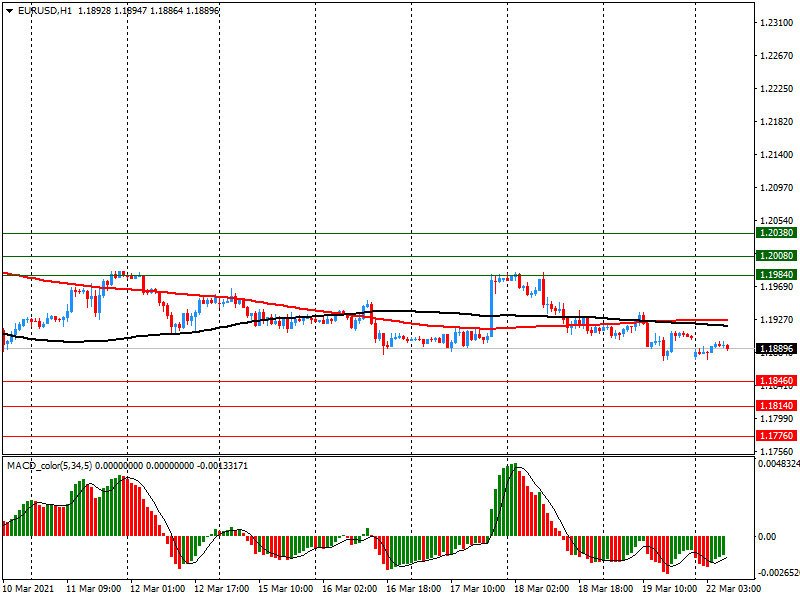
EUR/USD
Resistance levels (open interest**, contracts)
$1.2038 (581)
$1.2008 (879)
$1.1984 (1133)
Price at time of writing this review: $1.1890
Support levels (open interest**, contracts):
$1.1846 (4966)
$1.1814 (3141)
$1.1776 (4479)
Comments:
- Overall open interest on the CALL options and PUT options with the expiration date April, 9 is 64835 contracts (according to data from March, 19) with the maximum number of contracts with strike price $1,1900 (4966);
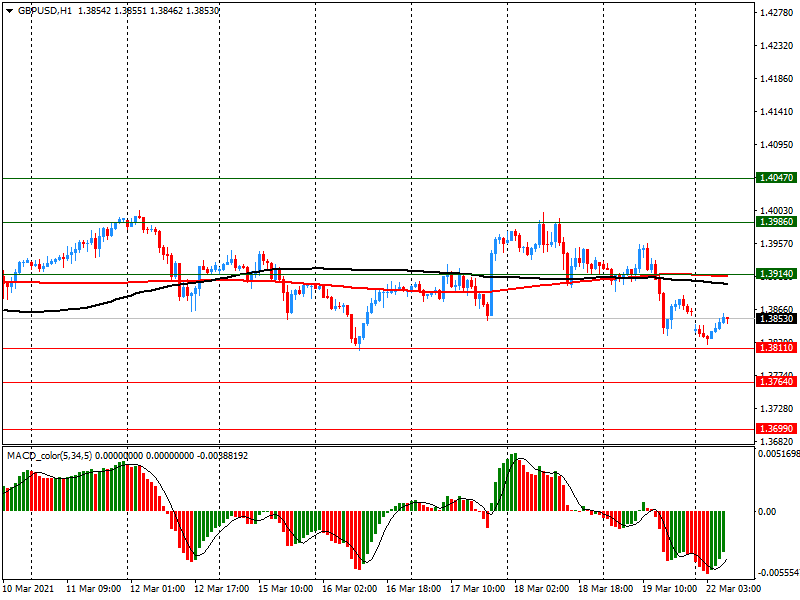
GBP/USD
$1.4047 (664)
$1.3986 (871)
$1.3914 (676)
Price at time of writing this review: $1.3853
Support levels (open interest**, contracts):
$1.3811 (524)
$1.3764 (1826)
$1.3699 (1229)
Comments:
- Overall open interest on the CALL options with the expiration date April, 9 is 9490 contracts, with the maximum number of contracts with strike price $1,4100 (1279);
- Overall open interest on the PUT options with the expiration date April, 9 is 19976 contracts, with the maximum number of contracts with strike price $1,3200 (5598);
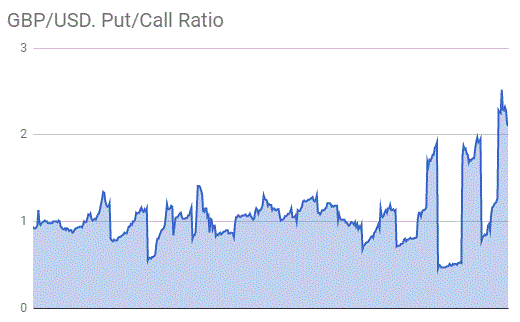
- The ratio of PUT/CALL was 2.10 versus 2.13 from the previous trading day according to data from March, 19
* - The Chicago Mercantile Exchange bulletin (CME) is used for the calculation.
** - Open interest takes into account the total number of option contracts that are open at the moment.







© 2000-2026. All rights reserved.
This site is managed by Teletrade D.J. LLC 2351 LLC 2022 (Euro House, Richmond Hill Road, Kingstown, VC0100, St. Vincent and the Grenadines).
The information on this website is for informational purposes only and does not constitute any investment advice.
The company does not serve or provide services to customers who are residents of the US, Canada, Iran, The Democratic People's Republic of Korea, Yemen and FATF blacklisted countries.
Making transactions on financial markets with marginal financial instruments opens up wide possibilities and allows investors who are willing to take risks to earn high profits, carrying a potentially high risk of losses at the same time. Therefore you should responsibly approach the issue of choosing the appropriate investment strategy, taking the available resources into account, before starting trading.
Use of the information: full or partial use of materials from this website must always be referenced to TeleTrade as the source of information. Use of the materials on the Internet must be accompanied by a hyperlink to teletrade.org. Automatic import of materials and information from this website is prohibited.
Please contact our PR department if you have any questions or need assistance at pr@teletrade.global.


 Bank
Bank transfers


