- Analytics
- News and Tools
- Market News
Analytics, News, and Forecasts for CFD Markets: currency news — 18-03-2021.
| Time | Country | Event | Period | Previous value | Forecast |
|---|---|---|---|---|---|
| 00:30 (GMT) | Australia | RBA Bulletin | |||
| 00:30 (GMT) | Australia | Unemployment rate | February | 6.4% | 6.3% |
| 00:30 (GMT) | Australia | Changing the number of employed | February | 29.5 | 30 |
| 07:00 (GMT) | Switzerland | Trade Balance | February | 3.58 | |
| 07:30 (GMT) | Switzerland | Producer & Import Prices, y/y | February | -2.1% | |
| 08:00 (GMT) | Eurozone | ECB President Lagarde Speaks | |||
| 10:00 (GMT) | Eurozone | Trade balance unadjusted | January | 29.4 | |
| 11:00 (GMT) | Eurozone | ECB President Lagarde Speaks | |||
| 12:00 (GMT) | United Kingdom | Asset Purchase Facility | 875 | 875 | |
| 12:00 (GMT) | United Kingdom | BoE Interest Rate Decision | 0.1% | 0.1% | |
| 12:00 (GMT) | United Kingdom | Bank of England Minutes | |||
| 12:30 (GMT) | U.S. | Continuing Jobless Claims | March | 4142 | 4070 |
| 12:30 (GMT) | Canada | New Housing Price Index, MoM | February | 0.7% | |
| 12:30 (GMT) | Canada | New Housing Price Index, YoY | February | 5.4% | |
| 12:30 (GMT) | U.S. | Philadelphia Fed Manufacturing Survey | March | 23.1 | 23 |
| 12:30 (GMT) | U.S. | Initial Jobless Claims | March | 725 | 700 |
| 14:00 (GMT) | U.S. | Leading Indicators | February | 0.5% | 0.3% |
| 23:30 (GMT) | Japan | National CPI Ex-Fresh Food, y/y | February | -0.6% | -0.4% |
| 23:30 (GMT) | Japan | National Consumer Price Index, y/y | February | -0.6% |
| Time | Country | Event | Period | Previous value | Forecast |
|---|---|---|---|---|---|
| 00:01 (GMT) | United Kingdom | Gfk Consumer Confidence | March | -23 | |
| 00:30 (GMT) | Australia | Retail Sales, M/M | February | 0.5% | |
| 03:00 (GMT) | Japan | BoJ Interest Rate Decision | -0.1% | ||
| 07:00 (GMT) | Germany | Producer Price Index (YoY) | February | 0.9% | |
| 07:00 (GMT) | Germany | Producer Price Index (MoM) | February | 1.4% | |
| 07:00 (GMT) | United Kingdom | PSNB, bln | February | -8.75 | |
| 12:30 (GMT) | Canada | Retail Sales YoY | January | 3.3% | |
| 12:30 (GMT) | Canada | Retail Sales, m/m | January | -3.4% | |
| 12:30 (GMT) | Canada | Retail Sales ex Autos, m/m | January | -4.1% | |
| 17:00 (GMT) | U.S. | Baker Hughes Oil Rig Count | March |
FXStreet reports that the Bank of Japan is scheduled to announce its decision on Friday at 03:00 GMT. According to Credit Suisse, no change is expected in its main policy settings for rates and YCC.
“The BoJ seems to believe that the YCC has worked well, and it is unlikely for the Bank to amend the current setting of YCC (yield curve control), where it targets the Tier 3 deposit rate and the 10-year JGB yield. Meanwhile, the Bank may tweak the 10-year JGB yield target. In other words, we do not rule out the possibility that the Bank would rewrite the 10- year JGB target from ‘around 0%’ to ‘0-0.25%’. The Bank appears to have two options for the ETF purchase operation, namely, revising the target to a range-based one, such as ‘2-4 trillion yen’ or scrapping the target. Given that the BoJ’s ETF holding already amounted to 36 trillion yen or around 4.8% of the total market cap of Tokyo Stock Exchange, it may opt for the latter, which will give the Bank more discretion for the buying amount. The BoJ would simultaneously demonstrate its intention to support the equity market proactively in critical times. The Bank is expected to reconfirm that it will continue to make monetary base expand until after the CPI inflation rate rises above +2%.”
Reuters reports that Greece's finance ministry said that Greece has made an early repayment of debt worth 3.3 billion euros to the International Monetary Fund.
The move, the second early repayment of debt to the IMF since 2019, allows Athens to reduce its debt-servicing costs, because IMF loans carry higher interest than Greece would now pay on the market.
“It reduces interest rate and foreign exchange risk and refinancing risk for the next two years,” the ministry said in a statement. “It also improves key debt sustainability indicators.”
The country has received three international bailouts from the euro zone and the IMF worth 280 billion euros since 2010. It emerged from its latest bailout in August 2018 and has relied on the debt markets to cover its borrowing needs since.
eFXdata reports that Citi discusses australian dollar (AUD) prospects.
"Australian jobs data for February beat market expectations with the number employed increasing by 88.7k in February (vs 30k estimated) with full-time employment as the main driver, accelerating further from a 29.5k job gain in January. We remain bullish AUD from a structural perspective and expect further appreciation following the dovish Fed overnight, which could asymmetrically boost commodity currencies," Citi adds
Bloomberg reports that Freddie Mac data showed that U.S. mortgage rates rose for a fifth straight week, reaching the highest level in nearly nine months.
The average for a 30-year, fixed loan was 3.09%, up from 3.05% last week and the highest since June 25.
The yield on the 10-year Treasuries that guide mortgage rates has ticked up above 1.7% for the first time since January 2020.
Borrowing costs have been climbing since finding a nadir in January. While they remain low by historical standards, the rise threatens to crimp the pandemic housing rally. Mortgage companies posted record profits in 2020 amid a flood of applications to purchase homes and refinance debt.
Reuters reports that the International Monetary Fund (IMF) said that Canada's economy is likely to rebound this year as long as COVID-19 is brought under control, but the government should introduce a 'fiscal anchor' to ensure credibility in the management of the public accounts. The IMF forecast economic growth of 4.4% this year after a 5.4% decline in 2020.
"The size and scope of policy support in Canada has been unprecedented" during the pandemic. The recent sharp rise in public debt increases the importance of clearly specifying a medium-term fiscal anchor ... to guard against a potential weakening of credibility in the fiscal framework," the IMF said.
According to the report from the Conference Board, leading economic index (LEI) increased 0.2 percent in February to 110.5 (2016 = 100), following a 0.5 percent increase in January and a 0.4 percent increase in December.
“The U.S. LEI continued rising in February, suggesting economic growth should continue well into this year,” said Ataman Ozyildirim, Senior Director of Economic Research at The Conference Board. “Indeed, the acceleration of the vaccination campaign and a new round of large fiscal supports are not yet fully reflected in the LEI. With those developments, The Conference Board now expects the pace of growth to improve even further this year, with the U.S. economy expanding by 5.5 percent in 2021.”
Coincident Economic Index decreased 0.1 percent in February to 103.0 (2016 = 100), following a 0.2 percent increase in January and a 0.1 percent decrease in December.
The Lagging Economic Index increased 0.2 percent in February to 104.5 (2016 = 100), following a 2.3 percent decrease in January and 0.4 percent increase in December.
FXStreet reports that economists at Rabobank discusses AUD/USD prospects.
“The next RBA meeting is scheduled for April 6 and we expect policymakers to maintain a dovish position. This could cause some pull backs towards 0.77, though we expect AUD/USD to remain relatively well supported close to current levels in the months ahead.” The better tone of AUD/USD has reduced the chances of a head and shoulders formation on the daily chart. Trendline support around 0.7629 is the potential neckline. The recent high close to 0.80 will likely act as strong resistance.”
| Time | Country | Event | Period | Previous value | Forecast | Actual |
|---|---|---|---|---|---|---|
| 00:30 | Australia | RBA Bulletin | ||||
| 00:30 | Australia | Unemployment rate | February | 6.4% | 6.3% | 5.8% |
| 00:30 | Australia | Changing the number of employed | February | 29.5 | 30 | 88.7 |
| 07:00 | Switzerland | Trade Balance | February | 3.58 | 3.34 | |
| 07:30 | Switzerland | Producer & Import Prices, y/y | February | -2.1% | -1.1% | |
| 08:00 | Eurozone | ECB President Lagarde Speaks | ||||
| 10:00 | Eurozone | Trade balance unadjusted | January | 29.4 | 6.3 | |
| 11:00 | Eurozone | ECB President Lagarde Speaks | ||||
| 12:00 | United Kingdom | Asset Purchase Facility | 875 | 875 | 875 | |
| 12:00 | United Kingdom | BoE Interest Rate Decision | 0.1% | 0.1% | 0.1% | |
| 12:00 | United Kingdom | Bank of England Minutes | ||||
| 12:30 | U.S. | Continuing Jobless Claims | March | 4142 | 4070 | 4124 |
| 12:30 | Canada | New Housing Price Index, MoM | February | 0.7% | 1.9% | |
| 12:30 | Canada | New Housing Price Index, YoY | February | 5.4% | 7% | |
| 12:30 | U.S. | Philadelphia Fed Manufacturing Survey | March | 23.1 | 23 | 51.8 |
| 12:30 | U.S. | Initial Jobless Claims | March | 725 | 700 | 770 |
During today's European trading, the US dollar rose modestly, retreating from a two-week low, helped by a rise in US government bond yields after the Federal Reserve meeting. The yield on the 10-year U.S. Treasury note rose to 1.741% for the first time since January 2020, an increase of about 10 basis points.
Following the results of the March meeting, the Federal Reserve predicted an acceleration in economic growth and consumer prices in the United States this year as the COVID-19 crisis recedes, and repeated the FOMC to keep the key rate near zero in the coming years.
The ICE index, which tracks the dynamics of the dollar against six currencies (euro, swiss franc, yen, canadian dollar, pound sterling and swedish krona), rose by 0.32%.
"The question remains whether the Fed really deter a surge in the yield of US Treasury bonds, especially given the fact that the improvement in the fundamental performance of the United States will continue," said Valentin Marinov from Credit Agricole.
"The renewed rise in bond yields should continue to support the dollar against lower-yielding currencies such as the euro, yen and swiss franc."
The US data also had a certain impact on the dollar. According to the report from the Department of Labor, in the week ending March 13, the advance figure for seasonally adjusted initial claims was 770,000, an increase of 45,000 from the previous week's revised level. The previous week's level was revised up by 13,000 from 712,000 to 725,000. Economists had expected a decrease to 700,000. The 4-week moving average was 746,250, a decrease of 16,000 from the previous week's revised average. The previous week's average was revised up by 3,250 from 759,000 to 762,250.
According to the report from Statistics Canada, new house prices were up in 22 of the 27 census metropolitan areas (CMAs) surveyed, pushing the national index up 1.9% in February. Builders in most cities linked the spike to higher construction costs as well as to an active housing market.
New home prices continued to rise as record low interest rates remained a key driver for housing activity. Furthermore, buyers, including first-time buyers and those looking to upgrade their living arrangements, also added pressure to housing prices in an already low-supply market. Younger Canadians are an important cohort with respect to housing demand, as roughly 12% of Canadians aged 25 to 35 purchased a property during the pandemic.
Nationally, new house prices rose 7.0% year over year in February—the largest increase in over a decade (since July 2007). Kitchener–Cambridge–Waterloo (+16.0%) registered the largest year-over-year gain in February, displacing Ottawa (+15.0%), which had been growing at the fastest year-over-year pace nationally since May 2018. Working from home, as well as Kitchener–Cambridge–Waterloo's relative affordability compared with Toronto, has strengthened the demand for larger homes in this housing market.
Other notable year-over-year price changes were seen in Hamilton and Guelph (both up +11.0%). Both cities offer more affordable housing options than Toronto, while still being in close proximity to Canada's largest economic centre. The new housing market remained weak in Regina (-0.6%) in February.
According to the report from the Department of Labor, in the week ending March 13, the advance figure for seasonally adjusted initial claims was 770,000, an increase of 45,000 from the previous week's revised level. The previous week's level was revised up by 13,000 from 712,000 to 725,000. Economists had expected a decrease to 700,000. The 4-week moving average was 746,250, a decrease of 16,000 from the previous week's revised average. The previous week's average was revised up by 3,250 from 759,000 to 762,250.
The advance seasonally adjusted insured unemployment rate was 3.0 percent for the week ending March 6, an increase of 0.1 percentage point from the previous week's unrevised rate. The advance number for seasonally adjusted insured unemployment during the week ending March 6 was 4,124,000, a decrease of 18,000 from the previous week's revised level. The previous week's level was revised down by 2,000 from 4,144,000 to 4,142,000. The 4-week moving average was 4,255,500, a decrease of 99,000 from the previous week's revised average. The previous week's average was revised down by 500 from 4,355,000 to 4,354,500.
MPC judged that the existing stance of monetary policy remains appropriate.
The MPC voted unanimously to maintain Bank Rate at 0.1%.
The Committee voted unanimously for the Bank of England to continue with its existing programme of UK government bond purchases, financed by the issuance of central bank reserves, maintaining the target for the stock of these government bond purchases at £875 billion and so the total target stock of asset purchases at £895 billion.
Outlook for the economy remains unusually uncertain
If inflation outlook weakens, BOE stands ready to take necessary action
BOE does not intend to tighten policy unless there is clear evidence of progress in achieving inflation goal sustainably
Recent plans for the easing of restrictions may be consistent with a slightly stronger outlook for consumption growth in Q2 2021
Developments in global GDP growth have been a little stronger than anticipated
Aggregate measure of UK financial conditions has been broadly unchanged since the February report
FXStreet reports that DBS Bank discusses GBP/USD prospects.
“There should be a unanimous decision from the Bank of England to stay pat on benchmark rates at 0.1% and leave the asset purchase programme unchanged at GBP895 B.”
“The EU has formally filed for legal action, blaming the UK for unilaterally delaying implementing part of the Northern Ireland protocol – in an extreme outcome, the EU can impose trade tariffs. However, this is more likely to be tactical manoeuvres on the part of both parties. Unless GBP/USD craters under 1.3749 and extends bearish pressure under the February lows of 1.3567, this remains a market path to advance, even towards the April 2018 highs at 1.4377”
CNBC reports that according to a report by S&P Global Ratings, rising U.S. bond yields will not hurt Asia’s emerging markets as badly as they did during the “taper tantrum” eight years ago.
“Taper tantrum” describes the surge in U.S. Treasury yields in 2013 after the Fed said it would wind down its quantitative easing .
“Not all yield shocks are created equal,” Shaun Roache, S&P’s Asia-Pacific chief economist, said in a press release on Wednesday.
U.S. Treasury yields have been ticking higher for weeks, and the benchmark 10-year Treasury note hit a high of 1.689% on Wednesday, its highest level since January 2020.
Roache explained that U.S. yields are rising in response to hopes that better economic growth will lift inflation. And Asia is usually a “prime beneficiary” of improving global growth, he said.
In addition, current economic conditions in Asia allow the region to better guard against external shocks compared to 2013, said S&P. Those conditions include current account surpluses, generally low inflation, higher real interest rates and higher foreign-exchange reserve buffers, the ratings agency said.
Still, risks remain. The economist said Asia’s recovery could be threatened if markets view the Fed as underestimating inflation risk, resulting in U.S. yields rising very quickly and the U.S. dollar appreciating at the same time.
Bloomberg reports that according to high-frequency data from the consultant Sixfold, Britain’s trade with the rest of Europe remains below levels prevailing a year ago.
The average weekly volumes of border crossings for both imports and exports were down about a fifth from the same period a year ago, according to the unit of the logistics platform Transporeon. Its Chief Executive Officer Stephan Sieber said it’s too early to tell how much of a structural shift has appeared due to Brexit and that more friction is coming end of March and over the Easter holiday.
U.K. Prime Minister Boris Johnson’s has described lower trade as temporary “teething problems” that are already passing. Figures from the Office for National Statistics on Friday revealed a 41% plunge in exports to the European Union from December to January and a 29% drop in imports.
According to the report from Eurostat, in the fourth quarter of 2020, the hourly labour costs rose by +3.0% in the euro area and by +3.3% in the EU, compared with the same quarter of the previous year. In the third quarter of 2020, hourly labour costs increased by +1.6% and +1.8% respectively.
The two main components of labour costs are wages & salaries and non-wage costs. In the euro area, the cost of wages & salaries per hour worked grew by +3.5% and the non-wage component by +1.5% in the fourth quarter of 2020, compared with the same quarter of the previous year. In the third quarter of 2020, the annual changes were +2.2% for wages & salaries and -0.3% for the non-wage component. In the EU, the costs of hourly wages & salaries increased by +3.7% and the non-wage component by +1.8% in the fourth quarter of 2020. In the third quarter of 2020, the annual change in wages & salaries was +2.4%, while the non-wage component remained unchanged.
In both the EU and the euro area, the non-wage component moderated the growth in hourly labour costs, in particular due to the tax reliefs and subsidies granted by EU governments to support enterprises affected by the crisis.
According to the report from Eurostat, the first estimate for euro area exports of goods to the rest of the world in January 2021 was €163.1 billion, a decrease of 11.4% compared with January 2020 (€184.0 bn). Imports from the rest of the world stood at €156.8 bn, a fall of 14.1% compared with January 2020 (€182.5 bn). As a result, the euro area recorded a €6.3 bn surplus in trade in goods with the rest of the world in January 2021, compared with +€1.5 bn in January 2020. Intra-euro area trade fell to €159.7 bn in January 2021, down by 3.9% compared with January 2020.
In January to December 2020, euro area exports of goods to the rest of the world fell to €2 131.4 bn (a decrease of 9.2% compared with January-December 2019), and imports fell to €1 897.1 bn (a decrease of 10.8% compared with January-December 2019). As a result the euro area recorded a surplus of €234.3 bn, compared with +€221.0 bn in January-December 2019. Intra-euro area trade fell to €1 798.2 bn in January-December 2020, down by 8.8% compared with January December 2019.
Reuters reports that the U.N. Conference on Trade and Development (UNCTAD) said that the global economy is set to grow by 4.7% this year thanks to a stronger-than-expected recovery in the United States. Thus, UNCTAD revised its previous forecast of 4.3%.
The upwards revision from its previous forecast made last September factors in an expected boost in U.S. consumer spending on the back of progress distributing COVID-19 vaccines and a vast stimulus package, the report said.
“The global recovery that began in the third quarter of 2020 is expected to continue through 2021, albeit with a good deal of unevenness and unpredictability, reflecting epidemiological, policy and coordination uncertainties,” the report said.
However, UNCTAD said COVID-19 will have lasting economic consequences that will require continued government support. UNCTAD said the main risk to the global outlook is a “misguided return to austerity”.
Reuters reports that IfW economic institute said that German economy will likely grow by 3.7% in 2021 and reach its pre-crisis levels before year-end, as the progress of the vaccination campaign should help exports and consumption to grow.
IfW revised up its forecast from December, when it had predicted a 3.1% growth. For next year, IfW said it expected the economy to expand by 4.8%, which is above the previous forecast of 4.5% from December.
In 2020, Europe's largest economy shrank by 4.9% due to the pandemic.
FXStreet reports that analysts at Westpac discusses US Dollar Index prospects.
“Fed Chair Powell resoundingly beat back growing doubts that the Fed could maintain a dovish track as growth rebounds. That should anchor the front end and leave the DXY wounded near-term. DXY could easily trade sub-91 in the coming days.
“A lack of front-end yield support for the DXY has been in place since the covid crash and it’s not entirely obvious that the DXY is about to slide all the way back to fresh lows sub-89. Yield spread support continues to build in the DXY’s favour at the back-end of the curve.”
“DXY likely trades a 90-93 range in coming weeks, the Fed’s dovish commitment clashing with a resounding US activity rebound, leaving DXY contained for now.”
Downside risks remain in the near-term, there is no room for complacency
The ongoing vaccination campaigns, together with the gradual relaxation of containment measures underpin the expectation of a firm rebound in economic activity in the second half of 2021.
The ECB will continue to deliver on its mandate and support the recovery with all appropriate measures.
ECB to continue monitoring developments in the euro exchange rate
PEPP will be implemented flexibly according to market conditions
Step-up in the run-rate of PEPP will become visible when ascertained over longer time intervals (short-term disrupted by noise, such as lumpy redemptions)
If favourable financing conditions can be maintained, don't need to use full PEPP envelope if it is not exhausted
We stand ready to adjust all of our instruments.
Our key ECB interest rates to the governing council’s forward guidance and the asset purchase programme – make a crucial contribution.
| Time | Country | Event | Period | Previous value | Forecast | Actual |
|---|---|---|---|---|---|---|
| 00:30 | Australia | RBA Bulletin | ||||
| 00:30 | Australia | Unemployment rate | February | 6.4% | 6.3% | 5.8% |
| 00:30 | Australia | Changing the number of employed | February | 29.5 | 30 | 88.7 |
| 07:00 | Switzerland | Trade Balance | February | 3.58 | 3.34 | |
| 07:30 | Switzerland | Producer & Import Prices, y/y | February | -2.1% | -1.1% | |
| 08:00 | Eurozone | ECB President Lagarde Speaks |
During today's Asian trading, the US dollar rose against the euro and the yen after the end of the US Federal Reserve meeting the day before.
The Fed kept the interest rate in the range from 0% to 0.25% per annum. The decision coincided with the forecasts of economists and market participants. In addition, the Federal Reserve raised its forecasts for US GDP growth for 2021 and 2022. According to the regulator's March forecast, US GDP will increase by 6.5% this year and by 3.3% next year. In December, the Fed expected GDP to increase by 4.2% and 3.2%, respectively.
The ICE index, which tracks the dynamics of the dollar against six currencies (euro, swiss franc, yen, canadian dollar, pound sterling and swedish krona), rose by 0.15%.
Investors are also waiting for the results of the meetings of the Bank of Japan and the Bank of England this week.
The Bank of Japan, most likely, according to the results of the meeting, which will be known on Friday, will keep the short - term interest rate on deposits of commercial banks in the Central Bank at -0.1% per annum, the target yield of ten-year government bonds of Japan-about zero, economists say. Investors are also awaiting the release of the results of the Bank of Japan's largest monetary policy review since 2016.
The Bank of England today is likely to leave the key rate at 0.1% and will not make changes to the asset purchase program, experts predict.
The Australian dollar rose 0.25% against the US dollar on the back of data on the Australian labor market. Australia's seasonally adjusted unemployment rate fell to 5.8% in February from 6.4% a month earlier, the Australian Bureau of Statistics said. This is the lowest figure since March last year, that is, since the beginning of the COVID-19 pandemic.
FXStreet reports that according to economists at Westpac, EUR/USD may test 1.17-1.22 range support.
“Comparatively poor EU vaccine rollouts and growing discontent over the distribution of both vaccines and Recovery Funds at national levels became more acute this week. The impact of the poor rollouts has become clear this week with rising Covid-19 case counts in many EU countries. Economic advisers to Germany’s Merkel cut German growth forecast to 3.1% in 2021 from their Nov forecast of 3.7% and warned that their projection of 4% growth in 2022 was at risk should the anticipated rise in consumer activity be suppressed by rising COVID-19 cases. Relative growth and vaccine rollouts are impacting FX and so the risk for EUR against the firming USD is an early slide to test 1.17-1.22 range support.”
According to the report from the Federal Statistical Office (FSO), the Producer and Import Price Index remained unchanged in February 2021 compared with the previous month. The index stood at 100.3 points (December 2020 = 100). Petroleum products as well as basic metals and semi-finished metal products in particular saw higher prices, while pharmaceutical products became cheaper. Compared with February 2020, the price level of the whole range of domestic and imported products fell by 1.1%.
In particular, lower prices for pharmaceutical preparations and basic pharmaceutical products were responsible for the decrease in the producer price index compared with the previous month. Meat and meat products, scrap, plastics in primary forms and cattle for meat also became cheaper. In contrast, increasing prices were seen for basic metals and semi-finished metal products, petroleum products and plastic products.
EUR/USD
Resistance levels (open interest**, contracts)
$1.2101 (810)
$1.2073 (567)
$1.2052 (575)
Price at time of writing this review: $1.1987
Support levels (open interest**, contracts):
$1.1950 (1230)
$1.1927 (1373)
$1.1899 (2229)
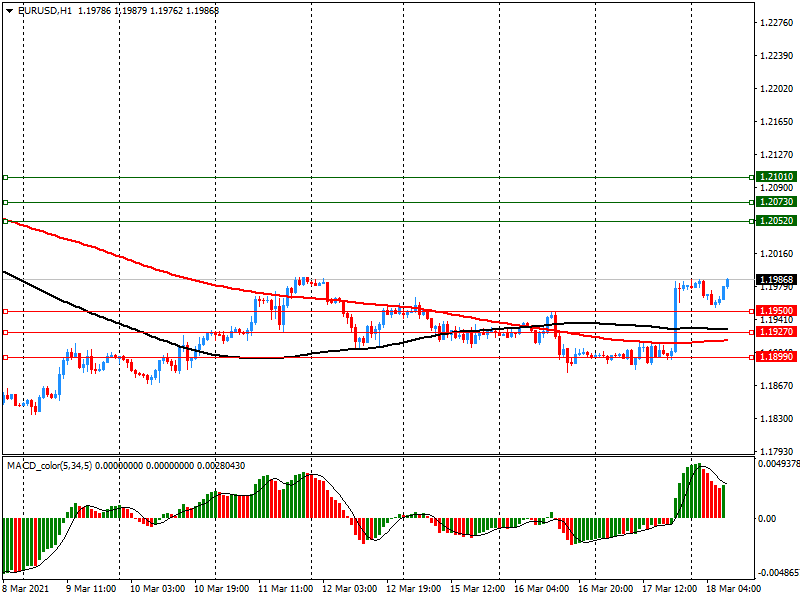
Comments:
- Overall open interest on the CALL options and PUT options with the expiration date April, 9 is 61447 contracts (according to data from March, 17) with the maximum number of contracts with strike price $1,1900 (4890);
GBP/USD
$1.4146 (1277)
$1.4082 (417)
$1.4034 (871)
Price at time of writing this review: $1.3979
Support levels (open interest**, contracts):
$1.3903 (459)
$1.3867 (290)
$1.3843 (468)
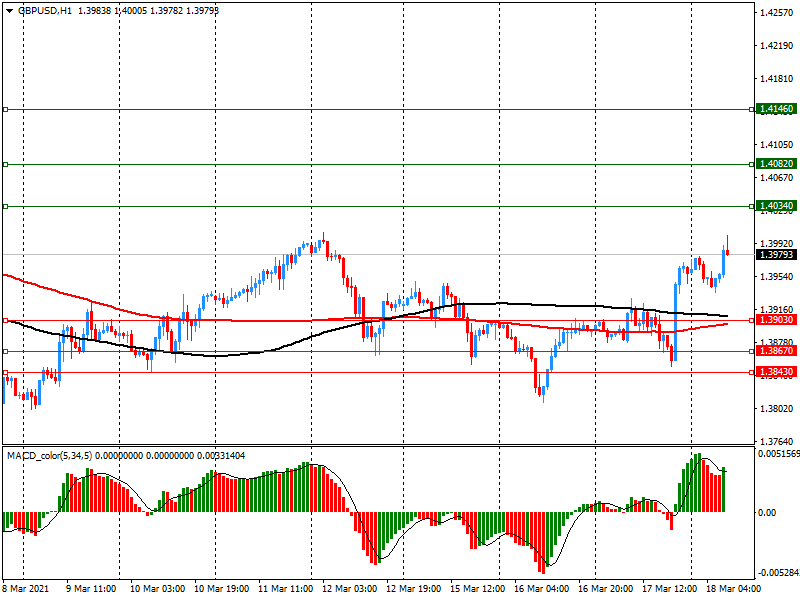
Comments:
- Overall open interest on the CALL options with the expiration date April, 9 is 8635 contracts, with the maximum number of contracts with strike price $1,4100 (1277);
- Overall open interest on the PUT options with the expiration date April, 9 is 19695 contracts, with the maximum number of contracts with strike price $1,3200 (5598);
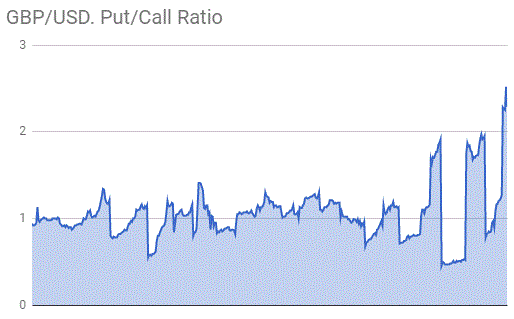
- The ratio of PUT/CALL was 2.28 versus 2.32 from the previous trading day according to data from March, 17
* - The Chicago Mercantile Exchange bulletin (CME) is used for the calculation.
** - Open interest takes into account the total number of option contracts that are open at the moment.
RTTNews reports that according to the report from the Australian Bureau of Statistics, the jobless rate in Australia was a seasonally adjusted 5.8 percent in February. That was well below forecasts for 6.3 percent and down sharply from 6.4 percent in January.
The Australian economy added 88,700 jobs last month to 13,006,900 - blowing away expectations for an increase of 30,000 following the increase of 29,100 in the previous month.
Full-time employment increased by 89,100 to 8,895,000 people, and part-time employment decreased by 500 to 4,111,900 people.
Over the year to February 2021, employment decreased 1,800 people, less than 0.1 percent.
The participation rate came in at 66.1 percent - unchanged from the previous month but shy of expectations for 66.2 percent.
Unemployment decreased by 70,000 people (8 percent) in February. The unemployment rate declined by 0.5 percentage points to 5.8 per cent (from a revised January figure of 6.3 per cent). The unemployment rate remained 0.6 percentage points above March 2020, with around 89,000 more unemployed people.
| Pare | Closed | Change, % |
|---|---|---|
| AUDUSD | 0.77947 | 0.67 |
| EURJPY | 130.408 | 0.54 |
| EURUSD | 1.19793 | 0.66 |
| GBPJPY | 151.978 | 0.39 |
| GBPUSD | 1.39613 | 0.5 |
| NZDUSD | 0.72282 | 0.56 |
| USDCAD | 1.24057 | -0.28 |
| USDCHF | 0.92216 | -0.25 |
| USDJPY | 108.837 | -0.13 |







© 2000-2026. All rights reserved.
This site is managed by Teletrade D.J. LLC 2351 LLC 2022 (Euro House, Richmond Hill Road, Kingstown, VC0100, St. Vincent and the Grenadines).
The information on this website is for informational purposes only and does not constitute any investment advice.
The company does not serve or provide services to customers who are residents of the US, Canada, Iran, The Democratic People's Republic of Korea, Yemen and FATF blacklisted countries.
Making transactions on financial markets with marginal financial instruments opens up wide possibilities and allows investors who are willing to take risks to earn high profits, carrying a potentially high risk of losses at the same time. Therefore you should responsibly approach the issue of choosing the appropriate investment strategy, taking the available resources into account, before starting trading.
Use of the information: full or partial use of materials from this website must always be referenced to TeleTrade as the source of information. Use of the materials on the Internet must be accompanied by a hyperlink to teletrade.org. Automatic import of materials and information from this website is prohibited.
Please contact our PR department if you have any questions or need assistance at pr@teletrade.global.


 Bank
Bank transfers


