- Analytics
- News and Tools
- Market News
Analytics, News, and Forecasts for CFD Markets: currency news — 25-03-2021.
| Time | Country | Event | Period | Previous value | Forecast |
|---|---|---|---|---|---|
| 07:00 (GMT) | Germany | Gfk Consumer Confidence Survey | April | -12.7 | -11.9 |
| 08:30 (GMT) | Switzerland | SNB Interest Rate Decision | -0.75% | -0.75% | |
| 09:00 (GMT) | Eurozone | Private Loans, Y/Y | February | 3% | 2.9% |
| 09:00 (GMT) | Eurozone | M3 money supply, adjusted y/y | February | 12.5% | 12.5% |
| 11:00 (GMT) | United Kingdom | CBI retail sales volume balance | March | -45 | -37 |
| 12:30 (GMT) | U.S. | Continuing Jobless Claims | March | 4134 | 4043 |
| 12:30 (GMT) | U.S. | Initial Jobless Claims | March | 781 | 730 |
| 12:30 (GMT) | U.S. | PCE price index, q/q | Quarter IV | 3.7% | 1.5% |
| 12:30 (GMT) | U.S. | PCE price index ex food, energy, q/q | Quarter IV | 3.4% | 1.4% |
| 12:30 (GMT) | U.S. | GDP, q/q | Quarter IV | 33.4% | 4.1% |
| 14:00 (GMT) | Belgium | Business Climate | March | -4.4 | -3.1 |
| 14:10 (GMT) | U.S. | FOMC Member Clarida Speaks | |||
| 23:30 (GMT) | Japan | Tokyo CPI ex Fresh Food, y/y | March | -0.3% | -0.2% |
| 23:30 (GMT) | Japan | Tokyo Consumer Price Index, y/y | March | -0.3% |
| Time | Country | Event | Period | Previous value | Forecast |
|---|---|---|---|---|---|
| 07:00 (GMT) | United Kingdom | Retail Sales (MoM) | February | -8.2% | |
| 07:00 (GMT) | United Kingdom | Retail Sales (YoY) | February | -5.9% | |
| 07:45 (GMT) | France | Consumer confidence | March | 91 | |
| 09:00 (GMT) | Germany | IFO - Expectations | March | 94.2 | |
| 09:00 (GMT) | Germany | IFO - Current Assessment | March | 90.6 | |
| 09:00 (GMT) | Germany | IFO - Business Climate | March | 92.4 | |
| 12:00 (GMT) | United Kingdom | MPC Member Saunders Speaks | |||
| 12:30 (GMT) | U.S. | Goods Trade Balance, $ bln. | February | -83.74 | |
| 12:30 (GMT) | U.S. | Personal Income, m/m | February | 10% | -7.2% |
| 12:30 (GMT) | U.S. | Personal spending | February | 2.4% | 0.1% |
| 12:30 (GMT) | U.S. | PCE price index ex food, energy, m/m | February | 0.3% | 0.2% |
| 12:30 (GMT) | U.S. | PCE price index ex food, energy, Y/Y | February | 1.5% | 1.5% |
| 14:00 (GMT) | U.S. | Reuters/Michigan Consumer Sentiment Index | March | 76.8 | 83 |
| 16:45 (GMT) | United Kingdom | MPC Member Tenreyro Speaks | |||
| 17:00 (GMT) | U.S. | Baker Hughes Oil Rig Count | March |
eFXdata reports that analysts at TD Research like selling USD/CAD on rallies over the coming weeks.
"We look for the CAD to retain a supportive tailwind after the Bank of Canada outlined steps to unwind its extraordinary stimulus programs in the weeks ahead."
"While we suspect overall USD direction is likely to dominate for a while longer, we think USDAD would be one of the better places to sell dollars if we do get a broader pullback in its latest rebound... We continue to target a move to 1.47 in EUR/CAD."
eFXdata reports that analysts at Credit Suisse discuss EUR/USD technical outlook and maintains a tactical bearish bias in the near-term.
"We look for a close below here to reinforce our broader roadmap for further weakness to 1.1745 and eventually a fall to the 38.2% retracement of the entire 2020/2021 uptrend at 1.1695."
"Resistance moves to 1.1873/77 initially, then 1.1896, with the recent reaction high and 13-day exponential average at 1.1933/48 now ideally capping."
FXStreet notes that the weekly jobless claims report showed on Thursday the lowest levels in a year, with initial claims below 700K for the first time since the pandemic. Analysts at Wells Fargo argue that while the ranks of beneficiaries remain staggeringly high at 19 million, the unemployment benefits flowing to these individuals is just another example of the significant income support to households this cycle that has kept consumer spending relatively buoyant.
“The direction and magnitude of weekly claims continue to hold clues about the recovery. To that end, claims tumbled by 97K to a 52-week low of 684K. The sharp drop came on the heels of an unexpected and upwardly revised figure of 781K the prior week. Through weekly volatility, however, the trend remains firmly, albeit slowly, downward. The four-week moving average fell by 13K to hit a fresh cycle low.”
“While this week's claims figures show conditions improving, the initial damage brought on by COVID lingers. About 4.5 million individuals continue to collect regular unemployment insurance, while another 6.6 million are collecting extended benefits, including through programs such as the Pandemic Emergency Unemployment Compensation program.”
FXStreet reports that some believe that the COVID crisis is going to give way to another Roaring Twenties period in OECD countries, with the same characteristics as in the 1920s. According to analysts at Natixis, there will be a strong economic recovery in the OECD after the crisis but it is not at all certain that it will become another Roaring Twenties.
“There must be a consumption boom, fuelled by the desire to offset the crisis years. Such a boom is possible, as households have accumulated large forced savings during the crisis."
“There is already euphoria in financial markets, which, in addition to the prospect of economic recovery, is primarily a result of the ultra-expansionary monetary policies.”
“We see that the COVID-19 crisis is leading to increased digitisation of the economy. But this does not mean that there will be rapid growth in productivity and employment. The development of new technologies has not come hand in hand with faster productivity gains; this is because the level of employment in the production of new technologies remains quite low, while their growth has given rise to many low-skilled jobs.”
- Going forward, low unemployment rate, in and of itself, will not be sufficient to trigger tightening of monetary policy absent any evidence from other indicators that inflation is at risk of moving above mandate-consistent levels
- It will take some time for economic activity and employment to return to levels that prevailed at business cycle peak reached last February
- U.S. economy is much more resilient than forecast a year ago
- We are committed to using our full range of tools to support economy until the job is well and truly done
- I expect most of increase in prices to be transitory and for inflation to return to-or perhaps run somewhat above-our 2% longer-run goal in 2022 and 2023; this outcome would be entirely consistent with new framework we adopted in August 2020
FXStreet notes that EUR/USD has broken below its 200-day moving average for the first time in 10 months. Mazen Issa, Senior FX Strategist at TD Securities, suggests that a dip below the 1.1800 level would imply a new 1.16-1.18 range.
“Despite a recent bounce in EZ PMIs, the EUR still can't buy a bid. Taken alongside the 200-dma breach, poor vaccine rollout, more lockdowns and more ECB buying suggests that EUR downside has further to run.”
“1.18 is a key pivot, but a break below will likely open talk of a new 1.16/1.18 range.”
- Won't specify his interest rate outlook for coming years
- Fed is tied to economic outcomes, not the calendar
- Supply disruptions, strong demand mean inflation will rise this year but revert to 2% over time
- Possible Fed could see substantial further progress on its jobs and inflation goals this year, with expected rise in inflation "straightforward" and hope for strong job growth in months ahead
- More focused on inflation expectations than actual rate
- Won't specify the level of inflation he would consider in line with Fed's plan a moderate overshoot of 2%
A report from
the Commerce Department showed on Thursday that the U.S. economy grew more than
initially thought in the fourth quarter of 2020, primarily reflecting an upward
revision to private inventory investment that was partly offset by a downward
revision to nonresidential fixed investment.
According to the third estimate, the U.S. gross domestic product (GDP) grew at an annual rate of 4.3 percent in the fourth quarter, better than a 4.1 percent advance reported in the second estimate.
Economists had
expected the contraction rate to be unrevised at 4.1 percent.
In the third
quarter, the economy expanded by a record 33.4 percent q-o-q.
The increase in
real GDP reflected gains in exports, nonresidential fixed investment, personal
consumption expenditures (PCE), residential fixed investment, and private
inventory investment, which were partly offset by declines in state and local
government spending as well as federal government spending (reflecting fewer
fees paid to administer the Paycheck Protection Program loans). Meanwhile, imports,
which are a subtraction in the calculation of GDP, rose.
The data from the Labor Department revealed on Thursday the number of applications for unemployment fell much more than expected last week, hitting its lowest level in more than a year.
According to the report, the initial claims for unemployment benefits decreased by 97,000 to 684,000 for the week ended March 20. This was the lowest reading since the pandemic hit the labor market in March 2020.
Economists had
expected 730,000 new claims last week.
Claims for the
prior week were revised upwardly to 781,000 from the initial estimate of 770,000.
Meanwhile, the
four-week moving average of jobless claims declined to 736,000 from an upwardly
revised 749,000 in the previous week.
Continuing
claims dropped to 3,870,000 from an upwardly revised 4,134,000 in the previous
week.
| Time | Country | Event | Period | Previous value | Forecast | Actual |
|---|---|---|---|---|---|---|
| 07:00 | Germany | Gfk Consumer Confidence Survey | April | -12.7 | -11.9 | -6.2 |
| 08:30 | Switzerland | SNB Interest Rate Decision | -0.75% | -0.75% | -0.75% | |
| 09:00 | Eurozone | Private Loans, Y/Y | February | 3% | 2.9% | 3% |
| 09:00 | Eurozone | M3 money supply, adjusted y/y | February | 12.5% | 12.5% | 12.3% |
| 11:00 | United Kingdom | CBI retail sales volume balance | March | -45 | -37 | -45 |
| 12:30 | U.S. | Continuing Jobless Claims | March | 4134 | 4043 | 3870 |
| 12:30 | U.S. | Initial Jobless Claims | March | 781 | 730 | 684 |
| 12:30 | U.S. | PCE price index, q/q | Quarter IV | 3.7% | 1.5% | 1.5% |
| 12:30 | U.S. | PCE price index ex food, energy, q/q | Quarter IV | 3.4% | 1.4% | 1.3% |
| 12:30 | U.S. | GDP, q/q | Quarter IV | 33.4% | 4.1% | 4.3% |
EUR fell against most of its major counterparts in the European session on Thursday as investors continued to fret over the rise of coronavirus cases around the EU, including in Germany, the region's largest economy.
Data showed that new COVID cases in Germany surged the most since January 9 yesterday. The report followed the announcement of the cancellation of the Easter lockdown by the German government on Wednesday. In France, the number of people with COVID-19 intensive care was the highest in 2021. Meanwhile, the EU governments continue to bicker over vaccine shipments.
Market participants also assessed GfK's consumer confidence survey for Germany, which revealed that German consumer sentiment is set to improve in April. According to the report, the forward-looking consumer sentiment index rose to -6.2 in April from a revised -12.7 in March. This was the highest reading since December 2020. Economists had forecast the indicator to increase to -11.9.
Elsewhere, the European Central Bank (ECB) reported that the annual growth rate of the Eurozone's monetary aggregate M3 decelerated to 12.3% in February 2021 from 12.5% in January, averaging 12.4% in the three months up to February. Economists had expected a 12.5% advance. Meanwhile, credit to the private sector rose at a steady pace of 5.1% in February. Similarly, adjusted loans to the private sector grew 4.5%, the same pace as in January.
FXStreet notes that the Swiss National Bank (SNB) announced its latest monetary policy decision this Thursday and left its sight deposit interest rate unchanged at -0.75%. The decision came as no surprise. Analysts at Capital Economics suggest that the prospect of further falls in the franc should allow the Bank to largely stay out of the FX market, but the policy rate will remain rooted at a record low of -0.75% for the foreseeable future.
“Given the importance that the SNB attaches to maintaining the interest rate differential with the ECB, we expect it to leave its policy rate on hold at -0.75% for the foreseeable future.”
“Although the SNB would intervene to counter any sudden increases in the franc, we expect a further rise in risk sentiment to relieve pressure on the currency franc and allow the Bank to largely stay out of the FX market.”
“We now expect the Swiss franc to fall to CHF 1.12 per euro by year-end (previously CHF 1.10) and to CHF 1.14 (previously CHF 1.12) by the end of 2022.”
- The process will take place with the greatest transparency
- Level of debt today is not unsustainable; no question of U.S. being able to service its debt right now
- We are strongly committed to inflation that averages 2% over time
The
Confederation of British Industry (CBI) reported on Thursday its latest survey
of retailers showed retail sales volume balance stood at -45 in the year to March,
unchanged from -45 in February, being well below seasonal norms and highlighting
the severe impact of the lockdown for many non-essential retailers.
Economist had
forecast the reading to improve to -37.
However, retail
sales volumes were expected to grow in the year to April (+17). This is the
first time the expectations have been positive since December 2019, reflecting the
anticipated reopening of non-essential retail from mid-April, but also the
relatively low base for comparison, given that April 2020 saw the joint steepest
drop in sales since the start of the survey in 1983.
The report also revealed that the retail orders balance decreased in March at broadly a similar pace as last month (balance of -33 from -36) and was seen to be generally flat in the year to April (+1). Meanwhile, internet sales eased in the year to March (balance of +60, from February’s record +75) and were forecast to slow to around the long-run average of 46 next month (+48).
In other survey results, stock levels in relation to expected sales decreased in March to below their long-run average of +18 (balance of +9, from +22) and are expected to be broadly adequate next month (-3).
“Retailers are
looking forward to April with a sense of optimism, given the potential
re-opening of the sector across the UK,” noted Ben Jones, Principal Economist
at the CBI. “However, it is clear that the potential easing of domestic
restrictions next month will not be a panacea for all retailers. Expectations
point to a fairly muted recovery, especially when considering that base effects
will tend to flatter annual growth next month, given the historic drop in sales
in April 2020.”
Reuters reports that German Chancellor Angela Merkel said that European Union leaders will discuss how to make sure more vaccines are made on European soil since the bloc’s supply problems are more to do with a lack of production capacity than with under-ordering
“British production sites are manufacturing for Britain and the United States is not exporting, so we are reliant on what we can make in Europe,” Merkel told .
In addition, more work had to be done on ensuring the rest of the world was supplied with vaccines, since otherwise new mutations would keep emerging, some of which might turn out to be vaccine-resistant, Merkel warned.
CNBC reports that UBS Global Wealth Management sees 5% to 10% upside for global stock markets, with emerging markets, financials, energy stocks and small caps best placed to capitalize.
U.K. CIO Caroline Simmons said analysts had a particular preference for emerging markets in Asia and China in particular. She also backed cyclical and value stocks.
This is based on expectations that the economic recovery will broaden out and accelerate over the course of the year, continuing to support a rotation from the high-flying growth sectors such as technology into sectors that benefit from an acceleration of industrial production and rising inflation.
She noted that financials had underperformed the S&P 500 by around 5% since the end of 2019, but have recently begun to make a comeback as the rotation to value and inflation expectations gathered pace.
A recent rise in the benchmark U.S. 10-year Treasury yield and other bond yields around the world have triggered volatility in equity markets, as investors began to question the valuations of growth-based sectors susceptible to higher interest rates.
The 10-year yield was hovering at around 1.6209% on Thursday morning in Europe, but UBS forecasts that it will reach around 2% by the end of the year.
“Higher yields and steeper yield curves generally are more helpful for financials. They help their net interest margins and they also generally see an improvement in non-performing loans,” Simmons said.
FXStreet reports that economists at Westpac said that the US Dollar Index (DXY) looks set to test higher levels near term.
“DXY looks determined to test the top-end of a rough 91-93 range that is likely to form in coming weeks.”
“Fed officials have resoundingly underscored their dovish policy track, anchoring the front-end, but long end-yields remain another matter. DXY weighted 10yr spreads have fully retraced the 2020Q1 pandemic collapse.”
“The medium-term USD bear trend has been adjourned, until sometime in 2021H2. By then Europe should surely have her vaccination act together and second derivative US rebound measures will probably be cresting.”
Reuters reports that Economy Minister Nadia Calvino said that Spanish economic indicators so far this year have given mixed signals on how the country's economy is performing.
"We're in the middle of a transition. We're at a moment of uncertainty and we always try to be prudent," she said.
The central bank on Tuesday said the Spanish economy will likely contract 0.4% in the first quarter due to the COVID-19 restrictions and lowered its growth figure for the full year.
"Indicators are mixed," Calvino said.
According to the report from European Central Bank, the annual growth rate of the broad monetary aggregate M3 decreased to 12.3% in February 2021 from 12.5% in January, averaging 12.4% in the three months up to February. Economists had expected a 12.5% increase.
The components of M3 showed the following developments. The annual growth rate of the narrower aggregate M1, which comprises currency in circulation and overnight deposits, stood at 16.4% in February, compared with 16.5% in January. The annual growth rate of short-term deposits other than overnight deposits (M2-M1) stood at 1.0% in February, compared with 1.1% in January. The annual growth rate of marketable instruments (M3-M2) decreased to 14.2% in February, down from 18.5% in January.
Annual growth rate of adjusted loans to households stood at 3.0% in February, unchanged from previous month
Annual growth rate of adjusted loans to non-financial corporations increased to 7.1% in February from 6.9% in January
The coronavirus pandemic is continuing to have a strong adverse effect on the economy.
Despite the recent weakening, the Swiss franc remains highly valued.
With a view to stabilising economic activity and price developments, the SNB is maintaining its expansionary monetary policy.
SNB remains willing to intervene in the foreign exchange market as necessary, while taking the overall currency situation into consideration.
The new conditional inflation forecast for 2021 and 2022 is higher than in December. This is primarily due to the rise in oil prices and the weaker Swiss franc.
Looking beyond the two year horizon, the inflation forecast is virtually unchanged compared with December. The forecast now stands at 0.2% for 2021, 0.4% for 2022 and 0.5% for 2023.
The conditional inflation forecast is based on the assumption that the SNB policy rate remains at −0.75% over the entire forecast horizon.
Coronavirus and the measures implemented to contain it are continuing to shape the global economy more than a year after the outbreak of the pandemic.
The SNB’s baseline scenario for the global economy anticipates a phased easing of the containment measures in place in many countries over the course of the spring.
The economic recovery is therefore likely to regain momentum from the second quarter.
In addition to the expected progress with vaccination programmes, the monetary and fiscal policy measures introduced worldwide are an important source of support.
Nevertheless, global production capacity will remain underutilised for some time to come.
The SNB continues to expect GDP growth of 2.5% to 3% for 2021.
Activity is thus likely to return to its pre-crisis level in the second half of the year. However, production capacity will remain underutilised for some time yet.
In the current situation, both the inflation outlook as well as the growth forecasts for Switzerland and abroad are still subject to high uncertainty.
Mortgage lending and residential property prices have risen further in recent quarters. The vulnerability of these markets thus persists and continues to present a risk for financial stability.
| Time | Country | Event | Period | Previous value | Forecast | Actual |
|---|---|---|---|---|---|---|
| 07:00 | Germany | Gfk Consumer Confidence Survey | April | -12.7 | -11.9 | -6.2 |
During today's Asian trading, the US dollar rose slightly against the euro and rose moderately against the yen.
Yesterday, the EUR/USD pair reached its lowest level since November amid concerns about a new wave of COVID-19 in Europe.
Experts note that risk aversion is back on the rise, and concern about the pace of global economic growth is increasing amid signs that COVID-19 is harder to control in Europe than expected.
After the extension of quarantine measures in Germany and some regions of France, the Dutch authorities announced that the restrictions in force in the country will be extended until April 20. Analysts believe that against the background of the third wave (coronavirus), economic data will not be very encouraging, especially compared to data from the United States.
Financial aid is critical to the U.S. economic recovery effort, Federal Reserve Chairman Jerome Powell said at a Senate Banking Committee hearing on Wednesday. When asked whether the rise in government bond yields threatens to slow the country's GDP recovery, he repeated that the increase comes from very low levels and reflects confidence in the improving state of the economy.
On Thursday, investors expect the publication of final data on the change in US GDP in the fourth quarter of 2020.
The ICE index, which tracks the dynamics of the dollar against six currencies (euro, swiss franc, yen, canadian dollar, pound sterling and swedish krona), rose by 0.11%
According to the report from Insee, in March 2021, the business climate has improved markedly. The indicator that synthesizes it, calculated from the responses of business leaders in the main market sectors of activity, has gained 7 points. At 97, it stands at the highest level since the start of the health crisis, thus approaching its long-term average (100).
This sharp increase reflects above all a renewed confidence in the tertiary sector: business climates in services and in retail trade have risen, respectively, by 6 and 5 points compared to February and, in wholesale trade, by 3 points compared to January. In manufacturing, after three months of improvement, the business climate is stable in March. These four business climates remain below their long-term averages, although in manufacturing and wholesale trade they are quite close to it. In the building industry, the opinion of business leaders on their activity, both recent and upcoming, has improved quite markedly in March.
At the same time, the employment climate has rebounded sharply. At 92, it has gained six points and returned to a level equivalent to that of September 2020, while remaining well below his average (100). This improvement is mainly due to the increase in the balances of opinion on the changes in the workforce size, both recent and expected, in services other than temporary employment agencies.
FXStreet reports that Daniel Ghali, Commodity Strategist at TD Securities notes that decarbonization may kill aluminium supply.
“Our gauge of supply risk is showing nascent signs of waning, and provincial sales of strategic reserves could dent this premium.”
“Reports of emissions cuts have boosted sentiment, but Inner Mongolia's capacity is contained in cities that have not contributed to overconsumption.”
“Positioning has surged, with top SHFE accounts growing length across metals. This ties into reflation, inflation-hedging, and the supercycle narrative but does not reflect facts on the ground.”
“Chinese deleveraging could see tailwinds morph into headwinds, ultimately catalyzing a reversal in length.”
According to the report from GfK, the easing of the hard lockdown, which began in early March, as well as falling infection rates at the time of the survey (March 4-15) boosted consumer confidence. Both economic and income expectations have increased, along with the propensity to buy, in some cases noticeably. As a result, GfK is forecasting a decrease of 6.2 points in consumer confidence for April 2021, up 6.5 points from March this year (revised from -12.7 points).
This growing optimism may seem surprising at first glance. Since the survey took place during March 4 and March 15, the events surrounding the AstraZenica vaccine and the significant increase in the number of infections in the last few days have not been taken into account. Instead, the survey period was characterized by the initial easing of the hard lockdown and stable or even slightly declining infection figures. A very similar development was also observed in the spring of 2020, when the hard lockdown was also relaxed.
With infection rates rising again and the lockdown will be tightened again, it is questionable whether the improvement in consumer confidence will continue.
Rolf Bürkl, GfK consumer expert comments on the subject: “The hard lockdown will severely damage consumer confidence and the current improvement will remain a flash in the pan. A sustained recovery in consumer confidence will continue to be a long time coming — which means difficult times ahead for retailers and manufacturers.”
EUR/USD
Resistance levels (open interest**, contracts)
$1.2011 (865)
$1.1970 (901)
$1.1934 (1145)
Price at time of writing this review: $1.1816
Support levels (open interest**, contracts):
$1.1787 (2782)
$1.1759 (4768)
$1.1724 (4850)
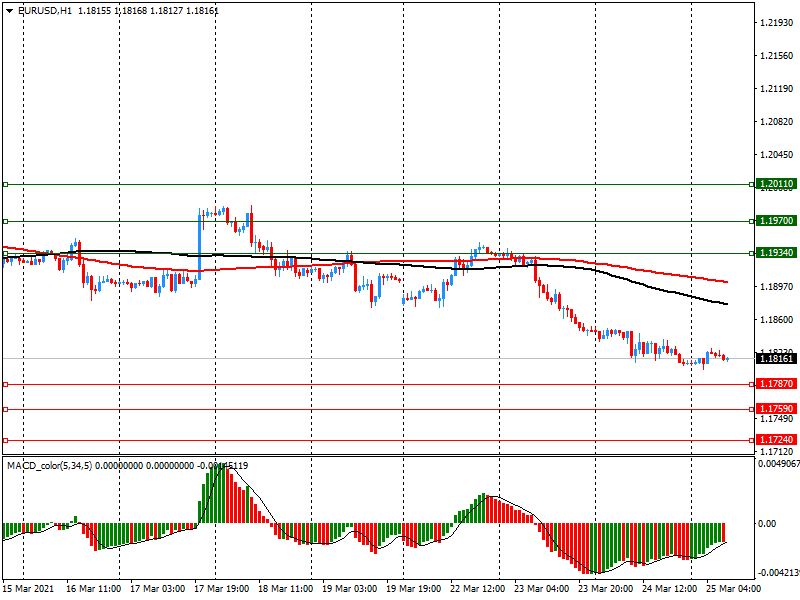
Comments:
- Overall open interest on the CALL options and PUT options with the expiration date April, 9 is 67129 contracts (according to data from March, 24) with the maximum number of contracts with strike price $1,1900 (5021);
GBP/USD
$1.3920 (842)
$1.3880 (115)
$1.3785 (565)
Price at time of writing this review: $1.3678
Support levels (open interest**, contracts):
$1.3635 (1225)
$1.3612 (1156)
$1.3545 (209)
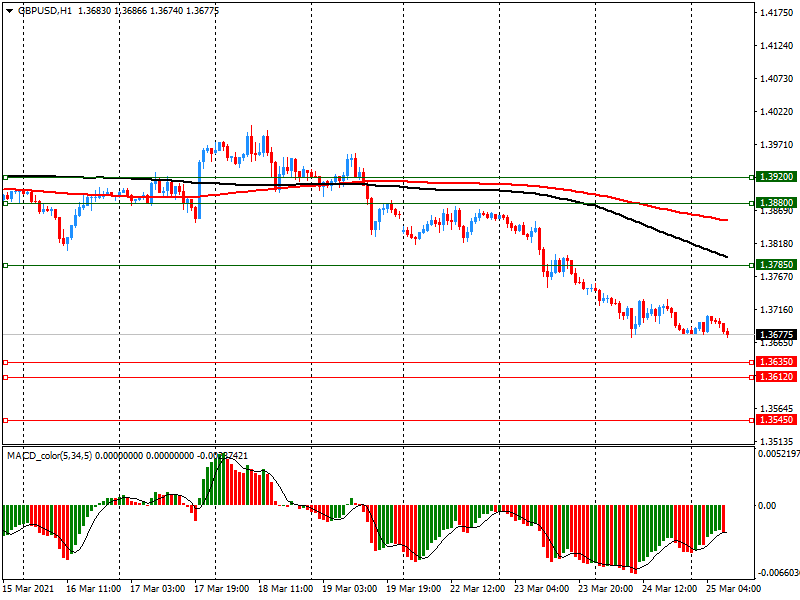
Comments:
- Overall open interest on the CALL options with the expiration date April, 9 is 9546 contracts, with the maximum number of contracts with strike price $1,4100 (1180);
- Overall open interest on the PUT options with the expiration date April, 9 is 16346 contracts, with the maximum number of contracts with strike price $1,3850 (1838);
- The ratio of PUT/CALL was 1.71 versus 2.14 from the previous trading day according to data from March, 24
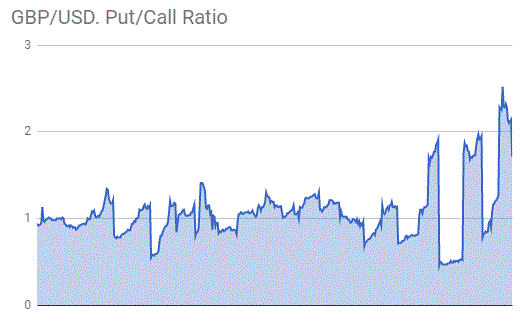
* - The Chicago Mercantile Exchange bulletin (CME) is used for the calculation.
** - Open interest takes into account the total number of option contracts that are open at the moment.
| Pare | Closed | Change, % |
|---|---|---|
| AUDUSD | 0.75804 | -0.64 |
| EURJPY | 128.403 | -0.21 |
| EURUSD | 1.1811 | -0.31 |
| GBPJPY | 148.8 | -0.35 |
| GBPUSD | 1.36842 | -0.46 |
| NZDUSD | 0.69648 | -0.56 |
| USDCAD | 1.25735 | -0 |
| USDCHF | 0.93544 | 0.17 |
| USDJPY | 108.708 | 0.1 |







© 2000-2026. All rights reserved.
This site is managed by Teletrade D.J. LLC 2351 LLC 2022 (Euro House, Richmond Hill Road, Kingstown, VC0100, St. Vincent and the Grenadines).
The information on this website is for informational purposes only and does not constitute any investment advice.
The company does not serve or provide services to customers who are residents of the US, Canada, Iran, The Democratic People's Republic of Korea, Yemen and FATF blacklisted countries.
Making transactions on financial markets with marginal financial instruments opens up wide possibilities and allows investors who are willing to take risks to earn high profits, carrying a potentially high risk of losses at the same time. Therefore you should responsibly approach the issue of choosing the appropriate investment strategy, taking the available resources into account, before starting trading.
Use of the information: full or partial use of materials from this website must always be referenced to TeleTrade as the source of information. Use of the materials on the Internet must be accompanied by a hyperlink to teletrade.org. Automatic import of materials and information from this website is prohibited.
Please contact our PR department if you have any questions or need assistance at pr@teletrade.global.


 Bank
Bank transfers


