- Analytics
- News and Tools
- Market News
Analytics, News, and Forecasts for CFD Markets: currency news — 13-02-2019.
| Time | Country | Event | Period | Previous value | Forecast |
|---|---|---|---|---|---|
| 00:00 | Australia | Consumer Inflation Expectation | February | 3.5% | |
| 03:00 | China | Trade Balance, bln | January | 57.06 | 33.5 |
| 07:00 | Germany | GDP (YoY) | Quarter IV | 1.1% | 0.8% |
| 07:00 | Germany | GDP (QoQ) | Quarter IV | -0.2% | 0.1% |
| 07:30 | Switzerland | Producer & Import Prices, y/y | January | 0.6% | -0.2% |
| 09:30 | United Kingdom | MPC Member Vlieghe Speaks | |||
| 10:00 | Eurozone | Employment Change | Quarter IV | 0.2% | 0.2% |
| 10:00 | Eurozone | GDP (QoQ) | Quarter IV | 0.2% | 0.2% |
| 10:00 | Eurozone | GDP (YoY) | Quarter IV | 1.6% | 1.2% |
| 13:30 | U.S. | Continuing Jobless Claims | 1736 | 1720 | |
| 13:30 | Canada | New Housing Price Index, YoY | December | 0% | |
| 13:30 | Canada | New Housing Price Index, MoM | December | 0% | 0% |
| 13:30 | Canada | Manufacturing Shipments (MoM) | December | -1.4% | 0.2% |
| 13:30 | U.S. | Initial Jobless Claims | 234 | 225 | |
| 13:30 | U.S. | Retail Sales YoY | December | 4.2% | |
| 13:30 | U.S. | Retail sales excluding auto | December | 0.2% | 0.1% |
| 13:30 | U.S. | Retail sales | December | 0.2% | 0.2% |
| 13:30 | U.S. | PPI, m/m | January | -0.2% | 0.1% |
| 13:30 | U.S. | PPI, y/y | January | 2.5% | 2.1% |
| 13:30 | U.S. | PPI excluding food and energy, m/m | January | -0.1% | 0.2% |
| 13:30 | U.S. | PPI excluding food and energy, Y/Y | January | 2.7% | 2.5% |
| 15:00 | U.S. | Business inventories | November | 0.6% | 0.3% |
| 16:00 | U.S. | FOMC Member Harker Speaks | |||
| 20:45 | Australia | RBA Assist Gov Kent Speaks | |||
| 21:30 | New Zealand | Business NZ PMI | January | 55.1 | |
| 21:45 | New Zealand | Visitor Arrivals | December | 7.1% |
| Time | Country | Event | Period | Previous value | Forecast |
|---|---|---|---|---|---|
| 00:00 | Australia | Consumer Inflation Expectation | February | 3.5% | |
| 03:00 | China | Trade Balance, bln | January | 57.06 | 33.5 |
| 07:00 | Germany | GDP (YoY) | Quarter IV | 1.1% | 0.8% |
| 07:00 | Germany | GDP (QoQ) | Quarter IV | -0.2% | 0.1% |
| 07:30 | Switzerland | Producer & Import Prices, y/y | January | 0.6% | -0.2% |
| 09:30 | United Kingdom | MPC Member Vlieghe Speaks | |||
| 10:00 | Eurozone | Employment Change | Quarter IV | 0.2% | 0.2% |
| 10:00 | Eurozone | GDP (QoQ) | Quarter IV | 0.2% | 0.2% |
| 10:00 | Eurozone | GDP (YoY) | Quarter IV | 1.6% | 1.2% |
| 13:30 | U.S. | Continuing Jobless Claims | 1736 | 1720 | |
| 13:30 | Canada | New Housing Price Index, YoY | December | 0% | |
| 13:30 | Canada | New Housing Price Index, MoM | December | 0% | 0% |
| 13:30 | Canada | Manufacturing Shipments (MoM) | December | -1.4% | 0.2% |
| 13:30 | U.S. | Initial Jobless Claims | 234 | 225 | |
| 13:30 | U.S. | Retail Sales YoY | December | 4.2% | |
| 13:30 | U.S. | Retail sales excluding auto | December | 0.2% | 0.1% |
| 13:30 | U.S. | Retail sales | December | 0.2% | 0.2% |
| 13:30 | U.S. | PPI, m/m | January | -0.2% | 0.1% |
| 13:30 | U.S. | PPI, y/y | January | 2.5% | 2.1% |
| 13:30 | U.S. | PPI excluding food and energy, m/m | January | -0.1% | 0.2% |
| 13:30 | U.S. | PPI excluding food and energy, Y/Y | January | 2.7% | 2.5% |
| 15:00 | U.S. | Business inventories | November | 0.6% | 0.3% |
| 16:00 | U.S. | FOMC Member Harker Speaks | |||
| 20:45 | Australia | RBA Assist Gov Kent Speaks | |||
| 21:30 | New Zealand | Business NZ PMI | January | 55.1 | |
| 21:45 | New Zealand | Visitor Arrivals | December | 7.1% |
EIA’s report reveals bigger than expected build in U.S. crude oil inventories
The U.S. Energy Information Administration (EIA) revealed that crude inventories rose by 3.633 million barrels in the week ended February 8. Economists had forecast an increase of 2.400 million barrels.
At the same time, gasoline stocks rose by 0.408 million barrels, while analysts had expected a build of 1.400 million barrels. Distillate stocks climbed by 1.187 million barrels, while analysts had forecast a decrease of 1.500 million barrels.
Meanwhile, oil production in the U.S. was unchanged at 11.900 million barrels per day.
U.S. crude oil imports averaged 6.2 million barrels per day last week, down by 936,000 barrels per day from the previous week.
- Time to put our policy on a more neutral range
- Important that we don’t go too fast and inadvertently restrict the economy
- One increase for 2019 as my model projection
- If we stay at 2.5 GDP growth for the year, consistent with my forecast of one rate hike
- Has not come to a view on what size reserves Fed should carry
- Government shutdown not going to show up in numbers too deeply, another layer of uncertainty
- Trade uncertainty with China, revision to NAFTA are risks
- Fed would use its tools to address economic downturn
- U.S. probably a little bit beyond full employment
- Wages are rising across all employee skill levels
- Growing wages are positive in a fairly low inflation environment
The Labor Department announced the U.S. consumer price index (CPI) was flat m-o-m in January 2019 after a 0.1 percent m-o-m drop in December 2018.
Over the last 12 months, the CPI rose 1.6 percent y-o-y last month, following a 1.9 percent m-o-m gain in the 12 months through December. That was the lowest rate since June 2017.
Economists had forecast the CPI to increase 0.1 percent m-o-m and 1.5 percent y-o-y in the 12-month period.
According to the report, the energy index (-3.1 percent m-o-m) decreased for the third consecutive month, offsetting advances in the indexes for all items less food and energy (+0.2 percent m-o-m) and for food (+0.2 percent m-o-m). All the major energy component indexes dropped in January, with the gasoline index declining 5.5 percent m-o-m.
The core CPI excluding volatile food and fuel costs increased 0.2 percent m-o-m in January, the same increase as in the previous month.
In the 12 months through January, the core CPI rose 2.2 percent, the same increase as for the 12 months ending December.
Economists had forecast the core CPI to rise 0.2 percent m-o-m and 2.1 percent y-o-y last month.
The U.S. President Donald Trump intends to sign the border security deal to avoid another partial government shutdown, told CNN two sources who have spoken directly with the President.
On Tuesday, Trump said that he was "not happy" with the tentative deal reached by congressional negotiators late Monday night that falls far short of his original demands.
CNN notes the U.S. Congress faces a deadline to get a deal passed and signed by Trump before Friday.
- An extension of Brexit deadline would normally not be open-ended
slowdown especially clear in euro area
we continue to see high pressure on swedish labour market
Swedish economy is still strong
there are good conditions for inflation to remain around 2pct
rates will need to be raised slowly in coming years
we have to live with krona going up and down
too early to say how fiscal policy under new government will affect inflation forecast
pointless to hike rates only to cut them again later
A sudden, no-deal Brexit next month would have a very severe and immediately disruptive effects on almost all areas of Ireland’s economy, the head of the country’s central bank said.
The central bank forecast last month that if Britain left the European Union without a deal, it could knock as much as 4 percentage points off the economy’s growth rate in its first full year and up to 6 percentage points over a decade.
“A sudden, no-deal scenario would have immediate disruptive effects that would permeate almost all areas of economic activity,” Philip Lane said.
China's economy is in "long-term decline" and growth from 2020 will be increasingly dependent on foreign capital
This year, the current account shortfall could be 0.3 percent of its GDP, and slip further to 0.6 percent in 2020, the bank predicted.
The report blamed the shrinking current account on China's aging population, and flattening market share in goods exports, among other factors. But there are opportunities for investors too, the bank said.
According to estimates from Eurostat, in December 2018 compared with November 2018, seasonally adjusted industrial production fell by 0.9% in the euro area (EA19) and by 0.5% in the EU28. Economists had expected a 0.4% decrease. In November 2018, industrial production fell by 1.7% in the euro area and by 1.2% in the EU28.
In December 2018 compared with December 2017, industrial production decreased by 4.2% in the euro area and by 2.7% in the EU28. Economists had expected a 3.2% decrease
The average industrial production for the year 2018, compared with 2017, rose by 1.1% in the euro area and by 1.3% in the EU28.
In the euro area in December 2018, compared with November 2018, production of both capital goods and nondurable consumer goods fell by 1.5% and energy by 0.4%, while production of intermediate goods remained unchanged and durable consumer goods rose by 0.7%. In the EU28, production of capital goods fell by 1.2% and non-durable consumer goods by 0.2%, while production of intermediate goods remained unchanged, energy rose by 0.4% and durable consumer goods by 0.1%.
According to the report from Office for National Statistics, the Consumer Prices Index (CPI) 12-month rate was 1.8% in January 2019, down from 2.1% in December 2018. It was the smallest increase since January 2017. Economists had expected a 1.9% increase
The Consumer Prices Index including owner occupiers’ housing costs (CPIH) 12-month inflation rate was 1.8% in January 2019, down from 2.0% in December 2018.
The largest downward contribution to the change in the 12-month rate came from electricity, gas and other fuels, with prices overall falling between December 2018 and January 2019 compared with price rises the same time a year ago. These downward effects were partially offset by air fares, with prices falling between December 2018 and January 2019 by less than a year ago.
The Office for National Statistics also said, the headline rate of output inflation for goods leaving the factory gate was 2.1% on the year to January 2019, down from 2.4% in December 2018. Economists had expected a 2.2% increase
The growth rate of prices for materials and fuels used in the manufacturing process slowed to 2.9% on the year to January 2019, down from 3.2% in December 2018. Petroleum products and crude oil provided the largest downward contribution to the change in the annual rate of output and input inflation respectively. Crude oil prices fell by 6.9% on the year to January 2019, the largest annual decrease since June 2016.
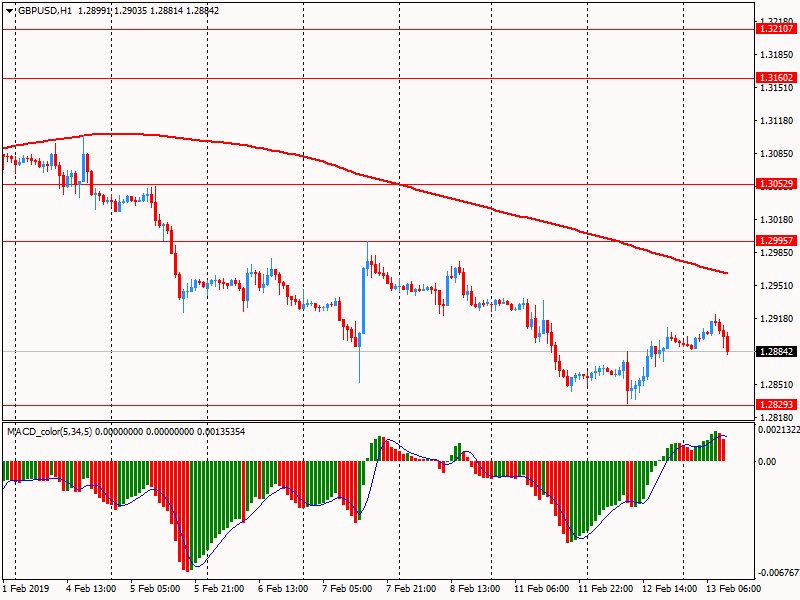
GBP / USD fell after the publication of data, updating the session low. Now GBP / USD is trading at $ 1.2884
China’s President Xi Jinping “is scheduled to meet” key members of the US trade talks delegation, including US trade representative Robert Lighthizer and US Treasury Secretary Steven Mnuchin, in Beijing on Friday, according to sources close to the matter
The "structural issue" of the United States' trade gap with China will reverse itself as the Chinese ramp up imports, Alibaba co-founder Joseph Tsai told CNBC.
The trade deficit will shrink once the Chinese government begins purchasing $40 trillion worth of goods as promised over the next 15 years, he said. Even though President Trump placed tariffs on imports in part to close the deficit, China's surplus topped $323 billion in 2018, the highest since 2006.
"With regards to the trade war, I would say this … if you look at the long term, the trade deficit itself will reverse," he said. "I talk about [the] 300 million middle-class consumers that will continue to buy more from all over the world."
China's economy is being powered by consumers, he said, and the Chinese middle-class consumer base could nearly triple by 2030.
President Mario Draghi ends his eight-year mandate in October and market players are anxious to know what direction the central bank will take when his tenure finishes. European officials have told CNBC that a French candidate is well placed to get the top job, but much depends on the upcoming European elections and the subsequent distribution of roles across the EU.
"In principle, (France) is well placed (to get the ECB presidency)," a European official with knowledge of the situation told.
The same official mentioned that France has more than one possible candidate and that Germany is more inclined to seek the presidency of the European Commission, the EU's executive arm, which also becomes available this year.
There are two possible French names circulating in European corridors: Benoit Coeure, who is a French economist and currently serves as a member of the executive board of the ECB; and Francois Villeroy de Galhau, who is France's current central bank governor. Both have said they would be keen to succeed Draghi, if asked
The 5-year bonds will start trading on secondary market on Feb 25
EU leaders don’t want extension of Brexit uncertainty
Need to watch out for side effects of easing policy
"It is my duty to continue persistently easing policy"
Overall financial system maintains stability
Companies are becoming less cautious over wages
Households are also becoming less cautious over prices
risks around rates are balanced
If growth does not pick up a rate cut may be required
exchange rate has been "remarkably well behaved in recent times"
open minded on capital requirement submissions
proposed bank capital levels well within norms
Inflation expectations are well anchored
we expect to keep the OCR at this level through 2019 and 2020.
employment is near its maximum sustainable level.
core consumer price inflation remains below our 2 percent target mid-point, necessitating continued supportive monetary policy.
sees annual CPI 1.7 pct by march 2020
keep cash rate expansionary for considerable period
risk of a sharper downturn in trading partner growth has heightened
upside and downside risks to inflation
despite the weaker global impetus, we expect low interest rates and government spending to support a pick-up in New Zealand’s GDP growth over 2019.
low interest rates, and continued employment growth, should support household spending and business investment.
government spending on infrastructure and housing also supports domestic demand.
we will keep the OCR at an expansionary level for a considerable period to contribute to maximising sustainable employment, and maintaining low and stable inflation.
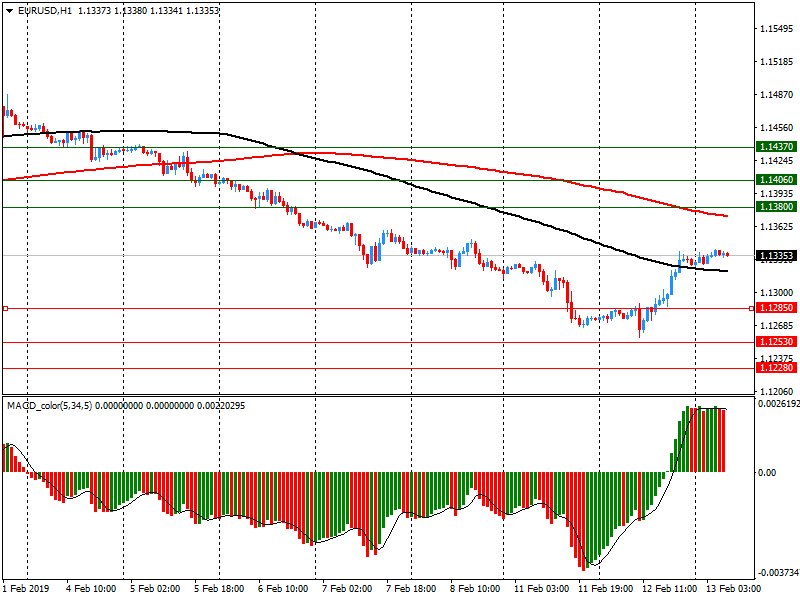
EUR/USD
Resistance levels (open interest**, contracts)
$1.1437 (3650)
$1.1406 (641)
$1.1380 (472)
Price at time of writing this review: $1.1335
Support levels (open interest**, contracts):
$1.1285 (1510)
$1.1253 (3096)
$1.1228 (5387)
Comments:
- Overall open interest on the CALL options and PUT options with the expiration date March, 8 is 91954 contracts (according to data from February, 12) with the maximum number of contracts with strike price $1,1700 (6197);
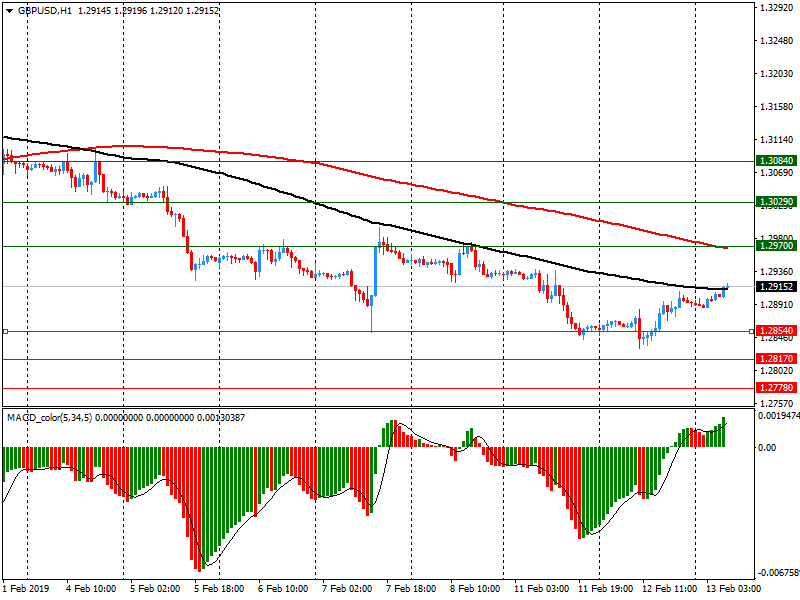
GBP/USD
Resistance levels (open interest**, contracts)
$1.3084 (3941)
$1.3029 (679)
$1.2970 (398)
Price at time of writing this review: $1.2915
Support levels (open interest**, contracts):
$1.2854 (653)
$1.2817 (1084)
$1.2778 (940)
Comments:
- Overall open interest on the CALL options with the expiration date March, 8 is 42256 contracts, with the maximum number of contracts with strike price $1,3200 (4743);
- Overall open interest on the PUT options with the expiration date March, 8 is 28968 contracts, with the maximum number of contracts with strike price $1,2400 (1903);
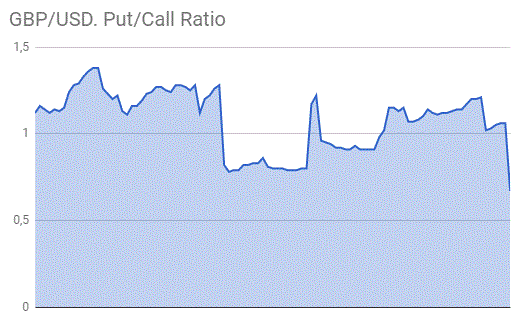
- The ratio of PUT/CALL was 0.69 versus 0.67 from the previous trading day according to data from February, 12
* - The Chicago Mercantile Exchange bulletin (CME) is used for the calculation.
** - Open interest takes into account the total number of option contracts that are open at the moment.
| Pare | Closed | Change, % |
|---|---|---|
| AUDUSD | 0.70948 | 0.48 |
| EURJPY | 125.134 | 0.56 |
| EURUSD | 1.13261 | 0.46 |
| GBPJPY | 142.452 | 0.37 |
| GBPUSD | 1.28935 | 0.27 |
| NZDUSD | 0.67361 | 0.08 |
| USDCAD | 1.32344 | -0.48 |
| USDCHF | 1.00617 | 0.22 |
| USDJPY | 110.475 | 0.1 |







© 2000-2026. All rights reserved.
This site is managed by Teletrade D.J. LLC 2351 LLC 2022 (Euro House, Richmond Hill Road, Kingstown, VC0100, St. Vincent and the Grenadines).
The information on this website is for informational purposes only and does not constitute any investment advice.
The company does not serve or provide services to customers who are residents of the US, Canada, Iran, The Democratic People's Republic of Korea, Yemen and FATF blacklisted countries.
Making transactions on financial markets with marginal financial instruments opens up wide possibilities and allows investors who are willing to take risks to earn high profits, carrying a potentially high risk of losses at the same time. Therefore you should responsibly approach the issue of choosing the appropriate investment strategy, taking the available resources into account, before starting trading.
Use of the information: full or partial use of materials from this website must always be referenced to TeleTrade as the source of information. Use of the materials on the Internet must be accompanied by a hyperlink to teletrade.org. Automatic import of materials and information from this website is prohibited.
Please contact our PR department if you have any questions or need assistance at pr@teletrade.global.


 Bank
Bank transfers


