- Analytics
- News and Tools
- Market News
Analytics, News, and Forecasts for CFD Markets: currency news — 23-02-2018.
The Consumer Price Index (CPI) rose 1.7% on a year-over-year basis in January, following a 1.9% increase in December. Excluding energy, the CPI increased 1.7%, matching the gain in December.
Prices were up in all eight major components in the 12 months to January, with the transportation (+3.2%) and shelter (+1.4%) indexes contributing the most to the gain.
Consumers paid 3.2% more for transportation in January, following a 4.9% increase in December. Growth in this index was moderated by the purchase of passenger vehicles index, which increased less on a year-over-year basis in January (+1.4%) than in December (+3.7%). Gasoline prices rose 7.8% in January, after a 12.2% gain in December.
Food prices were 2.3% higher in January on a year-over-year basis, after rising 2.0% in December. This gain, the largest year-over-year movement in the food index since April 2016, was led by higher prices for food purchased from restaurants, which were up 3.7% in January after increasing 2.9% in December. Year-over-year growth in the fresh vegetables (+9.0%) and fresh fruit (+2.8%) indexes intensified in January.
Euro area annual inflation rate was 1.3% in January 2018, down from 1.4% in December 2017. In January 2017, the rate was 1.8%. European Union annual inflation was 1.6% in January 2018, down from 1.7% in December 2017. A year earlier the rate was 1.7%. These figures come from Eurostat, the statistical office of the European Union.
The lowest annual rates were registered in Cyprus (-1.5%), Greece (0.2%) and Ireland (0.3%). The highest annual rates were recorded in Lithuania and Estonia (both 3.6%) and Romania (3.4%). Compared with December 2017, annual inflation fell in twenty-one Member States, remained stable in one and rose in six.
In January 2018, the highest contribution to the annual euro area inflation rate came from services (+0.56 percentage point), followed by food, alcohol & tobacco (+0.39 pp), energy (+0.22 pp) and non-energy industrial goods (+0.15 pp).
-
There will be some areas such as automotive where we can agree to align our regulations with the EU after brexit
EUR/USD
Resistance levels (open interest**, contracts)
$1.2407 (2552)
$1.2383 (1181)
$1.2352 (540)
Price at time of writing this review: $1.2293
Support levels (open interest**, contracts):
$1.2254 (2200)
$1.2225 (5684)
$1.2192 (3309)
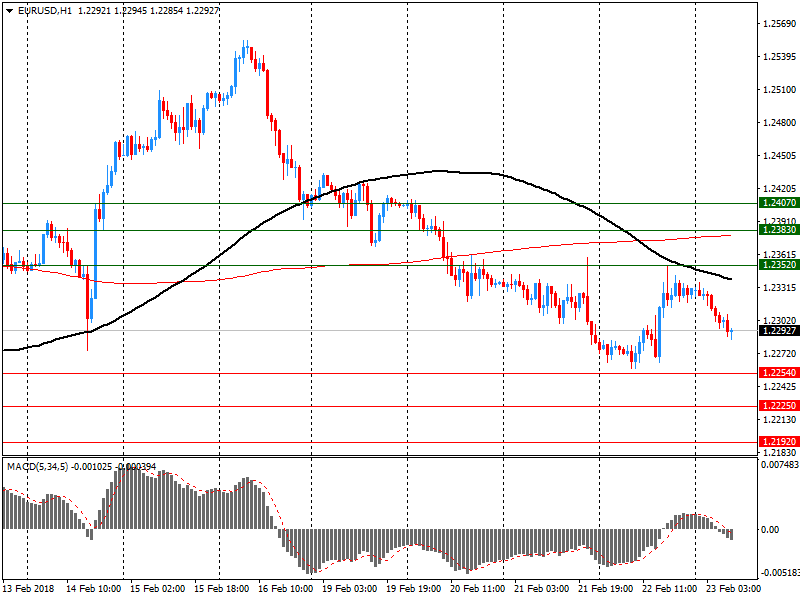
Comments:
- Overall open interest on the CALL options and PUT options with the expiration date March, 9 is 129184 contracts (according to data from February, 22) with the maximum number of contracts with strike price $1,2400 (6354);
GBP/USD
Resistance levels (open interest**, contracts)
$1.4093 (1859)
$1.4046 (3690)
$1.4014 (1335)
Price at time of writing this review: $1.3930
Support levels (open interest**, contracts):
$1.3876 (1794)
$1.3852 (714)
$1.3823 (2303)
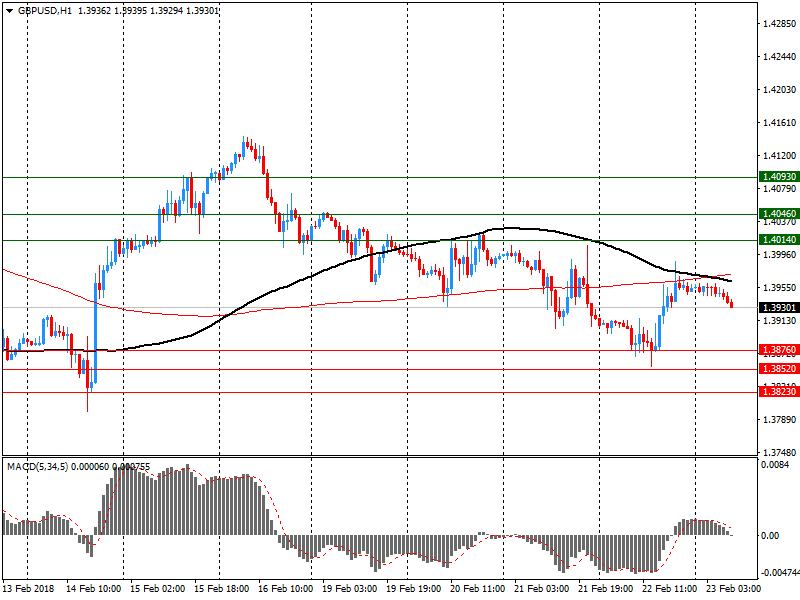
Comments:
- Overall open interest on the CALL options with the expiration date March, 9 is 49690 contracts, with the maximum number of contracts with strike price $1,3900 (3690);
- Overall open interest on the PUT options with the expiration date March, 9 is 46732 contracts, with the maximum number of contracts with strike price $1,3900 (2303);
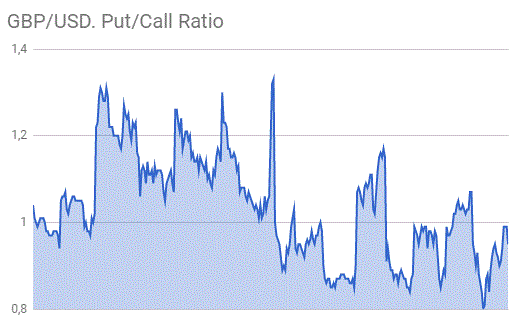
- The ratio of PUT/CALL was 0.94 versus 0.95 from the previous trading day according to data from February, 22
* - The Chicago Mercantile Exchange bulletin (CME) is used for the calculation.
** - Open interest takes into account the total number of option contracts that are open at the moment.
The German economy continued to grow at the end of 2017. As the Federal Statistical Office (Destatis), the gross domestic product (GDP) increased by 0.6% - upon price, seasonal and calendar adjustment - in the fourth quarter of 2017 compared with the previous quarter.
The economic situation in Germany in 2017 was characterised by steady and strong growth (+0.9% in the first quarter, +0.6% in the second quarter and +0.7% in the third quarter). For the whole year of 2017, this was an increase of 2.2% (calendar-adjusted: +2.5%), as reported by the Federal Statistical Office. The provisional annual GDP result released in January has thus been confirmed.
Overall nationwide consumer prices in Japan were up 1.4 percent on year in January, the Ministry of Internal Affairs and Communications said on Friday, cited by rttnews.
That exceeded forecasts for 1.3 percent and was up from 1.0 percent in December.
Core CPI, which excludes food prices, advanced an annual 0.9 percent - above expectations for 0.8 percent and unchanged from the previous month.
On a monthly basis, overall inflation added 0.4 percent and core CPI gained 0.2 percent.







© 2000-2026. All rights reserved.
This site is managed by Teletrade D.J. LLC 2351 LLC 2022 (Euro House, Richmond Hill Road, Kingstown, VC0100, St. Vincent and the Grenadines).
The information on this website is for informational purposes only and does not constitute any investment advice.
The company does not serve or provide services to customers who are residents of the US, Canada, Iran, The Democratic People's Republic of Korea, Yemen and FATF blacklisted countries.
Making transactions on financial markets with marginal financial instruments opens up wide possibilities and allows investors who are willing to take risks to earn high profits, carrying a potentially high risk of losses at the same time. Therefore you should responsibly approach the issue of choosing the appropriate investment strategy, taking the available resources into account, before starting trading.
Use of the information: full or partial use of materials from this website must always be referenced to TeleTrade as the source of information. Use of the materials on the Internet must be accompanied by a hyperlink to teletrade.org. Automatic import of materials and information from this website is prohibited.
Please contact our PR department if you have any questions or need assistance at pr@teletrade.global.


 Bank
Bank transfers


