- Analytics
- News and Tools
- Market News
CFD Markets News and Forecasts — 05-07-2022
- AUD/JPY remains pressured after reversing from monthly resistance line.
- Bearish MACD signals, downbeat RSI adds strength to the downside bias.
- 100-day EMA act as additional support, bulls need validation from April’s peak.
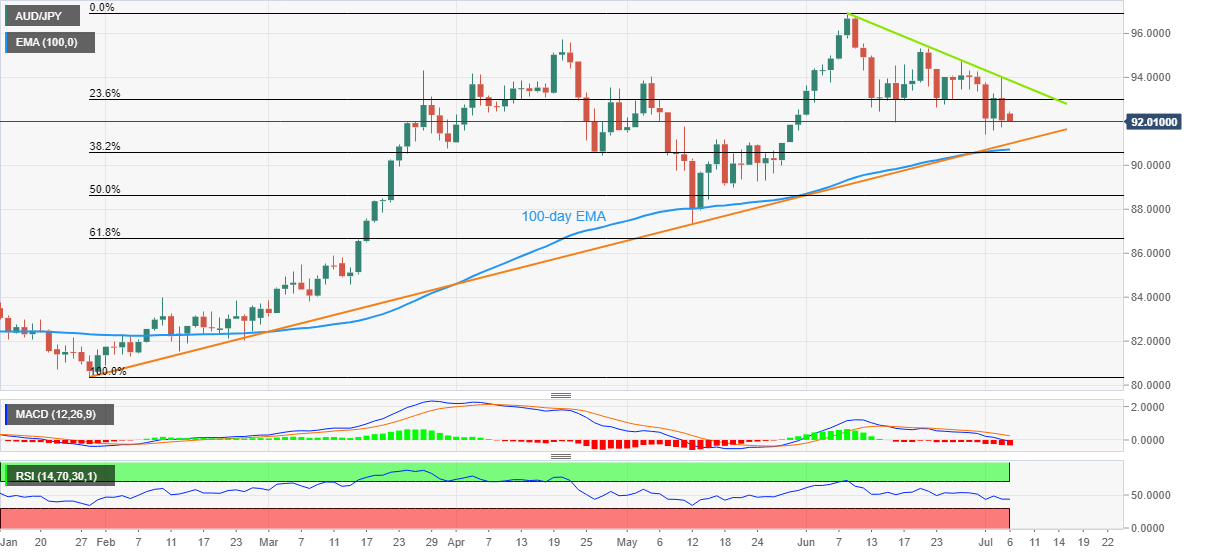
AUD/JPY remains on the back foot at around 92.00 as sellers keep the previous day’s U-turn from the monthly resistance line during Wednesday’s sluggish Asian session.
In addition to the pullback from the key resistance line, bearish MACD signals and the downward sloping RSI (14), not oversold, also favor sellers to expect further downside.
However, an upward sloping support line from January 28 and the 100-day EMA, respectively near 91.00 and 90.70, could challenge the AUD/USD bears.
In a case where AUD/JPY drops below 90.70, the 90.00 threshold may probe the sellers before directing them to May’s low of 87.30.
On the flip side, recovery remains elusive until the quote stays below the one-month-old descending resistance line, around 93.85 at the latest.
Even so, the late June swing low and April’s high, respectively near 95.30 and 95.75 in that order, could challenge the AUD/JPY bulls before questioning the yearly high of 96.88.
Overall, AUD/JPY remains pressured towards the key support with limited downside expected. However, sour sentiment and recession fears can drown the risk-barometer pair.
AUD/JPY: Daily chart
Trend: Further downside expected
US inflation expectations, as per the 10-year breakeven inflation rate per the St. Louis Federal Reserve (FRED) data, drop to the lowest levels since September 2021 by the end of Tuesday’s North American session. That said, the inflation gauge recently flashed the 2.30% mark, reversing the previous rebound from the yearly low of 2.33%.
The recently downbeat inflation expectations don’t rule out the inflation fears as the inversion of the 2-year and 10-year Treasury yield curve appears to hint at the global economic slowdown.
That said, Germany’s energy crisis, Italy’s drought and the Bank of England’s grim economic outlook, not to forget the strong prints of the US Factory Orders for May, were the latest catalysts that propelled the economic woes.
Amid these plays, US Dollar Index (DXY) jumped to the highest levels in two years while equities dropped, before a mild recovery, whereas the US Treasury yields refreshed one-month low while inverting the yield curve between the two-year and 10-year coupons. The S&P 500 Futures, however, struggle for clear directions of late.
Moving on, the Federal Open Market Committee (FOMC) Minutes and the US ISM Services PMI for June will be crucial for short-term market directions.
Also read: US 2s-10s Treasury Yield curve inverts, as recession fears build up
- GBP/JPY may deliver more losses on slippage below 161.50 on negative market sentiment.
- The pound bulls have faced significant offers on political instability in the UK economy.
- The inflation outlook in Tokyo may accelerate on a broad-based decline in yen.
The GBP/JPY pair is carry-forwarding the downside bias of Tuesday and is expected to extend losses after violating Tuesday’s low at 161.59. The cross has given a downside break of the minor consolidation formed in a narrow range of 161.27-161.46 in the early hour of Tokyo.
On Tuesday, the pound bears tested their two-day low at 161.57 after the warning commentary from the Bank of England (BOE). The statement from the Bank of England (BOE) that the outlook for the global economy has deteriorated materially and that volatility in the energy and raw materials cost is hinting at significant risk of disruption, which could amplify economic shocks in the future as per ANZ Research, spooked the market sentiment.
This has escalated the recession fears in the global economy and stagflation fears in the UK economy as their inflation rate has climbed above 9%. This has underpinned the risk-off impulse in the global market. Adding to that, market participants punished the sterling bulls on signs of political instability in their economy. The vice-chair of the UK Conservative Party, Bim Afolami, resigned and calls for PM Boris Johnson to stand down. The event has added severe volatility to the asset.
On the Tokyo front, rising expectations for higher price pressures have infused fresh blood in the yen bulls. Seisaku Kameda, a former chief economist at the Bank of Japan (BOJ) said that the sharp decline in yen on a broader note will lift the inflation outlook and it may remain well above 2% this year.
- The EUR/JPY extends its losses during the week by 1.37%.
- EU recession fears and risk aversion are a headwind for the EUR/JPY.
- EUR/JPY Tuesday’s price action opened the door for a corrective pullback towards 140.60s before resuming downwards.
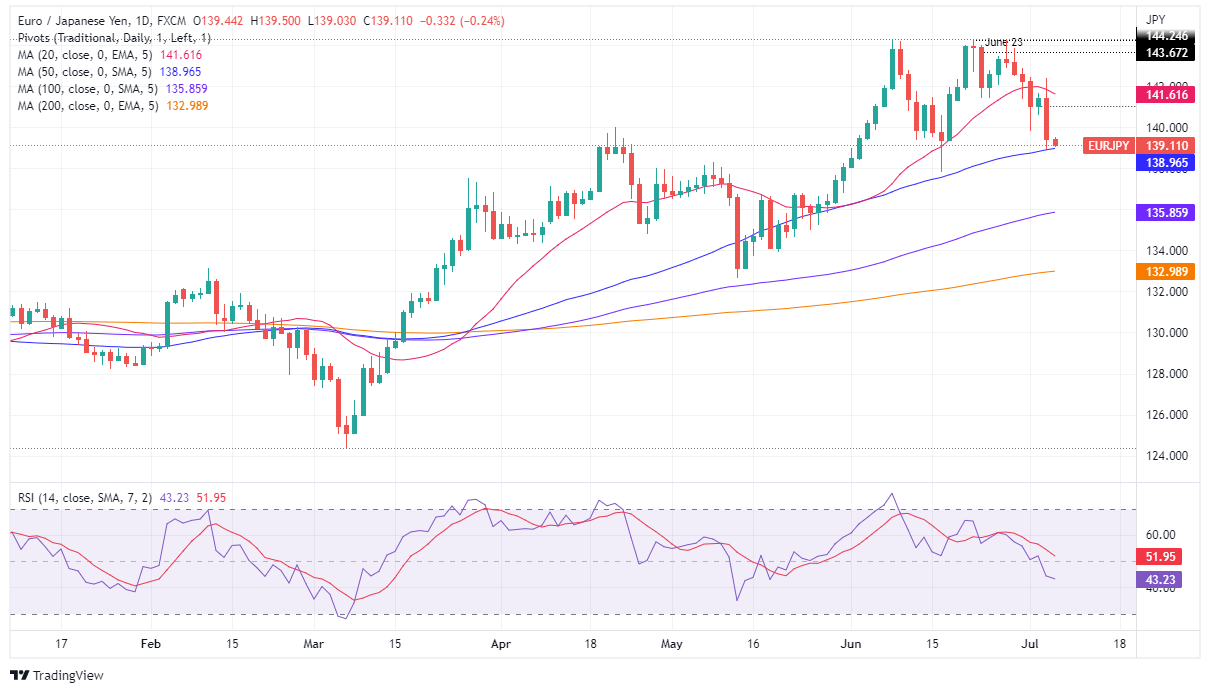
The EUR/JPY refreshes three-week lows below the 139.00 mark, for the first time since June 16, amidst a mixed market mood, which later progressed as US equities erased earlier losses. At the time of writing, the EUR/JPY is trading at 139.11.
EU recession fears, a headwind for the EUR/JPY
Futures of Asian stocks prepare to open mixed, carrying on Wall Street’s mood. Fears of a worldwide recession amidst inflation at around 40-year high levels spurred a flight to safety. Safe-haven peers, like the Japanese yen, got bolstered by the previously mentioned. Contrarily a gloomy economic outlook in the EU was a headwind for the EUR/JPY.
The EUR/JPY, Tuesday open, was near the Monday highs, followed by a rally towards the 200-H1 simple moving average (SMA) at around 142.35. However, once the cross approached that price level, sellers stepped in and sent the EUR/JPY nosediving towards the daily low around 138.94, reached late in the North American session.
EUR/JPY Daily chart
On the Monday analysis, I wrote that “EUR/JPY traders should note that albeit a bullish harami has formed, sellers begin to mount around 142.00, which might send the cross-currency pair tumbling toward the July 1 low at 139.80.” During the Tuesday session, the EUR/JPY achieved the target mentioned previously as sellers piled around the 200-H1 SMA, sending the pair tumbling beyond the July 1 low. Nevertheless, the magnitude of the fall opened the door for a corrective pullback, at least a 50% retracement towards 140.65, before resuming the ongoing downtrend.
If that scenario plays out, the EUR/JPY first support would be 140.00. The break below will expose the 50-day EMA at 138.96, followed by the June 16 daily low at around 137.83.
EUR/JPY Key Technical Levels
- WTI holds onto the corrective pullback from the lowest levels since late April.
- Bears take a breather after a volatile day, fears of economic slowdown drowned commodities.
- OPEC’s Barkindo failed to impress buyers amid market pessimism.
- Weekly API inventories, Fed Minutes and US ISM Services PMI will be important to watch for clear directions.
WTI crude oil picks up bids to $99.00 as it pares the biggest daily loss since March during Wednesday’s Asian session. The black gold dropped the most in many ways while refreshing the three-month low as recession fears outweighed supply-crunch concerns.
Growing fears of global recession joined speculations that China may recall covid-led lockdowns to drown the energy benchmark the previous day. The pessimism intensified after policymakers from the major central banks signaled further hardships for the global economy. On the same line was China’s mass covid testing announcement.
The bearish bias failed to cheer news that the US is up for removing the Trump-era tariffs on China, as well as comments from the Secretary-General of the Organization of the Petroleum Exporting Countries (OPEC). OPEC Secretary-General Mohammad Barkindo said on Tuesday that the energy sector is facing huge challenges on multiple fronts. "Refining capacity in OECD countries declined by 3.3% globally in 2021," added OPEC’s Barkindo per Reuters.
It should be noted that the news conveying an end to the Norwegian oil and gas workers’ strike and hopes of further oil output from Venezuela and Iran also exert downside pressure on the quote.
That said, the US dollar’s strength and the downbeat risk profile were the main catalysts behind the WTI’s biggest slump in many days. US Dollar Index (DXY) jumped to the highest levels in two years while equities dropped, before a mild recovery, whereas the US Treasury yields refreshed one-month low while inverting the yield curve between the two-year and 10-year coupons.
Looking forward, the Federal Open Market Committee (FOMC) Minutes and the US ISM Services PMI for June will be important for fresh impulse. Further, API Weekly Crude Oil Stock for the week ended on July 01, prior -3.799M, will also be crucial to follow.
Technical analysis
A clear downside break of an upward sloping trend line from February 18, around $101.30 by the press time, keeps WTI bears hopeful of witnessing further declines.
- Gold price is establishing below $1,770.00 as soaring recession fears underpinned the DXY.
- The BOE noted that volatility in the oil and raw material prices may amplify economic shocks in the future.
- Going forward, the release of the FOMC minutes will provide further direction in the gold prices.
Gold price (XAU/USD) has turned sideways after displaying a vertical downside move. The precious metal is displaying back and forth moves in a narrow range of $1,763.90-1,771.37 in early Tokyo. The asset witnessed a steep fall after the market participants channelize their liquidity into the US dollar index (DXY) amid soaring recession fears.
The statement from the Bank of England (BOE) that the outlook for the global economy has deteriorated materially and that volatility in the energy and raw materials cost is hinting for a significant risk of disruption, which could amplify economic shocks in the future as per ANZ Research.
The gold prices closed below the psychological support of $1,800.00 for the first time in the past five months and plunged to a fresh six-month low at $1,763.93. The follow-up oscillating seems lucrative for the gold bears and more downside in the counter is on the cards.
In today’s session, the release of the Federal Open Market Committee (FOMC) minutes will remain in focus. June’s monetary policy minutes will provide a detailed viewpoint of Federal Reserve (Fed) policymakers on supporting the 75 basis points (bps) interest rate hike by the Fed.
Gold technical analysis
On a daily scale, the gold prices accelerated their losses after violating the horizontal support line placed from January’s low at $1,782.68. The 20-period Exponential Moving Average (EMA) at $1,817.42 is acting as a major barricade for the counter. Meanwhile, the Relative Strength Index (RSI) has slipped below 40.00 and is indicating more downside ahead. The momentum oscillator is not displaying any signs of divergence and an oversold situation. Therefore, more downside cannot be ruled out.
Gold daily chart

- USD/CHF consolidates the biggest daily gains in three week around a fortnight top.
- Impending bull cross on MACD, sustained trading beyond 100-DMA favor buyers.
- 50-DMA, 38.2% Fibonacci Retracement appears important nearby hurdle to watch.
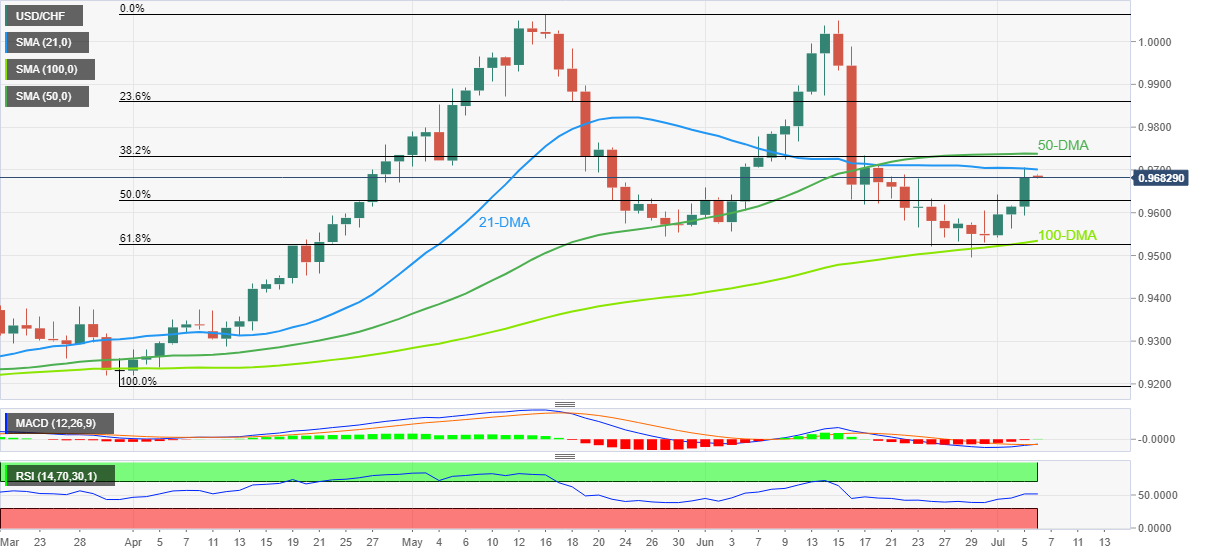
USD/CHF eases from a fortnight high as buyers take a breather around 0.9680, after rising the most in three weeks, during Wednesday’s Asian session. In doing so, the Swiss currency (CHF) pair prints the first intraday loss in four while reversing from the 21-DMA.
Despite the U-turn from the 21-DMA resistance of 0.9700, the USD/CHF remains on the bull’s radar due to the looming bullish signals on the MACD, as well as firmer RSI (14).
Also keeping USD/CHF buyers hopeful is the pair’s successful rebound from the 100-DMA and the 61.8% Fibonacci retracement (Fibo.) of March-May upside.
That said, the quote’s upside break of the 0.9700 DMA resistance isn’t an open invitation to the bulls as a convergence of the 50-DMA and the 38.2% Fibo highlights 0.9740 as an important hurdle for the buyers to cross.
Following that, a run-up towards the 23.6% Fibonacci retracement and the yearly high, respectively near 0.9860 and 1.0065, can’t be ruled out.
Alternatively, pullback moves may revisit the 50% Fibonacci retracement level surrounding 0.9630.
However, the 100-DMA and the 61.8% gold ratio, near 0.9530, appear crucial for the USD/CHF bears to watch to retake control.
USD/CHF: Daily chart
Trend: Further upside expected
- GBP/USD lacks momentum near the lowest levels since March 2020, pares the biggest daily loss in three weeks.
- British Health Secretary Sajid Javid, Finance Minister Rishi Sunak and Vice-Chair of Conservative Party Bim Afolami resigned.
- UK PM Johnson refrains from leaving and eyes to building new cabinet, recession fears also strengthen bearish bias.
- Risk catalysts will be important to watch, Fed Minutes, US ISM Services PMI and BOE speak to decorate calendar.
GBP/USD surprises traders by paying little heed to the severe political plays at Downing Street, after refreshing the two-year low on recession woes, during Wednesday’s initial Asian session. That said, the Cable pair seesaws around 1.1960 by keeping the latest rebound from the 28-month low of 1.1898.
UK PM Boris Johnson had a tough Tuesday as senior members of his cabinet, as well as the Tory Party, resigned after he decided to keep former Conservative party whip Chris Pincher in his post after sexual misconduct allegations were made against him. The British Leader, however, regretted his decision and took steps but it was too late. Even so, UK PM Johnson remained determined to keep his post and form the new cabinet.
Among the key resignations were British Health Secretary Sajid Javid, Finance Minister Rishi Sunak and Vice-Chair of Conservative Party Bim Afolami. It’s worth noting that multiple politicians are standing in the line to leave the boat as it appears sinking.
Elsewhere, the recession fears were in the talks and joined the firmer US Factory Orders for May, to 1.6% MoM versus 0.5% expected, to propel the US Dollar Index (DXY) to the highest levels in two years.
It’s worth noting that Germany’s energy crisis, Italy’s drought and the Bank of England’s grim economic outlook are the key catalysts that drowned the GBP/USD prices earlier, before the latest corrective pullback. On the same line could be hopes of an end to the British pessimism after the dissolution of the current cabinet, which is more likely soon.
Against this backdrop, the equities dropped, before a mild recovery, whereas the US Treasury yields refreshed one-month low while inverting the yield curve between the two-year and 10-year coupons.
Given the popularity of the political plays in the UK, GBP/USD traders should pay attention to the political news for fresh impulse. Also important will be the Federal Open Market Committee (FOMC) Minutes and the US ISM Services PMI for June.
Technical analysis
GBP/USD rebound hinges on its ability to confirm the short-term falling wedge bullish chart pattern, by crossing the 1.2200 hurdle. Until then, the quote is vulnerable to refreshing multi-month low under 1.2000.
- The greenback bulls have faced correction after testing a three-week high at 1.3080.
- Advancing 20- and 50-period EMAs add to the upside filters.
- The RSI (14) is oscillating in a bullish range of 60.00-80.00 which indicates more upside ahead.
The USD/CAD pair is going through a correction phase after displaying a perpendicular upside move from Tuesday’s low at 1.2844. The asset extended its recovery on Tuesday after overstepping the critical hurdle of 1.2965.
On an hourly scale, the asset has faced barricades while surpassing its three-week high at 1.3080. A violation of an old resistance fetches a reversal in the counter. However, the upside remains favored as the upside move towards 1.3080 was extremely firmer. Going forward, the corrective move may turn into a bullish impulsive wave.
The 20- and 50-period Exponential Moving Averages (EMAs) at 1.2990 and 1.2938 respectively are scaling higher, which adds to the upside filters.
Meanwhile, the Relative Strength Index (RSI) (14) is oscillating in a bullish range of 60.00-80.00, which indicates more upside ahead. A minor correction has been witnessed in the greenback bulls after the momentum oscillator turned overbought. The overall trend is still bulls and the RSI (14) may find support around 60.00.
Should the asset surpass the three-week high at 1.3080 decisively, the greenback bulls will drive the asset towards the round-level resistance and 4 November 2020 at 1.3200 and 1.3300 respectively.
Alternatively, the loonie bulls could regain control if the asset drops below the critical support of the June 28 low at 1.2819. This will drag the asset towards June 9 high at 1.2705, followed by June 6 high at 1.2619.
USD/CAD hourly chart
-637926574377866888.png)
- Silver prices plunged more than 3.76% on Tuesday as the greenback rose to a new twenty-year high.
- Recession fears and high inflation re-ignited nervousness around the financial markets.
- Silver Price Forecast (XAGUSD): The break below the 200-week SMA paved the way for a fall towards June’s 2020 lows just below $17.00.
Silver (XAGUSD) plummets as the New York session winds down after a risk-off impulse spurred safe-haven flows toward the greenback, which is having its best single-trading gain since March 19, 2020, when it rallied 2%. At $19.27, XAGUSD is trading just $0.10 above the YTD low, down 3.76%.
The market sentiment is mixed, as US equities pared earlier losses late in the North American session. Slower growth in the Euro area, alongside the deceleration of the US economy, stoked recession fears worldwide. Additionally, soaring energy prices in the EU and Russia threatening to halt natural gas flows to Europe kept investors nervous, who shifted toward safe-haven assets as a reaction to that.
During the Asian session, newswires reported that US President Joe Biden might roll back some tariffs imposed on Chines imports as they struggle to help alleviate inflation/recession worries.
In the meantime, the US Dollar Index is up by 1.28%, at 160.507. Contrarily, the US 10-year Treasury yield plunged eleven basis points, finishing the New York session at 2.818%.
During the US session, May’s Factory Orders rose by 1.6% MoM, more than the 0.5% expected. In the same report, orders excluding Transports jumped by 1.7%.
Later in the week, the US economic docket will feature FOMC meeting minutes alongside ISM Non-Manufacturing Indices, and some Fed speakers will cross the wires.
Silver Price Forecast (XAGUSD): Technical outlook
The XAGUSD’s weekly chart illustrates the pair as bearish biased. The last week’s silver price broke below the 200-week simple moving average (SMA), exposing the white metal to further selling pressure. Also, oscillators are still in negative territory but with some room to spare before entering the oversold area.
Therefore, XAGUSD’s first support would be $19.00. Break below will expose $18.94, followed by June’s 2020 lows around $16.95.
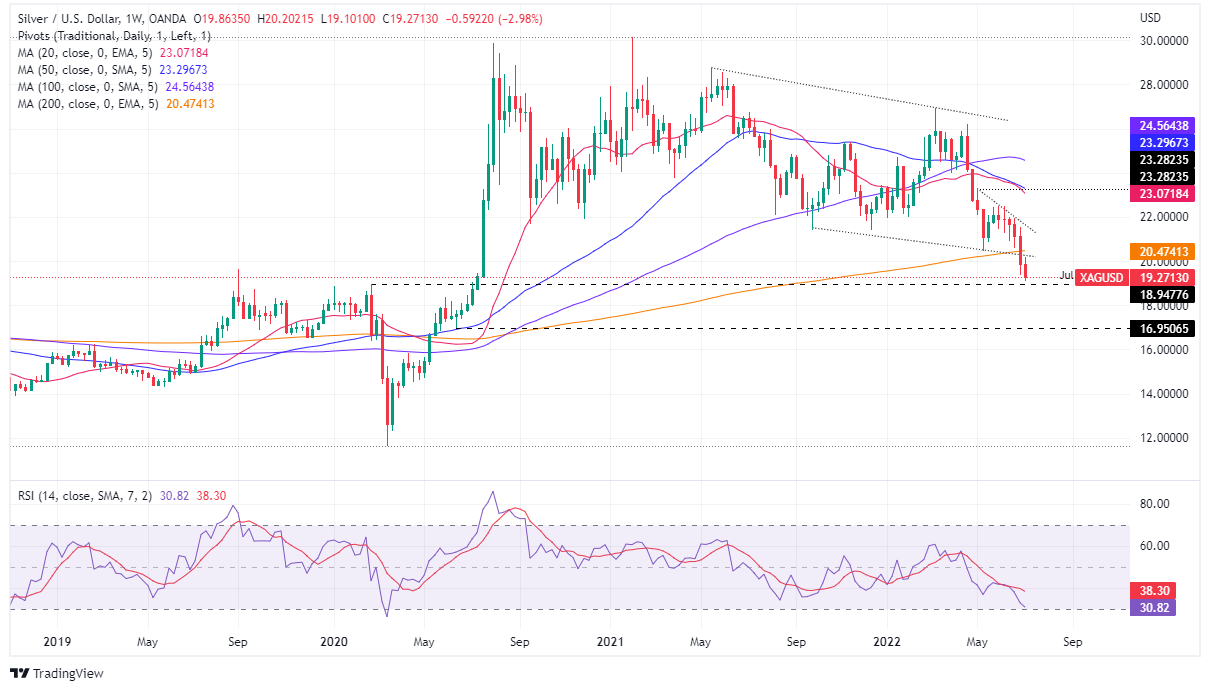
XAGUSD Key Technical Levels
- EUR/USD bears take a breather around the lowest levels since December 2020 after the biggest daily slump in 28 months.
- Recession fears joined upbeat US data to offer warm welcome to the USD after a long weekend.
- Yields dropped to five-week low, equities dwindled as well.
- EU Commission’s economic forecasts, Eurozone Retail Sales are extra catalysts to watch for fresh impulse.
EUR/USD moves stabilize near the lowest levels in two decades after falling the most since March 2020, as bears await fresh clues to extend the fierce south-run. In addition to the anxiety ahead of the key data/events, the initial hours of the Asian trading session also restrict the pair’s moves around 1.0370-60 on Wednesday.
Be it Germany’s energy crisis or Italy’s drought, not forgetting the bank of England’s grim economic outlook, everything contributed to the pessimism surrounding the economic conditions in the old continent. Adding to the downside pressure was the hawkish bias of the European Central Bank (ECB) policymakers, which in turn suggested aggressive central bank action and further strain on the bloc.
While the EUR struggled due to the economic fears, the US dollar was equally cheering the same as the US Dollar Index (DXY) rallied to the highest levels in two years as the US traders returned from the long weekend. In addition to the rush for risk safety, the DXY also benefited from the better-than-forecast US Factory Orders for May, to 1.6% MoM versus 0.5% expected and upwardly revised 0.7% previous readings.
On the other hand, an improvement in the final readings of the Eurozone’s S&P Global PMIs couldn’t help the bloc’s currency as German Economy Minister Robert Habeck hints at more pain due to the energy crisis. Further, the German Retail Association also blamed rising inflation and energy costs and poor consumer sentiment for the outlook.
Amid these plays, the equities dropped, before a mild recovery, whereas the US Treasury yields refreshed one-month low while inverting the yield curve between the two-year and 10-year coupons.
Moving on, European Commission’s economic forecasts and Eurozone Retail Sales for May will offer immediate directions ahead of the Federal Open Market Committee (FOMC) Minutes and the US ISM Services PMI for June.
Also read: FOMC June Minutes Preview: Opportunity for dollar correction?
Technical analysis
A clear downside break of the horizontal area comprising the yearly low, around 1.0360-50, keeps EUR/USD bears hopeful of extending the south-run towards the 1.0000 psychological magnet.
- AUD/USD is expected to turn sideways after a rebound from 0.6762.
- Investors are on the sidelines ahead of the release of the Fed minutes.
- The aussie bulls failed to capitalize on a 50 bps rate hike by the RBA.
The AUD/USD pair displayed a responsive buying action after hitting a low of 0.6762 in the late New York session. The responsive buying action came after the aussie bears re-tested the weekly lows at 0.6764, recorded on July 1. Usually, this kind of action results in a sideways move or a mild correction in the counter. Therefore, the asset will keep auctioning around 0.6800 ahead.
Also, the forward release of the Federal Open Market Committee (FOMC) minutes will keep investors on the sidelines. The release of the FOMC minutes will provide a detailed clarification on the prior rate hike announcement by the Federal Reserve (Fed). Fed chair Jerome Powell in June monetary policy announced a rate hike by 75 basis points (bps).
Adding to the clarification on the rate hike announcement, the FOMC minutes will dictate the economic indicators to understand the growth prospects of the US economy.
On the aussie front, the aussie bulls failed to capitalize on the 50 bps rate hike announcement by the Reserve Bank of Australia (RBA) on Tuesday. RBA Governor Philip Lowe elevated the Official Cash Rate (OCR) to 1.35%. No doubt, the RBA is aggressively working on containing its price pressures, which were recorded at 5.1% in the first quarter of CY2022. This is the consecutive 50 bps rate hike announcement by the RBA.
- NZD/USD bears are moving in following a firm recovery rally.
- The US dollar will be a focus and US events could be the catalyst.
At 0.6797, NZD/USD has recovered from New York session lows near 0.6762 following a drop in the US dollar that came as embattled Us stocks bounced back to life later in the day on Wall Street.
The turn-around on Tuesday followed a three-day holiday weekend after last Friday's sharp rally, as investors waited for economic data due later this week. Nevertheless, the US bulls could be treading carefully in the wake of the greenback's surge to fresh bull cycle highs that marked up 106.79 in the DXY.
''Once again it was global recession fears at work, with the consequent safe-haven demand favouring the USD as oil prices and bond yields both retreated lower,'' analysts at ANZ Bank argued. ''Looking ahead, it is difficult to see FX markets shifting from current USD-centric perspectives ahead of yet more key US data between now and Saturday morning. Technically, the Kiwi’s collapse overnight looks ominous; some caution is required.''
Meanwhile, non-local events are going to be the driver for the antipodeans. US Nonfarm Payrolls is expected to show that Employment likely continued to advance firmly in June but at a more moderate pace after three consecutive job gains of around 400k in March-May, analysts at TD Securities said.
Minutes of the Federal Reserve's June meeting will also be eyed. ''Persistent high CPI inflation and nascent signs of de-anchoring inflation expectations forced the Fed to amp the pace of rate tightening. The meeting minutes are likely to offer further colour around the Fed's more hawkish reaction function,'' the analysts at TD Securities said.
NZD/USD technical analysis
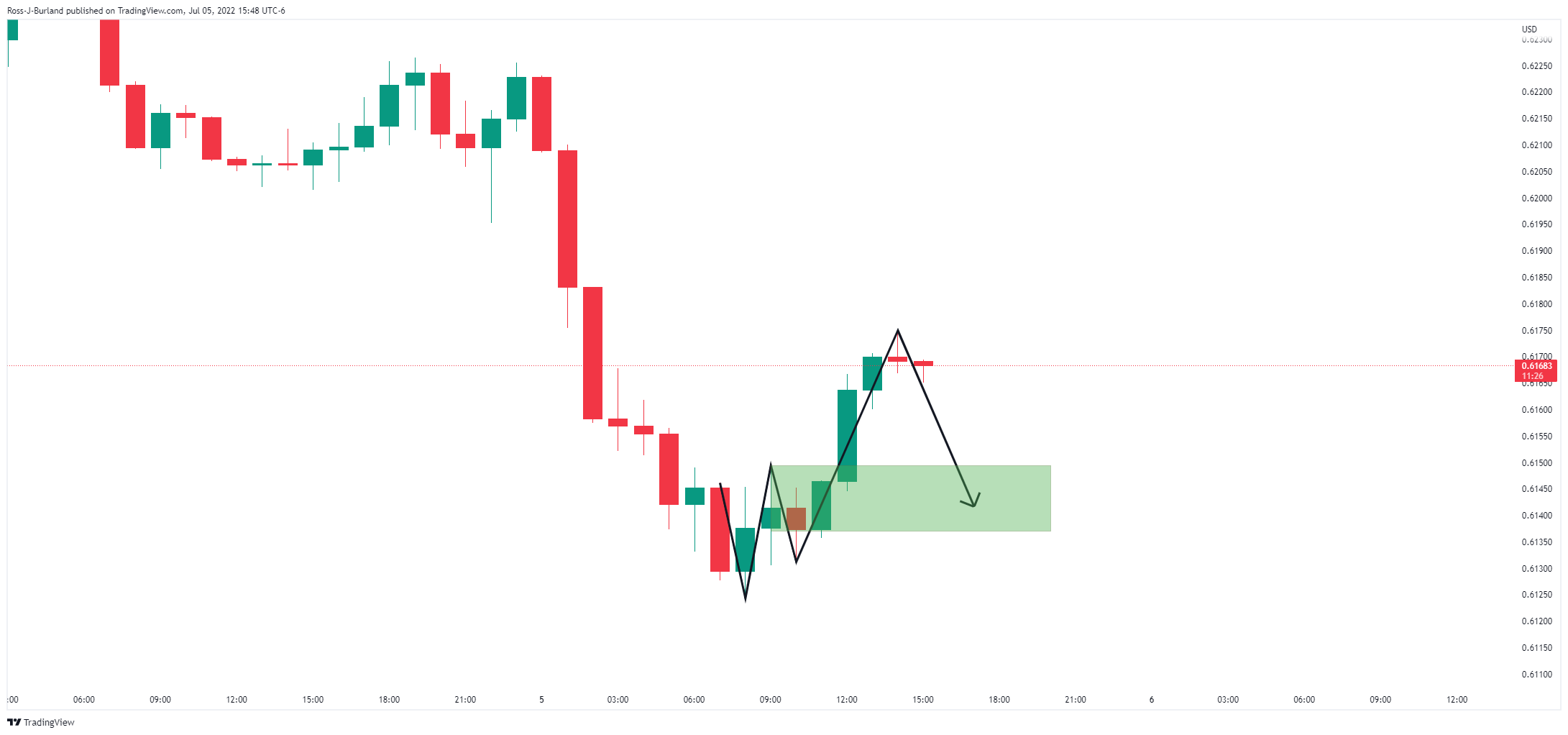
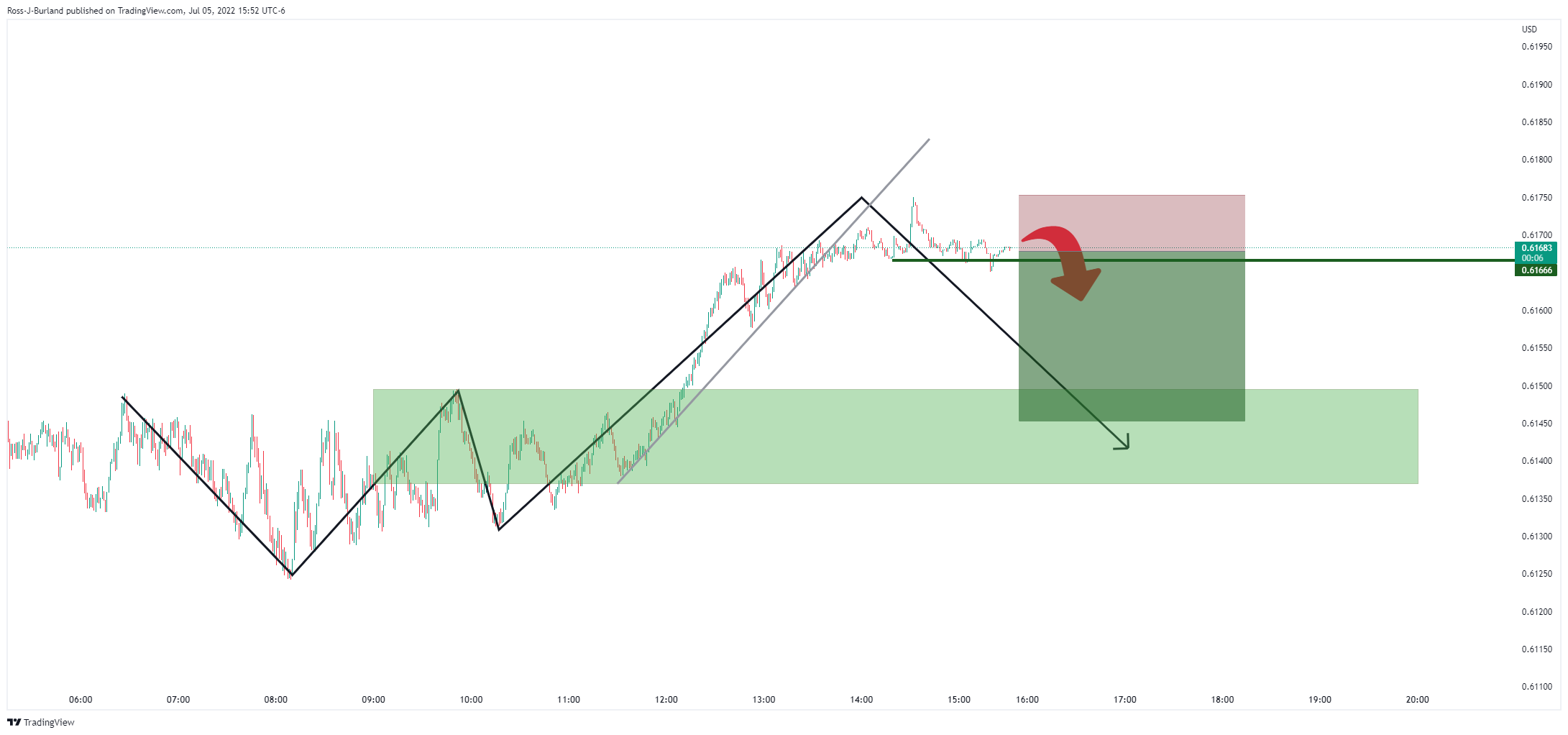
The W-formation is a compelling feature of the hourly chart that could be regarded as a reversion opportunity for days traders that might wish to approach the pattern from a lower time frame such as the 1-min chart as follows:
- Gold is pressured below a key monthly trendline and continues to bleed out.
- A sustained downtrend could form in gold should the large CTA selling program catalyze a breakdown in price, bank analysts argue.
At $1,767, the price of gold is down on the day by some 2.2% after falling from a high of $1,812.19 to a low of $1,763.92 so far. The precious metal has been under water for the start of July due to a rebound in the US dollar and has collapsed to the lowest levels since early December while the greenback takes off to a fresh 20-year high.
Global equities have been under pressure due to recessionary fears that have dominated the markets this month so far. European exchanges weakened which has weighed on stocks on Wall Street supporting the bid in the greenback and offers in gold. However, bond yields have moderated which could be a lifeline for the gold bugs since gold offers no interest. The US 10-year note was last seen paying 2.82%, down 3.45% on the day so far.
''Gold is being weighed down by substantial CTA trend followers, analysts at TD Securities explained. ''The margin of safety is razor-thin,'' the analysts added.
''A sustained downtrend could form in gold should the large CTA selling program catalyzes a breakdown in prices. After all, as central banks face a credibility crisis, they could remain committed to their battle against inflation and keep rates elevated for longer than recession odds would otherwise imply,'' the analysts argue.
''The massive amount of speculative length from proprietary traders in the yellow metal also appears complacent, given that this length was accumulated as early as 2020. The bias remains to the downside in gold.''
Gold technical analysis
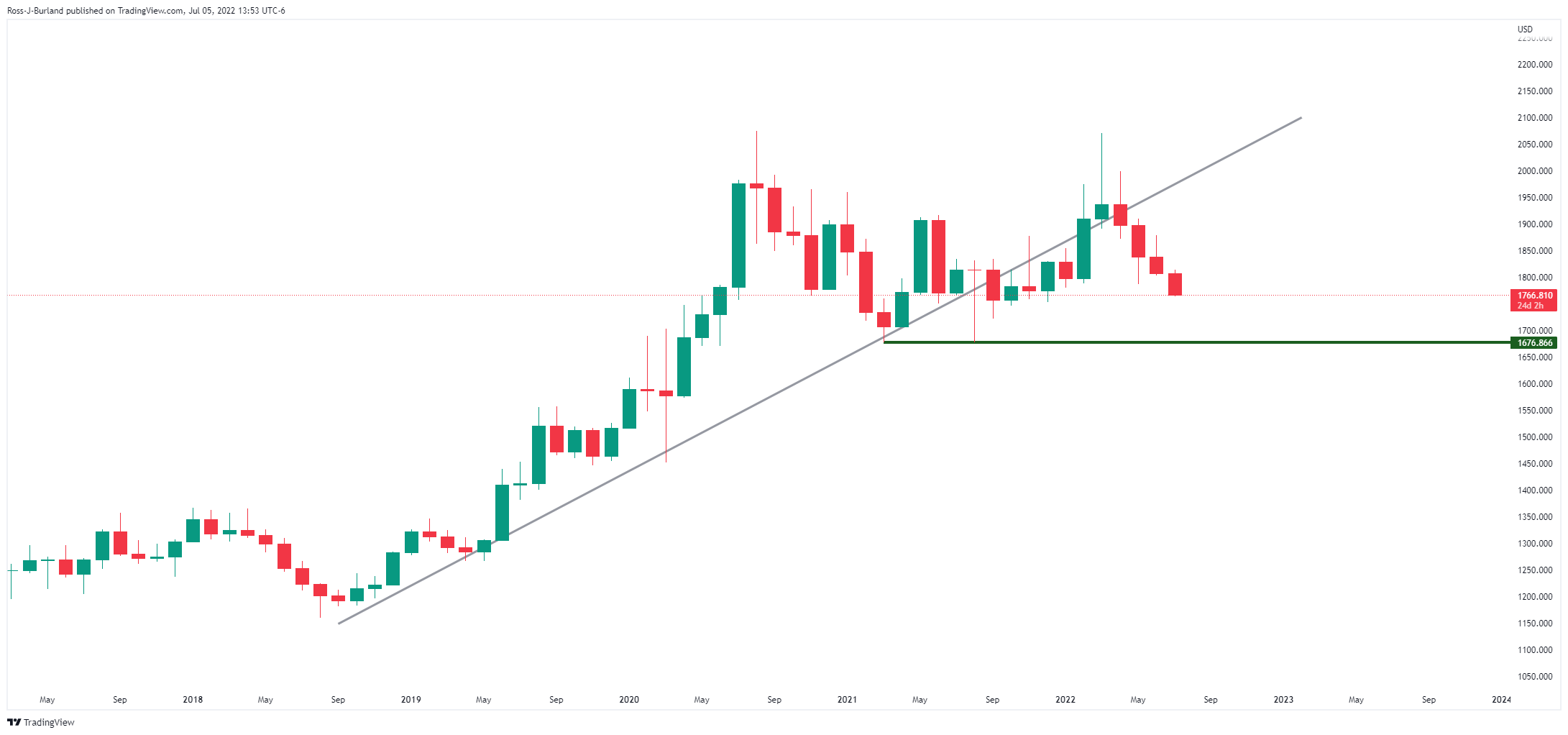
The price of the precious metal is trading below the rising supporting trendline on the monthly time frame but the critical fractal lows are located at $1,676.
- US Treasury yields plunged on Tuesday on what is seen as a “recession trade” by financial analysts.
- The US Q1 GDP on its final reading contracted by -1.6%.
- The US Federal Reserve Chair Jerome Powell committed to bringing inflation downs, even if the US economy slows down.
Fears of recession and elevated prices sent US Treasury bond yields nosediving, inverting the US 2s-10s yield curve, one of the most popular “leading indicators” of a recession, sitting at -0.006%, on Tuesday amidst a hopeless market sentiment as reflected by US equities registering losses between 0.28% and 0.91%. At the time of writing, the US 2-year Treasury bill rate sits at 2.822%, six basis points higher than the US 10-year Treasury note, which yields 2.816%.
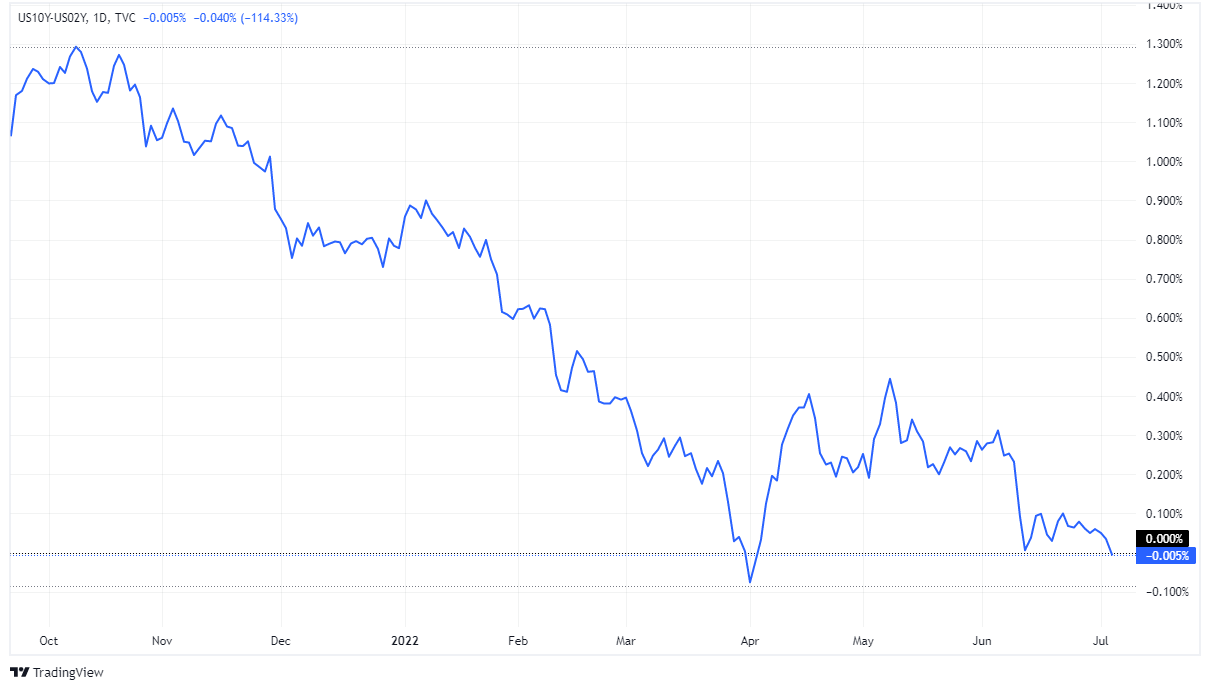
Given that the US inflation has remained stubbornly higher at around 8.6%, the US Federal Reserve hiked rates by 150 bps since March 2022. That has been felt in the economy, as the US Q1 final GDP dropped by -1.6%, while also showing that consumer spending has softened and inventories remained higher than reported in May.
Meanwhile, US Fed chair Jerome Powell acknowledged that growth risks are skewed to the downside. Last Wednesday, he said that the Fed would not let the economy get into a “higher inflation regime,” even if it puts growth at risk. He reiterated that while “there is a risk” that the Fed might get the US economy into a recession, he pledged that its biggest commitment is to “restore price stability.”
In the meantime, sources quoted by Bloomberg said, “We’re not in (a recession) one right now, but the markets are a discounting mechanism, and I think the markets see the economy potentially going into one or getting closer to being one.”
Meanwhile, the US Dollar Index, a gauge of the greenback’s value against a basket of its rivals, continues advancing, despite retracing from YTD highs around 106.792 toward 106.534, up 1.30%.
US Dollar Index Daily chart
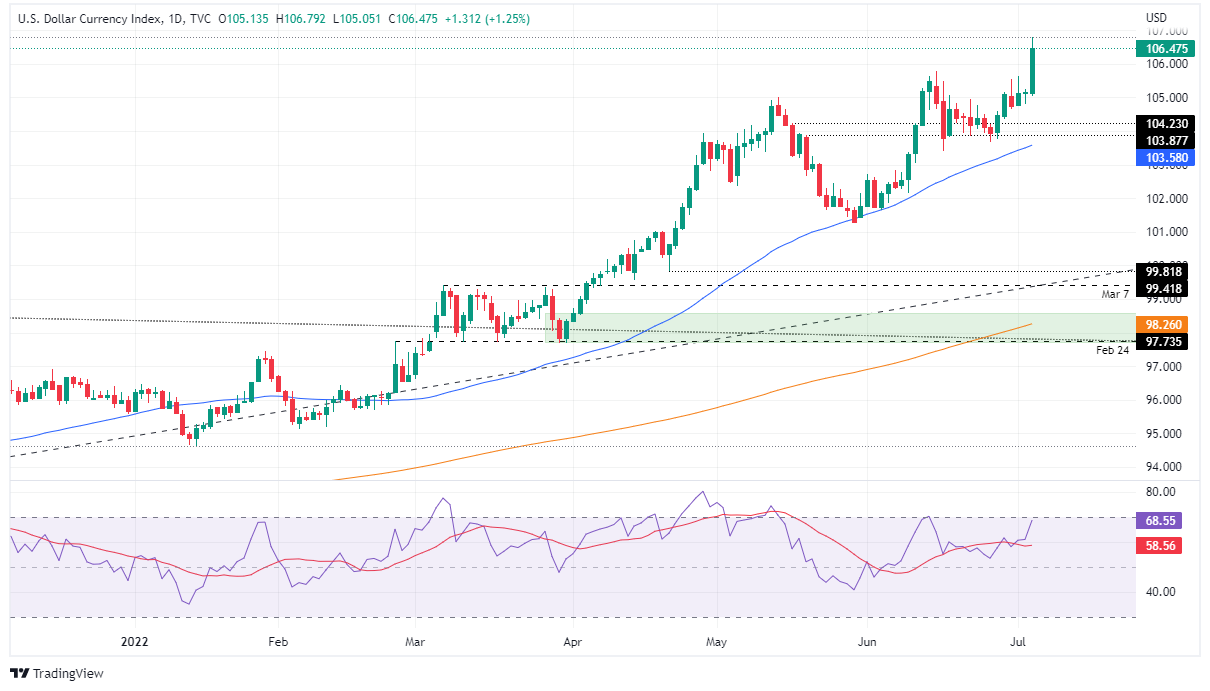
US Dollar Index Key Levels
What you need to take care of on Wednesday, July 6:
Fears of a globalized recession take their toll on financial markets. The greenback took advantage of the risk-averse scenario and soared. The risk of a US recession is above 70%, according to analysts.
The EUR/USD pair fell to a 20-year low of 1.0234, recovering some ground later in the day but settling below the 1.0300 threshold. EU growth slowed to a 16-month low, while Germany struggles to get gas amid mounting tensions with Russia.
German Economy Minister Robert Habeck noted that the energy industry crisis could have a negative impact on financial markets. He did not rule out intervening gas prices. Since Russia curbed its gas flows to the country, Germany fears a complete blackout of Moscow’s provision, as Russia will temporarily shut down the NordStream-1 pipeline on July 11 for annual maintenance. The country moved to alert level two in June and may soon move over intervening energy markets.
Eurozone money markets now expect the European Central Bank to hike rates by 130 bps by year-end.
The GBP/USD pair currently traded as low as 1.1897, now hovering around 1.1950. Turmoil in Downing Street will likely take its toll on the Pound as two senior cabinet ministers resigned, Sajid Javid and Rishi Sunak, quickly followed by vice-chair of the UK Conservative Party, Bim Afolami, Parliamentary Private Secretary Saqib Bhatti, and Parliamentary Private Secretary to Secretary of State for N. Ireland Jonathan Gullis.
The resignations came as Johnson kept former Conservative party whip Chris Pincher in his post after sexual misconduct allegations were made against him. The count may not be over yet, and Prime Minister Boris Johnson is working on replacing them all.
Meanwhile, and with a global energy crisis, the Norwegian oil and gas association reported offshore workers began a strike on Tuesday in demand of wage hikes. It means an estimated 341K barrels lost on output per day. Crude oil prices edged lower amid risk-off flows, with WTI now trading at around $99.60 a barrel. US coal prices, on the other hand, reached all-time highs.
Gold Price plummeted to a fresh 2020 low of $1,764.99 a troy ounce, now trading a couple of bucks above such a low.
USD/CAD trades at 1.3030 after peaking at 1.3083, while AUD/USD nears 0.6800 after bottoming at 0.6760. The late recoveries are related to Wall Street, as US indexes trimmed a good part of their intraday losses ahead of the close.
Like this article? Help us with some feedback by answering this survey:
UK PM Johnson reportedly plans to stay on and appoint new Cabinet ministers, according to Bloomberg sources.
More to come...
The vice-chair of the UK Conservative Party, Bim Afolami, has resigned and calls for Boris Johnson to stand down.
This follows a series of earlier key resignations from UK Tories as follows:
- UK parliamentary private secretary Saqib Bhatti resigns.
-
UK political Tory resignations at Downing Street are dropping like bombs
In forex, however, the pound is holding up and testing the commitments of the bears into a critical area on the charts as follows:
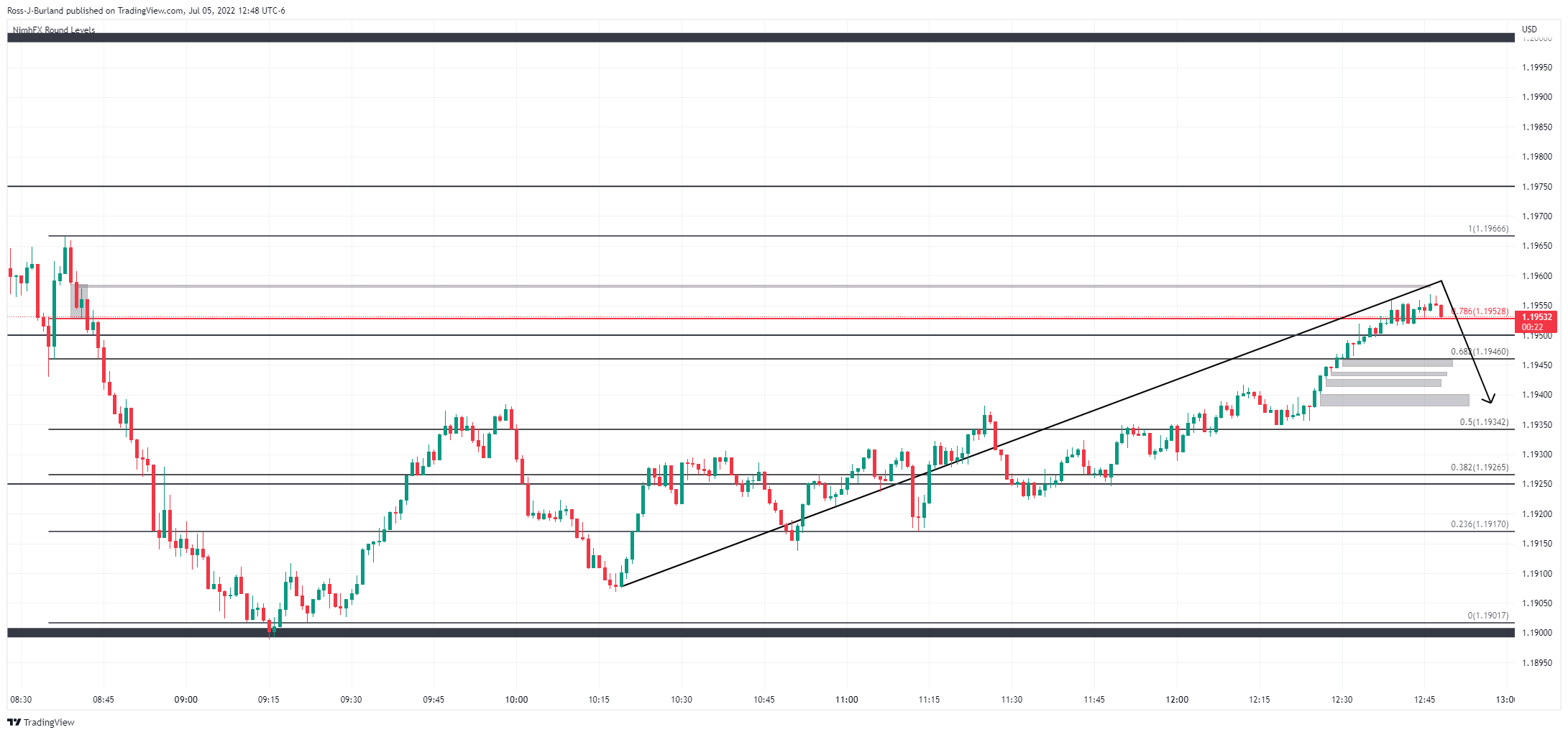
The price is headed towards a 1-min time frame order block (grey areas) and an area of imbalance that could serve to be the last area of liquidity that the market is hunting down prior to a correction of the bullish trend into the price imbalances (grey areas) below. Bears will be looking for a peak formation at this juncture.
- The Swiss franc weakened against the greenback, despite safe-haven flows, down almost 1%.
- Sentiment and a stronger US Dollar lift the pair as buyers step in, eyeing a break of the 50-DMA.
- The USD/CHF double top is still in play, but upside risks remain.
The USD/CHF advances sharply for the third straight day, snapping two days of consecutive losses that dragged the major to print a fresh two-month low of around 0.9495, gaining almost 1% on Tuesday. At the time of writing, the USD/CHF is trading at 0.9687.
Investors’ fears that the global economy might enter a recession sent US equities sliding, except for the Nasdaq Composite. The US Treasury yields followed suit, sliding, led by the US 10-year Treasury yield descending close to 4%, sitting at 2.804%. Meanwhile, the US Dollar Index is rallying close to 1.50%, at 106.646, a tailwind for the USD/CHF.
On Tuesday, the USD/CHF opened near Monday highs. Nevertheless, it dipped as the London session opened, towards the daily pivot point around 0.9590, to never look back, overcoming on its way up some resistance levels, like the R1 pivot point at 0.9630, the July 1 high at 0.9641, before settling around just shy of the 0.9700 figure.
USD/CHF Daily chart
The USD/CHF daily chart illustrates the pair as upward biased; however, the double top remains in play. If the greenback extends its gains throughout the week and if USD/CHF buyers step in, a break above the 50-day moving average (DMA) at 0.9733 is on the cards and could accelerate a rally towards the 0.9900 mark. However, on its way north, USD/CHF buyers will need to reclaim April 2020 high at around 0.9802.
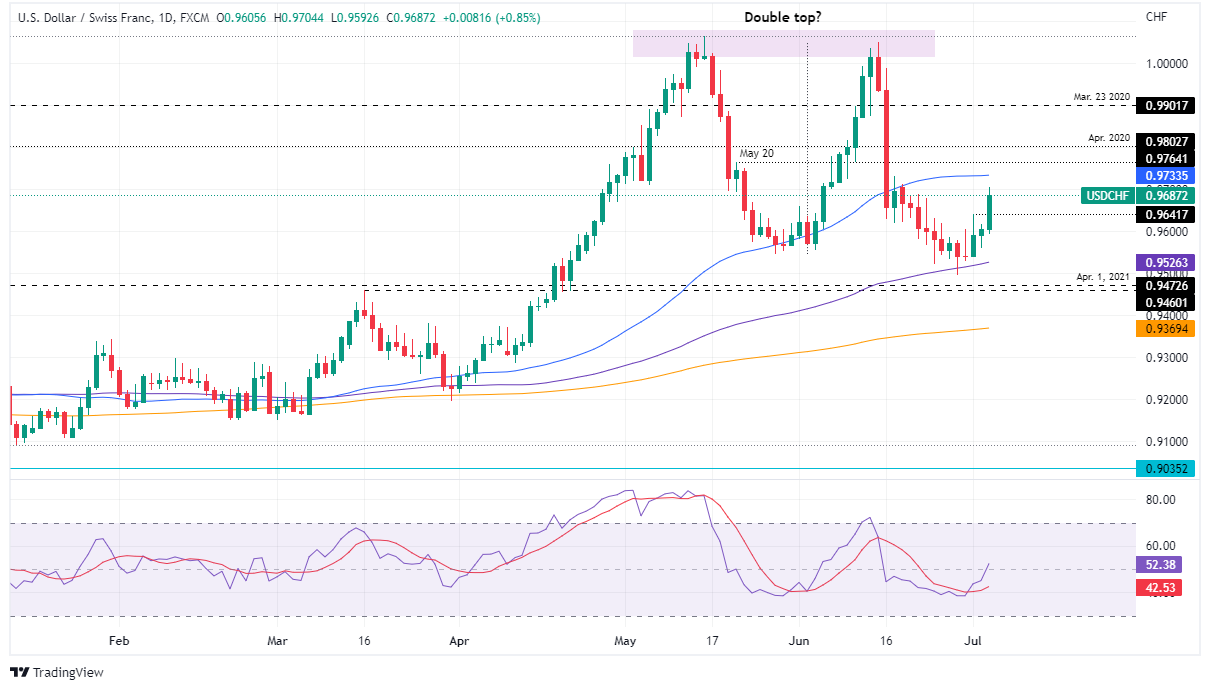
USD/CHF Key Technical Levels
- WTI drops like a stone on fears of a global recession and a strong US dollar.
- Bulls note that product inventories are at critically low levels, which suggests restocking will keep crude oil demand strong.
At 98.73, the price of oil is down 10.6% on the day after falling from a high of $111.42 to a low of $97.46. The black gold has drop like a stone on Tuesday due to the worries over the global recession and curtailing demand overshadowed a strike by Norwegian oil and gas workers that could cut exports and exacerbate supply shortages. However, the Union leaders have announced that the strike is over.
Investors are concerned over central banks across the world that is taking aggressive actions to limit inflation. Overnight, the Reserve Bank of Australia hiked by 50 basis points with more in the pipeline to come as per its hawkish statement. We are seeing safe-haven demand for US Treasuries that have also boosted the US dollar DXY by about 1.37% at the time of writing with traders taking it to a high of 106.792 on the day. This has also weighed on greenback-denominated oil as it becomes more expensive for buyers holding other currencies.
Bullish case for oil
Analysts at TD Securities noted, however, that ''product inventories are at critically low levels, which also suggests restocking will keep crude oil demand strong. Considering that little progress has been made towards solving structural supply challenges, even a slow rate of demand growth can endanger energy supply.''
In this context, the analysts argued that ''brent crude and distillates prices are also exhibiting strong asymmetry towards upside moves in demand, which could point to an uncoiling process should commodity demand rebound.''
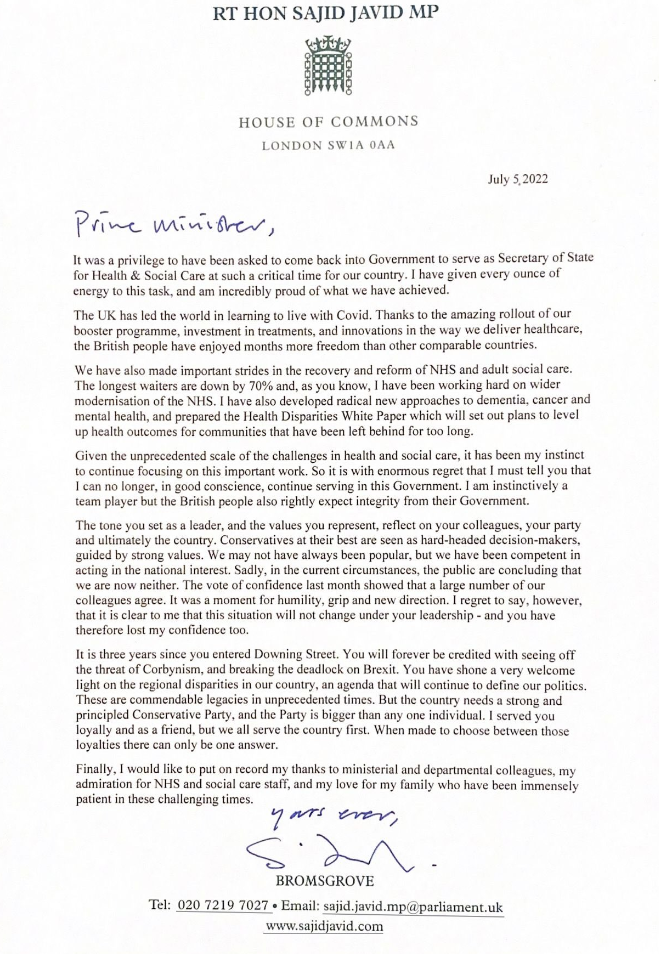
In recent trade, UK political Tory resignations are dropping like bombs due to the incompetence of the PM.
Firstly, British Health Secretary Sajid Javid resigned from Prime Minister Boris Johnson's government on Tuesday, he said in a statement.
We then had news across Twitter that the UK's Finance Minister Rishi Sunak resigned.
UK PM Boris Johnson says ''it seemed to me that it was 'reasonable grounds' for pincher to continue in his post after a complaint was raised, but in retrospect that was the wrong decision.''
''Past complaint against pincher brought to johnson didn't come 'anywhere near the threshold of criminality'''
So far, GBP is holding up after the initial 12 pip move to the downside vs the US dollar.
Letters of resignation:
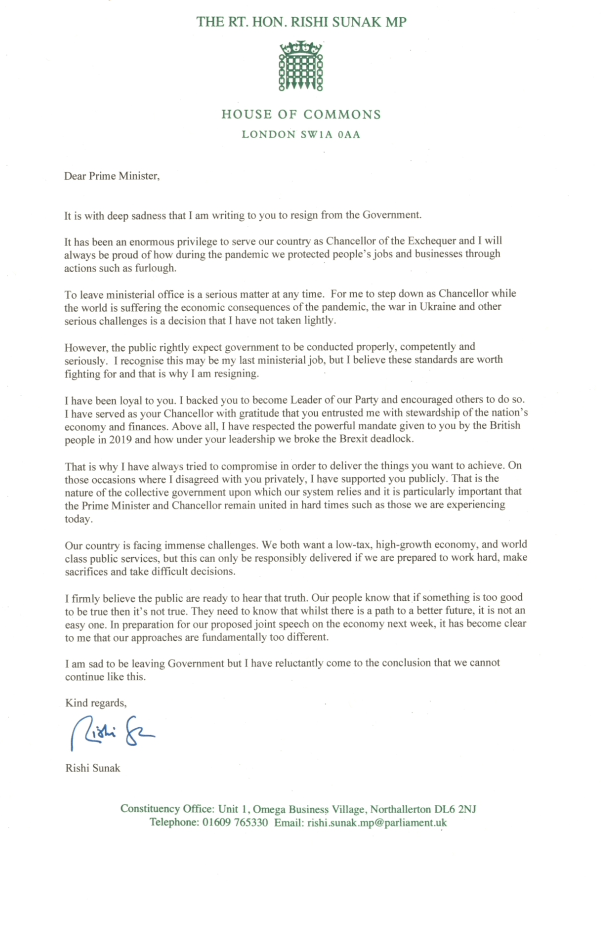
More to come...
- The USD/JPY seesaws in a 100 pip range on Tuesday, limited by a mighty US dollar and falling US Treasury yields.
- Risk-off impulse increased appetite for safe-haven assets, with the greenback taking the upper hand.
- US Treasury yields drop more than 13 bps and are back below 2.80%.
The USD/JPY is almost unchanged in a trading session dominated by risk aversion, triggering flows toward safe-haven assets, and in the FX space, the USD, the JPY, and the CHF are the winners. Nevertheless, due to its risk-off nature, the USD/JPY is barely up 0.07%, trading around the 135.70s area.
USD/JPY range-bound capped by factors that boosts both currencies, to remain steady
Recession and high inflation worries are the headlines of the session. That said, European and US equities tumbled while safe-haven flows dominated the session, with the US Dollar Index, which pairs the greenback vs. six currencies, gaining 1.50%, sitting at 106.716. in the meantime, the USD/JPY seesawed in the 135.50-136.40 area during the day, within familiar ranges.
On the downside, the USD/JPY was capped by the strength of the greenback, but on the upside, falling US Treasury yields, mainly the US 10-year Treasury yields, are nose-diving thirteen basis points, sitting at 2.794%, well below the 3.50% YTD high.
In the meantime, Tuesday’s Asian Pacific session’s upbeat mood spurred by talks between US/Chinese officials was short-lived. Despite newswires stating that US President Biden is expected to roll back tariffs on Chinese imports soon, it could not overshadow the looming stagflation scenario in the worldwide economy.
In the meantime, the Japanese economic docket featured the Jibun Bank Services and Composite PMIs, for June, which showed the economy’s resilience, printing better than expected figures. Across the pond, the US calendar featured positive data, with Durable Goods Orders and Factory Orders beating forecasts.
Later in the week, an absent Japanese economic docket will leave USD/JPY traders adrift to US data. The US macroeconomic calendar will reveal the ISM Non-Manufacturing PMIs, JOLTs Job Openings, and FOMC Minutes. Furthermore, Fed officials will be crossing newswires, led by the New York Fed President John Williams on Wednesday, while Christopher Waller and the St. Louis Fed President Bullard on Thursday.
USD/JPY Key Technical Levels
- Emerging market currencies are under pressure amid risk aversion.
- Mexican peso heads for the lowest daily close since March versus the US dollar.
- Next resistance in USD/MXN seen at 20.70.
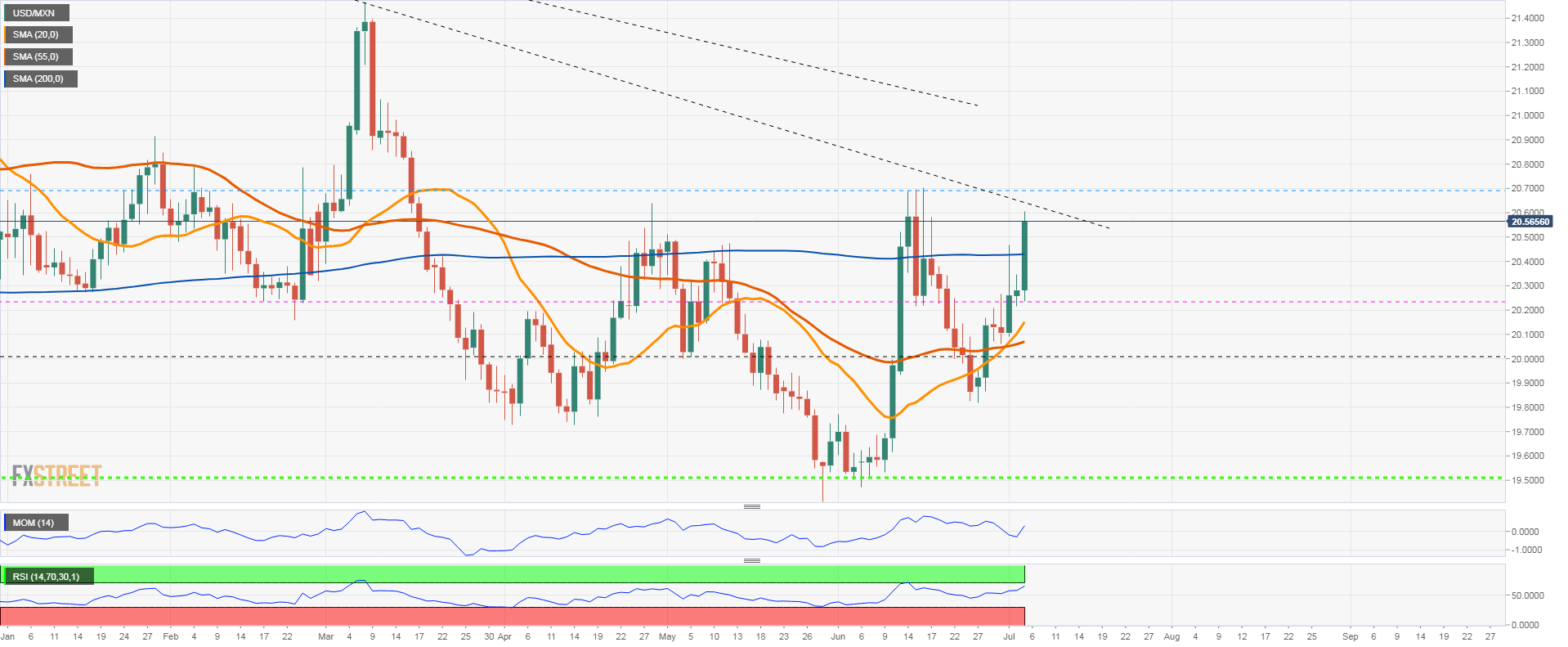
The USD/MXN accelerated the move to the upside on Tuesday amid a sharp decline in equity markets across the globe. Fears about a recession weighed on Emerging market currencies, pushing the greenback to the upside.
During the American session the USD/MXN peaked at 20.60, the highest level since June 16. It remains near the top, with the bullish pressure still elevated. Some technical indicators are approaching overbought levels, like the daily RIS near 70; however, no signs of exhaustion are seen at the moment.
The next strong barrier is the 20.70 that capped the upside in June. A break higher would open the doors to more gains, targeting 20.90. A slide under 20.45 would alleviate the bullish bias.
Fear drives dollar higher
The greenback is trading at multi-year highs. The US Dollar Index stands at levels not seen since 2002. At the same time, Treasuries are rallying. The US 10-year plummets and stands at 2.79%, while the 30-year is approaching 3%.
The Dow Jones is falling by almost 600 points and the S&P 500 by 1.54%. In Mexico, the IPC index falls by 2%. Among emerging market currencies, the worst performer is the Russian ruble (USD/RUB +10%) followed by the Polish zloty (USD/PLN +2.80%) and the Chilean peso (USD/CLP +2.35% at 950, new record high). Crude oil tumbles nearly 9%.
USD/MXN daily chart
- Pound under pressure, among worst performers of the American session.
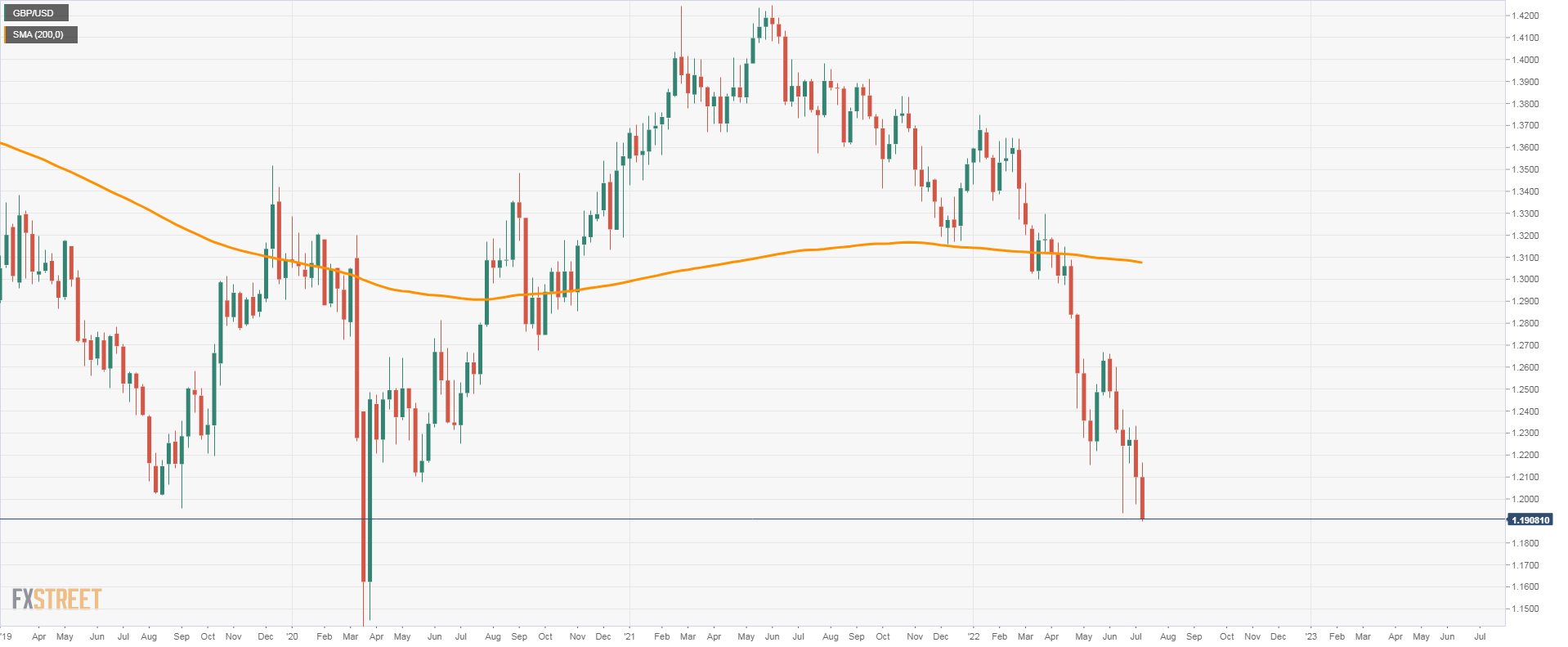
- GBP/USD heads for the lowest close since March 2020.
- US dollar holds onto significant daily gains as Wall Street tumbles.
Risk aversion continues to weigh on GBP/USD. The pair fell further, reaching at 1.1897, the lowest level since March 2020. It remains under pressure around 1.1900, unable to find support as markets tumble.
Fears about a global recession and a worsening growth outlook in the UK continue to drive the pound lower, in line with many analysts’ forecasts. At the same time, it boosts the demand for the greenback. The DXY is trading at the highest level since 2002, at 106.70, up 1.46% for the day.
Equity prices in Wall Street are falling 1.70% on average. The FTSE 100 dropped almost 3% and the DAX 2.75%. Commodity prices are sinking, with gold down 2% and silver 2.95%. Crude oil collapses, falling by 8.50%.
Adding to concerns, Norway just warned that gas exports to the UK could be shut off this weekend. A strike threatens production in the Scandinavian country.
The pound is among the worst performers of the American session. EUR/GBP has erased daily losses and is back around 0.8600 after falling earlier to 0.8540.
Economic data came in above expectation in the UK and the US. The UK S&P Global Service PMI in June was revised higher from 53.4 to 54.3. In the US, Factory Orders rose by 1.6% in May, surpassing the 0.5% of market consensus. Market participants ignored the numbers. On Wednesday, the FOMC minutes will be released, and on Friday, the Non-farm payroll.
GBP/USD weekly chart
- The AUD/USD tumbled more than 100-pips during the day and probed the YTD low around 0.6763.
- The RBA hiked rates by 0.50%, but it wasn’t enough to overcome a dampened sentiment spurred by the stagflation economic outlook, so the AUD/USD dived.
- US-China tussles ease as US President Biden evaluates tariffs imposed by the Trump administration.
The Australian dollar followed its fellow peers and is tanking to fresh two-year-lows amidst renewed concerns of a recession looming worldwide, amidst a high inflation scenario, bolstering the appetite for safe-haven peers in the FX complex. At the time of writing, the AUD/USD is trading at 0.6767.
King dollar is back as risk appetite takes a hit on recession fears
The market mood remains dismal, as portrayed by European and US equities tumbling. The AUD/USD got a lift during the Asian session, printing the daily high at 0.6894, spurred by the Reserve Bank of Australia (RBA), hiking rates by 50 bps in back-to-back meetings. Nevertheless, the major began tumbling post-Euro area S&P Global PMIs releases, depicting a gloomy economic outlook in the EU block.
Regarding the RBA’s decision, the bank said that the size and timing of further interest rates would be guided by the incoming data and the Board’s assessment of the inflation outlook. The RBA noted that strong demand, a tight labor market, and capacity constraints in some sectors put upward pressure on prices while emphasizing that inflation is foreseen to peak later this year.
On the US front, US President Joe Biden is assessing removing tariffs imposed by the Trump presidency on some Chinese products as a solution to help the Federal Reserve to tackle inflation. However, it was outweighed by US recession fears, despite positive economic data released on Tuesday.
Data-wise, the US calendar showed that Durable Goods Orders and Factory Orders rose more than expected in May.
In the calendar ahead, the Australian docket will feature the RBA Chart Pack, while on the US front, ISM Non-Manufacturing PMIs, JOLTs Job Openings, and FOMC Minutes will be unveiled. Also, AUD/USD traders should take note of New York Fed President Williams on Wednesday.
AUD/USD Key Technical Levels
- US Dollar Index jumps to highest level since December 2002.
- Wall Street indexes tumble more than 1%.
- NZD/USD vulnerable to more losses while under 0.6200.
The NZD/USD is losing almost 90 pips on Tuesday, hit by a stronger US dollar amid risk aversion. The greenback is rising sharply as stocks and commodities tumble. The pair fell to as low as 0.6123 on Tuesday, the lowest since May 2020. The rebound from the lows is facing resistance at 0.6150.
Fears about a global recession weigh on equity prices. In Wall Street, the Dow Jones is falling more than 550 points and the S&P 500 drops by 1.53%. Crude oil prices sank 5%. Gold is at $1,775 down 1.85% at the lowest since December.
The negative environment is pushing the dollar and government bonds to the upside. The DXY trades at 106.50, the highest level in two decades. The worst performers are emerging market currencies and the euro.
Under pressure below 0.6200
The NZDUSD failed to hold above 0.6200 and while it remains under it seems vulnerable to more losses. A recovery back above should alleviate the negative pressure. If the slide continues, the next support are could be seen at 0.6100 and then the area around 0.6070
NZD/USD weekly chart
- The shared currency is trading below 1.0300, accelerating towards the 1.0250 area.
- The EUR/USD nose-dived to a fresh 20-year-low at 1.0246 as the market asses parity’s chances.
- EU S&P Global Services and composite PMIs, decelerated sharply as Natural gas higher prices struck the Eurozone.
The EUR/USD plummets to fresh twenty-year-lows, below the 1.0350 previous low printed on May 13, accelerating towards the 1.0250s region courtesy of a stronger US dollar. At 1.0256, the EUR/USD loses almost 1.60% during the day.
Risk aversion and the King-dollar weighs on the euro
A risk-off impulse has the safe-haven peers on the right foot. The US Dollar Index, a gauge of the greenback’s measurement, also advances to twenty-year-highs, above the 106.500 mark, up almost 1.30%, on renewed concerns of a recession, amidst an inflationary scenario. All that despite the chances that US President Joe Biden might lift tariffs imposed on China’s products during the Trump presidency.
In the meantime, on Monday, the Bundesbank President and ECB member Joachim Nagel warned the ECB against lowering borrowing costs for EU members in the southern area. He emphasized that the central bank should focus on fighting inflation, which according to him, may require more rate hikes than projected.
Meanwhile, weakness in the single currency is mainly attributed to a further surge in European gas prices, which triggered fresh concerns of a recession across the Eurozone. According to Reuters, the reduction in pipeline supplies from Russia has accelerated the adjustment in stockpiles, generating upward pressure on European LNG prices.
Data-wise, the EU economic docket featured S&P Global Services and Composite PMIs for June, in Spain, Italy, France, and Germany. Most readings missed expectations and are showing the economy slowing at a faster pace. In the case of the Euro area as a whole, the Services PMI reading came at 53, while the Composite stayed around 52.
Across the pond, the calendar is light, and Factory Orders for May, rose by 1.6% MoM, beating the street’s estimations.
EUR/USD Key Technical Levels
Gold came under heavy selling pressure in the second half of the day on Tuesday and touched its lowest level since late 2021 below $1,770.
The precious metal is having a difficult time finding demand despite the risk-averse market environment. The dollar seems to be capitalizing on safe-haven flows with the US Dollar Index trading at its strongest level in nearly two decades above 106.50.
In the meantime, the S&P 500 Index is down nearly 2% following the three-day weekend in the US. Investors continue to stay away from risk-sensitive assets amid growing recession fears and the Federal Reserve's willingness to continue to tighten its policy at an aggressive pace.
There won't be any high-impact data releases in the remainder of the day and XAU/USD remains at the mercy of the dollar's valuation.
The fact that the bearish momentum picked up pace after gold broke below $1,800 also suggests that the yellow metal is facing technical selling pressure as well.
On Wednesday, the Federal Reserve will release the minutes of its June meeting. The US Bureau of Labor Statistics' jobs report for June will also be watched closely by market participants later in the week.
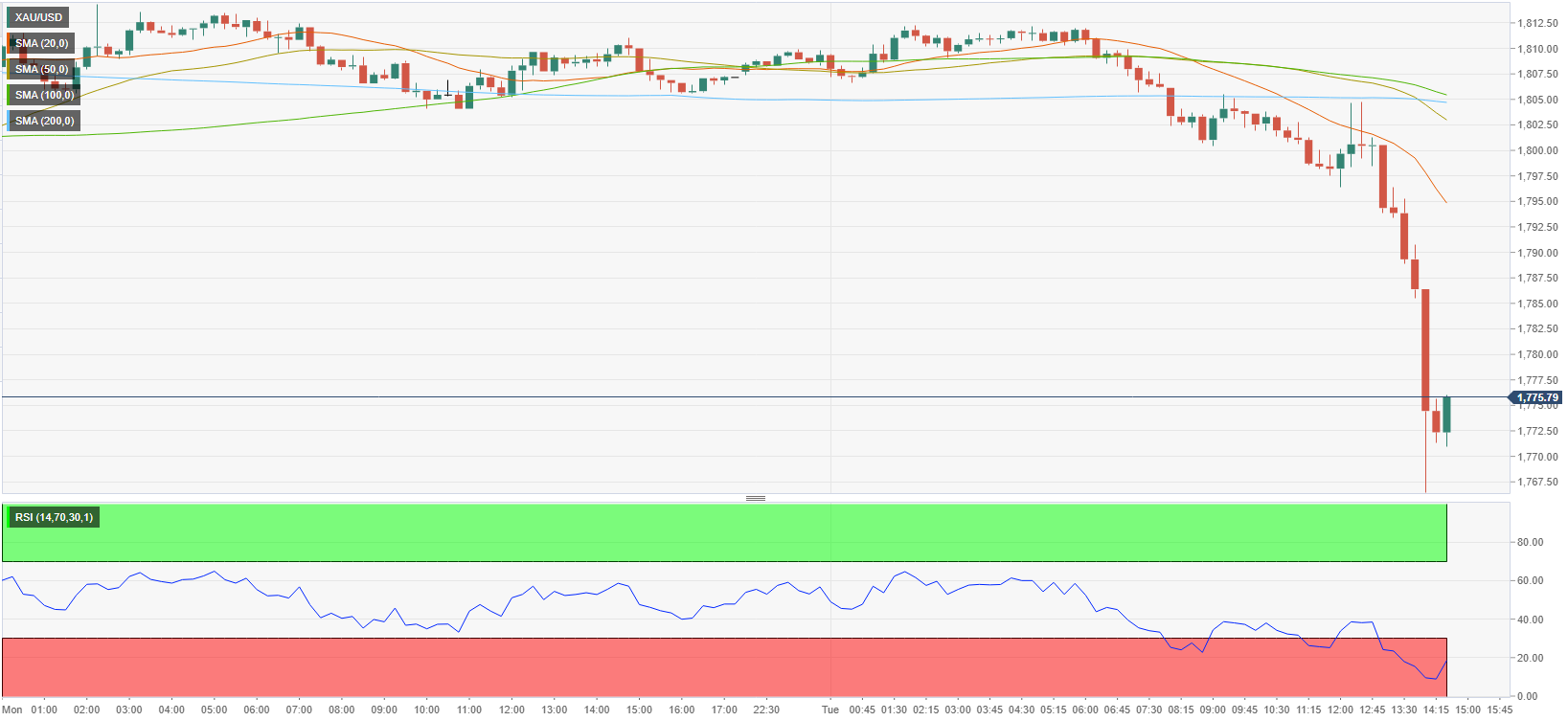
Gold 15-minute chart
During June, the pound weakened notably against the US dollar from 1.2613 to 1.2155. As we enter the second half of the year, some analysts have updated their British pound forecasts. Here you can find the expectations of seven major banks regarding GBP’s outlook for the coming months.
Wells Fargo
“The mix of measured monetary tightening and rapid inflation, combined with a UK economic downturn, provides an underwhelming backdrop for the UK currency. We have revised our forecast for the pound lower, and now see a trough in the GBP/USD exchange rate around 1.17 in mid-2023.”
Credit Suisse
“A central bank that sets a high bar to keeping pace with not just the Fed but even the likes of SNB and maybe ECB going forward, against a backdrop of weak trade dynamics and ambiguous long-term government policy, keeps the door open for GBP/USD to slip towards 1.17 and for EUR/GBP to rise towards 0.90.”
TDS
“The near-term GBP trajectory is biased to the downside, even though it maintains a pretty heft discount. The EURGBP rally reflects GBP's relatively higher beta to risk assets. At the same time, the ECB has turned more hawkish. The BoE plus fiscal support may help to put a floor in cable but not before a near-term break below 1.20. Still, BoE pricing seems too aggressive relative to our forecast, leaving GBP vulnerable on the crosses.”
MUFG
“The risks for GBP/USD over Q3 is to the downside given GBP tends to perform poorly as financial conditions tighten. Beyond then, even as GBP/USD recovers, GBP will remain weak versus EUR.”
HSBC
“Over the medium-term, we continue to expect the GBP to weaken further against the USD, built on more measured steps at the BOE compared to the Fed’s ongoing marked tightening. The UK may also face structural challenges over a longer-term.”
CIBC
“Building macro headwinds suggest that the BoE will not be as aggressive as the market discounts. We expect a protracted policy pause post once rates reach 1.75% in September. As the growth versus inflation trade-off remains challenging, expect the bank to prioritize growth. This favours GBP downside, especially as ongoing political risks, including a potential trade spat with the EU, remains real.”
Scotiabank
“We think market bets on 150 bps+ of additional BoE hikes this year are stretched and a slashing of these will act as a GBP headwind in the months ahead.”
- Factory Orders in the US increased at a stronger pace than expected in May.
- The greenback continues to outperform its rivals after the data.
The data published by the US Census Bureau revealed on Tuesday that new orders for manufactured goods, Factory Orders, rose by 1.6%, or $8.4 billion to $543 billion in May. This print followed April's increase of 0.7% and came in much better than the market expectation for a growth of 0.5%.
"Inventories, up twenty-one of the last twenty-two months, increased $10.0 billion or 1.3%, to $797.9 billion," the publication further read. "This followed a 0.8% April increase. The inventories-to-shipments ratio was 1.47, unchanged from April."
Market reaction
The US Dollar Index extended its impressive rally in the early American session and was last seen trading at its highest level since December 2002 at 106.60, rising 1.4% on a daily basis.
- USD/CAD gathered bullish momentum and climbed above 1.3000 on Tuesday.
- Crude oil prices are down more than 6% amid the worsening demand outlook.
- The dollar benefits from risk-aversion, fueling the pair's rally.
The USD/CAD pair advanced beyond 1.3000 and touched its strongest level in two weeks. The broad-based dollar strength and falling crude oil prices allow the pair to preserve its bullish momentum during the American trading hours.
Falling oil prices hurt CAD
Investors grow increasingly concerned over a global recession and the energy demand outlook. The barrel of West Texas Intermediate (WTI) was last seen losing 6.6% on the day at $103.20, weighing in on the commodity-sensitive CAD.
While speaking at an energy conference in Nigeria, "the ongoing war in Ukraine, a COVID-19 pandemic which is still with us, and the inflationary pressures across the globe have come together in a perfect storm that is causing significant volatility and uncertainty in the commodity markets in general," OPEC Secretary-General Mohammad Barkindo said on Tuesday.
On the other hand, the intense flight to safety is helping greenback outperform its rivals. Following Monday's choppy action, the US Dollar Index turned north on Tuesday and was last seen sitting at its highest level in nearly two decades at 106.50, rising 1.3% on a daily basis. Reflecting the souring market mood, major equity indexes in the US are down between 1.5% and 2%.
In the meantime, the data from the US revealed that Factory Orders rose by 1.6% in May, surpassing the market expectation for an increase of 0.5%.
Technical levels to watch for
- Gold Price continued losing ground for the second straight day and slipped below the $1,800 mark.
- Aggressive Fed rate hike bets, along with a blowout USD rally, exerted pressure on the commodity.
- The prevalent risk-off mood amid growing recession fears could offer support and limit the decline.
Gold Price drifted lower for the second successive day on Tuesday and weakened further below the $1,800 mark during the early North American session. The intraday decline was sponsored by a combination of factors, hawkish Fed expectations and a stronger US dollar, though the prevalent risk-off environment could help limit the downside.
Fed Chair Jerome Powell said last week that the US central bank remains focused on getting inflation under control and added that the US economy is well-positioned to handle tighter policy. This was seen as a key factor that continued acting as a headwind for the non-yielding yellow metal. Apart from this, a blowout USD rally to a fresh two-decade high further contributed to driving flows away from the dollar-denominated gold.
The greenback remained well supported by expectations for more aggressive Fed rate hikes and seemed rather unaffected by a steep decline in the US Treasury bond yields. Concerns about a potential economic recession forced investors to take refuge in traditional safe-haven assets and dragged the yield on the benchmark 10-year US government bond to a fresh multi-week low. This, in turn, could offer some support to gold.
Nevertheless, spot prices have now drifted back closer to the $1,786-$1,784 support zone, which if broken decisively would mark a fresh breakdown. That said, bearish traders might refrain from placing aggressive bets ahead of the FOMC meeting minutes, due on Wednesday. Apart from this, the release of the closely-watched US monthly jobs report (NFP) will influence the USD and determine the near-term trajectory of gold price.
Technical levels to watch
- USD/TRY regains upside traction and surpasses 17.00.
- The upside bias in the greenbacks weighs on the lira.
- Inflation fears continue to hurt the currency.
Further depreciation of the Turkish currency lends extra wings to USD/TRY and motivates it to break above the 17.00 yardstick on Tuesday.
USD/TRY now targets the 2022 highs near 17.40
USD/TRY extends the advance for the fourth consecutive session on Tuesday amidst the solid performance of the greenback, the pick-up of the risk aversion and recession chatter.
Indeed, the greenback saw its upside momentum gather extra steam in response to rising speculation of a global recession, which has been recently intensified after final Services PMIs in the euro area dropped further in June.
In addition, Monday’s higher-than-expected inflation figures in Türkiye also weigh on the sentiment around the lira and prompted the pair to almost fully recover the ground lost following the ban on Turkish lira loans to some companies by the banking watchdog (BDDK) on Friday 24.
What to look for around TRY
USD/TRY looks to consolidate the sharp rebound from 16.00 neighbourhood, as investors continue to digest the latest announcement by the Turkish banking watchdog (BDDK) on June 27.
So far, the lira’s price action is expected to keep gyrating around the performance of energy prices, the broad risk appetite trends, the Fed’s rate path and the developments from the war in Ukraine.
In addition, the effects of this new measure aimed at supporting the de-dolarization of the economy will also have its say, at least in the very short term.
Extra risks facing the Turkish currency also come from the domestic backyard, as inflation gives no signs of abating, real interest rates remain entrenched in negative figures and the political pressure to keep the CBRT biased towards low interest rates remain omnipresent.
Key events in Türkiye this week: Inflation Rate, Producer Prices (Monday) – Current Account (Friday).
Eminent issues on the back boiler: FX intervention by the CBRT. Progress (or lack of it) of the government’s new scheme oriented to support the lira via protected time deposits. Constant government pressure on the CBRT vs. bank’s credibility/independence. Bouts of geopolitical concerns. Structural reforms. Presidential/Parliamentary elections in June 23.
USD/TRY key levels
So far, the pair is gaining 1.40% at 17.0208 and faces the immediate target at 17.3759 (2022 high June 23) seconded by 18.2582 (all-time high December 20) and then 19.00 (round level). On the other hand, a breach of 16.0365 (monthly low June 27) would pave the way for a test of 15.6684 (low May 23) and finally 15.3361 (100-day SMA).
Gold has dipped below $1,800. A break under critical support at $1,780 would signal a trend change, strategists at TD Securities report.
Bias remains to the downside
“For the time being, gold prices are managing to hold onto a critical threshold for a change in trend by year-end at $1,780, as rising recession odds fuel inflows for gold as a safe-haven asset.”
“The margin of safety is razor-thin as a break below $1,780 would imply that gold would succumb to the weight of the most hawkish central bank regime since the 1980s. This scenario implies that a sustained downtrend could form in gold should the large CTA selling program catalyze a breakdown in prices.”
“As central banks face a credibility crisis, they could remain committed to their battle against inflation and keep rates elevated for longer than recession odds would otherwise imply.”
“A break below the $1,780 critical threshold could spark additional outflows on the horizon, which suggests the bias remains to the downside in gold.”
Recession fears have contributed to the recent consolidation in oil prices. Still, strategists at TD Securities highlight their confidence in the uptrend in energy markets.
Supply risk insulation
“Recession fears are weighing on energy markets, leading to a consolidation, but the uptrend in oil markets benefits from a substantial margin of safety.”
“As long as Brent crude prices remain above the $87/bbl mark, oil bulls should hold onto their conviction in oil's uptrend.”
“The margin of safety also remains elevated into year-end, reflecting our view that even in a recession, oil prices could remain elevated as energy supply risk continues to soar.”
- GBP/USD came under intense selling pressure on Tuesday and dived to a three-week low.
- A combination of factors lifted the USD to a fresh 20-year peak and weighed on the major.
- Brexit woes, less hawkish BoE expectations further exerted downward pressure on the GBP.
The GBP/USD pair remained under intense selling pressure through the early North American session and dived to the 1.1965-1.1960 area, or a three-week low in the last hour.
The US dollar caught aggressive bids on Tuesday and rallied to a fresh two-decade high, which, in turn, was seen as a key factor that exerted heavy downward pressure on the GBP/USD pair. The Federal Reserve’s non-stop chatter about rate hikes to curb soaring inflation continued lending support to the USD. Apart from this, the prevalent risk-off environment provided an additional boost to the safe-haven greenback.
The market sentiment remains fragile amid concerns that rapidly rising interest rates and tightening financial conditions would pose challenges to global economic growth. Apart from this, the ongoing Russia-Ukraine war and the COVID-19 outbreak in China have been fueling recession fears. This, in turn, tempered investors' appetite for perceived riskier assets, which was evident from a fresh leg down in the equity markets.
The British pound was further pressured by domestic issues and worried that the UK government's controversial Northern Ireland Protocol Bill could trigger a trade war with the European Union. Apart from this, expectations that the Bank of England would adopt a gradual approach towards raising interest rates amid the ongoing cost of living crisis further contributed to the GBP/USD pair's steep decline.
The sharp intraday downfall took along some short-term trading stops near the 1.2000 psychological mark. This might have already set the stage for a further near-term depreciating move. Some follow-through selling below the YTD low, around the 1.1935-1.1930 region, would reaffirm the negative bias and make the GBP/USD vulnerable.
Technical levels to watch
- AUD/USD came under renewed selling pressure on Tuesday despite a 50 bps rate hike by the RBA.
- The recent fall in commodity prices, recession fears continued weighing on the risk-sensitive aussie.
- Aggressive Fed rate hike bets lifted the USD to a fresh 20-year high and added to the selling bias.
The AUD/USD pair struggled to capitalize on the overnight recovery gains and met with a fresh supply in the vicinity of the 0.6900 mark on Tuesday. The intraday selling pressure dragged spot prices closer to the YTD low, around the 0.6780 region heading into the North American session.
The Australian dollar weakened broadly after the Reserve Bank of Australia (RBA), as was anticipated, hiked its key interest rate by 50 bps to 1.35% - the highest since May 2019. This marked the third successive month of a rate increase, though did little to impress bullish traders and was largely overshadowed by the worsening global economic outlook.
Investors remain concerned that rapidly rising interest rates and tightening financial conditions would pose challenges to global economic growth. Apart from this, the ongoing Russia-Ukraine war and the COVID-19 outbreak in China have been fueling recession fears. This led to a further decline in commodity prices and weighed on the resources-linked aussie.
This, along with the emergence of aggressive US dollar buying, exerted additional downward pressure on the AUD/USD pair. In fact, the USD shot to a fresh 20-year peak and continued drawing support from the prospects for more aggressive rate hikes by the Fed. Apart from this, the prevalent risk-off mood provided an additional boost to the safe-haven greenback.
The latest leg down validates the recent bearish breakdown and supports prospects for an extension of the recent depreciating move. Some follow-through selling below the YTD low, around the 0.6765 region touched last Friday, will reaffirm the negative outlook and drag the AUD/USD pair towards testing the next relevant support near the 0.6700 mark.
Market participants now look forward to the US economic docket, featuring the release of Factory Orders data. This, along with the broader market risk sentiment, will influence the USD price dynamic and provide some impetus to the AUD/USD pair. The focus, however, will remain on Wednesday's release of the FOMC minutes and the US monthly jobs report on Friday.
Technical levels to watch
Gold is benefiting from rising recession odds. However, if central banks keep rates elevated to combat high inflation, the yellow metal could struggle to sustain an uptrend, strategists at TD Securities report.
XAUUSD needs to hold onto $1,780 to sustain an uptrend by year-end
“Gold prices are struggling to hold onto the critical threshold near $1,780 required to sustain an uptrend by year-end.”
“Trend signals in the yellow metal clash with those in industrial precious metals, which trade well below the threshold for an uptrend to form with price action most consistent with a strengthening downtrend. This divergence in the face of the most hawkish central bank regime since the 1980s reflects growing odds of a recession, supporting the yellow metal, as traders anticipate a pivot in policy.”
“In this cycle, however, a sustained downtrend could form in gold if central banks, facing a credibility crisis, remain committed to their battle against inflation and keep rates elevated for longer than they otherwise would.”
S&P 500 remains in a short-term consolidation phase. Key short-term support is seen at 3739/15, below which would open up a retest of the 2022 low at 3637, analysts at Credit Suisse report.
Recent consolidation phase to extend further
“The S&P 500 remains in a short-term consolidation phase after recently holding above the bottom of its trend channel from April, however, the market remains below key moving averages and momentum indicators stay negative, which points to further short-term weakness over the next 2-4 weeks.”
“Support is seen at 3739/15, below which would open up a retest of the 3637/33 2022 low. We note that the next support below here is seen at 3600/3594, then the key 50% retracement support at 3519/3500.”
“Resistance is seen at 3946, then the price gap from earlier in June, starting at 3974 and stretching up to 4017/19, which also coincides with the 38.2% retracement of the March/June fall and the top of the trend channel from April. We look for a cap here if reached to maintain the short-term downward pressure on equity markets. A break would significantly improve the short-term technical outlook, with the next key resistance seen at 4088/4101.”
In the view of economists at Natixis, China’s economic strategy must now change. China’s growth strategy will revert to a mercantilist strategy – which requires a weak currency.
Why should China move to a weak currency (renminbi) strategy?
“The structural weakness of domestic demand in China due to population ageing is forcing China to revert to an export-based mercantilist strategy.”
“This strategy requires a weak currency (renminbi), while the previous domestic demand-stimulus strategy required a strong renminbi. We can therefore expect further depreciation of the renminbi.”
German Economy Minister Robert Habeck said on Tuesday that they will stick to their plan of prioritizing private households in case of a gas emergency, as reported by Reuters.
"The gas market situation is tense, cannot say whether more protection measures will be needed," Habeck added. "We want to prevent a domino effect in the gas market."
Market reaction
Safe-haven flows continue to dominate the financial markets following these remarks. As of writing, Germany's DAX 30 Index was down 1.5% on the day at 12,580.50 points.
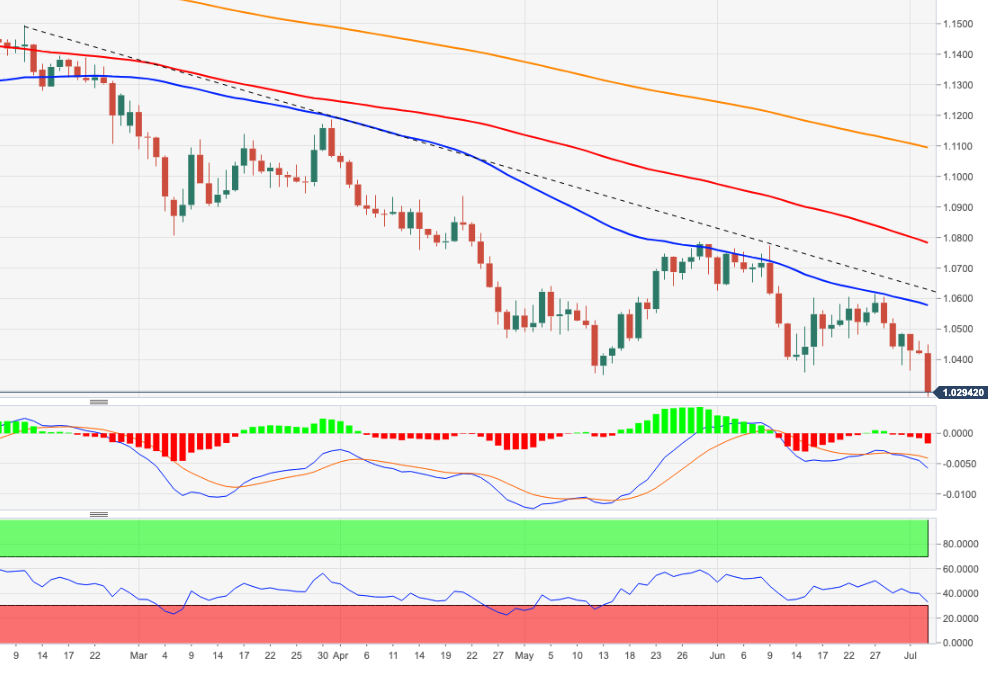
- EUR/USD collapses below the 1.0300 yardstick.
- A probable drop to parity slowly emerges on the horizon.
EUR/USD plummets to levels last seen back in December 2002 around 1.0280 on turnaround Tuesday.
Recession fears seem to dominate the sentiment around investors and keep the mood around the European currency well depressed. Against that gloomy backdrop, further losses should not be ruled out in the near term, with the next target of note at the parity level. Down from here comes the December 2002 low at 0.9859 (December 2)
In the longer run, the pair’s bearish view is expected to prevail as long as it trades below the 200-day SMA at 1.1092.
EUR/USD daily chart
USD/CNH keeps the 6.6600-6.7400 range well in place for the time being, said FX Strategists at UOB Group Quek Ser Leang and Peter Chia.
Key Quotes
24-hour view: “Yesterday, USD traded in a relatively quiet manner between 6.6810 and 6.7072 before closing largely unchanged at 6.6956 (-0.02%). The price actions are likely part of a consolidation. USD could continue to consolidate, likely between 6.6800 and 6.7100.”
Next 1-3 weeks: “We have expected USD to trade sideways between 6.6600 and 6.7400 for about 2 weeks now. Our view was not wrong as USD traded well within the expected range. There is no change in our view and only a break below 6.6600 or above 6.7400 would indicate that USD is ready to move in a directional manner.”
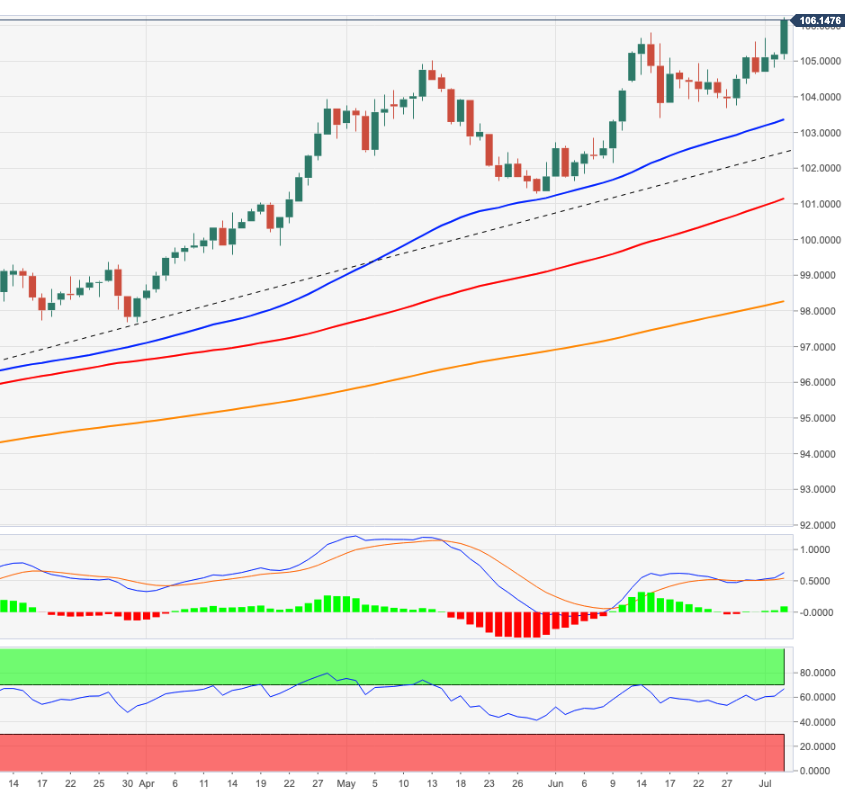
- DXY quickly left behind the YTD peaks and broke below the 106.00 mark.
- Further upside now targets the round level at 107.00.
DXY picks up extra pace and surpasses the 106.00 yardstick to print new cycle tops on Tuesday.
Further upside in the dollar remains in store in the short-term horizon. Against that, the index could attempt a visit to the round level at 107.00 before the December 2002 high at 107.31.
As long as the 5-month line near 102.50 holds the downside, the near-term outlook for the index should remain constructive.
The broader bullish view remains in place while above the 200-day SMA at 98.25.
DXY daily chart
USD/JPY is now seen navigating the 134.75-137.00 range in the next weeks, commented FX Strategists at UOB Group Quek Ser Leang and Peter Chia.
Key Quotes
24-hour view: “USD traded between 134.77 and 135.77 before closing at 135.69 (+0.37%). USD traded on a firm note upon opening and upward momentum is beginning to build. From here, USD could edge higher to 136.50. The major resistance at 137.00 is unlikely to come under threat. Support is at 135.60 followed by 135.25.”
Next 1-3 weeks: “Last Friday (01 Jul, spot at 135.90), we indicated, ‘waning upward momentum suggests that the odds for USD to move to 137.50 have diminished’. USD subsequently dropped and took out our ‘strong support’ level at 135.50 (low of 134.74). Despite the strong rebound from 134.74, upward momentum has not improved by much. The current movement appears to be part of a broad consolidation phase and USD is likely to trade between 134.75 and 137.00 for now. Looking ahead, USD has to break clearly above 137.00 before a sustained rise is likely.”
The energy sector is facing huge challenges on multiple fronts, OPEC Secretary-General Mohammad Barkindo said on Tuesday and added that the oil and gas industries are "under siege," as reported by Reuters.
"Years of underinvestment in the oil sector help explain market tightness in OPEC and outside OPEC," Barkindo further elaborated. "Venezuelan and Iranian oil is held hostage by geopolitics."
Market reaction
Crude oil prices remain under pressure following these comments and the barrel of West Texas Intermediate (WTI) was last seen trading at $108,15, where it was down 2.15% on a daily basis.
- A combination of factors assisted USD/CAD to regain strong positive traction on Tuesday.
- Sliding oil prices undermined the loonie and extended support amid aggressive USD buying.
- Hawkish Fed expectations, recession fears continued underpinning the safe-haven greenback.
The USD/CAD pair attracted fresh buying in the vicinity of the 50-day SMA on Tuesday and rallied nearly 100 pips from the daily low, around the 1.2840 region. The momentum lifted spot prices back to the 1.2930-1.2935 area during the first half of the European session and was sponsored by a combination of factors.
Crude oil prices came under renewed selling pressure and snapped a two-day winning streak to a four-day high amid the worsening global economic outlook, which could stall fuel demand recovery. This, in turn, undermined the commodity-linked loonie and provided a goodish lift to the USD/CAD pair amid the emergence of aggressive US dollar buying.
The Federal Reserve’s non-stop chatter about rate hikes to curb soaring inflation turned out to be a key factor that continued lending support to the USD. In fact, Fed Chair Jerome Powell said last week that the US central bank remains focused on getting inflation under control and that the US economy is well-positioned to handle tighter policy.
Apart from this, an intraday turnaround in the equity markets pushed the safe-haven greenback to a fresh 20-year peak. The early optimism led by reports that US president Joe Biden was leaning toward a decision on easing tariffs on goods from China faded quickly amid worries about a recession, which continued weighing on investors' sentiment.
The fundamental backdrop supports prospects for additional gains, though bulls might prefer to wait for a fresh catalyst from the FOMC meeting minutes, due for release on Wednesday. Apart from this, traders will take cues from Friday's release of the monthly jobs report from the US and Canada to determine the near-term trajectory for the USD/CAD pair.
Technical levels to watch
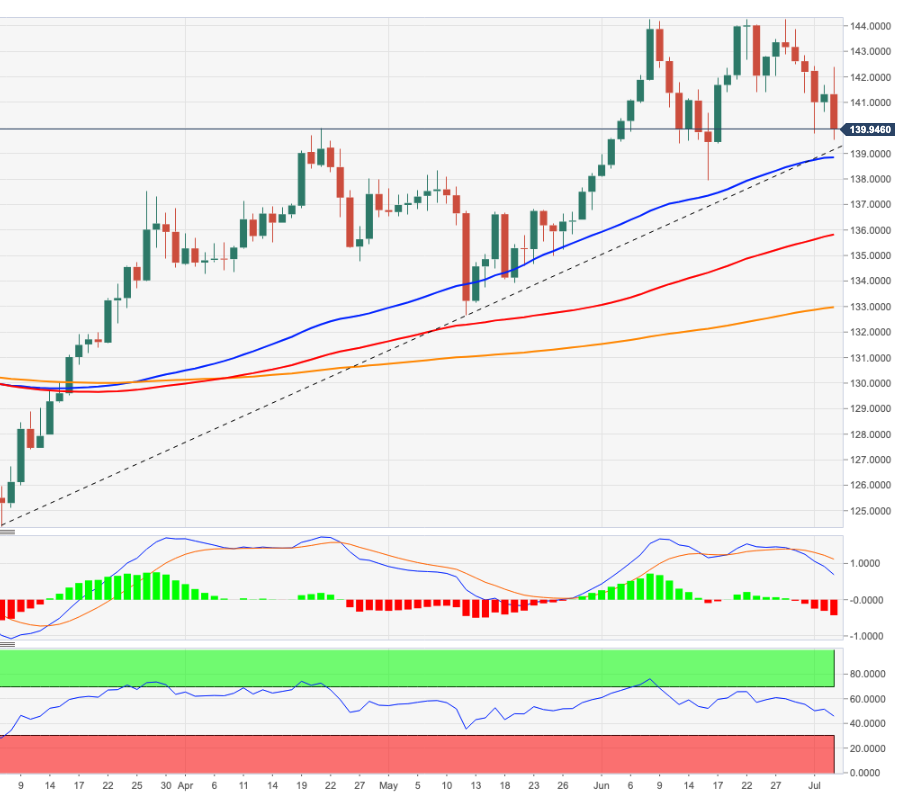
- EUR/JPY resumes the downside following the EUR sell-off.
- The near-term outlook could shift to negative below 139.25.
EUR/JPY quickly fades Monday’s uptick and breaks below the 140.00 mark to record new 3-week lows.
If the selling pressure accelerates, it could challenge the current short-term bullish bias. That said, if the cross breaches the 4-month support line near 139.25, it could open the door to a deeper pullback to, initially, the 55-day SMA, today at 138.80 prior to the June low at 137.83 (June 16).
In the longer run, the constructive stance in the cross remains well propped up by the 200-day SMA at 132.94.
EUR/JPY daily chart
FX option expiries for July 5 NY cut at 10:00 Eastern Time, via DTCC, can be found below.
- EUR/USD: EUR amounts
- 1.0450 764m
- 1.0500-05 600m
- 1.0520 357m
- 1.0570 235m
- 1.0600 508m
- GBP/USD: GBP amounts
- 1.22280 231m
- USD/JPY: USD amounts
- 134.95-00 1.44b
- 135.40-45 338m
- 136.05 265m
- 136.40 235m
- 136.75 240m
- 137.00 1.68b
- AUD/USD: AUD amounts
- 0.6850 204m
- 0.6875 290m
- 0.7030 316m
According to FX Strategists at UOB Group Quek Ser Leang and Peter Chia, further decline looks likely in NZD/USD in the near term.
Key Quotes
24-hour view: “NZD consolidated yesterday and closed little change at 0.6209 (+0.06%). Momentum indicators are mostly neutral and NZD is likely to continue to consolidate. Expected range for today, 0.6190/0.6245.”
Next 1-3 weeks: “Our latest narrative was from last Thursday (30 Jun, spot at 0.6220) where NZD could drop below 0.6200 but it has to close below this solid support before further sustained decline is likely. On Friday, NZD cracked 0.6200, plunged to 0.6150 before staging a strong rebound to close at 0.6205. While further NZD weakness is not ruled out, downward momentum is beginning to wane and the chance for NZD to break below 0.6150 is not high. On the upside, a breach of 0.6280 (no change in ‘strong resistance’ level) would indicate that NZD is unlikely to weaken further.”
- USD/JPY gained traction for the second straight day, though the intraday uptick ran out of steam.
- A turnaround in the risk sentiment benefitted the safe-haven JPY and capped the upside for the pair.
- The Fed-BoJ policy divergence should limit the downside ahead of the FOMC minutes on Wednesday.
The USD/JPY pair struggled to capitalize on the intraday positive move and met with some supply near the 136.35 region on Tuesday. Spot prices surrendered a major part of the early gains and retreated to the 135.70-135.65 region during the first half of the European session.
The initial optimism led by reports that US president Joe Biden was leaning toward a decision to ease tariffs on goods from China faded rather quickly amid the worsening economic outlook. Investors remain concerned that rapidly rising interest rates and tightening financial conditions would pose challenges to global economic growth. Apart from this, the ongoing Russia-Ukraine war and the COVID-19 outbreak in China have been fueling recession fears. This, in turn, led to a fresh leg down in the equity markets, which offered some support to the safe-haven Japanese yen.
The anti-risk flow dragged the US Treasury bond yields back closer to a multi-week low touched on Friday, narrowing the US-Japan rate differential. This was seen as another factor that benefitted the JPY and acted as a headwind for the USD/JPY pair. The downside, however, remains cushioned amid the divergent monetary policy stance adopted by the Bank of Japan (BoJ) and the Federal Reserve. It is worth recalling that the BoJ has repeatedly signalled that it would stick to its ultra-accommodative policy and pledged to keep borrowing costs at "present or lower" levels.
In contrast, Fed Chair Jerome Powell last week reaffirmed bets for more aggressive rate hikes and said that the US economy is well-positioned to handle tighter policy. Hence, the market focus will remain glued to the FOMC meeting minutes on Wednesday. Apart from this, Friday's release of the closely-watched US monthly jobs report (NFP) will play a key role in influencing the near-term USD price dynamics. This, in turn, should help determine the next leg of a directional move for the USD/JPY pair. In the meantime, traders might refrain from placing aggressive bets.
Technical levels to watch
“The UK and global outlook deteriorated materially,” the Bank of England (BOE) said in its latest biannual Financial Stability Report (FSR) published on Tuesday.
Additional headlines
Will increase counter-cyclical capital buffer rate to 2% in July 2023.
Ukraine war key to global and UK outlook.
Significant risk of further disruption in commodity markets.
2022 bank stress test will start in sept, results due mid-2023.
Will conduct in-depth analysis into commodity market vulnerabilities.
Risky assets still vulnerable to sharp adjustments.
Liquidity deteriorated in the US Treasury, UK gilt and rate future markets.
Conditions in core UK markets could worsen further, especially if volatility rises.
Risks remain around China property sector.
Falling crypto markets expose vulnerability but not stability risk overall.
UK banks can weather severe economic outcomes.
Stands ready to vary CCYB rate in either direction.
There will be separate stress test of misconduct costs.
Investor confidence in certain stablecoins has weakened significantly.
UK house price growth expected to slow later in 2022 and 2023.
Market reaction
GBP/USD is deep in the red this Tuesday, as recession risks mount on soaring natural gas prices. The BOE report will only add to the pain in the pound.
The spot is currently trading at 1.2041, down 0.51% on a daily basis.
EUR/USD has pierced through key supports and touched its weakest level since December 2002 near 1.0300. The pair eyes 1.0260 as next target, FXStreet’s Eren Sengezer reports.
Negative shift witnessed in risk sentiment to hurt the euro
“The next bearish target for the pair aligns at 1.0260 but the oversold conditions suggest that there could be a technical correction before the next leg lower.”
“In case safe-haven flows continue to dominate the financial markets following Wall Street's opening bell, the pair is likely to stay under bearish pressure.”
- GBP/USD witnessed fresh selling on Tuesday and was pressured by a combination of factors.
- Aggressive Fed rate hike bets and recession fears lifted the safe-haven USD to a 20-year peak.
- Brexit woes, expectations for a cautious BoE weighed on the GBP and contributed to the fall.
The GBP/USD pair came under some renewed selling pressure during the early European session on Tuesday and dived to a two-day low, just below mid-1.2000s in the last hour.
Following the overnight brief pause, the US dollar caught aggressive bids and rallied to a fresh 20-year peak amid the prospects for more aggressive rate hikes by the Fed. The bets were reaffirmed by Fed Chair Jerome Powell's remarks last week, saying that the US economy is well-positioned to handle tighter policy. Apart from this, a turnaround in the global risk sentiment provided an additional boost to the safe-haven greenback, which, in turn, exerted some downward pressure on the GBP/USD pair.
The latest optimism over reports that US president Joe Biden was leaning toward a decision on easing tariffs on goods from China fizzled out rather quickly amid the worsening economic outlook. Investors remain concerned that rapidly rising interest rates and tightening financial conditions would pose challenges to global economic growth. This, along with the ongoing Russia-Ukraine war and the COVID-19 outbreak in China, has been fueling recession fears and continued weighing on investors' sentiment.
The British pound was further pressured by concerns that the UK government's controversial Northern Ireland Protocol Bill could trigger a trade war with the European Union amid the cost of living crisis. Apart from this, expectations that the Bank of England would adopt a gradual approach toward raising interest rates should act as a headwind for sterling. The fundamental backdrop supports prospects for a further depreciating move for the GBP/USD pair and a slide back towards challenging the YTD low.
Market participants now look forward to the release of the BoE's Financial Stability Report. This will be followed by BoE Governor Andrew Bailey's press conference, which will influence the GBP price dynamics and provide some impetus to the GBP/USD pair. Traders will further take cues from the broader market risk sentiment and the USD price dynamics to grab short-term opportunities around the major.
Technical levels to watch
The German Retail Association maintained the nominal 2022 outlook of 3% sector growth, expecting a 2% contraction in the real term due to rising inflation.
Key details
“Blamed rising inflation and energy costs and poor consumer sentiment for the outlook.”
“Brick-and-mortar turnover would grow 1.4% in nominal terms and online retail 12.4%. Total turnover would hit 607.1 billion euros.”
"Rising inflation is massively affecting shoppers."
Market reaction
The above report accentuates concerns over a likely recession in the euro area, smashing EUR/USD to the weakest level in 20 years at 1.0301. The pair is down over 1% on the day.
The European natural gas price has risen sharply since mid-June because gas flows from Russia have been reduced. The gas price could well climb further, in the view of strategists at Commerzbank.
Strike in the Norwegian oil and gas industry
“Annual maintenance of the Nord Stream pipeline is scheduled to begin at the start of next week. During this time, gas flows will come to a complete standstill for ten days. It is doubtful whether Russia will supply more gas via the other pipelines instead. The concern is rather that gas shipments may be even further reduced or not even resumed at all following the maintenance work. This would make it virtually impossible to replenish European natural gas stocks for next winter and would necessitate further-reaching political measures and cuts to gas consumption.”
“A decline in gas supply from Norway is looming in the near future. A strike in the oil and gas industry began there today that could paralyse around 13% of gas production, according to the Norwegian producers’ association. If the strike were to last any length of time, the already tight supply situation on the European gas market would further deteriorate, which we believe would cause the gas price to climb even further.”
- Gold Price edged lower for the second straight day and was pressured by a combination of factors.
- Aggressive Fed rate hike bets continued acting as a headwind amid signs of stability in the markets.
- Modest USD strength further weighed on the XAUUSD, though recession fears helped limit losses.
Gold Price edged lower for the second successive day on Tuesday and dropped back closer to the $1,800 mark through the early European session.
The Federal Reserve’s non-stop chatter about rate hikes to curb soaring inflation turned out to be a key factor that continued acting as a headwind for the non-yielding gold. In fact, Fed Chair Jerome Powell said last week that the US central bank remains focused on getting inflation under control and added that the US economy is well-positioned to handle tighter policy. Apart from this, signs of stability in the financial markets further weighed on the traditional safe-haven XAUUSD.
Reports that US president Joe Biden was leaning toward a decision on easing tariffs on goods from China offered a brief respite to nervous investors. That said, growing worries about a global recession should keep a lid on any optimistic move. Meanwhile, the risk-on flow pushed the US Treasury bond yields higher. This, along with hawkish Fed expectations, lifted the US dollar back closer to a two-decade high and exerted additional downward pressure on the dollar-denominated gold.
Despite the combination of negative factors, bearish traders seem reluctant to place aggressive bets and might prefer to wait for this week's key releases. The minutes of the latest FOMC monetary policy meeting are due on Wednesday and would be looked upon for fresh clues about the policy tightening path. Market participants will further take cues from Friday's release of the closely-watched US monthly jobs report (NFP). This will play a key role in influencing the near-term USD price dynamics and help investors to determine the next leg of a directional move for gold price.
Technical levels to watch
Pressured by the broad-based dollar strength, EUR/USD has extended its daily slide and touched its lowest level since December 2002 below 1.0340.
Developing story...
Here is what you need to know on Tuesday, July 5:
Following the three-day weekend in the US, the dollar started to gather strength against its rivals early Tuesday with the US Dollar Index approaching its highest level in nearly two decades above 105.50. The US economic docket will feature Factory Orders data for May. The 10-year US Treasury bond yield is up nearly 1% in the early European session, helping the greenback find demand. In the meantime, US stock index futures are up modestly, pointing to a slightly upbeat market mood. Later in the day, the Bank of England will release its Financial Stability Report.
The Wall Street Journal reported on Monday that US President Biden's administration planning to roll back some tariffs on Chinese imports in an attempt to ease inflationary pressures. Meanwhile, the data from China showed that the Caixin Services PMI rose sharply to 54.5 in June from 41.4 in May, surpassing the market expectation of 47.3 by a wide margin.
Earlier in the day, the Reserve Bank of Australia (RBA) announced that it hiked its policy rate by 50 basis points (bps) to 1.35% from 0.85%. This decision came in line with the market expectation but the RBA's neutral tone on policy outlook made it difficult for the AUD/USD pair to gather bullish momentum. The RBA said that medium-term inflation expectations remain well-anchored and noted that the size and timing of future rate increases will depend on data. As of writing, AUD/USD was down 0.8% on the day at 0.6810.
EUR/USD stays under heavy bearish pressure early Tuesday and trades deep in negative territory below 1.0400. European Central Bank (ECB) Governing Council member Madis Muller and ECB Vice President Luis de Guindos both said on Monday that a 25 bps rate hike in July would be appropriate.
GBP/USD closed the first day of the week virtually unchanged but turned south in the European morning. The pair was last seen trading below 1.2100.
In its quarterly survey, the Bank of Canada (BOC) said that the 1-year-ahead consumer inflation expectations jumped to 6.8% from 2.2%. "Survey shows concern over near-term inflation has increased and inflation is expected to run higher for longer than the previous survey," the BOC said. After having posted small daily losses on Monday, the USD/CAD pair is recovering toward 1.2900 on Tuesday.
Supported by rising US yields, USD/JPY climbed above 136.00 on Tuesday. In the early Asian session, the data from Japan showed that the business activity in the service sector continued to expand at a healthy pace in June with the Jibun Bank Services PMI arriving at 54.
Gold failed to make a decisive move in either direction and continue to move sideways in a tight range above $1,800 early Tuesday.
Bitcoin staged a rebound on Monday and managed to reclaim $20,000. Ethereum gained more than 7% on Monday and was last seen rising 1% on the day at $1,160.
- NZD/USD attracted fresh selling on Tuesday and weakened back below the 0.6200 mark.
- The formation of a descending trend-channel point to a well-established bearish trend.
- Negative technical indicators on hourly/daily charts support prospects for further losses.
The NZD/USD pair witnessed some selling during the early European session and extended the overnight retracement slide from the 0.6250-0.6255 supply zone. Spot prices dropped back below the 0.6200 round-figure in the last hour and remain vulnerable to slide further.
Looking at a slightly broader picture, the NZD/USD pair has been trending lower along a descending channel extending from mid-June, which points to a well-established short-term bearish trend. The negative bias is reinforced by the fact that oscillators on the daily chart are holding deep in the bearish territory and have been struggling to gain any meaningful traction on hourly charts.
The technical set-up seems tilted firmly in favour of bearish traders and supports prospects for an extension of the recent depreciating move. Hence, a subsequent slide back towards the YTD low, around the 0.6150-0.6145 region touched last Friday, remains a distinct possibility. Bears might eventually aim to challenge the lower end of the descending channel, near the 0.6120 area.
A convincing break through the channel support, leading to some follow-through weakness below the 0.6100 round-figure mark would be seen as a fresh trigger for bearish traders. This, in turn, would set the stage for additional losses and make the NZD/USD pair vulnerable to prolonging the downward trajectory towards the 0.6000 psychological mark.
On the flip side, any meaningful move back above the 0.6100 mark might continue to confront stiff resistance and remain capped near the 0.6150-0.6155 region. The said area coincides with the top boundary of the descending channel, which if cleared decisively would negate the near-term bearish bias. This might prompt a short-covering move and push the NZD/USD pair to the 0.6200 mark.
NZD/USD 4-hour chart
-637926036866003258.png)
Key levels to watch
The Bank of Israel (BoI) hiked rates a more aggressive 50 basis points (bps). Economists at ING expect the shekel to strengthen and forecast the USD/ILS pair at 3.30/20.
Bank Of Israel hikes 50 bps
“BoI’s lift takes the base rate to 1.25%. The BoI research department sees the policy rate being taken up to 2.75% in 1H23 – in line with market pricing.”
“Medium-term, we like the shekel and feel that when the major dollar trend does turn – perhaps towards the end of the year when Fed easing is priced more clearly – USD/ILS should return to the 3.20/30 area and perhaps go even lower next year.”
“This year's tech-wreck is not expected to hit the Israeli economy as hard as it did in 2000 – so thinks the BoI – and Israel's balance of payments position should improve later in the year.”
AUD/USD has been unable to advance on the back of the Reserve Bank of Australia’s (RBA’s) 50 bps rate hike. Amid global recessionary risks, economists at MUFG Bank expect the aussie to move downward.
RBA action fails to lift aussie
“RBA has taken the official policy rate to 1.35%, the highest since May 2019 and the first-ever back-to-back 50 bps hike. Around 40 bps of tightening is currently priced for the August meeting and 175 bps through the five remaining meetings this year. As is our view for the Fed and other major central banks, we do not expect the RBA to hike through the remainder of the year.”
“We maintain that risks for AUD are to the downside. The global growth outlook is deteriorating and the fact that AUD/USD is now lower on the day after a 50 bps rate hike underlines the potential over the near-term for renewed declines on global growth concerns.”
See: AUDUSD to remain under pressure for now as recession fears linger – Commerzbank
USD/CHF traded down to a 0.9495 low. Benjamin Wong, Strategists at DBS Bank, expects the pair to regain poise and trend higher.
Another leg higher
“The recent decline to 0.9495 lows is deemed corrective, and USD is poised to complete another leg higher.”
“Recovering through 0.9732, 0.9815 can have the USD pull a Fibonacci retracement into 0.9919.”
It has been another volatile month for the lira. The lira weakened throughout most of June hitting an intra-day high of 17.445 before staging a sharp rebound at the end of the month. Economists at MUFG Bank expect the TRY to suffer further downward pressure.
TRY weakness undermining confidence in Turkiye’s public finances
“Turkiye’s banking regulator will restrict commercial lira loans to corporate borrowers if they hold more than TRY15 million in foreign currencies and if the amount exceeds 10% of total assets or annual sales. It will encourage companies to reduce exposure to foreign assets/currencies in order to access new credit in lira and the flows will provide more support for the lira. However, the new policy measures alone will not be sufficient to trigger a more sustained reversal of the lira weakness.”
“Turkiye will continue to run inappropriately loose monetary policy that has played a key role in undermining confidence in the lira. Turkiye has limited scope to support the lira through intervention reinforcing the bearish trend.”
“The Ukraine conflict has reinforced upside inflation risks, and at the same time is resulting in Turkiye recording wider current account deficits that increase downward pressure on the lira.”
- GBP/JPY shot back above the 165.00 mark amid the offered tone surrounding the safe-haven JPY.
- Brexit woes, expectations for a less hawkish BoE to hold back bulls from placing aggressive bets.
- Traders eye the final UK Services PMI for some impetus ahead of BoE’s Financial Stability Report.
The GBP/JPY cross gained traction for the second successive day on Tuesday and climbed to a two-day high during the early European session. The momentum pushed spot prices further beyond the 165.00 mark and was sponsored by the prevalent selling bias surrounding the Japanese yen, though lacked follow-through.
Despite growing worries about a global recession, reports that US president Joe Biden was leaning toward a decision on easing tariffs on goods from China offered a brief respite to nervous investors. This was evident from a generally positive tone around the equity markets, which undermined demand for traditional safe-haven assets. Apart from this, a big divergence in the monetary policy stance adopted by the Bank of Japan and other major central banks further drove flows away from the JPY. The combination of factors acted as a tailwind for the GBP/JPY cross, though domestic issues could act as a headwind for the British pound and keep a lid on any meaningful gains.
Investors seem concerned that the UK government's controversial Northern Ireland Protocol Bill could trigger a trade war with the European Union amid the ongoing cost of living crisis. Apart from this, expectations that the Bank of England would adopt a gradual approach towards raising interest rates amid growing recession fears might hold back traders from placing bullish bets around sterling. The fundamental backdrop makes it prudent to wait for strong follow-through buying before positioning for any further appreciating move for the GBP/JPY. Market participants now look forward to the final UK Services PMI for some impetus ahead of the BoE's Financial Stability Report.
This, along with BoE Governor Andrew Bailey's press conference about the report, will influence the GBP price dynamics. Traders will further take cues from the broader market risk sentiment to grab short-term opportunities around the GBP/JPY cross.
Technical levels to watch
The rand has fallen towards year-to-date lows against the US dollar. In the view of economists at MUFG Bank, ZAR is vulnerable to further weakness in the coming months amid unfavourable external backdrop.
Negative external backdrop offset support from domestic developments
“Elevated energy and food prices are triggering demand destruction which is now starting to weigh down more on prices. At the same time, the rand has been undermined by ongoing hawkish repricing of Fed rate hike expectations.”
The Fed has delivered a much stronger policy signal that it will raise rates further into restrictive territory in order to dampen upside inflation risks even if it results in a more notable slowdown for the US economy. It is creating an unfavourable external backdrop for the rand which leaves it vulnerable to further weakness in the coming months.”
“The negative external backdrop has more than offset support for the rand from domestic developments. South Africa’s economy expanded more strongly at the start of this year by 1.9% in Q1 although worsening power shortages are currently increasing downside risks to growth. Inflation has also surprised to the upside jumping above the top of the SARB’s target band between 3.0% and 6.0% to 6.5% in May.”
The rouble has continued to strengthen sharply against the US dollar resulting in USD/RUB falling to the lowest level since the middle of 2015. Capital controls and higher energy prices are set to continue propelling the RUB, economists at MUFG Bank report.
RUB has benefitted from record current account surpluses while outflows restricted
“The sharp strengthening of the rouble appears to be creating more concern amongst domestic policymakers. It has been reported that Russian officials are considering ways to dampen upward pressure on the rouble including a further loosening of rules on currency operations for companies active abroad and allowing more access to foreign exchange for households and businesses at home. Another method would be to set up a new budget rule to sterilize windfall budget revenues.”
“The CBR has now fully reversed the 10.5 point emergency rate hike delivered at the end of February when the Ukraine conflict first started. It reflects confidence from the CBR that the inflation outlook will improve significantly in the coming years supported by the sharp strengthening of the rouble.”
“The rouble will remain subject to upward pressure while capital controls remain in place to limit outflows, and Russia’s export revenues are boosted by higher energy prices.”
Inflation in Switzerland is accelerating. Therefore, the Swiss National Bank (SNB) is set to tolerate franc appreciation. Economists at Commerzbank consider EUR/CHF levels close to parity as justified.
Upside scope in EUR/CHF is likely to be limited
“The inflation rate in Switzerland has climbed above the 3% mark in June. Other central banks would welcome such a level. However, for the SNB it is sufficient reason to show concern about price developments. And that is correct as it is pursuing an inflation target of 0-2%, but inflation has been above this target level for some time now.”
“The important drivers for inflation remain import goods, but prices for domestic goods are also rising increasingly quickly. The SNB’s concerns that there might be second-round effects, therefore, do not seem too far-fetched so further monetary policy tightening over the coming months might become necessary. We are likely to hear comments of this nature from board members of the SNB in the near future and that is likely to support the franc principally.”
“While the risk scenario energy crisis is putting pressure on EUR, EUR/CHF levels close to parity seem justified.”
“High inflation levels suggest that the SNB is more likely to be prepared to tolerate franc appreciation than depreciation. That means upside scope in EUR/CHF is likely to be limited.”
- AUD/USD remains pressured around intraday low, fades the previous day’s rebound from yearly low.
- RSI retreat, bearish MACD signals keep sellers hopeful of breaking immediate support line.
- Bulls need validation from late June swing high, bears can aim the yearly low.
AUD/USD holds onto the day-start bearish bias as sellers attack the two-day-old support line heading into Tuesday’s European session. That said, the Aussie pair remains depressed at around 0.6860 by the press time.
The quote’s weakness could be linked to its failure to cross the 200-HMA, as well as the bearish MACD signals. Additionally, lower high formations since the last week and a downward sloping RSI (14) from the overbought area also keep sellers hopeful.
That said, the AUD/USD pair’s latest weakness needs validation from the aforementioned support line, at 0.6855 by the press time, to direct the pair towards the yearly low marked in the last week around 0.6765.
Should the quote remains bearish past 0.6765, a downward sloping support line from late January, near 0.6755, will act as an extra filter to the south before giving control to the AUD/USD bears.
On the contrary, a successful break of the 200-HMA, around 0.6890, won’t be enough to recall the AUD/USD buyers as the 61.8% Fibonacci retracement of June 16 to July 01 declines, near 0.6950, acts as the key hurdle to forecast further upside.
In a case where the AUD/USD prices remain firmer past 0.6950, the odds of witnessing a run-up towards the 0.7000 psychological magnet can’t be ruled out.
AUD/USD: Hourly chart
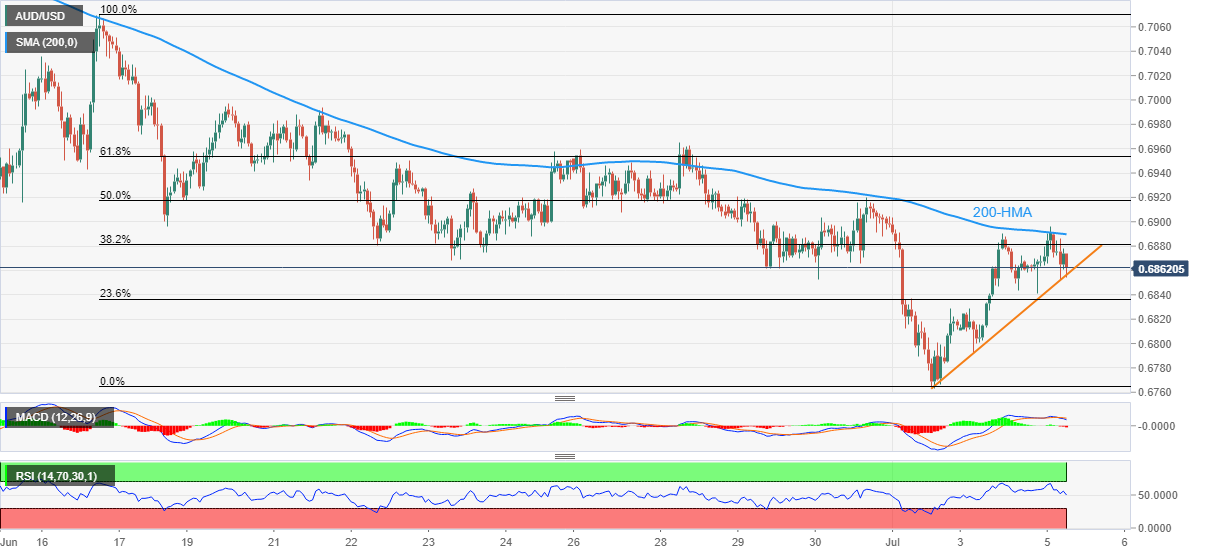
Trend: Bearish
If a recession results from the scarcity of commodities and supply problems, it will not push down inflation, on the contrary, as it will be accompanied by a sharp rise in commodity prices. Central banks would then face their worst-case scenario: a recession linked to very high inflation, economists at Natixis report.
Household savings rate is falling and corporate profit margins are high
“Because the household savings rate is falling, which, in the United States, is linked above all to household credit growth, and given high corporate profit margins, a recession due to a fall in consumption or investment is unlikely.”
“But we can imagine a recession due to scarcities: hiring difficulties for companies, energy shortages, shortages of other commodities, insufficient production capacity in transport and semiconductors. This scarcity-induced recession would then be accompanied by high inflation, not disinflation, which would be a worst-case scenario for central banks: recession and high inflation.”
The Reserve Bank of Australia (RBA) raised its cash rate by 50 basis points (bps) to 1.35% as it moves to tame strengthening inflation. As the rate decision did not entail any surprises, the aussie was unable to benefit. Economists at Commerzbank expect the Australian dollar to remain under pressure for now.
RBA plays its cards close to its chest
“A 50 bps rate hike had been expected and that is exactly what the RBA delivered. The RBA expects inflation to peak later on in the year. As far as future monetary policy is concerned the RBA once again is playing its cards close to its chest. Even though it will normalise monetary policy further over the coming months, extent and timing depend on future data developments though. The RBA does not want to commit more clearly.”
“It can be expected that also over the coming months the RBA will tighten its monetary policy in a controlled manner, not too much and not too little. However, that is unlikely to be sufficient for AUD and AUD is unlikely to receive support on this front.”
“The aussie is likely to be largely driven by external factors such as the prospects for economic developments in China and market sentiment. As recession fears are likely to continue for some time, AUD is likely to remain under pressure for now.”
In the opinion of FX Strategists at UOB Group Quek Ser Leang and Peter Chia, AUD/USD’s probability of a decline to the 0.6760 region now looks diminished.
Key Quotes
24-hour view: “Yesterday, AUD rose to a high of 0.6887 before closing at 0.6868 (+0.75%). The underlying tone has improved somewhat and AUD could advance from here. That said, any advance is unlikely to challenge the strong resistance at 0.6920 (there is another resistance at 0.6900). On the downside, a breach of 0.6830 (minor support is at 0.6850) would indicate that the mild upward bias has dissipated.”
Next 1-3 weeks: “Our latest narrative was from last Thursday (30 Jun, spot at 0.6880), where AUD could break 0.6860. We indicated that the next support is at 0.6830. While our view for AUD to weaken was not wrong, we did not expect the price actions on Friday where AUD plummeted to 0.6764 before rebounding sharply. While there is room for further AUD weakness, the probability for AUD to move below 0.6764 is not high. Overall, only a break of 0.6920 (‘strong resistance’ level previously at 0.6940) would indicate that the weakness in AUD has run its course.”
- EUR/USD reverses the recent downside and retests 1.0450.
- The greenback looks offered following Monday’s US holiday.
- Final June Services PMIs are due in the euro area.
The single currency leaves behind part of the recent weakness and lifts EUR/USD to the area of 1.0450, where some initial resistance turns up.
EUR/USD up on risk appetite
EUR/USD manages to regain some composure and posts decent gains after two consecutive daily pullbacks on Tuesday.
The uptick in the pair comes on the back of the renewed buying interest in the risk complex, which at the same time is reinforced by higher US yields vs. some mild downside seen in the German 10y bund yields.
Price action around the shared currency is also seen within a range bound theme in the next session ahead of the release of the ECB Accounts on Thursday and key US data at the end of the week.
In the domestic docket, the final Services PMIs for the month of June are due, whereas Factory Orders will take centre stage across the pond later in the session.
What to look for around EUR
EUR/USD remains under pressure and still unable to gather serious upside traction, another proof that sellers remain well in control of the sentiment surrounding the European currency for the time being.
Indeed, the pair is still far away from exiting the woods and it is expected to remain at the mercy of dollar dynamics, geopolitical concerns, fragmentation worries and the Fed-ECB divergence.
Among positives for the euro can be found, however, in higher German yields, persistent elevated inflation in the euro area and a decent pace of the economic recovery in the region. Collaborating with this view also appears the generalized hawkish chatter around ECB’s rate-setters.
Key events in the euro area this week: Germany, EMU Final Services PMI (Tuesday) – Germany Construction PMI, EMU Retail Sales (Wednesday) – ECB Accounts (Thursday) – ECB Lagarde (Friday).
Eminent issues on the back boiler: Fragmentation risks. Kickstart of the ECB hiking cycle in July? Asymmetric economic recovery post-pandemic in the euro bloc. Impact of the war in Ukraine on the region’s growth prospects and inflation.
EUR/USD levels to watch
So far, spot is gaining 0.13% at 1.0431 and a break above 1.0615 (weekly high June 27) would target 1.0773 (monthly high June 9) en route to 1.0786 (monthly high May 30). On the other hand, immediate contention emerges at 1.0382 (weekly low June 30) seconded by 1.0358 (monthly low June 15) and finally 1.0348 (2022 low May 13).
A recession is coming at some point. Given that the Federal Reserve, therefore, will have to cut rates, the US dollar is unlikely to fully benefit from higher interest rates at present, economists at Commerzbank report.
Interest rates to rise significantly in the US short-term
“Interest rates will continue to rise significantly in the US short-term because high inflation levels are the more urgent issue at present.”
“The prospect of a US recession and the resulting prospects of Fed rate cuts next year are the reason why we think that the USD will not be able to fully benefit from higher interest rates.”
“The subject of a recession does not only affect the US. There are also economic concerns in the UK, in the eurozone or in China. This is dampening sentiment on the financial markets and usually USD is able to benefit from periods like that. That means recession fears regarding the US are not necessarily USD-negative. It depends on whether the risk of a recession is also seen for the rest of the world (at least for the major economies).”
India's gold imports in June grew roughly threefold from a year ago as the XAUUSD price corrected sharply, a government source cited by Reuters on Tuesday.
Also read: Gold Price Forecast: Recovery appears limited by $1,821, with death cross in play
Key takeaways
Jewellers replenished inventories after robust sales during a key festival.
The country had imported 49 tonnes of gold in June, compared with 17 tonnes a year earlier.
In value terms, June imports surged to $2.61 billion from $969 million a year ago.
India's gold imports still dropped to 335 tonnes in the first half of 2022 from 493 tonnes last year.
On Friday, the country’s Finance Ministry announced that they increased the import tax on gold from 10.75% to 15% in response to an increase in gold imports that placed pressure on the current account deficit (CAD). The move was directed at lifting the bearish pressure on the Indian rupee.
- Copper Price remains pressured around multi-month low despite market’s cautious optimism.
- Fears of economic slowdown, higher production and central banks’ aggression exert downside pressure.
- US-China dialogue favor hopes of American removal of Trump-era tariffs but expectations of no major impact on inflation tame optimism.
Copper Price stays depressed near the lowest levels since February 2021, down for the fourth consecutive day at around $3.56 while heading into Tuesday’s European session. It should be noted that the three-month copper futures on the London Metal Exchange dropped 0.50% to $7,973 whereas the most-traded August copper contract in Shanghai fell 0.6% to 60,870 yuan ($9,094.58) a tonne by the press time.
In doing so, the red metal justifies the market’s inability to cheer the expectations of the US removal of Trump-era tariffs from China. The challenge to risk-aversion could be linked to the comments from Chinese Vice Premier Liu He suggests an improvement in the US-China trade ties, at least for now, which in turn favored the market sentiment previously. “The two agreed to need to strengthen communication & coordination of macroeconomic policies between China and the US,” said the macro update conveying telephonic talks between China’s Liu He and US Treasury Secretary Janet Yellen.
Also likely to have probed the metal bears were headlines suggesting China’s readiness to put aside 500 billion yuan ($74.69 billion) to spur infrastructure spending, as well as upbeat prints of China’s Caixin Services PMI for June.
However, expectations that such an act by the US won’t be able to ease the supply chain constraints, and hence may not be effective in taming inflation, appear to have probed the risk-on mood of late.
Additionally, recession fears recently took clues from Europe as Italy declared a state of emergency amid the worst drought in 70 years. Further, Germany also flashed signals of economic hardships as energy companies struggle to pay gas prices after the Russia-Ukraine crisis.
That said, copper prices are likely to refresh the multi-month low amid fears of demand, as well as increasing supplies from Asia. However, the SMM news spots a supply crunch for copper ingredients called TC/RCs to hint at the metal’s rebound in the third quarter of 2022. “Demand for copper concentrate in Asia is likely to be supported in the third quarter by high margins and increased Chinese smelter capacity, while clean copper concentrate is expected to be in tight supply, putting downward pressure on TC/RCs charged on Chinese smelters,” said the latest SMM piece on copper.
Analysts at Barclays Research express their view on the expected US move to roll back tariffs on Chinese goods and its impact on inflation and the yuan.
Key quotes
The effect on US inflation is “a drop in the bucket,” and would likely be immaterial for monetary policy deliberations.
A partial removal of tariffs may result in an even smaller drag on inflation, closer to a few-tenths.
For the Chinese currency, the potential improvement in US-China trade relations is also “not a yuan supercharger.”
If tariffs were removed on both sides, China’s current account surplus would gain by about $90 billion.
Related reads
- S&P 500 futures jump nearly 1% as US set to rollback China tariffs to fight inflation
- US Treasury: Yellen-Liu virtual meeting was part of efforts to maintain open lines of communication
Gold Price is making headway to the north this Tuesday. However, recovery appears limited by $1,821, with death cross in play, FXStreet’s Dhwani Mehta reports.
XAUUSD eyes $1,821 on its road to recovery
“Acceptance above the falling trendline resistance at $1,821 is critical to unleashing the further upside, as the bearish 21-Daily Moving Average (DMA) at $1,830 will be next on buyers’ radar. Further up, the June 27 high at $1,841 will come into the picture.”
“With the death cross in play, any upswing in gold price is likely to remain short-lived. The 50 DMA cut the 200 DMA for the downside on Monday, flashing a bearish signal.”
“Gold bears need a daily close below the $1,800 mark to resume the downtrend towards the critical support at $1,785, below which $1,780 the figure will be probed.”
- USD/TRY remains on the front for the fourth consecutive day.
- An upward sloping trend line from late May favors buyers.
- Two-month-old previous support line adds to the upside filters.
USD/TRY extends the previous week’s rebound while portraying the four-day uptrend as buyers attack the 10-DMA hurdle surrounding 16.85 heading into Tuesday’s European session.
The recovery moves also take clues from the recently firmer RSI (14), as well as an upward sloping support line from May 23, around 16.60 by the press time.
However, the bearish MACD signals join the immediate DMA hurdle to test the upside momentum around 16.85.
In a case where USD/TRY rises past 16.85, the previous support line from May 05, close to $17.20, could challenge the pair buyers before directing them to the yearly high marked in May around 17.50.
Meanwhile, pullback moves could aim for the 16.60 support retest before the latest swing low surrounding 16.10.
Also likely to challenge the USD/TRY bears is the 16.00 threshold, a break of which could signal the pair’s further downside targeting 61.8% Fibonacci retracement level of May-June upside, near 15.77.
To sum up, USD/TRY remains on the upward trajectory but the bulls need to justify their strength.
USD/TRY: Daily chart
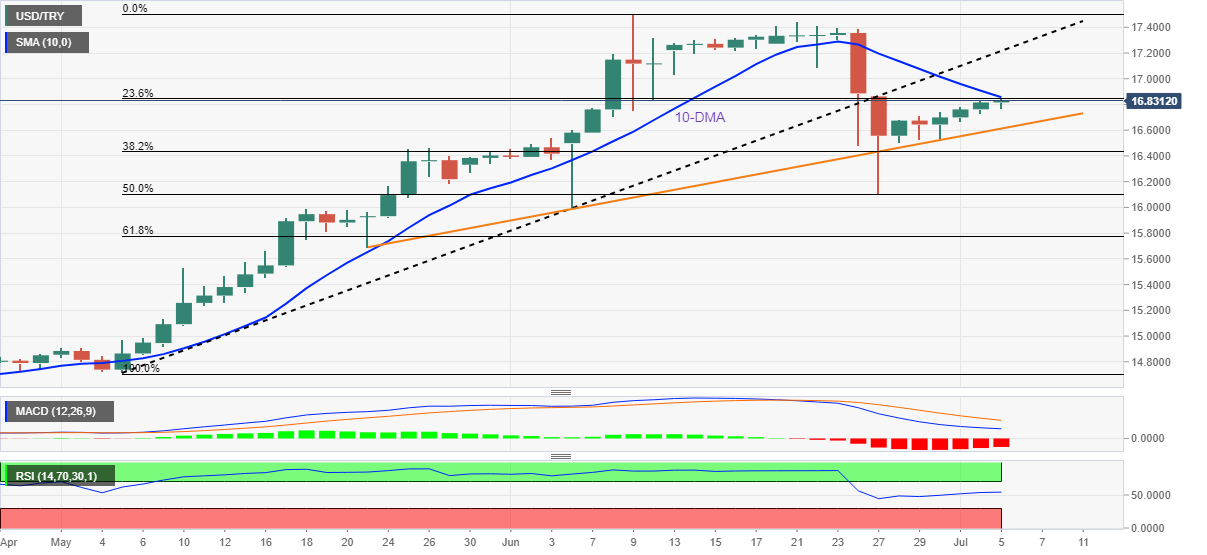
Trend: Further upside expected
- Steel prices have slipped to near 6.30 as investors weigh demand worries on monsoon arrival.
- The hard metal carries an inverse relationship with the monsoon season.
- The setup of China’s infrastructure fund may revive the demand for steel.
Steel prices have corrected in the Asian session after failing to surpass the critical hurdle of 6.40 amid the arrival of monsoon in 14 provinces across northern, central, and eastern China, and some other Asian countries. The season-sensitive asset is expected to extend its losses on a broader note as heavy rains will dampen the overall demand for steel.
For a longer period, steel prices are declining firmly as steel mill owners halted the production of steel. The steel mill owners halted steel production due to a significant slump in the overall demand and the stipulations of coping with the environmental restrictions.
On the demand side, the resumption of economic activities in China at its pre-pandemic levels may elevate the demand for steel. Earlier, the lockdown curbs in Shanghai and Beijing due to the resurgence of Covid-19 had halted economic activities forcefully. The Chinese economy adopted a zero-Covid policy to contain the pandemic, therefore restrictions on the movement of men, materials, and machines were extremely harsh.
Apart from that, China is expected to launch a state infrastructure investment fund that would be worth the Chinese Yuan (CNY) 500 billion ($74.69 billion) to boost infrastructure spending and to bring a revival to the flagging economy, as per Reuters. The usage of steel in infrastructure building remains extremely high and higher infrastructure development in the Chinese economy will spurt the demand for steel.
In the latest Gas Market Report, the International Energy Agency (IEA) warned that global natural gas demand growth is likely to contract slightly in 2022 and will continue it sluggish trend over the next three years.
The dire gas consumption outlook is based on the fact that Russia's war in Ukraine has pushed up prices and fuelled fears of further supply disruptions.
Key quotes
Today's record-high gas prices are depressing demand and causing some gas users to switch to coal and oil, while recent sharp cuts in Russian gas flows to Europe are raising alarms about supplies ahead of the winter.
The turmoil is damaging natural gas' reputation as a reliable and affordable energy source, casting doubts about the role it was expected to play in helping developing economies meet rising energy demand and transition away from more carbon-intensive fuels.
The recent developments have led to a considerable downward revision of gas' growth prospects.
Global gas demand is set to rise by a total of 140 billion cubic metres (bcm) between 2021 and 2025, less than half the amount forecast previously and smaller than the 170 bcm increase seen in 2021 alone.
- Gold prices struggle to cheer US dollar pullback aid firmer yields, fears of recession.
- US-China trade dialogue, hopes of easing Trump-era tariffs on China favor cautious optimism.
- US data, economic slowdown chatters could exert downside pressure on the metal if Fed Minutes appear hawkish.
Gold Price (XAU/USD) fades early Asian session strength, taking rounds to $1,810 after a downbeat start to the week during the pre-European session trading on Tuesday.
In doing so, the yellow metal prices portray the traders’ indecision even as the China-US dialogue appears to have favored the risk-on mood. That said, comments from Chinese Vice Premier Liu He suggests an improvement in the US-China trade ties, at least for now, which in turn favored the market sentiment previously. “The two agreed to need to strengthen communication & coordination of macroeconomic policies between China and the US,” said the macro update conveying telephonic talks between China’s Liu He and US Treasury Secretary Janet Yellen.
The recession fears recently took clues from Europe as Italy declared a state of emergency amid the worst drought in 70 years. Further, Germany also flashed signals of economic hardships as energy companies struggle to pay gas prices after the Russia-Ukraine crisis.
Elsewhere, strong US Treasury yields also hint at the market’s expectations of tighter monetary policies ahead, which in turn challenge the risk profile.
To sum up, the market’s cautious optimism fails to impress gold buyers, despite positing mild gains. Hence, today’s US Factory Orders for May, expected 0.5% versus 0.3%, as well as Wednesday’s Federal Open Market Committee (FOMC) Minutes and Friday’s US jobs report for June should be watched closely for clear directions.
Technical analysis
Gold Price grinds higher as the bullish MACD signals and sustained trading beyond the two-day-old support line keep buyers hopeful. However, repeated pullbacks from the 50% Fibonacci retracement of June 27 to July 01 downturn, around $1,813, tests the upside momentum.
Even if the quote manages to cross the $1,813 hurdle, a convergence of the 200-HMA, one-week-old descending trend line and 61.8% Fibonacci retracement level challenge the XAU/USD bulls around $1,820.
In a case where gold rises past $1,820, it can rally to the mid-June swing high near $1,857.
Alternatively, an immediate support line near $1,808 precedes the $1,800 threshold to restrict the short-term downside of the metal, a break of which could quickly drag the XAU/USD towards the recent swing low near $1,785.
Gold: Hourly chart
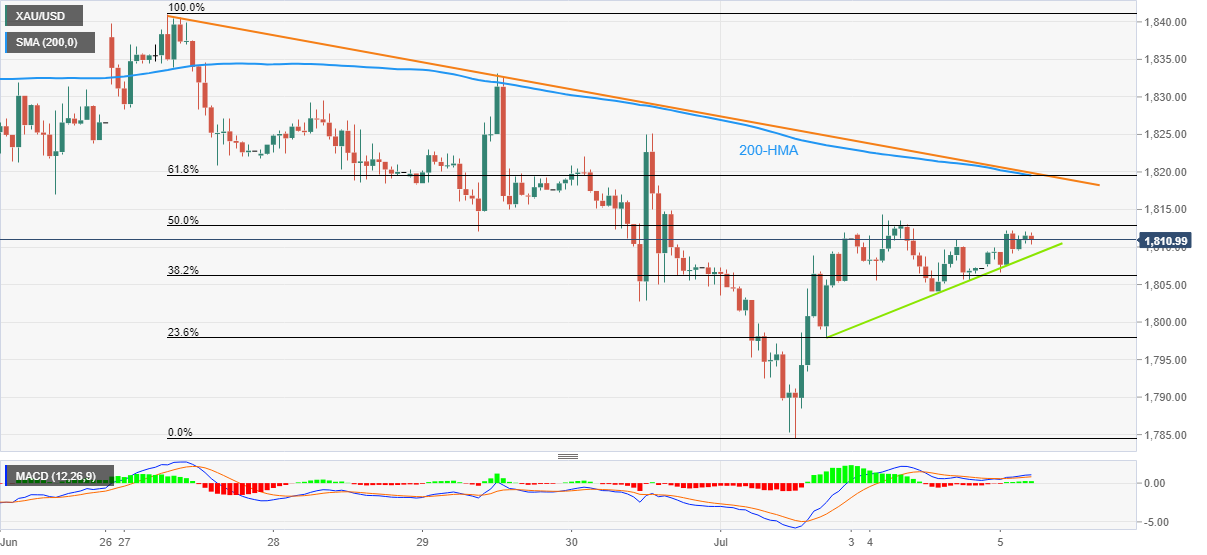
Trend: Limited recovery expected
Prospects for another test of 1.1976 in GBP/USD now looks out of favour for the time being, suggested FX Strategists at UOB Group Quek Ser Leang and Peter Chia.
Key Quotes
24-hour view: “The current movement in GBP is likely part of a consolidation phase. For today, GBP is likely to consolidate and trade between 1.2080 and 1.2175.”
Next 1-3 weeks: “We turned negative on GBP in the middle of last week. In our latest narrative from last Friday (31 Jul, spot at 1.2160), we highlighted that downward momentum is beginning to wane and a break of the ‘strong resistance’ at 1.2205 would indicate that 1.2040 is out of reach. We did not quite anticipate the sharp sell-off to 1.1976 and the subsequent strong rebound. Downward momentum has waned further and the chance for GBP to move below 1.1976 is not high. That said, only a break of 1.2205 (no change in ‘strong resistance’ level) would indicate that the weak phase has come to an end.”
- DXY exchanges gains with losses around 105.00.
- US yields resume the upside as US markets return to normality.
- May’s Factory Orders next on tap in the NA session.
The greenback, in terms of the US Dollar Index (DXY), trades without a clear direction around the 105.00 neighbourhood on turnaround Tuesday.
US Dollar Index looks weak amidst risk-on mood
The index trades virtually unchanged from Monday’s close just above the 105.00 mark, as US markets slowly return to the normal activity following Monday’s Independence Day holiday.
The dollar so far appears decoupled from the resumption of the upside bias in US yields, which look underpinned by the current sentiment favouring the risk-associated assets.
Further consolidation should not be ruled out around the buck in the next days in a week dominated by the publication of the FOMC Minutes on Wednesday and the release of June’s Nonfarm Payrolls on Friday.
Later in the NA session, Factory Orders for the month of May will be the sole release in the docket seconded by short-term Bill Auctions.
What to look for around USD
The continuation of the risk-on sentiment bolsters the lack of traction in the index, which remains side-lined around the 105.00 zone for the time being.
The dollar, in the meantime, remains well supported by the Fed’s divergence vs. most of its G10 peers (especially the ECB) in combination with bouts of geopolitical effervescence, higher US yields and a potential “hard landing” of the US economy, all factors suggesting a stronger dollar in the next months.
Key events in the US this week: Factory Orders (Tuesday) – MBA Mortgage Applications, Final Services PMI, ISM Non-Manufacturing, FOMC Minutes (Wednesday) – ADP Report, Initial Claims, Balance of Trade (Thursday) – Non-farm Payrolls, Unemployment Rate, Wholesale Inventories, Consumer Credit Change (Friday).
Eminent issues on the back boiler: Hard/soft/softish? landing of the US economy. Escalating geopolitical effervescence vs. Russia and China. Fed’s more aggressive rate path this year and 2023. US-China trade conflict. Future of Biden’s Build Back Better plan.
US Dollar Index relevant levels
Now, the index is down 0.05% at 105.09 and faces the next support at 103.67 (weekly low June 27) seconded by 103.41 (weekly low June 16) and finally 101.29 (monthly low May 30). On the other hand, a break above 105.54 (weekly high June 30) would expose 105.78 (2022 high June 15) and then 107.31 (monthly high December 2002).
- GBP/USD fails to cheer US dollar pullback amid Brexit fears, political woes at home.
- Labour Party steps back from Brexit rejections, UK PM Johnson struggles to defend position amid partygate scandal.
- US-China trade dialogue helps improve market sentiment, yields fail to propel USD.
- US Factory Orders, final readings of UK PMIs will be important for fresh impulse.
GBP/USD struggles to defend 1.2100 as pessimism surrounding Brexit and the UK politics weigh on the cable pair even as the US dollar retreat from a two-week high. That said, the quote remains directionless and awaits more clues heading into Tuesday’s London open.
With the Labour Party Leader Keir Starmer’s u-turn towards favoring Brexit, the hardships for the Tories during re-election will increase, if it all takes place. Also portraying the Brexit woes is the deadlock over the Northern Ireland Protocol (NIP).
Elsewhere, UK PM Boris Johnson is under immense pressure from all sides, be it from the opposition or the Tory rebels after the ‘partygate’ scandal. Recently, the British politicians are bracing for another attempt to oust the national leader by trying to alter the committee rules that previously defended Johnson.
On a broader front, comments from Chinese Vice Premier Liu He suggests an improvement in the US-China trade ties, at least for now, which in turn favored the market sentiment previously. “The two agreed to need to strengthen communication & coordination of macroeconomic policies between China and the US,” said the macro update conveying telephonic talks between China’s Liu He and US Treasury Secretary Janet Yellen.
On a different page, fears of recession join the Bank of England’s (BOE) inability to convince the Cable buyers to weigh on the GBP/USD prices.
Moving on, final readings of the UK’s June S&P Global month Composite PMI and Services PMI will entertain the pair traders before the Federal Open Market Committee (FOMC) Minutes and the US Jobs report for June. For intraday, the US Factory Orders for May, expected 0.5% versus 0.3%, could direct short-term traders.
Technical analysis
GBP/USD pair holds onto the previous day’s upside break of the weekly resistance, now support around 1.2090, to portray an inverse Head and Shoulders (H&S) formation. However, buyers need to cross the 1.2155 neckline hurdle to gain the market’s acceptance. Even so, the 200-HMA and the 61.8% Fibonacci retracement level of June 27 to July 01 downside, around 1.2200, appears a tough nut to crack for the bulls.
- USD/CAD has sensed offers around 1.2870 as the DXY is displaying a subdued performance.
- An underperformance is expected from the US and loonie region on the employment generation front.
- Oil prices are facing a correction however the broader context is bullish.
The USD/CAD pair has witnessed a rejection after attempting an upside break of the consolidation formed in a narrow range of 1.2846-1.2865 in the Tokyo session. The asset is facing barricades on higher levels as the US dollar index (DXY) is displaying a subdued performance in the Asian session.
The DXY displayed wild moves at the open after an extra-long weekend as on Monday US markets were closed on account of Independence Day. Therefore, a wide gyration by an asset after a long weekend cannot be ruled out as investors trim their positions vigorously.
Investors are keeping an eye on the release of the Federal Open Market Committee (FOMC) minutes on Wednesday. This will provide a detailed view of the 75 basis points (bps) rate hike announcement by the Federal Reserve (Fed) in June.
This week, the release of the labor market data from the US and Canada on Friday carries significant importance. A preliminary estimate for the job additions by the US economy in its labor market is 270k, much lower than the former release of 390k. While, the Canadian administration may have generated 22.5k, lower than the prior release of 39.8k.
Meanwhile, the oil prices have corrected after failing to kiss the psychological resistance of $110.00. Investors should not mix the minor correction with a bearish reversal as the latter needs more filters. On a broader note, the market participants are weighing the supply disruption as the OPEC cartel is unable to meet the reduced demand due to their production limiting capacity.
A probable drop to 1.0350 in EUR/USD seems to have been losing momentum, according to FX Strategists at UOB Group Quek Ser Leang and Peter Chia.
Key Quotes
24-hour view: “EUR consolidated between 1.0415 and 1.0462 yesterday before closing at little changed at 1.0421 (-0.07%). Momentum indicators are mostly neutral and EUR could continue to consolidate, likely within a range of 1.0410/1.0470.”
Next 1-3 weeks: “Our latest narrative was from last Friday (01 Jul, spot at 1.0475) where EUR could consolidate for a couple of days first before attempting to move towards 1.0350. EUR subsequently dropped to 1.0365 before rebounding. Downward momentum has slowed somewhat and the odds for EUR to move to 1.0350 have diminished. Note that 1.0385 and 1.0365 are both rather solid support now. Overall, only a break of 1.0500 (‘strong resistance’ level previously at 1.0535) would indicate that 1.0350 is out of reach this time round.”
- AUD/NZD retreats from intraday high, short-term key resistance line after the RBA’s rate increase.
- RBA matches wide market expectations of announcing a 50 bps rate hike.
- Steady RSI, bullish MACD signals keep buyers hopeful, 50-day EMA restricts immediate downside.
AUD/NZD tracks other Australia dollar (AUD) pairs while failing to cheer the RBA’s 0.50% rate hike during early Tuesday morning in Europe. In doing so, the cross-currency pair steps back from a two-week-old descending resistance line of late.
Reserve Bank of Australia (RBA) matched wide market expectations by announcing 50 basis points (bps) rate hike during its third attempt to battle inflation. That said, the benchmark rate rises to 1.35% after the rate increase.
Even if the quote eased back from the immediate resistance line near 1.1070, the steady RSI and bullish MACD signals keep AUD/NZD buyers hopeful until the pair stays beyond the 100-day EMA level of 1.0920.
However, a pullback towards the 50-day EMA level of 1.1000 can’t be ruled out.
In a case where the AUD/NZD pair drops below the 100-day EMA, the downward trajectory can aim for the 61.8% Fibonacci retracement (Fibo.) of March-May upside, around 1.0830, appear more likely.
On the contrary, a clear upside break of the 1.1070 resistance line can quickly trigger the run-up towards June’s peak of 1.1180.
Following that, the yearly high marked in May at around 1.1195 could lure the AUD/NZD bulls.
AUD/NZD: Daily chart
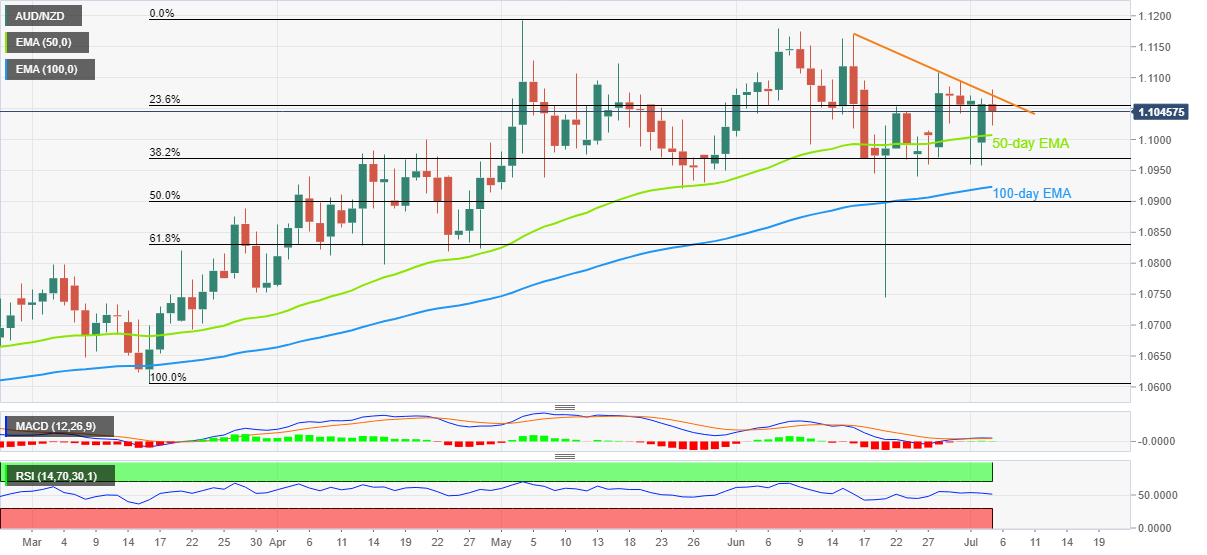
Trend: Further upside expected
- AUD/JPY has witnessed significant offers on a 50 bps rate hike by the RBA.
- The extent of the rate hike has remained in line with the estimates.
- The Official Cash Rate (OCR) has been elevated to 1.35%.
The AUD/JPY pair has slipped sharply below 93.40 as the Reserve Bank of Australia (RBA) has elevated its interest rates by 50 basis points (bps). The extent of the rate hike by the RBA has remained in line with the consensus. Officially, RBA Governor Philip Lowe has elevated the Official Cash Rate (OCR) to 1.35%.
Considering the soaring price pressures in the Australian economy, a rate hike was highly required. The inflation rate in the Australian economy jumped to 5.1% in the first quarter of CY2022. Soaring price pressures amid costly fossil fuels and food products are impacting the households in the economy.
Earlier, the risk barometer witnessed a minor correction after hitting a high of 94.00. Despite the release of the upbeat Caixin Services PMI, the aussie dollar faced correction. The economic data has landed at 54.5, extremely higher than the forecasts of 47.3 and the prior print of 41.4. It is worth noting that Australia is a leading exporter to China and better-than-expected China economic data is supportive for the antipodean.
On the Tokyo front, the continuation of an ultra-loose monetary policy by the Bank of Japan (BOJ) will weigh pressure on the yen bulls as other nations are suiting up for more rate hike announcements this month. The economy is facing the headwinds of soaring oil and food prices, which have elevated their plain-vanilla inflation rate but not the core Consumer Price Index (CPI).
- AUD/USD takes offers to refresh intraday low even as RBA announced 0.50% interest rate increase.
- Hopes of US-China trade deal join downbeat Treasury yields to portray cautious optimism.
- US dollar begins trading week on a back foot with eyes on Factory Order for June.
- Fed Minutes, US NFP appear as the week’s key events.
AUD/USD fails to cheer the Reserve Bank of Australia’s (RBA) interest rate hike as it drops nearly 30 pips towards 0.6850 after the announcement. The reason could be linked to the mostly priced-in news impacts.
That said, the quote’s latest weakness could also be linked to the RBA statement saying, “In Australia, inflation is high, but not as high as in many other countries.”
Elsewhere, comments from Chinese Vice Premier Liu He suggests an improvement in the US-China trade ties, at least for now, which in turn favored the market sentiment previously. “The two agreed to need to strengthen communication & coordination of macroeconomic policies between China and the US,” said the macro update conveying telephonic talks between China’s Liu He and US Treasury Secretary Janet Yellen.
Additionally, expectations surrounding Aussie-China Foreign Ministers’ meeting in Indonesia and upbeat China Caixin Services PMI also favored the AUD/USD prices before the RBA.
China’s Caixin Services PMI for June rallied past market consensus and previous readouts as it flashed 54.5 figure, compared to 47.3 forecasts and 41.4 prior.
While portraying the market’s mood, the US 10-year Treasury yields approach 3.0% level up 1.70% intraday by the press time, whereas the S&P 500 Futures rise 0.40% by extending the previous two-day upside near 3,850.
To sum up, AUD/USD traders appear unimpressed by the RBA’s 0.50% rate hike as it was widely expected. Hence, the intraday moves seek clues from the US Factory Orders for May, expected 0.5% versus 0.3%, ahead of Federal Open Market Committee (FOMC) Minutes and the US Jobs report for June.
Technical analysis
A pullback from the key hurdle surrounding 0.6900, comprising the 10-DMA and the 13-day-old descending trend line, challenge AUD/USD buyers.
On the contrary, a downward sloping support line from late January, near 0.6755 by the press time, could restrict short-term declines of the AUD/USD pair, even if it fails to keep the latest run-up beyond the 0.6900 resistance-turned-support.
Following are the key headlines from the July RBA monetary policy statement, via Reuters, as presented by Governor Phillip Lowe.
Board expects to take further steps in the process of normalising monetary conditions.
Inflation in Australia is also high, but not as high as it is in many other countries.
Board is committed to doing what is necessary to ensure that inflation returns to target over time.
Size and timing of future interest rate increases will be guided by data and assessment of the outlook for inflation and the labour market.
Strong demand, a tight labour market and capacity constraints in some sectors are contributing to the upward pressure on prices.
Inflation is forecast to peak later this year and then decline back towards the 2–3 percent range next year.
One source of ongoing uncertainty about the economic outlook is the behaviour of household spending.
Medium-term inflation expectations remain well anchored and it is important that this remains the case.
Recent spending data have been positive, although household budgets are under pressure from higher prices and higher interest rates.
Australian economy remains resilient and the labour market is tighter than it has been for some time.
Bank's business liaison program and business surveys continue to point to a lift in wages growth.
-
AUD/USD slides 30-pips on RBA’s priced-in 50 bps interest rate hike
At its July 5 monetary policy meeting, the Reserve Bank of Australia (RBA) board members decided to raise the official cash rate (OCR) by 50 basis points (bps) from 0.85% to 1.35%, as widely expected.
A Reuters poll of 33 economists showed the RBA will increase its cash rate by another 50 bps to 1.35% in July. One economist predicted a 25 bps hike.
AUD/USD reaction
The AUD/USD pair was little changed in an immediate reaction to the expected 50 bps RBA rate hike.
The delayed reaction, however, saw the aussie falling 20 pips to near 0.6865, down 0.05% on the day.
About RBA rate decision
RBA Interest Rate Decision is announced by the Reserve Bank of Australia. If the RBA is hawkish about the inflationary outlook of the economy and rises the interest rates it is positive, or bullish, for the AUD. Likewise, if the RBA has a dovish view on the Australian economy and keeps the ongoing interest rate, or cuts the interest rate it is seen as negative, or bearish.
- Silver extends the week-start recovery towards short-term key hurdle.
- 100-HMA, weekly resistance line challenge buyers amid bullish MACD signals.
- Nearby support line restricts immediate downside ahead of the multi-month low.
Silver Price (XAG/USD) remains on the front foot at around $20.10 during early Tuesday morning in Europe. In doing so, the bright metal rises towards the key $20.30 resistance confluence of late.
Bullish MACD signals and the metal’s ability to stay beyond the immediate support line, near $20.00, keeps the XAG/USD buyers hopeful of overcoming the key hurdle comprising the 100-HMA and one-week-old descending trend line.
Following that, a run-up towards the 200-HMA and 61.8% Fibonacci retracement of June 27 to July 01 downside, near $20.80, appears imminent.
If silver buyers keep reins past $20.80, the run-up could easily cross the $21.00 threshold to direct the upside towards the late June swing high near $22.00.
On the contrary, the aforementioned support line, at $20.00 now, could challenge silver sellers from retaking control.
In a case where the XAG/USD drops past $20.00, the recently refreshed two-year low, around $19.40, will be in focus ahead of the year 2020 peak surrounding $19.00.
To sum up, silver prices are likely to extend the latest recovery but need validation from $20.30.
Silver: Hourly chart
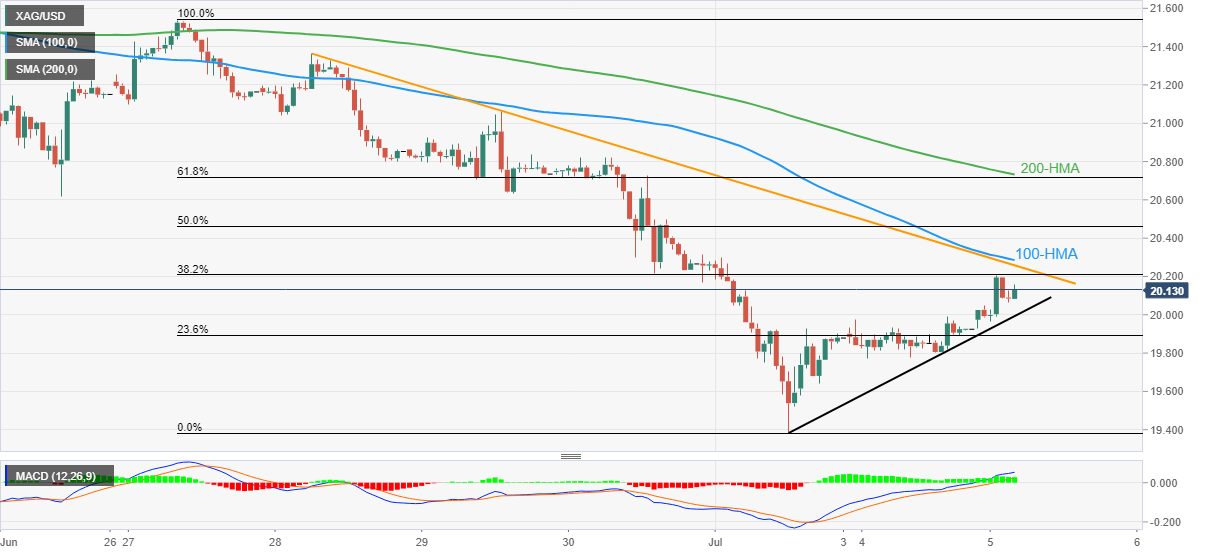
Trend: Limited upside expected
China is expected to launch a state infrastructure investment fund worth CNY500 billion ($74.69 billion) to boost infrastructure spending and revive a flagging economy, Reuters reported, citing two people with knowledge of the matter.
“China will issue 2023 advance quota for local government special bonds in the fourth quarter,” sources said.
- Asian equities trade mixed as fears of economic slowdown battles the US-China dialogue.
- Italy, Germany amplified recession woes amid concerns over energy, grain production, etc.
- Strong yields also challenge market sentiment amid fears of central banks’ aggression.
Market sentiment remains cautiously optimistic, even as equities flash mixed gains, during Tuesday’s Asian session amid headlines surrounding trade and economic transition.
The comments from Chinese Vice Premier Liu He suggests an improvement in the US-China trade ties, at least for now, which in turn favor the market sentiment. “The two agreed to need to strengthen communication & coordination of macroeconomic policies between China and the US,” said the macro update conveying telephonic talks between China’s Liu He and US Treasury Secretary Janet Yellen.
On the other hand, Italy declared a state of emergency amid the worst drought in 70 years. Further, Germany also flashed signals of economic hardships as energy companies struggle to pay gas prices after the Russia-Ukraine crisis.
In addition to the fears of the recession, strong US Treasury yields also hint at the market’s expectations of tighter monetary policies ahead, which in turn challenge the risk profile.
Amid these plays, MSCI’s index of Asia-Pacific shares outside Japan print mild gains while Japan’s Nikkei 225 also rise 0.62% intraday by the press time. The stocks in Australia and New Zealand print mild gains as investors await the Reserve Bank of Australia (RBA) rate hikes. However, Chinese equities remain pressured amid fears of a retreat by the Chinese tech giant as they seek subsidies to back the US expansion plans. Furthermore, upbeat China Caixin Services PMI also plays a role to confuse traders.
Elsewhere, South Korea’s KOSPI rises over 1.0% as the Bank of Korea (BOK) looks to expand the measure to tame inflation. Additionally, Indonesia’s IDX Composite gained around 1.5% after the nation raised its palm oil export quota.
It’s worth noting that Indian equities remain mildly bid while tracking the US stock futures and the optimism surrounding the US-China trade deal amid the first trading day of the full markets, following Monday’s US holiday.
To sum up, market sentiment remains divided despite the US-China trade optimism as traders await the key data/events scheduled for the week. Among them, Federal Open Market Committee (FOMC) Minutes and the US Jobs report for June will be crucial to watch while US Factory Orders for May, expected 0.5% versus 0.3%, could entertain intraday traders.
- EUR/USD is aiming to violate 1.0440 as investors see eurozone PMI stable.
- The DXY is displaying a subdued performance as the focus has shifted to the Fed minutes.
- The ECB may announce its first interest rate hike after a span of 11 years.
The EUR/USD pair is juggling in a narrow range of 1.0423-1.0438 in the Asian session after rebounding from the critical support of 1.0420. On a broader note, the shared currency bulls have defended the significant support of 1.0380 and have recovered firmly as investors are betting over a rate hike by the European Central Bank (ECB).
The FX domain is waiting for the rate hike announcement from the ECB as it will be the first rate hike by the central bank in the past 11 years. Taking into consideration the plain-vanilla Harmonized Index of Consumer Prices (HICP), which has climbed to 8.6%, a rate hike looks invincible. The households in Europe are facing real income shocks as soaring oil and food prices have reduced their paychecks. However, the continuation of an accommodative monetary policy may elevate the price rise further.
In today’s session, investors will keep an eye on the eurozone PMI data. The S&P Global Composite and Services PMI are expected to remain stable at 51.9 and 52.8 respectively.
Meanwhile, the US dollar index (DXY) is facing barricades around 105.20 as the asset is expected to remain volatile ahead of the release of the Federal Open Market Committee (FOMC) minutes, which are due on Wednesday. The release of the Fed minutes will unfold the ideology behind announcing the 75 basis points (bps) interest rate hike by the Federal Reserve (Fed) in its June monetary policy.
- USD/INR takes the bids to refresh intraday high, snaps two-day downtrend.
- Progress on US-China trade ties, firmer yields underpin cautious optimism in Asia.
- Anxiety ahead of the key data/events joins fears of aggressive central banks, recession to weigh on market sentiment.
- Pullback in oil prices fails to please INR bulls amid fears of economic slowdown.
USD/INR rises the most in three days as it renews an intraday high near 79.03 during the initial hour of the Indian trading session on Tuesday. In doing so, the Indian rupee (INR) pair fails to cheer a pullback in the US Dollar Index (DXY) amid cautious optimism in the markets, mainly triggered by China-linked headlines.
That said, comments from Chinese Vice Premier Liu He suggests an improvement in the US-China ties, at least for now, which in turn favors the pair buyers due to Beijing’s status as a regional leader. “The two agreed to need to strengthen communication & coordination of macroeconomic policies between China and the US,” said the macro update conveying telephonic talks between China’s Liu He and US Treasury Secretary Janet Yellen.
It’s worth noting that the fears of recession, however, direct market players towards selling the Treasury bonds and propel the yields, which should have ideally recalled the US dollar bears but did not. The reason could be linked to the market’s caution ahead of Federal Open Market Committee (FOMC) Minutes and the US Jobs report for June.
Additionally, fears of economic slowdown in Germany, due to the rallying energy prices, also challenge the market sentiment and propel USD/INR prices.
That said, the WTI crude oil prices retreat from a one-week high, towards $110.00, while snapping the two-day uptrend of late.
Against this backdrop, the US 10-year Treasury yields approach 3.0% level up 1.70% intraday by the press time, whereas the S&P 500 Futures rise 0.40% by extending the previous two-day upside near 3,850.
Moving on, US Factory Orders for May, expected 0.5% versus 0.3%, will be important for the day while major attention will be given to risk catalysts.
Technical analysis
USD/INR remains sidelined between 78.85 and 79.10. That said, the bought RSI conditions hint at the pair’s pullback moves before refreshing the record high near the 80.00 psychological magnet.
- USD/JPY pares intraday gains but defends the bullish breakout of 100-HMA.
- MACD signals, immediate support adds strength to the upside bias.
- Two-week-old horizontal hurdle appears crucial for further advances.
USD/JPY eases from intraday high as bulls struggle to stay beyond 136.00 amid overbought RSI conditions. However, the bulls keep reins as MACD signals remain firmer and the quote holds onto the early Asian session beak of the 100-HMA.
In addition to the 100-HMA support, at 135.80, an upward sloping trend line from Monday, near 135.75 by the press time, also challenges the USD/JPY pair sellers.
In a case where the yen pair drops below 135.75, a downward trajectory towards the 135.00 threshold can be expected.
Following that, the recent swing low near 134.70-75 will gain the USD/JPY seller's attention.
On the contrary, a two-week-old resistance area surrounding 136.70 appears an important challenge for the pair bulls to cross if they wish to refresh the multi-month top surrounding 137.00.
Should the quote remain past 137.00, multiple levels marked during mid-1998 could challenge the pair’s upside around 138.00 before directing the buyers towards the 140.00 round figure.
Overall, USD/JPY retreats from the intraday high and hints at a short-term pullback but the bullish trend remains intact.
USD/JPY: Hourly chart
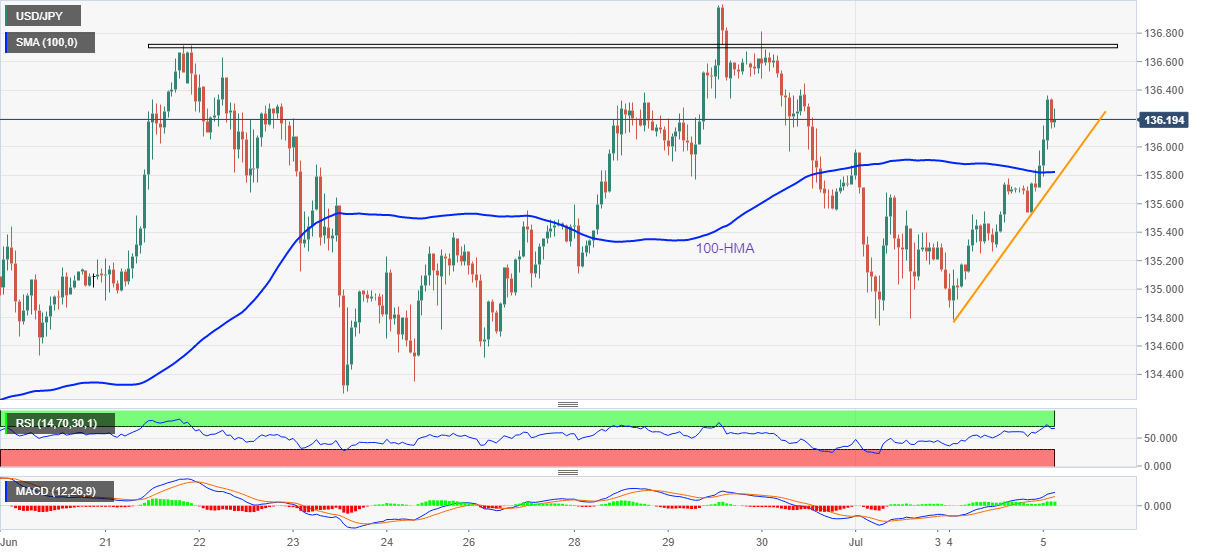
Trend: Further upside expected
- Gold price is hovering around $1,810.00 as investors await Fed minutes.
- Investors will be delighted on having a detailed viewpoint of Fed policymakers towards the economy.
- The expectations of the downbeat US NFP may keep the DXY on the edge.
Gold price (XAU/USD) is testing the upside break of the consolidation formed in a narrow range of $1,806.60-1,809.89 in the early Tokyo session. On a broader note, the precious metal has turned sideways after a firmer rebound from Friday’s low at $1,784.55.
The gold prices are likely to remain on the tenterhooks ahead of the release of the Federal Open Market Committee (FOMC) minutes on Wednesday. The detailed viewpoint from Federal Reserve (Fed) policymakers on the economic indicators of the US economy especially on the inflation rate and growth projections will support the market participants to adjust their positions on associated assets. Also, investors will be able to scrutiny the further direction of the yellow metal and US dollar index (DXY) in a more informed manner.
Meanwhile, the DXY is holding itself above the psychological resistance of 105.00 comfortably. The DXY is expected to remain sideways till the European session as higher volatility at the open leads to a contraction in the same. This week, apart from the Fed minutes, the US Nonfarm Payrolls (NFP) will be of significant importance. As per the market consensus, the US economy added 270k jobs in June, lower than the prior release of 390k.
Gold technical analysis
The gold prices are forming a Bullish Pennant chart pattern on an hourly scale that displays a consolidation phase, which is followed by a sheer upside move. The consolidation phase indicates an initiative buying structure in which those investors initiate longs, which prefer to enter after an establishment of the trend. The precious metal is auctioning above the 50-period Exponential Moving Average (EMA) at $1,808.23, which indicates a bullish bias.
However, the Relative Strength Index (RSI) (14) is oscillating in a 40.00-60.00 range, which signals the unavailability of any potential trigger as it will continue the consolidation process.
Gold hourly chart
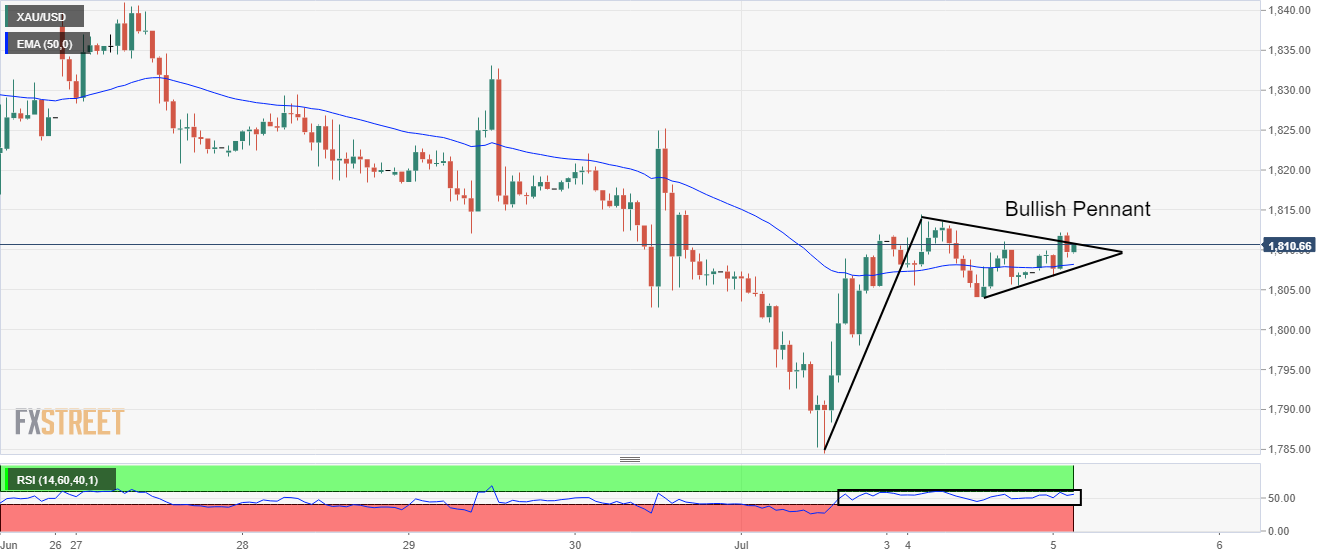
Seisaku Kameda, a former chief economist at the Bank of Japan (BOJ) said on Tuesday that the Japanese central bank is expected to upgrade its outlook on inflation later this month, in the face of the sharp decline in the yen.
Key quotes
“Japan’s inflation will be stronger and will last for longer than the Bank of Japan expects now.”
“Inflation is going to clearly top 2% this year.”
“The rapid weakening of the yen is obviously a huge factor.”
Its worth noting that Kameda led the compilation of the most recent quarterly forecast in April.
Market reaction
At the time of writing, USD/JPY is trading at 136.19, adding 0.48% on the day. The renewed uptick in the US Treasury yields and offshore funds buying is underpinning the major amid an underlying risk-on market profile.
- USD/CNH is attempting to recover after testing Monday’s low near 6.6800.
- The upbeat Caixin Services PMI has supported the Chinese yuan.
- The economic data has landed at 54.5, higher than the forecasts of 47.3 and the prior print of 41.4.
- Investors are awaiting the release of the Fed minutes for defining the further direction in the DXY.
The USD/CNH pair has attracted some significant bids after testing Monday’s low near 6.6800 as the release of the upbeat Caixin Services PMI data has strengthened the Chinese yuan against the greenback. The economic data has landed at 54.5, extremely higher than the forecasts of 47.3 and the prior print of 41.4.
It is worth noting that last week’s Caixin Manufacturing PMI data also landed better than the consensus. The Manufacturing PMI data landed at 51.7 vs. 50.1 the expectations and 48.1 the former release. A sheer positive deviation in the major economic indicators dictates that the Chinese economy is returning to its track after facing the headwinds of the resurgence of Covid-19.
Major Chinese cities: Shanghai and Beijing remained locked for more than two months. The lockdown curbs levied by the Chinese government to contain the pandemic had halted economic activities. However, the economy has managed to revive after the restrictions on the movement of men, materials, and machines.
On the dollar front, the US dollar index (DXY) has displayed wild gyrations at the open. Usually, a follow-up holiday after a weekend results in higher volatility in the respective market. The DXY has managed to hold itself above the psychological support of 105.00 as investors are bracing for more volatility on the release of the Federal Open Market Committee (FOMC) minutes on Wednesday. More clarity on the prior rate hike of 75 basis points (bps) will facilitate the market participants to make informed decisions.
US Treasury Department releases a statement, with their take on the virtual call between Chinese Vice Premier Liu He spoke with Treasury Secretary Janet Yellen held earlier this Tuesday.
Key takeaways
Yellen - Liu He virtual meeting was part of efforts to maintain open lines of communication.
Discussed macroeconomic and financial developments in the US and China, the global economic outlook and food security challenge.
Yellen raised concerns including the impact of Russia's war against Ukraine on the global economy and also on 'unfair, non-market PRC economic practices.
Market reaction
AUD/USD is off the highs, preserving a major part of the latest gains ahead of the RBA rate hike verdict.
The pair is currently trading at 0.6877, retreating from 0.6896 highs, still up 0.16% on the day.
| Raw materials | Closed | Change, % |
|---|---|---|
| Brent | 116.42 | 2.39 |
| Silver | 19.923 | 0.19 |
| Gold | 1807.05 | -0.16 |
| Palladium | 1928.41 | -1.55 |
Ahead of the Reserve Bank of Australia (RBA) policy decision, Goldman Sachs’ Australia and New Zealand Chief Economist Andrew Boak said in a Bloomberg TV interview, Australian households can withstand materially higher interest rates this year amid shrinking net debt.
Also read: Reserve Bank of Australia Preview: Will a 50 bps rate hike rescue AUD bulls?
Key quotes
“It’s a very unusual situation, where at the moment financial buffers are very, very large and unprecedentedly large.”
“A Reserve Bank measure of household debt minus savings and deposits, that’s fallen to around 75% of disposable income from more than 100% during the 2008-09 crisis.”
“See the RBA delivering a 50 basis point increase today and forecasts the central bank’s terminal rate at 3.1%.”
After announcing two rate increases in the last meetings, the Reserve Bank of Australia (RBA) is up for another hawkish monetary policy outcome during the scheduled Interest Rate Decision around 04:30 AM GMT on Tuesday.
The RBA is expected to lift the benchmark interest rate by 50 basis points (bps) to 1.35%, mainly to fight inflation and join the league of its foreign friends.
With this, the Aussie central bank could reach near the monetary policy hawks like the Fed and RBNZ, not to forget the BOE and BOC, which makes today’s RBA rate hike interesting. As a result, the RBA Rate Statement will be more important to watch and forecast near-term AUD/USD moves.
Ahead of the event Westpac said,
We expect the RBA to deliver a back–to–back 50bp interest rate hike at the July board meeting, lifting the cash rate from 0.85% to 1.35%. This is in line with the consensus forecast, while markets price 45bp.
On the other hand, FXStreet’s Dhwani Mehta says,
A fully baked-in 50 bps rate hike is unlikely to inspire AUD bulls, as any meaningful recovery in AUD/USD will gain acceptance only on a sustained move above the rising trendline support-turned-resistance at 0.6862. The 14-day Relative Strength Index (RSI) is seeing a minor pullback from lower levels but still remains deep in the bearish territory.
How could the RBA decision affect AUD/USD?
AUD/USD remains on the front foot at around 0.6885 while extending the week-start rebound from the yearly low. In doing so, the Aussie pair justifies recently positive developments surrounding the US-China trade ties and firmer Treasury yields, backed by hopes of a hawkish move by the RBA. However, economic fears join China’s covid conditions to keep the buyers in check.
That being said, the RBA’s 0.50% rate hike is already known and may not impress the AUD/USD bulls. Also challenging the moves could be the looming 0.75% Fed rate increase and the anxiety ahead of the Fed Minutes and US Nonfarm Payrolls (NFP).
Hence, AUD/USD prices may portray a knee-jerk reaction to the 0.50 bps rate hike from the RBA. However, the bulls need strongly-worded commentary from the RBA Rate Statement to convince the buyers.
Technically, the convergence of the 10-DMA and the 13-day-old descending trend line, around 0.6900, challenges buyers. Even so, a downward sloping support line from late January, near 0.6755 by the press time, could restrict short-term declines of the AUD/USD pair.
Key quotes
AUD/USD Price Analysis: Bulls stampede towards 0.6900 targets
AUD/USD approaches 0.6900 amid trader’s anxiety ahead of RBA Interest Rate hike
Reserve Bank of Australia Preview: Will a 50 bps rate hike rescue AUD bulls?
About the RBA interest rate decision
RBA Interest Rate Decision is announced by the Reserve Bank of Australia. If the RBA is hawkish about the inflationary outlook of the economy and rises the interest rates it is positive, or bullish, for the AUD. Likewise, if the RBA has a dovish view on the Australian economy and keeps the ongoing interest rate, or cuts the interest rate it is seen as negative, or bearish.
Australian Foreign Minister Penny Wong is expected to meet with her Chinese counterpart Wang Yi in Indonesia this week.
The main agenda of the meeting is to discuss detained (in China) Australian Cheng Lei and eventually reach a diplomatic agreement. But if that meeting goes down well, it will raise hopes for bettering the diplomatic ties further.
This comes as the US is likely to roll back tariffs imposed on some of the Chinese goods, as early as this week.
Related reads
- S&P 500 futures jump nearly 1% as US set to rollback China tariffs to fight inflation
- China’s Vice Premier Liu and US Treasury Sec Yellen discuss economy, supply chains
- AUD/JPY pierces one-month-old resistance line on upbeat China PMI for June.
- China Caixin Services PMI jumped to 54.5 in June, versus 47.3 expected.
- 21-DMA offers additional upside filter to probe falling wedge confirmation.
- 50-DMA acts as immediate support before the wedge’s lower line.
AUD/JPY remains on the front foot around a one-week high as buyers poke the short-term key hurdle near 94.00 after China flashed upbeat data during Tuesday’s Asian session.
That said, China’s Caixin Services PMI for June rallied past market consensus and previous readouts as it flashed 54.5 figure, compared to 47.3 forecasts and 41.4 prior.
While cheering the upbeat China data, AUD/JPY crosses the upper line of the one-month-old falling wedge chart pattern, suggesting further advances.
However, the 21-DMA level near 94.05 appears the validation point for the cross-currency pair’s further upside towards the theoretical target surrounding 101.50.
It’s worth noting that the late June swing high near 95.30, the previous monthly peak of 96.88 and the 100.00 psychological magnet could entertain AUD/JPY during the run-up to 101.50.
On the contrary, failure to provide a daily closing beyond 94.05 could drag the quote back to 50-DMA support near 92.50.
Following that, the lower line of the stated wedge, close to 91.30, may entertain the AUD/JPY pair sellers before directing them to the 90.00 round figure.
Overall, confirmation of the bullish chart pattern joins upbeat MACD and RSI signals to keep buyers hopeful ahead of the key Reserve Bank of Australia (RBA) Interest Rate Decision.
AUD/JPY: Daily chart
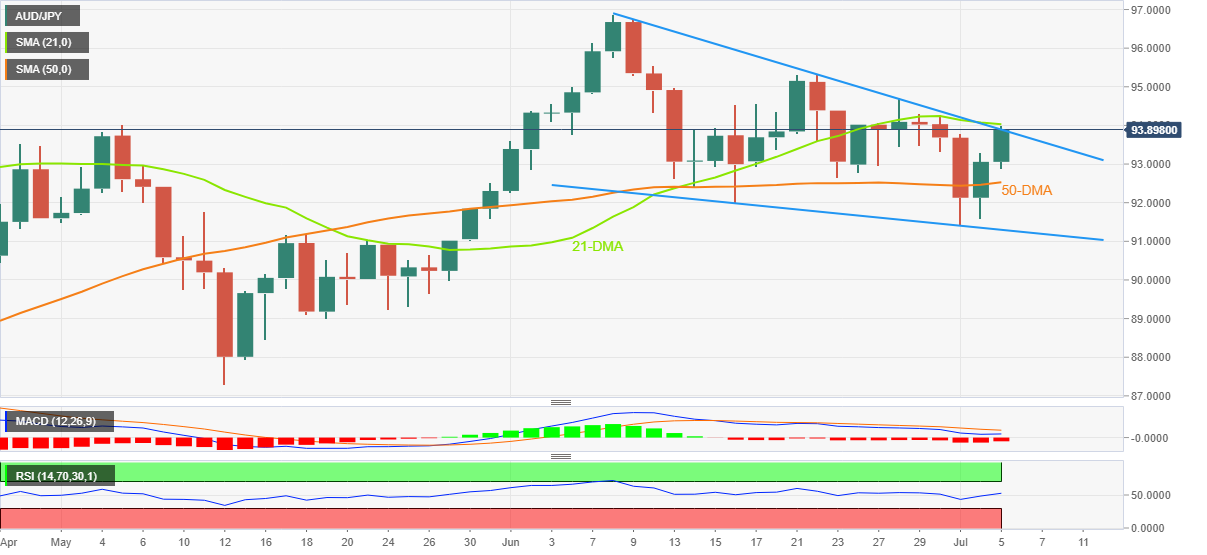
Trend: Further upside expected
Bloomberg reported early Tuesday, citing unidentified people familiar with the deliberations, President Joe Biden is set to roll back some US tariffs on Chinese consumer goods as soon as this week.
Key takeaways
The Biden Administration will also conduct a new probe into industrial subsidies that could lead to more duties in strategic areas like technology.
The president in recent weeks held a number of meetings with senior economic advisers where options for a decision on the Trump-era tariffs were discussed.
Meanwhile, the Wall Street Journal (WSJ) previously reported a decision could come as soon as this week.
Market reaction
Risk sentiment remains underpinned by hopes of an imminent withdrawal of US tariffs on Chinese goods, as political pressure in America heightens amid raging inflation.
Commodities and high-beta currencies cheered the US-Sino trade optimism, with AUD/USD advancing 0.35% on the day to 0.6890 ahead of the critical RBA rate hike decision.
S&P 500 futures is up 0.90% so far at 3,845 while the Asian stocks trade firmer, led by the 1% rally in the Japanese Nikkei 225 index.
- NZD/USD extends Monday’s recovery, takes the bids to refresh intraday high.
- China Caixin Services PMI jumped to 54.5 in June, versus 47.3 expected.
- Hopes of US-China trade peace, firmer Treasury yields underpin immediate bullish bias.
- RBA, risk catalysts and US Factory Orders can be watched for intraday directions.
NZD/USD justifies firmer China data and risk-on mood as buyers poke the monthly resistance around 0.6235 during Tuesday’s Asian session.
China’s Caixin Services PMI for June rallied past market consensus and previous readouts as it flashed 54.5 figure, compared to 47.3 forecasts and 41.4 prior.
In addition to upbeat activity data from the key customer China, risk-on mood and headlines concerning the Sino-American trade deal also appeared to have favored the NZD/USD buyers.
While portraying the mood, the US 10-year Treasury yields pick-up bids to regain 3.0% level up 1.70% intraday by the press time, whereas the S&P 500 Futures rise 0.40% by extending the previous two-day upside near 3,850.
Elsewhere, comments from Chinese Vice Premier Liu He suggests an improvement in the US-China ties, at least for now, which in turn favor the pair buyers due to New Zealand’s (NZ) dependence on Beijing. “The two agreed to need to strengthen communication & coordination of macroeconomic policies between China and the US,” said the macro update conveying telephonic talks between China’s Liu He and US Treasury Secretary Janet Yellen.
It should be noted, however, that the early Asian session release of NZIER Business Confidence and covid fears in China, not to forget the risk of economic slowdown, probe the NZD/USD bulls. That said, NZIER Business Confidence slumped to the lowest levels since March 2020, to -65% versus -40% expected, during the second quarter (Q2) of 2022.
That said, NZD/USD traders need to pay attention to the Reserve Bank of Australia’s (RBA) monetary policy decision for immediate direction due to its close links with Australia. In a case where the RBA manages to please the bulls, the Kiwi pair can extend the latest rebound.
Following that, Factory Orders for May, expected 0.5% versus 0.3%, will be important to watch.
Above all, risk catalysts, as well as the pre-NFP sentiment, not to forget the full markets’ reaction to the recently firmer bond yields, will be crucial to track for clear directions.
Technical analysis
A one-month-old descending trend line resistance near 0.6235 challenges immediate NZD/USD upside ahead of the mid-June swing high near 0.6300. Until then, the downward trajectory towards refreshing the multi-month low marked the last week, near 0.6145, can’t be ruled out. It’s worth noting that the RSI and MACD conditions recently favored the bulls.
China Caixin Services PMI for June have been released as follows:
- 54.5 (vs 41.4 in May).
"Overall, regional COVID outbreaks were put under control and restrictions were loosened in June, facilitating a gradual recovery in business operations," said Wang Zhe, Senior Economist at Caixin Insight Group.
"Deteriorating household income and expectations caused by a weak labour market dampened the demand recovery. Correspondingly, supportive policies should target employees, gig workers and low-income groups impacted by the outbreaks."
AUD/USD update
As per the following series of technical analyses, AUD has been in the hands of the bulls this week so far ahead of the Reserve Bank of Australia meeting:
- AUD/USD Price Analysis: The bulls could be on the verge of a move ahead of RBA
- AUD/USD Price Analysis: Bulls could be on the verge of taking over
The 0.6880s that were forecasted into the RBA have been met and the bulls have moved in on the 0.6990s with a pre-China data high of 0.6994:
-
AUD/USD Price Analysis: Bulls stampede towards 0.6900 targets
There is going to the liquidity above the 0.6900 level which could well be exploited around the RBA event.
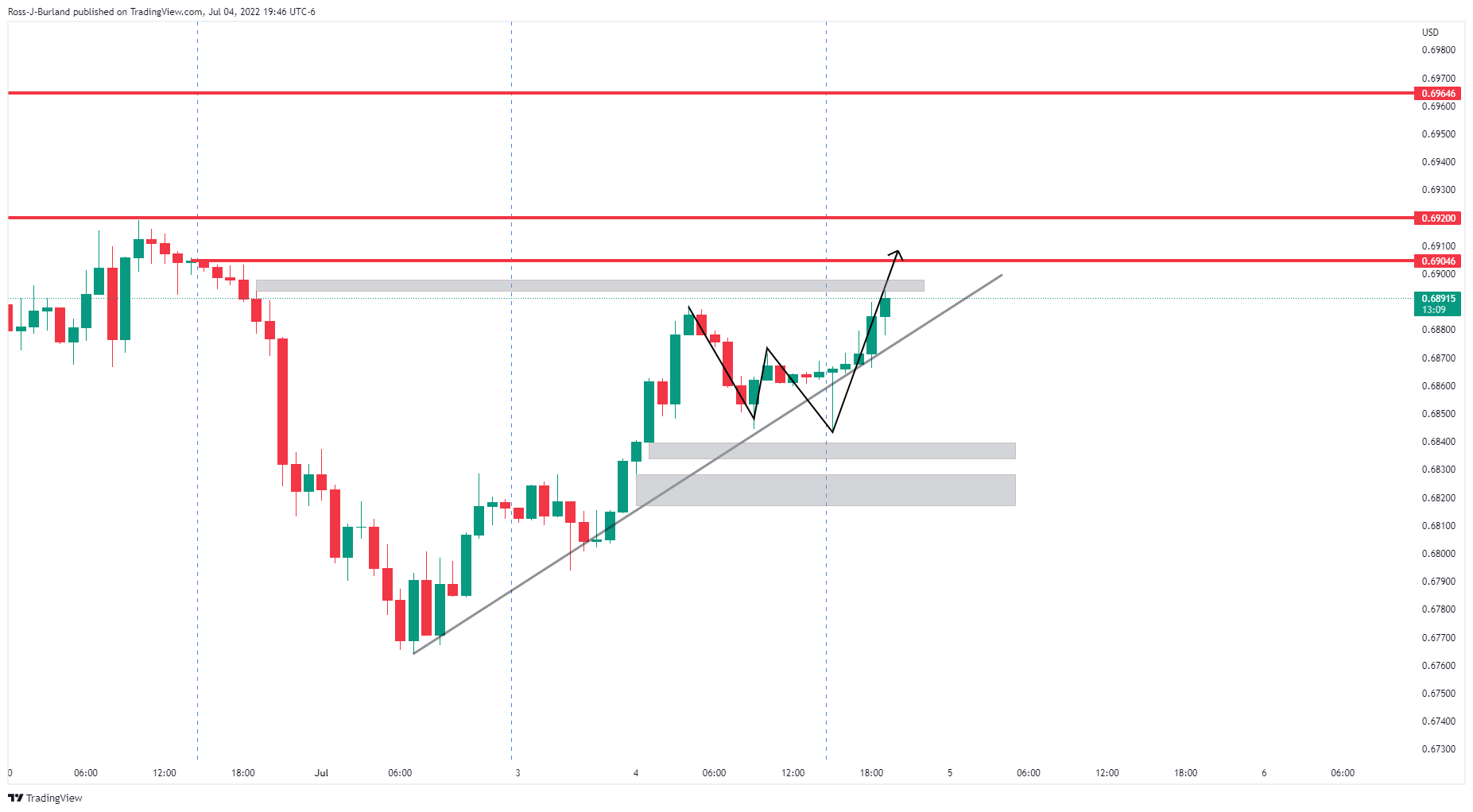
The price was firmly bid into the data which has failed to lift it any higher, so far.
About the Caixin Services PMI
The Caixin Services PMI™, released by Markit Economics, is based on data compiled from monthly replies to questionnaires sent to purchasing executives in over 400 private service sector companies. The panel has been carefully selected to accurately replicate the true structure of the services economy.
- AUD/USD bulls are moving in on the 0.6900s ahead of key events.
- The RBA and China Services are eyed but the technicals are firmly bullish.
As per the following series of technical analyses, AUD has been in the hands of the bulls this week so far ahead of the Reserve Bank of Australia meeting:
- AUD/USD Price Analysis: The bulls could be on the verge of a move ahead of RBA
- AUD/USD Price Analysis: Bulls could be on the verge of taking over
AUD/USD prior analysis, daily chart
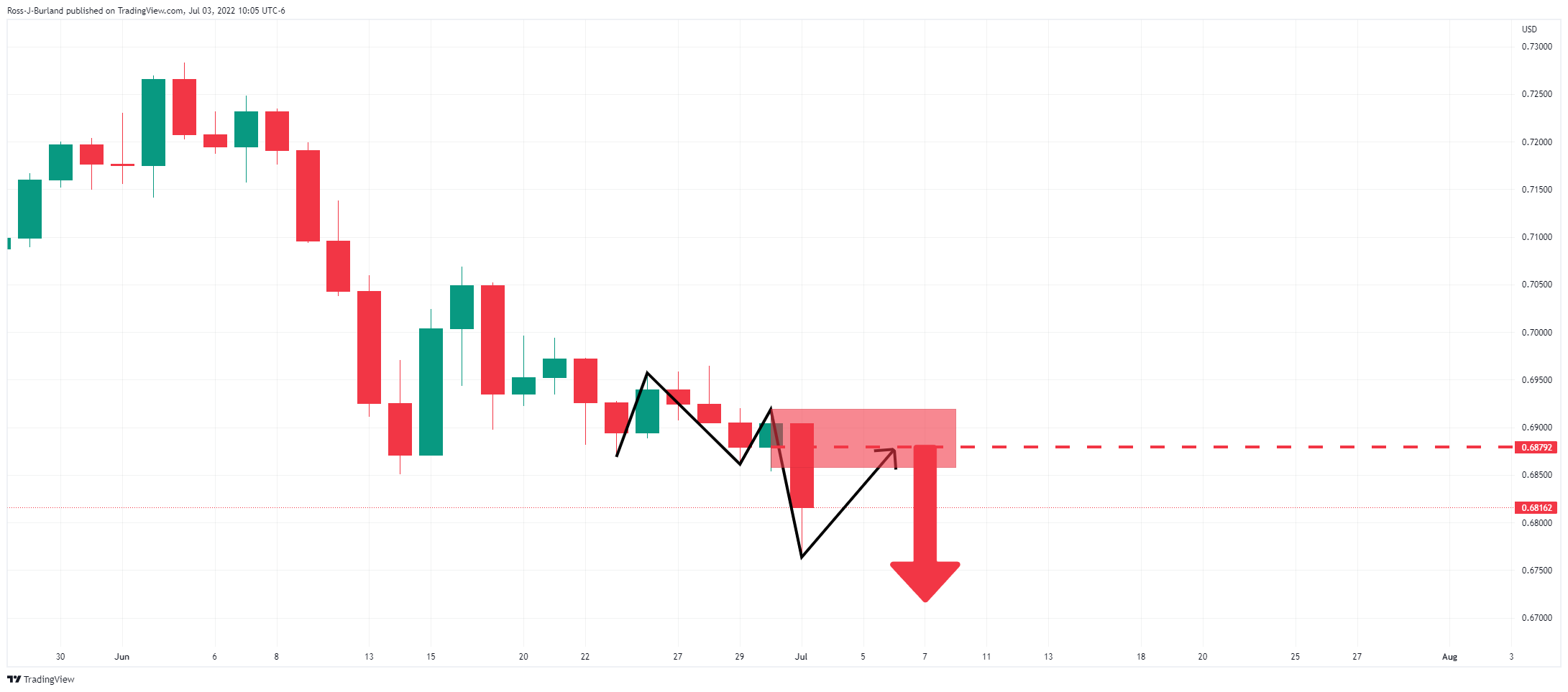
The above chart was the pre-open analysis at the start of this week and below was the analysis conducted leading into the Asia today on the 15-0min time frame chart:
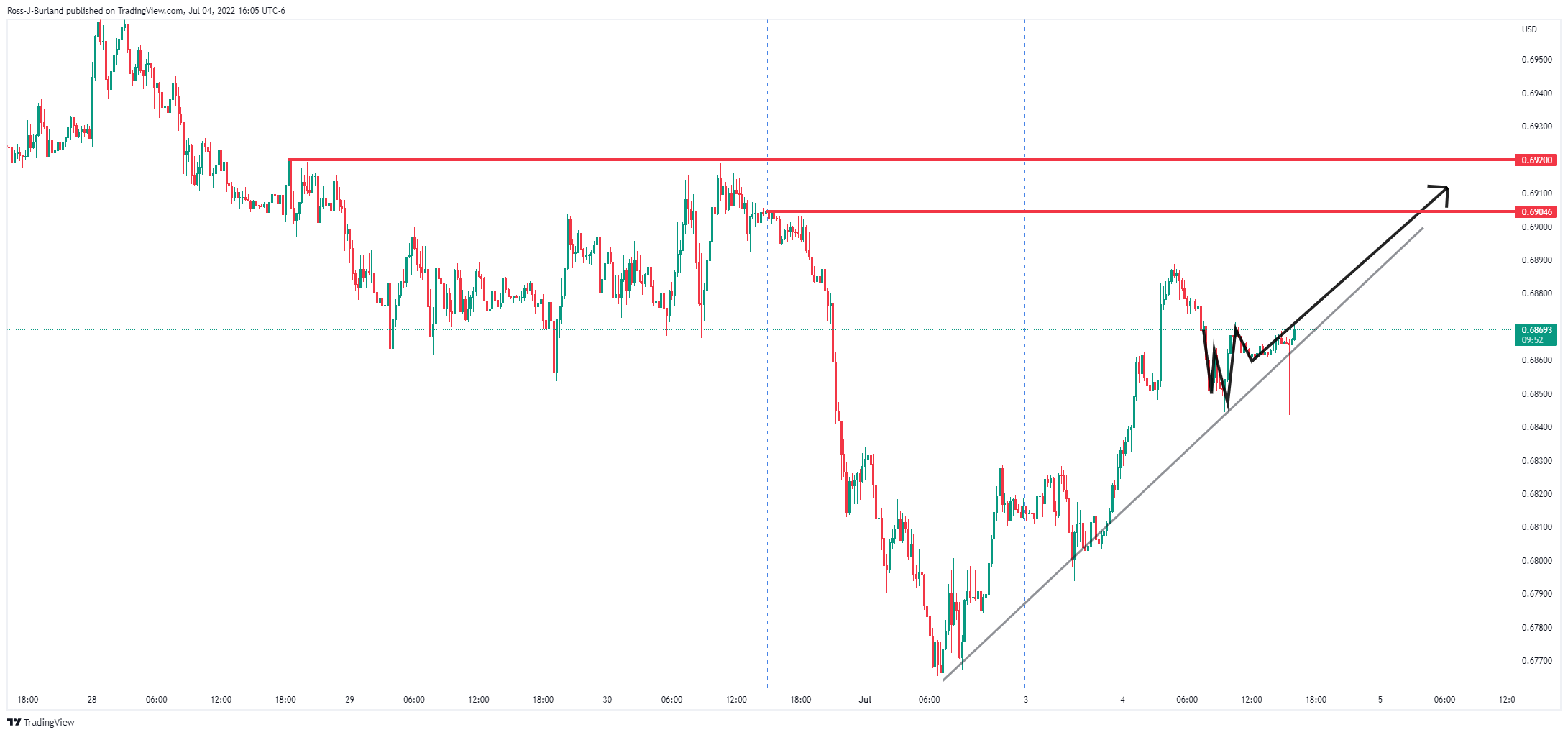
The 0.6880s that were forecasted pre-open at the start of this week into the RBA have been met and the pre-Tokyo analysis 06900/20 box could be mitigated immanently:
AUD/USD live chart, H1
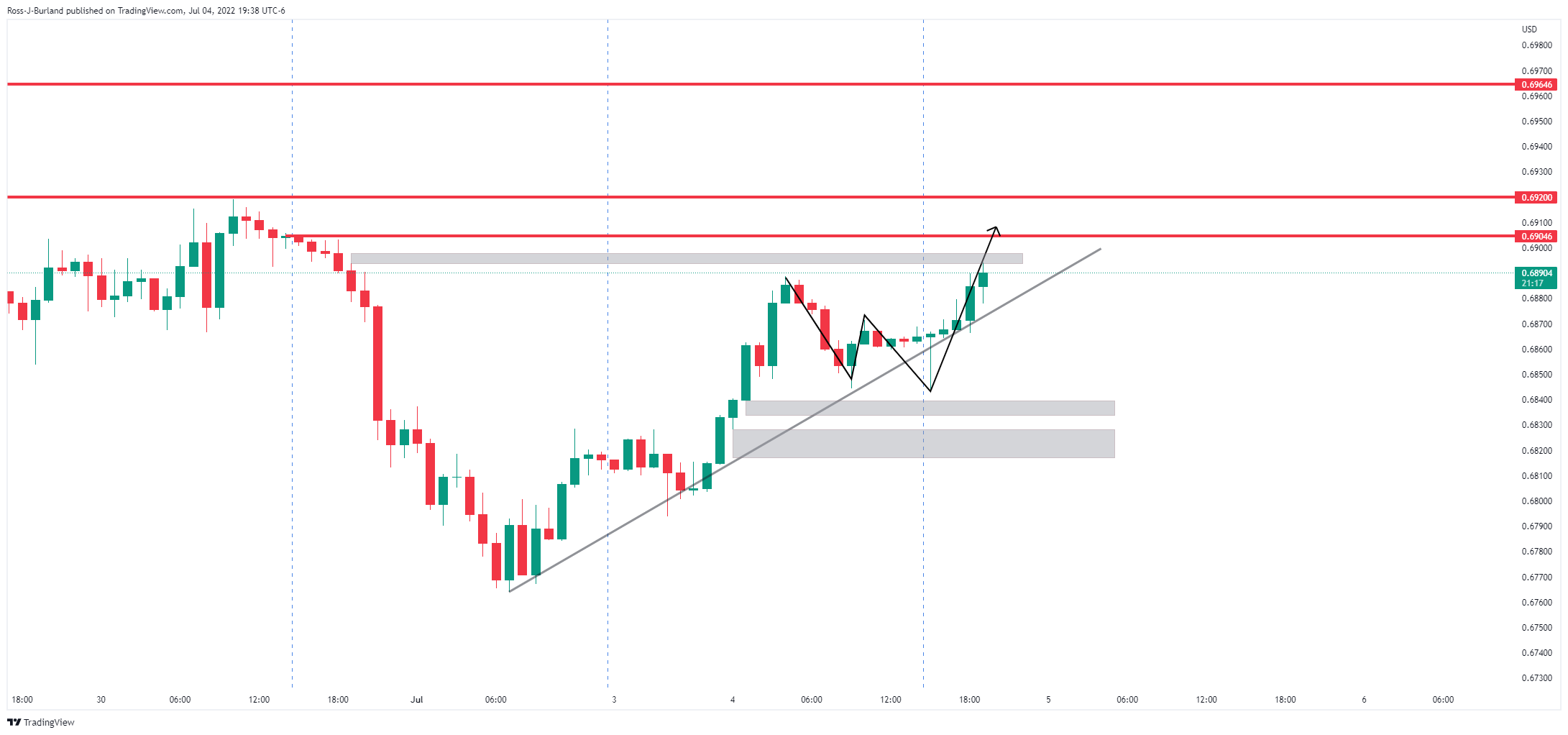
There is going to the liquidity above the 0.6900 level which could well be exploited around the event. First, we have China Caixin Services as a potential meanwhile catalyst.
Chinese Vice Premier Liu He spoke with US Treasury Secretary Janet Yellen via phone early Tuesday, as they discussed the economy and supply chains, China’s Commerce Ministry noted.
Key quotes
Talks were constructive.
The two agreed need to strengthen communication & coordination of macroeconomic policies between China and the US.
Exchange views on economic situation.
Agree stable global supply chain good for China, US.
China expresses concern on US possible tariff rollback.
Paying attention to possible rollback.
Agree to continue communications.
Market reaction
AUD/USD is capitalizing on the above headlines, flirting with daily highs of 0.6880, up 0.20% on the day.
- EUR/GBP stays mildly bid inside a 13-day-old bullish channel.
- Steady RSI adds to the upside bias, 200-SMA strengthens 0.8560 support.
- Pullback from 0.8680 appears necessary to defend the yearly high.
EUR/GBP picks up bids to reverse the week-start losses around 0.8615 during Tuesday’s Asian session. In doing so, the cross-currency pair remain inside a two-week-long ascending trend channel.
Adding strength to the bullish bias is the firmer RSI (14), as well as the pair’s sustained trading beyond the 200-SMA.
It’s worth noting, however, that the upside momentum needs validation from the latest swing high near 0.8680 before rejecting the bullish channel formation, by crossing the 0.8685 hurdle.
In doing so, the EUR/GBP pair buyers could aim for the recently flashed multi-month high near 0.8720.
Meanwhile, pullback remains elusive until staying beyond the 0.8560 support confluence including the 200-SMA and lower line of the stated channel.
In a case where EUR/GBP drops below 0.8560, the odds of its pullback towards a six-week-old horizontal support area near 0.8485-80 can’t be ruled out.
Overall, EUR/GBP holds onto the bullish trajectory towards refreshing the multi-month high marked in June, near 0.8720. However, any upside beyond the same appears less likely.
EUR/GBP: Four-hour chart
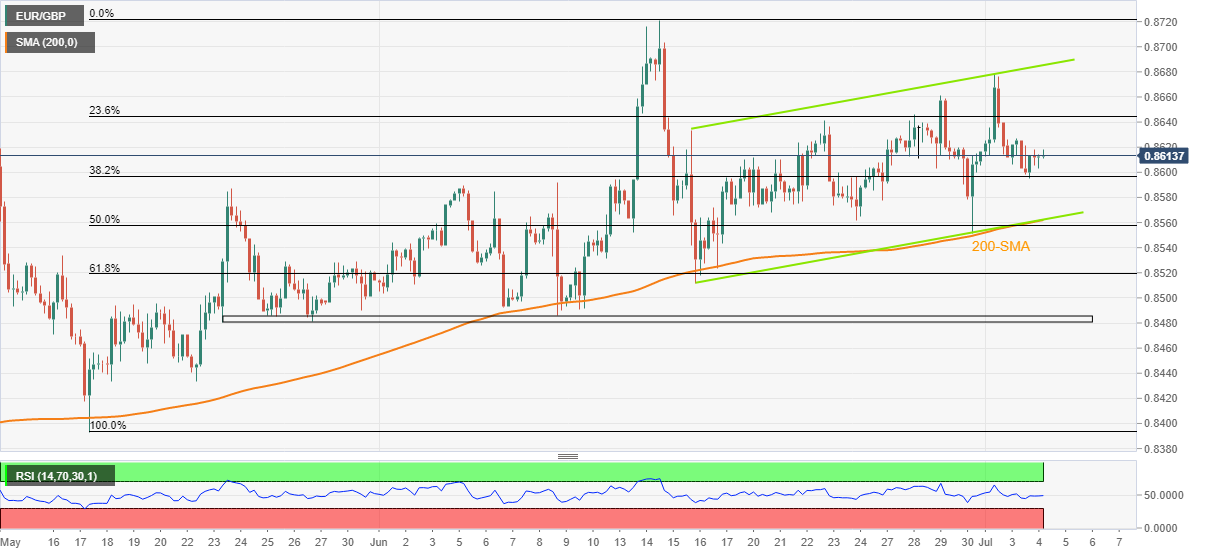
Trend: Further upside expected
In recent trade today, the People’s Bank of China (PBOC) set the yuan (CNY) at 6.6986 vs. the previous fix of 6.7071 and the prior close of 6.6988.
About the fix
China maintains strict control of the yuan’s rate on the mainland.
The onshore yuan (CNY) differs from the offshore one (CNH) in trading restrictions, this last one is not as tightly controlled.
Each morning, the People’s Bank of China (PBOC) sets a so-called daily midpoint fix, based on the yuan’s previous day's closing level and quotations taken from the inter-bank dealer.
- The 4-hour structure in USD/CAD has been broken at the start of this week.
- There is an emphasis on the downside for the sessions ahead.
CAD is benefitting from a risk-on environment and is sinking USD/CAD away from a key resistance area on the daily and 4-hour time frames. The following illustrates the bearish bias based on the daily chart's M-formation's neckline resistance and the break of structure on the 4-hour chart:
USD/CAD daily chart
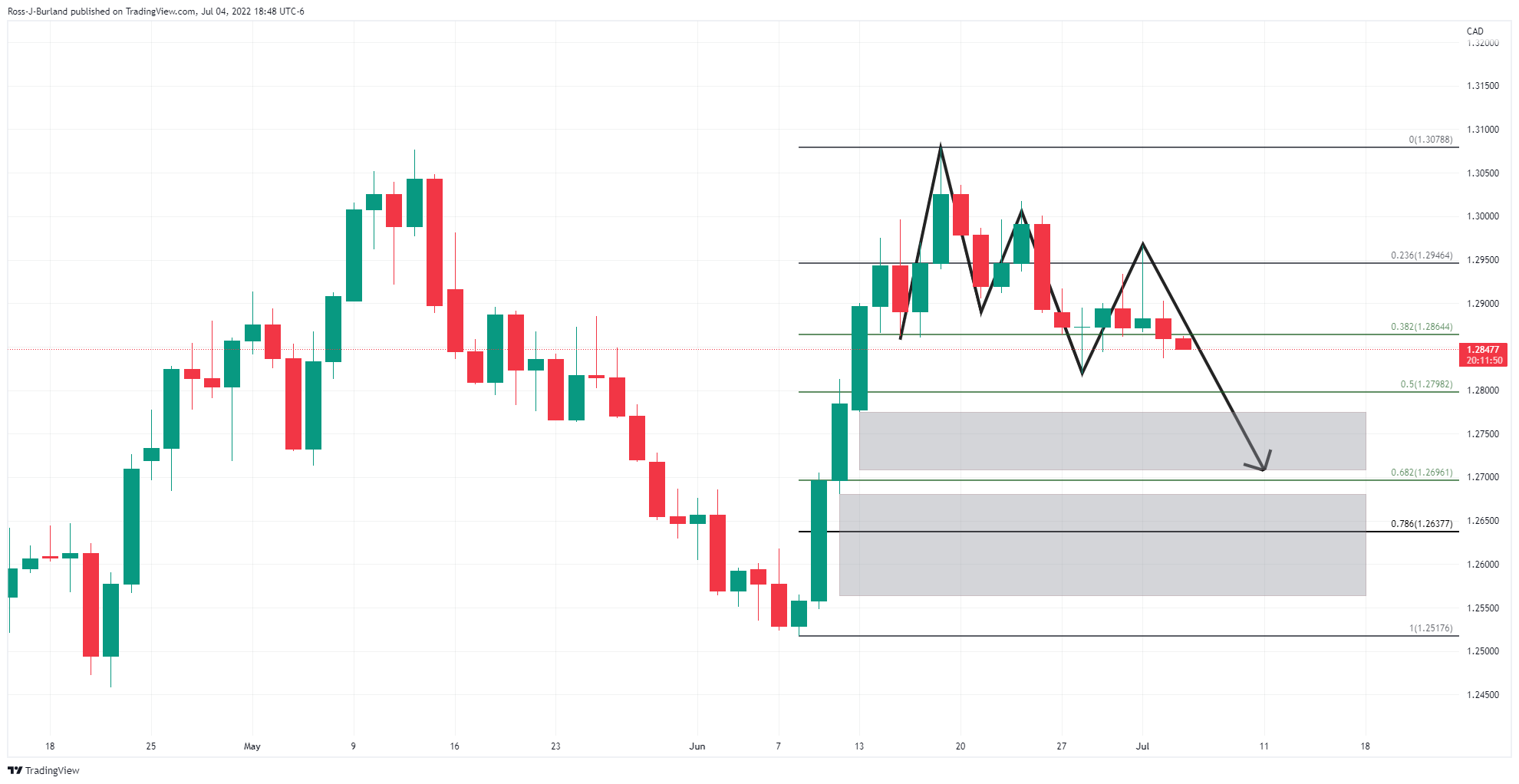
USD/CAD bears have moved in following a retest of the neckline and given the break of horizontal support and fresh lows made at the start of the week, there is a bias towards the price imbalances of the prior bullish impulse. The 50% mean reversion level has confluence in this regard and is a compelling target on the daily chart near 1.2800.
USD/CAD H4 chart
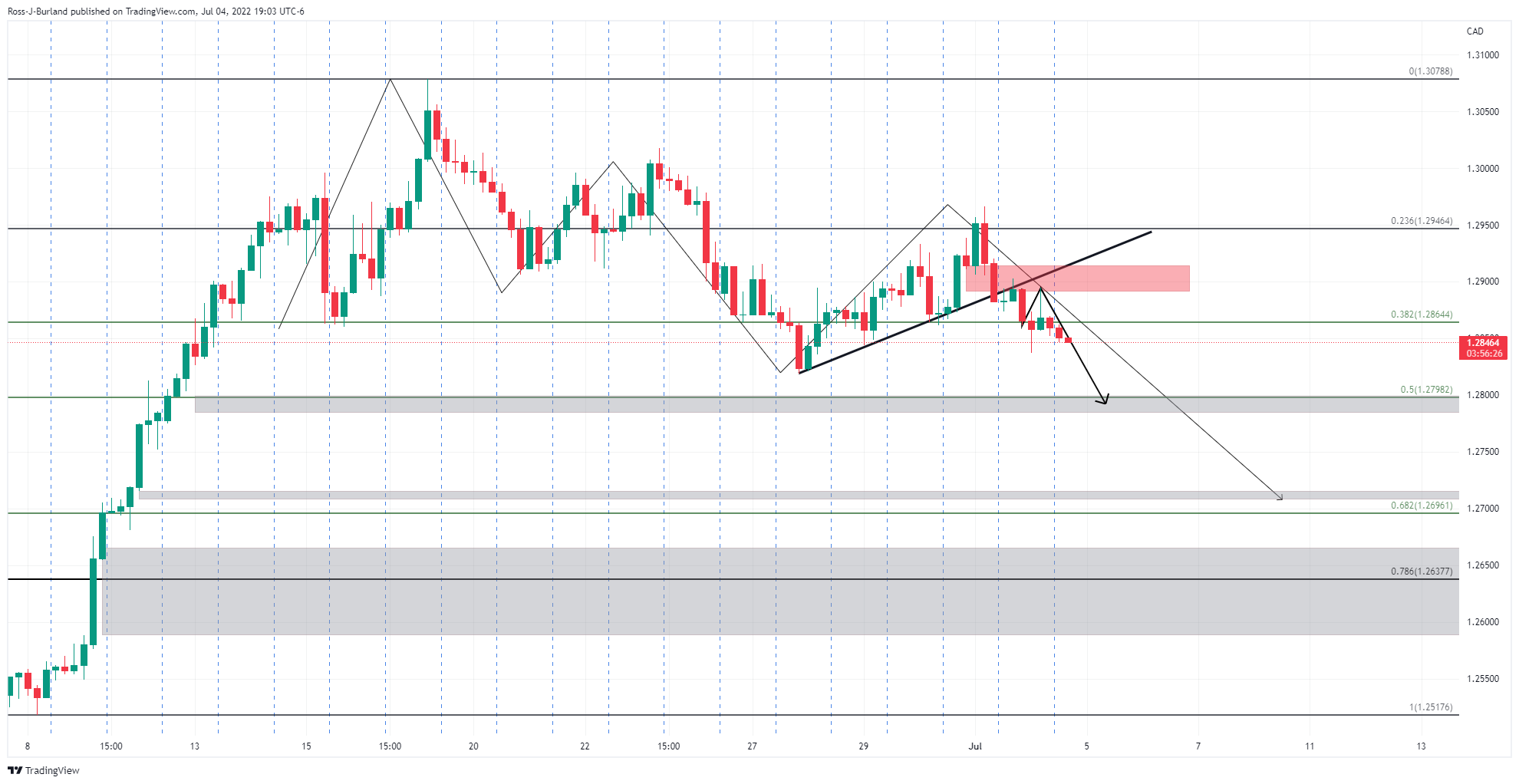
The 4-hour structure has been broken in the move lower this week which leaves the emphasis on the downside.
- GBP/USD has corrected to near 1.2100 as DXY displayed a volatile show at open.
- The release of the Fed minutes will be the major event for the greenback bulls.
- Pound bulls are facing the headwinds of real income shocks and Brexit jitters.
The GBP/USD pair has slipped to near the critical support of 1.2100 after facing barricades around 1.2118 in the Asian session. The cable is in a correction mode after failing to sustain above 1.2160 on Monday, however, a resumption in the upside journey cannot be warranted as the market participants are awaiting the release of the Federal Open Market Committee (FOMC) minutes on Wednesday.
The US dollar index (DXY) is displaying wild moves at the open as an extra-long weekend on US Independence Day added volatility to the asset.
The release of the minutes after the policy announcement facilitates the market participants with more information on the condition of the US economy and how policy decisions will impact the economy further.
Investors must be aware of the fact that the Federal Reserve (Fed) announced a 75 basis point (bps) interest rate hike to combat the soaring inflation. The inflation rate has climbed to 8.6% despite the balance sheet reduction program and the elevation of the borrowing rates to 1.50-1.75%. The detailed minutes on the interest rate decision will delight investors and help them to take informed decisions.
Meanwhile, the pound bulls are broadly on the backfoot amid tensions on renewed Brexit and enlarging real income shocks in the UK economy. The odds of the UK returning to the EU have trimmed significantly as Sir Kier Stammer, leader of the labor party in the UK has denied returning to the EU. Speaking to the BBC's political editor Chris Mason before the speech, Sir Keir said: "We want to go forward, not backward. And therefore this is not about rejoining the EU.
Also, the households in the UK economy are facing the headwinds of large real income shocks. The inflation rate in the pound region has surpassed 9% and its multiplier effects have trimmed the paychecks of the households. The Bank of England (BOE) is highly required to focus on cooling off the ultra-hot inflation.
Reuters highlights the latest Bank of Canada (BOC) survey to raise the possibilities of a heavy rate hike in its analytical piece published late Monday.
“Consumer inflation expectations surged in Canada, hitting fresh highs in the short-term and up "significantly" over the long-term, a Bank of Canada survey showed Monday, bolstering calls for a very rare 75-basis point rate increase,” said the update.
Key findings
Consumers' expectations for inflation have risen, alongside concerns about prices for food, gas and rent, the central bank said in its second-quarter Survey of Consumer Expectations.
Generally, people see inflation as being more pervasive now.
In a separate survey, the bank found businesses expect high inflation for longer, with firms eyeing survey-record wage increases over the next 12 months and many planning to pass rising costs onto customers.
The surveys both reinforce calls for a 75-bp rate increase at the Bank of Canada's next decision on July 13. That would be the largest hike since August 1998, when the bank lifted rates by 100 bp to defend the currency.
Also read: USD/CAD corrects to near 1.2850 on subdued DXY, oil steadies
- Gold remains pressured after a downbeat week-start amid traders’ anxiety ahead of the key data/events.
- US Treasury yields pare recent downside moves amid sluggish session.
- US-China trade headlines, upbeat performance of EU bond coupons also defend buyers.
- Sellers keep worrying global economic slowdown, US Factory Orders can direct intraday moves but FOMC Minutes, NFP is the key.
Gold Price (XAU/USD) remains pressured around $1,807, after beginning the week’s trading on a negative side, as traders stay worried ahead of crucial catalysts up for publication during the week. In doing so, the bright metal fails to cheer firmer US Treasury yields, as well as a pullback in the US Dollar Index (DXY).
That said, the greenback gauge struggles to defend the two-day uptrend around 105.15 as buyers retreat from a two-week top.
The DXY’s latest pullback could be linked to the firmer Treasury yields. It’s worth noting that the benchmark 10-year Treasury bond yields keep the previous U-turn from a one-month low at around 2.95%, up by five basis points (bps) from Friday’s closing.
Underlying the firmer US Treasury yields are the firmer prints of the German Bunds and chatters surrounding the US discussion on removing the Trump-era tariffs on China. However, an offer in the US and fears of economic slowdown, as well as anxiety ahead of Federal Open Market Committee (FOMC) Minutes and the US Jobs report for June, appear to challenge the metal buyers.
It should be observed that the yields on the 10-year German Bund rose over 10 basis points to 1.32% at the latest.
Looking forward, US Factory Orders for May, expected 0.5% versus 0.3%, could entertain gold traders ahead of the key Fed Minutes and US Nonfarm Payrolls (NFP) data. Additionally important will be the updates surrounding the global economic slowdown and the US-China trade relations.
Technical analysis
A three-week-old horizontal area between $1,805 and $1,802 restricts immediate gold price downside. Also challenging the metal sellers are the steady RSI and the bullish MACD signals.
However, a convergence of the 100-SMA and descending trend line from June 16, around $1,827, guards nearby upside moves of the XAU/USD. Also acting as an upside filter is the 200-SMA level surrounding $1,840.
Meanwhile, a downside break of the $1,802, needs validation from the $1,800 threshold before challenging the yearly low surrounding $1,780.
On the contrary, gold price run-up beyond $1,840 enables the buyers to aim for June’s peak of $1,879.
Gold: Four-hour chart

Trend: Sideways
- EUR/USD bulls are taking charge in a slow start in Tokyo.
- The US dollar is on the backfoot and the technical structure points higher for the euro.
EUR/USD is attempting to move higher in a risk-on start in Tokyo as the US dollar struggles to pick up demand on Tuesday. The pair is consolidating in a 4-hour 100 pip bow between 1.0400 and 1.0500 which has been established in the first week of the new month while the price carves out a daily triple bottom. The following illustrates the market structure across the time frames and arrives at a short-term bias to the upside with eyes on 1.0500.
EUR/USD H1 chart
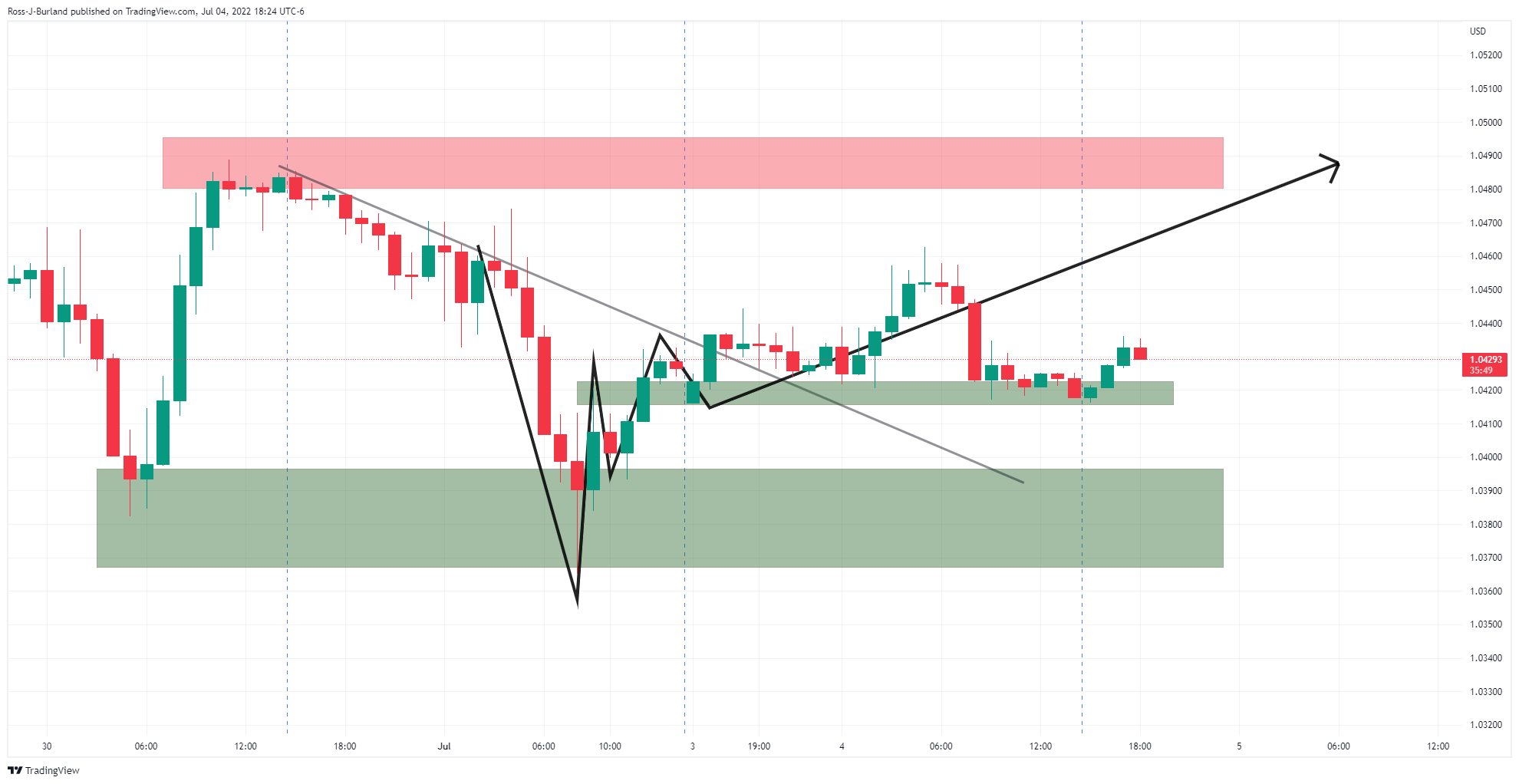
From an hourly perspective, the price is testing the neckline of the bullish W-formation. If the bulls commit here, then there will be prospects of a move higher within the sideways channel with a focus on 1.0500.
EUR/USD daily chart
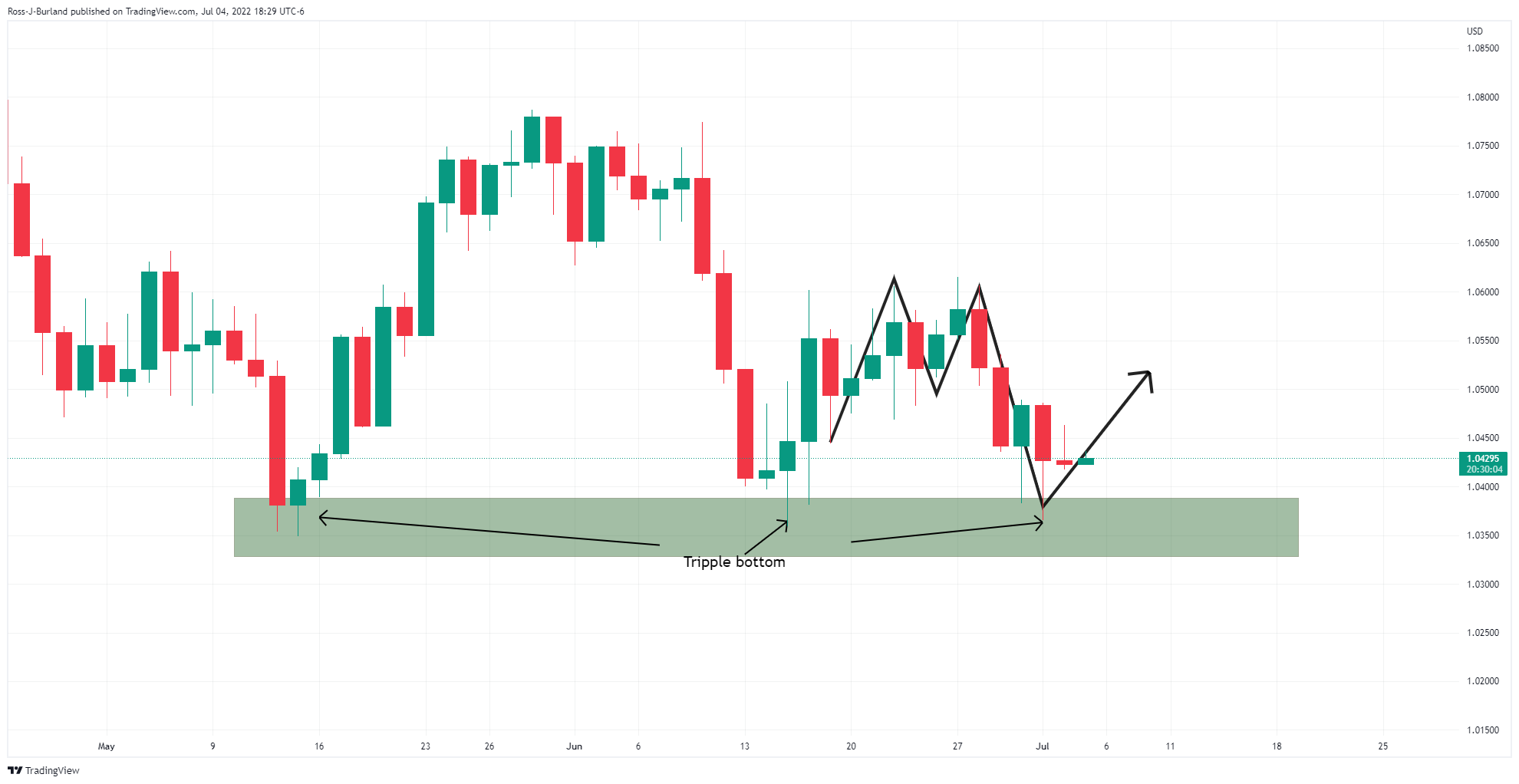
The daily chart shows the price has the potential to move higher from the foundations of a triple bottom. The M-formation is a compelling feature of this time frame also which is a reversion pattern, at least until the neckline.
- The DXY has turned wild as market participants trim their positions after a long weekend holiday.
- The dual stalwarts of confident Fed: solid growth prospects and labor market have started fading away.
- Fed’s minutes will be more clarifying on the announcement of a bumper rate hike.
The US dollar index (DXY) has gyrated in a wide range of 104.81-105.25 at the open as an elevated weekend amid holiday on account of US Independence Day was expected to bring wild moves in the counter. The DXY is expected to continue displaying topsy-turvy moves as investors have shifted their focus to the Federal Open Market Committee (FOMC) minutes, which will release on Wednesday. A detailed clarification of the ideology of the Federal Reserve (Fed) policymakers on voting for the 75 basis points (bps) interest rate hike will be crucial for making informed decisions on the further direction of the DXY.
Lower growth prospects have trimmed extreme hawkish Fed bets
The release of the downbeat US ISM economic data last week has cleared the policy tightening measures from the Fed may have not shown their impact on inflation but have started affecting the economic activities. The dual stalwarts of confident Fed: solid growth prospects and employment generation ability have started fading away.
On Friday, the US ISM reported the Manufacturing PMI and New Orders Index were extremely lower than the estimates and their former releases. And, now a vulnerable performance is expected from the US employment data. As per the market consensus, the US agency will report the Nonfarm Payrolls (NFP) at 270k, much lower than the prior print of 390k. However, the Unemployment Rate will remain stable at 3.6%.
Key data this week: Factory Orders, S&P Global PMI, ISM Services PMI, JOLTs Job Openings, ADP Employment Change, Initial Jobless Claims, Nonfarm Payrolls (NFP), Unemployment Rate.
Major events this week: Reserve Bank of Australia (RBA) interest rate decision and Federal Open Market Committee (FOMC) minutes
| Index | Change, points | Closed | Change, % |
|---|---|---|---|
| NIKKEI 225 | 218.19 | 26153.81 | 0.84 |
| Hang Seng | -29.44 | 21830.35 | -0.13 |
| KOSPI | -5.08 | 2300.34 | -0.22 |
| ASX 200 | 72.7 | 6612.6 | 1.11 |
| FTSE 100 | 63.95 | 7232.65 | 0.89 |
| DAX | -39.65 | 12773.38 | -0.31 |
| CAC 40 | 23.59 | 5954.65 | 0.4 |
- AUD/USD defends the week-start optimism, seesaws inside an immediate range of late.
- Softer Aussie data, firmer US Treasury yields join pre-RBA caution to test recovery moves.
- US Factory Orders, Sino-American trade headlines and covid news also need attention for clear guide.
AUD/USD holds onto the week-start recovery on its way to battle the key 0.6900 hurdle, around 0.6875 by the press time of Tuesday’s Asian session. The quote’s firmer performance could be linked to the market’s cautious optimism, as well as the softer US dollar. However, the bulls appear cautious ahead of the key Reserve Bank of Australia (RBA) Interest Rate Decision.
That said, the US Dollar Index (DXY) struggles to defend the two-day uptrend to 105.00 as buyers retreat from a two-week top.
In doing so, the greenback bulls appear to have tracked firmer Treasury yields. It’s worth noting that the benchmark 10-year Treasury bond yields keep the previous U-turn from a one-month low at around 2.92%, up by three basis points (bps) from Friday’s closing.
Although the US holiday failed to offer much to cheer for the bond bears, firmer prints of the German Bunds and chatters surrounding the US discussion on removing the Trump-era tariffs on China seemed to have favored the US Treasury yields.
The yields on the 10-year German Bund rose over 10 basis points to 1.32% at the latest.
Talking about the Aussie data, the AiG Performance of Construction Index for June also eased to 46.2, below 50.4 prior, whereas S&P global Composite PMI and Services PMI confirmed the 52.6 initial forecasts for June.
Meanwhile, the recession fears and China’s covid woes join Russia’s claim of winning total control in Lysychansk, not to forget the pre-RBA anxiety, to probe the pair buyers.
Moving on, US Factory Orders for May, expected 0.5% versus 0.3%, could entertain USD/JPY traders but major attention should be given to the risk catalysts, as well as the pre-NFP sentiment, not to forget the full markets’ reaction to the recently firmer bond yields.
It should be noted that the RBA’s 0.50% rate hike is already given and appeared to have been priced in, which in turn highlights Tuesday’s RBA Rate Statement for fresh impulse. Should the policy statement hint at further rate increases, the AUD/USD may extend the latest run-up, at least for the for time being.
Also read: Reserve Bank of Australia Preview: Will a 50 bps rate hike rescue AUD bulls?
Technical analysis
A convergence of the 10-DMA and the 13-day-old descending trend line, around 0.6900, challenges buyers. Even so, a downward sloping support line from late January, near 0.6755 by the press time, could restrict short-term declines of the AUD/USD pair.
| Pare | Closed | Change, % |
|---|---|---|
| AUDUSD | 0.68656 | 0.73 |
| EURJPY | 141.352 | 0.23 |
| EURUSD | 1.04209 | -0.04 |
| GBPJPY | 164.137 | 0.23 |
| GBPUSD | 1.21001 | -0.05 |
| NZDUSD | 0.62084 | 0.04 |
| USDCAD | 1.28576 | -0.2 |
| USDCHF | 0.9608 | 0.12 |
| USDJPY | 135.689 | 0.3 |
- USD/JPY picks up bids to extend the week-start rebound amid cautious optimism.
- US Treasury bonds begin the week’s trading on a negative side ahead of the key data/events.
- Sino-American trade headlines, chatters surrounding BOJ keeps the buyers hopeful.
- Risk catalysts, US Factory Orders data for May are also important for fresh impulse.
USD/JPY holds onto the week-start recovery around 136.00 as Tokyo opens on Tuesday. The yen pair’s latest gains could be linked to the market’s mildly positive sentiment and firmer Treasury bond yields.
The US bond markets regain traction after the US holidays paused the Treasury yield moves on Monday. It’s worth noting that the benchmark 10-year Treasury bond yields keep Monday’s U-turn from a one-month low at around 2.92%, up three basis points (bps) from Friday’s closing.
In doing so, the bond yields appear to have tracked German bunds. That said, the yields on the 10-year German Bund rose over 10 basis points to 1.32% at the latest.
On a different page, the mildly positive risk profile could be linked to the US holiday on Monday, as well as the chatters surrounding the US discussion on removing the Trump-era tariffs on China.
Elsewhere, Japanese policymakers’ refrain from rate hikes emphasizes the Fed versus Bank of Japan (BOJ) divide and the resulted monetary policy divergence, which in turn propel the US Treasury yields, as well as the USD/JPY prices.
Looking forward, US Factory Orders for May, expected 0.5% versus 0.3%, could entertain USD/JPY traders but major attention should be given to the risk catalysts, as well as the pre-NFP sentiment, not to forget the full markets’ reaction to the recently firmer bond yields.
Technical analysis
The 21-DMA restricts short-term USD/JPY downside around 135.00, which in turn propels the yen pair towards the recently flashed multi-year high near 137.00.
- GBP/JPY is advancing towards 165.00 amid broader weakness in the Japanese yen.
- The real income shocks for UK households may trim their confidence in the economy.
- The UK has no intention to return to the EU.
- Japan’s failure to raise the wage index is responsible for the BOJ’s ultra-loose monetary policy.
The GBP/JPY pair is heading towards the round-level resistance of 165.00 as the cross has extended its recovery after overstepping 164.40 in early Tokyo. The asset has remained in the grip of bulls from Friday after sensing a responsive buying action. The cross slipped to near 161.50 but later found a responsive buying action as investors found the asset a value bet. A sheer upside move recorded by the asset has shifted it into a positive trajectory.
Investors’ focus has shifted to the extent of the interest rates, the Bank of England (BOE) will dictate to barricade the soaring price pressures. The inflation rate in the UK economy has crossed the mark of 9% smoothly and the households are facing the headwinds of real income shocks. No doubt, the multiplier effects of the soaring inflation in the UK economy will trim the overall demand and henceforth the consumer confidence in the economy.
Meanwhile, the odds of the UK returning to the EU have trimmed significantly as Sir Kier Stammer, leader of the labor party in the UK has denied returning to the EU. Speaking to the BBC's political editor Chris Mason before the speech, Sir Keir said: "We want to go forward, not backward. And therefore this is not about rejoining the EU.
In today’s session, the focus will remain on the UK Purchase Managers Index (PMI) figures. A preliminary estimate for the Composite and Services PMI is 53.1 and 53.4 respectively, similar to their prior releases.
On the Tokyo front, the inability of the Japanese economy to spurt the overall demand is haunting the yen bulls. The Bank of Japan (BOJ) is worried over the lower inflation rate as the economy has failed to elevate the Wage Price Index (WPI) as required.







© 2000-2026. All rights reserved.
This site is managed by Teletrade D.J. LLC 2351 LLC 2022 (Euro House, Richmond Hill Road, Kingstown, VC0100, St. Vincent and the Grenadines).
The information on this website is for informational purposes only and does not constitute any investment advice.
The company does not serve or provide services to customers who are residents of the US, Canada, Iran, The Democratic People's Republic of Korea, Yemen and FATF blacklisted countries.
Making transactions on financial markets with marginal financial instruments opens up wide possibilities and allows investors who are willing to take risks to earn high profits, carrying a potentially high risk of losses at the same time. Therefore you should responsibly approach the issue of choosing the appropriate investment strategy, taking the available resources into account, before starting trading.
Use of the information: full or partial use of materials from this website must always be referenced to TeleTrade as the source of information. Use of the materials on the Internet must be accompanied by a hyperlink to teletrade.org. Automatic import of materials and information from this website is prohibited.
Please contact our PR department if you have any questions or need assistance at pr@teletrade.global.


 Bank
Bank transfers


