- Analytics
- News and Tools
- Market News
CFD Markets News and Forecasts — 08-07-2022
- The USD/JPY has been trading in a choppy 100 pip range for the last five days.
- The major seesawed spurred by the assassination of Japan’s ex-PM Abe and upbeat US economic data.
- USD/JPY Price Analysis: Range-bound, but the RSI’s aiming lower and USD/JPY uptrend overextended, might pave the way for further downside.
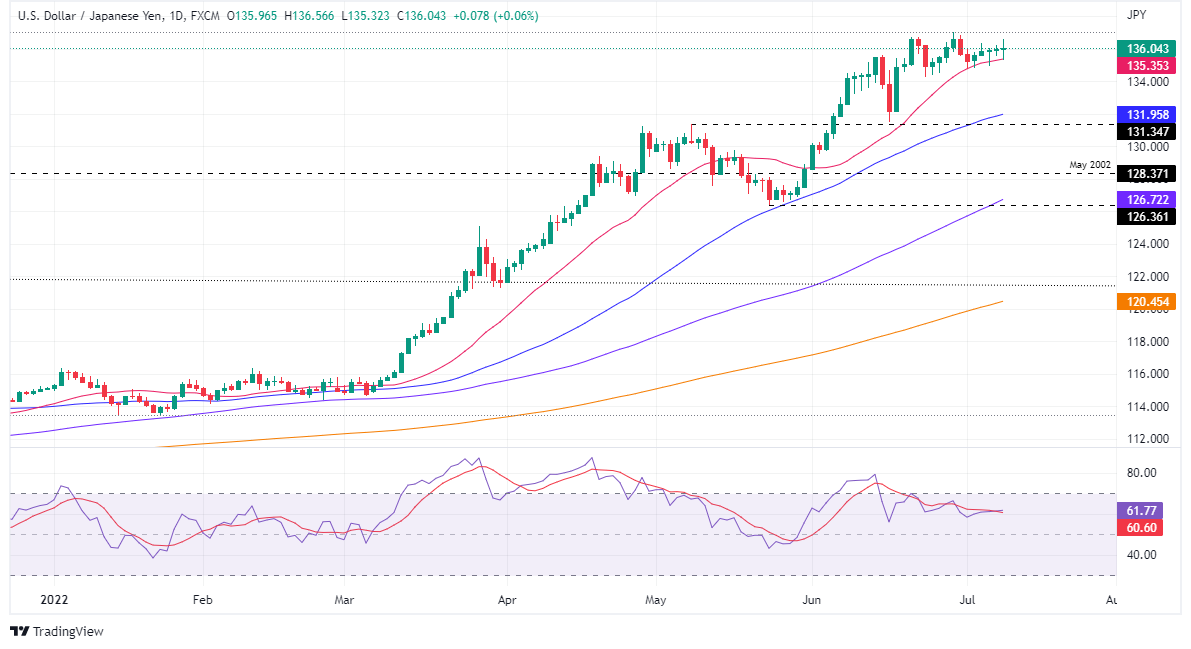
USD/JPY is subdued as the North American session winds down, consolidating in the 135.00-136.00 range amidst the lack of a catalyst that could trigger an upward/downward break of the previously-mentioned area after news of the assassination of the Japanese ex-Prime Minister Shinzo Abe.
The USD/JPY began the last day of the week trading around 136.00, followed by an aggressive fall toward 135.32 on the breaking news of the attack on Shinzo Abe. However, favorable US employment data lifted the major towards the weekly high around 136.56 before retreating toward current levels. At the time of writing, the USD/JPY is trading at 136.04.
USD/JPY Daily chart
The USD/JPY daily chart illustrates that the price is overextended and the uptrend has lost steam. However, USDJPY sellers’ failure to break below the 20-day EMA at 135.35 has exposed the pair to some upside pressure, but the Relative Strenght Index (RSI) at 41.89 begins to aim downwards, meaning that a pullback might be on the cards.
That said, the USD/JPY first support would be136.00. Break below will expose the 20-day EMA, followed by the June 23 daily low at 134.26, followed by 50-day EMA at 131.95.
USD/JPY Key Technical Levels
- June’s US Nonfarm Payrolls report exceeded expectations, further cementing the case for a Fed’s 75 bps rate hike.
- The consensus amongst ECB policymakers is for a 25 bps rate hike in July; September is still open.
- EUR/USD Price Analysis: Sellers in control might take a breather before launching an assault towards parity.
EUR/USD remains subdued as North American traders prepared for the weekend, in choppy trading within the 1.0150-80 range after June’s employment report and further Fed speakers crossing wires.
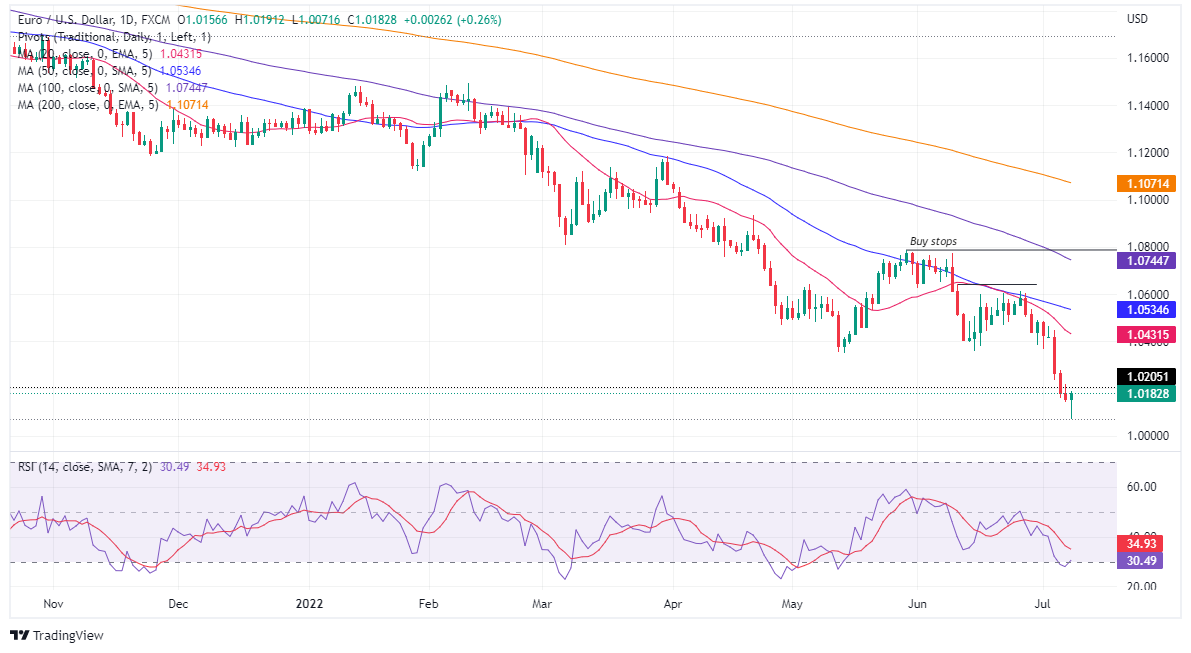
The EUR/USD is trading at 1.0182, having hit a fresh 20-year low at 1.0071 during the European session, though recovered after the release of the US Nonfarm Payrolls report, bouncing off late towards daily highs near 1.0190, before losing steam and settling at around current levels.
EUR/USD rallied despite solid US job report, EU’s energy crisis
Earlier in the North American session, the US Department of Labour reported that June’s Nonfarm Payrolls added 372K jobs to the economy, exceeding estimations of 268K. Average Hourly Earnings, and an indication of a wage-price spiral, remained contained at 5.1% YoY, above estimates, while the Unemployment rate prevailed unchanged at 3.6%. At the same time Fed speakers, namely Waller, Bullard, Bostic, and Williams, reiterated the case for a 75 bps rate hike to the Federal funds rate (FFR), while downplaying recession fears.
On the Eurozone side, ECB speakers remain vocal about hiking rates this month, and the consensus remained around a 25 bps rate hike. However, a 50 bps could be in play, but it is not the case scenario, as mentioned on its June minutes. Despite all that, the EU’s ongoing energy crisis hit the shared currency hard during the week, as the EUR/USD weekly chart illustrates the major is losing 2.47% in the week
Therefore, the EUR/USD path of least resistance is tilted to the downside, and a parity test is on the cards.
EUR/USD Price Analysis: Technical outlook
The EUR/USD daily chart indicates that sellers are in control, despite buyers’ effort to hold the fort around 1.0100. As the New York session waned, they achieved their task so far. However, oscillators like the Relative Strength Index (RS) exited oversold conditions, meaning sellers might be taking a breather before exerting additional pressure to drag prices lower.
Therefore, the EUR/USD first support would be 1.0100. Once cleared, the next support would be the current YTD low at 1.0071, followed by the EUR/USD parity at 1.0000. A decisive break would clear the way for September 2002 lows around 0.9608.
- The EUR/GBP cross-currency tumbled since Tuesday close to 200 pips.
- Fragile market mood shows investors’ nervousness in an uncertain scenario.
- EUR/GBP Price Analysis: Pressured around the 200-day EMA; once cleared, a fall towards 0.8300 is on the cards.
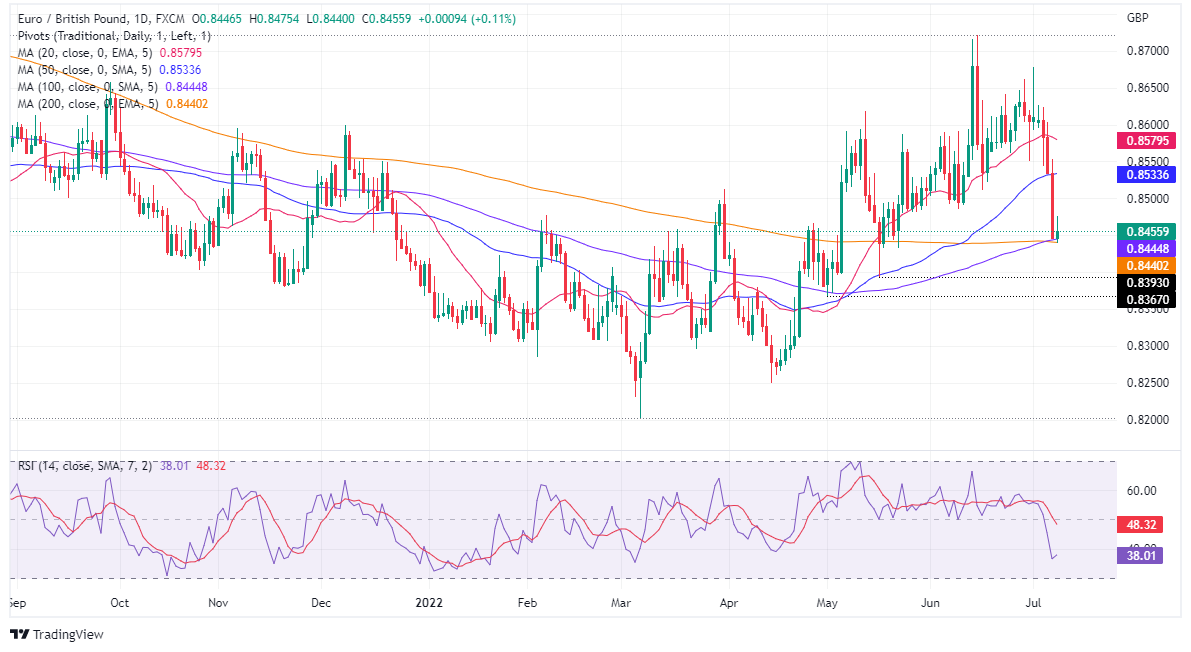
On Friday, the EUR/GBP trims some of Thursday’s losses, though braced for the confluence of the 100 and 200-day EMAs around 0.8440-44 during the North American session. At 0.8455, the EUR/GBP is up by a minimal 0.10%.
US equities wobble, reflecting a downbeat market mood. The EU’s energy crisis linked to Russia’s invasion of Ukraine, and signs of EU economic contagion or even contraction, weigh heavily in the shared currency, particularly in the EUR/GBP pair. Meanwhile, BoE’s Pill and Mann expressed the need for faster rate hikes in the UK amidst the resignation of UK’s Prime Minister Boris Johnson.
In the meantime, the cross-currency opened near 0.8445 and slid towards the daily low below 0.8440 before printing the daily high at 0.8475.
EUR/GBP Daily chart
The EUR/GBP is about to change its bias, due in part to fundamental reasons attached to a Euro area economic slowdown, but also for the presence of the 200-day EMA just 12 pips below the current exchange rate. The EUR/GBP fall from 0.8600 to current price levels shifted the Relative Strength Index (RSI) to bearish conditions, meaning that selling pressure lies ahead.
Therefore, the EUR/GBP bias in the near term is neutral but slightly tilted to the downside. Break below the 200-day EMA will expose the 0.8400 figure. Once cleared, EUR sellers’ next stop will be the May 2 swing low at 0.8367, followed by the 0.8300 figure.
EUR/GBP Key Technical Level
- During the week, the Swiss franc is still under heavy pressure, losing more than 2%.
- Broad US dollar strength across the board underpins the USD/CHF.
- USD/CHF Price Analysis: The pave towards parity is clear, but 0.9800 and 0.9975 are still on the way for USD/CHF buyers; otherwise, a re-test of 0.9700 is on the cards.
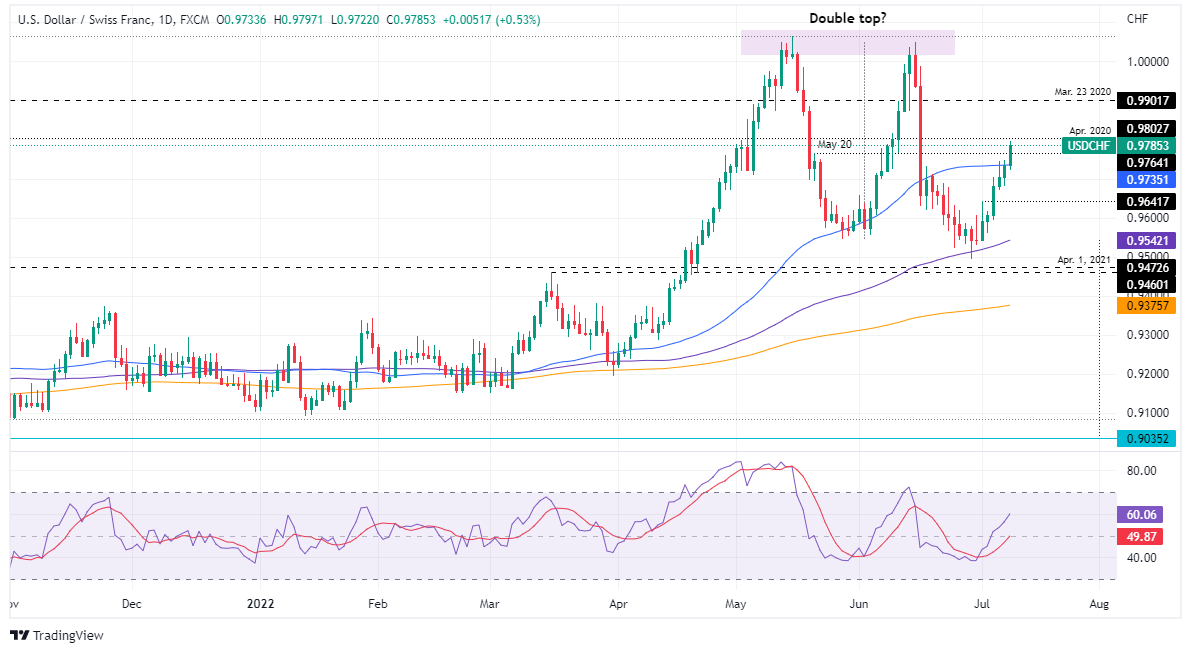
The USD/CHF marches firmly for the sixth straight day, trading near weekly highs around 0.9790s, after falling from around YTD highs at parity, though since then, the major is up by almost 300 pips, though shy of reaching 0.9800. At the time of writing, the USD/CHF is trading at 0.9785.
Sentiment shifted for the worse in the last hour or so for no fundamental reason. However, traders should not tat US President Biden was due to meet with advisers on China’s tariffs late on Friday, though it remains unclear if he would make a decision or not, according to Reuters sources. Meanwhile, US equities trade in negative territory, and the greenback shifted positive, as shown by the US Dollar Index up 0.01%, at 107.044.
Aside from this, the USD/CHF began Friday’s session trading around 0.9730s and dipped toward the daily low around 0.9720 before rallying to the daily high at 0.9797.
USD/CHF Daily chart
The USD/CHF broke above the 50-day moving average (DMA), clearing the way for a re-test of parity. However, April’s 2020 high around 0.9802 has been a tough nut to crack, but once done, a rally towards USD/CHF’s parity is on the cards. Nevertheless, on its way north, the USD/CHF traders must overcome the May 10 high at 0.9975.
Otherwise, the major would be vulnerable to selling pressure, and a fall towards the 50-DMA at 0.9735 is on the cards, and then the USD/CHF could slip to the 0.9700 figure.
USD/CHF Key Technical Levels
- Wall Street turns positive on Friday, helping MXN.
- US jobs report shows better-than-expected numbers.
- USD/MXN corrects lower, the trend is still bullish.
The USD/MXN is modestly lower on Friday still up for the week. It bottomed at 20.36, a three-day low before bouncing to the 20.45 zone. The outlook remains bullish for the pair.
Fed and Banxico: rate hikes to continue
On Friday, the US dollar lost momentum after the beginning f the American session amid an improvement in market sentiment, following the US jobs report. “Another robust gain in payrolls should squash discussions that the economy is already in a recession. Employers added 372K jobs in June, with the unemployment rate holding steady at 3.6%. Wage growth eased up a touch, advancing 0.3%, but with hiring still solid, we believe the June jobs report bolsters the case for another 75 bps rate hike at the FOMC's July 27 meeting”, explained analysts at Wells Fargo.
Equity markets are about to post weekly gains still the caution stance prevails amid a worsening economic outlook and higher interest rates ahead. The current environment makes it difficult for the Mexican peso to sustain any rebound. The Bank of Mexico is expected to raise again by 75 bps the key interest rate, offering some support to the peso, although the reasons for the aggressive hike are negative. Inflation hit in June 7.99%, the highest level since 2001.
The MXN remains among the few currencies to be still up against the US dollar on the year.
Still bullish but limited under 20.70
The USD/MXN is about to post another weekly gain. It is hovering around 20.45, far from the weekly top. A recovery above 20.45, would keep the door open for another test of 20.70. A daily close above 20.75 is likely to signal a test of 20.90, the last defense to 21.00.
On the flip side, a consolidation below 20.40 would strengthen the Mexican peso, paving the way to the 20-day Simple Moving Average, currently at 20.25; below await the 200-day SMA at 20.18.
Technical levels
- The AUD/USD is still up during the week by 0.37%.
- An upbeat mood, a soft US dollar, and higher commodity prices underpinned the AUD/USD.
- Fed speakers backed a 75 bps rate hike and said the US economy is strong.
The AUD/USD is almost unchanged on Friday, amidst a positive tone in the market, as US equities rise but remain at the brink of turning red, on sudden market sentiment shift after June’s US employment report exceeded expectations, signaling that recession fears are overblown. At the time of writing, the AUD/USD is trading at 0.6837.
Upbeat mood and a soft US dollar, a tailwind for the AUD/USD
A risk-on impulse spreads to the FX space as risk-sensitive currencies rally. The US Labor Department reported that June’s Nonfarm Payrolls added 372K jobs to the economy, more than the 268K estimated. Despite a favorable report, the Unemployment Rate remained unchanged at 3.6%, as wage growth remained firm. Traders sold off equities as a reaction that could motivate the Fed to keep hiking rates aggressively to tame inflation.
The AUD/USD reacted to the downside, printing the daily low at around 0.6791, but bounced off as investors dissected the report, breaking towards fresh three-day highs around 0.6870s. Furthermore, higher commodity prices underpinned the major, as shown by the Bloomberg Commodity Index, up 0.88%, contrarily to Iron Ore prices, down 1.22%, at $113.74 a ton.
At the time of writing, New York’s Fed President John Williams said that the central bank is 100% committed to goals and expected GDP to grow by less than 1% this year.
Elsewhere a raft of Fed speakers, namely Waller, Bullard, and Bostic, reiterated their view backing up 75 bps rate hikes in the Fed’s July meeting. They also expressed that the US economy is strong and can withstand higher rates while downplaying recession fears.
What to watch
The Australian economic calendar will feature June’s NAB Business Confidence, the July Consumer Confidence, and the Employment Report for June. On the US front, June’s Consumer Price Index (CPI), the Producer Price Index (PPI), and the University of Michigan (UoM) Consumer Sentiment would update the status of the US economy.
Also, Fed speakers will cross wires before entering the blackout period of the July monetary policy meeting.
AUD/USD Key Technical Levels
According to the Federal Reserve Bank of Atlanta's GDPNow model, the US economy is expected to contract by 1.2% in the second quarter, up from the July 7 forecast of -1.9%.
"After this morning's employment situation report by the US Bureau of Labor Statistics and the wholesale trade report from the US Census Bureau, the nowcasts of second-quarter real personal consumption expenditures growth and real gross private domestic investment growth increased from 1.3% and -14.9%, respectively, to 1.9% and -13.7%, respectively," Atlanta Fed explained in its publication.
Market reaction
The US Dollar Index showed no immediate reaction to this report and was last seen trading flat on the day near 107.00.
The net change in employment in Canada was negative in June by 43K, against expectations of an increase of 23K. Analysts at CIBC point out that other details of the report keep the Bank of Canada on its way to a 75 basis points rate hike next week.
Key Quotes:
“At a time in which modestly bad news would be good news, Canada's June jobs data weren't really bad enough to generate a sigh of relief for those concerned about an inflationary overheating. The 43,000 jobs decline was certainly a break from a run of hefty hiring since February, but other signposts, from brisk year-on-year wage gains, a climb in hours worked, and a new low in the unemployment rate, should be enough to have the Bank of Canada hiking rates by an outsized 75 basis points next week.”
“The Bank of Canada's concerns over labour market tightness won't be eased given that the unemployment rate dropped two ticks to a new cycle low of 4.9%. That reflected a drop in labour force participation, as fewer of those not working were actively seeking jobs.”
“Economic growth in the second quarter should still be in the 4% range, and even with the drop in employment, other signposts in today's data are consistent with the need to tighten monetary policy further. We're sticking to our call for a 75 basis point rate hike next week, with the overnight rate peaking at 3% this year.”
Data released on Friday showed the US economy added 372K non-farm payroll in June, surpassing expectations. According to analysts at Wells Fargo, the “robust gain in payrolls should squash discussions that the economy is already in a recession.” They believe the June jobs report bolsters the case for another 75 bps rate hike at the FOMC's July 27 meeting.
Key Quotes:
“If the economy is in a recession, employers have not seemed to notice. Despite clamors that the economy may already be in a recession due to the possibility of two consecutive negative quarters of GDP growth (a view we do not share), the labor market continues to plow forward, supporting aggregate income and limiting the havoc wrought on spending by high inflation.”
“Nonfarm payrolls put up another robust gain in June, increasing by 372K. Even accounting for a net downward revision of 74K over the past two months, that still puts the number of jobs in the economy ahead of where forecasters expected it to be heading into today's report. Payrolls are now 0.3% below their pre-COVID peak, with gains remarkably steady the past three months in the narrow range of 368-384K.”
“Inflation remains paramount for the Fed, but the jobs market is also an important piece of the puzzle to the path ahead for policy as growth concerns mount. Today's report indicates that the jobs market remains extraordinarily strong. While the size of the FOMC's next move hangs primarily on this upcoming Wednesday's June CPI report, the June jobs report bolsters the case for another 75 bps hike at the July 27 meeting.”
Former British Finance Minister Rishi Sunak announced on Friday that he will be running in the contest to replace Prime Minister Boris Johnson.
"I’m standing to be the next leader of the Conservative Party and your Prime Minister," Sunak tweeted out. "Let’s restore trust, rebuild the economy and reunite the country."
Market reaction
This announcement doesn't seem to be having a noticeable impact on the British pound's performance against its rivals. As of writing, the GBP/USD pair was posting modest daily gains at 1.2035.
- On Friday, Gold rises almost 0.40% but is still down by 3.53% in the week.
- The bright metal recovered some of its shine due to a weaker US dollar and a mixed sentiment.
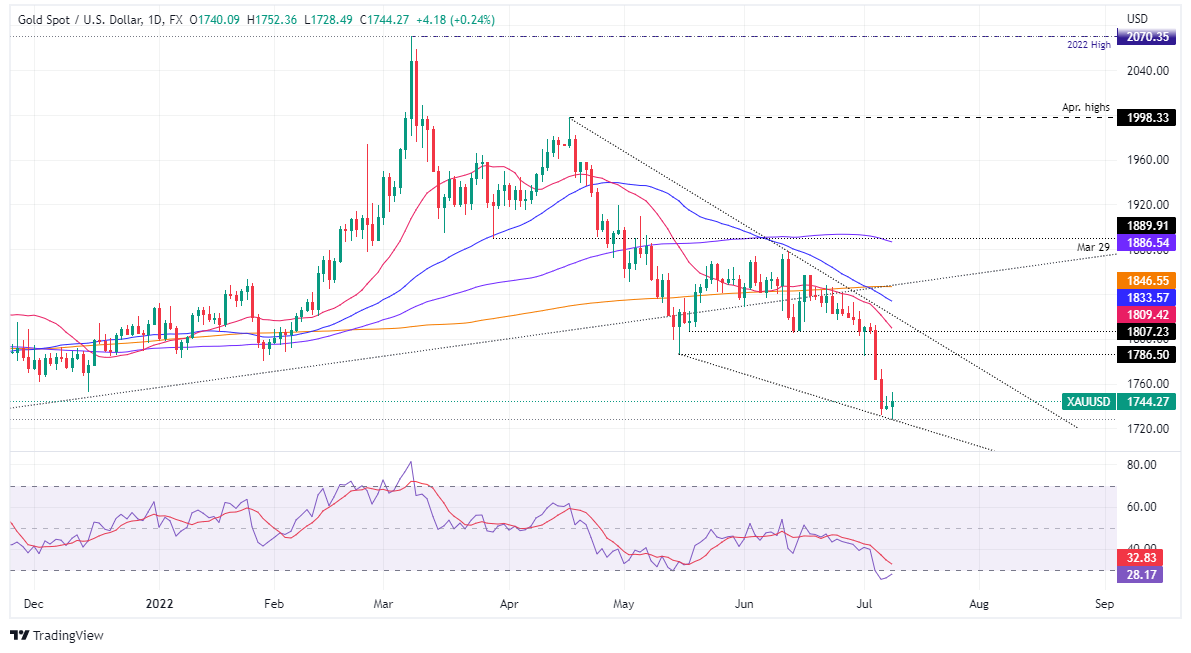
- Gold Price Forecast (XAUUSD): A falling wedge suggests upward pressure might be building, but buyers need to reclaim $1773; otherwise, gold can fall toward $1700.
Gold spot (XAUUSD) climbs during the North American session, bouncing from fresh YTD lows at around highs $1720s, eyeing a break above the $1750 figure as the US dollar weakens across the board. At the time of writing, XAUUSD is trading at $1744.27.
The yellow metal rebounds from weekly lows on a soft US dollar
Sentiment remains fragile, fluctuating on an upbeat US jobs report. The US Department of Labour reported that Nonfarm Payrolls for June rose by 372K, beating estimates of 268K, while the previous reading was downward revised to 384K. That clears the way for the Federal Reserve to remain tightening aggressively. At the time of writing, money market futures STIRs odds of a 75 bps hike to the Federal funds rate (FFR) lie at 97%, while investors expect a 50 bps rate raise for the September meeting.
Reflection of the aforementioned is US stocks mixed. In the meantime, the greenback erases earlier gains after reaching a fresh YTD high, tumbling below the 107.000 mark, down 0.07%, while the US 10-year Treasury rate is rising six bps, yielding 3.063%.
Lingering recession fears remain fueled by the inversion of the US 2s-10s yield curve, which sits at -0.021%, up from -0.03% at around 14:15 GMT.
Fed speakers will continue crossing news wires, led by New York Fed President John Williams. However, Atlanta’s Fed President Raphael Bostic said that the US jobs report shows the economy is strong, and he backs a 75 bps rate hike. On Thursday, Fed’s FOMC 2022 voters, Christopher Waller and James Bullard expressed that they favor a 75 bps rate hike in July, and downplayed recession fears, stating that the US economy remains solid.
What to watch
In the next week, the US economic docket will feature additional Fed speakers before entering the blackout period of the July monetary policy meeting. The Regional Fed Presidents Williams, Barkin, and Bostic will speak on Monday, Tuesday, and Friday, respectively. Meanwhile, Christopher Waller will take the stand on Thursday.
Data-wise, the June’s Consumer Price Index (CPI), the Producer Price Index (PPI), and the University of Michigan (UoM) Consumer Sentiment will shed some light on the status of the US economy.
Gold Price Forecast (XAUUSD): Technical outlook
Gold’s daily chart depicts a falling wedge forming, suggesting that the yellow metal could turn bullish in the near term. Nevertheless, oscillators are in oversold conditions, with the RSI at 28.70, far from supporting a bullish bias, but once it exits from that area, gold might consolidate before challenging the rising wedge top trendline around the $1800 mark.
- Improvement in risk sentiment weighs on the US dollar.
- US yields higher after a better-than-expected jobs report.
- NZD/USD recovers from 2-year lows, heads for a weekly gain.
The NZD/USD is trading above 0.6200, at the highest level in three days. The pair rose more than 70 pips from the daily low boosted by a weaker US dollar across the board.
Risk-on, NZD up
An improvement in risk sentiment triggered a reversal of the US dollar. Stocks in Wall Street are up after a negative opening. The Dow Jones rises by 0.37% and the Nasdaq 0.43%. US yields are at weekly highs, with the 10-year at 3.07%.
Regarding economic data released on Friday, the US June jobs report showed the economy added 372K payroll against expectations of 268K. The unemployment rate held steady at 3.6%, in line with market consensus.
The NZD/USD bottomed at 0.6130 after NFP and then rebounded more than 70 pips. It printed a fresh daily high at 0.6206. As of writing, it remains near the top, with a positive momentum.
The 4-hour chart shows the pair breaking above a short-term downtrend line and the 0.6190 resistance. If it remains above, more gains seem likely. The next resistance stands at 0.6220 followed by 0.6250. A slide back under 0.6190 would expose again 0.6130.
-637928902299599288.png)
The NZD/USD is about to end the week with modest gains and far from the two-year low it reached on Tuesday at 0.6123. Next Wednesday, the Reserve Bank of New Zealand will announce its decision on monetary policy. A rate hike from 2% to 2.50% is expected.
Technical levels
The sky-high inflation is the number one danger to the US economy, New York Fed President John Williams said on Friday, as reported by Reuters.
Additional takeaways
"We are 100% committed to goals."
"We must be resolute, and cannot fall short."
"Price stability is absolutely essential for a strong economy."
"Fed is strongly committed to bringing inflation back down to 2% goal."
"I expect unemployment rate to reach somewhat above 4% next year."
"GDP to grow less than 1% this year, rebound to 1.5% next year."
"Some signs job growth has slowed, but labor market remains incredibly tight."
"We will be data-dependent, nimble in our policy approach."
"High inflation is incredibly harmful; I am resolutely focused on restoring price stability."
"May take some time to get inflation to 2%, may well be a bumpy road."
Market reaction
The US Dollar Index showed no immediate reaction to these comments and was last seen posting small daily losses at 106.95.
A strong and above consensus payrolls report offers a reminder that the US is still on a firm footing. USD strength this week has come off the back of a breakdown in EUR, and this narrative is set to continue, according to strategists at TD Securities.
Not the recession you are looking for
“A solid payrolls report calls into question the repricing of the fed funds curve since the June meeting and more recently, recession talk. While we see the latter as likely in the next 12m, the timing of this could be further than the market currently thinks. Consequently, we believe that the market is far too premature on betting on a lower and earlier end to the tightening cycle.”
“The economy is standing strong, especially compared to some of its G7 peers (like the Eurozone) and it will be very difficult to displace the USD – especially with the EUR to remain very weak.”
“EUR/USD came perilously close to hitting parity; and while we would expect that to offer some natural defense (particularly in the options space), the macro headwinds are immense in Europe and the balance of payments is experiencing an epic deterioration that is likely to continue. And without a EUR offset, the USD remains king of FX.”
USD/CAD holds fairly well against a strong US Nonfarm Payrolls and disappointing Canadian jobs report. That said, economists at TD Securities think the pair is in the midst of forming a higher base, and a topside break above key resistance at 1.3080 is inevitable.
Disappointing jobs number does not do the CAD any favors
“A disappointing jobs number does not do the CAD any favors, particularly against a much stronger payrolls report in the US. The data mix is supportive of a higher USD/CAD, but we are not convinced that it will break the 1.3080 resistance in the near-term. More dominoes need to fall before that happens. But make no mistake, it will.”
“We think USD/CAD is forming a higher base, and we believe that holding risk into US inflation and the Fed's Index of Common Inflation Expectations (CIE) next week is playing with fire (US CPI is expected to be as strong as the last report while the CIE likely rose).”
“We are long USD/CAD and target 1.35.”
See – Canadian dollar: Forecasts from five major banks, best G10 currency only means modest recovery
- USD/JPY shot to over a one-week high in reaction to the upbeat NFP report for June.
- The widening US-Japan rate differential weighed on the JPY and remained supportive.
- The fundamental backdrop supports prospects for a move towards the 137.00 mark.
The USD/JPY pair recovered its early lost ground to the 135.30 area and turned positive for the fifth successive day on Friday. The intraday uptick picked up pace during the early North American session and pushed spot prices to over a one-week high, around the 136.55 region.
The US dollar stood tall near a two-decade high after the US monthly jobs report that the US economy added 372K jobs in June, far more than the 268K anticipated. The upbeat headline NFP was accompanied by a steady Unemployment rate, which came in at 3.6% for the reported month. Adding to this, Atlanta Fed President Raphael Bostic backed the case for a 75 bps rate hike move at the upcoming FOMC meeting in July.
Speaking to CNBC, Bostic - one of the most dovish policymakers - said that the Fed needs to move aggressively and that the core of the US economy is still strong. This, in turn, pushed the US Treasury bond yields and further widened the US-Japan rate differential. Apart from this, the divergent policy stance adopted by the Fed and Bank of Japan undermined the Japanese yen, which, in turn, lifted the USD/JPY pair.
The USD bulls, however, seemed reluctant to place fresh bets amid slightly overstretched conditions, especially after the recent strong bullish runup. This was seen as the only factor that kept a lid on any meaningful upside for the USD/JPY pair, at least for the time being. That said, the fundamental backdrop supports prospects for a move back towards testing a 24-year high, around the 137.00 mark set in June.
Technical levels to watch
- EUR/USD’s price action remains depressed on Friday.
- Further weakness could test the parity zone soon-ish.
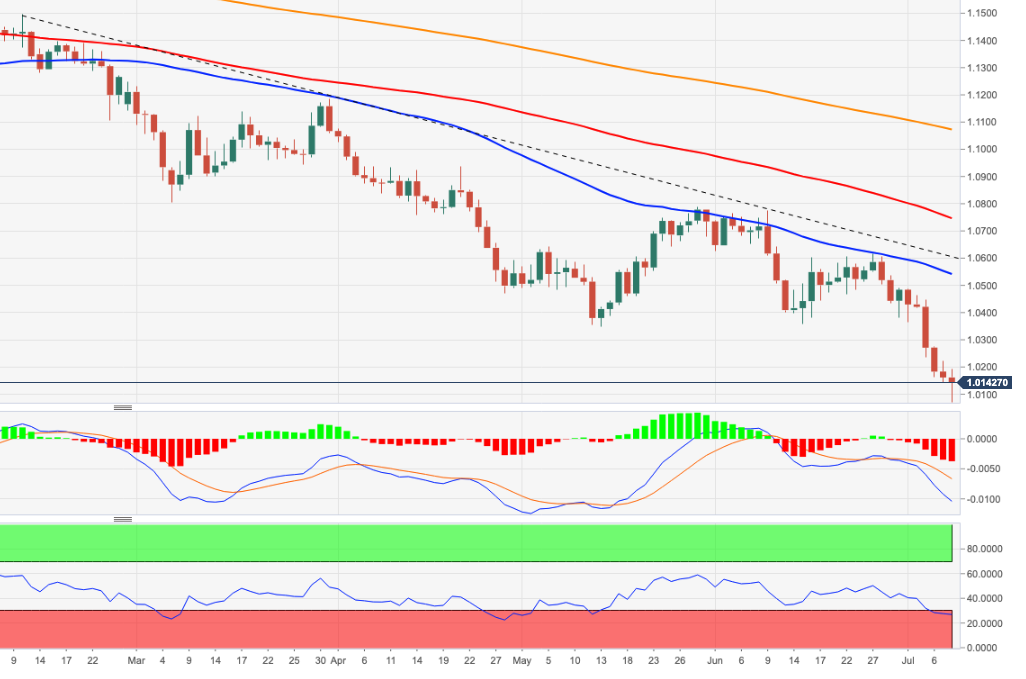
EUR/USD drops and rebounds from fresh cycle lows around 1.0070 on Friday.
The pair’s bearish stance stays everything but abated for the time being. Against that, there is a minor support level at 1.0060 (low December 11 2002). The loss of this level could lead up to a visit to parity for the first time since December 2002.
In the longer run, the pair’s bearish view is expected to prevail as long as it trades below the 200-day SMA at 1.1071.
EUR/USD daily chart
- USD/CAD edged higher in reaction to the upbeat US NFP report and mixed Canadian jobs report.
- An uptick in oil prices underpinned the loonie and continued acting as a headwind for the major.
- A sustained strength beyond the 1.3075-1.3080 barrier is needed to confirm a bullish breakout.
The USD/CAD pair caught fresh bids during the early North American session and shot to the daily high, around the 1.3035 region following the release of the US/Canadian jobs report.
The headline NFP showed that the US economy added 372K jobs in June as against an increase of 384K (revised down from 390K) reported in May. This, however, surpassed consensus estimates of 268K by a big margin. Adding to this, the Unemployment Rate held steady at 3.6% and reaffirmed expectations for a more aggressive policy tightening by the US central bank. The prospects for faster Fed rate hikes triggered a sharp spike in the US Treasury bond yields. Apart from this, a softer risk tone continued lending support to the safe-haven US dollar and pushed the USD/CAD pair higher.
In contrast, Statistics Canada reported a 43.2K decline in Net Change in Employment, which exerted some pressure on the domestic currency and provided an additional lift to spot prices. The disappointment, however, was offset by that the fact that the Unemployment Rate in Canada declined to 4.9% in June from 5.1% in the previous month. Adding to this, some follow-through uptick in crude oil prices underpinned the commodity-linked loonie and capped any meaningful upside for the USD/CAD pair. This, in turn, warrants some caution before placing aggressive bullish bets around the major.
Hence, it will be prudent to wait for strong follow-through buying and sustained strength beyond the 1.3075-1.3085 supply zone before positioning for any further gains. Nevertheless, the USD/CAD pair remains on track to end the week on a positive note and might continue to take cues from the US/oil price dynamics.
Technical levels to watch
In an interview with CNBC on Friday, Atlanta Fed President Raphael Bostic said that he is "fully supportive" of one more 75 basis points rate hike in July, as reported by Reuters.
Additional takeaways
"This jobs report shows economy is strong."
"Still a lot of labor market momentum."
"Economy is starting to slow."
"We will get inflation under control."
"These job numbers show just minor signs of slowing."
"We need to see more sustained, more significant slowing."
"Starting to inch in right direction, but need to see a lot more."
"I've had to adapt on where I think policy should go, we need to move aggressively."
"Tremendous momentum in economy shows 75 bps move in economy won't mean protracted damage to economy."
"Will take wait and see attitude, will observe and adapt."
"This may be the labor market catching up to output, but doesn't necessarily represent recessionary issue."
Market reaction
The dollar preserves its strength after these comments with the US Dollar Index holding in positive territory above 107.00.
- DXY extends the upside and prints new cycle highs near 107.80.
- Immediately to the upside emerges the minor hurdle at 108.00.
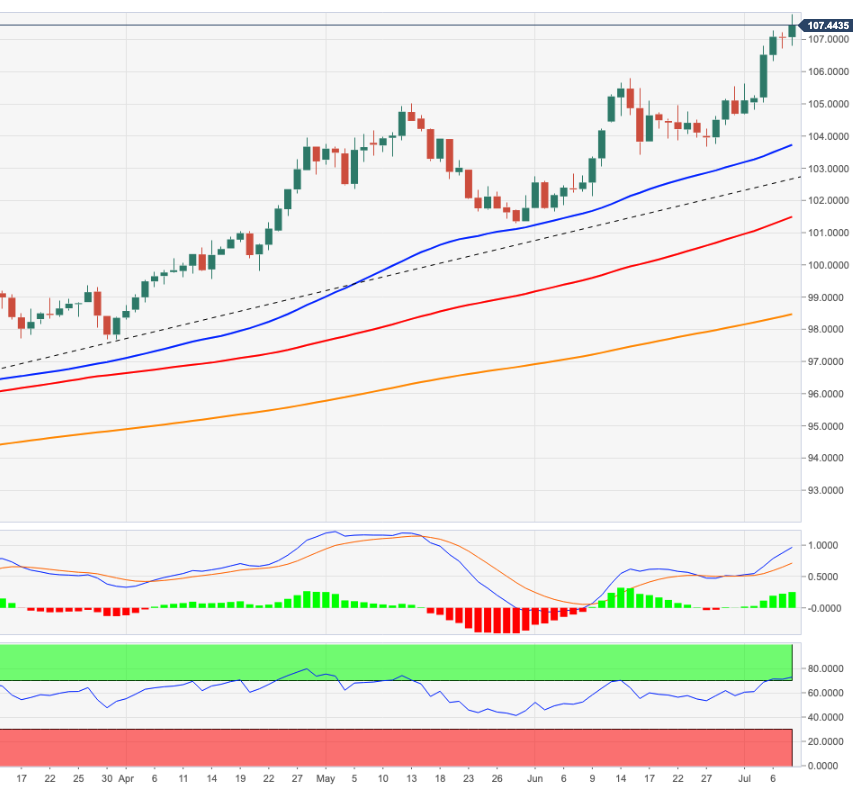
DXY has quickly left behind Thursday’s small correction and advanced to new cycle peaks near 107.80 at the end of the week
Further upside in the dollar remains in store in the short-term horizon. That said, the surpass of the 2022 high at 107.78 (July 8) should pave the way for a move to the round level at 108.00 prior to the October 2002 top at 108.74.
As long as the 5-month line near 102.75 holds the downside, the near-term outlook for the index should remain constructive.
In addition, the broader bullish view remains in place while above the 200-day SMA at 98.45.
Of note, however, is that the index trades in the overbought territory and it therefore could extend the corrective decline to, initially, the 105.80 region (high June 15).
DXY daily chart
- Unemployment Rate in Canada fell unexpectedly in June.
- USD/CAD trades in positive territory above 1.3000 after Canadian jobs report.
The Unemployment Rate in Canada declined to 4.9% in June from 5.1% in May despite a 43.2K decline in Net Change in Employment, the data published by Statistics Canada showed on Friday. Investors were expecting the Unemployment Rate to remain unchanged at 5.1%.
The Participation Rate fell to 64.9% from 65.3% in the same period, explaining the lower Unemployment Rate despite falling employment. Finally, the Average Hourly Wages rose by 5.57% on a yearly basis in June, up from 4.45% in May.
Market reaction
The USD/CAD pair gained traction after this report and was last seen rising 0.5% on the day at 1.3030.
- GBP/USD edged lower during the early North American session in reaction to the upbeat US NFP report.
- The US economy added 372K new jobs in June (268K expected) and the jobless rate held steady at 3.6%.
- The data reaffirmed bets for aggressive Fed rate hikes and continued lending support to the greenback.
The GBP/USD pair struggled to capitalize on its intraday bounce from the 1.1920 region and attracted fresh selling in reaction to mostly upbeat US employment details. The pair was last seen trading around the 1.1985-1.1980 region, down nearly 0.35% during the early North American session.
The intraday US dollar pullback from a two-decade high was quickly bought into after the headline NFP showed that the US economy added 372K jobs in June. This was slightly below the previous month's downwardly revised reading of 384K, though was well above the 268K anticipated. Adding to this, the Unemployment Rate held steady at 3.6%, as expected, and cemented expectations for a more aggressive policy tightening by the Fed.
Apart from this, the prevalent cautious mood around the equity markets offered some support to the safe-haven greenback. That said, weaker US Treasury bond yields held back the USD bulls from placing fresh bets and offered some support to the GBP/USD pair, at least for the time being. The near-term bias, however, remains tilted in favour of bearish traders amid Brexit woes and expectations for a less hawkish Bank of England.
Investors remain concerned that the UK government's controversial Northern Ireland Protocol Bill could trigger a trade war with the European Union amid the cost-of-living crisis. Furthermore, recession fears could force the BoE to adopt a gradual approach toward raising interest rates and act as a headwind for the British pound.
Technical levels to watch
- EUR/USD extends the rebound from earlier cycle lows.
- US Non-farm Payrolls rose by 372K jobs in June.
- The unemployment rate remained at 3.6%.
Despite the rebound from lows, the selling interest around the single currency remains well and sound and motivates EUR/USD to keep the price action subdued around 1.0100/15 at the end of the week.
EUR/USD still faces a potential drop to parity
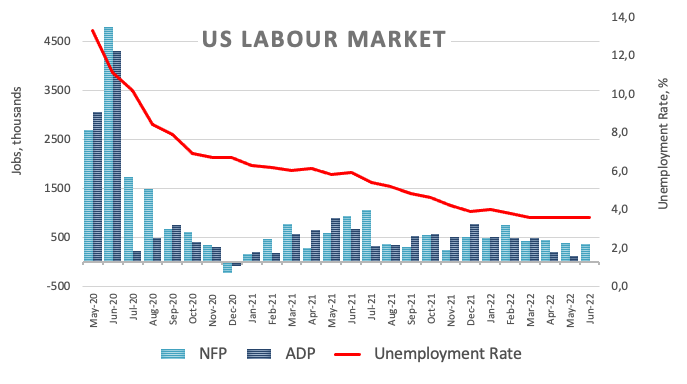
EUR/USD keeps the negative stance on Friday after the release of the Nonfarm Payrolls showed the US economy created 372K jobs during June, surpassing initial estimates for a gain of 268K jobs. The May reading was revised down to 384K (from 390K).
Further data saw the jobless rate unchanged at 3.6% and the key Average Hourly Earnings – a proxy for inflation via wages – rise 0.3% MoM and 5.1% from a year earlier. Additionally, the Participation Rate, eased a little to 62.2%.
What to look for around EUR
Bears maintain the EUR/USD under heavy pressure and the acceleration of the downside opens the door to a probable visit to the parity level sooner rather than later.
Indeed, the pair’s price action remains depressed and keeps closely following rising speculation around a probable recession in the region, dollar dynamics, geopolitical concerns, fragmentation worries and the Fed-ECB divergence.
Key events in the euro area this week: ECB Lagarde (Friday).
Eminent issues on the back boiler: Fragmentation risks. Kickstart of the ECB hiking cycle in July? Asymmetric economic recovery post-pandemic in the euro bloc. Impact of the war in Ukraine on the region’s growth prospects and inflation.
EUR/USD levels to watch
So far, spot is down 0.16% at 1.0140 and faces the next contention at 1.0071 (2022 low July 8) seconded by 1.0060 (low December 11 2002) and finally 1.0000 (psychological level). On the upside, a breakout of 1.0538 (55-day SMA) would target 1.0615 (weekly high June 27) en route to 1.0773 (monthly high June 9).
The CAD weakened in June along with nearly all G10 currencies. As we enter the second half of the year, some analysts have updated their Canadian dollar forecasts. Here you can find the expectations of five major banks regarding loonie’s outlook for the coming months. Although the CAD is set to stay resilient, it is unlikely to enjoy substantial gains.
Wells Fargo
“We believe the Bank of Canada will maintain a relatively hawkish stance on monetary policy, while elevated energy prices and relatively sound consumer finances are also favorable factors. In addition, we expect the Bank of Canada to hold policy rates steady even as the Fed eventually begins to ease monetary policy. We look for modest CAD strength against the dollar by mid-2023, the most optimistic view on any G10 currency.”
MUFG
“The BoC meeting in July will be important and if the BoC follows the Fed’s lead, it will limit near-term downside risks. However, the global backdrop for risk is set to remain unfavourable and that points to broader US dollar strength. However, aggressive BoC action and a rebound in crude oil prices like we expect should limit the scope for USD/CAD to move higher in Q3. The risk of a downturn in 2023 is increasing and given Canada’s closer links to the US where the Fed’s actions make a recession there more likely, it could result in a more muted recovery for the Canadian dollar. We expect crude oil prices to decline in Q4 which could further undermine the extent of CAD recovery. So while we expect CAD recovery from current levels, we have become a little more cautious over the extent of the recovery.”
CIBC
“A likely 75 bps hike by the Bank of Canada in July, and the potential for another move of that magnitude in September if we don't see enough of an inflation deceleration by then, should be aggressive enough to allow USD/CAD to remain around current levels over the next three months. Markets appear to be overpricing both BoC and Fed tightening this year, but comparatively more for the BoC, and that recalibration will lead the CAD to end the year weaker, with USD/CAD expected to reach 1.31 by then. In 2023, the loonie could weaken further on a global slowdown in growth as interest rate hikes take a toll on activity, which will weigh on commodity prices and dent nominal exports for Canadian natural resource producers. Look for USD/CAD to reach 1.33 in early 2023, before recouping some of that ground further into the year as the USD loses favour globally.”
Credit Suisse
“CAD is well positioned within the G10 commodity FX complex: BoC is seen as credible, activity data are solid, but housing represents a near-term risk. A range approach remains valid: we widen our USD/CAD target range slightly from 1.2650-1.3100 to 1.2670-1.3340, with a midpoint range target of 1.3000.”
TDS
“USD/CAD should continue to maintain the 1.27/1.31 range in the short-term. The bias, though, remains to the upside, especially as BoC rate hikes start to rattle the housing market and risk appetite remains shaky. We also downplay the importance of the oil factor given limited longer-term investment implications. While the consensus view around USD/CAD seems less varied than other pairs, we're generally more bearish CAD in the months ahead.”
Nonfarm Payrolls in the US rose by 372,000 in June, the data published by the US Bureau of Labor Statistics revealed on Friday. This reading followed May's increase of 384,000 (revised from 390,000) and came in better than the market expectation of 268,000. The Unemployment Rate remained unchanged at 3.6% as expected.
Further details of the publication revealed that the annual wage inflation, as measured by the Average Hourly Earnings, edged lower to 5.1% from 5.3% in May and the Labor Force Participation declined to 62.2% from 62.3.
Follow our live coverage of market reaction to the US jobs report.
Market reaction
The greenback gathered strength against its major rivals with the initial reaction and the US Dollar Index was last seen rising 0.32% on a daily basis at 107.38
Economist at UOB Group Enrico Tanuwidjaja comments on the recently published FX reserves figures in Indonesia.
Key Takeaways
“Indonesia’s foreign exchange reserves jumped to USD136.4bn in Jun 2022, reversing decline and was highest in 3 months following an increase of USD0.8bn.”
“The latest reserve level was equivalent to finance 6.6 months of import or 6.4 months of imports and servicing the government’s external debt, well above the international adequacy standard of 3 months of imports.”
“Bank Indonesia (BI) maintains their view that the official reserve assets will remain adequate, supported by the stability and solid domestic economic outlook in line with several responsive policies to support long-term economic recovery.”
- EUR/JPY trades without direction in the 138.00 region.
- Next on the downside comes the 100-day SMA.
EUR/JPY printed news multi-week lows in the 136.80 region, although it managed to regain composure afterwards.
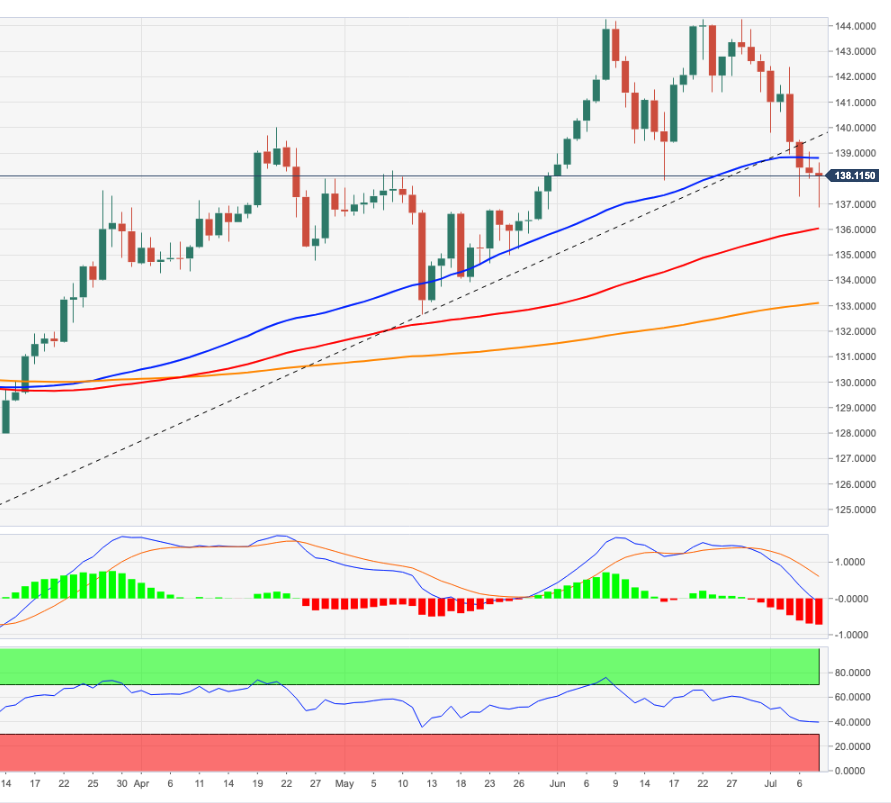
The cross remains under pressure, particularly after breaking below the 4-month support line, today around 139.65. That said, further downtrend could revisit the 100-day SMA at 136.00 ahead of the minor support at 133.92 (low May 19).
In the longer run, the constructive stance in the cross remains well propped up by the 200-day SMA at 133.07.
EUR/JPY daily chart
- AUD/USD reversed an intraday dip to the 0.6800 mark amid a modest intraday USD pullback.
- The upside remains capped near a resistance marked by the top end of a descending channel.
- Investors now seem to have moved on the sidelines and await the US monthly jobs report (NFP).
The AUD/USD pair attracted some dip-buying near the 0.6800 mark on Friday and has now recovered its modest intraday losses. The pair was last seen trading in the neutral territory, around the 0.6830 area, as traders now await the release of the US monthly jobs data for a fresh impetus.
The US dollar surrendered a major part of its intraday gains to a fresh two-decade high amid some repositioning trade ahead of the NFP report. Apart from this, a generally positive tone around the equity markets undermined the safe-haven buck and offered support to the risk-sensitive aussie.
From a technical perspective, the AUD/USD pair, so far, has failed to capitalize on this week's rebound from a two-year low and the upside remains capped near a descending trend channel resistance. The said barrier, currently around the 0.6855-0.6860 region, should now act as a pivotal point.
This is closely followed by the 0.6900 mark, which coincides with the 100-period SMA on the 4-hour chart, which if cleared would suggest that the AUD/USD pair has formed a bottom. This, in turn, could trigger a short-covering move and lift spot prices towards the 0.6955-0.6960 supply zone.
On the flip side, the 0.6800 mark now seems to have emerged as immediate support, below which the AUD/USD pair could slide back to the 0.6765-0.6760 area. Some follow-through selling would pave the way for a slide towards the ascending channel support, currently around the 0.6715-0.6710 area.
A convincing break through the latter, leading to a subsequent fall below the 0.6700 mark would be seen as a fresh trigger for bearish traders and pave the way for additional losses. The AUD/USD pair might then accelerate the fall towards the next relevant support near the 0.6655-0.6650 region.
AUD/USD 4-hour chart
-637928787785792831.png)
Key levels to watch
UOB Group’s Senior Economist Julia Goh and Economist Loke Siew Ting assess the latest labour market report in the Malaysian economy.
Key Takeaways
“Malaysia’s labour market recovery continued to gain traction in May, supported by the full reopening of economic and social activities as well as country borders since Apr. Both the labour force participation rate and employment increased further to a fresh high of 69.5% and 15.90mn persons respectively (Apr: 69.4% and 15.85mn persons). This helped to keep the unemployment rate unchanged at 3.9% in May.”
“Record hiring was again propelled by the continuing recruitment in almost all economic sectors, expect for the mining & quarrying industry which recorded a decline in employment for the 22nd straight month. Services sector, which made up about 58% of the national GDP, remained the key driver of overall employment in Malaysia with wholesale & retail trade, information & communication, and food & beverage services sub-sectors taking the lead during the month.”
“Although the labour market showed persistent improvement, it is still unlikely to fully recover back to pre-pandemic levels at this juncture given multiple headwinds on the horizon. Worsening supply chain disruptions, elevated cost and consumer price pressures, as well as mounting fears of global recession may soon see more firms hitting the brakes on recruitment. We reiterate our year-end unemployment rate forecast of 3.6% for 2022 (BNM est: ~4.0%, end-2021: 4.2%, end-2019: 3.3%).”
Canadian employment details overview
Statistics Canada is scheduled to publish the monthly employment details for June later this Friday at 12:30 GMT. The Canadian economy is anticipated to have added 22.5K jobs during the reported month, down from the 39.8K rise reported in May. Meanwhile, the unemployment rate is expected to hold steady at 5.1% in June.
Analysts at Citibank sounded slightly more optimistic and offered a brief preview of the report: “We expect a solid 45K increase in employment in June, similar to the rise in May but with two-sided risks. The path of wage growth however will likely be more important to determine
whether the BoC starts to ease up on aggressive rate hikes later this year or if they remain more hawkish in line with the Fed.”
How could the data affect USD/CAD?
The data is likely to be overshadowed by the simultaneous release of the closely-watched US jobs report - popularly known as NFP. That said, a significant divergence from the expected readings should influence the Canadian dollar and provide some meaningful impetus to the USD/CAD pair.
Heading into the key data risks, spot prices regained positive traction amid an extension of the recent strong US dollar bullish run. That said, some follow-through uptick in crude oil prices underpinned the commodity-linked loonie and caped the upside for the USD/CAD pair.
Stronger domestic data should lend additional support to the Canadian dollar and exert some downward pressure on the major. That said, the daily swing low, around the 1.2955-1.2950 area, might continue to act as immediate support, below which the USD/CAD pair could slide further towards the 1.2900 mark. The latter should act as a strong base for the major, which if broken decisively would negate any near-term positive outlook and prompt aggressive technical selling.
Conversely, a weaker-than-expected report would be enough to assist the USD/CAD pair to build on this week's strong rally from the vicinity of the 50-day SMA. Bulls, however, might wait for a sustained move beyond the 1.3075-1.3085 region before placing fresh bets. Spot prices would then aim to surpass an intermediate barrier near the 1.3155-1.3160 region and reclaim the 1.3200 mark before eventually climbing to the 1.3270 resistance zone.
Key Notes
• Canadian Jobs Preview: Forecasts from five major banks, fairly moderate employment growth in June
• USD/CAD Outlook: Bulls have the upper hand, US/Canadian jobs data awaited
• USD/CAD: A move to the 1.31-1.32 area is surely possible – ING
About the Employment Change
The employment Change released by Statistics Canada is a measure of the change in the number of employed people in Canada. Generally speaking, a rise in this indicator has positive implications for consumer spending which stimulates economic growth. Therefore, a high reading is seen as positive, or bullish for the CAD, while a low reading is seen as negative or bearish.
About the Unemployment Rate
The Unemployment Rate released by Statistics Canada is the number of unemployed workers divided by the total civilian labour force. It is a leading indicator for the Canadian Economy. If the rate is up, it indicates a lack of expansion within the Canadian labour market. As a result, a rise leads to weaken the Canadian economy. Normally, a decrease of the figure is seen as positive (or bullish) for the CAD, while an increase is seen as negative or bearish.
US monthly jobs report overview
Friday's US economic docket highlights the release of the closely-watched US monthly jobs data for June. The popularly known NFP report is scheduled for release at 12:30 GMT and is expected to show that the economy added 268K jobs during the reported month, down from the 390K in May. The unemployment rate, however, is expected to hold steady at 3.6% in June. Apart from this, investors will take cues from Average Hourly Earnings, which could offer fresh insight into the possibility of a further rise in inflationary pressures.
Analysts at ING offered a brief preview of the report and explained: “We think payrolls may grow somewhere in the 250-300K range, which should still be enough to keep the unemployment rate at 3.6% and wages continuing to tick higher. For us to seriously consider changing our July Fed call we would need to see payrolls growth fall with the unemployment rate moving a couple of tenths higher and wage growth showing signs of stagnating. Even then we would still probably need to see a surprisingly large decline in inflation the following week.”
How could the data affect EUR/USD?
Heading into the key release, the US dollar shot to a fresh two-decade high amid growing acceptance that the Fed would retain its aggressive policy tightening path. This, in turn, dragged the EUR/USD pair below the 1.0100 mark for the first time since December 2002. Against the backdrop of the hawkish FOMC meeting minutes released earlier this week, a stronger NFP print would reaffirm bets for faster rate hikes by the Fed and further lift the buck.
Conversely, a weaker reading could add to worries about a possible global recession and might do little to trigger any meaningful USD corrective pullback. This, along with the energy crisis in Europe, which might drag the Eurozone economy faster and deeper into recession, suggests that the path of least resistance for the EUR/USD pair is to the downside.
According to Eren Sengezer, Editor at FXStreet: “EUR/USD remains extremely oversold in the near term with the Relative Strength ındex (RSI) indicator on the four-hour chart staying well below 30. The descending regression channel coming from late-June stays intact and the pair's technical correction is likely to meet resistance at the upper limit of that channel at 1.0150.”
Eren further outlined important technical levels to trade EUR/USD: “With a four-hour close above that level, the pair could extend its recovery toward 1.0200 (psychological level, static level, 20-period SMA). On the downside, interim support seems to have formed at 1.0070 (static level) before the pair could target the all-important parity.”
Key Notes
• Nonfarm Payrolls Preview: Three dollar-positive scenarios, only one negative one
• NFP Preview: Forecasts from 10 major banks, labour market loses momentum
• EUR/USD Forecast: Door opens to parity
About the US monthly jobs report
The nonfarm payrolls released by the US Department of Labor presents the number of new jobs created during the previous month, in all non-agricultural business. The monthly changes in payrolls can be extremely volatile, due to its high relation with economic policy decisions made by the Central Bank. The number is also subject to strong reviews in the upcoming months, and those reviews also tend to trigger volatility in the forex board. Generally speaking, a high reading is seen as positive (or bullish) for the USD, while a low reading is seen as negative (or bearish), although previous months reviews and the unemployment rate are as relevant as the headline figure.
British Prime Minister Boris Johnson's spokesperson said on Friday that the latest political events will not affect the progression of the Northern Ireland Protocol bill, as reported by Reuters.
"The government will continue to move ahead with already agreed policies such as Rwanda immigration flights," the spokesman added. When asked about fiscal policy, "a responsible government does need to react to emerging issues," he noted.
Market reaction
Markets remain risk-averse following these comments and the UK's FTSE 100 Index was last seen losing 0.45% on a daily basis.
Senior Economist at UOB Group Alvin Liew reviews the latest release of the FOMC Minutes of the June 14-15 gathering.
Key Takeaways
“The key takeaway from the 14/15 Jun FOMC minutes was that Fed policymakers agreed interest rates may need to keep rising for longer and into a restrictive policy stance to prevent higher inflation from becoming entrenched, even if it came at the cost of slower US economic growth “for a time”. Policymakers also warned of "a significant risk" if the Fed cannot maintain its credibility to fight inflation.”
“The other key takeaway was there was broad agreement among the policy makers as ‘participants judged that an increase of 50 or 75 basis points would likely be appropriate at the next meeting [Jul]’.”
“As evident from the minutes, the overarching message from the Fed was still centered on inflation with 90 references to inflation and that ‘many participants’ were concerned that ‘longer-run inflation expectations could be beginning to drift up to levels inconsistent with the 2 percent objective.’ There was not a single mention of ‘recession’ in the minutes, only the acknowledgement of slower growth. The policymakers also broadly agreed with the assessment of a ‘very tight [US] labor market’.”
“FOMC Outlook – Jun CPI inflation the key determinant for Jul FOMC policy action: FOMC Chair Powell highlighted the importance of headline CPI inflation to inflation expectations (and by that extension, to Fed policy). We will mark the Jun CPI (due on 13 Jul 2022, 8:30pm SGT) as the key determinant of whether we get a 50bps or 75bps hike for the next FOMC on 26/27 Jul. Currently, we are projecting US CPI inflation coming in at 0.8% m/m, 8.4% y/y in Jun (from 1% m/m, 8.6% y/y in May). Thus, inflation is still elevated and accelerating sequentially but the headline print will be off its peak (i.e. lower at 8.4% versus 8.6%), so that will warrant a 50bps hike for July, in our view. However, if inflation accelerates more than our expectation and prints above May’s 8.6% inflation rate, then that will mean a stronger response from the Fed is required, i.e. 75bps.”
“In addition to the move in Jul, we expect another two more 50bps rate hikes in Sep and Nov FOMC before ending the year with a 25bps hike in Dec. Including the 150bps of hikes to date, this implies a cumulative 325bps of increases in 2022, bringing the FFTR higher to the range of 3.25-3.50% by end of 2022, a range largely viewed as above the neutral stance (which is seen as 2.25-2.50%, the Fed’s long run projection of FFTR). We maintain our forecast for two more 25bps rate hikes in 2023, but likely to be brought forward to the first three months of 2023, bringing our terminal FFTR to 3.754.00% by end 1Q-2023.”
Italy economy minister Daniele Franco said on Friday, inflation doesn't seem likely to decline quickly.
Additional quotes
Italy economy minister franco says q2 probably saw "robust" GDP growth in Italy.
Italy economy minister franco says govt will continue to take steps to limit impact of high energy prices on firms and households.
Market reaction
- EUR/USD: Bears don’t give up and open the door to parity
- EUR/USD shows no signs of a convincing recovery, parity in the crosshairs
- Gold Price gives up recovery gains, as the US dollar rebounds firmly.
- Risk-aversion backs the USD ahead of the critical US NFP.
- XAUUSD extends its journey towards the $1,700 mark.
Gold Price is trading with mild losses, attacking nine-month lows of $1,732, as the US dollar finds renewed demand amid a risk-off market profile.
Investors digest the news of the former Japanese Prime Minister Shinzo Abe passing away due to a rare incident that happened in Japan. He was shot twice from behind by a shotgun in the chest and was rushed to the hospital. But succumbed to the wounds a few hours later.
Further, looming recession concerns, aggressive Fed rate hike expectations and the sell-off in the EUR/USD pair towards parity are all boding well for the greenback at gold’s expense. Amidst risk-off flows dominated, the US Treasury yields are losing their appeal, as government bonds remained favored.
Markets are eagerly awaiting the release of the all-important US Nonfarm Payrolls data, with the headline number seen arriving at 300K in June vs. 268K reported in May. The US unemployment rate is likely to hold steady at 3.6% in the previous month.
The dollar is likely to remain in a win-win situation whatever the outcome of the US labor market data may be. That said, the Fed will continue with its hawkish tightening stance, as it remains committed to tackling the inflation monster. The bright metal remains exposed to downside risks in the near term.
Gold Price: Daily chart
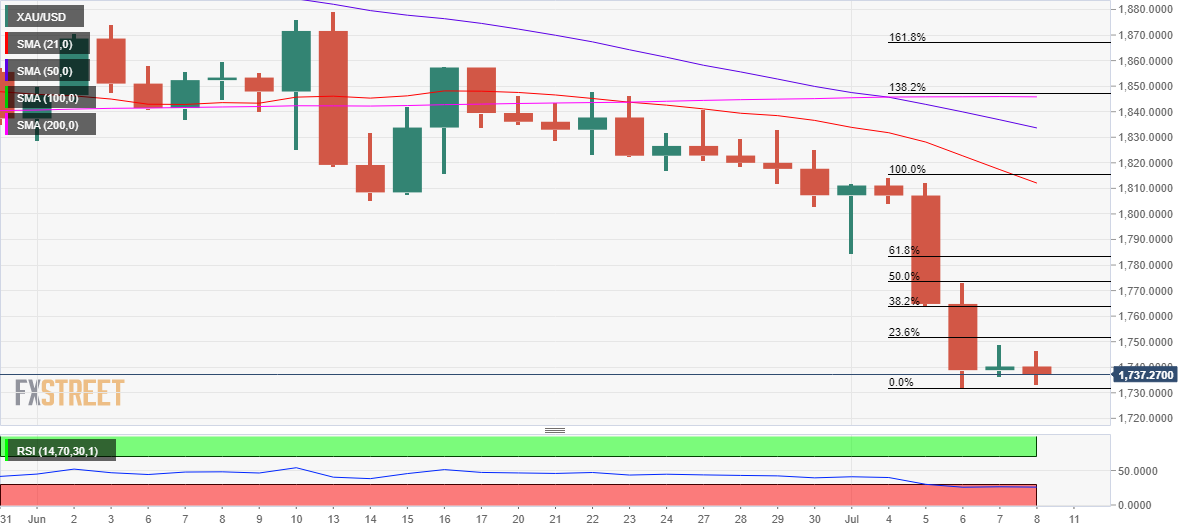
Gold price slipped further after facing rejection below $1,751, which is the 23.6% Fibonacci Retracement (Fibo) level of this week’s sell-off from $1,815 levels.
Daily closing above the latter is required to initiate any meaningful recovery from multi-month troughs of $1,732. Further up, the 38.2% Fibo level at $1,763 will challenge the bearish commitments.
Powerful resistance at $1.770 will be the next stop for XAU bulls. That level is the confluence of the psychological mark and the 50% Fibo level of the same decline.
Also read: Gold Price Forecast: XAUUSD remains non-committal below $1,750, awaiting US NFP
The 14-day Relative Strength Index (RSI) is flattening while within the oversold territory.
On the downside, the $1,732 will be the initial support, below which the rising channel target at $1,722 will come into play. A sustained move below the latter will expose the $1,700 threshold.
Gold Price: Additional levels to consider
- A combination of supporting factors assisted USD/CAD to regain positive traction on Friday.
- Aggressive Fed rate hike bets amidst a cautious mood pushed the USD to a fresh 20-year peak.
- Recession fears capped oil prices, which undermined loonie and further extended support.
- Traders now look forward to the release of the monthly jobs report from the US and Canada.
The USD/CAD pair attracted fresh buying in the vicinity of mid-1.2900s on Friday and continued scaling higher through the first half of the European session. The pair has now reversed a major part of the overnight losses and was last seen trading just above the 1.3000 psychological mark.
Following the previous day's brief pause, the US dollar was back in demand and shot to a fresh two-decade high amid the prospects for faster rate hikes by the Fed. The market bets were reaffirmed by hawkish minutes of the June 14-15 FOMC meeting released on Wednesday, indicating that another 50 or 75 bps rate hike is likely at the July meeting. Apart from this, the prevalent cautious market mood also benefitted the safe-haven greenback, which, in turn, assisted the USD/CAD pair to regain positive traction on the last day of the week.
The market sentiment remains fragile amid concerns that rapidly rising interest rates and tightening financial conditions would pose challenges to global growth. Apart from this, the ongoing Russia-Ukraine war and the latest COVID-19 outbreak in China have been fueling recession fears. Meanwhile, the worsening economic outlook has raised concerns about the fuel demand recovery. This, in turn, acted as a headwind for crude oil prices, which undermined the commodity-linked loonie and provided an additional lift to the USD/CAD pair.
It would now be interesting to see if bulls are able to maintain their dominant position or refrain from placing fresh bets ahead of Friday's release of monthly jobs data from the US and Canada. The popularly known NFP report might infuse some volatility in the financial markets and drive the USD demand. Apart from this, traders will further take cues from oil price dynamics to grab short-term opportunities around the USD/CAD pair.
Technical levels to watch
- EUR/USD breaches below 1.0100 and clinches new lows.
- ECB Visco advocated for a 50 bps (?) rate hike in September.
- It is Payrolls’ day across the Atlantic, yay!
EUR/USD accelerates losses and breaks below the 1.0100 level for the first time since December 2002.
EUR/USD weaker on USD-strength, looks to data
EUR/USD extends the decline for the sixth consecutive session so far on Friday amidst deteriorating conditions in the risk-associated universe, rising speculation of a recession in the euro bloc and intense dollar gains.
No effects on the single currency from hawkish comments by ECB’s Visco, who suggested a larger than 25 bps rate hike at the September event in case inflation conditions do not improve (which looks like the most probable scenario). He also expects (wishes) that inflation could return to the bank’s 2% target in 2024.
In the German money market, the 10y Bund yields appear slightly on the defensive above 1.25% following Thursday’s decent uptick.
In the docket, Italian Industrial Production contracted 1.1% MoM in May and expanded 3.4% vs. May 2021. Later in the session, Chair Lagarde will participate in an event in France.
In the NA session, June’s Nonfarm Payrolls will steal the show seconded by Wholesale Inventories and Consumer Credit Change as well as the speech by NY Fed J.Williams.
What to look for around EUR
Bears maintain the EUR/USD under heavy pressure and the acceleration of the downside opens the door to a probable visit to the parity level sooner rather than later.
Indeed, the pair’s price action remains depressed and keeps closely following rising speculation around a probable recession in the region, dollar dynamics, geopolitical concerns, fragmentation worries and the Fed-ECB divergence.
Key events in the euro area this week: ECB Lagarde (Friday).
Eminent issues on the back boiler: Fragmentation risks. Kickstart of the ECB hiking cycle in July? Asymmetric economic recovery post-pandemic in the euro bloc. Impact of the war in Ukraine on the region’s growth prospects and inflation.
EUR/USD levels to watch
So far, spot is down 0.37% at 1.0118 and faces the next contention at 1.0071 (2022 low July 8) seconded by 1.0060 (low December 11 2002) and finally 1.0000 (psychological level). On the upside, a breakout of 1.0538 (55-day SMA) would target 1.0615 (weekly high June 27) en route to 1.0773 (monthly high June 9).
EUR/USD has dropped below 1.0100 for the first time in nearly 20 years. In the view of FXStreet’s Eren Sengezer, it would not be surprising to see the euro hit parity against the dollar at this point.
Focus shifts to June Nonfarm Payrolls data from the US
“An upbeat NFP print coupled with strong wage inflation could provide a boost to the dollar. On the other hand, disappointing figures could trigger a dollar selloff but the currency's weakness is likely to remain short-lived with investors seeking refuge in that scenario.”
“The descending regression channel coming from late-June stays intact and the pair's technical correction is likely to meet resistance at the upper limit of that channel at 1.0150. With a four-hour close above that level, EUR/USD could extend its recovery toward 1.0200 (psychological level, static level, 20-period SMA).”
“On the downside, interim support seems to have formed at 1.0070 (static level) before the pair could target the all-important parity.”
See – NFP Preview: Forecasts from 10 major banks, labour market loses momentum
The upside bias on USD/CNH seems to have ebbed somewhat and the pair could now trade between 6.6600 and 6.7400 in the next few weeks.
Key Quotes
24-hour view: “Our expectations for USD to ‘trade sideways between 6.7050 and 6.7250’ was incorrect as it dropped to a low of 6.6919. While downward momentum has not improved by much, USD could decline but a break of 6.6820 is unlikely. Resistance is at 6.7040 followed by 6.7140.”
Next 1-3 weeks: “Two days ago (06 Jul, spot at 6.7140), we highlighted that shorter-term upward momentum is beginning to build and the risk of a break of 6.7400 has increased. However, USD has not been able to make any headway on the upside and the build-up in momentum has fizzled out. In other words, USD is likely to continue to consolidate and trade between 6.6600 and 6.7400 for now.”
- Sustained USD buying interest pushed USD/CHF to a fresh multi-week high on Friday.
- The cautious market mood underpinned the safe-haven CHF and acted as a headwind.
- Traders also seemed reluctant to place aggressive bets ahead of the key US jobs report.
The USD/CHF pair prolonged its recent strong bounce from sub-0.9500 levels and gained some follow-through traction for the seventh successive day on Friday. The momentum pushed spot prices to over a three-week high during the first half of the European session, though stalled just ahead of the 0.9800 round-figure mark.
Following the previous day's brief pause, the US dollar was back in demand and shot to a fresh two-decade high amid expectations for more aggressive Fed rate hikes. The market bets were reaffirmed by hawkish minutes of the June 14-15 FOMC meeting released on Wednesday, indicating that another 50 or 75 bps rate hike is likely at the July meeting. This, in turn, was seen as a key factor that continued pushing the USD/CHF pair higher and contributed to the ongoing positive move.
That said, the prevalent cautious mood around the equity markets offered some support to the safe-haven Swiss franc and kept a lid on any further gains for the USD/CHF pair, at least for now. Traders also seemed reluctant to place aggressive bets and might prefer to wait for Friday's release of the closely-watched US monthly jobs data. The popularly known NFP report will play a key role in influencing the near-term USD price dynamics and provide a fresh directional impetus to the major.
The US economy is expected to have added 268K jobs in June, down from 390K in the previous month. Meanwhile, the unemployment rate is expected to hold steady at 3.6% during the reported month. Any significant divergence from the expected reading would infuse some volatility in the financial markets. This, in turn, will drive demand for the USD and produce short-term trading opportunities around the USD/CHF pair on the last day of the week.
Technical levels to watch
USD/JPY witnessed a quick drop to the 135.50 psychological level after NHK Broadcaster reported that the former Japanese Prime Minister Shinzo Abe passed away.
Although the latest downtick was quickly bought into, as investors were anticipating the bad news following the fateful incident that occurred early Friday.
The former Prime Minister Abe was shot in the chest and collapsed during an election campaign speech in Nara. He was immediately taken to the hospital but an hour later, the Japanese media outlets reported that he was showing no vital signs.
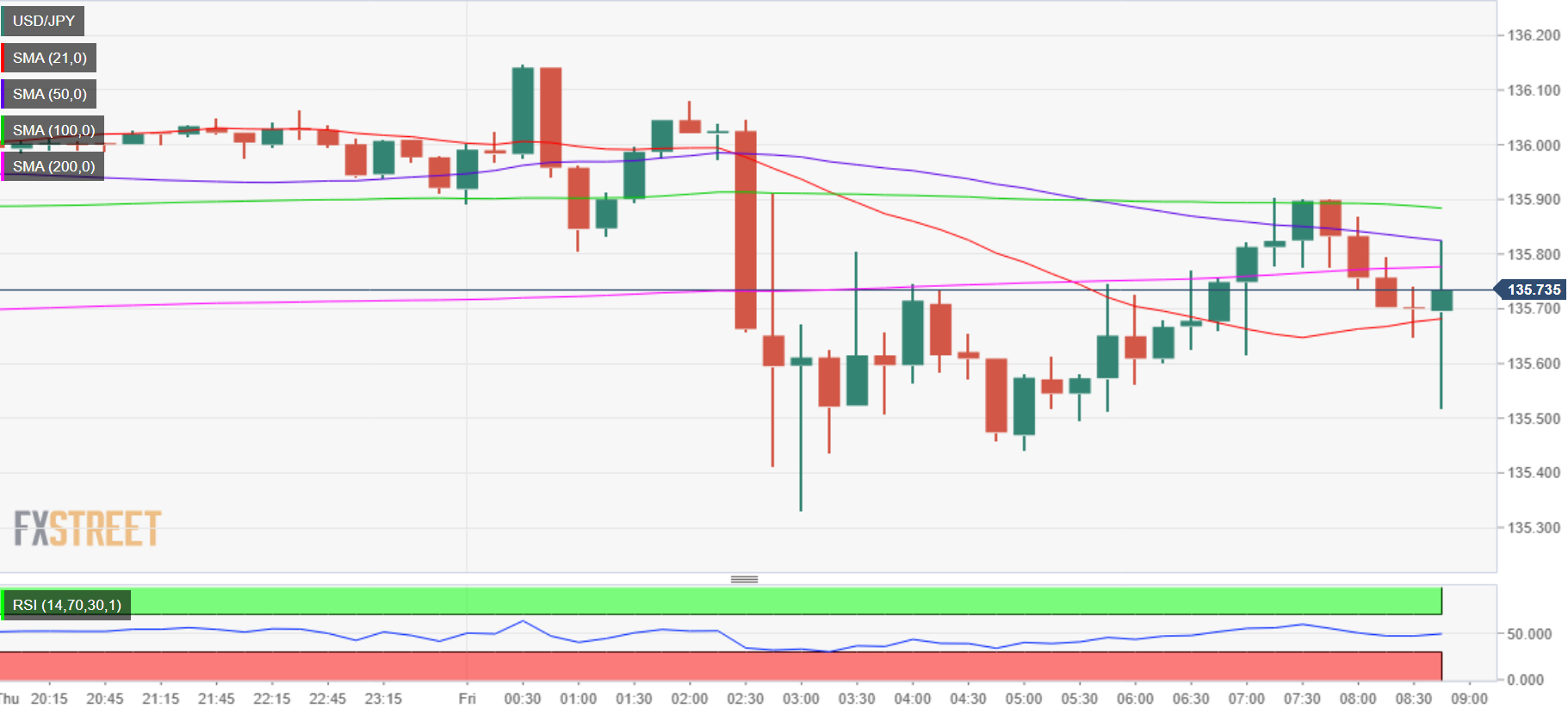
USD/JPY: 15-minutes chart
European Central Bank (ECB) Governing Council member Ignazio Visco said on Friday, “rate hike bigger than 25 bps could be appropriate in September if medium-term inflation expectations don't improve.”
Key quotes
Pace of further "gradual but lasting" tightening will hinge on data and how they affect inflation prospects.
Markets affected in June by unwarranted perception of "particularly aggressive" monetary policy stance.
10-yr btp/bund spread peak of 250 bps hit in early June is not consistent with Italy’s economic fundamentals.
No signs at present of "dangerous wage-price spiral".
Anchored inflation expectations support view monetary policy normalisation can be gradual.
Market reaction
EUR/USD is extending its recovery from fresh two-decade lows of 1.0072, finding some demand on the above comments.
The pair was last seen trading at 1.0116, down 0.41% on the day.
Gold has come under considerable pressure of late and has dropped to a nine-month low.However, the slide in the gold price is excessive in the view of economists at Commerzbank, so the yellow metal is expected to recover.
Main factor weighing on XAUUSD is the firm US dollar
“The main factor weighing on gold price is the strong US dollar, which on a trade-weighted basis has appreciated to its highest level in nearly 20 years.”
“ETF investors are turning their backs on gold. The gold ETFs tracked by Bloomberg registered outflows of around 60 tons in the past two weeks alone.”
“We regard the current price weakness as exaggerated. The persistently high inflation and the risk of a recession argue in favour of gold, which suggests that the price will recover.”
- GBP/USD witnessed fresh selling on Friday and eroded a major part of the overnight gains.
- Domestic issues continued weighin on the British pound and acted as a headwind for the pair.
- Fed rate hike bets lifted the USD to a fresh 20-year high and contributed to the selling bias.
- Investors now look forward to the US monthly employment report (NFP) for a fresh impetus.
The GBP/USD pair attracted fresh selling near the 1.2055 region on Friday and has now reversed a major part of the previous day's positive move. The intraday downfall picked up pace during the early European session and dragged spot prices to a fresh daily low, back closer to the 1.1900 mark in the last hour.
The British pound did get a minor lift on Thursday after Boris Johnson announced that he would quit as British Prime Minister and ended the recent political drama at 10 Downing Street. The market reaction, however, turned out to be short-lived as Johnson's departure was almost a certainty and was largely priced in by markets. Furthermore, other domestic issues continued acting as a headwind for sterling, which, along with a fresh bout of the US dollar buying, exerted fresh downward pressure on the GBP/USD pair.
Investors remain concerned that the UK government's controversial Northern Ireland Protocol Bill could trigger a trade war with the European Union amid the cost of living crisis. Furthermore, the Bank of England is expected to adopt a gradual approach toward raising interest rates amid growing recession fears, which further undermined the GBP. In contrast, minutes of the June 14-15 FOMC meeting released on Wednesday reinforced bets for a faster policy tightening and continued lending support to the US dollar.
In fact, policymakers emphasized the need to fight inflation even if it meant slowing an economy and indicated that another 50 or 75 bps rate hike is likely at the July meeting. Apart from this, the prevalent cautious market mood pushed the safe-haven greenback to a fresh two-decade high, which further contributed to the GBP/USD pair's intraday decline. Market participants now look forward to the US monthly jobs report (NFP), due later during the early North American session, for a fresh trading impetus.
Technical levels to watch
Here is what you need to know on Friday, July 8:
Following Thursday's choppy market action, investors seem to have turned cautious ahead of the US June jobs report on Friday. The US Dollar Index continues to edge higher above 107.00, US stock index futures are down between 0.4% and 0.6% and the 10-year US T-bond yield stays calm near 3% following the two-day rebound. The European economic docket will not be featuring any high-impact data releases ahead of the weekend. Statistics Canada will release the Unemployment Rate data for June as well.
Nonfarm Payrolls Preview: Three dollar-positive scenarios, only one negative one.
Wall Street's main indexes closed decisively higher on Thursday as risk flows dominated the markets. Growing concerns over China going into another lockdown and recession fears, however, don't allow a steady risk rally to take place.
EUR/USD slumped below 1.0100 during the European trading hours on Friday and touched its lowest level in nearly 20 years. The pair managed to recover a small portion of its daily losses but continues to trade deep in negative territory. The European Central Bank's (ECB) June policy meeting showed on Thursday that Governing Council members agreed the revised medium-term inflation outlook required further steps to be taken in normalising monetary policy.
GBP/USD came under heavy bearish pressure early Friday and fell below 1.1950. British Prime Minister Boris Johnson announced his resignation on Thursday. Bank of England (BOE) policymaker Catherine Mann argued on Thursday that the uncertainty about the inflation process was strengthening the case for front-loading interest rate rises.
USD/JPY continues to move sideways below 136.00 following a steep drop with the initial reaction to reports of Japanese former Prime Minister Shinzo Abe getting shot on Friday while campaigning in the city of Nara.
Gold closed virtually unchanged on Thursday and stays relatively quiet at around $1,740 on Friday.
US June Nonfarm Payrolls Preview: Analyzing gold's reaction to NFP surprises.
Bitcoin benefited from the risk-positive market environment and rose to its highest level in three weeks above $22,000 early Friday before erasing a large portion of its daily gains. Ethereum closed the previous two days in positive territory and climbed above $1,200 on Friday.
- GBP/JPY came under fresh selling pressure on Friday and was pressured by a combination of factors.
- Reviving safe-haven demand boosted the JPY and triggered the initial leg of the intraday downfall.
- Domestic issues continued undermining the British pound and also contributed to the selling bias.
The GBP/JPY cross witnessed an intraday turnaround from the vicinity of the 164.00 mark on Friday and has now erased a major part of the previous day's gains. Spot prices continued losing ground through the early European session and dropped to a fresh daily low, around the 162.00 round figure in the last hour.
The Japanese yen drew haven flows on Friday after former Japanese Prime Minister Shinzo Abe was shot while delivering a speech in the western city of Nara. This, along with the emergence of fresh selling around the British pound, exerted downward pressure on the GBP/JPY cross on the last day of the week.
The overnight market reaction to UK Prime Minister Boris Johnson's resignation turned out to be short-lived as his departure was almost a certainty and largely priced in by markets. Furthermore, Brexit woes, along with expectations for a less hawkish Bank of England, acted as a headwind for sterling.
Investors remain concerned that the UK government's controversial Northern Ireland Protocol Bill could trigger a trade war with the European Union amid the cost of living crisis. Adding to this, growing recession fears could force the BoE to adopt a gradual approach toward raising interest rates.
The fundamental backdrop supports prospects for the resumption of a nearly three-week-old downtrend. That said, repeated bounces from the 200-day SMA warrant caution for bearish traders amid a big divergence in the monetary policy stance adopted by the Bank of Japan and other major central banks.
Technical levels to watch
Following a brief consolidation phase during the Asian trading hours on Friday, EUR/USD came under heavy bearish pressure in the European morning and touched its weakest level since December 2002 below 1 .0100. The pair is now less than 100 pips away from hitting parity.
The risk-averse market environment on Friday seems to be providing a boost to the greenback and causing the pair to continue to push lower. US stock index futures are down between 0.2% and 0.3% while the US Dollar Index rises 0.65% at 107.75.
Later in the day, the US Bureau of Labor Statistics will release the June jobs report. Nonfarm Payrolls are expected to rise by 268,000 in June following May's better-than-forecast increase of 390,000.
Nonfarm Payrolls Preview: Three dollar-positive scenarios, only one negative one.
EUR/USD 15-min chart
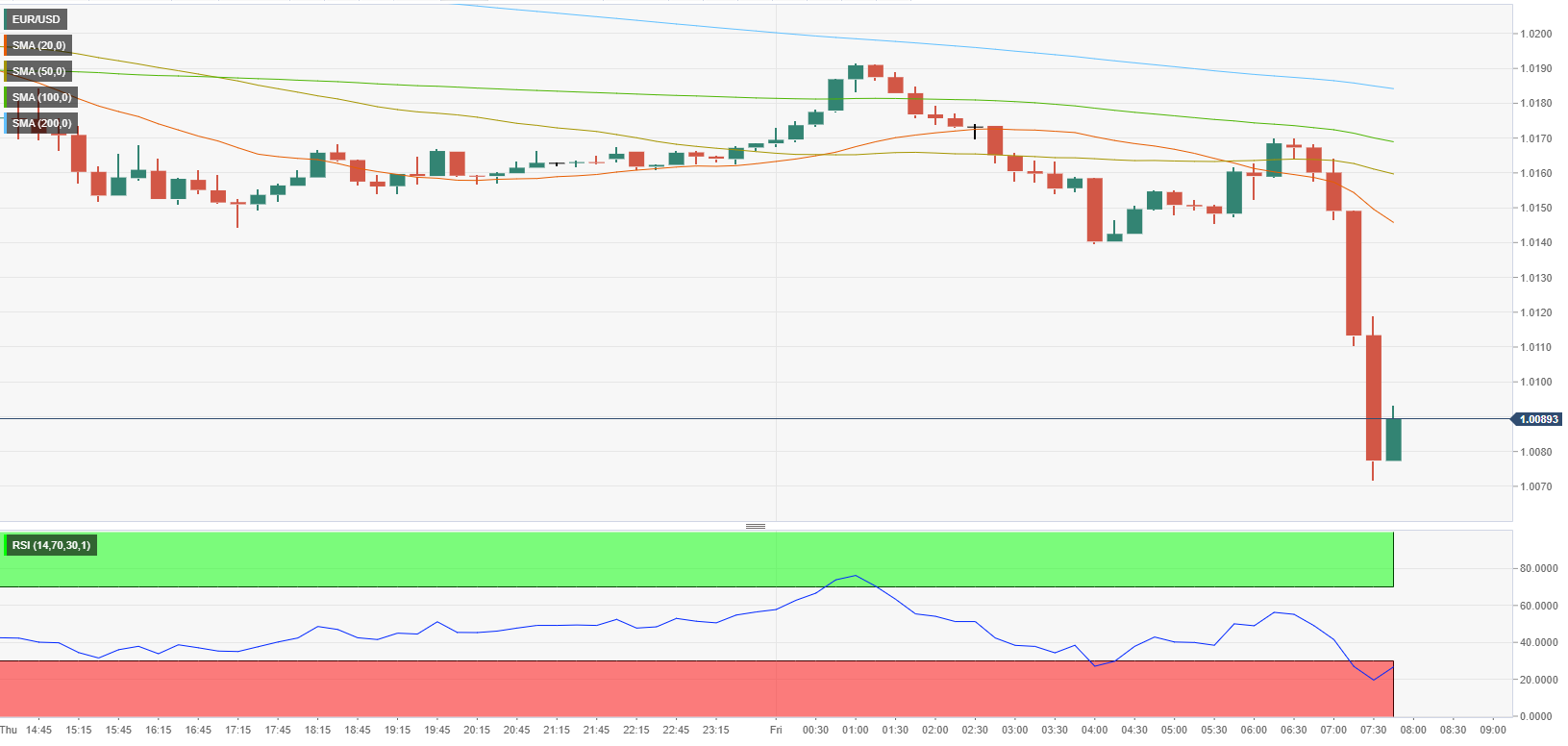
The dollar has remained close to its recent highs. Today's Nonfarm Payrolls data in the US should show a slowdown in hiring, but economists think only a big miss can trigger a dovish re-pricing in the Fed's rate expectations, and the dollar should be able to consolidate around recent highs.
NFP unlikely a game-changer
“We think that only a very weak reading today can trigger a sizeable re-pricing in the market’s Fed rate expectations given the Bank’s explicit strong focus on fighting inflation and CPI numbers next week will surely carry a much bigger weight.”
“The Fed's underlying narrative should continue to provide some support to the dollar, which incidentally seems to embed a larger risk of a global slowdown now, and likely some growing divergence between the economic outlook for North America and the rest of the world (Europe, above all).”
“We expect the dollar to consolidate around current levels today, and DXY to close the week around 107.00.”
See – NFP Preview: Forecasts from 10 major banks, labour market loses momentum
Canada’s jobs numbers should show a modest slowdown in hiring. However, USD/CAD is set to be moved by external factors, which could lift the pair to the 1.31/32 area, economists at ING report.
Jobs data unlikely to impact BoC rate expectations
“Consensus is centred around a 22K headline reading today. We think only a markedly weak reading today can force a dovish re-pricing of BoC rate expectations. Markets are fully pricing in a 75 bps rate hike, and marginally speculating on an even larger increase next week. We expect 75 bps and a lingering hawkish statement.”
“USD/CAD should remain primarily a function of global factors: risk sentiment and commodities above all.”
“Upside risks for the pair persist in the short term, despite the constructive domestic picture, and a move to the 1.31-1.32 area is surely possible.”
See – Canadian Jobs Preview: Forecasts from five major banks, fairly moderate employment growth in June
The euro received very little support from the recovery in sentiment in the eurozone (EuroStoxx up 2%) on Thursday. In the view of economists at ING, EUR/USD remains at risk of hitting parity soon as concerns about a gas crunch in the EU persist.
EUR still looking vulnerable
“Concerns about a gas crunch in the EU remain elevated, as the Nord Stream 1 pipeline is due to shut for 10 days of annual maintenance on Monday and some fear Russia may not resume flows at the end of that period.”
“We expect to hear more on euro weakness from ECB members, but the predominance of external downside risks still suggests a somewhat limited ability for hawkish rhetoric to lift the currency.”
“The risks of EUR/USD dropping to parity in the coming days remain relatively elevated, with further developments in the gas market and the US CPI figures likely to be major drivers along with the usual combination of risk sentiment and Fed-ECB policy differential.”
The highlight of the day is the release of June’s Nonfarm Payrolls in the US. Economists at MUFG Bank expect the US dollar to remain well supported unless a plunge in NFP today.
Big payrolls miss required to dent dollar strength
“We would have to see a really bad NFP print to move the dial on near-term rate expectations and hence the US dollar is unlikely to be undermined by more moderate signs of slowing employment growth.”
“Fed rhetoric (Waller & Bullard) suggests there is still support for going by 75 bps this month given that the market is positioned for it. So the US dollar should remain well supported bar a plunge in NFP today.”
See – NFP Preview: Forecasts from 10 major banks, labour market loses momentum
The pound was moderately bid after Prime Minister Boris Johnson announced a well-telegraphed resignation. However, politics are set to have a limited impact, therefore, EUR/GBP trading below 0.85 looks unsustainable.
Politics not the main concern for the pound
“For now, given the high uncertainty around possible candidates, drawing conclusions about the future implications for the pound is quite premature.”
“We think politics will continue to have a relatively contained FX impact, and lingering downside risks for GBP mean that sub-0.8500 levels in EUR/GBP may prove unsustainable unless we see a material further deterioration in the eurozone’s economic outlook.”
Another day and another big jump in natural gas prices on the continent. Economists at MUFG Bank expect the EUR/USD pair to drop below parity.
Natural gas risk reinforcing the worsening growth outlook
“The growth outlook has now become the primary concern for the markets with the natural gas risk reinforcing the worsening growth outlook.”
“The ECB’s outdated concerns over market reaction to a bigger rate hike on top of the downside growth risks will keep EUR/USD under downward pressure with a parity test soon looking more and more likely.”
USD/CAD extends recovery above 1.30. Economists at OCBC Bank believe that the pair could enjoy further gains to the 1.3030/3100 area.
Eyes on Canadian Employment report
“While the CAD shall benefit from a hawkish BoC, the near term movement is primarily dollar-driven; current risk rally may push the pair higher towards 1.3030/3100, while support sits at 1.2919.”
“Domestically, there is the labour market report on Friday, the key release ahead of next week’s MPC meeting.”
See – Canadian Jobs Preview: Forecasts from five major banks, fairly moderate employment growth in June
AUD/USD trades slightly above the 0.68 level. A break past the 0.6885 resistance would open up room for a move towards 0.6920/60, economists at OCBC Bank report.
Reserve Bank of Australia is likely to underdeliver on rate hikes
“The short bias remains given the global recession fears and that the RBA is likely to underdeliver on rate hikes.”
“A break above 0.6885 may open up room for a move towards 0.6920/60, while 0.6762 is the immediate support ahead of 0.6670.”
USD/JPY has been oscillating in a range. As analysts at OCBC Bank note, 137.00 remains the key level to watch on the topside.
135.00 is an important support level
“The weak global growth prospects should keep the pair heavy on rallies in the near term.”
“137.00 remains the key level to watch on the topside, while 135.00 is an important level ahead of US payroll report.”
See – NFP Preview: Forecasts from 10 major banks, labour market loses momentum
Economists at Citibank maintain an overall bearish bias on the EUR/USD pair. However, there is a scope for short-term spikes.
Risks of short-term corrections rise
“We warn risks of a short-term retracement are rising amidst the sell-off and bearish sentiment. We still remain bearish EUR/USD.”
“A close below support between 1.0341-1.0350 (2017 & 2022 lows respectively) on a weekly basis, if seen, could suggest an extension lower below parity with intermediate support between 1.0073-1.0108 (long-term 76.4% Fibonacci & July 1999 low).”
Economists at Crédit Agricole CIB Research analyzes Australia's latest record trade balance. What does it mean for the aussie? The AUD/USD pair is set to trade within a 0.68-0.70 range.
Australia logged a record trade surplus in May
“Australia logged a record trade surplus in May. Australia’s trade surplus surged to nearly AUD16 bn, which is about 50% more than the consensus expectations.”
“Australia’s basic balance of payments remains supported by its strong trade balance and this is an underlying support for the AUD. Portfolio outflows remain a weight on Australia’s balance of payments and the AUD, however, we expect AUD/USD to be trapped between these two opposing forces and to finish Q3 at 0.68 and Q4 at 0.70.”
- Gold Price continued with its struggle to register any meaningful recovery from the YTD low.
- Aggressive Fed rate hike bets kept the USD elevated near a 20-year high and capped gains.
- Recession fears acted as a tailwind for the XAUUSD as the focus remains on the NFP report.
Gold Price extended its consolidative price move on Friday and remained confined in a range below the $1,750 level through the early European session.
Investors seem convinced that the Federal Reserve would retain a faster policy tightening path to combat stubbornly high inflation. The bets were reaffirmed by the unsurprisingly hawkish minutes of the June 14-15 FOMC meeting. In fact, policymakers emphasized the need to fight inflation even if it results in an economic slowdown and indicated that another 50 or 75 bps rate hike is likely at the July meeting. This, in turn, was seen as a key factor that continued acting as a headwind for the non-yielding gold.
The prospects for more aggressive Fed rate hikes kept the US dollar elevated near a two-decade high and further undermined the dollar-denominated commodity. The downside, however, remains cushioned amid growing recession fears, which kept a lid on the overnight optimistic move in the US equity markets and offered some support to the safe-haven XAUUSD. Traders also seemed reluctant to place aggressive bets and preferred to wait on the sidelines ahead of Friday's release of the closely-watched US jobs data.
The popularly known NFP report is expected to show that the US economy added 268K jobs in June, down from 390K in the previous month. The unemployment rate, however, is expected to hold steady at 3.6% during the reported month. The data would influence the near-term USD price dynamics, which, along with the broader risk sentiment, should provide some impetus to the gold price. The lack of any meaningful buying interest, however, suggests that the near-term bearish trend might still be far from being over.
Hence, any attempted recovery could be seen as an opportunity for bearish traders and runs the risk of fizzling out rather quickly. Nevertheless, the XAUUSD remains on track to end in the red for the fourth successive week, just above its lowest level since September 2021, around the $1,732 region touched on Wednesday.
Technical levels to watch
The situation in Europe looks completely different to that in the US. Inflation expectations here are rising notably. Undoubtedly, such a scenario would be negative for the euro, economists at Commerzbank report.
Is the euro “unbuyable”?
“With gas prices at astronomical levels, there is a risk of a further inflation shock being added to the current one. It does not require much speculation to establish that such a development would be negative for the euro. The ECB would only be able to do the most urgent inflation fighting. Just enough to prevent a spiral of EUR depreciation and inflation acceleration. Some might even fear that it will be unable to achieve even that.”
“If I read that some analysts refer to the euro as being ‘unbuyable’ I do get the impression that EUR levels and sentiment have gone too far. But even under that assumption, there are no reasons for a significant euro recovery – as long as the sword of Damocles of a gas crisis is hanging over us.”
- USD/JPY prints the first daily loss of the week, near intraday low of late.
- Japan’s ex-PM got wounded in the gun-shot from behind, yields portray sour sentiment.
- Mixed data, doubts over China’s stimulus add to the risk-aversion and weigh on the pair.
- US NFP, risk catalysts are important for fresh impulse.
USD/JPY rebounds from intraday low surrounding 135.30 but remains pressured around 135.70 as it snaps the four-day uptrend during early Friday in Europe.
The yen pair’s losses could be linked to the multiple catalysts boosting the risk-off mood at home and aboard. Among them, shooting the ex-Prime Minister Shinzo Abe ahead of the elections appears to gain major attention. On the same line could be the market’s anxiety ahead of the key US jobs report for June and doubts over China’s ability to tame economic woes with heavy stimulus.
“Japan's former Prime Minister Shinzo Abe is showing no vital signs,” per the latest update on the Japanese issue from Reuters.
Elsewhere, “A market indicator measuring how investors are positioned held at "extremely bearish" levels for a fourth consecutive week. Outflows from European equity funds extended into its 21st week, while emerging market debt has now seen outflows for the past 13 weeks,” said Bank of America (BofA) per Reuters.
On a different page, news that China is ready for $220 billion of stimulus with unprecedented bond sales, per Bloomberg, previously propelled the market sentiment before the doubts over the heavy stimulus joined the covid woes to recall bears. Reuters mentioned the local government's lack of readiness to push more stimulus, mainly due to a limit at home, to mark the odds of failures of such a huge stimulus from the dragon nation.
Amid these plays, the US 10-year Treasury yields drop two basis points (bps) to 2.99% while the US 2-year bond coupon stays around 3.02%, keeping the inverted curve that signaled recession risks earlier in the week. It should be noted that the US stock futures are also mildly offered even as the Wall Street benchmarks cheered mixed US data to print gains.
That said, US Initial Jobless Claims rose by 4,000 to 235,000 in the week ending July 2, versus 230,000 expected. With this, the 4-week moving average number was 232,500, up 750 from the previous week's average. Further, the US goods and services deficit narrowed by $1.1 billion to $85.5 billion in May, marking the smallest monthly deficit in 2022.
Moving on, USD/JPY traders should pay attention to the risk catalysts ahead of the US employment data for clear directions. Forecasts suggest the headline US Nonfarm Payrolls (NFP) is expected to post the smallest monthly increase in jobs since April last year, by easing to 268K from 390K for June while the Unemployment Rate is likely to stay unchanged at 3.6% for the said month.
Technical analysis
USD/JPY seesaws inside a fortnight-old symmetrical triangle between 135.95 and 135.10.
USD/CNY is hovering around the 6.70 level. Economists at Westpac expect the Chinese renminbi to strengthen throughout the coming months, therefore, USD/CNY is seen at 6.35 by the end of the year.
Economic activity driving Chinese growth should be favourable for CNY
“While growth in the US and Europe has collapsed below potential and is expected to remain there in 2023, momentum in China’s economy is expected to hold around trend through both years. Moreover, the economic activity driving this growth should be favourable for the currency, with the investment being undertaken in the economy targeted at increasing efficiency, productivity and boosting the trade balance.”
“The ongoing reforms being undertaken by authorities and the starting valuations for equities are also supportive of financial flows into China, in addition to those related to trade.”
“We continue to have a bullish expectation for renminbi, expecting USD/CNY to fall from 6.70 currently to 6.35 end-2022 and 6.15 end-2023.”
Fear of the unknown continues to drive FX markets seeing the US dollar jump to yet another multi-decade high. However, economists at Westpac still expect to see a marked decline in the US dollar.
There is a much greater chance of disappointment for sterling than euro
“While the starting point for the US dollar is much higher this month than in June, we remain of the view that at end-2022 and end-2023, DXY is likely to be back near 101 and 95 respectively.”
“Driving the US dollar depreciation over the period will be the euro which is forecast to rise from 1.02 currently to 1.09 end-2022 and 1.15 end-2023.”
“Sterling is expected to contribute similarly, with GBP/USD forecast to rise from 1.20 to 1.26 end-2022 and 1.34 end-2023 – although we must note that there is a much greater chance of disappointment for sterling than euro given the UK’s current political and Brexit-related concerns.”
“Albeit smaller in magnitude than for euro and sterling, the anticipated rise in Canada’s dollar is also significant for DXY, with USD/CAD forecast to fall from 1.30 to 1.25, a level that is expected to be broadly maintained until March 2024.”
- DXY trades without a clear direction around 107.00.
- US yields trade with marginal losses early in Europe.
- US Nonfarm Payrolls will be the salient event later on Friday.
The greenback appears somewhat consolidative in the 107.00 neighbourhood when tracked by the US Dollar Index (DXY) at the end of the week.
US Dollar Index focuses on Payrolls
The absence of a clear direction in the dollar’s price action remains well in place for the second session in a row, as market participants get ready for the release of the always relevant Nonfarm Payrolls for the month of June later on Friday.
In the same line, US yields look somewhat consolidative in the upper end of the monthly range following the rebound earlier in the week.
In the meantime, recession talks seem to be taking a breather, while speculation around the Fed’s normalization process and the next moves regarding interest rates continue to take centre stage.
On the latter, and according to CME Group’s FedWatch Tool, the probability of a 75 bps rate hike at the July 27 gathering climbs to almost 94% on Friday from below 1% recorded a month ago.
In the docket, and other than the NFP, Wholesale Inventories, Consumer Credit Change and the speech by NY Fed J.Williams (permanent voter, centrist) are all due later.
What to look for around USD
The index rose to nearly 2-decade highs around 107.30 earlier in the week, all against the backdrop of further deterioration in the risk complex in response to rising recession talks.
Further support for the dollar is expected to come from the Fed’s divergence vs. most of its G10 peers (especially the ECB) in combination with bouts of geopolitical effervescence and the re-emergence of the risk aversion among investors. On the flip side, chatter of US recession could temporarily undermine the uptrend trajectory of the dollar somewhat.
Key events in the US this week: Non-farm Payrolls, Unemployment Rate, Wholesale Inventories, Consumer Credit Change (Friday).
Eminent issues on the back boiler: Hard/soft/softish? landing of the US economy. Escalating geopolitical effervescence vs. Russia and China. Fed’s more aggressive rate path this year and 2023. US-China trade conflict. Future of Biden’s Build Back Better plan.
US Dollar Index relevant levels
Now, the index is up 0.01% at 107.04 and a break above 107.26 (2022 high July 6) would expose 107.31 (monthly high December 2002) and then 108.74 (monthly high October 2002). On the flip side, the next support aligns at 103.67 (weekly low June 27) seconded by 103.41 (weekly low June 16) and finally 101.29 (monthly low May 30).
The recent souring in economic data has raised fears of an imminent US recession. Strategists at TD Securities now see 60% odds of a recession within the next 12 months.
Does a recession stop Fed rate hikes?
“We continue to judge that the US economy is currently not in recession even if GDP growth turns out to be negative in Q2. However, the risks of a 2022 recession have increased after recent data, and we now see 60% odds of a recession within the next 12 months.”
“We are now looking for GDP growth to slow further by the end of the year and into the beginning of 2023. That said, we expect the Fed to continue tightening policy ‘expeditiously’ to above its estimate of neutral by the end of the year despite rising recession odds and continue to see a terminal Fed funds rate of 4%.”
USD/INR has reached new highs amid persistent equity outflows, and higher oil prices. Economists at Société Générale expect the pair to surge above 80 by the fourth quarter.
RBI interventions limit runaway depreciation risks
“RBI interventions limit runaway depreciation risks, but the trend weakness is unlikely to reverse.”
“We expect the USD/INR to breach 80 by 4Q this year.”
USD/JPY is still seen navigating the 134.75-137.00 range in the short term, commented FX Strategists at UOB Group Lee Sue Ann and Quek Ser Leang.
Key Quotes
24-hour view: “We highlighted yesterday that ‘the current movement appears to be part of a consolidation phase’ and we expected USD to ‘trade within a range of 135.30/136.30’. Our view for consolidation was not wrong even though USD traded within a narrower range than expected (135.52/136.22). Further consolidation appears likely but the slightly firmed underlying tone suggests a higher range of 135.50/136.50.”
Next 1-3 weeks: “We continue to hold the same view as from Tuesday (05 Jul, spot at 135.95). As highlighted, the current movement appears to be part of a broad consolidation phase and USD is likely to trade between 134.75 and 137.00 for now.”
Considering preliminary readings from CME Group for natural gas futures markets, open interest shrank by nearly 5K contracts on Thursday. Volume, instead, increased by more than 100K contracts.
Natural Gas appears supported near $5.30
Thursday’s strong rebound in prices of natural gas was amidst shrinking open interest, indicative that extra gains appear somewhat capped. Against that, another test of the contention area near $5.30 per MMBtu should not be ruled out in the short term
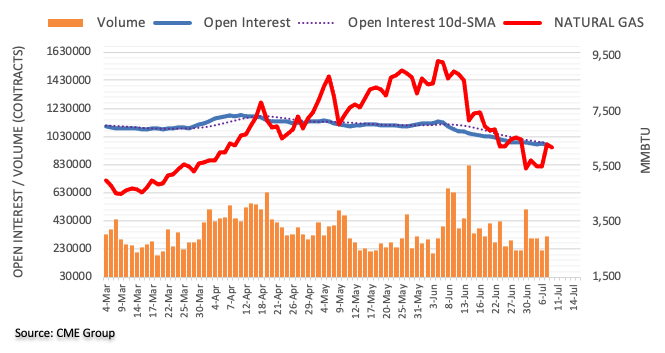
- Copper takes offers to renew intraday low, reverses the previous day’s recovery moves.
- Fears of economic slowdown, doubts over Chinese stimulus join virus woes to weigh on sentiment.
- Pre-NFP anxiety, mixed US data also exert downside pressure on the metal.
Copper Price fades the bounce off the lowest levels since November 2020 as risk-aversion continued to weigh on the red metal prices ahead of the key US jobs report.
That said, a three-month copper on the London Metal Exchange (LME) fell 0.5% to $7,780 a tonne by 0428 GMT while the most-traded August copper contract ended morning trade with 1.2% daily gains at 58,940 yuan ($8,787.83) a tonne on Shanghai Futures Exchange (SFE). Also, the COMEX Futures contract drops 1.5% to $3.48 by the press time of early Friday morning in Europe.
News that China is ready for $220 billion of stimulus with unprecedented bond sales, per Bloomberg, previously propelled the red metal before the doubts over the heavy stimulus joined the covid woes to recall sellers. Reuters mentioned the local government's lack of readiness to push more stimulus, mainly due to a limit at home, to mark the odds of failures of such a huge stimulus from the dragon nation.
Also, National Australia Bank economist Tapas Strickland said, “While Chinese policymakers are considering boosting stimulus, the headwind from COVID-19 restrictions remain given China is still running a zero-COVID policy.” The same joins news suggesting an increase in China’s daily covid numbers, from 409 to 478, to weigh on the metal prices.
Additionally, Reuters also came out with the resumption of copper production by the world’s largest manufacturer and gave more reason to justify the latest downturn in the metal prices. “Chile's state-owned Codelco, the world's largest copper producer, will begin construction on a long-delayed $1 billion desalination plant this year to supply its largest operations in northern Chile,” said the news.
Elsewhere, an inverted curve between the 2-year and 10-year US Treasury bond yields joins central bankers’ aggression towards the higher rates to weigh on Copper Price.
Moving on, updates from China and Chile will join the US jobs report for June to direct immediate moves of the metal. Forecasts suggest the headline US Nonfarm Payrolls (NFP) is expected to post the smallest monthly increase in jobs since April last year, by easing to 268K from 390K for June while the Unemployment Rate is likely to stay unchanged at 3.6% for the said month.
- Steel prices have taken a hit on monsoon arrival and the return of lockdown worries in China.
- Back-to-back resurgence in Covid-19 in China has dented the steel prices.
- Next week’s US CPI figures will be crucial for steel and base metals.
Steel prices are declining firmly as more downside catalysts are adding to the surrendered production by steel mill owners in China. Along with the finished steel, raw materials that inculcate coke and steel scrap have dropped significantly. Thanks to the slump in the demand due to traditional off-season and growing lockdown worries in China.
The monsoon has arrived in 14 provinces of China and some parts of Asia. This has forced the public and private sectors to halt the construction and infrastructure development process. The postponement of the construction activities has resulted in a significant drop in the demand for steel and other base metals too.
Apart from that, the Chinese economy is facing the headwinds of a resurgence of Covid-19 after growing figures of Covid-19 cases. The Chinese administration has ordered mass testing and the observation of the pandemic-affected rates is indicating that the adaptation of lockdown measures is imminent.
The restrictions on the movement of the men, materials, and machines will reduce the production activities and henceforth the demand for steel. No doubt, the market participants are discounting these catalysts now and steel prices are facing severe heat.
Next week, the release of the US Consumer Price Index (CPI) will be significant for steel prices. A higher US inflation figure will compel the Federal Reserve (Fed) to tighten its policy further. This may result in a slump in the aggregate demand by the global economy.
AUD/USD seems to have now embarked on a consolidation theme between 0.6760 and 0.6930 in the next week, suggested FX Strategists at UOB Group Lee Sue Ann and Quek Ser Leang.
Key Quotes
24-hour view: “Our view for AUD to ‘dip below 0.6760’ yesterday was incorrect as it rebounded to a high of 0.6848. While upward momentum has barely improved, the rebound could extend but any advance is unlikely to break 0.6900 (minor resistance is at 0.6865). On the downside, a break of 0.6810 (minor support is at 0.6825) would indicate that the current mild upward pressure has eased.”
Next 1-3 weeks: “We have held a negative AUD view since late last week. As AUD declined, we highlighted on Wednesday (06 Jul, spot at 0.6805) that while downward momentum has not improved by much, the risk for AUD is still on the downside. We added, ‘only a break of 0.6865 would indicate that the weak phase in AUD has run its course’. AUD rebounded to a high of 0.6848 during NY session and while our ‘strong resistance’ level at 0.6865 is still intact, downward pressure has eased. In other words, the weak phase in AUD has ended. From here, AUD is likely to trade sideways between 0.6760 and 0.6930.”
CME Group’s flash data for crude oil futures markets saw traders scale back their open interest positions by around 22.6K contracts on Thursday, clinching the second consecutive daily drop. Volume, in the same line, went down for the second day in a row, now by around 212.5K contracts.
WTI could revisit the 200-day SMA near $93.60
Prices of the WTI reversed part of the recent sharp pullback on Thursday. However, the move was on the back of diminishing open interest and volume, opening the door to the continuation of the downtrend to, initially, the 200-day SMA at $93.64.
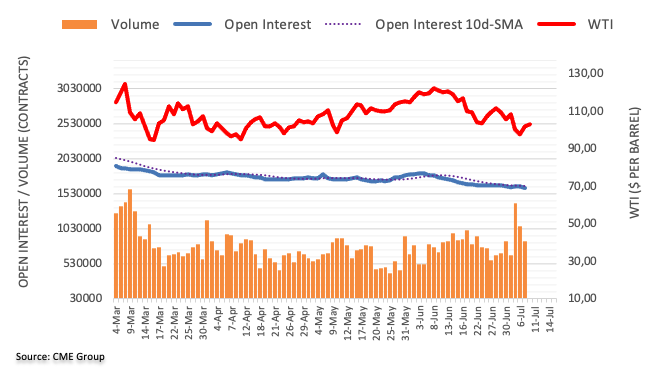
Gold remains non-committal below $1,750 as traders refrain from placing any aggressive directional bets in the run-up to the all-important US Nonfarm Payrolls release, FXStreet’s Dhwani Mehta reports.
NFP holds the key
“A slowdown in the US jobs creation alongside the wage growth could discourage the Fed to go on an all-out aggressive tightening spree. In such a case, the USD-price gold could catch fresh bids in an immediate reaction to the data release. Although a tighter labor market may justify the US central bank’s rapid and bigger rate-hike stance, reviving recession fears. The greenback is likely to remain in a win-win situation, irrespective of the NFP outcome.”
“The recovery in gold remains capped below $1,751, which is the 23.6% Fibonacci Retracement (Fibo) level of this week’s sell-off from $1,815 levels. Daily closing above the latter is required to initiate any meaningful recovery. Further up, the 38.2% Fibo level at $1,763 will challenge the bearish commitments. Powerful resistance at $1.770 will be the next stop for XAU bulls. That level is the confluence of the psychological mark and the 50% Fibo level of the same decline.”
“On the downside, the $1,732 will be the initial support, below which the rising channel target at $1,722 will come into play. A sustained move below the latter will expose the $1,700 threshold.”
See – NFP Preview: Forecasts from 10 major banks, labour market loses momentum
- USD/CHF remains on the front foot at the highest levels in three weeks.
- Firmer RSI, sustained break of 20-DMA suggests further upside momentum towards two-month-old horizontal resistance.
- Bears need to stay cautious unless breaking 100-DMA.
USD/CHF stays firmer for the sixth consecutive day, taking rounds to 0.9740-45 during early Friday morning in Europe. In doing so, the Swiss currency (CHF) pair remains near the highest levels since mid-June while poking the 50-DMA for the third day in a row.
Although the quote failed to cross the key DMA hurdle two times during the week, the bulls are likely to win the latest battle as the quote remains firmer past 20-DMA and the RSI (14) also grinds higher.
Following that, the USD/CHF prices could rally to the early May swing high near 0.9800 before challenging the two-month-old horizontal resistance, near 0.9870.
It should be noted, however, that the pair’s run-up beyond 0.9870 enables the buyers to challenge the yearly top marked in May at around 1.0065. During the rise, the 1.0000 psychological magnet could probe the bulls.
Meanwhile, pullback moves remain elusive until staying beyond the 20-DMA level of 0.9688.
Should the USD/CHF bears manage to conquer the 20-DMA support, a downward trajectory towards the 100-DMA support of 0.9545 can’t be ruled out. Also challenging the pair’s downside is June’s low around 0.9495.
USD/CHF: Daily chart
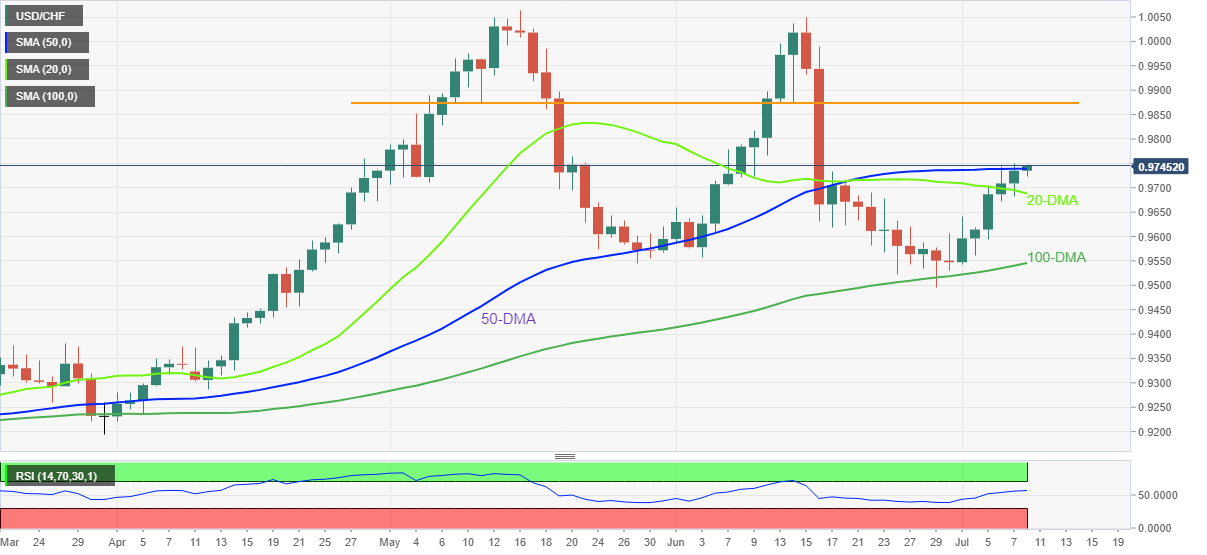
Trend: Further upside expected
Canada will release June employment figures on Friday, July at 12:30 GMT and as we get closer to the release time, here are forecasts from economists and researchers at five major banks regarding the upcoming employment data.
Another 22,5K new workers are expected in May, following April’s gain of 39,8K. The unemployment rate should remain at 5.1% and the participation rate is also forecast to be unchanged at 65.3% just 0.3 points below its final pre-pandemic level.
NBF
“Our call is for 25K increase. Such an improvement of the labour market would leave the unemployment rate unchanged at 5.1%, assuming the participation rate remained at 65.3%.”
RBC
“We expect Canadian employment growth slowed to 15K in June – driven by a dwindling supply of workers rather than a lack of demand. Canada’s unemployment rate likely held at 5.1%. But wage growth probably accelerated again, as businesses compete for fewer available workers.”
CIBC
“A more moderate 25K increase in employment would be broadly in line with the pace of population growth and means that, assuming no change in the participation rate, the jobless rate would hold steady at 5.1%.”
Citibank
“We expect a solid 45K increase in employment in June, similar to the rise in May but with two-sided risks. The path of wage growth however will likely be more important to determine whether the BoC starts to ease up on aggressive rate hikes later this year or if they remain more hawkish in line with the Fed.”
TDS
“We look for the Canadian labour market to add another 32K jobs in June, pulling the unemployment rate to a new low of 5.0%. We also look for a sharp increase in wage growth for permanent employees, rising to 5.6% from 4.5% in May, on a combination of base effects and another sizable MoM increase.”
- USD/CAD is attempting to balance above 1.3000 as DXY rebounds ahead of the US NFP.
- Lower employment generation by the Canadian economy may weigh pressure on loonie.
- The US Average Hours Earnings data will be of utmost importance.
The USD/CAD pair is aiming to establish comfortably above the psychological resistance of 1.3000 as the US dollar index (DXY) has performed strongly in the Asian session. The DXY is carry-forwarding the bullish tone to the European session and may recapture the latest 19-year high at 107.26.
The greenback bulls have been underpinned by the market participants despite the lower estimates for the US Nonfarm Payrolls (NFP). The market participants are expecting the release of the US NFP at 270k, much lower than the prior print of 390k. Apart from that, the Unemployment Rate is expected to remain unchanged at 3.6%.
The employment level in the US economy is sustaining at the targeted levels, therefore a decline in the employment generation figures won’t affect the DXY much. However, the data that could fetch trouble for the DXY is the Average Hourly Earnings.
Price pressures are soaring in the US economy and stagnancy in the earnings may result in lower income for the households and henceforth, lower consumption and savings. This may affect the overall demand, especially for durable goods as their demand could be postponed.
On the loonie front, the Net Change in Employment is seen at 22.5K, lower than the former release of 39.8k. The Unemployment Rate is seen stable at 5.1%. The Canadian jobless rate is higher than the required levels and lower employment generation may affect the Bank of Canada (BOC) to announce an interest rate hike in a presumptuous manner.
Russian Foreign Minister Sergey Lavrov said on Friday that Russia is ready to negotiate on grain with Ukraine and Turkey.
It’s worth noting that Ukraine's grain exports plunged 68.5% year-on-year to 163,000 tonnes in the first six days of July, per Reuters, the first month of the 2022/23 season, the Ukrainian Agriculture Ministry said.
The Russian diplomat spoke while attending the Group of 20 nations’ meeting in Indonesia, which is likely to exert pressure on Moscow to resolve the key issue. However, Russian President Vladimir Putin has already signaled readiness to combat any major force that wants to test Russian aggression.
FX implications
The news should have ideally favored the market sentiment but the pre-NFP anxiety joins geopolitical headlines from Japan and recession woes to keep S&P 500 Futures pressured near 3,890, down 0.40% intraday, snapping a five-day uptrend.
Read: Asian Stock Market: Wall Street bulls support carry-forwarded buying, DXY firms
In the opinion of FX Strategists at UOB Group Lee Sue Ann and Quek Ser Leang, GBP/USD seems to have now moved into a consolidative phase.
Key Quotes
24-hour view: “We highlighted yesterday that ‘the rebound amidst oversold conditions suggest that the weakness in GBP has stabilized’. We added, ‘GBP is unlikely to weaken further’ and we expected GBP to ‘trade between 1.1870 and 1.1980’. However, GBP soared to a high of 1.2030 before closing on a firm note at 1.2027 (+0.88%). While the rapid rise appears to be running ahead of itself, GBP could advance to 1.2065 first before a pullback is likely. GBP is unlikely to challenge the next resistance at 1.2130. Support is at 1.1985 followed by 1.1940.”
Next 1-3 weeks: “We turned negative in GBP last Wednesday (29 Jun, spot at 1.2185). After declining for more than a week, GBP rebounded strongly yesterday (07 Jul) as it rose to a high of 1.2030. While our ‘strong resistance’ level at 1.2030 was not clearly breached (NY high of 1.2030), downward pressure has more or less dissipated. In other words, the GBP weakness has run its course. The current movement is likely the early stages of a consolidation phase and GBP is likely to trade between 1.1900 and 1.2165 for now.”
Open interest in gold futures markets shrank by around 4.2K contracts after two daily builds in a row on Thursday, according to advanced prints from CME Group. Volume followed suit and went down for the second straight session, this time by around 155.6K contracts.
Gold: Next on the upside emerges the 200-day SMA
Prices of the ounce troy of gold closed with marginal gains and near recent lows on Thursday. Bullion looks consolidative in the lower end of the range and amidst shrinking open interest and volume, hinting at the idea that a deeper retracement is not favoured in the very near term. On the upside, the precious metal should regain the key 200-day SMA, to alleviate the downside pressure.
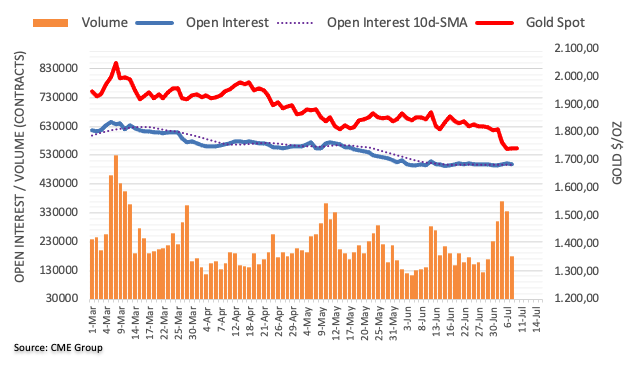
- The confluence of the 50-EMA and the descending triangle has pushed the asset lower.
- Aussie bulls have surrendered the cushion of the 20-EMA at 0.6822.
- A (40.00-60.00) range by the RSI (14) indicates the unavailability of any potential trigger.
The AUD/USD pair is declining firmly after hitting a high of 0.6822 in the Asian session. The asset has displayed a steep reversal while attempting to surpass the 50-period Exponential Moving Average (EMA) at 0.6848. Now, the downside move has pushed the asset below the 20-EMA at 0.6822.
On a four-hour scale, the pair is auctioning in a Descending Triangle pattern whose downward-sloping trendline is plotted from June 16 high at 0.7070. While the horizontal support is placed from July 1 low at 0.6764. The asset has sensed significant offers after attempting to surpass the downward-sloping trendline of the above-mentioned chart pattern.
Meanwhile, the Relative Strength Index (RSI) (14) is oscillating in a 40.00-60.00 range, which signals an indecisive move ahead due to the unavailability of any potential trigger.
Should the asset drop below July 1 low at 0.6766, the greenback bulls will drag the asset towards the 29 May 2020 high at 0.6683. A breach of the latter will drag the asset towards the 30 April 2020 high at 0.6570.
On the contrary, the greenback bulls could lose their grip if the asset violates Tuesday’s high at 0.6896. An occurrence of the same will drive the asset towards June 30 high at 0.6920, followed by June 28 high at 0.6965.
AUD/USD four-hour chart
-637928542122865314.png)
- USD/INR picks up bids to extend recovery from weekly low.
- Geopolitics, recession weigh on prices even as China, RBI tries to lure INR bulls.
- US employment data, risk catalysts will be important for fresh impulse.
USD/INR grinds higher around 79.25, stretching the previous day’s rebound from the weekly bottom, as bulls witness US dollar demand during Friday’s Asian session. In doing so, the Indian rupee (INR) pair braces for the third weekly gain while rushing towards the record high marked on Wednesday.
The US Dollar Index (DXY) remains firmer around 107.10 while reversing the early Asian session losses after news of attack on former Japanese Prime Minister Shinzo Abe. The greenback gauge took a U-turn from the multi-day top on Thursday as mixed US data joined receding fears of economic slowdown, mainly due to Fed policymakers’ attempts to talk down the recession.
The risk-off mood also takes clues from sluggish US Treasury yields. That said, the 10-year US benchmark drops towards posting a 0.80% intraday loss, down three basis points (bps) to 2.978% at the attest. In doing so, the key bond coupons print the first daily loss in three and help the riskier assets, like the US dollar to recover early-day losses.
Also portraying the risk-off mood is the S&P 500 Futures that print 0.30% intraday loss. However, Indian equity markets are up half a percent on local news concerning big auto companies and IT firms.
It’s worth noting that the USD/INR run-up portrays the Reserve Bank of India’s (RBI) failures to restrict the INR weakness, in multiple ways like inducing USD selling and Indian rupee buying or via direct market intervention.
Looking forward, US employment numbers for June and recession headlines will be more important to watch for fresh impetus. The forecast suggests that the headlines Nonfarm Payrolls (NFP) will post the lowest monthly increase in jobs since April last year, by easing to 268K from 390K for June while the Unemployment Rate is likely to stay unchanged at 3.6% for the said month.
Also read: Nonfarm Payrolls Preview: Three dollar-positive scenarios, only one negative one
Technical analysis
The weekly ascending trend channel restricts immediate USD/INR moves between 79.60 and 78.95.
EUR/USD remains under pressure and could slip back to the 1.0100 level in the next few weeks, according to FX Strategists at UOB Group Lee Sue Ann and Quek Ser Leang.
Key Quotes
24-hour view: “Yesterday, we highlighted that EUR ‘could dip to 1.0145 first before stabilization is likely’. We added, ‘EUR is unlikely to challenge the next major support at 1.0100’. Our view was not wrong as EUR dropped to a low of 1.0142 before rebounding slightly. While downward momentum is beginning to ease, the weakness in EUR has not stabilized just yet. In other words, there is room for further EUR weakness even though the major support at 1.0100 is unlikely to come under threat (there is another support at 1.0125). On the upside, a break of 1.0220 (minor resistance is at 1.0195) would indicate that EUR weakness has stabilized.”
Next 1-3 weeks: “There is not much to add to our update from yesterday (07 Jul, spot at 1.0185). As highlighted, further EUR weakness still appears likely even though oversold conditions could slow the pace of any further decline. Overall, only a break of 1.0270 (‘strong resistance’ level was at 1.0310 yesterday) would indicate the downside risk in EUR that started one week ago has run its course. Looking ahead, the next support below 1.0100 is at the rather critical psychological level of 1.0000.”
- Asian equities have carry-forwarded their positive tone on positive Wall Street.
- The DXY is aiming to recapture its fresh 19-year high at 107.26.
- Investors have ignored the lower consensus for the US NFP and have underpinned the DXY.
Markets in the Asian domain have carry-forwarded their buying spree on Friday after tracking strong cues from Wall Street and other global markets. Indices in Wall Street displayed a stellar performance on optimism over the result season for the second quarter of CY2022.
At the press time, Japan’s Nikkei225 surged 0.75%, China A50 added 0.31%, Hang Seng advances 0.17%, and Nifty50 jumped 0.65%.
The US dollar index (DXY) has displayed a firmer rebound in the Asian session and is near to recapturing its 19-year high at 107.26, recorded this week. Investors have ignored the lower expectations for the US Nonfarm Payrolls (NFP) and have started channelizing funds into the safe-haven asset. The market participants are expecting the release of the US NFP at 270k, much lower than the prior print of 390k. In spite of that, investors are underpinning the DXY. Apart from that, the Unemployment Rate is expected to remain unchanged at 3.6%.
The figures for Average Hourly Earnings will remain critical for the US economy. The inflation rate is skyrocketing in New York and stagnancy in the economic data will put more burden on the paychecks of the households. This may also result in a loss of overall demand in the economy quantity-wise.
In early Tokyo, ex-Japanese Prime Minister Shinzo Abe was shot during his speech at a rally in Nara. The ex-Japan PM is unconscious and is showing no signs of recovery yet.
- Gold Price fades recovery from yearly low as traders await US employment numbers for June.
- Risk-aversion underpins US dollar even if policymakers talk down recession woes.
- XAU bulls battle key resistance area while bracing for a bumpy road to the north, supports seem weak.
Gold Price (XAUUSD) remains pressured towards the yearly low as geopolitical concerns join fears of global economic slowdown, despite the Fed policymakers’ efforts to tame recession woes. The risk-aversion wave also takes clues from the inverted yield curve between the 2-year and 10-year US Treasury yields. It’s worth noting, however, that chatters surrounding China’s $220 billion stimulus and the Sino-American trade peace put a floor under the gold prices. Also keeping the buyers hopeful are recently mixed US data and the latest gains in equities ahead of the Q2 2022 earnings season. That said, the metal’s further weakness hinges on the US Nonfarm Payrolls, expected post the lowest monthly increase in jobs since April last year.
Also read: US June Nonfarm Payrolls Preview: Analyzing gold's reaction to NFP surprises
Gold Price: Key levels to watch
The Technical Confluence Detector shows that Gold Price pokes the key resistance near $1,743 comprising Fibonacci 61.8% one-day and SMA 5 and 10 on four-hour, as well as SMA 10 on the hourly play.
Following that, upper Bollinger Bank on one-hour and Fibonacci 23.6% one-day could test the bulls around $1,747.
In a case where the XAUUSD rises past $1,747, the monthly Pivot Point S2 near $1,754 will act as the last defense for bears.
Alternatively, the weekly Pivot Point S3 near $1,727 could lure the gold sellers if prices fail to defend the $1,740 round figure.
It’s worth noting that multiple small supports around $1,735 and $1,730 could also entertain XAUUSD bears.
Here is how it looks on the tool
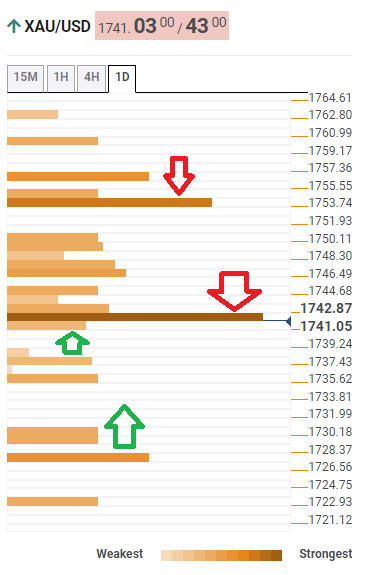
- GBP/USD reverses early Asian session gains amid latest blow to risk appetite.
- News of attack on ex-Japanese Prime Minister blew sentiment of late, anxiety over UK PM haunt also favor sellers.
- Receding fears of recession, mixed US data and UK PM Johnson’s resignation previously recalled buyers.
GBP/USD reverses early Asian session gains while taking offers to renew intraday low near 1.2020 heading into Friday’s London open. The cable pair’s latest pullback could be linked to the US dollar’s rebound amid the fresh blow to the risk appetite, as well as the market’s cautious mood ahead of the US employment report for June.
“Japan's former Prime Minister Shinzo Abe is showing no vital signs,” per the latest update on the Japanese issue from Reuters. “Ex-prime minister of Japan Abe is reportedly unconscious and unresponsive, and is in cardiac arrest,” said Kyodo news. The news previously reported that the former Japanese leader was shot in the chest and rushed to the hospital.
The news drowned the Treasury yields and pushed the 10-year US benchmark towards posting a 0.80% intraday loss, down three basis points (bps) to 2.978% at the attest. In doing so, the key bond coupons print the first daily loss in three and help the riskier assets, like the US dollar to recover early-day losses.
It’s worth noting, however, that the S&P 500 Futures drops 0.35% intraday while Japan’s benchmark equity gauge fails to extend the initial gains and retreats to 26,664, up 0.65% by the press time.
That said, the US Dollar Index (DXY) picks up bids to 107.09 while reversing the initial losses around the 20-year high. The greenback gauge took a U-turn from the multi-day top on Thursday as mixed US data joined receding fears of economic slowdown, mainly due to Fed and Bank of England (BOE) policymakers’ attempts to talk down the recession.
In addition to the USD pullback, the GBP/USD pair buyers also cheered the UK PM Boris Johnson’s resignation from the post of the UK Conservative Party Leader, after multiple political quits and a strong push from the cabinet. The action gives rise to a sigh of relief among the rebels and assures an absence of much political damage. However, the search for a successor and a naïve cabinet, with multiple new appointments, keep the risk-on mood challenged.
Hence, the GBP/USD traders should pay attention to UK politics for immediate directions. However, US employment numbers for June and recession headlines will be more important to watch for fresh impetus. The forecast suggests that the headlines Nonfarm Payrolls (NFP) will post the lowest monthly increase in jobs since April last year, by easing to 268K from 390K for June while the Unemployment Rate is likely to stay unchanged at 3.6% for the said month.
Also read: Nonfarm Payrolls Preview: Three dollar-positive scenarios, only one negative one
Technical analysis
GBP/USD remains inside a two-month-long falling wedge bullish chart pattern, recently flirting with the weekly resistance line around 1.2030.
That said, the quote’s rebound from the stated bullish formation’s support line, coupled with an improvement in the RSI (14), favor buyers targeting the 1.2155-60 key hurdle, including the wedge’s resistance line, also nearing the 20-DMA.
Meanwhile, pullback moves may take a breather near the 1.2000 psychological magnet before revisiting the recent multi-month low of 1.1876.
- EUR/USD has wiped off its entire gains recorded in early Tokyo as DXY rebounds.
- Declining US NFP is not bad for the DXY as the economy has reached its full employment levels.
- The delay in policy tightening measures by the ECB may result in an untamed inflation rate.
The EUR/USD pair has erased its entire gains recorded in the early Asian session. The asset has tumbled to near 1.0160 and is expected to display more losses after violating Thursday’s at 1.0144. A rebound in the risk-off market mood has pushed offers to the counter.
It won’t be wrong to state that the US dollar index (DXY) has resumed its upside journey after a corrective move and the asset is healthy to print a fresh 19-year high going forward. The asset has displayed a responsive buying action after slipping below the critical support of 107.00.
In today’s session, the release of the US Nonfarm Payrolls (NFP) will be of utmost importance. A preliminary estimate for the job additions data is 270k, significantly lower than the prior release of 390k. It is worth noting that the economic data is increasing but at a diminishing rate from October 2021, except February 2022, when the agencies recorded job additions by 714k.
Investors might find the data incompetency from the US administration on creating more job opportunities. However, one should understand that the employment level in the US economy has reached its full employment targets and also sustaining at the same. So less room for more job additions is not a shortcoming for the DXY.
On the eurozone front, the shared currency bulls are worried over escalating recession fears. The economy is likely to face a shortage of energy as it has not revealed the names of alternative suppliers of oil and gas after initiating the gradual process of prohibiting oil imports from Russia. Apart from that, the delay in policy tightening measures by the European Central Bank (ECB) may result in an untamed inflation rate.
- USD/JPY snaps four-day uptrend after ex-Japanese Prime Minister Shinzo Abe shot.
- Clear break of immediate triangle, 200-HMA directs bears towards weekly support line.
- Buyers need validation from 136.40 to retake control.
USD/JPY dropped nearly 70 pips on news of the shooting on ex-Japanese Prime Minister Abe, before bouncing off 135.33, during early Friday morning in Europe.
Also read: USD/JPY: Yen catches a fresh bid as ex-Japan PM Abe shot
The news also pushed the yen pair below the 200-HMA, as well as broke the three-day-old ascending triangle to portray the risk-off mood due to the local news.
It’s worth noting that the bearish MACD signals and a dip in the RSI (14), not oversold, also join the latest breakdown of the key technical levels, which in turn favor USD/JPY sellers.
However, the 61.8% Fibonacci retracement of June 23-29 upside, around 135.30, precedes the weekly support line near 135.00 to restrict the short-term USD/JPY downside.
Following that, 134.25-20 may offer an intermediate halt during the slump targeting a mid-June swing low of 131.50.
Meanwhile, the 200-HMA level of 135.80 and the support line of the triangle, at 136.00, guard immediate recovery moves.
In a case where the USD/JPY remains firmer past 136.00, the buyers could again aim for the 23.6% Fibonacci retracement level surrounding 136.35-40.
USD/JPY: Hourly chart

Trend: Further weakness expected
- EUR/JPY slides 70 pips on sentiment-negative news, prints four-day downtrend.
- Ex-Japanese Prime Minister Shinzo Abe appears critical after bearing two gun shots from behind.
- Risk-aversion returns to the table, Nikkei 225 pares early-day gains.
EUR/JPY stands on slippery grounds, refreshing intraday low around 137.50, on news of an attack on former Japanese Prime Minister during early Friday. The geopolitical headline renewed the risk-off mood and helped the pair bears cheer the four-day downtrend.
“Ex-prime minister of Japan Abe is reportedly unconscious and unresponsive, and is in cardiac arrest,” said Kyodo news. The news previously reported that the former Japanese leader was shot in the chest and rushed to the hospital. As per the latest report from Reuters, “Japan's former Prime Minister Shinzo Abe is showing no vital signs.”
The news drowned the Treasury yields and pushed the 10-year US benchmark towards posting a 0.80% intraday loss, down three basis points (bps) to 2.978% at the attest. In doing so, the key bond coupons print the first daily loss in three and help the riskier assets, like the US dollar to recover early-day losses.
That said, the S&P 500 Futures drops 0.30% intraday while Japan’s benchmark equity gauge fails to extend the initial gains and retreats to 26,664, up 0.65% by the press time.
Moving on, updates from Japan and headlines surrounding catalysts could help forecast the immediate EUR/JPY moves ahead of a speech from ECB President Christine Lagarde where traders will be more interested in hearing about July rate hikes.
Technical analysis
A clear downside break of the four-month-old ascending trend line and 50-DMA, respectively near 139.60 and 139.00, directs EUR/JPY towards a late May swing high near 136.70.
- AUD/JPY has turned volatile and has recorded an intraday low of 92.35 after ex-Japan PM Abe shot in Nara.
- Ex-Japanese Prime Minister Shinzo Abe has been shot during his speech at a rally in Nara.
- This week’s hawkish RBA policy strengthened the aussie bulls against the Japanese yen.
The AUD/JPY pair has slipped strongly to near 92.35 after the headlines from Japan that ex-Japanese Prime Minister Shinzo Abe shot during his speech at a rally in Nara. At the time of writing, the headlines describing his condition were that he is unconscious. This has dragged the risk barometer firmly after a decent upside move from the critical support of 91.50 recorded on Wednesday.
The aussie bulls were performing better than the Japanese yen on the announcement of a jumbo rate hike by the Reserve Bank of Australia (RBA). The RBA announced a consecutive rate hike by 50 basis points (bps) this week. RBA Governor Philip Lowe has elevated the Official Cash Rate (OCR) to 1.35%. It is worth noting that the decision remained in line with the estimates by the market participants. No doubt, the price pressures are soaring in the Australian economy. The inflation rate has reached 5.1% and the room for more inflation is still there as oil and food products have turned volatile further.
On the Tokyo front, the wide divergence between the plain-vanilla Consumer Price Index (CPI) and core CPI has affected the Japanese economy. A higher core CPI indicates that the overall demand is majorly driven by food products and fossil fuels. This may keep restricting the Bank of Japan (BOJ) with its ultra-loose monetary policy.
- The momentum oscillator, RSI (14) is displaying a loss of momentum on the upside.
- Advancing and untouched 50-EMA supporting the greenback bulls.
- The RSI (14) has also shifted into the 40.00-60.00 range.
The USD/TRY pair is auctioning sideways in a narrow range of 17.20-17.24 in the Asian session. The major is displaying some exhaustion signals after double attempts of overstepping the critical hurdle of 17.30 on Thursday.
Exhaustion in the upside trend has weakened the greenback bulls. The momentum oscillator, Relative Strength Index (RSI) has displayed a loss of momentum towards the north. The asset formed higher highs continuously while the RSI (14) formed lower highs, which signals that the greenback bulls are out of gas now.
Also, the RSI (14) has shifted into the 40.00-60.00 range, which signals that the Turkiye lira bulls are not more bearish now.
The Turkiye lira bulls are continuously attacking the 20-period Exponential Moving Average (EMA) at 17.25. While the 50-EMA at 17.19 is advancing and is untouched, this indicates that the short-term trend is still favoring bulls.
A decisive drop below the critical support of Thursday’s low at 17.18 will drag the asset towards May Wednesday’s low at 16.98, followed by Monday’s low at 16.73.
Alternatively, a break above Wednesday’s high at 17.26 will trigger the upside break of the Bullish Flag chart pattern, which will drive the asset towards the round level resistance at 17.50, followed by the 20 December 2021 high at 18.26.
USD/TRY hourly chart
-637928459028759416.png)
The Japanese yen is catching a safe-haven bid following news that former Prime Minister Abe was shot in the chest, now being taken to a hospital.
USD/JPY dropped nearly 50 pips on the above news, now trading at 135.78, losing 0.16% on the day.
Various Japanese media outlets are covering this unfortunate incident, noting that Abe collapsed during a stump speech in Nara and was bleeding after he was shot.
Additional takeaways
Gunshot-like sound heard when Japan ex-PM Abe collapsed.
Former PM Abe shot in breast and hospitalised, attacker in custody.
Could hear two consecutive bangs during former PM Abe’s speech.
Former PM Abe seems unconscious according to LDP members.
South Korean Finance Ministry announced measures worth some 810 billion won ($624.84 million) to lift the pressure off people's living costs, including removal of tariffs on some food imports and increased welfare support for low-income earners, Reuters reports.
more to come ...
According to the latest Reuters poll of economists, the Reserve Bank of New Zealand (RBNZ) is on track to deliver a 50 bps rate hike for the third meeting in a row when it meets next Wednesday.
Key findings
A majority, 15 of 22, now expect the official cash rate (OCR) to reach 3.50% or higher by the end of this year, broadly in line with market pricing.
Over 90% of economists, 20 of 22, forecast the RBNZ will hike by 50 basis points to 2.50% at its July 13 meeting with only two saying 25 basis points.
If the majority view prevails, it would mark the most aggressive monetary policy tightening since the central bank introduced the OCR in March 1999.
Over 70% of respondents, 16 of 22, forecast another half-point hike at the August meeting, taking rates to 3.00%, three times where it was before the pandemic.
The latest poll has rates at 3.50% for all of next year, according to median forecasts. That is short of the RBNZ's own expectations for rates to climb to 4.00% by the middle of next year.
The poll showed inflation was forecast to average 6.0% this year and ease to 2.8% in 2023.
New Zealand's economy was expected to grow 2.3% in 2022 and 2023, a marked downgrade from 3.1% and 2.7% predicted in April. Only a few economists forecast an outright recession next year.
| Raw materials | Closed | Change, % |
|---|---|---|
| Brent | 106.26 | 4.21 |
| Silver | 19.229 | 0.11 |
| Gold | 1739.97 | -0.01 |
| Palladium | 1996.04 | 4.7 |
- AUD/USD extends the previous day’s rebound from two-year low.
- US President Biden braces for easing China tariffs, Beijing teases $220 billion fresh stimulus.
- Sluggish yields, Fed policymakers’ efforts to downplay recession woes strengthen recovery moves.
- Outcome of Biden’s meeting on China tariffs, US employment numbers will be important for fresh impulse.
AUD/USD buyers flirt with a short-term key resistance around 0.6860 amid cautiously optimistic markets on early Friday. The Aussie pair’s latest gains could be linked to the hopes of improvement in the US-China trade relations, as well as easing fears of the recession. However, anxiety ahead of the US employment report for June tests the buyers of late.
US President Joe Biden is up for a meeting with his senior advisors on Friday to determine the tariff policy on China. Previously, diplomats from the US and China signaled a personal meeting after the latest virtual trade talks witnessed progress. With this, Beijing is optimistic that it can help ease the US its inflation problem by solving the supply-chain riddle, the same gained fewer accolades from the experts though.
Also relating to China-inspired optimism is the dragon nation’s readiness for $220 billion of stimulus with unprecedented bond sales, per Bloomberg. It’s worth mentioning that China’s zero covid-linked deaths also favor the risk-on mood and AUD/USD prices.
On a different page, the CEO of the Federal Reserve Bank of St. Louis, James Bullard stated, per Reuters, “We've got a good chance at a soft landing.” Additionally, Federal Reserve Governor Christopher Waller said inflation is way too high and does not seem to be easing and the Fed has to apply a more restrictive policy. However, both the policymakers tried to talk down the recession fears and seemed to have favored sentiment.
Furthermore, mixed data from the US also improved risk appetite the previous day and underpins the AUD/USD pair’s recent strength. That said, US Initial Jobless Claims rose by 4,000 to 235,000 in the week ending July 2, versus 230,000 expected. With this, the 4-week moving average number was 232,500, up 750 from the previous week's average. Further, the US goods and services deficit narrowed by $1.1 billion to $85.5 billion in May, marking the smallest monthly deficit in 2022.
While portraying the mood, Wall Street closed with gains and the US Treasury yields also marked the biggest daily run-up of the week. However, the S&P 500 Futures struggle to extend the risk-on mood forward as traders await the US jobs report for June. Forecasts suggest the headline US Nonfarm Payrolls (NFP) is expected to post the smallest monthly increase in jobs since April last year, by easing to 268K from 390K for June while the Unemployment Rate is likely to stay unchanged at 3.6% for the said month.
Also read: Nonfarm Payrolls Preview: Three dollar-positive scenarios, only one negative one
Technical analysis
AUD/USD needs a successful break of a three-week-old resistance line, around 0.6860 by the press time, to convince buyers to aim for the 0.7000 threshold. Failing to do so can drag the quote back to the recently flashed yearly low near 0.6760.
- EUR/GBP firms at the bottom of the sell-off from London and US markets.
- Bulls move in ahead of critical US data with NFP eyed.
EUR/GBP is trading flat on the day between a high of 0.8459 and a low of 0.8444. The pair is consolidating the sell-off that ensued overnight as politics distracted traders momentarily away from key data at the end o the week.
The UK focus was on Prime Minister Boris Johnson’s resignation. It could mean that the government will come up with popular measures, such as another tax cut, in an effort to regain the confidence of voters and party members, analysts at Rabobank argued.
Johnson held a meeting with newly appointed Cabinet ministers hours after resigning as the UK’s prime minister in an attempt to project an image of calm as the ruling Conservative Party begins the process of electing a new leader, who will become the next prime minister. In a statement, Downing Street said no new policies will be announced until the next premier is chosen.
Meanwhile, the focus will be back on the US dollar again ahead of the Federal Reserve meeting later this month and critical data points such as inflation readings and today's Nonfarm Payrolls report. ''Non-farm payrolls should reflect moderating but still healthy jobs growth in June keeping pressure on the unemployment rate and supporting robust growth in average hourly earnings, analysts at Westpac said.
- USD/CNH consolidates the biggest daily loss in three weeks.
- Impending bull cross on MACD, RSI rebound underpin recovery hopes.
- 200-HMA adds to the upside filters, weekly support line challenges bears.
USD/CNH picks up bids to refresh intraday high around 6.6980 during Friday’s Asian session. In doing so, the offshore Chinese yuan (CNH) currency pair pokes a two-day-old resistance line while bouncing off the weekly support trend line.
Given the recent rebound in the RSI (14), as well as the impending bull cross of the MACD line, the USD/CNH prices are likely to extend the latest run-up towards crossing the 6.6985 immediate hurdle.
Even so, the 200-HMA level near 6.7025 will challenge the pair buyers before directing them to the weekly top surrounding 6.7270.
It’s worth noting that tops marked during late June, near 6.7345-50 could challenge the quote’s upside past 6.7270, a break of which will again highlight the 6.7855-60 resistance area comprising multiple highs marked since May 27.
Alternatively, a downside break of the immediate support line, near 6.6915, will need validation from the 6.6900 round figure to revisit the weekly low near 6.6800.
Following that, the late June bottom surrounding 6.6685 could test the USD/CNH bears before directing them to the previous monthly low near 6.6170.
USD/CNH: Hourly chart
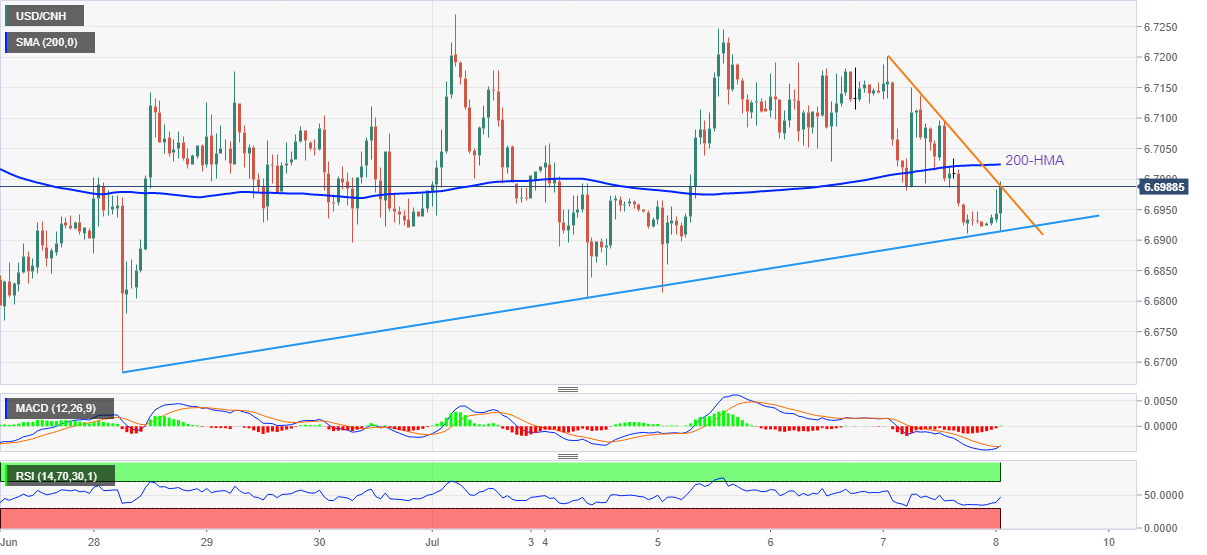
Trend: Further upside expected
Analysts at Societe Generale offer a sneak peek at what to expect from Friday’s US labor market report due for release at 1230 GMT.
Also read: Nonfarm Payrolls Preview: Three dollar-positive scenarios, only one negative one
Key quotes
“Employment gains are slowing, and we view this as inevitable as more of the unemployed have found jobs and the unemployment rate has dropped well below 4%.”
“Strong employment, however, is how we interpret an increase of nearly 300K jobs in a month.”
“Trucking, delivery, food services and healthcare remain areas of recovery and growth for job markets.”
“We expect the unemployment rate to edge back down to 3.5% for June, possibly very soon.”
“A rising labor force participation rate (more people entering the labor force) is one pro-growth factor that can steady the unemployment rate, preventing a decline, even when the economy is strong. Later, as businesses reduce their demand for labor, smaller job gains are why the unemployment rate stabilizes or begins to rise.”
- Gold Price extends the previous day’s corrective pullback from yearly low.
- Softer yields offer extra strength to buyers, by exerting more downside pressure on USD.
- Sentiment improves as recession fears ebb on absence of major fresh catalysts, China news.
- Technical details also add strength to the recovery moves ahead of the key US data, Biden’s meeting on China tariff.
Gold Price (XAU/USD) cheers the US dollar pullback from a nearly two-decade high to extend the recovery moves towards $1,750 during Friday’s Asian session. That said, the metal renews its intraday high near $1,745 by the press time.
US Dollar Index (DXY) drops 0.20% while portraying the market’s preparations for today’s US jobs report. Also weighing on the greenback’s gauge versus the six major currencies is the improvement in the risk profile amid repeated comments from the major central bankers and efforts to tame recession fears, not to forget headlines concerning China. It’s worth mentioning that Thursday’s Doji candlestick at the multi-year high joins the overbought RSI to also weigh on the DXY.
That said, CEO of the Federal Reserve Bank of St. Louis, James Bullard stated, per Reuters, “We've got a good chance at a soft landing.” Additionally, Federal Reserve Governor Christopher Waller said inflation is way too high and does not seem to be easing and the Fed has to apply a more restrictive policy.
On other hand, US President Joe Biden is up for a meeting with his senior advisors on Friday to determine the tariff policy on China. Previously, diplomats from the US and China signaled a personal meeting after the latest virtual trade talks witnessed progress. With this, Beijing is optimistic that it can help ease the US its inflation problem by solving the supply-chain riddle, the same gained fewer accolades from the experts though. Also relating to China is the dragon nation’s readiness for $220 billion of stimulus with unprecedented bond sales, per Bloomberg.
Mixed data from the US also weighed on the DXY as US Initial Jobless Claims rose by 4,000 to 235,000 in the week ending July 2, versus 230,000 expected. With this, the 4-week moving average number was 232,500, up 750 from the previous week's average. Further, the US goods and services deficit narrowed by $1.1 billion to $85.5 billion in May, marking the smallest monthly deficit in 2022.
Amid these plays, the US 10-year Treasury yields fade the two-day rebound while the S&P 500 Futures remain directionless at the latest.
Moving on, updates from Biden’s meeting on China tariffs will join the US employment data for June to direction short-term Gold Price moves.
Also read: US June Nonfarm Payrolls Preview: Analyzing gold's reaction to NFP surprises
Technical analysis
A clear upside break of the previous support line from the last Friday joins bullish MACD signals to keep gold buyers hopeful inside a three-day-old ascending trend channel.
That said, the 50-HMA level near $1,749 guards immediate recovery moves ahead of the stated channel’s upper line, near $1,751.
It should be noted, however, that the 100-HMA and 50% Fibonacci retracement of the last week’s downturn, around $1,774, appears a tough nut to crack for the XAU/USD bulls.
Alternatively, pullback moves need to break the channel’s support line, at $1,739 by the press time, to tease sellers. Also challenging the downside move is the latest low of $1,732.
If the Gold Price drops below $1,732, the odds of witnessing a south-run towards September 2021 low near $1,721 can’t be ruled out.
Gold: Hourly chart

Trend: Further recovery expected
A White House reporter for Bloomberg News tweeted out early Friday that US President Joe Biden is scheduled to meet with senior advisors on Friday to discuss the next moves on Chinese tariffs.
He tweeted, “@POTUS is convening a meeting with senior advisers tomorrow to discuss a path forward on China tariffs. He’s been considering cutting some of the $300B imposed by Trump and whether to initiate a new probe into Chinese subsidies that could lead to more tariffs down the road.”
Market reaction
AUD/USD remains strongly bid amid the extended recovery in risk sentiment while awaiting the US NFP and Biden’s meeting on China tariffs.
The pair was last seen trading up 0.23% on the day at 0.6853.
In recent trade today, the People’s Bank of China (PBOC) set the yuan (CNY) at 6.7098 vs the previous fix of 6.7143 and the prior close of 6.7015.
About the fix
China maintains strict control of the yuan’s rate on the mainland.
The onshore yuan (CNY) differs from the offshore one (CNH) in trading restrictions, this last one is not as tightly controlled.
Each morning, the People’s Bank of China (PBOC) sets a so-called daily midpoint fix, based on the yuan’s previous day's closing level and quotations taken from the inter-bank dealer.
NZD/USD renews intraday high around 0.6195 as bulls attack a three-week-old horizontal resistance near 0.6200, during Friday’s Asian session.
The kiwi pair’s latest gains could be linked to the upbeat signals from the options market, via the risk reversal (RR), spread between the call options and the put options.
That said, the NZD/USD pair’s daily RR printed the strongest figure in two weeks the previous day, to +0.155.
On the same line, the weekly RR figure also reversed the previous -0.260 with a positive 0.185 number at the latest.
It’s worth noting that the market’s preparations for the US employment data for June and an absence of major negatives could also be linked to the NZD/USD pair’s recovery moves. Further, repeated comments from the major central bankers and efforts to tame recession fears join headlines from China to keep the Kiwi pair buyers of late.
Also read: NZD/USD traders are getting set for the US NFP
- USD/CAD bears have moved in on the 1.2950s.
- The bulls could be lurking at this juncture with eyes towards 15-min M-formation neckline.
USD/CAD has plummeted in the first hour of Tokyo trade as the US dollar is pushed back by the bears. The Canadian dollar is enjoying some relief and the bears have homed in on the mid point of the 1.29 area. The following illustrates this in a 15-min time frame and explains the prospects of a correction back to a significant area on the charts.
USD/CAD 15-min chart

The bears are carving out an M-formation on the 15-min chart, moving in on the 1.2950s. There would be expected to be a retracement to mitigate the price imbalance between the low and the neckline of the pattern.
- Silver Price picks up bids to consolidate losses at two-year low.
- Dojis in the last two days hint at traders’ indecision, oversold RSI signal further recovery.
- Five-month-old previous support guards immediate upside, early 2020 tops probe bears.
Silver Price (XAG/USD) renews intraday high around $19.30 after portraying sluggish moves in the last two days. Even so, the bright metal remains below the previous key support, now resistance, during Friday’s Asian session.
It should be noted that the oversold RSI conditions suggest the quote’s further recovery towards the support-turned-resistance line from February, near $19.50.
However, the bearish MACD signals and the $20.00 round figure may challenge the quote’s further upside.
It’s worth noting that the May month low of $20.45 act as the key hurdle for silver buyers to watch to retake control.
On the contrary, the highs marked during February and January 2020, respectively around $18.95 and $18.85, could challenge the XAG/USD bears.
In a case where the silver prices decline below $18.65, the June 2020 peak of $18.39 and late 2019 high surrounding $18.33 could challenge the sellers before directing them to the late 2020 bottom near $16.95.
Overall, multiple Dojis and mixed oscillators portray the XAG/USD traders’ confusion ahead of the key US jobs report for June.
Silver: Daily chart
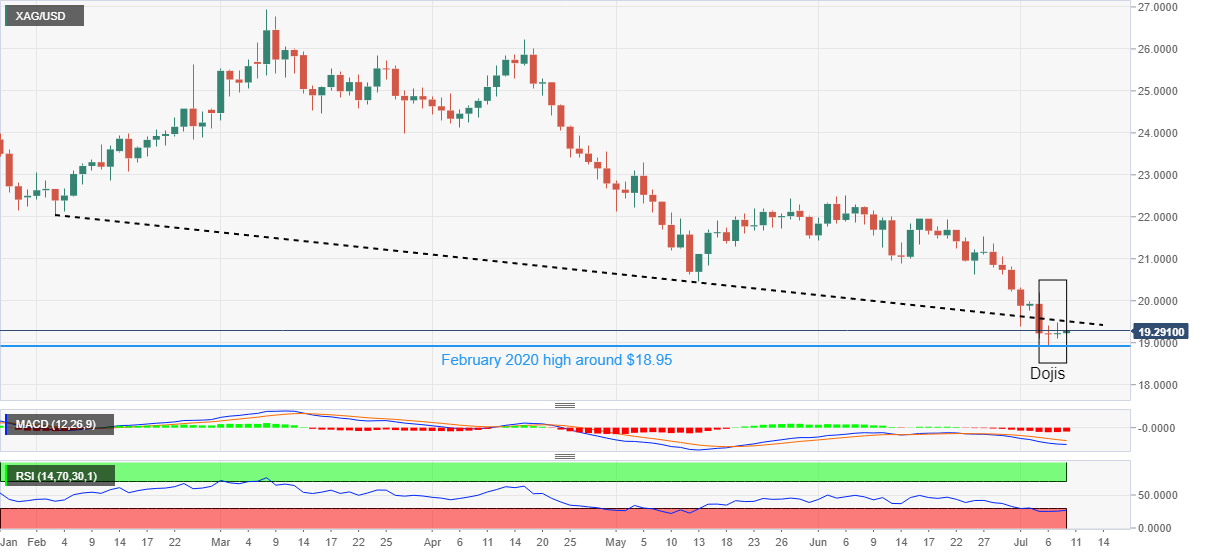
Trend: Recovery expected
- AUD/NZD has printed a fresh weekly high at 1.1088 on the upbeat Australian Trade Balance.
- The RBA elevated its OCR by 50 bps, in line with the estimates of the market.
- The RBNZ may reach neutral rates sooner than the other Western leaders.
The AUD/NZD pair has printed a fresh weekly high at 1.1088 in the early Tokyo session. The cross has remained in the grip of bulls for the past two trading sessions after the announcement of the rate hike by the Reserve Bank of Australia (RBA).
RBA Governor Philip Lowe announced a rate hike by 50 basis points (bps) consecutively this week. The Official Cash Rate (OCR) of the RBA has been elevated to 1.35%. The announcement remained in line with the estimates of the market participants. Price pressures are scaling higher in the Australian economy thanks to the soaring prices of fossil fuels and food products, which have accelerated the inflation rate to 5.1%, recorded for the first quarter of CY2022.
Apart from that, the upbeat Australian Trade Balance has strengthened the aussie against the kiwi dollar. The monthly economic data landed at 15,965M, higher than the estimates of 10,725M and the prior release of 13,248M.
Next week, the Australian employment data will keep investors busy. As per the market consensus, the Employment Change will remain at 25k, significantly lower than the prior print of 60.6k.
On the kiwi front, investors’ focus has shifted to the interest rate decision by the Reserve Bank of New Zealand (RBNZ). Taking into account the runaway inflation, RBNZ Governor Adrian Orr may elevate the OCR further. Currently, the RBNZ’s OCR is 2%. It is worth noting that the RBNZ has elevated its interest rates at a higher pace than the other Western leaders. It will reach its target of neutral rates sooner.
- GBP/JPY grinds higher after rising the most in 13 days.
- UK’s PM Boris Johnson’s resignation from Conservative Party placates political trauma but search for successor probe the optimism.
- Market sentiment improves amid an absence of fresh catalysts suggesting more economic hardships.
- Biden’s meeting with advisors on China tariffs could join risk catalysts to entertain traders.
GBP/JPY holds onto the previous day’s gains at around 163.60 during the initial hour of Friday’s Tokyo open. The cross-currency pair recently cheered easing political drama at Downing Street and firmer US Treasury yields, not to forget the US dollar easing, to recall the buyers amid the sluggish Asian session.
After multiple resignations and a strong push from the cabinet, UK PM Boris Johnson finally resigned from the post of the UK Conservative Party Leader the previous day. The action gives rise to a sigh of relief among the rebels and assures an absence of much political damage. However, the search for a successor and a naïve cabinet, with multiple new appointments, keep the risk-on mood challenged.
Risk-aversion also eased the previous day as major policymakers repeated previous comments while trying to tame the recession fears. Also keeping the market hopeful were headlines concerning China and mixed data from the US.
China is up for $220 billion of stimulus with unprecedented bond sales, per Bloomberg. On the same line was news that diplomats from the US and China are up for meeting personally after the latest virtual meeting cited progress in trade talks. With this, Beijing is optimistic that it can help ease the US its inflation problem by solving the supply-chain riddle, the same gained fewer accolades from the experts though.
It should be noted that the recently softer Japan Current Account balance for May, ¥128.4B versus ¥185.6B expected, also allows the GBP/JPY pair to remain firmer. Furthermore, the broad US dollar pullback and the market’s preparation for today’s US jobs report could also be cited as favoring the pair prices of late.
Amid these plays, the US Treasury yields regain upside momentum and the Wall Street benchmarks closed with gains. However, the S&P 500 Futures print mild losses by the press time.
Looking forward, GBP/JPY traders should pay attention to the UK politics and Brexit headlines, not to forget the recession woes, for fresh impulse.
Technical analysis
A clear upside break of the 50-DMA, around 162.85 by the press time, directs GBP/JPY buyers towards a two-week-old resistance line, close to 164.15 at the latest.
- GBP/USD is firmly balancing above 1.2000 despite the turmoil in the UK Parliament.
- UK PM Boris Johnson has also announced his resignation from his post.
- Lower expectations for the US NFP have brought exhaustion signals in the DXY.
The GBP/USD pair is advancing modestly towards the critical resistance of 1.2050 as the asset has extended Thursday’s bullish bias. The pound bulls have overstepped Thursday’s high at 1.2020 comfortably despite the turmoil of the dominant government in the UK economy.
After a spree of resignations from the delegates of the UK’s Conservative Party, the political situation turned unstable. Lower confidence of the ministers in the leadership of UK PM Boris Johnson forced the former to put resignations at the table. This has been followed by the resignation itself of the UK PM and he will handle the chair until the appointment of a new PM in the country.
Meanwhile, the US dollar index (DXY) is displaying exhaustion signals after printing a fresh 19-year high at 107.26 on Wednesday. The DXY is losing momentum as the market participants are discounting the consecutive 75 basis points (bps) rate hike by the Federal Reserve (Fed) and the lower expectations for the US Nonfarm Payrolls (NFP).
Considering the estimates, the US economy has created 270k jobs in June, lower than the prior release of 390k. The jobless rate may remain stable at around 3.6%. This may compel the Fed to announce one more bumper rate hike in July with extreme precautions as more policy tightening may result in lose strings in the tight labor market.
| Index | Change, points | Closed | Change, % |
|---|---|---|---|
| NIKKEI 225 | 382.88 | 26490.53 | 1.47 |
| Hang Seng | 56.92 | 21643.58 | 0.26 |
| KOSPI | 42.26 | 2334.27 | 1.84 |
| ASX 200 | 53.5 | 6648 | 0.81 |
| FTSE 100 | 81.28 | 7189.08 | 1.14 |
| DAX | 248.7 | 12843.22 | 1.97 |
| CAC 40 | 94.32 | 6006.7 | 1.6 |
| Dow Jones | 346.87 | 31384.55 | 1.12 |
| S&P 500 | 57.54 | 3902.62 | 1.5 |
| NASDAQ Composite | 259.5 | 11621.35 | 2.28 |
- EUR/USD picks up bids around multi-year low inside a bullish chart pattern.
- Bullish RSI divergence adds strength to the upside bias.
- Two-week-old previous support, 100-HMA adds to the upside filters.
EUR/USD consolidates losses at the lowest levels since 2002, picking up bids to 1.0165 during Friday’s Asian session.
The major currency pair has been trading mostly sideways since Wednesday, which in turn portrays the falling wedge bullish chart pattern on the hourly play.
Also teasing the EUR/USD buyers is the bullish RSI divergence. The quote has recently been forming lower low on prices but the RSI (14) does portray higher lows and hence hint at the bullish build of momentum.
However, a clear upside break of the 1.0190 hurdle appears necessary to confirm the falling wedge.
Even so, a fortnight-long resistance line and the 100-HMA could challenge the pair’s further upside, respectively near 1.0280 and 1.0290.
Meanwhile, pullback moves could revisit the latest multi-year low of 1.0144 before the stated wedge’s support line, near 1.0135, could challenge the EUR/USD bears.
In a case where the EUR/USD prices remain pressured below 1.0135, the odds of witnessing the 1.0000 psychological magnet on the chart can’t be ruled out.
EUR/USD: Hourly chart
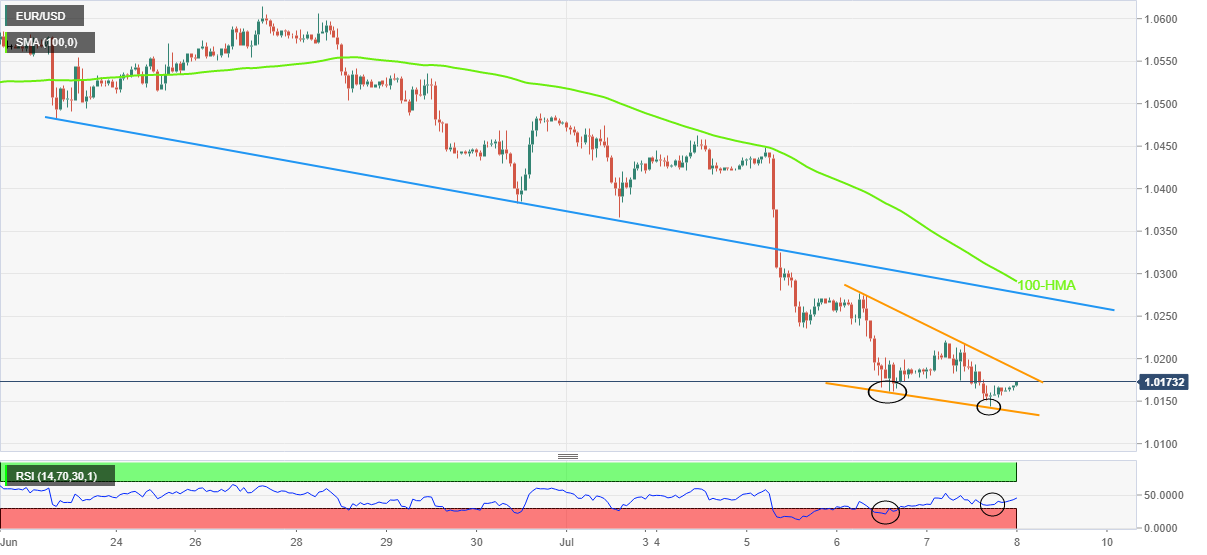
Trend: Further recovery expected
- AUD/USD bears move in for the kill at 0.6850.
- The bears eye the W-formation's neckline and a break of the trendline.
AUD/USD is under pressure from a critical area on the hourly chart and the following illustrates the prospects of a break of the trendline:

The bears could move in during Tokyo as the price meets 0.6850 but there is still room to go on the upside as well. However, the W-formation is a reversion pattern and if the price were to move into the neckline, that could be a significant development as the trend would come undone as per the break of the trendline support.
AUD/USD 15-min chart

For the immediate future, the price has an area of imbalance near 0.6835 that could be mitigated in the coming hours on the 15-min chart.

As illustrated, the price has moved in on the trendline but so far it is holding up.
| Pare | Closed | Change, % |
|---|---|---|
| AUDUSD | 0.68395 | 0.86 |
| EURJPY | 138.165 | -0.2 |
| EURUSD | 1.01602 | -0.27 |
| GBPJPY | 163.512 | 0.93 |
| GBPUSD | 1.2022 | 0.84 |
| NZDUSD | 0.61747 | 0.41 |
| USDCAD | 1.29691 | -0.52 |
| USDCHF | 0.97354 | 0.33 |
| USDJPY | 136.024 | 0.1 |
- USD/JPY has slipped firmly below 136.00 as investors await the release of the US NFP.
- The downbeat US ISM Services New Orders Index data has open room for downside potential for the DXY.
- Stagnancy in Japan’s wage price will restrict the inflation rate to remain at desired levels.
The USD/JPY pair has given a downside break after witnessing topsy-turvy moves in a 135.94-136.06 range in the early Tokyo session. For the past two trading sessions, the asset is trading in a range of 135.55-136.21, however, the US dollar index (DXY) has remained volatile these trading sessions amid the release of the Federal Open Market Committee (FOMC) minutes and US ISM Services data.
The undertone of the FOMC minutes for the June monetary policy was extremely hawkish as only one FOMC member was not in favor of announcing a 75 basis point (bps) interest rate hike. Also, the guidance provided by the Federal Reserve (Fed) was extremely hawkish as the central bank is ‘unintentionally committed’ to bringing price stability to the economy. In case, the price pressures persist, the Fed won’t hesitate in announcing one more 75 bps rate hike.
The release of the downbeat US ISM Services New Orders Index data has triggered the downside risk for the DXY. The US ISM New Orders Index landed at 55.6, significantly lower than the estimates and the prior print of 62.1 and 57.6 respectively. The corresponding data reflects the forward demand by the households and eventually, the lower New Orders Index indicates lower demand ahead.
Going forward, the US Nonfarm Payrolls (NFP) will keep investors busy. As per the market consensus, the US economy has added 270k jobs in the labor market, significantly lower than the former release of 390k. Alongside, the Unemployment Rate may remain stable at 3.6%.
On the Tokyo front, the Bank of Japan (BOJ) is worried over the stagnant wage-price concept. The BOJ believes that wage prices are needed to be hiked in order to keep the inflation rate near the desired levels. Otherwise, the households will face the heat of higher price pressures and aggregate demand will tumble quantity-wise.







© 2000-2026. All rights reserved.
This site is managed by Teletrade D.J. LLC 2351 LLC 2022 (Euro House, Richmond Hill Road, Kingstown, VC0100, St. Vincent and the Grenadines).
The information on this website is for informational purposes only and does not constitute any investment advice.
The company does not serve or provide services to customers who are residents of the US, Canada, Iran, The Democratic People's Republic of Korea, Yemen and FATF blacklisted countries.
Making transactions on financial markets with marginal financial instruments opens up wide possibilities and allows investors who are willing to take risks to earn high profits, carrying a potentially high risk of losses at the same time. Therefore you should responsibly approach the issue of choosing the appropriate investment strategy, taking the available resources into account, before starting trading.
Use of the information: full or partial use of materials from this website must always be referenced to TeleTrade as the source of information. Use of the materials on the Internet must be accompanied by a hyperlink to teletrade.org. Automatic import of materials and information from this website is prohibited.
Please contact our PR department if you have any questions or need assistance at pr@teletrade.global.


 Bank
Bank transfers


