- Analytics
- News and Tools
- Market News
CFD Markets News and Forecasts — 11-07-2022
- EUR/USD remains pressured around 20-year low, sidelined of late.
- Impending gas shortage propels fears of recession in the bloc to favor the bears.
- Strong US inflation expectations, risk-aversion wave underpin USD’s safe-haven demand.
- ZEW Survey figures for July can entertain traders but risk catalysts are the key.
EUR/USD bears take a breather around 1.0050, after refreshing the 20-year low with the biggest daily slump in a week. That said, a lack of major catalysts and the market’s cautious mood ahead of the key data/events appear to challenge the pair traders during Tuesday’s Asian session.
With the chatters surrounding Russia’s closure of the Nordstorm 1 gas pipeline for maintenance fueling fears of economic slowdown in Europe, EUR/USD had a major downside to track the previous day. On the other hand, a jump in the US inflation expectations and comments from the US policymakers suggesting more pain ahead escalated the fears of economic slowdown, which in turn propelled the US dollar’s safe-haven demand.
German Economy Minister Robert Habeck said on Monday it was difficult to say whether Nord Stream 1 gas pipeline would come back online after the maintenance, as reported by Reuters. On the same line, a German Newspaper Handelsblatt quoted the Chief of the German trade union DGP as saying, “Millions of jobs could be threatened if Russian gas stop goes on for longer.” However, Vice President of the European Commission Valdis Dombrovskis mentioned, per Reuters, “Complete gas stop this month is a no base scenario.”
That said, one-year US inflation expectations jumped to the record high of 6.8% in June, versus 6.6% prior, per the NY Fed’s survey of one-year-ahead consumer inflation expectations. The inflation expectations followed strong US employment data, published Friday, to underpin hopes of an aggressive Fed rate hike and fuelled concerns over the health of the US economy, as well as the global ones. That said, the latest US jobs report mentioned that the US Nonfarm Payrolls (NFP) rose by 372K for June, versus expected 268K and downward revised 384K prior. Further, the Unemployment Rate matched market expectations of reprinting 3.6% level. Further details suggest that the annual wage inflation, as measured by the Average Hourly Earnings, edged lower to 5.1% from 5.3% in May and the Labor Force Participation declined to 62.2% from 62.3.
Elsewhere, White House Press Secretary Karine Jean-Pierre told reporters that she expects new Consumer Price Index (CPI) data to be highly elevated. Further, Atlanta Fed President Raphael Bostic said that recent inflation data has not been as encouraging as I would have liked, per Reuters.
Amid these plays, equities remained depressed and the US Treasury yields kept flashing recession fears. S&P 500 Futures, however, print mild gains by the press time.
Moving on, ZEW Survey for Economic Sentiment, for Eurozone and Germany, expected -32.8 and -38.0 respectively, appear important for the EUR/USD traders to watch amid fears of economic slowdown in the bloc. However, major attention will be given to fears of higher inflation ahead of the US Consumer Price Index (CPI) for June, up for publication on Wednesday.
Technical analysis
A clear downside break of the early 2017 low of 1.0340 keeps EUR/USD bears directed towards the August 2002 low near 0.9625. However, the 1.0000 psychological magnet may probe the short-term bears.
- USD/CHF is likely to display more gains above 0.9850 as a consensus for US CPI indicates higher print.
- The Fed is expected to maintain the status quo and will raise interest rates by 75 bps.
- Swiss’s light economic calendar compels US CPI to remain the major trigger for this week.
The USD/CHF pair is juggling in a narrow range of 0.9822-0.9834 in the Asian session as investors are shifting their focus on the release of the US Inflation on Wednesday. On a broader note, the asset has remained in the grip of bulls consecutively for the past seven trading sessions. It would be worth keeping an eye on Monday’s high of 0.9843 as a break of the same will strengthen the odds of the maintenance of the winning spree.
A preliminary estimate for the US Consumer Price Index (CPI) is 8.7%, modestly higher than the former release of 8.6%. The Federal Reserve (Fed) has already elevated its interest rates to 1.50-1.75% in its last three monetary policy meetings. Despite that, the price pressures have not shown any sign of exhaustion. Therefore, the odds of a consecutive 75 basis points (bps) interest rate hike by the Fed have bolstered.
Meanwhile, the US dollar index (DXY) is holding itself above 108.20 firmly amid an ongoing risk-off impulse. This has improved the appeal for the safe haven vigorously. On the lower timeframe, the DXY is displaying some exhaustion signals, therefore a minor correction cannot be ruled out.
On the Swiss franc front, the release of the flat jobless rate last week failed to support the Swiss franc bulls. The monthly data remained in line with the estimates and the prior release of 2.2%.
- WTI extends week-start pullback amid fears of slower demand, higher output.
- US President Biden is up for pushing Middle East producers for more oil production.
- 14 oil firms will benefit from the US Strategic Petroleum Reserve (SPR) action.
- US API inventories, risk catalysts will be important to watch for fresh impulse.
WTI crude oil takes offers to renew its intraday low near $100.25 during the initial Asian session on Tuesday. The black gold reversed from a one-week high the previous day while snapping a two-day uptrend as the market’s fears of recession joined chatters surrounding the likely increase in oil output.
Recently, White House National Security Adviser Jake Sullivan said, per Reuters, “US President Joe Biden will make the case for greater oil production from OPEC nations to bring down gasoline prices when he meets Gulf leaders in Saudi Arabia this week.”
The news joined another piece from Reuters suggesting an increase in the oil output saying, “The United States on Monday said 14 companies had been awarded contracts for the latest sale of oil from the Strategic Petroleum Reserve as part of the administration's efforts to ease disruption caused by the war in Ukraine.”
Elsewhere, a jump in the US inflation expectations and comments from the US policymakers suggesting more pain ahead escalated the fears of economic slowdown, which in turn weighed on the energy demand. That said, one-year US inflation expectations jumped to the record high of 6.8% in June, versus 6.6% prior, per the NY Fed’s survey of one-year-ahead consumer inflation expectations. The inflation expectations followed strong US employment data, published Friday, to underpin hopes of an aggressive Fed rate hike and fuelled concerns over the health of the US economy, as well as the global ones. That said, the latest US jobs report mentioned that the US Nonfarm Payrolls (NFP) rose by 372K for June, versus expected 268K and downward revised 384K prior.
Further, White House Press Secretary Karine Jean-Pierre told reporters that she expects new Consumer Price Index (CPI) data to be highly elevated. Further, Atlanta Fed President Raphael Bostic said that recent inflation data has not been as encouraging as I would have liked, per Reuters.
Additionally, Shanghai’s first coronavirus Omicron sub-variant BA-5 case escalated virus woes after the dragon nation failed to sustain the unlock activities. On the same line was firmer inflation data from the Asian major and doubts over Beijing’s GDP goal, as well as on the stimulus’ ability to renew optimism, which in turn challenges oil demand.
Moving on, weekly readings of the industrial player American Petroleum Institute (API), prior 3.825M, could entertain the oil traders. Though, major attention will be given to the chatters surrounding the recession.
Technical analysis
Although the 200-DMA challenges WTI bears around $93.00, any intermediate recovery appears elusive until the quote rises past $106.10-15 resistance confluence, including the 100-DMA and downward sloping trend line from June 14.
- The EUR/JPY remains heavy, extending its losses, also weighed by a falling EUR/USD, which is approaching parity.
- Sentiment is still negative; with Asian equities set to open lower, safe-haven flows will remain bid.
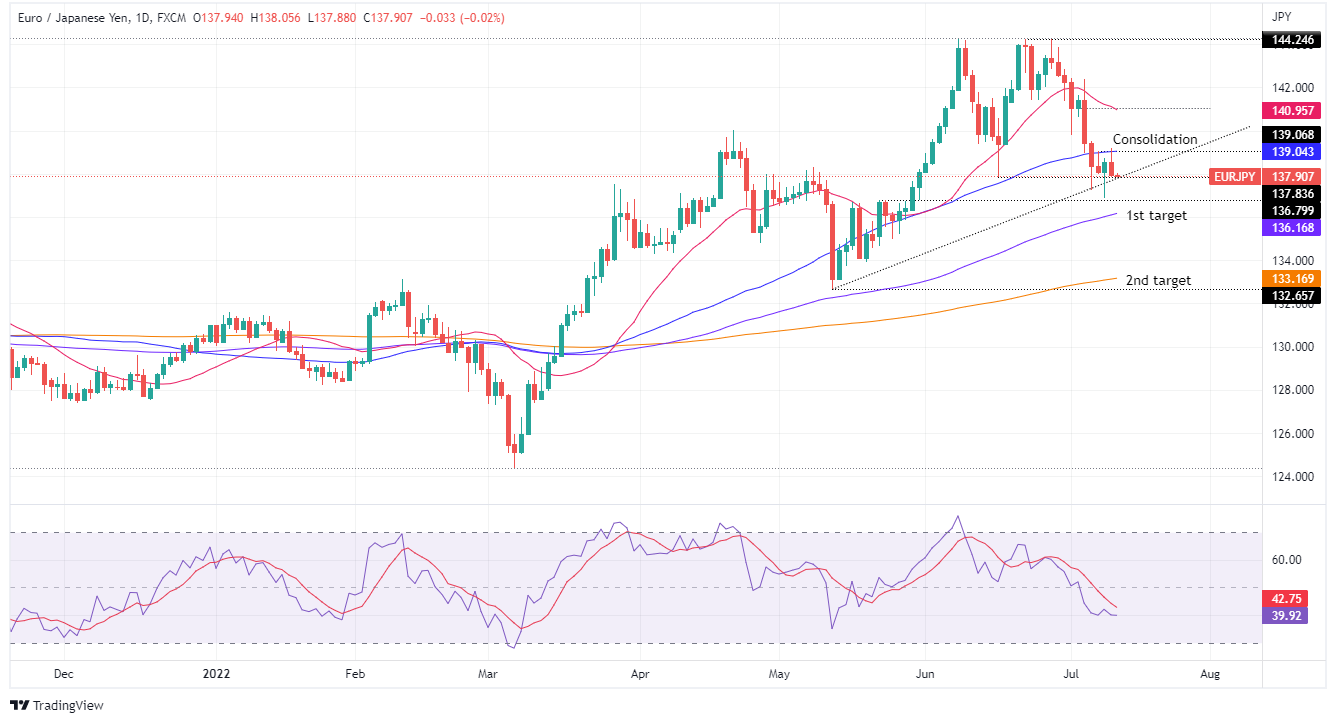
- EUR/JPY sellers stepped in around the 139.00 area and sent the pair sliding as they targeted a move towards the 100-day EMA around 136.00.
The EUR/JPY slumps below the 50-day EMA after last Friday’s buyers attempts to drag the pair above the 139.00 figure, though sellers regained control on Monday, courtesy of downbeat market sentiment sparked by the resurgence of covid-19 in China, as the US inflation data looms.
During Monday’s trading session, the EUR/JPY began trading around 138.50s, surging towards the daily high just above 139.15, tripping down afterward towards the daily low of the day at 137.88. At 137.90, the EUR/JPY stabilized as Tuesday’s Asian session began, almost flat.
EUR/JPY Daily chart
The EUR/JPY is upward biased, despite slipping through the 50-day EMA around 139.05. Nevertheless, oscillators residing in sellers’ territory, and pushing downwards, opens the door for a 100-day EMA test at 136.16. Regardless, the cross-currency might consolidate due to solid support around 137.20-60 and could form a bearish rectangle before aiming lower.
If that scenario plays out and the EUR/JPY breaks below, the first support would be 137.00. The break below would expose the 100-day EMA at 136.16. If that level is cleared, the next support would be the 200-day EMA at around 133.16.
EUR/JPY Key Technical Levels
- USD/CAD bulls take a breather after posting the biggest daily jump in a week.
- Oil prices remain pressured amid hopes of more output, recession fears.
- US dollar cheers market’s rush to risk-safety ahead of Wednesday’s key inflation data.
- BOC is up for a heavy rate hike in its fourth consecutive hawkish move.
USD/CAD seesaws around the 1.3000 psychological magnet after rising the most in a week as buyers struggle for fresh directions during Tuesday’s Asian session. The Loonie pair portrayed the broad risk-off mood, as well as softer oil prices, to begin the key week comprising the US inflation data, as well as the Bank of Canada (BOC) monetary policy meeting.
A jump in the US inflation expectations and comments from the US policymakers suggesting more pain ahead escalated the fears of economic slowdown, which in turn propelled the market’s rush towards risk safety. Also adding to the risk-off mood, as well as to the broad US dollar strength, were Friday’s upbeat US employment data and geopolitical/trade fears. It should be noted that the weakness in the oil prices, amid recession woes and expectations of higher output, offers extra support to the USD/CAD bulls, due to Canada’s reliance on crude oil export.
That said, one-year US inflation expectations jumped to the record high of 6.8% in June, versus 6.6% prior, per the NY Fed’s survey of one-year-ahead consumer inflation expectations. The inflation expectations followed strong US employment data, published Friday, to underpin hopes of an aggressive Fed rate hike and fuelled concerns over the health of the US economy, as well as the global ones. That said, the latest US jobs report mentioned that the US Nonfarm Payrolls (NFP) rose by 372K for June, versus expected 268K and downward revised 384K prior.
On a different page, White House Press Secretary Karine Jean-Pierre told reporters that she expects new Consumer Price Index (CPI) data to be highly elevated. Further, Atlanta Fed President Raphael Bostic said that recent inflation data has not been as encouraging as I would have liked, per Reuters.
Elsewhere, WTI crude oil keeps the week-start losses around $100.30, down 0.80% intraday, as fears of softer demand due to the global economic slowdown fears join the chatters that US President Joe Biden will push for greater oil output during his trip to the Middle East, starting from Tuesday.
Amid these plays, equities and were lower while the S&P 500 Futures remains directionless by the press time.
Moving on, risk catalysts could be of importance to the USD/CAD traders amid a light calendar at home. However, major attention will be given to Wednesday’s BOC meeting as the Canadian central bank is up for a heavy rate hike of 0.75% during its fourth attempt to tame inflation.
Technical analysis
USD/CAD struggles for clear directions between a two-month-old resistance line and an upward sloping support line from June 08, respectively around 1.3085 and 1.2925. That said, RSI (14) hints at a gradually rising bullish bias.
- The cable has given a downside break of the symmetrical triangle that signals more downside.
- Declining 20- and 50-period EMAs add to the downside filters.
- The RSI (14) has shifted into the bearish range of 20.00-40.00, which signals more pain ahead.
The GBP/USD pair is displaying topsy-turvy moves in a narrow range of 1.1882-1.1897 in the Asian session. The cable has shown a mild consolidation after a vertical downside move. The asset tumbled significantly on Monday after surrendering the psychological support of 1.2000. The asset is hovering around the fresh two-year low at 1.1866.
On the four-hour scale, the cable has given a downside break of the symmetrical triangle. The downward-sloping trendline of the above-mentioned pattern is plotted from July 4 high at 1.2161 while the upward-sloping trendline is placed from Wednesday’s low at 1.1876. Also, the horizontal resistance placed from June 14 at 1.1934 will remain a critical resistance for the cable.
Declining 20- and 50-period Exponential Moving Averages (EMAs) at 1.1970 and 1.2027 respectively signal that the downside is still far from over.
Also, the Relative Strength Index (RSI) (14) has shifted into the bearish range of 20.00-40.00, which adds to the downside filters.
The cable is expected to display more losses if the asset drops below Monday’s low at 1.1866. An occurrence of the same will drag the asset to the round-level support of 1.1800, followed by a 26 March 2020 low at 1.1777.
Alternatively, a decisive move above Friday’s high of 1.2056 will send the asset towards July 4 high at 1.2161. A breach of the latter will drive the cable towards June 28 high at 1.2292.
GBP/USD four-hour chart
-637931769434471212.png)
White House Press Secretary Karine Jean-Pierre told reporters that she expects new Consumer Price Index (CPI) data to be highly elevated.
Her comments escalate inflation woes ahead of Wednesday’s US CPI release for June, expected 8.8% YoY versus 8.6% prior.
It’s worth noting that the US inflation expectations jumped to the record high of 6.8% in June, versus 6.6% prior, per the NY Fed’s survey of one-year-ahead consumer inflation expectations.
On the same line, Atlanta Fed President Raphael Bostic said that recent inflation data has not been as encouraging as I would have liked, per Reuters.
FX implications
The inflation fears weigh on the market sentiment and fuel the US dollar due to its safe-haven appeal, also drowning the commodities and Antipodeans.
Also read: NZD/USD bears attack 0.6100 at two-year low amid inflation/recession fears, RBNZ eyed
“US President Joe Biden will make the case for greater oil production from OPEC nations to bring down gasoline prices when he meets Gulf leaders in Saudi Arabia this week, White House national security adviser Jake Sullivan said on Monday,” reported Reuters.
Key quotes
Biden leaves Tuesday night on his first visit to the Middle East as president, with stops in Israel, the occupied West Bank and Saudi Arabia on his agenda.
Sullivan said members of the Organization of the Petroleum Exporting Countries (OPEC) have the capacity to take ‘further steps’ to increase oil production despite suggestions from Saudi Arabia and the United Arab Emirates that they can barely increase oil production.
Experts say the White House understands Saudi Arabia is unlikely to move unilaterally and that Riyadh and other Gulf nations lack significant spare capacity.
In a commentary published in the Washington Post late on Saturday, Biden said his aim was to reorient and not rupture relations with a country that has been a U.S. strategic partner for 80 years.
Iran is expected to be discussed on the trip in a region nervous about Tehran's influence.
Sullivan said the United States believes Iran is preparing to provide Russia with up to several hundred drones, including some that are weapons capable, for use in its war against Ukraine.
FX implications
WTI crude oil remains pressured around $100.60, extending the week-start retreat, as recession fears join expectations of more output.
- NZD/USD stays depressed at the lowest levels since May 2020.
- Fears of higher inflation increase the odds of recession and underpin USD’s safe-haven demand.
- China’s covid woes, geopolitical/trade chatters also exert downside pressure on the pair.
- RBNZ is expected to lift interest rates by 0.50% on Wednesday, no major data/events appear interesting ahead of that.
NZD/USD struggles to defend the 0.6100 threshold, after refreshing the 26-month low as risk-aversion propelled the US dollar, amid early Tuesday morning in Asia. The Kiwi pair’s latest weakness could be linked to the market’s fears of recession and cautious mood ahead of Wednesday’s monetary policy decision of the Reserve Bank of New Zealand (RBNZ). It’s worth noting that hardships for China, the world’s biggest industrial player and New Zealand’s key customer, also drown the quote.
One-year US inflation expectations jumped to the record high of 6.8% in June, versus 6.6% prior, per the NY Fed’s survey of one-year-ahead consumer inflation expectations. The inflation expectations followed strong US employment data, published Friday, to underpin hopes of an aggressive Fed rate hike and fuelled concerns over the health of the US economy, as well as the global ones. That said, the latest US jobs report mentioned that the US Nonfarm Payrolls (NFP) rose by 372K for June, versus expected 268K and downward revised 384K prior. Further, the Unemployment Rate matched market expectations of reprinting 3.6% level. Further details suggest that the annual wage inflation, as measured by the Average Hourly Earnings, edged lower to 5.1% from 5.3% in May and the Labor Force Participation declined to 62.2% from 62.3.
It’s worth noting that Kansas City Federal Reserve President Esther George recently raised concerns over recession while saying, “Recession projections suggest to me that rapid rate hikes risk tightening faster than the economy and markets can adjust,” per Reuters.
Elsewhere, Shanghai’s first coronavirus Omicron sub-variant BA-5 case escalated virus woes after the dragon nation failed to sustain the unlock activities. It should be noted that firmer inflation data from the Asian major and doubts over Beijing’s GDP goal, as well as on the stimulus’ ability to renew optimism, exert additional downside pressure on the market sentiment.
Amid these plays, equities and US Treasury yields began the week on a back-foot while the yield curves kept signaling recession fears.
Considering these catalysts, analysts at the Australia and New Zealand Banking Group said, “We expect the RBNZ to be hawkish tomorrow (they can’t afford not to be), but in a world of dollar dominance that may not do a lot for the beleaguered Kiwi, especially amid NZ recession fears.”
Technical analysis
Oversold RSI (14) joins a one-month-old descending support line to restrict short-term NZD/USD declines around 0.6100. However, corrective pullback remains elusive unless crossing a downward sloping resistance line from June 16, close to 0.6215 by the press time.
- AUD/USD is hovering around monthly lows at 0.6715, downside remains warranted on risk-off impulse.
- Volatile energy and food products are still guiding the US CPI higher despite policy tightening measures.
- Aussie’s jobless rate may decline to 3.8% vs. 3.9% reported prior.
The AUD/USD pair has turned sideways after a sheer downside move to Monday’s low at 0.6715 on a risk-off impulse on the market. The asset is hovering around its fresh monthly low as the US dollar index (DXY) has printed a fresh 19-year high at 108.27.
The DXY extended its gains beyond the prior high of 107.79 on a higher consensus for US Inflation. A preliminary estimate for the plain-vanilla Consumer Price Index (CPI) is 8.7%, higher than the print of 8.6%. While the core CPI may settle lower to 5.7%.
The core CPI doesn’t include fossil fuels and food products and is seen lower, however, the annual CPI that includes the duo is seen higher. This indicates that the volatile energy bills and food items are still guiding the inflation rate significantly despite the deployment of policy restrictive measures by the Federal Reserve (Fed).
Apart from the US CPI, investors will also focus on the US Retail Sales this week. The economic data is seen meaningfully higher at 0.8% than the prior print of -0.3%.
On the aussie front, investors are keeping an eye on the employment data, which is due on Thursday. The Employment Change is expected to land at 25k, less-than-half than the prior release of 60.6K. However, the Unemployment Rate will slip to 3.8% vs. 3.9% reported previously.
- The AUD/JPY edges lower as the Asian session begins, almost flat during the day.
- Risk-aversion favors AUD/JPY downside, though support levels at around and below 92.00 might cap selling pressure.
- A break of a falling wedge might send the pair towards 97.00 before correcting towards 93.30s.
The AUD/JPY tumbles after recording two days of gains blamed on a gloomy market mood spurred by investors positioning ahead of the US inflation readings, China’s coronavirus reemergence, and broad safe-haven strength across the board.
At 92.55, the AUD/JPY lost almost 0.80% on Monday’s session, in which the pair began trading near the pivot point of the day, around 93.20. Then the cross rallied shy of 93.70, plunging afterward towards the daily lows around 92.30, finally settling down around current levels.
AUD/JPY Daily chart
The AUD/JPY depicts the formation of two different wedges, one rising and inside of it, another one falling. The former suggests that the AUD/JPY might be headed downwards, while the latter indicates that buying pressure remains, so the cross-currency pair still has another leg up.
The AUD/JPY price action is very close to the top trendline of the falling wedge, so that's the first scenario to discuss. If that plays out, the AUD/JY would break upwards, aiming toward its measured target profit right at the top-trendline of the rising wedge, around the 97.20-50 range.
Once that is achieved, the AUD/JPY might correct towards the bottom-trendline of the rising wedge and could probably break immediately, targeting 86.00, or print a subsequent leg-up at fresh YTD highs around 98.05 before plummeting towards the bottom-trendline of the wedge, followed by a break targeting 87.00.

AUD/JPY Key Technical Levels
- Gold price is looking to come out of the woods by surrendering the critical support of $1,730.00.
- The DXY has printed a fresh 19-year high at 108.27 on expectations for higher US Inflation.
- Soaring expectations for lower earnings by the corporate have underpinned the risk-off market mood.
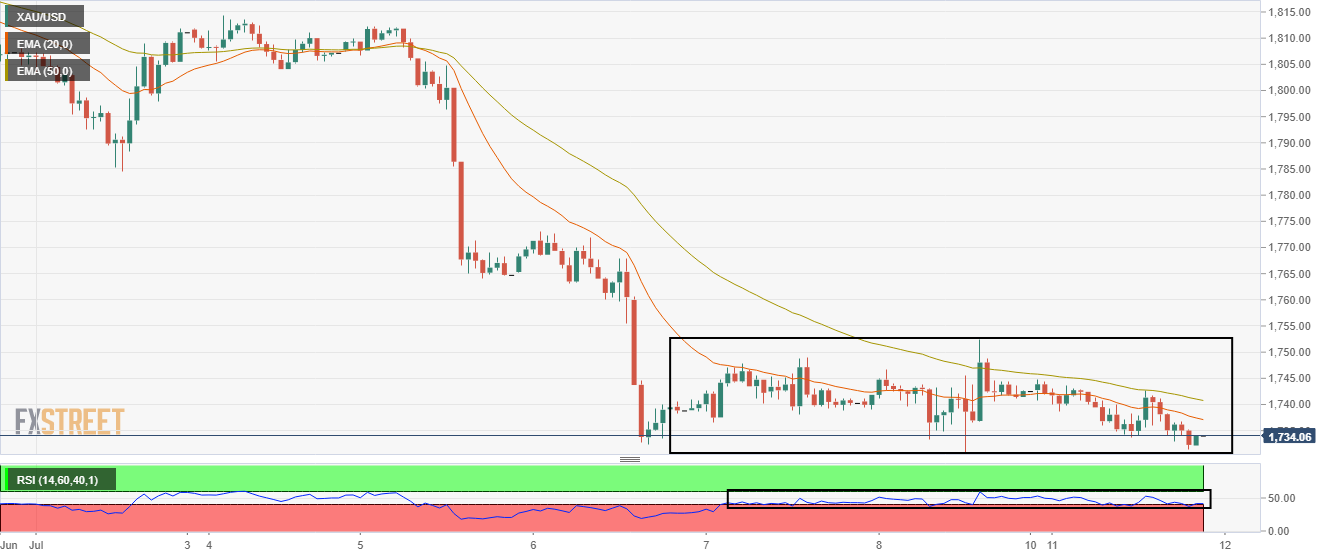
Gold price (XAU/USD) has established below $1,740.00 but is still inside the woods. The precious metal is witnessing back-and-forth moves in a range of $1,730.73-1,752.49 from the past three trading sessions. The bright metal is displaying subdued performance and the volatility prior to the release of the US Consumer Price Index (CPI) is expected to drag the asset below the critical support of $1,730.00.
As per the market consensus, the plain-vanilla CPI is seen minutely higher at 8.7% than the prior release of 8.6%. However, the core CPI that excludes food products and oil prices may drop to 5.7% vs. 6% reported earlier. This signifies that durable goods, automobiles, and other commodities are displaying the impact of policy restrictive measures, which have adopted by the Federal Reserve (Fed) earlier. However, the volatile food and fossil fuels are still not responding.
Meanwhile, the US dollar index (DXY) printed a fresh 19-year high at 108.27 on Monday amid a souring market mood. Escalating odds for one more bumper rate hike by the Fed are bolstering the case for lower earnings by the corporate. The unavailability of cheap money in the economy has forced the corporate sector to put an extra lens on investment opportunities.
Gold technical analysis
On an hourly scale, the gold prices are on the verge of giving a downside break of the consolidation formed in a $1,730.73-1,752.49 range. The 20- and 50-period Exponential Moving Averages (EMAs) at $1,737.04 and $1,740.86 respectively have started declining, which adds to the downside filters. Also, the Relative Strength Index (RSI) (14) is looking to surrender the cushion of 40.00 to add volatility to the counter.
Gold hourly chart
- EUR/USD moves closer to the parity level as bears commit.
- The US CPI will be a key catalyst this week that might either put 1.0100 back on the map or potentially result in a break of parity.
EUR/USD has come to its closest to parity in 20 years. At the turn of the roll-over and start of the Tuesday early Asian session, the pair had made a low for the week so far of 1.0037. Crucially, this is below the 1.0050 level and bears are going to be hunting down tepid pullbacks in a draw on liquidity for a move to challenge the bull's commitments below parity.
The US dollar has risen on safe-haven demand and the euro is under pressure due to concerns that an energy crisis will force the eurozone into a recession. Reuters reported that the biggest single pipeline carrying Russian gas to Germany, the Nord Stream 1 pipeline, began annual maintenance on Monday, with flows expected to stop for 10 days. ''Governments, markets and companies are worried the shutdown might be extended because of the war in Ukraine.''
Stocks were also under pressure as markets move out of risk ahead of the highly anticipated inflation reading from the US this week and the start of a key earnings season fuelling a bid in the greenback as for fears of a recession. ''Core prices likely stayed strong in June, with the series registering a 0.5% MoM gain,'' analysts at TD Securities said. ''Our MoM forecasts imply 8.9%/5.7% yoy for total/core prices.''
Meanwhile, net EUR speculators’ net short positions increased again last week as the market turned its attention to recession risks for the Eurozone, as analysts at Rabobank pointed out. ''This is linked to potential gas shortages during the winter and fears that industry may suffer rationing. This scenario is likely to focus the market on fragmentation risks.''
EUR/USD technical analysis
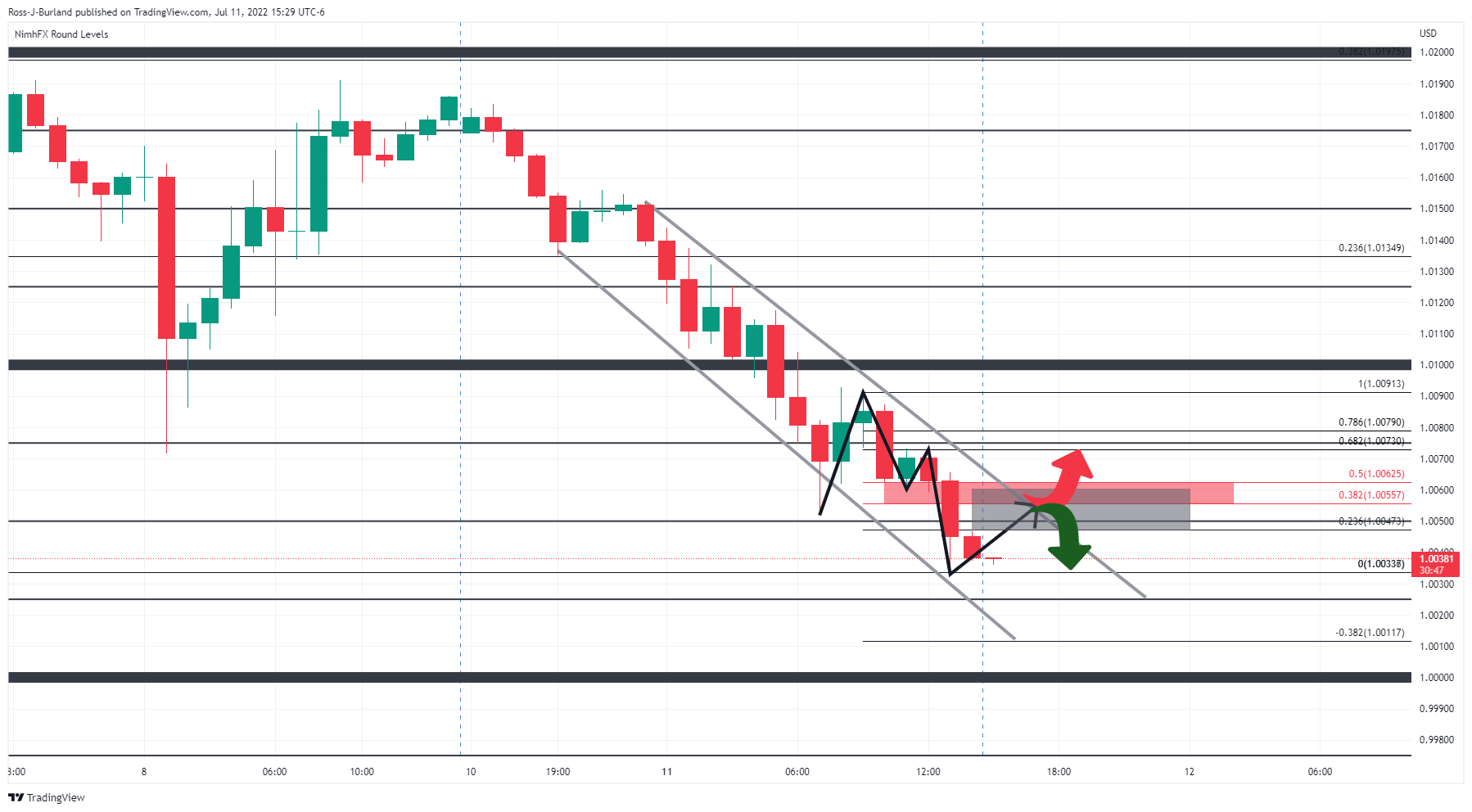
The pair is in a bearish channel and below 1.0050. This puts the emphasis on the downside. However, the M-formation is a bullish reversion pattern and a confluence with the bear-channel resistance, the 38.2% Fibonacci retracement level and the 50% mean reversion area is compelling above 1.0050.
If the bulls commit, there will be the case for a period of either accumulation that could result in a move back to 1.0100 and above, or, so long as the bears commit below this area of confluence, then a break of parity will be back on the cards for the days ahead.
- USD/JPY has been a head-turner at the start of the week.
- The pair has rallied to fresh bull cycle highs, but corrections are anticipated.
The US dollar soared to a 24-year high on the yen following Japan's ruling conservative coalition's strong election showing indicated no change to loose monetary policies. This has seen the pair move deeper into blue skies making analysis to the upside a tricky task. 109.77 is the Sep 2002 high in the DXY which leaves plenty of room for USD/JPY to move higher.
The dollar has already climbed to as high as 137.75, its firmest since late 1998. However, corrections are anticipated along the way and the following illustrates the potential trajectory for the pair on a multi-timeframe basis:
USD/JPY monthly chart
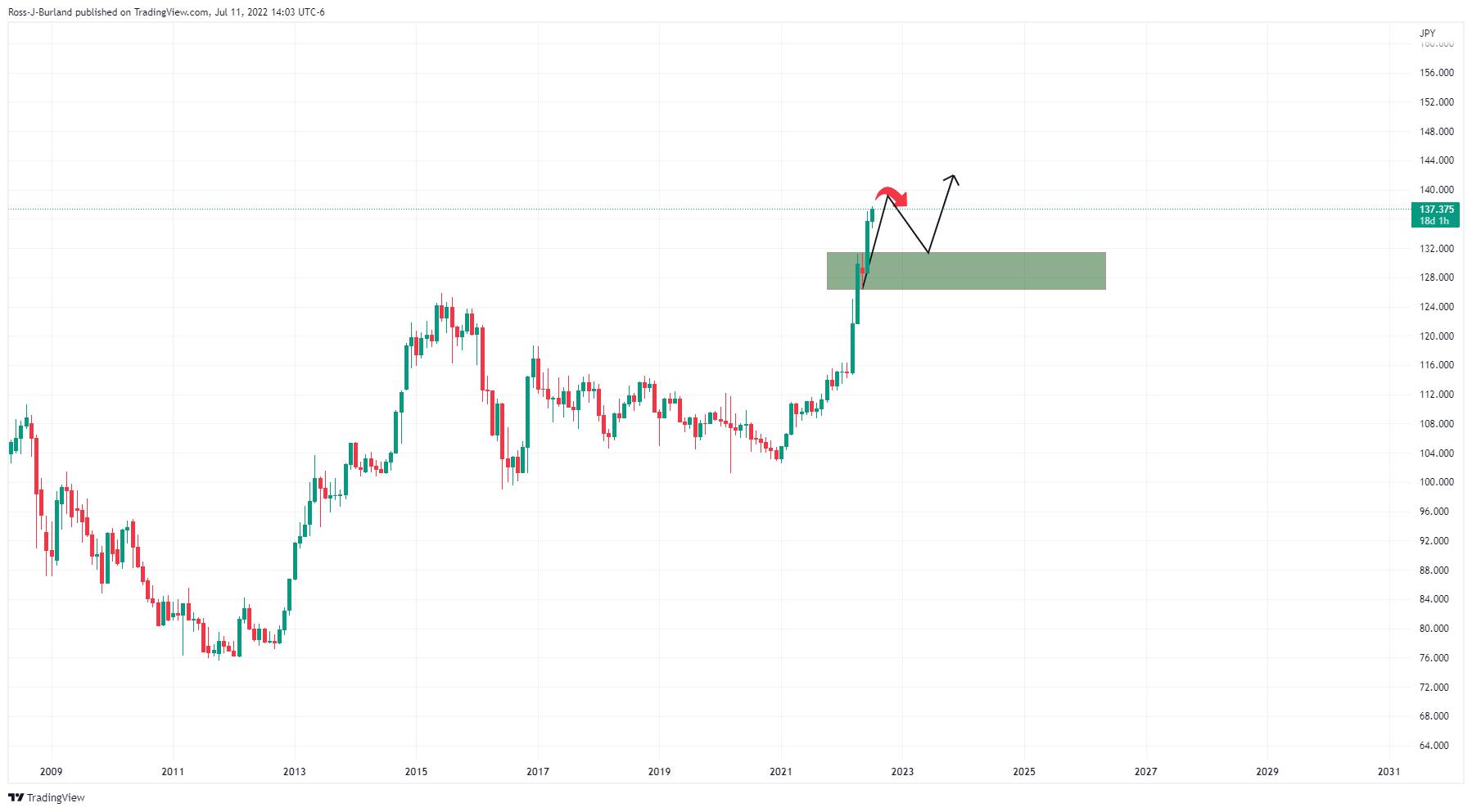
The pair is showing no signs of slowing and it is feasible for it to add to today's gains this week. But the question is how far can this run before pulling back?
USD/JPY daily chart
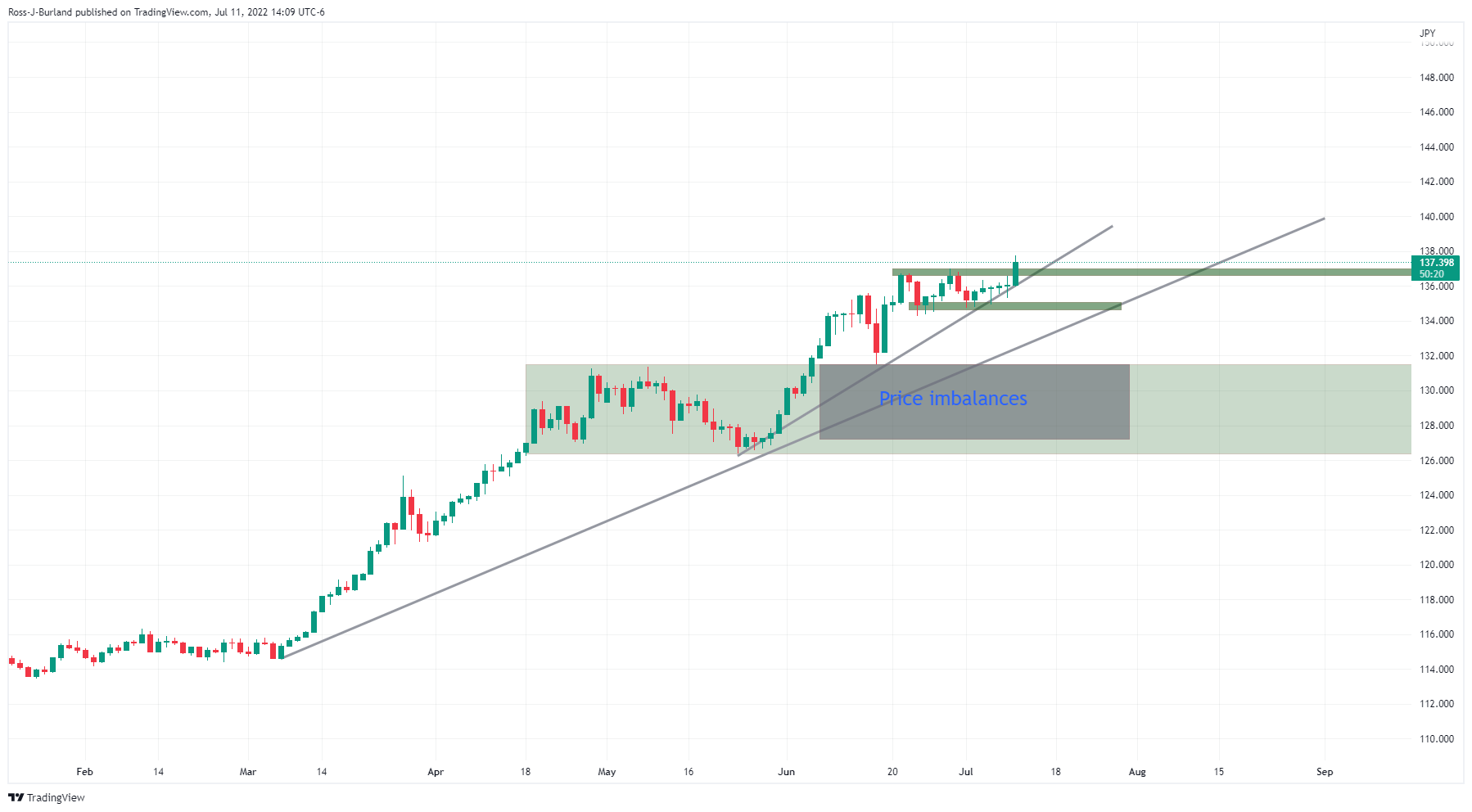
The bulls have taken out prior highs following a higher low. The old highs come as new support.
USD/JPY hourly chart
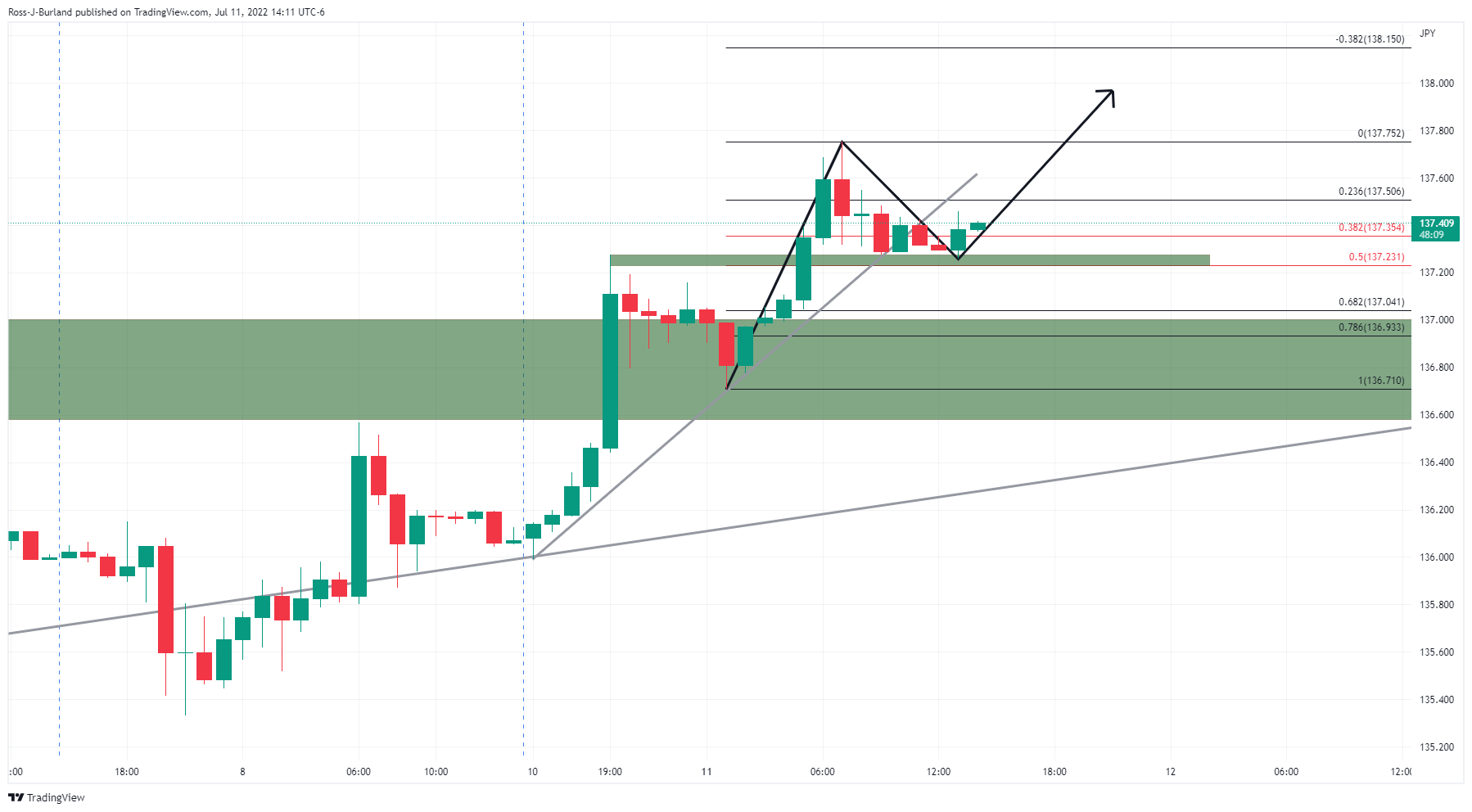
We have a classic impulse, correction and expected fresh impulse stacking up on the hourly chart with the price holding above prior highs and having made a deep 38.2% Fibonacci correction.
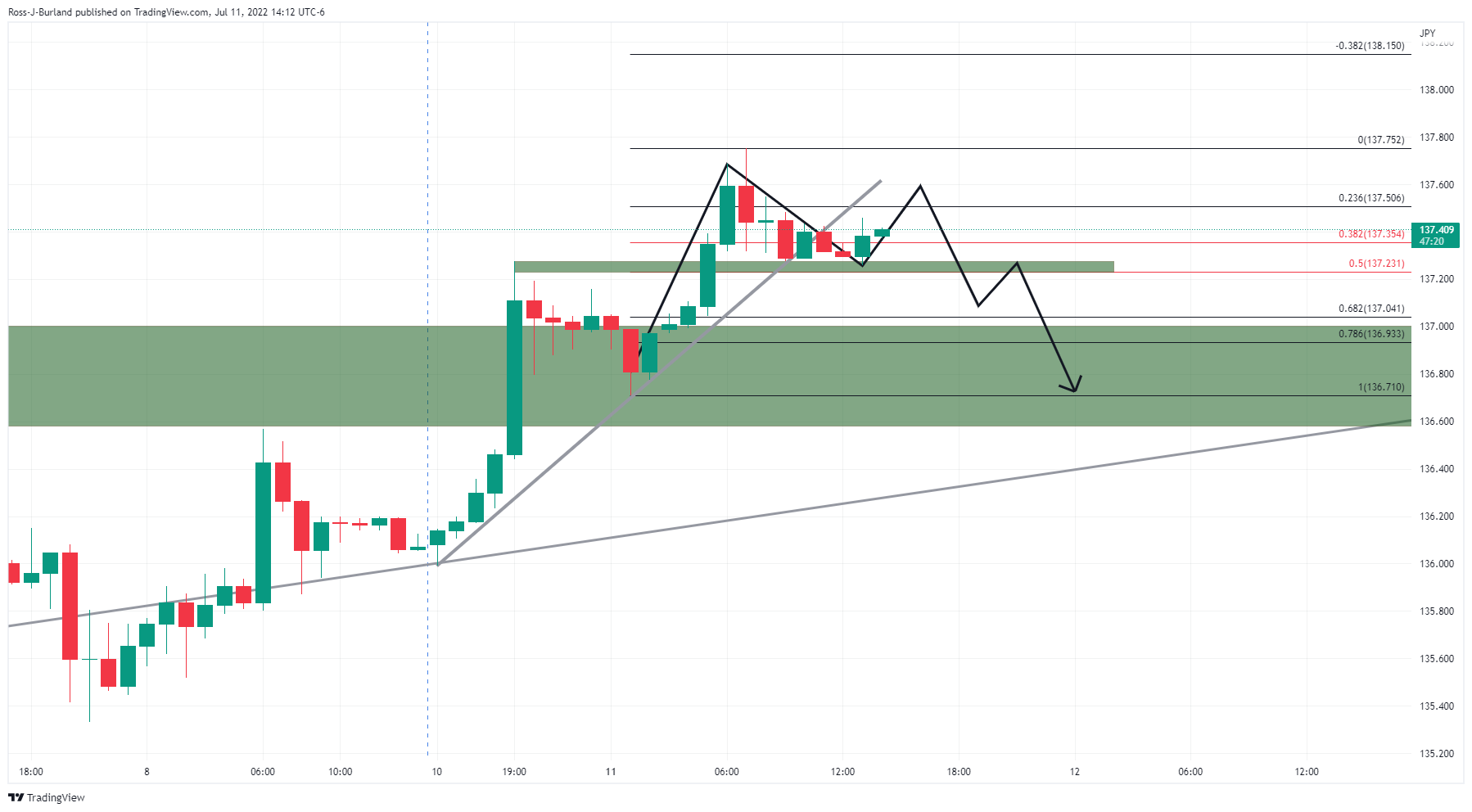
However, the downside cannot be ruled out given the break of the supporting trendline.
USD/JPY 15 min chart
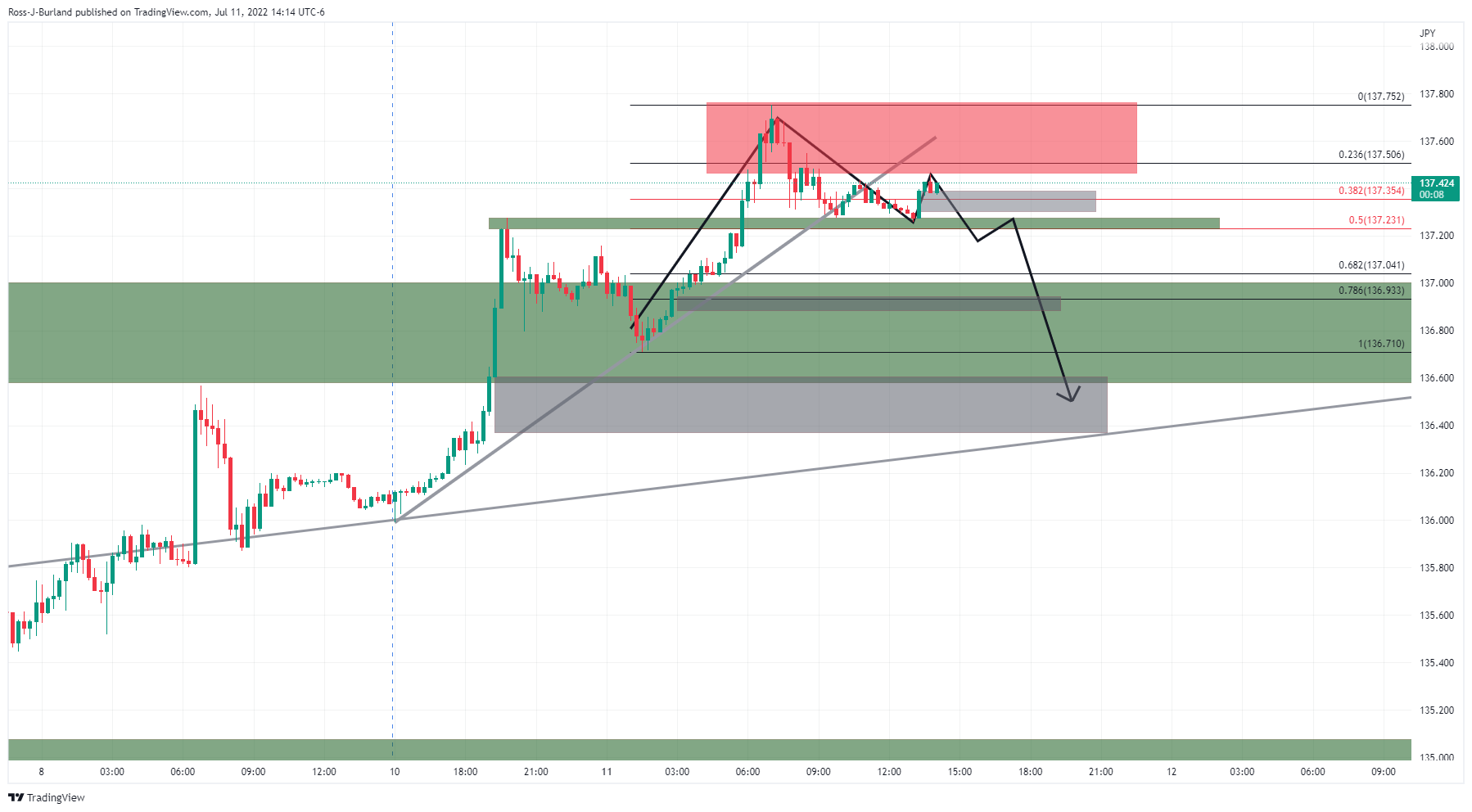
If the downside were to play out, it could look something like the above with price imbalances, the grey boxes, being mitigated along the way as price targets.
- The USD/CAD buyers regain control and lift the pair above 1.3000, eyeing 1.30776.
- Decreased risk appetite and investors’ positioning ahead of the US CPI to keep the USD/CAD upward pressured.
- The Bank of Canada (BoC) is expected to hike rates by 75 bps, as shown by STIRs futures.
The USD/CAD snaps three days of consecutive losses and bounces off last week’s lows around 1.2930s due to a stronger greenback, bolstered by investors positioning ahead of a US inflation reading expected to remain hot and China’s coronavirus reemergence, particularly in Shanghai, threatening to derail the global economic growth.
After reaching a daily high at around 1.3030s, 100 pips up from the daily lows, the USD/CAD is trading at 1.3002, gaining some 0.51% during the North American session at the time of writing,
USD/CAD rises on risk-aversion and falling oil prices
Stocks slid while the greenback remains in the driver’s seat, as shown by the US Dollar Index, rallying more than 1%, printing a fresh YTD high at around 108.211, while US Treasury yields fell on safe-haven appetite. Those factors, alongside falling US crude oil prices with WTI trading at $103.68 BPR, are a headwind for the loonie, which trimmed last week’s losses since last Wednesday.
In the week, the Canadian economic calendar illustrated that the Bank of Canada (BoC) would have its monetary policy meeting, where the bank is expected to hike rates from 1.50% to 2.25%, a 75 bps. Money market futures STIRs, priced in a 99.8% chance of a 0.75% rate increase, while odds of a 1% upward move sit at 74.9%.
Analysts at TD Securities wrote in a note that the BoC Business and Consumer Surveys provided new evidence of rising inflation expectations, further cementing the case for a 75 bps rate hike. Additionally, “With the economy operating in excess demand and inflation running well above the target, we see little room for nuance at the upcoming meeting and look for a broadly hawkish tone.”
Furthermore added that “The policy statement should also repeat that rates need to rise further and that the Bank is prepared to act more forcefully if needed.”
On the US front, the US economic calendar is packed, reporting that US inflation readings for consumers and producers, with both numbers estimated at the top of the range. Late in the week, US Retail Sales are expected to be higher, and the University of Michigan Consumer Sentiment would be in the spotlight after June’s figures triggered a market shift and weighed on the Federal Reserve rate hike decision, according to some Fed speakers.
USD/CAD Key Technical Levels
What you need to take care of on Tuesday, July 12:
The American dollar reached fresh highs against most major rivals, as the week started in risk-off mode. News coming from China spurred the dismal mood, as inflation in the country surged by 2.5% YoY in June, above the market’s expectations. Furthermore, Shanghai officials reported the first case of the coronavirus Omicron sub-variant BA-5, spurring concerns of a new lockdown in the region just a few weeks after the end of a month-long isolation mandate.
The EUR/USD pair trades in the 1.0040 price zone, its lowest since December 2002. The shared currency is under additional pressure amid an energy crisis. As expected, Russia closed the Nord Stream 1 pipeline for maintenance, although Germany fears it would not reopen it.
The GBP/USD pair trades below 1.1900. The UK’s Conservative 1922 Committee announce that nominations to replace Boris Johnson as Prime Minister will open and close on Tuesday. They would have successive ballots until they reach the final two, which could happen early in the next week. Finally, the results will be announced on September 5.
Global equities fell ahead of earnings reports and US inflation figures.
The Australian dollar weakened against its American rival, with AUD/USD trading near a fresh 2-year low of 0.6713. The greenback advanced against the CAD, but USD/CAD remains within familiar levels and trades around 1.3000.
The USD/JPY pair surged to a fresh multi-year high of 137.74, holding nearby despite volatile action among government bonds. Nevertheless, and despite back and forth, the US yield curve remains inverted, hinting at an upcoming recession.
Gold weakened by the end of the day, now trading at around $1,731.00 a troy ounce. Crude oil prices remained stable, with the barrel of WTI now at $103.65.
Like this article? Help us with some feedback by answering this survey:
- GBP/USD bulls start to move in following a significant sell-off.
- The price is correcting into an M-formation's neckline on the 4-hour chart.
GBP/USD is pressured at around 1.1900, losing some 1% on the day following a move higher in the greenback that has sunk all ships. The US dollar gained 1% against a basket of six major currencies, reaching 108.191, the strongest since October 2002, DXY.
The expectation is that the Federal Reserve will continue to aggressively raise rates as it tackles soaring inflation which is supporting the currency ahead of this week's US Consumer Price Index data. The Fed is expected to lift rates by 75 basis points at its July 26-27 meeting. Fed funds futures traders are pricing for its benchmark rates to rise to 3.49% by March, from 1.58% now.
The inflation data that is due on Wednesday is this week’s major US economic focus and economists polled by Reuters expect the index to show that consumer prices rose by an annual rate of 8.8% in June. For the UK, growth data will be important. Analysts at TD Securities expect Gross Domestic Product to fall for the third consecutive month as the cost-of-living crisis continues to weigh on household spending. ''We look for a 0.2% decline in services (mkt: +0.1%) and a 0.3% m/m fall in manufacturing (mkt: 0.0%). This would confirm our view that the UK essentially is already in a recession—even though erratics might save it from one in a technical sense.''
Bank of England Governor Andrew Bailey said on Monday that he thought the BoE's most recent forecast for inflation, showing it was likely to fall sharply next year, remained valid.
"I always go into forecasts with an open mind, and that's critical, but I think the basic fundamentals of that profile remain in place today," the top central banker told lawmakers. ''Inflation was likely to be back at its 2% target in around two years' time, he added.
Meanwhile, net short GBP positions have increased moderately last week counter to the recent trend. ''More political scandal had begun to descend on UK PM Johnson at the start of last week which culminated in his resignation. Looking ahead, hopes of a more coherent government are likely to mingle with uncertainties about the policies of Johnson’s successor, suggesting that GBP may lack direction near term,'' analysts at Rabobank explained.
GBP/USD technical analysis
Friday's London session lows of 1.1920 are in sight for the immediate future:
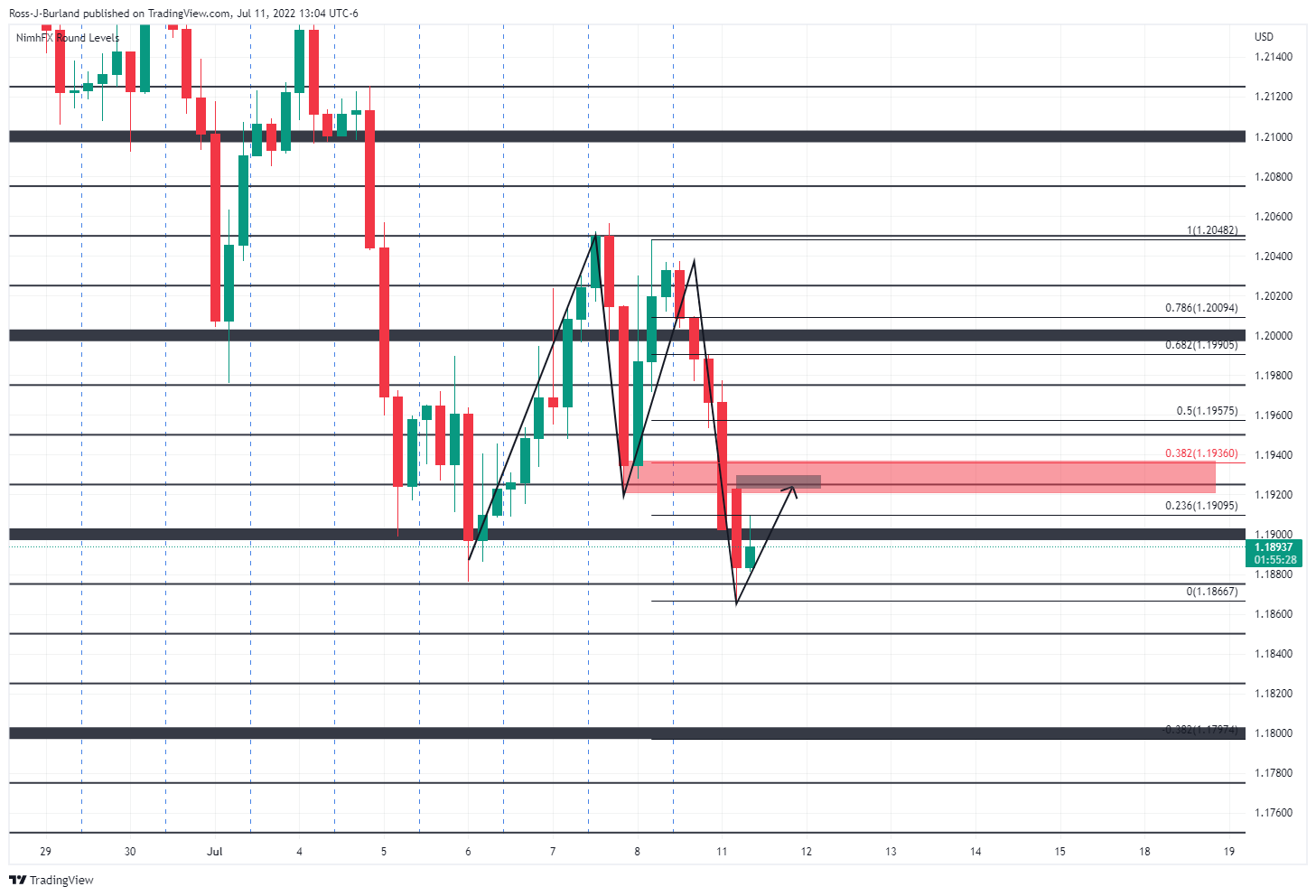
The price has pierced the round 1.1900 level, but the tied is turning which leaves the buys stops above vulnerable with the 38.2% Fibonacci in confluence with the neckline of the M-formation, Friday's London sesison lows and a price imbalance in the hourly chart between the 1.1920/30s.
- The three major US equity indices plunge between 0.29% and almost 2%.
- Risk-aversion dominates Monday’s trading session, on China’s covid-19 fears and high inflation reducing corporate profits as the earnings session looms.
- Fed’s George worried that faster rates would be harmful to the economy.
- Fed’s Bullard commented that the US economy is solid and can withstand higher rates.
US stocks snapped five days of consecutive gains, trading lower on Monday, courtesy of risk aversion and fears that earnings would miss expectations due to the deteriorating economic outlook, spurring an appetite for safe-haven assets
At the time of writing, the S&P 500 sits at 3863.20, falling 0.93%, while the heavy-tech Nasdaq tumbles by 1.86% at 11,420.73. In the meantime, the Dow Jones Industrial slumps 0.29%, sitting at 31,246.41
Sector-wise, the leading sectors are Utilities, up by 0.37%, followed by Real Estate and Health, each recording gains of 0.20 % and 0.02%, respectively. As the appetite for riskier assets diminished, the biggest losers were Communication Services, Consumer Discretionary, and Technology, plummeting 2.59%, 2.31%, and 0.96% each.
Stocks fell due to renewed worries about China’s Covid-19 resurgence and tumbling commodity prices. Corporate America will begin earnings season late in the week, which could signal a high inflation impact on businesses. The US economic calendar will reveal inflation among consumers and producers, US Retail Sales, and the University of Michigan (UoM) Consumer sentiment.
In the meantime, Fed speakers crossed newswires, led by Kansas City Fed President Esther George, who said that “moving interest rates too fast raises the prospect of oversteering.” George said she agreed that hiking rates faster to dampen inflation, though she expressed concerns that it could harm the economy. Later, the St. Lous Fed President James Bullard reiterated that the US economy is solid and can handle higher rates while backing a 75 bps rate hike for the July meeting.
The US Dollar Index (DXY), a measurement of the greenback’s value against some currencies, rallies 1.04% to 108.003, while the 10-year US Treasury yield losses some ground dropping nine basis points, yielding 2.993%.
The US crude oil benchmark in the commodities complex, WTI drops 0.70%, exchanging hands at $104.05 BPD. Meanwhile, precious metals like gold (XAU/USD) drop 0.47%, trading at $1734.20 a troy ounce.
SP 500 Chart
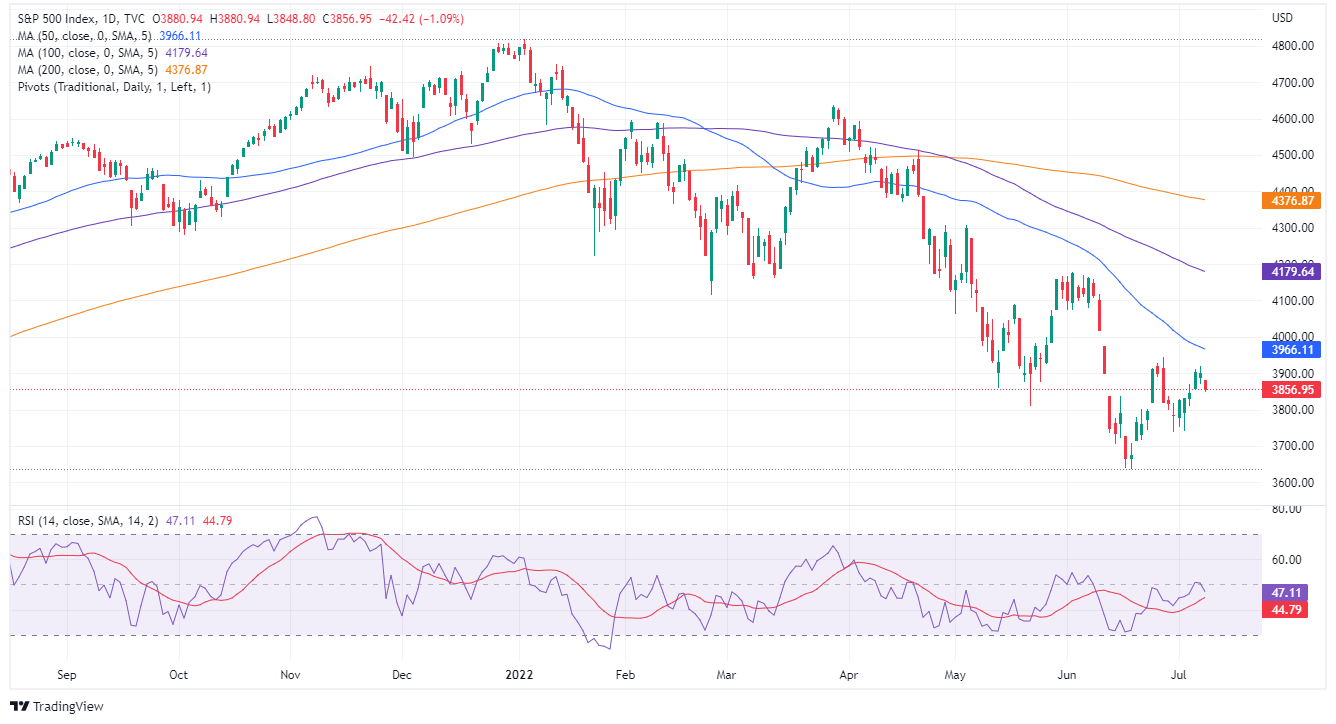
Key Technical Levels
- The USD/CHF is upward biased, but the change of posture of the Swiss National Bank (SNB) from dovish to hawkish could cap USD/CHF rallies toward the YTD high.
- USD/CHF Price Analysis: The daily and 1-hour charts illustrate an upward bias in the pair, so any pullbacks are better opportunities for buyers to step in.
The USD/CHF advances firmly on Monday amidst traders’ risk-off sentiment, which bolstered the greenback. However, last month’s Swiss National Bank (SNB) sudden shift towards a hawkish posture put a lid on the USD/CHF climb, retreating from daily highs around 0.9840.
The USD/CHF is trading around the 0.9790s region and remains positive in the day, up by 0.33% amidst a risk-aversion trading day.
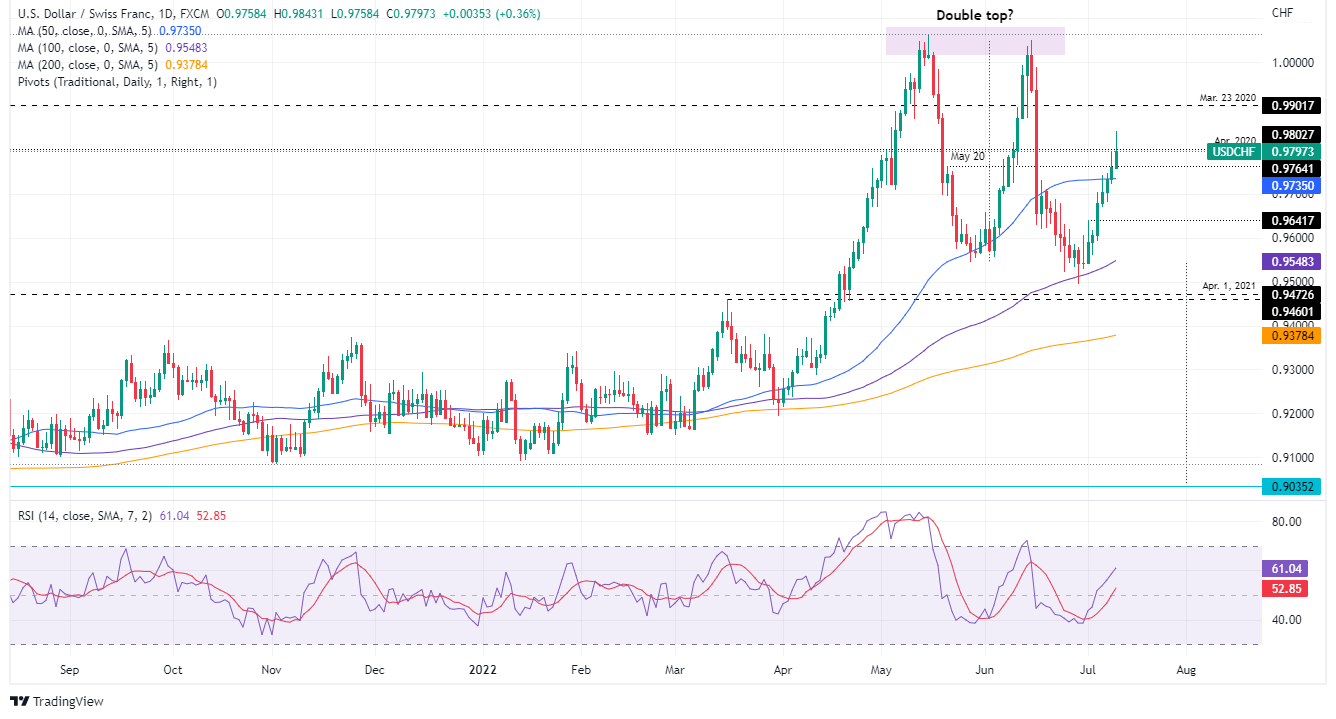
USD/CHF Daily chart
The USD/CHF is still in an uptrend, as depicted by the daily chart. However, some selling pressure emerged between the 0.9800-0.9900 range, dragging prices lower, below last Friday’s daily high at 0.9797. Oscillators remain in bullish territory, like the Relative Strength Index (RSI) at 60.67, with room to spare before reaching overbought conditions. Therefore, the USD/CHF path of least resistance will continue upwards.
That said, the USD/CHF first resistance will be 0.9800. A breach of the latter will send the major towards July 11 high at 0.9843, followed by May 23, 2020, daily high at 0.9901.
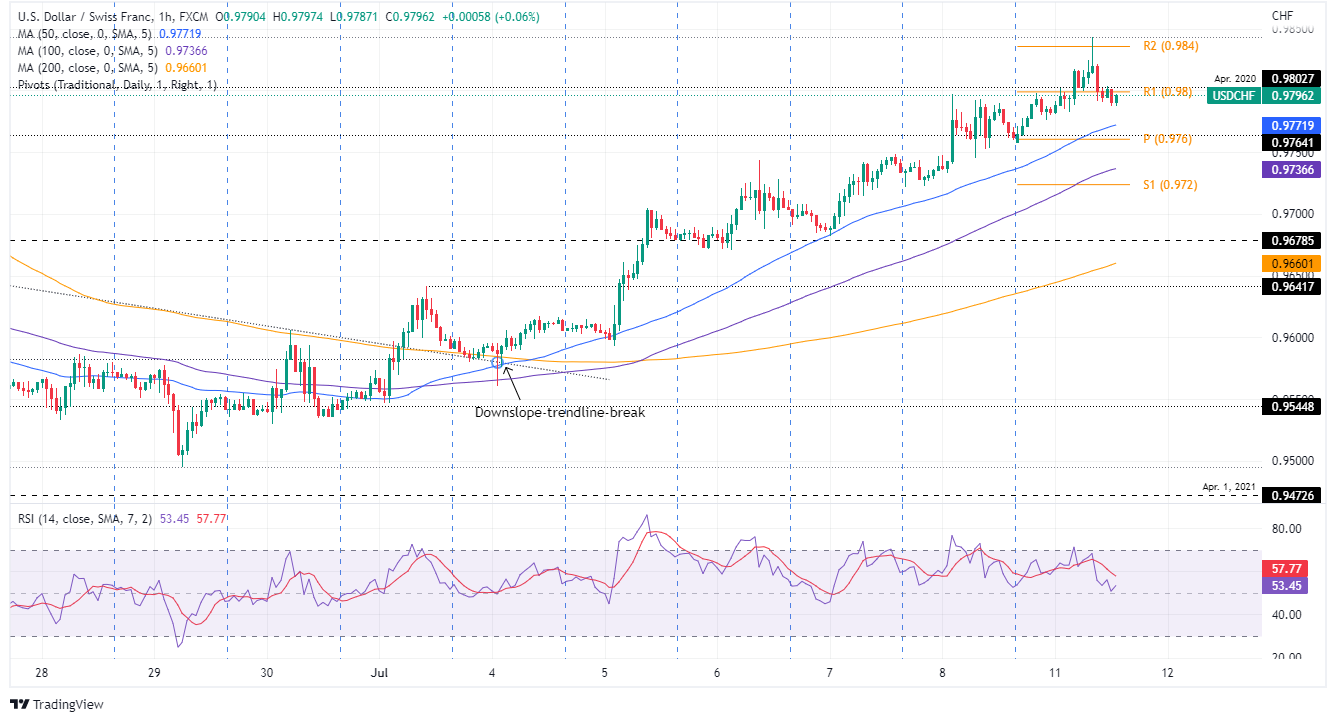
USD/CHF 1-Hour chart
The USD/CHF shows an upward trajectory, aligned with the USD/CHF higher time-frame (HT), being the daily chart. Nevertheless, the rally stalled around the R2 daily pivot, and subsequent pullbacks should be bought, as the major would continue to the upside. USD/CHF traders should be aware that the Relative Strenght Index (RSI) in this time frame, as the pair rallies and retraces, the RSI’s has been seesawing within the 50-70 boundaries without reaching overbought conditions, meaning the uptrend is solid.
Hence, the USD/CHF first resistance would be the R1 pivot point at 0.9800. The break above would expose the R2 daily pivot at 0.9835, followed by the daily high around 0.9843.
USD/CHF Key Technical Levels
- The gold bears have taken charge at the start of the week on a stronger US dollar ahead of more critical US events.
- The neckline of the H4 M-formation near $1,740 remains vulnerable to a test and break thereof.
- A move beyond $1,740 will open the risk of a run on the highs of Friday through $1,750 and then $1,759.60.
The gold price has been pressured by a resurgence in the greenback at the start of the trading week. The US dollar has torn through last week's highs and had denied the bears in the forex space that were in anticipation of corrections. At the time of writing, DXY, a measure of the US dollar vs. a basket of major currencies is up by over 1% and oscillates around 108 the figure.
Spot gold is moving in on the prior lows, July 8, of $1,729.98. It has made a low of $1,733.92 so far on the day and is currently down by 0.48% at $1,734.09. Sentiment had been brewing, supportive of gold, that the market may have over-estimated the extent to which the Federal Reserve will hike rates this cycle. However, a stronger than expected US June Nonfarm Payrolls report has reinforced expectations for another 75 bp Fed rate hike in July which is giving rise to demand in the greenback at the open before more critical US data this week.
Key US calendar events
The main event will be the publication of June’s consumer Price Index report. Analysts at the National Bank of Canada argue that ''the food component likely remained very strong given severe supply constraints globally, and this increase may have been compounded by sharply higher gasoline prices. As a result, headline prices could have increased 1.2% MoM, lifting the year-on-year rate to a 40-year high of 8.8%.''
US Retail Sales will also be important. A recovery in June is expected, following the series' first contraction this year in May. ''Spending was likely aided by another firm showing in gasoline station sales and a rebound in the auto segment,'' analysts at TD Securities said. ''We also look for another gain in the eating/drinking segment as consumers continue to transition away from goods. That said, control group sales likely fell again.''
Meanwhile, the analysts at TDS are highly bearish on the precious metal. Noting that ''gold bugs are falling like dominoes, with selling flow spreading across participants as CTA trend followers join into the vacuum'' they add that ''a major capitulation event may be unfolding in gold.''
''We see evidence that the steepest outflows from broad commodity funds since the Covid-19 crisis may be catalyzing a series of cascading liquidations from various speculative groups. This argues for substantial downside for gold in the coming sessions as participants are forced to sell in a vacuum.''
Gold technical analysis
The price action in gold has started to erode a pre-market-open corrective bias analysis on the 4-hour charts.
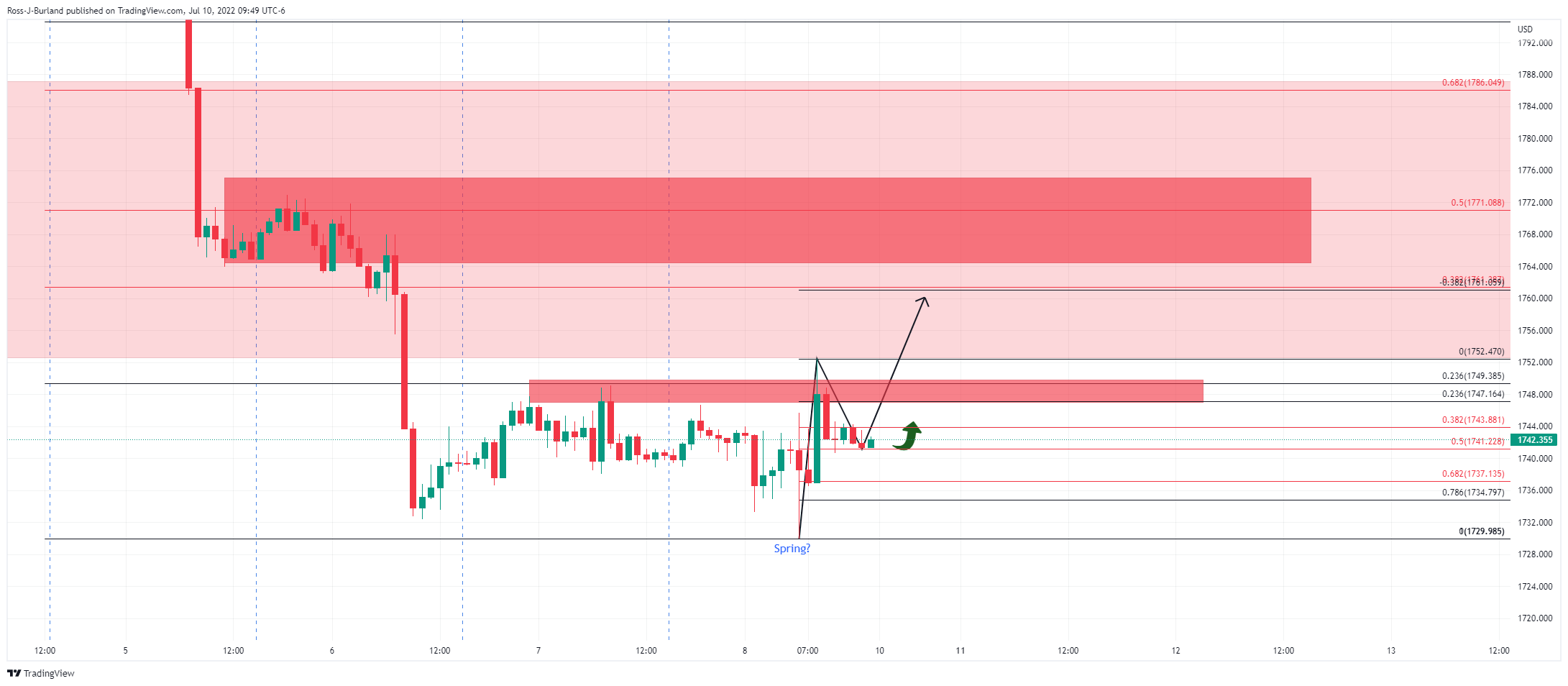
The spring was identified at around $1,730. However, the market is moving in on this level, so while it still remains valid until it is breached, the price behaviour at the start of this week is putting the bullish thesis in jeopardy. With that all being said, the M-formation is a bullish reversion pattern that could be the bulls get of jail free card:
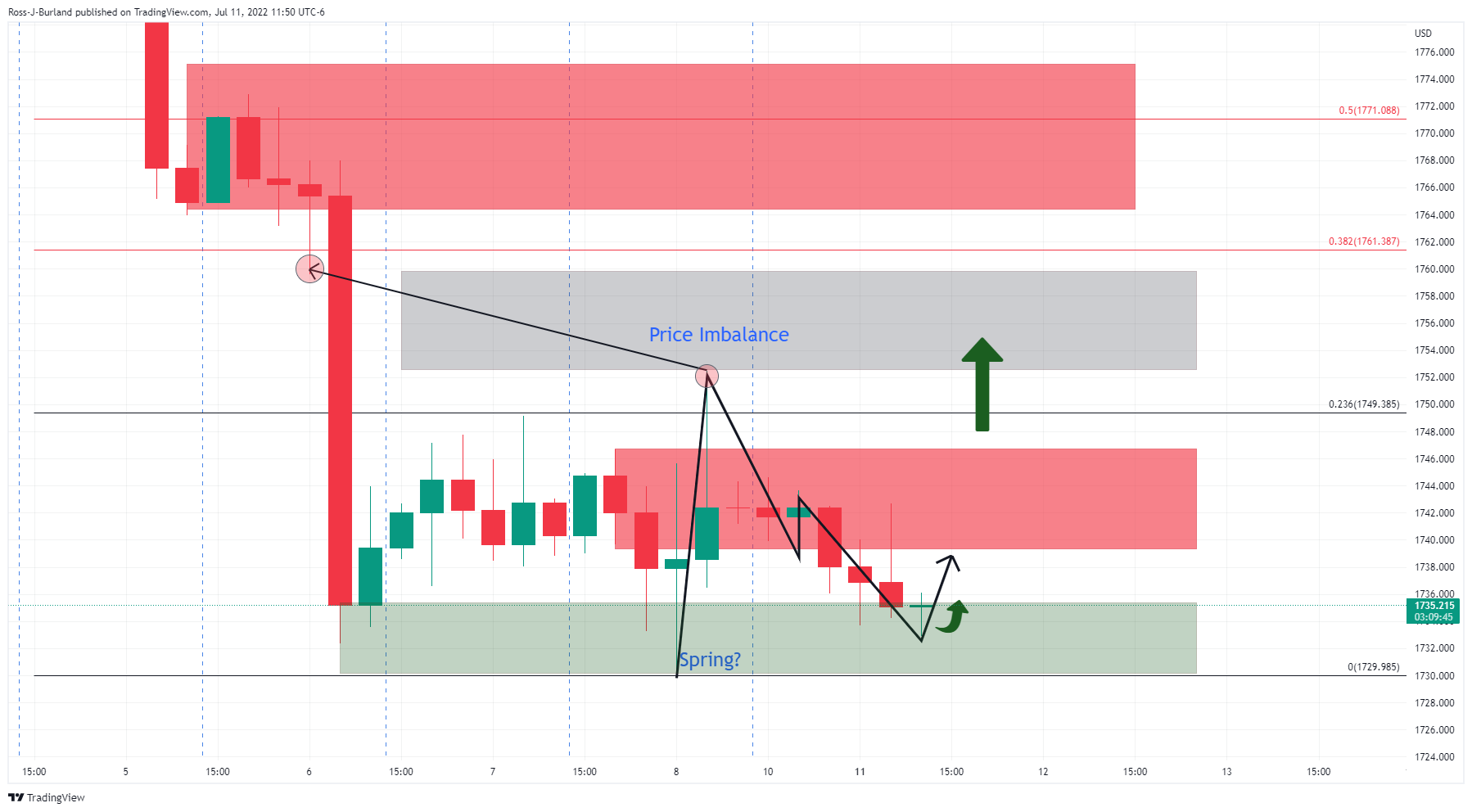
The spring will still be intact if the bulls continue to correct into the neckline of the M-formation near $1,740. A move beyond there will open the risk of a run on the highs of Friday through $1,750. This will then expose the vulnerability of the price imbalance between there and $1,759.60. On the downside, a break of the lows opens the risk of another significant sell-off towards the monthly lows of $1,676.
- The white metal remains downward biased but appears to have found a base around $19.00.
- Safe-haven flows toward the greenback, and US Treasuries keep the precious metals complex under pressure.
- The US 2s-10s yield curve is still inverted, flagging recession fears.
Silver (XAGUSD) is subdued during the North American session, seesawing for the fourth consecutive day in a narrow $19.13-37 area. The white metal remains downward biased, pressured by a buoyant greenback, higher US Treasury yields, and risk aversion on investors’ uncertainty about the economic outlook.
The XAGUSD is trading at $19.19, near the daily pivot point around $19.26, down 0.61%, while the US Dollar Index, a measure of the greenback’s value against a basket of peers, sits at 107.949, up 0.98%. US Treasury yields are down, led by the 10-year benchmark note rate at 2.991%, dropping ten bps, while the US 2s-10s yield curve stays inverted for the fifth consecutive day, at -0.052%.
A risk-off impulse and US dollar flows drag precious metals down
Risk aversion dominates Monday’s session as global equities drop. China’s covid resurgence, the release of US inflation figures, and recession fears keep the king dollar intact. Shanghai reported a new coronavirus variant, while Macau shut off its business and casinos at least for one week.
In the meantime, the US economic calendar featured Fed speakers. The Kansas City Fed President Esther George said, “moving interest rates too fast raises the prospect of oversteering.”. George, a dissenter in the last meeting, who opposed a 75 bps, said that she agreed about hiking rates faster to dampen inflation, though expressed concerns that it could harm the economy.
Later the St. Lous Fed President James Bullard reiterated that the US economy is solid and can handle higher rates while backing a 75 bps rate hike for the July meeting.
What to watch
The week ahead, the US economic docket will feature the US Consumer Price Index, Retail Sales, PPI, and the University of Michigan Consumer Sentiment.
Silver (XAGUSD) Key Technical Levels
Emerging market currencies are under pressure on Monday; the USD/BRL is up by 1.85% at 5.35. Since June, the pair has been rising constantly. Analysts at Rabobank see the USD/BRL ending the year around 5.25.
Key Quotes:
“After the Fed released the latest FOMC meeting’s minutes, two Fed hawks said they would slow pace after July’s meeting decision while June’s payrolls surprise to the upside again. Domestically, June’s CPI inflation starts to show the temporary fuel-taxes cut impact of the recently approved PLP18 bill, but the key vote on the social benefits bill was postponed to next week. Over the week, the DXY dollar index appreciated 1.8%, the USDBRL ended up appreciating 1.5% (although it closed the week at 5.2559, the same level of 30 June), the Ibovespa rose 1.4%, while the local inverted yield curve steepened.”
“We still see a 50-bp hike at the August meeting, then likely staying put until yearend. Even though we expect a longer Selic hiking cycle than at the beginning of 2022, we believe the Fed’s recent display of hawkishness and the intensification of the traditional electoral cycle will end up weighing on the BRL and other local assets going forward. By year-end we expect the BRL to trade at 5.25.”
The EUR/USD hit new cycle lows on Monday at 1.0050 as it continues to approach parity. The next half of 2022 is unlikely to foster conditions for euro appreciation as the European economy could be in a technical recession, explained analysts at National Bank of Canada. They expect the euro to remain low in the near term and will require improvements for energy prices and supply to catch a bid.
Key Quotes:
“The first half of 2022 can only be described as eventful for the Eurozone. The common currency area has faced spiking energy prices, a war on its borders and surging inflation. The aforementioned factors have given no traction to the euro, the latter having slipped from 1.14 at the end of 2021 to nearly parity (1.01) as of this writing.”
“The next half of 2022 is unlikely to foster conditions for euro appreciation as the European economy could be in a technical recession. Some of the recent euro weakness can be retraced to the ECB emergency meeting on the 15th of June. The spread between an Italian and German 10y bond had reached 240 basis points, prompting serious discussions. The central bank promised an anti-fragmentation tool to help alleviate supposedly unjustified interest-rate spreads.”
“Altogether, the picture for the European economy is far from rosy and it may already be in the throes of a technical recession. As such, we expect euro to remain low in the near term and will require improvements for energy prices and supply in order to catch a bid.”
While testifying before the UK Treasury Select Committee on Monday, Bank of England (BOE) Governor Andrew Bailey argued that they should not pre-commit to the next policy move and said they have a range of options for the August meeting.
Key takeaways via Reuters
"UK is facing a very big real income shock."
"We need to assess how much real income shock will bring down inflation itself."
"We expect inflation to be back to target in around two years, other things being equal."
Market reaction
These comments failed to help the British pound find demand and the GBP/USD pair was last seen losing 1.1% on a daily basis at 1.1895.
- The Mexican peso resumes the decline versus the dollar.
- USD/MXN likely to rise further while above 20.70.
- USD/COP and USD/CLP hit record highs.
After a two-day correction, the USD/MXN resumed the upside and jumped to 20.78, matching the July high. A stronger US dollar across the board boosted the pair on Monday as risk aversion prevails.
In Wall Street, the Dow Jones is falling by 0.38% and the Nasdaq slides by 2.01%. US yields are sharply lower as the demand for Treasuries strengthens as investors look for safety.
Emerging markets under pressure
Stocks are also falling in Emerging Markets. Mexico’s IPC drops 0.51%, Brazil’s Bovespa tumbles 1.70%. Among currencies, the Chilean peso and the Colombian peso hit a new record low. USD/CLP traded above 1,000 and the USD/COP above 4,500 for the first time. The USD/BRL (Brazilian real) is up 1.78% at 5.34.
The negative global growth outlook and higher interest rates contribute to keep driving the dollar higher versus EM currencies, including the Mexican peso.
The USD/MXN is testing the July high and as long as it remains above 20.70 more gains seem likely. The next resistance is located at 20.90, the last defence to 21.00. On the flip side, a decline back below 20.45 would alleviate the bullish pressure.
Technical levels
- US Dollar rises across the board on risk aversion.
- DXY hits the highest level since October 2002.
- NZD/USD unable to regain 0.6200 and breaks the 0.6130 support.
The NZD/USD is falling on Monday and it printed a fresh two-year low at 0.6096, before trimming losses to 0.6130. The pair is under pressure amid risk aversion that continues to boost the US dollar.
The greenback, measured by the DXY, hit a fresh 19-year high above 108.00. The move took place even as US yields tumble. The US 10-year stands at 2.98%, down more than 3% while the 30-year is at 3.16%. In Wall Street, the Dow Jones falls by 0.32% and the Nasdaq by 1.85%.
Concerns about the economic outlook continue to weigh on market sentiment. New COVID-19 restrictions in China added to fears about global growth.
Regarding economic data, the focus is set on the June US CPI due on Wednesday. Earlier that day, the Reserve Bank of New Zealand will announce its decision on monetary policy. A 50 basis points rate hike to tame inflation is expected.
Breaking support
The NZD/USD dropped below the 0.6130 strong support area. If the pair consolidates below, more losses seem likely. A recovery back above could alleviate the pressure, favoring a return to the 0.6200/0.6130 range.
Technical levels
- On Monday, the AUD/USD nosedives mainly on risk-aversion spurred by China’s Covid-19 resurgence.
- US economic data and Fed speakers to remain in the driver’s seat throughout the week; US inflation and consumer sentiment watched.
- AUD/USD Price Analysis: Tilted to the downside, and a break below 0.6700, would expose May 2020 swing lows in the 0.6400-0.6600 area.
The AUD/USD is plunging in the North American session, in which the major reached a daily high of around 0.6854, diving to fresh two-year lows under 0.6730s, amidst China’s coronavirus reemergence, recession fears, and risk aversion.
The AUD/USD is trading at 0.6744, down almost 1.80%, slightly up from the daily lows at 0.6714, in the mid-0.6730-40s. in the meantime, the US Dollar Index, a gauge of the buck’s value vs. six currencies remains trading at 20-year highs around
AUD/USD tanks on safe-haven plays, falling commodity prices
The sentiment is downbeat as global equities fall. The AUD/USD stays on the defensive, adrift to investors’ mood, amidst the lack of economic data. In the week, the US economic calendar will be busy reporting that US inflation – consumer and producer based – is expected to rise. After that, US Retail Sales are expected to be higher, while the University of Michigan Consumer Sentiment could be in the spotlight after June’s figures triggered a market shift and weighed on the Federal Reserve rate hike decision. Meanwhile, money market futures odds of a Fed's 75 bps rate hikes are fully priced in at a 99% chance.
In the case of Australia, the Aussie remains heavy also on lower commodity prices. The Iron Ore price is down 1.22%, at 113.74 a ton, contrarily to the Bloomberg Commodity Index, up by a decent 0.22%. With the Reserve Bank of Australia (RBA) decision in the rearview mirror, the Australian economic docket will feature June’s Business and Consumer Confidence, alongside employment data.
Newswires reported that Kansas City Esther George crossed wires. She said that the speed of rates should be questioned, adding that raising rates too fast risks “oversteering.”
AUD/USD Price Analysis: Technical outlook
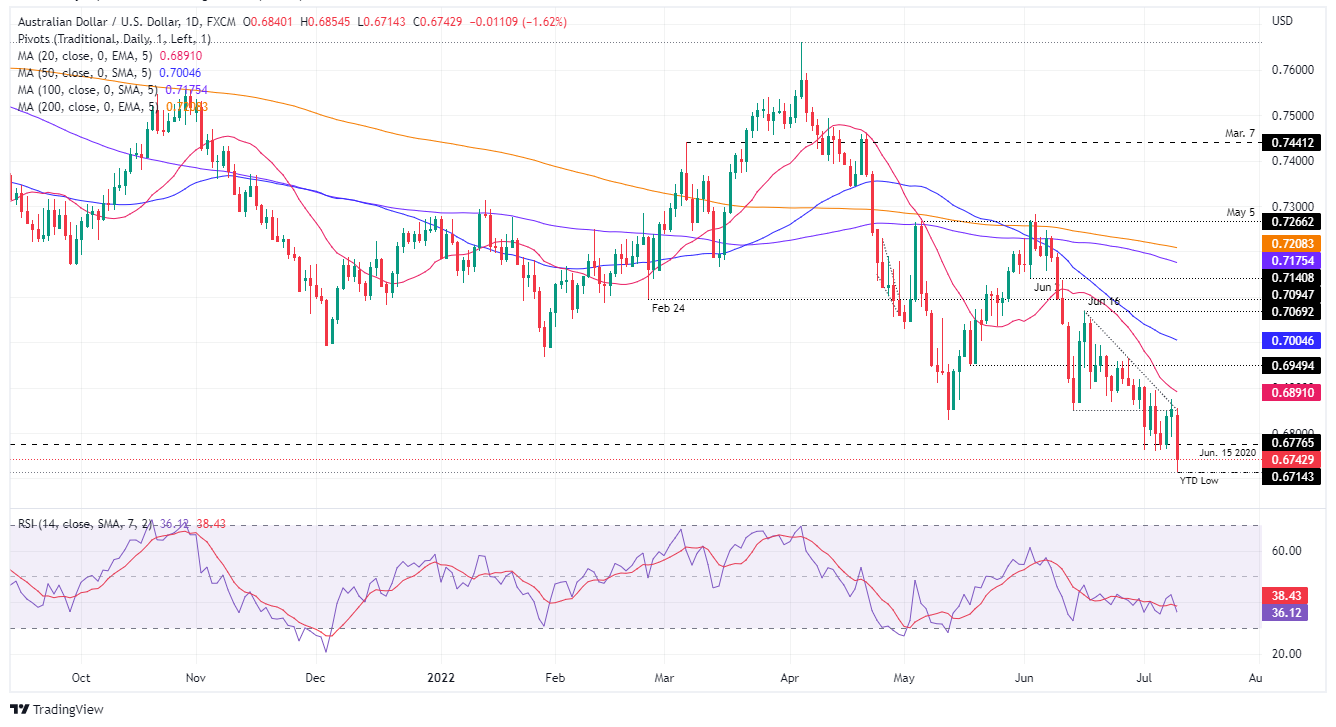
The AUD/USD daily chart depicts the pair as downward biased. Confirmation of the previously mentioned is the exchange rate below 0.7000, the daily moving averages (DMAs) above the spot price, and the Relative Strength Index (RSI) in bearish territory, crossing below the RSI’s 7-day SMA, a sell signal.
That said, the AUD/USD first support would be May 27, 2020, high at 0.6680. Break below will expose May 22, 2020, low at 0.6505, followed by May 15, 2020, daily low at 0.6402.
The Federal Reserve Bank of New York's monthly Survey of Consumer Expectations showed on Monday that the US Consumers' one-year inflation expectations rose to 6.8% in June from 6.6% in May. The three-year inflation expectations, however, declined to 3.6% from 3.9%.
Key takeaways as summarized by Reuters
"Consumers see home prices up 4.4% in the next year, down from 5.8% in May."
"Consumers' year-ahead earnings growth expectations were unchanged in June at 3%."
"Consumers' median 1-year household income growth expectation rises to 3.2% in June from 3.0% in May."
"Consumers on average see 40.4% probability of higher unemployment rate in a year, highest since April 2020."
"Consumers' median 1-year household spending growth expectation declines to 8.4% in June from 9.0% in May."
"A rising share of consumers say credit has been harder to get in the last year and will be in the year ahead."
"More than half of US consumers say their household financial situation deteriorated from a year ago and nearly half expect it to worsen in the year ahead, both up from May."
Market reaction
The US Dollar Index edged slightly lower from the multi-decade high it set above 108.00 earlier in the day and was last seen rising 0.9% on the day at 107.85.
Kansas City Fed President Esther George, who voted against the 75 basis points rate hike in June, argued on Monday that the pace of rate increases needs to be carefully balanced against the state of the economy, as reported by Reuters.
Key takeaways
"Speed at which interest rates should rise an open question, moving too fast risks oversteering."
Communicating the path for rates is far more consequential than the speed of policy change."
"Recession projections suggest to me that rapid rate hikes risk tightening faster than the economy and markets can adjust."
"Abrupt changes in rates could create strains in economy."
"Remarkable that there is growing discussion of recession risk just four months after Fed began raising rates."
"Transmission of policy to economy will be lagged and subject to considerable uncertainty, unclear how high rates will need to rise."
"Steady path of rate increases could improve market functioning and assist balance sheet runoff."
"GDP still 2.5% below pre-pandemic trend suggests pandemic did long-lasting damage to supply side, particularly service sector."
"Nature of inflation suggests tight economy rather than specific supply disruptions are driving prices."
"Raising short term rates faster than long-term rates adjust could invert yield curve, stress banks."
Market reaction
These comments don't seem to be having an impact on the greenback's valuation. As of writing, the US Dollar Index was up 1.05% on the day at 108.02.
- Gold Price witnessed some selling on Monday amid relentless USD buying interest.
- Bets for more aggressive rate hikes by the Fed pushed the USD to a fresh 20-year high.
- Recession fears weighed on investors’ sentiment and helped limit losses for the XAUUSD.
Gold Price edged lower through the early North American session and dropped to the $1,734 area in the last hour, back closer to its lowest level since September 2021 touched on Friday. The downtick was exclusively sponsored by the emergence of aggressive US dollar buying, which tends to undermine the dollar-denominated commodity.
In fact, the USD Index surged to a new 20-year high and continued drawing support from expectations that the Fed would retain its faster policy tightening path to curb soaring inflation. The bets were reaffirmed by last week's FOMC meeting minutes, which emphasized the need to fight inflation even if it results in an economic slowdown. Policymakers indicated that another 50 or 75 bps rate hike is likely at the upcoming FOMC meeting in July. Hence, the market focus now shifts to the latest US consumer inflation figures, due for release on Wednesday.
In the meantime, the prospects for rapidly rising interest rates and tightening financial conditions continued to fuel worries about the global growth outlook. This, in turn, tempered investors' appetite for perceived riskier assets, which was evident from a generally weaker tone around the equity markets and offered some support to the safe-haven gold. The flight to safety triggered a fresh leg down in the US Treasury bond yields and was seen as another factor that helped limit deeper losses for the non-yielding yellow metal, at least for the time being.
The mixed fundamental backdrop warrants some caution for bearish traders and before positioning for any further near-term depreciating move. Even from a technical perspective, the recent range-bound price action witnessed over the past three trading sessions points to indecision among traders over the next leg of a directional move. Hence, sustained weakness below the $1,733 region is needed to confirm a fresh breakdown, which would make gold price vulnerable to testing the $1,700 mark in the near term.
Technical levels to watch
- USD/JPY caught aggressive bids on Monday and rallied to a fresh 24-year high.
- The Fed-BoJ policy divergence weighed on the JPY and remained supportive.
- Technical buying above the 137.00 mark contributed to the strong move up.
The USD/JPY pair added to its strong intraday gains and rallied further beyond the mid-137.00s, to a fresh 24-year high during the early North American session. The pair was last seen trading around the 137.65 region, up over 1.15% for the day.
A strong showing by Japan’s ruling coalition in Sunday’s upper house election reinforced bets that the Bank of Japan would stick to its ultra-loose monetary policy stance. Adding to this, BoJ Governor Haruhiko Kuroda said on Monday that the central bank won’t hesitate to take additional monetary easing steps as necessary. This, in turn, weighed heavily on the Japanese yen, which, along with aggressive US dollar buying provided a goodish lift to the USD/JPY pair on the first day of a new week.
In fact, the USD Index surged to a fresh two-decade high amid growing acceptance that the Fed would retain a faster policy tightening path to curb soaring inflation. The June FOMC meeting minutes emphasized the need to fight inflation even if it results in an economic slowdown and indicated that another 50 or 75 bps rate hike is likely at the July meeting. Furthermore, Friday's upbeat US jobs report reaffirmed bets for more aggressive Fed rate hikes and continued underpinning the USD.
The USD/JPY pair's strong positive move on Monday could further be attributed to some technical buying on a sustained move beyond the previous YTD peak, around the 137.00 mark. The subsequent strength reaffirms a fresh bullish breakout and supports prospects for additional gains. That said, the prevalent risk-off environment could offer some support to the safe-haven JPY. This, along with extremely overbought conditions on hourly charts, could cap gains, at least for the time being.
Nevertheless, the divergent BoJ-Fed policy outlooks should continue to weigh on the JPY and supports prospects for a further appreciating move for the USD/JPY pair. The market focus now shifts to this week's release of the latest US consumer inflation figures, due on Wednesday. Apart from this, the US monthly Retail Sales data and Prelim Michigan Consumer Sentiment on Friday will influence the USD price dynamics. This, in turn, should provide a fresh impetus to the major.
Technical levels to watch
Gold Price sees a negative start to the week. The yellow metal sees more downside, in the view of strategists at TD Securities.
Cascading liquidations from various speculative groups
“We see evidence that the steepest outflows from broad commodity funds since the COVID-19 crisis may be catalyzing a series of cascading liquidations from various speculative groups. This is particularly concerning for gold prices given the extremely bloated length remaining in gold markets from proprietary traders.”
“The substantial size accumulated from proprietary traders during the pandemic appears complacent in the face of a steadfastly hawkish Fed. In a liquidation vacuum, these positions are now vulnerable, which suggests the yellow metal remains prone to further downside still.”
- EUR/USD tumbles further and clinches new YTD lows.
- Extra decline could test the parity zone soon-ish.
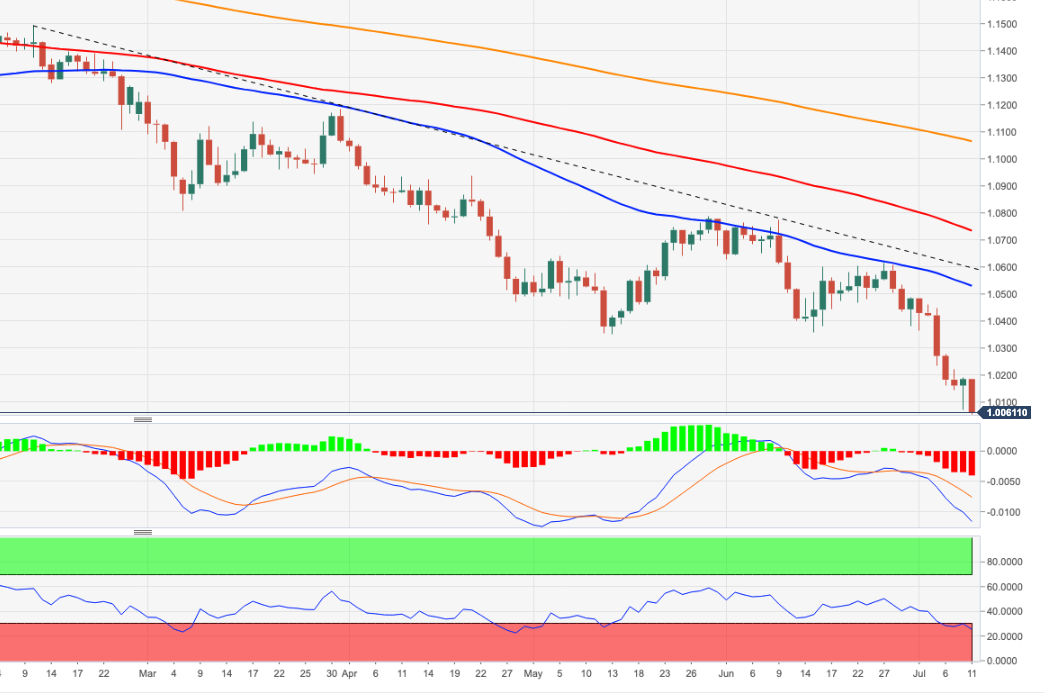
EUR/USD drops to new cycle lows around the 1.0050 region at the beginning of the week.
The pair’s bearish stance stays everything but abated for the time being. Against that, there are no support levels of note until the critical parity zone. Further south comes the December 2002 low at 0.9859.
As long as the pair navigates below the 5-month support line near 1.0580, further losses remain in store.
In the longer run, the pair’s bearish view is expected to prevail as long as it trades below the 200-day SMA at 1.1063.
EUR/USD daily chart
- GBP/USD witnessed a turnaround from the top end of a two-week-old descending channel.
- The USD climbed to a fresh two-decade high and was seen as a key factor exerting pressure.
- A sustained break below the YTD low would set the stage for a fall towards the 1.1800 mark.
The GBP/USD pair stalled last week's bounce from the 1.1875 region, or its lowest level since March 2020 and witnessed a turnaround from a two-week-old descending trend-channel resistance. The mentioned barrier, currently around the 1.2035-1.2040 region, nears the 50-period SMA on the 4-hour chart and should act as a pivotal point for short-term traders.
Against the backdrop of expectations for a more aggressive policy tightening by the Fed, the prevalent risk-off mood lifted the safe-haven US dollar to a fresh two-decade high. On the other hand, Brexit woes and speculations that the Bank of England would adopt a gradual approach toward raising interest rates continued weighing on the British pound. This, in turn, prompted fresh selling around the GBP/USD pair on the first day of a new week.
Market participants now look forward to BoE Governor Andrew Bailey's testimony before the Treasury Select Committee, which might influence sterling and provide some impetus to the GBP/USD pair. The market focus would then shift to the UK monthly GDP print and the latest US consumer inflation figures due for release on Wednesday.
In the meantime, some follow-through selling below the 1.1900 mark, leading to a subsequent break through the YTD low, around the 1.1875 region, would be seen as a fresh trigger for bearish traders. This, in turn, would set the stage for a slide towards the 1.1800 round-figure mark, or the lower end of the aforementioned channel.
On the flip side, the 1.1940-1.1950 region now seems to act as an immediate resistance ahead of the 1.200 psychological mark. Any further move up might continue to confront stiff resistance and remain capped near the ascending trend-channel barrier, which if cleared would suggest that the GBP/USD pair has formed a near-term bottom.
Some follow-through buying beyond the 50-period SMA on the 4-hour chart should allow the GBP/USD pair to aim back to reclaim the 1.2100 round figure. The momentum could further get extended and lift spot prices towards testing the next relevant resistance near the 1.2175-1.2185 supply zone en-route the 1.2200 mark.
GBP/USD 4-hour chart
-637931404636530662.png)
Key levels to watch
EUR/GBP has finally suffered an aggressive fall. In the view of analysts at Credit Suisse, a close below its 200-day moving average (DMA) at 0.8444 can reassert a broader sideways trend again.
Key support is seen at 0.8444/32 with resistance at 0.8516/40
“A close below the 200-DMA and late May reaction low at 0.8444/32 would be seen to reassert a broader sideways trend again with support seen next at the 61.8% retracement of the March/June rally and mid -May low at 0.8401/.8393.”
“Resistance is seen at 0.8479 initially, above which can ease the immediate downside bias for strength back to 0.8516/40 but with fresh sellers expected here.”
German Economy Minister Robert Habeck said on Monday it was difficult to say whether Nord Stream 1 gas pipeline would come back online after the maintenance, as reported by Reuters.
Additional takeaways
"Germany has become too dependent on Russia."
"Two floating terminals could be completed by the end of the year."
"Germany is aware gas needs to be distributed among others."
"We have to be prepared for various outcomes, including shipments not renewed after maintenance."
"We will help each other with gas supplies."
"People in Europe know that large savings in gas usage are possible."
"Winter will be critical and we need to prepare as well as possible."
Market reaction
EUR/USD pair showed no immediate reaction to these comments and was last seen losing 0.8% on a daily basis at 1.0100.
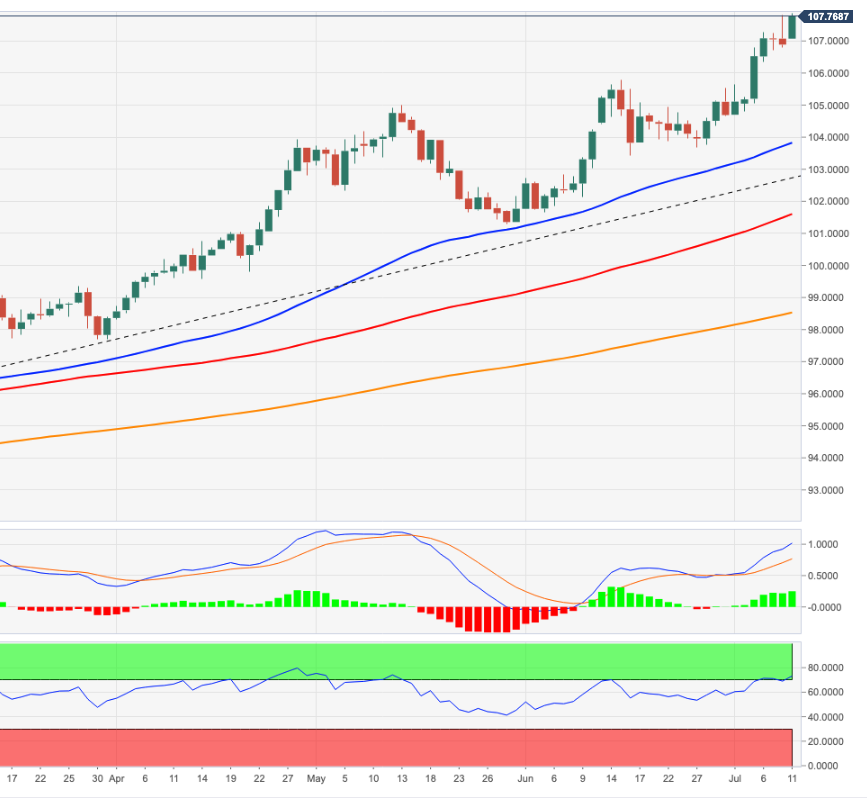
- DXY resumes the upside and advances to new cycle peaks.
- Next on the upside comes the round level at 108.00.
DXY fades the weakness seen in the last couple of sessions and prints new nearly 2-decade tops past 107.80 on Monday.
Further upside in the dollar remains in store in the short-term horizon. That said, the continuation of the uptrend initially targets the round level at 108.00 ahead of the October 2002 top at 108.74.
As long as the index trades above the 5-month line near 102.85, the near-term outlook for DXY should remain constructive.
In addition, the broader bullish view remains in place while above the 200-day SMA at 98.52.
Of note, however, is that the index trades in the overbought territory and it therefore could extend the corrective decline to, initially, the 105.80 region (high June 15).
DXY daily chart
USD/CAD has rejected the YTD high at 1.3078. Analysts at Credit Suisse look for a near-term consolidation below this level.
Drop below 1.2816/01 to signal a deeper move lower
“We stay biased for the market to remain capped below 1.3078/1.3123 to avoid a breakout higher and to see a near-term consolidation below this area, though a fall back below 1.2911 is needed reduce the immediate risk of a break higher.”
“Only a break below the recent low at 1.2816/01 would signal a mean-reversion back towards the bottom of the channel, with next support then seen at 1.2771/52 and then at 1.2680/71.”
“A sustained move above 1.3100/23 would make room for further upside to next resistance at 1.3172/77. Nonetheless, with the current volatile environment in mind, we would stay wary of a potential mean-reversion back upon reaching this level.”
GBP/USD closed the previous week above 1.20 but has reversed its course on Monday. The pair is expected to see a clear break below 1.1936, with Credit Suisse’s core technical objective at 1.15/1.14.
Next major support seen at 1.1500/1.1409
“With a top in place in trade-weighted terms and with short-term momentum reaccelerating, we look for a sustained break of the 1.1936 June low in due course. This should then clear the way for further weakness to next support at 1.1861/57 ahead of 1.1775 and eventually 1.1500/1.1409, the bottom of the six-year range and potential long-term trend support stretching back to 1985. Our bias remains to then look for a more important floor to be found here.”
“Near-term resistance is seen at 1.2003, then 1.2039/49, with the recent reaction high and 13-day exponential average at 1.2057/89 ideally capping on a closing basis.”
- A combination of factors assisted USD/CAD to regain strong positive traction on Monday.
- Sliding oil prices undermined the loonie and extended support amid resurgent USD demand.
- Bulls might wait for a sustained move beyond the 1.3080-85 area before placing fresh bets.
The USD/CAD pair caught aggressive bids on Monday and reversed a major part of its losses recorded over the past two trading sessions. The momentum lifted spot prices back above the 1.3000 psychological mark during the first half of the European session and was sponsored by a combination of factors.
Investors remain concerned that a possible global recession, along with the latest COVID-19 outbreak in China, would hurt fuel demand. This, in turn, exerted some downward pressure on crude oil prices, which undermined the commodity-linked loonie. Apart from this, the emergence of fresh US dollar buying provided a goodish lift to the USD/CAD pair.
From a technical perspective, the recent pullback from the 1.3080-1.3085 strong horizontal hurdle, or the YTD peal touched last week, stalled near the 100-period SMA on the 4-hour chart. The said support, currently around the 1.2940 region, should now act as a pivotal point for short-term traders ahead of this week's key event/data risks.
The latest US consumer inflation figures are due for release on Wednesday and will be followed by the Bank of Canada monetary policy decision. Apart from this, traders will take cues from the US monthly Retail Sales data and Prelim Michigan Consumer Sentiment on Friday, which would influence the USD and provide a fresh impetus to the USD/CAD pair.
In the meantime, any subsequent move up is likely to confront resistance near the 1.3065 region. Bulls, however, might wait for a sustained break through the 1.3080-1.3085 strong barrier before positioning for any further gains. Some follow-through buying beyond the 1.3100 round figure would mark a fresh bullish breakout and pave the way for additional gains.
The USD/CAD pair would then aim to surpass an intermediate barrier near the 1.3155-1.3160 region and reclaim the 1.3200 mark. The momentum could further get extended and eventually lift spot prices to the next relevant resistance near the 1.3270 zone.
On the flip side, the 1.2950-1.2945 region might continue to protect the immediate downside. A convincing break below could prompt some technical selling and drag the USD/CAD pair towards the 1.2900 mark. The latter should act as a strong base, which if broken would negate any near-term positive outlook and shift the bias in favour of bearish traders.
USD/CAD 4-hour chart
-637931379547294888.png)
Key levels to watch
EUR/USD has fallen sharply after its break below key price support from the YTD and 2017 lows at 1.0350/41. Analysts at Credit Suisse look for this to clear the way for a fall to parity/0.99, where another phase of consolidation is expected.
The 1.0341/66 price barrier ideally caps further strength
“We stay directly negative with support below 1.0073 seen next at 1.0060/50 ahead of parity/0.99, which we look to ideally be achieved within a 2-4 week time horizon. Thereafter, our bias would be for another consolidation/recovery phase to emerge, similar to the one we saw in May/June.”
“Immediate resistance is seen moving to 1.0185/92, above which can ease the immediate downside bias for a recovery back to resistance next at 1.027/77, with the 1.0341/66 price barrier ideally capping further strength.”
The S&P 500 recovery has extended towards the top of its downtrend channel from April at 3946/50. Analysts at Credit Suisse look for a fresh downturn from here.
Break above 3950 to improve the short-term technical outlook
“The spotlight now turns to the top of the trend channel from April and recent reaction high at 3946/50. Our bias remains for a fresh cap to be seen here and for fresh weakness to emerge over the next 2-4 weeks.”
“Support is seen at 3859 initially, with a break below gap support at 3838 needed to ease the immediate upside bias for weakness back to the short-term uptrend at 3785. Beneath 3742/39 though stays seen needed to open up a retest of the 3637 YTD low.”
“A break above 3950 would improve the short-term technical outlook with the next resistance seen at 3974 ahead of the top of the price gap from early in June at 4017/19. With the 63-day average seen not far above at 4059, we would look for a fresh cap here.”
USD/JPY is still struggling to clear the 137.21 high of September 1998. But as long as the pair trades above 135.35, it can keep the immediate risk higher, according to economists at Credit Suisse.
Support at 135.35 holding can still keep the immediate risk higher
“USD/JPY is still struggling to stage a clear break of the 137.21 high of September 1998. While support at 135.35 holds, the immediate risk is seen higher for now and with a multi-year ‘secular’ base completed earlier this year in April, we continue to look for an eventual sustained break higher. We would then see resistance next at 138.26, from which a fresh pause will be looked for.”
“Big picture, we look for a move to 139.00/10 next and eventually into the 147.62/153.01 zone.”
“Near-term support moves to 136.56, then 135.93. Below 135.35 can ease the immediate upside bias for a pullback to 134.79/79, potentially 134.27.”
- EUR/JPY navigates within an inconclusive range on Monday.
- The 139.85 region caps the upside for the time being.
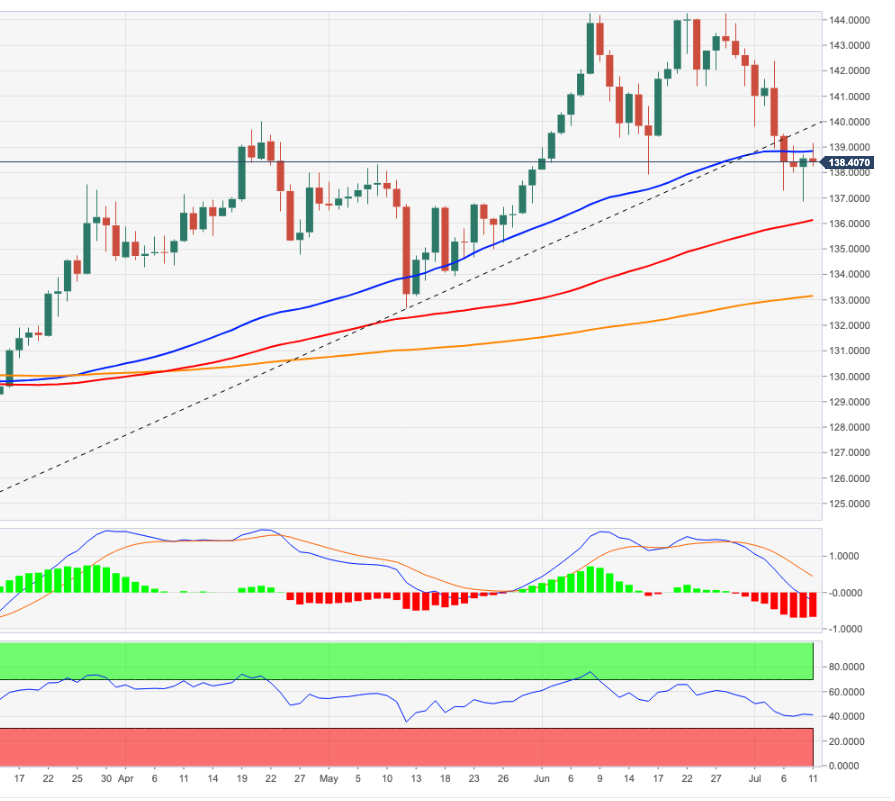
EUR/JPY alternates gains with losses in the mid-138.00s at the beginning of the trading week.
In the meantime, the cross remains under pressure amidst the ongoing rebound from July lows in the 136.80 region (July 8). As long as the cross keeps trading below the 4-month resistance line near 139.85, extra losses should remain in the pipelie.
That said, further downtrend could revisit the 100-day SMA at 136.09 prior to the minor support at 133.92 (low May 19).
In the longer run, the constructive stance in the cross remains well propped up by the 200-day SMA at 133.12.
EUR/JPY daily chart
- A combination of factors failed to assist GBP/JPY to capitalize on its modest intraday gains.
- Brexit woes, less hawkish BoE expectations continued acting as a headwind for sterling.
- The risk-off environment benefitted the safe-haven JPY and capped the upside for the cross.
The GBP/JPY cross attracted some selling in the vicinity of mid-164.00s on Monday and for now, seems to have stalled last week's goodish rebound from the very important 200-day SMA support. Spot prices surrendered a major part of the modest intraday gains and retreated to the 163.70-163.75 area during the first half of the European session.
A strong election showing by Japan's ruling conservative coalition suggests no change to the ultra-loose monetary policy stance adopted by the Bank of Japan. In fact, BoJ Governor Haruhiko Kuroda reiterated on Monday that the central bank remains ready to take additional monetary easing steps as necessary. This, in turn, was seen as a key factor that undermined the Japanese yen and provided a goodish lift to the GBP/JPY cross on the first day of a new week.
That said, the prevalent risk-off environment - as depicted by a generally weaker tone around the equity markets amid growing recession fears - helped limit losses for the safe-haven JPY. Apart from this, expectations that the Bank of England would adopt a gradual approach toward raising interest rates and Brexit woes acted as a headwind for the British pound. This, in turn, held back bulls from placing aggressive bets and capped the GBP/JPY cross.
Furthermore, investors remain concerned that the UK government's controversial Northern Ireland Protocol Bill could trigger a trade war with the European Union. This further suggests that the path of least resistance for the GBP/JPY cross is to the downside. That said, a repeated bounce from a technically significant 200-day SMA warrants caution for bearish traders amid a big divergence in the policy stance adopted by the BoJ and other major central banks.
Technical levels to watch
Japanese Finance Minister Shunichi Suzuki is scheduled to meet US Treasury Secretary Janet Yellen on Tuesday from 0445 GMT, the Ministry of Finance said in a statement on Monday.
The Ministry said that “the two ministers would likely discuss coordination against the yen weakening and sanctions against Russia for its invasion of Ukraine as part of a broader agenda.”
- USD/CHF gained traction for the eighth straight day and climbed to a fresh multi-week high.
- Hawkish Fed expectations continued lending support to the USD and provided a goodish lift.
- The risk-off environment underpinned the safe-haven CHF and capped gains for spot prices.
The USD/CHF pair prolonged its nearly two-week-old uptrend from sub-0.9500 levels and edged higher for the eighth successive day on Monday. The momentum lifted spot prices to a three-and-half-week high during the early part of the European session, with bulls still awaiting sustained strength beyond the 0.9800 mark.
The US dollar attracted fresh buying on the first day of a new week and inched back closer to a two-decade high touched on Friday amid hawkish Fed expectations. In fact, the markets seem convinced that the US central bank would retain its aggressive policy tightening path to combat stubbornly high inflation. The bets were reaffirmed by the FOMC minutes released last Wednesday, indicating that another 50 or 75 bps rate hike is likely at the July meeting.
Friday's upbeat US monthly jobs report (NFP), which showed that the economy added 372K jobs in June, reinforced faster Fed rate hikes and continued underpinning the greenback. This, in turn, was seen as a key factor that acted as a tailwind for the USD/CHF pair. That said, the prevalent risk-off environment offered some support to the safe-haven Swiss franc, which held back bulls from placing aggressive bets around the USD/CHF pair and capped the upside at least for now.
Investors remain concerned that rapidly rising interest rates and tightening financial conditions would pose challenges to global economic growth. Apart from this, the ongoing Russia-Ukraine war and the latest COVID-19 outbreak in China have been fueling recession fears. This makes it prudent to wait for sustained strength beyond the 0.9800 round-figure mark before traders start positioning for an extension of the USD/CHF pair's recent strong bullish trajectory.
The market focus now shifts to the release of the latest US consumer inflation figures, due on Wednesday. This week's US economic docket also features the release of monthly Retail Sales data and Prelim Michigan Consumer Sentiment on Friday. The data would influence the near-term USD price dynamics and provide a fresh impetus to the USD/CHF pair. In the meantime, traders might take cues from the broader market risk sentiment to grab short-term opportunities.
Technical levels to watch
Reuters reported on Monday that the key market gauge of long-term Eurozone inflation expectations fell below 2% for the first time since March.
Despite, record-high inflation rate in the old continent, with the annual figure at 8.6% in June, and no signs of peaking as yet, the inflation expectations have dipped back below 2%.
With increasing odds of a recession in the Eurozone amid a worsening gas crisis, there seems to be a little reprieve for the shared currency.
“Nord Stream I, the biggest single pipeline carrying Russian gas to Germany, starts annual maintenance on Monday. Flows are expected to stop for 10 days, but markets fear the shut-down might be extended due to war in Ukraine and could disrupt plans to fill storage for winter,” per Reuters.
Market reaction
At the press time, EUR/USD is losing 0.65% on the day, trading at 1.0114.
- Gold Price returns to the red amid unabated US dollar demand.
- “Sell everything” mode persists, as risk-aversion remains at full steam.
- XAUUSD sees more downside, with eyes on the $1,722 key support.
Gold Price sees a negative start to the week so far this Monday, as the US dollar regains traction towards fresh two-decade highs. Risk-off flows dominate, in the face of looming fresh lockdowns in Shanghai and recession fears, which boost the dollar’s safe-haven appeal. Tighter US labor market conditions lift the odds of a total of 150 bps Fed rate hike in July and September to roughly around 30% from about 15% before Friday’s NFP release. Investors reassess the risk of a recession, with “sell everything” mode back in vogue and the greenback emerging as the undisputed winner. The USD-priced gold, therefore, appears vulnerable to more pain ahead amid a data-light start to the US inflaton week.
Also read: Gold Price Forecast: XAUUSD consolidates near YTD low, seems vulnerable to slide further
Gold Price: Key levels to watch
The Technical Confluence Detector shows that Gold Price is gathering strength to yield a fresh downside leg, with the previous day’s low of $1,730 in sight.
A breach of the latter will expose the Bollinger Band four-hour Lower at $1,728. The line in the sand for XAU bulls appears at $1,722, which is the pivot point one-day S2.
Alternatively, acceptance above the powerful hurdle of $1,742 is needed to initiate any meaningful recovery. That level is the confluence of the SMA10 four-hour, Fibonacci 61.8% one-day and the Bollinger Band one-day Lower.
The next stop for bulls is seen at the Fibonacci 38.2% one-day at $1,744. The Fibonacci 23.6% one-week at $1,750 will guard the further upside, a failure of which will challenge the convergence of the pivot point one-month S2 and pivot point one-day 1 at $1,753.
Here is how it looks on the tool
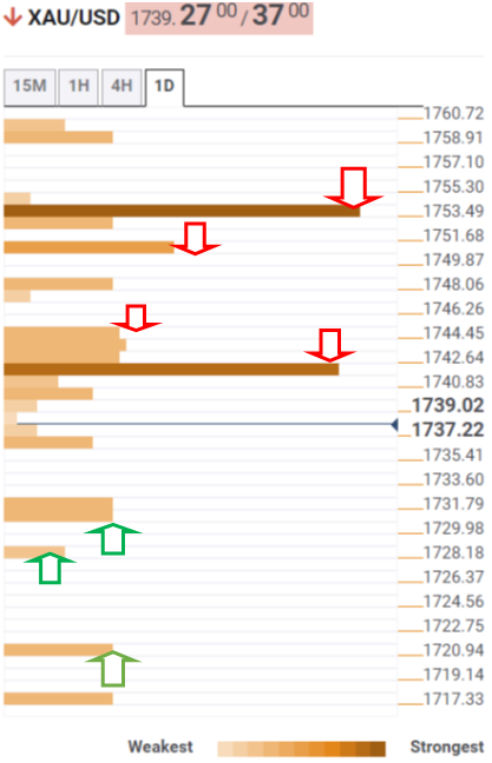
About Technical Confluences Detector
The TCD (Technical Confluences Detector) is a tool to locate and point out those price levels where there is a congestion of indicators, moving averages, Fibonacci levels, Pivot Points, etc. If you are a short-term trader, you will find entry points for counter-trend strategies and hunt a few points at a time. If you are a medium-to-long-term trader, this tool will allow you to know in advance the price levels where a medium-to-long-term trend may stop and rest, where to unwind positions, or where to increase your position size.
- NZD/USD struggled to capitalize on last week’s modest recovery from over a two-year low.
- A three-week-old descending trend-channel hurdle capped the upside amid a stronger USD.
- The downside seems cushioned ahead of the RBNZ and the US CPI report on Wednesday.
The NZD/USD pair faced rejection near the top end of a three-week-old descending channel and for now, seems to have stalled its modest bounce from over a two-year low touched last week.
Expectations for more aggressive rate hikes by the Fed assisted the US dollar to regain strong positive traction on the first day of a new week. Apart from this, the prevalent risk-off environment – amid recession fears - lifted the safe-haven buck back closer to a two-decade high and acted as a headwind for the risk-sensitive kiwi.
The downside, however, remains cushioned, at least for the time being, as traders seemed reluctant to place aggressive bets ahead of this week's key event/data risk. The Reserve Bank of New Zealand will announce its decision on Wednesday, which will be followed by the latest US consumer inflation figures.
From a technical perspective, a convincing break through the descending channel resistance will suggest that the NZD/USD pair has formed a near-term bottom and pave the way for additional gains. The next relevant hurdle is pegged near the 0.6245-0.6250 region, or the 100-period SMA on the 4-hour chart.
Some follow-through buying will reaffirm a near-term bullish breakout and allow bulls to aim back to reclaim the 0.6300 round-figure mark. The momentum could further get extended and push the NZD/USD pair further towards the 0.6325 supply zone.
On the flip side, the 0.6135-0.6130 region, or the YTD low, might continue to protect the immediate downside ahead of the 0.6100 round-figure mark. This is followed by the descending channel support, currently around the 0.6075 region, which if broken would be seen as a fresh trigger for bearish traders and set the stage for further losses.
NZD/USD 4-hour chart
-637931268088559569.png)
Key levels to watch
A number of candidates have thrown their hats into the ring as the process to elect the new Conservative Party leader (and future Prime Minister) kicks off. However, the pound is set to shrug off politics as recession fears and potential BoE’s dovish repricing looks more relevant, economists at ING report.
EUR/GBP may remain in a 0.8450-0.8500 range for now
“We expect sterling to be only modestly influenced by the Tory leadership contest, and downside risks stemming from the challenging external environment, a grim domestic outlook and a potential dovish repricing of the Bank of England’s rate expectations look set to remain much more relevant.”
“Since EUR remains in a fragile state too, EUR/GBP may remain in a 0.8450-0.8500 range for now, while GBP/USD could extend losses to the 1.1700-1.1800 area on the back of dollar strength.”
The dollar appears to have started the week on a strong footing, again. In the opinion of economists at ING, more strength is possible.
Global risk aversion and recession fears to remain in place in the near term
“We don’t expect the Federal Reserve narrative to turn much less supportive for the dollar over the summer. The other major drivers of dollar strength; global risk aversion and recession fears, also look likely to remain in place in the near term.”
“We think the overall message for markets is that further aggressive tightening from the Fed remains warranted, which should consolidate a supportive underlying narrative for the dollar.”
“DXY may easily find its way above 108.00 this week.”
Will this be the week when EUR/USD hits parity? The chances are quite high, in the view of economists at ING.
Parity inches closer
“We struggle to see EUR/USD rapidly inverting its recent bearish trend this week. Most key drivers of the pair’s recent weakness (risk sentiment, Fed-ECB divergence, to name two) don’t look highly likely to improve just yet, and the lingering concerns about a reduction in Russian gas flows to the EU should continue to keep the euro rather unattractive.”
“There has been much discussion about EUR/USD hitting parity and given the lingering downside risks highlighted above, the chances of this happening as early as this week are quite high.”
- Silver was seen consolidating its recent slide to a two-year low and remained confined in a range.
- The set-up favours bearish traders, though oversold RSI on the daily chat warrants some caution.
- Sustained weakness below the $19.00-$18.90 region is needed to confirm a fresh bearish break.
Silver continued with its struggle to register any meaningful recovery from a two-year low and has been oscillating in a narrow band over the past four sessions. The range-bound price action constitutes the formation of a rectangle on short-term charts and points to indecision among traders over the near-term direction.
Given last week's convincing break below descending trend-channel support, the indecisive move might still be categorized as a bearish consolidation phase before the next leg down. That said, the oversold RSI (14) on the daily chart held back bearish traders from placing fresh bets and positioning for any further losses.
Hence, some follow-through selling below the $19.00-$18.90 region, or the YTD low touched last week, is needed to confirm a fresh bearish breakdown. The XAG/USD would then turn vulnerable to accelerate the downward trajectory towards testing the $18.00 round figure en-route the next relevant support near the $17.65 zone.
On the flip side, the top boundary of a near one-week-old trading range, around the $19.50-$19.55 area, might continue to act as an immediate hurdle. Any subsequent move up is more likely to meet with a fresh supply and run out of steam near the descending channel support breakpoint, now turned resistance near the $19.75-$19.80 zone.
This is closely followed by the $20.00 psychological mark, which if cleared decisively might trigger a short-covering move. The XAG/USD might then surpass an intermediate barrier near the $20.60-$20.65 region, which coincides with 100-period SMA on the 4-hour chart, and aim to reclaim the $21.00 round-figure mark.
The latter marks the top boundary of the aforementioned descending channel and also nears the 200-period SMA on the 4-hour chart. Sustained strength beyond would suggest that the XAG/USD has formed a strong base near the $19.00 mark and pave the way for a further near-term appreciating move.
Silver 4-hour chart
-637931243339708054.png)
Key levels to watch
- EUR/USD comes under renewed downside pressure.
- The dollar starts the week on a positive foot above 107.00.
- Italian Retail Sales will be in the limelight later in the session.
The European currency comes under renewed and quite strong downside pressure and drags EUR/USD back to the vicinity of the 1.0100 region on Monday.
EUR/USD weaker on USD recovery
EUR/USD starts the week on the defensive and enters its third consecutive week with losses against the backdrop of the resumption of the strong upside momentum in the US dollar.
Indeed, further gains in the greenback come pari passu with expectations of the continuation of the Fed’s hiking cycle following another strong print from US Nonfarm Payrolls in June (+372K jobs). These results, at the same time, appear to have alleviated the effervescence around a potential “hard landing” of the US economy.
In the German money market, the 10y Bund yields grind a tad lower on Monday, in line with the performance of the US bond market.
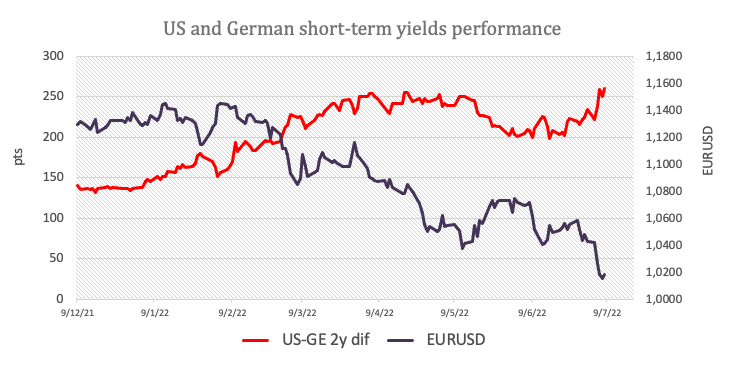
In the docket, the only release of note in the old continent will be the Italian Retail Sales for the month of May. Across the pond, a couple of short-term Bill Auctions are due along with the speech by NY Fed J.Williams.
What to look for around EUR
Bears maintain the EUR/USD under heavy pressure and the acceleration of the downside opens the door to a probable visit to the parity level sooner rather than later.
In the meantime, the price action around the single currency continues to follow increasing speculation of a probable recession in the euro area, dollar dynamics, geopolitical concerns, fragmentation worries and the Fed-ECB divergence.
Key events in the euro area this week: Germany, EMU ZEW Economic Sentiment (Tuesday) – Germany Final Inflation Rate, EMU Industrial Production (Wednesday) – EMU Balance of Trade (Friday).
Eminent issues on the back boiler: Fragmentation risks. Kickstart of the ECB hiking cycle in July? Asymmetric economic recovery post-pandemic in the euro bloc. Impact of the war in Ukraine on the region’s growth prospects and inflation.
EUR/USD levels to watch
So far, spot is down 0.76% at 1.0108 and faces the next contention at 1.0071 (2022 low July 8) seconded by 1.0060 (low December 11 2002) and finally 1.0000 (psychological level). On the upside, a breakout of 1.0528 (55-day SMA) would target 1.0615 (weekly high June 27) en route to 1.0773 (monthly high June 9).
- GBP/USD met with a fresh supply on Monday amid broad-based USD strength.
- Aggressive Fed rate hike bets pushed the USD back closer to a two-decade high.
- Domestic issues continued weighing on the GBP and added to the selling bias.
The GBP/USD pair struggled to capitalize on last week's modest recovery move from its lowest level since March 2020 and attracted fresh selling around the 1.2035 region on Monday. The pair extended its steady intraday descent through the early European session and dropped to a fresh daily low, around the 1.1960-1.1955 region in the last hour.
The US dollar regained strong positive traction on the first day of a new week and inched back closer to a two-decade high touched on Friday amid hawkish Fed expectations. On the other hand, the recent political turmoil in the UK and Brexit woes continued undermining the British pound. This, in turn, exerted some downward pressure on the GBP/USD pair.
The markets seem convinced that the US central bank would retain its aggressive policy tightening path to curb stubbornly high inflation. In fact, the FOMC minutes released last Wednesday indicated that another 50 or 75 bps rate hike is likely at the July meeting. Adding to this, the upbeat US monthly employment figures reaffirmed bets for faster Fed rate hikes.
In contrast, the Bank of England is expected to adopt a gradual approach toward raising interest rates amid growing recession fears. Investors also remain concerned that the UK government's controversial Northern Ireland Protocol Bill could trigger a trade war with the European Union. This should continue to act as a headwind for sterling and favours the GBP/USD bears.
Hence, a subsequent slide towards the 1.1900 round-figure mark, en-route the YTD low around the 1.1875 region touched last week, remains a distinct possibility. In the absence of any major market-moving economic releases, either from the UK or the US, the USD price dynamics will play a key role in influencing the GBP/USD pair and produce short-term trading opportunities.
The market focus, however, would remain on the release of the latest US consumer inflation figures, due on Wednesday. This week's US economic docket also features the release of monthly Retail Sales data and Prelim Michigan Consumer Sentiment on Friday. The data will drive the USD demand and provide a fresh directional impetus to the GBP/USD pair.
Technical levels to watch
The US dollar has resumed its surge, with the DXY Index hitting its highest level since 2002. However, the US dollar’s surge looks unlikely to endure, in the view of economists at UBS.
Commodity currencies to benefit as commodity prices rebound from the recent dip
“In the current atmosphere of risk aversion in markets, the US dollar rally is likely to continue in the near term. But in our view, this strength is unlikely to persist over the longer term.”
“Further US dollar upside is likely to be capped by slowing US economic growth and market perceptions that the Federal Reserve will start to cut rates again in 2023.”
“The Swiss franc now looks more attractive than the US dollar as a safe haven, especially given the willingness of the central bank to allow currency appreciation to curb inflation.”
“Commodity-linked currencies also look set to appreciate, notably the Canadian and Australian dollars, as the recent bout of commodity weakness reverses.”
Japan's Chief Cabinet Secretary Hirokazu Matsuno said in a statement on Monday, “we are working towards holding the first meeting for a panel on raising wages this week.”
His comments come after Japanese Prime Minster Fumio Kishida said earlier this morning that “We will take every possible step to deal with rising prices,” adding that will create atmosphere for private sector firms to raise wages more easily.”
Related reads
- USD/JPY consolidates around 137.00 mark, just below a fresh 24-year peak
- Japan ruling bloc wins upper house election
Gold fails to benefit from safe-haven flows amid gloomy demand outlook. Inflation data from the US will be watched closely by investors this week. A soft print could allow the yellow metal to stage a recovery, FXStreet’s Eren Sengezer report.
Difficult time finding a good enough reason to bet on a steady rebound
“On Wednesday, the BLS will release the Consumer Price Index (CPI) data for June. Markets expect annual CPI to edge higher to 8.7% from 8.6% in May. Core CPI, which excludes volatile food and energy prices, is forecast to decline to 5.9% from 6%. There is room for additional dollar strength in case inflation prints surpass analysts’ estimates. On the other hand, a soft inflation report should trigger a downward correction in the greenback and allow XAUUSD to stage a rebound.”
“Gold’s demand outlook is unlikely to improve in the near term and market participants are likely to refrain from committing to a risk rally.”
“In case inflation data from the US revive hopes of the Fed taking its foot off the gas pedal in the last quarter of the year, it wouldn’t be surprising to see XAUUSD reverse its direction but recovery attempts are likely to remain limited.”
- DXY leaves behind two consecutive daily pullbacks.
- US yields give away part of the recent gains on Monday.
- Fed’s Williams will speak later ahead of a 3m/6m Bills auctions.
The greenback, in terms of the US Dollar Index (DXY), leaves behind two daily drops and regains upside momentum past the 107.00 mark at the beginning of the week.
US Dollar Index looks stronger post-Payrolls
The index regains the area north of the 107.00 yardstick with conviction during the European morning on Monday, as market participants continue to digest the upbeat results from Friday’s Nonfarm Payrolls for the month of June (+372K jobs).
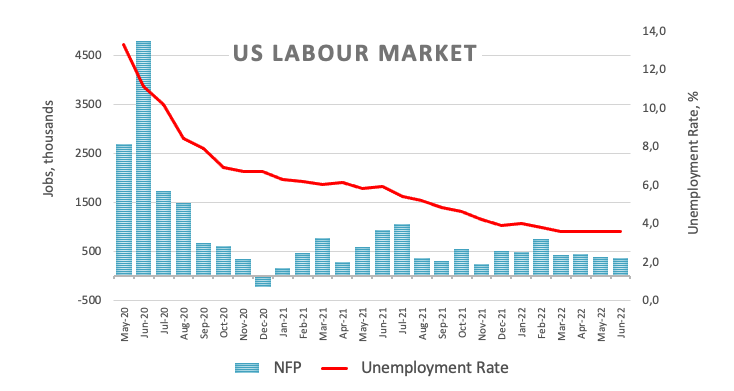
Indeed, the solid performance of the labour market during the previous month seems to have poured cold water over the likelihood of a US recession in the next months, giving the Fed green light to maintain its aggressive normalization process.
So far, and according to CME Group’s FedWatch Tool, the probability of a 75 bps rate hike at the July 27 meeting is now at 93%, from around 9% a month ago.
In the US docket, a 3-month and 6-month Bill Auctions are due later seconded by the speech by NY Fed J.Williams (permanent voter, centrist).
What to look for around USD
The index regains the initiative and fades the recent technical correction after climbing to nearly 2-decade highs around 107.80 during last week, all against the backdrop of further deterioration in the sentiment surrounding the risk complex in response to rising recession talks.
Further support for the dollar is expected to come from the Fed’s divergence vs. most of its G10 peers (especially the ECB) in combination with bouts of geopolitical effervescence and the re-emergence of the risk aversion among investors. On the flip side, market chatter of a potential US recession could temporarily undermine the uptrend trajectory of the dollar somewhat.
Key events in the US this week: MBA Mortgage Applications, Inflation Rate, Fed Beige Book (Wednesday) – Producer Prices, Initial Claims (Thursday) – Retail Sales, Industrial Production, Flash Consumer Sentiment, Business Inventories (Friday).
Eminent issues on the back boiler: Hard/soft/softish? landing of the US economy. Escalating geopolitical effervescence vs. Russia and China. Fed’s more aggressive rate path this year and 2023. US-China trade conflict. Future of Biden’s Build Back Better plan.
US Dollar Index relevant levels
Now, the index is up 0.62% at 107.56 and a break above 107.78 (2022 high July 6) would expose 108.00 (round level) and then 108.74 (monthly high October 2002). On the flip side, the next support aligns at 103.67 (weekly low June 27) seconded by 103.41 (weekly low June 16) and finally 101.29 (monthly low May 30).
The pound is trading above last week’s lows vs. the USD and it holding most of its recent gains vs. the beleaguered EUR. As there is still a long way to go before the new leadership can prove its worth to sceptical investors, the GBP is likely to have to wait until seeing a fresh start, economists at Rabobank report.
Awaiting a government less distracted by scandal and more focussed on the job in hand
“For GBP a crucial element of the policies of the new PM will be how they can underpin the growth outlook. However, this is a complex ask. Although many of the candidates are promising to lower taxation in the UK, in line with traditional Tory values, this could clearly raise inflation further if not handled properly.”
“Although GBP investors will be hoping for a government less distracted by scandal and more focussed on providing coherence around the post Brexit economy, the jury is still out. GBP may suffer a lack of fresh direction until the new PM is in place.”
The zloty exchange rate extended its underperformance late last week. This trend is set to last as long as inflation continues to be a worry, according to economists at Commerzbank.
Dovish remarks by NBP governor
“NBP governor Adam Glapinski sent overly dovish signals at his monthly press conference. Glapinski summarised that Poland is nearing peak interest rates and that the MPC might forgo further hikes if inflation were to show any sign of peaking in the summer.”
“Ultimately, NBP’s monetary stance will more likely follow whatever inflation trend materialises, not Glapinski’s fixed guidance.”
“The exchange rate will likely extend its underperformance for as long as inflation continues to be a worry.”
USD/JPY has climbed to a fresh year to date high of 137.28. USD/JPY may remain elevated over the near term, but it is prone to downside risks amid stretched valuation, in the view of economists at HSBC.
Downside beckons
“Our analysis result suggests that the JPY tends to be negatively correlated with the Organisation for Economic Co-operation and Development (OECD) area’s Composite Leading Indicators (CLI) – that is, it is an anti-cyclical currency – but the correlation coefficient is quite modest and less negative than that for the US Dollar Index (DXY). In other words, the USD tends to benefit more than the JPY when the global economy is slowing.”
“Another complication that while oil prices remain on the defensive, they remain high and problematic for a large energy importer like Japan.”
“While USD/JPY may remain at elevated levels over the near team, we think that USD/JPY is looking stretched from a valuation perspective and is prone to downside risk over the longer term.”
UK Conservative Leadership Candidate Jeremy Hunt said on Monday that he wants to cut all taxes. Hunt added that “I can tax cuts within our current fiscal rules.”
Meanwhile, various UK media outlets are reporting UK Finance Minister Nadhim Zahawi has plans to impose 20% cuts on every government department in order to pay for his planned tax cuts. Zahawi entered the race to succeed Boris Johnson as PM.
Over the weekend, Foreign Secretary Liz Truss joined the UK Conservative Party leadership race and declared her plans to start cutting taxes "from day one".
Another leadership contender, Tom Tugendhat, echoed Truss's calls to lower taxes, and said he would be "looking to lower taxes across every aspect of society".
The newly-appointed Foreign Office Minister Rehman Chishti also declared his candidacy on Sunday, according to BBC News.
Market reaction
GBP/USD remains on the defensive amidst looming UK political uncertainty and the timeline of the leadership hunt seemingly longer. At the time of writing, cable is trading at 1.1969, down 0.50% on the day.
The Fed's quick and aggressive hikes might not be the best for the US dollar. In contrast, a more cautious Federal Reserve could provide better arguments for further USD strength, according to economists at Commerzbank.
The Fed will be lowering its key rates again next year
“If the market does not expect a central bank to be able to stick with its restrictive monetary policy for long – as is currently the case in the US – its effect on longer-term interest rate and yield levels has reached its limits.
“As everybody believes that the Fed will be lowering its key rates again next year it makes no sense to hike them exorbitantly in the first place.”
“I think that means for the dollar: an even more aggressive Fed would not be USD-positive. In contrast, a more cautious Fed could provide better arguments for further USD strength.”
The EUR has declined by a further -2.1% against the USD over the past week as the pair moves closer to parity for the first time since November 2002. Economists at MUFG Bank expect EUR/USD to dip below parity in the coming days.
Germany recorded its first trade deficit in May since 1991
“It now appears only a matter of time before EUR/USD falls back below parity. The main driver for EUR weakness continues to be building concerns over greater disruption for European economies from tightening energy supplies.”
“According to reports in the FT, the worsening supply situation is already encouraging energy rationing.”
“The sharp deterioration in Germany’s trade balance has also attracted more market attention last week. It was reported that Germany recorded its first trade deficit in May since 1991. It has mainly been driven by the sharp rise in import (energy) prices.”
The eyes of all of Europe are on a pipeline. Economists at Commerzbank expect the EUR/USD to push lower if there is a ‘technical’ delay to the resumption of the gas supplies.
The pipeline thriller
“The threat of an energy crisis in Europe is the sword of Damocles hanging above the EUR exchange rates and is putting pressure on them. Prior to an end of the pipeline maintenance work (middle of next week) things will not improve. And any day longer than planned these take, might put additional pressure on the euro.”
“I don’t want to sound alarmist, but a ‘technical’ delay to the resumption of the gas supplies, with all the drama that causes: the Russian side is unlikely to resist that. At that point, EUR/USD could easily dip below parity.”
Boris Johnson has resigned as Tory leader but will remain UK Prime Minister until a new leader is chosen. The pound did not react much to Mr Johnson’s resignation. Looking through headline noise and short-term volatility, economists at HSBC believe fiscal policy and Brexit matter more for the GBP.
Policies matter more than politics
“UK political volatility appears to have overtaken GBP volatility in recent days, with the GBP not reacting much to Mr Johnson’s resignation. Looking through any potential headline noise and short-term volatility, there is unlikely to be a meaningful trend impact on the GBP unless we see a big shift in underlying policy under a new leader, or indeed under a new government if there is an early election.”
“Fiscal policy has been reined in somewhat following the big stimulus delivered during the COVID-19 crisis. In our view, a looser fiscal policy that helps to boost growth and possibly to ease the burden on households might help the GBP, particularly if it could be met by a more hawkish Bank of England.”
“On Brexit, any signs that a new leader or government is taking a more collaborative approach with the EU might also support the GBP. This would help to lower the tail risk of a breakdown in the UK-EU relationship over Northern Ireland, and lower the possibility that the UK might face even greater barriers to trade – such as new tariffs – with the EU.”
- USD/JPY caught aggressive bids on Monday and rallied to a fresh 24-year peak.
- The Fed-BoJ policy divergence remained supportive of the strong positive move.
- The risk-off mood offered some support to the safe-haven JPY and capped gains.
The USD/JPY pair now seems to have entered a bullish consolidation phase and was seen oscillating in a range around the 137.00 mark, just a few pips below a fresh 24-year peak touched earlier this Monday.
A strong election showing by Japan's ruling conservative coalition indicated no change to the loose monetary policy adopted by the Bank of Japan. Adding to this, BoJ Governor Haruhiko Kuroda reiterated on Monday that the central bank remains ready to take additional monetary easing steps as necessary. This, in turn, was seen as a key factor that undermined the Japanese yen and provided a goodish lift to the USD/JPY pair amid a fresh wave of the US dollar buying interest.
In fact, the USD Index inched back closer to a two-decade high touched on Friday and continued drawing support from expectations that the Fed would retain its aggressive policy tightening path. The bets were reaffirmed by FOMC minutes released last Wednesday, which indicated that another 50 or 75 bps rate hike is likely at the July meeting. Adding to this, the upbeat US monthly jobs report assisted the USD to catch fresh bids on Monday and acted as a tailwind for the USD/JPY pair.
That said, the prevalent risk-off environment - amid growing fears about a possible global recession - offered some support to the safe-haven Japanese yen. Apart from this, a softer tone surrounding the US Treasury bond yields held back bulls from placing fresh bets and kept a lid on any further gains for the USD/JPY pair, at least for the time being. Nevertheless, the Fed-BoJ monetary policy divergence supports prospects for an extension of the near-term appreciating move.
The market focus now shifts to the release of the latest US consumer inflation figures, due on Wednesday. This week's US economic docket also features the release of monthly Retail Sales data and Prelim Michigan Consumer Sentiment on Friday. This will play a key role in influencing the near-term USD price dynamics and provide a fresh directional impetus to the USD/JPY pair. In the meantime, the broader risk sentiment would be looked upon for short-term opportunities.
Technical levels to watch
Here is what you need to know on Monday, July 11:
Safe-haven flows dominate the markets at the start of the week and the greenback gathers strength against its rivals in the early European session. The US Dollar Index, which registered small daily losses on Friday, was last seen rising 0.5% on the day and US stock index futures were down between 0.8% and 1.1%. There won't be any high-impact data releases featured in the economic docket on Monday and the risk perception is likely to continue to dominate the market action. Bank of England Governor Andrew Bailey will testify before the UK's Treasury Committee.
Earlier in the day, the data from China showed that annual inflation, as measured by the Consumer Price Index, climbed to 2.5% in June from 2.1% in May. This reading came in higher than the market expectation of 2.4%. Meanwhile, the city of Shanghai reported they confirmed the initial case of the highly infectious BA.5 omicron sub-variant and warned of “very high” risks. Later in the day, city officials are expected to hold a press conference on new pandemic control measures.
In Europe, Nord Stream 1 Gas Pipeline's annual maintenance has started. Although this is a planned shutdown, investors are concerned about whether the reopening will occur as planned as well.
On Friday, the data published by the US Bureau of Labor Statistics showed that Nonfarm Payrolls rose by 372,000 in June, surpassing the market expectation of 268,000. This print came in higher than analysts' estimate of 268,000. Assessing the data, "June payrolls virtually guarantee a 75 basis point increase at the July 27 Federal Open Market Committee (FOMC) meeting," said FXStreet Analyst Joseph Trevisani. "Treasury futures have the odds for a three-quarters of a point hike at 93.0%, with 7.0% favoring a full 1.0%."
The recession next time, US employers hang tough with jobs.
EUR/USD turned south on Monday and started to push lower toward 1.0100. Despite Friday's modest rebound, the pair lost more than 200 pips last week.
GBP/USD closed the previous week above 1.2000 but reversed its course early Monday. In the early European session, the pair was trading in negative territory near 1.1970.
USD/JPY rose sharply during the Asian session and was last seen posting strong daily gains near 137.00. Earlier in the day, "we won't hesitate to take additional monetary easing steps as necessary," Bank of Japan Governor Haruhiko Kuroda said.
Gold stays on the back foot early Monday and trades slightly below $1,740. The benchmark 10-year US Treasury bond yield holds steady above 3%, making it difficult for XAU/USD to stage a rebound.
Bitcoin continues to edge lower following Sunday's drop and closes in on $20,000. Ethereum is already down more than 2% on the day and trades near $1,100.
Open interest in natural gas futures markets dropped for the second session in a row on Friday, this time by just 224 contracts considering advanced prints from CME Group. In the same line, volume remained choppy and went down by nearly 30K contracts, partially trimming the previous daily build.
Natural Gas faces a minor hurdle at $6.83
Prices of natural gas edged lower at the end of last week against the backdrop of shrinking open interest and volume. That said, further decline appears not favoured in the very near term and could motivate the commodity to retest the weekly high at $6.83 per MMBtu (June 29).
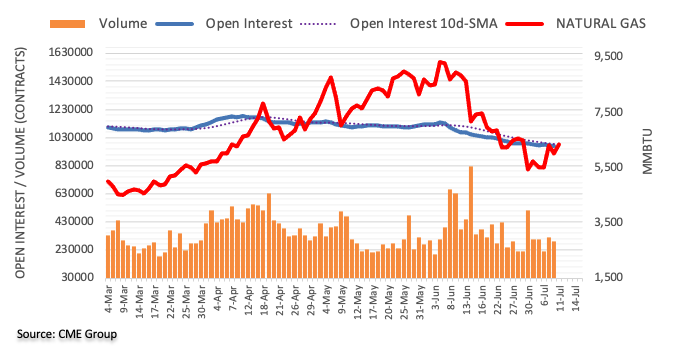
Significant structural changes in the functioning of today’s economies are under way. In the view of strategists at Natixis, these structural changes will lead to an increase in conflict.
Towards a world with much more conflict
“The new global economic equilibrium (scarcity of labour, energy, commodities; inflation) is much more fertile ground for the emergence of tensions (between countries, between wage earners and companies, between commodity-producing and importing countries, between wage earners and governments, between companies) than the previous economic equilibrium of abundance.”
“These tensions are already appearing (between countries for access to commodities, between buyers and sellers of oil, between trade unions and companies, etc.) and will increase, as the scarcities are set to last.”
In June, the Indonesian rupiah remained strong against the US dollar at the beginning of the month but depreciated significantly toward the end of the month. In July, the IDR is forecast to remain robust against the USD, economists at Mizuho Bank report.
Significant trade surplus in Indonesia to support the IDR
“The May trade balance of Indonesia saw a significant decline in surplus compared to that in April, as a result of the ban on palm oil exports. However, the restriction on exports has already been lifted. It is, therefore, possible to expect a significant trade surplus in Indonesia, which is likely to support the Indonesian rupiah.”
“Risk scenarios include a possible situation in which the rise of CPI becomes uncontrollable in various countries and regions, while many countries including the US at the top of the list are raising their policy interest rates. Such a situation is expected to fuel concerns over a global economic downturn, resulting in growing risk-averse sentiment in the market that could encourage market participants to sell the currencies of emerging countries. Following such a trend, the Indonesia rupiah could depreciate as well. However, as the most likely scenario, the Indonesian rupiah is poised to remain robust in July.”
USD/INR renewed its all-time high in June. In July, the pair is forecast to remain high, economists at Mizuho Bank report.
If oil prices remain at current level, the impact on INR is likely to be minimal
“If crude oil prices remain as they are now, it would not significantly impact the Indian rupee market.”
“Even though market participants are advised to remain cautious about interest rate hikes in the US, depending on economic indices, a fall in US interest rates could lead the Indian rupee to appreciate. The rest depends on market interventions by the central bank.”
How do stock market indices behave during a recession? Today, economists at Natixis expect to see a long period of falling share prices, as interest rates are still rising.
At what point in a recession or a fall in activity can investors return to equities?
“Stock market indices react to changes in earnings, real interest rates, risk aversion and inflation. This reaction is therefore complex.”
“We have seen that since the late 1990s, in terms of the economic cycle, stock market indices have taken four years on average to return to their pre-crisis levels.”
“One can also compare the evolution of stock market indices with that of central bank interest rates. We see that since the late 1990s: Downturns in stock market indices have occurred during periods of rising interest rates; Stock market indices have recovered a little before the central banks’ interest rates bottomed out and well after the central banks began cutting their interest rates.”
The Bank of Japan (BOJ) Osaka branch manager said on Monday that the rapid and short-term moves in forex market, as seen recently, are undesirable.”
Additional comments
“Very important for forex to move stably reflecting fundamentals.”
“Must be mindful impact of forex moves will depend on business structure, size of each entity.”
Market reaction
USD/JPY keeps its range around 137.00, unfazed by the above comments by the BOJ official. The spot is up 0.68% on a daily basis.
- A combination of factors assisted USD/CAD to regain positive traction on Monday.
- Sliding oil prices undermined the loonie and extended support amid a stronger USD.
- Aggressive Fed rate hike bets, softer risk tone lifted the USD closer to a 20-year high.
The USD/CAD pair attracted fresh buying near the 1.2940 region on Monday and for now, seems to have stalled its retracement slide from the YTD peak touched last week. The pair maintained its bid tone through the early European session and was last seen hovering near the daily high, just below the 1.3000 psychological mark.
Investors remained concerned about the fuel demand outlook amid growing fears about a possible global recession and the latest COVID-19 outbreak in China. This, to a larger extent, overshadowed worries over tight global supplies and exerted some downward pressure on crude oil prices, which, in turn, undermined the commodity-linked loonie. Apart from this, the emergence of fresh US dollar buying provided a goodish lift to the USD/CAD pair on the first day of a new week.
Following Friday's modest pullback from a fresh two-decade high, the US dollar was back in demand amid growing acceptance that the Fed would stick to its faster policy tightening path. The bets were reaffirmed by FOMC minutes released last Wednesday, which indicated that another 50 or 75 bps rate hike is likely at the July meeting. Adding to this, the upbeat US monthly jobs report reinforced hawkish Fed expectations and remained supportive of the bid tone surrounding the greenback.
The prospects for more aggressive rate hikes by the Fed lifted the yield on the benchmark 10-year US government bond back above the 3.0% threshold. This, along with a generally weaker risk tone, offered additional support to the safe-haven buck. The fundamental backdrop supports prospects for a further near-term appreciating move for the USD/CAD pair. That said, bulls might refrain from placing fresh bets and prefer to wait for this week's key data/event risks.
The latest US consumer inflation figures are due for release on Wednesday, which will be followed by the Bank of Canada monetary policy decision. Traders will further take cues from the US monthly Retail Sales data and Prelim Michigan Consumer Sentiment on Friday. This will play a key role in driving the near-term USD demand. This, along with oil price dynamics, would help investors to determine the next leg of a directional move for the USD/CAD pair.
Technical levels to watch
CME Group’s flash data for crude oil futures markets noted open interest went up by around 2.3K contracts following two consecutive daily pullbacks at the end of last week. Volume, instead, extended the downtrend and shrank by around 164.7K contracts.
WTI keeps targeting $114.00
Friday’s uptick in prices of the WTI was on the back of rising open interest, which suggests the continuation of this trend in the very near term. However, another daily pullback in volume could remove strength from this move. Further gains in the commodity face the immediate target at the weekly high at $114.00 per barrel (June 29).
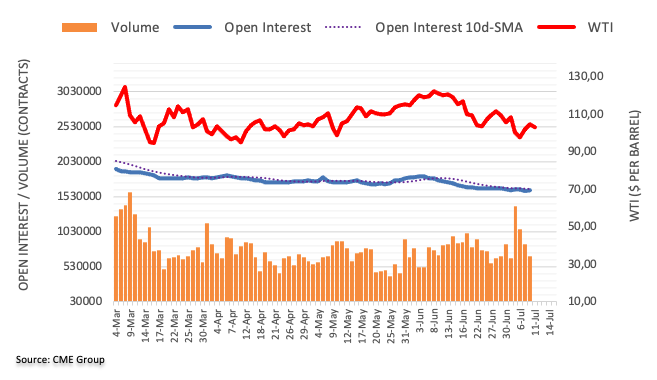
Gold Price extended its sideways consolidative move for the third successive day on Monday. As FXStreet’s Haresh Menghani notes, XAUUSD seems vulnerable to slide further.
Friday’s peak at $1,752 to act as immediate strong resistance
“Sustained weakness below the trading range support, around the $1,733 region, will reaffirm the near-term bearish outlook and make gold price vulnerable. The downward trajectory could then drag the XAUUSD towards the next relevant support near the $1,721 area, en-route the $1,700 round figure and August 2020 low, around the $1,687-$1.686 region.”
“Friday’s peak, near the $1,752 zone, now seems to act as immediate strong resistance. Sustained strength beyond might trigger a short-covering move and lift gold price further towards the $1,767-$1,770 strong horizontal support breakpoint. Some follow-through buying would suggest that the XAUUSD has formed a near-term base and allow bulls to aim back to reclaim the $1,800 mark.”
“US inflation data show little sign of slowing from a torrid pace in May, with no immediate relief from Fed tightening for key core services components like shelter and dining out costs,” MNI reports, citing comments from Federal Reserve Bank of Dallas economist Jim Dolmas.
Additional quotes
"There's nothing I see in the data that makes me optimistic that things are starting to moderate.”
"There are developments outside of the inflation data where we see markets starting to cool off a little bit -- like commodities prices going down -- so there are positive signs, but I'm not seeing a reflection of that moderation as yet."
But there's room for price growth to accelerate even as the Fed hikes interest rates briskly.”
"Housing activity cooled down a lot but prices so far less so.”
"It's a slow process and will take a while to filter through to rents and OER."
As for wages, "we're seeing tiny evidence of cooling -- job openings came down a little bit -- but the labor market still looks really tight. That's also something that's not going to shift on a dime.”
"If long-run expectations go materially higher, then that would start to be worrisome. So far they haven't."
"Short-run expectations have gone up much more than the long-run, and in some sense, that's a confirmation of Fed credibility."
Market reaction
The US dollar is showing little to no impact from the above comments, as it is currently trading at 107.38, up 0.35% on the day.
- Gold price is displaying a lackluster performance, downside looks likely as DXY reclaims day’s high.
- The Fed has already deployed restrictive quantitative measures, however, the inflation rate is still solid.
- The precious metal is on the verge of witnessing a downside break of the week-old consolidation.
Gold price (XAU/USD) has carry-forwarded its back-and-forth moves structure in the early European session. The precious metal is displaying subdued performance, however, the downside is warranted on soaring bets over the maintenance of the status quo by the Federal Reserve (Fed) in its July interest rate decision.
Fed chair Jerome Powell announced a 75 basis point (bps) rate hike and a similar announcement is expected ahead. The inflation rate is not showing any slowdown signals despite the deployment of the policy tightening measures. The interest rates have already elevated to 1.50-1.75% in the past three monetary policy meetings along with the balance sheet reduction program.
Meanwhile, the US dollar index (DXY) has recaptured its intraday high after a minor corrective move. The DXY is aiming for higher levels while the gold prices will display a severe downside after violating the crucial support of $1,740.00. This week, the release of US inflation will be of utmost importance. The annual plain-vanilla Consumer Price Index (CPI) figure is seen at 8.7% while the core CPI may slip to 5.7%.
Gold technical analysis
On a broader note, the gold prices are juggling in a $1,730.73-1,752.49 range. The 20-period Exponential Moving Average (EMA) at $1,741.92 is overlapping with the gold prices. Also, the 50-EMA at $1,745.00 has turned flat, which signals a consolidation ahead. The Relative Strength Index (RSI) (14) is oscillating in a 40.00-60.00 range. The broader weakness in the bright metal will accelerate further if the RSI (14) surrenders the support at 40.00 levels.
Gold hourly chart
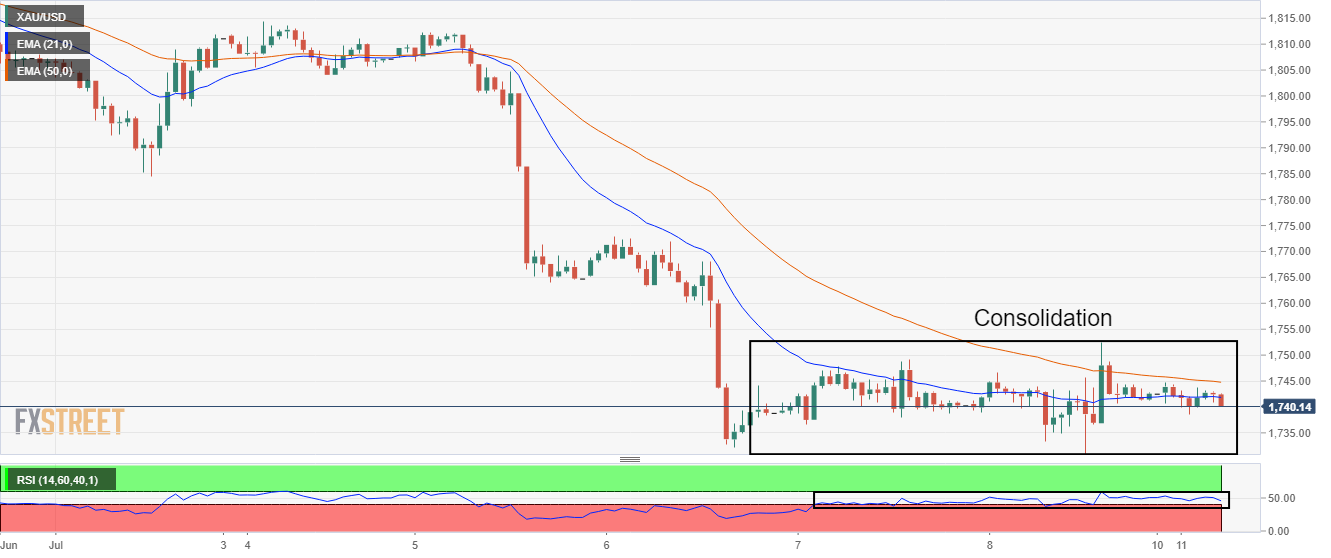
According to preliminary readings from CME Group for gold futures markets, open interest resumed the upside and increased by around 5.7K contracts on Friday. Volume followed suit and rose by more than 68K contracts after two consecutive daily pullbacks.
Gold: Next on the downside comes $1,721
Gold prices charted another inconclusive session on Friday amidst rising open interest and volume, leaving the door open to the continuation of the current side-lined trading for the time being. Further decline in bullion should meet the next support at the September 2021 low at $1,721 per ounce troy.
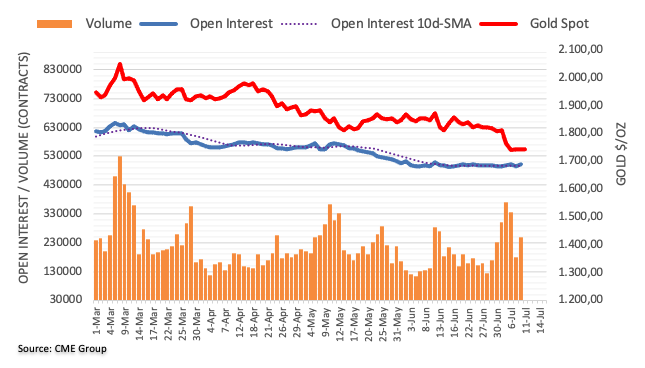
FX option expiries for July 11 NY cut at 10:00 Eastern Time, via DTCC, can be found below.
- EUR/USD: EUR amounts
- 1.0050 658m
- 1.0125 208m
- 1.0200 243m
- 1.0225 589m
- 1.0250 1.34b
- 1.0300 1.32b
- 1.0350 545m
- GBP/USD: GBP amounts
- 1.2035 351m
- USD/JPY: USD amounts
- 136.50 855m
- 137.00 200m
- USD/CHF: USD amounts
- 0.9745 205m
- AUD/USD: AUD amounts
- 0.6825 418m
- USD/CAD: USD amounts
- 1.2985 200m
- EUR/CHF: EUR amounts
- 1.0150 439m
Gold lost more than 3% on a weekly basis. As FXStreet’s Eren Sengezer notes, the technical outlook suggests there could be a correction before the next leg lower.
Sellers are likely to dominate gold's action while below $1,800
“The Relative Strength Index (RSI) indicator on the daily chart dropped into the oversold territory below 30. The last time the daily RSI fell below in August 2021, XAUUSD staged a technical correction and a similar action could be expected in the short term.”
“On the upside, $1,765 (former support, static level) aligns as first technical resistance ahead of $1,790 (former support, static level). A daily close above the latter could open the door for an extended recovery toward $1,800, where the descending trend line coming from early March and the 20-day SMA is located.
“As long as the $1,800 level stays intact, however, sellers are likely to dominate gold's action following the correction.”
“On the downside, $1,730 (July 8 low) forms interim support ahead of $1,720 (static level) and $1,700 (psychological level).”
Economist at UOB Group Lee Sue Ann suggests the Bank of Korea (BoK) could hike its policy rate by 25 bps at its meeting on July 13.
Key Quotes
“The BOK’s inflation forecasts indicate an elevated inflation view into 2023, strengthening the case for further monetary policy tightening.”
“We have thus revised our forecast and now expect the central bank to hike its base rate by 25bps at each of the three subsequent meetings in Jul, Aug and Oct before pausing at its last meeting this year in Nov, at 2.50%. More aggressive tightening is not ruled out if inflation continues to come in above expectation in Jun.”
- A combination of factors prompted fresh selling around AUD/USD on Monday.
- The USD stood tall near a two-decade high amid aggressive Fed rate hike bets.
- Recession fears, a softer risk tone further undermined the risk-sensitive aussie.
The AUD/USD pair struggled to capitalize on last week's recovery move from the 0.6765-0.6760 area, or over a two-year low and met with a fresh supply on Monday. The pair remained on the defensive heading into the European session and was last seen trading near the daily low, around the 0.6820-0.6815 region.
Following Friday's post-NFP modest pullback from a fresh two-decade high, the US dollar was back in demand amid growing acceptance that the Fed would stick to its faster policy tightening path. The bets were reaffirmed by the latest US monthly jobs report, which showed that the economy added 372K jobs in June as against 268K anticipated. Apart from this, the worsening economic outlook further underpinned the safe-haven buck and exerted downward pressure on the risk-sensitive aussie.
Investors remain concerned that rapidly rising interest rates and tightening financial conditions would pose challenges to global economic growth. This, along with the ongoing Russia-Ukraine war and the latest COVID-19 outbreak, has been fueling recession fears. The combination of factors favours the USD bulls and supports prospects for the resumption of the AUD/USD pair's bearish trend. Hence, a fall back towards the 0.6765-0.6760 support zone, or the YTD low, remains a distinct possibility.
There isn't any major market-moving economic data due for release from the US on Monday. That said, the broader market risk sentiment would influence the USD price dynamics and provide some impetus to the AUD/USD pair. The focus, however, would remain on the US consumer inflation figures on Wednesday. Traders will further take cues from the US monthly Retail Sales data and Prelim Michigan Consumer Sentiment on Friday. This will play a key role in driving the near-term USD demand and help determine the next leg of a directional move for the AUD/USD pair.
Technical levels to watch
- Chinese equities have tumbled amid renewed lockdown fears in Shanghai.
- S&P500 futures have slipped on accelerating odds of one more 75 bps rate hike by the Fed.
- Unavailability of the cheaper money will result in lower investment by US corporate.
Markets in the Asian domain are displaying a mixed performance as the Chinese equities have displayed a vulnerable performance. The Chinese indices have witnessed a steep fall amid escalating lockdown worries in Shanghai. The Shanghai administration reported the initial case of the highly infectious BA.5 omicron sub-variant and has warned of “very high” risks. This has escalated the lockdown worries in Shanghai. It is worth noting that the city has yet not recovered substantially from the prior lockdown.
At the press time, Japan Nikkei225 added 1.13% while China A50 eroded 2.03%, Hang Seng nosedived more than 3% and Nifty50 eased 0.40%.
A slippage in the S&P500 has also underpinned bears in the Asian markets. The US futures are underperforming on escalating odds of a consecutive 75 basis points (bps) interest rate hike by the Federal Reserve (Fed). Higher consensus for US Consumer Price Index (CPI), which is due on Wednesday and the outstanding US Nonfarm Payrolls (NFP) released on Friday have delighted the Fed.
An elevation in the interest rates will restrict the flow of a major chunk of funds in the economy. This will force the corporate sector to inject more filters into investment opportunities. Lower investment by the corporate due to the unavailability of cheap money will trim their earnings.
Meanwhile, the US dollar index (DXY) has recaptured the crucial resistance of 107.00 as investors are channelizing their funds into the DXY on soaring hawkish Fed bets.
“We will take every possible step to deal with rising prices,” Japanese Prime Minister Fumio Kishida said in an appearance on Monday.
Additional quotes
I will take up difficult problems former PM Abe was not able to achieve, including revising the constitution.
To make flexible use of 5.5 trillion yen of budget reserve for dealing with price hikes.
We should be able to provide sufficient, stable energy supplies all summer.
Govt will swiftly implement targeted steps to combat rising food, energy prices.
Will create atmosphere for private sector firms to raise wages more easily.
Panel I head will meet this week to kick off discussions on steps to cushion blow from rising food, fuel prices.
No schedule set yet for cabinet reshuffle, personnel changes.
Sufficient debate needed on revising constitution, hope for discussions during next parliamentary session.
Govt ready to take additional, new steps to cushion blow from rising fuel, food prices.
Wage growth must be sustained as price hikes continue.
Market reaction
At the time of writing, USD/JPY is consolidating its upside around 137.00, underpinned by the Fed-BOJ policy divergence following Governor Kuroda’s dovish remarks.
Chinese Foreign Minister Wang Yi said in a statement on Monday that he told US Secretary of State Antony Blinken that the two sides should consider establishing rules for positive interactions in Asia-Pacific.
Wang and Blinken met over the weekend, as both senior diplomats described their first in-person talks since October as "candid".
A US official said "neither side held back.” “We were very open about where our differences are ... but the meeting was also constructive because despite the candor, the tone was very professional.”
Market reaction
AUD/USD was last seen trading 0.53% lower at 0.6818, near-daily lows.
- EUR/USD has rebounded from 1.0140 amid a minute correction in the DXY.
- The ongoing Eurogroup meeting and the upcoming Germany HICP will be crucial for eurozone.
- Lower US core CPI is indicating that the oil and food prices are guiding the price pressures.
The EUR/USD pair has recovered some intraday losses after fetching bids near 1.0140 in the Asian session. The shared currency bulls have bounced as the US dollar index (DXY) is facing a mild correction. The pair is likely to remain on the tenterhooks as the investors are shifting their focus on the inflation data from the US and Germany this week.
The economic data from Germany carries a significant impact on the shared currency. A preliminary estimate for Germany's Harmonized Index of Consumer Prices (HICP) is 8.2%, similar to its prior print. It is worth noting that the European Central Bank (ECB) has not elevated its interest rates yet while the Western leaders have come way ahead. This time, a rate hike looks likely as the ECB is done with the Asset Purchase Program (APP) and is left with interest rate policy measures only.
Apart from that, the ongoing Eurogroup meeting will also affect the eurozone bulls. Most probably, the issues of higher inflation, more sanctions on Russia, and Brexit issues will be discussed.
Meanwhile, the US dollar index (DXY) is hovering around 107.30 after hitting a high of 107.45. The fundamentals are supporting a breach of the 19-year high at 107.79. The consensus for the US Consumer Price Index (CPI) is higher at 8.7%. While the core CPI that excludes oil and food prices is seen lower at 5.7% than the prior print of 6%.
A significant fall in the core CPI indicates that the price pressures are mostly guided by volatile oil and food prices. Also, the slippage in the prices of base metals and other commodities is lowering the inflation rate.
- USD/INR is expected to cross an all-time high at 79.40 amid a firmer DXY.
- The Indian rupee may display recovery signs as FIIs are returning to Dalal Street.
- Oil prices are regaining their glory as investors have underpinned supply worries.
The USD/INR pair is aiming toward its all-time high at 79.40 amid a broader strength in the US dollar index (DXY). The asset is performing stronger as higher estimates for the US Consumer Price Index (CPI) are bolstering the case for a 75 basis point (bps) interest rate hike by the Federal Reserve (Fed).
Inflation is already skyrocketing in the US economy and even this time investors see a mild improvement to 8.7%. Last week’s upbeat US Nonfarm Payrolls (NFP) has delighted Fed policymakers to keep up with their extreme policy tightening measures. One factor that Fed policymakers should be worried about is lower Average Hourly Earnings along with the US employment data.
The combination of soaring price pressures, which have devalued the paychecks of the households, and lower Average Hourly Earnings will create more troubles for them. Lower-income will trim the consumption and savings, and eventually the overall demand. In the later stages, a slippage in the overall demand may impact the greenback.
On the Indian rupee front, a decent recovery in the Indian indices from the last week is indicating that the Foreign Institutional Investors (FIIs) are returning to Dalal Street. This may fetch significant fund flows into the Indian market and may support the Indian rupee ahead. Also, the kick-start of the earnings season for the first quarter of FY22 may strengthen the Indian rupee bulls.
Meanwhile, the oil prices are holding themselves on higher levels as investors have shifted their focus to the supply worries. The oil cartel is unable to produce more oil except the Saudi Arabia and United Arab Emirates (UAE), which are already operating at maximum capacity levels.
- USD/CHF is going through a minor correction following the footprints of the DXY.
- Solid employment data and higher consensus for US CPI are underpinning a 75 bps rate hike by the Fed.
- A light economic calendar by the Swiss economy will shift the entire focus on US inflation.
The USD/CHF pair is facing correction after re-testing a three-week high at 0.9797 in the early Asian session. The unavailability of extreme buying interest at elevated levels has dragged the asset lower. However, the correction is mild for now and doesn’t warrant a bearish reversal as the odds of a consecutive 75 basis points (bps) interest rate hike by the Federal Reserve (Fed) are soaring vigorously.
The release of the outstanding US Nonfarm Payrolls (NFP) last week has provided the freedom to the Federal Reserve (Fed) to announce more rate hikes. The preliminary estimate for the job additions in June was 268K, however, the economic data landed at 372k. Adding to that, the jobless rate remained steady at 3.6%.
The US economy is maintaining its full employment levels for a decent period. The continuous elevation of interest rates by the Fed will restrict liquidity in the economy, which will result in the execution of ultra-filtered investment opportunities only. No doubt, the event may accelerate the jobless rate, but the Fed will still have enough room to play with the policy measures.
Meanwhile, the US dollar index (DXY) has corrected mildly after failing to hit 107.50. The asset has displayed a stellar performance in the Asian session.
Going forward, US inflation will remain a key event this week. As per the market participants, the plain-vanilla US inflation will land at 8.7%, a little higher than the prior print of 8.6%. This could be the peak of the price pressures.
On the Swiss franc front, Thursday’s Unemployment Rate failed to make a meaningful impact on the Swiss franc bulls. The monthly data remained in line with the estimates and the prior release of 2.2%.
- A symmetrical triangle formation near two-year lows is strengthening the greenback bulls.
- The cable has surrendered the support of 50-EMA at 1.2000.
- The RSI (14) has sensed barricades around 60.00 which add to the downside filters.
The GBP/USD pair has witnessed a steep fall after failing to tap Friday’s high of 1.2055 in the early Asian session. The downside move by the greenback bulls has dragged the cable below the psychological support of 1.2000.
After a severe fall, the pair is displaying a volatility squeeze. The asset has turned sideways and is trading in a symmetrical triangle pattern. The downward-sloping trendline of the above-mentioned pattern is plotted from July 4 high at 1.2161 while the upward-sloping trendline is placed from Wednesday’s low at 1.1876.
The cable has surrendered the cushion of the 50-period Exponential Moving Average (EMA) at 1.2000. Also, the 200-EMA at 1.2056 is declining which indicates a continuation of the downside bias.
Meanwhile, the Relative Strength Index (RSI) (14) has faced resistance around 60.00 and has slipped lower, which indicates that the asset is no more bullish for now.
The cable may display more losses if the asset drops below Friday’s low at 1.1920. An occurrence of the same will drag the asset to Wednesday’s low at 1.1876, followed by the 26 March 2020 low at 1.1777.
Alternatively, a decisive move above Friday’s high of 1.2055 will send the asset towards July 4 high at 1.2161. A breach of the latter will drive the cable towards June 28 high at 1.2292.
GBP/USD hourly chart
-637931064168767348.png)
- Gold Price trades on the defensive after Friday’s positive close.
- US NFP beat trigger two-way businesses in the yellow metal.
- XAUUSD hovers near nine-month lows, with eyes on US inflation.
Gold Price is moving back and forth in a familiar range around the $1,740 level, as the US dollar sees fresh buying at the start of the week. Investors digest Friday’s stellar US Nonfarm Payrolls report while assessing the Fed rate hike expectations.
The US economy added 372,000 jobs in June vs. expectations of 268,000 addition while the Unemployment Rate steadied at 3.6%. The solid US labor market offered a tailwind to the aggressive Fed tightening expectations, keeping the sentiment around the dollar buoyed.
Moreover, the risk-off mood in Asian trading, with the renewed concerns over Chinese covid lockdowns and their impact on global growth, added to the greenback’s strength.
Although the retreat in the US 10-year Treasury yields from multi-day highs helps cushion the downside in the bright metal. Persistent risk-off flows boost the safe-haven appeal of the American government bonds, dragging yields lower.
Meanwhile, markets grieve over the shocking assassination of the former Japanese Prime Minister Shinzo Abe. Further, a sense of caution prevails ahead of the critical US inflation data due later this week, which leaves gold bulls in the back seat.
In the meantime, the Fed sentiment and recession fears will continue to influence the broader market theme, eventually impacting the dollar valuations and gold price action. The US economic calendar remains light on Monday; therefore, the focus will be on the Fed official Williams speech.
Gold Price: Daily chart
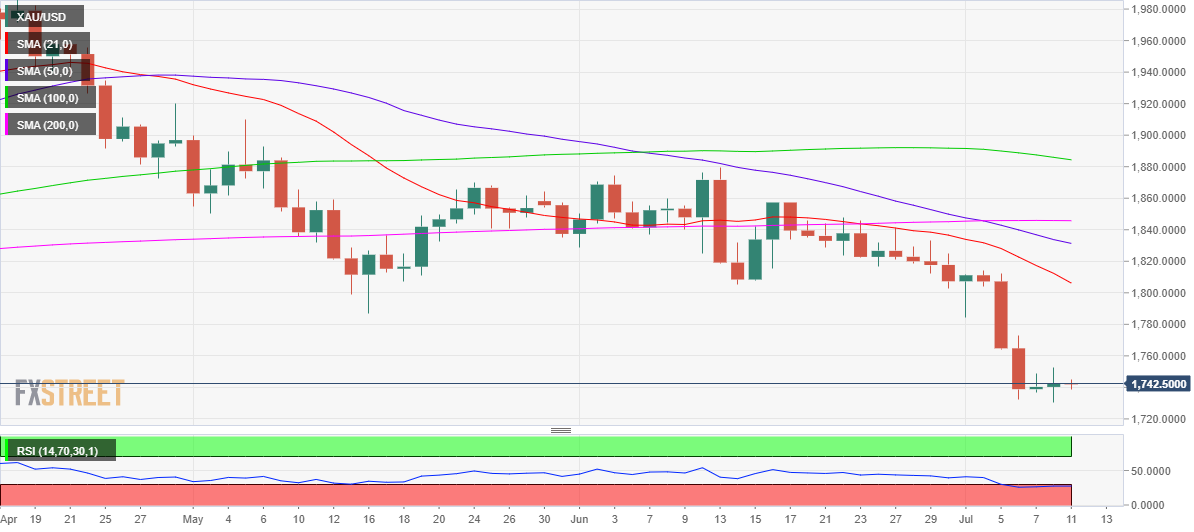
“On the upside, $1,765 (former support, static level) aligns as the first technical resistance ahead of $1,790 (former support, static level). On the downside, $1,730 (July 8 low) forms interim support ahead of $1,720 (static level) and $1,700 (psychological level),” FXStreet’s Senior Analyst, Eren Sengezer explained in his gold weekly forecast.
Gold Price: Additional levels to consider
- USD/JPY has printed a fresh 23-year high of 137.28 on dovish commentary from the BOJ.
- Higher consensus for inflation and firmer US NFP are advocating for a bumper rate hike by the Fed.
- Solid US NFP has provided much freedom to the Fed to elevate interest rates.
The USD/JPY pair has climbed above the significant hurdle of 137.00 for the first time in the past 23 years as the chances of further escalation in the Federal Reserve (Fed)-Bank of Japan (BOJ) has escalated. The release of the robust US Nonfarm Payrolls (NFP) by the Department of Labor on Friday has bolstered the odds of a consecutive 75 basis points (bps) by the Fed.
The US NFP landed at 372k jobs for June, significantly higher than the estimates of 268k but a little lower than the prior release of 384k. The Unemployment Rate remained in line with estimates and the prior print at 3.6%. No doubt, the upbeat US NFP will delight the Fed to feature a rate hike decision without much hesitation.
Apart from that, higher consensus for the US Consumer Price Index (CPI) is bolstering the case for a bumper rate hike announcement by Fed chair Jerome Powell. The preliminary estimate for the plain-vanilla US CPI is 8.7% on an annual basis. The inflation rate is increasing at a diminishing rate, however, the figure is still more than four times of the targeted inflation rate, which is at 2%.
On the Tokyo front, dovish commentary from BOJ Governor Haruhiko Kuroda has weakened the yen bulls. The comments from BOJ’s Kuroda in his speech at the quarterly meeting of the central bank's branch managers “We won't hesitate to take additional monetary easing steps as necessary" with an eye on risks, have underpinned the pair. Also, the guidance is indicating that the short-term and long-term rates will remain steady or shift lower.
- WTI is starting the week off on the backfoot as the US dollar firms.
- Investors continue to reduce their bullish bets.
The price of WTI is lower at the start of the week, losing some 0.82% at the time of writing after falling from a high of $105.02 to a low of $103.54 so far. There is a public holiday in parts of Southeast Asia so volumes are out but there have been moves in markets nonetheless, filtering their way through to the black gold.
Oil finished the start of a new month and quarter on Friday lower due to recessionary fears that have weighed on risk apatite, supporting the greenback.
''Investors continue to reduce their bullish bets as restrictive monetary policy raises the risk of slower economic growth,'' analysts at ANZ Bank said, noting that net long positions in WTI crude futures at now at their lowest level since March 2020, when demand collapsed amid the initial outbreak of COVID-19.
''This is despite ongoing signs of tightness. The US crude prompt time spread (spot - 1m future), an indication of supply and demand balances has surged to USD4/bbl, its highest level since March. Saudi Arabia also raised its selling prices of light crude to most regions for August amid strong demand,'' the analysts explained.
''US exports also remain strong, with the four-week average sitting above 3mb/d. Further supply disruptions are also hanging over the market. G7 members are discussing further sanctions, which could include a plan to cap Russia’s oil revenue. This has sparked a rebuke from Russia, with President Putin warning it would be a catastrophe for global energy markets.''
Russia is the wild car for oil
Meanwhile, plans by the West to cap Russian oil prices are the wild card in the oil market. President Vladimir Putin has warned that further sanctions could lead to "catastrophic" consequences.
“Further use of sanctions may lead to even more severe — without exaggeration, even catastrophic — consequences on the global energy market," Putin explained at a televised meeting with senior officials. "I see certain colleagues [thinking]... we do not give a damn about those sanctions, to hell with them,” he added, urging caution from the Russian side as well. “Yes, we must feel confident, but we must recognize the risks, too."
| Raw materials | Closed | Change, % |
|---|---|---|
| Silver | 19.322 | 0.44 |
| Gold | 1742.56 | 0.11 |
| Palladium | 2142.67 | 7.62 |
- EUR/USD bears have sunk in their teeth as the US dollar starts off strong.
- The US data on Friday is being digested with more to come this week in CPI and Retail Sales.
EUR/USD is under pressure in the Tokyo equities morning session as the greenback rallies into the peak formation formed on Friday as Europe opened for its last session of the week. At the time of writing, EUR/USD is trading 0.42% higher and has firmed from a low of 106.89 and has printed a recent high of 107.34.
After some volatility, markets steadied following the tragic assassination of the former Japanese PM Shinzo Abe. The focus moved to the US data in the Nonfarm Payrolls labour market report which beat expectations. This upset risk assets such as stocks given that the outcome has pushed back against expectations that US domestic demand may be rapidly moving towards contraction.
Payrolls jobs gains beat expectations, rising 372k vs expectations of 265k and the Unemployment Rate was steady at 3.6% for a fourth consecutive month. The average hourly earnings also remained stable at 0.3% MoM and 5.1% YoY. However, the Participation Rate lost 0.1% to 62.2%.
''Labour supply is still not recovering amid very strong jobs demand,'' analysts at ANZ bank said in a note on Monday when assessing the data. ''The household survey showed unemployment broadly unchanged at 5.9m. Clearly, the pool of available skilled workers remains very tight. The number of people prevented from looking for work because of the pandemic was 610k, up from 455k in May. Total non-farm employment is 524k or 0.3% below pre-pandemic levels.''
For the week ahead, the focus will be on US data again with a void on the eurozone calendar. Instead, the main event will be the publication of June’s consumer Price Index report. Analysts at the National Bank of Canada argue that ''the food component likely remained very strong given severe supply constraints globally, and this increase may have been compounded by sharply higher gasoline prices. As a result, headline prices could have increased 1.2% MoM, lifting the year-on-year rate to a 40-year high of 8.8%.''
Traders will also take note of the US Retail Sales. A recovery in June is expected, following the series' first contraction this year in May. ''Spending was likely aided by another firm showing in gasoline station sales and a rebound in the auto segment,'' analysts at TD Securities said. ''We also look for another gain in the eating/drinking segment as consumers continue to transition away from goods. That said, control group sales likely fell again.''
In recent trade today, the People’s Bank of China (PBOC) set the yuan (CNY) at 6.6960 vs. the estimate at 6.7002 and the last close of 6.6950.
About the fix
China maintains strict control of the yuan’s rate on the mainland.
The onshore yuan (CNY) differs from the offshore one (CNH) in trading restrictions, this last one is not as tightly controlled.
Each morning, the People’s Bank of China (PBOC) sets a so-called daily midpoint fix, based on the yuan’s previous day's closing level and quotations taken from the inter-bank dealer.
Reuters reports that the ''Bank of Japan Governor Haruhiko Kuroda said on Monday the central bank was closely watching the impact currency moves could have on the economy, warning of 'very high uncertainty' on the outlook due to rising commodity prices''
"We won't hesitate to take additional monetary easing steps as necessary" with an eye on risks, Kuroda said in a speech to a quarterly meeting of the central bank's branch managers.Kuroda also repeated the BOJ's policy guidance that the bank expects short- and long-term interest rate targets to "move at current or lower levels."
Key notes
Japan's economy showing some signs of weakness but picking up as a trend.
Japan's economy likely to recover as impact of covid-19, supply constraints eases.
Japan's core consumer inflation moving around 2%.
Uncertainty regarding japan's economy is very high.
Japan's financial system stable as a whole.
Must be vigilant to impact of financial, currency market moves and their impact on japan's economy, prices.
BoJ will maintain ultra-loose policy to stably achieve 2% inflation target.
BoJ stands ready to ease policy further without hesitation as needed.
Japan's consumer inflation likely to accelerate pace of increase.
Japan's financial conditions are easing as a whole.
Expects short-, long-term policy rate targets to remain at current or lower levels.
USD/JPY update
USD/JPY bulls have stepped in at the start of the week as the greenback remains firm despite the bearish close on Friday. The pair is trading bid by some 0.5% to 136.75 so far in the Tokyo sesison.
- Descending Triangle’s downward sloping trendline has acted as a major barricade.
- Aussie bulls may also surrender the support of 20-EMA after the 50-EMA.
- The RSI (14) has sensed hurdles while crossing the 60.00, which adds to the downside filters.
The AUD/USD pair is displaying vulnerable performance in the Asian session after failing to sustain above the critical hurdle of 0.6850. The asset is witnessing a bearish open-rejection reverse trading session. The asset moved marginally higher after opening flat, found barricades above the crucial hurdle of 0.6850, slipped lower and extended losses after slipping below the opening price at 0.6840.
On a four-hour scale, the pair has sensed resistance after attempting a break above the Descending Triangle pattern whose downward-sloping trendline is plotted from June 16 high at 0.7070. While the horizontal support is placed from July 1 low at 0.6764.
Offers are increased in the asset as it has faced a tough fight against the 50-period Exponential Moving Average (EMA) at 0.6848. The aussie bulls may surrender the cushion of 20-EMA at 0.6835, which may bolster the downside bias.
Meanwhile, the Relative Strength Index (RSI (14) has faced resistance around 60.00 and has slipped lower, which indicates that the asset is no more bullish for now.
Should the asset drop below July 1 low at 0.6766, the greenback bulls will drag the asset towards the 29 May 2020 high at 0.6683. A breach of the latter will drag the asset towards the 30 April 2020 high at 0.6570.
On the contrary, the greenback bulls could lose their grip if the asset violates Tuesday’s high at 0.6896. An occurrence of the same will drive the asset towards June 30 high at 0.6920, followed by June 28 high at 0.6965.
AUD/USD four-hour chart
-637930989007582449.png)
- The DXY marches towards 107.20 as investors see inflation jumping to 8.7%.
- Job additions in the US economy remained higher at 372k than the estimates of 268k.
- Lower earnings by the US households will trim the consumption vigorously.
The US dollar index (DXY) has displayed a decent buying action in early Tokyo after defending the crucial support of 108.86. The DXY witnessed a steep fall on Friday after printing a fresh 19-year high of 107.79. The asset fell sharply after the release of the US Nonfarm Payrolls (NFP).
US Employment data
The greenback bulls are expected to underperform despite the upbeat US Nonfarm Payrolls (NFP) data. The US economy added 372k jobs in June, significantly higher than the estimates of 268k but a little lower than the prior release of 384k. The Unemployment Rate remained in line with estimates and the prior print at 3.6%. No doubt, the outperformance of the US economy on the labor market front will empower the Federal Reserve (Fed) to announce extreme rate hikes without much hesitation.
Higher Consensus for US Inflation
As per the market consensus, the plain-vanilla US Inflation is expected to climb to 8.7% vs. 8.6% reported earlier. However, the core CPI may slip to 5.7% from the prior print of 6%. Higher inflation may strengthen the odds of one more 75 basis points (bps) interest rate hike by the Federal Reserve (Fed), however, the overall demand may take a serious hit. Price pressures are skyrocketing in the US economy, however, earnings are not following a similar pattern. Lower earnings by the US households will trim the consumption vigorously.
Key data this week: US CPI, US core Inflation, Initial Jobless Claims, Producers Price Index (PPI), Retail Sales, and Industrial Production.
Major events this week: Eurogroup meeting, Bank of England (BOE) Andrew Bailey speech, Reserve bank of New Zealand (RBNZ) interest rate decision, and Bank of Canada (BOC) monetary policy.
| Index | Change, points | Closed | Change, % |
|---|---|---|---|
| NIKKEI 225 | 26.66 | 26517.19 | 0.1 |
| Hang Seng | 82.2 | 21725.78 | 0.38 |
| KOSPI | 16.34 | 2350.61 | 0.7 |
| ASX 200 | 30 | 6678 | 0.45 |
| FTSE 100 | 7.1 | 7196.2 | 0.1 |
| DAX | 172.01 | 13015.23 | 1.34 |
| CAC 40 | 26.43 | 6033.13 | 0.44 |
| Dow Jones | -46.4 | 31338.15 | -0.15 |
| S&P 500 | -3.24 | 3899.38 | -0.08 |
| NASDAQ Composite | 13.96 | 11635.31 | 0.12 |
- USD/JPY is marching towards 136.50 as the DXY has strengthened on higher consensus for US Inflation.
- The plain-vanilla US CPI is seen higher at 8.7% while the core CPI may slip by 5.7%.
- Japan’s Industrial Production data is expected to remain flat.
The USD/JPY pair is heading towards the critical resistance of 136.50 firmly as the US dollar index (DXY) has overstepped the crucial hurdle of 107.00 in early Tokyo. On a broader note, the asset has remained sideways from the past week in a 135.22-136.56 range. This week, a power-pack performance is expected as the US Consumer Price Index (CPI) will release on Wednesday.
A preliminary estimate for the US CPI is 8.7%, mildly higher than the prior release of 8.6% on an annual basis. While the core CPI may slip lower to 5.7% vs. 6% recorded earlier. Lower expectations from the core CPI dictate that the oil and food prices are trimming their impact, however, the commodity and other products are still dampening the market mood.
Well, the runaway inflation rate is highly required to be fixed by higher paychecks for the households. And, in that context, the US economy is failing to gear up Average Hourly Earnings that could mitigate the vulnerable impact of higher price pressures.
Meanwhile, the US dollar index (DXY) is displaying a firmer upside move in the Tokyo session. The DXY has established above 107.00 as a higher inflation rate in the US economy will support the interest rate decision of a bumper rate hike by the Federal Reserve (Fed).
On the Tokyo front, investors are awaiting the release of the Industrial Production data, which is due on Thursday. The economic data is expected to land at -2.8%, similar to its prior print on an annual basis. However, the quarterly data may remain stable at -7.2%. Apart from that, the death of Japan’s ex-Prime Minister Shinzo Abe has soured the market mood in Japan.
| Pare | Closed | Change, % |
|---|---|---|
| AUDUSD | 0.68529 | 0.16 |
| EURJPY | 138.613 | 0.26 |
| EURUSD | 1.01836 | 0.18 |
| GBPJPY | 163.792 | 0.16 |
| GBPUSD | 1.20343 | 0.08 |
| NZDUSD | 0.61882 | 0.2 |
| USDCAD | 1.29366 | -0.24 |
| USDCHF | 0.97651 | 0.28 |
| USDJPY | 136.114 | 0.08 |
- NZD/USD bears are holding up the bulls in their endeavour for a break of 0.6200.
- The bulls will be in play so long as the neckline of the W-formation holds as support.
NZD/USD is working the highs of Friday's session but failures to hold above 0.6210, where the ere is a price imbalance, should it be tested, could lead to a sell-off to the bottom of the New York range.
The following illustrates the hourly chart's market structure and prospects for a move higher for the Tokyo session:
NZD/USD H1 chart

The price is trading in the upper-end of the 0.61 area after printing a W-formation where the neckline has already been retested and has been held as support. While above there, the focus is on the upside for a bullish extension for the sessions ahead. However, failures there will open the risk of a move back to the downside which will leave 0.6150 and a touch lower vulnerable.







© 2000-2026. All rights reserved.
This site is managed by Teletrade D.J. LLC 2351 LLC 2022 (Euro House, Richmond Hill Road, Kingstown, VC0100, St. Vincent and the Grenadines).
The information on this website is for informational purposes only and does not constitute any investment advice.
The company does not serve or provide services to customers who are residents of the US, Canada, Iran, The Democratic People's Republic of Korea, Yemen and FATF blacklisted countries.
Making transactions on financial markets with marginal financial instruments opens up wide possibilities and allows investors who are willing to take risks to earn high profits, carrying a potentially high risk of losses at the same time. Therefore you should responsibly approach the issue of choosing the appropriate investment strategy, taking the available resources into account, before starting trading.
Use of the information: full or partial use of materials from this website must always be referenced to TeleTrade as the source of information. Use of the materials on the Internet must be accompanied by a hyperlink to teletrade.org. Automatic import of materials and information from this website is prohibited.
Please contact our PR department if you have any questions or need assistance at pr@teletrade.global.


 Bank
Bank transfers


