- Analytics
- News and Tools
- Market News
CFD Markets News and Forecasts — 09-07-2021
On Monday at 06:00 GMT, Japan will announce a change in equipment orders for June. At 22:45 GMT, New Zealand will report a change in the level of food prices for June.
On Tuesday, at 01:30 GMT, Australia will present the NAB Business Confidence index for June. At 03:00 GMT, China will announce a change in the foreign trade balance for June. At 06:00 GMT, in Britain, the Bank of England's financial stability report will be released, as well as the minutes of the meeting of the Bank of England's Financial Policy Committee. Also at 06:00 GMT, Germany will publish the consumer price index for June. At 06:30 GMT, Switzerland will release the producer and import price index for June. At 06:45 GMT, France will present the consumer price index for June. At 12:30 GMT, the US will publish the consumer price index for June. At 18:00 GMT, in the US, the budget report for June will be released . At 22:45 GMT, New Zealand will report a change in the number of tourists for May.
On Wednesday, at 00:30 GMT, Australia will release the Westpac consumer confidence index for July. At 02:00 GMT in New Zealand, the RBNZ interest rate decision will be announced. At 04:30 GMT, Japan will report a change in industrial production for May. At 06:00 GMT, Britain will release the consumer price index, the retail price index, the producer purchase price index and the producer selling price index for June. At 09:00 GMT, the eurozone will announce a change in the volume of industrial production for May. At 12:30 GMT, Canada will announce a change in the volume of production supplies for May. Also at 12:30 GMT, the US will publish the producer price index for June. At 14:00 GMT in Canada, the Bank of Canada interest rate decision will be announced. At 14:30 GMT, the US will report on the change in oil reserves according to the Ministry of Energy. At 16:00 GMT, the head of the Federal Reserve Powell will make a speech. At 18:00 GMT, the US will publish the Fed's Beige Book.
On Thursday, at 01:00 GMT, Australia will announce a change in expectations for consumer price inflation for July. At 01:30 GMT, Australia will report changes in the unemployment rate and the number of people employed for June. At 02:00 GMT, China will announce changes in the volume of GDP for the 2nd quarter, as well as the volume of investment in fixed assets, the volume of industrial production and the volume of retail trade for June. At 04:30 GMT, Japan will release the index of activity in the service sector for May. At 06:00 GMT, Britain will announce changes in the number of applications for unemployment benefits for June, as well as the unemployment rate and the level of average earnings for May. At 08:30 GMT, in Britain, a report on credit conditions will be released . At 12:30 GMT, the US will publish the Fed-Philadelphia manufacturing index and the index of activity in the manufacturing sector from the Federal Reserve of New York for July, as well as the import price index for June. Also at 12:30 GMT, the United States will report a change in the number of initial applications for unemployment benefits. At 13:15 GMT, the US will announce changes in the volume of industrial production and the capacity utilization for June. At 13:30 GMT, the head of the Federal Reserve Powell will make a speech. At 22:30 GMT, New Zealand will publish the index of business activity in the manufacturing sector for June, and at 22:45 GMT - the consumer price index for the 2nd quarter.
On Friday, at 03:00 GMT, the Bank of Japan's interest rate decision will be announced, and at 06:30 GMT a press conference of the Bank of Japan will be held. At 09:00 GMT, the eurozone will release the consumer price index for June and report on the change in the foreign trade balance for May. At 12:15 GMT, Canada will announce a change in the housing starts for June, and at 12:30 GMT - the volume of transactions with foreign securities for May and the volume of wholesale trade for May. Also at 12:30 GMT, the US will announce a change in the volume of retail trade for June. At 14:00 GMT, the US will present the consumer sentiment index from the University of Michigan for July and will report on the change in the business inventories for May. At 17:00 GMT, in the United States, the Baker Hughes report on the number of active oil drilling rigs will be released. At 20:00 GMT, the US will announce changes in the net and total volume of purchases of long-term US securities by foreign investors for May.
ActionForex reports that analysts at RBC Financial Group discuss Canada's June jobs data.
"Job gains all in part-time work, and largely in industries hardest hit by spring lockdowns, and concentrated among younger workers
Further job market recovery expected over the summer with virus containment measures continuing to ease."
"The 231k increase in employment in June was broadly in line with expectations – but retraced more than 80% of the 275k drop over April and May. The details of the increase were less impressive than the headline, with all of the gain coming from part-time work."
"The June jobs increase was heavily concentrated in the high-contact service sectors which rebounded after being once again disproportionately hit by spring virus containment measures – and it was concentrated in youth aged 15-24. But those hard-hit service industries also still account for the bulk of the remaining (and still large) 340k shortfall in employment versus pre-shock (February 2020) levels – over three-quarters from the accommodation & food services sector alone, even after a 101k increase in June."
"Outside of those high-contact service-sector industries, supply chain disruptions and labour shortages have become a more pressing concern than a lack of orders. Manufacturing employment edged down another 12k in June to build on a 36k May drop. Vaccine distribution has ramped up significantly and provided virus spread remains in check, there are still a lot of jobs to recoup over the second half of the year in high-contact service sectors."
eFXdata reports that analysts at MUFG Research discuss the ECB's strategy review.
"President Lagarde confirmed yesterday that the new strategy does not have implications on pushing back the timing of when monetary tightening may come. This begs the question - what was the point in all of this? If the new strategy does not change the ‘reaction function’ of the ECB well then why should the markets attach any greater level of credibility on the ECB achieving the inflation target than before?."
"In theory the ECB should be doing something different at the next meeting when this new framework will be live - on 22nd July. But it won’t and therefore we see little impact for now from this review announcement. There may have been some modest speculative selling on the prospect of a more meaningful policy review providing a more dovish tilt to monetary policy and hence at the margin this may be EUR supportive."
The
Commerce Department announced on Friday the U.S. wholesale inventories rose 1.3
percent m-o-m in May, being higher than the preliminary estimate of a 1.1
percent m-o-m increase. This was the biggest monthly gain since January.
Economists
had forecast the reading to stay unrevised at 1.1 percent m-o-m.
In April,
wholesale inventories rose 1.1 percent m-o-m (revised from 1.0 percent).
According
to the report, durable goods inventories increased 1.2 percent m-o-m in May,
while stocks of nondurable goods jumped 1.5 percent m-o-m.
In y-o-y terms, wholesale inventories surged 8.2 percent in May.
FXStreet reports that the Credit Suisse analyst team notes that USD/CHF needs to hold above 0.9142/33 in order to avoid triggering a small top and open up a move and eventual break above 0.9264/75.
“We look to hold above 0.9142/33 and for an eventual close above 0.9264/75 in due course, which would further reinforce the case for a move higher within the 2021 range over the next 1-2 months.”
“The next resistance above 0.9264/75 is seen at 0.9300/05, before the 78.6% retracement at 0.9356.”
“Near-term support stays at 0.9142/33, which as above ideally holds to keep the risks directly higher.”
U.S. stock-index futures traded mixed on Friday, as energy and banking shares rebounded from a drastic selloff on Thursday that was triggered by worries that global growth could be stalled by the spread of COVID-19 variants, while tech stocks edged down on reports that the U.S. President Joe Biden planned to announce a new executive order aimed at the competitive practices by the sector’s giants.
Global Stocks:
Index/commodity | Last | Today's Change, points | Today's Change, % |
Nikkei | 27,940.42 | -177.61 | -0.63% |
Hang Seng | 27,344.54 | +191.41 | +0.70% |
Shanghai | 3,524.09 | -1.42 | -0.04% |
S&P/ASX | 7,273.30 | -68.10 | -0.93% |
FTSE | 7,077.96 | +47.30 | +0.67% |
CAC | 6,503.71 | +106.98 | +1.67% |
DAX | 15,557.91 | +137.27 | +0.89% |
Crude oil | $73.88 | +1.29% | |
Gold | $1,801.50 | +0.07% |
(company / ticker / price / change ($/%) / volume)
3M Co | MMM | 198.98 | 0.71(0.36%) | 906 |
ALCOA INC. | AA | 36.08 | 0.72(2.04%) | 34934 |
ALTRIA GROUP INC. | MO | 46.71 | 0.28(0.60%) | 27904 |
Amazon.com Inc., NASDAQ | AMZN | 3,725.00 | -6.41(-0.17%) | 44647 |
American Express Co | AXP | 169.5 | 2.00(1.19%) | 3222 |
AMERICAN INTERNATIONAL GROUP | AIG | 45.47 | 0.61(1.36%) | 3373 |
Apple Inc. | AAPL | 142.9 | -0.34(-0.24%) | 767761 |
AT&T Inc | T | 28.24 | 0.06(0.21%) | 148380 |
Boeing Co | BA | 238.98 | 2.21(0.93%) | 117419 |
Caterpillar Inc | CAT | 215.3 | 3.19(1.50%) | 26500 |
Chevron Corp | CVX | 103.5 | 0.90(0.88%) | 12127 |
Cisco Systems Inc | CSCO | 53.16 | -0.10(-0.19%) | 30822 |
Citigroup Inc., NYSE | C | 68.12 | 1.39(2.08%) | 240153 |
Deere & Company, NYSE | DE | 348.99 | 5.41(1.57%) | 6695 |
Exxon Mobil Corp | XOM | 60.72 | 0.58(0.96%) | 50014 |
Facebook, Inc. | FB | 345.1 | -0.55(-0.16%) | 98180 |
FedEx Corporation, NYSE | FDX | 294.98 | 1.74(0.59%) | 2412 |
Ford Motor Co. | F | 14.29 | 0.23(1.64%) | 486949 |
Freeport-McMoRan Copper & Gold Inc., NYSE | FCX | 35.47 | 0.78(2.25%) | 86544 |
General Electric Co | GE | 13.01 | 0.14(1.09%) | 350727 |
General Motors Company, NYSE | GM | 58.37 | 2.31(4.12%) | 360875 |
Goldman Sachs | GS | 364.84 | 5.90(1.64%) | 19059 |
Google Inc. | GOOG | 2,584.00 | 0.46(0.02%) | 4746 |
Hewlett-Packard Co. | HPQ | 30.04 | 0.12(0.40%) | 1874 |
Home Depot Inc | HD | 320.5 | 1.96(0.62%) | 5181 |
HONEYWELL INTERNATIONAL INC. | HON | 221.53 | 2.21(1.01%) | 32162 |
International Business Machines Co... | IBM | 141.39 | 0.65(0.46%) | 4437 |
Johnson & Johnson | JNJ | 169.4 | 0.32(0.19%) | 3281 |
JPMorgan Chase and Co | JPM | 153.17 | 2.23(1.48%) | 51527 |
McDonald's Corp | MCD | 233 | 0.16(0.07%) | 1405 |
Merck & Co Inc | MRK | 78.16 | 0.04(0.05%) | 6054 |
Microsoft Corp | MSFT | 276.18 | -1.24(-0.45%) | 140149 |
Nike | NKE | 161.51 | 0.88(0.55%) | 4510 |
Pfizer Inc | PFE | 39.42 | 0.17(0.43%) | 106078 |
Procter & Gamble Co | PG | 137.4 | 0.42(0.31%) | 2366 |
Starbucks Corporation, NASDAQ | SBUX | 116.05 | 0.06(0.05%) | 11079 |
Tesla Motors, Inc., NASDAQ | TSLA | 656.06 | 3.25(0.50%) | 144682 |
The Coca-Cola Co | KO | 54.27 | 0.14(0.26%) | 21203 |
Twitter, Inc., NYSE | TWTR | 67.12 | 0.29(0.43%) | 45623 |
UnitedHealth Group Inc | UNH | 410.5 | 0.55(0.13%) | 1830 |
Verizon Communications Inc | VZ | 55.76 | 0.08(0.14%) | 52035 |
Visa | V | 238.35 | 1.74(0.74%) | 5002 |
Wal-Mart Stores Inc | WMT | 140.1 | 0.51(0.37%) | 3487 |
Walt Disney Co | DIS | 173.99 | 1.19(0.69%) | 14544 |
Statistics
Canada reported on Friday that the number of employed people increased by 230,700
m-o-m in June (or +1.2 percent m-o-m) after an unrevised decrease of 68,100
m-o-m in the previous month.
Economists
had forecast a gain of 195,000 m-o-m.
Meanwhile,
Canada's unemployment rate fell to 7.8 percent in June from 8.2 percent in May,
missing economists’ forecast for 7.7 percent. This was the lowest rate since March.
According
to the report, full-time employment declined by 33,200 (or -0.2 percent m-o-m)
in June, while part-time jobs surged by 263,900 (or +8.0 percent m-o-m).
In June,
the number of public sector employees rose by 43.200 (or +1.1 percent m-o-m), and
the number of private sector employees went up by 250,500 (or +2.1 percent
m-o-m). Meanwhile, the number of self-employed fell by 63,100 (or -2.3 percent
m-o-m) last month.
Sector-wise,
employment increased in the services-producing sector (+1.9 percent m-o-m) but
dropped in the goods-producing business (-1.2 percent m-o-m).
American Express (AXP) assumed with a Neutral at Citigroup; target raised to $183
General Motors (GM) initiated with an Outperform at Wedbush; target $85
UnitedHealth (UNH) initiated with a Buy at Seaport Global Securities; target $450
GBP rose against most of its major rivals in the European session on Friday, as investors shrugged off the weaker-than-expected UK’s GDP growth data for May.
The Office for National Statistics (ONS) reported the UK’s GDP grew by 0.8% m/m in May. This was much lower than the 1.5% advance economists had been looking for and marked a noticeable slowdown from a 2.0% m/m gain in April, despite a further easing of social-distancing rules. Compared with May last year, when Britain was in its first coronavirus lockdown, GDP surged by nearly 24.6%, slightly less than economists’ forecasts of 25.9%. Data also showed that the British GDP remained 3.1 percent below its pre-coronavirus pandemic levels seen in February 2020.
The pound continued to be supported by the UK Prime Minister Boris Johnson’s plans to lift most of the remaining COVID-19 restrictions in England on July 19.
FXStreet reports that WTI crude oil is trading around $73, off the lows it hit in response to speculation that the UAE would ramp up output. Bart Melek, Head of Commodity Strategy at TD Securities, believes the black gold may hit $80 during the thirds quarter but WTI is forecast to trend back lower to the $70 level over the next twelve months.
“A material rally or decline is unlikely until the market hears details on how the OPEC+ group settles the request from the UAE to increase its production base. If the producer group limits monthly supply increases to the previously discussed 400k b/d per month through December, we project that WTI may well challenge $80/b some time during Q3-2021, despite COVID-19 Delta variant risks.”
“After current uncertainties and a period of elevated prices, we believe that OPEC+ will come to an accord which will continue to see supply match demand growth, with WTI prices then trending back to near $70/b over the next twelve months.”
The
ECB released account of its June 9-10 monetary policy meeting. It noted that:
- Members generally agreed that, despite increase in nominal risk-free rates, euro area financing conditions had remained accommodative and continued to support recovery;
- Concern was voiced that sustained rise in market rates could translate into tightening of broader financing conditions that were relevant for wider economy;
- It was reiterated that preserving favourable financing conditions over pandemic period remained essential to reduce uncertainty and bolster confidence;
- Members expressed broad agreement with Lane’s proposal to reconfirm very accommodative monetary policy stance and to leave ECB’s monetary policy configuration unchanged, including proposal to continue net purchases under PEPP over the next quarter at significantly higher pace than during the first months of the year;
- While it seemed appropriate that improved outlook should be reflected in Governing Council’s policy stance, financing conditions were assessed as too fragile to allow meaningful reduction in pace of purchases without risking disorderly rise in yields;
- It was stressed that recovery was at early stage and lacked robustness, as it depended heavily on policy support;
- Undue tightening of financing conditions at current juncture could jeopardise ongoing economic recovery and outlook for inflation; noticeable slowing of pace of purchases for next quarter was therefore seen as inappropriate at current juncture;
- Concern was expressed that any change in net purchases not based on clear improvement in medium-term inflation outlook would lead to unwarranted tightening of financing and financial conditions and cast doubt on Governing Council’s resolve to bring inflation back to its aim;
- It was also argued that, to provide same degree of accommodation, asset purchases should be scaled back somewhat. It was stressed that improved outlook should be reflected in pace of purchases
FXStreet reports that analysts at Credit Suisse note that GBP/USD holds a bearish “outside day” to leave the cable at risk of a fall back to 1.3734, then more important support at 1.3669/48.
“Beneath Friday’s low at 1.3734 should then see a test of what we see as more important support at 1.3669/48 – the April low, 38.2% retracement of the rally from September and rising 200-day average. We would look for a fresh and ideally important floor here.”
“Resistance stays seen at 1.3816 initially, then 1.3734, with the immediate risk seen staying lower whilst below 1.3865/99. Above though can reassert a recovery bias for a move back to 1.4000/10.”
FXStreet reports that Senior Economist at UOB Group Alvin Liew comments on the recent publication of the FOMC Minutes.
“While the latest FOMC minutes noted the faster progress of the economic recovery, FED policymakers continued to grapple with the uncertainty of US economic and inflation outlook with no concrete decision yet for the Fed policy timeline.”
“With the “talk about the talk” now set in motion for taper discussion, the process will lead to the fleshing out of the tapering of its asset purchase program. The first indicative hint could be released during the Jackson Hole Symposium (26 Aug) and further articulated into a pledge of the taper timeline in the 21/22 September 2021 FOMC. We now expect the first taper to be carried out in December 2021 and the tapering process will last for nearly 1.5 years until May 2023. Thereafter, we project two 25bps rate hikes for 2023, first to 0.25%-0.50% in June and then to 0.50%-0.75% in December."
FXStreet reports that economists at Credit Suisse note that USD/JPY weakness has extended to the 55-day average and further price support at 109.72/60 and they look for a floor to be found here.
“USD/JPY has seen a further sharp sell-off following the completion of a top and break of its uptrend from January for a fall to our corrective objective of the 55-day average and late June low at 109.72/60. Our bias remains for a floor to be found here for a resumption of the broader uptrend.”
“Resistance is seen at 110.38/42 initially, above which can see a move back to 110.82, but with a break above here needed to add weight to our basing story to reassert an upward bias again for strength back to 111.20 initially, then last Friday’s high at 111.66/72.”
FXStreet reports that UOB Group’s FX Strategists noted USD/CNH could now advance well above the 6.5000 level in the short-term horizon.
24-hour view: “Our expectation for USD to ‘trade within a 6.4670/6.4870 range’ was incorrect as it soared to 6.5004 before pulling back. The rapid rise appears to be running ahead of itself and while there is room for USD to move above 6.5000 again, the next resistance at 6.5060 is likely out of reach. Support is at 6.4840 followed by 6.4790.”
Next 1-3 weeks: “USD broke above 6.4900 yesterday (08 Jul) and soared to 6.5004. Upward momentum has improved further and a clear break of 6.5060 could potentially lead to a rapid rise to 6.5200. On the downside, a breach of 6.4730 (‘strong support’ level previously at 6.4640) would indicate that the risk for further USD strength has dissipated.”
FXStreet reports that the Credit Suisse analyst team discusses AUD/USD prospects.
“AUD/USD remains under pressure, in line with its major top and our medium-term bearish view, with medium-term momentum indicators close to turning outright bearish and short-term momentum still accelerating.”
“The aussie maintains its recent to new year-to-date lows and is now testing more important support at the 23.6% retracement of the upmove from 2020 at 0.07418/09. It’s worth reiterating that there is a dearth of meaningful support below here, meaning the downtrend could accelerate on a break below this level, with next minor support at 0.7379/72, then 0.7338 and eventually 0.7209/00 and beyond.”
Reuters reports that U.S. Treasury Secretary Janet Yellen said that G20 countries are responsible for 80% of the world's carbon emissions and need to take concrete action now, but there are different paths to achieve this besides explicit carbon pricing.
Yellen said that member countries will need to make significant public and private investments and make "difficult economic decisions" to achieve goals of decarbonizing their economies by mid-century.
CNBC reports that the White House on Friday will announce a new executive order aimed at cracking down on competitive practices in Big Tech
The Biden administration will make the case that the biggest companies in the tech sector are wielding their power to box out smaller competitors and exploit consumers’ personal information.
The order will call for regulators to enact reforms such as increasing their scrutiny of tech mergers and putting more focus on moves like “killer acquisitions,” in which firms acquire smaller brands to take them out of the market.
Reuters reports that German central bank chief Jens Weidmann said that the European Central Bank will not try to make up for lost inflation after periods of anaemic price growth and will not strive to overshoot its new 2% target.
"We are not striving for either lower or higher rates," Weidmann said. "That was important to me."
Investors were also keen to know if the ECB would follow a "make up" strategy, aiming for higher inflation after longer periods of undershooting its target.
Weidmann, however, dismissed this idea.
"We do not make our monetary policy contingent on targets not met in the past: our strategy remains forward-looking and takes into consideration the new challenge of the effective lower bound."
The ECB has undershot its target for nearly a decade and its projections predict low inflation for several years to come.
CNBC reports that China’s Ministry of Commerce plans to scrutinize foreign investment more closely on the basis of national security.
The ministry’s priorities for the next five years include reference to the “Measures for Security Review of Foreign Investment” that took effect in January. These measures generally require pre-review of foreign investment plans related to the Chinese military, and important agriculture, energy and technology products.
While the brief mention of the review system doesn’t necessarily represent new action by Chinese authorities, the reference does indicate foreign investment into China can face greater scrutiny.
In a section about preventing risks form foreign investment, the commerce ministry said it would “improve the national security review system for foreign investment, and open security investigations into foreign investment that affects or could affect national security.”
However, the ministry also said it would expand the areas that foreign capital could invest in, including strategic areas such as telecommunications, the internet, education and health care. The ministry said it would further relax the ability of foreigners to make strategic investments in publicly listed companies.
According to the report from Istat, in May 2021 the seasonally adjusted industrial production index decreased by 1.5% compared with the previous month. The change of the average of the last three months with respect to the previous three months was +1.2%.
The index measures the monthly evolution of the volume of industrial production (excluding construction). With effect from January 2018 the indices are calculated with reference to the base year 2015 using the Ateco 2007 classification (Italian edition of Nace Rev. 2).
The calendar adjusted industrial production index increased by 21.1% compared with May 2020 (calendar working days being 21 versus 20 days in May 2020).
The unadjusted industrial production index increased by 24.9% compared with May 2020.
FXStreet reports that economists at HSBC believe the divergent monetary policy between China and the US has been a new normal.
“This is the first time in more than a year since the State Council mentioned using RRR cuts as one of the monetary policy tools. In our economists’ view, this opens a door for a possible RRR cut in the coming months, if not weeks, and it is more likely that the cut is a targeted one with the aim of supporting small businesses.”
“A narrower CNY yield advantage in 2021 is a key reason behind our view that USD/CNY will gradually trade higher in 2H. However, the absolute yield advantage of the CNY is still high at the moment. Hence, if markets start to price in a more accommodative stance of the PBoC or when a (targeted) RRR cut is delivered, it may not trigger significant CNY weakness. Rather, it should serve to slow down the CNY's outperformance.”
“A higher USD/CNY has played into our thinking that the broad USD should begin to bottom in the months ahead. After all, the CNY’s performance is a key determinant of the broad USD overall.”
Reuters reports that data from the China Association of Automobile Manufacturers (CAAM) showed that auto sales in China, the world’s biggest car market, fell 12.4% in June from the corresponding month a year earlier. Overall sales stood at 2.02 million vehicles in June.
The country sold 12.89 million vehicles between January and June, up 25.6% from year-ago levels.
Sales of new energy vehicles (NEVs) including battery-powered electric vehicles, plug-in petrol-electric hybrids, and hydrogen fuel-cell vehicles maintained their strong momentum, jumping 139.3%, with 256,000 units sold last month.
| Time | Country | Event | Period | Previous value | Forecast | Actual |
|---|---|---|---|---|---|---|
| 01:30 | China | PPI y/y | June | 9% | 8.8% | 8.8% |
| 01:30 | China | CPI y/y | June | 1.3% | 1.3% | 1.1% |
| 06:00 | United Kingdom | Manufacturing Production (MoM) | May | 0% | 1% | -0.1% |
| 06:00 | United Kingdom | Manufacturing Production (YoY) | May | 39.1% | 29.5% | 27.7% |
| 06:00 | United Kingdom | Industrial Production (YoY) | May | 27.2% | 21.6% | 20.6% |
| 06:00 | United Kingdom | Industrial Production (MoM) | May | -1% | 1.5% | 0.8% |
| 06:00 | United Kingdom | GDP m/m | May | 2% | 1.5% | 0.8% |
| 06:00 | United Kingdom | GDP, y/y | May | 27.4% | 25.9% | 24.6% |
During today's Asian trading, the US dollar rose slightly against major world currencies amid growing concern about the global economic recovery after the COVID-19 pandemic.
The Japanese government has decided to introduce a state of emergency in Tokyo for the period of the Olympic Games due to the deteriorating situation with the spread of COVID-19. Earlier, the authorities wanted to limit themselves to milder restrictive measures in Tokyo, but there is an increase in the incidence of coronavirus in the capital of the country.
The spread of new strains of coronavirus and the possible impact of this on the development of the global economy have a negative impact on investors ' appetite for risk, experts say.
Meanwhile, the European Central Bank (ECB) on Thursday published the official results of the revision of the monetary policy strategy, changing the inflation target. The regulator said in a statement that the ECB considers that the best way to maintain price stability is to aim for the inflation target of 2% in the medium term. At the same time, the regulator notes that the inflation target is symmetrical. This means that deviations from the target indicator in the positive or negative direction are undesirable.
The ICE Dollar index, which shows the value of the US dollar against six major world currencies, rose by 0.1%.
FXStreet reports that economists at Nomura are of the view the US rates move has further to go and EUR/USD should climb higher with it.
“From a market perspective the most important news is that the ECB has switched from an inflation target of ‘close to, but below, 2%’ to 2% identically, specified over the medium-term and symmetric in nature (i.e. that overshoots are seen as equally undesirable as undershoots).”
“We see it as a modestly dovish move at the margin, supporting our view that the ECB will need to expand its APP next year as and when the PEPP is wound down (what the ECB describes as a ‘forceful’” response to avoid sub-target inflation expectations becoming entrenched).”
“We are waiting for EUR/USD to break below 1.18 towards 1.17 before considering fading price action and for macro correlations to kick back in. Currently, the risk off in markets looks to be position reduction, with the catalysts for it unclear.”
According to the report from Office for National Statistics, monthly production increased by 0.8% between April 2021 and May 2021 meaning output was 2.6% below its February 2020 level, the last month of "normal" trading conditions prior to the coronavirus (COVID-19) pandemic. Economists had expected a 1.5% increase in May.
The rise in production was driven by increases of 5.7% in electricity and gas, and 3.8% in mining and quarrying; these were offset partially by a fall of 0.1% in manufacturing; water supply and sewerage remained flat at 0.0%.
The 0.1% fall in manufacturing over the month was driven by lower output in 5 of the 13 manufacturing subsectors and was led by a fall of 16.5% in the manufacture of transport equipment; this was offset by a rise of 25.2% in manufacture of basic pharmaceutical products and pharmaceutical preparations.
Production output for the three months to May 2021 increased by 0.8% compared with the three months to February 2021.
The coronavirus pandemic has had a generally negative impact on production output, although each sector has been affected differently; manufacturing output remains 3.0% below its February 2020 level, and mining and quarrying is 21.8% below; however, electricity and gas is now 9.6% above its February 2020 level, and water supply and sewerage is 3.4% above
According to the report from Office for National Statistics, UK gross domestic product (GDP) is estimated to have grown by 0.8% in May 2021, the fourth consecutive month of growth, but remains 3.1% below the pre-coronavirus (COVID-19) pandemic levels seen in February 2020. Economists had expected a 1.5% increase.
The service sector grew by 0.9% in May 2021 – accommodation and food service activities grew by 37.1% as restaurants and pubs welcomed customers back indoors following the easing of coronavirus restrictions.
Output in the production sector returned to growth in May 2021, at 0.8%, mainly because of adverse weather conditions in May boosting output in electricity, gas and air supply.
Output in the manufacture of transport equipment fell by 16.5%, its largest fall since April 2020 as microchip shortages disrupted car production.
The construction sector contracted for a second consecutive month in May 2021, by 0.8%, but remains 0.3% above its pre-pandemic level in February 2020.
EUR/USD
Resistance levels (open interest**, contracts)
$1.1950 (3353)
$1.1902 (773)
$1.1865 (646)
Price at time of writing this review: $1.1833
Support levels (open interest**, contracts):
$1.1799 (1185)
$1.1750 (1247)
$1.1700 (1573)
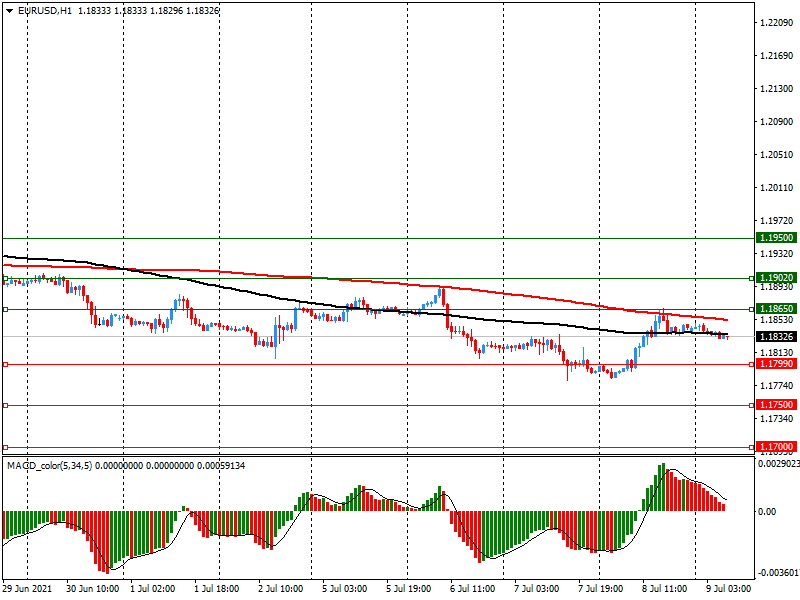
Comments:
- Overall open interest on the CALL options and PUT options with the expiration date July, 8 is 57292 contracts (according to data from July, 9) with the maximum number of contracts with strike price $1,1650 (3607);
GBP/USD
$1.4000 (1437)
$1.3950 (566)
$1.3900 (354)
Price at time of writing this review: $1.3772
Support levels (open interest**, contracts):
$1.3699 (593)
$1.3650 (2148)
$1.3600 (255)
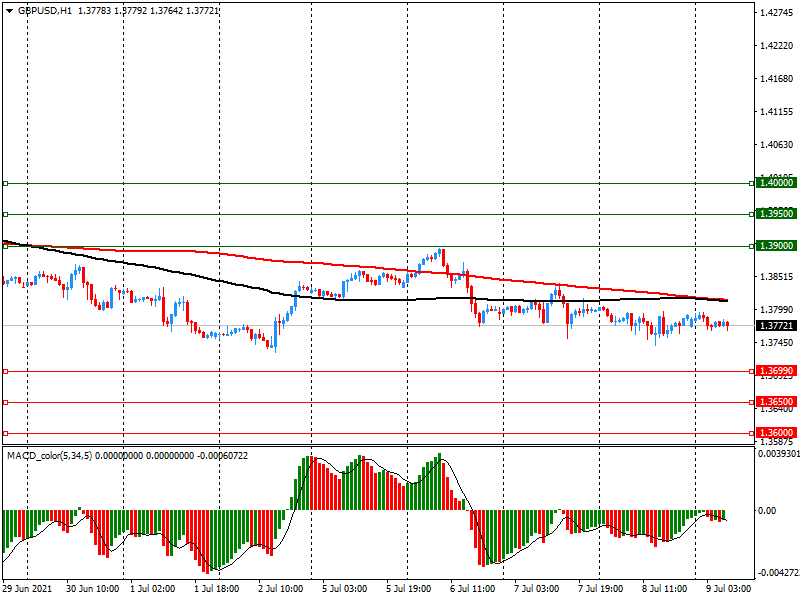
Comments:
- Overall open interest on the CALL options with the expiration date July, 9 is 17162 contracts, with the maximum number of contracts with strike price $1,4500 (3570);
- Overall open interest on the PUT options with the expiration date July, 9 is 15048 contracts, with the maximum number of contracts with strike price $1,3650 (2148);
- The ratio of PUT/CALL was 0.88 versus 0.88 from the previous trading day according to data from July, 8
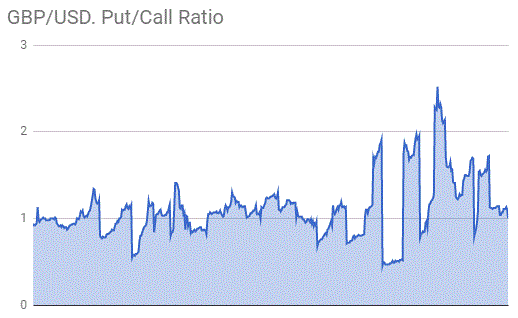
* - The Chicago Mercantile Exchange bulletin (CME) is used for the calculation.
** - Open interest takes into account the total number of option contracts that are open at the moment.
| Raw materials | Closed | Change, % |
|---|---|---|
| Brent | 74.59 | 1.11 |
| Silver | 25.894 | -0.88 |
| Gold | 1802.247 | -0.08 |
| Palladium | 2799.72 | -1.77 |
| Time | Country | Event | Period | Previous value | Forecast |
|---|---|---|---|---|---|
| 01:30 (GMT) | China | PPI y/y | June | 9% | 8.8% |
| 01:30 (GMT) | China | CPI y/y | June | 1.3% | 1.3% |
| 06:00 (GMT) | United Kingdom | Manufacturing Production (MoM) | May | -0.3% | 1% |
| 06:00 (GMT) | United Kingdom | Manufacturing Production (YoY) | May | 39.7% | 29.5% |
| 06:00 (GMT) | United Kingdom | Industrial Production (YoY) | May | 27.5% | 21.6% |
| 06:00 (GMT) | United Kingdom | Industrial Production (MoM) | May | -1.3% | 1.5% |
| 06:00 (GMT) | United Kingdom | Total Trade Balance | May | -0.9 | |
| 06:00 (GMT) | United Kingdom | GDP m/m | May | 2.3% | 1.5% |
| 06:00 (GMT) | United Kingdom | GDP, y/y | May | 27.6% | 25.9% |
| 10:00 (GMT) | Eurozone | ECB President Lagarde Speaks | |||
| 11:30 (GMT) | Eurozone | ECB Monetary Policy Meeting Accounts | |||
| 12:30 (GMT) | Canada | Employment | June | -68 | 195 |
| 12:30 (GMT) | Canada | Unemployment rate | June | 8.2% | 7.7% |
| 13:00 (GMT) | United Kingdom | NIESR GDP Estimate | Quarter II | 3.8% | |
| 14:00 (GMT) | U.S. | Wholesale Inventories | May | 1% | 1.1% |
| 17:00 (GMT) | U.S. | Baker Hughes Oil Rig Count | July | 376 |
| Pare | Closed | Change, % |
|---|---|---|
| AUDUSD | 0.74272 | -0.73 |
| EURJPY | 129.983 | -0.36 |
| EURUSD | 1.18435 | 0.44 |
| GBPJPY | 151.262 | -0.91 |
| GBPUSD | 1.37807 | -0.13 |
| NZDUSD | 0.69414 | -1.03 |
| USDCAD | 1.25294 | 0.41 |
| USDCHF | 0.91445 | -1.18 |
| USDJPY | 109.74 | -0.8 |







© 2000-2026. All rights reserved.
This site is managed by Teletrade D.J. LLC 2351 LLC 2022 (Euro House, Richmond Hill Road, Kingstown, VC0100, St. Vincent and the Grenadines).
The information on this website is for informational purposes only and does not constitute any investment advice.
The company does not serve or provide services to customers who are residents of the US, Canada, Iran, The Democratic People's Republic of Korea, Yemen and FATF blacklisted countries.
Making transactions on financial markets with marginal financial instruments opens up wide possibilities and allows investors who are willing to take risks to earn high profits, carrying a potentially high risk of losses at the same time. Therefore you should responsibly approach the issue of choosing the appropriate investment strategy, taking the available resources into account, before starting trading.
Use of the information: full or partial use of materials from this website must always be referenced to TeleTrade as the source of information. Use of the materials on the Internet must be accompanied by a hyperlink to teletrade.org. Automatic import of materials and information from this website is prohibited.
Please contact our PR department if you have any questions or need assistance at pr@teletrade.global.


 Bank
Bank transfers


