- Analytics
- News and Tools
- Market News
CFD Markets News and Forecasts — 06-07-2021
| Time | Country | Event | Period | Previous value | Forecast |
|---|---|---|---|---|---|
| 01:00 (GMT) | New Zealand | ANZ Business Confidence | July | -0.4 | |
| 05:00 (GMT) | Japan | Coincident Index | May | 95.3 | |
| 05:00 (GMT) | Japan | Leading Economic Index | May | 103.8 | |
| 06:00 (GMT) | United Kingdom | Halifax house price index | June | 1.3% | |
| 06:00 (GMT) | United Kingdom | Halifax house price index 3m Y/Y | June | 9.5% | |
| 06:00 (GMT) | Germany | Industrial Production s.a. (MoM) | May | -1% | 0.5% |
| 06:45 (GMT) | France | Trade Balance, bln | May | -6.24 | |
| 07:00 (GMT) | Switzerland | Foreign Currency Reserves | June | 902.466 | |
| 14:00 (GMT) | Canada | Ivey Purchasing Managers Index | June | 64.7 | |
| 14:00 (GMT) | U.S. | JOLTs Job Openings | May | 9.286 | 9.31 |
| 18:00 (GMT) | U.S. | FOMC meeting minutes | |||
| 23:50 (GMT) | Japan | Current Account, bln | May | 1321.8 | 1820.4 |
eFXdata reports that analysts at MUFG Research discuss GBP outlook and adopt a core bullish bias versus EUR over the coming months.
"The main trigger for pound outperformance at the start of this week has been the announcement from UK Prime Minister Boris Johnson yesterday that the government plans to proceed with the final stage of easing COVID restrictions on 19th July following a four-week delay."
"Allowing the UK economy to more fully re-open supports our bullish outlook for the pound. We expect EUR/GBP to fall into the low 0.8000’s as the UK economy continues to recover more robustly through the rest of this year, and speculation continues to build over BoE rate hikes a soon as next year."
FXStreet reports that economists at TD Securities prefer to focus on currencies where there is no ambiguity in the policy stance. The Bank of Canada (BoC), the Reserve Bank of New Zealand (RBNZ) and Norges remain on the "hawkish" frontlines while the Reserve Bank of Australia (RBA) has started to soften up. The CAD and the NZD are among the cheapest currencies in the G10 and there is merit in pursuing upside in the coming weeks.
“The BOC, RBNZ and Norges provide the clearest contrast from the rest of its peers, though the broader G10 seems to be showing signs of FOMO. Most recently, the RBA has softened its dovish tone in spite of more restrictive lockdown measures amidst a COVID-19 outbreak and slow vaccinations.”
“While the RBA does not appear to be in a rush to normalize the cash rate and has retained the April 2024 YCC target bond, the statement no longer maintains ‘2024 at the earliest’. Moreover, the Governor seems to have downplayed the impact of slow vaccinations on the medium-term outlook and the RBA has slowed its asset purchases. All in all, we do not think this is particularly strong enough to entice a major revival in AUD longs. Nonetheless, we think it should, at a minimum, reinforce the 2021 lows and the 200-DMA near 0.76 as key technical support and thresholds for AUD/USD.”
“The Q2 NZIER Business Survey points to a fairly strong turnaround in the coming six months with hiring intentions and investment shifting meaningfully higher. This has compelled speculation that the RBNZ might hike as soon as this year.”
“A strong Business Outlook Survey is likely to underpin the BoC's sentiment at next week's policy decision. What's more, last week's April industry level GDP report was far less negative than expected, which implies very little revision to the Bank's forecast as Q2 GDP is tracking in the low 3% compared to the BoC's 3.5% from the April MPR.”
“The NZD and the CAD are among the cheapest in the G10 at nearly 3%. While we see some merit in pursuing this against the USD, we certainly find comfort against the traditional 'funders' and even against the AUD. 1.25 looks to be the local top in USD/CAD for now, and we think fading rallies into next week's BoC meeting is appropriate.”
The
Institute for Supply Management (ISM) reported on Tuesday that its
non-manufacturing index (NMI) came in at 60.1 in June, which was 3.9 percentage
points lower than unrevised May’s all-time high reading of 64.0 percent. The latest reading pointed to the
growth in the services sector for the 13th straight month but at the slowest
pace in four months.
Economists
forecast the index to decrease to 63.5 last month. A reading above 50 signals
expansion, while a reading below 50 indicates contraction.
Of
the 18 services industries, 16 reported gains last month, the ISM said, even though
challenges with materials shortages, inflation, logistics and employment
resources continued to be an impediment to business conditions.
According
to the report, the ISM’s non-manufacturing Production measure fell 5.8
percentage points to 60.4 percent from the May reading, while its New Orders
gauge declined 1.8 percentage points to 62.1 percent and the Employment
indicator plunged 6.0 percentage points to 49.3 percent. Elsewhere, the Supplier
Deliveries index dropped 1.9 percentage points to 68.5 percent and the
Inventories indicator decreased 1.6 percentage points to 49.9 percent. On the
price front, the Prices index went down 1.1 percentage point to 79.5 percent,
indicating that prices increased in June, and at a slightly slower rate.
Commenting
on the data, the Chair of the ISM Services Business Survey Committee, Anthony
Nieves, noted, “The past relationship between the Services PMI and the overall
economy indicates that the Services PM for June (60.1 percent) corresponds to a
3.8-percent increase in real gross domestic product (GDP) on an annualized
basis.”
The
latest report by IHS Markit revealed on Tuesday the seasonally adjusted final
IHS Markit U.S. Services Business Activity Index (PMI) stood at 64.6 in June,
up from 70.4 in May and slightly below the earlier released “flash” estimate of
64.8. The latest reading pointed to the third-fastest growth in business
activity across the U.S. service sector since data collection began in October
2009, only slower than recent upturns in May and April, respectively.
Economists
had forecast the index to stay unrevised at 64.8.
According
to the report, rates of output and new order growth eased from May's record
highs, while capacity constraints meant backlogs of work increased at the quickest
rate for ten months. Although firms continued to hire new workers, challenges
finding suitable candidates weighed on the pace of job creation. On the price
front, input prices increased at the second-fastest rate on record as supplier
price hikes and greater wage bills pushed up cost burdens, while output charges
rose at the second-steepest rate on record, albeit with the rate of
inflation cooling from May’s peak.
U.S. stock-index futures traded mixed on Tuesday, as energy shares rose as oil prices touched multi-year highs, while the U.S.-listed Chinese names dropped after a fresh crackdown on tech stocks in China.
Global Stocks:
Index/commodity | Last | Today's Change, points | Today's Change, % |
Nikkei | 28,643.21 | +45.02 | +0.16% |
Hang Seng | 28,072.86 | -70.64 | -0.25% |
Shanghai | 3,530.26 | -4.06 | -0.11% |
S&P/ASX | 7,261.80 | -53.20 | -0.73% |
FTSE | 7,154.76 | -10.15 | -0.14% |
CAC | 6,559.19 | -8.35 | -0.13% |
DAX | 15,641.00 | -20.97 | -0.13% |
Crude oil | $75.79 | +0.84% | |
Gold | $1,810.70 | +1.54% |
FXStreet notes that GBP/USD weakness on Friday was abruptly reversed post the US payrolls report and the subsequent recovery has seen a bullish “reversal day” established. Economists at Credit Suisse look for the recovery to extend further to 1.3931/40, then to the 1.4000/15 neighborhood.
“With a bullish daily RSI momentum divergence in place, we look for the recovery from Friday to extend further. Resistance is seen next at 1.3900, above which can add weight to this view for a move back to 1.3931/40, then what we see as more important and tougher resistance at the late June reaction high and 55-day average at 1.4000/15.”
“Whilst we would look for a fresh cap at the 1.4000/15 region for now, a break would see a base complete to further reinforce the recovery with resistance then seen next at the downtrend from the beginning of June, seen at 1.4052 today.”
(company / ticker / price / change ($/%) / volume)
3M Co | MMM | 198.01 | -1.88(-0.94%) | 6074 |
ALCOA INC. | AA | 38.14 | 0.22(0.58%) | 29694 |
ALTRIA GROUP INC. | MO | 47.48 | -0.05(-0.11%) | 8640 |
Amazon.com Inc., NASDAQ | AMZN | 3,525.00 | 14.02(0.40%) | 36147 |
American Express Co | AXP | 172.49 | 3.99(2.37%) | 61243 |
Apple Inc. | AAPL | 140.28 | 0.32(0.23%) | 1157407 |
AT&T Inc | T | 29.29 | 0.06(0.21%) | 112664 |
Boeing Co | BA | 237.22 | 0.54(0.23%) | 45981 |
Caterpillar Inc | CAT | 218.14 | 0.38(0.17%) | 4156 |
Chevron Corp | CVX | 106.45 | 0.38(0.36%) | 22455 |
Cisco Systems Inc | CSCO | 53.55 | 0.01(0.02%) | 22876 |
Citigroup Inc., NYSE | C | 70.4 | -0.01(-0.01%) | 19069 |
Exxon Mobil Corp | XOM | 63.48 | 0.31(0.49%) | 98710 |
Facebook, Inc. | FB | 356.55 | 1.85(0.52%) | 51307 |
FedEx Corporation, NYSE | FDX | 299.87 | 0.49(0.16%) | 882 |
Ford Motor Co. | F | 14.86 | -0.07(-0.47%) | 348722 |
Freeport-McMoRan Copper & Gold Inc., NYSE | FCX | 37.92 | 0.78(2.10%) | 718397 |
General Electric Co | GE | 13.32 | -0.04(-0.30%) | 106850 |
General Motors Company, NYSE | GM | 58.68 | -0.28(-0.47%) | 60318 |
Goldman Sachs | GS | 373.6 | -0.56(-0.15%) | 3786 |
Google Inc. | GOOG | 2,589.90 | 15.52(0.60%) | 4924 |
Hewlett-Packard Co. | HPQ | 30.66 | -0.04(-0.13%) | 3363 |
HONEYWELL INTERNATIONAL INC. | HON | 221.17 | -0.15(-0.07%) | 336 |
Intel Corp | INTC | 56.78 | 0.02(0.04%) | 51493 |
International Business Machines Co... | IBM | 140.15 | 0.13(0.09%) | 15693 |
Johnson & Johnson | JNJ | 167.62 | -1.36(-0.80%) | 3637 |
JPMorgan Chase and Co | JPM | 155.9 | -0.13(-0.08%) | 18707 |
McDonald's Corp | MCD | 233.04 | -0.59(-0.25%) | 1118 |
Merck & Co Inc | MRK | 78.35 | -0.25(-0.32%) | 4765 |
Microsoft Corp | MSFT | 278.58 | 0.93(0.34%) | 92106 |
Nike | NKE | 159.66 | -0.08(-0.05%) | 6721 |
Pfizer Inc | PFE | 39.42 | -0.31(-0.78%) | 58286 |
Procter & Gamble Co | PG | 135.96 | 0.06(0.04%) | 3586 |
Starbucks Corporation, NASDAQ | SBUX | 115.22 | 0.25(0.22%) | 5471 |
Tesla Motors, Inc., NASDAQ | TSLA | 682 | 3.10(0.46%) | 198805 |
The Coca-Cola Co | KO | 54.14 | -0.04(-0.07%) | 19796 |
Twitter, Inc., NYSE | TWTR | 69.6 | 0.40(0.58%) | 34750 |
UnitedHealth Group Inc | UNH | 408.52 | -0.84(-0.21%) | 847 |
Verizon Communications Inc | VZ | 56.53 | 0.09(0.16%) | 40290 |
Visa | V | 239.1 | 0.47(0.19%) | 5252 |
Walt Disney Co | DIS | 176.8 | -0.31(-0.18%) | 10535 |
DuPont (DD) resumed with a Neutral at Credit Suisse; target $83
3M (MMM) downgraded to Neutral from Outperform at Credit Suisse; target raised to $212
American Express (AXP) upgraded to Buy from Neutral at Goldman; target raised to $225
FXStreet reports that in the opinion of strategists at Deutsche Bank the Brent crude oil is likely to break above $80/bbl this year, but retrace somewhat in 2022.
“We think fundamental strength is likely to support further gains, with Brent likely to break above $80/bbl this year.”
“Our central case rests on OPEC introducing no further supply beyond expected Iranian volumes beginning in September.”
“There are reasons not to extrapolate toward $100/bbl from the strength of the rally, and we forecast Q4-22 Brent to retrace to $75/bbl.”
“The call on OPEC will be limited by a slow but gradual US supply response, Iran should finally achieve a deal to reintroduce supply late this year, and OPEC members may grumble louder for quota increases around the May 2022 provisional date.”
FXStreet reports that FX Strategists at UOB Group note that USD/JPY is forecast to keep the 110.60-111.65 range for the time being.
24-hour view: “USD subsequently traded within a 110.78/111.18 range before closing little changed at 110.96 (-0.07%). The underlying tone has weakened and USD is likely to trade with a downward bias but a clear break of 110.60 is unlikely (the next support is at 110.30). On the upside, a breach of 111.10 would indicate that the current mild downward pressure has eased.”
Next 1-3 weeks: “There is not much to add to our update from yesterday (05 Jul, spot at 111.10). As highlighted, USD has likely moved into a consolidation phase and is likely to trade between 110.60 and 111.65 for a period of time.”
FXStreet reports that AUD/USD has moved sharply higher again after the Reserve Bank of Australia (RBA) meeting. Nevertheless, economists at Credit Suisse expect the aussie to remain capped below key resistance at 0.7597/7617.
“AUD/USD has recovered back to the ‘neckline’ to its major top at 0.7597/7617 following the RBA meeting, however, the recent weekly close below this key band of support reversed us into a medium-term bearish view and we therefore still expect this level to cap.”
“We look for a close back below the 200-day average at 0.7573, which should confirm that the ‘neckline’ resistance has held. Thereafter, near-term supports move to 0.7508, then 0.7447, before the more important 23.6% retracement of the upmove from 2020 at 0.7418."
“We still look for ‘neckline’ resistance at 0.7597/7617 to cap. Above here would suggest a deeper rally, with the next resistances seen at 0.7642/45, then 0.7694/7707, above which would make the top much less compelling.”
| Time | Country | Event | Period | Previous value | Forecast | Actual |
|---|---|---|---|---|---|---|
| 04:30 | Australia | Announcement of the RBA decision on the discount rate | 0.1% | 0.1% | 0.1% | |
| 06:00 | Germany | Factory Orders s.a. (MoM) | May | 1.2% | 1% | -3.7% |
| 06:00 | Australia | RBA's Governor Philip Lowe Speaks | ||||
| 08:30 | United Kingdom | PMI Construction | June | 64.2 | 63.8 | 66.3 |
| 09:00 | Eurozone | Retail Sales (MoM) | May | -3.9% | 4.4% | 4.6% |
| 09:00 | Eurozone | Retail Sales (YoY) | May | 23.3% | 8.2% | 9% |
| 09:00 | Eurozone | ZEW Economic Sentiment | July | 81.3 | 61.2 | |
| 09:00 | Germany | ZEW Survey - Economic Sentiment | July | 79.8 | 75.2 | 63.3 |
AUD appreciated against most of its major rivals in the European session on Tuesday following the announcement of the policy decision by the Reserve Bank of Australia (RBA).
At the July meeting, the RBA’s policymakers decided to leave the cash rate unchanged at 0.10%, in line with expectations. The central bankers also retained the April 2024 bond as the bond for the yield target and maintained the target of 10 basis points. At the same time, they announced an extension of the Bank’s current asset purchase program to “until at least mid November” (the program was originally planned to be completed in early September) but said the rate of the purchases would be reduced to AUD4 billion a week from AUD5 billion currently. “The Board is responding to the stronger-than-expected economic recovery and the improved outlook by adjusting the weekly amount purchased,” the RBA noted in its policy statement. In addition, the RBA’s board reiterated it “remains committed to maintaining highly supportive monetary conditions to support a return to full employment in Australia and inflation consistent with the target”. It also pledges not to hike the cash rate until actual inflation is sustainably within the 2% to 3% target range. The Australian central bank’s main scenario for the economy is that this condition will not be met before 2024.
FXStreet reports that Axel Rudolph, Senior FICC Technical Analyst at Commerzbank, notes that copper (LME) has resumed its ascent but needs to rise above 10120 to confirm longer-term up move.
“Copper’s slide has taken it to its June low at 9011, close to the 8800/8570 March to early April lows, before gradually giving way to an advance. This has so far taken it close to the three month resistance line at 9727.50 which together with the 55-day moving average at 9815.40 and also the June 11 high at 10120 would need to be exceeded for the resumption of the long-term uptrend to be confirmed. If so, the May peak at 10747.50 would be back in the picture.”
“Minor support is seen at the 9236 late June low and more support at the June low at 9011 as well as in the 8800/8570 zone.”
FXStreet reports that in the opinion of FX Strategists at UOB Group, USD/CNH is now likely to navigate within the 6.4480-6.4850 range in the next weeks.
24-hour view: “Downward momentum has improved a tad and USD could dip towards 6.4560 first before a rebound can be expected. The major support at 6.4480 is not expected to come into the picture. On the upside, a breach of 6.4740 (minor resistance is at 6.4700) would indicate that the downward pressure has eased.”
Next 1-3 weeks: “We highlighted yesterday (05 Jul, spot at 6.4730) that ‘the prospect for USD to move clearly above 6.4950 has diminished considerably’. We added, ‘only a break of 6.4590 would indicate that the upside risk has dissipated’ USD subsequently dropped to within a few pips of 6.4590 (low of 6.4596). While 6.4590 is still intact, upward pressure has dissipated and from here, USD is expected to consolidate and trade between 6.4480 and 6.4850.”
FXStreet reports that the Credit Suisse analyst team expects EUR/USD to extend its recovery to its 13-day exponential average at 1.1911/17, potentially price resistance at 1.1945.
“Friday post the US payrolls report has seen EURUSD recover back above the 78.6% retracement of the March/May rally at 1.1824 and with daily RSI momentum holding a bullish divergence there is a risk last week may have marked an in-range low.”
“Above 1.1885 suggests a minor base has also been completed to allow the recovery from Friday to extend further to test the 13-day exponential average at 1.1911/17, potentially price resistance at 1.1940/45. For now, our bias is for 1.1945 to then ideally cap for a fresh move lower.”
“Above 1.1945 though would further increase the risk a low is in place for further strength to what we see as more important resistance at the late June high at 1.1976.”
“Below support at 1.1850 is needed to see the risk remain directly lower for a fall back to Friday’s low at 1.1808.”
- Says he sees intense economic rebound in H2
Reuters reports that the Japan government said in revised estimates that Japan's economy is set to recover to pre-pandemic levels by the end of this year, helped by solid exports as well as consumer spending supported by progress in vaccinations.
In a mid-year review, the government now forecasts that during the fiscal year to end-March, the economy will expand 3.7% and at some point real gross domestic product (GDP) will exceed the 547 trillion yen ($4.9 trillion) marked in October-December 2019.
The forecasts appear to show a weaker expansion than the government's January estimate of 4.0% growth for this fiscal year. But that is largely due to a smaller-than-expected 4.6% contraction for the economy in fiscal 2020.
Growth for the next fiscal year is expected to slow to 2.2% as the pace of exports moderates. But robust domestic demand will lift GDP to a record 558 trillion yen, according to the projections which serve as a basis for policy-making and crafting the state budget.
According to the report from ZEW, the Indicator of Economic Sentiment for Germany decreased in the current July 2021 survey, falling 16.5 points to a new reading of 63.3 points. However, expectations for the next six months still remain at a very high level. The assessment of the economic situation in Germany once again improved strongly and stands at 21.9 points in July, 31.0 points higher than in the previous month. The economic situation in Germany is now rated similarly to how it was at the beginning of 2019, with the corresponding indicator now being back in positive territory for the first time in two years.
“The economic development continues to normalise. In the meantime, the situation indicator for Germany has clearly overcome the coronavirus-related decline. Although the ZEW Indicator of Economic Sentiment has once again fallen significantly, it is still at a very high level. The financial market experts therefore expect the overall economic situation to be extraordinarily positive in the coming six months,” comments ZEW President Professor Achim Wambach on current expectations.
The financial market experts’ sentiment concerning the economic development of the eurozone also recorded a decrease in the July survey, falling to a new reading of 61.2 points. This corresponds to a drop of 20.1 points compared to the previous month.
The situation indicator reached a new level of 6.0 points, climbing 30.4 points compared to June 2021.
According to the report from Eurostat, in May 2021, the seasonally adjusted volume of retail trade rose by 4.6% in both the euro area and the EU, compared with April 2021. Economists had expected a 4.4% increase in the euro area. In April 2021, the retail trade volume decreased by 3.9% in the euro area and by 3.6% in the EU.
In May 2021 compared with May 2020, the calendar adjusted volume of retail trade increased by 9.0% in the euro area and by 9.2% in the EU. Economists had expected a 8.2% increase in the euro area.
In the euro area in May 2021, compared with April 2021, the volume of retail trade increased by 8.8% for non-food products and by 8.1% for automotive fuels, while it decreased by 0.2% for food, drinks and tobacco. In the EU the volume of retail trade increased by 8.5% for non-food products and by 6.8% for automotive fuels, while it decreased by 0.3% for food, drinks and tobacco.
In the euro area in May 2021, compared with May 2020, the volume of retail trade increased by 28.4% for automotive fuels, by 14.8% for non food products and by 0.1% for food, drinks and tobacco. In the EU, the volume of retail trade increased by 25.0% for automotive fuels, by 15.0% for non-food products and by 0.3% for food, drinks and tobacco.
According to the report from IHS Markit/CIPS, the recovery in UK construction output gained further momentum during June. Overall construction activity expanded at the fastest pace since June 1997, supported by another sharp rise in new orders. Suppliers' delivery times lengthened to the greatest extent since the survey began just over 24 years ago, surpassing the previous record seen in April 2020. Severe shortages of construction products and materials resulted in a survey record rise in purchasing prices in June.
At 66.3 in June, up from 64.2 in May, the seasonally adjusted UK Construction PMI Total Activity Index signalled the strongest rate of output growth for exactly 24 years. Sharp increases in business activity were seen across all three main areas of the construction sector monitored by the survey.
Construction work in the house building sub-category (index at 68.2) increased at the fastest pace since November 2003. The second-best performing area was commercial work (66.9), with output rising at the strongest rate since March 1998. Meanwhile, civil engineering activity rose sharply in June (60.7), but the speed of growth eased to a three month low. Survey respondents widely commented on a rapid turnaround in demand for new construction work, especially residential building and commercial projects related to the reopening of the UK economy. Total new orders have increased in each of the past 13 months, although the latest expansion was slower than May's survey-record high.
Construction companies remain optimistic about growth prospects for the next 12 months. That said, the degree of confidence eased to its lowest since January, in part reflecting concerns about labour availability and the sustainability of the recent surge in demand.
FXStreet reports that economists at MUFG Bank note, the UK government embraces learning to live with COVID-19 approach, supporting the pound.
“The main trigger for pound outperformance at the start of this week has been the announcement from UK Prime Minister Boris Johnson yesterday that the government plans to proceed with the final stage of easing COVID-19 restrictions on 19th July following a four week delay.”
“Allowing the UK economy to more fully re-open supports our bullish outlook for the pound. We expect EUR/GBP to fall into the low 0.8000’s as the UK economy continues to recover more robustly through the rest of this year, and speculation continues to build over BoE rate hikes as soon as next year.”
“However, the bold approach from the UK government is not without risks. The first potential problem will be that a sharp increase in hopefully ‘mild’ COVID-19 cases while maintaining the legal requirement to self isolate will create disruption as more people are likely to have to isolate as they come into contact with more cases. The second bigger problem will come if the government’s calculations prove inaccurate and pressure on the NHS proves more challenging and then ultimately requires another lockdown heading into the autumn/winter. It would then trigger a correction lower for the pound if renewed restrictions are required.”
CNBC reports that former U.S. Energy Secretary Dan Brouillette told that oil prices could “very easily” hit $100 a barrel in the aftermath of the failed OPEC+ talks.
On the flip side, it’s “equally possible” that prices could collapse too.
“If there isn’t any agreement on production, and countries tend to go off and do their own thing, or do their own production, you could have a collapse of oil prices,” said Brouillette, who U.S. energy secretary from 2019 to 2021.
OPEC and its allies, referred to collectively as OPEC+, twice failed to reach a deal on oil output last week. On Monday, another attempt to resume talks broke down, and discussions were put off indefinitely.
Prices soared to three-year highs following the collapse of those talks on Monday. On Tuesday during Asia trading, they surged even higher.
Oil prices topping $100 would destroy demand, warned oil expert Dan Yergin, who said that it would not be in the interest of countries.
“I think countries recognize that $100 barrel oil would not be in (their) interest,” Yergin, the vice chairman of IHS Markit, told. “You would see governments pour more incentives into electric cars, and see the impact on demand.”
According to the report from IHS Markit, the Eurozone Construction Total Activity Index was unchanged at 50.3 in June, indicating a marginal expansion in construction activity. The increase meant that eurozone construction activity has expanded in each of the latest four months. Growth was linked to work commencing on new sites although some firms highlighted concerns that raw material shortages and increasing cost burdens had dampened new work. House building remained the only monitored sub-sector to signal growth, with further declines recorded for both commercial and civil engineering work.
Work undertaken on housing by eurozone construction firms increased modestly in June. The expansion was the fourth in consecutive months, but the pace of growth eased from that seen in May. A sustained and robust rise in Italian homebuilding activity was complemented by a renewed expansion in German homebuilding. French firms meanwhile signalled a contraction at the end of the second quarter, the first since February.
Eurozone commercial construction activity declined again in the latest survey period. This extended the current sequence of contraction to 16 months, although the pace of the decrease softened from May. Italian firms indicated the sharpest rise in commercial projects since January 2007, while French firms noted a second successive rise. However, this was offset by a marked decline in Germany.
The downturn in civil engineering activity continued in June, as work undertaken on infrastructure projects declined for the twenty-third month in a row. The rate of contraction eased from May and was moderate overall. The fall was also faster than for commercial work. Declines in civil engineering projects in Germany and France remained solid, while Italian firms signalled a slight reduction that was the first in four months.
Eurozone construction companies signalled stronger optimism regarding the year-ahead outlook for activity, the strongest since June 2019. This marked the sixth consecutive month of positive sentiment among. Both Italian and French firms indicated strong confidence in June, with the latter at the highest level since July 2019. German builders remained pessimistic, however.
FXStreet reports that economists at OCBC Bank forecast the EUR/USD to trend lower in the second half of the year as the European Central Bank (ECB) is set to remain more dovish compared to the Federal Reserve.
“Chatter about reopening positives leading to EZ macro outperformance have been building, and is often presented as a positive risk for the EUR. However, there appears to be limited upside momentum in terms of positive data surprises, especially relative to the US. Thus, remain fundamentally suspicious of EUR-positive arguments based on EZ macro outperformance.”
“Overall, expect the ECB balance sheet expansion to continue to outpace the Fed at this juncture. This belies our structural EUR-negative view in 2H 2021. Investment community long on the EUR, suggesting considerable scope for EUR declines should sentiment turn.”
| Time | Country | Event | Period | Previous value | Forecast | Actual |
|---|---|---|---|---|---|---|
| 01:00 | Australia | MI Inflation Gauge, m/m | June | -0.2% | 0.4% | |
| 04:30 | Australia | Announcement of the RBA decision on the discount rate | 0.1% | 0.1% | 0.1% | |
| 06:00 | Germany | Factory Orders s.a. (MoM) | May | 1.2% | 1% | -3.7% |
| 06:00 | Australia | RBA's Governor Philip Lowe Speaks |
During today's Asian trading, the US dollar declined moderately against major currencies. The focus of the market's attention this week is the minutes of the meeting of the Federal Reserve System (Fed) from June 15-16, which will be published on Wednesday.
The ICE index, which tracks the dynamics of the dollar against six currencies (euro, swiss franc, yen, canadian dollar, pound sterling and swedish krona), fell by 0.18%. However, the index still remains near a three-month high amid signals from representatives of the Fed leadership that they expect two rate hikes by the end of 2023.
The Australian dollar rose 0.8% against the US dollar. The Reserve Bank of Australia at the end of the July meeting left the key rate at a record low of 0.1%. At the same time, the regulator said that it will begin to abandon a soft monetary policy. From September, the volume of the asset repurchase program will be reduced to 4 billion Australian dollars from the current 5 billion dollars per week, and in October the purchase amounts will be revised again. Meanwhile, the main scenario of the RBA still does not imply an increase in the base rate before 2024.
FXStreet reports that according to Daniel Ghali, Commodity Strategist at TD Securities, the set-up for a summer breakout is forming.
“An overly cautious policy from OPEC+ has overwhelmingly driven the breakout higher in crude oil prices, more than offsetting concerns about mobility tied to a spreading Delta variant. Monday's stalemate for August production could lead to a significant overshoot in prices during this Summer Breakout.”
“With no increase in production, the forthcoming growth in demand should see global energy markets tighten up at an even faster pace than anticipated. This comes at a time when the cost of capital for traditional swing production has likely permanently risen, which argues for energy supply risk driving prices higher. This impasse will lead to a temporary and significantly larger-than-anticipated deficit, which should fuel even higher prices for the time being.”
According to provisional results of the Federal Statistical Office (Destatis), real (price adjusted) new orders decreased by a seasonally and calendar adjusted 3.7% in May 2021 compared with April 2021. Economists had expected a 1.0% increase. Excluding major orders, real new orders in manufacturing were 3.7% lower than in the previous month.
Compared with February 2020, which was the month before restrictions were imposed due to the corona pandemic in Germany, new orders in May 2021 were 6.2% higher in seasonally and calendar adjusted terms. Compared with May 2020, a month very strongly affected by the pandemic, the increase in calendar adjusted new orders amounted to +54.3%.
Domestic orders increased by 0.9% and foreign orders went down by 6.7% in May 2021 on the previous month. New orders from the euro area decreased 2.3%, and new orders from other countries fell by 9.3% compared with April 2021 following increases recorded in the last few months.
In May 2021, the manufacturers of intermediate goods saw new orders decrease by 3.6% compared with April 2021. The manufacturers of capital goods saw a decrease of 4.6% on the previous month. Regarding consumer goods, new orders rose by 3.9%.
For April 2021, the revision of the preliminary outcome resulted in an increase of 1.2% compared with March 2021 (provisional: -0.2).
EUR/USD
Resistance levels (open interest**, contracts)
$1.2002 (1334)
$1.1955 (2891)
$1.1915 (584)
Price at time of writing this review: $1.1877
Support levels (open interest**, contracts):
$1.1823 (537)
$1.1789 (1299)
$1.1745 (1075)
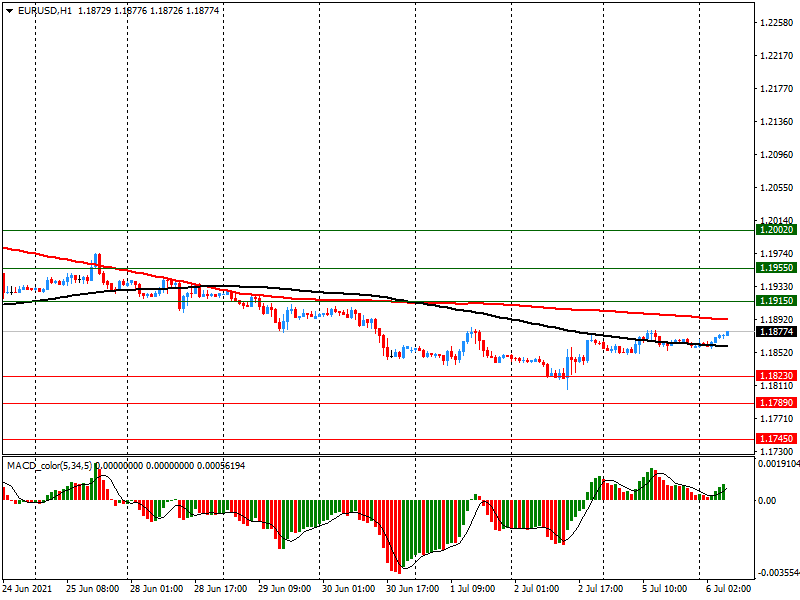
Comments:
- Overall open interest on the CALL options and PUT options with the expiration date July, 5 is 55294 contracts (according to data from July, 9) with the maximum number of contracts with strike price $1,1650 (3643);
GBP/USD
$1.4003 (1443)
$1.3956 (602)
$1.3913 (391)
Price at time of writing this review: $1.3883
Support levels (open interest**, contracts):
$1.3780 (1260)
$1.3758 (880)
$1.3727 (693)
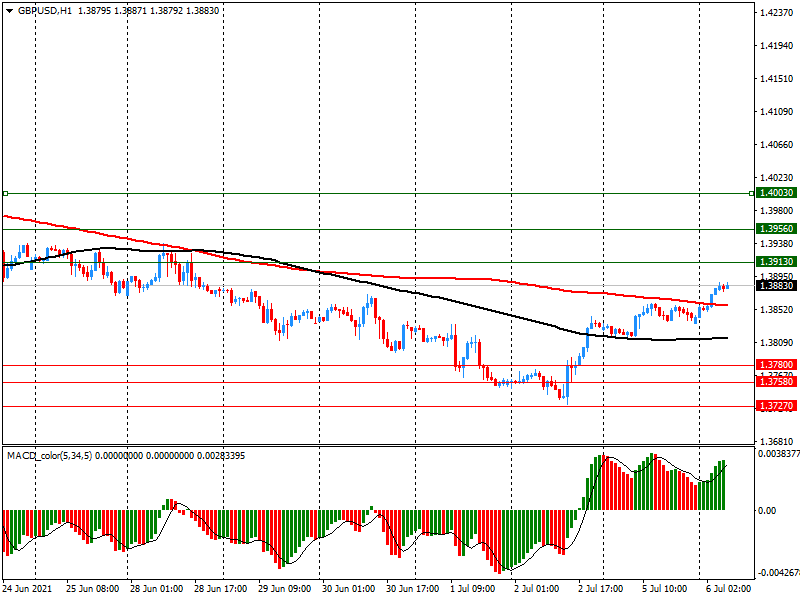
Comments:
- Overall open interest on the CALL options with the expiration date July, 9 is 17033 contracts, with the maximum number of contracts with strike price $1,4500 (3570);
- Overall open interest on the PUT options with the expiration date July, 9 is 17093 contracts, with the maximum number of contracts with strike price $1,4000 (2930);
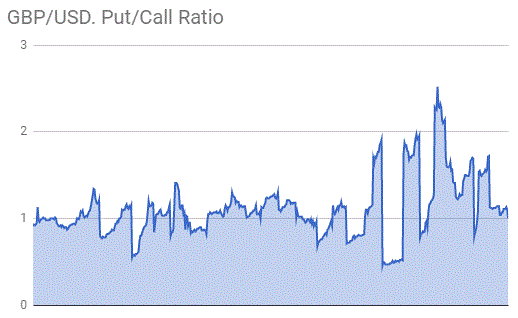
- The ratio of PUT/CALL was 1.00 versus 1.10 from the previous trading day according to data from July, 5
* - The Chicago Mercantile Exchange bulletin (CME) is used for the calculation.
** - Open interest takes into account the total number of option contracts that are open at the moment.
| Raw materials | Closed | Change, % |
|---|---|---|
| Brent | 77.46 | 1.29 |
| Silver | 26.444 | 0.07 |
| Gold | 1790.688 | 0.21 |
| Palladium | 2808.95 | 0.69 |
| Time | Country | Event | Period | Previous value | Forecast |
|---|---|---|---|---|---|
| 01:00 (GMT) | Australia | MI Inflation Gauge, m/m | June | -0.2% | |
| 04:30 (GMT) | Australia | Announcement of the RBA decision on the discount rate | 0.1% | 0.1% | |
| 06:00 (GMT) | Germany | Factory Orders s.a. (MoM) | May | -0.2% | 1.3% |
| 06:00 (GMT) | Australia | RBA's Governor Philip Lowe Speaks | |||
| 08:30 (GMT) | United Kingdom | PMI Construction | June | 64.2 | 63.5 |
| 09:00 (GMT) | Eurozone | Retail Sales (MoM) | May | -3.1% | 4.1% |
| 09:00 (GMT) | Eurozone | Retail Sales (YoY) | May | 23.9% | 7.9% |
| 09:00 (GMT) | Eurozone | ZEW Economic Sentiment | July | 81.3 | |
| 09:00 (GMT) | Germany | ZEW Survey - Economic Sentiment | July | 79.8 | 75.4 |
| 13:45 (GMT) | U.S. | Services PMI | June | 70.4 | 64.8 |
| 14:00 (GMT) | U.S. | ISM Non-Manufacturing | June | 64 | 63.5 |
| 22:30 (GMT) | Australia | AIG Services Index | June | 61.2 |
| Pare | Closed | Change, % |
|---|---|---|
| AUDUSD | 0.75278 | 0.07 |
| EURJPY | 131.6 | -0.08 |
| EURUSD | 1.18616 | -0.03 |
| GBPJPY | 153.584 | 0.06 |
| GBPUSD | 1.38433 | 0.09 |
| NZDUSD | 0.702 | -0.09 |
| USDCAD | 1.2336 | 0.13 |
| USDCHF | 0.92216 | 0.15 |
| USDJPY | 110.936 | -0.05 |







© 2000-2026. All rights reserved.
This site is managed by Teletrade D.J. LLC 2351 LLC 2022 (Euro House, Richmond Hill Road, Kingstown, VC0100, St. Vincent and the Grenadines).
The information on this website is for informational purposes only and does not constitute any investment advice.
The company does not serve or provide services to customers who are residents of the US, Canada, Iran, The Democratic People's Republic of Korea, Yemen and FATF blacklisted countries.
Making transactions on financial markets with marginal financial instruments opens up wide possibilities and allows investors who are willing to take risks to earn high profits, carrying a potentially high risk of losses at the same time. Therefore you should responsibly approach the issue of choosing the appropriate investment strategy, taking the available resources into account, before starting trading.
Use of the information: full or partial use of materials from this website must always be referenced to TeleTrade as the source of information. Use of the materials on the Internet must be accompanied by a hyperlink to teletrade.org. Automatic import of materials and information from this website is prohibited.
Please contact our PR department if you have any questions or need assistance at pr@teletrade.global.


 Bank
Bank transfers


