- Analytics
- News and Tools
- Market News
CFD Markets News and Forecasts — 05-07-2021
| Time | Country | Event | Period | Previous value | Forecast |
|---|---|---|---|---|---|
| 01:00 (GMT) | Australia | MI Inflation Gauge, m/m | June | -0.2% | |
| 04:30 (GMT) | Australia | Announcement of the RBA decision on the discount rate | 0.1% | 0.1% | |
| 06:00 (GMT) | Germany | Factory Orders s.a. (MoM) | May | -0.2% | 1.3% |
| 06:00 (GMT) | Australia | RBA's Governor Philip Lowe Speaks | |||
| 08:30 (GMT) | United Kingdom | PMI Construction | June | 64.2 | 63.5 |
| 09:00 (GMT) | Eurozone | Retail Sales (MoM) | May | -3.1% | 4.1% |
| 09:00 (GMT) | Eurozone | Retail Sales (YoY) | May | 23.9% | 7.9% |
| 09:00 (GMT) | Eurozone | ZEW Economic Sentiment | July | 81.3 | |
| 09:00 (GMT) | Germany | ZEW Survey - Economic Sentiment | July | 79.8 | 75.4 |
| 13:45 (GMT) | U.S. | Services PMI | June | 70.4 | 64.8 |
| 14:00 (GMT) | U.S. | ISM Non-Manufacturing | June | 64 | 63.5 |
| 22:30 (GMT) | Australia | AIG Services Index | June | 61.2 |
The
report from IHS Markit revealed on Monday that activity in Eurozone’s services
sector grew at the fastest pace in nearly 14 years in June.
According
to the report, the IHS Markit Eurozone PMI Services Business Activity Index
came in at 58.3 in June, up from 55.2 in May and a flash estimate of 58.0. This
was the highest reading since July 2007. Economists had forecast the indicator
to stay unrevised at 58.0.
According
to the report, the general easing of COVID-19 restrictions helped to support
market activity, which, in turn, resulted in a noticeable and accelerated increase
in new business volumes. Growth in new work was the strongest recorded by the
survey since July 2007. Elsewhere, employment in the service sector rose at the quickest pace since
October 2018. Capacity, however, came under significant pressure as evidenced
by an advance in backlogs of work outstanding for the third month in
succession. The net gain was the sharpest recorded since May 2000 and
encouraged firms to take on additional staff. On the price front, input costs
rose at the strongest rate since July 2008, while output charges were raised in
response to the greatest degree since October 2000.
Meanwhile,
the IHS Markit Eurozone PMI Composite Output Index increased to 59.5 in June from
57.2 in the previous month, being revised slightly up from the flesh estimate of
59.2. The latest reading pointed to the fastest rate of expansion in private
sector activity since June 2006.
The
report from IHS Markit revealed on Monday that the activity in Germany’s
services sector expanded at the fastest pace in more than a decade in June amid the
further easing of coronavirus containment measures.
According
to the report, the headline seasonally adjusted IHS Markit Germany Services PMI
Business Activity Index came in at 57.5 in June, up from 52.8 in May, but
marginally down from the flash estimate of 58.1. This, however, still was the
highest reading since March 2011. Economists had expected the reading to be
unrevised at 58.1.
According
to the report, the new business saw a sharp increase, while the expectations for
the year ahead improved markedly, with both helping drive a pick-up in job creation.
The upturn in activity coincided with further growth in inflationary
pressures: the rate of input cost inflation faced by service firms to the
quickest in the series history since 1997, while output prices also displayed a
record rate of inflation.
The
report from IHS Markit revealed on Monday that activity in France’s services
sector expanded at the fastest pace in almost 3 ½ years in June.
According
to the report, the headline seasonally adjusted IHS Markit France Services
Business Activity Index came in at 57.8 in June, up from 56.6 in May. The
reading pointed to the strongest rise in output in French services since January 2018,
underpinned by a further lifting of pandemic-related restrictions during the
month.
Economists
had forecast the indicator to increase to 57.4 in June.
According to the report, the demand for French services saw another healthy improvement in June, while jobs growth was the fastest for three months, new business from abroad recorded first increase since February 2020 and business confidence remained strongly positive. Elsewhere, price pressures intensified: cost inflation reached a 17-month high due to greater supplier fees and shortages of inputs, while the rate of output price inflation was the steepest in almost a decade.
FXStreet reports that economists at Rabobank expect the USD to stay on the front foot through the summer but don’t yet see a reason to adjust down their six-month EUR/USD 1.17 forecast.
“We are not yet convinced that real yields are offering enough support to allow a sustained and significant rally in the value of the USD vs. the EUR back to levels seen at the start of last year.”
“While we have adjusted down our 1 month EUR/USD forecast from 1.20 to 1.19, we are holding our 6 month forecast at 1.17. For the USD to rally further, we expect that the Fed would likely have to step further into the hawkish camp.”
According to the report from Insee, in May 2021, output decreased in the manufacturing industry (–0.5%, after –0.1%), as well as in the whole industry (–0.3%, after +0.1%). Economists had expected a 0.8% increase in the whole industry.
Compared to February 2020 (the last month before the first general lockdown), output remained in sharp decline in the manufacturing industry (–6.9%), as well as in the whole industry (–5.6%).
In May, output fell back sharply in the manufacture of transport equipment (–5.4% after –0.8%) due to shortages of raw materials in the automotive industry. It decreased more moderately in the manufacture of machinery and equipment goods (−0.8% after +0.9%) and in “other manufacturing” (–0.2% after –0.3%). On the contrary, it continued to grow in the manufacture of food products and beverages (+1.4% after +0.1%) and in mining and quarrying, energy, water supply (+0.9% after +1.1%). Output recovered in the manufacture of coke and refined petroleum (+5.2% after −1.0%).
In May 2021, output remained in sharp decline compared to its February 2020 level in most industrial activities. It slumped in the manufacture of transport equipment (−29.7%), both in the manufacture of other transport equipment (−30.0%) and in the manufacture of motor vehicles, trailers and semi-trailers (−29.2%). It also plummeted in the manufacture of coke and refined petroleum (−13.3%).
| Time | Country | Event | Period | Previous value | Forecast | Actual |
|---|---|---|---|---|---|---|
| 01:30 | Australia | ANZ Job Advertisements (MoM) | June | 6.8% | 3% | |
| 01:30 | Australia | Building Permits, m/m | May | -5.7% | -5% | -7.1% |
| 01:30 | Australia | Retail Sales, M/M | May | 1.1% | 0.4% | |
| 01:45 | China | Markit/Caixin Services PMI | June | 55.1 | 50.3 | |
| 06:45 | France | Industrial Production, m/m | May | 0.1% | 0.8% | -0.3% |
During today's Asian trading, the US dollar consolidated against the euro and the yen, but fell against the pound.
The focus of the market's attention this week is the minutes of the meeting of the Federal Reserve System from June 15-16, which will be published on Wednesday. The Fed kept the base interest rate in the range of 0-0. 25% per annum at the end of the June meeting. The Federal Reserve also confirmed that it will continue to buy back assets totaling $120 billion every month "until significant progress is made in moving towards the goals of maximum employment and price stability."
At the same time, Fed Chairman Jerome Powell said during a press conference following the meeting that the leaders of the Fed began to discuss a possible reduction in the asset repurchase program. These words were perceived by investors as a "hawkish" signal.
The minutes of the June meeting are likely to confirm the "hawkish" shifts in the Fed's policy, experts say. The appearance in the minutes of the meeting of new information for traders about when the Federal Reserve may begin to reduce the volume of asset repurchases will support the dollar.
Analysts also note that the latest statistical data on the US economy speak in favor of strengthening the dollar. The number of jobs in the US economy increased by 850 thousand in June, the highest pace in 10 months, the Labor Department reported on Friday. Experts on average expected an increase in the number of jobs in June by 700 thousand.
The ICE index, which tracks the dynamics of the dollar against six currencies (euro, swiss franc, yen, canadian dollar, pound sterling and swedish krona), rose by 0.02%.
CNBC reports that according to energy analyst Vandana Hari, investors have high expectations for the global oil recovery because of the economic pick up in the U.S. — but those expectations could be “too optimistic”.
“The U.S. rebound and the U.S. leaving behind all Covid restrictions almost … dramatically, starting in April and May, has taken the markets by surprise,” said Hari, founder and chief executive officer of Vanda Insights.
“But that has also set expectations on a slightly different, more optimistic path,” she told.
Multiple states in the U.S. have lifted Covid restrictions and a sense of normalcy has somewhat returned in the country.
“The U.S. macroeconomic indicators, the mobility indicators — are all going gangbusters,” she said.
Hari said the oil market appears to be using the U.S. as a model for what is going to unfold in the rest of the world.
“It may be too optimistic, but that’s what the market is factoring in,” she said.
Richer countries are leading the way when it comes to vaccinations and reopening, but Covid cases are still raging in many poorer nations that are unlikely to be able to follow the path of the U.S.
While she’s “constructive” about where oil prices may be headed, Hari said she was less of a “raging bull” than those calling for $80 in 2021 or even $100 oil in 2022.
Brent prices could stay close to where they are now — in the $70 to $75 range — at least for the summer months, she said.
Reuters reports that Bank of Japan Governor Haruhiko Kuroda reiterated the central bank's readiness to ease monetary policy further if needed, with a close eye on the coronavirus pandemic's impact on the economy.
Kuroda said economic activity will remain below pre-pandemic levels for the time being as curbs to prevent the spread of the virus weigh on service industries.
But he said Japan's economy will likely recover as the pandemic's impact subsides, with solid export demand underpinning corporate profits and capital expenditure.
"As the pandemic's impact gradually eases, the economy will recover thanks to increasing external demand, loose monetary policy and the effect of government stimulus measures," he said.
In a quarterly report released on Monday, the BOJ raised its economic assessment for two of Japan's nine regions. But it cut its view for two other regions and maintained its view for the remaining areas, as the pandemic continued to hit consumption.
RTTNews reports that survey results published by IHS Markit showed that China's service sector expanded at a much slower pace in June as the recent uptick in COVID-19 cases and reduced travel dampened overall new business.
In June, the services PMI fell notably to 50.3 from 55.1 in May. Nonetheless, the index has remained above the neutral 50 mark for the fourteenth successive month.
The slower upturn in business activity coincided with a softer increase in overall new work. New work from abroad meanwhile increased only marginally. Employment across the service sector fell for the first time in four months.
On the price front, the survey showed that input price inflation eased to the lowest since September 2020. Services companies lowered their average output charges for the first time in nearly a year in June.
Although services companies remained strongly upbeat regarding the year-ahead outlook for activity, the resurgence of the COVID-19 virus dampened overall optimism in June. Moreover, the degree of positive sentiment slipped to a nine-month low.
EUR/USD
Resistance levels (open interest**, contracts)
$1.2002 (1334)
$1.1955 (2891)
$1.1915 (584)
Price at time of writing this review: $1.1857
Support levels (open interest**, contracts):
$1.1823 (537)
$1.1789 (1299)
$1.1745 (1075)
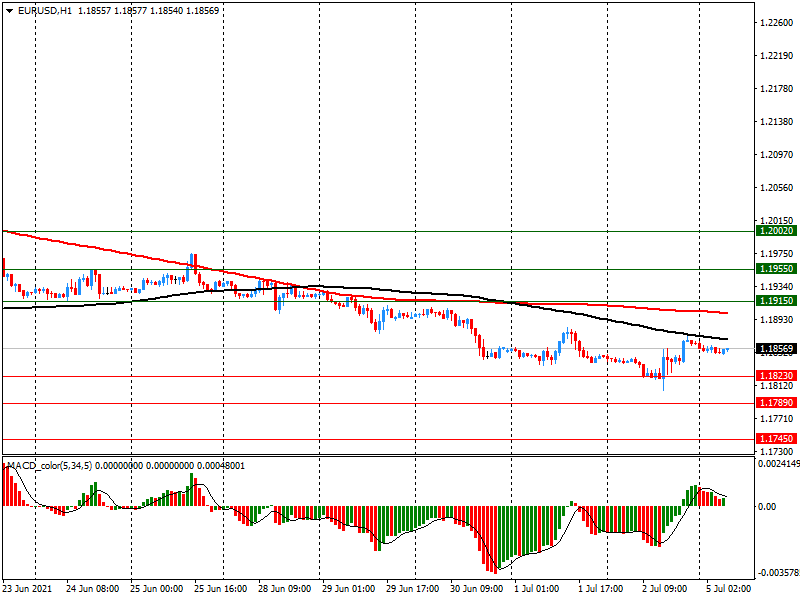
Comments:
- Overall open interest on the CALL options and PUT options with the expiration date July, 2 is 55294 contracts (according to data from July, 9) with the maximum number of contracts with strike price $1,1650 (3643);
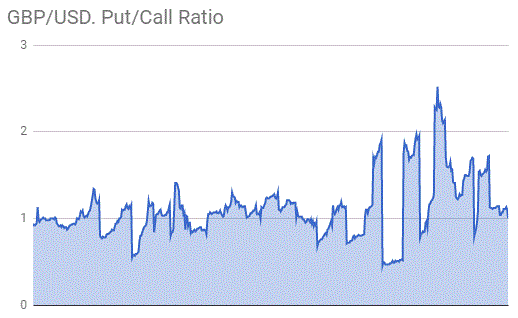
GBP/USD
$1.3956 (602)
$1.3913 (391)
$1.3877 (158)
Price at time of writing this review: $1.3820
Support levels (open interest**, contracts):
$1.3780 (1260)
$1.3758 (880)
$1.3727 (693)
Comments:
- Overall open interest on the CALL options with the expiration date July, 9 is 17033 contracts, with the maximum number of contracts with strike price $1,4500 (3570);
- Overall open interest on the PUT options with the expiration date July, 9 is 17093 contracts, with the maximum number of contracts with strike price $1,4000 (2930);
- The ratio of PUT/CALL was 1.00 versus 1.10 from the previous trading day according to data from July, 2
* - The Chicago Mercantile Exchange bulletin (CME) is used for the calculation.
** - Open interest takes into account the total number of option contracts that are open at the moment.
| Raw materials | Closed | Change, % |
|---|---|---|
| Brent | 76.68 | 0.67 |
| Silver | 26.432 | 1.64 |
| Gold | 1787.148 | 0.62 |
| Palladium | 2782.04 | 1.15 |
| Time | Country | Event | Period | Previous value | Forecast |
|---|---|---|---|---|---|
| 01:30 (GMT) | Australia | ANZ Job Advertisements (MoM) | June | 7.9% | |
| 01:30 (GMT) | Australia | Building Permits, m/m | May | -8.6% | -5% |
| 01:30 (GMT) | Australia | Retail Sales, M/M | May | 1.1% | |
| 01:45 (GMT) | China | Markit/Caixin Services PMI | June | 55.1 | |
| 06:45 (GMT) | France | Industrial Production, m/m | May | -0.1% | 0.8% |
| 07:50 (GMT) | France | Services PMI | June | 56.6 | 57.4 |
| 07:55 (GMT) | Germany | Services PMI | June | 52.8 | 58.1 |
| 08:00 (GMT) | Eurozone | Services PMI | June | 55.2 | 58.0 |
| 08:30 (GMT) | Eurozone | Sentix Investor Confidence | July | 28.1 | |
| 08:30 (GMT) | United Kingdom | Purchasing Manager Index Services | June | 62.9 | 61.7 |
| 14:30 (GMT) | Canada | Bank of Canada Business Outlook Survey | |||
| 22:00 (GMT) | New Zealand | NZIER Business Confidence | Quarter II | -13% | |
| 23:30 (GMT) | Japan | Labor Cash Earnings, YoY | May | 1.6% | |
| 23:30 (GMT) | Japan | Household spending Y/Y | May | 13% | 10.9% |
| Pare | Closed | Change, % |
|---|---|---|
| AUDUSD | 0.75243 | 0.76 |
| EURJPY | 131.706 | -0.32 |
| EURUSD | 1.18633 | 0.13 |
| GBPJPY | 153.544 | 0.05 |
| GBPUSD | 1.38305 | 0.51 |
| NZDUSD | 0.70285 | 0.93 |
| USDCAD | 1.2326 | -0.9 |
| USDCHF | 0.92057 | -0.5 |
| USDJPY | 111.01 | -0.45 |







© 2000-2026. All rights reserved.
This site is managed by Teletrade D.J. LLC 2351 LLC 2022 (Euro House, Richmond Hill Road, Kingstown, VC0100, St. Vincent and the Grenadines).
The information on this website is for informational purposes only and does not constitute any investment advice.
The company does not serve or provide services to customers who are residents of the US, Canada, Iran, The Democratic People's Republic of Korea, Yemen and FATF blacklisted countries.
Making transactions on financial markets with marginal financial instruments opens up wide possibilities and allows investors who are willing to take risks to earn high profits, carrying a potentially high risk of losses at the same time. Therefore you should responsibly approach the issue of choosing the appropriate investment strategy, taking the available resources into account, before starting trading.
Use of the information: full or partial use of materials from this website must always be referenced to TeleTrade as the source of information. Use of the materials on the Internet must be accompanied by a hyperlink to teletrade.org. Automatic import of materials and information from this website is prohibited.
Please contact our PR department if you have any questions or need assistance at pr@teletrade.global.


 Bank
Bank transfers


