- Analytics
- News and Tools
- Market News
CFD Markets News and Forecasts — 02-07-2021
On Monday, at 01:00 GMT, Australia will present inflation data from MI for June, and at 01:30 GMT - the index of the number of vacancies from ANZ for June. Also at 01:30 GMT, Australia will announce a change in the construction permits for May. At 01:45 GMT, China will publish the Markit/Caixin Services PMI for June. Then the focus will be on the indices of business activity in the services sector from Markit for June: France will report at 07:50 GMT, Germany will report at 07:55 GMT, and the eurozone will report at 08:00 GMT. At 08:30 GMT, the eurozone will present the Sentix investor confidence indicator for July. Also at 08:30 GMT, Britain will release the PMI index for the services sector for June and will announce changes in mortgage loans issued for the 1st quarter. At 14:30 GMT, in Canada, Bank of Canada Business Outlook Survey for the 2nd quarter will be released. At 22:00 GMT, New Zealand will publish the NZIER business confidence for the 2nd quarter. At 23:30 GMT, Japan will report on the change in the level of wages and household spending for May.
On Tuesday, at 01:30 GMT, Australia will release the NAB Business Confidence index for June. At 04:30 GMT in Australia, the RBA's interest rate decision will be announced. At 06:00 GMT, Germany will announce a change in the factory orders for May. At 08:30 GMT, Britain will publish the PMI index for the construction sector for June. At 09:00 GMT, Germany and the eurozone will release the ZEW Economic Sentiment for July. Also at 09: 00 GMT, the eurozone will report on the change in retail sales for May. At 13:45 GMT, the US will publish the PMI index for the services sector for June, and at 14:00 GMT - the ISM index of business activity in the services sector for June. At 22:30 GMT, Australia will release the AiG Services activity index for June.
On Wednesday, at 05:00 GMT, Japan will publish an index of leading economic indicators for May. At 06:00 GMT, Germany will announce a change in industrial production for May, and Japan will announce a change in equipment orders for June. At 06:45 GMT, France will report a change in the trade balance for May. At 07:00 GMT, Switzerland will announce a change in the SNB's foreign currency reserves for June. At 14:00 GMT, Canada will release the Ivey Managers ' Business Activity Index for June. Also at 14: 00 GMT, the United States will announce changes in the level of vacancies and labor turnover for May. At 18:00 GMT, the US will publish the minutes of the Fed meeting. At 23:50 GMT, Japan will report a change in the current account balance for May.
On Thursday, at 01:30 GMT, Australia will announce the change in retail trade for May. At 03:00 GMT, Canada will announce a change in the foreign trade balance for June. At 05:00 GMT, in Japan, a survey of economic observers for June will be released. At 05:45 GMT, Switzerland will report a change in the unemployment rate for June. At 06:00 GMT, Germany will announce a change in the trade balance for May. At 11:30 GMT, in the eurozone, the ECB monetary policy meeting accounts will be released. At 12:30 GMT, the US will announce a change in the number of initial applications for unemployment benefits, and at 14:30 GMT - a change in oil reserves according to the Ministry of Energy. At 19:00 GMT, the US will report on the change in the volume of consumer lending for May. At 23:50 GMT, Japan will announce a change in orders for machinery and equipment for May.
On Friday, at 01:30 GMT, China will release the consumer price index and the producer price index for June. At 06:00 GMT, Britain will announce changes in the volume of GDP, the volume of industrial production, the volume of manufacturing production and the balance of visible trade for May. At 06:45 GMT, France will report on the change in industrial production for May. At 12:30 GMT, Canada will announce changes in the unemployment rate and the number of people employed for June. At 14:00 GMT, the United States will announce a change in the wholesale inventories for May. At 17:00 GMT, in the United States, the Baker Hughes report on the number of active oil drilling rigs will be released.
- Coronavirus vaccines have played a decisive role in breaking the link between infection, death, and serious disease in UK
- We will follow scientific guidance on hosting soccer games
eFXdata reports that analysts at CIBC Research offer their thoughts on today's U.S. jobs report for June.
"Hiring accelerated in the US in June as recruitment efforts by employers paid off, resulting in 850K jobs being added. That was above the consensus expectation of 720K, with hiring in the leisure and hospitality sector, which continued to reopen, seeing the single largest gain in jobs amongst industries."
"While generous unemployment benefit top-ups in larger states are likely still preventing more workers from re-entering the labor force, as the participation rate remained steady in June, higher wages should bolster participation ahead, and we expect a continued acceleration in hiring over the rest of the summer to give the Fed enough confidence to announce an early 2022 tapering at the September meeting."
The
U.S. Commerce Department reported on Friday that the value of new factory
orders jumped 1.7 percent m-o-m in May, following a revised 0.1 percent m-o-m drop
in April (originally a 0.6 percent m-o-m decrease).
Economists
had forecast a 1.6 percent m-o-m climb.
According
to the report, orders for transport equipment (+7.7 percent m-o-m) posted the
biggest increase in May.
Meanwhile, total factory orders excluding transportation, a volatile part of the overall reading, went up 0.7 percent m-o-m in May (compared to an upwardly revised 1.0 percent m-o-m advance in April), while orders for nondefense capital goods excluding aircraft, a measure of business spending plans, edged up 0.1 percent m-o-m (compared to a 2.7 percent m-o-m advance in the previous month) instead of slipping 0.1 percent m-o-m as reported last month. The report also showed that shipments of core capital goods rose 1.1 percent m-o-m in May.
Overall,
durable goods orders climbed 2.3 percent m-o-m in May, while orders for
nondurable goods rose 1.0 percent m-o-m.
Statistics
Canada announced on Friday that the value of building permits issued by the
Canadian municipalities plunged 14.8 percent m-o-m in May, following a revised 0.2
percent m-o-m gain in April (originally a fall of 0.5 percent m-o-m).
Economists
had forecast a 0.3 percent decrease in May from the previous month.
According
to the report, the value of residential permits tumbled 16.0 percent m-o-m in May,
as single-family permits declined 10.6 percent m-o-m and permits for
multi-family dwellings plunged 20.6 percent m-o-m.
At
the same time, the value of non-residential building permits dropped 12.2
percent m-o-m in May, reflecting decreases in commercial (-15.8 percent m-o-m),
industrial (-14.6 percent m-o-m) and institutional (-3.4 percent m-o-m) permits.
In
y-o-y terms, building permits surged 22.0 percent in May.
U.S. stock-index futures rose on Friday after the key U.S. employment situation report showed stronger-than-expected job growth in June, and lower-than-forecast wage gains, which signaled that inflation pressures could ease into the latter part of the year.
Global Stocks:
Index/commodity | Last | Today's Change, points | Today's Change, % |
Nikkei | 28,783.28 | +76.24 | +0.27% |
Hang Seng | 28,310.42 | -517.53 | -1.80% |
Shanghai | 3,518.76 | -70.02 | -1.95% |
S&P/ASX | 7,308.60 | +43.00 | +0.59% |
FTSE | 7,141.19 | +16.03 | +0.22% |
CAC | 6,567.89 | +14.07 | +0.21% |
DAX | 15,696.52 | +92.71 | +0.59% |
Crude oil | $75.07 | -0.21% | |
Gold | $1,792.30 | +0.87% |
Statistics Canada announced on Friday that Canada recorded a trade deficit of CAD1.39 billion in May, compared with a revised CAD0.46-billion surplus in March (originally a CAD0.59-billion surplus).
Economists had forecast a surplus of CAD0.37 billion.
According
to the report, Canada’s exports fell 1.6 percent m-o-m to CAD49.53 billion in May,
as 8 of the 11 product sections posted declines, led by consumer goods (-8.8
percent m-o-m). Meanwhile, imports increased 2.1 percent m-o-m to CAD50.92
billion in May, with 7 of the 11 product sections recording gains, led by metal
and non-metallic mineral products (+17.7 percent m-o-m).
(company / ticker / price / change ($/%) / volume)
ALCOA INC. | AA | 37.12 | 0.16(0.43%) | 81567 |
ALTRIA GROUP INC. | MO | 48 | 0.17(0.36%) | 1819 |
Amazon.com Inc., NASDAQ | AMZN | 3,446.00 | 13.03(0.38%) | 14006 |
American Express Co | AXP | 166.58 | -0.36(-0.22%) | 498 |
AMERICAN INTERNATIONAL GROUP | AIG | 48.4 | 0.13(0.27%) | 36009 |
Apple Inc. | AAPL | 138.13 | 0.86(0.63%) | 731139 |
AT&T Inc | T | 29.2 | 0.09(0.31%) | 59268 |
Boeing Co | BA | 240.6 | 0.87(0.36%) | 57417 |
Caterpillar Inc | CAT | 217.35 | 0.64(0.30%) | 6041 |
Chevron Corp | CVX | 106.43 | 0.22(0.21%) | 6985 |
Cisco Systems Inc | CSCO | 53.25 | 0.18(0.34%) | 35798 |
Citigroup Inc., NYSE | C | 70.95 | -0.06(-0.08%) | 51184 |
Exxon Mobil Corp | XOM | 63.25 | -0.01(-0.02%) | 39700 |
Facebook, Inc. | FB | 355.48 | 1.09(0.31%) | 76046 |
FedEx Corporation, NYSE | FDX | 299 | -0.12(-0.04%) | 1974 |
Ford Motor Co. | F | 14.93 | 0.02(0.13%) | 236928 |
Freeport-McMoRan Copper & Gold Inc., NYSE | FCX | 37.35 | 0.26(0.70%) | 41695 |
General Electric Co | GE | 13.55 | 0.07(0.52%) | 275686 |
General Motors Company, NYSE | GM | 59.36 | 0.25(0.42%) | 74436 |
Goldman Sachs | GS | 375 | 0.01(0.00%) | 2500 |
Google Inc. | GOOG | 2,536.09 | 8.72(0.35%) | 25185 |
Hewlett-Packard Co. | HPQ | 30.4 | 0.05(0.16%) | 1436 |
Home Depot Inc | HD | 321.7 | 0.16(0.05%) | 2351 |
Intel Corp | INTC | 56.4 | 0.39(0.70%) | 93221 |
International Business Machines Co... | IBM | 146.97 | 0.13(0.09%) | 2466 |
Johnson & Johnson | JNJ | 166.52 | 0.56(0.34%) | 20698 |
Merck & Co Inc | MRK | 77.91 | -0.08(-0.10%) | 3310 |
Microsoft Corp | MSFT | 272.93 | 1.33(0.49%) | 94614 |
Nike | NKE | 158.15 | 0.15(0.09%) | 11172 |
Pfizer Inc | PFE | 39.49 | -0.07(-0.18%) | 34521 |
Procter & Gamble Co | PG | 135.5 | 0.26(0.19%) | 2070 |
Starbucks Corporation, NASDAQ | SBUX | 113.72 | 0.31(0.27%) | 7008 |
Tesla Motors, Inc., NASDAQ | TSLA | 674 | -3.92(-0.58%) | 533977 |
The Coca-Cola Co | KO | 54 | 0.04(0.07%) | 12005 |
Travelers Companies Inc | TRV | 151.77 | -0.06(-0.04%) | 756 |
Twitter, Inc., NYSE | TWTR | 68.47 | 0.36(0.53%) | 25615 |
Verizon Communications Inc | VZ | 56.36 | 0.07(0.12%) | 13662 |
Visa | V | 235.95 | 0.80(0.34%) | 4373 |
Wal-Mart Stores Inc | WMT | 139.43 | 0.11(0.08%) | 7173 |
Walt Disney Co | DIS | 177.5 | 0.24(0.14%) | 9263 |
Yandex N.V., NASDAQ | YNDX | 70.62 | 0.21(0.30%) | 1300 |
The
U.S. Commerce Department reported on Friday that the U.S. goods and services
trade deficit widened to $71.2 billion in May from a revised $69.1 billion in
the previous month (originally a gap of $68.9 billion).
Economists
had expected a deficit of $71.4 billion.
According
to the report, the May advance in the goods and services reflected a gain in
the goods deficit of $2.3 billion to $89.2 billion and an increase in the
services surplus of $0.1 billion to $17.9 billion.
In May,
exports of goods and services from the U.S. rose 0.6 percent m-o-m to $206.0
billion, while imports jumped 1.3 percent m-o-m to $277.3 billion, as the
global COVID-19 pandemic and the economic recovery continued to impact
international trade.
Year-to-date,
the goods and services deficit surged 45.8 percent from the same period in
2020. Exports jumped 11.4 percent, while imports climbed 18.7 percent.
The
U.S. Labor Department announced on Friday that nonfarm payrolls rose by 850,000
in June after a revised 583,000 increase in the prior month (originally a gain of
559,000). This marked the largest monthly advance since August 2020.
According to the report, notable job gains were recorded in leisure and hospitality (+343,000), public and private education (+269,000), professional and business services (+72,000), retail trade (+67,000), and other services (56,000).
The unemployment rate edged up to 5.9 percent in June from 5.8 percent in May.
Economists
had forecast the nonfarm payrolls to increase by 700,000 and the jobless rate
to drop to 5.7 percent.
The
labor force participation rate was unchanged at 61.6 percent in June, while hourly earnings for private-sector workers
advanced 0.3 percent m-o-m (or $0.10) to $30.40, following a revised 0.4
percent m-o-m increase in May (originally an increase of 0.5 percent m-o-m). Economists
had forecast the average hourly earnings to increase 0.4 percent m-o-m in June.
Over the year, the average hourly earnings jumped 3.6 percent in June,
following a revised 1.9 percent climb in May (originally an increase of 2.0
percent).
The
average workweek reduced by 0.1 hour to 34.7 hours in June, being below economists'
forecast for 34.9 hours.
FXStreet notes that the dollar remains a touch higher against most G10 and major EM currencies ahead of today’s US employment data. Economists at TD Securities think a much larger upside surprise is needed for the USD to sustain further gains and see a potential acceleration to the upside.
“We think today's reading could be a very important one for FX market direction over the next several weeks – particularly on an outlier.”
“TD is above the consensus on headline NFP, but we think FX markets would take this in stride as small upside risks already look priced. After a solid run higher, we think the USD would need a particularly strong reading to see sustained upside from current levels.”
“A weaker report would naturally see some correction of recent gains, but we think investors may be more forgiving of a disappointment.”
“Our base case suggests the USD is likely to revert to consolidation mode against most G10 peers – at least once any knee-jerk reaction is out of the way.”
| Time | Country | Event | Period | Previous value | Forecast | Actual |
|---|---|---|---|---|---|---|
| 09:00 | Eurozone | Producer Price Index, MoM | May | 0.9% | 1.2% | 1.3% |
| 09:00 | Eurozone | Producer Price Index (YoY) | May | 7.6% | 9.5% | 9.6% |
USD rose slightly against most of its major rivals in the European session on Friday ahead of the release of a crucial U.S. jobs report for June due at 12:30 GMT, which is expected to help determine the pace of improvement in the labor market and may affect the Federal Reserve’s economic outlook.
The U.S. Dollar Index (DXY), measuring the U.S. currency's value relative to a basket of foreign currencies, inched up 0.03% to 92.63.
Economists forecast that today's employment report will show that the U.S. employers added 700,000 jobs in June, while the unemployment rate edged down to 5.7% from May's 5.8% and hourly earnings rose 0.4% m/m and 3.7% y/y.
There are fears that better-than-expected jobs readings and signs of rising inflation, which could be underpinned by higher-than-forecast annual wage gains, might lead to a hawkish reaction from the Fed policymakers.
FXStreet reports that during June the Australian dollar weakened against the US dollar from 0.7709 to 0.7497 as the aussie has underperformed recently even as risk sentiment has continued to improve. Looking ahead, the AUD/USD pair is set to appreciate mildly, according to economists at MUFG Bank.
“A key risk over the short-term is the evidence of increased COVID-19infections with the Delta variant becoming prevalent. The government describes the outbreak as a ‘very real and present danger’ that has prompted a tightening of restrictions in numerous cities with around 50% of the population impacted. While mindful of that risk the data from Australia is likely to continue confirming a strong rebound (assuming no prolonged COVID-19 disruption).”
“The July RBA meeting will be important and we expect a modified, more flexible QE program to be confirmed that could allow for slowing purchases as the economy improves. That would be the most beneficial for AUD and support our view of modest, gradual appreciation.”
FXStreet reports that the Credit Suisse analyst team notes that GBP/USD has broken below its recent low at 1.3786 – which should lead to further weakness within the range. The next support is seen at the more important 1.3369/48 zone, which is a major medium-term inflection point.
“We look for a move to minor support at 1.3717 next and likely the more important April low, 200-day average and 38.2% retracement of the rally from last September at 1.3669/48, where we would look for a more important floor.”
“It’s worth highlighting that a break below 1.3669/48 would complete a major ‘double top’, however this is viewed as a risk scenario for now.”
“Short-term resistance moves to 1.3873/86, which now ideally caps to maintain the short-term downward pressure.”
FXStreet reports that analysts at Goldman Sachs offer a sneak peek at what to expect from Friday’s US Nonfarm Payrolls (NFP) due for release at 12:30 GMT.
“We estimate nonfarm payrolls rose 750k in June.”
“Coupled with very strong labor demand and continued progress on vaccinations and reopening, we believe job growth probably picked up further in the month.”
“We estimate a two-tenths drop in the unemployment rate to 5.6%.”
FXStreet reports that EUR/USD has closed below the confirmed uptrend from the 2020 low at 1.1862, with next short-term supports at 1.1824, then 1.1767. Key resistance is seen at 1.1976/2001, which economists at Credit Suisse expect to cap, even on a payrolls miss.
“EUR/USD has weakened further ahead of the NFP report today, closing decisively below the important uptrend from March last year and the recent low at 1.1862/47, which further increases the risk of a broader trend turn, with weekly MACD also getting closer to turning outright bearish for the first time since 2020.”
“The next short-term support is seen at the 78.6% retracement of the March/May rally just below at 1.1824, which the market is testing this morning. A break below here is expected, which should see a move to the lower end of the converging range, now at 1.1767.”
“Near-term resistance moves to 1.1911/24. More important resistance is back at 1.1976/2001, which should hold now, even on a NFP miss in our view. Only a close back above here would point to further sideways ranging.”
Reuters reports that the ECB's top supervisor Andrea Enria said that the ECB plans to come down on banks that are taking too much risk via financial instruments such as leveraged loans and equity-related derivatives.
Enria said there was evidence that despite the pandemic, banks had become complacent and risk-hungry after years of low rates and rising stock markets, pointing to a boom in the issuance of collateralised loans obligations, equity swaps and loans to already indebted clients.
"Concrete signs of risk build-up have in our view become apparent in the risky asset segments of leveraged debt and equity-related derivatives, which warrant intensified supervision," Enria said during an academic lecture via weblink.
He warned this bonanza may come to an end when pandemic-fighting public support measures are withdrawn or if investors start expecting inflation to accelerate and demand higher interest rates.
FXStreet reports that in the view of economists at MUFG Bank, more risk factors in the second half of the year could restrain the degree of China’s economic recovery, implying a volatile USD/CNY.
“For the next couple months, we don’t expect persisting depreciation pressure on CNY against USD but in fact, we forecast a weaker USD for the remainder of 2021 despite the recent strengthening of USD.”
“Compared with H1, we see increasing factors in H2 which could restrain economic growth. We expect China’s growth to moderate further in Q3 and Q4. Considering a potential weaker US dollar in H2 and the risks surrounding the development of the Chinese economy, we expect USD/CNY to be range bound over the remaining months of this year with higher volatility. During H1 2022, as we expect the USD gets a lift from building speculation on rate hikes in 2023, combined with less supportive fundamentals and possible more balanced trade balance, we expect USD/CNY to increase to 6.6000 by the end of 2022H2.”
According to the report from Eurostat, in May 2021, industrial producer prices rose by 1.3% in the euro area and by 1.4% in the EU, compared with April 2021. Economists had expected a 1.2% increase in the euro area. In April 2021, prices increased by 0.9% in both the euro area and the EU. In May 2021, compared with May 2020, industrial producer prices increased by 9.6% in both the euro area and the EU. Economists had expected a 9.5% increase in the euro area.
Industrial producer prices in the euro area in May 2021, compared with April 2021, increased by 2.1% in the energy sector, by 1.8% for intermediate goods, by 0.4% for capital goods and by 0.3% for durable consumer goods and for non-durable consumer goods. Prices in total industry excluding energy increased by 0.9%.
In the EU, industrial producer prices increased by 2.3% in the energy sector, by 1.9% for intermediate goods, by 0.4% for capital goods and for durable consumer goods, and by 0.3% for non-durable consumer goods. Prices in total industry excluding energy increased by 1.0%.
CNBC reports that oil prices surged toward $80 a barrel for the first time in more than two and a half years.
Analysts on Wall Street believe there is potential for crude markets to climb even higher in the coming months, although not everyone is convinced that’s the case.
Brent futures rose more than 8% in June while WTI climbed over 10%, reaching their highest levels since Oct. 2018.
Analysts attribute the oil price rally to a combination of factors, including the rollout of Covid-19 vaccines, a gradual easing of lockdown measures and massive production cuts from OPEC and non-OPEC members — an energy alliance known as OPEC+.
Looking ahead, Goldman Sachs sees Brent prices averaging above $80 in the third quarter, with potential spikes “well above” that level as demand comes roaring back. JPMorgan, meanwhile, expects crude oil prices to “decisively” break into the $80s during the final three months of the year.
Analysts at Bank of America are even more bullish. They argue Brent prices could see $100 in the summer of next year. That would mark a return to triple digits for the first time since 2014.
It comes as all three of the world’s main forecasting agencies — OPEC, the International Energy Agency and the U.S. Energy Information Administration — expect a demand-led recovery to pick up speed in the second half of 2021.
FXStreet reports that economists at TD Securities judge that the Fed’s continued emphasis on its full employment mandate should see the yellow metal recover most of its recent losses.
“Despite the fact that the FOMC dot plot shifted hike expectations forward to late-2023 (median showing a 50bp of tightening), with many traders expecting a much earlier tightening, and that Chair Powell has started the process of preparing markets for QE tapering, we believe that the yellow metal is still in a position which makes a return to a $1,900/oz range possible into 2022.”
“Real rates likely remain at the lows, along the longer end of the curve too, which is gold accretive. The yellow metal has a good chance to again move into $1,900/oz territory for part of 2022-23. In addition to all the macro and monetary policy ducks having to be lined up in a row, there will need to be an improvement to physical demand in China and India for our optimistic view to play out.”
Reuters reports that the European Central Bank's President Christine Lagarde said in an interview that the euro zone's economy is beginning to rebound from a pandemic-induced slump but this recovery remains fragile.
"We agreed to maintain (emergency stimulus) measures until at least March 2022, and in any case, until we judge that the coronavirus crisis phase is over. While the recovery is now beginning to get under way, it remains fragile", Lagarde told.
FXStreet reports that economists at MUFG Bank have lowered their forecast for the EUR/USD pair from 1.26 to 1.22.
“The incoming economic data across the eurozone makes for a compelling case for the ECB to consider altering the pace of PEPP purchases come the September meeting. Given the PEPP program is scheduled to end fully in Q1 2022, some tapering down of the rate would be desirable to avoid a bigger cliff-edge decline next year. The economic backdrop will justify it too. Real GDP is set to be supported in H2 2021 by the release of funds under the EU Recovery Fund.”
“The FOMC announcements have led us to lower our year-end EUR/USD target from 1.2600 to 1.2200 but the prospect of ECB tapering and the benefits from the EU Recovery Fund should help provide a modest lift to EUR in H2 2021.”
During today's Asian trading, the US dollar consolidated against major currencies, remaining near a three-month high. Traders expect that strong data on the US labor market may push it even higher.
Analysts expect an increase in the number of jobs in June by 700 thousand and a decrease in unemployment to 5.6% from 5.8% in May.
Data on the labor market are key for the policy of the Federal Reserve System, along with inflation indicators. The dynamics of employment will largely depend on when the Federal Reserve will begin to curtail large-scale stimulus measures introduced at the peak of the coronavirus pandemic.
The ICE index, which tracks the dynamics of the dollar against six currencies (euro, swiss franc, yen, canadian dollar, pound sterling and swedish krona), rose by 0.02%.
"The dollar started July strongly; if today's nonfarm payrolls data meets or exceeds the forecast, this will support its momentum," DBS Bank noted.
"In 2021, there was a tendency for the dollar to show an asymmetric reaction to labor data: the result below the forecast led to a greater depreciation of the dollar compared to the growth provoked by stronger than expected figures," ING said.
Bloomberg reports that Morgan Stanley downgraded its outlook on China’s property sector amid risks policy makers may take steps to cool down the overheated market and further prompt developers to cut their debt levels.
Morgan Stanley lowered its recommendation on the real estate sector in the world’s second-largest economy to “in-line” from “attractive”. Strong sales continue and land sales “haven’t cooled off yet, therefore policy risk is still to the downside,” analysts led by Elly Chen wrote.
China’s property firms are under pressure as Beijing moves to curb leverage in the debt-laden sector that has propelled a record wave of corporate bond defaults this year.
“We expect government property policy to remain relatively tight, and cities with overheated markets may need to tighten further,” the Morgan Stanley analysts wrote. That may potentially include the introduction of a property tax pilot program and inclusion of commercial paper into ‘three red lines’ evaluation.”
Morgan Stanley also sees China continuing its deleveraging push by tightening funding channels and setting property-related loan caps for lenders. It expects gross margins for developers under its coverage to fall 0.4 percentage points in the 2021 fiscal year due to bookings of low-margin projects with high land cost and capped selling prices.
EUR/USD
Resistance levels (open interest**, contracts)
$1.2006 (966)
$1.1963 (2020)
$1.1926 (537)
Price at time of writing this review: $1.1838
Support levels (open interest**, contracts):
$1.1779 (780)
$1.1740 (640)
$1.1695 (1343)
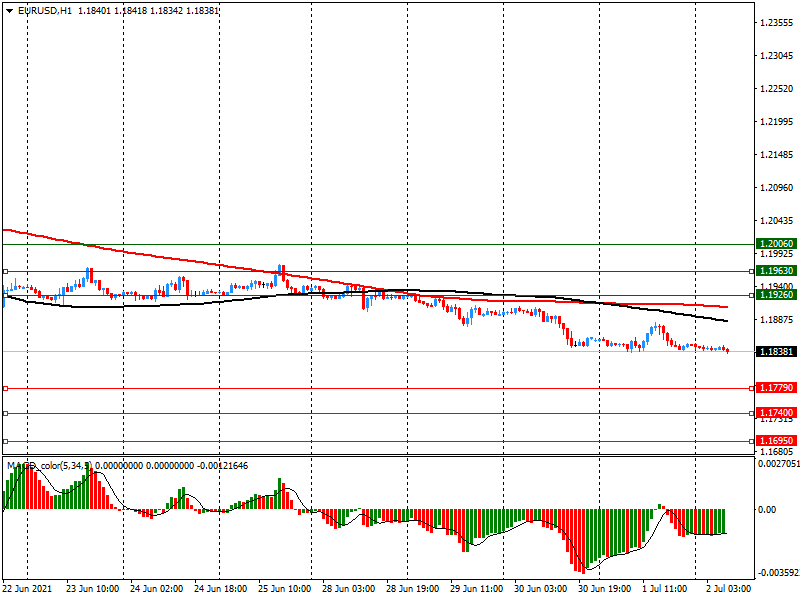
Comments:
- Overall open interest on the CALL options and PUT options with the expiration date July, 1 is 52085 contracts (according to data from July, 9) with the maximum number of contracts with strike price $1,2050 (5829);
GBP/USD
$1.3956 (596)
$1.3912 (298)
$1.3872 (160)
Price at time of writing this review: $1.3743
Support levels (open interest**, contracts):
$1.3718 (858)
$1.3695 (573)
$1.3665 (564)
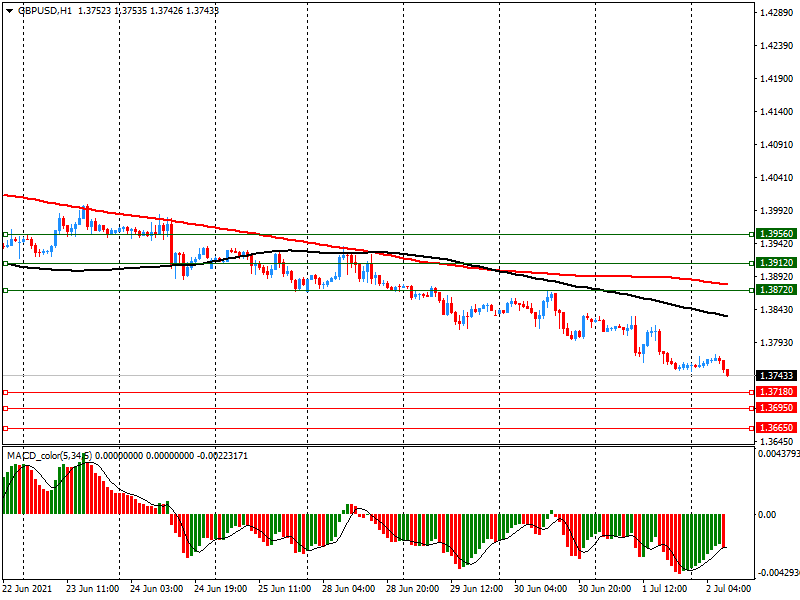
Comments:
- Overall open interest on the CALL options with the expiration date July, 9 is 16598 contracts, with the maximum number of contracts with strike price $1,4500 (3570);
- Overall open interest on the PUT options with the expiration date July, 9 is 18274 contracts, with the maximum number of contracts with strike price $1,4000 (2931);
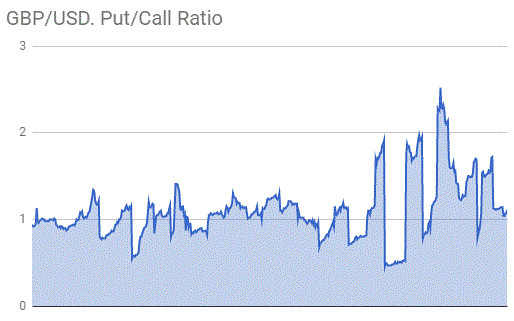
- The ratio of PUT/CALL was 1.10 versus 1.13 from the previous trading day according to data from July, 1
* - The Chicago Mercantile Exchange bulletin (CME) is used for the calculation.
** - Open interest takes into account the total number of option contracts that are open at the moment.
Reuters reports that the International Monetary Fund raised its 2021 U.S. growth projection sharply to 7.0% due to a strong recovery from the COVID-19 pandemic and an assumption that much of President Joe Biden's infrastructure and social spending plans will be enacted.
The IMF's latest forecast, marking the fastest U.S. growth pace since 1984, compares with an April projection of 4.6% growth in 2021. The Fund raised its 2022 U.S. GDP growth forecast to 4.9%, up from its previous 3.5% April forecast.
The new forecasts, contained in the IMF's annual assessment of U.S. economic policies, assume that the U.S. Congress will pass the Biden administration'sAmerican Jobs Plan and American Families Plan infrastructure, social spending and tax reform plans this year at a size and composition similar to their original proposals.
The IMF forecast came shortly after the Congressional Budget Office offered a similarly optimistic forecast for the U.S. economy this year. The non-partisan CBO's forecast makes no assumption about the fate of Biden's spending plans and is based only on current laws. read more
The Fund added that it expects U.S. inflation expectations to remain well-anchored, but these "will be obscured in the coming months by significant, transitory movements in relative prices," which could cause personal consumption expenditure inflation to peak temporarily near to 4% later this year.
FXStreet reports that in opinion of FX Strategists at UOB Group, AUD/USD’s downside is expected to meet the next support at 0.7450.
24-hour view: “While we expected AUD to weaken yesterday, we were of the view that ‘0.7450 is likely out of reach’. Our view was not wrong as AUD dropped to 0.7461 before closing on a soft note at 0.7471 (-0.38%). Despite the decline, downward momentum has not improved by much. That said, there is room for AUD dip below 0.7450 but it is unlikely able to maintain a foothold below this level. The next support at 0.7410 is unlikely to come into the picture. On the upside, a break of 0.7495 (minor resistance is at 0.7480) would indicate that the current downward pressure has eased.”
RTTNews reports that survey data from ANZ showed that New Zealand consumer confidence remained broadly unchanged in June. The consumer sentiment index came in at 114.1 in July versus 114.0 in the previous month.
The proportion of people who believe it is a good time to buy a major household item, a key retail indicator, rose 3 points to +22 in July.
Perceptions of current financial situations advanced 7 points to +14 percent, by far its strongest post-COVID level.
Perceptions regarding the next year's economic outlook rose 4 points to +3 percent, while the five-year outlook fell 8 points to +10 percent.
At the same time, CPI inflation expectations jumped 0.7 percentage points to 5.1 percent, a record high in data that starts in 2010.
| Raw materials | Closed | Change, % |
|---|---|---|
| Brent | 75.98 | 1.19 |
| Silver | 26.006 | -0.41 |
| Gold | 1776.338 | 0.37 |
| Palladium | 2758.48 | -0.72 |
| Time | Country | Event | Period | Previous value | Forecast |
|---|---|---|---|---|---|
| 09:00 (GMT) | Eurozone | Producer Price Index, MoM | May | 1% | 1.2% |
| 09:00 (GMT) | Eurozone | Producer Price Index (YoY) | May | 7.6% | 9.5% |
| 12:30 (GMT) | U.S. | Average workweek | June | 34.9 | 34.9 |
| 12:30 (GMT) | U.S. | Government Payrolls | June | 67 | |
| 12:30 (GMT) | U.S. | Manufacturing Payrolls | June | 23 | 28 |
| 12:30 (GMT) | Canada | Building Permits (MoM) | May | -0.5% | -0.3% |
| 12:30 (GMT) | U.S. | Average hourly earnings | June | 0.5% | 0.4% |
| 12:30 (GMT) | U.S. | Labor Force Participation Rate | June | 61.6% | |
| 12:30 (GMT) | U.S. | Private Nonfarm Payrolls | June | 492 | 600 |
| 12:30 (GMT) | Canada | Trade balance, billions | May | 0.59 | 0.37 |
| 12:30 (GMT) | U.S. | International Trade, bln | May | -68.9 | -71.4 |
| 12:30 (GMT) | U.S. | Nonfarm Payrolls | June | 559 | 700 |
| 12:30 (GMT) | U.S. | Unemployment Rate | June | 5.8% | 5.7% |
| 14:00 (GMT) | U.S. | Factory Orders | May | -0.6% | 1.6% |
| 17:00 (GMT) | U.S. | Baker Hughes Oil Rig Count | July | 372 |
| Pare | Closed | Change, % |
|---|---|---|
| AUDUSD | 0.74673 | -0.41 |
| EURJPY | 132.133 | 0.34 |
| EURUSD | 1.18482 | -0.06 |
| GBPJPY | 153.463 | -0.06 |
| GBPUSD | 1.37602 | -0.46 |
| NZDUSD | 0.69634 | -0.35 |
| USDCAD | 1.24382 | 0.35 |
| USDCHF | 0.92522 | 0.08 |
| USDJPY | 111.515 | 0.4 |







© 2000-2026. All rights reserved.
This site is managed by Teletrade D.J. LLC 2351 LLC 2022 (Euro House, Richmond Hill Road, Kingstown, VC0100, St. Vincent and the Grenadines).
The information on this website is for informational purposes only and does not constitute any investment advice.
The company does not serve or provide services to customers who are residents of the US, Canada, Iran, The Democratic People's Republic of Korea, Yemen and FATF blacklisted countries.
Making transactions on financial markets with marginal financial instruments opens up wide possibilities and allows investors who are willing to take risks to earn high profits, carrying a potentially high risk of losses at the same time. Therefore you should responsibly approach the issue of choosing the appropriate investment strategy, taking the available resources into account, before starting trading.
Use of the information: full or partial use of materials from this website must always be referenced to TeleTrade as the source of information. Use of the materials on the Internet must be accompanied by a hyperlink to teletrade.org. Automatic import of materials and information from this website is prohibited.
Please contact our PR department if you have any questions or need assistance at pr@teletrade.global.


 Bank
Bank transfers


