- Analytics
- News and Tools
- Market News
CFD Markets News and Forecasts — 01-07-2021
| Time | Country | Event | Period | Previous value | Forecast |
|---|---|---|---|---|---|
| 09:00 (GMT) | Eurozone | Producer Price Index, MoM | May | 1% | 1.2% |
| 09:00 (GMT) | Eurozone | Producer Price Index (YoY) | May | 7.6% | 9.5% |
| 12:30 (GMT) | U.S. | Average workweek | June | 34.9 | 34.9 |
| 12:30 (GMT) | U.S. | Government Payrolls | June | 67 | |
| 12:30 (GMT) | U.S. | Manufacturing Payrolls | June | 23 | 28 |
| 12:30 (GMT) | Canada | Building Permits (MoM) | May | -0.5% | -0.3% |
| 12:30 (GMT) | U.S. | Average hourly earnings | June | 0.5% | 0.4% |
| 12:30 (GMT) | U.S. | Labor Force Participation Rate | June | 61.6% | |
| 12:30 (GMT) | U.S. | Private Nonfarm Payrolls | June | 492 | 600 |
| 12:30 (GMT) | Canada | Trade balance, billions | May | 0.59 | 0.37 |
| 12:30 (GMT) | U.S. | International Trade, bln | May | -68.9 | -71.4 |
| 12:30 (GMT) | U.S. | Nonfarm Payrolls | June | 559 | 700 |
| 12:30 (GMT) | U.S. | Unemployment Rate | June | 5.8% | 5.7% |
| 14:00 (GMT) | U.S. | Factory Orders | May | -0.6% | 1.6% |
| 17:00 (GMT) | U.S. | Baker Hughes Oil Rig Count | July | 372 |
eFXdata reports that MUFG Research discusses the USD outlook in light of its strong performance in June.
"The US dollar strengthened further yesterday extending its advance in Jun... The dollar index strengthened by 2.9% in June in what was its best monthly performance since November 2016 when Donald Trump was elected President... The key trigger for the turnaround in the US dollar has been the hawkish shift in the Fed’s policy stance."
"We anticipate that the US dollar and US yields will become more sensitive to the US data releases. A key first test will be the latest non-farm payrolls report on Friday, especially given the Fed leadership have since reiterated that they want see the labour market return closer to full employment before beginning to seriously consider raising rates. Like in previous months market participants are going into Friday’s NFP report in anticipation that it could show much stronger employment growth of closer to 1 million job gains in June."
The
Commerce Department announced on Thursday that construction spending fell 0.3
percent m-o-m in May after a revised 0.1 percent m-o-m advance in April
(originally a 0.2 percent m-o-m increase). This was the first monthly decrease
in construction spending in three months.
Economists
had forecast construction spending growing 0.4 percent m-o-m in May.
According
to the report, spending on private construction declined 0.3 percent m-o-m,
while investment in public construction dropped 0.2 percent m-o-m.
A
report from the Institute for Supply Management (ISM) showed on Thursday the
U.S. manufacturing sector’s activity expanded in June, albeit at a slower pace than in May.
The
ISM's index of manufacturing activity came in at 60.6 percent last month, down
0.6 percentage point from an unrevised May reading of 61.2 percent. The June reading pointed to the
growth in the manufacturing sector for the 13th straight month but at the
slowest pace since December 2020.
Economists'
had forecast the indicator to edge down to 61.0 percent.
A
reading above 50 percent indicates expansion, while a reading below 50 percent
indicates contraction.
According
to the report, the New Orders Index was at 66.0 percent, dropping 1.0
percentage point from the May reading, the Employment Index came
in at 49.9 percent, also falling 1.0 percentage point from the May figure and slipping into contraction territory, the
Supplier Deliveries Index stood at 75.1 percent, down 3.7 percentage points
from the May print and the Backlog of Orders Index registered 64.5 percent, 6.1
percentage points lower compared to the May reading. Meanwhile, the Production
Index posted 60.8 percent, a gain of 2.3 percentage points compared to the May figure
and the Inventories Index registered 51.1 percent, 0.3 percentage point higher
than the May reading. On the price front, the Prices Index recorded 92.1
percent, up 4.1 percentage points compared to the May print.
Timothy
R. Fiore, Chair of the ISM Manufacturing Business Survey Committee, noted that
the Survey Committee members reported that their companies and suppliers
continue to struggle to meet increasing rates of demand. “Record-long
raw-material lead times, wide-scale shortages of critical basic materials,
rising commodities prices and difficulties in transporting products are
continuing to affect all segments of the manufacturing economy,” he said. “Worker
absenteeism, short-term shutdowns due to parts shortages, and difficulties in
filling open positions continue to be issues that limit manufacturing-growth
potential. Optimistic panel sentiment remained strong, with 16 positive
comments for every cautious comment.” Fiore also noted that the past
relationship between the PMI and the overall economy indicated that the PMI for
June (60.6 percent) corresponds to a 5-percent increase in real gross domestic
product (GDP) on an annualized basis.
The
latest report by IHS Markit revealed on Thursday the seasonally adjusted IHS
Markit final U.S. Manufacturing Purchasing Managers’ Index (PMI) came in at 62.1
in June, unchanged on May, but dropping slightly from the earlier released “flash”
reading of 62.6. The June reading pointed to a noticeable improvement in
operating conditions, which was the joint-strongest since data collection began
in May 2007.
Economists
had forecast the index to stay unrevised at 62.6.
According
to the report, the May gain in headline figure was supported by further significant
expansions in output and new orders, but supply chain disruptions worsened and weighed
on production capacity. Vendor performance deteriorated to the greatest extent
on record. Input costs, meanwhile, showed the biggest gain on record, feeding
through to another record increase in factory selling prices.
U.S. stock-index futures traded mixed on Thursday, as investors assessed the latest U.S. weekly jobless claims data ahead of Friday’s release of the key June labour market report and prepared for the start of the Q2 corporate earnings season later this month.
Global Stocks:
Index/commodity | Last | Today's Change, points | Today's Change, % |
Nikkei | 28,707.04 | -84.49 | -0.29% |
Hang Seng | - | - | - |
Shanghai | 3,588.78 | -2.42 | -0.07% |
S&P/ASX | 7,265.60 | -47.40 | -0.65% |
FTSE | 7,090.86 | +53.39 | +0.76% |
CAC | 6,534.58 | +26.75 | +0.41% |
DAX | 15,547.90 | +16.86 | +0.11% |
Crude oil | $75.49 | +2.75% | |
Gold | $1,777.00 | +0.30% |
FXStreet reports that analysts at Credit Suisse note that USD/JPY looks to be making a decisive break above 110.97, with a close above here sharply increasing the risk of a major base.
“USD/JPY has surged beyond the prior 110.97 high for the year after. We stay bullish and look for a move to long-term and more important resistance, starting at 111.93 and stretching up to the 112.40 high of 2019.”
“Whilst we would expect a cap in the 112.40 vicinity at first, we are biased to a break higher in due course, which would then see a much more significant base established to mark a more important turn higher and a move to 114.00 next.”
“Near term support moves to 111.01/110.93, which now ideally holds to maintain the breakout."
(company / ticker / price / change ($/%) / volume)
3M Co | MMM | 199.28 | 0.65(0.33%) | 527 |
ALCOA INC. | AA | 37.06 | 0.22(0.60%) | 35594 |
ALTRIA GROUP INC. | MO | 47.77 | 0.09(0.19%) | 7540 |
Amazon.com Inc., NASDAQ | AMZN | 3,439.94 | -0.22(-0.01%) | 17559 |
American Express Co | AXP | 165.8 | 1.00(0.61%) | 79559 |
AMERICAN INTERNATIONAL GROUP | AIG | 47.79 | 0.19(0.40%) | 655 |
Apple Inc. | AAPL | 136.85 | -0.11(-0.08%) | 436002 |
AT&T Inc | T | 28.87 | 0.09(0.31%) | 65941 |
Boeing Co | BA | 241.55 | 1.99(0.83%) | 47954 |
Caterpillar Inc | CAT | 218.91 | 1.28(0.59%) | 3609 |
Chevron Corp | CVX | 106.25 | 1.51(1.44%) | 66939 |
Cisco Systems Inc | CSCO | 53.13 | 0.13(0.25%) | 7126 |
Citigroup Inc., NYSE | C | 71.16 | 0.41(0.58%) | 153726 |
Exxon Mobil Corp | XOM | 63.9 | 0.82(1.30%) | 212187 |
Facebook, Inc. | FB | 347.6 | -0.11(-0.03%) | 44898 |
FedEx Corporation, NYSE | FDX | 298 | -0.33(-0.11%) | 925 |
Ford Motor Co. | F | 14.91 | 0.05(0.34%) | 332064 |
Freeport-McMoRan Copper & Gold Inc., NYSE | FCX | 37.59 | 0.48(1.29%) | 89262 |
General Electric Co | GE | 13.58 | 0.12(0.89%) | 243547 |
General Motors Company, NYSE | GM | 59.39 | 0.22(0.37%) | 36367 |
Goldman Sachs | GS | 382.24 | 2.71(0.71%) | 26026 |
Google Inc. | GOOG | 2,506.00 | -0.32(-0.01%) | 1776 |
Hewlett-Packard Co. | HPQ | 30.15 | -0.04(-0.13%) | 208 |
Home Depot Inc | HD | 320 | 1.11(0.35%) | 670 |
Intel Corp | INTC | 56.04 | -0.10(-0.18%) | 103664 |
Johnson & Johnson | JNJ | 165.01 | 0.27(0.16%) | 2002 |
JPMorgan Chase and Co | JPM | 156.5 | 0.96(0.62%) | 107040 |
McDonald's Corp | MCD | 231.5 | 0.51(0.22%) | 1203 |
Merck & Co Inc | MRK | 77.89 | 0.12(0.15%) | 2658 |
Microsoft Corp | MSFT | 270.63 | -0.27(-0.10%) | 52323 |
Nike | NKE | 154.88 | 0.39(0.25%) | 2984 |
Pfizer Inc | PFE | 39.2 | 0.04(0.10%) | 15258 |
Procter & Gamble Co | PG | 135.33 | 0.40(0.30%) | 1571 |
Starbucks Corporation, NASDAQ | SBUX | 112 | 0.19(0.17%) | 2286 |
Tesla Motors, Inc., NASDAQ | TSLA | 683.7 | 4.00(0.59%) | 171838 |
The Coca-Cola Co | KO | 54.25 | 0.14(0.26%) | 9065 |
Twitter, Inc., NYSE | TWTR | 68.67 | -0.14(-0.20%) | 12784 |
Visa | V | 234.3 | 0.48(0.21%) | 11348 |
Wal-Mart Stores Inc | WMT | 140.66 | -0.36(-0.26%) | 3898 |
Walt Disney Co | DIS | 176.15 | 0.38(0.22%) | 20229 |
NVIDIA (NVDA) target raised to $1000 from $750 at BMO Capital Markets
The data from the Labor Department revealed on Thursday the number of applications for unemployment decrease more than expected last week.
According to the report, the initial claims for unemployment benefits fell by 51,000 to 364,000 for the week ended June 26. This was the lowest reading since March 2020, when the COVID-19 pandemic struck.
Economists
had expected 390,000 new claims last week.
Claims for the prior week
were revised upwardly to 415,000 from the initial estimate of 411,000.
Meanwhile,
the four-week moving average of jobless claims decreased to 392,750 from an
upwardly unrevised 398,750 in the previous week.
Continuing claims rose to 3,469,000 from an upwardly
revised 3,413,000 in the previous week.
| Time | Country | Event | Period | Previous value | Forecast | Actual |
|---|---|---|---|---|---|---|
| 06:00 | Germany | Retail sales, real adjusted | May | -6.8% | 5% | 4.2% |
| 06:00 | Germany | Retail sales, real unadjusted, y/y | May | 5.1% | -2.4% | |
| 06:30 | Switzerland | Retail Sales (MoM) | May | -2.9% | -1.8% | |
| 06:30 | Switzerland | Retail Sales Y/Y | May | 37.7% | 2.8% | |
| 06:30 | Switzerland | Consumer Price Index (YoY) | June | 0.6% | 0.7% | 0.6% |
| 06:30 | Switzerland | Consumer Price Index (MoM) | June | 0.3% | 0.2% | 0.1% |
| 07:00 | Eurozone | ECB President Lagarde Speaks | ||||
| 07:30 | Switzerland | Manufacturing PMI | June | 69.9 | 69.7 | 66.7 |
| 07:50 | France | Manufacturing PMI | June | 59.4 | 58.6 | 59 |
| 07:55 | Germany | Manufacturing PMI | June | 64.4 | 64.9 | 65.1 |
| 08:00 | Eurozone | Manufacturing PMI | June | 63.1 | 63.1 | 63.4 |
| 08:00 | United Kingdom | BOE Gov Bailey Speaks | ||||
| 08:30 | United Kingdom | Purchasing Manager Index Manufacturing | June | 65.6 | 64.2 | 63.9 |
| 09:00 | Eurozone | Unemployment Rate | May | 8.1% | 8% | 7.9% |
| 12:00 | OPEC | OPEC-JMMC Meetings |
EUR rose against its major rivals in the European session on Thursday, supported by an upward revision to the Eurozone’s June manufacturing PMI.
IHS Markit reported its final estimates showed that the expansion of the Eurozone’s manufacturing sector hit new heights during June, with the headline PMI registering a fresh survey record for a fourth successive month. According to the report, the IHS Markit Eurozone Manufacturing PMI rose to 63.4 last month, up from 63.1 in May and firmer than a preliminary estimate of 63.1. Production growth in the Eurozone’s manufacturing sector remained elevated during June, edging up slightly since May to a level close to the survey records registered earlier in the year, the IHS Markit notes. Output continued to grow at especially strong rates in both Germany and the Netherlands.
The region’s May data on the jobless rate also offered cause for optimism. According to Eurostat, the euro area’s unemployment rate declined to 7.9% in May from 8.1% in the previous month. Economists had forecast the rate to edge down to 8%. This was the lowest reading since May 2020. The number of people out of work decreased by 306,000 from the previous month, as the region’s labor market showed signs of recovery amid the gradual easing of coronavirus restrictions.
Investors also digested media reports that the ECB is to lift the dividend cap on banks in the near future and plans to hold several special meetings in the coming weeks to work out differences surrounding its new inflation strategy.
FXStreet reports that in the view of Jane Foley, Senior FX Strategist at Rabobank, the JPY is only likely to strengthen significantly in the coming months if risk appetite were to take a tumble.
“How the JPY performs in the coming weeks vs the USD will depend on how the Fed communicates its monetary policy. Although a couple of other factors are also likely to influence the USD/JPY pair, the widespread assumption that there will be no tightening in BoJ policy settings for some time suggests little support for the JPY from domestic policies in Japan.”
“On June 24, in the wake of the June FOMC meeting, USD/JPY made a new fifteen-month high close to 111.12. The latter was a significant psychological resistance level and the failure to hold about this high almost inevitably triggered some selling pressures. Despite the pullback, USD/JPY remained in the uptrend drawn from the start of the year. A break above the 111.12 level could see the currency pair lurch higher.”
“Triggered by the June FOMC, USD/JPY has rallied faster than our expectations, we have brought forward our forecasts and now see a move to 112 by the end of the year.”
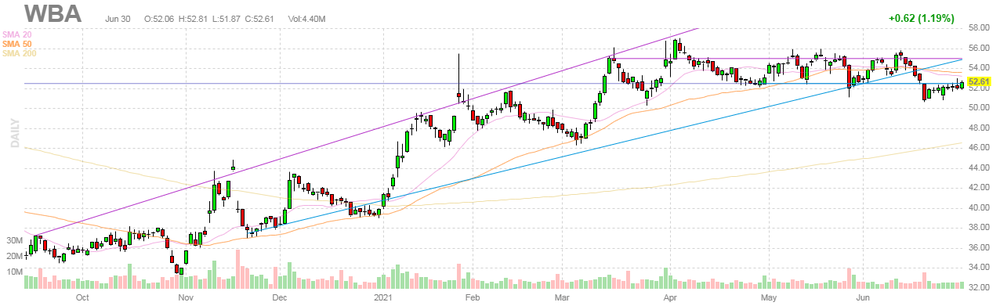
Walgreens Boots Alliance (WBA) reported Q3 FY 2021 earnings of $1.51 per share (versus $0.83 per share in Q3 FY 2020), beating analysts’ consensus estimate of $1.15 per share.
The company’s quarterly revenues amounted to $34.030 bln (+12.1% y/y), beating analysts’ consensus estimate of $33.472 bln.
The company also issued upside guidance for FY 2021, projecting EPS of ~10% y/y growth to ~$5.05 versus analysts’ consensus estimate of $4.75.
WBA rose to $54.20 (+3.02%) in pre-market trading.
FXStreet reports that strength in the Canadian dollar was part of the view of analysts at Credit Suisse set for Q2 and remains so in Q3. The USD/CAD target is set at the 1.2150 level.
“We raise our USD/CAD target from 1.1920 to 1.2150. CAD remains a pro-cyclical play on US growth and energy prices: we expect a more domestic-driven story in Q3.”
“While the data validates the supportive US momentum story, covid vaccinations are proceeding at the fastest pace in G10. With restrictions still in place across Canada, re-opening prospects point to a possible Q3 acceleration in domestic demand.”
“Rates markets are pricing in a slightly earlier rate hike (Q2 ‘22) compared to BoC guidance (H2 ‘22), but overall expectations seem far from stretched. This should keep the 2-year interest rate differential vs the US firmly in favour of CAD.”
- This may not be the case in future if inflation expectations exceed ECB's target on sustained basis
- EU must consider how to allow all member states to issue safe debt to stabilise their economies
- Discussion on the reform of stability pact is ideal opportunity to do this
- Expects European Commission to hike its growth forecast for Italy and EU as whole
FXStreet reports that UOB Group’s FX Strategists notes that USD/CNH is still seen within the 6.4300-6.4900 range in the next weeks.
24-hour view: “Despite the quiet price actions, we continue to see chance for USD to edge higher but a sustained rise above 6.4780 appears unlikely. Support is at 6.4600 followed by 6.4550.”
Next 1-3 weeks: “USD traded in a quiet manner the past couple of days and our update from Monday (28 Jun, spot at 6.4605) still stands. As highlighted, USD expected to trade sideways, likely within a 6.4300/6.4900 range.”
According to the report, OPEC+ deal is likely to include monthly oil production increases of less than 0.5 mln bpd until December 2021.
Micron Technology (MU) reported Q3 FY 2021 earnings of $1.88 per share (versus $0.82 per share in Q3 FY 2020), beating analysts’ consensus estimate of $1.71 per share.
The company’s quarterly revenues amounted to $7.422 bln (+36.5% y/y), beating analysts’ consensus estimate of $7.258 bln.
The company also issued upside guidance for Q4 FY 2021, projecting EPS of $2.20-$2.40 versus analysts’ consensus estimate of $2.15 and revenues of $8.0-$8.4 bln versus analysts’ consensus estimate of $7.89 bln.
MU fell to $82.75 (-2.62%) in pre-market trading.

FXStreet reports that slow vaccine rollout and ongoing policy resistance to market pressure instead leave the Credit Suisse analyst team neutral on the kiwi despite strong commodity prices.
“We are neutral NZD/USD, with a 0.6850-0.7215 target range for Q3 (prev. 0.6925-0.7215).”
“A large upside surprise in Q1 Kiwi GDP shows that New Zealand has rebounded faster than Australia. Nevertheless, border closures continue to be a concern for growth prospects. The travel bubble with Australia has had limited success in normalizing inbound travel.”
“The country’s vaccine rollout lags all G10 economies, a particularly serious issue for NZ’s tourism dependent economy.”
“Markets expect the RBNZ to hike by Q1 2022, ahead of all other G10 CBs (other than the Norges Bank). This creates a high bar for the RBNZ to deliver a hawkish message at the 18 Aug meeting. The RBNZ’s flexible LSAP program has allowed it to slowly taper asset purchases. The bank, however, flagged tapering as due to a smaller issuance plan, rather than as a reduction of stimulus.”
FXStreet reports that economists at Westpac said that a strong USD and likely ongoing covid cases point to a slip towards 0.7400/25 on the AUD/USD pair.
“The RBA itself has made sure that Tuesday’s meeting is one of the most significant of the post-pandemic years, by choosing July rather than August to make the decision on 3-year yield target and the $100bn QE program which concludes in September. Moreover, 90 minutes after the statement, Governor Lowe will deliver ‘remarks’ to elaborate on the decision.”
“Since the June meeting, the RBA’s changing tone and key events such as Australia’s booming May jobs data and the Fed’s step towards tapering QE have seen consensus solidify on no extension of the 0.1% bond target, plus an extension of QE but more likely a weekly pace that is easier to trim than a lumpy $100bn total. So A$ reaction to the decision is hard to judge. Australia’s trade position remains extremely strong. This keeps our fair value estimate near 0.85, but near term a strong US$ and likely ongoing CoVID-19 cases point to a slip towards 0.7400/25.”
CNBC reports that a group of some of the world’s most powerful oil producers will meet on Thursday to decide the next phase of their production policy.
OPEC and non-OPEC partners, an energy alliance often referred to as OPEC+, will convene via videoconference at 2 p.m. London time.
The meeting comes at a time when OPEC+ is relatively upbeat about improved market conditions and the outlook for fuel demand growth following a sharp rebound in oil prices over the first six months of the year.
Analysts say the most probable outcome is for an increase of around 500,000 barrels per day in August.
Chris Midgley, global head of analytics at S&P Global Platts, told that OPEC kingpin Saudi Arabia would likely maintain a “cautious” approach to production policy. This is because Riyadh would prefer to see global demand increase before adding supply and remains concerned about when Iranian oil could return to the market, he said.
“OPEC is treading a tight rope to sustain more attractive prices without hurting consumer confidence while not adding too much supply ahead of the weaker Autumn shoulder period for demand,” Midgley said.
According to the report from Eurostat, in May 2021, the euro area seasonally-adjusted unemployment rate was 7.9%, down from 8.1% in April 2021 and up from 7.5% in May 2020. Economists had expected a decrease to 8.0%. The EU unemployment rate was 7.3% in May 2021, down from 7.4% in April 2021 and up from 6.9% in May 2020.
Eurostat estimates that 15.278 million men and women in the EU, of whom 12.792 million in the euro area, were unemployed in May 2021. Compared with April 2021, the number of persons unemployed decreased by 382 000 in the EU and by 306 000 in the euro area. Compared with May 2020, unemployment rose by 949 000 in the EU and by 803 000 million in the euro area.
In May 2021, 2.979 million young persons (under 25) were unemployed in the EU, of whom 2.403 million were in the euro area. In May 2021, the youth unemployment rate was 17.3% in the EU and 17.5% in the euro area, down from 18.2% and 18.4% respectively in the previous month. Compared with April 2021, youth unemployment decreased by 174 000 in the EU and by 138 000 in the euro area. Compared with May 2020, youth unemployment increased by 119 000 in the EU and by 70 000 in the euro area.
Reuters reports that European Central Bank President Christine Lagarde said that the euro zone economy may well avoid the most pessimistic scenario envisaged at the start of the COVID-19 pandemic but it still faces risks from virus mutations.
"The improved economic outlook on the back of rapid progress in vaccination campaigns has reduced the probability of severe scenarios," Lagarde told the European Parliament.
"Of course, the nascent recovery still faces uncertainty also due to the spread of virus mutations."
She was speaking in her role as the chair of the European Systemic Risk Board, the European Union's financial stability watchdog.
In its annual report published on Thursday, the ESRB said the EU's most indebted states could ill afford a surge in yields after borrowing massively to finance their responses to the pandemic.
According to the report from IHS Markit/CIPS, manufacturing remained in a strong growth phase in June, with rates of expansion in output, new orders and employment among the best seen during the near 30-year survey history. Industry was still beset by supply-chain and distribution difficulties, however, leading to longer vendor lead times and disruption to production schedules.
The seasonally adjusted PMI dipped slightly to 63.9 in June, down from May's record high of 65.6. The PMI has signalled an improvement for 13 successive months. Manufacturing production increased at marked rates across the consumer, intermediate and investment goods industries during June. Growth was supported by strong intakes of new business, which rose at a rate close to May's record high.
Improved demand was linked to the ongoing easing of COVID-19 restrictions, re-opening of the economy from lockdown and improving global market conditions. New export orders increased again, reflecting inflows of new work from mainland Europe, the US and Asia. The strong upswing in global market conditions combined with constraints introduced to combat the COVID-19 pandemic continued to result in considerable supply-chain and price inflationary pressures in June.
Average input costs rose at the fastest pace in the survey history, with over three-quarters (77%) of manufacturers reporting an increase. A wide range of raw materials were up in price, including chemicals, electronics, energy, food products, metals, plastics and timber. Cost pressures were exacerbated by demand outstripping supply, logistic delays and raw material shortages.
Employment rose at a rate close to May's record high during June. Jobs growth reflected capacity issues – highlighted by near-record accumulation of work backlogs – and optimism among manufacturers. Almost 63% of companies expect production to rise over the coming year, reflecting reduced uncertainty regarding COVID 19 and Brexit and improving global market conditions.
According to the report from IHS Markit, growth of the eurozone manufacturing sector hit new heights during June, with the headline PMI setting a fresh survey record for a fourth successive month.
After accounting for seasonal factors, the PMI improved to 63.4, up from 63.1 in May and firmer than the earlier flash reading. June marked a twelfth successive month that the index has posted above the 50.0 no-change mark that separates growth from contraction.
Once again, all three market groups registered noticeable improvements in operating conditions. In line with recent trends, it was investment goods producers that recorded the strongest growth, followed by intermediate goods which registered its best PMI reading in the survey history. Consumer goods continued to lag, though growth here was still the sharpest since June 2000.
Overall production growth in the eurozone’s manufacturing sector remained elevated during June, edging up slightly since May to a level close to the survey records registered earlier in the year. Output continued to increase at especially strong rates in both Germany and the Netherlands. Strong growth in production was again closely linked to positive demand developments, with new orders experiencing their third-fastest ever reported increase during June. Growth remains broad-based, with new export orders again increasing sharply over the
month.
Manufacturers struggled to meet higher sales in June, as evidenced by a near series record increase in backlogs of work. Moreover, supply-side constraints again placed some restrictions on production, as strong global demand continued to weigh heavily on suppliers. Average lead times deteriorated to the second-greatest degree in the survey history during June (surpassed only by May).
Finally, confidence about future output edged higher in June reaching a level that was close to April’s survey record. Manufacturers remain optimistic that the continued reopening of economies as the negative effects of the pandemic recede will bolster output and sales in the next year.
| Time | Country | Event | Period | Previous value | Forecast | Actual |
|---|---|---|---|---|---|---|
| 00:30 | Japan | Manufacturing PMI | June | 53 | 52.4 | |
| 01:30 | Australia | Trade Balance | May | 8.157 | 10 | 9.681 |
| 01:45 | China | Markit/Caixin Manufacturing PMI | June | 52 | 51.8 | 51.3 |
| 06:00 | Germany | Retail sales, real adjusted | May | -6.8% | 5% | 4.2% |
| 06:00 | Germany | Retail sales, real unadjusted, y/y | May | 5.1% | -2.4% | |
| 06:30 | Switzerland | Retail Sales (MoM) | May | -2.9% | -1.8% | |
| 06:30 | Switzerland | Retail Sales Y/Y | May | 37.7% | 2.8% | |
| 06:30 | Switzerland | Consumer Price Index (YoY) | June | 0.6% | 0.7% | 0.6% |
| 06:30 | Switzerland | Consumer Price Index (MoM) | June | 0.3% | 0.2% | 0.1% |
| 07:00 | Eurozone | ECB President Lagarde Speaks |
During today's Asian trading, the US dollar was almost unchanged against the major currencies. Risk appetite in global markets has decreased recently amid the spread of the COVID-19 "delta" strain, which supports the dollar and other "safe haven" assets.
There is still optimism that vaccination will cope with the new strain, but a number of regions of the world, including Asian countries, need much faster progress in vaccination to contain the spread of the coronavirus. If the rate of vaccination does not accelerate, new quarantine measures may be required, which will slow down the pace of economic recovery.
The market's focus this week is on US unemployment data for June, which will be released on Friday. Analysts expect an increase in the number of jobs in June by 706 thousand and a decrease in unemployment to 5.6% from 5.8% in May.
Data on the labor market are key for the policy of the Federal Reserve System, along with inflation indicators. The dynamics of employment will largely depend on when the Federal Reserve will begin to curtail large-scale stimulus measures introduced at the peak of the coronavirus pandemic.
The ICE index, which tracks the dynamics of the dollar against six currencies (euro, swiss franc, yen, canadian dollar, pound sterling and swedish krona), rose by 0.03%.
Reuters reports that according to data from China Index Academy, growth in China's new home prices remained largely steady in June, with momentum slowed by government curbs on rampant borrowing and caps on prices of housing projects in some cities.
New home prices in 100 cities rose 0.36% in June from a month earlier, up slightly from 0.34% growth in May.
Fewer cities reported monthly gains, with the number down to 77 in June from 80 in May, while 20 cities posted lower home prices compared with 17 in the preceding month.
Prices of resale homes grew 0.49% in June from the previous month, marginally slowing from May's 0.5% increase.
China implemented a raft of broad measures to rein in the red-hot property market this year, including caps on home prices set by developers.
Many banks in cities including Shanghai and Guangzhou also face tight quotas for mortgage lending as the central bank limits loans to the property sector, local media reported.
EUR/USD
Resistance levels (open interest**, contracts)
$1.2006 (964)
$1.1964 (1994)
$1.1929 (581)
Price at time of writing this review: $1.1842
Support levels (open interest**, contracts):
$1.1812 (592)
$1.1780 (733)
$1.1740 (638)

Comments:
- Overall open interest on the CALL options and PUT options with the expiration date June, 30 is 53127 contracts (according to data from July, 9) with the maximum number of contracts with strike price $1,2050 (5829);
GBP/USD
$1.4102 (326)
$1.4007 (1363)
$1.3922 (309)
Price at time of writing this review: $1.3816
Support levels (open interest**, contracts):
$1.3767 (1296)
$1.3744 (858)
$1.3714 (559)

Comments:
- Overall open interest on the CALL options with the expiration date July, 9 is 16028 contracts, with the maximum number of contracts with strike price $1,4500 (3570);
- Overall open interest on the PUT options with the expiration date July, 9 is 18168 contracts, with the maximum number of contracts with strike price $1,4000 (2931);
- The ratio of PUT/CALL was 1.13 versus 1.11 from the previous trading day according to data from June, 30

* - The Chicago Mercantile Exchange bulletin (CME) is used for the calculation.
** - Open interest takes into account the total number of option contracts that are open at the moment.
The Federal Statistical Office said that the consumer price index (CPI) increased by 0.1% in June 2021 compared with the previous month, reaching 101.1 points (December 2020 = 100). Economists had expected a 0.2% increase. Inflation was +0.6% compared with the same month of the previous year. Economists had expected a 0.7% increase.
The 0.1% increase compared with the previous month is due to several factors including rising prices for fruiting vegetables. International package holidays also recorded a price increase, as did heating oil. In contrast, prices for stone fruits and air transport decreased.
In June 2021, the Swiss Harmonised Index of Consumer Prices (HICP) stood at 101.00 points (base 2015 = 100). This corresponds to a rate of change of 0.0% compared with the previous month and of +0.5% compared with the same month the previous year. The HICP is a supplementary indicator for inflation based on a harmonised method across EU member countries. It enables inflation in Switzerland to be compared with that of European countries.
According to provisional results of the Federal Statistical Office (Destatis), the real (price-adjusted) turnover of all retail enterprises in Germany was 4.2% higher and the nominal (not price-adjusted) turnover was 4.5% higher, on a calendar and seasonally adjusted basis, in May 2021 than in April 2021. This development is probably due to the declining coronavirus incidence in all of Germany and, consequently, the easing of restrictions provided for by the federal emergency brake. Economists had expected a 0.3% increase in the real (price-adjusted) turnover.
Compared to the pre - crisis month of February 2020, sales in May 2021 were 3.9% higher in real terms on a calendar and seasonally adjusted basis. Compared to the same month of the previous year, May 2020, retail sales fell by 2.4% in real terms and by 0.6% in nominal terms in May 2021. However, with 23 sales days, May 2021 had one less sales day than May 2020.
In May 2021, the retail trade in food, beverages and tobacco rose by 3.4% in real terms, adjusted for calendar and seasonal effects, compared with April 2021. Sales in supermarkets and hypermarkets were 2.6% higher than in the previous month. Specialist retail trade in food products (e.g. fruit and vegetables, meat, baked goods or beverages) recorded an increase of 5.0% in the corresponding comparison.
There were significant increases in the retail trade with non-food products. Real sales in May 2021 were 6.7% higher on a calendar and seasonally adjusted basis than in the previous month. The retail trade in textiles, clothing, shoes and leather goods, which was particularly affected by the business closures caused by the Federal Emergency Brake, recorded an increase in sales of 72.1% compared with April 2021, while the retail trade in goods of various types (for example, department stores and department stores) recorded an increase of 15.3 %. Similarly, sales in the trade in furnishings, household appliances and building supplies were 9.6% higher.
| Raw materials | Closed | Change, % |
|---|---|---|
| Brent | 75.12 | -0.07 |
| Silver | 26.1 | 1.26 |
| Gold | 1769.428 | 0.42 |
| Palladium | 2775.84 | 3.76 |
| Time | Country | Event | Period | Previous value | Forecast |
|---|---|---|---|---|---|
| 00:30 (GMT) | Japan | Manufacturing PMI | June | 53 | |
| 01:30 (GMT) | Australia | Trade Balance | May | 8.028 | 10 |
| 01:45 (GMT) | China | Markit/Caixin Manufacturing PMI | June | 52 | 51.8 |
| 06:00 (GMT) | United Kingdom | Nationwide house price index, y/y | June | 10.9% | |
| 06:00 (GMT) | United Kingdom | Nationwide house price index | June | 1.8% | |
| 06:00 (GMT) | Germany | Retail sales, real adjusted | May | -5.5% | 5% |
| 06:00 (GMT) | Germany | Retail sales, real unadjusted, y/y | May | 4.4% | |
| 06:30 (GMT) | Switzerland | Retail Sales (MoM) | May | -4.4% | |
| 06:30 (GMT) | Switzerland | Retail Sales Y/Y | May | 35.7% | |
| 06:30 (GMT) | Switzerland | Consumer Price Index (YoY) | June | 0.6% | 0.7% |
| 06:30 (GMT) | Switzerland | Consumer Price Index (MoM) | June | 0.3% | 0.2% |
| 07:00 (GMT) | Eurozone | ECB President Lagarde Speaks | |||
| 07:30 (GMT) | Switzerland | Manufacturing PMI | June | 69.9 | 69.7 |
| 07:50 (GMT) | France | Manufacturing PMI | June | 59.4 | 58.6 |
| 07:55 (GMT) | Germany | Manufacturing PMI | June | 64.4 | 64.9 |
| 08:00 (GMT) | Eurozone | Manufacturing PMI | June | 63.1 | 63.1 |
| 08:00 (GMT) | United Kingdom | BOE Gov Bailey Speaks | |||
| 08:30 (GMT) | United Kingdom | Purchasing Manager Index Manufacturing | June | 65.6 | 64.2 |
| 09:00 (GMT) | Eurozone | Unemployment Rate | May | 8% | 8% |
| 12:00 (GMT) | OPEC | OPEC-JMMC Meetings | |||
| 12:30 (GMT) | U.S. | Continuing Jobless Claims | June | 3390 | 3382 |
| 12:30 (GMT) | U.S. | Initial Jobless Claims | June | 411 | 393 |
| 13:45 (GMT) | U.S. | Manufacturing PMI | June | 62.1 | 62.6 |
| 14:00 (GMT) | U.S. | Construction Spending, m/m | May | 0.2% | 0.4% |
| 14:00 (GMT) | U.S. | ISM Manufacturing | June | 61.2 | 61 |
| Pare | Closed | Change, % |
|---|---|---|
| AUDUSD | 0.74983 | -0.19 |
| EURJPY | 131.69 | 0.14 |
| EURUSD | 1.18555 | -0.35 |
| GBPJPY | 153.555 | 0.39 |
| GBPUSD | 1.38236 | -0.08 |
| NZDUSD | 0.69878 | -0.02 |
| USDCAD | 1.23949 | -0.01 |
| USDCHF | 0.92452 | 0.42 |
| USDJPY | 111.07 | 0.49 |







© 2000-2026. All rights reserved.
This site is managed by Teletrade D.J. LLC 2351 LLC 2022 (Euro House, Richmond Hill Road, Kingstown, VC0100, St. Vincent and the Grenadines).
The information on this website is for informational purposes only and does not constitute any investment advice.
The company does not serve or provide services to customers who are residents of the US, Canada, Iran, The Democratic People's Republic of Korea, Yemen and FATF blacklisted countries.
Making transactions on financial markets with marginal financial instruments opens up wide possibilities and allows investors who are willing to take risks to earn high profits, carrying a potentially high risk of losses at the same time. Therefore you should responsibly approach the issue of choosing the appropriate investment strategy, taking the available resources into account, before starting trading.
Use of the information: full or partial use of materials from this website must always be referenced to TeleTrade as the source of information. Use of the materials on the Internet must be accompanied by a hyperlink to teletrade.org. Automatic import of materials and information from this website is prohibited.
Please contact our PR department if you have any questions or need assistance at pr@teletrade.global.


 Bank
Bank transfers


